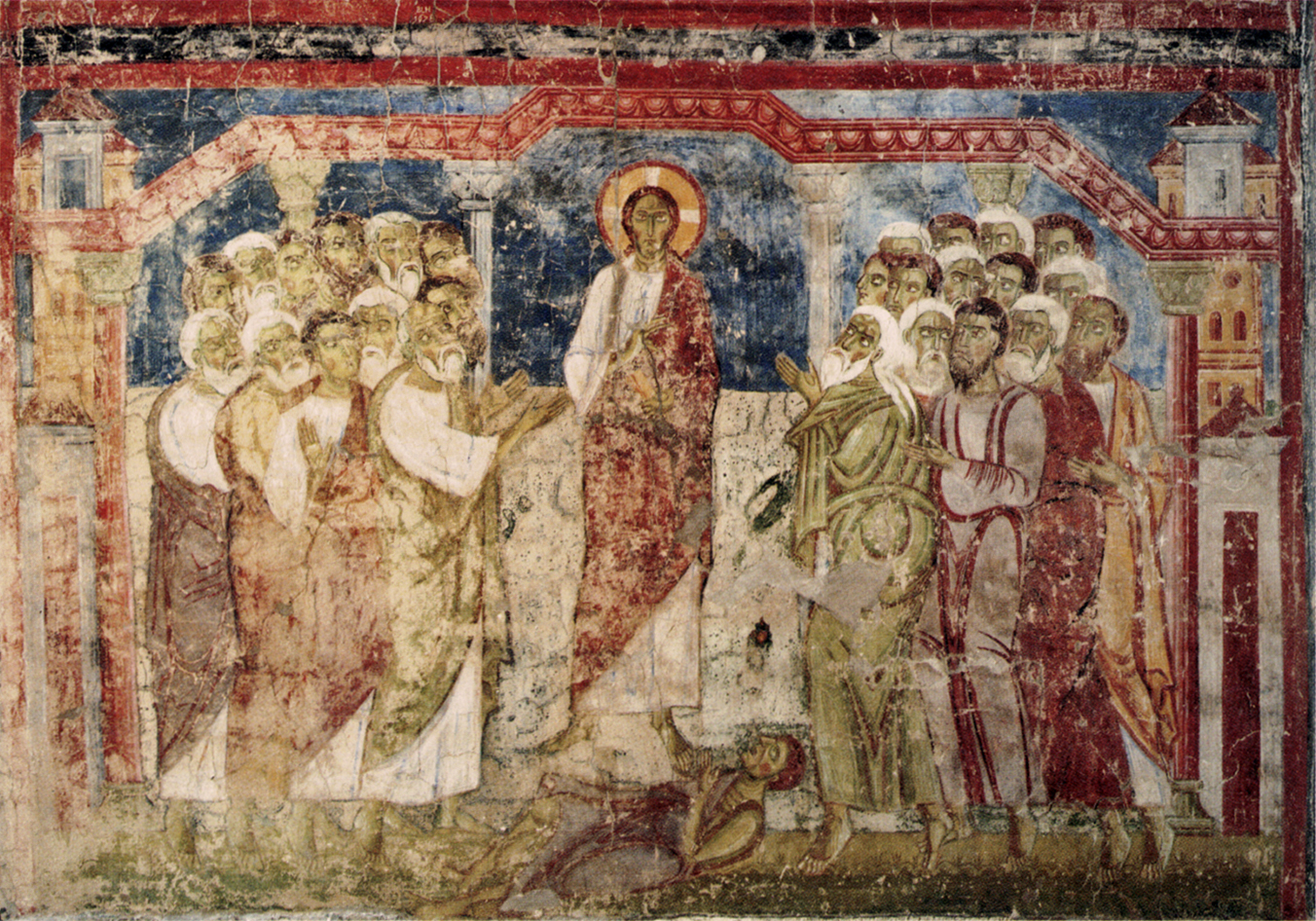
Pentecost

For most people up to 1965, Pentecost, or Whitsunday, was probably associated with gifts: new clothes, a Bank Holiday on Whitmonday, and trips, picnics, and ice-cream. The bank holiday was moved to the last Monday in May, and there it has stayed. While Pentecost is with Christmas and Easter one of the three major feasts of the Christian Year, its roots are older.

Fifty days after the Passover, the Jews celebrated Shavuot, the Feast of Weeks, a week of weeks, the grain harvest in Ancient Israel, and the giving of the law to Moses on Mt Sinai, it was an important festival, and Jews would gather in Jerusalem to celebrate the Law, which defined them as Jews, and regulated how they lived their lives. They would offer their first fruits in the Temple, rather like our harvest festival, and read the Book of Ruth, whose story is centred around harvest time.

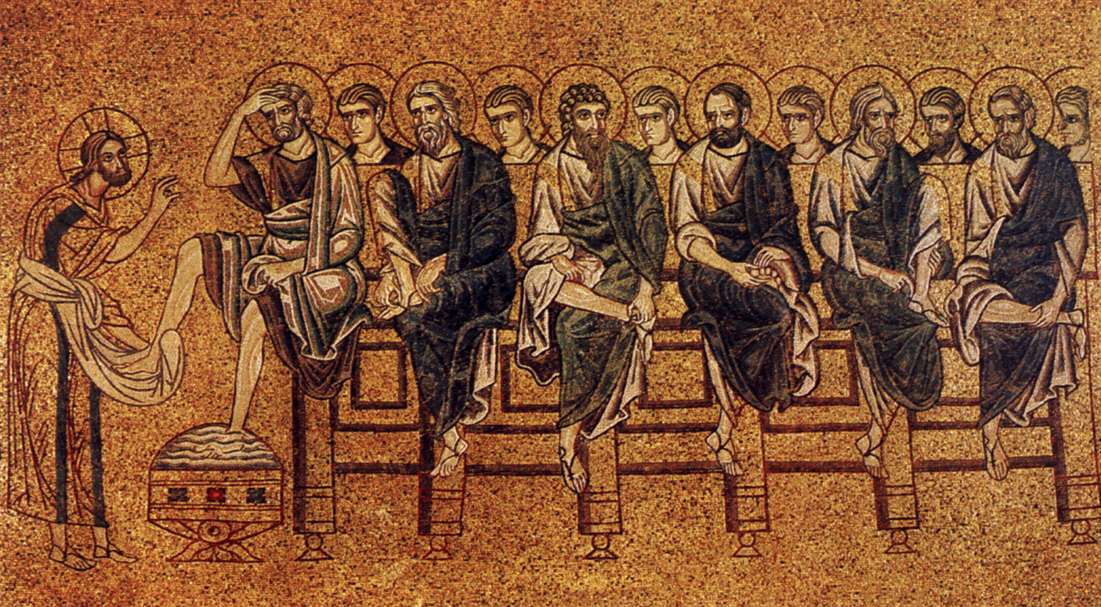
The disciples have gathered in the Upper Room, with the Blessed Virgin Mary, where Christ instituted the Eucharist, and washed his disciples’ feet. They have gathered together because Jesus told them to be together and to pray, for ‘you shall receive power when the Holy Spirit has come upon you; and you shall be my witnesses … to the end of the earth’ (Acts 1:8). They are filled with the Holy Spirit, tongues of fire rest upon them, and they speak in a variety of languages. People from all over the world, who have come to Jerusalem for the feast hear the mighty works of God, they hear a proclamation of who Jesus is, and what he has done. People think they are drunk, but it is nine o’ clock in the morning. The prophecy of Joel is fulfilled. God can and does do wonderful things. And he will still, if we let him. 

Jesus promised his disciples that he will send ‘the Spirit of truth, who proceeds from the Father, he will bear witness about me. And you will bear witness, because you have been with me from the beginning.’ (Jn 15:26-27 ESV) He also promises that, ‘When the Spirit of truth comes, he will guide you into all the truth, for he will not speak on his own authority, but whatever he hears he will speak, and he will declare to you the things that are to come. He will glorify me, for he will take what is mine and declare it to you. All that the Father has is mine; therefore I said that he will take what is mine and declare it to you.’ (Jn 16:13-15 ESV) 

We know that Jesus speaks the truth, that his promises can be trusted, that he pours his Holy Spirit upon the Church on the day of Pentecost, and continues so to do until he comes in glory as our Saviour and our Judge. He wants us to tell people about Him, and how he came to show the world LOVE.

The Apostles have obeyed Jesus’ command, they have waited and prayed, and they are filled with the Holy Spirit, so that they can proclaim the good news of the Kingdom, so that they can make Jesus known, so that people can come to know him and be filled with his love. People are amazed and perplexed, they simply cannot understand what is going on, some people assume that the disciples are drunk. Just as once people called Jesus a drunkard and a glutton because he used to hang around with the wrong sort of people. 

Instead St Peter can show that what is happening has been prophesied by the prophet Joel, whom he quotes (Acts 2:16-21) to show that Christ, the Word made flesh is the fulfilment of Scripture, it finds its true meaning in and through Him. He can preach Christ crucified and risen, for our salvation: ‘This Jesus God raised up, and of that we all are witnesses’ they have seen and can testify that Jesus is alive. “Let all the house of Israel therefore know for certain that God has made him both Lord and Christ, this Jesus whom you crucified.” (Acts 2:36) Peter and the apostles can confess their faith in Christ and bear witness to him. It has an immediate effect: (Acts 2:37) ‘Now when they heard this they were cut to the heart, and said to Peter and the rest of the apostles, “Brothers, what shall we do?”’ To which Peter replies, ‘Repent and be baptized every one of you in the name of Jesus Christ for the forgiveness of your sins, and you will receive the gift of the Holy Spirit. For the promise is for you and for your children and for all who are far off, everyone whom the Lord our God calls to himself.’ (Acts 2:38-39) 

This is what the church is called to proclaim, so that people can come and have new life in Christ. You and I are to tell people about Jesus, so that they can repent and believe. Then, later in the Acts of the Apostles we see them all living a recognisable Christian life: ‘And they devoted themselves to the apostles’ teaching and the fellowship, to the breaking of bread and the prayers.’ (Acts 2:42) 

This is what we are called to be and to do as Christians, to a life where we are close to Christ, in Word and Sacrament, so that we may be strengthened to live the life of faith, and to proclaim the Good News of Jesus Christ so that the world may believe. It is just as true here and now as it was there and then: Jesus promises his spirit to transform and empower people to tell the Good News of the Kingdom. ‘And when he comes, he will convict the world concerning sin and righteousness and judgement: concerning sin, because they do not believe in me; concerning righteousness, because I go to the Father, and you will see me no longer; concerning judgement, because the ruler of this world is judged.’ (Jn 16:8-11) Sin, that which separates us from God, and each other is tied in with not believing in Jesus, who he is, what he does. He is God, and he dies for love of us, to reconcile us, to heal our wounds. He is the true Balm of Gilead which heals sin-sick souls, and He gives himself here, under the outward forms of bread and wine, to heal us, to restore us, Righteousness: having been obedient to the will of the Father, dying and rising again, He returns from whence he came, so that He can send the Holy Spirit. Judgement: the ruler of this world has been judged, the world, the flesh and the devil can have no power over us as Christ has overcome them. They offer us death, whereas Christ has brought us life, eternal life in Heaven. God’s judgement on the world was to offer His Only Son to die, to heal its wounds, and reconcile its differences. God’s judgement is LOVE, and he calls us to live as people of love. To live out the same sacrificial redemptive love in the world, to transform it, into the world God wants it to be, where people are filled with love, and live lives of love, where they are generous and peaceful, loving and forgiving. Fed by Christ and fed with Christ we can be transformed more and more into His likeness, inviting others to share in His LOVE, so that they and all the world may know the love and sing the praise of God the Father, God the Son, and God the Holy Spirit, to whom be ascribed as is most right and just, all might, majesty, glory, dominion, and power, now and forever.
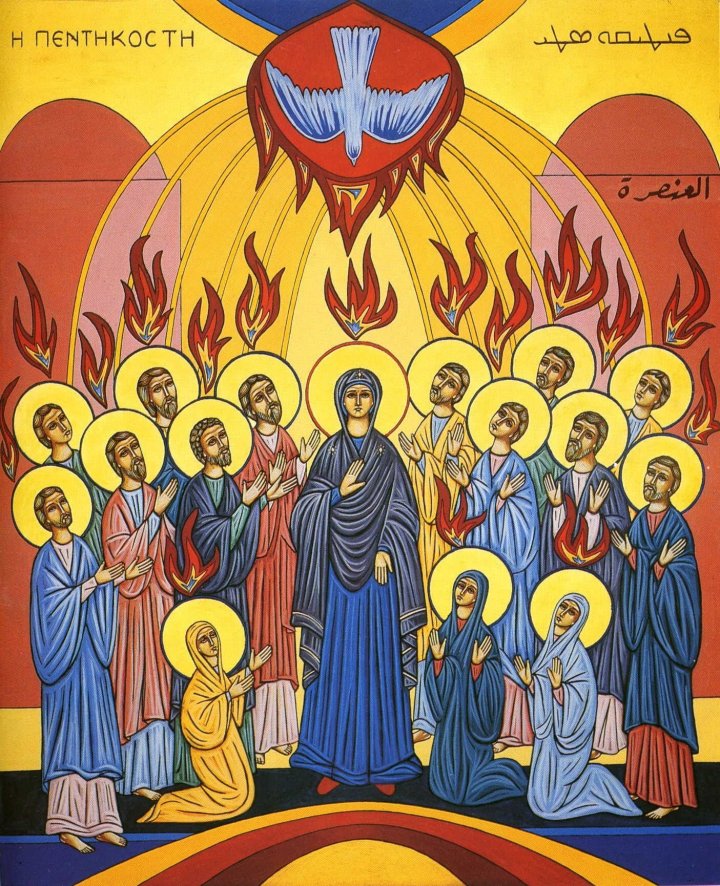
pentecost_maronite_icon

Easter VII [Acts 1:15-17, 20-26; 1 Jn 5:9-13; Jn 17:6-19]

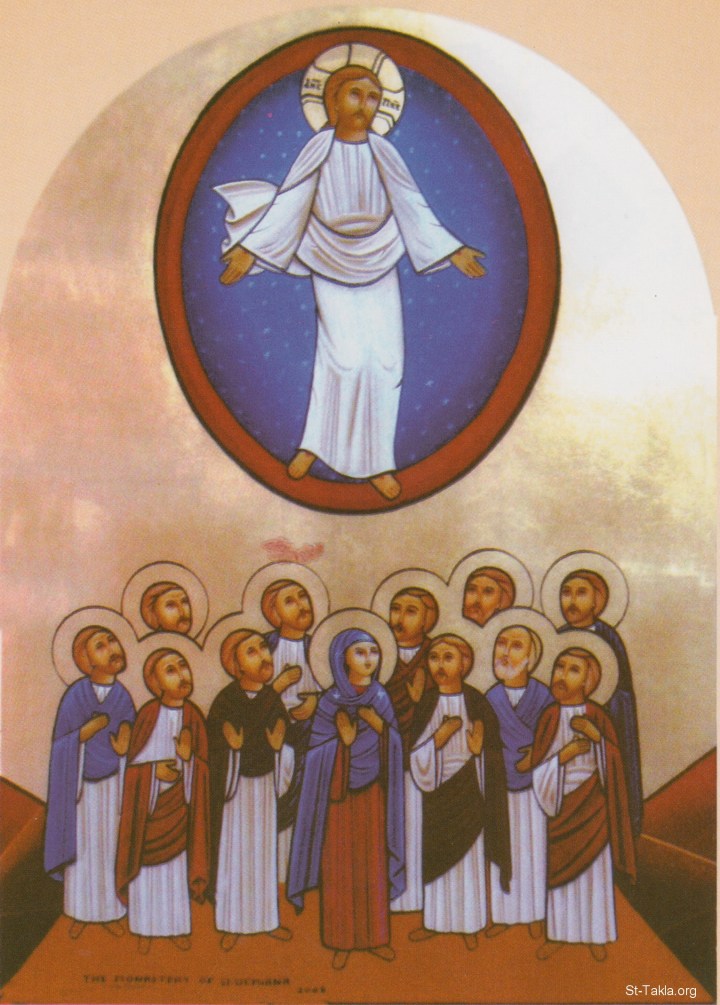
On Thursday the Church celebrated the Ascension, when the Risen Christ returns to his Father’s side in Heaven. The Apostles haven’t been left or abandoned, instead Jesus tells them to wait ten days, until the feast of Pentecost. To wait and to pray for the outpouring of God’s Holy Spirit. Jesus shows us that we are made for heaven, 

For all those of us who live after the moment of Jesus’ Ascension into Heaven, we too are called to wait, to wait for His Holy Spirit, and to wait for Him to come again as our Saviour and our Judge. But if we are honest, none of us likes waiting, let’s be honest! There’s an old joke that if you put three Scotsmen together for long enough they will form a bank, three Welshman, and they will form a male-voice choir, and three Englishmen will form a queue. While it may be a characteristic which has come to define us, as British people, we do it rather grudgingly, and with a sense of resigned reluctance. And yet, our vocations as Christians is JOY, the joy of the Lord is our strength. We wait in eager expectation, and filled with the joy of Easter, of the Risen Christ, who promises us His Holy Spirit. We wait that God might continue to be generous towards us, and all who believe in Him. 

God will give us a new heart and put his Spirit within us, just as he did on the day of Pentecost. So we in the Church are to wait to prepare to live as the people of God, filled with his love, and forgiveness, and proclaiming his Truth to the world. That’s what this time between the Ascension and Whitsun is for: to pray to God, for Him to be at work in us, and in people all around the world. Indeed there is now an initiative called ‘Thy Kingdom Come’ which encourages people to pray in this time between the Ascension and Pentecost. To pray for the outpouring of God’s Holy Spirit, that people may come to know Christ, and that we may all be one — for the unity of Christians everywhere. If heaven is our home, which it is, as we are made for relationship with God, and each other, then we should prepare, here and now, for what awaits us. We should pray that, through the outpouring of God’s Holy Spirit, we are built up in LOVE.

This Sunday in the Gospel we are in the middle of Jesus’ High Priestly Prayer, which is the summit of his teaching just before his arrest and Passion. Christ has made God’s name known to us, we know God in a different way, we pray to him as ‘Father’ and we are His, we are not our own, despite the Western Liberal infatuation with personal freedom, we are God’s, which affects both who we are, and what we do.We belong to God, and we do what He tells us to do, so that we may flourish, that we may have life and have it to the full.

We are to be one, as Jesus and His Father are one — one in mind, heart, and soul, filled with LOVE, sanctified with the truth which comes from the Holy Spirit. This is Christs’s will, it isn’t a pipe-dream, or an optional extra. We have to do it. If we really love Jesus then how can we be other than wishes us to be. The pain and division will not be healed in a moment, there is no magic wand to be waved, life is not like that. We have to start by praying, and working for unity, doing what we can to make Christ’s will for the Church a reality. 

Christ speaks to us, and teaches us so that our joy may be complete in him, filled with his love, and the Holy Spirit. The world’s reaction to this is a negative one: because what we are, what we stand for, and how we live as Christians is to be opposed to what the world around us stands for — selfishness, greed, which it makes into false gods, as though material wealth, or power, or status could save us — such things are transient and fleeting. The world seeks to offer us a short-cut, an easy road; whereas if we are following Christ, then we are walking the way of his Passion, we are walking the Way of the Cross, dying daily to sin, and letting God’s grace be at work in and through us. It is certainly not easy, it is difficult, most of us are unable to manage on our own, we need the grace of God. We need the Eucharist to strengthen us on our journey of faith, and we need the love and support of the Christian community to help us, even the first Christians, those who had been with Jesus, needed each other’s help and support, so they can continue what Jesus started.

We need to be together, to meet together to pray for our needs and those of the world, and to be nourished by the word of God, the Bible, and the Sacrament of Our Lord’s Body and Blood, not because they’re something nice to do on a Sunday morning: a sort of add-on, an optional extra that we can opt into and out of as we feel like, but because as Christians they are crucial to who and what we are, if we are to remain in the love of God then we have to live this way. Only then can we offer the world an alternative to the ways of selfishness and sin. It will certainly hate us for doing this, it will despise us, it will call us hypocrites when we fail to live up to the example of Jesus, but as Christians who live in the love of God we forgive each other our trespasses, so that we can live out that same radical love and forgiveness which sees Jesus die upon the Cross for love of us and all the world.

It is a message of such love, such forgiveness that the world cannot or does not want to understand it, we may not understand it, but we know that it can be experienced, in encounter with Jesus, and we are living testimony to its power to change lives. It turns our lives around and sets us free to live for God and to proclaim his saving truth in our words and actions, calling the world to repentance, to turn to Christ, and to be renewed in and through Him.

So as we wait with the Apostles for the gift of the Holy Spirit let us pray that God may be at work in us, building us up, and giving us strength to live his life and to proclaim his truth, to offer the world that which it most earnestly desires, a peace, a joy and a freedom which pass human understanding, and the gift of eternal life in Christ. And let us share these gifts with others, so that they may come to believe and give glory to the Father, the Son and the Holy Spirit, to whom be ascribed as is most right and just, all might, majesty, glory, dominion, and power, now and forever…

www-St-Takla-org--Damiana-Monastery-icon-Ascension

Easter VI [Acts 10:44-48, 1 Jn 5:1-6, Jn 15:9-17]

During the Easter season we spend time exploring what Baptism is, and what it means. It is a good thing to do, it is after all how we enter the Church. Also Lent is a season of preparation for baptism, which happened at Easter so that people could die with Christ, and by raised to life by Him, and with Him. For those of us baptised as infants, it isn’t something we remember, so it is good to have an opportunity to reflect on what it is, and what it means. 

In this morning’s reading from the Acts of the Apostles, Peter has been preaching the Word of God to Cornelius at Caesarea, and it has an amazing effect — they are filled with the Holy Spirit, and so Peter calls for them to be baptised. The Good News isn’t just for Jews — gentiles like Cornelius, the Roman centurion, his relatives and close friends are welcome as well — this is good news indeed. The church exists to break down human barriers, and to unite people in Christ. We are, all of us, brothers and sisters in Christ, and we enter into a new relationship with God and each other. We are called to be a family, where we find our true identity as those called into a relationship with God, and with each other in the Church. It is a relationship expressed through our communion with God and each other in the Eucharist, the central act of Christian worship, where we do what Jesus commanded us to do, and we are fed by Him, and with Him, with His Body and Blood, to have life in Him, to be nourished in our journey of faith.

In our reading from the First Letter of John we learn that faith is the foundation of love — we can love because we believe in God who loves us, and demonstrates that love in the person of His Son, Jesus Christ. We believe that He is the Messiah, the Anointed Son of God, who comes to give us life and freedom. We respond by loving Him, and keeping God’s commandments, we listen to what God says to us, and we do it, not out of fear, but out of love for Him who loves us. Through our baptism we are born again of water and the Spirit, and in this we can like Christ overcome the world 

So how do we live out this faith? We do so by living an other-worldly life — by not going along with the ways of the world: selfishness, greed, business. Instead we follow the way of radical love shown to us in Jesus Christ, a love which pours itself out in extravagant generosity, which holds nothing back, which welcomes, reconciles, and heals. We love our neighbour, we are hospitable, we care for the vulnerable. We live lives which put our faith into practice, lives filled with love of God and neighbour, which proclaim the truth of God’s Kingdom to the world, and call it to repent, to turn from the ways of selfishness and bitterness and death, to come to Christ, and have life in all its fulness. ‘By this all people will know that you are my disciples, if you have love for one another.’ (Jn 13:35) So let us joyfully live lives of love, to proclaim God’s love to the world.

In this morning’s Gospel reading, we continue Jesus’ advice to his disciples in the Upper Room on the night before He died. Those who follow Christ are called to abide in Christ’s love, to remain in it, to live and make our home there. It means being in the Church but also standing by the Cross, where Christ’s love is made manifest to the world. If we love God and each other, and lay down our lives for Him, we do so at the Cross, washed by the Blood of the Lamb, and fed by Him, and called to live lives of sacrificial love for love of Him who died for love of us. God is love, ‘love has a particular trait: far from being indulgent or fickle, it has a task or purpose to fulfil: to abide. By its nature love is enduring. Again, dear friends, we catch a further glimpse of how much the Holy Spirit offers our world: love which dispels uncertainty; love which overcomes the fear of betrayal; love which carries eternity within; the true love which draws us into a unity that abides!Pope Benedict XVI Address to World Youth Day Vigil We see that love most fully in the Eucharist where Christ continues to give Himself to us, out of love, to hear our wounds, to restore our relationship with God and each other, to give us a foretaste of heaven here and now. There is nothing on earth as precious as this, nothing more wonderful than this sign and token of God’s love for us.

From the Son’s death springs life … He, who at Cana changed water into wine, has transformed his Blood into the wine of true love and thus transforms the wine into his Blood. In the Upper Room he anticipated his death and transformed it into the gift of himself in an act of radical love. His Blood is a gift, it is love, and consequently it is the true wine that the Creator was expecting. In this way, Christ himself became the vine, and this vine always bears good fruit: the presence of his love for us which is indestructible.

These parables thus lead at the end to the mystery of the Eucharist, in which the Lord gives us the bread of life and the wine of his love and invites us to the banquet of his eternal love. We celebrate the Eucharist in the awareness that its price was the death of the Son—the sacrifice of his life that remains present in it. Every time we eat this bread and drink this cup, we proclaim the death of the Lord, until he comes, Saint Paul says (cf. 1 Cor 11:26). But we also know that from this death springs life, because Jesus transformed it into a sacrificial gesture, an act of love, thereby profoundly changing it: love has overcome death. In the Holy Eucharist, from the Cross, he draws us all to himself (cf. Jn 12:32) and makes us branches of the Vine that is Christ himself. If we abide in him, we will also bear fruit, and then from us will no longer come the vinegar of self-sufficiency, of dissatisfaction with God and his creation, but the good wine of joy in God and of love for our neighbour.The Wine of True Love 

So my brothers and sisters let us abide in Him, be nourished by Him and with Him, and bear fruit so that the world may come to believe and give glory the Father, the Son and the Holy Spirit, to whom be ascribed as is most right and just, all might, majesty, glory, dominion, and power, now and forever…

mostsacredheartofjesus-bruges

A Thought for the day from Pope Benedict XVI

Seeing God’s Love

God has made himself visible; in Jesus we are able to see the Father (cf. Jn 14:9). Indeed, god is visible in a number of ways. In the love story recounted by the Bible, he comes to us, he seeks to win our hearts, all the way to the Last Supper, to the piercing of his heart on the Cross, to his appearances after the Resurrection, and to the greta deeds by which, through the activity of the Apostles, he guided the nascent Church along its path. Nor has the Lord been absent from subsequent Church history; he encounters us ever anew in the men and women who reflect his presence, in his word, in the sacraments, and especially in the Eucharist. In the Church’s Liturgy, in her prayer, in the living community of believers, we experience the love of God, we perceive his presence, and we thus learn to recognise that presence in out daily lives. He has loved us first and he continues to do so; we too, then, can respond with love. God does not demand of us a feeling which we ourselves are incapable of producing. He loves us, he make us see and experience his love, since he has ‘first loved us’ (1 Jn 4:19), love can also blossom as a response within us.

Deus Caritas Est 17

Easter IV — The Good Shepherd [Acts 4:5-12; 1John 3:16-24; John 10:11-18]

If you ask people about Wales they will probably mention Rugby Football, Singing, and Sheep. The first two we do with great passion or hwyl, and thanks to the large amount of hills and mountains there are here, it is ideal countryside for rearing sheep. As animals go, they often don’t get a good press: they are seen as simple creatures, unable to give birth without assistance, it’s hardly flattering to be compared to sheep, and yet throughout the Bible we see references to sheep and shepherds, important for a nomadic people.

Sheep are gentle creatures, they need help and protection, so that they don’t wander off, and are protected from wolves. The relationship between God and Israel is often described as like a shepherd and his sheep. They know each other, there is a close bond between them, and they need the care and protection of a shepherd. They love company, they like to be together in a flock. Their needs are simple: grass and water. They are not violent or nasty, but they need to be cared for, and loved, and helped.

In this morning’s Gospel, Jesus says of himself, ‘I am the good shepherd. The good shepherd lays down his life for the sheep.’ (Jn 10:11 ESV) Jesus lays down His life for us. He offers it willingly, and out of love, to die, and to be crucified for us. This is the heart of our faith as Christians: Jesus loves us, Jesus dies for us, and rises again. It is simple, profound and extraordinary. God loves us this much, that he suffers the most painful, shameful, and degrading death for us, to demonstrate love in action. 

Such love requires a response from us, and John, the beloved disciple puts his finger on it in this morning’s epistle, ‘By this we know love, that he laid down his life for us, and we ought to lay down our lives for the brothers’ (1John 3:16 ESV). We lay down our lives for each other, in love and service. This is what being a Christian looks like in practice — we do the right thing, regardless of the cost. The world around us will tell us to be selfish, and self-centred, to think of ourselves before others, the ‘I’m alright Jack mentality’. It is selfish, and sinful, and wrong. We offer the world something different, sure it is costly, but it proclaims the simple truth that another way is possible, and that we march to the beat of a different tune. We can have the courage and the confidence to do this because Christ rose from the dead, and offers eternal life to those who follow Him. This life is not all that there is. We are preparing for the hope of Heaven, made possible by Christ, by living out our faith here and now. It has the power to the change the world, a soul at a time, because we ARE revolutionaries. We want people to join us, and be like Jesus. He lays down His life for us, and expects to follow His example, and lay down our lives to follow Him. It takes commitment, it isn’t just something you do in a building for an hour on a Sunday morning, it takes over your entire life. I know, for a variety of reasons. Firstly in ordination I offered my life to Jesus, for the service of his church, and secondly in last twelve months I got married, and we got a dog. Marriage and dog ownership are both lifelong commitments, and are both about learning to love, and forgive. My life is far more wonderful and richer than I could have imagined because of the commitments I have made. Yes, they are costly, but they are wonderful. To a world scared by commitment I would have to say, don’t be afraid, dive in, and have a go. You will make mistakes, but as love and forgiveness go hand in hand, through them you have the chance to change, to blossom, and become something other than you were before. This is true for the Christian faith. It offers salvation, through faith, as St Peter puts it in this morning’s reading from the Acts of the Apostles, ‘And there is salvation in no one else, for there is no other name under heaven given among men by which we must be saved.’(Acts 4:12 ESV) Jesus offers what no-one else can, salvation and eternal life to those who believe in Him, and follow Him. This truly is good news, true freedom, which the world needs to hear. No-one else can save them, money in the bank, the car you drive, the clothes you wear, they may be pleasant and useful, but they can’t save you. Only Jesus, the Good Shepherd, can do that. He still offers the chance to become bart of His flock, under the One Shepherd, to have life, and life in all its fulness, eternal life, with Him, forever. Just as the apostles testified to the healing power of His name, so that same healing is offered to all who believe and trust in Him. It’s not a magic wand, but a chance to enter into a relationship which can take away our sins, heal our souls, our bodies and our lives. 

He lays down His life for us, and He gives himself here today, under the outward forms of bread and wine, so that we can be healed by Him, and given a foretaste of heaven in His Body, and His Blood. Here today, as on a hundred thousand successive Sundays, we meet to be fed by Christ, and fed with Christ, to be healed, to know his love, love you can touch and taste. 

What more wonderful proof could we ask for than this, to feast on the Body and Blood of Him who died for us, and rose again. Who gives himself so that we might have life. Let us be filled with His Love, and His Life, let it transform us, and all the world that it may come to know Him, to trust Him, to love Him, and be fed by Him, to give praise to God the Father, God the Son, and God the Holy Spirit, to whom be ascribed as is most right and just, all might, majesty, glory dominion and power, now and forever…

06f84c08-66cf-4481-baf0-09d3f1849f7e

Good Friday

Love has three and only three intimacies: speech, vision, and touch. These three intimacies God has chosen to make his love intelligible to our poor hearts. God has spoken: he told us that he loves us: that is revelation. God has been seen: that is the incarnation. God has touched us by his grace: that is redemption. Well indeed, therefore, may he say: ‘What more could I do for my vineyard than I have done? What other proof could I give my love than to exhaust myself in the intimacies of love? What else could I do to show that my own Sacred Heart is not less generous than your own?’

If we answer these questions aright, then we will begin to repay love with love …. then we will return speech with speech which will be our prayer; vision with vision which will be our faith; touch with touch which will be our communion.

Fulton J Sheen The Eternal Galilean

Prophets have a job to do. They tell people things, usually uncomfortable home truths. It isn’t a popular job, and generally speaking prophets are not treated well. A number of them end up being killed. There is a tradition that Isaiah was sawn in half on the orders of Manasseh, the son of Hezekiah. Amos was tortured and killed, Habbakuk and Jeremiah were stoned. And John the Baptist was beheaded to satisfy the whim of Salome. Telling the truth is a risky business. When we proclaim the truth of our faith to the world around us we are met with contempt and unbelief.

The prophets look towards a future, with an anointed leader, a Messiah, the Christ. They point towards Jesus, and they like all of the Hebrew Scriptures find their fullest meaning in Jesus Christ, the Word of God made flesh. Christ is the fulfilment of Scripture – it finds its truest and fullest meaning in Him, and Him alone. The Scriptures point to something beyond themselves, to our Lord and Saviour, and it is thus understandable that tIsaiah has been called the fifth Gospel, because of his prophesies especially concerning Our Lord’s Birth, Suffering and Death.

This is not a new phenomenon; in the 8th Chapter of the Acts of the Apostles we see the meeting of Philip and an Ethiopian eunuch, who is reading this very passage which we have just heard — the Suffering Servant. Philip asks him if he can understand what he is reading. He replies that he cannot, unless someone shows him the way. ‘Then Philip opened his mouth, and beginning with this Scripture he told him the good news about Jesus.’ (Acts 8:35 ESV). Isaiah’s prophesy of the Suffering Servant is fulfilled in Jesus and this is the proclamation of the Church: we proclaim Jesus Christ and him crucified. The proclamation remains the same, as the church continues to understand Isaiah, and all the Old Testament as pointing to Christ.

We read scripture so that we can understand it, and see in its words how it discloses the truth of the Word made flesh, who suffered and died for our sake. Isaiah, in the Songs of the Suffering Servant, prophesies Our Lord’s Passion and Death. Thus it makes sense, it can be understood, and the more we come to understand, the more we come to know just how much God loves us, and how that tale of love is told through history.

Today Christ is both priest and victim, and upon the altar of the Cross he offers himself as a sacrifice for sin, for the salvation of humanity. A new covenant is made in his blood which restores the relationship between God and humanity, we are shown in the most graphic way possible how much God loves us, and thus how much we are to love God and to love each other, with that costly self-sacrificial love embodied by Our Lord in his Passion and Death.

After scourging him the soldiers put a purple robe around our Lord, they crown him with thorns, and give him a reed for a sceptre. They think they’re being clever and funny: they’re having a laugh, mocking a man about to be executed. But this is God showing the world what true kingship is: it is not pomp, or power, the ability to have one’s own way, but the Silent Way of suffering love. It shows us what God’s glory is really like: it turns our human values on their head and it inaugurates a new age, according to new values, and restores a relationship broken by human sin.

In dying on the Cross, our Lord is in fact reigning in glory — the glory of God’s free love given to restore humanity, to have new life in him. Jesus dies the death of an enemy of the state, but THIS IS GOD’S GLORY – to die in such a way, naked and vulnerable, shunned, and humiliated. This is GLORY, while the same people who a few days ago welcomed him as the Messiah, now mock and jeer and His life slips away. This is the Glory of God’s love for us, a love which will do anything to heal us, to reconcile us, to bring us back.

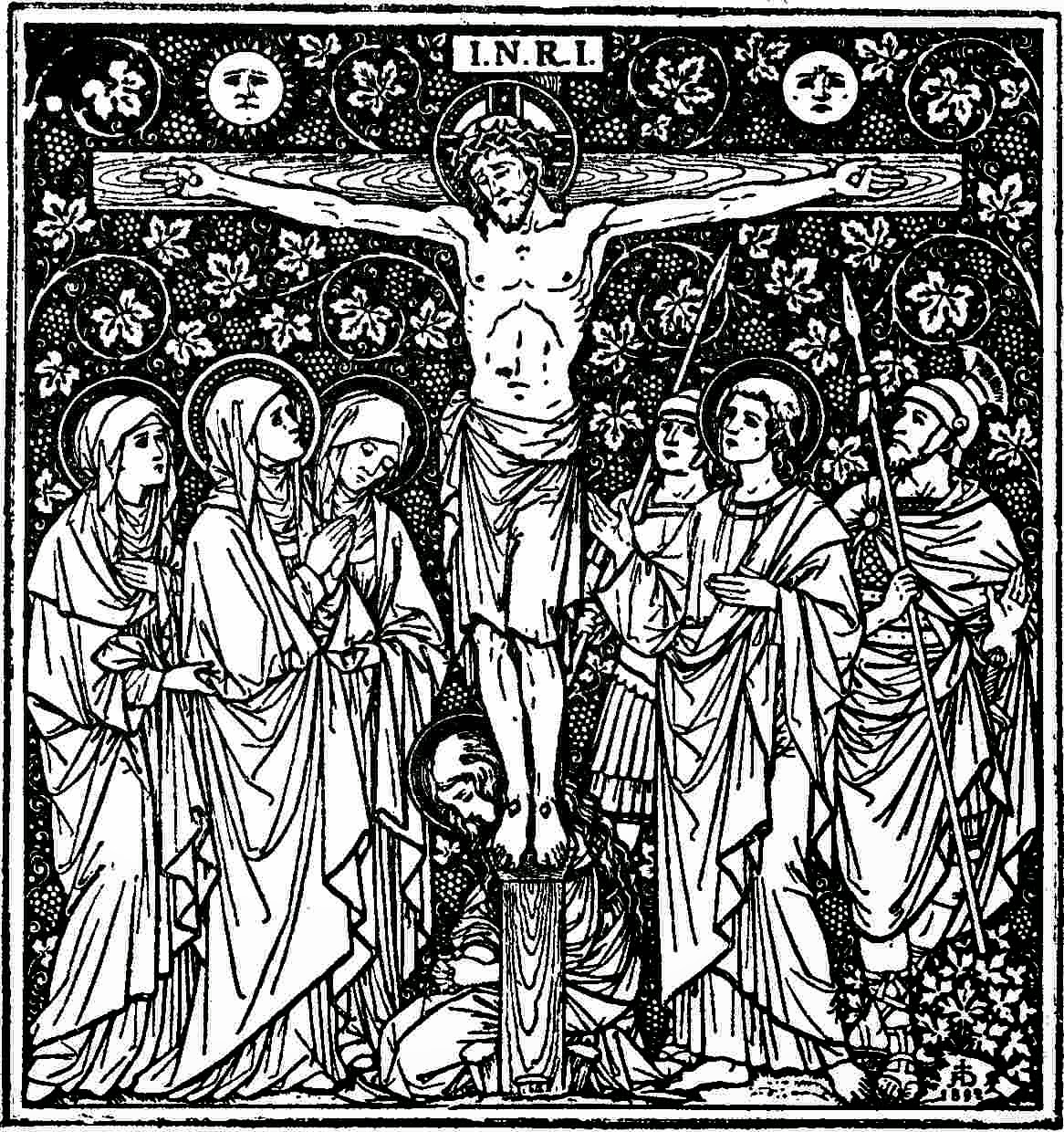
Jesus’ hands and feet and side are pierced and his head wears a crown of thorns, as wounds of love, to pour out God’s healing life upon the world. In his obedience to the Father’s will, he puts to an end the disobedience of humanity’s first parent. Here mankind who fell because of a tree are raised to new life in Christ through his hanging on the tree. Christ is a willing victim, the Lamb of God who takes away the sins of the world, the Silent lamb led to his slaughter, the Good Shepherd who lays down his life for his sheep that have gone astray. At the time when the Passover lambs are slaughtered in the temple, upon the Altar of the Cross, Christ as both priest and victim offers himself as the true lamb to take away the sins of the whole world, offers his death so that we may have life, new life in Him.

Death and hell, which are the reward of sin, have no power over us: for in dying, and being laid in a stranger’s tomb, Christ will go down to Hell, to break down its doors, to lead souls to heaven, to alter the nature of the afterlife, once and for all. Just when the devil thinks he’s won, then in his weakness and in his silence Christ overcomes the world, the flesh, and the devil. The burden of sin which separates humanity from God is carried on the wood of the Cross, upon the shoulders of the One who loves us.

On the way to Calvary our Lord falls three times such is the way, such was the burden, so we too as Christians, despite being reconciled to God by the Cross, will fall on our road too. We will continue to sin, but also we will continue to ask God for his love and mercy. But those arms which were opened on the cross will always continue to embrace the world with God’s love.

We don’t deserve it and we haven’t earned it, that’s the point, that’s what grace is, unmerited kindness, reckless generosity. It is there to help us become the people God wants us to be: to be strengthened, fed, healed, and restored by him: to die to sin and be raised to new life, and to share that life and love with others, that the world might believe and be saved through him. Christ pays the debt which we cannot to reconcile humanity to his loving and merciful Father. He shows us the meaning of true love: that we might live it out in our lives, forgiving one another, bearing our own cross, and living lives of love for love of him who died for love of us.

We should glory in the Cross of our Lord Jesus Christ, for he is our salvation, our life, and our resurrection, through him we are saved and made free.

4_1

Maundy Thursday

Tonight Jesus does many things, many things which we still do in the Church. To put it simply we do them now because He did them nearly two thousand years ago, and told us to do them. So we do; it’s plain and simple.

Preparations were being made to celebrate the Passover, Israel’s journey from slavery in Egypt to the Promised Land. Lambs were slaughtered in the Temple for the Passover, at the same time that Jesus will die tomorrow. He is the Lamb of God, who takes away the sins of the world. Tonight He gives the Church the Eucharist, the memorial of His Passion and Death, so that we, the Church, can feast on His Body, and drink His Blood, to have life in Him. For doing this we were once condemned as atheists, and cannibals, followers of strange rites. People died for doing this. It was once a risky business, and in countries around the world it still is.

But we come here to do what Jesus did, to be with Him, as His earthly ministry reaches its climax. We gather as disciples of Our Lord and Saviour Jesus Christ, to be fed by Him, and with Him. He has given us an example that we should copy. We do things as the Church, not because they’re nice, not because they make us feel good, but because Jesus told us to.

Jesus begins this evening by removing his clothes, taking water, and washing his disciples’ feet. He, the son of God, who was with His Father before the universe and time began, kneels before his disciples, and serves them. He takes the place of a slave or a servant and shows us as Christians that to follow Him is to serve. Never did a cross redeem nature from the curse: never was a lamb set upon the altar that could take away the sins of the world, until God took on the nature of the servant. We as Christians are to serve one another; we are to wash one another’s feet, to help each other to pray for each other, and not to think that any of us is better than the other.

Despite what the world may think about clergy: that we are weak, ineffectual, and well-meaning, or that we love to lord it over our flock, to stand pontificating six foot above criticism, we are in all things to fashion our life and example after Christ. In giving an example of service before the Last Supper, in praying for and setting apart his disciples as the first priests of his church, we who follow in their footsteps are shown in the clearest possible way that to love him, to care for his people is to serve them: we are to imitate the mysteries which we celebrate: offering our lives in His service and the service of His Church. It is truly extraordinary that we should have such a responsibility placed on our shoulders. We are all of us, if the truth be told, incapable of such a task if we were acting solely in our own strength and our own abilities. But through the Grace of God, and with the help of the prayers of you, God’s people, it is our hope that we may conform ourselves ever more closely to Christ, our great high priest.

Priests are amongst other things set apart for the service of God and the administration of His sacraments. At this time on this night, Jesus gives us himself, His Body and Blood to feed us, to nourish us, to strengthen us and to help us become what he is. So that we may share in the outpouring of love which is the very life of God, that we may be given a foretaste of the heavenly banquet, that we may experience something of the joy and love and life which awaits us in heaven, forever united with the triune God.

To do this Our Lord takes bread and wine, simple ordinary foodstuffs, to transform them, to make something other than they are to view them with new meaning and new life, to strengthen and heal his mystical body of the church with his own true body and blood. It is remarkable and extraordinary, words cannot fully express our awe that we poor wretched sinners, though unworthy are fed by our Lord as both priest and victim. It is not something for us to understand with our minds, but a mystery for us to enter with all our lives.

Jesus, receiving the cup, gave thanks and gave it to them saying: drink ye all of this, for this is my blood for blood of the new and everlasting covenant which will be shed for you and for many so that sins may be forgiven. This is my blood, he says, which is to be shed. The blood shed and this blood are not two different things, but one and the same. Tomorrow it shall be shed from my side, tonight you drink it and behold it in the cup.

We here, tonight, have come together as the people of God, to be fed by God to be strengthened by him, to live lives in his service. Both tonight and tomorrow, we will see how God loves us. In his service, in his giving of himself to be taken, beaten, falsely accused, scourged and crucified, God shows us what true love, true glory, and true service are. The world cannot understand this: it goes against everything people are told about putting themselves and their lives first, to judge their importance or worth by what they own, rather than how they live their lives. And yet this world is wounded by sin, the image of God is marred. In its selfish searching, what it truly wants and needs is to be healed, to be embraced by a loving God. That is why it tomorrow on the cross our Lord’s Arms will be flung wide open to embrace the world with God’s love.

Let us then prepare ourselves, let us have our feet washed by Christ, let us be fed by him, with him, strengthened by him, to fashion our lives after his. Let us prepare to go to Calvary with him, laying down our lives in his service, picking up our Cross and following him, to death and beyond, to the new life of Easter. Let us live his risen life, and share our joy with others, that the world may believe and trust in God the Father, God the Son, and God the Holy Spirit, to whom be ascribed as is most right and just all might, majesty, glory, dominion and power, now, and forever…

e726c-christ_washing
Rembrandt Christ washing the disciples’ feet, (c.1645)  Rijksmuseum, Amsterdam

Palm Sunday 2018

If anyone asks you why you are untying it [the ass the disciples were sent to find], this must be your answer, ‘The Lord has need of it’ (Lk 19:31). Perhaps no greater paradox was ever written than this: on the one hand the sovereignty of the Lord, and on the other hand his ‘need’. His combination of Divinity and dependence, of possession and poverty was a consequence of the Word becoming flesh. Truly, he who was rich became poor for our sakes, that we might become rich. Our Lord borrowed a boat from a fisherman from which to preach; he borrowed barley loaves and fishes from a boy to feed a multitude; he borrowed a grave from which he would rise; and now he borrows an ass on which to enter Jerusalem. Sometimes God pre-empts and requisitions the things of man, as if to remind him that everything is a gift from him.

Fulton J. Sheen Life of Christ

Today seems like a triumph. Jerusalem is celebrating: the people treat Jesus’ entry into Jerusalem as the triumphal entry of the Messiah. People lay down their clothes and wave palm branches The crowd cry out ‘Hosanna to the Son of David! Blessèd is he who comes in the name of the Lord! Hosanna in the highest!’ (Mt 21:9 ESV) They cry out for God to save them, and that is exactly what he will do in a few days time, upon the Cross. This is a God who keeps his promises and who also defies our expectations. The crowd in Jerusalem is expecting a king of the Davidic line. One who would be seen as a challenge to the ruling élite, the status quo. But in Christ God gives Israel something else: a King of the line of David, yes, but one who rules with love, who has no desire for power, or honour. Those who have power are threatened by him: he turns their world on its head, he is awkward, an inconvenience. Jesus does not want their power, as he has come to be and do something completely different: what is taken as a political coup is in fact a renewal of religion, the fulfilment of prophecy, and a new hope for Israel.

In riding into Jerusalem Jesus is fulfilling the prophecies of Zechariah (9:9) and Isaiah (62:11). The King of Israel comes riding on a donkey: a humble beast of burden, which carried his Mother to Bethlehem for his birth, and carried the Holy Family into exile in Egypt. It is an act of humble leadership which fulfils what was foreseen by the prophets. It shows us that Jesus Christ is truly the one who fulfils the hopes of Israel. The Hebrew Scriptures look forward to the deliverance of Israel, which is enacted in front of their very eyes. God is saving His people, but they cannot see it. In a few days time it will all have changed, love will turn to hatred; joy to sadness.

This is why today and throughout Holy Week we will have readings from the prophet Isaiah, which are known as the Songs of the Suffering Servant. This morning we see the servant being mistreated, he is struck on the back, his beard is torn out, he is spat at and insulted. This will all come to pass as Our Lord goes to the Cross on Good Friday, it is the fulfilment of prophecy. God will show us how much he loves us by enduring such treatment.It shows US what humanity is capable of: anger, hatred, bitterness, mob rule, the desire to have a scapegoat, someone to blame. This is fallen, sinful humanity at its worst, and we will see more of it over the coming days. It should shock us, we should feel sick to the pits of our stomachs, because it shows us why Christ had to die – to take our human sin, to overcome sin, the world, and the Devil will the redemptive power of God’s LOVE.

And so it begins: a week when Our Lord and Saviour makes a triumphal entry into Jerusalem. He is hailed as the Messiah, it is a cause for celebration and joy. It is a week which will see Him betrayed by a close friend, arrested,  abandoned, tried and killed as a common criminal. Strangely enough, the world around us can still be just as fickle, just as quick to turn someone from hero into pariah. Lest we think that somehow we’re better, more advanced, more civilised, as though we’ve learned our lesson. The plain unvarnished truth is that we’re not. We need the annual reminder which the church gives through its liturgical year – a chance to be confronted by stark realities, and to be brought up short by them. What Christ says and does in this coming week He says to us, he does all this for us – to HEAL us, to RESTORE us, so that we can live His risen life HERE and NOW, as the people of God, fed by Him, fed with Him, sharing in His Death and Resurrection though our baptism, trusting in Him.

In our pilgrimage through Lent, through our prayer, our fasting, we hope to increase our closeness to Christ, so that following Him, and meditating upon His Passion, we may be transformed by His love, following in His footsteps, entering into the mystery of God’s LOVE poured out on the world. In the next few days we will go to the Upper Room, to have our feet washed, we watch and wait with Christ, we walk the way of the Cross, we gaze upon Christ crucified to see just how much God in Christ loves us – the lengths to which God will go to demonstrate that love, and make it a reality in our lives. Let us prepare to celebrate Easter: Our Lord’s rising from the tomb, His conquering death, so that we may have new life in Him.

In his Letter to the Christians in Philippi, written in prison in Rome in AD62, St Paul lays great stress upon the Humility of Jesus Christ. It is not a popular virtue these days, in fact the world around us would have us be quite the opposite: full of ourselves, with a high opinion of ourselves. Our is a world which is more and more characterised by sin and selfishness. The individual is all that matters: me and what I want, that’s what counts. At the root of it all is pride, thinking that we are more important than we are, making ourselves the centre of things, whereas we need to put God at the centre of things, and learn to be thankful.

Gratitude is characteristic only of the humble. The egotistic are so impressed by their own importance that they take everything given them as if it were their due. They have no room in their hearts for recollection of the undeserved favours they have received.

Fulton Sheen On Being Human 1982: 325

We need to have the mind of Christ, a mind devoted to love and service of God. Christ doesn’t just do what he wants to, but everything he says and does is the will of God the Father. It is a mind which lays down his life bearing the sins of all humanity, past, present , and future, out of love. This is humility and obedience in action: embracing the most shameful death possible, for love of us. Thus we should love Jesus, we should worship Him, because He is God, and He loves us. It is extraordinary, it goes against everything that we think about God, that scorning majesty, He embraces shame and sin, total utter degradation to save us. The Saviour of the World will suffer and die, and rise again, for us. This is why we are thankful — because God in Christ Jesus has done this for us, poor sinful humanity, to save us from ourselves, to save us from the Hell which we deserve, and to show us that God loves us, and longs to reconcile us to Himself and each other. He des this to heal the wounds of sin and division, so that we might have life, and life in all its fulness, with Him, for ever.  This is why Jesus is willing to suffer, to be vulnerable, to take our human frailty and to redeem it through His suffering, through His vulnerability, to show the World that God’s ways are different from ours, and that this is the only way to sort out our problems, through what Jesus does, and who He is. This is the example for us to follow — the way of suffering love and humility.

Today and in the coming week we will see what God’s Love and Glory are really like: it is not what people expect, it is power shown in humility, strength in weakness. As we continue our Lenten journey in the triumph of this day and looking towards theHoly and Life-giving Cross and beyond to the new life of Easter, let us trust in the Lord. Let us be like him, and may he transform our hearts, our minds and our lives, so that they may have live and life in all its fullness. We are fed by the word of God and by the Sacrament of His Body and Blood to be strengthened, to share in His divine life, to fit us for Heaven, and to transform all of creation that it may resound his praise and share in his life of the Resurrection, washed in His Blood and the saving waters of Baptism: forgiven and forgiving so that all that we say, or think, or do, all that we are may be for the praise of God the Father, God the Son, and God the Holy Spirit, to whom be ascribed as is most right and just, all might, majesty, glory dominion and power, now and forever…

13-b

Lent V (Jn 12:20-33)

Imagine a scene if you will, it’s the Passover – the highlight of the Jewish Year. It is when they celebrate their journey from slavery in Egypt, through the wilderness of Sinai to the Promised Land. It’s a big deal. Some people have come who speak Greek, and are not Jews, to worship at the festival. They’re righteous God-fearing people They approach Philip, a disciple with a Greek name, it means ‘lover of horses’, and they ask him a simple question, ‘Sir, we should like to see Jesus – Syr, fe hoffem weld Iesu’ (Jn 12:21).  They want to see Jesus. It’s understandable – he’s a teacher, a man with a message. They long for an encounter with Him, to hear what He has to say.

Jesus speaks about his coming death upon the Cross, this is glory, not a human idea of glory, quite the opposite – dying the death of common criminal. It doesn’t make sense, in human terms, and it isn’t supposed to. As it says in the prophet Isaiah (55:8), ‘For my thoughts are not your thoughts, neither are your ways my ways, declares the Lord.’ The point is that we need to do things, God’s way, not ours. Christ is the grain of wheat who dies, and who yields a rich harvest, in the Church, saving the souls of countless billions of people over the last two thousand years. The mention of wheat makes think of Bread, because (Jn 6:35), ‘Jesus said to them, “I am the bread of life; whoever comes to me shall not hunger, and whoever believes in me shall never thirst.’ This is why we obey His command to do this in memory of Him – in the Eucharist we will be fed with Jesus, the living Bread. His blood which he sheds for us is ours to drink, so that we can have a foretaste here on earth of the banquet of Heaven. It can transform our souls and bodies, so that we share His risen life.

Jesus calls us to follow Him, and to not care for life in this world – heaven is our home, it is what we prepare for here on earth, and if we want to share His glory, then we need to follow the same path of suffering love which takes Him to His Cross, and will take us to ours. As sales pitches go it isn’t going to win plaudits from an Advertising Agency, and that’s the point, it’s honest, it is the truth, plain and unvarnished, a truth which changes the world, and which sets us free (cf. Jn 8:32). Which sets us free because He hung on a wooden cross and died and rose again for us. That’s God’s glory – dying for love us, to set us free, free to live for Him, and with Him, forever.

Syr, fe hoffem weld Iesu’ (Jn 12:21 BCN) Mae’r rhain yn eiriau sy’n herio ni i gyd. These are words which challenge us all. When people see us, as Christians, do they see Jesus in us?

I have heard of these words being placed on a card in a pulpit so that they are visible on the lectern, for the preacher to see. It is quite an ask, that simple request, and I feel their great responsibility . When people hear me, or read my words, do they see Jesus? Do they see the God who loves them so much that He died for them? It is a burden to great for me, to carry that cross, and follow Jesus – I cannot do it in my own strength — my words and my life aren’t up to the task, and that’s alright, because it is in’t about me, it’s all about Him. As St Paul says (2Cor 12:9), ‘But he said to me, “My grace is sufficient for you, for my power is made perfect in weakness.” Therefore I will boast all the more gladly of my weaknesses, so that the power of Christ may rest upon me’.

It is a great responsibility, that in what we do and say and think, people might see Jesus in us. We need to be living, breathing, walking advertisements for the Good News of Jesus Christ here and now. It is what we signed up to in our baptism, and we can use this time of Lent to consider important matters in out lives. Nothing could be more important than this: that people might see Jesus in who and what WE are, and what WE do.

How do we do this? We do it through the Grace of God, and by trying, by co-operating with that Grace. The simple answer is by trying, by making a conscious effort to live out our faith together, as a Christian community, filled with love, filled with grace, in the knowledge of the forgiving power of His blood which was shed for us. We need to do it together because we cannot just do it alone, we cannot save ourselves, only Christ can do that, nor is salvation solely an individual matter. Christ came to change the world, and He does, one soul at a time, through the Church, and the sacraments of Baptism and the Eucharist, outward and visible signs of the inward and spiritual grace, the free gift of God to his people.

We will fail to practise what we preach, so that people can call us hypocrites, but the point is not failure but that we keep on trying. God will not abandon us, He dies for us, bearing the burden of our sins, so that we might become like Him, that’s why Jesus was born for us, lived, died, and rose again for us.

Because of this we can live no longer for ourselves, but for the God who loves us, and we can offer the world around us an alternative to the  way of selfishness and sin. We need to trust Him, and fashion our lives after His example, together, nourished by Word and Sacrament, carrying our own cross, trusting in His grace and proclaiming His truth, so that the world may believe and follow God the Father, God the Son and God the Holy Spirit to whom be ascribed as is most right and just, all might, majesty, glory, dominion and power, now and forever…

cropped-velazquezcrucifxion.jpg

Lent II Year B

In Mark’s Gospel, just before the passage we have heard Jesus asks his disciples, ‘Who do people say that I am?’ After he hears the answers Jesus asks, ‘But who do YOU say that I am?’ (Mk 8:29) Peter answers that He is the Messiah, and Jesus told them sternly not to tell anyone about this.

He asks the same question of each and every one of us this morning, ‘Who do you say that I am?’ It is worth taking a few moments to consider just what our answer would be. A very nice man? An inspiring teacher? Yes, all those things, and more; as Christians we can only echo the words of St Thomas after the Resurrection and simply say, ‘My Lord and My God!’

That’s who and what He is, and nothing less. True God, and True Man, who comes among us to proclaim that God’s Kingdom is near, and that we need to repent. We need to turn away from sin, and turn back to God, a God who loves us, and who sent His Only-Begotten Son to show us just who much He loves us.

Jesus teaches that the He must undergo great suffering, like the servant in the prophecy of Isaiah, be rejected by the Jewish  religious authorities, be killed and after three days rise again. It is quite a lot to take in. Peter, who only a few moments earlier has acknowledged Jesus as the Messiah, the Lord’s Anointed, just can’t take this. It isn’t part of the plan. It isn’t supposed to happen. Peter cannot bear the thought of Jesus suffering and dying, he loves Him. Peter just cannot understand that it needs to happen, that it is Who and What Jesus is.

Fundamentally, ours is a God who makes promises, and keeps them. He makes a promise to Abraham, and keeps it. God makes promises because He loves us. We don’t deserve to be loved because we sin, we alienate ourselves from God, and each other. But because God loves each and every one of us, then Jesus goes to die upon the Cross to demonstrate this love to the world.

Jesus says to us, that we have to deny ourselves, take up our cross, and follow Him. It sounds pretty straightforward, doesn’t it! But like many things Jesus says it is fine in theory, but in practice it is a lot harder. For two thousand years we’ve been struggling with it, and that’s the point. It isn’t easy, I wish I could say that it was, but quite frankly it isn’t. I know that I struggle, that I’m not a good Christian, that I need to trust God more, but also I know that I am not alone in this, there are several billion Christians alive today, and countless billions through the last hundred thousand successive Sundays who have felt just like this. Rather like Peter, I don’t want Jesus to die for me, I don’t deserve to be saved, such are my many sins, that I should be cast away from God’s presence for all eternity. And yet, Jesus died for me, to save me, and for each and every one of you.

God loves us: frail, weak, sinful humanity. He gives us this time of Lent to prepare to celebrate Jesus’ Passion, Death, and Resurrection. He gives us a chance to enter the desert of repentance, and, with renewed vigour, to follow Him. It really is good news. And we need to lose our lives for Christ’s sake: living out our faith in all that we say, or think or do — to follow Him, whose service is perfect freedom. We live, not for ourselves, but for the God who loves us, who died for us.

So now the Cross is our only hope — the sacrifice of God for humanity, not something we can give God, but something he gives us — a free gift of infinite value. God gives it to us and to all the world for one simple reason — love, for love of us — weak, poor, sinful humanity, so that we might be more lovely, more like Him. God sends His Son into the world not to condemn it, but so that the world might be saved through Him — an unselfish act of generosity, of grace, so that we might be saved from sin and death, from ourselves, so that we can share new life in Him.

It is that same sacrifice which we see here this morning at the altar, which we can taste and touch, which we can eat and drink, so that our lives and our souls can be transformed more and more into God’s likeness. It is something which we treat with the uttermost reverence because it is God, given for us, because it can transform us to live as children of the Holy Spirit, freed from the shackles of this world, free to live for Him, to live as He wants us to, His new creation, of water and the Spirit. This is what the Church has done on a hundred thousand successive Sundays, in memory of Him, to make the holy people of God. To make us holy: so that everything which we say, or think, or do, may be for His praise and glory, living out the faith which we believe in our hearts, as a sign to the world that the ways of selfishness and sin are as nothing compared with the generous love of God.

So great is this gift, that we prepare to celebrate it with this solemn season of prayer, and fasting, and abstinence, to focus our minds and our lives on the God who loves us and who saves us. We prepare our hearts and minds and lives to celebrate the mystery of our redemption, so that our lives may reflect His glory, so that we may live for Him, fed by Him, fed with Him, with our lives and souls transformed by Him. We are transformed so that we can transform the world so that it may live for Him, living life in all its fullness: living for others, living as God wants us to live. Living the selfless love which saves us and all the world, living out our faith, and encouraging others so to do, can and will conform us to Christ, so that we may be like Him, and become ever more like Him, prepared for eternal life with Him, so that we may sing the praises of God the Father, God the Son, and God the Holy Spirit, to whom be ascribed, as is most right and just, all might, majesty, glory, dominion, and power, now and forever.

cropped-velazquezcrucifxion.jpg

Fifth Sunday of Year B, Mark 1:29-39

It can be hard for us nowadays to imagine what life was like before the National Health Service, when medical care was there for those who could afford it. If we are unwell we see someone and we are treated, and hopefully we recover. In the Ancient World it was not so. Infections and Mental Illness were not understood, people could not do anything, they needed hope, they needed healing.

In Mark’s Gospel, Jesus has called the first disciples from their nets by the Sea of Galilee and they have gone to the Synagogue in Capernaum, where Jesus has taught on the Sabbath, and healed a man possessed by an unclean spirit. He has shown that God longs to heal humanity, to restore us, and make us whole. He leaves the synagogue and goes to Peter and Andrew’s home in Capernaum, and finds Simon Peter’s mother-in-law ill with a fever. It’s serious, and it’s life-threatening. He takes her by the hand, lifts her up, and she is immediately restored to full health: she gets up and looks after them. Mark’s account is simple and straightforward, and goes along at a tremendous breathless pace. The healing is miraculous and instantaneous. It takes your breath away. It is a powerful demonstration of the reality of God’s love for us: if we let God be at work in our lives then wonderful things are possible, but we have to trust Him. I know that I really struggle with that, and I suspect that I’m not alone in feeling that way.

Once the Sabbath was over at sundown, the people of Capernaum bring people to Him who are sick, and in need of healing, and he heals them. The Kingdom of God has become a reality in the person and actions of Jesus. And then early the next morning, before dawn Jesus goes away to pray. He finds a deserted place, a place where He can be alone with God to pray. It reminds us of the need for prayer and quiet in our own lives – we need time to be with God, to talk to Him, and to listen to what He has to say to us. We live in a world filled with noise and distraction, where social media and mobile phones vibrate and flash to get our attention to draw us in. Instead if we want to be close to God and let His power be at work in us we need to be silent and find a deserted place if only for a few minutes to let a healing encounter take place. God meets us when we are alone, when we are silent, when we are vulnerable, when we no longer rely on our own strength but hand ourselves over completely to Him. This is not an easy thing to do, but it is the only way for God to be at work in us: we need to make space for Him.

And then it is over, Simon and the other disciples find Jesus and call Him back to the people who need Him. But rather than simply staying where He is, He moves them on to the next towns, so that He may preach there, for that is why He came out. As well as healing the sick Jesus has a message to proclaim: repent and believe the Good News(Mk 1:15). He calls people to turn away from sin, to turn back to God, and to know that the Kingdom is near. The disciples can only see people’s needs, they need to understand that there is a wider context too. So Jesus preaches, He explains the Scriptures so that people can understand that prophecies are being fulfilled in Him, and He casts out demons so that people can see the Healing which the kingdom promises is a reality there and then.

Which of us can say that we don’t need Christ’s healing in our lives? I know that I do, the truth is that we all do. If we are close to Him in prayer, if we listen to Him, if we have the humility which says, ‘I need God’s help’ then we can be open to the transforming power of His Love. Here this morning, in the Eucharist, at the Altar, Christ will give Himself for us, His Body and His Blood, so that we can feed on Him, be fed by Him, and be fed with Him, so that our souls can be healed. What greater medicine could there be for us, than God’s very self? What gift more precious or more wonderful? Our soul’s true food. We eat Christ’s Body and drink His Blood so that we might share His Divine life, that we might be given a foretaste of Heaven here on earth. For two thousand years, on a hundred thousand successive Sundays, the Church has done THIS, to obey Christ’s command, and so that the healing work begun in Galilee might be continued here, now, among us.

Let us listen to His words. Let us be close to Him in prayer. Let us come to Him, to the One who loves us, who heals us, who gives Himself upon the Cross to die for us. To the One who rises again to give us the promise of eternal life in Him. Let us come to be healed, to the table of the Lord to be fed with Him, so that He might heal us, and restore us, so that we might have life, and life to the full in and through Him. Let us live out our faith, and proclaim Him, so that the world may believe, and give glory to God the Father, God the Son, and God the Holy Spirit, to whom be ascribed as is most right and just all might, majesty, glory, dominion, and power, now and forever.

jesus-heals-peters-mother-in-law-chora-museum2

Candlemas 2018

Not all that long ago it was not uncommon to hear of the Churching of Women, sometimes called Thanksgiving after Childbirth, as it was after all a dangerous and risky business. We are perhaps now not quite so used to ideas of ritual purity inherent in the Thanksgiving for a woman after Childbirth, or her re-admission into society after a period of confinement. But the Law of Moses required that forty days after giving birth the mother was purified in a mikveh, a ritual bath and that her son, as a first-born male was presented to the Lord. This week the Church celebrates the Presentation of Christ in the Temple, also known as the Purification of the Blessed Virgin Mary and commonly called Candlemas, from the ceremonies which saw the candles for the coming year blessed at this service, so that they may burn as lights which proclaim Christ, the true Light, the light to lighten the Gentiles. They are different titles, but one feast, which make us think about who and what Jesus Christ is, and what he does.

This feast then is the fulfilment of the prophecy spoken by Malachi, which also looks to our purification in and through the death of Christ and his atoning sacrifice of himself, which will be be re-presented here, made present so that we can share in it, so that we can be healed and restored by the very Body and Blood of Our Lord and Saviour Jesus Christ. As the Letter to the Hebrews puts it:  ‘Therefore he had to become like his brothers and sisters in every respect, so that he might be a merciful and faithful high priest in the service of God, to make a sacrifice of atonement for the sins of the people. Because he himself was tested by what he suffered, he is able to help those who are being tested.’ It is hard to see how it could be any clearer. Just as Abraham was willing to sacrifice Isaac on Mt Moriah, so now God will gladly give His only Son to restore our relationship with Him.

The Holy Family go to the Temple to give thanks to God and to comply with the Law, just as they had in circumcising their baby on the eighth day: and in so doing they demonstrate obedience, they listen to what God says and do it and as such they are a model for all Christian families to follow – we need to be like them, listening to what God tells us and doing it, regardless of the cost.

When they go to the Temple the Holy Family encounter Simeon, a man of faith and holiness. A man devoted to God, who is looking for the consolation of Israel. He knows that he will not die until he sees the Messiah, the Lord’s Anointed, and the Saviour of the World. As he takes the child Jesus in his arms he prays: ‘Lord, now lettest thou thy servant depart in peace : according to thy word. For mine eyes have seen : thy salvation, Which thou hast prepared : before the face of all people; To be a light to lighten the Gentiles : and to be the glory of thy people Israel.’

The promise made to him by God, revealed through the Holy Spirit, has been fulfilled in the six-week-old infant in his arms. Simeon can prepare to meet his God happy in the knowledge that Salvation has dawned in this little child. As Christ was made manifest to the Gentiles at Epiphany, so now His saving message is proclaimed, so that the world may know that its salvation has come in the person of Jesus Christ. Simeon speaks to Our Lord’s Mother of her Son’s future, and the pain she will endure at the foot of the Cross. Before he dies Simeon is looking to the Cross, the means by which our salvation is wrought, the Cross at which Mary will stand to see humanity freed from its sin through the love and mercy of God, through grace, the free gift of God in Christ. So as Candlemas concludes our celebration of Christmas, and the mystery of the Incarnation, so to it points to that which gives it its true meaning: the Death and Resurrection of Jesus Christ. It prepares for the coming season of Lent by changing our focus and attention from Jesus’ birth to His death, for our sins.

That is why we are here this morning, to be fed by Christ, to be fed with Christ, truly present in His Body and Blood, Soul and Divinity. A God whom we can touch and taste. A God who shares His Divine Life with us, so that we can be transformed by Him, built up as living stones as a temple to His Glory, and given a foretaste of Heaven here on Earth. This is our soul’s true food, the bread for the journey of faith, a re-presentation of the sacrifice which sets us free to live for Him, to live with Him, through Him and in Him.

The significance of what is happening is not just recognised by Simeon, but also by Anna, a holy woman, a woman of prayer, a woman who is close to God, she recognises what God is doing in Christ, and she proclaims it, so that God’s redemption of His people may be known. Let us be like her, and let all of our lives, everything which we say, or think, or do, proclaim the saving truth of God’s love to the world.

And finally the Holy Family go back to Nazareth, and Jesus begins to grow up, in the favour of God, obedient to God and His parents in the Gospel we see all of human life: birth, death, work, normality hallowed by the God who loves us, who gives His Son for us. God shares our human life, as He will share our death, to restore us, to heal us,

So let us burn, like the candles which God has blessed, let our faith be active to give light and warmth and hope to the world, so that it may feel that love and warmth, and come to believe and give glory to God the Father, God the Son, and God the Holy Spirit, to whom be ascribed as is most right and just all might, majesty, glory, dominion, and power, now and forever.

6567

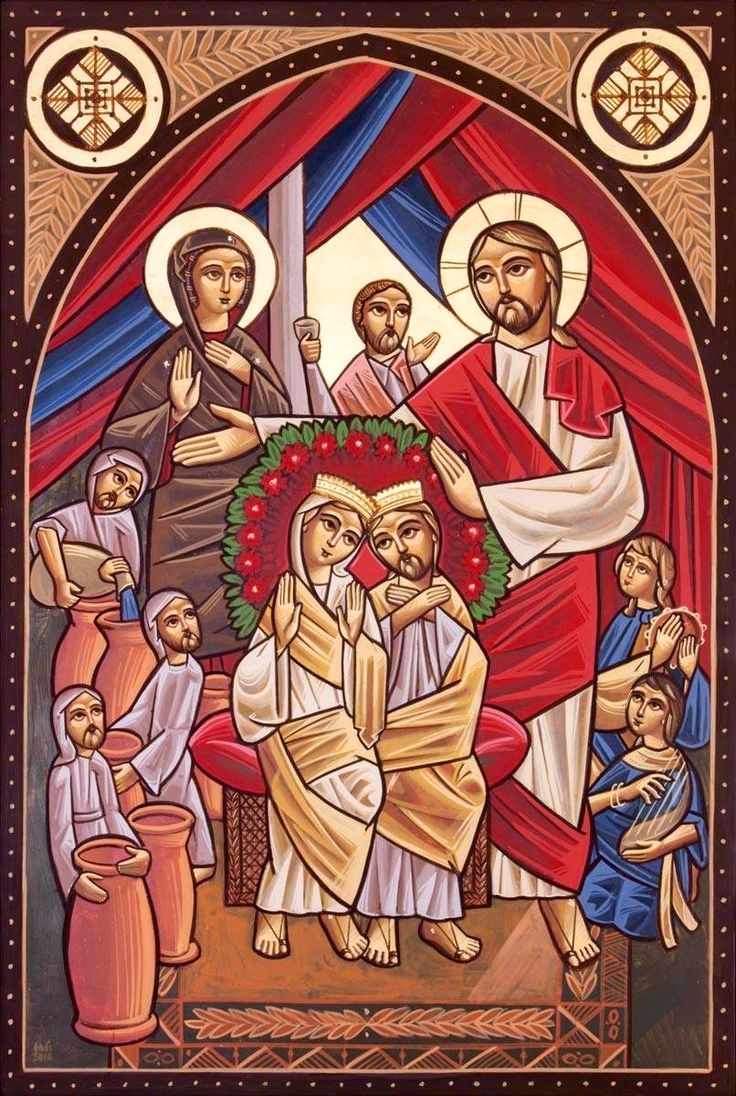
Homily for Epiphany III [Gen 14: 17-20; Rev 19:6-10; Jn 2:1-11]

The feast of the Epiphany which we celebrated a couple of weeks ago, is the Manifestation of Christ to the Gentiles. It shows the world that Jesus Christ is God born among us, and points forward to two marvellous miracles. The first is the Baptism of Christ, which we celebrated last week. Jesus shows humanity the way back to the Father, through baptism, and we see the Holy Spirit active in the world. Secondly, this morning, we turn to the first of Jesus’ miracles which took place at a wedding in Cana.

A wedding is a very happy event, celebrated by the whole community, and a jolly good excuse for a party, which in some cultures can go on for many days. Jesus, His Mother, Mary, and the disciples have been invited to a local Galilean party. The happy couple were fairly young, and probably not all that well off. Even so, they would have still put on a huge spread with lots of wine to wash it down. To run out of wine would be seen as a cause of shame and disgrace. The couple and their families would have been shown up in public. This is a culture which valued such things highly, so losing face is a very serious matter indeed. Consequently, when Mary tells Jesus that they have run out of wine, what we are looking at is something of a disaster, a source of shame, a nightmare to be avoided at all costs.

Jesus’ reply to His Mother, ‘Woman … come’, could be seen as curt and dismissive. However, He is not being rude, instead His remark refers to a far larger context than the wedding, the whole of His Earthly ministry in fact. He tells His Mother that it is isn’t their problem, and states that His hour has not yet come:It is not yet His time. Jesus’ hour comes with His Death upon the Cross, when he will wipe away our sins, and take all our shame upon himself.

Mary’s response is instructive. Despite what Jesus says to her she instructs the servants to, ‘Do whatever He tells you’. In this simple phrase she shows us that the key is obedience to the will of God: Listen to what God says and do it. It is that simple and straightforward. As Christians we need to follow her example. Our life should be rooted in obedience: we need to listen to God and obey, for our own good, and the good of the Kingdom. We need to follow the will of God and not be conformed to the world and its ways. We need to truly enter into the joy of the Lord, in humble obedience, be fed by Him, and fed with Him, who died for love of us, in submission to the will of the Father.

Everyone is happy with the miraculous wine; it gives you to all who taste it. Our vocation as Christians is JOY. The joy of the Lord is our strength [Nehemiah 8:10]. We read in the Gospels that Jesus liked nothing better than to hang around at parties with all sorts of people, especially social undesirables. He was even accused by Scribes and Pharisees of being a glutton and a drunkard. In both Luke [7:34] and Matthew [11:19] we see Jesus rejoicing in such name-calling, ‘the Son of man came eating and drinking, and they say, ‘Behold, a glutton and a drunkard, a friend of tax collectors and sinners!’ Yet wisdom is justified by her deeds.”’ [Matthew 11:19] [Also cf. Deut 21:20 ‘and they shall say to the elders of his city, ‘This our son is stubborn and rebellious; he will not obey our voice; he is a glutton and a drunkard.’’ The next verse talks of death by stoning, and looks forward to Our Lord’s Crucifixion at Calvary.]

Jesus enjoys eating and drinking because feasting is a sign of the Kingdom of God. It is clearly shown in the prophecy of Isaiah: ‘On this mountain the Lord of Hosts will make for all peoples a feast of fat things, a feast of wine on the lees, of fat things full of marrow, of wine on the lees well refined. And he will destroy on this mountain the covering that is cast over all peoples, the veil that is spread over all nations. He will swallow up death for ever, and the Lord God will wipe away tears from all faces, and the reproach of his people he will take away from all the earth; for the Lord has spoken. It will be said on that day, “Lo, this is our God; we have waited for him, that he might save us. This is the Lord; we have waited for him; let us be glad and rejoice in his salvation.”’ [Isaiah 25:6-9] Here prophecy is fulfilled and we see a glimpse of the banquet at the end of time which is our hope in Heaven

Jesus tells the servants to fill the water jars to the brim. Most of us have outside our houses one or two wheelie bins, which each hold about 30 gallons, or 240 pints of beer. Multiply that by 6 and you’re looking at the equivalent of 1,500 pints of beer, in the Ancient World people drank their wine diluted down to about 5% abv, or two parts water, one part wine.

The wedding party was well underway. An extravagant party, but it points to something greater than itself. It is a foreshadowing of the joy of the Kingdom. It is a taste of the lavish excess that our God, whose love and generosity are beyond our understanding, wishes to bestow on us, as a sign of His love for us.

The world today struggles somewhat with extravagance, and rightly so: when we see the super-rich riding around in gold-plated supercars we are right to be concerned, yet in the Gospel we see something strange. The head steward had a point: you serve the best wine first, while people are sober and can appreciate it. The Kingdom of God, however, turns human values on their head – the joyous new wine of the Kingdom is finer than any human wine. It is lavished upon undeserving humanity, so that it might transform us, so that we might come to share in the glory of God, and his very nature. Christ therefore becomes the true master of the feast, as He will feed humanity from the abundance of the Heavenly Wedding Feast [Revelation 19:6-9], as He will feed us here, today.

Thus, as we start this new year, we see a three-fold dawning of the Glory of God in Christ Jesus. First Our Lord’s manifestation to the Gentiles, the proclamation of the Messiah to the whole world, Then His Baptism, which shows us the way to the Father, a sign of love and obedience, and now the Wedding Feast at Cana, a sure sign of the superabundance of God’s love. It is shown to us here today in the Eucharist, where we drink the wine of the Kingdom, the Blood of Christ.This transforms us by the power and the grace of God, so that we may share his Divine life, and encourage others to enter into the joy of the Lord. Jesus is the Lamb of God who takes away the sins of the world [Jn 1:36]. He holds nothing back for love of us. He replaces the sacrificial system of the Jews, so that as both Priest [cf. Melkisedech] and Victim he may reconcile us to God.

The Wedding at Cana points to the Cross, as it is when Jesus’ hour comes, when He sheds his blood for us It removes all our shame, all the sins of humanity, so that we can enjoy forever the banquet of God’s love prepared for us in Heaven, and it is shown and foreshadowed here under the outward forms of Bread and Wine. So let us feast on the Body and Blood of Christ so that we may be transformed more and more into His likeness. Let us live out our Joy, and share it with others so that they may come to believe and give glory to God the Father, God the Son, and God the Holy Spirit, to whom be ascribed as is most right and just, all might, majesty, glory, dominion and power, now and forever.

34e6a6d0dc658ea56066d3b87e92982b-religious-icons-orthodox-icons

The Baptism of Christ: Gen 1:1-5; Acts 19:1-7; Mk 1:4-11


January is a time for making resolutions: we start the New Year full of optimism, full of promise, but despite our good intentions, most of us, myself included, have probably broken them by now. We mean well, and we fail. And that’s the point. We try to turn over a new leaf, but we find it hard to stick to. The God whom we worship understands temptation and sin, because he lived as one of us. He is a God of love, of mercy, and forgiveness. How ever many times we fall short we be assured that we will be welcomed, healed, restored and pardoned. God loves us as we are. We do not need to earn his love, or deserve it. He loves us and longs for us to have the fulness of life in Him. Today Jesus shows us the way back to the Father,

The ideas of baptism, of becoming regenerate, born again in Christ, of repentance, a change of mind, turning away from sin, and turning to Jesus Christ seem, as ever, to be just what we need as human beings, men and women, who despite our best efforts to the contrary just find it all too easy to be and do what we know we shouldn’t.

John the Baptist goes out into the desert in this morning’s Gospel. He goes out into the wilderness, to a place on the margins, of society and of human habitation, to take people out of their comfort zone, where they feel safe, to a place of encounter with God. John is ‘proclaiming a baptism of repentance for the forgiveness of sins’. His message is a simple one: Repent for the Kingdom of God is at hand. What he does – pouring the water of the River Jordan over people –  signifies their turning back to God, a new start, a new beginning, wiping the slate clean. What starts as something symbolic becomes something more with the Baptism of Jesus – it becomes a sacrament, an outward and visible sign of an inward and spiritual grace.

Jesus does not need to be baptised, he has no sins from which to repent, there is nothing which separates Him from God, the Father. He is both God and man, and yet He is baptised – out of obedience to the will of the Father and for the outpouring of the Holy Spirit – so that we can see God in action in the world. The heavens are torn open, and the Spirit of God is active in the world. God has taken flesh in the womb of Mary and is born among us, recognised and worshipped by the Wise Men. Now he shows us the way back to the Father, through obedience and humility, through repentance, turning away from the ways of sin and the world, and turning back to the God who loves us. This is what the church is all about – proclaiming the same message, going the same thing, sharing in the same grace, which we do not deserve, we haven’t worked for or earned, but which God in His love and mercy gives us. We receive adoption, we become part of the family of God, we are born again, of water and the Spirit, we are ‘in Christ’, clothed with Him.

The utterly unnecessary nature of the act of Jesus’ Baptism discloses something profound about the nature of God and His love for us. God gives us more than we ask for, because it is in His nature to be generous in a way which astounds us. There is something reckless, profligate, and extravagant, utterly over the top, about the love of God, which should prompt us to react in a similar way.

John’s baptism of water prepares the way for the baptism of the Holy Spirit in Christ, through which we enter the Church, it shows us a new way of life, life in the Spirit, life with God, which has a profound effect on our lives, who we are and what we do. It opens a possibility to us, of living in a new way, a way of love, which mirrors the generosity shown to us by God. It shows us in the Church what it is to be truly alive and how to live in a new way. It points to another act of God’s extravagant love – that Christ dies on the Cross, to take away our sin, to carry our burden, which separates us from God and each other. This sacrifice is made present here and now so that under the outward forms of bread and wine we may partake of the Body and Blood of Christ, so that our souls may be nourished and our lives transformed by God’s very self – a solemn moment, the holiest thing on earth, the most wonderful moment of our lives. Here, now, God continues to give himself so that we can continue to be transformed, something which begins at our baptism, to prepare us for heaven, and so that we can live the life of the Kingdom of God here and now – living out that self-giving, reckless, extravagant love and forgiveness in our own lives, and in the world around us.

It sounds easy, being extravagantly loving and forgiving, and yet for two thousand years we have struggled with it. It is easier to be selfish and sinful. Yet, despite our shortcomings, God continues to forgive us, so that we can carry on trying to be the people he wants us to be, which we need to be together, as a community of love and forgiveness, which is what the Church is.

Ours is a faith which can transform the world, so that all humanity can share in God’s life and love, each and every one of us can become part of something radical and revolutionary, which can and will transform the world one soul at a time, it may sound strange, crazy even, but that is the point. Rather than human violence, cruelty, and murder, the only way to transform the world is through the love of God. This is what the church is for, what it’s all about; it is why we are gathered here, to be strengthened and nourished, through prayer, the Word of God, and the Sacraments of the Church, strengthened and nourished to live out our faith in our lives to transform the world. Nothing more, nothing less, just a revolution of love, of forgiveness, and healing, which the world both wants and needs, so let us live it so that the world may be transformed and believe and give glory to God the Father, God the Son, and God the Holy Spirit, to whom be ascribed as is most right and just, all might, majesty, glory, dominion and power, now and forever.

epiphany


Advent 1 Year B Mk 13:24-37

When I was a child I loved reading books. My favourite place in the world was a library, and I can still remember going there one day and my father gave me a bookmark on which the following words were written, ‘Be alert, the world  needs all the lerts it can get!’  The pun was a good one, I enjoyed it, and can remember it decades later. It makes a serious point, namely how do prepare to meet Jesus? Advent is a season of preparation, when we prepare to meet Jesus, both as a baby born in Bethlehem, and as our Saviour and Judge, who will come to call the world to account.

The world around us sees preparations for Christmas as most concerned with cards, decorations and shopping. The Church sees things somewhat differently. What matters are our souls and our lives: who and what we are, what we do, and why we do it.

We, here, this morning, as Christians are living between Christ’s Resurrection and the end of the world. We are to be ready, and to spend our time considering the four last things: death, judgement, heaven, and hell. They await us all, each and every one of us, so how will we prepare for them?

In this morning’s gospel, our Lord tells us to stay awake, to be on our guard, to be prepared, because we do not know the time when our Lord will return in glory to judge both the living and the dead.

Jesus tells us not to be found asleep, in the sleep of sin. An attitude which says ‘I’m alright’, ‘I don’t need God’. It is this sleep which affects many people, both those who come to church, and the vast majority who do not. That’s not to say they don’t try and live good Christian lives. We all do, instinctively. And yet any mention of the last things tends to conjure up images of fire and damnation, hell and brimstone preachers, thumping pulpits and putting the fear of God into people. Such is the characterisation of the religious as extremists, something increasingly common. Yet, such people have a point – their message is true – but I suspect that they put it across in a way which strikes people as unpalatable, and so they switch off and go to sleep.

And yet, what they say matters, it is true and we could all do with being reminded of it. How we live our lives matters, it affects who and what we are, and the world around us. We have but one life to live on Earth, and we must try, with God’s grace, to do the best we can. We live in a world which does not care about such questions, apparently people’s lives are their own business, and we have no business calling people’s actions into question, but this will not do. Our actions affect us, our character, our lives, and the lives of people around us – our actions have consequences, which is why our lives and how we live them matter. What we do and say matters and the Church exists to call people to repentance – to turn around and change the whole of their lives and follow Christ in their thoughts, their words, and their deeds – for the Kingdom of God is close at hand.

Lest we get too afraid, we can turn in confidence to the words of Isaiah in our first reading this morning. The prophet is looking forward to the redemption of Israel, the coming of the Messiah, a new future after exile. Against a picture of human sin, and rebellion against God, there is the implicit possibility of something better. In those times when God can seem absent, there is the possibility that God as a loving parent is giving us space and time to reflect and repent. Isaiah is convinced both of the power and the love of God, to remake us, and restore us, to enrich us with his grace, and give us the gifts of his spirit, as Paul wrote to the church in Corinth.

We’re not being left alone in all this. God both tells us the nature and source of the problem, and provides us with a solution. He even helps us along our way: he strengthens and encourages us, to turn our lives around, and follow him. That we be vigilant – and take care of the state of our lives and our souls, and those around us, that we are awake, rather than indulging in the self-satisfied sleep of sin.

For God asks of us – that we, this Advent, turn our own lives around, and prepare ourselves to meet our Lord, at the Eucharist, when he meets us at his altar in His Body and Blood, and in His Words proclaimed in Scripture. We also need to look forward to meeting our Lord in the yearly remembrance of His Nativity, and in his coming in glory as our Saviour and our Judge. If we can look beyond the commercialism of a sad, cynical world, we can see that God was prepared to go to any length to meet us, to be with us and heal us. Can we not prepare ourselves, our souls and our lives to meet Him?

Ours is, after all, a God of love and mercy, born as a helpless child in a stable, who gives Himself out of love for us, to suffer and die to restore our relationship with God the Father and each other, who gives us Himself under the outward forms of bread and wine so that we might have life in Him. He sends us His Holy Spirit to strengthen us, so that we can be alert, stay vigilant, and prepare to meet Him.

50e5f-1st_sun_of_advent_pic

Christ the King, Year A

In 1925 Pope Pius XI instituted the feast of Christ the Universal King to stress the all-embracing authority of Christ and to lead mankind to seek the Peace of Christ in the Kingdom of Christ. In a time of great misery and inequality: the Church was reminded of what the coming of Christ as Saviour and Judge meant, as well as ending the liturgical year by looking forward to Advent: the season of preparation for our Lord’s coming, in His Incarnation, and as our Judge. A season of reflection, a season of hope, and new life.

In today’s Gospel we have the last parable in Matthew which also gives us an apocalyptic vision of Our Lord’s Second Coming. The first thing to notice is that, as befits the Kingdom of God, all people will be there. This is not a Christians-only event. In the Holy Land to this day you will see herds of goats and sheep grazing together and at the end of the day they are separated by a shepherd who can tell the difference between them. Jesus does, however, give his reasons for making his judgement: ‘For I was hungry and you gave me food; I was a stranger and you made me welcome; naked and you clothed me, sick and you visited me, in prison and you came to see me.’ To give food and drink and to make people welcome is fundamental to hospitality and is a sign of Love. Clothing the naked and visiting the sick and imprisoned is likewise showing concern for people, and their needs, showing our love to the world.

We believe that God is love and that we are called to show love ourselves in our lives. Our faith, therefore, is not simply private interior devotion, something that we do on Sundays for our benefit, and keep in a box like a Sunday hat. No!It is something we can put into practice in our lives, every day, everywhere.

Now in the parable in this morning’s Gospel the virtuous seem rather surprised and ask our lord when they did this to him. Jesus answers, ‘I tell you most solemnly, insofar as you did this to the least of the brothers of mine you did it to me.’ As St Antony, the founder of monastic tradition once said, ‘Our life and death is with our neighbour – if we win our brother we win God; if we cause our neighbour to stumble then we have sinned against Christ.’ So who are the least of Christ’s brethren? Who are the little people? Or to put it another way, who is the most important person in church? Is it Fr Neil? Or is it me? Is it a magistrate? Or a businessman? No … who are the least amongst our communities and who are the least outside them? And what are we doing to help them?

Some of the people who would have heard Jesus teaching this parable might well have thought, as Jews, that Israel were the sheep, and the gentiles were the goats, and I wonder whether we don’t all of us feel a little complacent at times. By the same token, the standards Jesus sets in this parable seem almost unattainable so we can feel that we simply cannot live up to them. So we need to be careful that we don’t just despair, that we don’t just give up, and don’t let our discipleship become one of apathy.

Our Lord and Saviour Jesus Christ, God himself, became man and lived among us. He showed humility in washing His disciples’ feet at the Last Supper, in eating and drinking with tax-collectors and prostitutes, the social outcasts of His day. He, unlike the society in which he lived, did not judge them. He loved them in order to proclaim in word and deed that the Kingdom of God was for ALL people – the people we might not like, the people we might look down our noses at, and with whom we might not wish to share our table. He gives himself to feed heal and restore them and us.

His love and humility are shown in that being condemned to death by those whom he came to save he does not cry out, he does not blame them, but instead asks, ‘Father, forgive them for they know not what they do.’ The Christ who reigns on the tree, and who will come again to judge the world, bears the marks in his hands, feet, and side, because they are the marks of LOVE. They remind us of God’s love for us, and when we eat and drink His Body and Blood at the Eucharist we are healed, and share in His Divine Life, so that we might become the Body of Christ, His Church. Strengthened by this Sacrament of Love we are called to live out our faith in the world around us. While we may not have lived up to the example He sets us, we can nonetheless try to do what we can. In acknowledging the Universal Kingship of Christ we recognise an authority higher than human power, higher than any monarch or dictator, and we are called to conform the world to His just and gentle rule. We are called to transform the world one soul at a time, and through acts of mercy and a life of prayer to make a difference.

We may not like the idea of judgement: it is big and scary, and most of us, if we are honest feel that we deserve to be condemned. Now rather than just thinking about judgement as a future event, let’s think about it as a process, something going on here and now. We all live under God’s judgement. Are there things which are hellish in our lives? The problems of cliamte change and how we treat God’s world don’t exactly look great. The way in which we do business with one another, the on-going financial crisis, poverty, hunger and the existence of food-banks show us that all is not well with our country. The wars which our leaders wage against each other seem very far away from the ideal where the lion lies down together with lamb, where swords are beaten into ploughshares and spears into pruning-hooks. For all this we will be called to account, like the servants in last week’s parable of the talents.

So what are we to do? First, we are to pray to God that we might have the strength and courage to follow the example of His Son, Jesus Christ. Secondly, we are to remember that God’s love and mercy were poured out on the world at Calvary, and continue to be poured out on us who know His forgiveness. Thirdly, that we are fed and strengthened in the Eucharist so that we may be transformed to go out into the world and be active in God’s service.Finally we are to remember that whatever we do for the least of our brothers and sisters we do for Him. The people or the acts may seem insignificant to us, but not to God.

I would like to conclude this morning by asking you, what would our communities look like if we lived like this: giving food and drink to those in need; visiting those who are sick, or in prisons with or without bars – the prison of fear, loneliness, old age, depression, addiction, or abusive relationships? For such is the kingdom of God. Amen

9b5d6-christtheking
Christus vincit, Christus regnat, Christus imperat!

Remembrance 2017

‘Greater love has no man than this, that a man lay down his life for his friends.’  Cariad mwy na hwn nid oes gan neb; sef, bod i un roi ei einioes dros ei gyfeillion. Jn 15:13

We come here today to remember, to remember and give thanks for a sacrifice. As Christians, we remember and give thanks for the sacrifice of Jesus Christ, which reconciles us with God and gives us the hope of everlasting life in him. Fel Cristnogion ry’n cofio ac yn diolch am aberth Iesu Grist, sy’n ein cyfiawnhau â Duw ac yn rhoi gobaith i ni fywyd tragwyddol ynddo. As we meet him week by week and day by day in Word and Sacrament, for He is truly present in Scripture and in his Body and Blood, what we are doing is not simply recalling the events of the past, but experiencing those events and their effects here in the present. The sacrifice and its effects are a reality in our lives.

Likewise when we recall the sacrifice made by people from this village, this country and all over the world, our remembrance must likewise be an active one which has an effect in our lives. We recall the generosity of those who have tried to ensure that we can live lives free from warfare and suffering, a generosity which must leave a mark on our lives, and help us to learn from the mistakes of the past and not repeat them in the future.

No-one has not been touched by the events of the past one hundred years. Many people, members of our own families, gladly offered, and still continue to offer themselves for the safety and security of humanity. An act of remembrance has a deeper significance when we know that members of Her Majesty’s Armed Forces are on active service overseas, working for peace and stability, for a safer, fairer, world, where people can live in peace and plenty. We remember too all the victims of warfare, the countless millions who have lost their lives in a century characterised by conflict. Our reaction will, I suspect, of necessity, be a complex one: a mixture of sadness and thankfulness, gratitude and grief. While we are grateful to live in comparative peace after a period of wholesale slaughter, we cannot fail to be moved by the cost of military and civilian lives, which continues to this day.

It is important to see the sacrificial self-giving love of God in Christ’s passion as the pattern of our own lives. We as Christians are called in our baptism to share in Jesus’ life, death, and resurrection, and this can be lived out in any number of ways. We can remember, too, the vision of peace which characterises the understanding of the Messiah in the prophets. It is a time when the lion will lay with the lamb, and when swords will be beaten into ploughshares. So it seems as though we’re not there yet and in many ways this characterises much of the two thousand years following Christ’s birth. Humanity it seems, while it deeply wants the vision of messianic peace finds itself engaged in warfare of one sort or another, mostly for political ends, with the cost being borne by ordinary men, women and children.

So is there a way out of this endless cycle? In short, Yes. In the sacrifice of Jesus Christ upon the cross, who gave himself and suffered for our sins and the sins of all humanity: past, present and future. The slaughter of millions of people which characterised the wars of the last century is an act of brutality which nails Jesus to the cross. And yet he goes to his death gladly, for love of us. It is this act of total self-giving which shows us what true love is, and how we too need to fashion our lives after this pattern of love. We must always remember that Jesus’ loving self-giving is done for the healing of sin and division – for the reconciliation of humanity with God. While we are conscious of our failings and shortcomings and need for God, we must always remember that we are a people who are forgiven, who are loved by God in a way which has the power to transform our lives. Our lives can be transformed when and if we learn to love not only our friends and family, but our enemies, only then can swords be beaten into ploughshares and spears into pruning-hooks. Only then can the peace for which people fought, struggled and died become a reality in our world. By our trusting in the superabundance of God’s mercy and the power of the cross in our lives can we realise our hopes and dreams for peace. But we need to co-operate with a merciful and loving God, by living out lives which are informed by and filled with our faith, to bring about the peace for which we long, and which is the will of Almighty God.

Bible Sunday (Trinity XX 30th of Yr A) Neh. 8:1-4a, 8-12 Col. 3:12-17, Mt 24:30-35

The joy of the Lord is our strength

We are, generally speaking, more than glad to have a reason for a celebration. Especially when the weather is lousy, the news is gloomy and the Church appears to be in something of a mess. However if I were to say that the reason for having the celebration was ‘listening to a sermon’ then I suspect that you would be more than a little bit surprised. There’s nothing to celebrate here … it is just what we do in church.

But in this morning’s first reading from the Book of Nehemiah, it is exactly what happens. The Jewish people have been in exile in Babylon and have returned to Jerusalem. The scribe and priest, Ezra, and the governor, Nehemiah, are celebrating the Jewish New Year. Ezra reads from the Torah, the Books of the Law, the Books of Moses, the Pentateuch, and the Levites explain the scriptures, translating them from Hebrew into Aramaic and explaining them to the people. It is basically what we have done here in church this morning. It doesn’t seem like much of a reason for a celebration. The people are overcome with emotion, perhaps at being back home in Jerusalem, or perhaps at having the scriptures read and explained to them. Ezra tells them to feast, to drink sweet wine. We will follow their example here this morning, as we have done on a hundred thousand successive Sundays, since our Lord was raised from the dead, because the joy of the Lord is our strength.

God delighted to send His Holy Spirit so that Jesus Christ, His Son, might be born of the Virgin Mary for us. Christ preached the Good News of the Kingdom to remind humanity how to live as God wants us to live, so that we might thrive, so that we might be filled with His Joy, and be strong in Him. Christ became what we are, so that we might become what He is. He died for us, so that we might live in Him, and share in that Divine Life for ever.

All of this to show God’s love for His people, so that we might share in the joy of the Lord. God delights in His people following His Law, in hearing it explained so that they live, and live life to the full.

It is exactly the same ass when S. Paul is writing to the church at Colossæ, in Asia Minor. He addresses them as ‘chosen of God, holy, and beloved’ terms used to describe the Jews as God’s people – a relationship He now has with the Church – this is our inheritance as the Church, to be a people chosen by God, holy and beloved, and as such we are to be clothed with compassion, kindness, lowliness, meekness, forbearance, and forgiveness. This is because the Holy Spirit has been poured into our hearts and souls at our baptism. We are, above all else, to be a people of love: not the saccharin-sweet thing of Hollywood movies, but real, genuine, costly love. It isn’t as easy as it sounds. It is demanding, and difficult. It means loving each other as Christ has loved us: in exactly the same way and to the same extent. In so doing, we know that we are living as God wants us to live: we are to be people formed by the word of God – the Bible. The word of Christ is to dwell richly in our hearts, in such a way that it bears fruit in our lives. It leads us to worship God, to sing His praises, thankful for all that God has done for us, and giving thanks to God through our Lord Jesus Christ, His Son, who died for us.

Thus, when Jesus talks about the end of time, the time of judgement, when He will come again to judge the living and the dead, we know how we are to live as Christians. Whether this happens today or a hundred thousand years in the future, we know how to live. We know that that we are to live by, and be known by our faith, what we believe and how we put it into practice in our lives. We will know when it is time, but what matters is what we believe and how we live. We can trust Jesus, His words will not pass away. He came to proclaim the Kingdom of God’s love here on earth. He proclaimed it, and He died for it: making peace with His Blood. It is why we meet on the day when Our Lord rose again, so that we might feed on His Body and Blood. We are fed by Him, with Him, so that we might share in His Divine, and be strengthened to live out our faith, and be conformed more and more to the will of Our Heavenly Father, and share His joy that the world may believe and give glory to God the Father, God the Son, and God the Holy Spirit, to whom be ascribed as is most right and just, all might, majesty, glory dominion and power, now and forever.


Ff100284
Albert Dürer, Christ at Emmaus, 1511 (Small Passion)

Harvest (John 6:27–35)

Meddai Iesu wrthynt, ‘Myfi yw’r bara bywyd.’ 

Jesus said to them, ‘I am the bread of life.’ 

In the second chapter of the Book of Genesis we read that, ‘the Lord God took the man, and put him into the garden of Eden to dress it and to keep it.’ Thus, to work the land is to engage in something which takes us back to the very beginnings of humanity. It is the most ancient profession and indeed an honourable one. The practice of coming together to offer our praise and thanksgiving to Almighty God for the goodness of creation and a harvest safely gathered in is, likewise, an ancient and honourable thing. Just as the Ancient Israelites gave thanks for their harvest in the promised land, so do we. We should, as part of our worship of God offer him the best of all that we have as a response to a loving and generous God. Mae popeth yn rhodd gan Dduw All things are a gift from God, it is right that we are thankful to God who created all things.

But while this is important, we need to be careful. Is what we are engaged in a bit of cosy folk religion, a matter of duty, an excuse to be seen, or perhaps something more? When this church was built, its congregation, who lived on and worked the land would gather on the 1st August for Lammas, or Loaf-Mass to give thanks for a successful grain harvest. With the renewal of the Church in the mid nineteenth century the idea of a harvest celebration became popular once again. This is a good thing, the world is better when filled with grateful, loving people.

But as well as giving thanks to God, we also need to be shocked, challenged, and changed by the example and teaching of Jesus in the Gospel. Are we as a church and a society, content simply to be fed, or is God asking more of us. Our faith is not something we can simply keep safe in a box, to put on like a hat for church on Sunday – it needs to be more than that. Our faith must form all that we are, and all that we do, and say, and think. Our belief in our Lord and Saviour Jesus Christ needs to form the very ground of our being. This faith, like a plant, needs to be tended, watered, and protected from weeds. It needs to be nourished, encouraged, and taught, and shared with others.

The crowd in the Gospel story have not grasped the meaning and importance of their being fed. They have not understood its spiritual meaning but are rather interested in the prospect of another free meal. Jesus, however, feeds them as a sign of their heavenly food, the bread of eternal life. Rather than working for the food that perishes we too need to work for the bread of life, which is Christ himself. We need to meet at the Lord’s table to be fed by his word and his very self, his body and blood under the forms of bread and wine. We need to have our bread for the journey for our life of faith together. God is the sustenance of life itself, of our very existence, for those who trust in him, and he will fill our every need, by giving us that which we cannot work for ourselves, and for which we hunger most. That is why a celebration of Harvest is best done within the context of a Eucharist, a Thanksgiving to God for Who and What He is, and What HE does for us.

Our desire is surely for a world where none are hungry, where all are loved and cared for. This requires our co-operation with the will of God, and our trust in him. By our being fed by his word and the Eucharist our faith will strengthened and renewed. Our lives can be transfigured, enabling us to transform the world around us, conforming it to the will of God. We can only do this through being nourished body and soul by God – through our participation in the Eucharist, the Holy Communion, the Lord’s Supper – fed by God, with God, for God’s work in the world. When we eat normal food it becomes what we are. But here when we eat, we become what it is, we a re transformed more and more into the God who loves us and saves us. Only this can satisfy our deepest hunger and thirst, and give us true peace, and hasten the coming of God’s kingdom on earth. Whilst we are thankful, we also need to be mindful that the kingdom of God is something happening right here and right now, and it has the power to transform the world around us, starting with us here today: the true harvest for the Church is the harvest of souls, of those who love Jesus Christ and are nourished by Him and with Him. We are grateful for all that we are, and are given by God, which makes us want to share it with others. It may not look it, but it is a radically different way of life. If we take Jesus seriously when He says, ‘Myfi yw’r bara bywyd’ ‘I am the bread of life’ then we eat Him so that we might share in His life, and share that life with others. This is our faith as Christians, and it provides us with the hope that we may live with Him forever.

We share His life with others so that they may enter into the joy of the Lord, and receive the precious gift of new life in Christ. The gift is free but it comes with the obligation to share it with others. We do this willingly because it is not a hardship, or an imposition, but rather a joy, a gift which so precious that not to share it would be selfish and wrong.

So let us share it with the world so that it may believe and give glory to God the Father God the Son of God the Holy Spirit, be ascribed this is most right and just all might, majesty, glory, dominion, and power now and for ever

from Priesthood in Liturgy and Life by Fr Alban Baverstock SSC

The Christian priest pre-eminently exercises his priesthood at the Christian altar, offering the Christian sacrifice.  But it is surely clear that the Christian priest cannot satisfy the obligations which his share in the Eternal Priesthood lays upon him by the sole act of celebrating, occasionally or frequently, the Christian Mysteries.  At the altar or away from it, he is still a priest; and this priesthood must express itself in a life which is throughout an ordered ministry to God.  In other words the life of the priest must be liturgical.  His mass must be the summary for him, as for the great High Priest, of a life of self-oblation.  In the mysteries he offers himself in Christ.  His whole life must be a showing of Christ, impersonated in him, to God.  He must always be saying Mass.

A ready parallel meets us here in the apostolic injunction to ‘pray without ceasing’ [1Thess. 5.17].  This is rightly explained to mean more than that Christians are to be often at their prayers.  It means that the whole life of the Christian should be in a sense prayer, a coming to God, an energizing towards him.

And the parallel suggests an important conclusion as to the relation of the formal liturgy to the liturgical life, parallel to the relation between formal prayer and the life which is itself a continual prayer.  For the life of prayer, as experience abundantly proves, involves of necessity a due and constant attention to formal prayer.  Similarly the liturgical life, the life which is throughout a ministry to God, an oblation by the priest of himself in Christ and of Christ in him, depends very much on his formal celebration of the holy mysteries.  And the converse is true.  We shall never pray as we ought in our formal prayers unless our whole life breathes the spirit of prayer.  The priest will never say mass as he ought unless his whole life is imbued with the spirit of the mass, the spirit of oblation.

advent-holy-sacrifice-of-the-mass1

The Twelfth Sunday of Year A (Mt 10:26-33)


The death of Our Lord on the Cross reveals that we are meant to be perpetually dissatisfied here below. If earth were meant to be a Paradise, then He who made it would never have taken leave of it on Good Friday. The commending of the Spirit to the Father was at the same time the refusal to commend it to earth. The completion or fulfilment of life is in heaven, not on earth.

Fulton Sheen Victory over Vice 1939: 99

We are not used nowadays to seeing religion being couched in negative terms, but its effects can be salutary. If I were to ask you the question, ‘What does Jesus say that we should not do most often in the Gospels?’ what would your answer be? Something to do with sin? It is, ‘Do not be afraid!’ Jesus tells us not to be afraid, to fear no-one, and to trust in Him.

Fear is a feeling induced by a perceived danger or threat, but if we are close to Christ and trust in Him then we need not be afraid. No perceived danger or threat can really harm us: we may suffer pain or even death, but if our trust is in Christ, if our identity is in Him, then we have nothing to fear. He created us, he has redeemed us, and our eternal destiny is to be with Him for ever.

Living a Christian life is at one level a very simple thing: we follow Christ – we do what he told us to do, we fashion our lives after the example of His. We pray because He told us to; we read Scripture which finds its fulfilment and truest meaning in Him. We are baptised like He was, and we come together to do just what He did with His disciples on the night before He died because he told us to ‘Do this’, so we do. We are fed by Him and fed with Him so that we may share His life, and be given a foretaste of the heavenly banquet of the Kingdom of Heaven here and now.

Jesus calls us to follow Him by taking up our Cross and prizing our relationship with Him over all the things of this world. It’s a bit tricky, it’s a bit of an ask! In fact, for many people it’s pretty much impossible. Such are the enticements of the world, and the fact that there are those who want us to relegate religion to the private sphere. They argue that our faith shouldn’t affect our lives, it’s something which we can take out of its neat little box and wear for an hour on a Sunday morning, like a hat or some gloves, and then forget about, having done one’s public duty. Religion is not a matter solely for the private sphere, it affects who and what we are, and the world around us.

While may be tempting to follow the Enlightenment ideal of privatised religion, it simply will not do. We cannot truly follow Christ if we are not willing to lay down our lives for the sake of Him who died and rose again for us. Baptism and the Eucharist are free, but living out the faith which they encapsulate will cost us our lives. And yet we should give our life gladly, even though the world may well deride us, and call us fools.

In the Gospel Christ says to His disciples, and he says to us, ‘Do not be afraid … have no fear of them … Do not fear those who kill the body but cannot kill the soul’. We can laugh at those who pour scorn upon us for all that they promise is of this world, fleeting, and of no real value; whereas what Christ promises us is of God, it will last forever, it is a glory which can never fade – it is ours and is offered to the whole world for free, if only they would accept it.

To follow Jesus we need to die to sin, we need to turn away from all the selfishness which separates us from God and each other, and instead live out the radical love of the Kingdom – a love which forgives, a love which thinks of others before ourselves. It is no good seeing this in individual terms; it affects us as a society. We need to do this together – you and me. Each and every one of us needs to live not enslaved to sin, but as slaves for Christ. His service is perfect freedom, freedom from the ways of the world and freedom to live the new life of the Kingdom of God, here and now.

We are called as a church to live out our faith together, praying for each other, supporting one another, and relying upon God, and His grace, that unmerited kindness and free gift, which we do not deserve, but which has the power to transform us, to conform us to the pattern of His Son. This He pours out upon us in the Sacraments of His Church, so that we might be conformed to His will: fed by God, with God, to have life in Him. We can only do this if we rely upon God and do it TOGETHER, built up in love.

Only then can our lives, our words and our actions proclaim the saving truth which can change the world.

For two thousand years the church has been changing the world, one soul at a time, so that God’s will may be done, and His Kingdom may come here on earth, as in Heaven. We are radicals, and revolutionaries who believe that the Love of God can transform our Human nature. That water, bread, and wine are the most powerful things we have, when, through the power of the Holy Spirit, they wash us clean, and feed us with the Body, Blood, Soul and Divinity of Our Lord and Saviour, Jesus Christ. We are still being persecuted for this, by those who are afraid of what we are, and what God’s love can do.

Whatever they do, they cannot win. We cannot lose. We have nothing to fear, only a message of love to live out so that the world may believe and give glory to God the Father, God the Son, and God the Holy Spirit, to whom be ascribed, as is most right and just, all might, majesty, glory, dominion, and power, now, and forever.

cropped-velazquezcrucifxion.jpg

11th Sunday of Year A (Mt 9:35-10:28)

Sheep are lovely creatures, their lambs gambol in fields, their wool keeps us warm, their meat is tasty. They do, however, have something of a bad reputation – they are seen as simple, stupid creatures, who munch grass all day and are a bit dozy and clueless. They can be seen very negatively, as an unthinking herd, or as wandering off and getting caught in thickets. It is no wonder then that one of the images in this morning’s Gospel is likewise not generally seen as positive. ‘When he saw the crowds, he had compassion on them, because they were harassed and helpless like sheep without a shepherd’ (Mt 9:36) Jesus has compassion on them, Matthew uses a word which means to be moved deep inside, it is a gut feeling, a feeling of compassion, of love and care. Like sheep without a shepherd they can wander aimlessly. They need direction; they need help.

We could be forgiven for thinking that that such feelings belong in our past. We’ve grown up, we’ve moved beyond all that. But, if anything the events of the last few weeks tell us clearly that where there is an absence of leadership people get worried. They start to panic. They’re not sure what is going on, or how they are going to find safety and security . So the world around us is a mess, our politicians don’t seem to be much help, and we’re not sure that the Church is any better. It is a sad indictment of the age in which we live, but THERE IS HOPE. We can always, and in all things trust in Our Lord and Saviour Jesus Christ, who is the Good Shepherd, and who lays down his life for the sheep.

After Jesus has said this He proceeds to call labourers for the Lord’s harvest. He summons the twelve apostles to share his work of proclamation and healing. They are to be sent out for the healing and reconciliation of the nations and to preach the Good News of the Kingdom. He gives them power and authority to do God’s work in the world. It is no easy task – they are to be flogged and handed over for trial. They are to face persecution in the world for doing the work of God. As co-workers with the Lord, fellow shepherds, they too will lay down their lives for their flock, and such is the lot of those called to serve God as bishops, priests and deacons.

In the book of Exodus Moses is addressed by God: ‘Indeed the whole earth is mine but you shall be for me a priestly people and a holy nation. These are the words that you shall speak to the Israelites.’ (Exod 19:5-6) As the church is the New Israel, bought through the New Covenant in Jesus’ blood, then these words apply to us. We are to be priestly and holy. We are to honour God and worship Him, and encourage others so to do. We do this by being close to God in our reading of Holy Scripture and our participation in the sacraments of the New Covenant – primarily Baptism and the Eucharist.

Christ has compassion on the people and gives them the shepherds that they need and want, to guide and direct them along the right path, to feed them, and lay down their lives for the sheep, as in all things they will look to Jesus as their pattern and example. His entire life and ministry points towards His Death and Resurrection, where He lays down his life in obedience to the will of the Father to reconcile humanity to God and to each other. It is this sacrifice and self-oblation which the church sees re-presented in the Eucharist, where on one hundred thousand successive Sundays the Church, through its priests and bishops has done what Jesus did on the night before He died with his apostles in the Upper Room. The Eucharist makes the holy people of God, because in it we are fed by Christ and fed with Christ, fed with the Lamb of God who takes away the sins of the world. We are given here and now a foretaste of the Heavenly Banquet – humanity eats the bread of Angels, pointed to by the manna in the Desert. We are called to share in the Body and Blood of Christ do that we might live in Him and He in us.

Words cannot adequately describe the wonder of this mystery, that we poor, frail, sinful humanity are called to share in the life of God, to be nourished by it, strengthened by it, to live the life of faith here and now. So to a world desperate for answers, which has given up trusting in God, and indeed in just about anything, we can say ‘Come and see’. The church can offer something that people can trust, someone whom they can follow. A true shepherd to guide them, guard them, and lead them.

So let us cast our cares aside and follow Him, let us be nourished by Him, and invite others to so that they may believe and give glory to God the Father, God the Son, and God the Holy Spirit, to whom be ascribed as is most right, all might, majesty, glory, dominion, and power, now and for ever.

_DSC1396

Homily for Candlemas 2017

Not all that long ago it was not uncommon to hear of the Churching of Women, sometimes called Thanksgiving after childbirth, as it was after all a dangerous business. We are not quite so used to ideas of ritual purity inherent in the Thanksgiving for a woman after Childbirth, or her re-admission into society after a period of confinement, but the Law of Moses required that forty days after giving birth the mother was purified in a mikveh, a ritual bath and that her son, as a first-born male was presented to the Lord. This week the Church celebrates the Presentation of Christ in the Temple, also known as the Purification of the Blessed Virgin Mary and commonly called Candlemas, that they may burn as lights which proclaim Christ, the true Light, the light to lighten the Gentiles.

This then is the fulfilment of the prophesy spoken by Malachi, which also looks to our purification in and through the death of Christ and his atoning sacrifice of himself, which will be be re-presented her, made present so that we can share in it, so that we can be healed and restored by the very Body and Blood of Our Lord and Saviour Jesus Christ. As the Letter to the Hebrews puts it: ‘Therefore he had to become like his brothers and sisters in every respect, so that he might be a merciful and faithful high priest in the service of God, to make a sacrifice of atonement for the sins of the people. Because he himself was tested by what he suffered, he is able to help those who are being tested.’ It’s hard to see how it could be any clearer.

The Holy Family go to the Temple to give thanks to God and to comply with the Law, just as they had in circumcising their baby on the eighth day: and in so doing they demonstrate obedience, they listen to what God says and do it – as such they are a model for all Christian families to follow – we need to be like them, listening to what God tells us and doing it, regardless of the cost.

When they go to the Temple the Holy Family encounter Simeon, a man of faith and holiness, devoted to God, and looking for the consolation of Israel, he knows that he will not die until he sees the Messiah, the Lord’s Anointed, and the Saviour of the World. As he takes the child Jesus in his arms he prays: ‘Lord, now lettest thou thy servant depart in peace : according to thy word. For mine eyes have seen : thy salvation, Which thou hast prepared : before the face of all people; To be a light to lighten the Gentiles : and to be the glory of thy people Israel.’

The promise made to him by, revealed through His Holy Spirit has been fulfilled in the six-week-old infant in his arms, and he can prepare to meet his God happy in the knowledge that Salvation has dawned in this little child. As Christ was made manifest to the Gentiles at Epiphany, so now His saving message is proclaimed, so that the world may know that its salvation has come in the person of Jesus Christ. Simeon speaks to Our Lord’s Mother of her Son’s future, and the pain she will endure. Before he dies Simeon is looking to the Cross, the means by which our salvation is wrought, the Cross at which Mary will stand to see humanity freed from its sin through the love and mercy of God, through grace, the free gift of God in Christ. So as Candlemas concludes our Celebration of Christmas, of the mystery of the Incarnation, so to it points to that which gives it its true meaning: the Death and Resurrection of Jesus Christ. It prepares for the coming season of Lent by changing our focus and attention from Jesus’ birth to His death.

That is why we are here this morning, to be fed by Christ, to be fed with Christ, truly present in His Body and Blood, Soul and Divinity – God whom we can touch and taste. A God who shares His Divine Life with us, so that we can be transformed by Him, built up as living stones as a temple to His Glory, given a foretaste of Heaven here on Earth. This is our soul’s true food, the bread for the journey of faith, a re-presentation of the sacrifice which sets us free to live for Him, to live with Him, through Him and in Him.

The significance of what is happening is not just recognised by Simeon, but also by Anna, a holy woman, a woman of prayer, a woman who is close to God – she to recognises what God is doing in Christ, and she proclaims it, so that God’s redemption of His people may be known. Let us be like her, and let all of our lives, everything which we say, or think, or do, proclaim the saving truth of God’s love to the world. And finally the Holy Family go back to Nazareth, and Jesus begins to grow up, in the favour of God, obedient to God and His parents — in the Gospel we see all of human life: birth, death, work, normality hallowed by the God who loves us, who gives His Son for us.

Let us burn, like the candles which God has blessed, let our faith be active to give light and warmth to the world, so that it may feel that love and warmth, and come to believe and give glory to God the Father, God the Son, and God the Holy Spirit, to whom be ascribed as is most right and just all might, majesty, glory, dominion, and power, now and forever.

6567purification_bvm_pic

The Ascension

One of the loveliest things about today is that it tends to focus, in religious art at least, on feet:  the smelly things we like to keep hidden away from the world. Today we see Jesus’ in all their glory going back to where they came from, but they go back differently than they descended: they go back marked with nails, wounded, bearing the marks of God’s love, it is this love which fills us in the Church, the same love which feeds us in His Body and Blood.

We have come here today to celebrate Our Lord’s Ascension into heaven. The world around us may well find the idea quaint or laughable – or at least physically impossible. But it is no less hard to believe than Our Lord becoming incarnate by the power of the Holy Spirit in the womb of the Blessed Virgin Mary, or his rising from the dead at Easter. The world, with the greatest confidence, will tell us that what we are celebrating are myths and fairy stories, but they fail to get the point of what’s really going on.

Our Lord ascends, body and soul into heaven, to the closer presence of God the Father, and to prepare for the sending of the Holy Spirit on his disciples at Pentecost. He who shares our humanity takes it into heaven, into the very life of the Godhead; so that where he is we may be also. We have seen the promise of new life in Easter, a new life which is in the closer presence of God, which we celebrate today. We can see where it leads – what started at the Incarnation finds its goal and truest meaning in the unity of the human and the divine.

But rather than seeing this as an end it is surely far better to see in it a beginning – a beginning of the Church as we know it – a church which goes and makes disciples of all nations, baptizing them in the Father and of the Son and of the Holy Spirit, teaching them to observe all that Our Lord commanded us. This is exactly where we have been for nearly two thousand years. Inspired by the Holy Spirit they did what their Lord commanded them to do and that is why we are here today celebrating this fact.

But like them we too are called to follow Our Lord’s commands and to share his good news with the world so that it may believe. We are called to live lives where our faith is enfleshed in us – it is not abstract and private, but concrete and public. The Atheist who finds our beliefs laughable now joins forces with an Enlightenment Rationalist who wishes faith to be a private matter rather than a public one. This will not do: Our Lord did not say ‘Don’t do this if it’s inconvenient’ or ‘There’s no need to make a fuss in public about me’. He speaks as one given authority, ‘all authority in heaven and on earth’, so we can gladly place ourselves under His authority, to do his will.

He makes us a promise: ‘Behold, I am with you always, to the end of the age.’ He is with us by sending His Spirit on the Church at Pentecost and ever since. He is with us in his Word, Holy Scripture and in the Sacrament of His Body and Blood. It is through this (and the other Sacraments of the Church) that God’s grace can perfect our human nature – so that we can prepare to share the divine life of love in Heaven. Where our Lord goes we can hope to follow, through his sacrifice of Himself upon the Cross, a sacrifice made present here and on the altars of churches all throughout the world, to strengthen us, so that we may be close to him, sharing in the divine life of love poured out on us.

Once Jesus has ascended in glory and before he returns as our judge the only place where we can encounter him is in and through the Church, in its sacraments, in the word of Holy Scripture, and in people, filled with His Holy Spirit: it is a huge responsibility, but a movement which started with 12 men in Jerusalem is still going strong nearly two thousand years later. We have been given the gift of faith and it is up to us to pass it on, so that others may come to share in the joy of the Lord.

We can all hope to follow Him, and to spend eternity contemplating the Beatific Vision, caught up in that love which is the Divine Nature, sharing in the praise of all creation of the God who creates, who redeems, and who sustains all. We can have this hope because Christ has gone before us, he has prepared the way for humanity to follow him and share in the divine life of love.

Let us prepare for this by living the life of faith, strengthened by Him, proclaiming his truth, praying for the gift of His Spirit at Pentecost, that the Church may be strengthened to proclaim His saving truth and the baptism of repentance, so that we and all the world may sing the praise of God the Father, God the Son, and God the Holy Spirit, to whom be ascribed as is most right and just all might, majesty, glory, dominion, and power, now and forever.

Christmas 2015


Αὐτὸς γὰρ ἐνηνθρώπησεν, ἵνα ἡμεῖς θεοποιηθῶμεν· ‘He became human so that we might become divine

Athanasius De Incarnatione Dei Verbi 54.3


Love tends to become like the one loved; in fact, it even wishes to become one with the one loved. God loved unworthy man. He willed to become one, and that was the Incarnation.

Fulton Sheen The Divine Romance New York 1930: 70

3689929886_206d540f30_o.jpg

We have come here tonight to celebrate something which defies our understanding and expectations. The simple fact that the God who created all that is took flesh in the womb of the Virgin Mary and was born for us in Bethlehem as the Messiah, the Anointed of God, who would save us from our sins, should still feel strange and odd. It simply doesn’t make sense, nor indeed should it. In human terms, Mary should have been stoned to death for extra-marital infidelity, and some thirty three years later her son is executed as a blasphemer, a rabble-rouser, a trouble maker, in an awkward backwater of the Roman Empire, having gathered round himself a small group of misfits and undesirables appealing to the baser elements of society. There is nothing respectable here, just the rantings of religious extremists.

And yet here we are, some two thousand years later, celebrating the birth of a child who changed human history and human nature, because we do not judge things solely by human standards. We come together so that we may ponder the mystery of God’s love for us, a God who heals our wounds, who restores broken humanity, who offers us a fresh start, who can see beyond our failures and shortcomings, and who becomes a human being so that humanity might become divine, so that we may share in the divine life of love, both here on earth and in heaven.

If that isn’t a cause for celebration, I honestly don’t know what is. We are so familiar with the story of Christmas that I wonder whether we, myself included, really take the time to ponder, to marvel at the mystery which unfolded two thousand years ago in Bethlehem. God, who made all that is, comes among us, taking flesh in the womb of a young girl through the power of His Holy Spirit, so that in His Son we might see and experience God and His love for us.

God comes among us not in power or splendour but as a weak, vulnerable child, depending on others for love, and food, and warmth, laid in an animal’s feeding trough, insulated from the cold hard stone by straw – beginning his life as he will end it placed in a stranger’s tomb.

Throughout his life all that Christ says and does shows us how much God loves us. The Word becomes flesh, and enters the world, he dwells among us, a wondrous mystery which provokes us to worship, to kneel with the shepherds and to adore the God who comes among us, who shares our human life so that we might share His divine life, not because we asked for it, not because we deserve it, we haven’t worked for it, or earned it, rather it is the free gift of a loving and merciful God, this then is the glory of God – being born in simple poverty, surrounded by outcasts, on the margins of society, to call humanity to a new way of being together, where the old order is cast aside, turning the world upside down and offering us the possibility of living in a radically different way, a way of peace and love and joy, not one of power. Heaven comes to earth, born in the womb of a Virgin, so that we might behold the glory of God in a new-born child. So that we might experience the love and truth of God.

The word is made flesh so that prophesy might be fulfilled, so that the hope of salvation might be dawn, so that a people who have languished long in darkness might behold the glory of God where heaven and earth meet, in a stable in Bethlehem, where men and angels may sing together ‘Alleluia, Glory be to God on high, and on earth peace to people of goodwill’ The worship of heaven is joined with earth on this most holy night, that in the quiet and stillness all the earth might be filled with the praises of Almighty God, who stoops to save humanity in the birth of His Son.

The Son who lives and dies and rises again for us will be here tonight under the outward forms of bread and wine so that the heavenly banquet may nourish our souls. He gives Himself so that we might share His Divinity, that God’s love can transform our human nature, having redeemed it in His Nativity. So let us come to sing his praises, and be nourished with His Body and Blood and experience here on earth the joy of Heaven and the closeness and the love of God, let it fill our souls with joy, and let us live lives which recognise the wondrous thing which happens tonight, that it may be a reality in our lives, that we may may proclaim in word and deed the reality of the Word made flesh, so that others may be drawn to kneel and worship like the shepherds, like the Holy Family of Mary and Joseph, and come to believe and give glory to God the Father, God the Son, and God the Holy Spirit, to whom be ascribed all might, majesty, glory, dominion and power, now and forever.

Advent IV (Year C)

bvm-visitation-web‘God does not love us because we are loveable of and by ourselves, but because he has put his own love into us. He does not even wait for us to love; his own love perfects us. Letting it do this with no resistance, no holding back for fear of what our egotism must give up, is the one way to the peace that the world can neither give nor take away’

Fulton J. Sheen Lift up your Heart

The fulfilment of prophesy is the great hope of Israel in times of tribulation, it speaks of their relationship with a loving God. The prophet Micah, after the destruction of Samaria, looks back to David of the tribe of Ephraim, to look forward to the saviour who will save Israel, who will be a true shepherd to his flock, one who will bring Peace. Whereas the first David sinned by sending a man to die: Uriah the Hittite, the husband of Bathsheba, the second of David will go to his death willingly to save from their sins even those who kill him. Prophecy is fulfilled, humanity is restored, and the peace of God’s kingdom can be brought about. His coming forth is from old from ancient days. Our salvation is both the fulfilment of prophesy and the outworking of God’s love. This is what we are preparing to celebrate

In the letter to the Hebrews we see the prophecy of Psalm 40:6-8 ‘In sacrifice and offering you have not delighted, but you have given me an open ear. Burnt offering and sin offering you have not required. Then I said, “Behold, I have come; in the scroll of the book it is written of me: I delight to do your will, O my God; your law is within my heart.”’ fulfilled in Christ. The sacrifices of the old covenant are replaced in the new covenant with the sacrifice of God for humanity: sacrifice is fulfilled and completed, once and for all. It is this sacrifice, which the church, through its priests of the new covenant pleads and re-presents: the eternal offering of a sinless victim, to free humanity of its sins, to restore our relationship with God and one another. It is an act of perfect obedience: the body prepared by God for Christ will do his will and will sanctify humanity: heal us and restore us.

In this morning’s Gospel Mary does not tell Elizabeth that she is pregnant. But by the power of the Holy Spirit John the Baptist, the forerunner, the last of the prophets announces the coming of the saviour by leaping of the joy in his mother’s womb. It’s important, there’s no time to waste: Mary arose and went with haste. Time is of the essence, for us too, not for the frantic fulfilment of consumerism: last-minute presents, or enough food to satisfy even the most gluttonous, no, we have to prepare our hearts, our minds, and our lives, so that Christ may be born again in us, so that we may live his life and proclaim his truth to the world.

Through the prompting of her son and the gift of the Holy Spirit, Elizabeth can cry ‘Blesséd are you among women, and blesséd is the fruit of your womb!’ She recognises that Mary’s obedience, her humble ‘Yes’ to God undoes the sinfulness of Eve. That she who knew no sin might give birth to Him who would save us and all humanity from our sin. It is through the love and obedience of Mary that God’s love and obedience in Christ can be shown to the world, demonstrated in absolute perfection, when for love of us he opens his arms to embrace the world with the healing love of God. He will be the good Shepherd, laying down his life for his flock that we may dwell secure. We prepare to celebrate Christmas because it points us to the Cross and beyond, in showing us once and for all that God loves us, how much he does, and why he does. It is this trust and confidence in a loving God which means that Mary can sing her great song of praise, the Magnificat: a song of joy, and trust in in a God who can turn the world around. It is a song of revolution, which turns the established order of sin and human power on its head: God’s way is different, it is the way of suffering love, of self-giving, it is truly revolutionary, and it still has the power to change the world two thousand years after it was first sung with joy.

Safe in the knowledge that God loves us, that he feeds us with word and sacrament, that he heals us, let us love God and love one another, truly, deeply, with all our lives. Let us prepare the greatest gift we can, ourselves:  that this Christmas Christ may truly be born in us, that as the Sanctified People of God, we may live that goodness, that holiness, that charity, which reflects the bountiful goodness of God who gives himself to be born and to die and rise again that we might truly live and have life in all its fullness, sharing the joy and the love of God with everyone we meet, safe in the knowledge that he has the power to change the world through us. As he will come to be our judge let us live His life, proclaim his saving love and truth to a world hungry for meaning and love and thereby honour God the Father, God the Son, and God the Holy Spirit, the consubstantial and co-eternal Trinity, to whom be ascribed as is most right and just, all might, majesty, glory, dominion, and power, now and forever.

Homily for the Twenty Fourth Sunday after Trinity

When faced with an example of evil, of horror, human sinfulness on a grand scale it can be hard to know exactly what to say and do, as terror has the ability to paralyse us. It may not seem much but we can pray and trust God, and in His love and mercy. Compared to this all the sin and hate and bitterness of the world melts away. 
When Jesus talks to his disciples on the Mount of Olives, he speaks of a future which is uncertain and unpleasant, a future which we inhabit. And yet in this uncertain future we can be absolutely certain of one thing: namely that we are loved by God, as this is demonstrated by Our Lord and Saviour Jesus Christ on the Cross, where he carries the burden of our sins, past present and future, each and every act of murderous terrorism, all the sin which separates us from each other and from God. It is this confidence which inspires the author of the Letter to the Hebrews – he knows and trusts in the love of God shown to the world in Christ Jesus, to heal and restore humanity. There may be times when we don’t feel this to be true, when faced with an unrelenting torrent of human misery that we fall into despair. We want God to act, to sort things out, and yet, he already has, that is the point of Calvary, it is the place where human sin and Divine Love and Forgiveness meet, and where death is swallowed up in the victory of the Resurrection. We get upset if God doesn’t act in the manner or time of our choosing, while forgetting that He already has, once and for all.
We can rest assured that in the end Love will win, it has fewer guns and bombs, but more friends, and as Christians we know that Divine Love has a human face, a human heart, who says of those crucifying Him ‘Father. forgive them, for they know not what they do.’ Even as he dies, in pain and agony, in naked humiliation, his thoughts are for those whom he loves, whom he came to save. This is something to cling to, someone in whom we can put our trust. This is why, day by day day and week by week, for nearly two thousand years the church does this in memory of Him, so that we are mindful of the fact the Christ as both priest and victim offers himself upon the altar of the Cross to take away our sins, and we come to be fed by Christ and with Christ, with His Body and His Blood, so that we may be healed and restored, given a taste here on earth of the glory which awaits those who truly love and follow him.
This why we are here today, because we know that death, and sin, and hatred, and fear could not overcome Divine Love: Our Lord rose on the first day of the week, victorious over sin and death. We are an Easter people and ‘Alleluia’ is our song. WE know that nothing, not even death itself can separate us from the love of God in Christ Jesus, and we can put our trust in Him. We can be fed by Him, and with Him, so that we can share in that life of divine love here and now, so that He may transform our human nature, giving us a pledge of immortality here and now to strengthen us, to restore us, to heal our wounds, and fill us with His Love.
His victory is complete and total, its effects extend through time, it is eternal, the Love of God can change our lives, if we let it. So, let us come to Him to be transformed, and filled with His Love, strengthen to proclaim the Good News of the Kingdom so that all may repent and believe, and give Glory to the Father, and the Son, and the Holy Spirit, to whom be ascribed as is most right and just, all might, majesty, glory, dominion and power, now and forever. 

Homily for the 21st Sunday after Trinity (Bible Sunday)


Never once did Our Lord tell these witnesses of His to write. He Himself only wrote once in His Life, and that was on sand. But He did tell them to preach in His Name and to be witnesses to Him to the ends of the earth, until the consummation of time. Hence those who take this or that text out of the Bible to prove something are isolating it from the historical atmosphere in which it arose, and from the word of mouth which passed Christ’s truth.
Fulton Sheen The World’s First Love, 1946: 45
On this Sunday the Church bids us give thanks for the gift of Holy Scripture: for the fact that we are able to tell the story of Jesus and the beginnings of the church through the words of the New Testament, that we can see Christ, the Word made flesh as the inspiration and fulfilment for all scripture. Prophesy is fulfilled in and through Him, it points to Him, it finds its true meaning in Him who is the Way, the Truth and the Life.
       In this morning’s first reading, the Prophet Isaiah is looking forward to a messianic future, where people’s deepest needs are satisfied. Our most basic needs are for food, water, shelter, warmth, clothing, and love. Christ fulfils these needs himself; he gives us himself, under the outward forms of bread and wine, he feeds us with His BODY and BLOOD, what richer food is there than this for our bodies and our souls, for those who are thirsting, who long to come to Christ, they come to the waters, the waters of baptism, through which they enter the Church, through which they die to the world and live to Christ, they are regenerate, born again, to new life in Him.
       ‘You that have no money, come, buy and eat!’ We, all of us are poor spiritually, and we cannot buy our way into Heaven, such is the cost of human sin and disobedience, that only Christ’s offering of Himself could pay the debt which we cannot, to we come to God poor and open-handed, relying upon his love and mercy, his grace, to heal and restore us. In Christ a New Covenant has been cut in His Blood, upon the Cross, to save humanity from its sins, and to restore us, to give us the hope of eternal life in Him, and through Him. Christ is the Son of David, Israel’s true and eternal king, the King of Heaven, the King of all the Earth, our Ruler, and our Judge, who has conquered all through his death and resurrection, and who reigns supreme, Lord of our hearts, the Lord of All, whose word has gone out into all lands, so that across the world people acclaim Him as their Lord and King. In Christ we can seek God and find Him, we can call upon Him, and know that he will listen, that He will hear our prayer, as His Son has taught us how to pray, and promised that our prayer will be answered.
       It is God who calls us to repentance, to turn away from sin, from all which separates us from God and each other and to turn to Him, to come in penitence and faith, to say sorry, to seek a fresh start, and to try not to repeat those sins in the future, it’s a process which we have to repeat every day, of every week of our lives here on earth, it’s why we meet together regularly as Christians, to be nourished, healed and restored by God, nourished with Word and Sacrament, to journey as the pilgrim people of God, loving Him, and each other, seeking his forgiveness, and that of our brothers and sisters in Christ, so that we can try to live out our faith, and journey together towards Heaven and the eternal joy of God’s presence. We don’t deserve it, but nonetheless God gives it to us in a generosity which we cannot understand, but only experience.
       This is why the church teaches and preaches rooted in Holy Scripture, so that we can be close to Christ, through it we proclaim the One who was born for us, who died and rose again for us. Thus the church has an educative role, to be a school for the saints, who are saved through faith in Jesus Christ. If we are honest then we recognise that despite our good intentions that we all fall short of the mark, of what we know God wants us to do, and quite of often of what we and our own consciences would have us do, and so we need to come to God, to ask for forgiveness, and to seek His grace to live out our faith in our lives, turning away from sin, back to the God who loves us and saves us.
       The world around us doesn’t care for such things: it’s too much like hard work; it’s far too much trouble to get up on a Sunday morning, and there are far more interesting things to do anyway, the delights of the world are too tempting, they entice people and while entry to the church through baptism is free it costs us our lives, in that we live for Christ, so that we can say  with the Apostle Paul that it is no longer I who live but Christ living in me (Gal. 2:20) It is difficult and costly, and worthwhile. The world around us and a great part of the church nowadays prefers to go soft on moral matters, and to preach a gospel of cheap grace, which doesn’t make demands on people, it is the church of NICE, of fuzzy felt, of fuzzy sentiment, of social convention, it is not challenging, it doesn’t make people feel awkward, GOD FORBID! we’re Anglicans after all. That if you don’t turn to God, and seeks his forgiveness that you are saying yes to a future without God: hellfire and damnation are a reality, and the way to them is broad and easy. Paul and Timothy faced this same problem nearly two thousand years ago, and we face it today. It is not easy to stand here and say such things, I’m a miserable sinner, who will have to answer to God on the day of judgement for all that I am and do, part of which is the proclamation of the truth of the Kingdom, and calling the people of God to repentance, to turn away from sin, from an easy faith which says that sin doesn’t matter, which downgrades and undervalues who Christ is and what he does. Let us come to Christ that we may have life, in Him, and through Him, fed by Him, fed with Him, in Word and Sacrament, to be filled with His love and forgiveness, and to live out our faith in our lives, so that in word and deed we may proclaim the Good News of His Kingdom, so that the world may believe and give glory… 

St Luke


One of the penalties of being religious is to be mocked and ridiculed. If Our Lord submitted Himself to the ribald humour of a degenerate Tetrarch, we may be sure that we, His followers, will not escape. The more Divine a religion is, the more the world will ridicule you, for the spirit of the world is the enemy of Christ

Fulton Sheen, Characters of the Passion, 1946: 56

St Luke was a physician by profession and having learned to cure the body, he met Him who could cure both body and soul, his Gospel is filled with healing miracles, here is a God who cares for the weak, the marginalised, the vulnerable. It also fulfils prophesy, such as that of Isaiah, who looks forward to the coming of the Messiah as a time of healing, this is a God who keeps his promise, who restores his people.  It reminds us that true peace and healing are the gift of God, and a sign of his love. It is a love shown in its fullness in the person and life of Jesus Christ; it is His suffering and death which bring us peace beyond our understanding.
            In this mornings Gospel we see something of the early spread of the Gospel, people are sent out by Jesus to prepare the way for Him, they are to be prophets, heralds, announcing the nearness of the Kingdom of God. They are sent out as lambs in the midst of wolves it sounds risky and vulnerable, its not easy or comfortable, it doesnt make sense, but thats the point: only then can we be like the Lamb of God, and proclaim his message of healing and reconciliation. If were concerned about the shortage of labourers in the Lords vineyard, then we need to pray, to ask God to provide, to trust and rely upon Him, and in His strength alone. Only then are we looking at things the right way: if we trust ourselves, our strength and abilities, we will surely fail. But if we trust in God, all things are possible. Its a hard lesson, and in two thousand years we havent managed to learn it and completely put it into practice, but we can, however, keep trying, as ours is a God of love, of mercy, compassion, and forgiveness.
            The heralds of the kingdom travel light, unlike most of us nowadays: they are unencumbered by stuff, and instead they are reliant upon others to provide what they do not have. They are dependent upon the charity of others they rely upon God and his people. They live out a faith which stresses our interconnectedness, our reliance upon those other than ourselves. Its quite strange for us to hear, were used to being told that its all about me: what I am, what I can do, what I have. These are the values and ideas of the world; those of the kingdom are entirely different. The interesting thing is that the seventy (which includes St Luke) listen to what Jesus tells them, they obey Him, and when they return they have done what He asked them to do. Their obedience bears fruit amidst the disobedience of the world, of selfishness and sin – they are sent out like lambs in the midst of wolves so that they can trust in God and not in themselves, and through their reliance upon Him and not their own efforts or strength they bear fruit for the glory of his kingdom. Here then is the pattern for our lives, Christ calls us to follow in the footsteps of the seventy, to fashion our lives after their example, so that we too might be heralds of the Kingdom, who rely upon God rather than humanity. So that we can say with the Apostle Paul in his Letter to the Galatians: But far be it from me to boast except in the cross of our Lord Jesus Christ, by which the world has been crucified to me, and I to the world (Gal 6:14).
            Such is the power of the Cross: this instrument of humiliation and torture displays Gods glory and saving love to the world. That is why we are here today to see the continuation of that sacrifice enacted in front of our very eyes, so that we are able to eat Christs Body and drink His Blood, so that our human nature may be transformed by His Grace, we are fed by God, with God, strengthened to live out our faith in our lives, to walk in the light of this faith, as heralds of the Kingdom, proclaiming the Gospel of repentance, of healing and reconciliation, brought about by Christ on the Cross, so that the world may share in the new life of Easter, lled with the Holy Spirit.
It is not an easy task, or indeed a pleasant one, the world will mock us, as it mocked Him. It will tell us that we are irrelevant and turn its back on us, just us it ignored Him. Let us trust in Him, proclaiming His peace and mercy, so that the world may believe and may be healed and be transformed and give glory to God the Father, God the Son, and God the Holy Spirit, to whom be ascribed as is most right and just all might, majesty, glory, dominion, and power, now and forever.

Trinity XII – 21st Sunday of Year B – ‘Lord to whom can we go?’


After the miraculous feeding of the Five Thousand in John’s Gospel, Jesus proceeds with a long Eucharistic discourse on the Bread of Life, which reaches its climax in this morning’s passage.
       Those who eat the Body and Blood of Christ abide in Him and He in us: to abide, to remain, there is something comfortable and comforting about its permanence. We sing the hymn ‘Abide with me’ which expresses the hope that this might happen, the longing to be close to Christ.
Christ gives himself to us so we may have life in this world and the next – it is a tremendous thing to say, and a troubling one. Jesus is speaking in the synagogue in Capernaum to Jews for whom the consumption of human flesh and blood is anathema – it is unacceptable, and unthinkable. What Jesus is promising goes against everything which they know and understand about their faith. He calls them to do the unthinkable.
Thus, is it hardly surprising that His disciples reply, ‘This teaching is difficult, who can accept it’. That is a normal reaction. But it is not one which Jesus will leave unchallenged. As he is the living bread which came down from Heaven so He will go back. After His death and Resurrection, He will ascend to the Father. Our being fed with the Lord’s Body and Blood is important, and what It is is clearly linked with who He is: God, born for us, who gives himself for us. It is linked to the proclamation of the Gospel, the Good News – the words are Spirit and Life – and God gives himself so that His Church may be nourished by Word and Sacrament.
It is sad to think that even then ‘many of his disciples turned back and no longer went about with him.’ Jesus had said something difficult, something troubling, something which turned the accepted order on it its head. People were unable or unwilling to accept what Jesus asked of them, and so He turns to his disciples and asks them if they want to go away too. Peter the leader of the disciples is the first one to reply: ‘Lord to whom can we go? You have the words of eternal life. We have come to believe that you are the Holy One of God.’ Who can offer what Jesus Christ does? Life, freedom, the Love of God. He has the words of eternal life, and the disciples have come to know that he is the Messiah. His words are our words, his confession of faith is ours so that we too can have that same closeness to Jesus that the disciples did.
We come so that we may hear the words of eternal life, the Good News of Jesus Christ, and so that we may be fed by Him, and fed with Him, with the Body and Blood of Christ, so that we can live forever because of Him. We can have a foretaste of the Heavenly banquet of the Kingdom, here and now, we can be fed with Jesus so that we can be transformed more and more into His likeness and prepared, here and now, for eternal life with God, and that we start living that life here and now, so that our faith is not a personal or a private matter but one which affects who and what we are, and how we live our lives, so that our faith affects who and what we are, and what we do, so that the Eucharist is our bread for the journey of faith, so that strengthened by Christ and with Christ, we may live lives which proclaim the Good News of the Kingdom. This is how are supposed to live together as a Christian community, living in love, fed with love itself, here in the Eucharist, where we thank God for His love of us. As children of God, loved by God, we are to imitate him, we are to live after the pattern of Christ, who offered himself, who was a sacrifice who has restored our relationship with God. It is this sacrifice, the sacrifice of Calvary, which has restored our relationship with God, which will be re-presented, made present here today, that we can touch and taste, that we can know how much God loves us; that we can be strengthened and given the hope of eternal life in Christ – that God’s grace can transform our human nature so that we come to share in the Divine Nature forever.

20th Sunday of Year B: I am the Living Bread


This morning’s Gospel is taken like those from the two previous Sundays from the extended discourse in John’s Gospel on the Bread of Life which follows the miraculous feeding of the Five Thousand. But, you may say, not this again, we’ve got the point, it’s time to move on, we understand; to which one may counter that what we are dealing with here is not something to understand, but rather something to experience.
In the Book of Proverbs we see Wisdom, who in the Christian tradition is identified with Christ, the Word made Flesh, issuing an invitation: she has built a house, the Church, she has hewn seven pillars, the sacraments, the means of God’s grace to be active in our lives, and the people of God are called to eat and drink, to live, and to walk in the way of insight, that is in following Jesus Christ. The New is prefigured in the Old, and the Hebrew Scriptures point to, and find their fulfilment in Jesus Christ, who is the Wisdom of God, and the Word made Flesh.
Likewise St Paul advises the church in Ephesus not to behave in a worldly manner, but to put God at the centre of our lives. He ends by invoking the names of the three persons of the Godhead, Father, Son, and Holy Spirit, in a context of worship, of praise of the Almighty, as that is what we as Christians are supposed to do, to love God and to serve him, through prayer and worship, through entering into the mystery of the Three in One, to be caught up in the outpouring of divine love, and to have a foretaste of it here on earth.
After feeding the Five Thousand in John’s Gospel, a sign of the generous nature of God’s love for humanity, Jesus embarks upon an extended discourse upon himself as the Bread of Life. John’s account of the Last Supper focuses on Christ washing the disciples’ feet, and their obeying Christ’s example and commands. There is no institution narrative, instead the Eucharistic teaching in John’s Gospel is centred around Jesus’ explanation in Chapter 6, so that a long time before Jesus’ suffering and death we can see what it is all about. It’s a process which starts with John the Baptist at the start of the Gospel, where he sees Jesus and says, ‘Behold the Lamb of God, who takes away the sin of the world’ (Jn 1:29) The Lamb points to Passover and the freedom of the people of God, freedom from sin and its effects.
Jesus begins the last section of his teaching with the bold claim that ‘I am the living bread that came down from heaven. Whoever eats this bread will live for ever; and the bread that I will give for the life of the world is my flesh.’ These are some extraordinary claims to make, they would have sounded shocking to a first century Jew, and some two thousand years later they still sound shocking, and yet the offering of Christ’s body for the sins of the world as a propitiatory sacrifice which is re-presented, made present again and offered to God the Father upon the altars of the church, is what the church is for, it is what we are for.
It is done so that we may have life in us, and have it for eternity, so that we may share in the pledge of eternal life given to us in Christ, who will raise us up forever with Him. Such is the nature of God’s love for us: it is freely given, we do not earn it, we do not deserve it; it is something given to us, so that by it, and through it, we may become something greater, something better than we are.
Such is the power of God’s sacrificial love at work in our lives; such is the treasure which we have come here to receive, if it were ordinary food then we would eat it, and it would become what we are, our flesh and blood; but instead we who eat it become what it is, the Body and Blood, Soul and Divinity of Our Lord and Saviour Jesus Christ, we share in His divine life, we are healed by His divine love, by his sacrifice the wounds of sin and division are healed so that humanity, made in the image of God might be ransomed, healed, restored, and forgiven by God, to live to his praise and glory.
Such wonderful news is truly worth pondering and considering in detail given its potential effects in our lives, so that bit by bit we are slowly and sure becoming more Christ-like, fed by Him, fed with Him, and encouraging others so to do so that the world may believe and give glory to God the Father, God the Son, and God the Holy Spirit, to whom be ascribed as is most right and just, all might, majesty, glory, dominion, and power, now and forever.
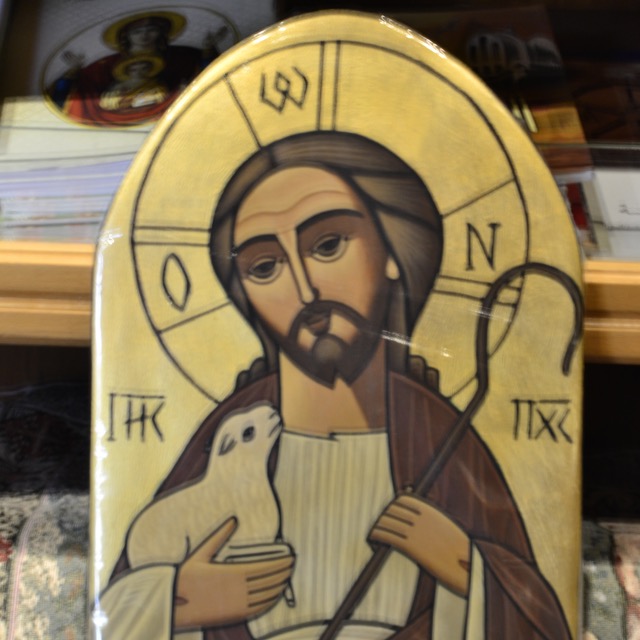
‘I am the Bread of Life’ Trinity X (19th of Year B)


I was somewhat troubled when I first read this morning’s Gospel. I find it all too easy to moan about all sorts of things, it is a very human failing, one to which we all, from time to time, succumb. But it’s something which Our Lord tells us not to do, and so I pray that through God’s grace I may live a life which more closely imitates Jesus, and follows His commands. It reminds me of a passage in the sermons of St Augustine, Bishop of Hippo and Doctor of the Church: ‘“You all say, ‘The times are troubled, the times are hard, the times are wretched.’ Live good lives and you will change the times. By living good lives you will change the times and have nothing to grumble about.”’ (Sermo 311.8) It reminds us that the work of the Gospel is at one level up to us, the Body of Christ, His Church. We have to live our faith out in our lives (as fine words butter no parsnips) and we have to live the change we want to see in the world. Christianity is a way of life, a way mocked and scorned by the world around us, written off as irrelevant, and yet close to the God who loves us and saves us.

       In the Old Testament reading this morning we see the prophet Elijah being fed, we see God providing food which gives strength, strength for the journey. It prefigures the Eucharist, it looks forward to the reason why we are here today: to be fed by God. We can have the strength for our journey of faith, and the hope of eternal life.
       In the letter to the Ephesians we see that as children of God, loved by God, we are to imitate him, after the pattern of Christ, who offered himself, who was a sacrifice who has restored our relationship with God. It is this sacrifice, the sacrifice of Calvary, which has restored our relationship with God, which will be re-presented, made present here today, that you can touch and taste, that you can know how much God loves you; that you can be strengthened and given the hope of eternal life in Christ – that God’s grace can transform your human nature so that you come to share in the Divine Nature forever. Paul’s hope for the church in Ephesus should be ours to. This is how are supposed to live together as a Christian community, living in love, fed with love itself, here in the Eucharist, where we thank God for His love of us.
       In this morning’s Gospel we see Jews complaining, ‘how can he be from Heaven, from God, we know his Mum and Dad’. It is a difficult thing to understand, especially before Jesus suffers and dies, and rises again. It can be hard to understand who and what Jesus is. The Jews can see him only in purely human terms, they cannot see beyond this, the Messiah whom they long for is in their midst and they fail to recognise him. The notion of consuming human flesh and blood is so abhorrent to Jews that it would represent something sinful and polluting. Jesus’ answer is simple and challenging: stop complaining. We are to accept, we are not to moan, to complain, but instead to trust him who is the Way, the Truth, and the Life.
       Jesus is the Bread of Life, the true nourishment of our souls. It is through him that we can have life as Christians. He came down from heaven and became incarnate by the Holy Spirit of the Virgin Mary. He was born as a human being, and in him our human flesh has been raised to eternal life, to glory with God. Jesus speaks of the Eucharist, the sacrament of his body and blood as providing us with eternal life, of opening the way to heaven. So we come to be fed by God, to be fed with God, to have a pledge and foretaste of the joy of heaven, of eternal life with God, to experience true love in the source of love – the Triune God, Father, Son and Holy Spirit.
       We can have such a hope because Jesus gives himself, to suffer and die, and rose again, for love of us. It is this life of love and sacrifice which we are to imitate. Jesus gives himself to us for the life of the world – it is through being fed by him that the world can truly live. It is in experiencing God’s self-giving love that the world can find true meaning. Life in Christ is what true life means. Fed by him, strengthened by him, to imitate him and live out lives of self-giving love, to draw others closer to Christ so that the world may believe and give glory to God the Father, God the Son, and God the Holy Spirit, to whom be ascribed as is most right and just, all might, majesty, glory, dominion, and power, now and forever.

Sermon for Trinity IX (18th of Yr B) John 6:24-35

Jan van Eyck The Adoration of the Lamb from the Ghent Altarpiece


In Exodus the people of Israel moan an awful lot, in this morning’s reading they are hungry and they long to be fed, and so God answers their prayer and gives them manna and quails, they are fed with bread and meat, a miracle which points forward to the more miraculous feeding when Christ will give his flesh, the bread of life, so that we his people may have life in Him, so that we may be built up in love, so that His Divine nature may transform our human nature and prepare us for heaven.
In this morning’s Gospel, we see people who have been fed in the miraculous feeding, the feeding of the five thousand, following Jesus around. Perhaps they’re hoping for another free lunch? They have seen and yet they have not seen the signs; they haven’t understood what’s going on. They haven’t seen what Jesus is doing and why he is doing it
Jesus feeds people not as a combination of magic trick and mass catering, but as a sign of God’s generous love, his healing and forgiveness. That God loves us, you and me, all of us, so much, that he longs to feed us with himself, that he gives himself to be tortured and die on the Cross for us, to show us that he loves us, to heal our wounds, to take away our sins. His feeding of the people of God points to this, so that they might believe in Him. And believing in Him, be fed by Him, fed with him, so that they might have life, and life in all its fullness.
Jesus wants us to believe in him, to trust in him, to be fed by him, with him, the Word of God made flesh, to be fed by word and sacrament, to be strengthened to live our life of faith, growing into His likeness, and to live out that faith in the world around us. Jesus is the true bread come down from heaven which satisfies our spiritual hunger in a way which the world: success, money, possessions, what we have and what we do, cannot. He is the living water which satisfies the thirst of our souls. If we believe in Him, and in Him alone, we will never be thirsty. He gives us not what we want, but what we need: a love, a true love which gives meaning to human love, and to all of human existence: a generous self-giving love.
One of the Desert Fathers was asked by a soldier if God accepted repentance. After the old man had taught him many things, he said, ‘Tell me my dear, if your cloak is torn do you throw it away?’ He replied, ‘No, I mend it and use it again.’ The old man said to him, ‘If you are so careful with your cloak, will not God be equally careful about his creature?’ God’s grace does not abolish our human nature but transforms it, through the power of the Holy Spirit, so that we may live forever in Him, living out our faith.
If we trust in God, and live our lives according to his will, loving God and each other, with faith in him alone we can win a reward which lasts far longer than human praise or glory: the crown of eternal life and the glory of heaven. So let us be fed by him, with him, let us be nourished by word and sacrament, let us believe in him, let us love Him and love one another, and live lives which proclaim his life, his truth and his victory to the world around us: a victory which allows us to win a greater prize, a greater glory than anything this world can offer – true life, true glory, and true joy with him forever in Heaven, who is the Way, the Truth and the Life.

Seventeenth Sunday of Year B (John 6:1-15)


As you were getting up this morning, to get ready to come to church, you probably went into your bathroom to wash your face and brush your teeth and turned on the tap marked ‘C’, and all was well. If you went on holiday to Italy and you wanted to have a drink, wash your face or brush your teeth, you may well stand by a sink and turn on the tap marked ‘C’ and you would get a nasty shock. It stands for Caldo the Italian word for Hot. What you needed to do instead was to turn on the tap marked ‘F’ for Fredo or Cold.
This mistake is easily made, especially since we are so used to seeing the letter ‘C’ on cold taps back home. But it shows us the problem of misreading the signs. In today’s Gospel we have several examples of people misreading signs. First, we have Philip: he is asked by Jesus where they can buy bread for the crowd to eat. He replies that 200 denarii would only buy them a mouthful each. Six months wages just for a mouthful! So Philip can see no way that the people can be fed. He is unable to see past the practicalities.
Andrew begins better. He shows Jesus a boy with two fish and five barley loaves, the bread of the poor. But he cannot see the point and asks ‘what is that between so many?’ The disciples cannot read the signs and give the wrong answers to Jesus’ questions
The people are also a bit of a mixed bag. They have followed Jesus as they are impressed by outward things, his miraculous healing of the sick. Once they have been fed, they recognise the sign as a declaration of Jesus’ identity, but they misinterpret it. They are about to take him by force and make him king. This is not what Jesus’ kingship is about, he isn’t a political ruler, and his kingship is not of this world. All three have expectations which are met, but not in the way they were expecting.
The context of the Gospel story is important. It was just before the Passover, the festival commemorating Israel’s journey from slavery in Egypt, across the Red Sea towards the Promised Land. It is a festival of Hope and Freedom, of Liberation, of a God who will feed them with manna from heaven.
It is also the same time that Jesus will celebrate the Last Supper with his disciples, instituting the Eucharist, which Christians have faithfully celebrated ever since and the reason why WE are here today. The blessing, breaking and sharing of bread is a serious matter then, and not just an excuse for a conjuring trick.
The fact that it is a serious matter explains why Jesus will devote so much time and effort to teaching the people about this in the Gospel passages we will read over the next few weeks. It matters because it is how we encounter Jesus and are fed by him.
In the Gospel, it is Jesus who takes the initiative. He recognises that people are hungry, and that they need to be fed. He takes the basic foodstuff, bread, to show us how God works with simple things. These may be, like the barley loaves, poor, the kind that the world despises and looks down its nose at, but for God, nothing or indeed nobody is scorned or cast aside. Ours is a God who takes what is available and uses it. Jesus takes what he is given and thanks God for it, in recognition that all we have, our lives and all of creation is a gift, for which we should thank God.
It is through prayer and blessing that bread can be broken and distributed and provide sustenance, on a scale and in a way that defies our expectation and understanding. Not only are the people fed but as a sign of the superabundance of God’s love and mercy, there is more left over at the end than there was to begin with. Thus, in giving thanks to God and sharing his love, the kingdom of God of which the bread is a sign, grows, is shared, and satisfies people’s deepest needs.
Jesus takes, blesses, breaks and distributes bread to demonstrate what the Kingdom of God and the message of the Gospel is. This looks forward to the Institution of the Eucharist, just before Passover. It points to the great Passover, where the world is freed from the slavery of sin, washed in the Red Sea that flows from Calvary, and given the Law of love of God and neighbour.
This miraculous feeding by the shore of the Sea of Galilee will happen here today, when we, the people of God, united in love and faith offer ourselves and like the little boy, give the bread that we have, so that it may be taken, blessed, broken and given that we may be partakers in the mystical supper of the Kingdom of God. We eat the Body of Christ not as ordinary food – that it may become what we are – but that WE may become what HE is. THIS is our bread for the journey of faith. THIS is the sign and token of God’s love. THIS is the means by which we too may enjoy forever the closer presence of God.
So then, as the five thousand received and were satisfied, let us prepare to eat that same bread, the body of Christ, which satisfies our every need and fills us with a foretaste of the Kingdom of God

Trinity IV (Thirteenth Sunday of Year B)


Our society has got rather caught up with the cult of the individual, and while matters of healing and salvation have been seen as individual matters, they are best understood as community affairs: what affects us affects our family, our friends, and community, as we do not live in isolation, likewise Christ’s healing love is poured out on individuals who are part of a community.  Likewise the church is to be a place of healing and love, for individuals, and for the community.
Given the events of the last few days it is impossible for us not to describe our world as one in need of healing. Our human proclivity for violence seems as strong as ever, which reminds us that when things are left up to ourselves they don’t always end well.  We need some help, and that can only come from God.
       St Antony the Great once said ‘Our life and our death is with our neighbour. If we win our brother, we win God. If we cause our brother to stumble, we have sinned against Christ.’ In the words of Rowan Williams:
‘Winning the brother or sister isn’t – in the perspective of St Antony – a matter of getting them signed up to something, getting them on your side, but opening doors for them to God’s healing. If you open such doors, you ‘win’ God, because you become a place where God ‘happens’ for someone else, where God comes to life for someone in a new and life- giving way – not because you are good and wonderful but because you have allowed the wonder and goodness of God to appear (and you may have no idea how). When we shift our preoccupations, anxiety and selfishness out of the way and some space appears for God, we ourselves are brought in touch with God’s healing. And so, in winning the brother and sister, we win God.’[1]
       This morning’s Gospel is concerned with healing, that of Jairus’ daughter and the woman with a haemorrhage. They show us the power of God to heal and restore humanity, which points to the Cross which is the greatest place of healing, where Christ bears our sins: for by his wounds we are healed, we are washed in his blood, healed and restored to new life in Him. Christ who was rich, for our sake made himself poor, so that we might become rich by his poverty. Likewise he gives himself under the outward forms of bread and wine, so that we can be healed by Him. Unlike the physicians who have taken all of the woman’s money and not made her better but worse; Christ’s healing is free. The woman is afraid, but Christ does not want to single her out, but rather is conscious that someone is in need of healing, hence his words: ‘Daughter, your faith has made you well; go in peace, and be healed of your disease.’  She has faith: she believes that simply by touching his clothes, by being close to Jesus, that she can be healed. Likewise Jairus, a well-known pillar of the community, who sits at the front of the synagogue, falls at Jesus’ feet and begs him repeatedly: here is a desperate man, whose concern is not for his own station, but rather that his daughter may be made well and live. He comes to Jesus, who raises his daughter, who restores her to health and life. Jairus is humble; he knows his need of God.
       We, too, know that we need God’s healing, in our lives and in the world around us. We need to come to Jesus, so that we can be healed by Him, and restored by Him, to have life and life in all its fullness. We are given a foretaste of it here, this morning, in the Sacrament of His Body and Blood, given to us so that we might be healed, body and soul, and given a foretaste of eternal life in Christ.
       Let us come to him, so that we too might be healed and restored by him, so that we might be built up in love, and our families and communities too might be healed and restored, living life in all its fullness – this is what Christ comes to bring to a world in need of healing. Let us come to him, so that we might be built up in love, so that the Kingdom may grow, so that we can invite others so share in God’s gift of his healing love, so that ransomed, healed, restored, and forgiven by him, through Christ’s saving death, we may sing the praises of God the Father, God the Son, and God the Holy Spirit, to whom be ascribed, as is most right and just, all might, majesty, glory, dominion, and power, now and forever.


[1]Rowan Williams Silence and Honeycakes: The wisdom of the desert , Oxford 2003: 104-5

10th Sunday of Year B


This morning’s readings start at the beginning, which, as we know, is a very good place to start, we go back to the root of the problem of the human condition – sin, not listening to God, and not obeying God, and suffering which we experience as a result of it. It is the common inheritance of humanity – we think we know better, that we can assume a place which rightly belongs to God and not suffer as a result. Worst of all, in the Genesis story Adam and Eve cannot even own up to their failing, they eschew the humility of being honest to God, preferring to try and shift the blame to someone else.  If that were the end of the story, then it would make for some fairly bleak reading and we would have every right to feel rather glum this morning, but thankfully this morning’s second reading from Paul’s Second Letter to the Corinthians can give us hope that this is not the end of the story, that we can have hope of a new future in Jesus Christ, and an eternal destiny thanks to him. Such is grace, the undeserved free gift of God, which should make us hopeful and thankful, and to live our lives in the light of Jesus Christ’s death and resurrection for our sake.
In this morning’s gospel we see that Jesus can provoke some strong reactions: it’s all a bit hot and bothered in Nazareth, there’s such a crowd around Jesus that he cannot even eat a meal, it’s clearly chaotic. Members of his family are so concerned for his safety and well-being that they want to restrain him, as they are not sure that he’s in his right mind – they cannot understand what is happening around them, and how it is that someone whom they know is doing this; the religious authorities likewise cannot understand his actions and accuse him of being possessed by an evil spirit.
Thankfully, Jesus is having none of it, and speaks to them in parables – How can Satan cast out Satan? How can they ascribe this to the devil? What they have witnessed are healings: they have seen humanity restored before their very eyes . The scribes have mistaken the kingdom of God for the action of the evil one, they, like Jesus’ relatives have fundamentally misread the situation. In ascribing Jesus’ actions, his preaching and his miraculous healing, to the powers of darkness, they have sinned against the Holy Ghost, which is apparently unforgiveable: they have mistaken the actions of God for those of the devil, they are blind, they are unable to see that what they are witnessing is the Messianic future foretold by the prophets – scripture is being fulfilled but they are unable or unwilling to recognise the fact.
       Then Jesus shows us that compared to our earthly ties, those of the kingdom are far wider, if whoever does the will of God is Jesus’ brother and sister then that should include all of us, and a whole lot more people – we are called into a relationship with God and with each other which transcends earthly ties and gives us a new paradigm within which to live. Thus to be in the church is to be part of Jesus’ extended family, called into a relationship with Him. It is a relationship characterised by the outpouring of God’s healing love upon us – Jesus’ miraculous healings in the Gospel are a sign of the Messianic kingdom, and they point to that great healing of all of humanity upon Calvary, where Jesus suffers and dies, taking our sins upon himself, paying the price which we cannot, so that in Christ humanity may be healed from the guilt and power of sin. It is that same sacrifice which is made present here, this morning, where we the people of God are given a foretaste of heaven, where we receive His Body and Blood, as a pledge of future glory, a healing remedy, the balm of Gilead to heal our sin-sick souls, the greatest spiritual medicine in all of creation, in all of history, is here for us now. So let us come to him, to be healed and restored by him, filled with his love and sharing that love with others.

Sermon for Evensong of the First Sunday after Easter

An old man said, ‘Joseph of Arimathea took the body of Jesus and placed it in a clean garment within a new tomb, which signifies a new humanity. Therefore let each one strive attentively not to sin so that they do not mistreat the God who dwells within themselves and drive him away from their soul.’
It is a good thing that we have time at Easter to take in and make sense of what we have commemorated: Our Lord’s Passion, Death, & Resurrection. They are linked and form part of a larger whole of the history which stretches back through the Incarnation, of the Word made flesh for our sake, to the Creation of the World.
 In the 8th Chapter of the Acts of the Apostles we see the meeting of Philip and an Ethiopian eunuch, who is reading the very passage which we have just heard  as our first lesson this evening– the Suffering Servant. Philip asks him if he can understand what he is reading. He replies that he cannot, unless someone shows him the way. ‘Then Philip opened his mouth, and beginning with this Scripture he told him the good news about Jesus.’ (Acts 8:35 ESV). Isaiah’s prophesy is fulfilled in Jesus and this is the proclamation of the Church: we proclaim Jesus Christ and him crucified.
We read scripture so that we can understand it, and see in its words how it discloses the truth of the Word made flesh, who suffered and died for our sake. Isaiah prophesies Our Lord’s Passion and Death, it, like the rest of Scripture points to Christ and finds its true meaning in Him, and thus it makes sense, it can be understood, and the more we come to understand, the more we come to know just how much God loves us.
Thus for Paul in the Letter to the Romans he needs to show them how Abraham, the father of our faith is rewarded by God not through his observance of the Law, as the Pharisees would argue,  but rather by the obedience of his faith in God which can lead to his righteousness.
As Christians we believe that we are saved by grace through faith – by grace, by the unmerited free gift of God who gives his own Son to be born, to suffer and die and to rise again for us, so that we might have life in Him, through our faith, through believing in the God who does this.  We can put our trust in a God who loves us, who dies this for us, to heal us and restore us, and thus we can have new life and eternal life in Him. It is unmerited: we do not deserve it, but it is a free gift rather than a reward, something earned.
In Christ the promise made to Abraham comes true in that through the proclamation of the Gospel, the Good News of Jesus Christ to the whole world Abraham can become the father of many nations, the word for the non-Jewish peoples of the world – he becomes a spiritual parent to Christians because of Abraham’s faith in God, he trusts God, even to the point of being ready to sacrifice his only son, which itself points to Christ, who as the Lamb of God who takes  away the sins  of the world is a type of the lamb caught in the thicket at Bethel. Abraham trusts in God, puts his faith in Him, and is rewarded for that faith. We put our faith in Him, and are fed by Him, fed with Him, so that we may share in his Divine life, strengthened and nourished by God, so that his grace may perfect our nature.
Thus we are to follow Abraham’s example and put our faith in the God who loves us and saves us by His Son, who suffered and died and rose again for our sake. It’s all about faith: faith in Jesus Christ, who died and rose again for us, who was delivered up for our sins and raised for our justification, this is what we believe, we have to be like Philip and share it with others, so that they too may believe and give glory to God the Father, God the Son, and God the Holy Spirit, to whom ….
            

A thought for the season from Dr Pusey

O
 THOU, Who didst manifest Thyself in the breaking of bread to Thy disciples at Emmaus, grant us ever through the same blessed Sacrament of Thy Presence to know Thee, and to love Thee more and more with all our hearts. Abide with us, abide in us, that we may ever abide in Thee; dwell in us that we may ever dwell in Thee, O good Jesu, Thou God of our salvation.

Maundy Thursday 2015

Since our Divine Lord came to die, it was fitting that there be a Memorial of his death. Since he was God, as well a man, and since he never spoke of his death without speaking of his Resurrection, should he not himself institute the precise memorial of his own death? And this is exactly what he did the night of the Last Supper….His memorial was instituted, not because he would die and be buried, but because he would live again after the Resurrection. His Memorial would be the fulfillment of the Law and the prophets; it would be one in which there would be a Lamb sacrificed to commemorate spiritual freedom; above all it would be a Memorial of a New Covenant…a Testament between God and man.
Fulton J. Sheen Life of Christ
My brothers and sisters, we have come together on this most holy night to enter into the Mystery of Our Lord’s Passion: to be with him in the Upper Room and in the garden of Gethsemane, and to prepare to celebrate his suffering and death – to behold the glory of the Lord and his love for the world he created and came to save.
            Obedient to the Old Covenant, Our Lord and his disciples prepare to celebrate the Passover: the mystery of Israel’s deliverance from slavery in Egypt to the new life in the Promised Land. While they are at table Our Lord lays aside his outer garments and takes a basin and a towel and washes the Apostles’ feet. He says to them I have given you an example so that you may copy what I have done to you.
The new commandment given to the disciples by our Lord at the Last Supper in John’s account is to love one another as he has loved us. The washing of the disciples’ feet is an act of loving service:  God who created the universe and who will redeem it kneels and washes the feet of sinful humanity. This is true love in action. . It is a gesture of humility and intimacy, which shows us how God loves us and how the events of the next few days will show us the depth of this love, a love which brings the entirety of the human race, past, present and future into a relationship with a loving God, through his sacrifice of himself upon the cross and through his bursting from the tomb
            But before this love is disclosed in our Lord’s Passion, Death and Resurrection, it is shown in loving service and humility, the Greek word for which is diakonia, which gives us our English word Deacon. All those who are ordained are set apart for the service of Almighty God and his church and we are all called to serve God and his people fashioning ourselves after the example of our Lord and Saviour Jesus Christ. All ordained Christian ministry is rooted in the diaconate, in a ministry of loving service, after the form and pattern of Our Lord and Saviour Jesus Christ, following HIS example and living it out in our lives. This is a most wonderful and humbling task which can fill us with both joy and fear and I would humbly ask that you continue to pray for me and for all of us who serve the church in this place, since we can do nothing without you.
            Christ then takes bread and wine and blesses them and gives them to his disciples. Again, this would look and feel like the Passover celebration to which they were accustomed. Except that before he broke and distributed the bread he said ‘Take, Eat. This is my body, which is given for you. Do this in remembrance of me.’ And before the Cup was distributed he said ‘Drink of it, all of you, for this is my blood of the new covenant, which is poured out for many for the forgiveness of sins. Do this, as often as you drink it, in remembrance of me.’ He feeds his disciples with his own body and blood to strengthen them, to show them what he is about to do for love of them and of the whole world. When, earlier in his public ministry, he has fed people he taught them in the synagogue at Capernaum ‘Truly, truly, I say to you, unless you eat the flesh of the Son of Man and drink his blood, you have no life in you. Whoever feeds on my flesh and drinks my blood has eternal life, and I will raise him up on the last day. For my flesh is true food, and my blood is true drink.  Whoever feeds on my flesh and drinks my blood abides in me, and I in him. As the living Father sent me, and I live because of the Father, so whoever feeds on me, he also will live because of me.’ (Jn 6:52–7 ESV). ‘Was ever another command so obeyed? For century after century, spreading slowly to every continent and country and among every race on earth, this action has been done, in every conceivable human circumstance, for every conceivable human need from infancy and before it to extreme old age and after it, ….  just to make the plebs sancta Dei—the holy common people of God’ [Dix The Shape of the Liturgy 744] Our Lord institutes the Eucharist, the Sacrament of His Body and Blood, to feed us, to nourish us, so that we may become what he is, that we may have a foretaste of heaven and the divine life of love, of the beatific vision of God, Father, Son, and Holy Spirit, the Holy, Eternal and Consubstantial Trinity. It re-presents, it makes present again, here and now, the sacrifice of Calvary, where upon the Altar of the Cross, as both priest and victim, Christ sacrifices himself for the sins of the whole world. He is the Lamb of God, foreshadowed in the ram offered by Abraham and Isaac, in the bread and wine offered by Melchisedek. In the blood and water which will flow from his side we are washed and creation is renewed. Christ gives the Church the Eucharist so that his saving work may continue, so that people may be given a pledge and token of their eternal life in him. It is loving service for our Lord to feed his disciples with his own body and blood. This the church was formed continue, offering the same sacrifice of Calvary at the altar, feeding His people with His Body and Blood, nourishing the church as a mother feeds her children, filling us with his love and grace, to transform our human nature through our sharing in the divine life of love. This is what priests and deacons are called to be, those who serve the people of God and nourish them with the word and sacrament, building up the body of Christ. We are to live exemplary lives of love, service, and prayer, which can serve as examples for the whole baptised people of God to copy and imitate in their own lives. This is a great, an awesome and wonderful task, for which we rely upon the grace of God’s and the help and support of you, the people of God in this place. It is not something which we can do on our own, relying on our own abilities or strengths, but on God. For we all, as Christians, are called to love one and to serve one another in a variety of ways. In this we follow the example of Christ, who washes our feet, who institutes the Eucharist to feed us with himself, to transform our nature by his grace and bring about the full flowering of the kingdom of God. He sets his disciples apart, consecrating them to God, for a life of prayer and service and to carry on the sacrifice of Calvary through their offering of the Eucharist of the altars of his church, to feed his people. This is the glory of God: in transforming bread and wine into his very self for the life of the whole world – a sign of love and a pledge and foretaste of eternal life. This is love that we can touch and feel and taste – given for us so that we might have life in him.
            So then, let us prepare for Christ to wash our feet, as the blood and water which will flow from his side tomorrow on Calvary will wash away all the sins of humanity, let us be fed with his body and blood, which tomorrow he will offer upon the altar of the cross as both priest and victim, reconciling humanity and embracing a world with his loving arms as he is nailed to the wood. And let us follow his example, in living lives of prayer and loving service, supporting one another so that the world may believe and give praise to God the Father, God the Son, and God the Holy Spirit, to whom be ascribed as is most right and just, all might, majesty, glory dominion and power, now and forever. AMEN.

Palm Sunday 2015


If anyone asks you why you are untying it [the ass the disciples were sent to find], this must be your answer, ‘The Lord has need of it’ (Lk 19:31). Perhaps no greater paradox was ever written than this – on the one hand the sovereignty of the Lord, and on the other hand his ‘need’. His combination of Divinity and dependence, of possession and poverty was a consequence of the Word becoming flesh. Truly, he who was rich became poor for our sakes, that we might become rich. Our Lord borrowed a boat from a fisherman from which to preach; he borrowed barley loaves and fishes from a boy to feed a multitude; he borrowed a grave from which he would rise; and now he borrows an ass on which to enter Jerusalem. Sometimes God pre-empts and requisitions the things of man, as if to remind him that everything is a gift from him.
Fulton J. Sheen Life of Christ
Pomp and ceremony seem to have been at the top of the agenda of late: in a week which saw the re-burial of the mortal remains of King Richard III, this is hardly surprising. As triumphant entries go, the one we see in the Gospel this morning is a bit strange: generally speaking, we are used to kings riding on horses, looking like powerful military leaders. Here we see something different, something which defies our expectations and which stops us seeing things in purely human terms.
          There are people who would ask, why all this fuss? Would Jesus have wanted it, would he want us to be carry on with it? If it were something which would not want us to do he would have said so. He did it because it was important, because it fulfilled prophesy and because liturgy is an important thing in and of itself: it marks out various things as special and helps us understand both who and what we are and what we do – it forms both habit and indeed our moral character.
          The crowd cry out “Hosanna to the Son of David! Blessed is he who comes in the name of the Lord! Hosanna in the highest!” (Mt 21:9 ESV) They cry out for God to save them, and that is exactly what he will do in a few days time, upon the Cross. This is a God who keeps his promises and defies our expectations. The crowd are expecting a king of the Davidic line, which would be seen as a challenge to the ruling elite, the status quo, but in Christ God gives Israel a King of the line of David forever. Those with power are threatened by him: he is awkward, an inconvenience. Jesus does not want their power, as he has come to be and do something completely different: what is taken as a political coup is a renewal of religion, the fulfilment of prophesy, and a new hope for Israel. 
In riding into Jerusalem Jesus is fulfilling the prophesies of Zechariah (9:9) and Isaiah (62:11).  The King of Israel comes riding on a donkey: a humble beast of burden, which carried his Mother to Bethlehem for his birth. It is an act of humble leadership which fulfils what was foreseen by the prophets. It shows us that Jesus Christ is truly the one who fulfils the hopes of Israel. The Hebrew Scriptures look forward to the deliverance of Israel, which is enacted in front of their very eyes.

Today and in the coming week we will see what God’s Love and Glory are really like: it is not what people expect, it is power shown in humility, strength in weakness. As we continue our Lenten journey in the triumph of this day and looking towards the Cross and beyond to the new life of Easter, let us trust in the Lord, let us be like him, and may he transform our hearts, our minds and our lives, so that they may have live and life in all its fullness. We are fed by the word of God and by the sacrament of His Body and Blood to be strengthened, to share in His divine life, to fit us for Heaven, and to transform all of creation that it may resound his praise and share in his life of the Resurrection, washed in His Blood and the saving waters of Baptism: forgiven and forgiving so that all that we say, or think, or do, all that we are may be for the praise of God the Father, God the Son, and God the Holy Spirit, to whom be ascribed as is most right and just, all might, majesty, glory dominion and power, now and forever…

Lent IV – Looking to the Cross

For God sent his Son into the world not to condemn the world, but that through him the world might be saved.
It is far too easy nowadays to see the church in a negative way –  it’s the fashionable thing to do – as the church we’re corrupt, we’re filling people’s heads with nonsense. We can be characterised as strange, quaint, and out of touch. It suits people to see us entirely in negative terms: as opposed to certain things. We are prescriptive: we limit people’s freedom, and in failing to practice what we preach, we can be written off as hypocrites, with no right to proclaim objective truth, to offer the world a moral framework, within which to live its life; to offer the world an alternative paradigm, a new way of living and of being through which to have life, and have life in all its fullness. It’s less a valid criticism and more of an excuse for people not to bother. It’s an easy way out, which saves people from the more difficult task of living Christ-like lives of love and self-sacrifice. The church does not claim to be perfect, but rather a collection of sinners justified by the grace of God, through faith in Christ.
          The simple truth is that people like to moan and grumble – we all do, and I’m as guilty of it as anyone, but there is a fundamental difference between being dissatisfied with the way things are and longing for change, and hopefully bringing about good change, change in a god-ward direction, and the corrosive moaning rooted in selfishness, which betrays a lack of trust in God. The Israelites in the desert represent this negative moaning, they are unable or unwilling to trust God to lead them on a journey towards the Promised Land, and while they realise their mistake their poisonous moaning has disastrous consequences for them. And yet even in this they are not abandoned by God, they gaze on the bronze serpent, they look to that which prefigures the Cross, through which God heals his people, taking their sins upon himself. That’s why it appears in stained-glass windows in churches, because it points to the Cross, it’s why when talking about the Cross Jesus mentions it, so that people might understand how and why God loves them and how it might affect their lives.
St Paul in his letter to the Ephesians can state with confidence, ‘For by grace you have been saved through faith, and this is not your own doing; it is the gift of God – not the result of works, so that no one may boast(Eph 2:8-9). It’s not about what we can do, but about what God can do for us. Our relationship with God is the result of a gift, which we can receive and which can transform our lives, if we only let go, and let God…
          This morning’s gospel reminds us of the fundamental truth that God loves us – it is the heart of the Good News – the Gospel, what we preach and what we live as Christians. There are few words as comforting as ‘For God so loved the world that he gave his only Son, so that everyone who believes in him may not perish but may have eternal life. ‘Indeed, God did not send the Son into the world to condemn the world, but in order that the world might be saved through him’ (Jn 3:16-17). They may be familiar to us, they certainly should be, but we must not let our familiarity with them cloud the significance of simply stating that God loves us, does not condemn us, but saves us, in and through Jesus Christ. That’s why we are Christians, it’s why we’re here, and recognising God’s love for us will have a transforming effect upon our lives.
In the Incarnation Jesus comes among us as a poor helpless baby, laid to rest in the rough wood of an animals’ feeding trough. He is cared for through the love of his mother, the Blessed Virgin Mary, who in her love, her service, and obedience, stands as the model for all Christians to follow. She is the first Christian, the greatest, a pattern for us to imitate, of loving trust and obedience, of care and costly love, and a foreshadowing of our great mother the church, through which we are saved by grace through faith.
          Upon the rough wood of the cross, Jesus will suffer and die for us – such is the cost of human sin. His mother, Mary, stands by and watches and weeps. As the church we too should watch and weep for the wounds of human sin and division which still scar Christ’s body. We feel helpless. What can we do? We should do all that we can to live God’s life of sacrificial self giving love: living lives of light, which shine in the darkness. It isn’t easy, but if we try and do it together then all things are possible, through him who loves us.
          The salvation and eternal life which Christ offers freely to all, comes through the church, which we enter in baptism, where we are nourished in word and are sacrament, where we are nourished, given food for the journey, strengthened and taught, to live his risen life, to share in the joys of Easter.
          God cares so much about the world and its people that he takes flesh, and lives a life of love, amidst the messiness of humanity, to show us how to live lives filled with love, life in all its fullness. God in Christ comes among us not to condemn the world but to offer it a way of being, of being truly alive in Him. God has made us for himself, and our hearts are restless until they find their rest in him. The spiritual needs and searching which characterise people in the world around us can be satisfied in God and in God alone, through the church. We can rejoice, and relax our Lenten discipline for a little while to give thanks for the wonderful gift of God’s love in our lives, in the church, and for the world.
          But we also need to trust God, to listen to what he says through Scripture, to be fed by him, and to live lives in accordance with his will and purpose, together, as a family, as a community of love, cared for and supported by our mother, the church. And in so doing we look to Our Lady as Mother of Our Lord and Mother of the Church, as a pattern for love and obedience, as a model for all mothers: loving and tender, putting the needs of others before self, self-giving, sacrificial, and open to both joy and pain, trusting in God.

This, as any mother can tell you, is not easy, it’s difficult, really hard, but its rewards are likewise great. So let us, as we continue our Lenten journey towards the cross, where God shows his love for us most fully and completely, giving his body to be broken and his blood be shed for us, a sacrifice which will be made present here today under the outward forms of bread and wine, to strengthen us to live the risen life of Easter, to offer the world an alternative to selfishness, to self-centredness, to the sin which continues to separate us from God, an alternative shown to us in a self-giving love of mothers, and of our mother the church. So that we may join the Angels in our song of love and praise to the Trinity: Father, Son, and Holy Spirit, to whom..

Jesus at the Synagogue in Capernaum


The beginning of Jesus’ public ministry is centred around Galilee: he’s on home territory. Having called the first disciples to help Him in the proclamation of the Good News of the Kingdom, Jesus goes to Capernaum with his disciples to teach on the Sabbath in the synagogue there. He teaches them, he explains the Jewish Scriptures, the Word made flesh, the Living Word, is among them. Their reaction is one of astonishment – amazement that he teaches them, not as the scribes but as one having authority. Rather than explaining human teaching in a human way, people are drawn closer to God, by one whose power and authority are derived from God, because that is who he is. Jesus can explain the Scriptures because he is the Way, the Truth, and the Life – He is the fulfilment of Scripture, and it finds its meaning in and through Him.
            There is a man in the synagogue who is not well. The Gospel uses the language of possession by an unclean spirit, whereas nowadays we would probably use the language mental illness. The man in his brokenness can recognise who and what Jesus is – the Holy One of God. The point of the Kingdom which Jesus proclaims, which he explains in his teaching, is that it is a place of healing. Ours is a God who can heal our wounds, who can take broken humanity and restore it in love. This is why Jesus’ teaching and the healing have to go together; they are both part of a larger whole, the coming Kingdom of God. Jesus proclaims our need to love God and each other, and puts it into practice, making the healing power of God’s love a reality in the world.
            From the very beginning, Jesus looks to the Cross, not as a place of torture, of humiliation, or defeat, but as a place of victory, and healing, as the supreme demonstration of God’s love for humanity – this is how much God loves us, this is why he sends his Son to heal our wounds, to restore us, and to give us the hope of Heaven. This healing love is what we have come to experience here this morning, where under the outward forms of bread and wine we are fed with the Body and Blood of Christ, so that their Divine nature might transform our human nature, might give us a foretaste of heaven, healing our wounds, taking away our sins, cancelling the debt which we cannot pay, so that we might have life in Him, in this world and the next.
            The possessed man asks ‘Have you come to destroy us?’ We know that Jesus has come not to destroy but to heal, so that we may have life and have it to the full – this is the Good News of the Kingdom, which is still a reality here and now – we in our brokenness can come to the source of healing, to the God who loves us and gives himself for us so that we can be healed and restored by Him. He can take our lives and heal us in His love. So let us come to Him, let us be healed by Him, that our lives too may be transformed, and let us proclaim to a world which longs for healing and wholeness the love of God in Christ. 

Epiphany II: John 1:43-51

In John’s Gospel we have seen Jesus baptised by John the Baptist, we have heard John declare ‘Behold the Lamb of God, who takes away the sins of the world’, we have seen Jesus call Andrew and Simon Peter, disciples of John, to follow him. Now Jesus decides to go from Bethany to Galilee, to go back home. He begins by saying to Philip ‘Follow me’ a simple invitation, which he accepts. Coming from Bethsaida, the same city as Andrew and Peter it is certain that Philip knows them, and is well-disposed to join in with them, and to answer Jesus’ invitation. He then finds Nathanael and testifies that Jesus is he who is spoken of in the Law of Moses and the prophets, the Messiah, the saviour of Israel. Nathanael’s reply, ‘Can anything good come out of Nazareth?’ looks like a proverbial saying – it reminds us of Jesus’ ordinary earthly existence, growing up in a backwater town. Nathanael’s initial scorn will be transformed; such is the power of God. Philip counters by saying ‘Come and see’, Jesus’ answer to John’s disciples who want to know where he is staying. This invitation to come and see for oneself lies at the heart of the proclamation of the Good News, it remains as key now as it did nearly two thousand years ago.
       Jesus sees Nathanael coming towards him and says ‘Here is an Israelite in whom there is no guile’ he’s plain-speaking, honest, there’s no flannel here. Nathanael is amazed before long has acclaimed Jesus as a teacher, the Son of God and King of Israel. Clearly something good can come out of Nazareth, good enough to save the world. For the kingdom to grow we cannot simply expect to open our doors and see people flood in, we have to invite people in, to say to them ‘Come and see’ and make sure that they see Jesus in Word, Sacrament, and in the lives of those around them. Having been called, they can respond to that call. This is what the church is for – to call people to be in a relationship with Jesus, to be nourished by him. We need to continue to repeat the simple invitation of Jesus ‘Come and see’, to come and see the one who is shown in the Law and the Prophets as the Messiah, the Anointed Saviour, so that people can become close to Him.
       This openness, this willingness to be changed by an encounter with Christ, encourages us to look outwards and share our faith with others – to live lives of joy, in the knowledge that God loves us and saves us. Our faith as Christians is not something which we keep to ourselves, but rather something which we share, and which affects all of who and what we are, and think, and say, and do. Ours is a radical faith which has at its aim to change the world. It may sound strange or overambitious, but if we acknowledge Jesus Christ as the King of Heaven and Earth, who came to save humanity, we have to call the world to follow him. Our faith then is not a private matter, or something which we just do on a Sunday morning for an hour or so, but rather something which changes our lives, and affects every part of who we are and what we do. What we see starting in this morning’s Gospel is something which we can bear fruit in our lives, if we accept the invitation to ‘Come and see’ and encourage others so to do.

       The Gospel is the Good News of Jesus Christ, good news that God loves humanity, that He saves us, that He gives Himself to save us from our sins, and nourishes us with His Word and His Sacraments, so that we can have life in Him, and life in all its fullness. What starts with the Incarnation is still bearing fruit here and now, still encouraging people to come and see, to meet Jesus, to be nourished and changed by Him, let us accept His invitation, and offer it to others that they too may enter into the joy of the Lord and give glory to God the Father, God the Son, and God the Holy Spirit, to whom be ascribed, as is most right and just, all might, majesty, glory, dominion, and power, now and forever.

Christmas II

We live in a world which is obsessed by time. The pace of modern life is quite different to that of a generation or two ago. Despite the advent of labour-saving devices and technology we seem if anything busier than ever as other things come along to fill our time – we can feel pressured, worried, and anxious. This isn’t good; we can’t help feeling that this isn’t how it is supposed to be. Thankfully God doesn’t work like this. The people of Israel have been waiting for a Messiah, for a Saviour to be born, who will save Israel from their sins, but it isn’t a case of birth on demand. As St Paul writes to the church in Galatia (Gal 4:4-5) ‘But when the fullness of time had come, God sent forth his Son, born of woman, born under the Law, to redeem those who were under the Law, so that we might receive adoption as sons.’ God’s time is not our time, and the Incarnation happens not at a convenient time, but in the fullness of time – after the message has been proclaimed by the prophets, who prepare the way for the Saviour; after Mary has said ‘yes’ to God, a ‘yes’ which can undo the ‘no’ of Adam and Eve.
            This is why, at the start of his Gospel, St John, the beloved disciple, can begin right at the start of salvation history, indeed with Creation itself: his opening words ‘In the beginning’ point us straight back to the opening words of Genesis, in Hebrew BeresithIn the beginning’. This is where it all starts, where everything that is starts,  and the Word through which God speaks creation into existence, this creative power of God is what will take human flesh and be born of the Virgin Mary. The enormity of this situation should not be lost on us, we cannot think about it too much, the helpless infant born in a stable is God, who created all that is, or has been, or will be, and who comes among us weak, helpless and vulnerable, dependent upon the love and support of father and mother for everything. Christ shares our human existence from birth to death, so that we may know that ours is a God who comes among us, who comes alongside us, who is not remote, but involved, a God of love.
            St John take us back to the beginning so that we can see what we are dealing with, and how it fits into the bigger picture. What we are celebrating at Christmas is something which extends through time, both in its nature and its effects. It is why we as Christians make such a big deal of Christmas – it isn’t just something to do in the middle of winter, but along with Our Lord’s Passion, Death, and Resurrection , the most wonderful and important moment of history, which affects us here and now. What was made known to the shepherds we now proclaim to the world, what symbolically is shown in the Solemn Feast of the Epiphany, which we prepare to celebrate, where the Wise Men point to the manifestation of Christ’s Divinity to the whole world.
            ‘And the Word was made flesh and dwelt among us, and we have seen his glory, the glory as of a father’s only son, full of grace and truth.’ The reality of the Incarnation, of God with us, Emmanuel, that God lives with us, sharing our human life, shows us the glory of God, that from which Moses hid his face in the Exodus is now made plain, and displayed for all to see, a proclamation of the glory, the love, and the goodness of God, shown in our adoption as children of God, given an inheritance – eternal life and a relationship with God – a humanity restored and healed. This is the light which shines in the darkness of our world, which it cannot overcome. John the Baptist testifies to this, the Wise Men kneel in adoration before Him, bringing gold for a King, Incense for the worship of God, and myrrh which points to His Death on the Cross for our salvation. Their gifts show that they understand and value who and what Christ is, and what He does.
            Are we to be like the world, which though it was created through Him does not know him? Or like his own people, who did not accept Him? Or do we receive Him, and believe in His Name, which is above every name? Do we accept the invitation to become children of God, and do we respond to it? Do we accept the challenge to live as the family of God, loving and forgiving, as those who are loved and forgiven by God, so that our lives, yours and mine, proclaim the glory and truth of God, and the message of salvation for all the world to hear? If we accept our inheritance, the fact that there is now a familial relationship between us and God, we need to understand that with that relationship comes duty and responsibility.

            And yet we do not see this as something imposed upon us, but rather as the truth which sets us free: a relationship with a God whose service is perfect freedom. So let us walk in His light, dwell in His love, and know the fullness of His joy, let us be glad that as a pledge of His love He gives Himself, under the outward forms of bread and wine, to feed us with His Body and His Blood, a sign that His promise is true, that we can have a foretaste of Heaven, food for our journey of faith here on earth, so that we may know his love, and touch it and taste it, so that we can be strengthen to live that faith and to proclaim it by word and deed, so that all the world may enter into His joy, and live His life. 

Advent IV Year B – Veni Emmanuel

We always make the fatal mistake of thinking that it is what we do that matters, when really what matters is what we let God do to us. God sent the angel to Mary, not to ask her to do something, but to let something be done. Since God is a better artisan than you, the more you abandon yourself to him, the happier he can make you.
Fulton J. Sheen Seven Words of Jesus & Mary
 
This morning, let me begin by asking you a question. How would you feel if one day a complete stranger turned up on your doorstep and told you something strange and unexpected? Surprised? Confused? Afraid? The fact that you are a teenage girl might well intensify these feelings. When you add to this the fact that the girl will conceive a child outside marriage something for which she could be stoned to death, according to the Law of Moses, the Gospel passage which we have just heard should strike us as odd, and unsettling – this isn’t how God is supposed to work, it isn’t supposed to be like this.
        It reminds us that biblical accounts of the interaction between God and humanity show us that ours is a God who takes risks. Mary could refuse, she could say no, and human history would be profoundly different. But instead, she says “Behold, I am the handmaid of the Lord; let it be to me according to your word.” It is through Mary saying yesto God, through her acceptance and obedience, that her son, our Lord Jesus Christ, the Saviour of the world, will be born.
As we come towards the end of our Advent journey, it is good to go back to where it all started, back to the account of the Annunciation to remind ourselves what we are celebrating at Christmas – the birth of a child, but not just any child, but rather Jesus Christ, the Son of God. He is born not in a royal palace, but in a stable, with straw for a bed, surrounded by livestock. While this scene is familiar, it should still strike us as something strange. It confounds our expectations; it isn’t what we think God would do. The greatest news in human history is a teenage pregnancy – something shameful, disgraceful even, is how God saves us.
In this morning’s Old Testament Reading we see King David concerned that he is living in a house built of fragrant cedar wood while the ark of God stays in a tent. Yet while Israel journeyed to the Promised Land, the ark, God’s presence among His people was in a tabernacle, without a permanent home. It reminds us both of a verse in the Prologue of John’s Gospel: (Jn 1:14) ‘And the Word became flesh and dwelt among us’ the word translated ‘dwelt’ actually means ‘pitched a tent’ which sees the New Covenant prefigured in the Old. God pitches his tent in the womb of a young girl, so that He might come and save us. He continues to dwell with us in tabernacles and aumbries in our churches, where His Body and Blood, under the outward forms of bread and wine, feed His pilgrim people, like manna in the desert, food for our journey of faith, so that we might become what he is, so that we might have a foretaste of heaven – this is what it is all about.
The key to it all, as St Paul reminds the Church in Rome is ‘the obedience of faith’ (Rom 16:26) – Mary listens to God, she says ‘yes’, she trusts, she has faith, and through this faith and trust our salvation is brought about.

So, as we prepare to remember the story of God’s love for humanity, may we continue to be struck by its strangeness, and in the confusion may we remember that it is brought about by Mary’s acceptance, and her trust in God. May we like Mary say yes to God, welcome him into our hearts, and show forth his love to the world. 

Be Prepared – Matthew 25:1-13

The Scouting Movement has as its motto ‘Be Prepared’ which rather sums up the message of this morning’s Gospel. As people who live in the countryside we are more than used to having a supply of candles and batteries ready at hand to deal with the inevitable winter power cuts caused by bad weather. It makes sense, so that we are not caught out – having to endure the cold and dark.
      The Gospel speaks of a more serious preparedness, one which we must all face.  Our earthly lives are finite, and we have to be prepared for our end. We know that as Our Lord came among us born as a baby in Bethlehem, so he will come as Our Judge, and we have to be ready to meet Him. Rather than face this future with a feeling of uncertainty, of dread, we can as Christians have hope, we can watch and wait in hope, in the darkness, in the knowledge that Christ loves us, that he gave himself for us, he died to take away our sins, and that we can live for and through Him. It need not catch us unawares, as we have been warned, so that we can be prepared, we can be ready, with the lamp of faith and good works ready, trimmed and burning – a light burning in the darkness.
      It is a very human fear, and clearly the Christians in Thessaly around ad55 were more than a little concerned about what might happen. They can have the hope that ‘so we will be with the Lord forever.’ (1Thes 4:17) and therefore confident in that hope, they can begin to live out their faith here and now. They can live out the justice and righteousness which is pleasing to God, as it is how he wants us to live, so that we can have life in its fullness in Him.
      If what we believe in our hearts and how we live our lives are in perfect sync with each other, then we need have no fear, as the promise of sharing in Christ’s Resurrection is there for us – we do not need to be afraid, and we can get on with the business of living our lives secure in our faith. When we do this we can begin to see something of the just and gentle rule of Christ, as we will transform the world, and will be truly alive, living the life of heaven here in earth. Each day, as Christians, we pray, and we say the prayer that Jesus taught us which includes the petition ‘Thy kingdom come, Thy will be done on earth as it is in heaven’. So that our words are not empty, as well as praying for the coming of God’s kingdom, we have to do something about it – we have to show how prepared we are by listening to God and doing what he tells us.

      We pray, we are nourished by the word of God, in reading the Bible, we are nourished by the sacraments of the Church, by the Body and Blood of Christ in the Eucharist, so that we may be strengthened in our faith, strengthened to live it out in our lives, living out the sacrifice so that we may be drawn into its mystery, carrying our own Cross, and being conformed ever more and more to the example of Our Lord and Saviour, living in Him, living like Him, living the life of the Kingdom here and now, so Christ’s kingdom may come here on earth, that His will may be done. 

All you need is love

John, Paul, George, and Ringo, are not exactly what one might call theologians, but the title of their 1967 hit ‘All You Need is Love’ does seem (at one level) to encapsulate the message of this morning’s Gospel.
At its heart, Our Lord’s teaching combines two of the central commandments of the Law of Moses: Loving God with all our heart, and soul, and mind, and loving our neighbour as our self. Out of the 613 commandments of the Torah, these two are central – Jesus cuts right to the heart of the Old Covenant to show that what he is teaching is the fulfilment rather than the abolition of the Law and the Prophets. We know from elsewhere in the Gospels that when someone asks the follow-up question, Our Lord tells the parable of the Good Samaritan, to show what costly love in action looks like.
It is a big ask – in Leviticus the Lord says ‘You shall be holy, for I the Lord your God am holy.’ (Lev 19:2) As people created in the image of God, we are called to be holy, to be like God, to live out this love and holiness in our lives, in what we say and do, and in how we treat people. It is something we do together, as the body of Christ in the world.
Christ shows the world what love looks like when he dies on the Cross – embracing the world with love, and reconciling the world to God and itself. This is what being the Messiah is all about. It is why Christ continues to give himself under the outward forms of bread and wine to heal and restore the world. This is why we are here today – to be fed by him, fed with him, so that our souls and bodies may be transformed more and more into his likeness. It is our food for the journey of faith, our manna in the wilderness of this world, to strengthen us to live out our faith. This is not some optional extra, but the heart of who and what we are. We listen to what Jesus tells us, and we are obedient to Him.
We do this together as people redeemed by Him, saved from self-absorption, singing a new song to call the world to have life and have it to the full. It is the most wonderful good news, which fills us with joy and confidence – a gift far too precious for us not to give it away, to share it with others so that they may be free.
The Pharisees are reduced to silence because they are faced with Truth, with God himself speaking to them. They cannot answer Jesus because he is what the Law and the Prophets look to for fulfilment. He shows how our duty to love God and to worship him is tied up with loving our neighbour, and living out our faith in our lives. He provides us with an ethical framework within which to live, to guide our thoughts and actions, not by casting aside the moral law but by fulfilling it – by showing us what love looks like. His death and resurrection shows us what love looks like in action. It is the same love which we can taste and eat here today, which shows us how to live – following Jesus’ example and his commands. We are to be people of love, not the saccharin-sweet sentiment of the movies, but the costly self-giving love shown to us by Christ, the love which gives without counting the cost – a love which can heal the wounds of the world, which can give us that which we truly long for.
We love God when we worship Him, when we listen to what he says and obey Him. We love our neighbour through living out the forgiveness which we have received through Christ, by showing the same love and care which Christ shows to us, in giving himself to die for us, and to be raised to give us the hope of eternal life with Him.
It is all about Love, a love which gives itself to fill us, so that we can have life and have it to the full. It is a love which we can touch and taste, which can transform our souls so that we can grow into the likeness of Christ. We are nourished by Word and Sacrament so that we can live out the holiness which is our calling. We live it out together, strengthening each other, building each other up in love, praying for our needs and those of the whole world, relying upon the God who loves us, and who gives himself for us, in his strength and power, transformed by his grace.

So let us come to Him, so that we can be transformed more and more into His likeness, and invite others to so that they may believe and give Glory to God the Father, God the Son, and God the Holy Spirit, to whom be ascribed as is most right and just all might, majesty, glory, dominion, and power, now and forever.  

St Matthew

Death and taxation are two things which none of us can escape, try though we might. Most of us, I suspect, while we recognise the fact that taxation is necessary, don’t particularly enjoy having to hand over money, though we recognise that for the greater good of society it is necessary. It was, I suspect, always thus.  In the Roman Empire the business of tax collection was privatised – people paid money for the right to collect taxes, and as a result tended to collect a bit extra so that they could recover the cost of their having to buy the right to collect taxes. This could make tax collectors very wealthy indeed, and so they were not exactly the most popular people – they had a reputation for being corrupt and greedy and selfish, and were not exactly the sort of people with whom one might choose to associate.
       And yet at the start of this morning’s Gospel we see Jesus walking past a tax collecting booth and he says to the man there, called Matthew, ‘Follow me’ and he gets up and follows Our Lord. An invitation is offered, to which he responds, which changes his life, and has left us with his account of the Good News of Jesus Christ. That evening at dinner many sinners and tax-collectors want to be near Jesus, they want to listen to him, to what he has to say. For the respectable religious elite, the Pharisees, it is all too much. Why is Jesus hanging around with social undesirables? It isn’t what you’re supposed to do. Hence Our Lord’s reply ‘Those who are well have no need of a physician, but those who are sick.’ These are people who know their need of God, who are humble enough to come to him, so that they can be healed by him. He tells the Pharisees to go away and learn what the prophet Hosea meant when he said ‘I desire mercy not sacrifice’. He has come not to call the righteous but sinners, not people who think they’re fine in the sight of God, but rather those who know that they are not.
       The invitation which Jesus makes Matthew is the same one which the Church continues to make – we say to the world ‘Come and follow Him’ and the Church continues to exist because people continue to respond to that same call. The Church continues to invite people to the banquet of the Kingdom, not because they are worthy or respectable, because they have enough money or social standing, because they are the right sort, or people like us, but rather because we are all sinners in need of God’s mercy, people who need healing and restoration. We are the sick who need a physician, the physician who offers the medicine which can heal our souls – His Body and Blood. His sacrifice of Himself in Atonement for our sins and those of the whole world, to heal us and restore our relationship with God and with each other is that for which our sin-sick souls cry out. We need God’s mercy and a sacrifice which does what not human sacrifice can do. That is why we are here, so that we can be nourished with Word and Sacrament, we can be fed by the Lord, with the Lord.
       As we are fed by Him and with Him, we can likewise respond to His invitation: ‘Follow me’. Our conversion is both an event and a process, the work of a lifetime, to draw ever closer to Him, and to seek to follow Him, and invite others so to do. This is the work of the kingdom – to continue to stand against the desire of the world to make the Church respectable, full of people like us, and to fling wide the doors and invite people into the banquet of the Kingdom. It is not a treasure which we keep to ourselves, jealously guarding it, but rather which we offer to all, for this is what it means to follow Him – to do what He tells us and to live lives which proclaim the reality of the Kingdom of God here and now, for all humanity.

       So let us come and follow Him, let us respond to that invitation and encourage others so to do. Let us be fed by Him and with Him, so that our souls may be healed, so that we can experience the fullness of God’s healing love and mercy, which we do not deserve, but which nonetheless he gives to us so that we may have life and life in all its fullness. 

Homily for the 22nd Sunday of Year A

No-one can fail to see the reality of human sin: all we need to do is to turn on the television or the radio or open a newspaper and see just what terrible things human beings can do to each other and themselves.
       As part of the his proclamation of the Kingdom, Jesus has to tell his disciples what will happen – he will be taken and accused, tortured and mistreated, and killed, but also rise again so that we may know that death is not the end, that our earthly life is not all that there is. It should come as no surprise that faced with this the apostle Peter cannot take it in – he does not want it to happen. It’s a human response – we do not want such a thing to take place, it’s horrible, it appals us. As Jesus says to Peter, ‘You are setting your mind on human things not divine things’. The Cross is inevitable for the simple reason that God loves us that much.
       As Christians, those who follow Christ, we are to take up our Cross and follow him. In the Letter to the Romans, St Paul describes what love looks like in action – it is how we put our faith, what we believe, into practice in our lives – by living out the love and forgiveness which we have received, turning from the ways of the world but rather following the way of God.
       We should be under no illusion; it isn’t easy following the way of the Cross. We cannot do it on our own, we have to do it together, as a community, relying upon God – loving and forgiving each other. All the power, all the wealth in the world is worth nothing compared to finding true life in Christ. These worldly things cannot save us, they cannot give us eternal life, they cannot deal with human sin – only Jesus can do this. Only in Christ can we have life and life in its fullness. Only if we lose our life by following him, can we find what our human life can be.
       Thus, the church in following Jesus, offers a radical alternative to the ways of selfishness and sin, a radical alternative which has the power to change the world through being conformed to Christ. We can do this together, by living out our faith and encouraging others to do so, living out an example of radical love which is difficult and costly and wonderful.

       We do it through prayer, through our conversation with God, listening to God, we are nourished by the Word of God, the Bible, to know that God loves us, and how are to live out that love and forgiveness in our lives. We are nourished by the sacraments of the Church, by Holy Communion, so that the love which God shows to the world on the Cross can continue to be poured out upon us, so that we can be strengthened to live out the life of faith. It is food for our souls, so that we may be built up in love. Let us come to him, to be fed by him, fed with him, to have new life in him, so that he can continue to transform our human nature and conform us to his example. Let us take our Cross, as people ransomed, healed, restored and forgiven by the love of God on the Cross. 

Ransomed, Healed, Restored, Forgiven

Our Lord and Saviour, Jesus Christ was never afraid to court controversy, or indeed to challenge a religious hierarchy. Generally speaking it’s the Pharisees who tend to get both barrels so to speak. Jesus has a problem with hypocrisy: when what we say and what we do don’t match up. The Pharisees are so concerned with outward conformity to the letter of the Law of Moses that they have forgotten what the spirit is. While they stress the need for outward purity in terms of hand-washing, they need to remember that what is far worse is how what people think and say and do affects who and what they are. In their rigid outward conformity they have forgotten that at a fundamental level the Law of Moses needs affect our lives and to be lived out.
It is a great challenge to each and every one of us to live up to this. It is both simple and difficult, and something which we all need to do together, as a community, so that we can support each other, and help each other to live out our faith in our lives. Otherwise we are the blind leading the blind, valuing outward conformity over the conversion of the soul, more concerned with appearance than reality and making a mockery of God and religion. It is an easy trap into which we can and do fall, so let us be vigilant and encourage each other not to fall into it, and to help each other out when we do.
Likewise the healing of the daughter of the Syro-Phoenecian woman can appear to be troubling at first: the Kingdom which Jesus comes to inaugurate is meant to be a place of healing, so its initial absence is troubling. The disciples can only see the woman as a troublesome annoyance, she’s making a fuss. Jesus begins by saying that he has not come to help her – his mission is save the lost sheep of Israel. So she begs him, ‘Lord help me’ His reply, ‘It is not fair to take the children’s food and throw it to the dogs’ can seem at a superficial level to be rude and dismissive. Yet it elicits the following response: ‘Yes, Lord, yet even the dogs eat the crumbs that fall from their masters’ table.’ To which Jesus replies ‘Woman, great is your faith! Let it be done for you as you wish.’ The girl is healed through the power of God, but Jesus’ initial withholding seems to be designed to show the centrality of faith in God as a prerequisite for the pouring out of God’s healing love upon the world.
As opposed to the exclusive view of Jesus’ mission being only to Jews, we see in this miracle that God’s healing love is for all, and the Gospel, the Good News of Christ, is for everyone, and that if we have faith, if we trust God to be at work in our lives then we will not be disappointed. We can put our trust in a God who loves us, who heals us, and who saves us, who offers freedom, healing and salvation for all, and who spared not His only Son for love of us.
As we are fed and nourished with the Word of God, and with the Sacrament of His Body and Blood, so that the healing love of God may be poured out upon us, to restore us, to strengthen us to live out our faith together, not in outward conformity, keeping up appearances, for the sake of propriety, but so that we can be healed, and helped to live out our faith together. Let us enter into the joy of the Lord, and encourage others to do so, so that they too may believe and give glory to God the Father, God the son, and God the Holy Spirit, to who whom be ascribed as is most right and just, all might, majesty, glory, dominion and power, now and forever.