11th Sunday of Year A (Mt 9:35-10:28)

Sheep are lovely creatures, their lambs gambol in fields, their wool keeps us warm, their meat is tasty. They do, however, have something of a bad reputation – they are seen as simple, stupid creatures, who munch grass all day and are a bit dozy and clueless. They can be seen very negatively, as an unthinking herd, or as wandering off and getting caught in thickets. It is no wonder then that one of the images in this morning’s Gospel is likewise not generally seen as positive. ‘When he saw the crowds, he had compassion on them, because they were harassed and helpless like sheep without a shepherd’ (Mt 9:36) Jesus has compassion on them, Matthew uses a word which means to be moved deep inside, it is a gut feeling, a feeling of compassion, of love and care. Like sheep without a shepherd they can wander aimlessly. They need direction; they need help.

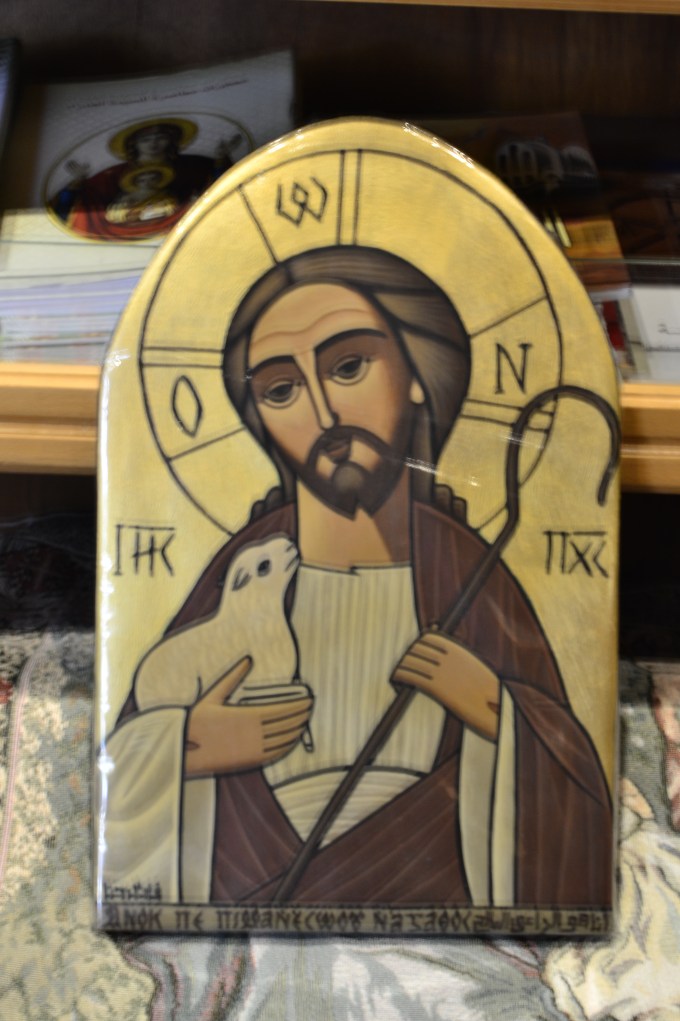
We could be forgiven for thinking that that such feelings belong in our past. We’ve grown up, we’ve moved beyond all that. But, if anything the events of the last few weeks tell us clearly that where there is an absence of leadership people get worried. They start to panic. They’re not sure what is going on, or how they are going to find safety and security . So the world around us is a mess, our politicians don’t seem to be much help, and we’re not sure that the Church is any better. It is a sad indictment of the age in which we live, but THERE IS HOPE. We can always, and in all things trust in Our Lord and Saviour Jesus Christ, who is the Good Shepherd, and who lays down his life for the sheep.

After Jesus has said this He proceeds to call labourers for the Lord’s harvest. He summons the twelve apostles to share his work of proclamation and healing. They are to be sent out for the healing and reconciliation of the nations and to preach the Good News of the Kingdom. He gives them power and authority to do God’s work in the world. It is no easy task – they are to be flogged and handed over for trial. They are to face persecution in the world for doing the work of God. As co-workers with the Lord, fellow shepherds, they too will lay down their lives for their flock, and such is the lot of those called to serve God as bishops, priests and deacons.

In the book of Exodus Moses is addressed by God: ‘Indeed the whole earth is mine but you shall be for me a priestly people and a holy nation. These are the words that you shall speak to the Israelites.’ (Exod 19:5-6) As the church is the New Israel, bought through the New Covenant in Jesus’ blood, then these words apply to us. We are to be priestly and holy. We are to honour God and worship Him, and encourage others so to do. We do this by being close to God in our reading of Holy Scripture and our participation in the sacraments of the New Covenant – primarily Baptism and the Eucharist.

Christ has compassion on the people and gives them the shepherds that they need and want, to guide and direct them along the right path, to feed them, and lay down their lives for the sheep, as in all things they will look to Jesus as their pattern and example. His entire life and ministry points towards His Death and Resurrection, where He lays down his life in obedience to the will of the Father to reconcile humanity to God and to each other. It is this sacrifice and self-oblation which the church sees re-presented in the Eucharist, where on one hundred thousand successive Sundays the Church, through its priests and bishops has done what Jesus did on the night before He died with his apostles in the Upper Room. The Eucharist makes the holy people of God, because in it we are fed by Christ and fed with Christ, fed with the Lamb of God who takes away the sins of the world. We are given here and now a foretaste of the Heavenly Banquet – humanity eats the bread of Angels, pointed to by the manna in the Desert. We are called to share in the Body and Blood of Christ do that we might live in Him and He in us.

Words cannot adequately describe the wonder of this mystery, that we poor, frail, sinful humanity are called to share in the life of God, to be nourished by it, strengthened by it, to live the life of faith here and now. So to a world desperate for answers, which has given up trusting in God, and indeed in just about anything, we can say ‘Come and see’. The church can offer something that people can trust, someone whom they can follow. A true shepherd to guide them, guard them, and lead them.

So let us cast our cares aside and follow Him, let us be nourished by Him, and invite others to so that they may believe and give glory to God the Father, God the Son, and God the Holy Spirit, to whom be ascribed as is most right, all might, majesty, glory, dominion, and power, now and for ever.

_DSC1396

Corpus Christi – Dom Gregory Dix on the Eucharist

At the heart of it all is the eucharistic action, a thing of absolute simplicity – the taking, blessing, breaking and giving of bread, and the taking, blessing, and giving of a cup of wine and water, as these were first done with their new meaning by a young Jew before and after supper with His friends on the night before he died. Soon it was simplified still further, by leaving out the supper and combining the double grouping before and after it into a single rite. So the four-fold action Shape of the Liturgy was found by the end of the first century. He had told His friends to do this henceforward with the new meaning ‘for the anamnesis‘ of Him, and they have done it always since.

Was ever another command so obeyed? For century after century, spreading slowly to every continent and country and among every race on earth, this action has been done, in every conceivable human circumstance, for every conceivable human need from infancy and before it to extreme old age and after it, from the pinnacle of earthly greatness to the refuge of fugitives in the caves and dens of the earth. Men have found no better thing than this to do for kings at their crowning and for criminals going to the scaffold; for armies in triumph or for a bride and bridegroom in a little country church; for the proclamation of a dogma or for a good crop of wheat; for the wisdom of the Parliament of a mighty nation or for a sick old woman afraid to die; for a schoolboy sitting an examination or for Columbus setting out to discover America; for the famine of whole provinces or for the soul of a dead lover; in thankfulness because my father did not die of pneumonia; for a village headman much tempted to return to fetich because the yams had failed; because the Turk was at the gates of Vienna; for the repentance of Margaret; for the settlement of a strike; for a son for a barren woman; for Captain so-and-so wounded and prisoner of war; while the lions roared in the nearby amphitheatre; on the beach at Dunkirk; while the hiss of scythes in the thick June grass came faintly through the windows of the church; tremulously, by an old monk on the fiftieth anniversary of his vows; furtively, by an exiled bishop who had hewn timber all day in a prison camp near Murmansk; gorgeously, for the canonisation of S. Joan of Arc—one could fill many pages with the reasons why men have done this, and not tell a hundredth part of them. And best of all, week by week and month by month, on a hundred thousand successive Sundays, faithfully, unfailingly, across all the parishes of Christendom, the pastors have done this just to make the plebs sancta Dei—the holy common people of God.

Dom Gregory Dix, The Shape of the Liturgy, London, 1945p.743-4

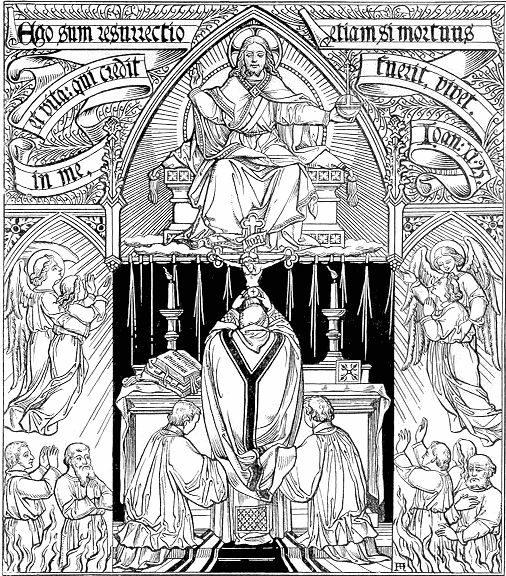
eucharist-sacrifice2.gif

Trinity Sunday

We celebrate the Feast of the Holy Trinity today because in 1334 Pope John XXII decided that on the Sunday after Pentecost the Western Church would celebrate the Trinity. It was already a popular feast. Nearly two hundred years previously Thomas Becket was consecrated a bishop on this day, and kept the feast. Its popularity in the British Isles is shown by the fact that we number the Sundays between now and Advent not ‘after Pentecost’ but ‘after Trinity’. It defines the majority of the liturgical year for us.

This morning, at the very beginning of our service, the following words were said, ‘In the name of the Father, and of the Son, and of the Holy Spirit.’ We said ‘Amen’ to signify our assent and many Christians make the sign of the Cross as the words are said. At the end of the Eucharist I, as the priest, will pray that God will bless you as I invoke the name of the Trinity and make the sign of the Cross. These words and gestures are not random, or the result of a whim, but are part of our tradition of worship as Christians. This is how we express and declare our faith; through words and actions. These help us to reinforce what we believe and help us to live out our faith.

In this morning’s epistle we heard the closing words of Paul’s Second Letter to the Corinthians. Their relations have not been been easy or pleasant. Paul has written urging reconciliation, something which the church always needs, and something at the heart of our faith. This is because it is what Jesus achieves on the Cross, our reconciliation with God and with each other. Paul urges the church to embrace in love, as we will soon do during the Peace. He ends with words which are very familiar to us: ‘The grace of our Lord Jesus Christ, and the love of God, and the fellowship of the Holy Spirit be with you all.’ (2Cor 13:13) We often repeat these words, and call them ‘the Grace’.

This Grace of Our Lord Jesus Christ is the unmerited kindness we have received through him, which we do not deserve. We have not earned it, but receive it through Him. The Love of God is such that He gave His only Son ‘that whoever believes in him should not perish but have eternal life. For God sent the Son into the world, not to condemn the world, but that the world might be saved through him.’ (Jn 3:16-17). The Love of God sees Jesus take flesh by the Holy Spirit, to be born of the Blessed Virgin Mary, preach repentance and the nearness of the Kingdom of God, and die for us on the Cross. Then he rose again, ascended, sent the Holy Spirit to us at Pentecost, and promised to come again as our Judge. Fellowship, or Communion is what the persons of the Trinity – the Father, the Son and the Holy Spirit – have between each other, and which we the Church are invited to share. It is the imparting of the grace, the undeserved kindness of God. In the act of Holy Communion we are fed with the Body and Blood of Christ, so that we might share in the divine life here on earth.

We can do this because we have been baptised. In this morning’s Gospel Jesus tells the apostles to go and make disciples ‘baptizing them in the name of the Father and of the Son and of the Holy Spirit’ (Mt 28:19). This is the central act of our faith, it is how we enter the Church; how we put on Christ; how we are saved. It defines us as Christians.

In public prayer, at the end of Psalms and Canticles, we end with the words, ‘Glory be to the Father and to the Son and to the Holy Spirit ; As it was in the beginning is now and ever shall be world without end. Amen.’ This is a doxology which means ‘Words that praise God’ We say these words because they express our faith.

Jews, Muslims, Jehovah’s Witnesses, Mormons and others cannot accept the fact that as Christians we say that we do not worship three Gods, but One God. That we believe that  the Son is God, not less than the Father, likewise the Holy Spirit, and yet there are not three Gods but one God. These are not manifestations, but persons which share the same divine essence and yet are distinct. The Father uncreated; the Son begotten; the Spirit proceeding. It is why we stand up and state our beliefs. It matters. We do it regardless of the cost. Simply believing the Christian faith and declaring it publicly can lead to imprisonment or death in some countries around the world today.

Our faith matters. It can change lives. It can change the world. It isn’t a private concern, something to be hid away politely. It is the most important thing there is. It is something to fill us with joy. It is something that we should share with others, so that they might believe and give glory to God the Father, God the Son, and God the Holy Spirit, to whom be ascribed as is most right and just, all might, majesty, glory, dominion, and power, now and forever.
masaccio_holy_trinity

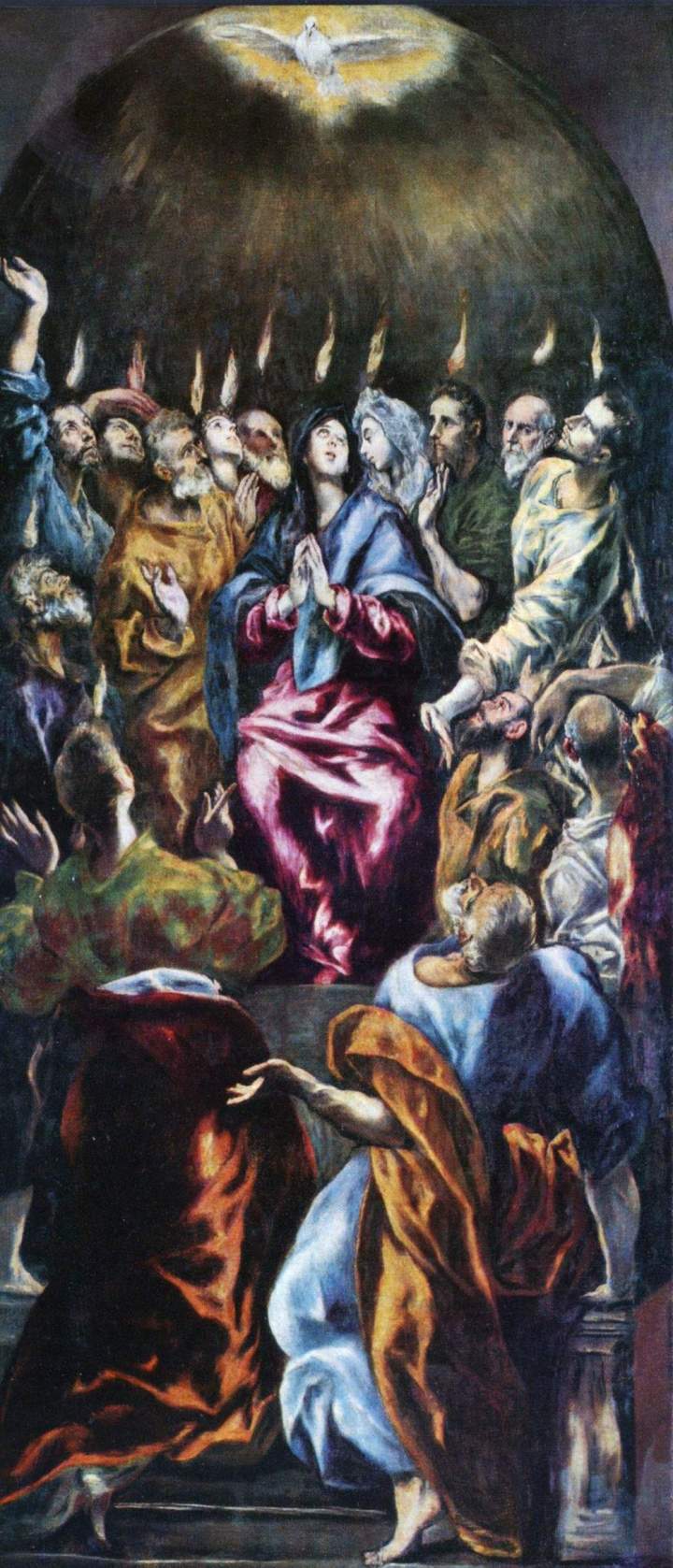
Pentecost 2017

The feast of Pentecost was well-known to Jews in Jesus’ time. Fifty days after the Passover, they celebrated God’s giving of the Law to Moses on Mt Sinai. It was an important feast as the Jews saw their whole life as tied up with the observance of God’s law. Jerusalem was full of people from all over the Mediterranean world who had come to celebrate this festival.

Although they are present in Jerusalem, the disciples have other things on their mind. Fifty days after our Lord’s death and resurrection, the disciples are carrying out Jesus’ instructions given just before his Ascension, to stay in Jerusalem and pray for the gift of the Holy Spirit. An amazing thing happens. Suddenly, men who were once afraid to leave a locked room get up and go out to tell people what God has done in his Son, Jesus Christ. They are inspired. They are on fire.  Filled with the love of God, they are able to go and share the Good News of the Kingdom.

At the Annunciation the angel Gabriel proclaims to Mary ‘The Holy Spirit will come upon you and the power of the Most High will overshadow you’ (Lk 1:35). Jesus Christ takes flesh in the womb of his mother by the power of the Holy Spirit. We are told that the Spirit hovers over him at his Baptism, like a dove. All His life and ministry is totally connected with God the Father in the power and union of the Holy Spirit. After Jesus’ Ascension God gives the Holy Spirit to the church. This is what we celebrate today!

In the Gospel passage we have heard today Jesus twice greets the apostles with the words ‘Peace be with you’. What he offers them is not simply an absence of noise or distraction but something far more wonderful. It is something we cannot fully understand though it is something which we can experience. Through Jesus’ death and resurrection we have peace with God and each other. The Kingdom of God is a Kingdom of love and peace. Jesus then gives the apostles a commission: ‘as the Father has sent me, so I send you’ (Jn 20:21). They are sent to proclaim the good news of the Kingdom in word and deed, laying down their lives in God’s service.

Jesus breathes on them, to empower them, that they may receive the Holy Spirit. Then Jesus tells them that whoever’s sins they forgive are forgiven. This is an extraordinary claim. But Jesus can make it because he is God. Through Him the church has become a place of healing, where we may be reconciled to God and to each other. Surely my brothers and sisters, this is is the most tremendous thing, a gift of a truly generous God.

The Jews in the Acts of the Apostles are amazed to hear the Good News in their own language, spoken by a rag-tag assortment of Galilean fisherman and other ordinary men. It is incredible. It is miraculous. And it points towards the present reality where there is not a country on this earth which has not heard the good news of Jesus Christ. But there is still work to do and it is wonderful to read that the Bible is currently being translated into 250 new languages.

Thus the work of proclamation is not finished. It is thanks to the preaching of the Good News started by the Apostles at Pentecost that we are Christians today, and that millions of people have come to know, love, and serve Jesus Christ. So, for those of us who are in Christ, who have entered the church through our Baptism, we have an important job to do. We need to tell people about Jesus.

The church is wonderful in its diversity, because we are all different, we don’t speak the same language, or have the same culture. We don’t look the same, we are not clones or robots. We are empowered through our having received the Holy Spirit at our Baptism, in our Confirmation, indeed through all the sacramental actions of the church; the outward and visible signs of the inward and spiritual grace. This is how the Holy Spirit works, how it builds us up in love. Through the sacrament of our Lord’s Body and Blood, the Eucharist, we are nourished spiritually to keep doing what God wants us to do.

Paul’s words to the believers in Corinth give us a vision of how the Holy Spirit unifies the Church. When we pray ‘Thy Kingdom come’ in the Lord’s Prayer every day we are praying for the Church and the world to be filled with God’s love through the Holy Spirit. That we might be drawn ever closer together, so that we may truly be one. This is Christ’s prayer for the Church in the Garden of Gethsemane in John 17. That the church should be one, united in love and in faith. It is God’s will. We cannot ignore it. We have to do all that we can to work towards it, and it is this desire for unity in the church which has seen an initiative ‘Thy Kingdom Come’ started by The Most Rev’d Justin Welby, the Archbishop of Canterbury, be taken up across the world, so that in the days from Ascension to Pentecost the church has prayed for the gift of the Holy Spirit to bring us closer together, in love and unity, to proclaim the good news, the people may come to know Jesus. It is the start of something great, where the church is renewed through the Holy Spirit, and it is something we can join in with. So let us pray:

Renew your wonders in this our day, as by a new Pentecost.

Grant to your Church that, being of one mind and steadfast in prayer with Mary, the Mother of Jesus, and following the lead of Blessed Peter, it may advance the reign of our Divine Saviour, the reign of truth and justice, the reign of love and peace. Amen.

Come Holy Spirit, in your power and might to renew the face of the earth.

Almighty God, your ascended Son has sent us into the world to preach the good news of your kingdom: inspire us with your Spirit and fill our hearts with the fire of your love, that all who hear your Word may be drawn to you, through Jesus Christ our Lord. Amen

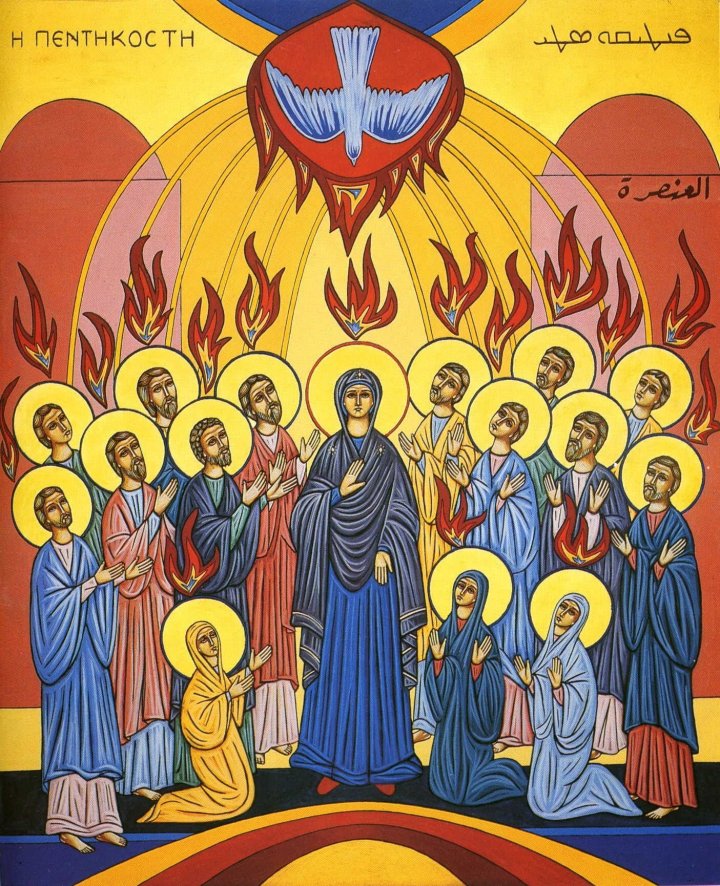
pentecost_maronite_icon

Easter VII, The Sunday after the Ascension Acts 1:6-14, John 17:1-11

So that they may be one, as we are one

The Gospel this morning has taken us back to the Garden of Gethsemane, where in the seventeenth Chapter of John’s Gospel , after celebrating the Last Supper with his disciples, Jesus goes out to spend time in prayer. It can seem strange to suddenly look back to Maundy Thursday seven weeks after we have celebrated Jesus’ resurrection, but there is a very good reason to do such a thing. The prayer we have just heard is a conversation between God the Son and God the Father. It is a moment of intimacy, a private moment which shows us their relationship, something extraordinary, something wonderful, we don’t often think of prayer in these terms, but currently there is a world-wide initiative, started by Justin Welby, the Archbishop of Canterbury called ‘Thy Kingdom Come’ which calls upon Christians everywhere to do something wonderful together. Between the Ascension and Pentecost there is a period of ten days when we are asked to be like the Apostles in the first chapter of the Book of the Acts of the Apostles, and pray for the gift of the Holy Spirit, just like they did, and for us all to do this together.

Prayer is a funny old thing, and most people probably think of it as asking God for things: please watch over my parents as they travel, please help me pass this examination, hopefully in our language of prayer we can also find time to say thank you for all the good things, and to say sorry for when we’ve not been good enough, and also time to say ‘I love you’ the prayer of adoration that we may be drawn closer to God. It’s a powerful thing, and a wonderful thing, and yet quite ordinary, yet able to do amazing things:

From the Sayings of the Desert Fathers (PL VII 34 col. 901)

A brother asked an old man, ‘What shall I do, father, for I am not acting like a monk at all, but I eat, drink and sleep, carelessly, and I have evil thoughts, and I am in great trouble, passing from one work to another, and from that work to the next.’ The old man said, ‘Sit in your cell and do the little you can, untroubled. For I think that the little you can do now is of equal value to the great deeds which abba Antony accomplished on the mountain and I believe that by remaining in your cell for the name of God and guarding your conscience you also will find where abba Antony is.’

It can be all to easy in life to think that what God wants is something big and difficult, when actually the opposite is what is required. The monk in the story needs to stay put and pray and that is all, why should we think that we are any different? The key to it all is humility: knowing your need of God. Those who are poor in Spirit, those who are humble can be filled with God’s Spirit, because they rely upon him, they know their need of him.

There it is plain and simple: prayer, it can change the world, and for the last two thousand years it has been changing the church and the world, one soul at a time, the wonderful revolution of God’s love at work in the world. In his prayer before his Passion, Jesus prays that we may be one, as he and the Father are one. He prays for unity, it is Jesus’ will for the church, and it is clear that the first apostles did what Jesus wanted them to do.

‘And when they had entered, they went up to the upper room, where they were staying, Peter and John and James and Andrew, Philip and Thomas, Bartholomew and Matthew, James the son of Alphaeus and Simon the Zealot and Judas the son of James. All these with one accord were devoting themselves to prayer, together with the women and Mary the mother of Jesus, and his brothers.’ (Acts 1:13-14 ESV)

Here is unity, unity of will and purpose, and we share that here and now, While the church is not as united as we would like it to be, or as God would like it to be, we can at least say that we are trying to do God’s will, and it is something that we can all try and do together. So let’s do it. Let’s pray for unity, and the outpouring of God’s Holy Spirit, to fill the Church with love, with grace, with forgiveness, with reconciliation, that we can heal the wounds of the past, and be drawn into unity and love, by the power of the Holy Spirit, knowing our need of God, and our reliance upon Him.

So as we stay put, and wait and pray with the Apostles for the gift of the Holy Spirit let us pray that God may be at work in us, that he will fill us with his love, and transform our lives, building us up, and giving us strength to live his life and to proclaim his truth, to offer the world that which it most earnestly desires, a peace, a joy and a freedom which pass human understanding, and the gift of eternal life in Christ. Let us pray that we are strengthened so that we can proclaim in word and deed what wonderful things God has done through his Son, Our Saviour Jesus Christ. That all that we are and do may confess that Jesus Christ is Lord to the glory of the Father, and that the world may be filled with his love so that all may come to believe and give glory to God the Father, God the Son, and God the Holy Spirit, to whom be ascribed as is most right and just, all might, majesty, glory, dominion, and power, now and forever.
3a8ed5baf8ee2d2d1cfd265911689e5b

Easter VI – John 14:15-21

I once asked a nun who had been professed many years what she found most difficult about the religious life. The answer I received was a surprising one: ‘Obedience’. She could cope with poverty and chastity, with stability, and the ongoing change of character, but she found it hard to do what she was told, to be obedient.

It is not for nothing that the opening words of the Rule of St Benedict are: ‘Listen my son to the words of the Master’. I, like her, struggle with obedience. In fact, if we are honest with ourselves, all of us do too. We like to have our own way, to do what we want, when we want, and how we want to do it. We are wilful, and proud, we want to have our own way, we don’t want to listen to someone else: a spouse, a parent, a priest, or God. Such is the nature of the human condition. This is the reason why God was born as a man, preached the Good News, and taught a new way to live as citizens of the Kingdom of God. For this he suffered, and died.

And for us as the church, the first thing we need to do is to listen to Jesus, to do what he tells us, to be obedient to him. If we love him we will keep his commandments, we will love God and each other with the same costly self-giving love that Jesus shows on the Cross.It’s quite a big ask, following in his footsteps, dying to self and living for God. It does however lie at the heart of it all. When Jesus says, ‘As the Father has loved me, so have I loved you’ in the Upper Room with His disciples, on the night before he dies, He is looking to the Cross and beyond, as the demonstration of real costly self-giving love. The agony of brutal torture awaits him, a painful death for the love of humanity, to save us and heal us. As St Isaac the Syrian says:

‘The sum of all is that God the Lord of all, out of fervent love for his creation, handed over his own Son to death on the cross. “For God so loved the world that he gave his only-begotten Son for its sake.” This was not because he could not have saved us in another way, but so that he might thereby the better indicate to us his surpassing love, so that, by the death of his only-begotten Son, he might bring us close to himself. Yes, if he had had anything more precious he would have given it to us so that our race might thereby have recovered. Because of his great love, he did not want to use compulsion on our freedom, although he would have been able to do so; but instead he chose that we should draw near to him freely, by our own mind’s love.’

God dies for us, and freely offers us the gift of new life in Him. If we listen to him, then Jesus promises us the Holy Spirit, to strengthen us, to encourage us: a generous gift from a generous God., so that we can experience the fulness of new life in him. A gift so wonderful that Jesus ascends to his Father before giving it to the church, a sign of God’s love and trust, given to strengthen and encourage, to build us up. Such is the power of obedience, where we recognise power greater than ourselves, needs greater than our own, when we turn from love of self to love of God and others The world around will never quite understand this, it simply cannot listen to Jesus or trust him, and so misses out on the fulness of God’s love, which awaits us in heaven. So we pray that we might be obedient, that we might listen to what Jesus says, and do it, and that God would pour out his Holy Spirit upon us, to strengthen and encourage us, to build us up in his love. By listening to what God says we find ourselves becoming more free than we could have been before

This is not some future event, but right here and right now; we thirst for this love, and only it can satisfy our deepest desires, so let us come, and drink of that living water, let us feast on him who is the living bread and the true vine, the shepherd of our souls, who loves us so much that he died for us, and let us love him and one another so that all the world may believe and give glory to God the Father, God the Son, and God the Holy Spirit, to whom be ascribed as is most right and just, all might, majesty, glory, dominion, and power, now and forever

salvador20dali20in20christ20of20st-20john20of20the20cross201951

Theodore of Mopsuestia

Catechetical Homily on Baptism, 5

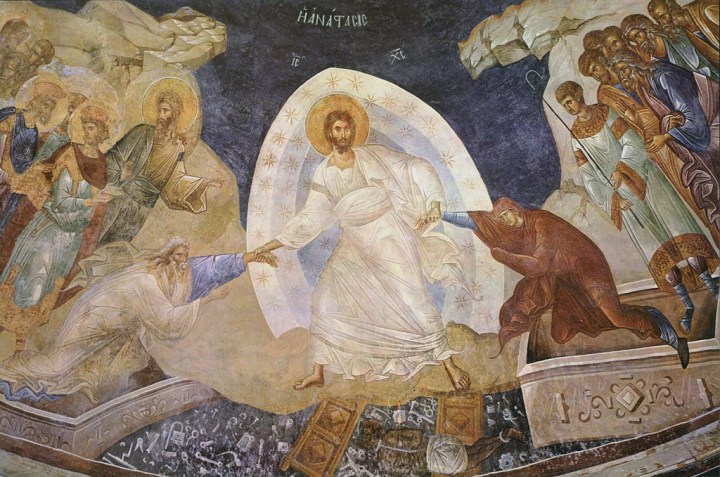
At one time, before the coming of Christ, death had true power over us and was fully indestructible in virtue of a divine verdict. Its power over us was immense. But through his Death and Resurrection, Christ our Lord abrogated that law and destroyed the power of death. And now the death of those who believe in Christ resembles a long sleep. As S. Paul says, ‘But now Christ has been raised from the dead, the first fruits of those who have fallen asleep’ (1Cor 15:20). Since Christ our Lord has subdued the strength of death with his own Resurrection, we can say, ‘We who are baptised in Christ Jesus have been baptised in his Death’; in other words, we know that Christ our Lord has killed death.

anastasis-chora.jpg

Cyril of Jerusalem

Catechetical Lectures 18:6

A felled tree will bloom again; will not fallen man bloom again? What was sown and reaped sits in the barnyard; will not man, once cut off from this world, sit in the barnyard? The branches of vines and trees, when completely cut off, receive life and bear fruit if grafted on; will not man, for whom plants exist, resurrect after being buried? Comparatively speaking, which task is the greater: creating a statue or that did not exist before , or remaking one that was broken, using the same form? Cannot God who made us out of nothing make those who lived and are now dead rise again? …. Those things that were created for us come back to life once dead; will not we, for whom they live, rise again once dead?

30-d

Lent III John 4: 5–42


God proves his love for us in that while we were still sinners Christ died for us

Hyperichius said, ‘The tree of life is high, and humility climbs it.’

He also said, ‘Imitate the tax-collector, to prevent yourself being condemned with the Pharisee. Follow the gentleness of Moses, and hollow out the rocky places of your heart, so that you turn them into springs of water.’


People can be strange, stubborn infuriating creatures, and the picture given to us of the Israelites in Exodus should strike something of a chord. We can recognise something of ourselves in it: stubborn, wilful, and sinful. But lest we get too disheartened it is important to recognise that Moses strikes the rock at Horeb, as the Lord commands him, and out flows water. This water, like the parted water of the Red Sea prefigures Christ, the living water, our baptism, through which we enter the Church. Through it we are regenerate, born again to eternal life in Christ Jesus, our Lord and Saviour, whose side was pierced on Calvary, and whence flowed blood and water. This water speaks to us of the grace of God poured out upon us, his people, to heal us and restore us, to help us live his risen life.

So as we continue our Lenten pilgrimage, we can do so joyfully because God’s love has been poured into our hearts – what matters is what has been done to us, by God, out of love, so that we can be like him. He is the reconciliation which achieves what we cannot: restoring our relationship with God and each other, healing our wounds, and giving us eternal life in Him.

Picture the scene – it’s the middle of the day, the sun is blazing overhead, he’s been walking for hours, days even. Jesus is tired – as a man, a human being, he is no different from you or me – he ate and drank,  he was thirsty, and he was knackered. Mid-day is certainly no time to be drawing water from a well – it’s something you do first thing in the morning, as the sun is rising. What sort of a woman is drawing water at mid-day? Hardly a respectable one, but rather someone shunned, someone beyond the pale, cast out of polite society as an adulteress who is living in sin. Jesus asks the woman for a drink – he’s defying a social convention – he’s breaking the rules. She’s really surprised – Jews are supposed to treat Samaritans as outcasts, they’re beyond the pale: they’re treated something like the Roma in Eastern Europe – outcasts, second class, scum, to be despised and looked down upon. And yet Jesus asks her for water, he initiates the conversation and the encounter, with an outsider, to bring her in.

Jesus offers her living water, so that she may never be thirsty again. The woman desires it, so that she will never be thirsty again, or have to come to the well to draw water, she’s fed up of the work, and fed up of being an outcast, and having to do it at antisocial hours when the community can see who and what she is. Jesus knows who and what she is – he recognises her irregular lifestyle. He also sees her need of God – her need for the water of grace to restore her soul, and inspire her to tell people the Good News. Her testimony is powerful because she has experienced God’s love as a living reality and she simply has to tell people about it. She brings them to Christ so that they can be nourished, so that they too can experience the grace of God.

People are interested in who and what Jesus is, what he’s got to say, and they believe and trust in Him as the Messiah the Anointed of God, as the Saviour of the World, a title recently taken up by the Roman Emperor, big claims to make, and dangerous ones, which along with His healings will soon lead to His condemnation and death. In plenty of parts of the world the proclamation of the Good News still leads to imprisonment, torture and death, even today. And yet as Christians we are called to bear witness regardless of the personal cost, so that the world may believe. Here in the West we have as a church become comfortable, we forget about persecution, or view it at a safe distance. We’re not involved, it doesn’t matter that much to us. Are we far from the grace of our baptism, have we not encountered Jesus in Word and Sacrament? Are we too afraid of the World? The world which Christ overcomes on the Cross.

To live is to change and to be perfect is to have changed often. If we are changing into Jesus Christ, then we’re on the right track. If we listen to his word; if we talk to him in prayer and let him talk to us; if we’re fed by Him in the Eucharist, by Christ both priest and victim, to become what He is – God; if we’re forgiven by Him, through making confession of our sins, not only do we come to understand Jesus, we become like him, we come to share in his divine nature, you, me, all of humanity ideally. We, the People of God, the new humanity, enter into the divine fullness of life, we have a foretaste of the heavenly banquet.

Lent should be something of a spiritual spring clean, asking God to drive out all that should not be there, preparing for the joy of Easter, to live the Risen Life, filled with God’s grace. In our baptism we died with Christ and were raised to new life in the Spirit. Let us prepare to live that life, holding fast to Our Lord and Saviour, clinging to the teachings of his body, the Church. Let us turn away from the folly of this world, the hot air, and focus on the true and everlasting joy of heaven, which awaits us, who are bought by his blood, washed in it, fed with it. So that we too may praise the Father, the Son and the Holy Spirit, to whom be ascribed as is most right and just, all might, majesty, glory, dominion, and power, now and forever…

23
Guercino Jesus and the Samaritan Woman, Museo Thyssen-Bornemisza, Madrid, 1640-1

Jesus and Nicodemus Lent II

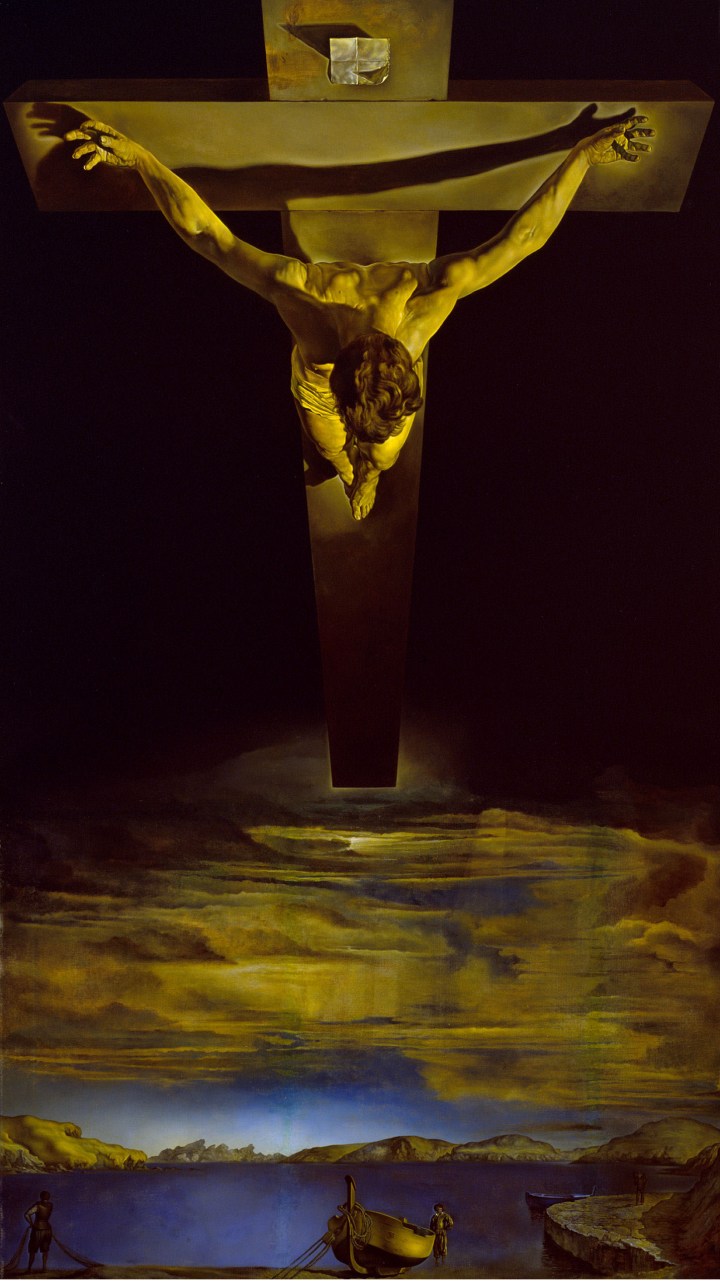
The sight of a crucifix has a continuity with Golgotha; at times its vision is embarrassing. We can keep a statue of Buddha in a room, tickle his tummy for good luck, but it is never mortifying. The crucifix somehow or other makes us feel involved. It is much more than a picture of Marie Antoinette and the death-dealing guillotine. No matter how much we thrust it away, it makes its plaguing reappearance like an unpaid bill.

Fulton J. Sheen Those Mysterious Priests 1974: 101—102


Our Baptism is a wonderful thing, and it is why each and every one of us is here today. It is how we enter the Church, how we become part of the body of Christ,  it is how our souls are infused with the virtues of Faith, Hope, and Charity, it is how we are regenerate, born again, sharing in His death, and His resurrection. It is something for which people have traditionally prepared during this season of Lent, for Baptism and Confirmation at Easter, so that they can die with Christ and be raised to new life with Him. We enter into the mystery of Christ’s saving work so that we may conformed to it and transformed by it, by Love, by believing and trusting in Christ, publicly declaring our faith in Him, and praying for His Holy Spirit, so that our lives may be transformed – living for Him, living in Him, and being transformed more and more into the likeness of Christ.

To be drawn into His likeness means coming closer to His Cross and Passion: just as Moses lifted up the serpent in the wilderness, so must the Son of Man be lifted up (Jn 3:14). Just as the serpent in the desert brought salvation to the people of Israel, so now the Cross is our only hope – the sacrifice of God for humanity, not something we can give God, but something he gives us – a free gift of infinite value. God gives it to us and to all the world for one simple reason – love, for love of us – weak, poor, sinful humanity, so that we might be more lovely, more like Him. God sends His Son into the world not to condemn it, but so that the world might be saved through Him – an unselfish act of generosity, of grace, so that we might be saved from sin and death, from ourselves, so that we can share new life in Him.

For God so loved the world, that he gave his only Son, that whoever believes in him should not perish but have eternal life. For God did not send his Son into the world to condemn the world, but in order that the world might be saved through him.’ John 3:16-17 (ESV) These few words spoken by Jesus to Nicodemus in John’s Gospel encapsulate what we believe as Christians, and why we believe it, may we live them, strengthened through prayer, our study of the Bible, nourished by Our Lord’s Body and Blood, forgiven and forgiving, preparing to be caught up forever in the love of God.

It is that same sacrifice which we see here this morning, which we can taste and touch, which we can eat and drink, so that our lives and our souls can be transformed to live Christ’s risen life. It is something which we treat with the uttermost reverence because it is God, given for us, because it can transform us to live as children of the Holy Spirit, freed from the shackles of this world, free to live for Him, to live as He wants us to, His new creation, of water and the Spirit. This is what the Church has done on a hundred thousand successive Sundays, in memory of Him, to make the holy people of God. To make us holy: so that everything which we say, or think, or do, may be for His praise and glory, living out the faith which we believe in our hearts, as a sign to the world that the ways of selfishness and sin are as nothing compared with the generous love of God.

So great is this gift, that we prepare to celebrate it with this solemn season of prayer, and fasting, and abstinence, to focus our minds and our lives on the God who loves us and who saves us. We prepare our hearts and minds and lives to celebrate the mystery of our redemption, so that our lives may reflect His glory, so that we may live for Him, fed by Him, fed with Him, with our lives and souls transformed by Him. We are transformed so that we can transform the world so that it may live for Him, living life in all its fullness: living for others, living as God wants us to live. Living the selfless love which saves us and all the world, living out our faith, and encouraging others so to do, can and will conform us to Christ, so that we may be like Him, and become ever more like Him, prepared for eternal life with Him, so that we all may sing the praises of God the Father, God the Son, and God the Holy Spirit, to whom be ascribed, as is most right and just, all might, majesty, glory, dominion, and power, now and forever.
3-agosto-crijn_hendricksz-550x400_c

The Sunday next before Lent

“Three important scenes of Our Lord’s life took place on mountains. On one, He preached the Beatitudes, the practice of which would bring a Cross from the world; on the second, He showed the glory that lay beyond the Cross; and on the third, He offered Himself in death as a prelude to His glory and that of all who would believe in His name”

Fulton Sheen The Life of Christ 1970: 158

Over the last few weeks we have been reading through what we generally know as the Sermon on the Mount. Jesus goes up to a high place to teach the assembled crowds how to live in a way that is pleasing to God and will bring about human flourishing. This morning we see Christ up a mountain doing something quite different. The world around us has a good idea of what it thinks glory is: most of the time it looks like human success and triumph, just think of people winning a gold medal at the Olympics, people waving flags, noise, pomp, pageantry, all fine and good in its place, but essentially something fleeting and transitory, it goes, it doesn’t last. As Claudio Ranieri the erstwhile manager of Leicester City knows all too well.

Rather than concentrate on human ideas of glory, this morning’s readings give us a glimpse of God’s glory. In the Book of Exodus we see Moses going up Mount Sinai to receive the Law, the Ten Commandments to show Israel both what to believe and how to live. Moses spends time in the closer presence of God, so that when he comes back down the mountain he is shining, he is transformed and transfigured by the experience. It’s an experience which takes time, God tells Moses to come up and  wait there, he waits six days before being invited to come up further. He spends forty days on the mountain, which prefigures Our Lord’s forty days in the wilderness before the start of his public ministry and our own forty days of Lent.

Jesus takes his closest disciples with him to show them something of the glory of God. He appears with Moses and Elijah to show them and us that He is the fulfilment of the Law and the Prophets. Jesus is the Messiah, and the Son of God. Christ is the fulfilment of the Law and the Prophets because they all look to him, they find their truest meaning in Him, they are fulfilled by Him. That is why the Church has always read the Hebrew Scriptures in a Christological Way: they point to Christ, who is the Word made flesh. The Church has never abandoned them, for in them we see a richness of material, a depth of proclamation throughout the history of Israel and its relationship with God which points to Christ, which can only be explained by Christ, who is the Way, the Truth and the Life, he is what the prophets look towards, and their hope, and their salvation.

When God speaks he tells us three things about Jesus: he is the Son of God, he is loved, and we should listen to him –  He is God, the Second Person of the Eternal and Divine Trinity, who created all that is and who will redeem it. We should worship Him, and obey Him. He is loved by God, love is what God is, the relationship of the Father, the Son and the Holy Spirit is one of love, and our human love is but a pale reflection of God’s love for us, shown by his Son Jesus Christ on the Cross, where he dies for our sins. We should listen to him , what he says and does should affect us and our lives. – We have to be open to the possibility of being changed by God, ‘to live is to change, and to live well is to change often’ as John Henry Newman once said, love changes us, it is dynamic not static, it forms who and what we are.

Jesus tells the disciples not to tell anyone about this until after he has risen from the dead. The detail is important: Jesus will suffer and die upon the cross, taking our sins upon Himself, restoring our relationship with God and each other – this is real glory – not worldly glory but the glory of God’s saving love poured out on the world to heal it and restore it.

As this is the Sunday before Lent, Quinquagesima, fifty days before Easter we have a chance to spend time time with God, we have the prospect of a penitential season, a chance to focus on what really matters, away from the noise and bustle of normal life, a chance through prayer, reading the Bible and Sacramental encounter to spend time with God, to be close to him, and to let his love and grace transform us more and more into his glorious likeness.

That is why we are here this morning – to see that self same sacrifice here with our own eyes, to touch and to taste what God’s love is really like – to go up the mountain and experience the glory of God, what God is really like, so that God’s love may transform us, given a foretaste of heaven, and prepared to be transformed by God. This is true glory – the glory of the Cross, the glory of suffering love lavished upon the world. The Transfiguration looks to the Cross to help us prepare for Lent, to begin a period of fasting and prayer, of spiritual spring cleaning, of getting back on track with God and each other, so that we may be prepared to celebrate Our Lord’s Passion, Death and Resurrection, to behold true majesty, true love and true glory – the kind that can change the world and last forever, for eternity, not the fading glory of the world, here today and gone tomorrow, but something everlasting, wonderful.

So let us behold God’s glory, here, this morning, and let us prepare to be transformed by his love, so that the world may believe and trust in God the Father, God the Son, and God the Holy Spirit, to whom be ascribed, as is most right and just, all might, majesty, glory, dominion, and power, now and forever.

7188e18c479349290fb479fef06a9482

Sexagesima Yr A (7th in OT)

‘Set your heart on his kingdom first, and on his righteousness’

Hating people is quite easy, you just do it, you realise that they are bad and horrible, and nothing gives you more pleasure that thinking of them unhappy, in pain, tortured by their conscience if they have one. You may even long to see them dead, disemboweled, with their heads on spikes. It’s quite easy to feel like this, but we have to ask ourselves the question ‘Are such feelings good?’ ‘Is this what God really wants?’ The answer is an unequivocal NO. In the Gospels Jesus offers humanity a radical alternative, to the way of sin and hatred. He calls us to love our enemies, to wish the best for them, to fight all that they do to  us with love and forgiveness, it is radical, and it can change our lives, and indeed it can change the entire world, if we live it out.

In the Gospels over the past few weeks Jesus has been telling us quite a lot about how we should live our lives. This concentration should alert us to two facts: it is important and it isn’t easy. How we live our lives matters, as it is how we put our faith into practice and also it forms our moral character: we become what we do. Living a Christian life isn’t a matter of giving our assent to principles, or signing on the dotted line, it’s about a covenant, a relationship with God and each other, which we demonstrate not only by what we believe, but how our beliefs shape our actions.

The call to holiness of life is rooted in the goodness of the created order: God saw all that he had made and it was good. The path to human flourishing starts with the response of humanity to the goodness of God shown in the goodness of the world. It continues with the hope which we have in Christ that all things will be restored in Him, for in this hope we were saved.

Living out our faith in the world can be a tricky business: we cannot serve both God and money. A world which cares only for profit and greed, for the advancement of self, is surely a cruel uncaring world which is entirely opposed to the values of the Gospel. The Church has to speak out against poverty, injustice, and corruption, in order to call the world back to its senses, to say to it ‘Repent, for the Kingdom of God is close at hand’. The kingdom is the hope that we will live in a world where the hungry are fed, the naked clothed, and all humanity lives in the peace of God. Christianity is a radical faith which looks to nothing less than the complete transformation of the world – you may see us as idealistic, as dreamers not rooted in reality, but this Kingdom is a reality here and now, and it’s up to us to help advance it.

Such is the power of advertising that we are forever being bombarded with enticements to buy new clothes, to diet, to celebrate, to spend money so that it makes us happy, but also so that we feel guilty, we take out loans to finance our extravagance. Against this we need to hear the words of Jesus ‘Surely life means more than food, and the body more than clothing’. But, I hear you cry; you’re wearing fine clothes, and standing in a pulpit telling us about this. Indeed I am, but priests and deacons wear beautiful vestments not to point to themselves, not as a display, put to point us to God, the source of all beauty, to honour Him, in all that we do or say, to remind us why we are here today, to be fed by God, to be fed with God, in Word and Sacrament, so that we may be strengthened and transformed. A God who loves us so much that he died for us on the Cross, the same sacrifice present upon the altar here – given for us to touch and taste God’s love, this is the reality of God’s love in our lives.

So how do we respond to it? This is the kingdom of God, right here, right now, we’re living it, and we need to trust the God who loves us and saves us, and live out our faith in our lives, we need to embody the values of the Kingdom, and help others to live them so that we can carry on God’s work. Every day when we pray the Lord’s Prayer we say ‘Thy Kingdom come, Thy will be done on earth as it is in heaven’.

As we look towards Lent let us all encourage each other to do God’s will in our lives so that we may hasten the coming of God’s Kingdom and do His will, living out our faith in our lives, helping each other to do this and inviting others in to share the peace and love and joy of the Kingdom, so that the world around us may believe and give glory to God the Father, God the Son, and God the Holy Spirit, to whom be ascribed, as is most right and just, all might, majesty, glory, dominion, and power, now and forever.

4987738dccb72f903f4eb80160c75b0a

The Sixth Sunday of Year A

Septuagesima is the Sunday roughly seventy days before Easter, or three weeks before the start of Lent.It reminds us that in the Church names and time are important things: they are used to divide and to mark, to draw our attention to things. Historically, the countdown to Lent is a chance to change our focus, with Candlemas our celebration of Christmas drew to a close, and we began to look to the Cross, to Our Lord and Saviour’s Passion. So we begin the countdown to our Lenten observance of prayer and fasting, we begin to get ready to prepare for the most solemn part of the Christian Year: Holy Week and Easter. It’s the Church’s equivalent of an advanced warning – we need to be on the lookout, we need to be prepared, if you like it is the spiritual equivalent of dealing with the current spate of bad weather and power cuts.

We have a choice. That’s what free will is, we are not compelled. We are not forced, we can choose what we want to do. We can follow the ways of the world, ways which will lead to spiritual death, or we can follow Christ, who came not to abolish the Law but to fulfil it, to show us the new Covenant in the Old, to show us that our is God of Love, of Healing, and of Reconciliation. And the Good news is that this loving God calls people to be in a covenant relationship with Him, a covenant cut on the Cross, bought with the Blood of His Son, which leads to the Resurrection, to New Life in and through Him.

What we do and how we do it are important things, and they matter – there are times when we make the sign of the Cross, when the names of the Trinity, the Father, The Son, and the Holy Spirit are mentioned, we bow our heads at the name of Jesus, and we bow or genuflect to altars and aumbries, from which we are fed with the Body and Blood of Christ to honour the God who loves us and who saves us. Many of us may receive flowers or other tokens of affection this week – they demonstrate in a physical way the feelings which we have inside. The church’s ritual is just like this – it enacts what it represents and allows us to make a physical demonstration of the faith which we have inside us. The gestures are not empty; rather they are full of meaning, and full of faith, they help us to express it and live it out in our lives.

What we say, and what we do matter. For a start being a Christian isn’t something we just do for an hour on a Sunday morning, without any connection to the other 167 hours in a week. We enter the Church through baptism, and through prayer and the sacraments, being fed with the Word of God and His Body and Blood, we can be transformed to be like the one who saves us, and who loves us. It doesn’t cost us any money, it’s free, it’s all gift – the grace of God, poured out on us, on you and me, to heal us and to restore us. You’d be a fool to turn this down, wouldn’t you?

It is free, but with it there comes a commitment: a commitment to Christ and His Church, to living our lives in a way which is recognisably Christ-like. This morning’s Gospel tells us that we need to be careful – even the words which we use and the thoughts which we have matter. They matter because they form who and what we are. To be a part of the Christian community has as its basis and starting point reconciliation: reconciliation to God and each other – we need to confess our sins, our faults, and our failings to God, and using the ministry of a priest. It isn’t something which we should leave to the secular courts, or the law of the land, because what is at stake is the state of our souls and our relationship with Christ and with His Body, the Church.

All of our life matters, even the smallest thing, even a thought or a glance. It matters because we are what we do, and what we do helps to form our moral character – we get used to it, it becomes normal and instinctive, it is how we put our faith into practice in our lives. It’s not easy, it’s difficult, and I’m certainly not standing here as a moral super-hero telling people off, but rather as a sinner redeemed by God’s love and mercy, who knows that it’s something which we cannot do alone, we need God, and we need each other – it’s a community effort, and through God’s mercy, and our prayer and support we can be built as living stones as a temple to God’s glory. We can do it together, we are doing it, but we need to keep on trying, together – living simple, transparent lives, letting our ‘Yes’ be ‘Yes’ and our ‘No’ be ‘No’, so that the whole of our lives together proclaims the faith of our hearts, that we are set free to live the life of the Kingdom here and now, that we are prepared to keep renewing our commitment to God and each other, so that the world around us may believe and give glory to God the Father, God the Son, and God the Holy Spirit, to whom be ascribed, as is most right and just, all might, majesty, glory, dominion, and power, now and forever.

383b369b93fecee7f9275b86f6b2ee4e

A though from Teilhard de Chardin

Above all, trust in the slow work of God.We are quite naturally impatient in everything to reach the end without delay.

We should like to skip the intermediate stages.We are impatient of being on the way to something unknown, something new. And yet it is the law of all progress that it is made by passing through some stages of instability — and that it may take a very long time.

And so I think it is with you; your ideas mature gradually — let them grow, let them shape themselves, without undue haste. Don’t try to force them on, as though you could be today what time (that is to say, grace and circumstances acting on your own good will) will make of you tomorrow.
Only God could say what this new spirit gradually forming within you will be. Give Our Lord the benefit of believing that his hand is leading you, and accept the anxiety of feeling yourself in suspense and incomplete.

Pierre Teilhard de Chardin, The Making of a Mind: Letters from a Soldier-Priest 1914-1919 (New York: Harper & Row, 1961), 57.

Fr John Behr on Theological Education

Wonderful words of advice that the church should take on board

Homily for Candlemas 2017

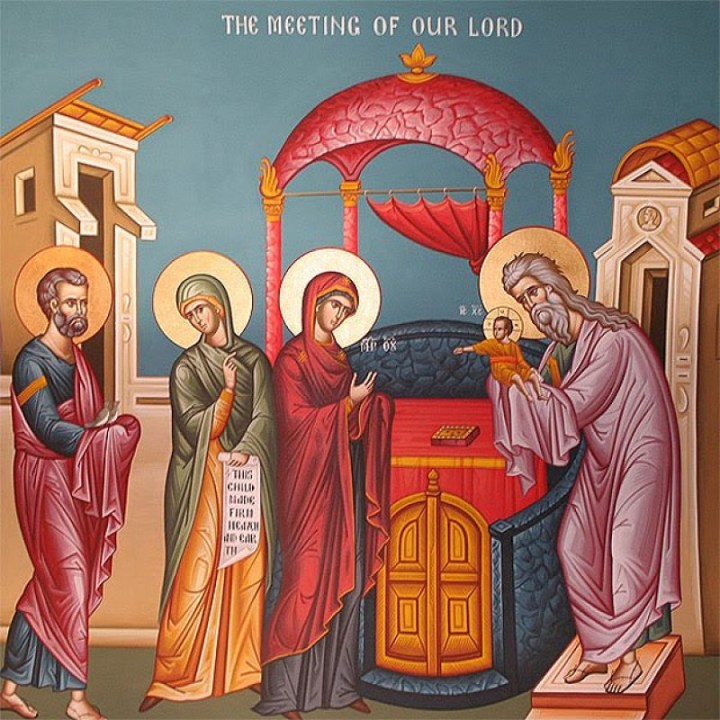
Not all that long ago it was not uncommon to hear of the Churching of Women, sometimes called Thanksgiving after childbirth, as it was after all a dangerous business. We are not quite so used to ideas of ritual purity inherent in the Thanksgiving for a woman after Childbirth, or her re-admission into society after a period of confinement, but the Law of Moses required that forty days after giving birth the mother was purified in a mikveh, a ritual bath and that her son, as a first-born male was presented to the Lord. This week the Church celebrates the Presentation of Christ in the Temple, also known as the Purification of the Blessed Virgin Mary and commonly called Candlemas, that they may burn as lights which proclaim Christ, the true Light, the light to lighten the Gentiles.

This then is the fulfilment of the prophesy spoken by Malachi, which also looks to our purification in and through the death of Christ and his atoning sacrifice of himself, which will be be re-presented her, made present so that we can share in it, so that we can be healed and restored by the very Body and Blood of Our Lord and Saviour Jesus Christ. As the Letter to the Hebrews puts it: ‘Therefore he had to become like his brothers and sisters in every respect, so that he might be a merciful and faithful high priest in the service of God, to make a sacrifice of atonement for the sins of the people. Because he himself was tested by what he suffered, he is able to help those who are being tested.’ It’s hard to see how it could be any clearer.

The Holy Family go to the Temple to give thanks to God and to comply with the Law, just as they had in circumcising their baby on the eighth day: and in so doing they demonstrate obedience, they listen to what God says and do it – as such they are a model for all Christian families to follow – we need to be like them, listening to what God tells us and doing it, regardless of the cost.

When they go to the Temple the Holy Family encounter Simeon, a man of faith and holiness, devoted to God, and looking for the consolation of Israel, he knows that he will not die until he sees the Messiah, the Lord’s Anointed, and the Saviour of the World. As he takes the child Jesus in his arms he prays: ‘Lord, now lettest thou thy servant depart in peace : according to thy word. For mine eyes have seen : thy salvation, Which thou hast prepared : before the face of all people; To be a light to lighten the Gentiles : and to be the glory of thy people Israel.’

The promise made to him by, revealed through His Holy Spirit has been fulfilled in the six-week-old infant in his arms, and he can prepare to meet his God happy in the knowledge that Salvation has dawned in this little child. As Christ was made manifest to the Gentiles at Epiphany, so now His saving message is proclaimed, so that the world may know that its salvation has come in the person of Jesus Christ. Simeon speaks to Our Lord’s Mother of her Son’s future, and the pain she will endure. Before he dies Simeon is looking to the Cross, the means by which our salvation is wrought, the Cross at which Mary will stand to see humanity freed from its sin through the love and mercy of God, through grace, the free gift of God in Christ. So as Candlemas concludes our Celebration of Christmas, of the mystery of the Incarnation, so to it points to that which gives it its true meaning: the Death and Resurrection of Jesus Christ. It prepares for the coming season of Lent by changing our focus and attention from Jesus’ birth to His death.

That is why we are here this morning, to be fed by Christ, to be fed with Christ, truly present in His Body and Blood, Soul and Divinity – God whom we can touch and taste. A God who shares His Divine Life with us, so that we can be transformed by Him, built up as living stones as a temple to His Glory, given a foretaste of Heaven here on Earth. This is our soul’s true food, the bread for the journey of faith, a re-presentation of the sacrifice which sets us free to live for Him, to live with Him, through Him and in Him.

The significance of what is happening is not just recognised by Simeon, but also by Anna, a holy woman, a woman of prayer, a woman who is close to God – she to recognises what God is doing in Christ, and she proclaims it, so that God’s redemption of His people may be known. Let us be like her, and let all of our lives, everything which we say, or think, or do, proclaim the saving truth of God’s love to the world. And finally the Holy Family go back to Nazareth, and Jesus begins to grow up, in the favour of God, obedient to God and His parents — in the Gospel we see all of human life: birth, death, work, normality hallowed by the God who loves us, who gives His Son for us.

Let us burn, like the candles which God has blessed, let our faith be active to give light and warmth to the world, so that it may feel that love and warmth, and come to believe and give glory to God the Father, God the Son, and God the Holy Spirit, to whom be ascribed as is most right and just all might, majesty, glory, dominion, and power, now and forever.

6567purification_bvm_pic

Epiphany IV

In the marriage act, love is triune: wife gives self to husband and husband to self and out of that mutual self-giving is  born the ecstasy of love. The spirit too must have its ecstasy. What the union of husband and wife is in the order of the flesh, the union of the human and the Risen Christ is in Holy Communion

Fulton J. Sheen Those Mysterious Priests, 1974: 157

Everyone loves a party, and that is right and proper, and what more wonderful thing is there to celebrate than a wedding, the joining of a man and a woman that they may become one flesh. Marriage is an image used of Christ and his church: it speaks of a deep union, a profound and meaningful relationship, one of self-giving love, commitment, something wonderful and mysterious. We have not come here this morning to celebrate a wedding but rather the death and resurrection of Jesus Christ, we have come to do what he told his disciples to do at the Last Supper, and the church has done ever since, and will until the end of time. We have come so that we may be fed, be fed by Christ, be fed with Christ, by the power of the Holy Spirit God is active in our lives, transforming us, by his grace, so that our human nature may be transformed, into His Divine nature.

If we were to listen to the many voices around us which criticise Christianity, we would think that we were of all people the most pitiable, ours is either a weak death-cult of a failed Jewish magician and wonderworker, or a strange oppressive force which actively works against human flourishing and actualisation.

But nothing could be further from the truth, we celebrate love, and forgiveness, we are imbued with faith, hope, and love in and through God at our Baptism, and as our vocation as Christians is JOY. The one whom we worship, the Son of God made flesh liked nothing better than to hang around at parties with social undesirables, and was accused of being a drunkard by religious authorities. Most of us have outside our houses one or two wheelie bins, which are a similar size to the water jars in the Gospel. They hold about 30 gallons, or 150 litres, or 200 bottles of wine. Multiply that by 6 and you’re looking at 1,200 bottles of wine, a hundred cases, and this was after the wine ran out, what we’re dealing with in the wedding at Cana must have been some party, it must have gone of for a couple of days, and it is only a foreshadowing of the joy of the Kingdom, it points to something greater than itself: this is what is in store.

Our starting point as Christians is Mary’s advice to the servants: Do whatever He tells you. Our life as Christians is rooted in obedience: we listen to God and we obey, for our own good, and the good of the Kingdom, so that we are not conformed to the world and its ways, but rather to the will of God, so that we can truly enter into the joy of the Lord, in humble obedience, fed by Him, and fed with Him, who died for love of us in obedience to the will of the Father.

The world around us struggles somewhat with extravagance, we distrust it, and rightly so: when we see Arabian oil magnates riding around in gold-plated supercars we are right to be concerned, yet in the Gospel we see something strange. The steward had a point: you serve the best wine first, while people are sober and can appreciate it, but the Kingdom of God turns human values on their head – the joyous new wine of the Kingdom is finer than any human wine and is lavished upon undeserving humanity, so that it might transform us, so that we might come to share in the glory of God, and his very nature. Thus, at the Epiphany we celebrate three feasts: Our Lord’s manifestation to the Gentiles, the proclamation of the Messiah to the whole world, his baptism, to show us the way to the Father, a sign of love and obedience, and the Wedding Feast at Cana, as a sign of the superabundance of God’s love, shown to us here today in the Eucharist where we drink the wine of the Kingdom the Blood of Christ so that we may be transformed by the power and the grace of God, so that we may share his Divine life, and encourage others to enter into the joy of the Lord.

All this is brought about by Christ on the Cross, where the Lamb of God is sacrificed, a new passover for a new Israel, the people of God, to free us from our sins, and to give us new life in Christ. It’s crazy, it doesn’t make sense: how and why should God love us so much to go far beyond what Abraham did with Isaac on the mountain of Moriah. The ram caught in the thicket points to Christ, who is the Lamb of God, even then, at the beginning God shows us his love for us, he prepares the way, by giving us a sign, to point us to Christ, to his Son.

Such generosity is hard to comprehend, it leaves us speechless, and all that we can do is to stand like the Beloved Disciple S. John at the foot of the Cross and marvel at the majesty of God’s love. It affects S. Paul in his preaching, a man who began persecuting the Church, who was present at the martyrdom of S. Stephen, has his life transformed by Christ, through the power of the Holy Spirit, Christ saving us does not make sense, it is an act of reckless generosity, like helping a wedding party drink to the point of excess, it is not supposed to make sense. In rational terms we are sinners, who do not deserve God’s mercy, and yet he shows us his love in giving us his Son, to be born for us, to work signs and wonders, to bring healing and to proclaim the good news of the Kingdom of God’s love, his mercy, and forgiveness.

So let us come to him, clinging to His Cross, our ONLY HOPE, let us be fed with him, and by him, to be strengthened, healed, and restored, and to share this is with the world, so that it may believe and give glory to God the Father, God the Son, and God the Holy Spirit, to whom be ascribed as is most right and just, all might, majesty, glory, dominion, and power, now and forever.

cana

Paul preaches the Cross to the Church in Corinth [1Cor 1:18-2:15]

For the word of the cross is folly to those who are perishing, but to us who are being saved it is the power of God. For it is written,

“I will destroy the wisdom of the wise,
    and the discernment of the discerning I will thwart.”

Where is the one who is wise? Where is the scribe? Where is the debater of this age? Has not God made foolish the wisdom of the world? For since, in the wisdom of God, the world did not know God through wisdom, it pleased God through the folly of what we preach to save those who believe. For Jews demand signs and Greeks seek wisdom, but we preach Christ crucified, a stumbling block to Jews and folly to Gentiles, but to those who are called, both Jews and Greeks, Christ the power of God and the wisdom of God. For the foolishness of God is wiser than men, and the weakness of God is stronger than men.

For consider your calling, brothers: not many of you were wise according to worldly standards, not many were powerful, not many were of noble birth. But God chose what is foolish in the world to shame the wise; God chose what is weak in the world to shame the strong; God chose what is low and despised in the world, even things that are not, to bring to nothing things that are, so that no human being might boast in the presence of God. And because of him you are in Christ Jesus, who became to us wisdom from God, righteousness and sanctification and redemption, so that, as it is written, “Let the one who boasts, boast in the Lord.”

And I, when I came to you, brothers, did not come proclaiming to you the testimony of God with lofty speech or wisdom. For I decided to know nothing among you except Jesus Christ and him crucified. And I was with you in weakness and in fear and much trembling, and my speech and my message were not in plausible words of wisdom, but in demonstration of the Spirit and of power, so that your faith might not rest in the wisdom of men but in the power of God.

Yet among the mature we do impart wisdom, although it is not a wisdom of this age or of the rulers of this age, who are doomed to pass away. But we impart a secret and hidden wisdom of God, which God decreed before the ages for our glory. None of the rulers of this age understood this, for if they had, they would not have crucified the Lord of glory. But, as it is written,

“What no eye has seen, nor ear heard,
    nor the heart of man imagined,
what God has prepared for those who love him”—

these things God has revealed to us through the Spirit. For the Spirit searches everything, even the depths of God. For who knows a person’s thoughts except the spirit of that person, which is in him? So also no one comprehends the thoughts of God except the Spirit of God. Now we have received not the spirit of the world, but the Spirit who is from God, that we might understand the things freely given us by God. And we impart this in words not taught by human wisdom but taught by the Spirit, interpreting spiritual truths to those who are spiritual.

The natural person does not accept the things of the Spirit of God, for they are folly to him, and he is not able to understand them because they are spiritually discerned. The spiritual person judges all things, but is himself to be judged by no one. “For who has understood the mind of the Lord so as to instruct him?” But we have the mind of Christ.

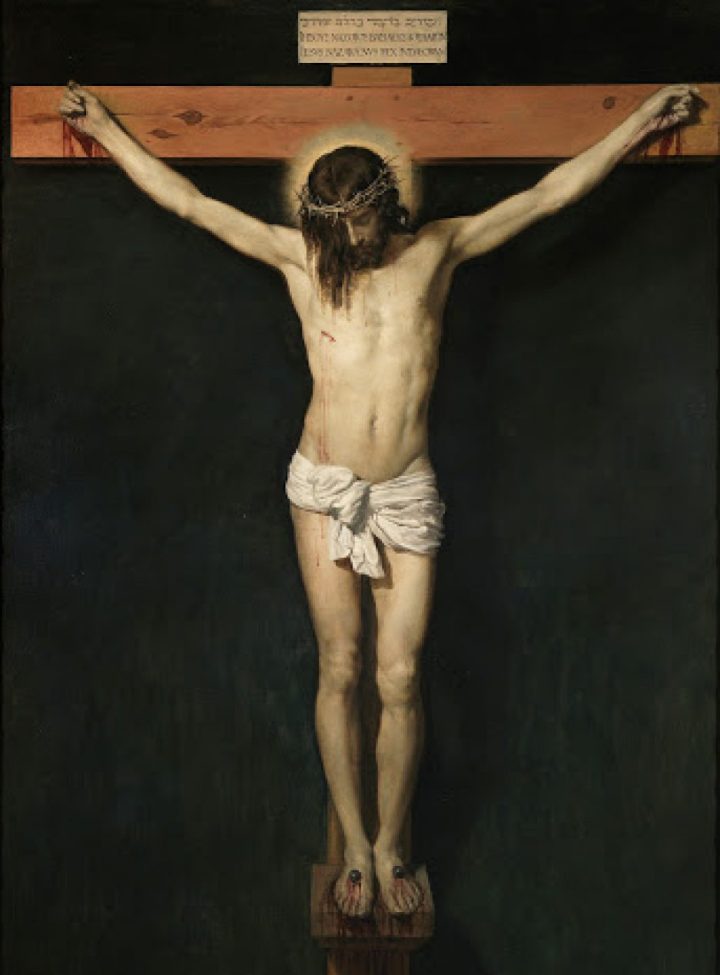
cropped-velazquezcrucifxion.jpg

Thoughts for the day from S. Francis de Sales: on gentleness and anger

‘Learn of me,’ Jesus said, ‘for I am meek and humble of heart.’ Humility perfects us towards God, mildness and gentleness towards our neighbour.

But be careful that mildness and humility are in your heart, for one of the great wiles of the enemy is to lead people to be content with external signs of these virtues, and to think that because their words and looks are gentle, therefore they themselves are humble and mild, whereas in fact they are otherwise. In spite of their show of gentleness and humility, they start up in wounded pride at the least insult or annoying word.

Present life is the road to a blessed life, so do not let us be angry with one another on the way. Never give way to anger if you can possibly avoid it; never for any reason let it enter your heart. It is safer to avoid all anger than to try and guide our anger with discretion and modesty. Directly you feel the slightest resentment, gather your powers together gently. When we are agitated by passion, we must imitate the apostles in the raging storm and call upon God to help us. He will bid our anger be still, and great will be our peace.

One form of gentleness we should practise is towards ourselves. We should never get irritable with ourselves because of our imperfections. It is reasonable to be displeased and sorry when we commit faults, but not fretful or spiteful to ourselves. Some make the the mistake of being angry because they have been angry, hurt because they have been hurt, vexed because they have been vexed. They think they are getting rid of anger, that the second remedies the first; actually, they are preparing the way for fresh anger on the first occasion. Besides this, all irritation with ourselves tends to foster pride and springs from self-love, which is displeased at finding we are not perfect.We should regard our faults with calm, collected, and firm displeasure. We correct ourselves better by a quiet persevering repentance than by an irritated, hasty, and passionate one. When your heart has fallen raise it gently, humbly yourself before God, acknowledging your fault, but not surprised at your fall. Infirmity is infirm, weakness weak, and frailty frail.

Introduction to the Devout Life III:8-9

img_0390

Third Sunday of Year A [Mt 4:12–23]

If you go to S. Paul’s Cathedral in London or the Chapel of Keble College, Oxford, you can see one of the most popular and reproduced works of Religious Art in the world: Holman Hunt’s painting, The Light of the World. It shows our Lord and Saviour Jesus Christ standing at a door with a lantern. The door has no handle; it needs to be opened from the inside: Jesus may be the Light of the World, but he does not force himself upon us, we have to welcome Him into our hearts and our lives. His coming into the world which we celebrate at Christmas, which was made manifest to the world at Epiphany, was not the entry of a tyrant, forcing himself upon the world, but as a vulnerable and loving baby, entirely dependent upon the love and care of others, God comes among us. His coming is foretold by the prophet Isaiah, He is the fulfilment of prophesy, he is the light of the nations, and a cause of great joy: to be a Christian, to follow Christ is it not to be filled with the joy and love which comes from God; we can be serious in our zeal, but should never be miserable: our vocation is to live out our faith, in love, and hope, and joy in our lives, to draw others to Him.

Of our many failings as followers of Christ there is nothing worse than to see strife and division amongst Christians, as S. Paul found in Corinth: it has no place in the church, it isn’t what God intended for us, it’s not how things should be. It has to be resisted: wounds have to be healed, transgressions forgiven, and unity restored. It’s part of how we live out our faith in our lives, it’s why we pray and work for Christian Unity, and why it matters for our proclamation of the good news of the Kingdom of God.

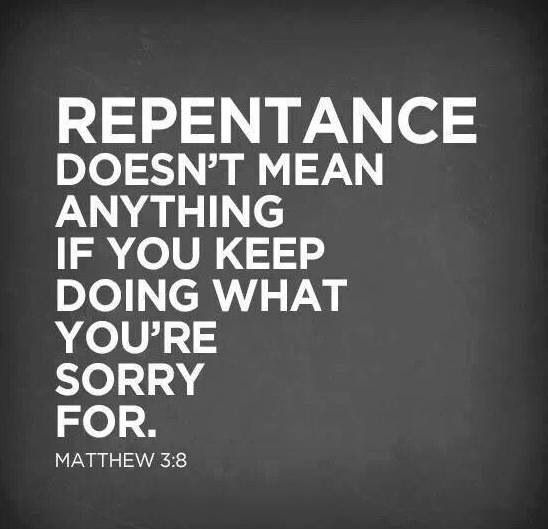
If we turn to the words of this morning’s Gospel we see Jesus saying, “Repent, for the kingdom of heaven is at hand.” To repent as Christ is asking us to, as St John the Baptist proclaimed before him is to change our mind, to make a change of direction in our lives, away from sin, and to Christ, it is what we promise in our baptism and it is how we are supposed to keep living our lives. It’s hard, I know, I fail on a daily basis, and yet I keep trying, turning back to a God who loves me, who took flesh of the Virgin Mary and became incarnate for me, and for you, and all who have ever or will ever turn to Him. Ours then is God of love and mercy, a God of forgiveness who calls us to turn to him, so that we may have life and have it to the full.

We turn away from what separates us from God and each other, we turn to God in Christ, to be close to Him in Word and Sacrament, to be fed by Him, to be fed with Him, with His Body and Blood, so that we might share His divine nature, so that we might be given a foretaste of heaven, so that we may be strengthened to live out our faith in our lives, so that the world may believe – the Kingdom is close at hand, and Christ calls us, the baptised people of God, to share in the work of His kingdom. He asks that we follow Him, that we go where He goes, that we do what He does – it sounds easy enough, but it’s not, it’s something which we need to do together, and while I can endeavour to help you along the way, I cannot without your help, your prayers, your love, and your support. As Christians we are inter-dependent, we rely upon each other, we’re in it together.

In the Gospel, Jesus sees Andrew and Simon Peter and then James and John the sons of Zebedee and says ‘Follow me and I’ll make you fish for people’. He calls them to share in God’s work of saving souls. They drop everything and follow him: it’s immediate and matter of fact. Jesus goes around preaching the good news of the kingdom, and the need for humanity to repent, and to be baptised, and he heals the sick, just as he can heal the sickness in our souls. This is good news indeed.

We need to be like lights in the world, shining in the darkness, so that Christ can knock on the door of people’s hearts. We need to be like those first disciples who heard what Jesus said, who listened, and did what He told them, who were close to Jesus, so that our faith is a reality in our lives. We need to be strengthened and fed by Him who is the greatest medicine for our souls, who comes to us here, this morning,  in His Body and Blood, to heal us, to restore us and strengthen us to follow him, so that the world may believe and and sing the praise of God the Father, God the Son, and God the Holy Spirit, to whom be ascribed as is most right and just all might, majesty, glory, dominion, and power, now and forever.

Öèôðîâàÿ ðåïðîäóêöèÿ íàõîäèòñÿ â èíòåðíåò-ìóçåå gallerix.ru

Second Sunday of Year A ‘Behold the Lamb of God’ Jn 1:29-34

‘Behold the Lamb of God, behold Him who takes away the sins of the world’

Sometimes we use words a lot, even to the point of perhaps overusing them. Sorry is a good example: it is perhaps something of a national characteristic – that we as British people apologise for everything just in case. This has led some people to the point of view that familiarity breeds contempt: that the more often we say sorry, the less we mean it, our words are empty and our society debased, rude and squalid. Whereas a more charitable interpretation sees something of love, care, concern, and humility in our apologising: it is a Christian thing to do, and what we say and do affects who and what we are as people, and the more we say or do something the greater its effects upon our lives and characters – the more it can form us and the people that we are. If we genuinely say sorry to God and each other and mean it, and amend our lives accordingly it can only be a good thing.

When John the Baptist greets his cousin in this morning’s Gospel, the words he uses are both familiar and strange. We, as Christians are used to saying and hearing the phrase ‘the Lamb of God’. We are used to it at Mass, we are used to seeing it on the Signs of public houses called the Lamb and Flag, or as the badge of Preston North End Football Club.

While the image is familiar, it is worth spending a few moments to consider exactly what John is saying about Jesus. The image of a lamb brings to mind a passage in the prophet Isaiah, in the Song of the Suffering Servant, who ‘like a lamb that is led to the slaughter, and like a sheep that before its shearers is dumb’ (Isa 53:7), a prophecy that will be fulfilled in Holy Week, on Good Friday. Yet here, just after the Baptism of Our Lord in the Jordan, when the Spirit descends at the beginning of Our Lord’s public ministry, before the first sign of turning water into wine at the marriage of Cana, we see in John’s description of Jesus a prophetic utterance which points forward to Jesus’ death on the Cross for the world. So then, from the very beginning, as with the gift of myrrh at Bethlehem, we see the culmination at Calvary, the beginning points to the end (and beyond). The other image of the lamb which comes to mind is that of the Passover lamb, by which the people of Israel are freed from slavery to journey to the Promised Land. Yet Jesus is the Passover Lamb who will free all of humanity from sin for all time.

In being baptised by John the Baptist, Jesus was doing something which he did not need to do, he who was without sin did not need to be cleansed from sin, but in his baptism Jesus gives us an example, for us to follow. It is a sign of humility and obedience which we as Christians are to follow: it is how we are to shape our lives, in humble obedience to the example and teaching of Christ, it’s how to be a Christian. It is also how God gives us his Holy Spirit, as a gift which we receive and use with humility.

From the beginning of His public ministry, and even from the gifts offered by the Three Wise Men, Jesus’ life and mission is to be understood in terms of the death he will suffer. It is this sacrificial, self-giving love which God pours out on his World, which streams from our Saviour’s pierced side upon the cross. This is the wood, marked with blood which saves not only the people of Israel, but the entire world. This makes our peace with God, and our peace with one another. It is this recognition of who and what Jesus really is that is capable of showing us all who and what we really are. We can live our lives truly, wholly, and fully, loved by God and loving one another.

That is why we are here today, in a church, at a celebration of Mass, so that the sacrifice of Calvary will be re-presented, made as real for us as it was on a hill outside Jerusalem nearly two thousand years ago. As we approach the altar, this is what we are to receive, the Body and Blood of Christ, the self same body and blood which were nailed to the Cross for our sins and the sins of the whole world. Our hands will hold and our lips will touch him who created the entire universe. How can we not fail to be shocked by the generosity of a God who gives himself to us in such a personal way, in a way that we do not deserve? Yet, we can never deserve such a gift, that is why God takes the initiative and gives himself to us, freely and gladly – like the Father of the Prodigal Son, God rushes to meet us, to embrace us and to celebrate with us, to show his love for us. God became a human being at Christmas so that we might become divine, through our baptism and our participation at the altar, the feast of the Lamb, so that we can become what God wants us to be – his people, sharing his body and blood, strengthened for the journey in body, mind, and spirit, to become what God wants us to be – united with him and one another.

The Mass is the sacrament of unity, uniting heaven and earth through the sacrifice of Calvary, making all humanity to share the body and blood of Our Saviour Jesus Christ, feeding on him so that we may become what he is, to share eternity with him, and to live lives of faith and show this faith in our lives in everything we say, or think, or do, that the world may believe. Our faith must then have an effect upon our lives, which other people can see, it must make a difference, and it will, because of our faith and because God gives himself to strengthen us to be able to do this. So then, let us join the Wedding banquet of the Lamb and enter into the mystery of God’s self-giving love, nourished by Word and Sacrament, to grow in faith and love, and share it with others, so that they may believe and give glory to God the Father, God the Son, and God the Holy Spirit, to whom be ascribed as is most right and just, all might, majesty, glory dominion and power, now and forever.

30-d

A thought from Henri Nouwen

All of this is simply to suggest how horrendously secular our ministerial lives tend to be. Why is this so? Why do we children of the light so easily become conspirators with the darkness? The answer is quite simple. Our identity, our sense of self , is at stake. Secularity is a way of being dependant upon the responses of our milieu. The secular or false self is the self which is fabricated, as Thomas Merton says, by social compulsions. ‘Compulsive’ is indeed the best adjective for the false self. It points to the need for ongoing and increasing affirmation. Who am I? I am the one who is liked, praised, admired, disliked, hated or despised. Whether I am a pianist, a businessman or a minister, what matters is how I am perceived by the world. If being busy is a good thing, then I must be busy. If having money is a sign of real freedom, then I must claim my money. If knowing many people proves my importance, I will have to make the necessary contacts. The compulsion manifests itself in the lurking fear of failure and the steady urge to prevent this by gathering more of the same – more work, more money, more friends.

These very compulsions are at the basis of the two main enemies of the spiritual life: anger and greed. They are the inner side of the secular life, the sour fruits of our worldly dependencies. What else is anger other than the impulsive response to the experience of being deprived? When my sense of self depends on what others say of me, anger is a quite natural reaction to a critical word. And when my sense of self depends on what I can acquire, greed flares up when my desires are frustrated. Thus greed and anger are the brother and sister of a false self fabricated by the social compulsions of the unredeemed world.

Anger in particular seems close to a professional vice in the contemporary ministry. Pastors are angry at their leaders for not leading and at their followers for not following. They are angry at those who do not come to church for not coming and angry at those who do come for coming without enthusiasm. They are angry at their families, who making them feel guilty, and angry at themselves for not being who they want to be. This is not open, blatant, roaring anger, but an anger hidden behind the smooth word, the smiling face, and the polite handshake. It is a frozen anger, an anger which settles into a biting resentment and slowly paralyzes a generous heart. If there is anything that makes ministry look grim and dull, it is this dark, insidious anger in the servants of Christ.

It is not so strange that Anthony and his fellow monks considered it a spiritual disaster to accept passively the tenets and values of their society. They had come to appreciate how hard it is not only for the individual Christian but also for the church itself to escape the seductive compulsions of the world. What was their response? They escaped from the sinking ship and swam for their lives. And the place of salvation is called desert, the place of solitude.

Henri Nouwen, The Way of the Heart, London: DLT, 1990: 14-16

1280px-egypte28099s_desert_mountains_2009a-1140x500

A Christmas Thought for the Day from Fulton Sheen

Let Christ be formed in You

As God was physically formed in Mary, so he wills to be spiritually formed in you. If you knew he was seeing through your eyes, you would see in everyone a child of God. If you knew that he worked through your hands, they would bless all the day through …. If you knew that he wants to use your mind, your will, your fingers, and your heart, how different you would be. If half the world did this, there would be no war!

How to find Christmas Peace

nativitycard

A thought for the day from Fulton Sheen

The Way to Peace

What Christ did in his own human nature in Galilee, he is doing today … in every city and hamlet of the world where souls are vivified by his Spirit. He is still being born in other Bethlehems of the world, still coming into his own and his won receiving him not, still instructing the learned doctors of the law and answering their questions, still labouring at a carpenter’s bench, still “[going] about doing good” (cf. Acts 10:34-43), still preaching, governing, sanctifying, climbing other Calvaries, and entering into the glory of his Father.

In the Fullness of Time

Maranatha – Come Lord Jesus


SONY DSC

A thought for the day from Fulton Sheen

Our own fiat

It makes no difference what you do here on earth; what matters is the love with which you do it. The street cleaner who accepts in God’s name a cross arising from his state of life, such a person is the scorn of his peers; the mother who pronounces her fiat to the Divine Will as she raises a family for the kingdom of God; the afflicted in hospitals who say fiat to their cross of suffering are the uncanonised saints, for what is sanctity but fixation in goodness by abandonment to God’s Holy Will?

Seven words of Jesus and Mary

A thought for the day from Fulton Sheen

God’s plan

We do not always know why such things as sickness and setbacks happen to us, for our minds are too puny to grasp God’s plan. A person is like a little mouse in a piano, which cannot understand why it must be disturbed by someone playing Chopin and forcing it to move off the piano wires.

From the Angels’ Blackboard

A thought for the day from Fulton Sheen

Let go of Fear

God does not love us because we are loveable of and by ourselves, but because he has put his own love into us. He does not even wait for us to love; his own love perfects us. Letting it do this, with no resistance, no holding back for fear of what our egotism must give up, is the one way to the peace that the world can neither give nor take away

Lift up your Heart

A thought for the day from Fulton Sheen

The Soul’s Atmosphere

Once our helplessness is rendered up to the power of God, life changes and we become less and less the victims of our moods. Instead of letting the world determine our state of mind, we determine the state of our soul with which the world is to be faced. The earth carries around its atmosphere with it as it revolves about the sun; so can the soul carry the atmosphere of God with it in disregard of turbulent events in the world outside.

Lift up your Heart

A thought for the day from Fulton Sheen

God’s Unconditional Love

Many people nowadays want God, but on their terms not on his, They insist that their wishes shall determine the kind of religion that is true, rather than letting God reveal his truth to them. So their dissatisfaction continues and grows. But God finds us loveable, even in our rebellion against him.

Lift up your Heart

A thought for the day from Fulton Sheen

Abandonment to God

We always make the fatal mistake of thinking that it is what we do that matters, when really what matters is what we let God do to us. God sent the angel to Mary, not to ask her to do something, but to let something be done. Since God is a better artisan than you, the more you abandon yourself to him, the happier he can make you.

Seven Words of Jesus and Mary

bvm-visitation-web

Advent with S. Benedict

Ours is a world characterised by noise, and by chatter. It’s hard to escape it’s everywhere, we even have social media to pursue us relentlessly, so that it feels like there is no escape. We long for more silence in our lives, in which case we had better do something about it. It is not for nothing that the first word of the Rule of S. Benedict is Ausculta  ‘Listen’. One cannot listen if one is talking, one needs to be silent, to be attentive, to concentrate on one thing, and the præcepta Magistri the words of the Master are simply a means to end, that we focus upon and listen to God, hence the large amount of quotation from Scripture in general and the Psalms in particular contained in the Rule, so that we are attentive to the Word of God, that’s the point of the Opus Dei, to help us to listen to what God says to us. Listening too lies at the heart of Obœdentia: being obedient, subject to another, listening – one cannot obey if one has not first listened – hence the constant need for silence, in lives and in our hearts, to create a space for God to be at work in and through us. It can sound easy and romantic, but it is tough, a constant battle to combat chatter, gossip, and other forms of idle talk.

De zelo bono quod debent monachi habere

Sicut est zelus amaritudinis malus qui separat a Deo et ducit ad infernum, ita est zelus bonus qui separat a vitia et ducit ad Deum et ad vitam æternam. Hunc ergo zelum ferventissimo amore exerceant monachi, id est ut honore se invicem præveniant, infirmitates suas sive corporum sive morum patientissime tolerent, obœdientiam sibi certatim inpendant: nullus quod sibi utile iudicat sequatur, sed quod magis alio; caritatem fraternitatis caste inpendant. Amore Deum timeant. Abbatem suum sincera et humili caritate diligant. Christo omnimo nihil præponant, qui nos pariter ad vitam æternam perducat.

Concerning the good zeal which monks ought to have.

Just as there is an evil zeal of bitterness which separates from God and leads to hell, so there is a good zeal which separates from vices and leads to God and to life everlasting. This zeal, therefore, the monks should practice with the most fervent love. Thus they should anticipate one another in honour (Rom. 12:10); most patiently endure one another’s infirmities, whether of body or of character; vie in paying obedience one to another — no one following what he considers useful for himself, but rather what benefits another; may they cherish fraternal charity chastely; fear God in love; love their Abbot with a sincere and humble charity; and prefer nothing whatever to Christ. And may He bring us all together to life everlasting!

The Chapter above, Chapter 72, lies at the heart of, and is the culmination of the Rule, and it is serious wonderful stuff. I know from personal experience that it is all to easy to fall into the evil zeal of bitterness, and it eats up your soul: you become suspicious, cynical, and while you try to kid yourself that such behaviour is in fact justified, borne out by the facts, all we are doing is trying to excuse the inexcusable, to salve our conscience, to save ourselves the difficult and hard task of loving those whom we would rather not. Thus, in the Gospels, Our Lord calls us to love our enemies (Mt 5:44, Lk 6:27-36) which is no small ask, if it were he would not ask it of us, it goes against our deepest nature, we want to hate those who hate and persecute us, we forget their humanity, and are wrapped up in our own pain. It is something which the world around us finds very hard, social media is full of it, it can feed off fear and jealousy, it is corrosive, it damages us, and those around us, and its consequences are toxic, and sinful, that’s what hell and being separated from God means, and its what Christ comes to save us from, from ourselves.

Love then is the key, it is the heart of the Gospel and the Rule: love God, and love one another as I have loved you, with that same costly love. Only then can we truly prefer nothing to Christ, which is the way to life everlasting: believing in Him, following Him, trusting Him, and letting Him guide our thoughts, our words and our actions. So that we may proclaim in word and deed that saving love which was born in Bethlehem, to a world which longs for healing, for love, and for peace.

b39

Bonhöffer on Cheap Grace

Cheap grace means grace sold on the market like cheapjacks’ wares. The sacraments, the forgiveness of sin, and the consolations of religion are thrown away at cut prices. Grace is represented as the Church’s inexhaustible treasury, from which she showers blessings with generous hands, without asking questions or fixing limits. Grace without price; grace without cost! The essence of grace, we suppose, is that the account has been paid in advance; and, because it has been paid, everything can be had for nothing. Since the cost was infinite, the possibilities of using and spending it are infinite. What would grace be if it were not cheap?…
Cheap grace is the preaching of forgiveness without requiring repentance, baptism without church discipline, Communion without confession, absolution without personal confession. Cheap grace is grace without discipleship, grace without the cross, grace without Jesus Christ, living and incarnate.

Costly grace is the treasure hidden in the field; for the sake of it a man will go and sell all that he has. It is the pearl of great price to buy which the merchant will sell all his goods. It is the kingly rule of Christ, for whose sake a man will pluck out the eye which causes him to stumble; it is the call of Jesus Christ at which the disciple leaves his nets and follows him.

Costly grace is the gospel which must be sought again and again, the gift which must be asked for, the door at which a man must knock.

Such grace is costly because it calls us to follow, and it is grace because it calls us to follow Jesus Christ. It is costly because it costs a man his life, and it is grace because it gives a man the only true life. It is costly because it condemns sin, and grace because it justifies the sinner. Above all, it is costly because it cost God the life of his Son: “ye were bought at a price,” and what has cost God much cannot be cheap for us. Above all, it is grace because God did not reckon his Son too dear a price to pay for our life, but delivered him up for us. Costly grace is the Incarnation of God.

Dietrich Bonhoeffer, The Cost of Discipleship

Gaudete semper in Dño

The words of the Introit at Mass and the Epistle, set to music by Mr Henry Purcell:

As we prepare the way of the Lord may peace and joy reign in our hearts and in our lives.

An Advent Meditation

The whole problem of our time is not lack of knowledge but lack of love

Thomas Merton, No Man is an Island

The season of Advent has an interesting character: it is one of joyful waiting, as we await our yearly remembrance of Our Lord and Saviour Jesus Christ’s Birth, the dawning of the new hope of Salvation for mankind. It is also a season of penitence, when the church considers the Four Last Things, one for each week of Advent: Death, Judgement, Heaven, and Hell. Such matters are nowadays rather passed over in our Christian discourse, and while this is understandable, it is not a good thing. Human life on earth, is, by its very nature finite: we are born and we die, we may live for minutes, or decades, even a century – but in the end death comes for us all. This is not morbid, it is a fact of life. The world around us finds death strange and scary: it is sanitised, medicalised, shut away in a hospital or a care home. What was once commonplace and domestic has been put out of sight and out of mind as we seem no longer willing or able to face our own mortality.

As Christians we have hope that this earthly life is not all that there is, we believe that Jesus Christ, who was born in Bethlehem, died on the Cross, and rose again on that glorious Easter morn, and after forty days ascended into Heaven to show us that this is our hope, this is the fruit of our reconciliation with God, and each other. As the Preface for the Dead puts it:

Tuis enim fidelibus, Domine, vita mutatur, non tollitur: et dissoluta terrestris hujus incolatus domo, aeterna in caelis habitatio comparatur.

For the life of thy faithful people, O Lord, is changed, not taken away: and at the dissolution of the tabernacle of this earthly sojourning, a dwelling place eternal is made ready in the heavens

Hence the Christian talk of a good death, a happy death. It is nothing to be feared, but rather to be embraced, as a means to an end, namely the hope of unity with God.

After death comes judgement, and the simple answer is that no single human being deserves to go heaven (with the obvious exception of the Holy Family). We all deserve to go to Hell, ours is a fallen world and we sin, each and every one of us, every day in a multitude of ways. It is that simple, and we cannot work out way to heaven through works, but rather through God’s grace and mercy, through our Baptism, which makes us one with Christ. He gave S. Peter the power to loose and bind, to remind us that sin is a serious matter, it destroys the soul, hence the sacrament of reconciliation, an outward and visible sign of the inward and spiritual grace of God, of forgiveness and mercy. The message Our Lord first declares is exactly the same as John the Baptist ‘καὶ λέγων ὅτι Πεπλήρωται ὁ καιρὸς καὶ ἤγγικεν ἡ βασιλεία τοῦ θεοῦ· μετανοεῖτε καὶ πιστεύετε ἐν τῷ εὐαγγελίῳ The time is fulfilled, and the kingdom of God is at hand; repent and believe in the gospel.’ (Mk 1:15 ESV) This is the message of Advent: repent and believe in the Good News of the Kingdom of God, Good News which starts at the Annunciation, which brings about Our Saviour’s Birth. This is why we say Maranatha, Come Lord Jesus!

This leaves us a question, ‘Will we follow Him?’ There are two ways, one leads to Heaven, one leads to Hell; the road to Heaven, the life of faith is not an easy journey, it’s hard. That’s why we have the Church, a frail body, comprised of sinners, but who trust in God’s mercy, and though we keep failing, yet we stumble on, knowing that Heaven is our goal, that the way of the world leads to a future without God, bleak, cold, and devoid of love.

God is a God of mercy, a God who will judge us, knowing that His Son has paid the price, conquering sin and death, so let us believe in Him, trust in Him, and follow Him, let us prepare to celebrate His Birth with joy, and commit ourselves to walking in His way, who is the Way, the Truth, and the Life. Let us experience that mercy and forgiveness in the Sacrament of Penance and Reconciliation, let us be fed with His Body and Blood, nourished by His Word, and the teaching of His Church, praying together, loving and forgiving together, so that together our hope may be of Heaven, where we and all the faithful may sing the praises of God the Father, God the Son, and God the Holy Spirit, to whom be ascribed as is most right and just, all might, majesty, glory, dominion, and power, now and forever.

the_last_judgment_michelangelo

The Only Remedy

Ours is a sick world, which longs for healing, which longs for the reconciliation which Christ alone can bring. As we prepare to welcome the Saviour, let us remember why He came among us, and why He is the Balm of Gilead which heals the sin-sick soul. Come Lord Jesus!

Here’s Sam Cooke saying more with music than I can just with words:

The Martyrdom of Saturninus, Bishop of Toulouse

Saturninus.jpeg

The following is an anonymously written account of the martyrdom of Saturninus, the Bishop of Toulouse, France, c. 257 A.D.

We revere with due admiration the most blessed sufferings of those who, as we have heard and believe (through the good service of the fame that reports the information), have been sanctified by a happy martyrdom.  We honor with vigils, hymns and even solemn sacraments those days on which they were crowned with [God’s] gift after victory, striving as they bore witness to the name of the Lord, and by their blessed death being reborn in the heavenly realms of the same Lord, who helped them with his own power in their struggle—[and we do this] so that we may ask for their protection and support before the Lord by praying, and deserve it by honoring [them].  With what solemnity, then, shall we revere, with what joy shall we observe that day, on which the most blessed Saturninus, bishop of the city of Toulouse and martyr, earned in that same city a double crown (as God is my witness)—the rank of bishop and the honor of martyrdom—so that his suffering sanctified one whose life had already made him worthy of reverence!

At that time (after the bodily coming of the Savior) the true Sun of Righteousness had risen in the darkness and had begun to illuminate the Western districts—for gradually, little by little, the sound of the Gospels went out into the whole world, and the preaching of the Apostles in its slow advance shone forth in our regions.  A few churches were being built in some cities, through the devotion of a small number of Christians, while numerous temples in all places were sending up the disgusting smoke [of sacrifices], through the lamentable error of the pagans.  Then (truly quite a long time ago, that is, during the consulship of Decius and Gratus, as the faithful report tells), the city of Toulouse had received Saturninus as its first and supreme priest of Christ. By his faith and virtue, the oracles of those demons who were worshiped in this same city began to cease; their fabrications were laid bare; their machinations uncovered; all their power among the pagans, all their deceit, began to decrease, as the faith of the Christians increased.  Since the aforementioned bishop, in his going to and from the church, which was quite small at that time, often went past the Capitol, which was between his house and the house of God, the deceitful crowd of demons was not able to stand the holy man’s presence; and the statues (mute as they were), overshadowed by no apparitions, remained in silence [as their only response] to the impious worship and the customary prayers of those who came to consult them.

All the priests of impious superstition, disturbed by the novelty of such a great thing, began to ask themselves whence this muteness (not usual for such a long time) had suddenly come upon their gods, and who had shut their ever-babbling mouths, so that they, not moved by the prayers of those who called upon them, nor charmed by the shed blood of bulls and so many sacrifices, refused to give any response to those who consulted them—[were they] angry or absent?  They heard from a certain enemy of our religion that some sect hostile to pagan superstition had arisen, which was called Christian, and that it was striving to destroy their gods; also, the bishop of this faith was Saturninus, who passed by the Capitol frequently—it was at the sight of this man that the mouths of their gods were terrified and fell silent; they could not easily be re-opened unless an accelerated death took that bishop away.

Oh unhappy error and blind madness!  They heard that the man was a terror to their own gods, and that the demons went into exile from their temples and their habitations when he passed by.  Not only did they hear—they also understood!  And they would prefer to kill this man, who was terrifying to the idols they worshiped even without making any threats, rather than to honor him.  Miserable people—who did not consider that they ought to worship no one more than him whose servant had given orders to their own divinities!  For what is more foolish than to fear those who are afraid, and not to fear that one who rules over the rulers?

In the midst of this eager questioning and astonishment, as little by little a great multitude of people had gathered and they were all eagerly wanting to find out something certain regarding all this talk, and (a bull having been prepared as a victim) they were desiring either to bring their gods back or propitiate them, by the sacrifice of such a tremendous victim—see!  the holy Saturninus himself, coming to a solemn service, was recognized by one of that malicious crowd, who said:  “Look! the adversary of our worship himself, the standard-bearer of the new religion, who preaches the destruction of temples, who despises our gods by calling them demons, whose constant presence, finally, prevents us from obtaining oracles!  And so, since the end he deserves has presented the very man to us at the opportune time, let us take vengeance for the injury to ourselves and to our gods at the same time!  And now, through our compulsion, may he either be pleasing to them, by sacrificing, or make them joyful, by dying!”

With the urging of such an impious voice, the whole crowd of lunatics surrounded the holy man and, once a priest and two deacons who had accompanied him had fallen away in flight, he was brought alone to the Capitol.  As they were trying to force him to sacrifice to the demons, he bore witness in a clear voice:  “I know only one God, the true God.  I will offer to him the sacrifice of praise.  I know that your gods are demons; and you honor them (in vain) not so much by the sacrifice of cattle as by the deaths of your own souls.  Now, how is it that you want me to fear those by whom, as I hear, you say I am feared?”

At these words of the holy bishop, the whole boisterous, impious multitude was inflamed, and used that bull, which had been prepared as a sacrificial victim, in the service of their savagery, tying a rope around its flanks and leaving it loose in back:  they bound the holy man’s feet with the end of the rope that was hanging down behind the bull, and drove the bull with rather sharp blows to rush down from the upper part of the Capitol onto the plain.  Without delay, during the first part of the descent of that slope, his head having been dashed [against the rocks], his brain having been scattered, and his body having been mangled in every part, his soul, worthy of God, was received by Christ—so that after the victory he [i.e., Christ] might crown with his own laurels [the soul] that pagan fury had wrenched out with torments while he was fighting faithfully for Christ’s name.

The dead body, however, now exposed to no one’s affronts, was led by the bull in its frenzy to that place where, the rope having snapped in two, it received burial in a mound at that time.  For since at that time the Christians themselves were afraid to bury the body of the holy man, on account of the pagans’ agitation, only two women, overcoming the weakness of their sex by the power of their faith, braver than all the men, and encouraged by the example of their bishop, I believe, to endure martyrdom, put the body of the blessed man into a wooden coffin and, after making deep trenches, placed it as far underground as possible.  And so, they seemed not so much to be burying the sacred remains (so worthy of reverence in their eyes) as to be hiding them, for fear that people of impious mind, perchance, if they saw any honors being paid to the buried body’s grave, might immediately dig up the body and tear it to pieces, and even take away the modest tomb.  But the Lord took up his martyr in peace—to him belong honor and glory, power and might for ever and ever.  Amen.

taken from http://www.paleoorthodoxy.org/2016/05/the-martyrdom-of-saturninus-bishop-of.html

Christ the King Year C

The death of Our Lord on the Cross reveals that we are meant to be perpetually dissatisfied here below. If earth were meant to be a Paradise, then He Who made it would never have taken leave of it on Good Friday. The commending of the Spirit to the Father was at the same time the refusal to commend it to earth. The completion or fulfilment of life is in heaven, not on earth.

Fulton Sheen, Victory over Vice, 1939: 99

Today the Church celebrates the last Sunday before Advent as the Solemnity of Christ the King, as a feast it is both old and new, while a relatively recent addition to the calendar, what it represents is something ancient and profound: as Christians we recognise the sovereignty of God over the world, and we ask that Christ may rule in our hearts and lives, so that we may live lives of love, so that our faith is proclaimed by word and deed.

Before we start Advent, the beginning of the Church’s year, the season of preparation for our yearly remembrance of Our Lord’s birth in Bethlehem; we stop for a moment to ponder Christ’s majesty, His kingship, and what this means for us and for the world. As someone of the House of David, it is good to start by looking back. Just as the Lord said to David ‘You shall be shepherd of my people Israel’ (2Sam 5:2) this also looks forward to Christ who is the the Good Shepherd, the one who lays down His life for His sheep. In him we see the meaning of true kingship, and true sacrifice.

In this morning’s epistle, St Paul praises his Lord and Saviour as ‘He is the image of the invisible God, the firstborn of all creation. For by him all things were created, in heaven and on earth, visible and invisible, whether thrones or dominions or rulers or authorities—all things were created through him and for him. And he is before all things, and in him all things hold together. And he is the head of the body, the church. He is the beginning, the firstborn from the dead, that in everything he might be pre-eminent. For in him all the fullness of God was pleased to dwell, and through him to reconcile to himself all things, whether on earth or in heaven, making peace by the blood of his cross.’ (Col. 1: 15–20). It places Christ before and above everything, it sets the scene for our worship of him.

Jesus Christ shows the world His kingship when He reigns on the Cross. It bears the title ‘Jesus of Nazareth, King of the Jews’ it proclaims His kingship, but those who are standing by cannot understand – if he is the Messiah, who saved others, why isn’t he saving himself? His kingship is not marked by self-interest, he rules for the sake of others, or as St Paul puts it ‘making peace by the blood of his cross’. Thankfully in Luke’s Gospel the penitent thief can say to him ‘Jesus, remember me when you come into your kingdom’ (Lk 23:42). The thief recognises Jesus’ kingly power, he acknowledges it, and puts himself under it. We need to be like him. We need to acknowledge Christ as our Lord and King; we need to recognise both who he is and what he does. We need to, the whole world needs to, acknowledge that Jesus Christ is Lord to the glory of the Father.

Jesus’ kingship is not the ruthless exercise of power by a dictator; it is rather shown by sacrificial self-giving love, to reconcile God to all things. It is costly, and His Body still bears the wounds of love, which heal our wounds of sin and division. But He is also transfigured and glorious, so that we can have confidence in whom we worship. As He gives himself for us on the Cross, He gives himself to us under the forms of bread and wine; he feeds us with himself, so that our nature may transformed, and we may be given a foretaste of heaven.

So let us worship Him, let us adore Him, let us acknowledge His universal kingship, the Lord and Redeemer of all. What looks to the world like defeat is God’s triumph, it opens the gates of heaven, it inaugurates God’s kingdom of peace and love, into which all may enter. So let us enter, and encourage others to do so, so that the world is transformed one soul at a time, let us invite people to enter into the joy of the Lord, that they may believe and to sing the praise of God the Father, God the Son, and God the Holy Spirit, to whom be ascribed as is most right and just all might, majesty, glory, dominion, and power, now and forever.

christpantocrator-sinai

Augustine on the works of mercy

Two works of mercy set a man free: forgive and you will be forgiven, and give and you will receive.

When you pray we are all beggars before God: we stand before the great householder bowed down and weeping, hoping to be given something, and that something is God himself.

What does a poor man beg of you? Bread. What do you beg from God? – Christ, who said, ‘I am the living bread which came down from heaven’.

Do you you really want to be forgiven? Then forgive. Do you want to receive something? Then give to another. And if you want your prayer to fly up to God, give it two wings, fasting and almsgiving.

But look carefully at what you do: don’t think it is enough to fast if  it is only  a penance for sin, and does not benefit someone else. You deprive yourself of something, but to whom do you give what you do without?

Fast in such a way that you rejoice to see that dinner is eaten by another; not grumbling and looking gloomy, giving rather because the beggar wearies you than because you are feeding the hungry.

If you are sad when you give alms, you lose both bread and merit, because ‘God loves a cheerful giver’.

hyla-blue-largposter-copy

St Augustine on imitating Christ

Pride is the great sin, the head and cause of all sins, and its beginning lies in turning away from God. Beloved, do not make light of this vice, for the proud man who disdains the yoke of Christ is constrained by the harsher yoke of sin: he may not wish to serve, but he has to, because if he will not be love’s servant, he will inevitably be sin’s slave.

From pride arises apostasy: the soul goes into darkness, and misusing its free will falls into other sins, wasting its substance with harlots, and he who was created a fellow of the angels becomes a keeper of swine.

Because of this great sin of pride, God humbled himself, taking on the form of a servant, bearing insults and hanging on a cross. To heal us, he became humble; shall we not be ashamed to be proud?

You have heard the Lord say that if you forgive those who have injured you, your Father in heaven will forgive you. But those who speak the world’s language say. ‘What! you won’t revenge yourself, but let him boast of what he did to you? Surely you will let him see that he is not dealing with a weakling?’ Did the Lord revenge himself on those who struck him? Dying of his own free will, he uttered no threats: and will you, who do not know when you will die, get in a rage and threaten?

900ab-crucifixion_013

St Augustine on Ps. 19:9

The Pharisee

Shall a Christian go and live apart from the world, so that he may not be tried by false brethren? Shall he who has progressed in a righteous life separate himself so that he need not suffer from anyone? Perhaps people have suffered from before he was converted. Has no one anything to put up with from you? It would surprise me – but if it is so, then you are stronger and thus able to endure other people’s failings.

Do you propose to shut out bad men from good men’s company? if that is what you say, see if you can shut out all evil thoughts from your own heart. Every day we fight with out own heart.

You say you will go apart with a few good men and admit no wicked brother to your society. How do you recognise the man you wish to exclude? Do all come to you with their hearts bare? Those who wish to come do not know themselves, they cannot be proved unless they are tried.

Nowhere in this life are we secure, except in God’s promise – only when we have attained to it, when the gates of Jerusalem are shut behind us, shall we be perfectly safe.

Beloved, mark the apostle’s words: ‘Support one another in charity.’ You forsake the world of men and separate yourself from it. Whom will you profit? Would you have got so far if no one had profited you?

5445613926_49f4d3ed25_o-1

30th Sunday of Year C

Humility is not self-contempt but the truth about ourselves coupled with a reverence for others; it is self-surrender to the highest goal.

Fulton Sheen Thoughts for Daily Living, 1955: 121

Most of us, I suspect, almost all of us don’t really like paying taxes; we know that we have to, but we’d rather not. There were taxes in Jesus’ day and tax collectors were privatised in the Roman Empire: they had to pay for the contract to collect the taxes, and recouped the cost of gaining the contract by over-charging people. They were not popular people, they were resented, they were hated, and with good reason.

We know that in this morning’s Gospel that the tax-collector is supposed to be the villain of the piece; the Pharisee, a religious authority, is supposed to be the person to whom we look up, the example one might expect to follow. Jesus’ parable, then, turns our understanding of the world on its head. The key to understanding it lies in Luke’s opening comment regarding those: ‘who trusted in themselves that they were righteous, and treated others with contempt’ (Lk 18:9). There is a fundamental problem with the difference between how they think of themselves and others. The Pharisee isn’t praying, he isn’t talking to God, he’s praying to himself, justifying what he thinks of himself, saying to God, ‘Look at me, am I not good?’

But the tax collector, standing far off, would not even lift up his eyes to heaven, but beat his breast, saying, ‘God, be merciful to me, a sinner!’ (Lk 18:13). His prayer is that God will be merciful. He is so conscious of his own sin and need of God that he opens up a space in which God can be at work. It is in this space that we all need to be. We need to recognise that we need God to be at work in us, that we need to rely upon him to change us, to transform us – so that we can become the people that God wants us to be. All the prayer, all the rituals, all the externals of religion, are of no use unless they go hand in hand with an attitude which recognises that we need God, that we are sinful, and need his love and his mercy to transform us.

That is why, as Christians, we pray, why we come to Mass each and every week to be fed by word and sacrament, so that God’s grace and transforming love may be at work in us, transforming our nature, making us more like him. Everything that we say or think or do needs to be an outworking of our faith, so that our exterior life and our interior life are in harmony with each other – so that our lives, like St Paul’s, may proclaim the Gospel. This is what we are called to, and how we are to live. Unless we start from the point where we know our need of God and rely upon him, where we too make that space where God can be at work in us, in our souls and our lives, we are doomed to be like the self-righteous Pharisee, talking to ourselves, massaging our own egos, wallowing in selfishness and narcissism, proud and cruel.

Now is this the kind of life we really want to lead? Is this really the path of human flourishing? Or are we called to something better, something greater, something more lovely? So let us put our trust in the God who loves us and who saves us, let us know our need of him and his transforming grace to fill our lives and transform all of his creation so that the world may believe and be transformed to sing the praise of God the Father, God the Son, and God the Holy Spirit, to whom be ascribed as is most right and just all might, majesty, glory, dominion, and power, now and forever.

5445613926_49f4d3ed25_o-1.jpg

Fulton Sheen on the Signs of Our Times

These words were spoken in 1947, and are as true now as they were when they were first spoken. Fulton Sheen preached the truth which the world still does not wish to hear.

What can we do? Love God, and each other, and hold fast to our faith in this time of trial, safe in the knowledge that Christ has conquered sin, evil, and death. Let us be hopeful and confident.

A Thought from S. Teresa of Avila – When discouraged trust in God’s Mercy

Beware, daughters, of a certain kind of humility suggested by the devil which is accompanied by great anxiety about the gravity of our sins.

He disturbs souls in many ways by this means, until at last he stops them from receiving Holy Communion and from private prayer by doubts as to whether they are in a fit state for it, and such thoughts as: ‘Am I worthy of it? Am I in a good disposition?I am unfit to live in a religious community. ‘

Thus Christians are hindered from prayer, and when they communicate, the time during which they ought to be obtaining graces is spent in wondering whether they are well prepared or no.

Everything such a person says seems to her on the verge of evil, and all her actions appear fruitless, however good they are in themselves. She becomes discouraged and unable to do any good, for what is right in others she fancies is wrong in herself.

When you are in this state, turn your mind so far as you can from your misery and fix it on the mercy of God, his love for us, and all that He suffered for our sake.

The Way of Perfection 39:1, 3

mostsacredheartofjesus-bruges

S. Francis de Sales on Charity

image.pngS. Francis used to say, “I hear of nothing but perfection on every side, so far as talk goes, but I see very few people who really practise it. Everybody has his own notion of perfection. One man thinks that it lies in the cut of his clothes, another in fasting, a third in almsgiving, or in frequenting the Sacraments, in meditation, in some special gift of contemplation, or in extraordinary gifts or graces; – but they are all mistaken, as it seems to me, because they confuse the means, or the results, with the cause.
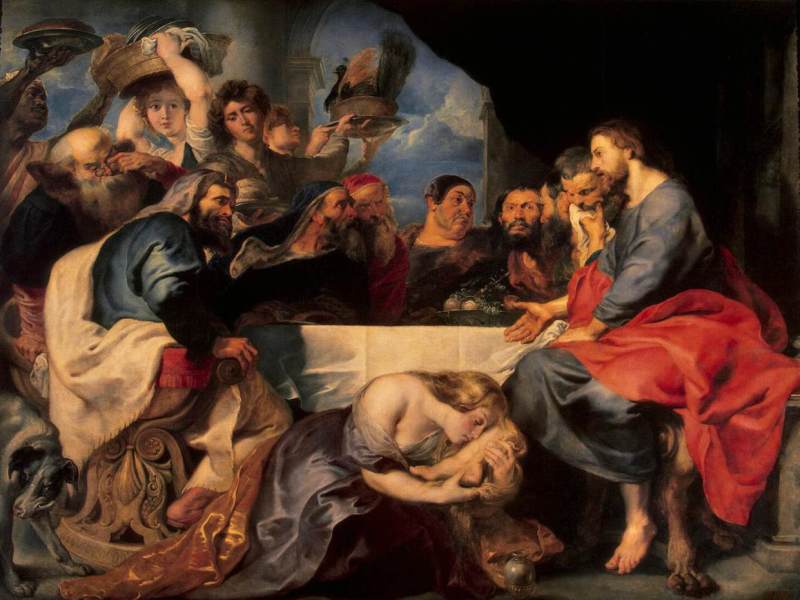
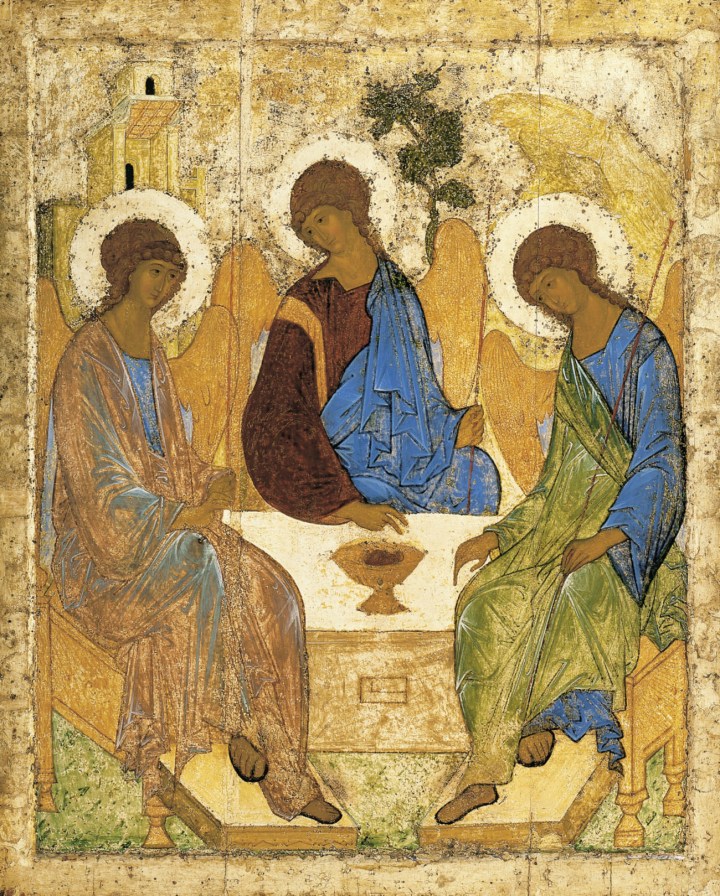
“For my part, the only perfection I know is a hearty love of God, and to love one’s neighbour as oneself. Without these there can be no real perfection. Charity is the only ‘bond of perfectness’ between Christians, the only virtue which rightly unites us to God and man. Such union is our final aim and end, and all else is mere delusion.

“No virtues, however great they may seem, are worth anything, without charity; – not even such faith as could ‘remove mountains’ or ‘understand all mysteries;’ which has ‘the gift of prophesy, or speaks with the tongue of men or angels;’ which ‘bestows all its gifts to feed the poor,’ or endures martyrdom, All is vain without charity. He who lacketh charity is dead while he liveth, and all his works, however fair to the eye, are valueless, seen from the point of eternity.

“I grant that austerity, meditation, and all such practices are admirable means whereby to advance towards perfection, so long as they are carried on in and through charity. But it will not do to seek perfection by any other means – rather in the end to which they do but lead, else we shall find ourselves halting in the midst of the race, instead of reaching the goal.”

taken from The Spirit of S. Francis de Sales Bishop and Prince of Geneva by Jean Pierre Camus, Bishop of Bellay. tr. H.I. Sidney Lear, London: Longmans, 1921: 1-2

Prayerful Action

Prayer and action can never be seen as contradictory or mutually exclusive. Prayer without action grows into powerless pietism, and action without prayer degenerates into questionable manipulation. If prayer leads us into deeper unity with the Compassionate Christ, it will always give rise to concrete acts of service. And if concrete acts of service do indeed lead us to a deeper solidarity with the poor, the hungry, the sick, the dying, and the oppressed, they will always give rise to prayer. In prayer we meet Christ, and in him all human suffering. In service we meet people, and in them the suffering Christ.

Action with and for those who suffer is the concrete expression of a compassionate life and the final criterion of being a Christian. Such acts do not stand beside the moments of prayer and worship but are themselves such moments. Why? Because Jesus Christ, who did not cling to his divinity, but became as we are, can be found where there are hungry, thirsty, alienated, naked sick, and imprisoned people. Precisely when we live in an ongoing conversation with Christ and allow his Spirit to guide our lives, we will recognize him in the poor, the oppressed, and the downtrodden and will hear his cry and respond to it wherever he reveals himself.

Henri J.M. Nouwen Compassion

Eleventh Sunday of Year C

There are three different ways in which we may judge others: with our passions, our reason and our faith. Our passions induce us to love those who love us; our reason makes us love all people within certain limits; our faith makes us love everyone, including those who do us harm and are our enemies.

Fulton Sheen Way to Inner Peace (1955) 110.

You can tell a man by the company he keeps, or so the saying goes. The Scribes and the Pharisees certainly subscribe to this idea and in this morning’s Gospel are not afraid to express it. They are more than happy to be judgemental – to only be seen with the right sort of people, certainly not with sinners, outcasts, people who ‘aren’t like us’ Well all I can say is that it’s a jolly good thing that God doesn’t treat humanity like it treats itself: as to put it simply the human judgement of others, to which each and every one of us falls prey from time to time, has no place in the Christian Faith at all. God in Christ seeks the lost, the outcast, the people outside the religious in-crowd, God seeks them out and eats with them. How shocking! It offends our human sensibilities and breaks down human distinctions to show us the radical freedom of the Kingdom of God. The woman who anoints Jesus’ feet does so out of love, and through her love and generosity her sins are forgiven. She puts her faith into action, and through her faith she is forgiven.

We are each and every one of us sinners, we are not worth of having God come to and eat with us, but that is exactly what happens day by day and week when Christ feeds us with himself, so that we may become what he is, so that we can be transformed by grace and share in the divine life. That is why we are here this morning to be fed by Him and with Him, to be healed and restored by Him, to share in His life.  God takes the initiative, He goes to seek out the lost, He doesn’t wait for them to come to Him. The banquet of the Kingdom is one to which everyone is invited, if they turn away from sin, if they repent and believe the Good News of Jesus Christ. Thus we can say with the Apostle Paul, it is no longer I who live, but it is Christ who lives in me, we live for others, and to bear witness to God’s saving love

God does the hard work, so that we have the simpler task of turning away from all that separates us from Him and each other. To do this takes humility – knowing our need of God, and his grace and mercy, knowing that without his help we are and can do nothing.  Our response to His love is to love Him and our neighbour – to put our faith into practice in our lives. This is a cause of joy in heaven, whereas its opposite, the reaction of the Scribes and Pharisees is to moan and begrudge, to criticise. It is a response of misery and bitterness, a smallness of mind and heart. Such feelings should have no place in the Church. The church is called to be generous, so that it follows the example of a generous God, who dies for love of us, who pays the price which we owe, who dies so that we might live, and live for Him.The world around us will be quick to point out out faults, without realising that the point of the Church is to be a place where sinners can encounter and be transformed by the love and mercy of God.

Christ is the Good Shepherd, who goes after the lost sheep to carry them back on his shoulders – likewise the Church is meant to be there for those outside it, to welcome them back inside the fold rejoicing. Our faith then should be the cause of our joy, a deep happiness that comes from being known and loved by Our Heavenly Father, who sent His Son to die for us, so that we might live. This is healing and generosity on an unimaginable scale, which has the power to transform our lives, so that we live for, in and through the God who loves and who heals us.

With our joy there comes freedom, a freedom from being constrained by the ways of the world, from conforming to its ways, a freedom to welcome others to Banquet of the Kingdom, where the clothes that matter are those of baptism, a sign of humility, where God gives himself to feed us to transform our human nature, to prepare us for eternal glory. So let us cast our cares on him so that his grace may be at work in us So that we may believe and be transformed, and share our faith with others that they too may believe and be transformed and give glory to of God the Father, God the Son, and God the Holy Ghost, to whom be ascribed as is most right and just all might, majesty, glory, dominion, and power, now and forever.

Trinity Sunday

Today the Sunday after Pentecost is notable for a number of reasons in 1334 Pope John XXII decreed that the Feast of the Holy Trinity should be kept and in 1162 Thomas Becket was consecrated a Bishop, and as the anniversary of his consecration, it was celebrated. It is something which gets people into a bit of a mess, there is the standard joke that it is a Sunday to get someone else to preach for you, a curate, a visiting preacher, anyone, as though the Doctrine is something of which to be scared.

Well I for one do not ascribe to such nonsense, I never have and I never will, as today gives us an opportunity to contemplate the mystery which is God’s very nature, we know God as the Father, the Creator and Ruler of all, the Son, who redeems humanity, and the Spirit, active in the World, who fills us with the love of God. There is a reason why we started our worship the morning with the words ‘In the name of the Father, and of the Son, and of the Holy Spirit’, and why it ends with ‘The Blessing of God the Father, God the Son, and God the Holy Spirit’ not three blessings, but one, our baptism, our worship as Christians is Trinitarian: Three persons, One God. It can be hard for some to understand, the church spent hundreds of years arguing of the Divinity of the Son and the Holy Spirit, and in the process worked out what we believe as Christians and why. We can Say One Father, One Son, One Holy Spirit, One God, because what we are dealing with is not a mathematical question, Christians are not polytheists, we do not worship three Gods, but One: the Trinity is not a problem to be solved through thought, but a mystery to enter through our worship of God, and a relationship, which through Christ is open to us, in the power of the Holy Spirit.

If anything it is better to approach such things obliquely rather than head on, and in this case with images rather than words. Andrei Rublev painted an icon of the Trinity either around 1411 or 1425-7. It shows the visit of the Angels to Abraham at the Oak of Mamre:

And the Lord appeared to him by the oaks of Mamre, as he sat at the door of his tent in the heat of the day. He lifted up his eyes and looked, and behold, three men were standing in front of him. When he saw them, he ran from the tent door to meet them and bowed himself to the earth and said, “O Lord, if I have found favour in your sight, do not pass by your servant. Let a little water be brought, and wash your feet, and rest yourselves under the tree, while I bring a morsel of bread, that you may refresh yourselves, and after that you may pass on—since you have come to your servant.” So they said, “Do as you have said.” And Abraham went quickly into the tent to Sarah and said, “Quick! Three seahs of fine flour! Knead it, and make cakes.” And Abraham ran to the herd and took a calf, tender and good, and gave it to a young man, who prepared it quickly. Then he took curds and milk and the calf that he had prepared, and set it before them. And he stood by them under the tree while they ate. (Gen 18:1-8 ESV)

In Andrei Rublev’s icon, the persons of the Holy Trinity are shown in the order in which they are confessed in the Creed. The first angel is the first person of the Trinity – God the Father; the second, middle angel is God the Son; the third angel is God the Holy Spirit. All three angels are blessing the chalice, in which lies a sacrificed calf, prepared for eating. The sacrifice of the calf signifies the Saviour’s death on the cross, while its preparation as food symbolizes the sacrament of the Eucharist. All three angels have staffs in their hand as a symbol of their divine power.

The first angel, shown at left, is vested in a blue undergarment which depicts his divine celestial nature, and a light purple outer garment which attests to the unfathomable nature and the royal dignity of this angel. Behind him and above his head towers a house, the abode of Abraham, and a sacrificial altar in front of the house. This image of the abode has a symbolic meaning: the house signifies God’s master plan for creation, while the fact that the house towers above the first angel shows him to be the head (or Father) of this creation. The same fatherly authority is seen in his entire appearance. His head is not bowed and he is looking at the other two angels. His whole demeanour – the expression on his face, the placement of his hands, the way he is sitting – all speaks of his fatherly dignity. The other two angels have their heads inclined and eyes turned toward the first angel with great attention, as though conversing with him about the salvation of mankind.

The second angel is placed in the middle of the icon. This placement is determined by the position held by the second Person within the Trinity Itself. Above his head extend the branches of an oak tree. The vestments of the second angel correspond to those in which the Saviour is usually depicted. The undergarment is a dark crimson colour which symbolizes the incarnation, while the blue outer robe signifies the divinity and the celestial nature of this angel. The second angel is inclined towards the first angel, as though deep in conversation. The tree behind him serves as a reminder of the tree of life that was standing in Eden, and of the cross.

The angel on the right is the third Person of the Trinity – the Holy Spirit. His light blue undergarment and smoky-green outer garment represent heaven and earth, and signify the life-giving force of the Holy Spirit, which animates everything that exists. “By the Holy Spirit every soul lives and is elevated in purity” – sings the Church. This elevation in purity is represented in the icon by a mountain above the third angel. (Taken from “Thoughts on Iconography” by monk Gregory Krug, found at http://www.holy-transfiguration.org/library_en/lord_trinity_rublev.html)

This relationship of equals has a space in front of them , and that’s where you and I come in, there is food at God’s table, spiritual food, prefigured in this vision of hospitality, we enter a relationship with the Trinity in our baptism and deepen it in our worship, and our prayer and reading of scripture, but most of all through our response to the Eucharistic hospitality of God, so let us come to Him, to be fed by Him and fed with him to share his life and proclaim his truth so that the world may believe and give glory…

017rublev troitsa

Easter VII 2016

Can we pray, therefore, for the coming of Jesus? Can we sincerely say ‘Marana tha Come Lord Jesus!’’? Yes we can. And not only that: we must! We pray for anticipations of his world-changing presence. We pray to him in moments of personal tribulation: Come, Lord Jesus and draw my life into the presence of your kindly power. We ask him to be close to those we love or for whom we are anxious. We ask him to be present and effective in his Church. Why not ask him to send us new witnesses of his presence today, in whom he himself will come to us? And this prayer, while it is not directly focussed on the end of the world, is nevertheless a real prayer for his coming; it contains the full breadth of the prayer that he himself taught us: ‘Your kingdom come!’ Come, Lord Jesus

Pope Benedict XVI Jesus of Nazareth Part Two,  London CTS 2011: 292

The other week week I was doing my shopping in Lidl, putting my shopping up on the belt, as you do, when, all of a sudden this old lady came, walked in front of the man behind me and, without so much as a by your leave, proceeded to put her shopping on the belt. The man behind me was dumbfounded. I wanted to ask her if she wanted to go in front of me, and she carried on regardless, starting a conversation with me, it was really quite something. Clearly she couldn’t be bothered to wait, to queue, I didn’t ask her why she was in such a rush. Waiting is one of those things you love or loathe, it’s a national characteristic that we don’t like fuss and will queue and wait, an American will make a fuss, whereas the British would find such impatience awkward. We might not enjoy it, but at least we aren’t going to make a fuss about it. And yet in these days between the Ascension and Pentecost, the Church waits, waits for her Lord, and her prayer is Maranatha, ‘Come Lord Jesus’. Come Lord Jesus, fill us with your love, with your Holy Spirit, give us life in you.

The prophet Ezekiel has a vision (in Chapter 36) of a messianic future, of the restoration of  Israel, which is found in Jesus Christ and the Church. We are those sprinkled with the clean water of baptism, who have been cleansed. God gives us a new heart and puts his Spirit within us, just as he did on the day of Pentecost, so we are to live as the people of God, filled with his love, and forgiveness, and proclaiming his Truth to the world.

This Sunday in the Gospel we are in the middle of Jesus’ High Priestly Prayer, which is the summit of his teaching just before his arrest and Passion. Christ has made God’s name known to us, we know him in a different way, we pray to him as ‘Father’ and we are his, we are not our own, despite the Western Liberal infatuation with personal freedom, we are God’s, which affects who we are, and what we do.

Christ speaks to us, and teaches us so that our joy may be complete in him, filled with his love, and the Holy Spirit. The world’s reaction to this is a negative one: because what we are, what we stand for, and how we live as Christians is to be opposed to what the world around us stands for – selfishness, greed, which it makes into false gods, as though material wealth, or power, or status could save us – such things are transient and fleeting. It offers us a short-cut, an easy road, whereas if we are following Christ, then we are walking the way of his Passion, we are walking the Way of the Cross, dying daily to sin, and letting God’s grace be at work in and through us. It is not easy, it is difficult, most of us are unable to manage on our own, we need the love and support of the Christian community to help us, even the first Christians, those who had been with Jesus, needed each other’s help and support, so they can continue what Jesus started.

We need to be together, to meet together to pray for our needs and those of the world, and to be nourished by the word of God, the Bible, and the Sacrament of Our Lord’s Body and Blood, not because they’re something nice to do on a Sunday morning: an add-on, an optional extra that we can opt into and out of as we feel like, but because as Christians they are crucial to who and what we are, if we are to remain in the love of God then we have to live this way. Only then can we offer the world an alternative to the ways of selfishness and sin. It will hate us for doing this, it will despise us and persecute us, it will call us hypocrites when we fail to live up to the example of Jesus; but as Christians who live in the love of God we forgive each other our trespasses, so that we can live out that same radical love and forgiveness which sees Jesus die upon the Cross for love of us and all the world, this is love which can transform the world. It is a message of such love, such forgiveness that the world cannot or does not want to understand it, we may not understand it, but we know that it can be experienced, and we are living testimony to its power. It turns our lives around and sets us free to live for God and to proclaim his saving truth in our words and actions, calling the world to repentance, to turn to Christ, and to be renewed in and through Him.In his power, with His Truth, filled with His Love we can transform the world, one soul at a time.

So as we wait with the Apostles for the gift of the Holy Spirit let us pray that Christ may come, and send His Holy Spirit, that God may be at work in us, building us up, and giving us strength to live his life and to proclaim his truth, to offer the world that which it most earnestly desires, a peace, a joy and a freedom which pass human understanding, and the gift of eternal life in Christ.

mostsacredheartofjesus-bruges

The Ascension

One of the loveliest things about today is that it tends to focus, in religious art at least, on feet:  the smelly things we like to keep hidden away from the world. Today we see Jesus’ in all their glory going back to where they came from, but they go back differently than they descended: they go back marked with nails, wounded, bearing the marks of God’s love, it is this love which fills us in the Church, the same love which feeds us in His Body and Blood.

We have come here today to celebrate Our Lord’s Ascension into heaven. The world around us may well find the idea quaint or laughable – or at least physically impossible. But it is no less hard to believe than Our Lord becoming incarnate by the power of the Holy Spirit in the womb of the Blessed Virgin Mary, or his rising from the dead at Easter. The world, with the greatest confidence, will tell us that what we are celebrating are myths and fairy stories, but they fail to get the point of what’s really going on.

Our Lord ascends, body and soul into heaven, to the closer presence of God the Father, and to prepare for the sending of the Holy Spirit on his disciples at Pentecost. He who shares our humanity takes it into heaven, into the very life of the Godhead; so that where he is we may be also. We have seen the promise of new life in Easter, a new life which is in the closer presence of God, which we celebrate today. We can see where it leads – what started at the Incarnation finds its goal and truest meaning in the unity of the human and the divine.

But rather than seeing this as an end it is surely far better to see in it a beginning – a beginning of the Church as we know it – a church which goes and makes disciples of all nations, baptizing them in the Father and of the Son and of the Holy Spirit, teaching them to observe all that Our Lord commanded us. This is exactly where we have been for nearly two thousand years. Inspired by the Holy Spirit they did what their Lord commanded them to do and that is why we are here today celebrating this fact.

But like them we too are called to follow Our Lord’s commands and to share his good news with the world so that it may believe. We are called to live lives where our faith is enfleshed in us – it is not abstract and private, but concrete and public. The Atheist who finds our beliefs laughable now joins forces with an Enlightenment Rationalist who wishes faith to be a private matter rather than a public one. This will not do: Our Lord did not say ‘Don’t do this if it’s inconvenient’ or ‘There’s no need to make a fuss in public about me’. He speaks as one given authority, ‘all authority in heaven and on earth’, so we can gladly place ourselves under His authority, to do his will.

He makes us a promise: ‘Behold, I am with you always, to the end of the age.’ He is with us by sending His Spirit on the Church at Pentecost and ever since. He is with us in his Word, Holy Scripture and in the Sacrament of His Body and Blood. It is through this (and the other Sacraments of the Church) that God’s grace can perfect our human nature – so that we can prepare to share the divine life of love in Heaven. Where our Lord goes we can hope to follow, through his sacrifice of Himself upon the Cross, a sacrifice made present here and on the altars of churches all throughout the world, to strengthen us, so that we may be close to him, sharing in the divine life of love poured out on us.

Once Jesus has ascended in glory and before he returns as our judge the only place where we can encounter him is in and through the Church, in its sacraments, in the word of Holy Scripture, and in people, filled with His Holy Spirit: it is a huge responsibility, but a movement which started with 12 men in Jerusalem is still going strong nearly two thousand years later. We have been given the gift of faith and it is up to us to pass it on, so that others may come to share in the joy of the Lord.

We can all hope to follow Him, and to spend eternity contemplating the Beatific Vision, caught up in that love which is the Divine Nature, sharing in the praise of all creation of the God who creates, who redeems, and who sustains all. We can have this hope because Christ has gone before us, he has prepared the way for humanity to follow him and share in the divine life of love.

Let us prepare for this by living the life of faith, strengthened by Him, proclaiming his truth, praying for the gift of His Spirit at Pentecost, that the Church may be strengthened to proclaim His saving truth and the baptism of repentance, so that we and all the world may sing the praise of God the Father, God the Son, and God the Holy Spirit, to whom be ascribed as is most right and just all might, majesty, glory, dominion, and power, now and forever.