![]() |
|
| Jan van Eyck The Adoration of the Lamb from the Ghent Altarpiece |
![]() |
|
| Jan van Eyck The Adoration of the Lamb from the Ghent Altarpiece |
Living as we do here, out in the countryside, surrounded by fields, I suspect that the imagery in this morning’s readings is not completely lost on us. We are used to sheep and the shepherds who look after them. The care and devotion which a Shepherd should devote to his flock is a sign of God’s love and care for us, and to those of us who have been given any sort of pastoral responsibility in the church it serves as a reminder of who and what we are supposed to be: its cost, and the responsibility we share for the care of Christ’s flock, the burden and the joy. It is frightening to think how little our own strength and skill is compared to the task – we have to rely upon God, and his strength and not our own.
In this morning’s first reading, we see what happens when it goes wrong (there’s advice for bishops here). The Kings of Israel are not true shepherds as they exercise power which destroys and drives away the sheep. They don’t care for the well-being of the people, who have scattered, gone wandering off, as the mood takes them. It’s all gone horribly wrong; and yet God, the true shepherd of our souls, does not leave his people comfortless. He promises to give them a good Shepherd, and points towards his son, the Good Shepherd, who will lay down his life for his sheep. The prophet Jeremiah looks forward to a future when there is a Good Shepherd, who is Christ, who lays down his life for his sheep. This is care, this is self-giving love.
In St Paul’s letter to the Ephesians we see the work of the Good Shepherd and its fruits. He gives us life through his death. Through him the flock is united; sin, that which divides, that which keeps us apart has been overcome by Jesus, he restores our relationship to one another and to God the Father, by laying down his life, by giving himself for us upon the cross and here in the Eucharist, where we the people of God are fed by God, are fed with God, to be built up into a holy nation, to become more like him, to have a hope of heaven, and of eternal peace and joy with him.
In this morning’s Gospel we see a picture of what good shepherds are like. Jesus and the apostles have been teaching the people, it’s a wonderful thing but it does take its toll. The disciples tell Jesus that it’s time to have a rest, to spend some time alone, in prayer and refreshment. The people are so many; their needs are so great that the apostles have not had time to even eat. It is a recognisable picture, and it shows us how great was the people’s need for God, for God’s teaching, for his love and reconciliation. Jesus does not send them away he takes pity on them because they are like sheep without a Shepherd, and he, the good Shepherd, will lay down his life for his sheep. His people are hungry so they will be fed by God, and fed with God. God offers himself as food for his people and continues to do so: he will feed us here today, feed us with his body and blood, with his word, so that we may be fed, so that we may be nourished, so that we may be strengthened to live our lives, that we may live lives which follow him, that we may have the peace which passes all understanding.
It’s a wonderful gift, which comes at a tremendous cost, which shows us how loving and generous God is towards us His people. Our response should be gratitude that we are fed in this way, that we have been reconciled to God through him. We should live lives fashioned after his example, lives which show his love and his truth to the world, lives which proclaim his victory, lives which will attract people to come inside the sheep-fold, to have new life in Jesus, to be with Jesus, to be fed by him, to be fed with him.
It’s a difficult thing to do, to live this life, to follow His example but with God’s help, and by helping each other to do it together, we can, and thereby give glory to God the Father, God the Son, and God the Holy Spirit, to whom be ascribed as is most right and just, all might, majesty, glory dominion, and power, now and forever.
O our Saviour! of ourselves we cannot love thee,cannot follow thee, cannot cleave to thee;
but thou didst come down that we might love thee
didst ascend that we might follow thee,
didst bind us round thee as thy girdle that we may be held fast unto thee;
Thou who hast loved us, make us to love thee,
Thou who hast sought us, make us to seek thee,
Tho who, when lost, didst find us,
be thou thyself the way,
that we may find thee
and be found in thee,
our only hope, and our everlasting joy.
![]() |
|||
| Abba Moses the Ethiopian |
Before our Lord ascended to his Father in heaven he told his disciples to wait, to wait for the gift of the Holy Spirit. Around them in Jerusalem people would have been waiting to celebrate Pentecost where they gave thanks for the Law, given to Moses on Mt Sinai. It was a time of celebration, of joy, but for the Church it was something more.
The prophet Ezekiel has a vision (in Chapter 36) of a messianic future, of the restoration of Israel, which is found in his Son, Jesus Christ and the Church, we are those sprinkled with the clean water of baptism, who have been cleansed. God gives us a new heart and puts his Spirit within us, just as he did on the day of Pentecost, so we are to live as the people of God, lled with his love, and forgiveness, and proclaiming his Truth to the world.
This Sunday in the Gospel we are in the middle of Jesus’ High Priestly Prayer, which is the summit of his teaching just before his arrest and Passion. Christ has made God’s name known to us, we know him in a different way, we pray to him as ‘Father’ and we are his, we are not our own, despite the Western Liberal infatuation with personal freedom, we are God’s, which affects who we are, and what we do.
Christ speaks to us, and teaches us so that our joy may be complete in him, lled with his love, and the Holy Spirit. The world’s reaction to this is a negative one: because what we are, what we stand for, and how we live as Christians is to be opposed to what the world around us stands for – selshness, greed, which it makes into false gods, as though material wealth, or power, or status could save us – such things are transient and fleeting. It offers us a short-cut, an easy road, whereas if we are following Christ, then we are walking the way of his Passion, we are walking the Way of the Cross, dying daily to sin, and letting God’s grace be at work in and through us. It is not easy, it is difficult, most of us are unable to manage on our own, we need the love and support of the Christian community to help us, even the rst Christians, those who had been with Jesus, needed each 0ther’s help and support, so they can continue what Jesus started.
We need to be together, to meet together to pray for our needs and those of the world, and to be nourished by the word of God, the Bible, and the Sacrament of Our Lord’s Body and Blood, not because they’re something nice to do on a Sunday morning: an add-on, an optional extra that we can opt into and out of as we feel like, but because as Christians they are crucial to who and what we are, if we are to remain in the love of God then we have to live this way. Only then can we offer the world an alternative to the ways of selshness and sin. It will hate us for doing this, it will despise us, it will call us hypocrites when we fail to live up to the example of Jesus, but as Christians who live in the love of God we forgive each other our trespasses, so that we can live out that same radical love and forgiveness which sees Jesus die upon the Cross for love of us and all the world. It is a message of such love, such forgiveness that the world cannot or does not want to understand it, we may not understand it, but we know that it can be experienced, and we are living testimony to its power. It turns our lives around and sets us free to live for God and to proclaim his saving truth in our words and actions, calling the world to repentance, to turn to Christ, and to be renewed in and through Him.
So as we wait with the Apostles for the gift of the Holy Spirit let us pray that God may be at work in us, building us up, and giving us strength to live his life and to proclaim his truth, to offer the world that which it most earnestly desires, a peace, a joy and a freedom which pass human understanding, and the gift of eternal life in Christ.
The Cross had asked the questions; the Resurrection had answered them…. The Cross had asked ‘Why does God permit evil and sin to nail Justice to a tree?’ The Resurrection answered: ‘That sin, having done its worst, might exhaust itself and thus be overcome by Love that is stronger than either sin or death.’ Thus there emerges the Easter lesson that the power of evil and the chaos of the moment can be defied and conquered, for the basis of our hope is not in any construct of human power but in the power of God, who has given to the evil of this earth its one mortal wound—an open tomb, a gaping sepulchre, an empty grave.
Fulton J. Sheen Cross-Ways
|
O
|
|
Τῷ ἁγίῳ καὶ μεγάλῳ Σαββάτῳ.
Τί τοῦτο; σήμερον σιγὴ πολλὴ ἐν τῇ γῇ· σιγὴ πολλὴ καὶ ἠρεμία λοιπόν· σιγὴ πολλὴ, ὅτι ὁ Βασιλεὺς ὑπνοῖ· γῆ ἐφοβήθη καὶ ἡσύχασεν, ὅτι ὁ Θεὸς σαρκὶ ὕπνωσε, καὶ τοὺς ἀπ’ αἰῶνος ὑπνοῦντας ἀνέστησεν. Ὁ Θεὸς ἐν σαρκὶ τέθνηκε, καὶ ὁ ᾅδης ἐτρόμαξεν. Ὁ Θεὸς πρὸς βραχὺ ὕπνωσε, καὶ τοὺς ἐν τῷ ᾅδῃ ἐξήγειρε.
|
Something strange is happening – there is a great silence on earth today, a great silence and stillness. The whole earth keeps silence because the King is asleep. The earth trembled and is still because God has fallen asleep in the flesh and he has raised up all who have slept ever since the world began. God has died in the flesh and hell trembles with fear.
|
|
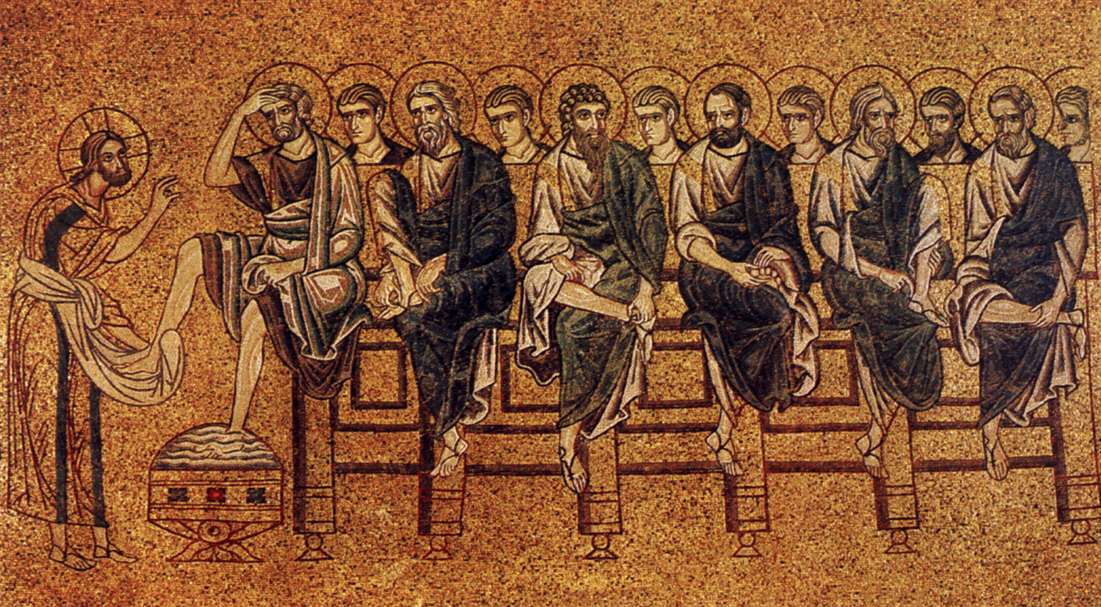
But before this love is disclosed in our Lord’s Passion, Death and Resurrection, it is shown in loving service and humility, the Greek word for which is diakonia, which gives us our English word Deacon. All those who are ordained are set apart for the service of Almighty God and his church and we are all called to serve God and his people fashioning ourselves after the example of our Lord and Saviour Jesus Christ. All ordained Christian ministry is rooted in the diaconate, in a ministry of loving service, after the form and pattern of Our Lord and Saviour Jesus Christ, following HIS example and living it out in our lives. This is a most wonderful and humbling task which can fill us with both joy and fear and I would humbly ask that you continue to pray for me and for all of us who serve the church in this place, since we can do nothing without you.
|
Judas really cannot understand why the myrrh is being lavished on Jesus. He doesn’t care for the poor, he’s looking for a chance to embezzle from the common fund. He’s thinking about himself and about worldly things. Jesus enjoys the things of this world: he’s having dinner with friends, he hangs around with all sorts and is accused of being a drunkard. He doesn’t care a jot for social convention, for keeping up appearances. It’s what on the inside that counts. He knows that Mary is acting out of love. As a costly extravagant act it points to his own death on the cross for love of us, wretches that we are. There is something wonderful and exuberant about divine generosity: it’s over the top, it is lavish and excess – such is the love of God, who spared not his own son for love of us. That’s how much God loves us. Can our response to that love be exuberant, or will we be like Judas: miserly, thinking of ourselves.
The Jews don’t get it either. They can see an event: Jesus is news and so is Lazarus: celebrity culture is not a new thing. The Religious Authorities think it’s all about power and influence: they don’t get it either. They can only see a zero-sum game. They are concerned with things of this world and are unable to the Kingdom of God in their midst. It’s always troubling when the church starts to look like the Pharisees: concerned with the things of this world, power, influence, courting popular opinion or popularity with politicians. Jesus has always had the ability to unsettle the powerful. They feel threatened by the freedom of the Kingdom, a freedom which sees Christ lay down his life freely. Such things can truly change the world. And they do. The Cross will show God’s power in weakness, his love in rejection and humiliation. It’s scandalous insofar as it turns the values of the world on their head. It announces and inaugurates the Kingdom of Christ: let us stay close to him, follow in his footsteps, and live his life by his rules, spurning the ways of the world to have life in all its fullness in Him.
If we do not venture to approach men who are in power, except with humility and reverence, when we wish to ask a favor, how much must we beseech the Lord God of all things with all humility and purity of devotion? And let us be assured that it is not in many words, but in the purity of heart and tears of compunction that we are heard. For this reason prayer ought to be short and pure, unless, perhaps it is lengthened by the inspiration of divine grace. At the community exercises, however, let the prayer always be short, and the sign having been given by the Superior, let all rise together.
12 Put on then, as God’s chosen ones, holy and beloved, compassionate hearts,kindness, humility, meekness, and patience,13 bearing with one another and, if one has a complaint against another, forgiving each other; as the Lord has forgiven you, so you also must forgive. 14 And above all these put on love, which binds everything together inperfect harmony. 15 And let the peace of Christ rule in your hearts, to which indeed you were called in one body. And be thankful. 16 Let the word of Christ dwell in you richly, teaching and admonishing one another in all wisdom, singing psalms and hymns and spiritual songs, with thankfulness in your hearts to God. 17 And whatever you do, in word or deed, do everything in the name of the Lord Jesus,giving thanks to God the Father through him.
When St Antony was praying in his cell, a voice spoke to him, saying ‘Antony, you have not yet come to the measure of the tanner who is in Alexandria.’ When he heard this, the old man arose and took his stick and hurried to the city. When he had found the tanner …. he said to him, ‘Tell me about your work, for today I have left the desert and come here to see you.’He replied, ‘I am not aware that I have done anything good. When I get up in the morning, before I sit down to work, I say that the whole of the city, small and great, will go into the Kingdom of God because of their good deeds while I will go into eternal punishment because of my evil deeds. Every evening I repeat the same words and believe them in my heart.’When St Antony heard this he said, ‘My son, you sit in your own house and work well, and you have the peace of the Kingdom of God; but I spend all my time in solitude with no distractions, and I have not come near to the measure of such words.’

About 1700 years ago the passage from the Book of Proverbs which is the Old Testament Reading which we have just heard was at the centre of a theological controversy which threatened the nature and existence of Christianity as we know it. Arius, a priest of Alexandria used the passage ‘The Lordcreated me at the beginning of his work, the first of his acts of long ago. Ages ago I was set up, at the first, before the beginning of the earth. When there were no depths I was brought forth, when there were no springs abounding with water. Before the mountains had been shaped, before the hills, I was brought forth’ to prove that Wisdom, which was understood as the Logos, the Word of God, the Creative Intelligence was not pre-existent, that it was a creation, and that ‘there was a time when he was not’. He may have been attempting to uphold what he understood as monotheism and the supremacy of God the Father, but in so doing he threatened the very nature of Christianity itself: denying the eternal nature of the Son of God, seeing Him as a creature, something created, something less than God.
The brethren came to the Abba Anthony and said to him, ‘Speak a word; how are we to be saved?’ The old man said to them, ‘You have heard the Scriptures. That should teach you how.’ But they said, ‘We want to hear it from you too, Father.’ Then the old man said to them, ‘The Gospel says,”if anyone strikes you on the one cheek, turn to him the other also.”‘ (Mt 5:39) They said, ‘We cannot do that.’ The old man said, ‘If you cannot offer the other cheek, at least allow one cheek to be struck.’ ‘We cannot do that either,’ they said. So he said, ‘If you are not able to do that, do not return evil for evil,’ and they said, ‘We cannot do that either.’ Then the old man said to his disciple, ‘Prepare a little brew of corn for these invalids. If you cannot do this, or that, what can I do for you? What you need is prayers.’
It was revealed to Abba Anthony in his desert that there was one who was his equal in the city. He was a doctor by profession and whatever he had beyond his needs he gave to the poor, and every day he sang the Sanctus with the angels.
He also said, ‘Our life and our death is with our neighbour. If we gain our brother, we have gained God, but if we scandalise our brother, we have sinned against Christ.’
Like many people I have found the images in CharlieHebdo which mock religion, and in particular Christianity, somewhat difficult and troubling. The following words of St Athanasius are, however, both a help and a comfort:
Come now, blessed one and true lover of Christ, let us, with the faith of our religion relate things concerning the Incarnation of the Word and expound his divine manifestation to us which the Jews slander and the Greeks mock, but which we ourselves venerate, so that all the more from his apparent degradation, you may have even greater and fuller piety towards him, for the more he is mocked by unbelievers by so much he provides a greater witness of his divinity, because what human beings cannot understand as impossible, these he shows to be possible (cf. Mt 19:26), and what human beings mock as unseemly, these he renders fitting by his own goodness, and what human beings through sophistry laugh at as merely human, these by his power he shows to be divine, overturning the illusion of idols by his own apparent degradation through the cross, invisibly persuading those who mock and disbelieve to recognise his divinity and his power.
Athanasius de Incarnatione Dei Verbi 1
tr. J. Behr (St Vladimir’s Seminary Press : 2011)
Αὐτὸς γὰρ ἐνηνθρώπησεν, ἵνα ἡμεῖς θεοποιηθῶμεν·Athanasius De Incarnatione Dei Verbi 54.3‘He became human so that we might become divine’
| Practise what you preach |
|---|