Homily for Lent V
Lent IV – Looking to the Cross
A Thought for the Day from St Benedict
If we do not venture to approach men who are in power, except with humility and reverence, when we wish to ask a favor, how much must we beseech the Lord God of all things with all humility and purity of devotion? And let us be assured that it is not in many words, but in the purity of heart and tears of compunction that we are heard. For this reason prayer ought to be short and pure, unless, perhaps it is lengthened by the inspiration of divine grace. At the community exercises, however, let the prayer always be short, and the sign having been given by the Superior, let all rise together.
Lent III Year B
A thought for the day from Colossians 3
12 Put on then, as God’s chosen ones, holy and beloved, compassionate hearts,kindness, humility, meekness, and patience,13 bearing with one another and, if one has a complaint against another, forgiving each other; as the Lord has forgiven you, so you also must forgive. 14 And above all these put on love, which binds everything together inperfect harmony. 15 And let the peace of Christ rule in your hearts, to which indeed you were called in one body. And be thankful. 16 Let the word of Christ dwell in you richly, teaching and admonishing one another in all wisdom, singing psalms and hymns and spiritual songs, with thankfulness in your hearts to God. 17 And whatever you do, in word or deed, do everything in the name of the Lord Jesus,giving thanks to God the Father through him.
Homily for Lent I
When St Antony was praying in his cell, a voice spoke to him, saying ‘Antony, you have not yet come to the measure of the tanner who is in Alexandria.’ When he heard this, the old man arose and took his stick and hurried to the city. When he had found the tanner …. he said to him, ‘Tell me about your work, for today I have left the desert and come here to see you.’He replied, ‘I am not aware that I have done anything good. When I get up in the morning, before I sit down to work, I say that the whole of the city, small and great, will go into the Kingdom of God because of their good deeds while I will go into eternal punishment because of my evil deeds. Every evening I repeat the same words and believe them in my heart.’When St Antony heard this he said, ‘My son, you sit in your own house and work well, and you have the peace of the Kingdom of God; but I spend all my time in solitude with no distractions, and I have not come near to the measure of such words.’

A Thought for the Day from the Desert
Sexagesima Year B
About 1700 years ago the passage from the Book of Proverbs which is the Old Testament Reading which we have just heard was at the centre of a theological controversy which threatened the nature and existence of Christianity as we know it. Arius, a priest of Alexandria used the passage ‘The Lordcreated me at the beginning of his work, the first of his acts of long ago. Ages ago I was set up, at the first, before the beginning of the earth. When there were no depths I was brought forth, when there were no springs abounding with water. Before the mountains had been shaped, before the hills, I was brought forth’ to prove that Wisdom, which was understood as the Logos, the Word of God, the Creative Intelligence was not pre-existent, that it was a creation, and that ‘there was a time when he was not’. He may have been attempting to uphold what he understood as monotheism and the supremacy of God the Father, but in so doing he threatened the very nature of Christianity itself: denying the eternal nature of the Son of God, seeing Him as a creature, something created, something less than God.
Jesus at the Synagogue in Capernaum
Sermon for Evensong (2nd Sunday after Epiphany)
Epiphany II: John 1:43-51
A Thought for the Day from S. Anthony the Great
The brethren came to the Abba Anthony and said to him, ‘Speak a word; how are we to be saved?’ The old man said to them, ‘You have heard the Scriptures. That should teach you how.’ But they said, ‘We want to hear it from you too, Father.’ Then the old man said to them, ‘The Gospel says,”if anyone strikes you on the one cheek, turn to him the other also.”‘ (Mt 5:39) They said, ‘We cannot do that.’ The old man said, ‘If you cannot offer the other cheek, at least allow one cheek to be struck.’ ‘We cannot do that either,’ they said. So he said, ‘If you are not able to do that, do not return evil for evil,’ and they said, ‘We cannot do that either.’ Then the old man said to his disciple, ‘Prepare a little brew of corn for these invalids. If you cannot do this, or that, what can I do for you? What you need is prayers.’
It was revealed to Abba Anthony in his desert that there was one who was his equal in the city. He was a doctor by profession and whatever he had beyond his needs he gave to the poor, and every day he sang the Sanctus with the angels.
He also said, ‘Our life and our death is with our neighbour. If we gain our brother, we have gained God, but if we scandalise our brother, we have sinned against Christ.’
A thought for the day from St Athanasius
Like many people I have found the images in CharlieHebdo which mock religion, and in particular Christianity, somewhat difficult and troubling. The following words of St Athanasius are, however, both a help and a comfort:
Come now, blessed one and true lover of Christ, let us, with the faith of our religion relate things concerning the Incarnation of the Word and expound his divine manifestation to us which the Jews slander and the Greeks mock, but which we ourselves venerate, so that all the more from his apparent degradation, you may have even greater and fuller piety towards him, for the more he is mocked by unbelievers by so much he provides a greater witness of his divinity, because what human beings cannot understand as impossible, these he shows to be possible (cf. Mt 19:26), and what human beings mock as unseemly, these he renders fitting by his own goodness, and what human beings through sophistry laugh at as merely human, these by his power he shows to be divine, overturning the illusion of idols by his own apparent degradation through the cross, invisibly persuading those who mock and disbelieve to recognise his divinity and his power.
Athanasius de Incarnatione Dei Verbi 1
tr. J. Behr (St Vladimir’s Seminary Press : 2011)
Christmas II
Homily for Christmas ‘And the Word became flesh and dwelt among us’
Αὐτὸς γὰρ ἐνηνθρώπησεν, ἵνα ἡμεῖς θεοποιηθῶμεν·Athanasius De Incarnatione Dei Verbi 54.3‘He became human so that we might become divine’
Advent IV Year B – Veni Emmanuel
A thought for the day from William of St Thierry
Advent III – Rejoice
Advent II Year B ‘Repent the Kingdom is close at hand’
Advent I Year B ‘Be on your guard, stay awake, because you never know when the time will come’
Living the life of the Kingdom – The parable of the Talents
Trinity XXI The Conversion and Sanctification of Man
Be Prepared – Matthew 25:1-13
A thought for the day from S. Charles Borromeo
| Practise what you preach |
|---|
Living the life of the Kingdom
All you need is love
Matthew 22:15-22 Trinity XVIII 29th Sunday of Year A
A Harvest Sermon
Homily for the 26th Sunday of Year A
Some words of St Vincent de Paul
| Serving the poor is to be preferred above all things |
|---|
St Matthew
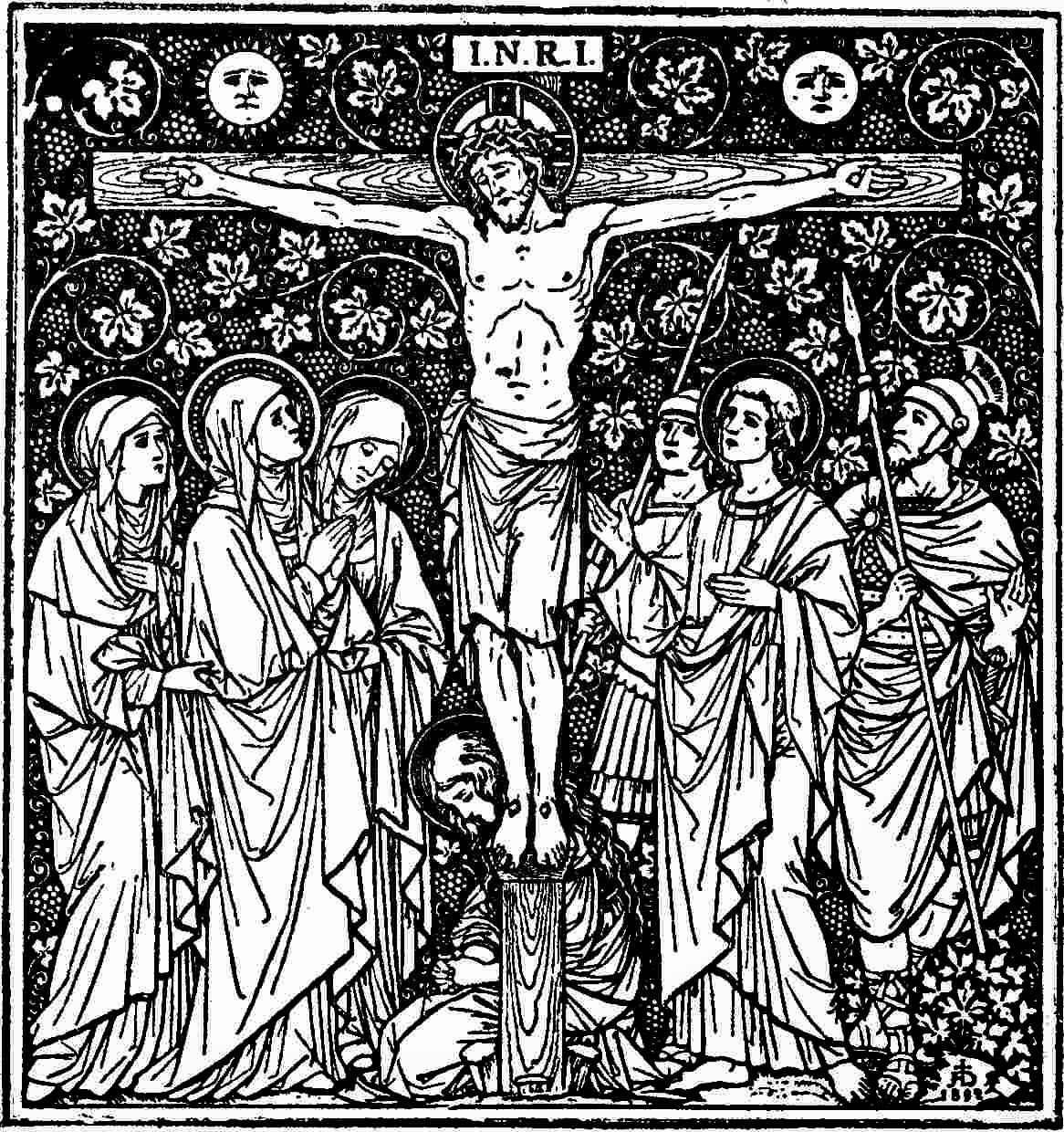
The Power of the Cross
Judgement would hold nothing but terror for us if we had no sure hope of forgiveness. And the gift of forgiveness itself is implicit in God’s and people’s love. Yet it is not enough to be granted forgiveness, we must be prepared to accept it. We must consent to be forgiven by an act of daring faith and generous hope, welcome the gift humbly, as a miracle which love alone, love human and divine, can work, and forever be grateful for its gratuity, its restoring, healing, reintegrating power. We must never confuse forgiving with forgetting, or imagine that these two things go together. Not only do they not belong together, they are mutually exclusive. To wipe out the past has little to do with constructive, imaginative, fruitful forgiveness; the only thing that must go, be erased from the past, is its venom; the bitterness, the resentment, the estrangement; but not the memory.
Sermon for Evensong Trinity XII
who was and is and is to come!”
A Choice
Metropolitan Anthony of Sourozh on Forgiveness
A thought for the day from St John of the Cross
Homily for the 22nd Sunday of Year A
A thought for the day from Jean-Pierre de Caussade
St Bartholomew
Metropolitan Anthony on Forgiveness
We must consent to be forgiven by a daring faith and generous hope, welcome the gift humbly, as a miracle which love alone, love human and divine, can work, and be forever grateful for its gratuity, its restoring, healing reintegrating power.
We must never confuse forgiving with forgetting, or imagine that these two things go together. Not only do they not belong together, but they are mutually exclusive. to wipe out the past has little to do with constructive, imaginative, fruitful forgiveness; the only thing that must go, be erased from the past, is its venom; the bitterness, the resentment, the estrangement; but not the memory.
Ransomed, Healed, Restored, Forgiven
A thought for the day from St Isaac the Syrian
When we have reached love, we have reached God and our journey is complete. We have crossed over to the island which lies beyond the world, where are the Father, the Son, and the Holy Spirit; to whom be glory and dominion. May God make us worthy to fear and love him. Amen
Walking on Water
At the end, once the wind has died down the disciples worship Him, saying, ‘Truly you are the Son of God.’ The end of it all is worship, it is what we as humans and as Christians are for, to worship God, in our love and our prayer, so that all of our lives are an act of worship, drawing us ever closer to the source of life and love. So that all we say or think or do may give glory to God the Father, God the Son, and God the Holy Spirit, to who whom be ascribed as is most right and just, all might, majesty, glory, dominion and power, now and forever.
The Multiplication of the Loaves
Picture the scene: Jesus has just been told that his cousin, John the Baptist, has been put in prison and killed, he himself has just been to Nazareth, where he was rejected, by the very people who should have accepted him. The atmosphere is tense, is he safe, will he too be arrested and killed? It is not for nothing that this morning’s Gospel passage begins with Jesus withdrawing to the desert – to be alone, to pray, to be close to God.
|
καὶ καθὼς Μωϋσῆς ὕψωσεν τὸν ὄφιν ἐν τῇ ἐρήμῳ, οὕτως ὑψωθῆναι δεῖ τὸν υἱὸν τοῦ ἀνθρώπου, ἵνα πᾶς ὁ πιστεύων ἐν αὐτῷ ἔχῃ ζωὴν αἰώνιον.
Οὕτως γὰρ ἠγάπησεν ὁ θεὸς τὸν κόσμον ὥστε τὸν υἱὸν τὸν μονογενῆ ἔδωκεν, ἵνα πᾶς ὁ πιστεύων εἰς αὐτὸν μὴ ἀπόληται ἀλλὰ ἔχῃ ζωὴν αἰώνιον. οὐ γὰρ ἀπέστειλεν ὁ θεὸς τὸν υἱὸν εἰς τὸν κόσμον ἵνα κρίνῃ τὸν κόσμον, ἀλλ’ ἵνα σωθῇ ὁ κόσμος δι’ αὐτοῦ.
|
And as Moses lifted up the serpent in the wilderness, so must the Son of Man be lifted up, that whoever believes in him may have eternal life.
For God so loved the world, that he gave his only Son, that whoever believes in him should not perish but have eternal life. For God did not send his Son into the world to condemn the world, but in order that the world might be saved through him.
Jn 3:14-17
|
A thought for the day from S. Isaac of Nineveh
Living the Life of the Kingdom
A thought for the day from St Isaac of Nineveh
If, as is said, peace of mind is perfect health, and zeal is opposed to peace, then a person stirred by zeal is ill with a grievous sickness.
While you presume to stir up your zeal against the sickness of others, you will have banished health from your own soul. You should concern yourself with your own healing. But if you wish to heal those who are sick, know that the sick have greater need of loving care than rebukes.
Zeal is not reckoned among mankind as a form of wisdom; rather it is one of the sicknesses of the soul, arising from narrow-mindedness and deep ignorance.
The beginning of divine wisdom is the serenity acquired from generosity of soul and forbearance with human infirmities.
For he says ‘You who are strong should bear the infirmities of the weak’ (Rom 15:1), and ‘Put right transgressor with a humble spirit’ (Gal 6:1). The Apostle numbers peace and long-suffering among the fruits of the Holy Spirit.
The Parable of the Wheat and the Tares
Thought for the Day – Trust in the Slow Work of God
Above all, trust in the slow work of God
We are quite naturally impatient in everything
to reach the end without delay
We should like to skip the intermediate stages.
We are impatient of being on the way to something
unknown, something new. And yet it is the law of all progress
that it is made by passing through
some stages of instability and
that it may take a very long time. And so I think it is with you.
your ideas mature gradually – let them grow,
let them shape themselves, without undue haste. Don’t try to force them on,
as though you could be today what time
(that is to say, grace and circumstances
acting on your own good will)
will make of you tomorrow. Only God could say what this new spirit
gradually forming within you will be. Give Our Lord the benefit of believing
that his hand is leading you, and accept the anxiety of feeling yourself
in suspense and incomplete.