When we have reached love, we have reached God and our journey is complete. We have crossed over to the island which lies beyond the world, where are the Father, the Son, and the Holy Spirit; to whom be glory and dominion. May God make us worthy to fear and love him. Amen
Living the Life of the Kingdom
Dom Gregory Dix on the Eucharist
Trinity Sunday
“One in essence, distinction of persons, such is the mystery of the Trinity, such is the inner life of God. The three angles of a triangle do not make three triangles but one; as the heat, power, and light of the sun do not make three suns but one; as water, air, and steam are all manifestations of the one substance; as the form, color, and perfume of the rose do not make three roses, but one; as our soul, our intellect, and our will do not make three substances, but one; as one times one times one times one does not equal three, but one, so too in some much more mysterious way, there are three Persons in God and yet only one God.”Archbishop Fulton Sheen (The Divine Romance)
Anglican Clergy can be strange. Amongst their peculiarities possibly the most galling has to be the habit of finding someone other than themselves: a curate, a visiting preacher, a lay reader, to preach this Sunday. On the First Sunday after Pentecost, since at least 1334 when it was granted an official place in the Calendar of the Western Church, and in some form since the Arian Controversy of the 4th Century, the Church has celebrated the mystery of God’s very self: a Trinity of Persons, consubstantial, co-equal and co-eternal.
I suspect that the problem lies with fact that the clergy themselves are frightened of the thought of preaching about a theological concept which they do not really understand, and which they fear their congregations will not either. I cannot claim to understand the mystery of the Holy and Undivided Trinity, but I’m certainly not going to patronise you by assuming that you cannot or do not wish to understand it. At the start of this morning’s Eucharist our worship began by invoking the Name of the Trinity and making the sign of the Cross, just as Christians have done for two thousand years. As Christians we are baptised in the name of the Father, Son, & Holy Spirit. We will soon say the Nicene Creed to profess our faith in the Triune God – it’s what makes us Christians and we express that faith in our worship of Almighty God. In the Offices of the Church, Psalms conclude with the Doxology: Glory be to the Father and to the Son and to the Holy Spirit. This is because we SAY what our worship DOES – we give Glory to God, who created us, who redeemed us, and who sanctifies and strengthens us. Thus we celebrate not a theological concept or philosophical proposition, but rather a relationship. When we say ‘Glory be to the Father and to the Son and to the Holy Ghost’ we are expressing what we as orthodox Christians believe. You cannot truly worship God and deny the divinity of Jesus Christ, or the procession of the Holy Spirit, for what we say and believe affects our lives and our relationship with God.
At the end of his Second Letter to the Corinthians, St Paul says to them ‘The Grace of the Lord Jesus Christ and the love of God and the fellowship of the Holy Spirit, be with you all’. They are words which we continue to use, to this day because they encapsulate our faith. We celebrate the fact that God the Father loves us, and spared not His Only Son for love of us, that His Son saves us by grace, through faith, so that we are built up in love, by the Spirit.
Our relationship with the Divine is intimate: the name Father speaks of a relationship, His Son taught us to pray to Him as Our Father, and dies for us, to heal us, restore us and save us from our sins, and sends His Spirit to strengthen us. This is the faith of our baptism, by which we enter the Church, in which we are nourished by Word and Sacrament, and which gives us the Hope of eternal life in the embrace of a loving God.
The words we use to worship God matter in that they express the faith which we believe, they form us into a community of belief where what we believe affects who we are and what we do. The gift of faith, and the life of love, and the hope of eternal life are something which we do not jealously guard but rather share with the world – we are called to make disciples, to share what we have received, so that others may experience the love of God.
And like all relationships, this goes beyond words, it is something which needs to be experienced, and which we can share. It is only in our experience of this relationship that we can begin to come to understand, and we will only do so fully when we experience this in heaven, in our contemplation of the beatific vision, when we see and experience the fullness of God’s love. So then let us prepare for this by sharing in God’s self giving love at this Eucharist – where God gives himself for us, to feed us, to strengthen us, to bind us together in love for one another and him, our bread for the journey which finds its end in the contemplation of God’s love in all its fullness, and which calls us to share with the world so that it may believe and give glory to God the Father, God the Son, and God the Holy Spirit, to whom be ascribed as is most right and just all might, majesty, glory, dominion, and power, now and forever.
Homily for the Seventh Sunday of Easter
A thought for the day
On the night he was betrayed our Lord Jesus Christ took bread, and when he had given thanks, he broke it and gave it to his disciples and said: “Take, eat: this is my body.” He took the cup, gave thanks and said: “Take, drink: this is my blood.” Since Christ himself has declared the bread to be his body, who can have any further doubt? Since he himself has said quite categorically, This is my blood, who would dare to question it and say that it is not his blood?
Therefore, it is with complete assurance that we receive the bread and wine as the body and blood of Christ. His body is given to us under the symbol of bread, and his blood is given to us under the symbol of wine, in order to make us by receiving them one body and blood with him. Having his body and blood in our members, we become bearers of Christ and sharers, as Saint Peter says, in the divine nature.
Once, when speaking to the Jews, Christ said: Unless you eat my flesh and drink my blood you shall have no life in you. This horrified them and they left him. Not understanding his words in a spiritual way, they thought the Saviour wished them to practise cannibalism.
Under the old covenant there was showbread, but it came to an end with the old dispensation to which it belonged. Under the new covenant there is bread from heaven and the cup of salvation. These sanctify both soul and body, the bread being adapted to the sanctification of the body, the Word, to the sanctification of the soul.
Do not, then, regard the eucharistic elements as ordinary bread and wine: they are in fact the body and blood of the Lord, as he himself has declared. Whatever your senses may tell you, be strong in faith.
You have been taught and you are firmly convinced that what looks and tastes like bread and wine is not bread and wine but the body and the blood of Christ. You know also how David referred to this long ago when he sang: Bread gives strength to man’s heart and makes his face shine with the oil of gladness. Strengthen your heart, then, by receiving this bread as spiritual bread, and bring joy to the face of your soul.
May purity of conscience remove the veil from the face of your soul so that by contemplating the glory of the Lord, as in a mirror, you may be transformed from glory to glory in Christ Jesus our Lord. To him be glory for ever and ever. Amen.
Good Friday
The Mass of the Lord’s Supper
Lent IV Year A
Lent III Yr A (John 4:5-42)
Homily for Lent II (John 3:1-17)
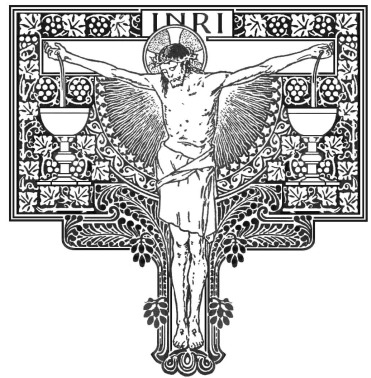
The sight of a crucifix has a continuity with Golgotha; at times its vision is embarrassing. We can keep a statue of Buddha in a room, tickle his tummy for good luck, but it is never mortifying. The crucifix somehow or other makes us feel involved. It is much more than a picture of Marie Antoinette and the death-dealing guillotine. No matter how much we thrust it away, it makes its plaguing reappearance like an unpaid bill.
Fulton J. Sheen Those Mysterious Priests1974: 101—102
Homily for Quinquagesima
Sexagesima Evensong
Paul had to begin with the Cross and then retrace his steps backward to Calvary. To him and to his people, the prophetic connection between suffering and glory were repugnant. The Jew and the Greek both had a horror of death; to the Greek there was a physical aversion; to the Jew it was a moral shame. And yet the glorified Christ began Paul’s conversion with the Cross—at that very point where all national characteristics were assailed. He had to see Christ repersecuted, recrucified, renailed. And when he asked who it was who questioned, there flashed the vision, ‘I am Jesus, Whom you are persecuting’ (Acts 26:16)Fulton Sheen Those Mysterious Priests 1974: 10
Homily for Sexagesima
Homily for the Sixth Sunday of Year A (Septuagesima)
Homily for Candlemas
Homily for Epiphany III Matthew 4:12-23
Homily for the Epiphany
Christmas Midnight Mass 2013
We consider Christmas as the encounter, the great encounter, the historical encounter, the decisive encounter, between God and mankind. He who has faith knows this truly; let him rejoice.
Pope Paul VI, speech, Dec. 23, 1965
Advent IV (Year A) Still Waiting
Advent II (Year A) Repent
Something to ponder
Homily for the 32nd Sunday of Year C
Homily for the 20th Sunday of Year C
Homily for the Eighteenth Sunday of Year C: A Sermon about Stuff
Homily for the Fourteenth Sunday of Year C
SS Peter and Paul, Apostles
A Thought for the Day from Fulton J. Sheen
Homily for the 12th Sunday of Year C: Zech 12:10–11, Gal 3:26–29, LK 9:18–24
Pentecost (Yr C)
The Ascension of the Lord Mt 28:16-20
Homily for the Third Sunday of Easter (Yr C) ‘Feed my Sheep’
Feria V in Cena Domini – The Mass of the Lord’s Supper: Exod. 12:1-8; ICor 11:23-26; Jn 13:1-15
A Prayer for the Day
Slapping Heretics
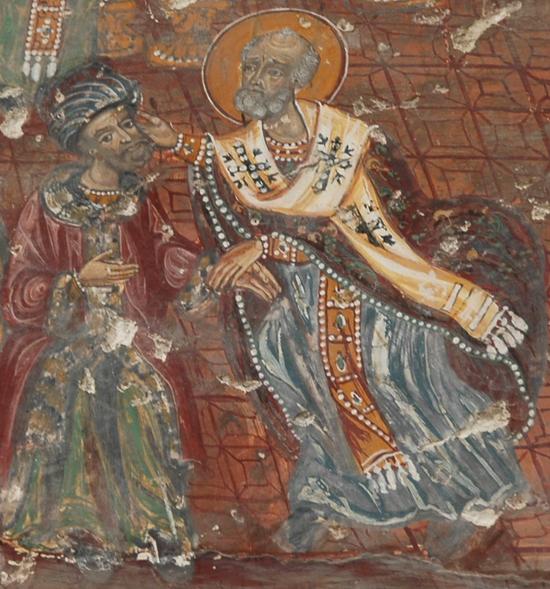
The world and the church have a picture of St Nicholas, it is a safe picture, he is a kindly man, a Bishop with a big white beard, who gives presents to children and does lots of lovely things. That’s all well and good, and there is much that can be said about the gentleness and generosity of the man, and how that points us to Christ. But recently I have found myself pondering another aspect of this great Saint. At the first ecumenical Council of Nicaea in ad325, Nicholas, Bishop of Myra slaps Arius for denying the coeternal and consubstantial nature of the second person of the Trinity, Our Lord and Saviour Jesus Christ. Nicholas got angry and his fellow bishops and the Emperor Constantine didn’t exactly approve of the pugilist prelate.
If it were to happen today I could imagine the media outcry, Twitter would be flooded with #bishopgate and #TeamArius posts. No doubt some eminent theologian would state that it’s perfectly alright to say that ‘there was a time when he was not’ and that Adoptionist or Subordinationist positions are all equally valid points of view and that one Christology is as good as another, that this was Arius’ truth and it needs to be affirmed, that we need to feel his pain and resist the patriarchal oppression of an authority figure like Nicholas and so on.