15th Sunday of Year A – The Parable of the Sower – Matthew 13:1–23

If, this morning, I were to go and stand  outside my local supermarket with a suitcase full of £20 notes and give away free money, you would be surprised if anyone refused the offer. There would in fact be a large queue. People would text and phone their friends. They would come from far and wide and would gladly take what I would give them and would go away happy.

And yet, we as the church offer something of far greater value than some bank notes: the love of God and life in all its fullness. If I were to stand in the middle of this village and talk to people about the love of God in Christ Jesus I doubt that there would be the same kinds of crowds, or a similar level of acceptance.

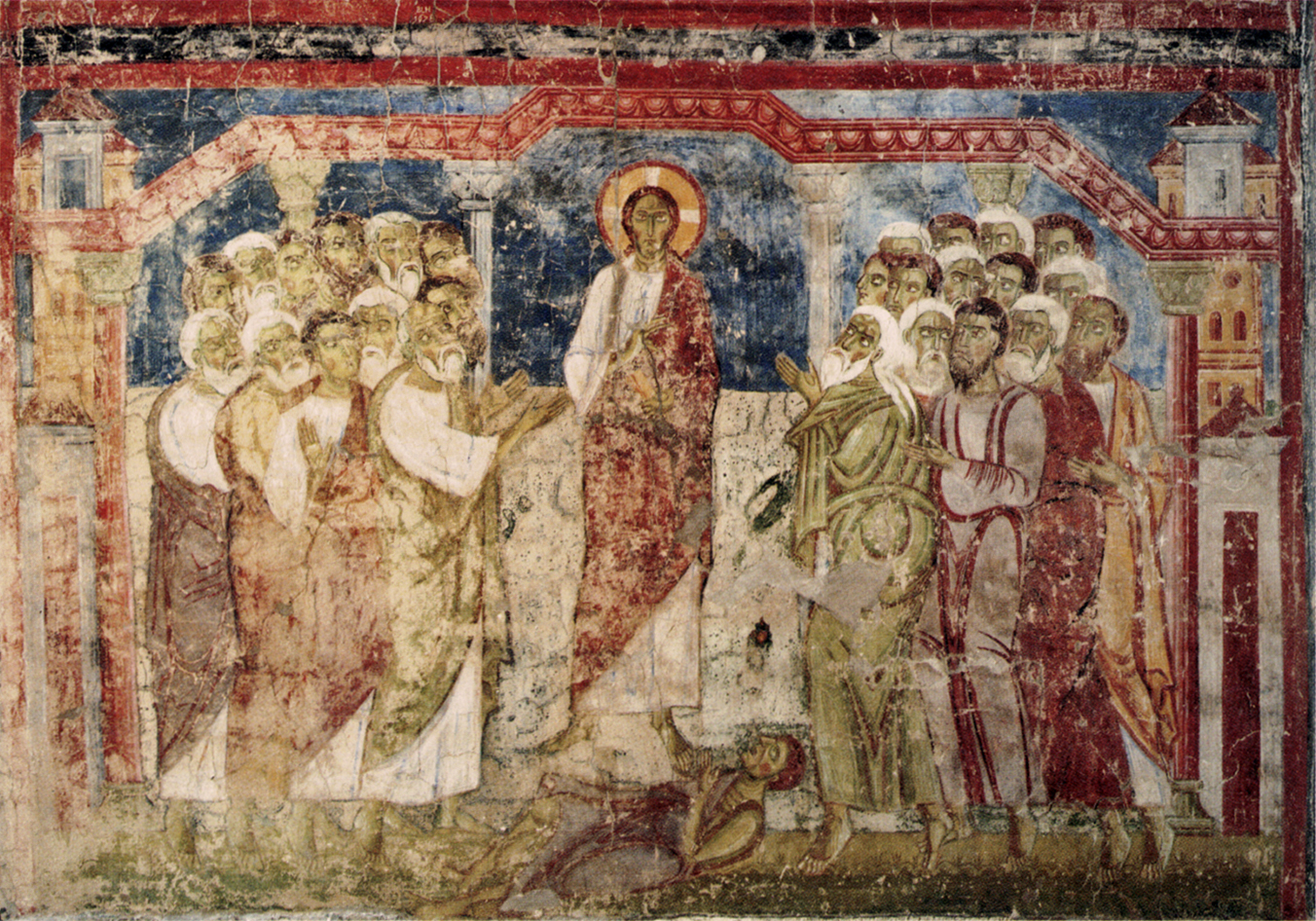
Jesus never had such problems, quite the opposite in fact, in the Gospel He has been teaching people about the Kingdom of God, and how it creates a new kind of family for us to belong to. He has been quoting from the prophet Isaiah, and now there are so many people who want to listen to what he has to say that he has to go into a boat on the Sea of Galilee to use a cove like a natural auditorium or theatre so that people can see and hear Him. He tells a parable to explain the Kingdom in a way that people could understand. A sower scatters seed, and it falls into various kinds of ground, some plants get choked by weeds. Others fall into thin soil and quickly wither and die. But some fall into good soil and produce a miraculous harvest. It’s a parable about people hearing the proclamation of the Kingdom of God: it’s easy to forget about it, to get choked by the cares of the world, to buckle under the first bit of pressure, but if you listen to what God says, and let it grow in your heart and your life then miraculous things can and will happen. Ours is an extravagant God, a generous God, a God who loves us.

The Church has always struggled with the fact that there are those who are unwilling or unable to receive the message of the Gospel of salvation. It seems so strange that people just aren’t interested in who Jesus is, in what He does, and why it matters.

I certainly don’t understand why anyone would think like that. It makes perfect sense to me, as a man of faith who loves Jesus. I want to tell people about Him. That is why I’m standing here talking to you. It is thanks to the example of a great and holy priest, Fr Glyn Bowen, who lived next door but one to us when I was a child. He was a humble, loving man, who lived out his faith and inspired me and countless others to follow Jesus.

We cannot do everything ourselves, we have to leave some things up to God.  But we can hope and trust along with the apostle Paul that ‘the creation itself will be set free from its bondage to decay and obtain the freedom of the glory of the children of God.’ (Rom 8:21 NRSV). We must remember that the spread of the Good News, like all things, is in God’s hands. Unlike in the supermarkets, the Church’s offers are not time-limited. We should not allow people’s reluctance to accept the gospel to detract us from our main purpose. We as Christians are to love God and to love our neighbour, in thought word and deed. This is the key to our faith.

By living lives which proclaim the gospel truth, that there is much more to life than the false enticements of this world, we become fruitful evangelists, with the word of God dwelling in us deeply. As Christians, all of our lives need to be filled with Christ-like love. It cannot be otherwise. Through regular prayer, and reading of the scriptures, but most of all through regular reception of Holy Communion, we can be fed by the Lord, with the Lord,  to become living temples to His glory.

For God is seeking the healing of his people as noted by the prophet Isaiah which Jesus quotes:

You will indeed listen, but never understand, and you will indeed look, but never perceive. For this people’s heart has grown dull, and their ears are hard of hearing, and they have shut their eyes; so that they might not look with their eyes, and listen with their ears, and understand with their heart and turn — and I would heal them.” (Mt 13:14-15 NRSV)

Isaiah is giving a message of hope to Israel, to trust in God, and turn towards Him, so that they may be healed. It is fulfilled in Jesus, who brings about that healing on the Cross, when He reconciles us to God and each other. ‘And I would heal them’, Jesus’ quotation of Isaiah ends with a promise of God’s healing. It is a promise which Jesus fulfils on the Cross. Here He shows us that God wants to heal His people, and has sent His Son to do it. This is the Good News of the Kingdom.

We can have a truly loving community in and through Christ, who has taken our sins upon Himself, and reconciled us to God and each other. It allows us to live in an entirely different way to the ways of the world, the ways of sin and division. And in the growth of the Church we can see the New Life and miraculous harvest which God offers.

The people of our generation are reluctant or scared to accept God’s love. They have become inherently suspicious of the idea of a free gift. The only way that they can be encouraged to accept it is by seeing in the lives of people around them examples of how the free love of God affects our lives. We need to reflect God’s love in our thoughts, our words, and our deeds.

So then, let us pray that we may be fed by Him, nourished by Him, strengthened to live lives of gospel truth which proclaim the generous love of God to all those around us. Let us show this love to one another, letting God work in our lives, and helping us to love Him and to love our neighbours, so that the world around us may believe and give glory to God the Father, God the Son, and God the Holy Spirit, to who whom be ascribed as is most right and just, all might, majesty, glory, dominion, and power, now and forever. AMEN.
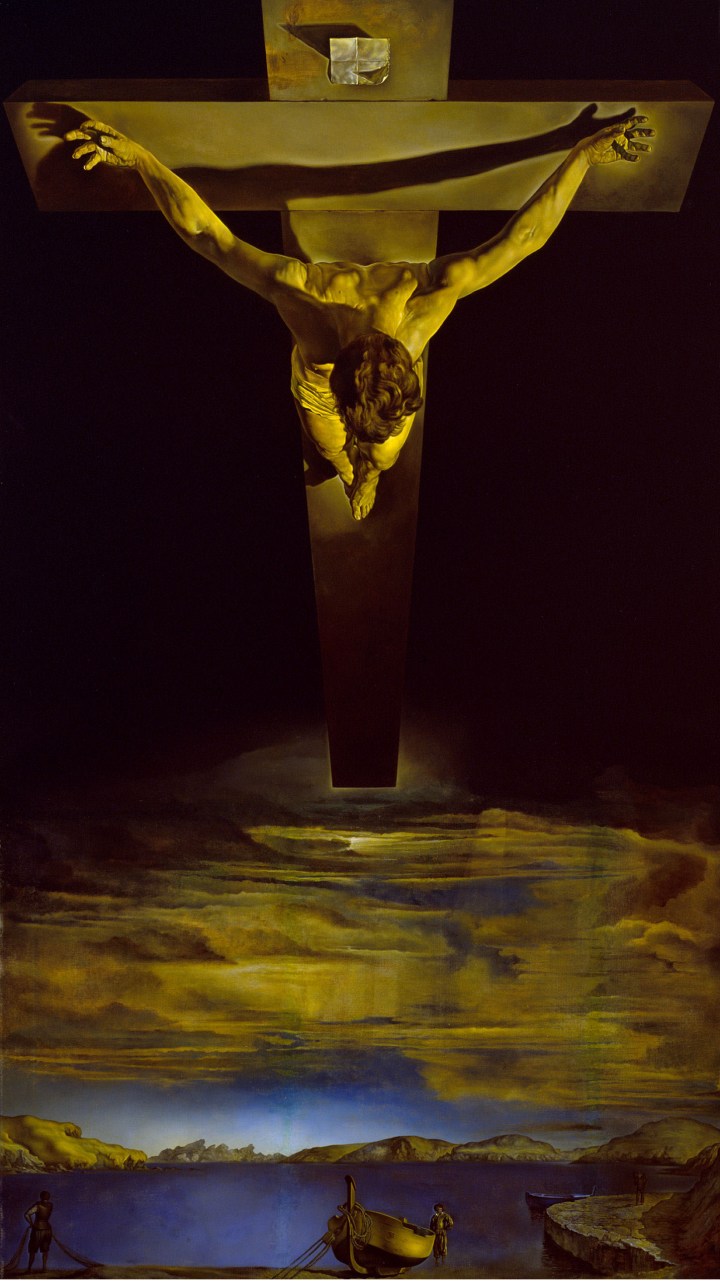
salvador20dali20in20christ20of20st-20john20of20the20cross201951

The Twelfth Sunday of Year A (Mt 10:26-33)


The death of Our Lord on the Cross reveals that we are meant to be perpetually dissatisfied here below. If earth were meant to be a Paradise, then He who made it would never have taken leave of it on Good Friday. The commending of the Spirit to the Father was at the same time the refusal to commend it to earth. The completion or fulfilment of life is in heaven, not on earth.

Fulton Sheen Victory over Vice 1939: 99

We are not used nowadays to seeing religion being couched in negative terms, but its effects can be salutary. If I were to ask you the question, ‘What does Jesus say that we should not do most often in the Gospels?’ what would your answer be? Something to do with sin? It is, ‘Do not be afraid!’ Jesus tells us not to be afraid, to fear no-one, and to trust in Him.

Fear is a feeling induced by a perceived danger or threat, but if we are close to Christ and trust in Him then we need not be afraid. No perceived danger or threat can really harm us: we may suffer pain or even death, but if our trust is in Christ, if our identity is in Him, then we have nothing to fear. He created us, he has redeemed us, and our eternal destiny is to be with Him for ever.

Living a Christian life is at one level a very simple thing: we follow Christ – we do what he told us to do, we fashion our lives after the example of His. We pray because He told us to; we read Scripture which finds its fulfilment and truest meaning in Him. We are baptised like He was, and we come together to do just what He did with His disciples on the night before He died because he told us to ‘Do this’, so we do. We are fed by Him and fed with Him so that we may share His life, and be given a foretaste of the heavenly banquet of the Kingdom of Heaven here and now.

Jesus calls us to follow Him by taking up our Cross and prizing our relationship with Him over all the things of this world. It’s a bit tricky, it’s a bit of an ask! In fact, for many people it’s pretty much impossible. Such are the enticements of the world, and the fact that there are those who want us to relegate religion to the private sphere. They argue that our faith shouldn’t affect our lives, it’s something which we can take out of its neat little box and wear for an hour on a Sunday morning, like a hat or some gloves, and then forget about, having done one’s public duty. Religion is not a matter solely for the private sphere, it affects who and what we are, and the world around us.

While may be tempting to follow the Enlightenment ideal of privatised religion, it simply will not do. We cannot truly follow Christ if we are not willing to lay down our lives for the sake of Him who died and rose again for us. Baptism and the Eucharist are free, but living out the faith which they encapsulate will cost us our lives. And yet we should give our life gladly, even though the world may well deride us, and call us fools.

In the Gospel Christ says to His disciples, and he says to us, ‘Do not be afraid … have no fear of them … Do not fear those who kill the body but cannot kill the soul’. We can laugh at those who pour scorn upon us for all that they promise is of this world, fleeting, and of no real value; whereas what Christ promises us is of God, it will last forever, it is a glory which can never fade – it is ours and is offered to the whole world for free, if only they would accept it.

To follow Jesus we need to die to sin, we need to turn away from all the selfishness which separates us from God and each other, and instead live out the radical love of the Kingdom – a love which forgives, a love which thinks of others before ourselves. It is no good seeing this in individual terms; it affects us as a society. We need to do this together – you and me. Each and every one of us needs to live not enslaved to sin, but as slaves for Christ. His service is perfect freedom, freedom from the ways of the world and freedom to live the new life of the Kingdom of God, here and now.

We are called as a church to live out our faith together, praying for each other, supporting one another, and relying upon God, and His grace, that unmerited kindness and free gift, which we do not deserve, but which has the power to transform us, to conform us to the pattern of His Son. This He pours out upon us in the Sacraments of His Church, so that we might be conformed to His will: fed by God, with God, to have life in Him. We can only do this if we rely upon God and do it TOGETHER, built up in love.

Only then can our lives, our words and our actions proclaim the saving truth which can change the world.

For two thousand years the church has been changing the world, one soul at a time, so that God’s will may be done, and His Kingdom may come here on earth, as in Heaven. We are radicals, and revolutionaries who believe that the Love of God can transform our Human nature. That water, bread, and wine are the most powerful things we have, when, through the power of the Holy Spirit, they wash us clean, and feed us with the Body, Blood, Soul and Divinity of Our Lord and Saviour, Jesus Christ. We are still being persecuted for this, by those who are afraid of what we are, and what God’s love can do.

Whatever they do, they cannot win. We cannot lose. We have nothing to fear, only a message of love to live out so that the world may believe and give glory to God the Father, God the Son, and God the Holy Spirit, to whom be ascribed, as is most right and just, all might, majesty, glory, dominion, and power, now, and forever.

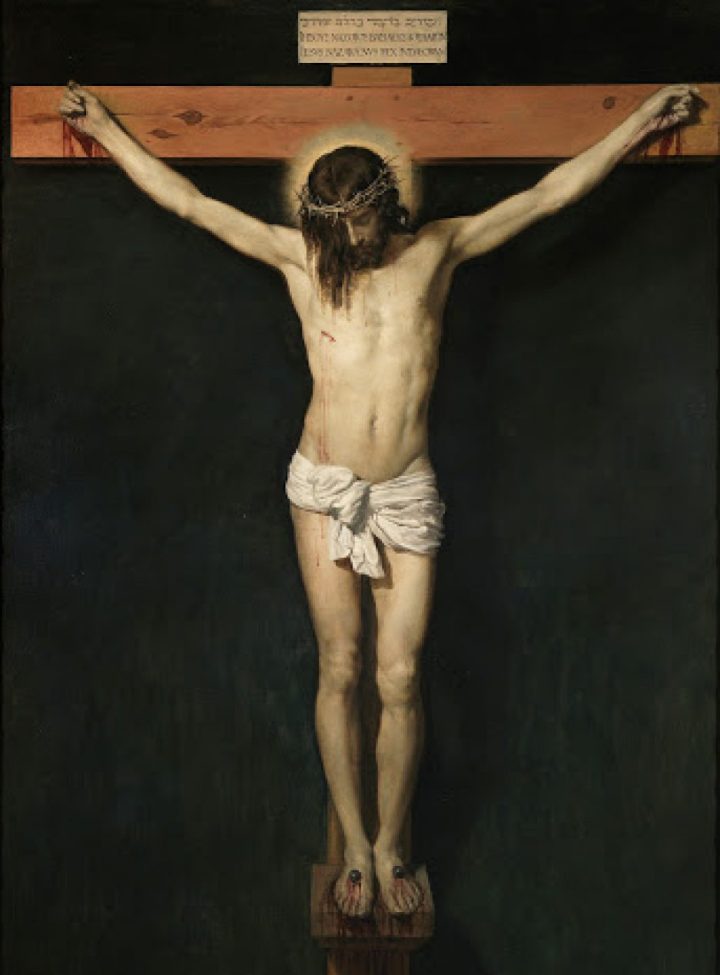
cropped-velazquezcrucifxion.jpg

Corpus Christi – Dom Gregory Dix on the Eucharist

At the heart of it all is the eucharistic action, a thing of absolute simplicity – the taking, blessing, breaking and giving of bread, and the taking, blessing, and giving of a cup of wine and water, as these were first done with their new meaning by a young Jew before and after supper with His friends on the night before he died. Soon it was simplified still further, by leaving out the supper and combining the double grouping before and after it into a single rite. So the four-fold action Shape of the Liturgy was found by the end of the first century. He had told His friends to do this henceforward with the new meaning ‘for the anamnesis‘ of Him, and they have done it always since.

Was ever another command so obeyed? For century after century, spreading slowly to every continent and country and among every race on earth, this action has been done, in every conceivable human circumstance, for every conceivable human need from infancy and before it to extreme old age and after it, from the pinnacle of earthly greatness to the refuge of fugitives in the caves and dens of the earth. Men have found no better thing than this to do for kings at their crowning and for criminals going to the scaffold; for armies in triumph or for a bride and bridegroom in a little country church; for the proclamation of a dogma or for a good crop of wheat; for the wisdom of the Parliament of a mighty nation or for a sick old woman afraid to die; for a schoolboy sitting an examination or for Columbus setting out to discover America; for the famine of whole provinces or for the soul of a dead lover; in thankfulness because my father did not die of pneumonia; for a village headman much tempted to return to fetich because the yams had failed; because the Turk was at the gates of Vienna; for the repentance of Margaret; for the settlement of a strike; for a son for a barren woman; for Captain so-and-so wounded and prisoner of war; while the lions roared in the nearby amphitheatre; on the beach at Dunkirk; while the hiss of scythes in the thick June grass came faintly through the windows of the church; tremulously, by an old monk on the fiftieth anniversary of his vows; furtively, by an exiled bishop who had hewn timber all day in a prison camp near Murmansk; gorgeously, for the canonisation of S. Joan of Arc—one could fill many pages with the reasons why men have done this, and not tell a hundredth part of them. And best of all, week by week and month by month, on a hundred thousand successive Sundays, faithfully, unfailingly, across all the parishes of Christendom, the pastors have done this just to make the plebs sancta Dei—the holy common people of God.

Dom Gregory Dix, The Shape of the Liturgy, London, 1945p.743-4

eucharist-sacrifice2.gif

Theodore of Mopsuestia

Catechetical Homily on Baptism, 5

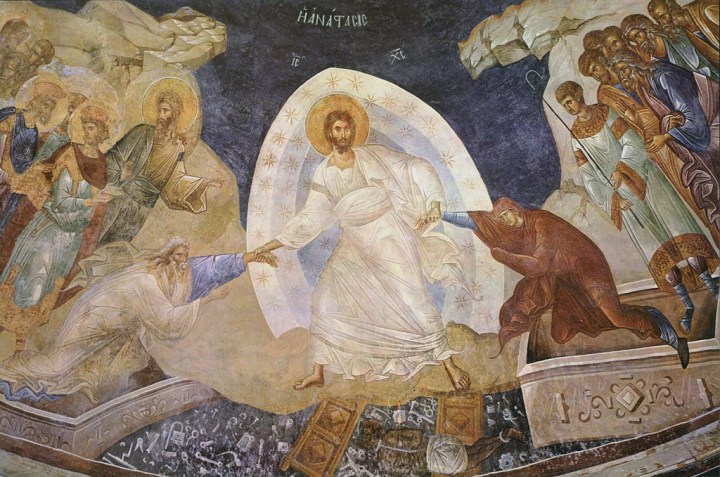
At one time, before the coming of Christ, death had true power over us and was fully indestructible in virtue of a divine verdict. Its power over us was immense. But through his Death and Resurrection, Christ our Lord abrogated that law and destroyed the power of death. And now the death of those who believe in Christ resembles a long sleep. As S. Paul says, ‘But now Christ has been raised from the dead, the first fruits of those who have fallen asleep’ (1Cor 15:20). Since Christ our Lord has subdued the strength of death with his own Resurrection, we can say, ‘We who are baptised in Christ Jesus have been baptised in his Death’; in other words, we know that Christ our Lord has killed death.

anastasis-chora.jpg

Jesus and Nicodemus Lent II

The sight of a crucifix has a continuity with Golgotha; at times its vision is embarrassing. We can keep a statue of Buddha in a room, tickle his tummy for good luck, but it is never mortifying. The crucifix somehow or other makes us feel involved. It is much more than a picture of Marie Antoinette and the death-dealing guillotine. No matter how much we thrust it away, it makes its plaguing reappearance like an unpaid bill.

Fulton J. Sheen Those Mysterious Priests 1974: 101—102


Our Baptism is a wonderful thing, and it is why each and every one of us is here today. It is how we enter the Church, how we become part of the body of Christ,  it is how our souls are infused with the virtues of Faith, Hope, and Charity, it is how we are regenerate, born again, sharing in His death, and His resurrection. It is something for which people have traditionally prepared during this season of Lent, for Baptism and Confirmation at Easter, so that they can die with Christ and be raised to new life with Him. We enter into the mystery of Christ’s saving work so that we may conformed to it and transformed by it, by Love, by believing and trusting in Christ, publicly declaring our faith in Him, and praying for His Holy Spirit, so that our lives may be transformed – living for Him, living in Him, and being transformed more and more into the likeness of Christ.

To be drawn into His likeness means coming closer to His Cross and Passion: just as Moses lifted up the serpent in the wilderness, so must the Son of Man be lifted up (Jn 3:14). Just as the serpent in the desert brought salvation to the people of Israel, so now the Cross is our only hope – the sacrifice of God for humanity, not something we can give God, but something he gives us – a free gift of infinite value. God gives it to us and to all the world for one simple reason – love, for love of us – weak, poor, sinful humanity, so that we might be more lovely, more like Him. God sends His Son into the world not to condemn it, but so that the world might be saved through Him – an unselfish act of generosity, of grace, so that we might be saved from sin and death, from ourselves, so that we can share new life in Him.

For God so loved the world, that he gave his only Son, that whoever believes in him should not perish but have eternal life. For God did not send his Son into the world to condemn the world, but in order that the world might be saved through him.’ John 3:16-17 (ESV) These few words spoken by Jesus to Nicodemus in John’s Gospel encapsulate what we believe as Christians, and why we believe it, may we live them, strengthened through prayer, our study of the Bible, nourished by Our Lord’s Body and Blood, forgiven and forgiving, preparing to be caught up forever in the love of God.

It is that same sacrifice which we see here this morning, which we can taste and touch, which we can eat and drink, so that our lives and our souls can be transformed to live Christ’s risen life. It is something which we treat with the uttermost reverence because it is God, given for us, because it can transform us to live as children of the Holy Spirit, freed from the shackles of this world, free to live for Him, to live as He wants us to, His new creation, of water and the Spirit. This is what the Church has done on a hundred thousand successive Sundays, in memory of Him, to make the holy people of God. To make us holy: so that everything which we say, or think, or do, may be for His praise and glory, living out the faith which we believe in our hearts, as a sign to the world that the ways of selfishness and sin are as nothing compared with the generous love of God.

So great is this gift, that we prepare to celebrate it with this solemn season of prayer, and fasting, and abstinence, to focus our minds and our lives on the God who loves us and who saves us. We prepare our hearts and minds and lives to celebrate the mystery of our redemption, so that our lives may reflect His glory, so that we may live for Him, fed by Him, fed with Him, with our lives and souls transformed by Him. We are transformed so that we can transform the world so that it may live for Him, living life in all its fullness: living for others, living as God wants us to live. Living the selfless love which saves us and all the world, living out our faith, and encouraging others so to do, can and will conform us to Christ, so that we may be like Him, and become ever more like Him, prepared for eternal life with Him, so that we all may sing the praises of God the Father, God the Son, and God the Holy Spirit, to whom be ascribed, as is most right and just, all might, majesty, glory, dominion, and power, now and forever.

3-agosto-crijn_hendricksz-550x400_c

Epiphany IV

In the marriage act, love is triune: wife gives self to husband and husband to self and out of that mutual self-giving is  born the ecstasy of love. The spirit too must have its ecstasy. What the union of husband and wife is in the order of the flesh, the union of the human and the Risen Christ is in Holy Communion

Fulton J. Sheen Those Mysterious Priests, 1974: 157

Everyone loves a party, and that is right and proper, and what more wonderful thing is there to celebrate than a wedding, the joining of a man and a woman that they may become one flesh. Marriage is an image used of Christ and his church: it speaks of a deep union, a profound and meaningful relationship, one of self-giving love, commitment, something wonderful and mysterious. We have not come here this morning to celebrate a wedding but rather the death and resurrection of Jesus Christ, we have come to do what he told his disciples to do at the Last Supper, and the church has done ever since, and will until the end of time. We have come so that we may be fed, be fed by Christ, be fed with Christ, by the power of the Holy Spirit God is active in our lives, transforming us, by his grace, so that our human nature may be transformed, into His Divine nature.

If we were to listen to the many voices around us which criticise Christianity, we would think that we were of all people the most pitiable, ours is either a weak death-cult of a failed Jewish magician and wonderworker, or a strange oppressive force which actively works against human flourishing and actualisation.

But nothing could be further from the truth, we celebrate love, and forgiveness, we are imbued with faith, hope, and love in and through God at our Baptism, and as our vocation as Christians is JOY. The one whom we worship, the Son of God made flesh liked nothing better than to hang around at parties with social undesirables, and was accused of being a drunkard by religious authorities. Most of us have outside our houses one or two wheelie bins, which are a similar size to the water jars in the Gospel. They hold about 30 gallons, or 150 litres, or 200 bottles of wine. Multiply that by 6 and you’re looking at 1,200 bottles of wine, a hundred cases, and this was after the wine ran out, what we’re dealing with in the wedding at Cana must have been some party, it must have gone of for a couple of days, and it is only a foreshadowing of the joy of the Kingdom, it points to something greater than itself: this is what is in store.

Our starting point as Christians is Mary’s advice to the servants: Do whatever He tells you. Our life as Christians is rooted in obedience: we listen to God and we obey, for our own good, and the good of the Kingdom, so that we are not conformed to the world and its ways, but rather to the will of God, so that we can truly enter into the joy of the Lord, in humble obedience, fed by Him, and fed with Him, who died for love of us in obedience to the will of the Father.

The world around us struggles somewhat with extravagance, we distrust it, and rightly so: when we see Arabian oil magnates riding around in gold-plated supercars we are right to be concerned, yet in the Gospel we see something strange. The steward had a point: you serve the best wine first, while people are sober and can appreciate it, but the Kingdom of God turns human values on their head – the joyous new wine of the Kingdom is finer than any human wine and is lavished upon undeserving humanity, so that it might transform us, so that we might come to share in the glory of God, and his very nature. Thus, at the Epiphany we celebrate three feasts: Our Lord’s manifestation to the Gentiles, the proclamation of the Messiah to the whole world, his baptism, to show us the way to the Father, a sign of love and obedience, and the Wedding Feast at Cana, as a sign of the superabundance of God’s love, shown to us here today in the Eucharist where we drink the wine of the Kingdom the Blood of Christ so that we may be transformed by the power and the grace of God, so that we may share his Divine life, and encourage others to enter into the joy of the Lord.

All this is brought about by Christ on the Cross, where the Lamb of God is sacrificed, a new passover for a new Israel, the people of God, to free us from our sins, and to give us new life in Christ. It’s crazy, it doesn’t make sense: how and why should God love us so much to go far beyond what Abraham did with Isaac on the mountain of Moriah. The ram caught in the thicket points to Christ, who is the Lamb of God, even then, at the beginning God shows us his love for us, he prepares the way, by giving us a sign, to point us to Christ, to his Son.

Such generosity is hard to comprehend, it leaves us speechless, and all that we can do is to stand like the Beloved Disciple S. John at the foot of the Cross and marvel at the majesty of God’s love. It affects S. Paul in his preaching, a man who began persecuting the Church, who was present at the martyrdom of S. Stephen, has his life transformed by Christ, through the power of the Holy Spirit, Christ saving us does not make sense, it is an act of reckless generosity, like helping a wedding party drink to the point of excess, it is not supposed to make sense. In rational terms we are sinners, who do not deserve God’s mercy, and yet he shows us his love in giving us his Son, to be born for us, to work signs and wonders, to bring healing and to proclaim the good news of the Kingdom of God’s love, his mercy, and forgiveness.

So let us come to him, clinging to His Cross, our ONLY HOPE, let us be fed with him, and by him, to be strengthened, healed, and restored, and to share this is with the world, so that it may believe and give glory to God the Father, God the Son, and God the Holy Spirit, to whom be ascribed as is most right and just, all might, majesty, glory, dominion, and power, now and forever.

cana

A thought for the day from Fulton Sheen

The Way to Peace

What Christ did in his own human nature in Galilee, he is doing today … in every city and hamlet of the world where souls are vivified by his Spirit. He is still being born in other Bethlehems of the world, still coming into his own and his won receiving him not, still instructing the learned doctors of the law and answering their questions, still labouring at a carpenter’s bench, still “[going] about doing good” (cf. Acts 10:34-43), still preaching, governing, sanctifying, climbing other Calvaries, and entering into the glory of his Father.

In the Fullness of Time

Maranatha – Come Lord Jesus


SONY DSC

Gaudete semper in Dño

The words of the Introit at Mass and the Epistle, set to music by Mr Henry Purcell:

As we prepare the way of the Lord may peace and joy reign in our hearts and in our lives.

An Advent Meditation

The whole problem of our time is not lack of knowledge but lack of love

Thomas Merton, No Man is an Island

The season of Advent has an interesting character: it is one of joyful waiting, as we await our yearly remembrance of Our Lord and Saviour Jesus Christ’s Birth, the dawning of the new hope of Salvation for mankind. It is also a season of penitence, when the church considers the Four Last Things, one for each week of Advent: Death, Judgement, Heaven, and Hell. Such matters are nowadays rather passed over in our Christian discourse, and while this is understandable, it is not a good thing. Human life on earth, is, by its very nature finite: we are born and we die, we may live for minutes, or decades, even a century – but in the end death comes for us all. This is not morbid, it is a fact of life. The world around us finds death strange and scary: it is sanitised, medicalised, shut away in a hospital or a care home. What was once commonplace and domestic has been put out of sight and out of mind as we seem no longer willing or able to face our own mortality.

As Christians we have hope that this earthly life is not all that there is, we believe that Jesus Christ, who was born in Bethlehem, died on the Cross, and rose again on that glorious Easter morn, and after forty days ascended into Heaven to show us that this is our hope, this is the fruit of our reconciliation with God, and each other. As the Preface for the Dead puts it:

Tuis enim fidelibus, Domine, vita mutatur, non tollitur: et dissoluta terrestris hujus incolatus domo, aeterna in caelis habitatio comparatur.

For the life of thy faithful people, O Lord, is changed, not taken away: and at the dissolution of the tabernacle of this earthly sojourning, a dwelling place eternal is made ready in the heavens

Hence the Christian talk of a good death, a happy death. It is nothing to be feared, but rather to be embraced, as a means to an end, namely the hope of unity with God.

After death comes judgement, and the simple answer is that no single human being deserves to go heaven (with the obvious exception of the Holy Family). We all deserve to go to Hell, ours is a fallen world and we sin, each and every one of us, every day in a multitude of ways. It is that simple, and we cannot work out way to heaven through works, but rather through God’s grace and mercy, through our Baptism, which makes us one with Christ. He gave S. Peter the power to loose and bind, to remind us that sin is a serious matter, it destroys the soul, hence the sacrament of reconciliation, an outward and visible sign of the inward and spiritual grace of God, of forgiveness and mercy. The message Our Lord first declares is exactly the same as John the Baptist ‘καὶ λέγων ὅτι Πεπλήρωται ὁ καιρὸς καὶ ἤγγικεν ἡ βασιλεία τοῦ θεοῦ· μετανοεῖτε καὶ πιστεύετε ἐν τῷ εὐαγγελίῳ The time is fulfilled, and the kingdom of God is at hand; repent and believe in the gospel.’ (Mk 1:15 ESV) This is the message of Advent: repent and believe in the Good News of the Kingdom of God, Good News which starts at the Annunciation, which brings about Our Saviour’s Birth. This is why we say Maranatha, Come Lord Jesus!

This leaves us a question, ‘Will we follow Him?’ There are two ways, one leads to Heaven, one leads to Hell; the road to Heaven, the life of faith is not an easy journey, it’s hard. That’s why we have the Church, a frail body, comprised of sinners, but who trust in God’s mercy, and though we keep failing, yet we stumble on, knowing that Heaven is our goal, that the way of the world leads to a future without God, bleak, cold, and devoid of love.

God is a God of mercy, a God who will judge us, knowing that His Son has paid the price, conquering sin and death, so let us believe in Him, trust in Him, and follow Him, let us prepare to celebrate His Birth with joy, and commit ourselves to walking in His way, who is the Way, the Truth, and the Life. Let us experience that mercy and forgiveness in the Sacrament of Penance and Reconciliation, let us be fed with His Body and Blood, nourished by His Word, and the teaching of His Church, praying together, loving and forgiving together, so that together our hope may be of Heaven, where we and all the faithful may sing the praises of God the Father, God the Son, and God the Holy Spirit, to whom be ascribed as is most right and just, all might, majesty, glory, dominion, and power, now and forever.

the_last_judgment_michelangelo

The Only Remedy

Ours is a sick world, which longs for healing, which longs for the reconciliation which Christ alone can bring. As we prepare to welcome the Saviour, let us remember why He came among us, and why He is the Balm of Gilead which heals the sin-sick soul. Come Lord Jesus!

Here’s Sam Cooke saying more with music than I can just with words:

Fulton Sheen on the Signs of Our Times

These words were spoken in 1947, and are as true now as they were when they were first spoken. Fulton Sheen preached the truth which the world still does not wish to hear.

What can we do? Love God, and each other, and hold fast to our faith in this time of trial, safe in the knowledge that Christ has conquered sin, evil, and death. Let us be hopeful and confident.

The Ascension

One of the loveliest things about today is that it tends to focus, in religious art at least, on feet:  the smelly things we like to keep hidden away from the world. Today we see Jesus’ in all their glory going back to where they came from, but they go back differently than they descended: they go back marked with nails, wounded, bearing the marks of God’s love, it is this love which fills us in the Church, the same love which feeds us in His Body and Blood.

We have come here today to celebrate Our Lord’s Ascension into heaven. The world around us may well find the idea quaint or laughable – or at least physically impossible. But it is no less hard to believe than Our Lord becoming incarnate by the power of the Holy Spirit in the womb of the Blessed Virgin Mary, or his rising from the dead at Easter. The world, with the greatest confidence, will tell us that what we are celebrating are myths and fairy stories, but they fail to get the point of what’s really going on.

Our Lord ascends, body and soul into heaven, to the closer presence of God the Father, and to prepare for the sending of the Holy Spirit on his disciples at Pentecost. He who shares our humanity takes it into heaven, into the very life of the Godhead; so that where he is we may be also. We have seen the promise of new life in Easter, a new life which is in the closer presence of God, which we celebrate today. We can see where it leads – what started at the Incarnation finds its goal and truest meaning in the unity of the human and the divine.

But rather than seeing this as an end it is surely far better to see in it a beginning – a beginning of the Church as we know it – a church which goes and makes disciples of all nations, baptizing them in the Father and of the Son and of the Holy Spirit, teaching them to observe all that Our Lord commanded us. This is exactly where we have been for nearly two thousand years. Inspired by the Holy Spirit they did what their Lord commanded them to do and that is why we are here today celebrating this fact.

But like them we too are called to follow Our Lord’s commands and to share his good news with the world so that it may believe. We are called to live lives where our faith is enfleshed in us – it is not abstract and private, but concrete and public. The Atheist who finds our beliefs laughable now joins forces with an Enlightenment Rationalist who wishes faith to be a private matter rather than a public one. This will not do: Our Lord did not say ‘Don’t do this if it’s inconvenient’ or ‘There’s no need to make a fuss in public about me’. He speaks as one given authority, ‘all authority in heaven and on earth’, so we can gladly place ourselves under His authority, to do his will.

He makes us a promise: ‘Behold, I am with you always, to the end of the age.’ He is with us by sending His Spirit on the Church at Pentecost and ever since. He is with us in his Word, Holy Scripture and in the Sacrament of His Body and Blood. It is through this (and the other Sacraments of the Church) that God’s grace can perfect our human nature – so that we can prepare to share the divine life of love in Heaven. Where our Lord goes we can hope to follow, through his sacrifice of Himself upon the Cross, a sacrifice made present here and on the altars of churches all throughout the world, to strengthen us, so that we may be close to him, sharing in the divine life of love poured out on us.

Once Jesus has ascended in glory and before he returns as our judge the only place where we can encounter him is in and through the Church, in its sacraments, in the word of Holy Scripture, and in people, filled with His Holy Spirit: it is a huge responsibility, but a movement which started with 12 men in Jerusalem is still going strong nearly two thousand years later. We have been given the gift of faith and it is up to us to pass it on, so that others may come to share in the joy of the Lord.

We can all hope to follow Him, and to spend eternity contemplating the Beatific Vision, caught up in that love which is the Divine Nature, sharing in the praise of all creation of the God who creates, who redeems, and who sustains all. We can have this hope because Christ has gone before us, he has prepared the way for humanity to follow him and share in the divine life of love.

Let us prepare for this by living the life of faith, strengthened by Him, proclaiming his truth, praying for the gift of His Spirit at Pentecost, that the Church may be strengthened to proclaim His saving truth and the baptism of repentance, so that we and all the world may sing the praise of God the Father, God the Son, and God the Holy Spirit, to whom be ascribed as is most right and just all might, majesty, glory, dominion, and power, now and forever.

Lent V

This morning’s Gospel asks us some serious questions: do we love Jesus this much? Would we risk being laughed at or criticised for our extravagance in being like Mary of Bethany and pouring ointment on Jesus?

How can we do this for Jesus in our lives? Can we really show him how much we love him, and how much we want to serve him? What might this look like in our lives, and how might we do it together as a Church, to proclaim God’s saving love to the world. As we begin Passiontide we look to the Cross that more radical costly act of generous love, the love of God for us. God does this for us, what are we going to do in return? Are we going to be like Judas and moan about the cost, the extravagance? Do we want to be a penny-pinching miserly church, or do we want to be something else, something which makes the world stop and take notice, which doesn’t make sense, which shows the world that there is another way, and it is the way of the Kingdom. God’s generosity gives his Son to die for us, he feeds us with His Body and Blood so that we might have life in Him. What are we going to do in return?

mary-anointing-jesus-feet-by-peter-paul-rubens

Lent IV

Let those who think that the Church pays too much attention to Mary give heed to the fact that Our Blessed Lord Himself gave ten times as much of His life to her  as He gave to His Apostles.

Fulton Sheen, The World’s First Love, 1956: 88

As human beings we believe  that we have been created in the image of God, and thus human love should reflect something of that divine love. Most of us, though sadly not all, experience self-giving, sacrificial love from our parents, and particularly our mothers: they nourish us, care for us, comfort and love us, just as they have given birth to us: it is a wonderful thing, which should be celebrated and held up as an example.

When the Church seeks to understand and celebrate mothers she does so by considering the Blessed Virgin Mary, the mother of Our Lord and Saviour Jesus Christ. He is cared for through the love of his mother, the Blessed Virgin Mary, who in her love, service, and obedience, stands as the model for all Christians to follow. She is the first Christian, and the greatest: a pattern for us to imitate, and a foreshadowing of our great mother the church, which seeks to offer the world a moral framework, within which to live its life; and to offer the world an alternative, a new way of living and of being through which to have life, and have life in all its fullness.

Mary’s is a love which will see her stand at the foot of the Cross and experience the pain of watching her Son die, for love of us. Any parent will tell you that they would do anything to save their children from hurt or harm, and yet there she stands, and is initiated into a new relationship where she becomes a mother to John, the beloved disciple, and through him, a mother of all of, the mother of the church, someone who loves, prays, and cherishes.

It is this love which St Paul expects of the church in Colossae, and which God expects of us: it describes what love looks like: it isn’t easy, it’s difficult, costly and frustrating, but through it we can grow in love, of God and each other.

The salvation and eternal life which Christ offers freely to all, comes through the church, which we enter in our baptism, where we are nourished in word and sacrament, where we given food for the journey of faith, strengthened and taught, to live his risen life, to share in the joys of Easter.

God cares so much about the world and its people that he takes flesh, and lives a life of love, amidst the messiness of humanity, to show us how to live lives filled with love, life in all its fullness. Not to condemn the world but to offer it a way of being. God has made us for himself , and our hearts are restless until they find their rest in him. The spiritual needs and searching which characterise people in the world around us, can be satisfied in God and in God alone, through the church. So we can rejoice, and relax our Lenten discipline for a little while to give thanks for the wonderful gift of God’s love in our lives, in the church, and for the world.

But we also need to trust God, to listen to what he says through Scripture, to be fed by him, and to live lives in accordance with his will and purpose, together, as a family, as a community of love, cared for and supported by our mother, the church. And in so doing we look to our Lady as mother of our Lord and mother of the church, as a pattern for love and obedience, as a model for all mothers: loving and tender, putting the needs of others before self, self-giving, sacrificial, and open to both joy and pain.

This, as any mother can tell you, is not easy, it’s difficult, really hard, but its rewards are likewise great. So let us, as we continue our Lenten journey towards the cross, where God shows his love for us most fully and completely, giving his body to be broken and his blood be shed for us, a sacrifice which will be made present here today under the outward forms of bread and wine, to strengthen us to live the risen life of Easter, to offer the world and alternative to selfishness, to self-centredness, to the sin which continues to separate us from God and each other, an alternative seen in the self-giving love of mothers, and in our mother, the church. So that we may join the Angels in our song of love and praise to the Trinity: Father, Son and Holy Spirit, to whom…

from Rhygyfarch’s Life of David

The holy Father David prescribed an austere system of monastic observance, requiring every monk to toil daily at manual labour and to lead a common life. So with unflagging zeal they work with hand and foot, they put the yoke to their own shoulders, and in their own holy hands, they bear the tools for labour in the fields. So by their own strength they procure every necessity for the community, while refusing possessions and detesting riches. They make no use of oxen for ploughing. Everyone is rich to himself and to the brethren, every man is his own ox. When the field work is done they return to the enclosure of the monastery, to pass their time till evening at reading, writing, or in prayer. Then when the signal is heard for evening prayer everyone leaves what he is at and in silence, without any idle conversation, they make their way to church. When, with heart and voice attuned, they have completed the psalmody, they remain on their knees until stars appearing in the heaven bring day to its close; yet when all have gone, the father remains there alone making his own private prayer for the well-being of the church.

Shedding daily abundance of tears, offering daily his sweet-scented sacrifice of praise, aglow with an intensity of love, he consecrated with pure hands the fitting oblation of the Lord’s body, and so, at the conclusion of the morning offices, attaining alone to the converse of angels. Then the whole day was spent undaunted and untired, in teaching, praying, on his knees, caring for the brethren, and for orphans and children, and widows, and everyone in need, for the weak and the sick, for travellers and in feeding many. The rest of this stern way of life would be profitable to imitate, but the shortness of this account forbids our entering upon it, but in every way his life was ordered in imitation of the monks of Egypt.

The Solemnity of Mary, Mother of God

Those who dislike any devotion to Mary are those who deny His Divinity or who find fault with Our Lord because of what He says.

These words of the Venerable and Most Reverend Fulton J. Sheen remind us of an important truth when we consider the Blessed Virgin Mary: she is always pointing to God – it’s all about God and not about Mary. But, I hear you cry, we have come here to celebrate the Solemn Feast of Mary, Mother of God, surely it’s all got to be about her? Well I am sorry to disappoint you, but it isn’t.

People who dislike Marian devotion, because it’s ‘a bit too ‘igh for ‘em’ or ‘it detracts from Jesus’, have got things wrong, and generally they err with how they understand one or all of the three Persons of the Trinity. For the last 1,585 years the Church has referred to Our Lady as the Mother of God, not the Mother of Christ, the Mother of Jesus, or some poor Jewish girl raped by a Roman soldier. The Mother of God, the Theotokos or God-bearer is her title which we celebrate today. The words we use matter. It matters that Mary bears in her womb the Word of God Incarnate, True God and True Man, for our salvation.

We celebrate the wonderful truth that God shows his love for us in being born, in being a vulnerable child who needs a mother’s love and tender care. Mary is obedient and says ‘Yes’ to God – she is the model Christian, Mother of God and Mother of the Church, who as she stands at the foot of the Cross becomes our Mother too.

At the Wedding in Cana she tells the servants ‘Do whatever he tells you’ she urges people to be obedient, to be close to God. She lives a life of faith: treasuring things and ‘pondering them in her heart’ so that we can be adopted children of God, and share in her Son’s gift of new life to the world. We honour her, because she points us to her Son. We rejoice that her obedience brings about the possibility of salvation in her Son. We love her because we love her Son, our God and Lord, Jesus Christ. If we honour him, how can we not honour she who bore him in her womb for our sake? If we believe that He is the Incarnate Word eternally begotten of the Father, and that they are con-substantial and co-eternal, true God and true man in two natures without confusion, change, division or separation, it surely follows that His Mother is the Mother of God. We rejoice that in her, the New Eve, the Ark of the new Covenant, the Tabernacle of the Most High, the possibility of new life in her Son has come about.

So, today, let us pause to ponder the love of God shown to us in Mary, let us be fed by word and sacrament, the Body of Christ, which became incarnate in the womb of the Virgin Mary, let us treasure him, and let us respond by loving and trusting God, by living lives of service, of God and of one another, and proclaiming the Good News in Jesus Christ, so that all creation may resound with the praise of God the Father, God the Son, and God the Holy Spirit, to whom be ascribed as is most right and just, all might, majesty, glory, dominion, and power, now and forever.

A thought from St Isaac the Syrian

The whole fabric of your prayer should be succinct. One word saved the publican, and one word made the thief on the cross heir to the heavenly kingdom

Trinity XIV 23rd Sunday of Year B ‘Let us be healed by Him’


From the Sayings of the Desert Fathers: ‘When blessed Antony was praying in his cell, a voice spoke to him, saying, “Antony, you have not yet come to the measure of the tanner who is in Alexandria.” When he heard this, the old man got up and took his stick and hurried into the city. When he had found the tanner … he said to him “Tell me about your work, for today I have left the desert and come here to see you.”
He replied, “I am not aware that I have done anything good. When I get up in the morning, before I sit down to work, I say that the whole of this city, small and great will go into the Kingdom of God because of their good deeds, while I alone will go into eternal punishment because of my evil deeds. Every evening I repeat the same words and believe them in my heart.”
When blessed Antony heard this he said “My son, you sit in your own house and work well, and you have the peace of the Kingdom of God; but I spend all my time in solitude with no distractions, and I have not come near the measure of such words
When Our Lord begins the Sermon on the Mount, he starts by saying ‘Blessed are the poor in spirit for theirs is the Kingdom of God’ To be poor in spirit is not to have a false idea of who and what you are, and it is to know your need for and dependence upon God, and God alone – to trust Him to be at work in your life, to heal and restore you.  That is how we are to live as Christians. In this morning’s Old Testament reading we see Isaiah prophesying about the Kingdom of God: he speaks of joy, refreshment and new life in God, it’s what the Kingdom of God looks and feels like – these are the promises fulfilled in the Word made flesh, Our Lord and Saviour Jesus Christ, who took our flesh and lived and died to heal us, to restore in us the image of God, in which we were created.
This is why in the Gospels Jesus performs miracles: not to show off his power, or to attract followers, or to win popularity or power, but to show God’s healing love for people who know their need of God. The miracles are first and foremost prophetic acts which announce God’s Kingdom among us: a kingdom of love and mercy and healing, where humanity is restored and valued. This morning’s second reading from the Letter of St James shows us how to live our lives as Christians in an authentic manner. Just as St Antony was not afraid to see a greater example of faith than his own lived out in the world, by a man who tanned animal hides in urine all day long, hard, demanding and smelly work; so we should not make the distinctions of which the world around us is so fond. If we live our lives without judging others, we can be as free as the deaf mute healed by Jesus. The ways of the world will not bind and constrain us; we can instead serve Him, whose service is perfect freedom.
To return to the desert for an example ‘A brother in Scetis committed a fault. A council was called to which abba Moses was invited, but refused to go to it. Then the priest sent someone to him saying “Come for everyone is waiting for you”. So he got up and went. He took a leaking jug with him filled with water and carried it with him. The others came to meet him and said, “What is this, father?” The old man said to them “My sins run out behind me, and I do not see them, and today I am coming to judge the errors of another.” When they heard that, they said no more to the brother but forgave him
This morning’s Gospel shows us God’s love and God’s healing. It is what we all need. I certainly need it: as I’m weak, broken, vulnerable, and sinful, and in need of what only God can give us. All of us, if we were to be honest are in need too – we need God to be at work in our lives, healing us, restoring us, helping us to grow more and more into his image. It would be foolish or arrogant to think otherwise: that we know it all, that we’re quite alright, thank you very much. Can we come to Jesus, and can we ask him to heal us, through prayer, through the Sacrament of His Body and Blood, the true balm of Gilead which can heal the sin-sick soul? We can and we should, indeed we must so that we can continue to live out our baptism as Christians.
 As those loved and healed by him we need to live out the reality of our faith in our lives, showing the love and forgiveness to others which God shows to us. So that all of our lives may give Glory to God the Father, God the Son, and God the Holy Spirit, to whom be ascribed as is most right and just, all might, majesty, glory dominion, and power, now and forever.

Trinity XIII 22nd Sunday of Yr B ‘Be doers of the word, and not merely hearers’


From the Sayings of the Desert Fathers: an instruction sent by Abba Moses to Abba Poemen
A brother asked the old man, ‘Here is a man who beats his servant because of the fault he has committed; what will the servant say?’ The old man said, ‘If the servant is good, he should say, “Forgive me, I have sinned.”’ The brother said to him, ‘Nothing else?’ The old man said, ‘No for the moment he takes upon himself the responsibility for the affair and says “I have sinned,” immediately the Lord will have mercy on him. The aim in all these things is not to judge one’s neighbour. For truly, when the hand of the Lord caused all the first-born of Egypt to die, no house was without its dead.’ The brother said, ‘What does this mean?’ The old man said, ‘If we are on the watch to see our own faults, we shall not see those of our neighbour. It is folly for a man who has a dead person in his house to leave him there and go to weep over his neighbour’s dead. To die to one’s neighbour is this: To bear your own faults and not pay attention to anyone else’s wondering whether they are good or bad. Do no harm to anyone, do not think anything bad in your heart towards anyone, do not scorn the man who does evil, do not put confidence in him who does wrong to his neighbour, do not rejoice with him who injures his neighbour. This is what dying to one’s neighbour means. Do not rail against anyone, but rather say, “God knows each one.” Do not agree with him who slanders, do not rejoice at his slander and do not hate him who slanders his neighbour. This is what it means not to judge. Do not have hostile feelings towards anyone and do not let dislike dominate your heart; do not hate him who hates his neighbour. This is what peace is: Encourage yourself with this thought, “Affliction lasts but a short time, while peace is for ever, by the grace of God the Word. Amen.”’ [1]
In this morning’s Gospel, Jesus is uncompromising when dealing with the hypocrisy of the Scribes and the Pharisees: their religion is a façade, a sham, something done for show, for outward appearance, whereas we know, from the prophets onward that God looks on the heart, and if our motives are suspect then, we’re in trouble. The point is simple: what we do affects who and what we are, hence the need for the people of Israel to observe the statutes and ordinances without addition or subtraction. Likewise, the advice of the Letter of James is that people should in all gentleness and humility both listen to the word of God and do what it says, so that their thoughts and words and actions proclaim the truth that Christ died to save them from their sins and rose again that they might have new life in Him.
Rather than the pharisaic obsession with exterior cleanliness (and the letter of the Law) Our Lord and Saviour is concerned with the cleanliness of people’s souls, as it is from within, from the human heart that sinfulness can spring: his point is a simple one we become what we do, and thus the formation of a moral character is important, and can only be brought about by doing the right things.
There is a problem, however, that despite our best intentions we will fail in our endeavours. So what do we do? Is it simply a case that having tried and failed we are written off, cast aside and prepared for hell and damnation? By no means! Just as in the Gospel Jesus commands his followers to keep forgiving those who sin; our lives should be ones where we are continually seeking God’s forgiveness and that of our brothers and sisters in Christ, so that slowly and surely, as part of a gradual process, as people forgiven and forgiving, we try day by day to live out our faith in our lives. It is something which affects us all, each and every one of us, and it is only when we can live it out in our lives that our proclamation of the Kingdom can look authentic rather than running the risk of  being accused of hypocrisy.
So, by seeking forgiveness and forgiving others, by being close to God in prayer, in reading the Bible, and in the sacraments of the Church, and in the love which we have for each other as a Christian community, which recognises both that we fail but also that together we can be something greater and more wonderful than we could apart, through the love of God being poured into our hearts, and through that love forming who we are and what we do, that self-giving sacrificial love shown to us by Our Lord and Saviour Jesus Christ, in his dying for us, so that we might live in Him, let us be attentive to the Word of God, the Word made flesh, and not simply listen but also act – relying not upon our own strength but upon the love and mercy of God, seeking His forgiveness, to do His Will. 
When we do this together then we can be built up in love, as living stones, a temple to God’s glory, which proclaims his love and truth to the world, which shows how forgiveness and sacrificial love can build up, rather than being bitter and judgemental and blind to our own faults: like the scribes and Pharisees, eager to point out the sins of others and yet blind to their own faults, failures and shortcomings. Instead, clothed in the humility of our knowledge of our need of God, his love and mercy, let us come to Him, to be fed by Him, to be fed with Him, to be healed and restored by him, so that we can live lives which speak of the power of his kingdom so that the world may believe and give glory to God the Father, God the Son, and God the Holy Spirit, to whom be ascribed as is most right and just, all might, majesty, glory, dominion, and power, now and forever.


[1] Sr Benedicta Ward(tr.) The Sayings of the Desert Fathers: The Alphabetical Collection, London: A. R. Mowbray 1975: 120-121

Sermon for Trinity IX (18th of Yr B) John 6:24-35

Jan van Eyck The Adoration of the Lamb from the Ghent Altarpiece


In Exodus the people of Israel moan an awful lot, in this morning’s reading they are hungry and they long to be fed, and so God answers their prayer and gives them manna and quails, they are fed with bread and meat, a miracle which points forward to the more miraculous feeding when Christ will give his flesh, the bread of life, so that we his people may have life in Him, so that we may be built up in love, so that His Divine nature may transform our human nature and prepare us for heaven.
In this morning’s Gospel, we see people who have been fed in the miraculous feeding, the feeding of the five thousand, following Jesus around. Perhaps they’re hoping for another free lunch? They have seen and yet they have not seen the signs; they haven’t understood what’s going on. They haven’t seen what Jesus is doing and why he is doing it
Jesus feeds people not as a combination of magic trick and mass catering, but as a sign of God’s generous love, his healing and forgiveness. That God loves us, you and me, all of us, so much, that he longs to feed us with himself, that he gives himself to be tortured and die on the Cross for us, to show us that he loves us, to heal our wounds, to take away our sins. His feeding of the people of God points to this, so that they might believe in Him. And believing in Him, be fed by Him, fed with him, so that they might have life, and life in all its fullness.
Jesus wants us to believe in him, to trust in him, to be fed by him, with him, the Word of God made flesh, to be fed by word and sacrament, to be strengthened to live our life of faith, growing into His likeness, and to live out that faith in the world around us. Jesus is the true bread come down from heaven which satisfies our spiritual hunger in a way which the world: success, money, possessions, what we have and what we do, cannot. He is the living water which satisfies the thirst of our souls. If we believe in Him, and in Him alone, we will never be thirsty. He gives us not what we want, but what we need: a love, a true love which gives meaning to human love, and to all of human existence: a generous self-giving love.
One of the Desert Fathers was asked by a soldier if God accepted repentance. After the old man had taught him many things, he said, ‘Tell me my dear, if your cloak is torn do you throw it away?’ He replied, ‘No, I mend it and use it again.’ The old man said to him, ‘If you are so careful with your cloak, will not God be equally careful about his creature?’ God’s grace does not abolish our human nature but transforms it, through the power of the Holy Spirit, so that we may live forever in Him, living out our faith.
If we trust in God, and live our lives according to his will, loving God and each other, with faith in him alone we can win a reward which lasts far longer than human praise or glory: the crown of eternal life and the glory of heaven. So let us be fed by him, with him, let us be nourished by word and sacrament, let us believe in him, let us love Him and love one another, and live lives which proclaim his life, his truth and his victory to the world around us: a victory which allows us to win a greater prize, a greater glory than anything this world can offer – true life, true glory, and true joy with him forever in Heaven, who is the Way, the Truth and the Life.

Easter Homily 2015

It is early in the morning; the sun has not yet risen when Mary Magdalene, Peter and John come to the tomb. They have seen their Lord and Saviour betrayed, falsely accused, flogged, and killed. We can scarcely imagine what’s going through their minds: grief, anguish, bitterness, Peter’s regret at having denied Jesus, of not being brave enough to say that he was a follower of Jesus, Mary and John who stood by the Cross, just want to be close to him in death as in life. They can’t take in what has happened: a week ago he was hailed as the Messiah, God’s anointed, the successor of David, now he has been cast aside: all his words of God’s love have fallen on deaf ears, he has been cast aside, ignored, a failure, a madman who wanted to change the world.
        Mary sees the stone rolled away, in the darkness, she doesn’t understand but says to Simon Peter ‘they have taken away the Lord out of the sepulchre and we know not where they have laid him’ her concern is for the dead body of Jesus. She does not know, she does not believe. As Mary has run away from the tomb, John and Simon Peter run towards it. John sees the cloths but does not go in. Peter goes in first and sees everything. Then John sees and believes: he believes that God has raised Jesus from the dead. It is his love for Our Lord and Saviour which allows him to see with the eyes of faith, to make sense of the impossible, of the incomprehensible.
        As Christians we need to be like the Beloved Disciple: to love Our Lord and Saviour above all else, to see and believe like him, and through this to let God work in our lives. For what happened on that hillside nearly two thousand years ago, early in the morning, on the first day of the week is either nothing at all: just a delusion of foolish people, a non-event of no consequence or interest, something which the world can safely ignore or laugh at, mocking our credulity in the impossible, childish fools that we are; or it is something else: an event of such importance that the world will never be the same again.
        In dying and rising again, Jesus has changed history; he has changed our relationship with God, and with one another. He has broken down the gates of Hell to lead souls to Heaven, restoring humanity to the loving embrace of God, to open the way to heaven for all humanity, where we may share in the outpouring of God’s love, which is the very life of the Trinity. His death means that our death is not the end, that we have an eternal destiny, a joy and bliss beyond our experience or understanding: to share in the life and love of God forever – this is what God does for us, for love of us, who nailed him to a tree, and still do with our dismissals or half-hearted grudging acceptance, done for propriety’s sake.
        There can be no luke-warm responses to this; there is no place for a polite smile and blithely to carry on regardless as though nothing much has happened. Otherwise, we can ask ourselves: why are we here? Why do Christians come together on the first day of the week to listen to the Scriptures, to pray to God, to ask forgiveness for our manifold sins, to be fed by Christ, to be fed with Christ: with his body and his blood, for Christ: to be his mystical body, the Church in the world?
        We are called to be something different, something out of this world, living by different standards and in different ways, living lives of love not selfishness, self-satisfaction and sin. In baptism we died with Christ and were raised to new life with him, we are to live this life, and to share it with others: ours is a gift far too precious to be kept to ourselves, it is to be shared with the whole world, every last human soul, that they too may believe, perfecting creation, and bringing all of prodigal humanity into the embrace of a loving Father, filled with His Spirit, conformed to the pattern of His Son. This is our life, our calling, to have the singularity of purpose of those first disciples, who saw and believed, who let God in Christ change their lives and share this great free gift of God’s love.

So let our hearts be filled with joy, having died with Christ and raised to new life with him. Let us take that new life, and live it, in our thoughts, our words, and deeds, and share that life with others that the world may believe, that what happened outside a city two thousand years ago has changed all of human history and is still changing lives today. Christ died and is alive so that we and all the earth may have life and have it to the full, sharing in the life and love of God the Father, God the Son, and God the Holy Spirit, to whom be ascribed as is most right and just, all might, majesty, glory, dominion, and power, now and forever. 

Maundy Thursday 2015

Since our Divine Lord came to die, it was fitting that there be a Memorial of his death. Since he was God, as well a man, and since he never spoke of his death without speaking of his Resurrection, should he not himself institute the precise memorial of his own death? And this is exactly what he did the night of the Last Supper….His memorial was instituted, not because he would die and be buried, but because he would live again after the Resurrection. His Memorial would be the fulfillment of the Law and the prophets; it would be one in which there would be a Lamb sacrificed to commemorate spiritual freedom; above all it would be a Memorial of a New Covenant…a Testament between God and man.
Fulton J. Sheen Life of Christ
My brothers and sisters, we have come together on this most holy night to enter into the Mystery of Our Lord’s Passion: to be with him in the Upper Room and in the garden of Gethsemane, and to prepare to celebrate his suffering and death – to behold the glory of the Lord and his love for the world he created and came to save.
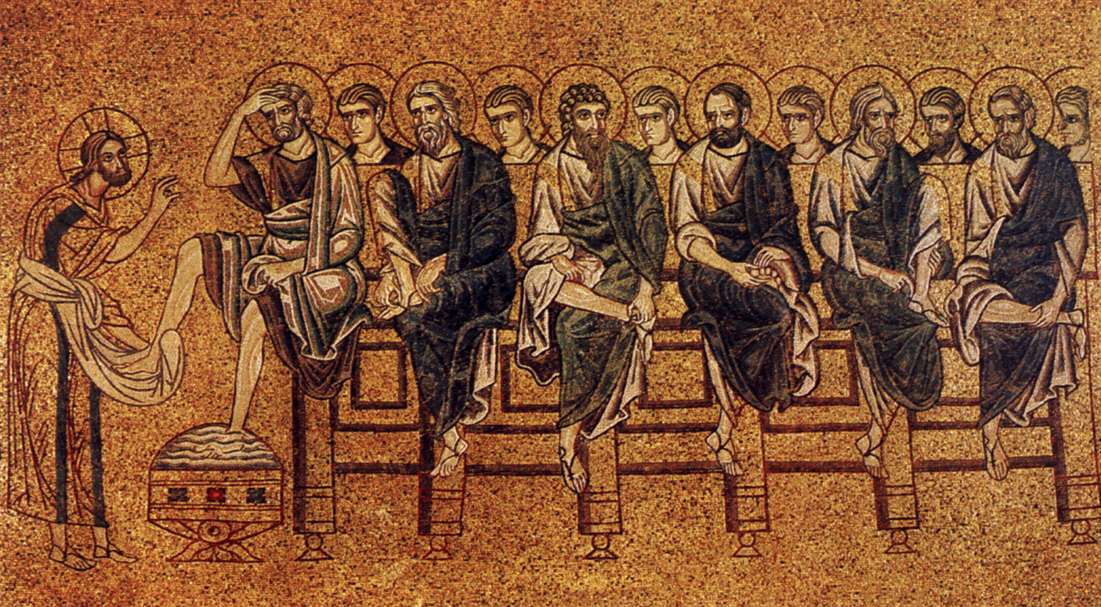
            Obedient to the Old Covenant, Our Lord and his disciples prepare to celebrate the Passover: the mystery of Israel’s deliverance from slavery in Egypt to the new life in the Promised Land. While they are at table Our Lord lays aside his outer garments and takes a basin and a towel and washes the Apostles’ feet. He says to them I have given you an example so that you may copy what I have done to you.
The new commandment given to the disciples by our Lord at the Last Supper in John’s account is to love one another as he has loved us. The washing of the disciples’ feet is an act of loving service:  God who created the universe and who will redeem it kneels and washes the feet of sinful humanity. This is true love in action. . It is a gesture of humility and intimacy, which shows us how God loves us and how the events of the next few days will show us the depth of this love, a love which brings the entirety of the human race, past, present and future into a relationship with a loving God, through his sacrifice of himself upon the cross and through his bursting from the tomb
            But before this love is disclosed in our Lord’s Passion, Death and Resurrection, it is shown in loving service and humility, the Greek word for which is diakonia, which gives us our English word Deacon. All those who are ordained are set apart for the service of Almighty God and his church and we are all called to serve God and his people fashioning ourselves after the example of our Lord and Saviour Jesus Christ. All ordained Christian ministry is rooted in the diaconate, in a ministry of loving service, after the form and pattern of Our Lord and Saviour Jesus Christ, following HIS example and living it out in our lives. This is a most wonderful and humbling task which can fill us with both joy and fear and I would humbly ask that you continue to pray for me and for all of us who serve the church in this place, since we can do nothing without you.
            Christ then takes bread and wine and blesses them and gives them to his disciples. Again, this would look and feel like the Passover celebration to which they were accustomed. Except that before he broke and distributed the bread he said ‘Take, Eat. This is my body, which is given for you. Do this in remembrance of me.’ And before the Cup was distributed he said ‘Drink of it, all of you, for this is my blood of the new covenant, which is poured out for many for the forgiveness of sins. Do this, as often as you drink it, in remembrance of me.’ He feeds his disciples with his own body and blood to strengthen them, to show them what he is about to do for love of them and of the whole world. When, earlier in his public ministry, he has fed people he taught them in the synagogue at Capernaum ‘Truly, truly, I say to you, unless you eat the flesh of the Son of Man and drink his blood, you have no life in you. Whoever feeds on my flesh and drinks my blood has eternal life, and I will raise him up on the last day. For my flesh is true food, and my blood is true drink.  Whoever feeds on my flesh and drinks my blood abides in me, and I in him. As the living Father sent me, and I live because of the Father, so whoever feeds on me, he also will live because of me.’ (Jn 6:52–7 ESV). ‘Was ever another command so obeyed? For century after century, spreading slowly to every continent and country and among every race on earth, this action has been done, in every conceivable human circumstance, for every conceivable human need from infancy and before it to extreme old age and after it, ….  just to make the plebs sancta Dei—the holy common people of God’ [Dix The Shape of the Liturgy 744] Our Lord institutes the Eucharist, the Sacrament of His Body and Blood, to feed us, to nourish us, so that we may become what he is, that we may have a foretaste of heaven and the divine life of love, of the beatific vision of God, Father, Son, and Holy Spirit, the Holy, Eternal and Consubstantial Trinity. It re-presents, it makes present again, here and now, the sacrifice of Calvary, where upon the Altar of the Cross, as both priest and victim, Christ sacrifices himself for the sins of the whole world. He is the Lamb of God, foreshadowed in the ram offered by Abraham and Isaac, in the bread and wine offered by Melchisedek. In the blood and water which will flow from his side we are washed and creation is renewed. Christ gives the Church the Eucharist so that his saving work may continue, so that people may be given a pledge and token of their eternal life in him. It is loving service for our Lord to feed his disciples with his own body and blood. This the church was formed continue, offering the same sacrifice of Calvary at the altar, feeding His people with His Body and Blood, nourishing the church as a mother feeds her children, filling us with his love and grace, to transform our human nature through our sharing in the divine life of love. This is what priests and deacons are called to be, those who serve the people of God and nourish them with the word and sacrament, building up the body of Christ. We are to live exemplary lives of love, service, and prayer, which can serve as examples for the whole baptised people of God to copy and imitate in their own lives. This is a great, an awesome and wonderful task, for which we rely upon the grace of God’s and the help and support of you, the people of God in this place. It is not something which we can do on our own, relying on our own abilities or strengths, but on God. For we all, as Christians, are called to love one and to serve one another in a variety of ways. In this we follow the example of Christ, who washes our feet, who institutes the Eucharist to feed us with himself, to transform our nature by his grace and bring about the full flowering of the kingdom of God. He sets his disciples apart, consecrating them to God, for a life of prayer and service and to carry on the sacrifice of Calvary through their offering of the Eucharist of the altars of his church, to feed his people. This is the glory of God: in transforming bread and wine into his very self for the life of the whole world – a sign of love and a pledge and foretaste of eternal life. This is love that we can touch and feel and taste – given for us so that we might have life in him.
            So then, let us prepare for Christ to wash our feet, as the blood and water which will flow from his side tomorrow on Calvary will wash away all the sins of humanity, let us be fed with his body and blood, which tomorrow he will offer upon the altar of the cross as both priest and victim, reconciling humanity and embracing a world with his loving arms as he is nailed to the wood. And let us follow his example, in living lives of prayer and loving service, supporting one another so that the world may believe and give praise to God the Father, God the Son, and God the Holy Spirit, to whom be ascribed as is most right and just, all might, majesty, glory dominion and power, now and forever. AMEN.

Palm Sunday 2015


If anyone asks you why you are untying it [the ass the disciples were sent to find], this must be your answer, ‘The Lord has need of it’ (Lk 19:31). Perhaps no greater paradox was ever written than this – on the one hand the sovereignty of the Lord, and on the other hand his ‘need’. His combination of Divinity and dependence, of possession and poverty was a consequence of the Word becoming flesh. Truly, he who was rich became poor for our sakes, that we might become rich. Our Lord borrowed a boat from a fisherman from which to preach; he borrowed barley loaves and fishes from a boy to feed a multitude; he borrowed a grave from which he would rise; and now he borrows an ass on which to enter Jerusalem. Sometimes God pre-empts and requisitions the things of man, as if to remind him that everything is a gift from him.
Fulton J. Sheen Life of Christ
Pomp and ceremony seem to have been at the top of the agenda of late: in a week which saw the re-burial of the mortal remains of King Richard III, this is hardly surprising. As triumphant entries go, the one we see in the Gospel this morning is a bit strange: generally speaking, we are used to kings riding on horses, looking like powerful military leaders. Here we see something different, something which defies our expectations and which stops us seeing things in purely human terms.
          There are people who would ask, why all this fuss? Would Jesus have wanted it, would he want us to be carry on with it? If it were something which would not want us to do he would have said so. He did it because it was important, because it fulfilled prophesy and because liturgy is an important thing in and of itself: it marks out various things as special and helps us understand both who and what we are and what we do – it forms both habit and indeed our moral character.
          The crowd cry out “Hosanna to the Son of David! Blessed is he who comes in the name of the Lord! Hosanna in the highest!” (Mt 21:9 ESV) They cry out for God to save them, and that is exactly what he will do in a few days time, upon the Cross. This is a God who keeps his promises and defies our expectations. The crowd are expecting a king of the Davidic line, which would be seen as a challenge to the ruling elite, the status quo, but in Christ God gives Israel a King of the line of David forever. Those with power are threatened by him: he is awkward, an inconvenience. Jesus does not want their power, as he has come to be and do something completely different: what is taken as a political coup is a renewal of religion, the fulfilment of prophesy, and a new hope for Israel. 
In riding into Jerusalem Jesus is fulfilling the prophesies of Zechariah (9:9) and Isaiah (62:11).  The King of Israel comes riding on a donkey: a humble beast of burden, which carried his Mother to Bethlehem for his birth. It is an act of humble leadership which fulfils what was foreseen by the prophets. It shows us that Jesus Christ is truly the one who fulfils the hopes of Israel. The Hebrew Scriptures look forward to the deliverance of Israel, which is enacted in front of their very eyes.

Today and in the coming week we will see what God’s Love and Glory are really like: it is not what people expect, it is power shown in humility, strength in weakness. As we continue our Lenten journey in the triumph of this day and looking towards the Cross and beyond to the new life of Easter, let us trust in the Lord, let us be like him, and may he transform our hearts, our minds and our lives, so that they may have live and life in all its fullness. We are fed by the word of God and by the sacrament of His Body and Blood to be strengthened, to share in His divine life, to fit us for Heaven, and to transform all of creation that it may resound his praise and share in his life of the Resurrection, washed in His Blood and the saving waters of Baptism: forgiven and forgiving so that all that we say, or think, or do, all that we are may be for the praise of God the Father, God the Son, and God the Holy Spirit, to whom be ascribed as is most right and just, all might, majesty, glory dominion and power, now and forever…

Lent IV – Looking to the Cross

For God sent his Son into the world not to condemn the world, but that through him the world might be saved.
It is far too easy nowadays to see the church in a negative way –  it’s the fashionable thing to do – as the church we’re corrupt, we’re filling people’s heads with nonsense. We can be characterised as strange, quaint, and out of touch. It suits people to see us entirely in negative terms: as opposed to certain things. We are prescriptive: we limit people’s freedom, and in failing to practice what we preach, we can be written off as hypocrites, with no right to proclaim objective truth, to offer the world a moral framework, within which to live its life; to offer the world an alternative paradigm, a new way of living and of being through which to have life, and have life in all its fullness. It’s less a valid criticism and more of an excuse for people not to bother. It’s an easy way out, which saves people from the more difficult task of living Christ-like lives of love and self-sacrifice. The church does not claim to be perfect, but rather a collection of sinners justified by the grace of God, through faith in Christ.
          The simple truth is that people like to moan and grumble – we all do, and I’m as guilty of it as anyone, but there is a fundamental difference between being dissatisfied with the way things are and longing for change, and hopefully bringing about good change, change in a god-ward direction, and the corrosive moaning rooted in selfishness, which betrays a lack of trust in God. The Israelites in the desert represent this negative moaning, they are unable or unwilling to trust God to lead them on a journey towards the Promised Land, and while they realise their mistake their poisonous moaning has disastrous consequences for them. And yet even in this they are not abandoned by God, they gaze on the bronze serpent, they look to that which prefigures the Cross, through which God heals his people, taking their sins upon himself. That’s why it appears in stained-glass windows in churches, because it points to the Cross, it’s why when talking about the Cross Jesus mentions it, so that people might understand how and why God loves them and how it might affect their lives.
St Paul in his letter to the Ephesians can state with confidence, ‘For by grace you have been saved through faith, and this is not your own doing; it is the gift of God – not the result of works, so that no one may boast(Eph 2:8-9). It’s not about what we can do, but about what God can do for us. Our relationship with God is the result of a gift, which we can receive and which can transform our lives, if we only let go, and let God…
          This morning’s gospel reminds us of the fundamental truth that God loves us – it is the heart of the Good News – the Gospel, what we preach and what we live as Christians. There are few words as comforting as ‘For God so loved the world that he gave his only Son, so that everyone who believes in him may not perish but may have eternal life. ‘Indeed, God did not send the Son into the world to condemn the world, but in order that the world might be saved through him’ (Jn 3:16-17). They may be familiar to us, they certainly should be, but we must not let our familiarity with them cloud the significance of simply stating that God loves us, does not condemn us, but saves us, in and through Jesus Christ. That’s why we are Christians, it’s why we’re here, and recognising God’s love for us will have a transforming effect upon our lives.
In the Incarnation Jesus comes among us as a poor helpless baby, laid to rest in the rough wood of an animals’ feeding trough. He is cared for through the love of his mother, the Blessed Virgin Mary, who in her love, her service, and obedience, stands as the model for all Christians to follow. She is the first Christian, the greatest, a pattern for us to imitate, of loving trust and obedience, of care and costly love, and a foreshadowing of our great mother the church, through which we are saved by grace through faith.
          Upon the rough wood of the cross, Jesus will suffer and die for us – such is the cost of human sin. His mother, Mary, stands by and watches and weeps. As the church we too should watch and weep for the wounds of human sin and division which still scar Christ’s body. We feel helpless. What can we do? We should do all that we can to live God’s life of sacrificial self giving love: living lives of light, which shine in the darkness. It isn’t easy, but if we try and do it together then all things are possible, through him who loves us.
          The salvation and eternal life which Christ offers freely to all, comes through the church, which we enter in baptism, where we are nourished in word and are sacrament, where we are nourished, given food for the journey, strengthened and taught, to live his risen life, to share in the joys of Easter.
          God cares so much about the world and its people that he takes flesh, and lives a life of love, amidst the messiness of humanity, to show us how to live lives filled with love, life in all its fullness. God in Christ comes among us not to condemn the world but to offer it a way of being, of being truly alive in Him. God has made us for himself, and our hearts are restless until they find their rest in him. The spiritual needs and searching which characterise people in the world around us can be satisfied in God and in God alone, through the church. We can rejoice, and relax our Lenten discipline for a little while to give thanks for the wonderful gift of God’s love in our lives, in the church, and for the world.
          But we also need to trust God, to listen to what he says through Scripture, to be fed by him, and to live lives in accordance with his will and purpose, together, as a family, as a community of love, cared for and supported by our mother, the church. And in so doing we look to Our Lady as Mother of Our Lord and Mother of the Church, as a pattern for love and obedience, as a model for all mothers: loving and tender, putting the needs of others before self, self-giving, sacrificial, and open to both joy and pain, trusting in God.

This, as any mother can tell you, is not easy, it’s difficult, really hard, but its rewards are likewise great. So let us, as we continue our Lenten journey towards the cross, where God shows his love for us most fully and completely, giving his body to be broken and his blood be shed for us, a sacrifice which will be made present here today under the outward forms of bread and wine, to strengthen us to live the risen life of Easter, to offer the world an alternative to selfishness, to self-centredness, to the sin which continues to separate us from God, an alternative shown to us in a self-giving love of mothers, and of our mother the church. So that we may join the Angels in our song of love and praise to the Trinity: Father, Son, and Holy Spirit, to whom..

A Thought for the Day from St Benedict

If we do not venture to approach men who are in power, except with humility and reverence, when we wish to ask a favor, how much must we beseech the Lord God of all things with all humility and purity of devotion? And let us be assured that it is not in many words, but in the purity of heart and tears of compunction that we are heard. For this reason prayer ought to be short and pure, unless, perhaps it is lengthened by the inspiration of divine grace. At the community exercises, however, let the prayer always be short, and the sign having been given by the Superior, let all rise together.

Lent III Year B


Lent can feel something like a spiritual spring clean, and that’s no bad thing. We, all of us, need opportunities for repentance, to turn away from sin, and to return to the Lord Our God. In this morning’s Gospel we see Jesus in quite an uncompromising mood: this is no ‘Gentle Jesus, meek and mild’ but rather here is the righteous anger of the prophets, a sign that all is not well in the world.
            When Moses receives the Ten Commandments from God on Mt Sinai the first is ‘I am the Lord your God, who brought you out of the land of Egypt, out of the house of slavery; you shall have no other gods before me.’ Could it be that the temple traders in their desire to profit from people’s religious observance have broken this first commandment? The temptation to have power, to be concerned above all else with worldly things: money, power, success, and influence, are still a huge temptation for the Church and the world. We may not mean to, but we do, and while we think of God as loving and merciful, we forget about righteous anger, and our need to repent, to turn away from our sins – the desire to control others and to be so caught up on the ways of the world that we lose sight of who and what we are, and what we are supposed to do and be.
            The Jews demand a sign, and Christ prophesies that if they destroy this temple then he will raise it up in three days: he looks to his death and resurrection to show them where true worship lies – in the person of Jesus Christ. Christians should be concerned with a relationship, our relationship with God, and with each other. Likewise Christians can all too easily forget that Jesus said ‘I have come not to abolish the law and the prophets but to fulfill them’. The Ten Commandments are not abolished by Christ, or set aside, but rather his proclamation of the Kingdom and Repentance show us that we still need to live these out in our lives, to show that we honour God and live our lives accordingly. In his cleansing of the Temple Christ looks to the Cross and to the Resurrection, a stumbling-block to Jews, obsessed with the worship of the Temple, and foolishness to Gentiles who cannot believe that God could display such weakness, such powerlessness. Instead this supreme demonstration of God’s love for us, shocking and scandalous though it is, is a demonstration of the utter, complete, self-giving love of God, for the sake of you and me – miserable sinners who deserve condemnation, but who instead are offered love and mercy to heal us and restore us.
            When we are confronted with this we should be shocked – that God loves us enough to do this, to suffer and die for us, to save us from our sins, and from the punishment that is rightly ours. We do not deserve it, that’s the point. But we are offered it in Christ so that we might become something other than we are, putting away the ways of the world, of power and money, selfishness and sin, to have new life in and through Him.
            To live is to change and to be perfect is to have changed often. If we are changing into Jesus Christ, then we’re on the right track. If we listen to his word in Scripture; if we talk to him in prayer and let him talk to us; if we’re fed by Him and with Him in the Eucharist, by Christ who is both priest and victim, so that we might become what He is – God; if we’re forgiven by Him, through making confession of our sins, not only do we come to understand Jesus, we become like him, we come to share in his divine nature, you, me, all of humanity ideally. We, the People of God, the new humanity, enter into the divine fullness of life, we have a foretaste of the heavenly banquet – we are prepared to enter the new life of the Kingdom, and to live it.

            Lent should be something of a spiritual spring clean, asking God to drive out all that should not be there, preparing for the joy of Easter, to live the Risen Life, filled with God’s grace. In our baptism we died with Christ and were raised to new life in the Spirit. Let us prepare to live that life, holding fast to Our Lord and Saviour, clinging to the teachings of his body, the Church. Let us turn away from the folly of this world, the hot air, and focus on the true and everlasting joy of heaven, which awaits us, who are bought by his blood, washed in it, fed with it. Let us proclaim it in our lives so that others may believe so that all may praise the Father, the Son and the Holy Spirit, to whom be ascribed as is most right and just, all might, majesty, glory, dominion, and power, now and forever…

Homily for Lent I

It is all too easy to see the forty days of Lent, the season of preparation for our celebration of Our Lord’s Passion, Death and Resurrection as a time of sadness and misery. Too often it is seen in entirely negative terms: we focus on what we are giving up. Now the practice of abstaining from bodily pleasures is a good and ancient one, not in and of itself, it is not some sort of holy diet, but rather we turn away from something we enjoy so that we may focus upon something else. The other practices of Lent: prayer and almsgiving are there to focus our minds upon God and other people, so that we may enter the desert of repentance with joy, thinking of the needs of others and growing closer to the God who loves us and longs for our healing, our repentance.
     
  In this morning’s first reading we see a covenant between God and humanity, a sign of God’s love for us, and a promise of reconciliation between God and the world which underlies what Jesus does for us, it allows us to have hope, to see things in an entirely positive way, and to see behind what we do, that it is a means, a means to an end, namely our sanctification, rather than an end in itself. In our second reading from the first letter of Peter, he draws the link between Noah’s ark, which saves people through water, and baptism, which is prefigured in it. Lent is a season of preparation for baptism, so that we can die with Christ and be raised like him and with him to new life in him. For those of us who have been baptised it is good to have a chance to spend the time in Lent praying, drawing closer to the God who loves us, and living out our faith in our lives – we can all do better, especially when we try, and try together, supporting each other, so that we might grow in holiness as the people of God.
When St Antony was praying in his cell, a voice spoke to him, saying ‘Antony, you have not yet come to the measure of the tanner who is in Alexandria.’ When he heard this, the old man arose and took his stick and hurried to the city. When he had found the tanner …. he said to him, ‘Tell me about your work, for today I have left the desert and come here to see you.’
He replied, ‘I am not aware that I have done anything good. When I get up in the morning, before I sit down to work, I say that the whole of the city, small and great, will go into the Kingdom of God because of their good deeds while I will go into eternal punishment because of my evil deeds. Every evening I repeat the same words and believe them in my heart.’
When St Antony heard this he said, ‘My son, you sit in your own house and work well, and you have the peace of the Kingdom of God; but I spend all my time in solitude with no distractions, and I have not come near to the measure of such words.’
It is a very human failure, for far too often we make things far too complicated when all we need to do is to keep things simple. In the story from the Desert Fathers, which we have just heard, St Antony, the founder of monasticism, a great and a holy man, is put to shame by a man who spends his days treating animal skins. The key to it all is the tanner’s humility, his complete absence of pride, and his complete and utter trust in God – his reliance upon him alone.
In this morning’s Gospel we see the beginning of Our Lord’s public ministry – he is baptised by John in the River Jordan before immediately  going into the desert for forty days. He goes to be alone with God, to pray and to fast, to prepare himself for the public ministry of the Proclamation of the Good News, the Gospel.
During this he is tempted by the devil: he faces temptation just like every human being, but unlike us, he resists. The devil tempts him to turn stones into bread. It is understandable – he is hungry, but it is a temptation to be relevant, which the church seems to have given into completely: unless we what we are and what we do and say is relevant to people, they will ignore us.
There is the temptation to have power, symbolised by worshipping the devil. It leads to the misuse of power. The church stands condemned for the mistakes of the past, but in recognising this there is the possibility of a more humble church in the future – a church reliant upon God and not on the exercise of power.
There is the temptation to put God to the test – to be spectacular and self-seeking. Whenever we say ‘look at me’ we’re not saying ‘look at God’.
Jesus resists these temptations because he is humble, because he has faith, and because he trusts in God. It certainly isn’t easy, but it is possible. It’s far easier when we do this together, as a community, which is why Lent matters for all of us. It’s a chance to become more obedient, and through that obedience to discover true freedom in God. It’s an obedience which is made manifest on the Cross – in laying down his life Jesus can give new life to the whole world. He isn’t spectacular – he dies like a common criminal. He has no power, he does not try to be relevant, he is loving and obedient and that is good enough.
It was enough for him, and it should be for us. As Christians we have Scripture and the teaching of the Church, filled with his Spirit, to guide us. We can use this time of prayer and fasting to deepen our faith, our trust, our understanding, and our obedience, to become more like Jesus, fed by his word and sacraments – to become more humble, more loving, living lives of service of God and each other.  It leads to Jesus’ proclamation of the kingdom: ‘The time is fulfilled, and the kingdom of God has come near; repent, and believe in the good news.’ Words as true now as then, which the world still longs to hear, and which we need to live out in our lives, so that the world may believe and give glory to God the Father, God the Son, and God the Holy Spirit, to whom be ascribed as is most right and just, all might, majesty, glory dominion and power, now and forever.
duccio_di_buoninsegna_040

A Thought for the Day from the Desert

The fear of the Lord is our cross. Just as someone who is crucied no longer has the power of moving or turning his limbs in any direction as he pleases, so we also ought to fasten our wishes and desires, not in accordance with what is pleasant and delightful to us now, but in accordance with the law of the Lord, where it hems us in. Being fastened to the wood of the cross means: no longer considering things present; not thinking about one’s preferences; not being disturbed by anxiety and care for the future; not being aroused by any desire to possess, nor inflamed by any pride or strife or rivalry; not grieving at present injuries, and not calling past injuries to mind; and while still breathing and in the present body, considering oneself dead to all earthly things, and sending the thoughts of one’s heart on ahead to that place where, one does not doubt, one will soon arrive
John Cassian, Institutes, Book IV ch.35

Sexagesima Year B


About 1700 years ago the passage from the Book of Proverbs which is the Old Testament Reading which we have just heard was at the centre of a theological controversy which threatened the nature and existence of Christianity as we know it. Arius, a priest of Alexandria used the passage ‘The Lordcreated me at the beginning of his work, the first of his acts of long ago. Ages ago I was set up, at the rst, before the beginning of the earth. When there were no depths I was brought forth, when there were no springs abounding with water. Before the mountains had been shaped, before the hills, I was brought forthto prove that Wisdom, which was understood as the Logos, the Word of God, the Creative Intelligence was not pre-existent, that it was a creation, and that ‘there was a time when he was not’. He may have been attempting to uphold what he understood as monotheism and the supremacy of God the Father, but in so doing he threatened the very nature of Christianity itself: denying the eternal nature of the Son of God, seeing Him as a creature, something created, something less than God.

        His position caused something of a fightback, and the church began to define the nature of God the Father, and God the Son with greater clarity, and while the orthodox position sometimes found favour with Imperial power, and sometimes did not, in the end political power could not enforce heresy. The views of Arius while condemned by the church and seemingly dead and buried once again found widespread fame with the arrival in 2003 of Dan Brown’s novel, The Da Vinci Code, with which you are no doubt familiar. I’ve read it, it is a rip-roaring page-turner of a book, but it is not based on the truth, it is a work of fiction, which may be plausible, which may be fun to read, but which is not true.  The idea that the church and state colluded to airbrush out the truth and replace it with an official version is simply not borne out by the facts. After Constantine, his son Constantius II reversed the policy of his father and was sympathetic to the Arians. This is hardly the practice of a cover-up, indeed the facts do not support the hypothesis – it’s fanciful but basically no more than a conspiracy theory.
        The Church formulated its beliefs in creedal statements first at Nicæa and later revised at Constantinople just over 50 years later, these are the words which we are about to say to express what the Church believes about God – we say them because they are true and because they help us to worship God.
        The second reading this morning from St Paul’s Letter to the Colossians is a statement of belief, an early creedal statement which focuses on who and what Jesus Christ is and what he does, written only some thirty years after his Crucifixion. Christ is the first-born in whom all creation has its existence. Creation exists because God was pleased to dwell in him in all his fullness and through him to reconcile all things whether in heaven or on earth. Christ’s great work is to reconcile all things in heaven and earth, making peace by the blood of his Cross. Our Lord’s Passion, Death, and Resurrection alter the created order in a fundamental way and are the outpouring of God’s love on the world, to heal it and restore it. This encapsulates what we believe as Christians and why we are here today to pray, to be nourished by Word and Sacrament, so that through our participation in the Eucharist, in Holy Communion, we may partake of His Divine nature, and be given a foretaste of heaven.
        Christ became human so that we might become divine. This profound and radical statement lies at the heart of the Prologue to John’s Gospel, a passage which we cannot hear too often, simply because it is wonderful and it manages in a few verses to cover the entirety of salvation history from the Creation of all that is to the Incarnation, when the Word became flesh and lived among us and we beheld his glory full of grace and truth. God became a human being, for love of us, to show us how to live, and to give us the hope of heaven, or as John’s Gospel later puts it ‘For God so loved the world, that he gave his only Son, that whoever believes in him should not perish but have eternal life. For God did not send his Son into the world to condemn the world, but in order that the world might be saved through him.’ (Jn 3:16-17) The Christian life therefore is one characterised by joy, by hope, by love, and forgiveness, it is to be freed from the way of this world given that we celebrate a Divine authority which is before and over all things. At the heart of our faith as Christians is a wonderful message of freedom, knowing that this life is not all that there is, that we are called to have life in him and life in all its fullness, and to live for and through him. This is our faith: it is what we believe and what we are to live, here and now, for the glory of Almighty God and the furthering of his kingdom.

        So let us live it, supporting each other in love, in prayer, and forgiveness – helping each other to proclaim by word and deed the Good News of Jesus Christ to a world which longs to hear it, which longs to be freed from selfishness and sin, to come to new life in the living waters of baptism and to live out that life in the Church, the Body of Christ, loved by Him, fed by Him, fed with Him, restored and healed by Him, set free from the ways of selfishness and sin to have life in all its fullness, even eternal life in Him.

Jesus at the Synagogue in Capernaum


The beginning of Jesus’ public ministry is centred around Galilee: he’s on home territory. Having called the first disciples to help Him in the proclamation of the Good News of the Kingdom, Jesus goes to Capernaum with his disciples to teach on the Sabbath in the synagogue there. He teaches them, he explains the Jewish Scriptures, the Word made flesh, the Living Word, is among them. Their reaction is one of astonishment – amazement that he teaches them, not as the scribes but as one having authority. Rather than explaining human teaching in a human way, people are drawn closer to God, by one whose power and authority are derived from God, because that is who he is. Jesus can explain the Scriptures because he is the Way, the Truth, and the Life – He is the fulfilment of Scripture, and it finds its meaning in and through Him.
            There is a man in the synagogue who is not well. The Gospel uses the language of possession by an unclean spirit, whereas nowadays we would probably use the language mental illness. The man in his brokenness can recognise who and what Jesus is – the Holy One of God. The point of the Kingdom which Jesus proclaims, which he explains in his teaching, is that it is a place of healing. Ours is a God who can heal our wounds, who can take broken humanity and restore it in love. This is why Jesus’ teaching and the healing have to go together; they are both part of a larger whole, the coming Kingdom of God. Jesus proclaims our need to love God and each other, and puts it into practice, making the healing power of God’s love a reality in the world.
            From the very beginning, Jesus looks to the Cross, not as a place of torture, of humiliation, or defeat, but as a place of victory, and healing, as the supreme demonstration of God’s love for humanity – this is how much God loves us, this is why he sends his Son to heal our wounds, to restore us, and to give us the hope of Heaven. This healing love is what we have come to experience here this morning, where under the outward forms of bread and wine we are fed with the Body and Blood of Christ, so that their Divine nature might transform our human nature, might give us a foretaste of heaven, healing our wounds, taking away our sins, cancelling the debt which we cannot pay, so that we might have life in Him, in this world and the next.
            The possessed man asks ‘Have you come to destroy us?’ We know that Jesus has come not to destroy but to heal, so that we may have life and have it to the full – this is the Good News of the Kingdom, which is still a reality here and now – we in our brokenness can come to the source of healing, to the God who loves us and gives himself for us so that we can be healed and restored by Him. He can take our lives and heal us in His love. So let us come to Him, let us be healed by Him, that our lives too may be transformed, and let us proclaim to a world which longs for healing and wholeness the love of God in Christ. 

Epiphany II: John 1:43-51

In John’s Gospel we have seen Jesus baptised by John the Baptist, we have heard John declare ‘Behold the Lamb of God, who takes away the sins of the world’, we have seen Jesus call Andrew and Simon Peter, disciples of John, to follow him. Now Jesus decides to go from Bethany to Galilee, to go back home. He begins by saying to Philip ‘Follow me’ a simple invitation, which he accepts. Coming from Bethsaida, the same city as Andrew and Peter it is certain that Philip knows them, and is well-disposed to join in with them, and to answer Jesus’ invitation. He then finds Nathanael and testifies that Jesus is he who is spoken of in the Law of Moses and the prophets, the Messiah, the saviour of Israel. Nathanael’s reply, ‘Can anything good come out of Nazareth?’ looks like a proverbial saying – it reminds us of Jesus’ ordinary earthly existence, growing up in a backwater town. Nathanael’s initial scorn will be transformed; such is the power of God. Philip counters by saying ‘Come and see’, Jesus’ answer to John’s disciples who want to know where he is staying. This invitation to come and see for oneself lies at the heart of the proclamation of the Good News, it remains as key now as it did nearly two thousand years ago.
       Jesus sees Nathanael coming towards him and says ‘Here is an Israelite in whom there is no guile’ he’s plain-speaking, honest, there’s no flannel here. Nathanael is amazed before long has acclaimed Jesus as a teacher, the Son of God and King of Israel. Clearly something good can come out of Nazareth, good enough to save the world. For the kingdom to grow we cannot simply expect to open our doors and see people flood in, we have to invite people in, to say to them ‘Come and see’ and make sure that they see Jesus in Word, Sacrament, and in the lives of those around them. Having been called, they can respond to that call. This is what the church is for – to call people to be in a relationship with Jesus, to be nourished by him. We need to continue to repeat the simple invitation of Jesus ‘Come and see’, to come and see the one who is shown in the Law and the Prophets as the Messiah, the Anointed Saviour, so that people can become close to Him.
       This openness, this willingness to be changed by an encounter with Christ, encourages us to look outwards and share our faith with others – to live lives of joy, in the knowledge that God loves us and saves us. Our faith as Christians is not something which we keep to ourselves, but rather something which we share, and which affects all of who and what we are, and think, and say, and do. Ours is a radical faith which has at its aim to change the world. It may sound strange or overambitious, but if we acknowledge Jesus Christ as the King of Heaven and Earth, who came to save humanity, we have to call the world to follow him. Our faith then is not a private matter, or something which we just do on a Sunday morning for an hour or so, but rather something which changes our lives, and affects every part of who we are and what we do. What we see starting in this morning’s Gospel is something which we can bear fruit in our lives, if we accept the invitation to ‘Come and see’ and encourage others so to do.

       The Gospel is the Good News of Jesus Christ, good news that God loves humanity, that He saves us, that He gives Himself to save us from our sins, and nourishes us with His Word and His Sacraments, so that we can have life in Him, and life in all its fullness. What starts with the Incarnation is still bearing fruit here and now, still encouraging people to come and see, to meet Jesus, to be nourished and changed by Him, let us accept His invitation, and offer it to others that they too may enter into the joy of the Lord and give glory to God the Father, God the Son, and God the Holy Spirit, to whom be ascribed, as is most right and just, all might, majesty, glory, dominion, and power, now and forever.

A thought for the day from St Athanasius

Like many people I have found the images in CharlieHebdo which mock religion, and in particular Christianity, somewhat difficult and troubling. The following words of St Athanasius are, however, both a help and a comfort:

Come now, blessed one and true lover of Christ, let us, with the faith of our religion relate things concerning the Incarnation of the Word and expound his divine manifestation to us which the Jews slander and the Greeks mock, but which we ourselves venerate, so that all the more from his apparent degradation, you may have even greater and fuller piety towards him, for the more he is mocked by unbelievers by so much he provides a greater witness of his divinity, because what human beings cannot understand as impossible, these he shows to be possible (cf. Mt 19:26), and what human beings mock as unseemly, these he renders fitting by his own goodnessand what human beings through sophistry laugh at as merely humanthese by his power he shows to be divine, overturning the illusion of idols by his own apparent degradation through the crossinvisibly persuading those who mock and disbelieve to recognise his divinity and his power.

Athanasius de Incarnatione Dei Verbi 1
tr. J. Behr (St Vladimir’s Seminary Press : 2011)

Christmas II

We live in a world which is obsessed by time. The pace of modern life is quite different to that of a generation or two ago. Despite the advent of labour-saving devices and technology we seem if anything busier than ever as other things come along to fill our time – we can feel pressured, worried, and anxious. This isn’t good; we can’t help feeling that this isn’t how it is supposed to be. Thankfully God doesn’t work like this. The people of Israel have been waiting for a Messiah, for a Saviour to be born, who will save Israel from their sins, but it isn’t a case of birth on demand. As St Paul writes to the church in Galatia (Gal 4:4-5) ‘But when the fullness of time had come, God sent forth his Son, born of woman, born under the Law, to redeem those who were under the Law, so that we might receive adoption as sons.’ God’s time is not our time, and the Incarnation happens not at a convenient time, but in the fullness of time – after the message has been proclaimed by the prophets, who prepare the way for the Saviour; after Mary has said ‘yes’ to God, a ‘yes’ which can undo the ‘no’ of Adam and Eve.
            This is why, at the start of his Gospel, St John, the beloved disciple, can begin right at the start of salvation history, indeed with Creation itself: his opening words ‘In the beginning’ point us straight back to the opening words of Genesis, in Hebrew BeresithIn the beginning’. This is where it all starts, where everything that is starts,  and the Word through which God speaks creation into existence, this creative power of God is what will take human flesh and be born of the Virgin Mary. The enormity of this situation should not be lost on us, we cannot think about it too much, the helpless infant born in a stable is God, who created all that is, or has been, or will be, and who comes among us weak, helpless and vulnerable, dependent upon the love and support of father and mother for everything. Christ shares our human existence from birth to death, so that we may know that ours is a God who comes among us, who comes alongside us, who is not remote, but involved, a God of love.
            St John take us back to the beginning so that we can see what we are dealing with, and how it fits into the bigger picture. What we are celebrating at Christmas is something which extends through time, both in its nature and its effects. It is why we as Christians make such a big deal of Christmas – it isn’t just something to do in the middle of winter, but along with Our Lord’s Passion, Death, and Resurrection , the most wonderful and important moment of history, which affects us here and now. What was made known to the shepherds we now proclaim to the world, what symbolically is shown in the Solemn Feast of the Epiphany, which we prepare to celebrate, where the Wise Men point to the manifestation of Christ’s Divinity to the whole world.
            ‘And the Word was made flesh and dwelt among us, and we have seen his glory, the glory as of a father’s only son, full of grace and truth.’ The reality of the Incarnation, of God with us, Emmanuel, that God lives with us, sharing our human life, shows us the glory of God, that from which Moses hid his face in the Exodus is now made plain, and displayed for all to see, a proclamation of the glory, the love, and the goodness of God, shown in our adoption as children of God, given an inheritance – eternal life and a relationship with God – a humanity restored and healed. This is the light which shines in the darkness of our world, which it cannot overcome. John the Baptist testifies to this, the Wise Men kneel in adoration before Him, bringing gold for a King, Incense for the worship of God, and myrrh which points to His Death on the Cross for our salvation. Their gifts show that they understand and value who and what Christ is, and what He does.
            Are we to be like the world, which though it was created through Him does not know him? Or like his own people, who did not accept Him? Or do we receive Him, and believe in His Name, which is above every name? Do we accept the invitation to become children of God, and do we respond to it? Do we accept the challenge to live as the family of God, loving and forgiving, as those who are loved and forgiven by God, so that our lives, yours and mine, proclaim the glory and truth of God, and the message of salvation for all the world to hear? If we accept our inheritance, the fact that there is now a familial relationship between us and God, we need to understand that with that relationship comes duty and responsibility.

            And yet we do not see this as something imposed upon us, but rather as the truth which sets us free: a relationship with a God whose service is perfect freedom. So let us walk in His light, dwell in His love, and know the fullness of His joy, let us be glad that as a pledge of His love He gives Himself, under the outward forms of bread and wine, to feed us with His Body and His Blood, a sign that His promise is true, that we can have a foretaste of Heaven, food for our journey of faith here on earth, so that we may know his love, and touch it and taste it, so that we can be strengthen to live that faith and to proclaim it by word and deed, so that all the world may enter into His joy, and live His life. 

Homily for Christmas ‘And the Word became flesh and dwelt among us’

Ατς γρ νηνθρώπησεν, να μες θεοποιηθῶμεν·
Athanasius De Incarnatione Dei Verbi 54.3
‘He became human so that we might become divine’
IT may well surprise you to know that I have, on occasion, had recourse to the services of a turf accountant, I perhaps ought to explain the situation a little further. At the time I happened to have a friend whose Uncle was a world-famous Horse-Racing Trainer; he would, from time to time, mention a horse and a race and a date to me and I would pop down to the betting shop and put a few pounds on the horse to win, which it invariably did. It was, though without my parents’ knowledge or approval, a way of increasing my pocket money, which was welcome. Yet, due to the quality of the knowledge and information I had received, I was, unlike the rest of the people in the betting shop, not really taking much of a risk.
       Thankfully, God isn’t like this. The mystery of the Incarnation, of the Word made Flesh, which we celebrate tonight, tells us above else that God takes risks. In sending the Angel Gabriel to a young unmarried Jewish girl to tell her that she is going to bear God as a human baby, God is taking a risk. Mary could have said ‘No’ instead of which she says ‘Behold the handmaid of the Lord, be it unto me according to thy word.’ It is this ‘yes’ which undoes the ‘No’ of Adam and Eve to God; but there was no guarantee that God’s offer would be taken up. Mary risked being shunned by her fiancé and by society in general: as a woman bearing a child ‘conceived out of wedlock’. The Incarnation was a source of shame: it was a scandal which put Mary, her unborn child and the Holy Family beyond the pale, outside the conventions of polite society, it broke the rules. It was scandalous, risky, and beyond our expectation or understanding, but it worked.
       Likewise, the place where the King of all the Nations was born was not a palace, nor even a private house – people could not or would not give them a place for Mary to give birth to her son.  Instead, in a stable, surrounded by animals, with no bed other than a feeding trough filled with straw, our salvation was wrought – though hardly the site one would expect. The first people to whom the birth was announced were shepherds – people on the margins of society, ritually unclean – unable to worship in the Temple, beyond the pale. Yet, as the prophets had envisaged God as the shepherd of His people Israel, caring for them and guarding them, so these simple shepherds, filled with simple faith, obeying the message of the angel, went, as they were – tired and dirty to worship the Messiah, the Saviour of the world. They like Mary said ‘Yes’ to God – they came as they were and they worshipped. The kingdom of God, as instituted by the birth of Jesus Christ, welcomes the outcast, the sinner – it defies our human expectation, it turns our world around.
       People had expected a Messiah from the family of David – it had been foretold by the prophets, Herod was afraid at the thought of being deposed, so afraid in fact that he arranged a mass murder in Bethlehem to try to safeguard his position. The zealous expected a great warrior leader to drive the Romans and Greeks out of Israel. But what God gives his world is something completely different – a weak, tender and vulnerable infant, who needs the love, care, and protection of a human family, to show us what love, simple faith and a trust in the intrinsic goodness of humanity can be. Rather than bringing war, the King of Peace was born, in Bethlehem, the House of Bread, a King who continues to feed us with his life-giving bread – his own Body and Blood, a scandal and yet a great gift, upon which we will feed this Christmas night.
‘And the Word was made flesh and dwelt among us’ God, the Creator of the Universe, becomes a human being, so that we, all of us, might become divine – a profoundly strange and surprising turn of events. But just as the people of Israel had put a tent around the Ark of the Covenant and carried it around until the building of the Temple in Jerusalem, so now God would be with his pilgrim people on earth – sharing all of human life, from birth to death, so that we might, through him, share the Divine Life of Love, that of God the Holy Trinity: a relational God who invites humanity to share that relationship, who offers it freely, and to all. The sheer exuberance of such an offer, is almost profligate: it is generous in a way which defies our human expectation and our human understanding. Yet the person of Christ is a gift to the world, a gift which cuts through all our human conventions; a person who can be born, live and die and rise again and reign in a way which is scandalous – so scandalous in fact that people then and now prefer to deny the truth of God and cling to a neater human picture. Better to deny His divinity or His humanity than accept a mysterious reality.
All that God asks of us is that like Our Lady and the Shepherds, we say ‘Yes’ to him, that we accept the mystery, and let the birth of this little child change our lives and our world. For to be a Christian is to accept the risk and invitation of a vulnerable God, and to live out our lives in the light of this relationship, to live our lives in the knowledge of the reality and truth of the love of God. We need to let the light of the world shine through us, that the world may believe. We need to bear witness to Jesus, the Way, the Truth and the Life. In the face of a world wearied by cynicism, which finds it easy to mock, we need to let our hearts, our homes and our lives be filled with the love which Jesus came to share. Amen


Advent IV Year B – Veni Emmanuel

We always make the fatal mistake of thinking that it is what we do that matters, when really what matters is what we let God do to us. God sent the angel to Mary, not to ask her to do something, but to let something be done. Since God is a better artisan than you, the more you abandon yourself to him, the happier he can make you.
Fulton J. Sheen Seven Words of Jesus & Mary
 
This morning, let me begin by asking you a question. How would you feel if one day a complete stranger turned up on your doorstep and told you something strange and unexpected? Surprised? Confused? Afraid? The fact that you are a teenage girl might well intensify these feelings. When you add to this the fact that the girl will conceive a child outside marriage something for which she could be stoned to death, according to the Law of Moses, the Gospel passage which we have just heard should strike us as odd, and unsettling – this isn’t how God is supposed to work, it isn’t supposed to be like this.
        It reminds us that biblical accounts of the interaction between God and humanity show us that ours is a God who takes risks. Mary could refuse, she could say no, and human history would be profoundly different. But instead, she says “Behold, I am the handmaid of the Lord; let it be to me according to your word.” It is through Mary saying yesto God, through her acceptance and obedience, that her son, our Lord Jesus Christ, the Saviour of the world, will be born.
As we come towards the end of our Advent journey, it is good to go back to where it all started, back to the account of the Annunciation to remind ourselves what we are celebrating at Christmas – the birth of a child, but not just any child, but rather Jesus Christ, the Son of God. He is born not in a royal palace, but in a stable, with straw for a bed, surrounded by livestock. While this scene is familiar, it should still strike us as something strange. It confounds our expectations; it isn’t what we think God would do. The greatest news in human history is a teenage pregnancy – something shameful, disgraceful even, is how God saves us.
In this morning’s Old Testament Reading we see King David concerned that he is living in a house built of fragrant cedar wood while the ark of God stays in a tent. Yet while Israel journeyed to the Promised Land, the ark, God’s presence among His people was in a tabernacle, without a permanent home. It reminds us both of a verse in the Prologue of John’s Gospel: (Jn 1:14) ‘And the Word became flesh and dwelt among us’ the word translated ‘dwelt’ actually means ‘pitched a tent’ which sees the New Covenant prefigured in the Old. God pitches his tent in the womb of a young girl, so that He might come and save us. He continues to dwell with us in tabernacles and aumbries in our churches, where His Body and Blood, under the outward forms of bread and wine, feed His pilgrim people, like manna in the desert, food for our journey of faith, so that we might become what he is, so that we might have a foretaste of heaven – this is what it is all about.
The key to it all, as St Paul reminds the Church in Rome is ‘the obedience of faith’ (Rom 16:26) – Mary listens to God, she says ‘yes’, she trusts, she has faith, and through this faith and trust our salvation is brought about.

So, as we prepare to remember the story of God’s love for humanity, may we continue to be struck by its strangeness, and in the confusion may we remember that it is brought about by Mary’s acceptance, and her trust in God. May we like Mary say yes to God, welcome him into our hearts, and show forth his love to the world. 

A thought for the day from William of St Thierry

Truly you alone are the Lord. Your dominion is our salvation, for to serve you is nothing else but to be saved by you!
  O Lord, salvation is your gift and your blessing is upon your people; what else is your salvation but receiving from you the gift of loving you or being loved by you?
  That, Lord, is why you willed that the Son at your right hand, the man whom you made strong for yourself, should be called Jesus, that is to say, Saviour, for he will save his people from their sins, and there is no other in whom there is salvation. He taught us to love him by first loving us, even to death on the cross. By loving us and holding us so dear, he stirred us to love him who had first loved us to the end.
  And this is clearly the reason: you first loved us so that we might love you – not because you needed our love, but because we could not be what you created us to be, except by loving you.

Advent II Year B ‘Repent the Kingdom is close at hand’

As Christians we are called to live in between Our Lord’s Resurrection and his coming as our Saviour and our Judge. We know that our redemption has been brought about: by Jesus’ birth and by His Death and Resurrection. This is the greatest news of all human history, and, as Christians, we should be glad, we should live lives full of joy. And yet somehow we don’t – we are tired of waiting, or perhaps we are not convinced of the truth of the message, or perhaps too distracted by the cares and worries of daily life.
I wish that I could say that this doesn’t apply to me, but I’m afraid that it does, I’m not a better Christian, though I long so to be. Thankfully, Advent is a time of preparation, of waiting, and hopefully of putting our own spiritual house in order, to greet our Lord when he comes, as the baby born in Bethlehem and as the Judge of all mankind.
       At one level, the idea of judgement worries me deeply, as I suspect if I were all up to me and my efforts, and were I simply to be judged on my own life I would not get to heaven – I cannot earn my way there. I, like all of you, and indeed all of humanity, are simply miserable sinners in need of God’s grace, his love and his mercy. We need Christ to be born, we need Him to die for our sins, and to rise again to give us the hope of eternal life with Him.
It probably does us all some good to think like this from time to time, not so that we feel wretched and depressed, but so that we recognise our need for God, that we turn to him again, that this time of Advent is part of our ongoing spiritual journey – turning away from sin and towards Christ. The Christian faith is the work of a lifetime, and of a community: it is something we all haveto do together.
Thankfully, we as Christians know that he will come to be our judge is our redeemer, who bore our sins upon the cross, he is loving and merciful. Just as the arms of the prodigal son’s father are wide open to embrace him, so too Christ’s arms are flung wide upon the cross to embrace the world, our judge will come bearing wounds in his hands, his feet, and his side, because they are the wounds of love. We can have hope and confidence in this.
       John the Baptist, the last of the prophets is the voice crying in the wilderness of which the prophet Isaiah spoke. He has an uncomfortable and uncompromising message: Repent for the Kingdom of God is close at hand. It may not be what people want to hear, but it is, however, what people NEED to hear. Thus people flock to him, they are aware of their sin, aware of their need of God, of His love, mercy, and forgiveness. His message is one of repentance, of turning away from sin, from the ways of the world, a world which seeks to change our celebration of our Lord’s nativity into an orgy of consumerist excess. His is the birth, his is the way by which we can find true peace, we can turn to Christ, we can be like Him.
       John the Baptist’s message is uncomfortable and yet it is GOOD NEWS – our prayers are answered- that for which we hope, for which our soul deeply longs is ours.
 Regardless of what we might think or feel, from a divine perspective things look very different. A thousand years are like a day, just as the Psalmist says. Ours is a God of patience and mercy, who wants all to come to repentance, a God who loves Creation, and who created us in His image – He’s interested in the long game – a God of love and patience.

How then  do we respond? We respond by living lives of godliness and holiness, by striving to be found by him at peace, a peace which prepares for His coming. We are patient, we wait in expectant hope, living out our faith, and encouraging others so to do so that all the world may be saved and give glory to God the Father, God the Son, and God the Holy Spirit, to whom be ascribed as is most right and just, all might, majesty, glory, dominion, and power, now and to the ages of ages.

Trinity XXI The Conversion and Sanctification of Man

Canon Henry Liddon was quite right when he spoke to the clergy saying, ‘Our end is the conversion and sanctification of man’. It’s what the church is for, and its ministerial priesthood, sharing in the priesthood of Christ, calls the common priesthood of the baptised to be conformed more and more to the image of the Crucified Lord, Our Saviour Jesus Christ.
       This is achieved by a variety of means, but particularly by prayer: where humanity speaks to and more importantly listens to God. It is a mark of the intimacy of our relationship with the divine that it is to be a regular constant conversation so that God may be at work in us. In our prayer we praise God, not because He needs it, but because it is right and good humanity, the creature to praise its Creator. We intercede for our own needs and for those of the world, and we plead the sacrifice of His Son which alone can heal the wounds of sin which mar our fallen human nature. In our humble talking to God and in the silence of our hearts there can a space for God to speak to us, to transform us, in the power of His Holy Spirit.
       When Paul writes to Titus, in this evening’s second lesson, he is concerned with the ordering of public worship, and particularly prayer. Here in a Cathedral we are not unacquainted with decent ordered worship, as one might well expect. We have standards, which are rightly high, and can serve as an example and an encouragement, but we are first and foremost a community of prayer, which invites people to draw ever closer to the God who loves us, who saves us, and redeems us.
       We pray for the Church and the World, for the living and the departed, for the sick and those in need, which is excellent and acceptable to God. We do so in order that we may strive to live an ordered, quiet, peaceable life, and thus may be drawn ever closer to the godliness which is the path to true holiness of life in Christ. His Salvation which is for all people is both an event – His sacrifice upon the Cross of Calvary, and a process – through the outpouring of His Sanctifying Grace in the Sacraments of the Church, nourished by the Word of God in Holy Scripture, the Revealed Truth of God’s love for us, and through remaining close to God in prayer, that our human nature can be transformed and perfected in Christ. It is the will of God that all people may be saved, the invitation is offered to all, freely, it costs nothing, it may be resisted and even refused, yet God in His love and mercy offers it. We do not deserve it, we cannot earn it, it is a gift which is offered and has to be accepted.
       There is one mediator between God and humanity, Our Lord and Saviour Jesus Christ, who gave himself as a ransom for all, bearing witness to the love and mercy of God, and offering himself freely as a sacrifice upon the altar of the Cross, where as priest and victim he makes the one perfect and sufficient sacrifice for the sins of the whole world. This simple world-changing fact is at the heart of our faith: Christ died for our sins, yours and mine, and was raised to give us the hope of eternal life in Him. This is what we preach, it is what we pray, and what we live, so that we may be drawn closer to Him.
       It is wonderful, and yet it is not easy – for two thousand years the church continues to call humanity to repentance, and while our human efforts may be haltering, nonetheless the call to conversion and sanctification is a constant one, of which we need to be constantly reminded, each and every one of us, so that we can support and forgive each other, and pray for and with each other.
       I would like to end with some words of Mother Mary Clare slg:
       Today we can easily become
       paralysed by a sense that
       there is nothing we can do
       in the face of so much suffering,
       such lack of love and justice
       in man’s relationship with man,
       but the Cross of Christ
       stands at the heart of it all,
       and the prayer of Christ,
       now as always
       is the answer to man’s need.

Be Prepared – Matthew 25:1-13

The Scouting Movement has as its motto ‘Be Prepared’ which rather sums up the message of this morning’s Gospel. As people who live in the countryside we are more than used to having a supply of candles and batteries ready at hand to deal with the inevitable winter power cuts caused by bad weather. It makes sense, so that we are not caught out – having to endure the cold and dark.
      The Gospel speaks of a more serious preparedness, one which we must all face.  Our earthly lives are finite, and we have to be prepared for our end. We know that as Our Lord came among us born as a baby in Bethlehem, so he will come as Our Judge, and we have to be ready to meet Him. Rather than face this future with a feeling of uncertainty, of dread, we can as Christians have hope, we can watch and wait in hope, in the darkness, in the knowledge that Christ loves us, that he gave himself for us, he died to take away our sins, and that we can live for and through Him. It need not catch us unawares, as we have been warned, so that we can be prepared, we can be ready, with the lamp of faith and good works ready, trimmed and burning – a light burning in the darkness.
      It is a very human fear, and clearly the Christians in Thessaly around ad55 were more than a little concerned about what might happen. They can have the hope that ‘so we will be with the Lord forever.’ (1Thes 4:17) and therefore confident in that hope, they can begin to live out their faith here and now. They can live out the justice and righteousness which is pleasing to God, as it is how he wants us to live, so that we can have life in its fullness in Him.
      If what we believe in our hearts and how we live our lives are in perfect sync with each other, then we need have no fear, as the promise of sharing in Christ’s Resurrection is there for us – we do not need to be afraid, and we can get on with the business of living our lives secure in our faith. When we do this we can begin to see something of the just and gentle rule of Christ, as we will transform the world, and will be truly alive, living the life of heaven here in earth. Each day, as Christians, we pray, and we say the prayer that Jesus taught us which includes the petition ‘Thy kingdom come, Thy will be done on earth as it is in heaven’. So that our words are not empty, as well as praying for the coming of God’s kingdom, we have to do something about it – we have to show how prepared we are by listening to God and doing what he tells us.

      We pray, we are nourished by the word of God, in reading the Bible, we are nourished by the sacraments of the Church, by the Body and Blood of Christ in the Eucharist, so that we may be strengthened in our faith, strengthened to live it out in our lives, living out the sacrifice so that we may be drawn into its mystery, carrying our own Cross, and being conformed ever more and more to the example of Our Lord and Saviour, living in Him, living like Him, living the life of the Kingdom here and now, so Christ’s kingdom may come here on earth, that His will may be done. 

A thought for the day from S. Charles Borromeo

Practise what you preach

I admit that we are all weak, but if we want help, the Lord God has given us the means to find it easily. One priest may wish to lead a good, holy life, as he knows he should. He may wish to be chaste and to reflect heavenly virtues in the way he lives. Yet he does not resolve to use suitable means, such as penance, prayer, the avoidance of evil discussions and harmful and dangerous friendships. Another priest complains that as soon as he comes into church to pray the office or to celebrate Mass, a thousand thoughts fill his mind and distract him from God. But what was he doing in the sacristy before he came out for the office or for Mass? How did he prepare? What means did he use to collect his thoughts and to remain recollected?
  Would you like me to teach you how to grow from virtue to virtue and how, if you are already recollected at prayer, you can be even more attentive next time, and so give God more pleasing worship? Listen, and I will tell you. If a tiny spark of God’s love already burns within you, do not expose it to the wind, for it may get blown out. Keep the stove tightly shut so that it will not lose its heat and grow cold. In other words, avoid distractions as well as you can. Stay quiet with God. Do not spend your time in useless chatter.
  If teaching and preaching is your job, then study diligently and apply yourself to whatever is necessary for doing the job well. Be sure that you first preach by the way you live. If you do not, people will notice that you say one thing, but live otherwise, and your words will bring only cynical laughter and a derisive shake of the head.
  Are you in charge of a parish? If so, do not neglect the parish of your own soul, do not give yourself to others so completely that you have nothing left for yourself. You have to be mindful of your people without becoming forgetful of yourself.
  My brothers, you must realise that for us churchmen nothing is more necessary than meditation. We must meditate before, during and after everything we do. The prophet says: I will pray, and then I will understand. When you administer the sacraments, meditate on what you are doing. When you celebrate Mass, reflect on the sacrifice you are offering. When you pray the office, think about the words you are saying and the Lord to whom you are speaking. When you take care of your people, meditate on how the Lord’s blood that has washed them clean so that all that you do becomes a work of love.
  This is the way we can easily overcome the countless difficulties we have to face day after day, which, after all, are part of our work: in meditation we find the strength to bring Christ to birth in ourselves and in other men.

All you need is love

John, Paul, George, and Ringo, are not exactly what one might call theologians, but the title of their 1967 hit ‘All You Need is Love’ does seem (at one level) to encapsulate the message of this morning’s Gospel.
At its heart, Our Lord’s teaching combines two of the central commandments of the Law of Moses: Loving God with all our heart, and soul, and mind, and loving our neighbour as our self. Out of the 613 commandments of the Torah, these two are central – Jesus cuts right to the heart of the Old Covenant to show that what he is teaching is the fulfilment rather than the abolition of the Law and the Prophets. We know from elsewhere in the Gospels that when someone asks the follow-up question, Our Lord tells the parable of the Good Samaritan, to show what costly love in action looks like.
It is a big ask – in Leviticus the Lord says ‘You shall be holy, for I the Lord your God am holy.’ (Lev 19:2) As people created in the image of God, we are called to be holy, to be like God, to live out this love and holiness in our lives, in what we say and do, and in how we treat people. It is something we do together, as the body of Christ in the world.
Christ shows the world what love looks like when he dies on the Cross – embracing the world with love, and reconciling the world to God and itself. This is what being the Messiah is all about. It is why Christ continues to give himself under the outward forms of bread and wine to heal and restore the world. This is why we are here today – to be fed by him, fed with him, so that our souls and bodies may be transformed more and more into his likeness. It is our food for the journey of faith, our manna in the wilderness of this world, to strengthen us to live out our faith. This is not some optional extra, but the heart of who and what we are. We listen to what Jesus tells us, and we are obedient to Him.
We do this together as people redeemed by Him, saved from self-absorption, singing a new song to call the world to have life and have it to the full. It is the most wonderful good news, which fills us with joy and confidence – a gift far too precious for us not to give it away, to share it with others so that they may be free.
The Pharisees are reduced to silence because they are faced with Truth, with God himself speaking to them. They cannot answer Jesus because he is what the Law and the Prophets look to for fulfilment. He shows how our duty to love God and to worship him is tied up with loving our neighbour, and living out our faith in our lives. He provides us with an ethical framework within which to live, to guide our thoughts and actions, not by casting aside the moral law but by fulfilling it – by showing us what love looks like. His death and resurrection shows us what love looks like in action. It is the same love which we can taste and eat here today, which shows us how to live – following Jesus’ example and his commands. We are to be people of love, not the saccharin-sweet sentiment of the movies, but the costly self-giving love shown to us by Christ, the love which gives without counting the cost – a love which can heal the wounds of the world, which can give us that which we truly long for.
We love God when we worship Him, when we listen to what he says and obey Him. We love our neighbour through living out the forgiveness which we have received through Christ, by showing the same love and care which Christ shows to us, in giving himself to die for us, and to be raised to give us the hope of eternal life with Him.
It is all about Love, a love which gives itself to fill us, so that we can have life and have it to the full. It is a love which we can touch and taste, which can transform our souls so that we can grow into the likeness of Christ. We are nourished by Word and Sacrament so that we can live out the holiness which is our calling. We live it out together, strengthening each other, building each other up in love, praying for our needs and those of the whole world, relying upon the God who loves us, and who gives himself for us, in his strength and power, transformed by his grace.

So let us come to Him, so that we can be transformed more and more into His likeness, and invite others to so that they may believe and give Glory to God the Father, God the Son, and God the Holy Spirit, to whom be ascribed as is most right and just all might, majesty, glory, dominion, and power, now and forever.  

Matthew 22:15-22 Trinity XVIII 29th Sunday of Year A

Jesus and the Pharisees had something of a troubled relationship: they just don’t seem to be able to get him – to understand what he is saying or why. All they can do is to try and catch him out, to find a way to entrap him. In this morning’s gospel they must think that they have finally got him on the horns of a dilemma – they ask him the question ‘Is it lawful to pay taxes to Caesar or not?’ If he says ‘no’ then he’s allied himself with zealots, religious extremists, he has made a provocative political statement for which he can be denounced, if  he says ‘yes’ then they can write him off as a collaborator, he is not one of us – he is not a real prophet, a true son of Israel. All they are interested in is understanding what he says in political terms. Their opening pleasantries ring hollow, they don’t mean what they say; they are just trying to butter him up with empty flattery.
       He turns the tables on them by asking them to show him a coin used to pay the tax, so that he can ask ‘Whose head is this, and whose title?’ They answer ‘Caesar’s’ allowing him to say ‘Render therefore unto Caesar the things that are Caesar’s and unto God the things that are God’s’. Whereas they come filled with malice, with a desire to catch him out, Jesus uses this as an opportunity to show them the proper order of things: pay your taxes but give God what is owed to him – a heart filled with love, love of God and of each other, a life which proclaims this love in the service of others and through the worship of Almighty God. This is where real power lies, this is the truly subversive aspect of Jesus’ teaching, which he proclaims in the Temple, in the heart of the religious establishment – to show them how to live, and live life to the full.
       In the power of the Holy Spirit the Truth can be proclaimed, the truth which sets us free from the ways of the world, free to love and serve God. This freedom can be seen in the lives of the Thessalonian Christians to whom Paul writes. Rather than worshipping idols, they serve the living and true God, they are an example to Christians of how to live. Their lives proclaim the truth which they serve. This is the dark truth of which the prophet Isaiah speaks, these are the hidden riches.
       As opposed to either the collaboration of the Herodians or the rigorist harshness of the Pharisees, Jesus proclaims the freedom and love of the Kingdom of God. It is a place of welcome – the image is that of the wedding feast to which all people are invited. People are too busy or preoccupied to come; others just don’t want to be invited: they mistreat the people who invite them. This does not stop the invitation being offered to all, it still is. It is why we are here today, so that we can be nourished by Word and Sacrament, so that we can be strengthened in love and in faith, to proclaim the reality of the Kingdom of God, to be an example to others to draw them in to the loving embrace of God – to be healed and restored by Him.
       We see this love and healing most fully in the death and resurrection of Jesus Christ. This is the costly love in action which restores our relationship with God and each other. Thanks to this we are here today to be restored and renewed, to be built up in love together, it is a reality in our lives.

       Let us come to him, to be healed and renewed, strengthened, built up in love.                                            

A Harvest Sermon

It is good to celebrate Harvest because it is a celebration of what the Church is all about.
If you were about to go to a foreign country the first words you would learn would probably be ‘Please, Thank you, and I’m sorry’ ‘os gwelwch yn dda, diolch, mae’n ddrwg gen i’ along with greetings like Hello and How are you? They’re basics of conversation, they help us to be understood, they make people willing to listen to us, because to use them is polite, not to use them is impolite.
We teach them to our children and encourage them to use them. And in the same way theta they’re useful in conversation when we pray, when we talk to God, and listen to Him, as we do in Church and in our lives we need to use these words in prayer. In our prayer we ask God for things, we say thank you to God for things, and we say sorry for what we’ve done wrong or haven’t done. It is important that our prayers just like our every day conversation are appropriate and polite – it helps form our character, and helps us to live out our faith.
Harvest is mostly about saying thank you to God, for the gifts of his creation, for the food we eat, for all that the earth provides As well as recognising the gift we realise that it is also our duty to share what we are given with the hungry, the poor and the need, so that all may be fed – it is no good living in a world where people go hungry – it produces enough food so that everyone can have enough to eat, so that everyone can say thank you to God for the gifts of his creation. It is up to us as the church to ensure that we live out the generosity which we receive from God in Our Lives.
This caring sharing vision of the world is what the prophet Isaiah envisions in his vision of the Kingdom of the Messiah – That’s here and now, it’s not some future hope, but rather it’s how we’re meant to be right here and now.
The celebration of harvest is not a new thing – it goes back to the central festivals of Judaism – Jesus gave thanks for the harvest – and so should we, because in giving thanks we recognise the greatness of God’s generosity, we recognise our own dependence upon God and each other, and we help to ensure a culture of thankfulness.
        In the feeding stories in the Gospels, one of which follows our second reading, Jesus thanks God and blesses the offerings of food. When the Church celebrates the Eucharist bread and wine are taken, blessed shared and given so that we the Church can carry on doing exactly what Jesus did, not because it’s nice or fuzzy or nostalgic but because he tells us to do it, and we listen to him. Christ alone can satisfy our spiritual hunger and thirst – only when we are fed by Him, the living bread which came down from heaven can we have eternal life in Him.
As the Prophet Isaiah says: ‘For as the heavens are higher than the earth, so are my ways higher than your ways and my thoughts than your thoughts.’ We see this most fully in God’s gift of His Son, to show humanity how to live and to give Himself to die and be born again, to take away our sins and to restore our relationship with God and each other. It is an act of supreme love and generosity – giving people something which they do not deserve so that they may be transformed by it into the loving generous people God longs for us to be.
The miraculous feedings and the Eucharist point to the Cross where Christ gives himself for love of us- our response should be one of generosity and service, because it matters. The Church is decorated with the fruits of the Harvest through the generosity and effort of people who want to put their faith into action – we are grateful that they have done so much to help us celebrate – to help us to say thank you to God, to recognise all that we have to be thankful for. In our saying thanks to God, let our thankfulness not be something we do here once, but rather let it form our lives so that we may be thankful at all times and in all places. May we be grateful people, loving people, sharing people, whose faith shines through all that we are or say or do, nourished by the Word of God, by the sacraments of the Church so that we may filled with God’s love and transformed by His Grace, that we too may be an offering to God, sharing our love and our faith with the world around us, putting it into practice so that it too may reap a great harvest, a harvest of souls, to the Glory of God.
Let us work to prepare for a harvest of love, of generosity, and forgiveness, sowing seeds of love in the soil of our lives, and those of others, confident in the promises of God that He may reap the harvest, that the world may be transformed to sing his praise, to rejoice in his love, and to share it with others.

 Here is the proclamation of the covenant faithfulness of God, which finds its fulfilment in Christ, As we are mindful of this we give thanks to God and let that thankfulness become a defining characteristic of our lives, overflowing into all that we are or think or do, Thus we live out our faith, we live life in all its fullness and encourage others so to do so that they may believe and give Glory to God the Father, God the Son, and God the Holy Spirit, to whom be ascribed as is most right and just all might, majesty, glory, dominion, and power, now and forever.

Homily for the 26th Sunday of Year A

In the Gospels Jesus crosses swords with religious authorities on a number of occasions – it’s quite understandable – all they want to do is nit-pick. They want to accuse him of blasphemy, and are so fixated with what they think he may be doing wrong that they completely fail to see what he is doing right. It’s a sad state of affairs, but a very human one – we can all be judgemental, and it can blind us to what’s really going on.
The Pharisees and Elders are so concerned with detail that they cannot see the wood for the trees – they fail to recognise who Jesus is and what he does. They are troubled by John the Baptist, with his message of repentance, of turning away from sin, and turning to God and having new life in Him, through the waters of baptism. Jesus can beat them at their own game and asks them a question which they cannot or will not answer.
The central part of Jesus’ teaching is the Parable of the Two Sons: one says he will and doesn’t, and the other says he won’t and does. Actions then speak louder than words, and our faith as Christians is something which needs to be put into action in our lives – we have to walk the walk, rather than simply talking the talk –it is difficult, it is challenging but equally that is the point of our faith as Christians – as people who follow Jesus and who do what he tells us.
Unlike the religious leaders, the message proclaimed first by John the Baptist and then by Our Lord is listened to and accepted by prostitutes and tax-collectors. These people were the lowest of the low – shunned by polite society for what they did, with a reputation for being greedy and sexually immoral, and yet they despite their failings know their need of God, they have the humility to recognise their need for grace and love to be poured into their hearts, and are willing to turn their lives around. They are not stubborn, hard-hearted or proud, they are humble – the kind of people in whose lives God can be at work.
The message of repentance was proclaimed by the prophets, as we see in the first reading from the prophet Ezekiel. He calls the people of Israel to repentance, to turn away from their sins and be close to God, it is the same message proclaimed by John the Baptist, it is a message which finds its fulfilment in the person, teaching, and life death and resurrection of Jesus Christ. This is the hope for which the prophets long and to which they point. God wants us to live, to have life and have it in all its fullness by being close to him, humble, repentant, and fashioning our lives after the example of His only Son.
It is the same message which the Apostle Paul preaches to the Church in Philippi – the obedience of the Son to the will of the Father, and at the heart of it all, the Cross. The greatest demonstration of God’s love for humanity, the power of God’s reconciling love at work to redeem, to heal and transform humanity. It is truly amazing that God loves us this much and that Christ flings wide His arms on the Cross to embrace the world with God’s love. We celebrate it because it is the single most important moment of human history, which can affect all time and all people. Here is the healing for which we long, the reconciliation, the restoration of humanity, and our relationship with each other and the divine.

That is why on the night before he died Jesus takes bread and wine to point to what he is about to accomplish. He tells us to do this, and so we do – we have come here this morning to be fed by word and sacrament, to be fed with the Body and Blood of Christ, so that through the re-presentation of the sacrifice of Calvary, we the people of God, can be fed by Him, and fed with Him, so that we can have new life in Him. So let us come to Him, knowing our need of God’s love and mercy, and letting it transform our lives, strengthening our faith and helping us to live out our faith in our lives, so that we can be built up as living stones, as a temple to God’s glory, with our lives proclaiming the saving truth that God loves us, that he forgives our sins, and can heal and restore us, and let us share this saving truth with others, so that they too may enter into the joy of the Lord.

Some words of St Vincent de Paul

Serving the poor is to be preferred above all things

Even though the poor are often rough and unrefined, we must not judge them from external appearances nor from the mental gifts they seem to have received. On the contrary, if you consider the poor in the light of faith, then you will observe that they are taking the place of the Son of God who chose to be poor.
  Although in his passion he almost lost the appearance of a man and was considered a fool by the Gentiles and a stumbling block by the Jews, he showed them that his mission was to preach to the poor: He sent me to preach the good news to the poor. We also ought to have this same spirit and imitate Christ’s actions, that is, we must take care of the poor, console them, help them, support their cause.
  Since Christ willed to be born poor, he chose for himself disciples who were poor. He made himself the servant of the poor and shared their poverty. He went so far as to say that he would consider every deed which either helps or harms the poor as done for or against himself. Since God surely loves the poor, he also loves those who love the poor. For when one person holds another dear, he also includes in his affection anyone who loves or serves the one he loves. That is why we hope that God will love us for the sake of the poor. So when we visit the poor and needy, we try to understand the poor and weak. We sympathise with them so fully that we can echo Paul’s words: I have become all things to all men. Therefore, we must try to be stirred by our neighbours’ worries and distress. We must beg God to pour into our hearts sentiments of pity and compassion and to fill them again and again with these dispositions.
  It is our duty to prefer the service of the poor to everything else and to offer such service as quickly as possible. If a needy person requires medicine or other help during prayer time, do whatever has to be done with peace of mind. Offer the deed to God as your prayer. Do not become upset or feel guilty because you interrupted your prayer to serve the poor. God is not neglected if you leave him for such service. One of God’s works is merely interrupted so that another can be carried out. So when you leave prayer to serve some poor person, remember that this very service is performed for God. Charity is certainly greater than any rule. Moreover, all rules must lead to charity. Since she is a noble mistress, we must do whatever she commands. With renewed devotion, then, we must serve the poor, especially outcasts and beggars. They have been given to us as our masters and patrons.

The Power of the Cross

Judgement would hold nothing but terror for us if we had no sure hope of forgiveness. And the gift of forgiveness itself is implicit in God’s and people’s love. Yet it is not enough to be granted forgiveness, we must be prepared to accept it. We must consent to be forgiven by an act of daring faith and generous hope, welcome the gift humbly, as a miracle which love alone, love human and divine, can work, and forever be grateful for its gratuity, its restoring, healing, reintegrating power. We must never confuse forgiving with forgetting, or imagine that these two things go together. Not only do they not belong together, they are mutually exclusive. To wipe out the past has little to do with constructive, imaginative, fruitful forgiveness; the only thing that must go, be erased from the past, is its venom; the bitterness, the resentment, the estrangement; but not the memory. 
 
How do we live as a Church? How do we live out our faith in lives in an authentic and authoritative way? These are questions which trouble us in the Church, and so they should, for they lie at the heart of what it is to be a Christian, to follow Jesus; and they help us to understand that how we live our lives affects how we proclaim the Good News, the saving truth of Jesus Christ to the world and for the world.
It goes without saying that we, as human beings sin, we say and think and do things which estrange us from each other and from God. Recognising this is part of one might like to term Spiritual Maturity – recognising that we miss the mark, and fall short of what God wants us to be. If this was all that there was then we could quite rightly wallow in a pit of misery and regret, out of which we could never climb by our own efforts.
Thankfully the solution can be found encapsulated in this morning’s Gospel: Peter asks Our Lord how many times he should forgive someone who sins against him – seven? Jesus reply, ‘Not seven times, but, I tell you, seventy-seven times’ looks back to the establishment of the jubilee year in Leviticus 25:8 – ‘You shall count seven weeks of years, seven times seven years, so that the time of the seven weeks of years shall give you forty-nine years.’ The jubilee of the Old Covenant is made real in Jesus – here is the forgiveness and the renewal for which Israel longs. It is radical, and powerful, and can transform us, and the world.
 
Jesus explains his message of forgiveness with the use of a parable, that of the dishonest servant: he owes a debt which he cannot pay, and begs for the chance to try. Yet, when faced with a debtor of his won, he fails to exhibit the mercy, the kindness which has been shown to him. For this he is rightly and justly punished, to show us who hear the parable that as we beg God to forgive our sins, so we need to forgive the sins of others.
 
It really is that simple, it is why when Jesus teaches his disciples how to pray he says ‘Forgive us our trespasses as we forgive those who trespass against us’. As Christians this is how we pray, but these cannot simply be words that we say with our lips, they need rather to be actions in our lives – we need to live out the forgiveness which we have received. Thus the Kingdom of God is a place where God’s healing love can be poured out upon the world – to restore our human nature, to heal our wounds, and to build us up in love, for our own sake, and for the sake of the Kingdom.
We see this forgiveness in Paul’s Letter to the Romans – here are people learning not to judge others, learning to live as people of love, freed from all that hinders our common life together. If we consider for a second the fact that for three centuries Christians were persecuted for their faith – they were sentenced to death for preferring Christ to the ways of the world, and yet they were not angry, but rather lived out the love and the forgiveness which they had received, it was this powerful witness which brought others to believe and follow Christ.
 
We have to follow their example and try to live authentic lives together, forgiving each other, and living in love – putting aside the petty rivalries, the squabbles, the slights, all the little everyday annoyances. For how can we ask God for forgiveness and not be ready, willing and able to show the same forgiveness to our brothers and sisters? We would be hypocrites: more to be pitied than blamed for failing to grasp the fact the heart of the Gospel is love, and failing to live this truth out in our lives.
 
That is why we celebrate the Cross of Christ – the simple fact that for love of us Jesus bore the weight of our sins upon himself, and suffered and died for us, to show that there was no length to which God would not go to demonstrate once and for all what love and forgiveness truly mean. It is our only hope, the one thing that can save us from ourselves, from that which divides, and wounds, which separates from each other and from God.
 
It may seem utterly ridiculous that the Gospel promises unlimited forgiveness to the penitent, but how can we learn to forgive others without first coming to terms with the fact that we are forgiven. The slate is wiped clean, but this does not mean we can sit back and say ‘I’m alright Jack’ – we cannot be complacent, instead we are humble knowing that we rely upon God for dealing with things. Sin matters, it matters so much that Christ died for it, and rose again, to show us that as the Church we are to have new life in him. The Kingdom is here, now, amongst us – it is up to us to live it, as a community of truth and reconciliation, showing that same costly love which our Lord exhibits upon the Cross, and proclaiming that same truth to the world.

Sermon for Evensong Trinity XII

It has been said that in the hereafter there are two smells: brimstone and incense. Needless to say, we should prefer the latter to the former, and also it reminds us of the religious practice of our brothers in faith the Jews: incense was offered in the Temple to God every morning and evening, a laudable practice which the Church continues.
It should also remind us that the Church Militant here in Earth just like the Church Triumphant in Heaven is focussed on one thing: the worship of Almighty God. This building was built for the glory of God, to give us something of a foretaste of Heaven and as a place of worship, where the praises of God might be sung: as above, so below:
And the four living creatures, each of them with six wings, are full of eyes all round and within, and day and night they never cease to say,
“Holy, holy, holy, is the Lord God Almighty,
    who was and is and is to come!”
And whenever the living creatures give glory and honour and thanks to him who is seated on the throne, who lives for ever and ever, the twenty-four elders fall down before him who is seated on the throne and worship him who lives for ever and ever. They cast their crowns before the throne, saying,
“Worthy are you, our Lord and God, to receive glory and honour and power, for you created all things, and by your will they existed and were created.” (Rev 4:8-11)
We praise God and thank Him in our worship not because He needs or wants it, but for the simple reason that he is worth it. We are grateful for our creation, preservation, and all the blessings of this life;but above all for thine inestimable love in the redemption of the world by our Lord Jesus Christ; for the means of grace, and for the hope of glory.
Our worship expresses our hope, our thanks and our praise, it reminds us to be grateful for what God has done for us, in giving His Son to be born for us, to proclaim the Good News of the Kingdom to us, to die for us and to rise again for us, to show us how we might have life and life in all its fullness in and through Him.
Therefore our vocation as Christians is to be a joyful people. There is nothing worse than seeing a sad miserable Christian: we are called to proclaim Good News, to live out the new life of our baptism, regenerate, born again, singing the praises of God who rather than condemn us loves us and saves us, who gives himself as priest and victim upon the altar of the Cross so that we might feed on Him, to heal our wounds, to transform us, so that His Grace can perfect rather than abolish our nature – it is wonderful, utterly mind-blowing, it has the power to transform the entire world if only we could stop getting in the way, and let the transformative power of God’s love be at work in the world.
We proclaim this Good News in our thoughts, our words, and our deeds, and the more we do it, the more it shapes our character, making us people of praise, people of worship – it can become all-encompassing, taking all of who and what we are, and using it for God’s good purposes. This is what Our Lord means when he says ‘whoever loses his life for my sake will find it.’ (Mt 16:25) This is life in all its fullness for we are never more fully alive than when we worship God, demonstrating our love for Him, and letting His love shine through us.
This characterised the first Apostles – how could they do otherwise after what God had done for them in Jesus, and we should be just like them, with the same singularity of vision and purpose.

So let us worship God not only with our lips but with our lives, so that all we are, all we say, all we think, all we do, may praise God the Father, God the Son, and God the Holy Spirit, to  whom be ascribed as is most right and just, all might, majesty, glory, dominion and power, now and forever.

A Choice

Humans are social animals, we live together and as creatures of habit we become that which we do habitually – our thoughts and actions form our moral character and thus the society in which we live. It is why the Church is concerned with such things, not to take on the role of a policeman, but rather to help us to flourish as human beings, to live as God wants us to live, so that we may have life, and have it to the full – this is the proclamation of the Good News of the Kingdom, a proclamation anticipated by the prophets who look to a future in Christ, a proclamation and a kingdom inaugurated by Jesus, which continues to be the work of his body, the  Church. The message and the choice offered is a simple one.

The prophet Ezekiel is at pains to point out the need for Israel to turn away from its sins, to turn back to God. Sin can separate us from God and each other, it is divisive, it wounds, whereas the kingdom of God is a place of healing. As Christians we believe that Our Lord and Saviour died upon the Cross bearing the weight of our transgressions: he is the Lamb of God who takes away the sins of the world, who once and for all deals with the problem – human sinfulness and its effects upon us and the world. It is why at the beginning of his public ministry he proclaims the same message as John the Baptist: ‘Repent, for the Kingdom of God is at hand’. To repent is to turn away from sin, to turn towards God, to be healed and restored by him. It is why our acts of worship as Christians often start with the recognition that we have fallen short; that we need constantly to turn to God, and ask for forgiveness, for the strength to live the kind of lives which lead to human flourishing. It affects each and every one of us, you and me, and we need help – we simply cannot manage on our own, we’re not strong enough. One can and should point out where someone is going wrong, but unless there is a conscious recognition of having fallen short, it is as though the grace of God can be resisted. Such stubbornness is part of the human condition, and it is why for two thousand years the Church has proclaimed the Love and Forgiveness of God, and its message can always be lived out better in our lives. The Church exists to continue to call people to repentance, to carry on the healing and reconciling work of Jesus, here and now.

Two thousand years ago the Christians living in Rome, to whom St Paul wrote his longest letter were prone to the kinds of behaviour which we can still see around us today, and which we, all of us, still indulge in. The Cross is the supreme demonstration of the fact that God loves us. ‘For God so loved the world, that he gave his only Son, that whoever believes in him should not perish but have eternal life. For God did not send his Son into the world to condemn the world, but in order that the world might be saved through him.’ [John 3:16-17]. We can recognise the problem and its effects but also be assured of a solution in the person of Jesus Christ, whose forgiveness is for all, who gives us baptism so that we might have new life in Him, and gives himself under the outward forms of bread and wine, so that we might feed on His Body and Blood to be healed and restored by Him.

This is not cosy or comfortable, but rather a radical transformative message, one which has the potential to change not just us, and who and what we are, but the entire world. Here in the Eucharist we are in the presence of the God who loves us, and who saves us, who heals and restores us. We have a foretaste of heaven; we can come far closer to God than Moses did on Mt Sinai. We have the medicine for which our souls cry out. So let us come to Him and let His Grace transform our lives.

At the end of this morning’s Gospel we see a promise made by Jesus firstly that prayer will be answered and of his presence among us. Part of repentance, the turning away from the ways of the world, is the turning towards God in prayer, listening to Him, being open to his transforming love in our lives, so that God’s grace can perfect our human nature, and prepare us for heaven here and now – so let us live the life of the Kingdom, having turned away from all that separates us from God and each other, with tears of repentance and a resolve not to sin, and with tears of joy that God gives himself to suffer and die for love us. We cannot be lukewarm about this: for it is either of no importance or interest to us whatsoever, or the most wonderful news which should affect who we are and what we do.

There can be no complacency, no simply going through the motions, turning up to be seen, to provide a veneer of social respectability. It is a matter of life and death, whose repercussions are eternal. We have a choice to make.

Metropolitan Anthony of Sourozh on Forgiveness

Judgement would hold nothing but terror for us if we had no sure hope of forgiveness. And the gift of forgiveness itself is implicit in God’s and people’s love. Yet it is not enough to be granted forgiveness, we must be prepared to accept it. We must consent to be forgiven by an act of daring faith and generous hope, welcome the gift humbly, as a miracle which love alone, love human and divine, can work, and forever be grateful for its gratuity, its restoring, healing, reintegrating power. We must never confuse forgiving with forgetting, or imagine that these  two things go together. Not only do they not belong together, they are mutually exclusive. To wipe out the past has little to do with constructive, imaginative, fruitful forgiveness; the only thing that must go, be erased from the past, is its venom; the bitterness, the resentment, the estrangement; but not the memory. 

A thought for the day from St John of the Cross

Wait upon God with loving and pure attentiveness, working no violence on yourself lest you disturb the soul’s peace and tranquility. God will feed your soul with heavenly food since you put no obstacle in his way. The soul in this state must remember that if it is not conscious of making progress, it is making much more than when it is walking on foot, because God himself is bearing it in his arms. Although outwardly it is doing nothing, it is in reality doing more than if it were working, since God is doing the work within it. And it is not remarkable that the soul does not see this, for our senses cannot perceive that which God works in the soul. Let the soul then leave itself in the hands of God and have confidence in him. Let it not trust itself to the hands and works of others, for if it stays in God’s care it will certainly make progress.