Homily for Lent II – Listen to Him
Divinity is so profound that it can be grasped only by the extremes of simplicity and wisdom. There is something in common between the wise and the simple, and that is humility
Homily for the First Sunday of Lent
Homily for Ash Wednesday Mt 6:1-6, 16-18 ‘Rend your Hearts and not your Garments’
Today the Church celebrates Ash Wednesday, ‘the beginning of her Lenten journey towards Easter. The entire Christian community is invited to live this period of forty days as a pilgrimage of repentance, conversion and renewal. In the Bible, the number forty is rich in symbolism. It recalls Israel’s journey in the desert: a time of expectation, purification and closeness to the Lord, but also a time of temptation and testing. It also evokes Jesus’ own sojourn in the desert at the beginning of his public ministry, a time of profound closeness to the Father in prayer, but also of confrontation with the mystery of evil. The Church’s Lenten discipline is meant to help deepen our life of faith and our imitation of Christ in his paschal mystery. In these forty days may we draw nearer to the Lord by meditating on his word and example, and conquer the desert of our spiritual aridity, selfishness and materialism. For the whole Church may this Lent be a time of grace in which God leads us, in union with the crucified and risen Lord, through the experience of the desert to the joy and hope brought by Easter.’[1]
Fasting, repentance, prayer, and the imposition of ashes were not unknown to Jews; that is why we as Christians carry on the tradition. The advice given by the prophet Joel in today’s first reading is both wise and salutary as we enter the desert of Lent. It reminds us that, first and foremost, we are to recognise our own brokenness, our own sinfulness, our own turning away from a God of Love and Mercy. While we may recognise this, any outward sign is not good enough. There is nothing that we can do in a solely exterior fashion – ripping our clothes, placing ashes upon our foreheads, which will, in itself, make a blind bit of difference. What matters, where it really counts, is on the inside. To rend one’s heart, is to lay ourselves open, to make ourselves vulnerable, and in this openness and vulnerability, to let God do his work.
If there are any of you determined to live a more Christian life, there is one resolution you need to make which is, out of all proportion, more important than the rest. Resolve to pray, to receive the sacraments, to shun besetting sins, to do good works – all excellent resolutions; but more important than any of these is the resolution to repent. The more resolutions you make, the more you will break. But it does not matter how many you break so long as you are resolute not to put off repentance when you break them, but to give yourself up to the mercy which will not despise a broken and a contrite heart. Converted or unconverted, it remains true of you that in you, that is, in your natural being, there dwells no good thing. Saints are not people who store goodness in themselves, they are just a people who do not delay to repent, and whose repentances are honourable.[2]
Homily for Shrove Tuesday : Mark 7:1-13
Homily for the Fifth Sunday of Year C
Homily for the 4th Sunday of Year C – Being prophetic
Homily for Sexagesima (BCP ) The Parable of the Sower
Septuagesima Evensong
Homily for the 3rd Sunday of Year C ‘The Joy of the Lord is your strength’
Every person is a precious mystery. An individual cannot be weighed by public opinion; he cannot be measured by his conditionings; he belongs to no-one but himself, and no creature in all the world can penetrate his mystery except the God who made him. The dignity of every person is beyond our reckoning.Fulton J. Sheen Lift Up Your Heart
January is a time for dieting, for turning away from the excess of Christmas, and so at one level when we hear in this morning’s Old Testament reading ‘Eat the fat and drink sweet wine’ we could be quite concerned. But we are also told to ‘send portions to anyone who has nothing ready’ – to feast then in the Kingdom of God involves everyone eating. In a world where we produce enough food for all to eat and not go hungry, it is good that there is a campaign to put an end to Global Hunger, as this is what the Kingdom of God looks like in action.
In St Paul’s First Letter to the Corinthians we see what it means to be the Church, the Body of Christ, through our common baptism. We may be different, but we all need one another, and are dependent on one another, a place of unity in, through and with Christ. Looking back on this two thousand later we can see the wounds which mar the Body of Christ and also how they can be healed.
In the Gospels we have seen Our Lord baptised to show the world how to turn away from sin and how to be reconciled with God, we have seen the Kingdom of God come among us in the Wedding at Cana. It is a place of joy, which we cannot understand, like the steward – the best wine has been kept for now, the new wine of the Kingdom, better than we have ever tasted, beyond our expectations and our efforts. We have seen in Our Lady’s word to the servants, ‘Do whatever He tells you’ that obedience is the key to new life in Christ.
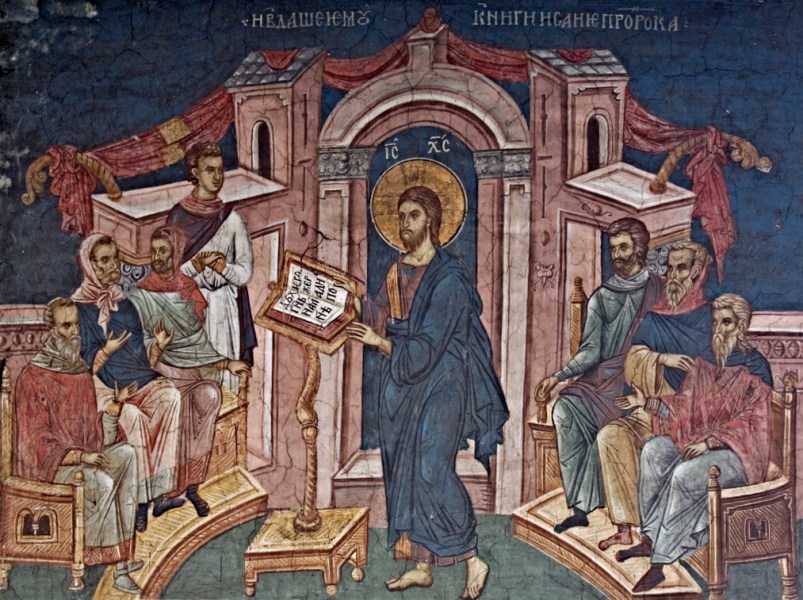
In this morning’s Gospel we Jesus ‘full of the power of the Spirit’ teaching people, showing them the way, and being glorified by them – they give to God what is due. When he comes to his home town and is given the scroll of the prophet Isaiah, he proclaims ‘good news to the poor’ ‘liberty to captives’ ‘new sight to the blind’ ‘freedom for the oppressed’ and ‘the year of the Lord’s favour’. As He will say in the Sermon on the Mount ‘Blessed are the poor in spirit, for theirs is the Kingdom of God’. The good news of the Gospel is for those who know their need of God, their spiritual poverty. Those who are slaves to sin can find true freedom in Christ; it allows us to see the world with new eyes, where everyone is our brother and sister, where we can be one in Christ.
‘Today this Scripture has been fulfilled in your hearing’ we, here, today, have heard this among us, we have come to be fed with Word and Sacrament, to be fed by Christ, with Christ, to have new life in Him, and to share that new life with others, a new life and a freedom which the world cannot give. So let us be fed to have new life in him, to live that life and share it with others, for the joy of the Lord is our strength.
As Christians we are to live lives of joy and love in Christ, and through him, rejoicing in our new life in baptism, in the saving sacrifice of the Cross, in the hope of the Empty Tomb, in our unity in the Body of Christ, so that all creation may resound with the praise of God the Father, God the Son, and God the Holy Spirit, to whom be ascribed as is most right and just, all might, majesty, glory, dominion, and power, now and forever.
A thought for the day from Fulton J. Sheen
The Baptism of the Lord
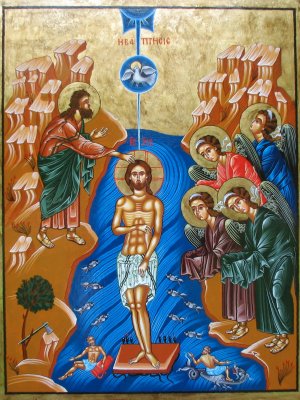
In Christ’s Baptism we see a God who walks with us, who is not a cold, remote figure; but who, for love of us, comes among us, and is one with us, and who shows us the way to his Father. Christ’s Baptism is an act of obedience to God the Father, an act of humility and of healing and restoration – the work of God in Christ, done for our sake. What began at the Annunciation, and was brought about at the Incarnation, and made manifest to the whole world at the Epiphany, is deepened: the world is invited to share in the saving love of God through baptism.
At the beginning of his public ministry, Jesus shows humanity the way to the Father, through himself. The world sees the generous love of God, which heals and restores us, from the darkness of the dungeon of sin and evil, to the light and life of the Kingdom of God. As our baptism is a sharing in the death and resurrection of Jesus, so his baptism points to the Cross, where streams of blood and water flow to cleanse and heal the world. We see the love of the Father, the power of the Spirit, and the obedience of Son, and all for us, who are so weak and foolish, and who need God’s love and healing, and forgiveness.
We need this, the whole world needs it, but is too proud to turn to a God of love, for fear of judgement, knowing that they deserve to be cut off forever, and yet it is exactly such people, such lost sheep that Our Lord comes to seek, whom he enfolds in his loving arms on the Cross, whom he washes in the waters of baptism, so that all may be a part of him, regardless of whom or what they are, and what they have done. Salvation is the free gift of God and open to all who turn to him.
In our suspicious modern world that gift is spurned and mocked, by those who feel that they can no longer trust the church, or denounce it is as hypocritical, an oppressor of one group or another. To which we can only reply with open doors, open arms, and open hearts – the church may be full of sinners and hypocrites and there’s always room for a few more! God in Christ is nothing if not generous, and so the Church, his body is called to the same generosity of spirit. With the open invitation comes a call to repentance, to a fundamental change of mind, which sees us turn away from sin to God.
Here is where I suspect it gets difficult for humanity, we know that sin is wrong, but we enjoy it, we can soothe our conscience with the fiction that something is not a sin: that it doesn’t hurt or harm us, we can even twist the Gospel to our own ends. But these will not do, because in them we say that we know better than God – the sin of pride, that primal sin which separates humanity from God. This was the problem Christ comes to fix, to heal and restore our nature, through his grace, to feed us with Word and Sacrament that we might share in the life and love of God.
We need to take to heart the words of advice written by St Paul to Titus and the Church in Crete: given that ‘the grace of God has appeared, bringing salvation for all people’ (Titus 2:11) the Church has to respond to that grace, that free gift of a loving God, by living in a certain way, the Church is there to train us to renounce, to turn our back on ‘ungodliness and worldly passions’ – using our lives and our bodies which fall short of what is expected of us. Notice the word ‘train’: it’s a process, very few people indeed can run a marathon without training; we need help and practice to turn our lives around together, as a community of faith. It takes time, and hard work and love, but it is something which we can do together – people will fail, but can be picked up, and helped to continue, that’s what healing and repentance are all about. It’s about saying ‘we can be better, we can do better together’ if we truly let the love of God into our hearts and turn away from the past and look forward to a future of hope and glory in Christ. So then, let us live out our faith and our baptism together, turning from sin to new life in Christ, and encourage others so to do, so that all creation may resound with the praise of God the Father, God the Son, and God the Holy Spirit, to whom be ascribed as is most right and just, all might, majesty, glory, dominion, and power, now and forever.
The Epiphany of the Lord: Come let us worship
What it’s all about…
|
|
The Solemnity of Mary, Mother of God
Homily for the Holy Family (Year C)
Homily for Christmas Jn 1:1-14 ‘And the Word became flesh, and dwelt among us’
Christ’s coming into the world was not like that of a sightseer to a strange city, but rather like that of an artist visiting his own studio or an author paging the books he himself has written, for in becoming incarnate, the divine Word was tabernacling himself in his own creation.
Fulton J. Sheen In the Fullness of Time
Homily for Advent IV Year C : ‘Blessed are you among women, and blessed is the fruit of your womb!
Homily for Advent III Year C: And the crowds asked him ‘What then shall we do?’
Perfect love casts out fear
Let Christ be formed in you
The Ven. Abp Fulton J. Sheen How to find Christmas Peace, taken from Advent Meditations with Fulton J. Sheen, Liuori Publications: Liguori MO, 2007
Homily for the Second Sunday of Advent (Year C)
Homily for the Immaculate Conception
Consecration to Jesus through Mary
|
O Jesu vivens in Maria
Veni et vive in famulis tuis, In spiritu sanctitatis tuae, In plenitudine virtutis tuae, In perfectione viarum tuarum, In veritate virtutum tuarum, In communione mysteriorum tuorum; Dominare omni adversae potestati, In Spiritu tuo ad gloriam Patris. |
O Jesus, living in Mary,
come and live in thy servants, in the spirit of thy holiness, in the fullness of thy might, in the truth of thy virtues, in the perfection of thy ways, in the communion of thy mysteries. Subdue every hostile power in thy spirit, for the glory of the Father.
|
Slapping Heretics
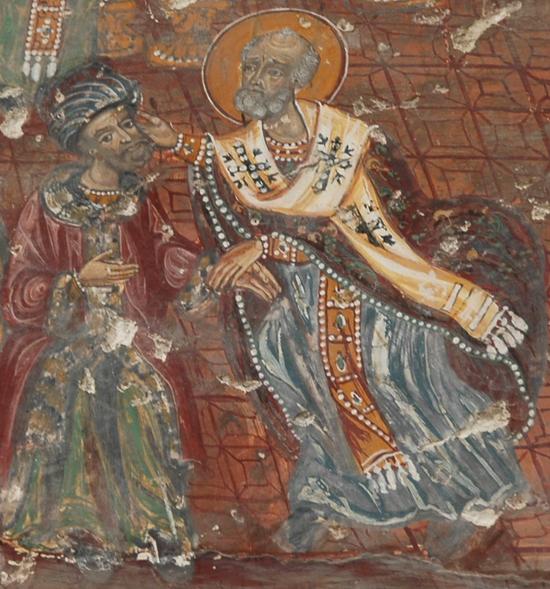
The world and the church have a picture of St Nicholas, it is a safe picture, he is a kindly man, a Bishop with a big white beard, who gives presents to children and does lots of lovely things. That’s all well and good, and there is much that can be said about the gentleness and generosity of the man, and how that points us to Christ. But recently I have found myself pondering another aspect of this great Saint. At the first ecumenical Council of Nicaea in ad325, Nicholas, Bishop of Myra slaps Arius for denying the coeternal and consubstantial nature of the second person of the Trinity, Our Lord and Saviour Jesus Christ. Nicholas got angry and his fellow bishops and the Emperor Constantine didn’t exactly approve of the pugilist prelate.
If it were to happen today I could imagine the media outcry, Twitter would be flooded with #bishopgate and #TeamArius posts. No doubt some eminent theologian would state that it’s perfectly alright to say that ‘there was a time when he was not’ and that Adoptionist or Subordinationist positions are all equally valid points of view and that one Christology is as good as another, that this was Arius’ truth and it needs to be affirmed, that we need to feel his pain and resist the patriarchal oppression of an authority figure like Nicholas and so on.
A thought for the day
from Richard Rohr, Preparing for Christmas – Daily Meditations for Advent, Cincinatti, 2008, p. 31
If only bishops and others could realize this is what they try to do to the church
Homily for the First Sunday of Advent
Christ the King: John 18: 33-37
|
|
A thought for the day
No amount of technological progress will cure the hatred that eats away the vitals of materialistic society like a spiritual cancer. The only cure is, and must always be, spiritual. There is not much use talking to men about God and love if they are not able to listen. The ears with which we hear the message of the Gospel are hidden in our hearts, and these ears do not hear anything unless they are favoured with a certain interior solitude and silence.
In other words, since faith is a matter of freedom and self-determination – the free receiving of a freely given gift of grace -we cannot assent to a spiritual message as long as our minds and hearts are enslaved by automatism We will always remain so enslaved as long as we we are submerged in a mass of other automatons, without individuality and without our rightful integrity as persons.
What is said here about solitude is not just a recipe for hermits. It has a bearing on the whole future of us and our world: and especially, of course, on the future of our religion.
More Thomas Merton
A thought for the day, and the coming week
Sermon for Trinity XXII: Mt 18:21–35
Homily for the 30th Sunday of Year B: Jer 31:7-9; Heb 5:1-6; Mk 10:46-52
Homily for the 29th Sunday of Year B: Isa 53:10-11; Heb 4:14-16; Mk 10:35-45
The Fifteenth Sunday after Trinity – Evensong: Exod 18:13–26, Mt 7:1–14 ‘which one of you, if his son asks him for bread will give him a stone?’
The Fifteenth Sunday after Trinity Gal 6:11, Mt 6:24 ‘But God forbid that I should glory, save in the cross of our Lord Jesus Christ’
Sermon for Trinity XIV Evensong
Homily for the Twenty-third Sunday of Year B
Trinity XII Evensong – Ex 4:27–5:1, Heb 13:16–21
Homily for the 19th Sunday of Year B (Jn 6:41–51) ‘Bread for the life of the world’ 12.viii.12
Trinity IX Evensong: Hebrews 11:17–31
Trinity VIII Evensong – Hebrews 8
Homily for 18th Sunday of Yr B (Jn 6:24–35)
29.vii.12 Homily for the 17th Sunday of Yr B (Jn 6:1-15)
16th Sunday of Year B – 22.vii.12 – Jer 23:1–6, Eph 2:13–18, Mk 6:30–34 ‘He took pity on them because they were like sheep without a shepherd’
Trinity VI Evensong 15.vii.12 Rom 15:1–29 May the God of hope fill you with all joy and peace in believing, so that by the power of the Holy Spirit you may abide in hope
Trinity VI 15.vii.12 Mt 5:20-26 Except your righteousness shall exceed the righteousness of the Scribes and Pharisees, ye shall in no case enter into the kingdom of heaven
|
It may not surprise you to learn that the Church is absolutely not a place in which to do politics. Politics is the art of the possible, where compromise lets you get something close to what you would originally have liked, with as many people on board as possible. Whereas what we see in this morning’s Gospel is something different, Our Lord would seem to be asking the impossible; he presents us with a totally uncompromising picture of what it means to live a Christian life, or in Matthew’s terms, to enter into the Kingdom of Heaven. There is no compromise here, and what is required looks completely beyond us – that is, I would suggest, the entire point – it isn’t about what we as human beings can do on our own, but what God can do through us.
|