Homily for Candlemas

Today the Church celebrates the Presentation of Christ in the Temple, also known as the Purification of the Blessed Virgin Mary and commonly called Candlemas. We are not quite so used to ideas of ritual purity inherent in the Thanksgiving for a woman after Childbirth, which used to be described as the Churching of Women. The Holy Family go to the Temple to give thanks to God and to comply with the Law: they demonstrate obedience, they listen to what God says and do it – as such they are a model for all Christian families to follow.
            When they go to the Temple the Holy Family encounter Simeon, a man of faith and holiness, devoted to God, and looking for the consolation of Israel, he knows that he will not die until he sees the Messiah, the Lord’s Anointed, and the Saviour of the World. As he takes the child Jesus in his arms he prays ‘Lord, now lettest thou thy servant depart in peace : according to thy word. For mine eyes have seen : thy salvation, Which thou hast prepared : before the face of all people; To be a light to lighten the Gentiles : and to be the glory of thy people Israel.’ The promise made to him by, revealed through His Holy Spirit has been fulfilled in the six-week-old infant in his arms. As Christ was made manifest to the Gentiles at Epiphany, so now His saving message is proclaimed, so that the world may know that its salvation has come in the person of Jesus Christ. Simeon speaks to Our Lord’s Mother of her Son’s future, and the pain she will endure. Before he dies Simeon is looking to the Cross, the means by which our salvation is wrought, the Cross at which Mary will stand to see humanity freed from its sin through the love and mercy of God, through grace, the free gift of God in Christ. So as Candlemas concludes our Celebration of Christmas, of the mystery of the Incarnation, so to it points to that which gives it its true meaning: the Death and Resurrection of Jesus Christ.
            That is why we are here this morning, to be fed by Christ, to be fed with Christ, truly present in His Body and Blood, Soul and Divinity – God whom we can touch and taste. A God who shares His Divine Life with us, so that we can be transformed by Him, built up as living stones as a temple to His Glory, given a foretaste of Heaven here on Earth. This is our soul’s true food, the bread for the journey of faith, a re-presentation of the sacrifice which sets us free to live for Him, to live with Him, through Him and in Him.
            The significance of what is happening is not just recognised by Simeon, but also by Anna, a holy woman, a woman of prayer, a woman who is close to God – she to recognises what God is doing in Christ, and she proclaims it, so that God’s redemption of His people may be known. Let us be like her, and let all of our lives, everything which we say, or think, or do, proclaim the saving truth of God’s love to the world. Let us burn, like the candles which God has blessed to give light and warmth to the world, so that it may believe and give glory to God the Father, God the Son, and God the Holy Spirit, to whom be ascribed as is most right and just all might, majesty, glory, dominion, and power, now and forever.
Homily for the Epiphany


What Christ did in his own human nature in Galilee, he is doing today … in every city and hamlet of the world where souls are vivified by his Spirit. He is still being born in other Bethlehems of the world, still coming into his own and his own receiving him not, still instructing the learned doctors of the law and answering their questions, still labouring at a carpenter’s bench, still ‘[going] about doing good’ (see Acts 10:34–43), still preaching, governing, sanctifying, climbing other Calvaries, and entering into the glory of his Father.
Fulton J. Sheen In the Fullness of Time
The Manifestation of Our Lord to the Gentiles, which the church celebrates today, is a deepening of the splendour of the Incarnation – the mystery is made manifest. With the arrival of the Wise Men from the East, the entire World is told that God is with us. Gentiles are made co-heirs, ‘members of the same body, and partakers of the promise in Christ Jesus through the gospel’. The Good news is for everybody.
          The promise is made through the words of the prophet Isaiah in this morning’s first reading. The light which is shown by the star which the Wise Men follow is the Light of the World: the true light, which gives light to all. Kings and the nations come to its brightness, they come to worship God made man; they come to pay their homage to the Saviour born among them. They come with camels, bringing gold and frankincense to worship their king and their God. They come to a stable in Bethlehem, to kneel before a manger where animals feed, and not to a royal palace, not to a throne. This is what true kingship is, true love, true glory: that of God and not of humanity.
          Herod is afraid, he fears for his own position; he worries about power, and commits infanticide to make sure of it. This very human response should stand as a warning to those who wish to follow the ways of the world. Herod clings to power; God becomes a vulnerable baby, totally dependent on others. Herod can only bring death; whereas Christ comes to bring life and life in all its fullness. Herod says he wants to worship, but it is the Wise Men who kneel before God incarnate and worship Him. They offer gold to honour a king, frankincense to worship God, and myrrh which speaks of His death. At the moment when Christ is made manifest to the world we are to look to the Cross, where the love of God will be shown must fully, and to the tomb in which his body will be laid, which will be empty.
          Likewise as we celebrate the Epiphany we also look forward to Our Lord’s Baptism in the River Jordan and his first miracle at the Wedding at Cana. He who is without sin shows humanity how to be freed from sin and to have new life in Him. In turning water into wine we see that the kingdom of God is a place of generous love, a place of joy, and of life in all its fullness.
It is a sign of the banquet where Christ feeds the faithful with the Sacrament of His Body and Blood, where God, who came to share our human nature, gives himself to us so that we might share His Divine nature, a treasure far greater and more valuable than gold, or frankincense, or myrrh – a treasure which can transform our souls and our lives, which can transform the entire world.
          So let us be filled with joy and love, may we live lives of joy, and love, and service of God and one another, which proclaim in word and deed the love of God to the world, that it may believe: so that all creation may resound with the praise of God the Father, God the Son, and God the Holy Spirit, to whom be ascribed as is most right and just, all might, majesty, glory, dominion, and power, now and forever.

Christmas Midnight Mass 2013

We consider Christmas as the encounter, the great encounter, the historical encounter, the decisive encounter, between God and mankind. He who has faith knows this truly; let him rejoice.

Pope Paul VI, speech, Dec. 23, 1965
The people of Israel longed for salvation: they hoped that God would deliver them as he had from Egypt and Babylon – he had done so in the past, he would do so in the future, but in a way which they could neither expect nor fully understand. The prophesy of Isaiah speaks of light shining in darkness – a time of hope, of new beginnings, of comfort amidst tribulation. It is a light which will shine with the coming of Jesus Christ, the Light of the World, a light which the darkness cannot overcome. His coming brings joy and peace, the promise is fulfilled. The promise is fulfilled and yet humanity clings to greed, and lust and selfishness.
The world can seem deaf to the message which was proclaimed over two thousand years ago – there was no room in the inn, no comfort or luxury; but in a stable, surrounded by animals, by shepherds, poor, hungry, shunned by ‘polite’ society, God comes to earth, he meets humanity not in a blaze of glory and triumph, but as a vulnerable baby, who needs a mother to feed him, who needs other to provide him with warmth and security. The Word of God, through which everything was created, lies silent and helpless. Here we see real love – open, vulnerable, all gift, holding back nothing, but risking all to come among us, to heal our wounds, to save us, to show us how to live.
All the tinsel, and excess, all the consumerism, and even the ignorance and unbelief of the modern world cannot cover up the sheer wonder of this night. God does not give us explanations; we do not comprehend the world, and we are not going to. It is and it remains for us a confused mystery of bright and dark. God does not give us explanations; he gives up a Son. Such is the spirit of the angel’s message to the shepherds: “Peace upon earth, good will to men … and this shall be the sign unto you: ye shall find a babe wrapped in swaddling clothes, and lying in a manger.” A Son is better than an explanation. The explanation of our death leaves us no less dead than we were; but a Son gives us a life, in which to live.’ [Austin Farrer Said or Sung pp. 27, 28]
The Son gives us a life in which to live, and gives us himself to us in bread and wine so that we might share his divine life, so as the shepherds hurried to meet him, let us too long for that divine encounter, let us long to be fed by him, fed with him, so that we can share his life, life in all its fullness. It is not something for us in purely spiritual terms, but rather to form our lives: who we are and what we say and do.
When the Holy Family came to Bethlehem there was no room for them. As we celebrate the birth of Our Saviour we have to ask ourselves: Have we made room for Himin our lives? Have we really? If we haven’t, then no fine words can make up for it. We have to let our hearts and our lives be the stable in which the Christ child can be born. We have to see him in the outcast, in the stranger, in the people which the world shuns, and we have to welcome them, and in welcoming them to welcome Him. This is how we live out His love in our lives. This is the meaning of Christmas – this is the love which can transform the world, it is radical and costly. It terrified the might of the Roman Empire, and showed human power that it was as nothing compared to Divine Love. Soul by individual soul, for the past two thousand years, the world has been changed by living out the love shown to the world in this little vulnerable child. So let us receive the greatest gift which has ever been given and share it with others, living it out in our lives, regardless of the cost, so that the world may believe and sing the praise of God the Father, God the Son, and God the Holy Spirit, to whom be ascribed as is most right and just all might, majesty, glory, dominion, and power, now and forever.

Advent IV (Year A) Still Waiting


We always make the fatal mistake of thinking that it is what we do that matters, when really what matters is what we let God do to us. God sent the angel to Mary, not to ask her to do something, but to let something be done. Since God is a better artisan than you, the more you abandon yourself to him, the happier he can make you.
 Fulton Sheen Seven Words of Jesus and Mary
The world around us can get things so wrong: with all the build-up around us we might easily think that it was already Christmas Day, that the true message of Christmas was one of conspicuous consumption, and spending money. Every year it seems that the decorations go up a bit earlier, and yet here we are in church, still waiting. I don’t know about you, but I for one am not overly keen on waiting, and yet it is what the church is called to be, to live out in the world. We are to be a people who watch and wait, in joyful hope and expectation – we are to be like Mary and Joseph – people who are waiting for God. In the prophesy of Isaiah we see the hope of salvation dawning in God-with-us, Emmanuel. God’s promise is fulfilled through the patience of Mary & Joseph, and their obedience to God’s will: ‘he did what the Angel of the Lord told him to do’. It is an obedience to the Father’s will borne out through suffering, death & resurrection which characterises the mission of the Son, this is what brings about our salvation. We in obedience look for his second coming as our Saviour and our Judge, and as the Church we have an opportunity to ponder these mysteries – to stop for a while amid the business of our modern existence and reflect upon the wondrous nature of God’s love for us and all humanity: we can stop for a moment and consider both what it means and how it affects our lives.
          As the Church, the people of God, which we enter through our baptism, we are called to proclaim the Good News, to live out the story of Jesus in our lives, and we call the world to stop and to consider exactly what we are celebrating at Christmas: a free gift, of hope and salvation for all people, in a baby, born in a stable, among the poor and the marginalised.
          The world around us is quick to judge, it wants to do the right thing – it is a bit like Joseph trying to save Mary the embarrassment and the shame. Thankfully God has other ideas, because he who will be born will save his people from their sins – what wonderful news this is. Those sins which separate us from each other and from God, this falling short of what we know we could or should be – this is what Jesus saves us from. We are to take this opportunity to stop and to ponder this wondrous fact, to reflect upon what ‘God-with-us’ means to us and our lives.
          The act of love which we will experience in Our Lord’s Nativity should draw us to love God and our neighbour, to live out the love which becomes flesh in the womb of the Virgin Mary, which will become flesh and blood that we can touch and taste, here, this morning, to feed us, so that we might share His divine life. So let us imitate the mystery we celebrate, let us be filled with and transformed by the divine life of love, let us like Mary and Joseph wait on the Lord, and be transformed by him, to live out our faith in our lives so that the world might believe and sing the praise of God the Father, God the Son, and God the Holy Spirit, to whom be ascribed as is most right and just all might, majesty, glory, dominion, and power, now and forever.

Something to ponder in Advent

“If you have never before prayed [with] Mary, do so now. Can you not see that if Christ himself willed to be physically formed in her for nine months and then spiritually formed by her for thirty years, it is to her that we must go to learn how to have Christ formed in us?”

Fulton Sheen, Seven Words of Jesus and Mary,Garden City NY 1953

Slapping Heretics

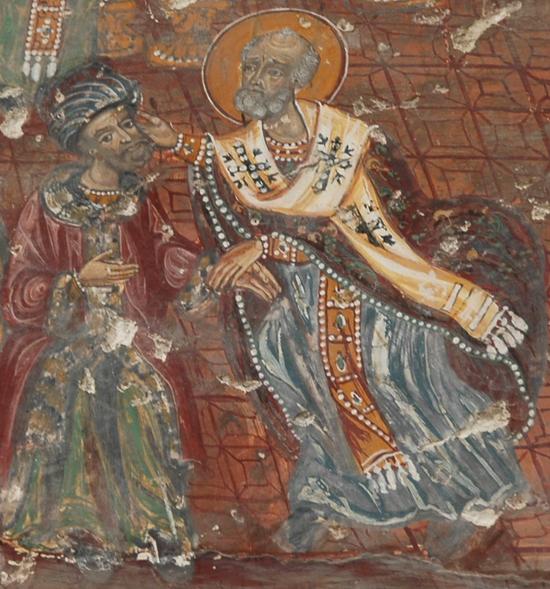
The world and the church have a picture of St Nicholas, it is a safe picture, he is a kindly man, a Bishop with a big white beard, who gives presents to children and does lots of lovely things. That’s all well and good, and there is much that can be said about the gentleness and generosity of the man, and how that points us to Christ. But recently I have found myself pondering another aspect of this great Saint. At the first ecumenical Council of Nicaea in ad325, Nicholas, Bishop of Myra slaps Arius for denying the coeternal and consubstantial nature of the second person of the Trinity, Our Lord and Saviour Jesus Christ. Nicholas got angry and his fellow bishops and the Emperor Constantine didn’t exactly approve of the pugilist prelate. 

If it were to happen today I could imagine the media outcry, Twitter would be flooded with #bishopgate and #TeamArius posts. No doubt some eminent theologian would state that it’s perfectly alright to say that ‘there was a time when he was not’ and that Adoptionist or Subordinationist positions are all equally valid points of view and that one Christology is as good as another, that this was Arius’ truth and it needs to be affirmed, that we need to feel his pain and resist the patriarchal oppression of an authority figure like Nicholas and so on.

Nicholas slaps Arius because orthodoxy really matters, what we believe about God and the Church really matters. The Word of God, who was with his Father in eternity, before all time, and matter, and space, becomes incarnate in the womb of the virgin, for the salvation and redemption of all humanity: true God and true man, consubstantial and coeternal. It may be easier to deny this, it may make more sense, or be consistent with a philosophical position, but it will not do. As St Ambrose put it: non in dialectica complacuit Deo salvum facere populum suum (it was not the will of God to save his people through dialectic) [De Fide 1:5, §42]. The Incarnation is a scandal and a mystery which defies human understanding and intellect, reason and philosophy it is something to be experienced, to be tasted and felt. 
This is what we await in Advent, the coming of Our Lord as a baby in Bethlehem and his second coming as Our Judge, bearing in his glorious body the wounds of love, borne for us and our salvation. So let us live lives which proclaim his saving love and truth to a world hungry for meaning and love and thereby honour God the Father, God the Son, and God the Holy Spirit, the consubstantial and coeternal Trinity, to whom be ascribed as is most right and just all might, majesty, glory, dominion and power, now and forever.