A thought for the day from Jean-Pierre de Caussade
Walking on Water
At the end, once the wind has died down the disciples worship Him, saying, ‘Truly you are the Son of God.’ The end of it all is worship, it is what we as humans and as Christians are for, to worship God, in our love and our prayer, so that all of our lives are an act of worship, drawing us ever closer to the source of life and love. So that all we say or think or do may give glory to God the Father, God the Son, and God the Holy Spirit, to who whom be ascribed as is most right and just, all might, majesty, glory, dominion and power, now and forever.
The Multiplication of the Loaves
Picture the scene: Jesus has just been told that his cousin, John the Baptist, has been put in prison and killed, he himself has just been to Nazareth, where he was rejected, by the very people who should have accepted him. The atmosphere is tense, is he safe, will he too be arrested and killed? It is not for nothing that this morning’s Gospel passage begins with Jesus withdrawing to the desert – to be alone, to pray, to be close to God.
|
καὶ καθὼς Μωϋσῆς ὕψωσεν τὸν ὄφιν ἐν τῇ ἐρήμῳ, οὕτως ὑψωθῆναι δεῖ τὸν υἱὸν τοῦ ἀνθρώπου, ἵνα πᾶς ὁ πιστεύων ἐν αὐτῷ ἔχῃ ζωὴν αἰώνιον.
Οὕτως γὰρ ἠγάπησεν ὁ θεὸς τὸν κόσμον ὥστε τὸν υἱὸν τὸν μονογενῆ ἔδωκεν, ἵνα πᾶς ὁ πιστεύων εἰς αὐτὸν μὴ ἀπόληται ἀλλὰ ἔχῃ ζωὴν αἰώνιον. οὐ γὰρ ἀπέστειλεν ὁ θεὸς τὸν υἱὸν εἰς τὸν κόσμον ἵνα κρίνῃ τὸν κόσμον, ἀλλ’ ἵνα σωθῇ ὁ κόσμος δι’ αὐτοῦ.
|
And as Moses lifted up the serpent in the wilderness, so must the Son of Man be lifted up, that whoever believes in him may have eternal life.
For God so loved the world, that he gave his only Son, that whoever believes in him should not perish but have eternal life. For God did not send his Son into the world to condemn the world, but in order that the world might be saved through him.
Jn 3:14-17
|
A thought for the day from St Isaac of Nineveh
If, as is said, peace of mind is perfect health, and zeal is opposed to peace, then a person stirred by zeal is ill with a grievous sickness.
While you presume to stir up your zeal against the sickness of others, you will have banished health from your own soul. You should concern yourself with your own healing. But if you wish to heal those who are sick, know that the sick have greater need of loving care than rebukes.
Zeal is not reckoned among mankind as a form of wisdom; rather it is one of the sicknesses of the soul, arising from narrow-mindedness and deep ignorance.
The beginning of divine wisdom is the serenity acquired from generosity of soul and forbearance with human infirmities.
For he says ‘You who are strong should bear the infirmities of the weak’ (Rom 15:1), and ‘Put right transgressor with a humble spirit’ (Gal 6:1). The Apostle numbers peace and long-suffering among the fruits of the Holy Spirit.
Trinity III ‘Cast your burden on the Lord’
Dying to Live: Trinity I
Dom Gregory Dix on the Eucharist
Trinity Sunday
“One in essence, distinction of persons, such is the mystery of the Trinity, such is the inner life of God. The three angles of a triangle do not make three triangles but one; as the heat, power, and light of the sun do not make three suns but one; as water, air, and steam are all manifestations of the one substance; as the form, color, and perfume of the rose do not make three roses, but one; as our soul, our intellect, and our will do not make three substances, but one; as one times one times one times one does not equal three, but one, so too in some much more mysterious way, there are three Persons in God and yet only one God.”Archbishop Fulton Sheen (The Divine Romance)
Anglican Clergy can be strange. Amongst their peculiarities possibly the most galling has to be the habit of finding someone other than themselves: a curate, a visiting preacher, a lay reader, to preach this Sunday. On the First Sunday after Pentecost, since at least 1334 when it was granted an official place in the Calendar of the Western Church, and in some form since the Arian Controversy of the 4th Century, the Church has celebrated the mystery of God’s very self: a Trinity of Persons, consubstantial, co-equal and co-eternal.
I suspect that the problem lies with fact that the clergy themselves are frightened of the thought of preaching about a theological concept which they do not really understand, and which they fear their congregations will not either. I cannot claim to understand the mystery of the Holy and Undivided Trinity, but I’m certainly not going to patronise you by assuming that you cannot or do not wish to understand it. At the start of this morning’s Eucharist our worship began by invoking the Name of the Trinity and making the sign of the Cross, just as Christians have done for two thousand years. As Christians we are baptised in the name of the Father, Son, & Holy Spirit. We will soon say the Nicene Creed to profess our faith in the Triune God – it’s what makes us Christians and we express that faith in our worship of Almighty God. In the Offices of the Church, Psalms conclude with the Doxology: Glory be to the Father and to the Son and to the Holy Spirit. This is because we SAY what our worship DOES – we give Glory to God, who created us, who redeemed us, and who sanctifies and strengthens us. Thus we celebrate not a theological concept or philosophical proposition, but rather a relationship. When we say ‘Glory be to the Father and to the Son and to the Holy Ghost’ we are expressing what we as orthodox Christians believe. You cannot truly worship God and deny the divinity of Jesus Christ, or the procession of the Holy Spirit, for what we say and believe affects our lives and our relationship with God.
At the end of his Second Letter to the Corinthians, St Paul says to them ‘The Grace of the Lord Jesus Christ and the love of God and the fellowship of the Holy Spirit, be with you all’. They are words which we continue to use, to this day because they encapsulate our faith. We celebrate the fact that God the Father loves us, and spared not His Only Son for love of us, that His Son saves us by grace, through faith, so that we are built up in love, by the Spirit.
Our relationship with the Divine is intimate: the name Father speaks of a relationship, His Son taught us to pray to Him as Our Father, and dies for us, to heal us, restore us and save us from our sins, and sends His Spirit to strengthen us. This is the faith of our baptism, by which we enter the Church, in which we are nourished by Word and Sacrament, and which gives us the Hope of eternal life in the embrace of a loving God.
The words we use to worship God matter in that they express the faith which we believe, they form us into a community of belief where what we believe affects who we are and what we do. The gift of faith, and the life of love, and the hope of eternal life are something which we do not jealously guard but rather share with the world – we are called to make disciples, to share what we have received, so that others may experience the love of God.
And like all relationships, this goes beyond words, it is something which needs to be experienced, and which we can share. It is only in our experience of this relationship that we can begin to come to understand, and we will only do so fully when we experience this in heaven, in our contemplation of the beatific vision, when we see and experience the fullness of God’s love. So then let us prepare for this by sharing in God’s self giving love at this Eucharist – where God gives himself for us, to feed us, to strengthen us, to bind us together in love for one another and him, our bread for the journey which finds its end in the contemplation of God’s love in all its fullness, and which calls us to share with the world so that it may believe and give glory to God the Father, God the Son, and God the Holy Spirit, to whom be ascribed as is most right and just all might, majesty, glory, dominion, and power, now and forever.
Homily for the Seventh Sunday of Easter
Easter V
Easter II Year A
A thought for the day
On the night he was betrayed our Lord Jesus Christ took bread, and when he had given thanks, he broke it and gave it to his disciples and said: “Take, eat: this is my body.” He took the cup, gave thanks and said: “Take, drink: this is my blood.” Since Christ himself has declared the bread to be his body, who can have any further doubt? Since he himself has said quite categorically, This is my blood, who would dare to question it and say that it is not his blood?
Therefore, it is with complete assurance that we receive the bread and wine as the body and blood of Christ. His body is given to us under the symbol of bread, and his blood is given to us under the symbol of wine, in order to make us by receiving them one body and blood with him. Having his body and blood in our members, we become bearers of Christ and sharers, as Saint Peter says, in the divine nature.
Once, when speaking to the Jews, Christ said: Unless you eat my flesh and drink my blood you shall have no life in you. This horrified them and they left him. Not understanding his words in a spiritual way, they thought the Saviour wished them to practise cannibalism.
Under the old covenant there was showbread, but it came to an end with the old dispensation to which it belonged. Under the new covenant there is bread from heaven and the cup of salvation. These sanctify both soul and body, the bread being adapted to the sanctification of the body, the Word, to the sanctification of the soul.
Do not, then, regard the eucharistic elements as ordinary bread and wine: they are in fact the body and blood of the Lord, as he himself has declared. Whatever your senses may tell you, be strong in faith.
You have been taught and you are firmly convinced that what looks and tastes like bread and wine is not bread and wine but the body and the blood of Christ. You know also how David referred to this long ago when he sang: Bread gives strength to man’s heart and makes his face shine with the oil of gladness. Strengthen your heart, then, by receiving this bread as spiritual bread, and bring joy to the face of your soul.
May purity of conscience remove the veil from the face of your soul so that by contemplating the glory of the Lord, as in a mirror, you may be transformed from glory to glory in Christ Jesus our Lord. To him be glory for ever and ever. Amen.
Good Friday
The Mass of the Lord’s Supper
Palm Sunday Evensong
Gratitude is characteristic only of the humble. The egotistic are so impressed by their own importance that they take everything given them as if it were their due. They have no room in their hearts for recollection of the undeserved favours they have received.
Fulton Sheen On Being Human 1982: 325
In this evening’s second lesson we are given the parable of Lazarus and Dives. Jesus has been in the company of Pharisees, members of a religious elite, figures of authority, who have been described as ‘lovers of money’. It’s always slightly uncomfortable when clergy are faced with Our Lord’s views on religious authorities. His audience are selfish, avaricious, self-satisfied, and arrogant: we need to be careful that the Church never becomes like this.
The parable the has at its heart the important message that charity and generosity are at the heart of our faith. We see this charity and generosity above all in Our Lord’s life, his preaching, his healing, his miracles, his passion, and death. They act as a paradigm, an example for us to follow. We need to live our lives so that they look like his.
The rich man is singularly unable to do this. Even when he is in Hades he wants Lazarus to come and cool his tongue, and to go and warn his brothers: even now he’s still treating Lazarus like a servant – giving him orders, making him work for him, even in death he is still arrogant, and self-absorbed, he needs to learn humility, to know his need of God.
Quite rightly Jesus can say that the Rich Man’s brothers have the Law & the Prophets: as we know from our 1928 Prayerbooks that we hace Jesus’ own summary:
You shall love the Lord your God with all your heart and all your mind, and all your soul, and with all your strength, and your neighbour as yourself – on these two commandments hang all the Law and the Prophets.
It’s all about faith & action: putting it into practice in our lives, it’s exactly what Jesus is doing in Holy Week, in his passion and death, showing us how much God loves us and the lengths to which he will go to heal and restore humanity – for love of us, each of us, you and me.
How do we respond to this other than living it out in our lives: living out the same costly self-giving sacrificial love in our lives, so that we can be like Jesus, fed by him in Word and Sacrament, becoming ever more like Him. The world around us may not believe, it’s too selfish, too self-absorbed, to be like Jesus. The cost is too great, and yet it is what our faith is all about. Following Jesus means being like Him, doing what he did, and how he did it, so that we may be more and more conformed to him, living out our faith and drawing others to him so that the world may believe and give glory to God the Father, God the Son, and God the Holy Spirit …
Palm Sunday 2014
Lent V Year A
A thought for the day from Mother Mary Clare SLG
Lent IV Year A
A thought for the day from Sr Mary Clare
Lent I Year A
Homily for Quinquagesima
A thought for the day from Mother Mary Clare SLG
You are dedicated to love and reconciliation. Your life is directed to that end, and you must learn to stand at the Cross. It is a long learning, a long road, but a sure road if it is up the hill to Calvary.
It is a road on which you, by being stripped of all self, may mediate to the world the dawning knowledge of the glory that descends.
Sexagesima Evensong
Paul had to begin with the Cross and then retrace his steps backward to Calvary. To him and to his people, the prophetic connection between suffering and glory were repugnant. The Jew and the Greek both had a horror of death; to the Greek there was a physical aversion; to the Jew it was a moral shame. And yet the glorified Christ began Paul’s conversion with the Cross—at that very point where all national characteristics were assailed. He had to see Christ repersecuted, recrucified, renailed. And when he asked who it was who questioned, there flashed the vision, ‘I am Jesus, Whom you are persecuting’ (Acts 26:16)Fulton Sheen Those Mysterious Priests 1974: 10
Homily for Sexagesima
Homily for the Sixth Sunday of Year A (Septuagesima)
Homily for the Fifth Sunday of Year A
Homily for Candlemas
Homily for Epiphany III Matthew 4:12-23
Christmas Midnight Mass 2013
We consider Christmas as the encounter, the great encounter, the historical encounter, the decisive encounter, between God and mankind. He who has faith knows this truly; let him rejoice.
Pope Paul VI, speech, Dec. 23, 1965
Something to ponder in Advent
Homily for the Solemnity of Our Lord Jesus Christ, Universal King (Yr C)
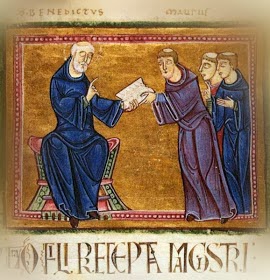
Homily for All Saints of the Order of St Benedict
And so I would like to begin by spending a few moments considering the portion of the Rule which is appointed to be read today, from the second half of Chapter 35 – it concerns those appointed to serve at table for the week. It is quite mundane and practical: they are to eat early, before they serve the brethren so that they do not grumble and it isn’t too hard for them. Before they begin or finish their week of service they are to give thanks to God. It is this reliance upon God which undergirds all that they do from start to finish which provides us with an important spiritual lesson: in knowing upon whom we can rely we can be truly thankful, we can be built up in love, with generous, thankful hearts.
That is why in the Prologue to the Rule our Holy Father St Benedict expresses his aim as follows: Constituenda est ergo nobis Dominici schola servitii – we have, therefore to establish a school of the Lord’s service. It is a school: somewhere where things can be both taught and practised, it is a place to learn to serve God and others. To love and to serve God and our neighbour is we are all called to by virtue of our baptism; it is how we live out our faith in our lives. This then is the path to heaven, for saints are sinners who, through God’s love and grace, keep trying, who stay close to Him.
So, as we keep trying, we can do so in the knowledge that nothing can separate us from the love of God in Christ Jesus our Lord (Rom 8:39). That’s what the Incarnation, the Cross, and the Resurrection achieve: a relationship of such depth, such love, which has such power to heal and transform our human nature. For all things are possible with God (Mk 10:27) this is why the first word of the Prologue is Ausculta ‘Listen’ we listen so that we might learn; in listening we focus our attention on what really matters so that we can sit lightly to the things of this world, all the superficial stuff that the world tells us is important or valuable, so that we might discard it and concentrate on what really matters. Our listening informs what we are, what we do, and what we shall be.
So as we sing the praises of those who have followed in the footsteps of St Benedict, let us imitate them, in the Lord’s service, strengthened by Word and Sacrament – fed by God, fed with God, so that our nature may be transformed, so that through prayer and service we may honour the God who created us, who redeemed us, and who sustains us, so that we may live out our faith so that the world may believe and give glory to God the Father, God the Son, and God the Holy Spirit, to whom be ascribed as is most right and just, all might, majesty, glory, dominion, and power, now and forever.
Homily for the 31st Sunday of Year C
Trinity XXI Evensong
St Isaac of Nineveh on the Mercy of God
A thought for the Day
It is easy to find Truth; it is harder to face it, and harder still to follow it.
Fulton Sheen Lift up your Heart, 1942:106
Homily for the 25th Sunday of Year C
True generosity never looks to reciprocity; it gives neither because it expects a gift in return, nor because there is a duty or an obligation to give. Charity lies beyond obligation; its essence is the ‘adorable extra.’ Its reward is in the joy of giving.
Fulton Sheen Way to Inner Peace, 1955: 108
The Nativity of the Blessed Virgin Mary
Such a wonderful free gift should have a serious effect upon our lives, who and what we are, and how we live our lives here and now. If we are willing to accept the free gift of God, we have to accept that it has consequences for who and what we are, and yet we know that the service of God is perfect freedom: we are not faced with tyranny or oppression but love and mercy. Do let us live, following the example of the Blessed Virgin Mary and aided by her prayers, so that we may transform our lives and the whole world, so that it too may believe and give glory to God the Father, God the Son, and God the Holy Spirit, to whom be ascribed as is most right and just, all might, majesty, glory, dominion, and power, now and forever.
Homily for the 21st Sunday of Year C
Homily for the 20th Sunday of Year C
A thought for the day
Trinity XI Evensong
To be worthy of the name Christian, then, means that we, too, must thirst for the spread of the Divine Love; and if we do not thirst, then we shall never be invited to sit down at the banquet of Life.
You are dedicated to love and reconciliation. Your life is directed to that end, and you must learn to stand at the Cross. It is a long learning, a long road, but a sure road if it is up the hill to Calvary. It is a road on which you by being stripped of all self, may mediate to the world the dawning knowledge of the glory that descends.The essence of the good news of the Gospel is that we are new creatures. In the Transfiguration we see the meaning of the new creation in the light of the Holy Spirit, the perfection of man which cannot be held by death but goes through death to the victory of union with God. God draws us not merely into the dark cloud, but into the tremendous stillness of the height of Calvary and through Calvary to the dawn of the new day.
Sermon for Evensong (Trinity X)
Homily for the Eighteenth Sunday of Year C: A Sermon about Stuff
Homily for 17th Sunday of Year C: Luke 11:1-13
A thought for the day from Mother Mary Clare
A Thought for the Day from S. Theresa of Avila
No. Our Lord expects works from us!
If you see someone sick whom you can relieve, never fear losing your devotion; have compassion on them; if they are in pain, feel it as if it were your own, and, when there is need, fast so that they may eat, not so much for their sake as because you know your Lord asks it of you.
This is the true union of our will with the will of God.
If someone else is well spoken of, be more pleased than it were yourself; this is easy enough, for if you were really humble it would vex you to be praised.
If you possess fraternal charity, I assure you that you will attain the union I have described.