‘Truly, I say to you, as you did it to one of the least of these my brothers, you did it to me.’
‘Yn wir, ‘rwy’n dweud wrthych, yn gymaint ag ichwi ei wneud i un o’r lleiaf o’r rhain, fy mrodyr, i mi y gwnaethoch.’ (Mt 25:40)
THE United Kingdom occupies a special place in world history: we are the only country which continues the ancient practice of anointing a monarch to serve as our head of state. Many of us watched the live television coverage of King Charles and Queen Camilla’s coronation, and were struck by the number of prayers said throughout the ceremony asking for God’s blessing upon the new King. Another large part of the service in Westminster Abbey involved the presentation of various symbols of Kingship, and in particular a crown, an orb, and a sceptre. Before the King was crowned, he was given an orb, representing his powers and responsibilities, and also a sceptre, which signifies good governance. Like the Crown, the Orb and the Sceptre have a Cross on the top of them. The reason that these three objects are surmounted by a cross is to signify that all power comes ultimately from God, who reigns over all. This symbolism is important. When we acknowledge Christ as King we are saying that He is above all human power and authority, and we affirm that God is supreme. We, as Christians, declare that our primary allegiance is to God alone, and not to the things of this world.
In our first reading this morning, from the prophet Ezekiel, we see God speaking as a shepherd caring for His flock. This image lies behind Jesus’ description of Himself as the Good Shepherd in John’s Gospel (Jn 10:11-18). Jesus uses imagery from the Hebrew Scriptures to show that they are fulfilled in Him; that God’s promises are coming true. Jesus the Good Shepherd is a hopeful and encouraging image, one which we need today as much as ever. God is not absent or disinterested in us or how we live our lives, quite the opposite, as these words from the prophecy of Ezekiel show:
I myself will be the shepherd of my sheep, and I myself will make them lie down, declares the Lord God. I will seek the lost, and I will bring back the strayed, and I will bind up the injured, and I will strengthen the weak (Ezekiel 34:15-16)
This vision of care, healing, and reconciliation, is exactly what Jesus promises and demonstrates in the Gospels. This should not surprise us, as there is a continuity between the Old and New Testaments. What is promised in the Old is fulfilled in the New. The Word of God finds its fullest expression in the Word made Flesh, Jesus Christ. Our Lord takes the image for His teaching from the words of Ezekiel’s Prophecy:
“As for you, my flock, thus says the Lord God: Behold, I judge between sheep and sheep, between rams and male goats.” (Ezekiel 34:15-16)
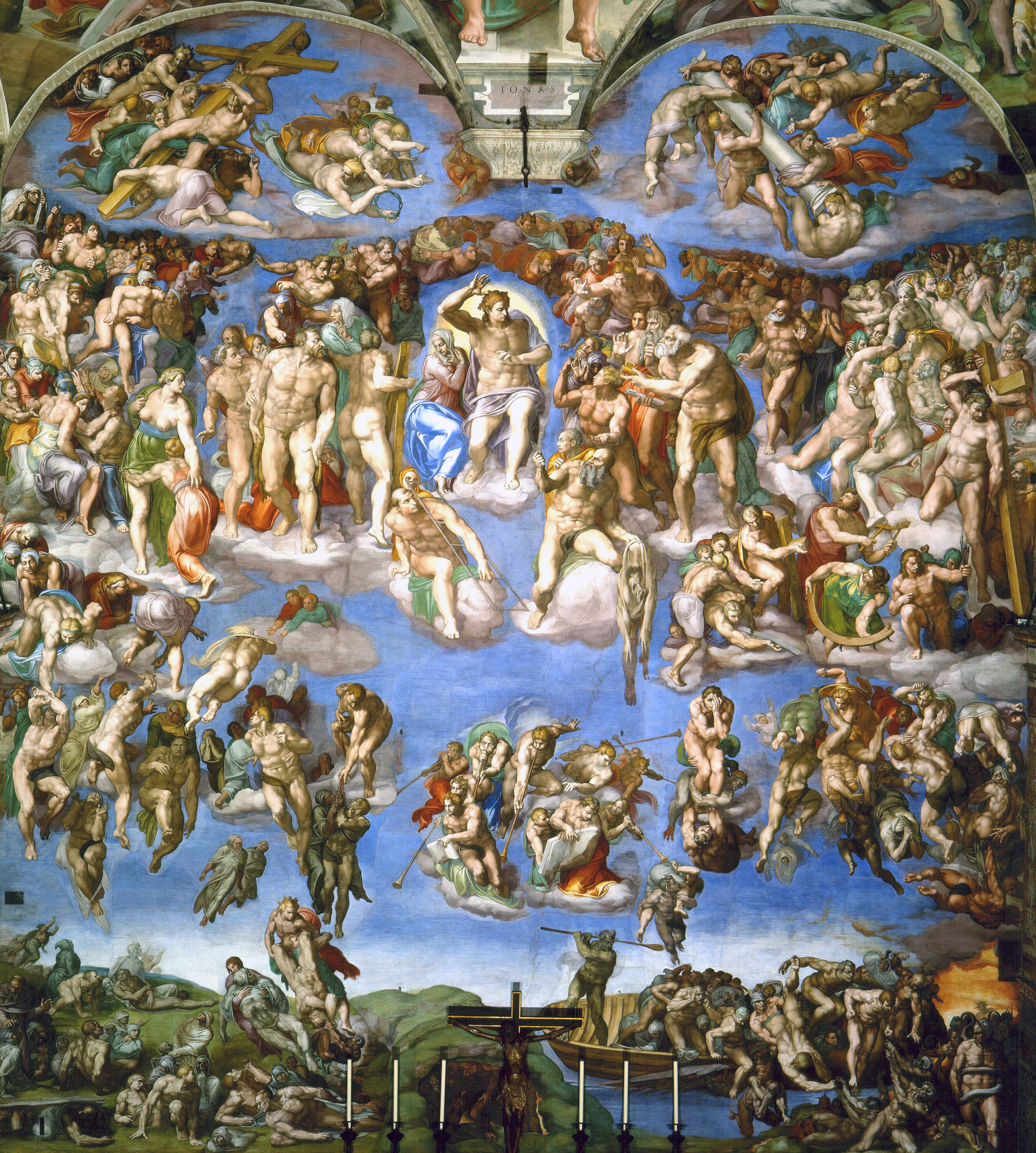
So this morning we come to the last of Jesus’ teachings concerning the end times: the Sheep and the Goats. This is not a parable, Our Lord does not say, ‘The Kingdom of Heaven is like…’ Instead, in the last section of teaching in Matthew’s Gospel, Jesus is looking towards the future, and to the end times. We have had teaching on the wise and foolish virgins, and also about the talents, to encourage people both to be ready, and to prepare for Christ’s Second Coming as Lord and Judge of all. This is what is envisaged when Jesus says:
“When the Son of Man comes in his glory, and all the angels with him, then he will sit on his glorious throne. Before him will be gathered all the nations, and he will separate people one from another as a shepherd separates the sheep from the goats.” (Mt 25:31-32)
The first time that Christ comes in His glory is when He is crucified. This is the glory of God. Our Lord reigns from the tree, and our crucified Saviour will return as the judge of all. As those involved in keeping animals will know, sheep and goats need to be separated. Sheep are hardier than goats, so they can sleep outside, whereas goats need shelter at night. Normally it is easy to distinguish the two animals from each other since sheep’s tails point down, and goats’ tails point up. The sheep and the goats are two of the three groups mentioned in the text, but there is also a third group which it is easy to overlook: that is those who are in need, the least of Christ’s brethren.
When Jesus describes his criteria for judgement he says:
“‘Come, you who are blessed by my Father, inherit the kingdom prepared for you from the foundation of the world. For I was hungry and you gave me food, I was thirsty and you gave me drink, I was a stranger and you welcomed me, I was naked and you clothed me, I was sick and you visited me, I was in prison and you came to me.’” (Mt 25:34-36)
Here we see faith lived out, and put into action. Jesus is telling us how Christians should live in the world, making their love visible and demonstrating it in acts of service. Those who are placed on Our Lord’s right are genuinely surprised to be there. At which point Christ answers:
‘Truly, I say to you, as you did it to one of the least of these my brothers, you did it to me.’ (Mt 25:40)
Our Lord’s brethren are those disciples who listen to His words, who believe in Him, and who do His will. In other words: you and me. We are to be Christ’s ambassadors, sharing the Good News of the Kingdom, and bringing His healing and reconciliation to the world. Jesus’ teaching tells us that we are called to be like Him, to carry our own cross daily, just as He is about to do. This is why Our Lord institutes the Eucharist on the night before He dies, so that we may be strengthened to continue the proclamation of His Kingdom, and His saving Death and Resurrection.
We celebrate Christ as King because He reigns from the Cross, reconciling God and humanity by His death. The throne of God is in fact the Cross. This is where Christ is raised up and reigns in glory, which is the glory of self-giving, generous love. Christ bears forever the marks of the nails and the spear because they are the marks of His love. This is the glory of the Kingdom, which we are called to share and participate in, and also to make a reality here and now, today.
We ourselves are not called to judge. That is God’s job. Our Heavenly Father will judge us with love and mercy. Instead, we are called to love God and our neighbour, to follow Him, and to proclaim the Good News of His Kingdom, today and every day. Along with all creation we bow before Our Heavenly King and worship God the Father, God the Son, and God the Holy Spirit, Duw Dad, Duw y Mab, a Duw yr Ysbryd Glân. To whom be ascribed all glory, dominion, and power, now and forever. Amen.