Most of us who drive around these parts are used to slowing down or swerving to avoid a sheep on the road. Whether it is the warm tarmac, or a tasty morsel nearby, sheep are happy to lie down or move without any thought of the cars around them. These animals are often characterised as being foolish, stubborn, and easily led. Sheep need shepherds, to keep them safe and healthy, to watch over them, and to protect them from danger. Sheep, therefore, may not, at first glance, be the most flattering metaphor to use for God’s people (both as the people of Israel and the Church) but they represent an ancient image, with deep resonance in Scripture. David, Israel’s second king, was taken from the sheep-folds, and God is described as a shepherd in Psalm 23: ‘The Lord is my shepherd’. This image speaks of a relationship of love and care, and of someone who protects us from harm, and who is willing to defend us at all costs. This points to Jesus: the Good Shepherd, who lays down his life for us on Calvary.
The first reading this morning is taken from the prophet Jeremiah, who is castigating the leaders of Israel. According to the prophet, they have failed to look after God’s people:
“Woe to the shepherds who destroy and scatter the sheep of my pasture!” declares the Lord.
“Gwae chwi fugeiliaid, sydd yn gwasgaru defaid fy mhorfa ac yn eu harwain ar grwydr,” medd yr Arglwydd (Jer 23:1)
The Kings and Priests of Israel are supposed to act as shepherds, and protect and care for their flock. But they are not true shepherds because they exercise power selfishly, driving away and destroying the sheep. Such leaders seek power for its own sake, to make themselves feel grand and important. They become cruel and selfish. These types of rulers do not care for the well-being of their people. Jeremiah then contrasts the leaders who fail to look after the people, with God who loves and cares for them.
“Then I will gather the remnant of my flock out of all the countries where I have driven them, and I will bring them back to their fold, and they shall be fruitful and multiply. I will set shepherds over them who will care for them, and they shall fear no more, nor be dismayed, neither shall any be missing,” declares the Lord.
“Yr wyf fi am gasglu ynghyd weddill fy mhraidd o’r holl wledydd lle y gyrrais hwy, a’u dwyn drachefn i’w corlan; ac fe amlhânt yn ffrwythlon. Gosodaf arnynt fugeiliaid a’u bugeilia, ac nid ofnant mwyach, na chael braw; ac ni chosbir hwy,” medd yr Arglwydd. (Jer 23:3-4)
The prophet then speaks of a future when God will ‘raise up for David a righteous branch’ ‘y cyfodaf i Ddafydd Flaguryn cyfiawn’ (Jer 23:5). This is understood as pointing to Jesus, the righteous King, sent by God to care for His people.
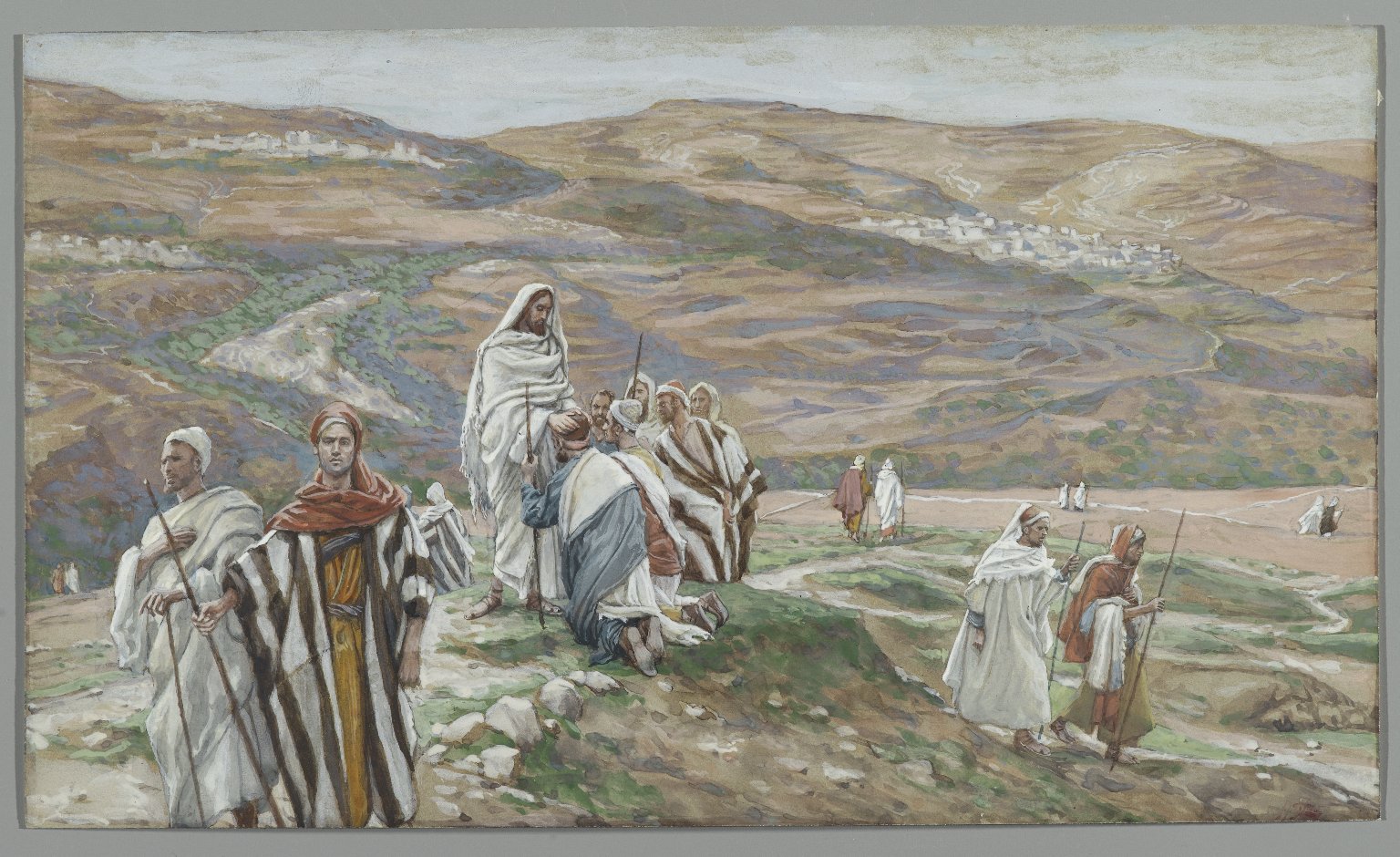
Meanwhile, in this morning’s Gospel, the disciples return to Jesus, after having been sent out in pairs to preach, teach, and heal. Once they have told the Lord what they have done, He replies:
“Come away by yourselves to a desolate place and rest a while.”
“Dewch chwi eich hunain o’r neilltu i le unig a gorffwyswch am dipyn.” (Mk 6:31)
Jesus understands that for ministry to be effective there needs to be a balance between action, rest, and reflection. Otherwise, the disciples will end up exhausted, as their pastoral ministry is demanding:
‘For many were coming and going, and they had no leisure even to eat.’
‘Oherwydd yr oedd llawer yn mynd a dod, ac nid oedd cyfle iddynt hyd yn oed i fwyta.’ (Mk 6:32)
Clearly the apostles need time to rest and to have some food. They also need time to learn from Jesus, and to take care of the people. Our Lord takes them by boat to a secluded spot, but they are recognised, and crowds run to greet them. It looks like the situation is about to be repeated, when Jesus intervenes:
‘When he went ashore he saw a great crowd, and he had compassion on them, because they were like sheep without a shepherd. And he began to teach them many things.’
‘Pan laniodd Iesu gwelodd dyrfa fawr, a thosturiodd wrthynt am eu bod fel defaid heb fugail; a dechreuodd ddysgu llawer iddynt.’ (Mk 6:34)
‘Like sheep without a shepherd’ ‘fel defaid heb fugail’ these are people in great need. They have heard the proclamation of the Kingdom of God, and they come to learn more, to be healed, and to be fed and nourished. Christ recognizes their longings and ministers to them, giving His disciples an opportunity to eat and rest. Jeremiah’s prophecy is fulfilled by Our Lord, and the people of Israel are cared for. They are loved, and they are nourished. When their needs were not met by their political and religious leaders, they turn to Christ, the Good Shepherd, who looks after God’s people.
On the Cross, the Good Shepherd lays down His life for His sheep. This sacrifice lies at the heart of St Paul’s message to the Ephesians in this morning’s second reading. Jesus gives humanity life through His suffering and death. On the night before He died He told us, His flock, what to do, so that God’s people might continue to be fed and nourished by Him, and with Him. Our Lord continues to care for us, because He loves us. God gives Himself to us, so that we might share in His life, and be transformed by His Grace, more and more into His likeness.
So, my brothers and sisters in Christ, let us rejoice that we are nourished and cared for by the true Shepherd of our souls. Let us prepare for the banquet of the Kingdom, by allowing God’s grace to transform us. And let us sing the praises of God the Father, God the Son, and God the Holy Spirit. To whom be ascribed all glory, dominion, and power, now and forever. Amen.
 Novus Motus Oxoniensis