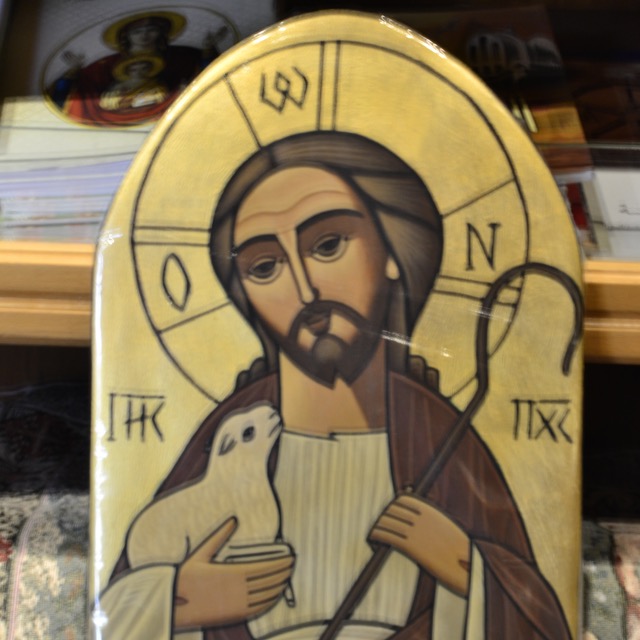
Living in Pembrokeshire, many of us know people who keep sheep. We are also aware of how difficult it has been for them, and all farmers, in the recent months with fields waterlogged due to unprecedented levels of rainfall. Sheep farming is a vital part of our rural life and so the image of Jesus as the Good Shepherd is something we find easy to identify with, unlike those who live in large cities.
Shepherds played an important part in Jesus’ life. Angels told them about the birth and they came down from the hills to worship Him in the stable in Bethlehem. Not wishing to leave their animals behind, Nativity scenes depict the shepherds bringing sheep to the manger. This may be why Our Lord has an affinity with those who look after sheep and care for them. Jesus describes himself as the Good Shepherd, the one who lays down His life for His sheep. Christ dies so that we may have eternal life in Him. This model of self-sacrificial love lies at the heart of the Christian faith, and because of it, we are able to live the new life of Easter.
Jesus says, ‘I am the Good Shepherd’ ‘Myfi yw’r bugail da’ (Jn 10:11). This is straightforward: He cares for His flock. But then He says, ‘The good shepherd lays down his life for the sheep.’ ‘Y mae’r bugail da yn rhoi ei einioes dros y defaid’ (Jn 10:11). This goes above and beyond what we would expect of a shepherd, even a very good one! Jesus is using the image of the Good Shepherd to explain what will happen on Good Friday. He will suffer and die to protect us, His flock.
Protect us from what? From Sin and Death. By dying for us, and rising from the dead, Jesus offers humanity freedom in Him. The Christian faith offers salvation, through faith. As St Peter puts it in this morning’s reading from the Acts of the Apostles:
‘And there is salvation in no one else, for there is no other name under heaven given among men by which we must be saved.’
‘Ac nid oes iachawdwriaeth yn neb arall, oblegid nid oes enw arall dan y nef, wedi ei roi i’r ddynolryw, y mae’n rhaid i ni gael ein hachub drwyddo.’ (Acts 4:12)
Jesus offers what no-one else can: salvation and eternal life to those who believe in Him, and follow Him. Eccentric American millionaires employ bizarre methods in an attempt to defy the ageing process, but they are still going to die. Each and every human being is. That is the fate of all living things. But, because of who Christ is — namely true God and true man — and what He has done on the Cross and at the empty tomb, death is no longer something to be feared. Instead, it can be embraced, as the entry to eternal life, with God, forever.
This way of looking at life and death is profoundly different from the world around us, because Christians are not bound by the primal human fear that our life is finite. Our Lord has opened to us the gates of Heaven, and shown us once and for all that God loves us.
At the heart of our faith as Christians is the profound conviction that we are people who are loved by God. As Archbishop Michael Ramsay said, ‘God is Christlike, and in him is no un-Christlikeness at all’ [God, Christ & the World: A Study in Contemporary Theology, London 1969, p.98]. When we see Jesus, we see God; when we hear Him speak, we hear the voice of God. We can know who God is, the Creator and Redeemer of the universe, through His Son, Jesus Christ. God is not a distant bearded man on a cloud. He is a loving Father, as illustrated in the Parable of the Prodigal Son. He loves us so much that He suffers and dies for us, to give us life in Him. This is the God who searches for lost sheep; who longs to love, restore, and reconcile; who can heal our wounds if we let Him. This is abundant life, offered to us by Our Lord, the Good Shepherd.
This life, this love is offered to us in the Eucharist, where we can touch and taste God’s profound love for us. In the bread and the wine we are given a foretaste of the heavenly banquet and a pledge of eternal life in Christ. Here today, as on a hundred thousand successive Sundays, we meet to be fed by Christ, and fed with Christ. To be healed, and to know His love. We are the sheep cared for by the Good Shepherd, who provides for all our needs. Who gives Himself so that we might have life.
So my brothers and sisters in Christ, as we continue to rejoice In Our Lord’s triumph over death, may we emulate His example and live the new life of Easter. Following Our Good Shepherd, who longs for us to be safe with Him forever in Heaven, let us share the Good News of His Kingdom with others. Let us pray that that all may come to know and love God the Father, God the Son, and God the Holy Spirit. To whom be ascribed all, glory, dominion, and power, now and forever. Amen.
 Novus Motus Oxoniensis