“As the Father has sent me, even so I am sending you”
“Fel y mae’r Tad wedi fy anfon i, yr wyf fi hefyd yn eich anfon chwi”(Jn 20:21)
The first Easter Day must have been very strange indeed for Jesus’ followers. Before the sun had even risen, Mary Magdalen comes and says that the tomb is empty. Peter and John go and look at Christ’s burial place, and then Mary comes back again having seen the Risen Lord. And while all of these earth-shattering discoveries are beginning to sink in, we are faced with this morning’s Gospel passage. It is evening and the disciples are afraid that they will face retribution for supporting a ‘false’ Messiah. They are scared, and can hardly believe what people have told them, let alone make sense of it all. And then suddenly, without warning, Jesus is in their midst, there in the room with them. Our Lord greets them and says, “Peace be with you.” (Jn 20:19) words which we still use in worship today. Jesus’ first words to the disciples are, ‘Shalom alechem’, ‘Tangnefedd i chwi’ ‘Peace be with you’. Christ’s greeting is one of peace and reconciliation, which dissipates their fear and anxiety. Then the Risen Christ shows the disciples His hands and side, the wounds which have brought about this peace and reconciliation.
Jesus shows the disciples the wounds of love, manifestations of God’s love for humanity. He then repeats His greeting of Peace and commissions them:
Jesus said to them again, “Peace be with you. As the Father has sent me, even so I am sending you.” (Jn 20:21)
God the Father sends Christ to proclaim the Good News of the Kingdom, to call people to repentance, and to reconcile God and humanity. As blood and water flowed from Christ’s side at Calvary, so through Baptism and the Eucharist, the Church gives life to the people of God. Then the commissioning and ordaining of the apostles continues:
And when he had said this, he breathed on them and said to them, “Receive the Holy Spirit. If you forgive the sins of any, they are forgiven them; if you withhold forgiveness from any, it is withheld.” (Jn 20:22-23)
Through the power of the Holy Spirit, God is active in the world. Christ gives the apostles the power to forgive sin. In Jewish understanding, this is something only God can do. Yet Jesus forgives sins, and empowers His disciples to do so. This forgiveness is a manifestation of God’s love and reconciliation, which can, and does, heal our wounded human nature. This is what Jesus came to do, and He commits the Church to continue His mission and His saving work. This is the reality which we inhabit as Christians. It is God’s free gift to His people, a sign of generous love. By the power of His Holy Spirit, the Church is to be a community of reconciliation, where we are forgiven and where we, in turn, forgive. This is designed to be a place where we are freed from sin, its power, and its effects.
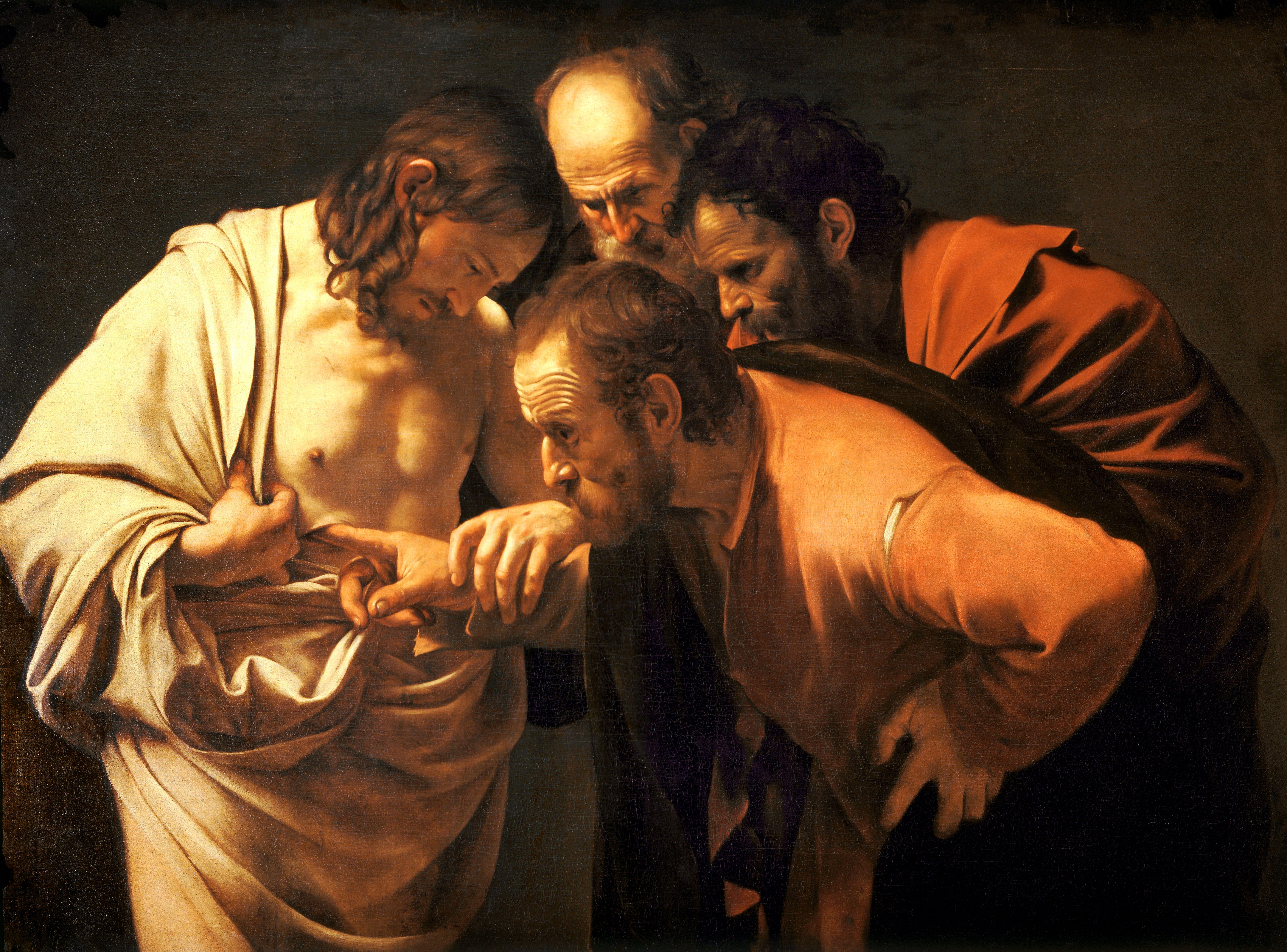
St Thomas is not there with the other disciples when The Resurrected Jesus appears on that first Easter Day. Understandably, Thomas feels somewhat left out. He knows he has missed the opportunity to experience something truly wonderful and life-changing. This is a perfectly normal human reaction to an extraordinary situation. Which of us would not feel the same? We too would want to be present to experience the reality of Jesus’ Resurrection, and to be sure of it. Thus, we empathise with Thomas when he says:
“Unless I see in his hands the mark of the nails, and place my finger into the mark of the nails, and place my hand into his side, I will never believe.” (Jn 20:25)
These are the words of someone who longs to experience the reality of the Resurrection. Like the other disciples, Thomas has been on something of an emotional rollercoaster. It is therefore understandable that Thomas wants to be certain, to know with his own eyes and hands that Jesus is alive.
A week later, Jesus comes to the disciples again, and says to them:
“Peace be with you.” Then he said to Thomas, “Put your finger here, and see my hands; and put out your hand, and place it in my side. Do not disbelieve, but believe.” (Jn 20:26-27)
Jesus gives Thomas exactly what he wants: the opportunity to experience the reality of the Resurrection and to touch the wounds of love and mercy. This leads Thomas to reply to Jesus:
“My Lord and my God!” (Jn 20:28)
Thomas no longer doubts. Instead he confesses that Jesus is God, and the Lord of his life. This is a profound and concise statement of faith, declaring both who Jesus is, and what He has done. Thomas has journeyed from doubt and despair to true faith. Doubt is the starting point, but it is not the end of the journey. St Thomas should not be known as ‘Doubting Thomas’, but rather as ‘Believing Thomas’, as this is what he becomes. Thomas’ belief changes his life, and leads him to take the Gospel to be proclaimed far and wide. He travels as far as India, founding Christian communities which have endured for two thousand years. Such faith is our inheritance, and in it we are blessed, as those who have not seen, but yet believe. We too are called to be like Thomas, and to share the Good News of Christ’s Resurrection with the world.
At its heart, today’s Gospel should be understood as something to greatly encourage us in our life of faith:
‘but these [things] are written so that you may believe that Jesus is the Christ, the Son of God, and that by believing you may have life in his name.’ (Jn 20:31)
Belief in Jesus leads to New Life. This underlines the Christian understanding of baptism. Through baptism we share in Jesus’ Death and Resurrection, and are given new life. This new existence is eternal life with Christ, and in Christ.
At the Easter Vigil, last week, we renewed our baptismal promises to remind ourselves of what Our Lord has done for us. What Jesus has done for you, and for me, and for every Christian over the past two thousand years. In our Baptism we are united with Christ and made brothers and sisters. We become part of a new family which we call the Church, which is called to live in a new way. This is made clear in the first reading from the Acts of the Apostles. Here we see people of faith being loving and generous, caring for each other. We pray that we may be inspired by their example, to live out the faith of our baptism throughout our lives.
It is important to take our time over our celebration of Easter. We need to pause to allow the reality of what we commemorate to sink in. Something this wonderful, this world-changing, needs to be pondered, and shared. We gather today to do what the disciples did, and are filled with joy at Our Lord’s Resurrection from the dead. Through Christ’s Resurrection we are changed, transformed, and filled with God’s love. Today, and every day, we give thanks and praise to God the Father, God the Son, and God the Holy Spirit, i Duw Dad, Duw y Mab, a Duw yr Ysbryd Glân. To whom be ascribed all, glory, dominion, and power, now and forever. Amen.