Septuagesima (Year B)

The narration of stories is a skilled activity, whether they are told orally, or in writing. Setting the scene and introducing the characters are an important part of the process. Sometimes people begin with a long introduction, whereas others take you straight to the action. Mark’s Gospel definitely takes the latter approach. He does not set the scene by giving details of Jesus’ birth or childhood. Instead, he plunges straight into chronicling Our Lord’s public ministry in Galilee.

Mark’s Gospel begins with a description of Jesus’ ministry that proceeds at a frenetic pace. Jesus is baptised by John, goes into the desert for forty days, and calls two sets of brothers to follow Him: Simon and Andrew, James and John. In today’s passage Jesus teaches in a synagogue and heals a man possessed by an unclean spirit. Everything happens in quick succession, there is no time to waste. Part of this is a desire on the Gospel writer’s part to embody the vibrancy of Jesus’ proclamation of the Kingdom:

“The time is fulfilled, and the kingdom of God is at hand; repent and believe in the gospel.”

‘Yr amser a gyflawnwyd, a theyrnas Dduw a nesaodd: edifarhewch, a chredwch yr efengyl.’ (Mk 1:15)

Jesus is a man on a mission. He calls people to turn away from their sins, and to believe in the Good News: to love God and also to love your neighbour. As it is the Sabbath, people gather in the local synagogue. Worship in a synagogue involved singing Psalms, reading from Scripture, and teaching, rather like a sermon. This is familiar to us, as our Morning and Evening Prayer proceeds along similar lines. In this instance, instead of a Scribe or Teacher of Law explaining the biblical reading, Jesus Himself is teaching the people.

‘And they were astonished at his teaching, for he taught them as one who had authority not as the scribes’

‘A synasant wrth ei athrawiaeth ef: canys yr oedd efe yn eu dysgu hwy megis un ag awdurdod ganddo, ac nid fel yr ysgrifenyddion.’ (Mk 1:22)

Scribes relied on the authority of Moses, and would refer to other passages in the first five books of the Old Testament, and to previous interpretations, to make their point. Jesus does something different, and while Mark doesn’t tell us exactly what He said, it is clear that Our Lord’s interpretation of the Scriptures was both refreshing and authoritative. Jesus teaches like someone with authority. He isn’t a scribe or a Pharisee, He hasn’t spent years in theological training. Jesus stands outside traditional religious power structures. Our Lord’s teaching has authority not just because it is spoken with conviction, but because it is real and embodied in Him. Christ’s words are lived out in His life, because he is God: the Son of God, beloved of the Father (cf. Mk 1:11). He is filled with the Holy Spirit, and proclaims the Good News of the Kingdom. 

After Jesus has unpacked the Scriptures, He is addressed by a man who is clearly unwell:

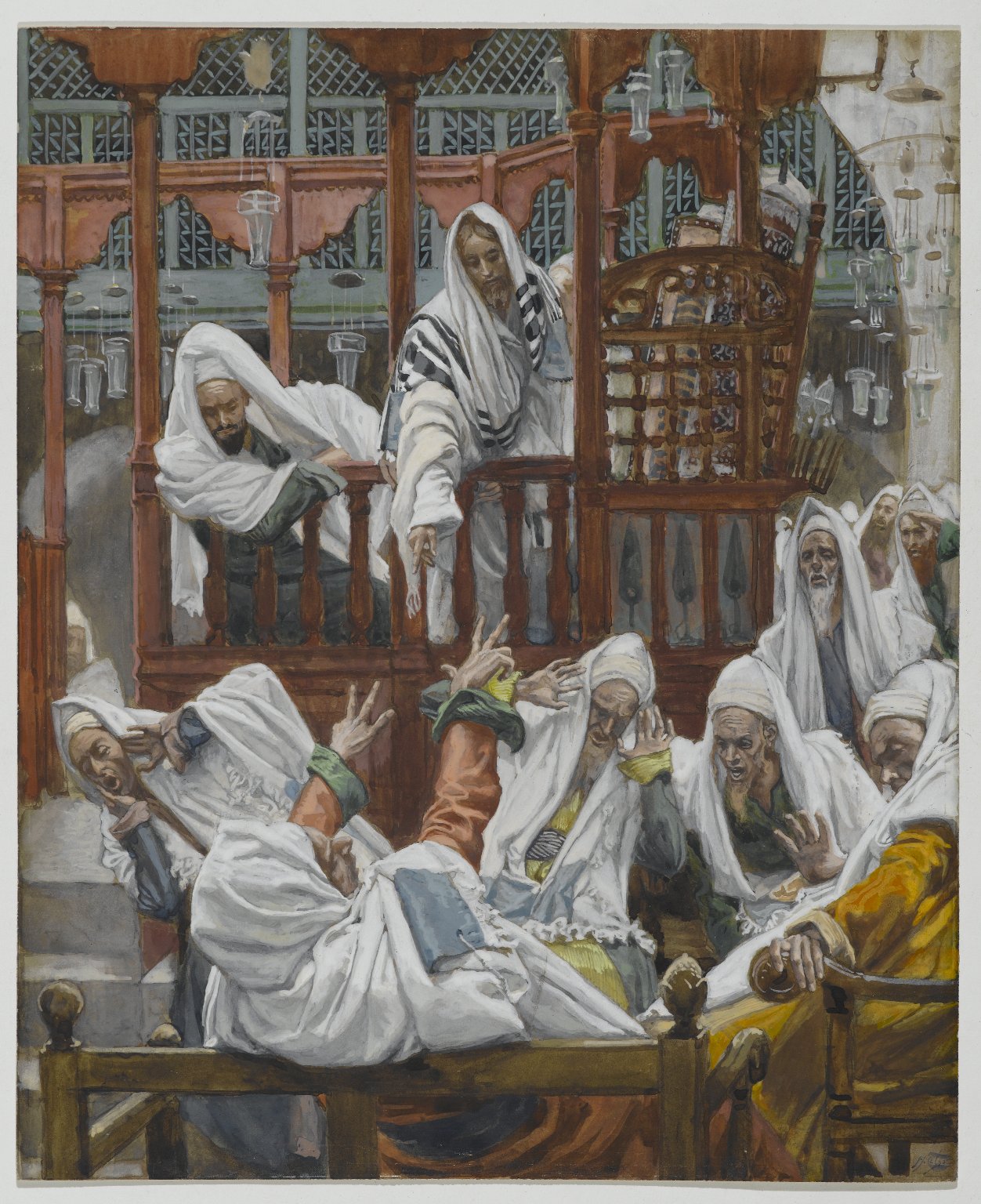
“And immediately there was in their synagogue a man with an unclean spirit. And he cried out, ‘What have you to do with us, Jesus of Nazareth? Have you come to destroy us? I know who you are—the Holy One of God.’” 

‘Ac yr oedd yn eu synagog hwy ddyn ag ynddo ysbryd aflan: ac efe a lefodd, Gan ddywedyd, Och, beth sydd i ni a wnelom â thi, Iesu o Nasareth? a ddaethost ti i’n difetha ni? mi a’th adwaen pwy ydwyt, Sanct Duw.’ (Mk 1:23-24)

This is a man in need of healing, who is described as being possessed by an evil spirit, though nowadays we would probably prefer to describe him as suffering from mental illness. He is suffering, and longs to be healed. This weak, broken man recognises who and what Jesus is: He is the Holy One of God, the Messiah, Y Meseia. Our Lord speaks with authority telling the evil spirit to be silent and come out of the man. He can do this because He is God.

The Kingdom which Jesus proclaims in His teaching is a place of healing. Ours is a God who can heal our wounds, who can take broken humanity and restore it in love. This is why Christ’s teaching and the healing have to go together; they are both part of a larger whole, the coming Kingdom of God. Jesus proclaims our need to love God and each other, and puts this into practice, making the healing power of God’s love a reality in the world. Therefore, at the beginning of Jesus’ public ministry in Mark’s Gospel we see the proclamation of the Good News, and its application in a healing miracle. Jesus is the fulfilment of Moses’ prophecy, in today’s first reading, where he says:

“The Lord your God will raise up for you a prophet like me from among you, from your brothers—it is to him you shall listen” 

‘Yr Arglwydd dy Dduw a gyfyd i ti, o’th blith dy hun, o’th frodyr dy hun, Broffwyd megis finnau; arno ef y gwrandewch’ (Deut 18:15)

“And I will put my words in his mouth, and he shall speak to them all that I command him.”

‘a rhoddaf fy ngeiriau yn ei enau ef; ac efe a lefara wrthynt yr hyn oll a orchmynnwyf iddo.’ (Deut 18:18)

These verses are quoted, by both St Peter in Acts 3:22 and St Stephen in Acts 7:37, to refer to Jesus. For nearly two thousand years the Church has had a consistent interpretation of this passage as pointing to, and finding its fulfilment in, Jesus Christ. We can listen to Him with confidence because Jesus is God. He has authority, and He longs to heal us.

The message that Our Lord proclaims in His teaching is reinforced by His actions. Jesus shows that the Kingdom of God is a place where humanity can be healed and freed from sin. Christ demonstrates this most fully when He suffers and dies for us on the Cross. From the very beginning, Jesus looks to the Cross —not as a place of torture, humiliation, or defeat — but as the place of victory and healing. The Crucifixion is the supreme demonstration of God’s love for humanity. Through the Cross we learn how much God loves us. This is why God sends His Son to heal our wounds, to restore us, and to give us the hope of Heaven. Confident in His promises we can turn to God and pray for the healing that we all so desperately long for, and which the world needs. We can pray that His Divine nature might transform our human nature, and give us a foretaste of Heaven. We pray that our own wounds: physical and mental, will be healed, so that we might have life in Him, in this world and the next.

The possessed man asks Jesus, ‘Have you come to destroy us?’ ‘a ddaethost ti i’n difetha ni?’ The only thing that Christ has come to eradicate is the power of evil which separates man from God. We know that the Son of God has come not to destroy but to restore humanity, so that we may have life and have it to the full. This is the Good News of the Kingdom, which is still a reality here and now. We, in our brokenness, can approach the source of all healing, the God who loves us and gives himself for us, so that we can be restored by Him. God can take our lives and heal us in His love. Let us then come to Him, so that our lives may also be transformed. Let us proclaim to a world, which longs for healing and wholeness, the love of God the Father, God the Son, and God the Holy Spirit. To whom be ascribed all glory, dominion, and power, now and forever. Amen.
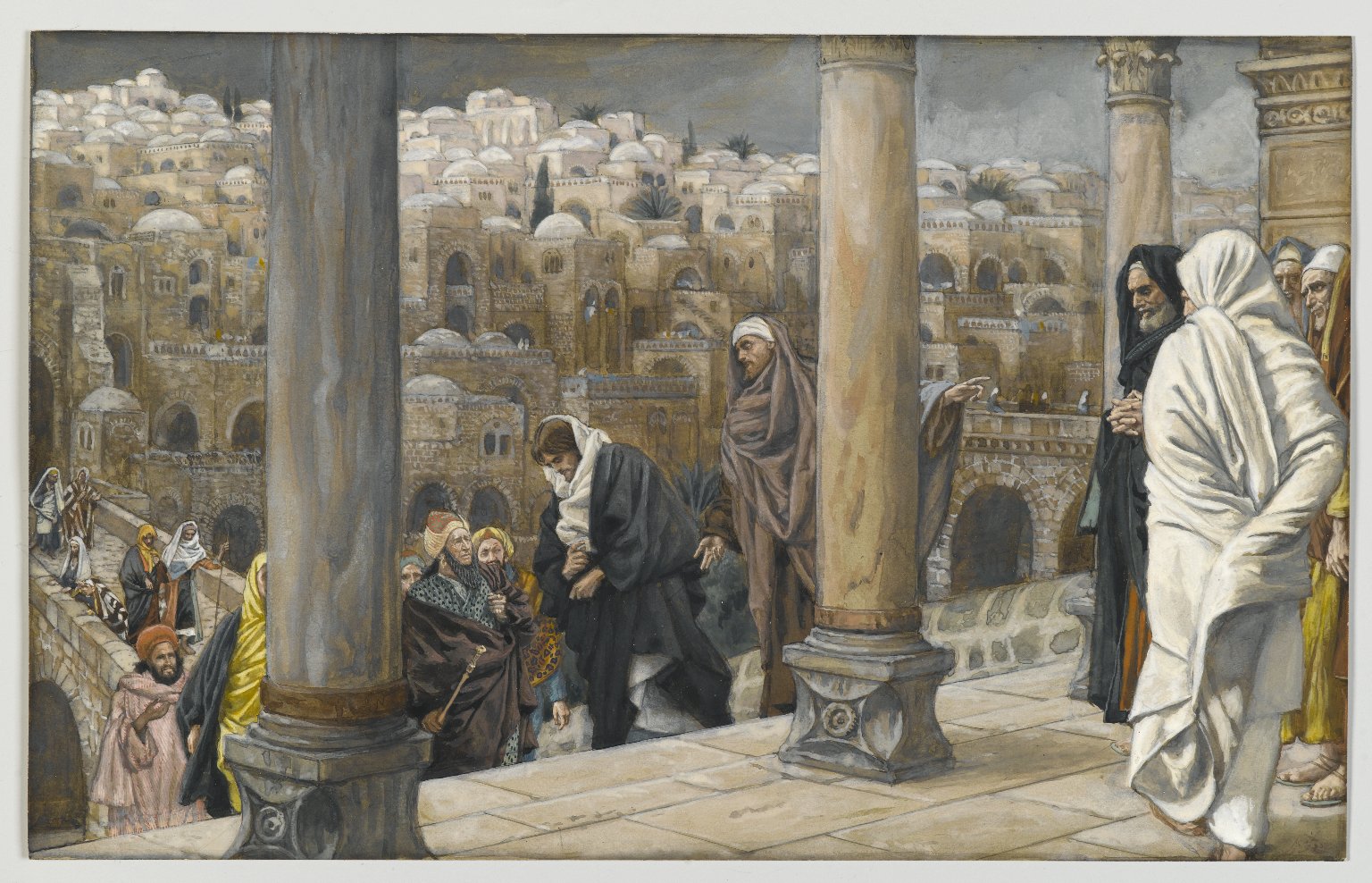
James Tissot The Possessed Man in the Synagogue (Brooklyn Museum)

The Third Sunday after Epiphany (Year B)

Organising a wedding is not an easy task. They can be complex and expensive undertakings, even when they are relatively modest affairs, with only family and a few friends. In some cultures, however, weddings can be more like celebrations for an entire community. Indeed, even today in the Middle East and Asia when a couple marry the celebrations can involve large numbers of guests, and last for several days. Clearly, the logistics of such festivities are complicated, and the financial outlay considerable. It is good to take a moment to consider how much the events in Cana, described in today’s Gospel reading, differ from most of the weddings that we have attended.

That Our Lord, His Mother, and His disciples are invited to the wedding should not be a surprise. This is a community celebration, with everyone present. The idea of running out of wine is not simply a failure of logistics and hospitality, but could represent a situation that would bring shame and disgrace on the hosts. It is a crisis which could stigmatise the family for years to come, with the couple thinking that their union had been cursed with bad luck. Suffice it to say, it would be a complete disaster for all concerned. Mary, wanting to prevent this, lets Jesus know that there is a serious problem. The situation is critical, and something needs to be done quickly. Our Lord, however, seems a little dismissive:

“Woman, what does this have to do with me? My hour has not yet come.”

‘Beth sydd i mi a wnelwyf â thi, wraig? ni ddaeth fy awr i eto.’ (Jn 2:4)

Jesus is looking ahead to when His hour will come, anticipating His Passion and Death on the Cross. That is also the next time that Mary will feature in John’s Gospel, when she stands with John at the foot of the Cross. The Wedding at Cana and the Crucifixion are two events that are clearly linked, both by what Our Lord says, and by who is present. What is about to happen at a Galilean wedding is a significant moment, which is underlined by Mary’s instruction to the servants:

‘His mother said to the servants, “Do whatever he tells you.”’

‘Ei fam ef a ddywedodd wrth y gwasanaethwyr, Beth bynnag a ddywedo efe wrthych, gwnewch’ (Jn 2:5)

Once again Mary demonstrates perfect obedience, and she encourages the servants to do the same. When we listen to what Jesus says and act on it we are following their example. Living the Christian life is essentially trying to do this. We listen to Jesus and do as He tells us. 

At the feast are six stone jars each holding thirty gallons which adds up to over eight hundred litres of water. This is a huge quantity of liquid, even for a large wedding. The servants fill the jars to the brim, making them fuller than they would usually be. This speaks of the abundance and generosity of God’s love. It defies our expectations, just as water being turned into wine defies expectation. The extravagant Wedding party points to something greater than itself. It is a foreshadowing of the joy of the Kingdom. The celebration at Cana is a taste of the lavish excess that our God wishes to bestow on us. His generosity, which is beyond our understanding, is a sign of His deep love for us.

The master of the feast does not seem to be bothered by the quantity of wine, but rather its quality. Moments ago the refreshments were running out, now they are plentiful. He addresses the bridegroom saying:

“Everyone serves the good wine first, and when people have drunk freely, then the poor wine. But you have kept the good wine until now.”

‘Pob dyn a esyd y gwin da yn gyntaf; ac wedi iddynt yfed yn dda, yna un a fo gwaeth: tithau a gedwaist y gwin da hyd yr awr hon.’ (Jn 2:10)

The steward has a point. It makes sense to serve the best wine first, and then serve inferior wine when people’s palettes are dulled. But this wedding feast represents a dramatic reversal of usual practice. It illustrates how God’s generosity stretches far beyond what we can expect or understand as humans. The Kingdom of God turns our values on their head, and its joyous new wine is finer than any earthly fruit of the vine. This is lavished upon humanity, so that it might transform us, so that we might come to share in the glory of God, and in His very nature. Our Lord therefore becomes the true master of the feast, just as He will feed humanity from the abundance of the Heavenly Banquet. The Wedding at Cana points to both Heaven, and to the Eucharist, where Christ nourishes us with the new wine of the Kingdom: His Blood, poured out to save and restore us. God loves us this much. How should we respond?

As Christians we are constantly called to live lives of joy and love in Christ. Through Him, rejoicing in our new life in baptism, and filled with the sober intoxication of the Spirit, we are nourished by Word and Sacrament. In this way we are restored to communion with God, and with each other, to live the life of the Kingdom, here and now. At the Wedding in Cana Jesus gives the world a sign, which shows both who and what He is, and which also points to heavenly and eternal realities. God manifests His glory, showing us who He really is: the personification of love and generosity.

This passage ends by explaining that, in response to this sign, Christs’s disciples  totally believe in Him. They put their trust in Him, as the one who fulfils prophecy, the Messiah, the Saviour of the world. Let us also put our trust in the God who loves us, and who feeds us with Himself, so that we might have life in and through Him. Let us share His joy both here on earth and in Heaven. And let us give praise to God the Father, God the Son, and God the Holy Spirit. To whom be ascribed all glory, dominion, and power, now and forever. Amen.

The Marriage at Cana (A. Mironov)

The Second Sunday of Year B

There is a common misconception that when the Church talks about vocation, being called, it is referring to the call to ordained ministry, to be a deacon or a priest. Nothing could be further from the truth. While this call is an important one, there remains a fundamental call which comes to us all in our baptism: the call to follow Christ. Each and every one of us is called to be a disciple of Jesus, to listen to what He says, and to let this call affect our lives. It is both a daunting prospect, and the most normal and natural thing in the world. 

Our first reading this morning tells the story of the call of Samuel, a young boy serving at the sanctuary in Shiloh with the high priest Eli. After his mother, Hannah, had prayed to God for a child whom she would dedicate to God as a Nazirite, she became pregnant and Samuel was born. Nazirites were not allowed to cut their hair, drink wine, or touch a dead body. Eli’s predecessor, Samson, the last of the Judges in the Book of Judges, was also a  Nazirite. Samuel is called three times. Each time he goes to Eli, whom he assumes is calling him. Eventually Eli tells Samuel to reply, ‘Speak, Lord, for your servant hears.’ (1Sam 3:9). So Samuel responds to God’s invitation, and it totally changes his life. Are we willing to take that risk, and answer God’s call?

Ancient Corinth was something like a cross between London and Las Vegas. It was a rich trading centre with a reputation for sexual immorality. This morning’s second reading from St Paul’s First Letter to the Corinthians, is an attempt to argue that our embodied existence, that is how we live our lives , matters. Often, we become what we do. It is therefore important to do the right thing, and not the wrong. Paul’s argument leads to his conclusion:

You are not your own, for you were bought with a price. So glorify God in your body. (1Cor 6:19-20) 

We are not our own, we belong to God, who bought us with the price of His Son, Jesus Christ. The world likes to tell us that we are autonomous, that we can do whatever we want to, but at a fundamental level we are God’s people, and belong to the God who made us, and who redeemed us out of love for us. God sets us free to love Him and serve Him, so how we live our lives is our response to that love and an act of loving service. We can choose to glorify God, not that God needs our glory, but because it is how we should live our lives, in love and service. Our faith affects our lived existence.

In today’s Gospel we move beyond the Baptism of Christ to the events of the following day. John has testified that Jesus is the Lamb of God, who takes away the sins of the world, and that He is the Son of God. When John sees Jesus walking by he again exclaims ‘Behold the Lamb of God’ (Jn 1:36). The phrase looks back to the Suffering Servant in Isaiah 52-53 who is led like a lamb to the slaughter. The beginning of Jesus public ministry points to its end on the Cross. Jesus is the Messiah and He will die to take away our sins. Two of John’s disciples hear him saying these words and follow Jesus. When Jesus asks them what they are looking for, the disciples answer ‘Rabbi’. They acknowledge Jesus as a teacher, and ask Him where He is staying. Jesus replies, “Come and you will see.” (Jn 1:39). Jesus invites them to follow Him, to see where He is staying and to spend time with Him. These two disciples of John become followers of Jesus, literally and metaphorically. The Church continues to make the same invitation to the world, to come and see, to follow Jesus. These two disciples stay with Jesus, they listen to Him, they eat with Him, and begin to have a relationship with Him. We then discover that one of the men is Andrew, and that he has a brother, called Simon. Andrew is convinced that he has found the Messiah and brings his brother to Jesus. When Jesus meets Simon he says,

“So you are Simon the son of John? You shall be called Cephas” (which means Peter) (Jn 1:42)

Jesus gives Simon a new name. He calls him Cephas, which means ‘rock’ in Aramaic, Petros in Greek, from which our name Peter comes. Peter will be the rock upon which Christ will build His Church (Mt 16:18). The name Jesus gives points to Peter’s future role as the leader of the Apostles. Jesus takes the initiative and begins to sketch out a future for the disciples who are following Him. It is quick, and matter of fact, and yet momentous. Jesus is gathering people to help Him with this ministry.

The Church therefore begins with a few Galilean fishermen following a rabbi whom they recognise as the Messiah. Thanks to them, and their faith in Jesus, we are in the Church today. Faith, where we put our trust, is an important thing. It affects both who we are, and how we live our lives. Faith turned Peter from a fisherman into a leader of the early Christians, and it has continued to transform lives for the past two thousand years. 

In our baptism, God in Christ invites each and every one of us to follow Him, to ‘come and see’, as the first disciples did, and to invite others, as Andrew invited Simon Peter. To come and see who Jesus is, to get to know Him, and start a relationship with Him. This begins with our sharing in His Death and Resurrection, and ends in the glory of Heaven. Where we, and all the Church, give glory to God the Father, God the Son, and God the Holy Spirit, to whom be ascribed, as is most right and just, all might, majesty, glory, dominion, and power, now and forever. Amen. 

The Twenty-second Sunday of Year A

The vocation to be a prophet is not an easy one. Prophets are tasked with telling people the plain, unvarnished truth about God. Their words can be quite unpalatable. Most, if not all, of us would much rather not hear hard truths. Therefore it comes as no surprise that in our first reading this morning, the prophet Jeremiah is feeling rejected and miserable. He has been prophesying the destruction of Jerusalem by the Babylonians, but, because this has not yet happened, he is seen as a fraud. Jeremiah starts to doubt God, and yet there is a burning fire within himself to call God’s people to repentance. However, when he announces this he is mocked. Jeremiah feels let down. 

Last week we read Peter’s declaration that Jesus is the Messiah, the Son of God. Following on from this, Jesus tells His disciples what must happen to Him:

He must go to Jerusalem and suffer many things from the elders and chief priests and scribes, and be killed, and on the third day be raised. (Mt 16:21)

Jesus’ words must have come as something of a shock to the disciples. This isn’t what is supposed to happen to the Messiah, so Peter takes Jesus to one side and tells Him off! Peter cannot understand what needs to happen. He has forgotten prophecies like Isaiah 53 which tell of the Suffering Servant. Peter cannot take it in — he does not want Jesus’ prophetic words to take place. This is a very human response. We also don’t want such appalling things to happen. Then it is Peter’s turn to be told off. Jesus says to him:

“Get behind me, Satan! You are a hindrance to me. For you are not setting your mind on the things of God, but on the things of man.” (Mt 16:23)

In just a couple of verses Peter has gone from being the rock upon which the church will be built, to being Satan, the deceiver, the devil, and a stumbling block. Peter has run the whole length of the spectrum, from getting things right to getting them totally wrong. There are no half-measures with Simon Peter. He jumps in with both feet. He may be right or wrong, but he is certainly committed, and through this commitment Jesus sees Peter as a leader. But the disciples’ inability to understand what Jesus is saying has led him to try and oppose the will of God. Peter, the Rock, has become a stumbling-block, an obstacle, something to trip over. Peter can only see things in human terms, but God has something else in store. The Cross is inevitable for the simple reason that God loves us that much. However, the Cross is not just for Christ. It is for each and every one of as Christians: we are called to bear it ourselves.

As believers, we are to take up our Cross and follow Jesus. We should be under no illusion; it isn’t easy to take up the Cross. We cannot do it on our own, we have to do it together, as a community, relying upon God, and loving and forgiving each other. All the power, all the wealth in the world, is worth nothing compared to finding true life in Christ. Worldly things cannot save us, they cannot give us eternal life, they cannot wipe clean our sins. Only Jesus can do this, on the Cross. Only in Christ can we have life — life in its fullness. Only if we lose our old life by following Him, can we find what our human life can truly be.

Thus the Church, in following Jesus, offers a radical alternative to the ways of selfishness and sin, an alternative which has the power to change the world through being conformed to Christ. We can do this together, by living out our faith and encouraging others to do so; by living lives of profound love, something that is difficult, and costly, and wonderful. 

Today, through prayer, through our conversation with God, throughlistening to God, we are nourished by the Word of God, the Bible, to know that God loves us, and will help us to live out that love and forgiveness in our lives. We are also nourished by the sacraments of the Church, by Holy Communion, so that the love which God shows to the world on the Cross continues to be poured out upon us, so that we can be strengthened to live out the life of faith. It is food for our souls, so that we may be built up in love. Let us turn to the Living God, to be fed by Him, fed with Him, to have new life in Him, so that He can continue to transform our human nature and follow His example. Let us take up our Cross, as people ransomed, healed, restored and forgiven by the love of God on the Cross.

In the Letter to the Romans, St Paul describes what love in action looks like. We are guided as to how to put our faith, into practice in our lives: by living out the love and forgiveness which we have received, turning from the ways of the world and following the way of God. The Christian life is sacrificial in that it involves personal sacrifice, and also by uniting ourselves to the sacrifice of Christ. This world cannot save us, only Christ can do that. The ways of the world cannot give us true happiness, or eternal life. Their promises are false. Only Christ, who is the Way, the Truth, and the Life (Jn 14:6) can save us. Only Christ can transform us, and this transformation lies at the heart of the proclamation of the Kingdom. Only by losing our life can we find it.

As Christians we embrace paradox, because God loves us enough to be born as one of us, to proclaim and live out the truth, healing and reconciliation, which He longs to lavish upon us. In Christ, God dies so that we might live. Words cannot express just how earth-shattering and transformative Divine Love is. It is a mystery, in the fullest sense of the word. God’s love and mercy are greater than anything we can know or imagine. We keep making mistakes, but God’s love is unconditional, we cannot earn it, it is freely offered to transform us. Thus, our faith is the work of a lifetime. Day by day God’s grace can perfect our nature, if we are humble enough to let God be at work in us. We pray that God’s grace may transform us so that, in this life and the next, we and all creation may give glory to God the Father, God the Son, and God the Holy Spirit, to who whom be ascribed as is most right and just, all might, majesty, glory, dominion and power, now and forever. Amen.
A 4158

The Second Sunday before Advent: Mk 13:1-8

There was a time when you would see men walking around with sandwich boards, which declared, ‘The End is Nigh!’ It would be all too easy to mock them, or write them off as crackpots. They do, however, make a serious point. For all Christians, after Jesus’ Ascension, we are waiting for Jesus to come again, as our Saviour and our Judge. It might be today, or in a thousand years from now, but He is coming, and we need to be ready. We need to be prepared to meet Him. It is why, in the Season of Advent, which will soon be upon us, we consider the two comings of Jesus. The first is as a baby born in Bethlehem, the second will be as Our King, Our Saviour and Our Judge. The two comings are linked, and we need to be ready for both. 

People nowadays are worried by many things: Britain’s departure from the EU, the President of the United States of America, the threat of nuclear war, global climate change, the end of the world. The latter part of the twentieth century and the start of the twenty-first are full of dire warnings of impending doom. It’s scary stuff, it really is. But as Christians we know that whatever happens, we are loved by and saved by God, that we, and all things are in His hands. It can be hard to hold onto hope like this, but we can. 

The buildings of the Temple complex were soon to be destroyed by the Romans. The single most holy place in the world for Jews was about to be destroyed. It’s a frightening prospect, but it teaches an important lesson: not to be overly concerned with the stuff of this world, as it isn’t as important as we tend to make it. The disciples can’t quite understand that yet, but they will, in time.

What’s more important for Jesus is that the disciples aren’t led astray into strange beliefs, or following false Christs. The last two thousand years have seen some very strange versions, some might say perversions, of Christianity. What we believe matters, because it affects how we live our lives, it helps us give right praise to God, rather than something distorted, ugly and man-made. When Mark wrote his Gospel there were lots of strange ideas floating around about Jesus, and there still are today. It was a time of great uncertainty then, as now. There were wars and natural disasters which portend the end times. Christians were facing persecution then, and they are now too, all over the world. We are more likely to face indifference than persecution, but it knocks your confidence somewhat. You want hope and comfort, and the promise of something better. 

And we have that in Jesus Christ, who died for our sins, and who rose again to show us that we have the promise of eternal life with God, ‘For by a single offering he has perfected for all time those who are sanctified’ (Heb 10:14). This is truly good news to a troubled world. It is the heart of our faith, and the source of our joy. Peter and Andrew, James and John want to know when it will take place. Jesus doesn’t tell them, but he gives them signs to be alert for, so that they can be ready.

I wasn’t a boy scout, but their motto ‘Be Prepared’ is a good one, especially for Christians, because Jesus is coming, and we need to be ready to meet Him. It is good to think about this as we prepare to enter Advent, the penitential season which looks towards Christmas, and our yearly celebration of Jesus’ birth. It is truly amazing thing, that God should be born as one of us, to save us from our sins, to give us the hope of Heaven. We need to prepare for it, because it is important: not the turkey and tinsel and the rampant consumerism, but the Incarnation of the Word of God. It changes the world, and has been doing so for the last two thousand years. We also know that Jesus will come to judge the world. It’s tricky that one, knowing that we will be called to account for what we have been, said, thought, and done.None of us deserve to go to Heaven, but God is loving and merciful, and forgives our sins when we are penitent, He gives us another chance when we make a mess of it. We keep doing it, and God keeps forgiving us, so that we can try to do what God wants us to do. I find such generosity staggering. The world around us can be judgmental, it likes to write people off as no good, as failures. Thankfully God isn’t like that, and the church shouldn’t be either. We have to be a community of healing and reconciliation, so that we can offer the world an alternative. It is both liberating and exciting to that you and I are part of it, and hopefully we want others to be as well. 

This is the covenant that I will make with them after those days, says the Lord: I will put my laws on their hearts, and write them on their minds,’ (Heb 10:16). The author of the Letter to the Hebrews quotes Jeremiah (31:33) to show us how Scripture is fulfilled in the Person of Jesus, who makes a new covenant with His Precious Blood on Calvary. God makes it possible for us to live this new life, triumphing over sin and death. Christ does this for us, what can we do for Him?

We can be ready to meet Him, and we can live the life He wants us to live, not worry whether Christ will come tomorrow or in a thousand years.