The Third Sunday after Epiphany (Year B)

Organising a wedding is not an easy task. They can be complex and expensive undertakings, even when they are relatively modest affairs, with only family and a few friends. In some cultures, however, weddings can be more like celebrations for an entire community. Indeed, even today in the Middle East and Asia when a couple marry the celebrations can involve large numbers of guests, and last for several days. Clearly, the logistics of such festivities are complicated, and the financial outlay considerable. It is good to take a moment to consider how much the events in Cana, described in today’s Gospel reading, differ from most of the weddings that we have attended.

That Our Lord, His Mother, and His disciples are invited to the wedding should not be a surprise. This is a community celebration, with everyone present. The idea of running out of wine is not simply a failure of logistics and hospitality, but could represent a situation that would bring shame and disgrace on the hosts. It is a crisis which could stigmatise the family for years to come, with the couple thinking that their union had been cursed with bad luck. Suffice it to say, it would be a complete disaster for all concerned. Mary, wanting to prevent this, lets Jesus know that there is a serious problem. The situation is critical, and something needs to be done quickly. Our Lord, however, seems a little dismissive:

“Woman, what does this have to do with me? My hour has not yet come.”

‘Beth sydd i mi a wnelwyf â thi, wraig? ni ddaeth fy awr i eto.’ (Jn 2:4)

Jesus is looking ahead to when His hour will come, anticipating His Passion and Death on the Cross. That is also the next time that Mary will feature in John’s Gospel, when she stands with John at the foot of the Cross. The Wedding at Cana and the Crucifixion are two events that are clearly linked, both by what Our Lord says, and by who is present. What is about to happen at a Galilean wedding is a significant moment, which is underlined by Mary’s instruction to the servants:

‘His mother said to the servants, “Do whatever he tells you.”’

‘Ei fam ef a ddywedodd wrth y gwasanaethwyr, Beth bynnag a ddywedo efe wrthych, gwnewch’ (Jn 2:5)

Once again Mary demonstrates perfect obedience, and she encourages the servants to do the same. When we listen to what Jesus says and act on it we are following their example. Living the Christian life is essentially trying to do this. We listen to Jesus and do as He tells us. 

At the feast are six stone jars each holding thirty gallons which adds up to over eight hundred litres of water. This is a huge quantity of liquid, even for a large wedding. The servants fill the jars to the brim, making them fuller than they would usually be. This speaks of the abundance and generosity of God’s love. It defies our expectations, just as water being turned into wine defies expectation. The extravagant Wedding party points to something greater than itself. It is a foreshadowing of the joy of the Kingdom. The celebration at Cana is a taste of the lavish excess that our God wishes to bestow on us. His generosity, which is beyond our understanding, is a sign of His deep love for us.

The master of the feast does not seem to be bothered by the quantity of wine, but rather its quality. Moments ago the refreshments were running out, now they are plentiful. He addresses the bridegroom saying:

“Everyone serves the good wine first, and when people have drunk freely, then the poor wine. But you have kept the good wine until now.”

‘Pob dyn a esyd y gwin da yn gyntaf; ac wedi iddynt yfed yn dda, yna un a fo gwaeth: tithau a gedwaist y gwin da hyd yr awr hon.’ (Jn 2:10)

The steward has a point. It makes sense to serve the best wine first, and then serve inferior wine when people’s palettes are dulled. But this wedding feast represents a dramatic reversal of usual practice. It illustrates how God’s generosity stretches far beyond what we can expect or understand as humans. The Kingdom of God turns our values on their head, and its joyous new wine is finer than any earthly fruit of the vine. This is lavished upon humanity, so that it might transform us, so that we might come to share in the glory of God, and in His very nature. Our Lord therefore becomes the true master of the feast, just as He will feed humanity from the abundance of the Heavenly Banquet. The Wedding at Cana points to both Heaven, and to the Eucharist, where Christ nourishes us with the new wine of the Kingdom: His Blood, poured out to save and restore us. God loves us this much. How should we respond?

As Christians we are constantly called to live lives of joy and love in Christ. Through Him, rejoicing in our new life in baptism, and filled with the sober intoxication of the Spirit, we are nourished by Word and Sacrament. In this way we are restored to communion with God, and with each other, to live the life of the Kingdom, here and now. At the Wedding in Cana Jesus gives the world a sign, which shows both who and what He is, and which also points to heavenly and eternal realities. God manifests His glory, showing us who He really is: the personification of love and generosity.

This passage ends by explaining that, in response to this sign, Christs’s disciples  totally believe in Him. They put their trust in Him, as the one who fulfils prophecy, the Messiah, the Saviour of the world. Let us also put our trust in the God who loves us, and who feeds us with Himself, so that we might have life in and through Him. Let us share His joy both here on earth and in Heaven. And let us give praise to God the Father, God the Son, and God the Holy Spirit. To whom be ascribed all glory, dominion, and power, now and forever. Amen.

The Marriage at Cana (A. Mironov)

Christmas 2023

How do you remember the significant people and events in your lives? Since the nineteenth century, with the invention of photography, we have tended to use photographs, and stored the pictures in albums. Nowadays, however they are more likely to be online or on a mobile phone or tablet. From the first ultrasound scans of a baby in the womb, and throughout life, we have visual reminders. But photography has only been widespread for about 150 years. Before then only the rich could afford to have pictures painted to record something for posterity. If we wished to recreate an event from the past, then a dramatic retelling was the only option available. This is exactly what St Francis of Assisi did to remember the events and people of the first nativity and to inspire the devotion of all those who saw it. 

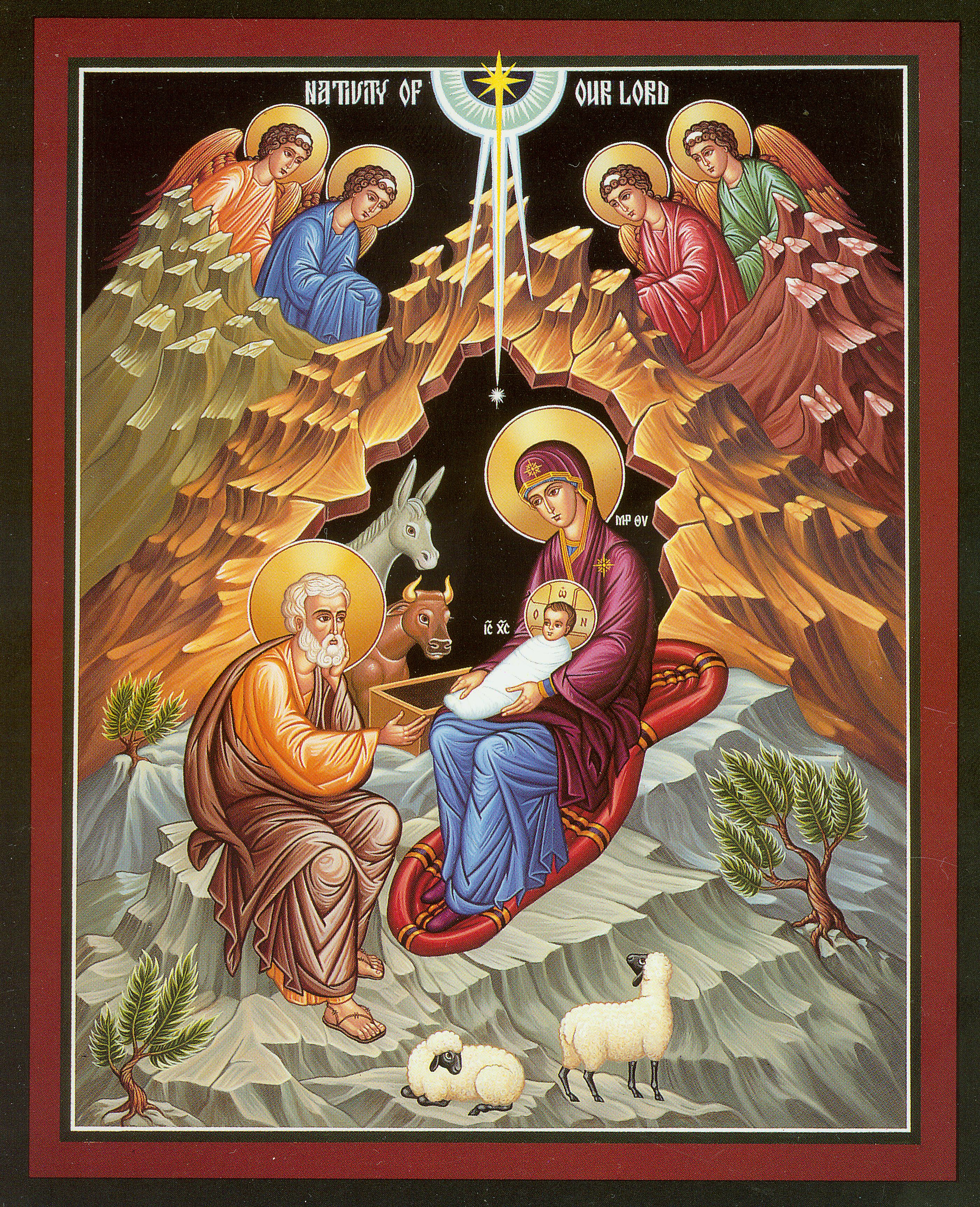
The first nativity took place exactly 800 years ago this month. The year was 1223, and the location was a cave at Greccio in Italy, around 100km north of Rome. St Francis of Assisi was inspired to recreate the first nativity in Bethlehem in an Italian village with real animals and humans playing various parts — exactly like we did in Maenclochog last night. There are good reasons why such recreations are appealing. They remind us of the reality of the Incarnation, that God took flesh in the womb of the Virgin Mary and was born in Bethlehem. The new-born baby Jesus was surrounded by an ox and an ass, and sheep, and was laid in an animals’ feeding trough. As the prophet Isaiah says:

‘The ox knows its owner, and the donkey its master’s crib’ 

‘Yr ych a edwyn ei feddiannydd, a’r asyn breseb ei berchennog’(Isa 1:3)

By this humble beginning God embarked on the journey of sharing our life, so that we might come to share His. Christ begins His life being laid on stone feeding trough. He will end it, taken down from the Cross and laid in a stone tomb. Such parallels are not mere coincidence. Instead, they point us towards a God who has made himself manifest, discoverable through signs, fulfilling prophecies, and declaring love for humanity. 

Jesus is the Prince of Peace, and the embodiment of the Gospel of Salvation. He comes to bring comfort and redemption to the whole world.

‘for the Lord has comforted his people; he has redeemed Jerusalem.’

‘canys yr Arglwydd a gysurodd ei bobl, efe a waredodd Jerwsalem.’ (Isa 52:9)

Today our salvation has dawned, prophecy is fulfilled, and the Saviour of the world is born. The message of Isaiah is one of joy. The birth of the Messiah, Jesus Christ, is Good News. This is because He comes to bring true peace to humanity. That such peace currently eludes our world, is exactly why He came: to heal our wounds and to show us a new way to live. Throughout His life, all that Christ says and does shows us how much God loves us. The Word becomes flesh, ‘A’r Gair a wnaethpwyd yn gnawd’ and enters the world. He dwells among us ‘ac a drigodd yn ein plith ni’: a wondrous mystery which provokes us to worship, to kneel with the shepherds and to adore the God who comes among us. Jesus shares our human life so that we might share His divine life, not because we asked, and not because we are deserving, it is not something we have earned. Rather, it is the free gift of a loving and merciful God. This then is the glory of God — being born in simple poverty. Jesus, the Son of God comes to call humanity to a new way of being together, where the old order is cast aside, turning the world upside down .He offers us the possibility of living in a radically different way. Instead of war, misery and hatred, He shows us the way of peace, joy, and love.

Such is the reality St Francis sought to inspire in the hearts and lives of people eight hundred years ago. It is a message which can still inspire us, a mystery which can still transform us. So that through the grace of God we can come to share in the Divine life, born among us, in a stable not a palace. God surprises us with generosity which we cannot fathom. God subverts human expectations. Christ’s first breaths are taken surrounded by animals and shepherds. Not what one would expect of a royal birth! 

God is a God of mystery and paradox. We know that we can never fully understand Him, but we can experience His love. To quote from Sir John Betjeman’s poem ‘Christmas’:

No love that in a family dwells,

No carolling in frosty air,

Nor all the steeple-shaking bells

Can with this single Truth compare —

That God was man in Palestine

And lives today in Bread and Wine.

May we greet Our Lord, born among us, and may we feed on His Body and Blood at the Altar. Given to transform us, so that we may join with the choir of angels in singing the praises of God the Father, God the Son, and God the Holy Spirit. To whom be ascribed all glory, dominion, and power, now and forever. Amen.

Merry Christmas to you all!

Nadolig Llawen i chi gyd!

Lent IV

Let those who think that the Church pays too much attention to Mary give heed to the fact that Our Blessed Lord Himself gave ten times as much of His life to her  as He gave to His Apostles.

Fulton Sheen, The World’s First Love, 1956: 88

As human beings we believe  that we have been created in the image of God, and thus human love should reflect something of that divine love. Most of us, though sadly not all, experience self-giving, sacrificial love from our parents, and particularly our mothers: they nourish us, care for us, comfort and love us, just as they have given birth to us: it is a wonderful thing, which should be celebrated and held up as an example.

When the Church seeks to understand and celebrate mothers she does so by considering the Blessed Virgin Mary, the mother of Our Lord and Saviour Jesus Christ. He is cared for through the love of his mother, the Blessed Virgin Mary, who in her love, service, and obedience, stands as the model for all Christians to follow. She is the first Christian, and the greatest: a pattern for us to imitate, and a foreshadowing of our great mother the church, which seeks to offer the world a moral framework, within which to live its life; and to offer the world an alternative, a new way of living and of being through which to have life, and have life in all its fullness.

Mary’s is a love which will see her stand at the foot of the Cross and experience the pain of watching her Son die, for love of us. Any parent will tell you that they would do anything to save their children from hurt or harm, and yet there she stands, and is initiated into a new relationship where she becomes a mother to John, the beloved disciple, and through him, a mother of all of, the mother of the church, someone who loves, prays, and cherishes.

It is this love which St Paul expects of the church in Colossae, and which God expects of us: it describes what love looks like: it isn’t easy, it’s difficult, costly and frustrating, but through it we can grow in love, of God and each other.

The salvation and eternal life which Christ offers freely to all, comes through the church, which we enter in our baptism, where we are nourished in word and sacrament, where we given food for the journey of faith, strengthened and taught, to live his risen life, to share in the joys of Easter.

God cares so much about the world and its people that he takes flesh, and lives a life of love, amidst the messiness of humanity, to show us how to live lives filled with love, life in all its fullness. Not to condemn the world but to offer it a way of being. God has made us for himself , and our hearts are restless until they find their rest in him. The spiritual needs and searching which characterise people in the world around us, can be satisfied in God and in God alone, through the church. So we can rejoice, and relax our Lenten discipline for a little while to give thanks for the wonderful gift of God’s love in our lives, in the church, and for the world.

But we also need to trust God, to listen to what he says through Scripture, to be fed by him, and to live lives in accordance with his will and purpose, together, as a family, as a community of love, cared for and supported by our mother, the church. And in so doing we look to our Lady as mother of our Lord and mother of the church, as a pattern for love and obedience, as a model for all mothers: loving and tender, putting the needs of others before self, self-giving, sacrificial, and open to both joy and pain.

This, as any mother can tell you, is not easy, it’s difficult, really hard, but its rewards are likewise great. So let us, as we continue our Lenten journey towards the cross, where God shows his love for us most fully and completely, giving his body to be broken and his blood be shed for us, a sacrifice which will be made present here today under the outward forms of bread and wine, to strengthen us to live the risen life of Easter, to offer the world and alternative to selfishness, to self-centredness, to the sin which continues to separate us from God and each other, an alternative seen in the self-giving love of mothers, and in our mother, the church. So that we may join the Angels in our song of love and praise to the Trinity: Father, Son and Holy Spirit, to whom…

Homily for the Week of Prayer for Christian Unity: 1 Peter 2:9-10

Hold me worthy , O Lord, to behold your mercy in my soul before I depart from this world; may I be aware in myself at that hour of your comfort, along with those who have gone forth from this world in good hope. Open my heart, O my God, by your grace and purify me from any association with sin. Tread out in my heart the path of repentance, my God and my Lord, my hope and my boast, my strong refuge, by whom may my eyes be illumined, and may I have understanding of your truth, Lord. Hold me worthy, Lord, to taste the joy of the gift of repentance, by which the soul is separated from co-operating with sin and the will of flesh and blood. Hold me worthy, O Lord, to taste this state, wherein lies the gift of pure prayer. O my Saviour, may I attain to this wondrous transition at which the soul abandons this visible world, and at which new stirrings arise on our entering into the spiritual world and the experience of new perceptions.

St Isaac of Nineveh

The Apostle Peter is writing to a church which is undergoing persecution on account of their faith in Our Lord and Saviour, Jesus Christ. While you could argue that this is not happening to us here, now, openly, it does nonetheless happen to our brothers and sisters in Christ around the world who are called to bear witness to Christ regardless of the cost. If anything the persecution in this country is more to do with apathy, ignorance, and our dismissal from public discourse unless we are in agreement with popular whim or sentiment: such is the tyranny of secularism, which we must, as Christians resist, as we are called to conform the world to the will of God.

We are called to be a holy nation and a chosen race, not in exclusive ethnic terms, like the people of Israel, but rather because we are one in Christ, through our common baptism, having passed through that water greater than the Red Sea, which gives freedom to all the world: we can look beyond the simplistic divisions of the world to something greater, and far more wonderful, and while we are certainly not there yet, we are all nonetheless travelling on a journey towards unity, because it is the will of Our Lord and Saviour Jesus Christ, and his prayer to the Father in the garden of Gethsemane before his arrest in John 17.

Our highest allegiance then is not to the powers of this world, for we recognise a higher power, the King of Heaven and Earth, which is Christ. He makes us royal, he gives us entry into that greatest of palaces, that is heaven, through His Precious Blood which was shed to heal us and restore us, there is as the hymn puts it power, power, wonder-working power in the precious blood of the Lamb. It is through Christ’s priesthood, a priesthood of the new covenant in His Blood, after the order of Melchisedech, that the church continues a cultic priesthood to offer continually that one perfect and sufficient sacrifice for the sins of the whole world, so that the people of God may be made holy, by being fed with His Body and Blood so that our human nature may be transformed into his divine nature: Αὐτὸς γὰρ ἐνηνθρώπησεν, ἵνα ἡμεῖς θεοποιηθῶμεν· ‘He became human so that we might become divine’ Athanasius De Incarnatione Dei Verbi 54.3.

We are holy, set apart for God’s service and the proclamation of His Kingdom , proclaiming the saving acts of God in Christ, and calling the world to repent, to turn away from the ways of sin and self, and to believe and trust in a God who loves us and saves us. Christ calls us out of the darkness of sin, of the world into the glorious light of His Kingdom. This is the fulfilment of the prophesy of Hosea 1:6 and 1:9 Once we were no people, now we are God’s people (cf. Hosea 1:9 Call his name lo-ammi [not my people] 1:6 Call her name lo-ruhamah [who has not received mercy]) We are God’s people, God claims us for His own, through His Son, who shows us in His life, Death, and Resurrection exactly what mercy is: A God who suffers and dies for love of us, poor sinful humanity, that we might become something better, something greater. God sees that human sinfulness is such a problem that only an outpouring of Divine Love in the sacrifice of His Son can save us.

And having received mercy, love and forgiveness in Christ, we show it in our lives so that ours is a proclamation not only of words but of deeds, so that we play an active part in the reconciliation of the world to God in Christ. Mercy, with joy and peace are the fruit of charity: our love of God and our neighbour, we love because God loved us first, and as we show mercy, we shall receive mercy, we harvest what we sow.

As St Isaac says ‘Do not hate the sinner. Become a proclaimer of God’s grace, seeing that God provides for you even though you are unworthy. Although your debt to him is very great, there is no evidence of him exacting any payment from you, whereas in return for the small ways you do manifest good intention he rewards you abundantly. Do not speak of God as ‘just’, for his justice is not in evidence in his actions towards you. How can you call God just when you read the gospel lesson concerning the hiring of the workmen in the vineyard? How can someone call God just when he comes across the story of the prodigal son who frittered away all his belongings in riotous living — yet merely in response to his contrition his father ran and fell upon his neck, and gave authority over all his possession? In these passages it is not someone else speaking about God; had this been the case, we might have had doubts about God’s goodness. No it is God’s own Son who testifies about him in this way. Where then is this ‘justice’ in God, seeing that, although we were sinners, Christ died for us? If he is so compassionate in this, we have faith that he will not change.’

We show this love first in obedience, like Our Lord’s Mother, the Blessed Virgin Mary, as we heard in this morning’s Gospel in her words to the servants ‘Do whatever he tells you’ If we are obedient, like Mary, then model disciple and mother of the Church, the first and greatest Christian, then we can truly be salt and light to the world, proclaiming the Good News of the Kingdom.

The Good News is the announcement of God’s mercy, shown to us in Christ, in Him we see what God is really like, in Him we experience love, healing, forgiveness, reconciliation. Through Him we are healed and restored, we become God’s people, and proclaim God’s Kingdom, so that humanity may come to experience God’s love and mercy, and believe and give Glory to God the Father, God the Son, and God the Holy Spirit, to whom be ascribed as is most right and just, all might, majesty, glory, dominion, and power, now and unto the ages of ages.