Advent Sunday

‘Gwisgwch yr Arglwydd Iesu Grist amdanoch’

‘But put on the Lord Jesus Christ.’ (Rom 13:14)

Today is Advent Sunday, the start of the season of Advent. The next four weeks are a time of waiting, of expectation: for the coming of Jesus Christ. Both as we prepare to celebrate His Birth at Christmas, and for the Second Coming of Christ as our Saviour and our Judge. The idea of Jesus’ return has not always been seen as something to look forward to. Judgement has been equated with condemnation, and fear of the coming judgement has been used to control people. Yet, as Christians, we look forward to Our Lord’s Second Coming, just as we look forward to our annual celebration of His First Coming, at Christmas.

In today’s Gospel Jesus is teaching His disciples about the end times. Our Lord draws a comparison between the Last Day and the Flood:

‘For as were the days of Noah, so will be the coming of the Son of Man. For as in those days before the flood they were eating and drinking, marrying and giving in marriage, until the day when Noah entered the ark, and they were unaware until the flood came and swept them all away, so will be the coming of the Son of Man.’ (Mt 24:37-39)

The point is that, just like the arrival of the Great Flood, no-one knows when the Last Day is going to happen. People are carrying on with their lives as normal. It is an unexpected event. One of the reasons Noah was saved was that he was prepared. He had built an ark. Our ark is the Church, which we enter through Baptism. For us the waters bring life not death. We are ready, and preparation is the key to Jesus’ message. Whenever the Lord comes, we need to be in a fit state to meet Him. 

How do we prepare? By following the advice in the first reading from the prophet Isaiah:

‘O house of Jacob, come, let us walk in the light of the Lord.’ (Isa 2:5)

If we walk in the light of the Lord, then we are not walking in darkness. We live out our faith in our lives, and our moral characters are formed by our behaviour. We become what we do often in our actions.

About sixteen hundred years ago, one of Christianity’s great figures, St Augustine, had been struggling towards the journey of faith. One day, as he sat under a fig tree, he kept hearing a child say, ‘Pick up and read’ (Aug. Conf. 8.29). And so he opened a Bible and read in the Letter to the Romans:

‘Not in revelling and drunkenness, not in debauchery and licentiousness, not in quarrelling and jealousy. But put on the Lord Jesus Christ, and make no provision for the flesh, to gratify its desires.’ (Rom 13:13-14)

Drunkenness, fornication, the sort of behaviour often associated with the Christmas Office Party in particular, and the modern society in general, can be dismissed as ‘just a bit of fun’ or of ‘no consequence in the great scheme of things’. However, what we do affects our lives: we become what we do often. The Christian Life is most definitely not a ‘fun-free zone’. Rather, it is a way of being which allows us to be fully alive; doing what we should be doing in the way we should be doing it. Today’s world is filled with examples of the behaviour which St Paul sees as problematic: people being quarrelsome and subject to baser appetites. One need only read a newspaper, look at the Internet, or turn on the television, to see a world which has got things wrong, in which we are not living decently. Our lives, our characters, are formed by what we think and do, by the decisions we make. This is a cumulative process, where we build on the choices we have made in the past. Therefore, we need to start down the right path as soon as possible, or turn back if we have gone astray.

The first reading, from the prophet Isaiah, looks forward to a Messianic Age of peace:

‘and they shall beat their swords into ploughshares, and their spears into pruning-hooks; nation shall not lift up sword against nation, neither shall they learn war any more.’ (Isa 2:4)

Swords and spears will be turned into agricultural tools for ploughing fields and cultivating vines.They will no longer be used for warfare, but instead for growing grain and grapes, to make bread and wine. These are the very foodstuffs Our Lord takes at the Last Supper, when He institutes the Eucharist. This feast of thanksgiving is the fulfilment of Isaiah’s prophecy, and represents the Messianic Kingdom where love will triumph over violence.

At this time of year, The Church prepares for three comings: the first is our annual commemoration of Jesus’ birth in Bethlehem, at Christmas, where the Word became flesh and dwelt among us. The second coming of Christ will be at the end of time, when He will be our Saviour and our Judge. The third coming we prepare for is even nearer. It happens day by day, and week by week, when Christ comes to us in the Eucharist, through His Body and Blood, under the outward forms of Bread and Wine. This is the Feast of the Kingdom, anticipated by the ploughshares and pruning hooks of Isaiah: tools used to help produce Bread and Wine. Isaiah’s prophecy looks forward to the peace of the Messiah and the banquet of Bread and Wine. These are the Foods of the Kingdom, which provide nourishment for our journey of faith, and give us strength and new life in Christ. Jesus comes to us in the Eucharist to fortify us, and to transform us into His likeness; to help us to live out our faith in the whole of our lives.

So, my brothers and sisters in Christ, let us prepare to meet Our Lord by living out our faith, in all aspects of our lives , nourished with Word and Sacrament. The time is short. The time is now. How we live really matters. We need to grow in the Lord, to learn His ways and walk in His paths. As Christians, we are called to live decently and vigilantly, preferring nothing to Christ, and inviting all the world to come to the fullness of life in Him. This is how we prepare for His coming at Christmas and as Our Saviour and Judge. By following Jesus, and being fed by Him, we are restored and healed by Him. And so, on this Advent Sunday, we sing the praise of God the Father, God the Son, and God the Holy Spirit, Duw Dad, Duw y Mab, a Duw yr Ysbryd Glân. To whom be ascribed all might, majesty, glory, dominion, and power, now and forever. Amen.

Fra Angelico The Conversion of St Augustine, [Musée Thomas-Henry, Cherbourg-en-Cotentin, France]

Christ the King 2025

‘God’s weakness is stronger than human strength.’

‘gwendid Duw yn gryfach na chryfder dynol.’ (1Cor 1:25)

On November 23rd 1927 the Mexican Jesuit priest Fr Miguel Pro SJ was arrested on false charges and placed in front of a firing squad. He refused a blindfold and spread his arms out into the shape of a cross. His last words were: ‘¡Viva Christo Rey!’ ‘Long live Christ the King!’. The Mexican regime of that time was cruel and went out of its way to persecute Christians, including thirty-six year old Miguel Pro, a twentieth century Christian martyr who died confessing Christ’s sovereignty over all things. His words are both powerful and inspiring. When we acknowledge Christ as King we are saying that He is above all human power and authority. We are affirming that God is supreme. As Christians, our primary allegiance is to God alone, and not to the things of this world. To proclaim Our Lord as King of Heaven and Earth will always challenge and trouble those who lay claim to an authority and a power which is not their own. There are plenty of examples in the world around us of those who are unwilling to recognize a power greater than themselves. 

Christians profess the sovereignty of God primarily on the basis of the Crucifixion of Our Lord and Saviour Jesus Christ. We worship a Crucified God. This should strike us as something strange and disconcerting. At one level it doesn’t quite make sense, and yet it does. St Paul expresses the paradox at the heart of the Christian Faith in his First Letter to the Corinthians:

‘For God’s foolishness is wiser than human wisdom, and God’s weakness is stronger than human strength.’ (1Cor 1:25)

God is doing something amazing, which we cannot fully comprehend, or understand. This is because it is the mystery of God’s love. This is a love which we can never fully understand but it is something that we can experience in our lives.

Today’s Gospel is from St Luke’s account of the Crucifixion. It begins with Jesus being mocked by religious leaders: 

“He saved others; let him save himself, if he is the Christ of God, his Chosen One!” (Lk 23:35)

They demand action — that Jesus saves Himself — because they have completely misunderstand Our Lord’s mission, which is not to save Himself, but to save others. The Roman soldiers then join in and mock Christ saying:

“If you are the King of the Jews, save yourself!” (Lk 23:37)

In these words, power has been conflated with self-interest. Jesus, however, is not interested in saving Himself, but rather in saving us. He is the King of the Jews, born in Bethlehem of the line and lineage of David. And here Christ, in saving humanity, is doing what a proper King does: caring for His people, even at the cost of His own life. While the soldiers are mocking Jesus, they are actually proclaiming Him as a King. 

One of the men crucified with Jesus asks:

“Are you not the Christ? Save yourself and us!” (Lk 23:39)

This man has been condemned to death for acts of robbery and rebellion, and he is only able to understand the Messiah in political terms. He is looking for a revolutionary leader, who can save him. This causes the other man being crucified to rebuke the first one, saying:

“Do you not fear God, since you are under the same sentence of condemnation? And we indeed justly, for we are receiving the due reward of our deeds; but this man has done nothing wrong.” (Lk 23:40-41)

This second man understands that Jesus is innocent. This leads to one of the most memorable interactions in Luke’s Gospel, a demonstration of faith followed by its reward:

And he said, “Jesus, remember me when you come into your kingdom.” And he said to him, “Truly, I say to you, today you will be with me in Paradise.” (Lk 23:42-43)

This man does not ask to be saved. He simply requests that Jesus keep him in mind, when He comes into His Kingdom. Christ immediately grants his request. The condemned man’s recognition of Jesus’ Kingship is rewarded with the promise of eternal life with God in Heaven. Here, in two sentences, we see salvation and redemption at work. Jesus’ death saves people — starting with the condemned man. That is what Christ’s kingship is all about: bringing healing and the forgiveness of sins to all who turn to Him in faith. 

We worship a Crucified God. One who suffers and dies for us, to offer us eternal life in Him. This is true kingship, shown in self-sacrificial love. Christ is the Good Shepherd, who lays down His life for His sheep. He wants to save others, because He is the Messiah, and He is God saving his people. The Hebrew for Jesus is Yeshua and means ‘God saves’. Here on the Cross Jesus fulfils His destiny: this is who and what He is. God saves His people by dying for them. This is real kingship — not robes, or power, but love — dying the death of a common criminal. It doesn’t make sense, and it isn’t supposed to. God’s ways are not our ways, nor His thoughts our thoughts. We cannot save ourselves. Only God can do that, in an act of generous love; an extravagant and exuberant gift that we can neither earn nor repay.

In the reading from St Paul’s Letter to the Colossians, we hear both what God has done for us, and who Christ is. God has qualified us to share in the inheritance of the saints in light. We are able to go to Heaven because we have been delivered from darkness, into the kingdom of God’s beloved Son. In Christ we have redemption and forgiveness. Jesus has paid the debt we owe; our sins are forgiven. We do not need to slaughter lambs and be sprinkled with their blood, because we have been sprinkled with the Blood of the Lamb of God in our Baptism. We are redeemed, and our transgressions are forgiven, because of what Christ does for us on the Cross. This is the heart of our faith: Jesus died for us, because He loves us. 

In Christ we see that God loves us. He created all that is, therefore things are subject to Him. He is the head of His Body, the Church, of which we are a part through our baptism, and our participation in the Eucharist. As the firstborn from the dead, Christ, in His Resurrection, shows us that death is not the end.

This is the God we worship, and whom we hail as our true King: the God of love and healing. Christ has conquered on the Cross; Christ reigns as King of the Universe; Christ reigns in our hearts, and in our lives. May we then lift our hearts and voices to sing the praises of our Divine King: God the Father, God the Son, and God the Holy Spirit, Duw Dad, Duw y Mab, a Duw yr Ysbryd Glân. To whom be ascribed all might, majesty, glory, dominion, and power, now and forever. Amen.

All Saints: Living the Beatitudes

I have an important message for you all this morning: God has a plan for your life! Now, you may well have heard these words before, possibly from someone preaching a sermon, but they contain a profound truth. They are found in the Bible, in words that God speaks through the prophet Jeremiah:

For I know the plans I have for you, declares the Lord, plans for welfare and not for evil, to give you a future and a hope.

Oherwydd myfi sy’n gwybod fy mwriadau a drefnaf ar eich cyfer, medd yr Arglwydd, bwriadau o heddwch nid niwed, i roi ichwi ddyfodol gobeithiol. (Jer 29:11)

It can be hard to hold onto such a promise, especially when times are difficult and the outlook is bleak. We need to ask ourselves the question, ‘Do we trust God?’ If the answer is ‘Yes’ then, whatever difficulties or hardships may come our way, we know that our future is in safe hands.

Fundamentally, the point of being a Christian is to reside in Heaven. Such a destination is possible because of what Jesus Christ has done for us, out of love. This is the plan God has for our life, and this is why Jesus became man, lived, died, and rose from the dead. God shows us both how to live, and what He desires for us. We can have faith, and put our trust in the God who loves us, in the clear hope that, after our earthly life is over, we may enjoy eternity with God and the Saints in Heaven. Most of all, in this hope, we can live earthly lives of love, loving both God and each other, foreshadowing the eternal joys of Heaven. 

In our current culture we are not used to hearing such a message. There is a tendency to think that holiness is for other people, certainly not for us. But God wants each and every one of us to become a saint. He wants us to live in a world full of people trying to be saints. The Church is ‘a school for saints’ (which is peopled by sinners), in which Christians try to live out their faith, cooperating with the grace of God. We do this when we let Christ live in us, so that we can say with the Apostle Paul:

‘It is no longer I who live, but Christ who lives in me.’

‘a mwyach, nid myfi sy’n byw, ond Crist sy’n byw ynof fi.’ (Gal 2:20)

There is a paradox at work here. For when we truly let Christ live in us, we do not lose ourselves, but instead we discover who we really are. This enables us to become the people God wants us to be; the people we were created to be. As Jesus says in Matthew’s Gospel:

For whoever would save his life will lose it, but whoever loses his life for my sake will find it.

Oherwydd pwy bynnag a fyn gadw ei fywyd, fe’i cyll, ond pwy bynnag a gyll ei fywyd er fy mwyn i, fe’i caiff. (Mt 16:25)

Today the Church celebrates the Feast of All Saints. On this day, in the eighth century ad, Pope Gregory III dedicated a chapel to All Saints in St Peter’s Basilica in Rome, and now there are many Churches with this dedication. It is a good thing to celebrate the fact that Heaven is full of saints. They are the Church Triumphant, who spend eternity praising God and praying for us. Just as we pray for our friends here on earth, it stands to reason that our friends in Heaven pray for us as well. It is reassuring to understand that we are not alone in our quest to reach Heaven, and to know that those who are already there long for us to join them. 

If Heaven is our goal, how then should we live our lives on earth? Thankfully today’s Gospel gives us a template to follow, an example of what a Christian life looks like. 

We constantly hear how the world around us values success and confidence, and looks up to the rich, and the powerful. In contrast to this, Jesus says to the gathered crowd:

“Blessed are the poor in spirit, for theirs is the kingdom of heaven.”

“Gwyn eu byd y rhai sy’n dlodion yn yr ysbryd, oherwydd eiddynt hwy yw teyrnas nefoedd.” (Mt 5:3)

‘Poor in spirit’ is not a term we are used to using today, but it means the exact opposite of pride. Jesus places humility as key to living a Christian life: knowing who we are, and our need for God. Only if we rely upon God, and not ourselves, and ask Him to work through us, can we truly live out the Christian life. 

“Blessed are those who mourn, for they shall be comforted.”

“Gwyn eu byd y rhai sy’n galaru, oherwydd cânt hwy eu cysuro.” (Mt 5:4)

We mourn those we love, those whom we see no longer in this life. We do so because we love them, we miss them, we want to see them, and hold them, and talk to them. Our parting, while temporary, is still very painful. Thankfully the Kingdom of God, which Christ comes to bring, is a place of healing and comfort with the promise of eternal life. 

“Blessed are the meek, for they shall inherit the earth.”

“Gwyn eu byd y rhai addfwyn, oherwydd cânt hwy etifeddu’r ddaear.” (Mt 5:5)

Gentle people are not weak: they know how to use their strength, and how not to use it. As Jesus will later say in Matthew’s Gospel: ‘Take my yoke upon you, and learn from me, for I am gentle and lowly in heart, and you will find rest for your souls.’ ‘Cymerwch fy iau arnoch a dysgwch gennyf, oherwydd addfwyn ydwyf a gostyngedig o galon, ac fe gewch orffwystra i’ch eneidiau.’ (Mt 11:29). This is how God wants us to live as human beings. Christ is the example of gentleness we must follow. Once again, God’s vision of the future turns human expectations upside down. 

“Blessed are those who hunger and thirst for righteousness, for they shall be satisfied.”

“Gwyn eu byd y rhai sy’n newynu a sychedu am gyfiawnder, oherwydd cânt hwy eu digon.” (Mt 5:6)

Should we be devoted to God? Absolutely! Should we pray that His will is done on earth as it is in Heaven? Definitely! Jesus taught us to pray this way. Clearly God wants to see our world transformed and has invited us to help in the process; and doing so gives us fulfilment.

“Blessed are the merciful, for they shall receive mercy.”

“Gwyn eu byd y rhai trugarog, oherwydd cânt hwy dderbyn trugaredd.” (Mt 5:7)

We see what God’s mercy looks like in Christ’s death for us on the Cross. In following Christ’s example, we both ask for forgiveness for our own sins, and forgive those who sin against us. This forgiveness can transform us and the world around us, and it is how the healing and reconciliation of God’s Kingdom functions. 

“Blessed are the pure in heart, for they shall see God.”

“Gwyn eu byd y rhai pur eu calon, oherwydd cânt hwy weld Duw.” (Mt 5:8)

To be pure in heart is to want what God wants: to align our will with the will of God. It is to be saintly, and thus have the promise of Heaven, which is less of a place or a time, and much more a relationship. To see God is know Him, and to know His love for us. This is the very thing that Christ comes to restore to humanity, and it is our hope. 

“Blessed are the peacemakers, for they shall be called sons of God.” 

“Gwyn eu byd y tangnefeddwyr, oherwydd cânt hwy eu galw’n feibion i Dduw.”(Mt 5:9)

First and foremost, we know that Christ is the Son of God because He made ‘peace by the blood of his cross’ ‘ar ôl gwneud heddwch trwy ei waed ar y groes’ (Col 1:20). We too are called to follow Christ’s example to take up our Cross, and work for peace. We are called to strive for peace in our own hearts and lives, in our families and communities, and in our world.

“Blessed are those who are persecuted for righteousness’ sake, for theirs is the kingdom of heaven. Blessed are you when others revile you and persecute you and utter all kinds of evil against you falsely on my account.”

“Gwyn eu byd y rhai a erlidiwyd yn achos cyfiawnder, oherwydd eiddynt hwy yw teyrnas nefoedd. Gwyn eich byd pan fydd pobl yn eich gwaradwyddo a’ch erlid, ac yn dweud pob math o ddrygair celwyddog yn eich erbyn, o’m hachos i.” (Mt 5:10-11)

Following Jesus will not, by default, make us popular. Often people’s response is quite the opposite. If, however, we want to see God’s Kingdom as a reality in this life and the next, then we must be prepared to be shunned, or even ridiculed by others. To follow Christ is to take up the Cross, and to expect persecution. But we are not alone in this. Christ has gone before us, showing us that the story does not end with Death on a Cross, but with the glory of the Resurrection and Eternal life. 

If we want to become saints, then we have to be like Christ. We have to share in His suffering and death, and we have to be prepared to be rejected by the world. We may not face imprisonment, torture and death in this country, but many Christians around the world do. However, we may be scorned, ignored, or criticised. What do we do in such circumstances? We are called to be loving, generous, and forgiving, because that is what Jesus has shown us. We can be different to the world around us because we belong to a new community — the Kingdom — a community of faith, built on our relationship with Jesus Christ, who came to save humanity from itself. Our Lord came so that we might have life in all its fullness.This is what the Beatitudes mean. By living the life of God’s Kingdom in this place and at this time, we can live the life of Heaven (here and now) on earth. This is what God wants us to do. It is the way Jesus has showed us how to live. It is what the Saints have done before us.

So, on this feast of All Saints, let us be filled with faith and joy, and let us be ready to conform our lives to God’s will. May we live the life of the Kingdom together, and encourage others, so that all may join the choirs of Heaven to sing the praise of God the Father, God the Son, and God the Holy Spirit, Duw Dad, Duw y Mab, a Duw yr Ysbryd Glân. To whom be ascribed all glory, dominion and power, now and forever. Amen

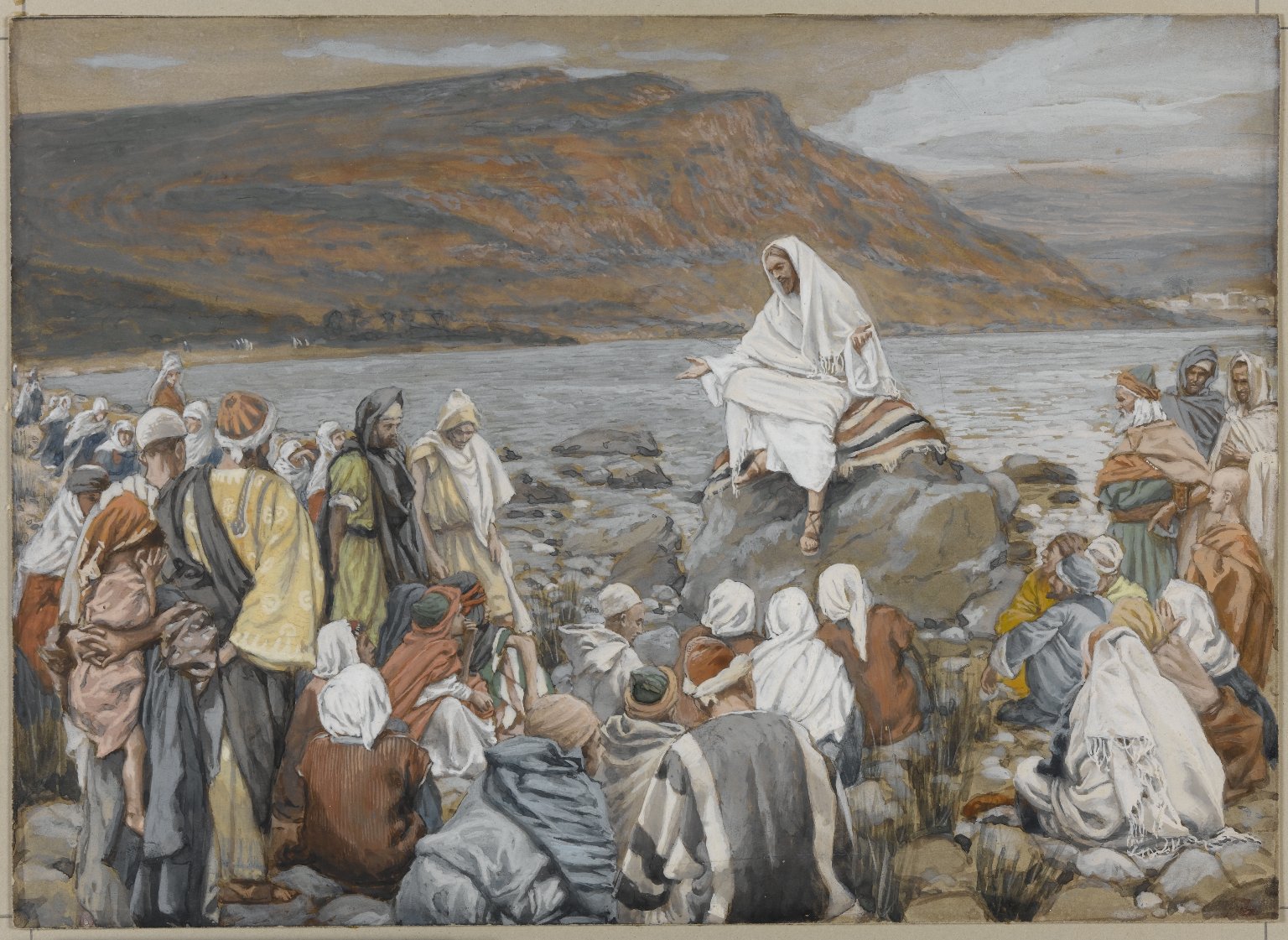
James Tissot, The Sermon on the Mount, Brooklyn Museum

Trinity VII: Generosity

Advertising media are constantly telling us that we need a new car, a larger house, the latest gadgets, expensive clothes, and exotic holidays. If we have all these things, we are told, then we will be truly happy. Covetousness is portrayed as a virtue. However, the more we have, the more we want. People are never satisfied. Even billionaires are happy to squeeze the poor if it will make them more money. St Paul, however, tells us that, as Christians, we should not focus our energies on the things of this world, and the author of Ecclesiastes reminds us that: ‘gwagedd llwyr yw’r cyfan’ ‘All is vanity’ (Eccles 1:2).

This morning’s Gospel begins with a striking scene. Jesus is teaching as He travels to Jerusalem, and a crowd gathers around Him. Then someone asks a question:

“Athro, dywed wrth fy mrawd am roi i mi fy nghyfran o’n hetifeddiaeth.”

“Teacher, tell my brother to divide the inheritance with me.” (Lk 12:13) 

As a religious teacher, Jesus could be called upon to make rulings on religious or legal matters. However he has no desire to do so:

Ond meddai ef wrtho, “Ddyn, pwy a’m penododd i yn farnwr neu yn gymrodeddwr rhyngoch?” A dywedodd wrthynt, “Gofalwch ymgadw rhag trachwant o bob math, oherwydd, er cymaint ei gyfoeth, nid yw bywyd neb yn dibynnu ar ei feddiannau.”

But he said to him, “Man, who made me a judge or arbitrator over you?” And he said to them, “Take care, and be on your guard against all covetousness, for one’s life does not consist in the abundance of one’s possessions.” (Lk 12:14-15)

Our Lord takes a family dispute over property and turns it into a teaching opportunity. The world around us tends to equate riches with success, but it is easy to forget that wealth is a means to an end, and not an end in itself. The unnamed man wants to get hold of his inheritance. He wants money so that he can spend it. He is obsessed with worldly things. Jesus is trying to encourage people to live in a different way: God’s way. 

To illustrate His point, Our Lord uses a parable:

“Yr oedd tir rhyw ŵr cyfoethog wedi dwyn cnwd da. A dechreuodd feddwl a dweud wrtho’i hun, ‘Beth a wnaf fi, oherwydd nid oes gennyf unman i gasglu fy nghnydau iddo?’ Ac meddai, ‘Dyma beth a wnaf fi: tynnaf f’ysguboriau i lawr ac adeiladu rhai mwy, a chasglaf yno fy holl ŷd a’m heiddo. Yna dywedaf wrthyf fy hun, “Ddyn, y mae gennyt stôr o lawer o bethau ar gyfer blynyddoedd lawer; gorffwys, bwyta, yf, bydd lawen.”’

“The land of a rich man produced plentifully, and he thought to himself, ‘What shall I do, for I have nowhere to store my crops?’ And he said, ‘I will do this: I will tear down my barns and build larger ones, and there I will store all my grain and my goods. And I will say to my soul, Soul, you have ample goods laid up for many years; relax, eat, drink, be merry.’” (Lk 12: 16-19)

In worldly terms, the man in the parable can be understood as behaving sensibly. But his concern with material success leads the man to think that he is in a safer position than he actually is. This is made clear at the end of the parable:

“Ond meddai Duw wrtho, ‘Yr ynfytyn, heno y mynnir dy einioes yn ôl gennyt, a phwy gaiff y pethau a baratoaist?’ Felly y bydd hi ar y rhai sy’n casglu trysor iddynt eu hunain a heb fod yn gyfoethog gerbron Duw.”

“But God said to him, ‘Fool! This night your soul is required of you, and the things you have prepared, whose will they be?’ So is the one who lays up treasure for himself and is not rich towards God.” (Lk 12:20-21)

Jesus is showing us that you cannot put pockets in your shroud. You cannot take wealth with you when you die. In the afterlife you do not need ‘stuff’. If the man had thought, How can I share what I have? How can I use my riches to alleviate poverty and make people’s lives better? Then he could have done some good. Instead, he has put all his efforts solely into increasing his own wealth. God does not want us to live selfish materialistic lives. But rather to help bring about a world where goods are shared, and where the hungry are fed. Yet we still see images of starving people, and many do not have a roof over their head. Whilst we cannot individually solve all the problems of the world, we can make an impact in our communities and beyond.

The Book Ecclesiastes, known also as Qoheleth, the Preacher, begins by stressing the fact that everything is vanity. All things are empty and worthless, in themselves, especially when compared to God. Our Heavenly Father longs for humanity to respond to His love and generosity, by living lives characterised by compassion and unselfishness. This is why Jesus preaches the Good News of the Kingdom of God: to wake humanity up to eternal realities and encourage us to live thoughtfully and generously here and now. 

This is the life which stores up treasure in Heaven, which we live when we have, ‘Rhowch eich bryd ar y pethau sydd uchod, nid ar y pethau sydd ar y ddaear’ ‘Set our minds on things that are above, not on things that are on earth’ (Col 3:2). This is what a Christian life really looks like, when lived out in the world. This is the sort of radically different life which can and does both change and transform the world: offering people a way that is different to an existence obsessed with possessions. This is the way of love and forgiveness, of knowing that we are loved and forgiven, no matter who we are or what we have done. With God’s help we can live as a community which embodies radical love and forgiveness in the world and offers others a new way of being, which turns the obsessions and values of the world on its head. The Christian way of life is that radical, that revolutionary, and can be lived out right here, today. Our Lord is speaking to us through His Scriptures. He calls us to live this life for the good of others, for our own good, and for the glory of the God who made us. God our Father loves us. He saves us from the tyranny of worldly possessions and sin, so that we can be free. Allowing us to focus on worshipping Him, and helping to make the Kingdom of God a reality.

This then is what the Church is called to be. As Christians, we need to be like a lamp set upon a lamp stand or a city upon a hill: shining, attractive, a light amidst the darkness of this world. We are called to represent a radical alternative: embodying life in all its fullness. So let us choose to live this way, together. Let us set our hearts on heavenly things. Let us build on Christ, our sure foundation. God is our treasure, and His wealth is self-giving love.

By gathering together this morning we are living out God’s kingdom here and now. Through our prayer, worship, and generosity, we can change the world; so that all people may be transformed and sing the praise to God, i Duw Dad, Duw y Mab, a Duw yr Ysbryd Glân. God the Father, God the Son, and God the Holy Spirit. I’r hwn y priodoler pob gogoniant, arglwyddiaeth, a gallu, yn awr, ac yn oes oesoedd. To whom be ascribed all glory, dominion and power, now and forever. Amen.

Rembrant The Parable of the Rich Fool, Gemäldegalerie, Berlin.

Trinity VI – Lord teach us how to pray

If I were to ask you if you could recite a text off by heart you might regale me with a poem, a passage from a book, or a speech from Shakespeare learned at school. If I then asked whether you knew any prayers off by heart you would probably say ‘The Lord’s Prayer’, ‘Y Gweddi’r Arglwydd’. Even if they do not know all the words, most people have heard the Lord’s Prayer. It is an important part of our Christian heritage.

Our readings this week focus on prayer. Christians know that God answers prayer. However, God may say, ‘Yes’ or ‘No’ or even ‘Not yet’. We may not like the answer, but one will be forthcoming. Prayer is both simple and mysterious. Simple, insofar as it is our conversation with the divine. Mysterious, in the fact that prayer changes us, and not the Almighty. So prayer is something of a paradox, being at the same time quite straightforward and also an enigma. We pray to God, but prayer doesn’t change God, it changes us. Pagans in Greece and Rome would bargain with their gods: if you do this for me, I will give you that. Jews and Christians, however, are profoundly different. We do not bargain with God, and we do not need to, because we are in a covenant relationship with our Heavenly Father who loves us.

It would be all too easy to see this morning’s first reading, where Abraham tries to save Sodom and Gomorrah, as being concerned with bargaining with God. However, prayer does not work in that way. What the reading from Genesis shows us is that we are in a covenant, a relationship with God, and that God is generous and loving. He wants the best for us.

The American Bishop Fulton J. Sheen summed it up as follows:

‘Prayer is helplessness casting itself on Power, infirmity leaning on Strength, misery reaching to Mercy, and a prisoner clamouring for Relief.’ Life Is Worth Living, Second Series (New York, 1954), p. 213.

In today’s Gospel the disciples ask Jesus:

“Arglwydd, dysg i ni weddïo, fel y dysgodd Ioan yntau i’w ddisgyblion ef.”

‘Lord teach us to pray, just as John taught his disciples’ (Lk 11:1).

Jesus and John the Baptist were cousins. They both preached about the need for both repentance and belief in the Good News. Also, they both taught their disciples how to pray. Virtually all Christian prayer can be described by one or more of four phrases: ‘please’, ‘thank you’, ‘I’m sorry’, and ‘I love you’. God does not need our prayers, we do. This is because praying allows us to open our hearts and lives to God, allowing Him to change us. Jesus answers His disciple’s request to teach them how to pray as follows:

Ac meddai wrthynt, “Pan weddïwch, dywedwch: ‘Dad, sancteiddier dy enw; deled dy deyrnas; dyro inni o ddydd i ddydd ein bara beunyddiol; a maddau inni ein pechodau, oherwydd yr ydym ninnau yn maddau i bob un sy’n troseddu yn ein herbyn; a phaid â’n dwyn i brawf.’” 

He said to them, ‘Say this when you pray: ‘“Father, may your name be held holy, your kingdom come; give us each day our daily bread, and forgive us our sins, for we ourselves forgive each one who is in debt to us. And do not put us to the test.”’  (Lk 11:2-4)

The version of Jesus’ words we are most familiar with is that found in Matthew’s Gospel, which is slightly longer than Luke’s prayer. But both contain the same elements. The prayer begins by calling God, ‘Abba’ ‘Father’ ‘Tâd’. Such a term expresses our close relationship with our Creator. The idea that God’s name should be kept holy goes hand in hand with the desire that God’s Kingdom may come. Christianity is all about the establishment of the Kingdom of God: that God may rule over our hearts and our lives.

Next, we ask God to feed us, to forgive us our sins, as we forgive those who sin against us, and to free us from temptation. It is important to note that every celebration of the Eucharist begins with us all acknowledging our own shortcomings and asking God’s forgiveness. Saying sorry to God is important, because it keeps us humble, and helps to maintain our relationship with God, and with each other. We all make mistakes, you do, I certainly do. Recognizing this is the start of a process which allows us to grow in virtue and holiness, through God’s love. The high point of the Eucharist is when God feeds us with His Body and Blood, providing us with spiritual food to nourish our souls. All our food is a gift from God, and being thankful for it, just like being humble, helps to keep us close to God. If you don’t already do so, try to get into the habit of saying a few words of thanks to God before you eat a meal.

There are good reasons why Christians regularly pray this prayer, which we call The Lord’s Prayer, Y Gweddi’r Arglwydd. Jesus has told us how to pray and gave us these words. Similarly, we celebrate the Eucharist because Jesus told us to ‘do this in memory of Him’ and so we do. We use the Lord’s Prayer when we pray, because it honours God, and it forms us as Christians. We will soon pray it together before Communion, asking that God will continue the process of transforming us day by day into His image and likeness. 

In the Gospel reading Jesus continues to teach His disciples using parables. In this narrative, there is a late-night hospitality emergency. A friend is on a journey (just like Jesus and His disciples), and arrives at your home (just like Jesus visited Mary and Martha last week). Naturally you want to be hospitable as a sign of your friendship. So, you pop round to a next door and ask to borrow some food. However, the initial response you receive from your neighbour is not very positive:

‘Paid â’m blino; y mae’r drws erbyn hyn wedi ei folltio, a’m plant gyda mi yn y gwely; ni allaf godi i roi dim iti’, rwy’n dweud wrthych, hyd yn oed os gwrthyd ef godi a rhoi rhywbeth iddo o achos eu cyfeillgarwch, eto oherwydd ei daerni digywilydd fe fydd yn codi ac yn rhoi iddo gymaint ag sydd arno ei eisiau.’

“Do not bother me. The door is bolted now, and my children and I are in bed; I cannot get up to give it you.” I tell you, if the man does not get up and give it him for friendship’s sake, persistence will be enough to make him get up and give his friend all he wants. (Lk 11:7-8)

Jesus shows that, despite the neighbour not wanting to get up and be bothered with the request for food, because the person is persistent and stays there, disregarding the initial reluctance, his request is granted. Perseverance is rewarded. The point Our Lord is making is that God hears our prayers and answers our requests. We might need to ask more than once, and commit time to prayer, but we will not be ignored.

‘Ac yr wyf fi’n dweud wrthych: gofynnwch, ac fe roddir i chwi; ceisiwch, ac fe gewch; curwch, ac fe agorir i chwi. Oherwydd y mae pawb sy’n gofyn yn derbyn, a’r sawl sy’n ceisio yn cael, ac i’r un sy’n curo agorir y drws.’

‘So I say to you: Ask, and it will be given to you; search, and you will find; knock, and the door will be opened to you. For the one who asks always receives; the one who searches always finds; the one who knocks will always have the door opened to him.’ (Lk 11:9-10)

The phrase ‘knock, and the door will be opened to you’ ‘curwch, ac fe agorir i chwi’ reinforces the teaching in the parable. The neighbour opens the door and gives the requested provisions. Jesus then develops His teaching, by drawing a comparison between the lesser and the greater. This is a common rabbinic practice:

‘Os bydd mab un ohonoch yn gofyn i’w dad am bysgodyn, a rydd ef iddo sarff yn lle pysgodyn? Neu os bydd yn gofyn am wy, a rydd ef iddo ysgorpion? Am hynny, os ydych chwi, sy’n ddrwg, yn medru rhoi rhoddion da i’ch plant, gymaint mwy y rhydd y Tad nefol yr Ysbryd Glân i’r rhai sy’n gofyn ganddo.’

‘What father among you would hand his son a stone when he asked for bread? Or hand him a snake instead of a fish? Or hand him a scorpion if he asked for an egg? If you then, who are evil, know how to give your children what is good, how much more will the heavenly Father give the Holy Spirit to those who ask him!’ (Lk 11:11-13)

The Good News of the Kingdom is that God answers prayer. Not only that, but He gives us more than we ask Him for. God also grants us the Holy Spirit. This is an important concept in the wider narrative of Luke’s Gospel and the Acts of the Apostles, where the Church is filled with God’s Spirit. God answers prayer because He is our Creator, and we are in a special relationship with Him. In today’s Old Testament reading God listens to Abraham’s pleas for mercy and then grants them. 

Turning to St Paul’s Letter to the Colossians, the apostle can proclaim baptism as the way to salvation, because this enables us to share in Christ’s Death and Resurrection, and the forgiveness of our sins:

‘Y mae wedi ei bwrw hi o’r neilltu; fe’i hoeliodd ar y groes.’ 

‘he has done away with it by nailing it to the cross’ (Col 2:14)

God cancels our debt by paying it Himself, overcoming evil and sin through an outpouring of healing love. This is the demonstration that God loves us and hears our prayers, and so we continue to remember the Passion through our celebration of the Eucharist. God forgives our sins, and gave His life for us, nailing our sins to the Cross. He suffered in His flesh so that we who have died with Christ in our baptism may also share His risen life. That is why Jesus can assure us that God listens to our prayers and answers them, giving us the good things we need.

My brothers and sisters in Christ, through practising both prayer and action, may we be agents of God’s love and grace in the world. May we transform our homes, our communities, and the whole world. Filled with God’s generous love, compassion and forgiveness, let us give glory to God, Duw Dad, Duw y Mab, a Duw yr Ysbryd Glân. God the Father, God the Son, and God the Holy Spirit. I’r hwn y priodoler pob gogoniant, arglwyddiaeth, a gallu, yn awr, ac yn oes oesoedd. To whom be ascribed all glory, dominion and power, now and forever. Amen.

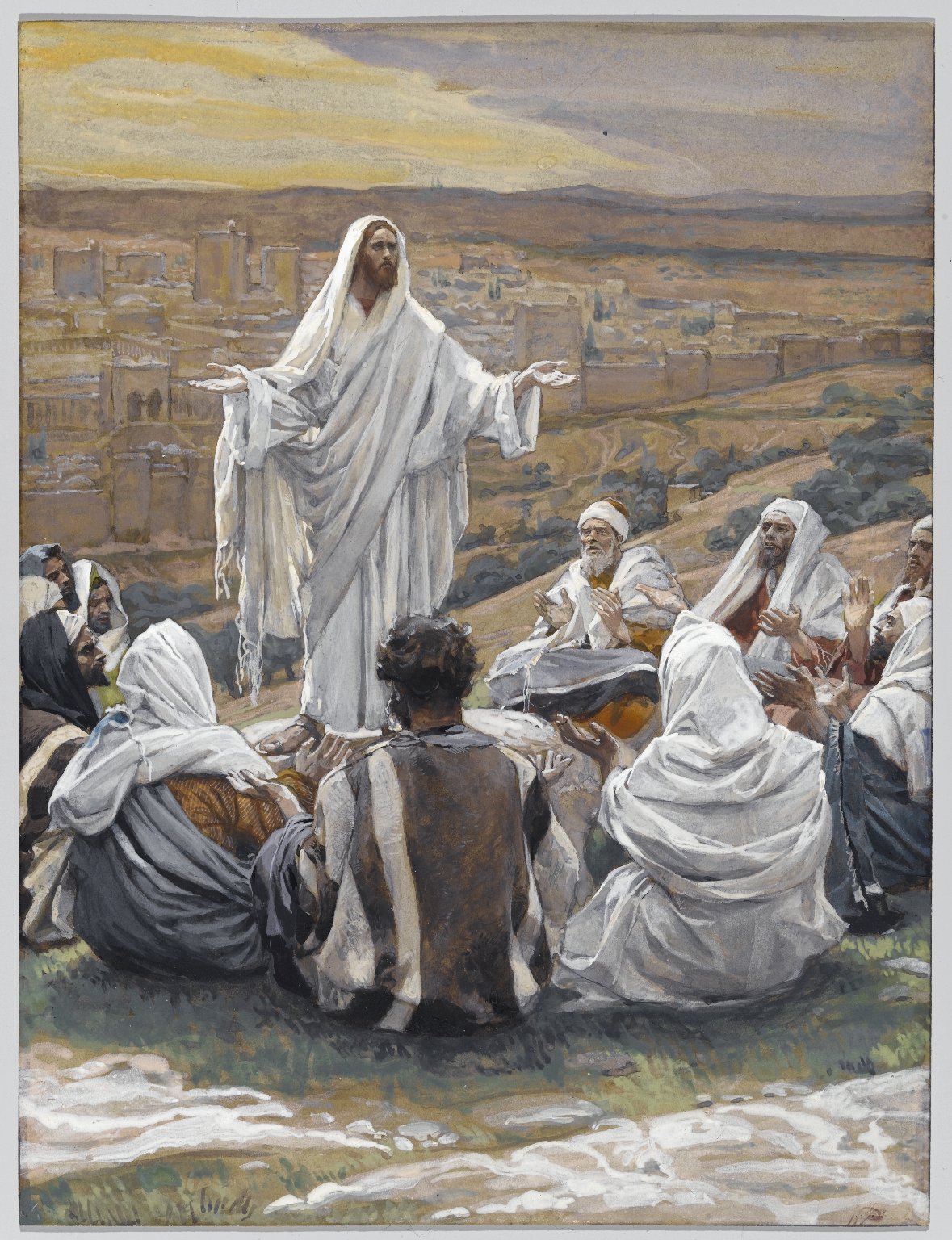
James Tissot – The Lord’s Prayer [Brooklyn Museum]

Trinity V – Mary & Martha

Life is all about decisions. The choices that we make can have a massive effect upon our lives. We often think of decisions as ‘either/or’ alternatives. However, we may be making a false distinction. Living the Christian life is often much more a case of ‘both/and’ rather than ‘either/or’. Nowhere is this shown with greater clarity than through the question of faith and action. These two concepts are not in opposition: they are two sides of the same coin. To make the Kingdom of God a reality we need both contemplation and practical application. If work and prayer are kept in balance, then our duties towards God and our neighbour can be fulfilled, and we can grow in faith and love. As Christians we need to demonstrate our faith by being hospitable and welcoming, as well as prayerful. 

Hospitality is the focus of this morning’s first reading from the Book of Genesis. God appears to Abraham at the Oak of Mamre near the town of Hebron, nineteen miles south of Jerusalem. Abraham is visited by three angels and looks after them, offering them hospitality, and taking care of them. In return the Patriarch is blessed with the promise of a son. From early times, biblical interpreters understand these three angels as symbolising the Trinitarian nature of God as Father, Son, and Holy Spirit, revealing their nature to Abraham, our father in faith. This view became particularly relevant during the fourth-century debate on the nature of God, which led to the formation of the Creed we will soon recite together. In this passage from Genesis, we see both what God is like and how we should respond to God: with generous hospitality, care and attention.

In today’s Gospel, Jesus is still travelling. As there were no hotels or service stations, the only way to eat, drink, and rest was through hospitality. Our Lord is welcomed into her home by a woman named Martha: 

‘Yr oedd ganddi hi chwaer a elwid Mair; eisteddodd hi wrth draed yr Arglwydd a gwrando ar ei air.’

‘And she had a sister named Mary, who sat at the Lord’s feet and listened to his teaching’ (Lk 10:39)

These sisters, Mary and Mary, may well be the same women who appear in John’s Gospel as the sisters of Lazarus, and who live in Bethany. There they are described as friends of Jesus who regularly provide hospitality for Him and His followers. We are told that Mary is giving Jesus her undivided attention, she sits at His feet, as a student would sit at the feet of their teacher. Her sister does not join her as she is so busy looking after the guests:

‘Ond yr oedd Martha mewn dryswch oherwydd yr holl waith gweini, a daeth ato a dweud, “Arglwydd, a wyt ti heb hidio dim fod fy chwaer wedi fy ngadael i weini ar fy mhen fy hun? Dywed wrthi, felly, am fy nghynorthwyo.”’

‘But Martha was distracted with much serving. And she went up to him and said, “Lord, do you not care that my sister has left me to serve alone? Tell her then to help me” (Lk 10:40)

Like the lawyer in the Parable of the Good Samaritan, Martha is attempting to justify herself. In order to do this, she blames others — in fact her own sister — to cover up the fact that she is anxious and troubled with the cares of the world. She allows these worries to take precedence over the Gospel. Martha has shown Jesus a hospitable welcome, but then she tries to involve Him in a domestic squabble, which is centred on justifying her own busyness. Jesus is a teacher, proclaiming the Good News of the Kingdom. While it is important that He and his disciples are fed and cared for, the immediate concern is to give Our Lord their undivided attention, and listen to what He has to say:

‘Atebodd yr Arglwydd hi, “Martha, Martha, yr wyt yn pryderu ac yn trafferthu am lawer o bethau, ond un peth sy’n angenrheidiol. Y mae Mair wedi dewis y rhan orau, ac nis dygir oddi arni.”’

‘But the Lord answered her, “Martha, Martha, you are anxious and troubled about many things, but one thing is necessary. Mary has chosen the good portion, which will not be taken away from her.”’ (Lk 10:41-42)

Jesus does not tell Martha off, rather He is encouraging, calming her down, and showing her a better way of living. Only one thing is necessary: for a host to pay attention to a guest, as Abraham did at the Oak of Mamre in the first reading this morning .

The point is not simply to prefer the contemplative to the practical, or the spiritual to the physical. Instead we need to balance our physical needs with our spiritual ones. Martha is too wrapped up in her own affairs and has forgotten what is really important. Jesus does not want special treatment, or a lavish banquet with lots of dishes. What He wants are people who pay attention to what He has to say. Martha has not chosen a bad portion, service and hospitality are important. However, attention — staying close to Jesus, listening to what He says, and not being distracted — is how we grow as Christians. This is the good portion that Christ speaks of. 

Jesus of Nazareth frequently breaks down cultural barriers. Last week we saw a Samaritan, a complete outcast held up as a model of neighbourly love and compassion. This week Mary sits at Christ’s feet, breaking a cultural taboo regarding women. She wants to be taught, and therefore displays both love and attention. Jesus tells us that, like Mary, we too should be attentive to God and His message for us in the Gospel. In doing this we emulate Mary, and choose the better part. This is a choice which has a moral dimension. When we truly listen attentively to what God says to us, our actions and our character are formed, helping our growth in holiness. Nourished by Word and Sacrament, we can progress in living out the graces which we received in our baptism, and prepare for our inheritance with the Saints in glory. We do not achieve this through prayer and contemplation alone, but by making our prayer and our work, all that we do, and all that we are, a response to God and to our neighbour. By responding in this way we are truly living out lives of Christian love. Such love is the nature of God and binds together the persons of the Trinity. This is a powerful catalyst which transforms both us and our world.

My brothers and sisters in Christ, through practising both prayer and action, may we be agents of God’s love and grace in the world. May we transform our homes, our communities, and the whole world. Filled with God’s love, and compassion, let us give glory to God, Duw Dad, Duw y Mab, a Duw yr Ysbryd Glân. God the Father, God the Son, and God the Holy Spirit. I’r hwn y priodoler pob gogoniant, arglwyddiaeth, a gallu, yn awr, ac yn oes oesoedd. To whom be ascribed all glory, dominion and power, now and forever. Amen.

Trinity I

Children love to ask questions: who? what? where? when? and, especially, why? The Questions we ask and the Answers we give can say an awful lot about who we are. One of the most fundamental question is one concerning identity: ‘Pwy wyt ti?’ ‘Who are you?’ My response would be: ‘I am Adrian, and I am a priest’. The name I was given in baptism, and the fact that God has called me to share in the priesthood of His Son Jesus Christ, define who I am, and what I do. They are why I am standing here, saying this to you, today.

From the time of their exile in Babylon, and before, the people of Israel had looked for a Messiah, a leader of the House of David. They sought someone who would bring them the peace and security that they longed for. The first reading this morning comes from the prophecy of Zechariah, and was written perhaps as late as two hundred years before the birth of Jesus Christ. At this time the Jewish people were struggling under Greek rulers who tried to abolish their identity, and all that they held sacred. The prophet Zechariah looks forward to a messianic future, when the people of the House of David :

‘edrychant ar yr un a drywanwyd ganddynt, a galaru amdano fel am uniganedig, ac wylo amdano fel am gyntafanedig.’

‘They will look on the one whom they have pierced; they will mourn for him as for an only son, and weep for him as people weep for a first-born child’ (Zech 12:10)

The mention of looking upon one whom they have pierced anticipates Christ and His Crucifixion, as noted by John’s Gospel: ‘They will look on him whom they have pierced’ (19:37). Zechariah also writes of the outpouring of a ‘spirit of kindness and prayer’, just as we have seen at Pentecost. Here Jesus’ Death, Resurrection and gift of the Holy Spirit are clearly prefigured: God’s saving plan is announced in the words of the prophet. A few verses later, Zechariah prophesies:

‘Yn y dydd hwnnw bydd ffynnon wedi ei hagor i linach Dafydd ac i drigolion Jerwsalem, ar gyfer pechod ac aflendid.’

‘On that day there shall be a fountain opened for the house of David and the inhabitants of Jerusalem to cleanse themselves from sin and uncleanness.’ (Zech 13:1)

This is what the Cross achieves for those who are washed in the Blood of Lamb, as we are at our Baptism. Christ’s death takes away our sins. Through Baptism and the Eucharist we share in Jesus’ Death and are raised to new life with Him. When St Paul writes to the Galatian Church, he stresses their common baptism:

‘Oblegid yr ydych bawb, trwy ffydd, yn blant Duw yng Nghrist Iesu. Oherwydd y mae pob un ohonoch sydd wedi ei fedyddio i Grist wedi gwisgo Crist amdano. Nid oes rhagor rhwng Iddewon a Groegiaid, rhwng caeth a rhydd, rhwng gwryw a benyw, oherwydd un person ydych chwi oll yng Nghrist Iesu.’

‘You are, all of you, sons of God through faith in Christ Jesus. All baptised in Christ, you have all clothed yourselves in Christ, and there are no more distinctions between Jew and Greek, slave and free, male and female, but all of you are one in Christ Jesus.’ (Gal 3:26-28)

St Paul is preaching a profound message. He explains that none of the distinctions which the world makes matter in God’s eyes. There is no difference. All people are one in Christ. There is a radical equality in the Church: all are welcome to come and experience God’s saving love. When Paul preached, nearly two thousand years ago, this was a revolutionary idea, and it still is today. We are all one in Christ: young and old, rich and poor. It doesn’t matter who we are, where we are from, or anything else. All that matters is that we find our true identity in Christ. This makes us heirs of God’s promise: that we would enjoy eternity in Heaven with our Creator and Sustainer.

In today’s Gospel Jesus begins by asking His disciples this question:

“Pwy y mae’r tyrfaoedd yn dweud ydwyf fi?”

“Who do the crowds say that I am?” (Lk 9:18)

His followers reply that the people think a variety of things: John the Baptist, Elijah, or another of the prophets. They recognise Jesus’ proclamation of the Good News of the Kingdom and understand Him in terms that are familiar to them. Christ, however, presses the issue by asking His disciples another question:

“pwy meddwch chwi ydwyf fi?”

“But who you say that I am?” (Lk 9:20)

Peter answers, ‘Meseia Duw, the Christ of God’ (Lk 9:20). By this answer Peter confesses that Jesus is the Messiah, God’s Anointed, the fulfilment of Zechariah’s prophecy. The disciple’s confession of belief is also our confession of belief as Christians: Jesus is the Christ, the Saviour, the Son of God. As we will soon declare in the words of the Nicene Creed.

Jesus instructs the disciples that they should not communicate this knowledge to anyone, at this time. He then explains what is about to happen:

“”Y mae’n rhaid i Fab y Dyn,” meddai, “ddioddef llawer a chael ei wrthod gan yr henuriaid a’r prif offeiriaid a’r ysgrifenyddion, a’i ladd, a’r trydydd dydd ei gyfodi.”

“The Son of Man is destined to suffer grievously, to be rejected by the elders and chief priests and scribes and to be put to death, and to be raised up on the third day” (Lk 9:22)

Jesus tells the disciples about His Passion, Death and Resurrection, because it is His mission. He has come to reconcile God and humanity, and to restore and heal our broken relationship. Christ then invites His followers to follow His example:

“Os myn neb ddod ar fy ôl i, rhaid iddo ymwadu ag ef ei hun a chodi ei groes bob dydd a’m canlyn i. Oherwydd pwy bynnag a fyn gadw ei fywyd, fe’i cyll, ond pwy bynnag a gyll ei fywyd er fy mwyn i, fe’i ceidw. Pa elw a gaiff rhywun o ennill yr holl fyd a’i ddifetha neu ei fforffedu ei hun?

‘If anyone wants to be a follower of mine, let him renounce himself and take up his cross every day and follow me. For anyone who wants to save his life will lose it; but anyone who loses his life for my sake, that man will save it.’ (Lk 9:23-24)

At the beginning of His public ministry, Jesus invites people to repent and believe. Now He calls us to self-denial, and to embrace the Cross. Christ asks us to accept the most shameful way to die, a form of torture, used by the Romans to execute slaves. As those saved and made free by the Cross of Christ, we take up our own cross and follow Jesus. We imitate Him, in selfless love and devotion, and we bear the weight of the cross in life’s difficulties and disappointments. Following Christ is hard. It is a struggle, and we cannot just rely solely upon our own willpower to succeed. Instead, the Christian life needs to be a corporate effort, something we do together, trusting in God’s Grace to be at work in us, both individually and as a community.

Christ wants us to lose our lives for His sake, and find freedom in His service. There is something paradoxical in Jesus’ teaching. We are to find perfect freedom in obedience, in service of God and each other. Each of us needs to be humble enough to accept what God offers us, and be prepared to try to live it out together. It isn’t about us, but rather letting God be at work in us. When we co-operate with God, and live in love, and joy, and peace, we flourish as human beings. This is liberating, and it is what Our Heavenly Father wants for us. This is what true freedom looks like, and we are called to live it together, today and every day.

So, as we celebrate the joy of our Salvation, let us pray that we may be changed by God’s love, and share this love with others. Let us give thanks for the mystery and wonder that is God, Duw Dad, Duw y Mab, a Duw yr Ysbryd Glân. God the Father, God the Son, and God the Holy Spirit. I’r hwn y priodoler pob gogoniant, arglwyddiaeth, a gallu, yn awr, ac yn oes oesoedd. To whom be ascribed all glory, dominion and power, now and forever. Amen.

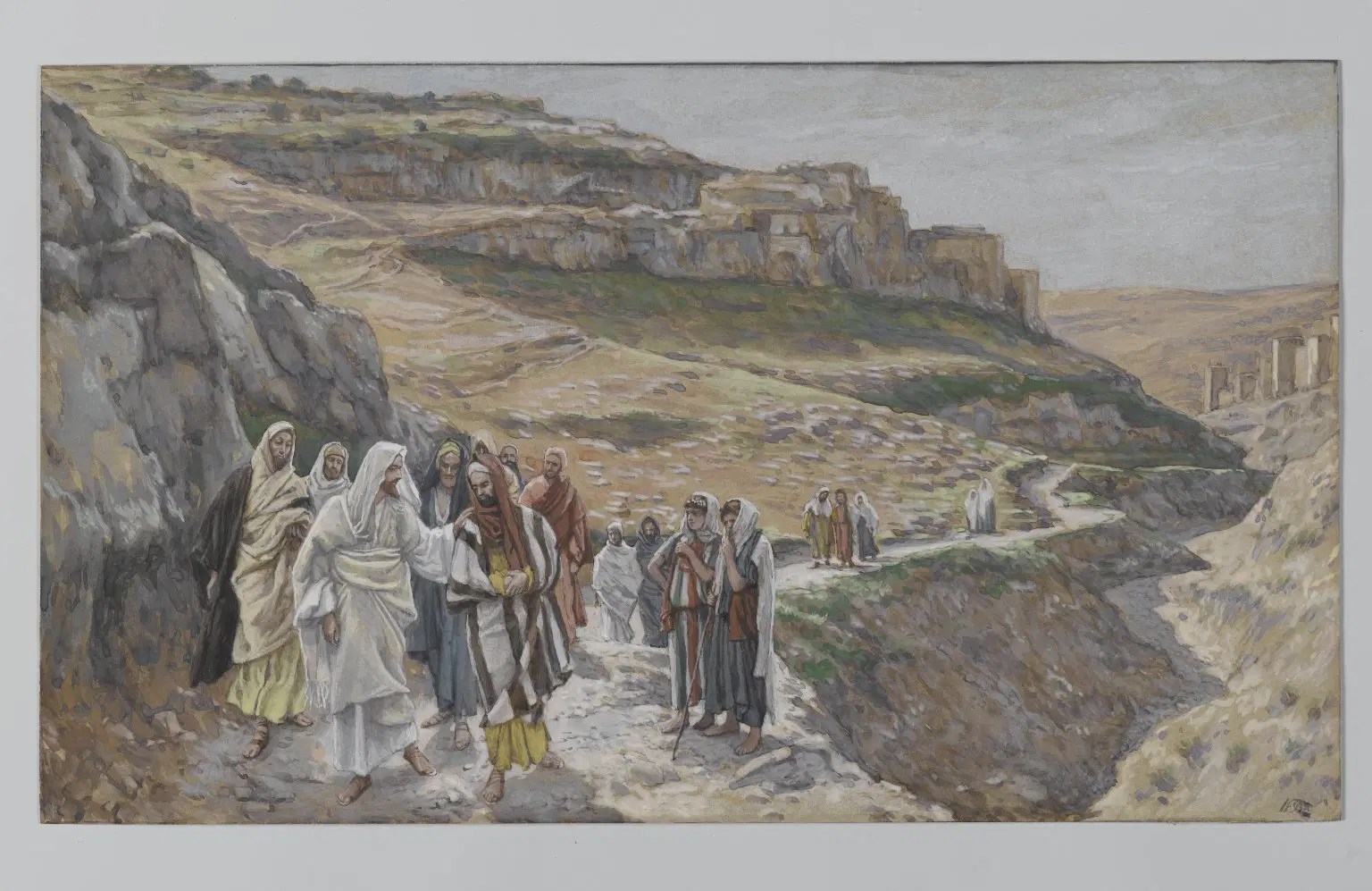
Jesus discourses with his disciples – James Tissot (Brooklyn Museum)

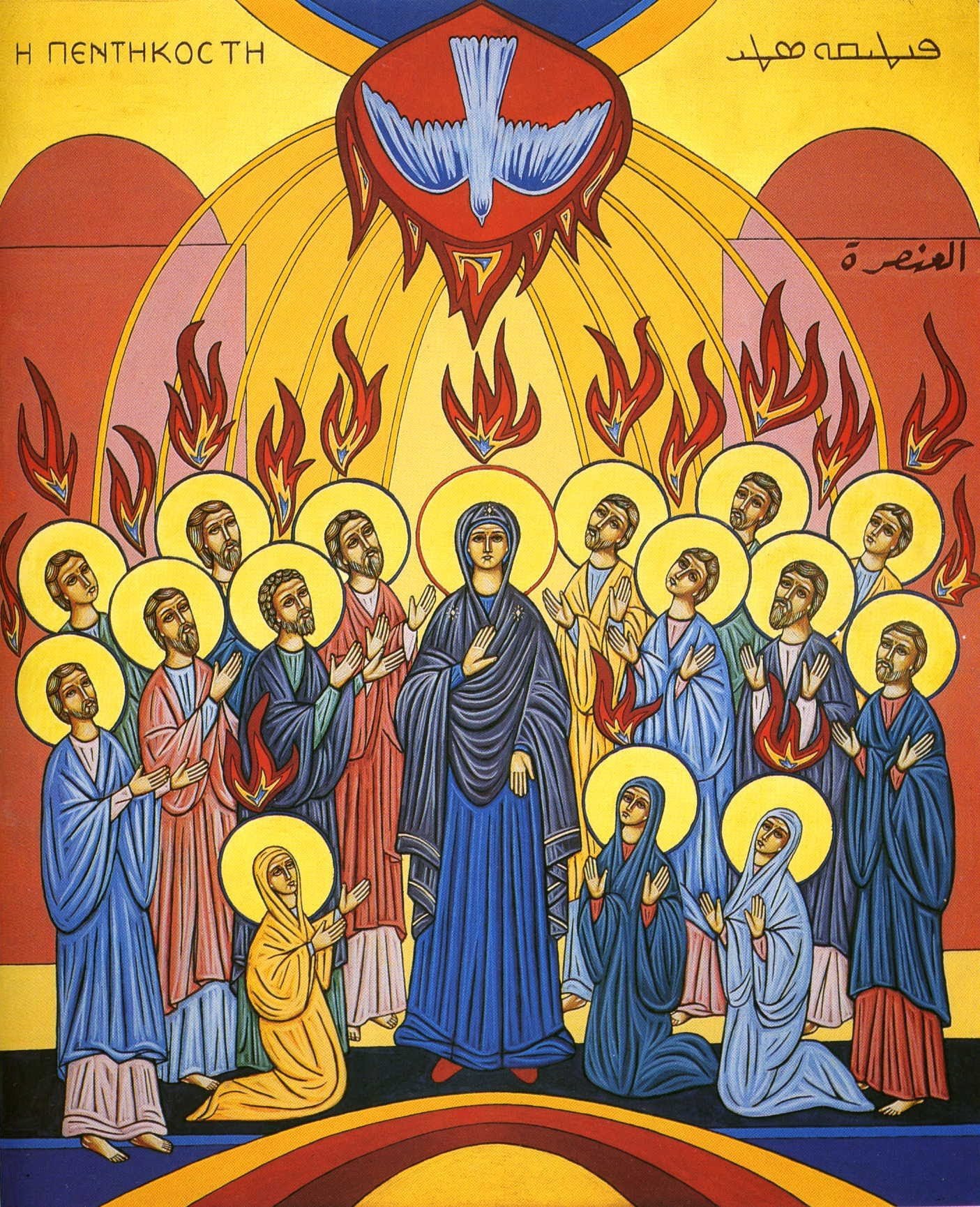
Pentecost 2025

Every Sunday, and also on solemn Feast days, Christians make a public declaration of their faith in God, Father, Son, and Holy Spirit, using the words of the Nicene Creed — which we will all say together in a few minutes time. This statement of belief was drawn up seventeen hundred years ago at the First Ecumenical Council, which was called by the Roman Emperor Constantine to sort out divisions within the Church concerning the Divinity of Jesus Christ. The council met at Nicaea in Asia Minor (modern day Turkey) and comprised of three hundred and eighteen bishops of the Church. One of these was Nicholas of Myra, St Nicholas, the patron saint of this church. 

Questions about belief matter. They have the potential to divide the Church. Taking it away from its core purpose of being united in a common faith, and making a consistent proclamation of that faith. This is the situation in today’s reading from the Acts of the Apostles. Having been promised the Holy Spirit by Our Lord at His Ascension, the disciples wait and pray. At Pentecost they are filled with the Spirit. Emboldened, they are able to tell Jews from all over the Mediterranean world, who have gathered in Jerusalem, who Jesus is, and what He has done. From this moment on the disciples are known as Apostles from the Greek ἀπόστολος (meaning one who is sent, a messenger). The message they deliver is that all people should repent and believe the Good News of Jesus Christ. 

The outpouring of the Holy Spirit is not a one-off event, but rather a permanent state of affairs. This is how God continues to be active in the world: inspiring and strengthening Christ’s followers in living and proclaiming their faith. In John’s Gospel, Jesus promises His disciples:

‘Os ydych yn fy ngharu i, fe gadwch fy ngorchmynion i. Ac fe ofynnaf finnau i’m Tad, ac fe rydd ef i chwi Eiriolwr arall i fod gyda chwi am byth,’

‘If you love me, you will keep my commandments. And I will ask the Father, and he will give you another Helper, to be with you for ever.’ (Jn 14:15-16)

The promise is that God’s Spirit will be present in perpetuity. God will continue to pour out His Spirit to strengthen the Church. This is what we are celebrating today at Pentecost. Indeed, during the Eucharistic Prayer I, as your priest,  will pray that God continues to do this and ‘trwy nerth dy Ysbryd, i’r rhoddion hyn o fara a gwin fod i ni ei gorff a’i waed ef’ ‘that, by the power of your [God’s] Spirit, these gifts of bread and wine may be for us his body and blood’. Our heavenly Father makes wonderful things happen. Disciples who have been scared and have been in hiding are transformed into fearless evangelists, going out to preach Christ’s message of love and forgiveness. They become enthusiastic fellow-workers in the vineyard. God is able to completely change people and situations, because His love for us knows no bounds.  

The 318 bishops, who met at Nicaea, in 325AD, were able to put into words what Christians believe because they began their deliberations by praying for the gift of the Holy Spirit to guide and direct their thoughts and actions. This is entirely in line with Our Lord’s teaching in the Gospel: 

‘Ond bydd yr Eiriolwr, yr Ysbryd Glân, a anfona’r Tad yn fy enw i, yn dysgu popeth ichwi, ac yn dwyn ar gof ichwi y cwbl a ddywedais i wrthych.’

‘But the Helper, the Holy Spirit, whom the Father will send in my name, he will teach you all things and bring to your remembrance all that I have said to you.’ (Jn 14:26)

The Bishops, including St Nicholas, were strengthened by God to proclaim the truth, and to bear witness to it, in the face of those who would deny it. They bore witness to the truth of Jesus Christ: true God and true man, who promised the gift of the Holy Spirit. God’s Spirit gives Christians strength and brings us together as brothers and sisters in a new family, which we call the Church. 

It is thanks to the preaching of the Gospel begun by the Apostles at Pentecost, and continued by their successors at Nicaea, that we are here today. It is how billions of people have come to know, love, and serve Our Lord Jesus Christ. As people who are in Christ, who have entered the Church through our Baptism, we are given a very important job to do. We need to tell people about Jesus!

The world-wide Christian Church is wonderful in its diversity. We are all different, we do not speak the same language, or have the same culture. However, we are all equally empowered through having received the Holy Spirit at our Baptism, in our Confirmation, and through all the sacramental actions of the church, which are the outward and visible signs of the inward and spiritual grace of God. This is how the Holy Spirit works. This is how God builds us up together in love. Through the Eucharist, through prayer and through Scripture, we are nourished spiritually to keep doing all that God desires of us.

So, my brothers and sisters in Christ, let us pray earnestly for the gift of the Spirit. Just as St Nicholas was inspired by the Spirit, may God also fill us with His love and equip us to proclaim the Good News of the Kingdom. May the fire of the Holy Spirit embolden us to encourage others to come to know, and love Duw Dad, Duw y Mab, a Duw yr Ysbryd Glân. God the Father, God the Son, and God the Holy Spirit. I’r hwn y priodoler pob gogoniant, arglwyddiaeth, a gallu, yn awr, ac yn oes oesoedd. To whom be ascribed all glory, dominion and power, now and forever. Amen.

Palm Sunday Evensong

THIS evening I would like to talk about the Apostle John. The name ‘John’ means ‘The Lord has worked grace’. John the Apostle is the son of Zebedee and Salome (the sister of the Blessed Virgin Mary). He is also the brother of James, and the cousin of Jesus. In the Bible, John is called ‘the beloved disciple’, the disciple whom Jesus loved. He is also believed to be the author of the Gospel which now bears his name, as well as three canonical letters and the Book of Revelation. While scholars tend to ascribe some or all of these works to others, I do not wish to. Time tonight does not allow me to examine all of John’s writings in detail, so I must be selective. However, I strongly urge you to read John’s works and immerse yourself in the richness of his vision.

In the Synoptic Gospels (Matthew, Mark, & Luke) we first meet our soon-to-be disciple by the shore of the Sea of Galilee with his father, Zebedee and his brother, James. In John’s Gospel, however, there is no mention of him until the Last Supper. The apostle is then also present at the Crucifixion, standing at the foot of the Cross with Mary, the mother of Jesus. Along with Simon Peter, he is the first witness of the Resurrection. John is also one of the seven disciples who have breakfast with the Risen Christ by the Sea of Galilee, when Jesus asks Simon Peter three times if he loves him. At the end of his Gospel John writes the following authorial comment:

This is the disciple who is bearing witness about these things, and who has written these things, and we know that his testimony is true. Now there are also many other things that Jesus did. Were every one of them to be written, I suppose that the world itself could not contain the books that would be written. (Jn 21:24-25)

John is someone we can trust, whose writings help us to ponder the mysteries of God’s love. Elsewhere, in the Synoptic Gospels, John appears as part of an inner circle of disciples. He is with Peter and James at the Transfiguration, and at several miracles where not all the Twelve are present. What then are we to make of this apostle? The various mentions of him in Scripture show that he is a beloved disciple, one loved by God, who loves God deeply. Love is something of a defining characteristic in John’s writing, especially in his Gospel and Letters. But even love must be set in a wider context, namely God.

John’s Gospel begins at the beginning, a very good place to start.‘In the beginning was the Word, and the Word was with God, and the Word was God.’ (Jn 1:1) God is trinitarian: Father, Son, and Holy Spirit (Duw Dad, Mab ac Ysbryd Glân). He always has been, and always will be. ‘The Word became flesh and dwelt among us’ (Jn 1:14). The word translated as ‘dwelt’ actually means ‘pitched his tent’, tabernacled among us, like a nomad, or a shepherd, or an exile wandering like Israel after the Exodus from Egypt.

John then introduces his namesake, the Baptist, who on seeing his cousin Jesus, exclaims ‘Behold, the Lamb of God, who takes away the sin of the world!’ (Jn 1:29). Jesus calls disciples, and suddenly they are at a wedding in Cana, where the wine runs out. To prevent shame and ‘social death’ for the hosts, Our Lord turns a large amount of water into wine. God is generous, and the messianic banquet is a reality! There are other signs of Jesus’ divinity and God’s love for humanity. In John’s Gospel, Our Lord is keen to say, ‘I am’: ‘I am the Good Shepherd’ ‘I am the Bread of Life’ ‘I am the Way, the Truth, and the Life’. Just as God reveals himself to Moses at the Burning Bush, saying: ‘I am who I am’. This is the same God who took flesh in the womb of the Virgin Mary.

It is when John is with Mary at the foot of the Cross that the Beloved Disciple is singled out for the second time. Just before Christ dies He looks down, and says:

‘Woman behold your Son.’ Then he said to the disciple, ‘Behold your mother!’ And from that hour the disciple took her to his own home (Jn 19:26-27)

Something wonderful is happening here. On the hill of Calvary, on Good Friday, Jesus is starting the Church, with His Mother (the laity), John the Beloved Disciple (the Clergy), and Himself (Our Great High Priest). Jesus offers himself as both priest and sacrifice upon the altar of the Cross to take away our sins, and to restore our relationship with God and with each other. John and Mary become a new family, not because of ties of blood and kinship (though they are related), but through Jesus. Likewise, every Christian is a brother or sister in Christ. We are all children of God.

From this verse the tradition arises that Mary and John lived together in Ephesus, south of Smyrna, (modern İzmir). This tradition maintains that the Apostle was exiled to the island of Patmos for his preaching of the Good News. There John lived in a cave where he had the visions which have come down to us as the Apocalypse, the Revelation of St John the Divine. Before his exile, during the reign of the emperor Domitian, it is recorded that John survived being immersed in a vat of boiling oil near the Porta Latina, the Latin Gate on the south of the Aurelian Wall of the City of Rome. This miraculous event was remembered in a feast celebrated (until 1960) on 6th May, and is found in the Calendar of the 1662 Book of Common Prayer. John’s main feast day, however, is the 27th December. Significantly, he is the only apostle not to have suffered a martyr’s death, and so the liturgical colour of his feast days is white and not red — the usual colour for a martyr. 

In 2007, Pope Benedict XVI wrote that the example of St John teaches us that:

‘The Lord wishes to make each of us a disciple who lives in personal friendship with him. To achieve this, it is not enough to follow him and listen to him outwardly: it is also necessary to live with him and like him. This is only possible in the context of a relationship of deep familiarity, imbued with the warmth of total trust. This is what happens between friends: for this reason Jesus said one day: “Greater love has no man than this, that a man lay down his life for his friends … No longer do I call you servants, for the servant does not know what his master is doing; but I have called you friends, for all that I have heard from my Father I have made known to you” (Jn 15:13, 15)’  [ Pope Benedict XVI, Christ and his Church: Seeing the face of Jesus in the Church of the Apostles, CTS 2007: 72-73.]

The way to understand John and his theology is through the prism of love. As the apostle writes:

“For God so loved the world, that he gave his only Son, that whoever believes in him should not perish but have eternal life. For God did not send his Son into the world to condemn the world, but in order that the world might be saved through him.” (Jn 3:16-17)

These words are echoed in John’s First Letter:

‘By this we know love, that he laid down his life for us, and we ought to lay down our lives for the brothers.’ (1Jn 3:16)

God loves us, and becomes one of us, so that we may have life in all its fulness. Love means willing the good of another. God’s love for us shows that our flourishing is His will. This is the reason for the Incarnation, our Salvation, and Redemption. Love is also the source for both the words of teaching and the signs which pervade John’s Gospel. This is Good News, given to us by the Church — a community of love, which feeds us with Christ’s teaching and the bread of life — so that we can grow more and more into the likeness of the one who loves us: Jesus Christ, who is Our Lord and God.

John is the disciple who has a vision of Heaven, of heavenly liturgy which looks Eucharistic. As one of the first disciples to experience the reality of the Resurrection, and as one who sees and believes, John understands that Eternal Life Heaven is our objective. He says:

‘I write these things to you who believe in the name of the Son of God that you may know that you have eternal life.’ (1Jn 5:13)

As Christians, we need to follow the example set by the Beloved Disciple. We need to love Our Lord and Saviour above all else. Like John, we need to see and to believe, and to let God work in our lives. We are called to let God act in us, and through us, to bring His message of love and forgiveness to our needy world.

The depth of John’s relationship with Jesus illustrates how such a theology might come about. John’s life and teachings should continue to inspire us as Christians today. Reminding us to love, to believe, and to persevere in faith, even in the face of hardship. May all of us gathered here today be strengthened by the example of John, to grow closer to God and to give glory i Duw Dad, Duw y Mab, a Duw yr Ysbryd Glân. To God the Father, God the Son, and God the Holy Spirit. I’r hwn y priodoler pob gogoniant, arglwyddiaeth, a gallu, yn awr, ac yn oes oesoedd. To whom be ascribed all glory, dominion and power, now and forever. Amen.

Correggio: St John,San Giovanni Evangelista, Parma

Lent V

THE past sixty years in Britain and the West have seen societal change on a scale arguably never witnessed before in the history of humanity. The world in which we live has changed, and people have become used to the changes. On the whole, despite becoming more permissive, society is still judgemental. We put people on pedestals, and then we are surprised when they fall off. More than that, the media constantly encourages us to be critical of others. This is deeply corrosive, because it sets us up to think that we are somehow better than others. However, we too make mistakes. We all, each and every one of us, myself included, say and do things which we should not, which hurt others, and for which we need forgiveness.

Thankfully, we can ask God and each other for this forgiveness. Because of what Christ did for us, taking our sins upon himself, on the Cross, we are forgiven. God loves us. In turning to God for forgiveness, we are turning away from sin and trying to live our lives in a new way. The Christian life is, like the season of Lent, a constant repetition of this process: failing and trying again, and keeping going. So that bit by bit, gradually, we let God be at work in us, to transform us. This helps us to be less judgemental, more loving, and more forgiving. Drawing on God’s love, we can build up a community that is filled with this radical transforming love. We can become a force for good, a beacon of hope, sharing Christian love with the world around us.

Today’s Gospel finds Jesus is in the Temple in Jerusalem for the Feast of Tabernacles. According to the law of Moses the woman caught in adultery should be punished by being stoned to death. However, the Roman occupiers had taken from the Jews the power to put anyone to death. Jesus’ response shows the world that there is another way: a way of love and not of judgement. Interestingly, this passage is the only time when the Gospel writers record Jesus writing. After the Scribes and Pharisees have brought the unnamed woman to Him:

‘Plygodd Iesu i lawr ac ysgrifennu ar y llawr â’i fys.’

‘Jesus bent down and wrote with his finger on the ground.’ (Jn 8:6) 

This verse has puzzled people for centuries. What exactly did Jesus write? We cannot know for certain. An answer to this intriguing question may come from Scripture. A few verses earlier in John’s Gospel, Jesus talks of rivers of living water. In the prophet Jeremiah we find the following words:

‘O Arglwydd, gobaith Israel, gwaradwyddir pawb a’th adawa; torrir ymaith oddi ar y ddaear y rhai sy’n troi oddi wrthyt, am iddynt adael yr Arglwydd, ffynnon y dyfroedd byw.’

‘O Lord, the hope of Israel, all who forsake you shall be put to shame; those who turn away from you shall be written in the earth, for they have forsaken the Lord, the fountain of living water.’ (Jer 17:13)

We can speculate that at least part of this verse from Jeremiah is what Jesus wrote in the earth. Writing these words would both fulfil the prophecy of Jeremiah, and shame the woman’s accusers. Jesus is showing that the Scribes and Pharisees have turned away from God, towards legalism and judgmental behaviour. Those gathered would know the prophecy of Jeremiah, and also that Jesus has recently mentioned streams of living water. This verse is the key to understanding what is going on. Jesus is fulfilling Scripture, and demonstrating that God should be characterised by love, mercy, and forgiveness. 

The Religious Authorities have not quite understood the situation. They continue to press Jesus for an answer, which He does not give. Instead Jesus challenges them:

‘ymsythodd ac meddai wrthynt, “Pwy bynnag ohonoch sy’n ddibechod, gadewch i hwnnw fod yn gyntaf i daflu carreg ati.”’

‘he stood up and said to them, “Let him who is without sin among you be the first to throw a stone at her.”’ (Jn 8:7)

Jesus’ position is non-judgemental, and highlights the hypocrisy of the accusers. Christ then returns to His writing:

‘Yna plygodd eto ac ysgrifennu ar y llawr.’

‘And once more he bent down and wrote on the ground.’ (Jn 8:8)

It is possible that Jesus was finishing the verse from Jeremiah. We cannot be sure, but what we do know is that the combination of His words, both written and spoken have a profound effect:

‘A dechreuodd y rhai oedd wedi clywed fynd allan, un ar ôl y llall, y rhai hynaf yn gyntaf, nes i Iesu gael ei adael ar ei ben ei hun, a’r wraig yno yn y canol. Ymsythodd Iesu a gofyn iddi, “Wraig, ble maent? Onid oes neb wedi dy gondemnio?” Meddai hithau, “Neb, syr.” Ac meddai Iesu, “Nid wyf finnau’n dy gondemnio chwaith. Dos, ac o hyn allan paid â phechu mwyach.”’

‘But when they heard it, they went away one by one, beginning with the older ones, and Jesus was left alone with the woman standing before him. Jesus stood up and said to her, “Woman, where are they? Has no one condemned you?” She said, “No one, Lord.” And Jesus said, “Neither do I condemn you; go, and from now on sin no more.”’ (Jn 8:9-11)

It is interesting that the older (and wiser) ones are the first to grasp the full implications of what Jesus is saying. Christ does not condemn the woman: God is a God of mercy. However, Our Lord does say, ‘Dos, ac o hyn allan paid â phechu mwyach’ ‘go, and from now on sin no more’ (Jn 8:11). Forgiveness goes hand-in-hand with contrition and repentance. We are loved, healed and restored by God, but with forgiveness comes a challenge. As Christians we are to turn away from wrongdoing, from the ways of the world, and instead find life in Christ.

Lent gives us the opportunity to take a long, hard look at ourselves and at our lives. It is a time to recognise that we need to become more like Jesus — to live, and think, and speak like Him. We need to be nourished, healed and restored by Christ, so that we can live lives which proclaim His love and His truth to the world. Lent is also a time for us to realise that we are loved by God, and that God is merciful, forgives our sins, and longs for us to experience life in all its fulness.

It is interesting that today is Passion Sunday when we begin in earnest our commemoration of Jesus’ death and Resurrection. This morning’s Gospel speaks of a different type of passion (sexual desire) which when uncontrolled could lead to death — either of a person condemned for committing adultery or a relationship between a husband and wife.

As we pray today for couples preparing for marriage we also pray for those whose relationships are under strain and for all who have experienced marital breakdown. Let us be slow to judge, and quick to show compassion and mercy to those whose lives are not perfect.

Let us, as followers of Jesus, rejoice in the generous love of God and prepare ourselves to celebrate Christ’s Passion. Let us give thanks for our families and relationships and give glory i Duw Dad, Duw y Mab, a Duw yr Ysbryd Glân. I’r hwn y priodoler pob gogoniant, arglwyddiaeth, a gallu, yn awr, ac yn oes oesoedd. Amen.

Christ and the sinner, A Mironov 2011

Lent IV

IT may seem strange that on the day in the year when we particularly remember mothers, the Gospel reading focuses on a father. However, given that the theme is love and generosity, the two are not as far apart as they may seem at first glance.

In the Gospels Jesus is often criticised for the company He keeps. Our Lord is shown associating with the ‘wrong sort of people’: sinners and tax collectors, those shunned by ‘polite society’. So, to make a point, Jesus tells a parable. 

A man has two sons, and the younger of the two asks his father for his inheritance:

‘Fy nhad, dyro imi’r gyfran o’th ystad sydd i ddod imi.’

‘Father, give me the share of property that is coming to me.’ (Lk 15:12)

At one level it is clear what is going on. The young man is asking for his inheritance, which he would normally receive after his father’s death. When he is given the money he goes off into the big, bad world. He is young, inexperienced, and not terribly wise. Like most young people he makes mistakes, and does foolish things. I know that I did, and I suspect that I’m not alone in that.

‘ymfudodd y mab ieuengaf i wlad bell, ac yno gwastraffodd ei eiddo ar fyw’n afradlon.’

‘the younger son gathered all he had and took a journey into a far country, and there he squandered his property in reckless living.’ (Lk 15:13)

The impetuous nature of youth has not changed much in two thousand years. We can see that things are going to go wrong, and they do.When the money runs out, the young man does try to get himself out of his mess by gaining employment, looking after someone’s pigs. For those of us living in the countryside this seems like a very sensible idea. However, under Jewish ritual law, animal husbandry was suspect, and those who did this work were deemed to be ritually impure. Also, swine were considered unclean animals. What the son has done is beyond the pale, and completely unacceptable to Jesus’ Jewish audience. 

Despite getting a job, the young man’s situation is not good:

‘Buasai’n falch o wneud pryd o’r plisg yr oedd y moch yn eu bwyta; ond nid oedd neb yn cynnig dim iddo.’

‘And he was longing to be fed with the pods that the pigs ate, and no one gave him anything.’ (Lk 15:16)

What is noticeable is that nobody is doing anything to help him: there is a distinct lack of charity and compassion amongst the people. The son, therefore,  decides to return home, and ask his father for forgiveness:

“Fe godaf, ac fe af at fy nhad a dweud wrtho, ‘Fy nhad, pechais yn erbyn y nef ac yn dy erbyn di. Nid wyf mwyach yn haeddu fy ngalw’n fab iti; cymer fi fel un o’th weision cyflog.’”

“I will arise and go to my father, and I will say to him, ‘Father, I have sinned against heaven and before you. I am no longer worthy to be called your son. Treat me as one of your hired servants.’” (Lk 15:18-19)

The son makes the journey back to his home. However, his father sees him a long way off, and runs to meet him. This behaviour, while normal and understandable to us, would have appeared strange to Jesus’ audience. Running wasn’t something that adults did. The father is breaking the rules, and acting in a way which defied the conventions of society. He has given away his property to his two sons, and now risks destroying his social capital. But he doesn’t care; it doesn’t matter. What is important is that his son has returned. The father embraces his lost son, kisses him, and then tells his servants:

‘Brysiwch! Dewch â gwisg allan, yr orau, a’i gosod amdano. Rhowch fodrwy ar ei fys a sandalau am ei draed. Dewch â’r llo sydd wedi ei besgi, a lladdwch ef. Gadewch inni wledda a llawenhau, oherwydd yr oedd hwn, fy mab, wedi marw, a daeth yn fyw eto; yr oedd ar goll, a chafwyd hyd iddo.’

“Bring quickly the best robe, and put it on him, and put a ring on his hand, and shoes on his feet. And bring the fattened calf and kill it, and let us eat and celebrate. For this my son was dead, and is alive again; he was lost, and is found.” (Lk 15:22-24)

The younger son is returned to his former state. He is accepted back into the family he left, he is treated with honour, and he is given respect. The calf that is slaughtered could potentially feed an entire community. The father is throwing a party for everyone to celebrate. However, the elder brother is (understandably) unhappy at his father’s reckless generosity. However, the purpose of Jesus’ parable is to teach people about the generous love of God, who longs to see prodigal humanity reconciled. God loves us enough to send His Son to die for us, to reconcile us to God, and to each other. 

In some ways, we are all like the prodigal son, and God is like the father in the parable. God loves us, and will do anything to see us return to where we belong: back home, embraced, restored, and made whole again. This is the central message of the Christian Faith: GOD LOVES US! We don’t deserve to be loved, we often turn away from God’s love, but God doesn’t abandon us, or reject us. Instead, our Heavenly Father welcomes us back, so that we may be transformed by His love. Love and forgiveness have the power to change us like nothing else. This love transforms the world. Like the prodigal son’s father, God is generous, extravagant, and loves us more than we can know or fully understand. As Christians, we experience that love, through the Church, when we read the Bible, in our Baptism, in the forgiveness of sin, and in the Eucharist, where we taste God’s real love and generosity. We receive it and are transformed by it. These things change and make us more generous and loving. They build up a community of faith, transformed by love, which can change the world.

So, my brothers and sisters, let us rejoice in the generous love of God and prepare ourselves to celebrate the Paschal mystery. Let us give thanks for our families and give glory i Duw Dad, Duw y Mab, a Duw yr Ysbryd Glân. I’r hwn y priodoler pob gogoniant, arglwyddiaeth, a gallu, yn awr, ac yn oes oesoedd. Amen.

James Tissot: The Return of the Prodigal Son (Brooklyn Museum)

Lent III

SOME of you may have visited the Egypt Centre on the campus of Swansea University. This small museum contains a fascinating collection of artefacts from a civilisation which is both strange and intriguing. In Ancient Egypt, gods were everywhere. Almost everything was worshipped as a god. This included the River Nile, which brought life, crops and fertility. Also there was the bull Apis in whose likeness the Israelites fashioned a Golden Calf. Another was Anubis with his black dog’s head, who was responsible for funerary rites. But in order to worship a divinity you first needed to know their name, and know who they were. 

In this morning’s first reading we hear that Moses is shepherding his father-in-law’s flock in the wilderness of Sinai. It is a difficult place: arid, rocky and mountainous. In the Ancient World, mountains were places for encounter with the divine. So when Moses sees a bush that is burning, but is not consumed by the fire, he wants to investigate what is going on. This leads to a meeting with God which will result in the Exodus, the journey from slavery to freedom; from Egypt to the Promised Land. 

God begins by saying who he is:

“Duw dy dadau wyf fi, Duw Abraham, Duw Isaac a Duw Jacob.”

‘I am the God of your father, the God of Abraham, the God of Isaac, and the God of Jacob.’ (Exod 3:6)

God has heard the cry of His people and is preparing to do something about their situation. He will lead them from Egypt to a land flowing with milk and honey. Moses then tells God that if he explains to the people that the God of their Ancestors has sent him, they will ask, ‘What is his name?’ The point of addressing a divinity by name was that then they would then listen to your prayers. This leads God to reply:

“Ydwyf yr hyn ydwyf. Dywed hyn wrth bobl Israel, ‘Ydwyf sydd wedi fy anfon atoch.’”

‘I Am Who I Am.’ And he said, ‘Say this to the people of Israel: “I Am has sent me to you.”’ (Exod 3:14)

God refuses to be named. God is who God is: the Creator of all, God of all. Almighty God is not to be reduced to a name or a category. However, He loves His People and intends, through Moses, to lead them from slavery in Egypt to freedom in the Promised Land. This journey is the event that will establish the people of Israel, and it also will provide the template for Jesus’ Passion, Death and Resurrection. 

Lent, at its heart, is a penitential season for Christians to prepare to celebrate the Passover which offers salvation to the whole world. This is why St Paul uses the story of the Exodus to remind the faithful of the importance of humility, and of knowing and acknowledging our need of God. As the Israelites were fed with spiritual food — manna — so Christians are fed with the Living Bread — Jesus Christ. As the Israelites were refreshed with spiritual drink, Christians drink the Blood of Christ, and are washed in the waters of Baptism. As Moses strikes the rock at Massah and Meribah, the Rock is Christ, upon whom we can build with sure foundations, against the storms of this world. Nourished by the Eucharist, we are fed by God, with God, so that He may transform us, so that we can share His Eternal Life. The Corinthians are taking this for granted, hence Paul’s warnings in the Epistle. Like the people of Corinth, we need to avoid sin, and turn back to God, and be sustained and upheld by Him, so that we can grow in faith.

Turning to this morning’s Gospel, we do not know who the Galileans that Pilate killed were. Galilee was renowned as a hotbed of political revolutionaries, full of people who wanted to free the Jewish people from Roman Rule. Forty years after Christ’s Passion, Rome will crush a revolution in Judea, and slaughter many people. Our Lord’s message to His followers is simple: repent. Repentance means changing your mind. Repentance means loving your enemies, and Repentance means living your life in a radically different way.

Once again, Jesus tells people a parable. A fig tree has not borne fruit in three years A man makes three visits to the fig tree. These visits represent the Patriarchs, the Prophets and the Gospel — the warnings given in Scripture to repent — and also the three years of Jesus’ earthly ministry. Despite the guidance, the fig does not bear fruit, therefore it should be cut down

However, the unproductive tree is not cut down, but instead it is given a reprieve. The gardener allows the fig tree another chance. This is grace: the free gift of God, granted and not earned. Only through God’s grace can we hope to bear fruit. God, the gardener who created humanity in Paradise, will offer himself as both Priest and Victim upon the Tree of Life, to bleed and die for love of us. This gardener will meet Mary Magdalene by the empty tomb on Easter Day so that we, and all humanity, may share Christ’s risen life. The fact that we are here today is proof that for two thousand years this tree has borne fruit in the Church.

God loves humanity, which is why — like the fig tree — we are given another chance. We are granted the opportunity to repent, to turn back to the God who loves us, and who longs to see us flourish. Our lives as Christians are a continual cycle of falling short, and turning back in repentance to the source of grace, love, and mercy: God. We receive God’s gifts, even though we are not worthy of His generosity, but that’s the point. Our Heavenly Father satisfies our deepest needs and desires out of love for us, so that, enfolded in His love, we might become more lovely, and be filled with God’s infinite love and grace. Only when we are watered by God’s love can we truly bear fruit. We are all forgiven, and we are all loved. That is what the Cross demonstrates: God’s unconditional love and forgiveness. Jesus’ willing sacrifice stands for all time, and fundamentally changes our relationship with our Creator and each other. Ours is a faith rooted in love, freely given for the life of the world and for every individual human being.

So, my brothers and sisters, let us prepare ourselves to celebrate the Paschal mystery so that we, and all the world, may give glory i Duw Dad, Duw y Mab, a Duw yr Ysbryd Glân. I’r hwn y priodoler pob gogoniant, arglwyddiaeth, a gallu, yn awr, ac yn oes oesoedd. Amen.

Quinquagesima 2025

LIVING in the Welsh countryside we are surrounded by trees (coed). At this time of year we notice changes in them as catkins and buds appear. Spring is arriving, a new season, and the trees prepare for the transformations they will undergo during the months ahead. Likewise, we too need to prepare to enter a new season: Lent. The time of preparation for the transformation of Easter, when death turns to life through the Resurrection of Our Lord Jesus Christ.

In our first reading this morning we are given a criterion for judgement:

‘Fel y mae ffrwyth pren yn dangos y driniaeth a gafodd, felly y mae mynegiant rhywun o’i feddyliau yn dangos ei ddiwylliant’

‘The fruit discloses the cultivation of a tree; so the expression of a thought discloses the cultivation of a person’s mind.’ (Eccles. 27:6)

However, mention of trees and fruit makes us look both backwards and forwards. Back to Genesis, where humanity falls through eating forbidden fruit, and forward to Calvary, where the Cross becomes the tree of salvation. Christ is the fruit that hangs upon this tree, who heals our wounds, and who offers us eternal life.

In today’s Gospel, Jesus begins by telling a parable which seeks to criticise the Pharisees, and Religious Authorities of His day. 

“Adroddodd Iesu ddameg wrth ei ddisgyblion: “A fedr y dall arwain y dall? Onid syrthio i bydew a wna’r ddau? Nid yw disgybl yn well na’i athro; ond wedi ei lwyr gymhwyso bydd pob un fel ei athro.”

“Jesus told his disciples a parable: ‘Can a blind man lead a blind man? Will they not both fall into a pit? A disciple is not above his teacher, but everyone when he is fully trained will be like his teacher. ”(Lk 6:39-40)

The Pharisees are described as the blind leading the blind; teachers leading people the wrong way, oblivious to their own faults and shortcomings, yet judging others. They appear as hypocrites, as the teaching goes on to explain:

“Pam yr wyt yn edrych ar y brycheuyn sydd yn llygad dy gyfaill, a thithau heb sylwi ar y trawst sydd yn dy lygad dy hun? Sut y gelli ddweud wrth dy gyfaill, ‘Gyfaill, gad imi dynnu allan y brycheuyn sydd yn dy lygad di’, a thi dy hun heb weld y trawst sydd yn dy lygad di? Ragrithiwr, yn gyntaf tyn y trawst allan o’th lygad dy hun, ac yna fe weli yn ddigon eglur i dynnu’r brycheuyn sydd yn llygad dy gyfaill.”

“Why do you see the speck that is in your brother’s eye, but do not notice the log that is in your own eye? How can you say to your brother, ‘Brother, let me take out the speck that is in your eye’, when you yourself do not see the log that is in your own eye? You hypocrite, first take the log out of your own eye, and then you will see clearly to take out the speck that is in your brother’s eye.” (Lk 6:41-42)

To recognise that you have ‘a log in your own eye’ requires both self-examination and the humility to recognise your own failures and shortcomings before making any criticism of others. Here Jesus is clearly telling His followers not to be judgemental. Logs and splinters are made of wood, which comes from trees. With a beam in our own eyes we cannot see anything, let alone assist someone with a splinter in their eye. Making the world a better place starts with each of us as individuals, and not with someone else.

Our Lord then goes on to point out the need to bear good fruit, using an analogy from the natural world:

“Oherwydd nid yw coeden dda yn dwyn ffrwyth gwael, ac nid yw coeden wael chwaith yn dwyn ffrwyth da. Wrth ei ffrwyth ei hun y mae pob coeden yn cael ei hadnabod; nid oddi ar ddrain y mae casglu ffigys, ac nid oddi ar lwyni mieri y mae tynnu grawnwin.”

“For no good tree bears bad fruit, nor again does a bad tree bear good fruit, for each tree is known by its own fruit. For figs are not gathered from thorn bushes, nor are grapes picked from a bramble bush.” (Lk 6:43-44)

This vivid imagery is simple and straightforward. If we as Christians are to bear good fruit, then we need to live good lives. The Pharisees are trees bearing bad fruit, whereas Our Lord has come to offer humanity life in all its fulness. But for this, He will be rejected and hung on a tree. However, this fruit is the greatest that there is. God gives himself for us and to us, so that we may have life in Him. So that we may grow and flourish.

Our taking part in and receiving of the Eucharist is the way in which we are strengthened as Christians. It is the medicine for our souls. If we are nourished by Jesus then we can be built up in love and faith, and strengthened to bear witness to Christ. We need God’s grace to be at work in us, to fortify, and sustain us. 

At its heart Christianity is a religion of transformation. In the Incarnation Christ became what we are, so that we might share His Divine Life. God does not want us to stay as we are. When we encounter Him in prayer, in reading Holy Scripture, and in the Sacraments, we are changed by that experience. We become something which we were not before. Our faith is deepened, we grow in holiness, and we reflect more fully the light of Him in whose image we were created.

So, let us prepare to deepen our encounter with God as we approach the season of Lent. Let us use self-examination, and prayer, so that we may grow in holiness. Let us become firmly rooted in Christ, living out our faith to proclaim the Good News of the Kingdom, so that the world may believe and give glory i Duw Dad, Duw y Mab, a Duw yr Ysbryd Glân. I’r hwn y priodoler pob gogoniant, arglwyddiaeth, a gallu, yn awr, ac yn oes oesoedd. Amen.

Septuagesima 2025

When we think back over our lives some of the people we remember the most vividly are our teachers. Teachers are important. They form us, they instruct us, they inspire us, and they shape our lives in countless ways. We would not be the people we are without their hard work and inspiration.

At one level Jesus, Christ is the greatest teacher humanity has ever had. This is because His mission was to proclaim the Kingdom of God and to educate humanity about it, so that we might flourish. Christ’s mission is rooted in the simple fact that God loves us. We may make plenty of mistakes, but nonetheless God comes to us, lives as one of us, and shows us how to live life in all its fulness.

The readings this morning outline two possibilities: living in accordance with God’s will, or living by our own desires. It is clear which is preferable, and which way leads to human flourishing. So we have the challenge set before us to live as children of God. It is not necessarily an easy path, and it may involve hardship and suffering. However, nothing worth achieving comes without effort, struggle, and even suffering. 

The prophet Jeremiah offers us a vision of what happens when we put our trust in God:

‘Bendigedig yw’r gŵr sy’n hyderu yn yr Arglwydd, a’r Arglwydd yn hyder iddo. Y mae fel pren a blannwyd ar lan dyfroedd, yn gwthio’i wreiddiau i’r afon, heb ofni gwres pan ddaw, a’i ddail yn ir; ar dymor sych ni prydera, ac ni phaid â ffrwytho’’

“Blessed is the man who trusts in the Lord, whose trust is the Lord. He is like a tree planted by water, that sends out its roots by the stream, and does not fear when heat comes, for its leaves remain green, and is not anxious in the year of drought, for it does not cease to bear fruit.” (Jer 17:7-8)

Here we see an image of human flourishing. This is how things should be. Also, references to trees in the Bible tend to look backwards to the Garden of Eden, and forwards to the tree of Calvary. Salvation history starts with humanity taking the wrong path after an interaction with a tree, and reaches a climax with God using a tree to make things right again. When my best friend got someone he’d worked with in Syria over here, he took them out into the British countryside, and they wept, because they had never seen so much green: grass and trees, and water. Coming from the Middle East, they were used to dryness and desert. The prophet Jeremiah is showing how good things can be, and paving the way for the proclamation which lies at the heart of today’s readings.

In Luke’s Gospel we see the continuation of Christ’s ministry of teaching and healing. People come to Jesus because they want to know God. They have travelled from a wide area, and are a diverse group of people, all united by a common desire: to be closer to God. Unlike in Matthew’s account, here Jesus does not go up a mountain to teach, but comes down to where people are. There He proclaims the values of the Kingdom:

‘Gwyn eich byd chwi’r tlodion, oherwydd eiddoch chwi yw teyrnas Dduw’

“Blessed are you who are poor, for yours is the kingdom of God.” (Lk 6:20)

To be poor in the world’s eyes is to lack money, possessions, power, and influence. All these worldly things do not matter in the Kingdom of God. There those who are poor, those who recognise their complete dependance upon God, are truly rich. This is because they have the humility to let God be at work in them, and they rely upon God, rather than their own strength, which enables them to be transformed. Two thousand years ago the poor were looked down upon, and their poverty was blamed on sin or fecklessness. They were at the bottom of the pile. To say that the Kingdom of God belongs to such people is to make a truly radical statement, turning societal norms and expectations on their head. What Our Lord is proposing is literally world-changing. This is the Good News of Jesus Christ. 

However, Our Lord recognises that His radical vision will meet with opposition:

‘Gwyn eich byd pan fydd dynion yn eich casáu a’ch ysgymuno a’ch gwaradwyddo, a dirmygi eich enw fel peth drwg, o achos Mab y Dyn. Byddwch lawen y dydd hwnnw a llamwch o orfoledd, oherwydd, ystyriwch, y mae eich gwobr yn fawr yn y nef.’

Blessed are you when people hate you and when they exclude you and revile you and spurn your name as evil, on account of the Son of Man! Rejoice in that day, and leap for joy, for behold, your reward is great in heaven.” (Lk 6:22-23)

To live the Christian life is to be different, to offer the world something new, something challenging, and something disturbing. It will be resisted, and it will lead to difficult times. Our reaction towards any persecution, however, is to be joy. At first sight this seems a little strange and it is definitely a challenge

Jesus then makes a series of four statements beginning with ‘Gwai chwi …Woe to you’. These parallel the earlier positive statements about the Kingdom and turn human values upside down. These speak to those people who trust in themselves, their riches and abilities, saying that all will not go well for them in the future. Those who will not listen to Jesus’ words, because they think they do not need to, will find out that they are wrong. 

In some important ways, Christianity looks dangerous and suspect to the world around us, and so it should. As Christians, we are not conformed to the ways of the world, but rather to the will of God. We do not simply go along with things, because that is what everyone does. Instead, we follow a higher authority. We cannot be bought off with baubles and trinkets, with wealth or power — the things of this world. This is because we acknowledge someone greater, namely God. We try to live as God wants us to live, acknowledging Him before all things. As Christians, there should be something different about us, something that others can see, something that reflects Christ.

Jesus died to reconcile us to God and each other, and He was raised from the dead to give humanity hope in the God who loves us. This hope inspired St Paul to preach the Good News, and it should inspire us as well. We are called to live out our faith in our lives. Our beliefs need to make a difference to who and what we are, so that others might see the truth of the Gospel. What we do here, today, in church helps us to follow in Jesus’ footsteps. We hear God’s word, and we are nourished by it. We pray together for the Church and the World, and those in need. In the Eucharist, Christ fill us with His grace to strengthen and transform us, and then sends us out into the world to love our neighbour.

May we, today and every day, live out and proclaim the coming of God’s Kingdom, so that the world may believe and give glory i Duw Dad, Duw y Mab, a Duw yr Ysbryd Glân. I’r hwn y priodoler pob gogoniant, arglwyddiaeth, a gallu, yn awr, ac yn oes oesoedd. Amen.

Epiphany V 2025

THIS week’s readings focus on God’s call to humanity, so I would like to begin by sharing with you something of my own call. The first time I realised that I wanted to be a priest, I was about 10 years of age. It was in church at Margam, during a Sunday Morning Eucharist. The priest standing at the altar praying the Eucharistic Prayer, lived next door but one to us. He was a retired priest, called Fr Glyn — a great and holy man. I would go on to study at the same theological college as him (although this was something I only found out once I’d got there). As he stood at the altar and prayed the words that Jesus recited on the night before He died, I can remember a strong, overwhelming feeling: ‘I really want to do THAT!’ Even now, nearly forty years later, and after serving God as a priest for nearly fourteen years, that feeling still feels real. I still do not feel worthy of the call. But I’m not supposed to. That is the point: only God is worthy. However, God calls us not because we are worthy, but so that we might co-operate with Him in the outworking of His goodness, healing and love.

In our first reading this morning, the prophet Isaiah has a vision of heavenly glory. In his vision, Isaiah sees the throne room of the Heavenly Temple, with God surrounded by angels The prophet does not describe his emotional state, but he speaks of his human unworthiness in the divine presence. When Isaiah is confronted by the majesty of God, the singing of angels, the smoke of incense, all he can say is:

‘Gwae fi! Y mae wedi darfod amdanaf! Dyn a’i wefusau’n aflan ydwyf’

‘Woe is me. For I am lost; for I am a man of unclean lips’ (Isa 6:5)

Isaiah is aware of his human sinfulness and the gulf between himself and God. Yet his guilt is taken away, and his sin is atoned for. The prophet, who will foretell the coming of the Messiah who will save humanity, is prepared by God. He is set apart. When God asks, ‘Pwy a anfonaf? Pwy a â drosom ni?’’Whom shall I send, who will go for us?’ Isaiah can respond, ‘Dyma fi, anfon fi.‘Here I am! Send me’. This is quite a journey in a few verses, and that is the point. God doesn’t call those who are equipped. Rather, He equips those whom He calls.

In the Gospel, the teaching ministry of Jesus, which we saw begin in the synagogue in Nazareth, continues. His fame is spreading and the crowd that has come to listen to Our Lord’s teaching is so large that He uses a boat to address them, so that the hills behind the crowd will help make Him more easily heard, acting like a natural theatre 

After speaking to the crowd, Jesus continues to draw disciples to Himself. On the Sea of Galilee the best time to catch fish is at night, but unfortunately Simon, James, John, and others have been out all night and caught nothing. It is the morning, now, and they are exhausted. Worst of all their effort has brought no reward. They have no fish to sell. 

Jesus says to Simon, 

‘Dos allan i’r dŵr dwfn, a gollyngwch eich rwydau am ddalfa.’

‘Put out into the deep and let down your nets for a catch.’ (Lk 5:4)

These words seem to be crazy. The time to catch fish on the lake is at night not during the daytime. Simon knows this, but he agrees to let down his nets. Suddenly the fishing nets are full to breaking point, and Simon calls his colleagues to help him pull in the catch. Both boats are so full of fish that they can barely float. 

Simon’s response is telling, he falls down at Jesus’ knees and says:

‘Dos ymaith oddi wrthyf, oherwydd dyn pechadurus wyf fi, Arglwydd.’

‘Depart from me, for I am a sinful man, O Lord.’ (Lk 5:8)

Simon appreciates that what has happened is a miracle, something that God has done. His response to the presence of God is contrition — awareness of his own unworthiness. Simon knows that he doesn’t deserve this outpouring of grace. The unmerited kindness of God, is too much for him. This humble fisherman recognises his own unworthiness to be in the presence of the Divine. It is understandable, and human, and we would likely feel exactly the same way.

Then Our Lord addresses Simon:

‘Paid ag ofni; o hyn allan dal dynion y byddi di’

’Do not be afraid; from now on you will be catching men.’ (Lk 5:10)

Paid ag ofni’ ‘Do not be afraid’ God begins by addressing our fear, our reluctance to commit. The point is that we are not alone in this, but rather that God wants to work with us, and through us, to proclaim and extend His Kingdom. God welcomes humanity into His embrace, to know the love for which we long. True, unconditional love, offered to each and every one of us to transform us.

The final words of the passage are instructive: 

‘Yna daethant a1’r cychod yn ôl i’r lan, a gadael popeth, a’i ganlyn ef.’

‘And when they had brought their boats to land, they left everything and followed him.’ (Lk 5:11)

The fishermen are literally leaving everything. They have just landed the biggest catch of fish in their entire lives. They were about to be rich in worldly terms, and they have to leave it all behind. Their sacrifice is a real one. Following Jesus comes at a cost. However, it is not without its rewards. The first disciples turn their backs on worldly riches and possessions in order to be free to do God’s work.

The calling of the disciples is also the calling of the entire baptised people of God. This is a calling not to be afraid, but to respond to the God who loves us and saves us. This is a calling to live out in our lives, by word and deed, the saving truths of God. So God can use us for His glory and to spread His Kingdom. So that others may come to know God’s Love, Mercy, and Forgiveness. This is what we have signed up for: to be disciples of Jesus; to profess the faith of Christ Crucified; to share this faith with others.

This treasure has been entrusted to each and every one of us. We are all called to share our faith with others, so that the world may believe. Like the first disciples we acknowledge the glory o Duw Dad, Duw y Mab, a Duw yr Ysbryd Glân. I’r hwn y priodoler pob gogoniant, arglwyddiaeth, a gallu, yn awr, ac yn oes oesoedd. Amen.

Jesus preaches from a boat – James Tissot (Brooklyn Museum)

Candelmas 2025

As a child growing up in Wales in the 1980s, I was brought up with tales of rugby glory, which then (as now) seemed sadly lacking. We had won the Five Nations Championship eight times between 1969-1980, but it wasn’t until 2005 that I saw Wales win a Grand Slam. It was a long time to wait. As someone who has spend a large part of their life living in England, rugby mattered. It was part of my identity, I was proud to be Welsh, and I wanted them to win. I wanted more glory days.

Seeing glory return is at the heart of today’s celebration. Forty days after the birth of a first-born son, the Law of Moses required the sacrifice of two doves be made at the Temple. At the same time the mother was purified in a mikvah, a ritual bath. Today the Church celebrates the Presentation of Christ in the Temple, also known as the Purification of the Blessed Virgin Mary, and commonly called Candlemas. The name Candlemas comes from the fact that this is the day when the candles to be used in church over the coming year are traditionally blessed. This is so that they may burn as lights which proclaim Christ, the true Light, the light to lighten the world. Today, therefore has three different titles, but it is one feast. On February 2nd, Christians celebrate who and what Jesus Christ is, and what He does. We give thanks that in Him we see the glory of God. 

The account of presentation of Christ in the Temple begins with the obedience of Mary and Joseph, the Holy Family, as they follow the law of Moses. The focus then moves to Simeon:

‘dyn cyfiawn a duwiol oedd hwn, yn disgwyl am ddiddanwch Israel; ac yr oedd yr Ysbryd Glân arno. Yr oedd wedi cael datguddiad gan yr Ysbryd Glân na welai farwolaeth cyn gweld Meseia’r Arglwydd’

this man was righteous and devout, waiting for the consolation of Israel, and the Holy Spirit was upon him. And it had been revealed to him by the Holy Spirit that he would not see death before he had seen the Lord’s Christ.’(Lk 2:25-26)

God has spoken to Simeon, telling him that during his lifetime he will see the Messiah, the consolation of Israel. This elderly holy man longs to see God put things right once again. And today the promise made to him by God, revealed through the Holy Spirit, has been fulfilled in the six-week-old infant he holds in his arms. Simeon can prepare to meet his maker happy in the knowledge that Salvation has dawned in this little child.

At Epiphany Christ was made manifest to the whole world. Now His saving message is proclaimed, so that all people may know that salvation has come in the person of Jesus Christ. The Glory of God has returned to the Temple. However, along with the joy there is sadness. Simeon speaks to the Blessed Virgin Mary of her Son’s future, and of the pain she will endure at the foot of the Cross. Before he dies Simeon is looking to the Cross, the vehicle of our salvation. It is at the Cross that Mary will stand to see humanity freed from its sin through God’s love and mercy. Through grace, the free gift of God in Christ.

Candlemas marks the conclusion of our celebration of Christmas. We now move on from the mystery of the Incarnation, to that which gives it its true meaning: the Death and Resurrection of Jesus Christ. Candlemas is a preparation for the coming season of Lent. It changes our focus and attention from Jesus’ birth to His death, on the Cross.

The significance of what is happening is not only recognised by Simeon, but also by Anna. Anna is a woman who is close to God, a woman of prayer, a holy woman. She recognises what God is doing in Christ, and she proclaims it, so that God’s redemption of His people may be known. As Christians we are called to be like her. Our lives, everything that we say, or think, or do, should proclaim the saving truth of God’s love to the world. 

After leaving the Temple the Holy Family finally return to Nazareth. There Jesus begins to grow up, obedient to God and to His parents. In today’s Gospel we see all of human life — birth, death, work, and normality — all hallowed by the God who loves us, and who gives His Son for us. God shares our human life, as He will share our death, to restore us, to heal us.

For almost two thousand years Christians have celebrated the proclamation of the Glory of God through the Eucharist. This is the Thanksgiving which Our Lord entrusted to us, so that we can be nourished and healed by Him by partaking in His Body and Blood. We do this so that we might be transformed. Nourished by Word and Sacrament, we are sent out into the world to invite others to share the joy and love of the Lord. United with our brothers and sisters in every land we give glory i’r Duw Dad, Duw y Mab, a Duw yr Ysbryd Glân. I’r hwn y priodoler pob gogoniant, arglwyddiaeth, a gallu, yn awr, ac yn oes oesoedd. Amen.

Epiphany III 2025

ONE of the wonderful things about living in this part of the country is that we can celebrate the new year twice. Once on January 1st and then again on January 13th for Hen Galan. It is good to celebrate new starts, new beginnings, and important milestones. Two of today’s readings focus on this theme. The reading from Ezra describes a religious assembly which takes place on the first day of the seventh month. In the Hebrew Calendar this corresponds to early September. It is this time when Jews celebrate Rosh Hashanah, or the New Year. 

Two weeks ago we celebrated the Baptism of Christ in the River Jordan, and last week we celebrated His first miracle — changing water into wine at a wedding at Cana. Jesus begins His public ministry in Galilee. He starts on home turf, where He has grown up, among the people and places that He knows best. Our Lord is full of the Holy Spirit, and there is a great deal of excitement regarding His teaching. He goes to the synagogue on the Sabbath, where He is invited to read a passage from Scripture and to comment upon it, just as Ezra did in the first reading this morning. Jesus is given the scroll of the prophet Isaiah, and He recites:

“Y mae Ysbryd yr Arglwydd arnaf, oherwydd iddo f’eneinio i bregethu’r newydd da i dlodion. Y mae wedi f’anfon i gyhoeddi rhyddhad i garcharorion, ac adferiad golwg i ddeillion, i beri i’r gorthrymedig gerdded yn rhydd, i gyhoeddi blwyddyn ffafr yr Arglwydd.”

“The Spirit of the Lord is upon me, because he has anointed me to proclaim good news to the poor. He has sent me to proclaim liberty to the captives and recovering of sight to the blind, to set at liberty those who are oppressed, to proclaim the year of the Lord’s favour.” (Lk 4:18-19)

This prophecy is taken from the 61st Chapter of the prophet Isaiah. It expresses the people of Israel’s hope for a Messianic future: a hope of healing, freedom, and restoration. This is similar to the idea of the Jubilee, when every fifty years all debts were cancelled, all slaves were freed, and all land was returned to its original owners. However, jubilees were proclaimed by the King of Israel, so here Jesus is announcing the fact that He is a Prophet, a Priest and also a King. As declarations of intent go, this is certainly a strong one! 

In today’s Gospel, we hear the announcement of the Kingdom of God, a new way of living, which can transform us, and our world, for the better. The Kingdom of God is to be a place where all are cared for, and where our needs are met. The good news of the Gospel is for those who know their need of God, those who are aware of their spiritual poverty. That means each and every one of us. Jesus will later go on to say, in the Sermon on the Mount: ‘Blessed are you who are poor, for yours is the Kingdom of God’ (Lk 6:20). We all need God’s love in our hearts, and our lives, so that we can be transformed. We cannot transform ourselves, this is something that only God can do. But only if we let Him, and co-operate with Him. 

Christ offers the world both freedom and vision. The opportunity to see what others cannot, and the experience of true freedom. God gives us life in all its fulness, so that we can be transformed by this love, into people who are loving, and who will the good of others. By living lives characterised by love and sacrifice we can be truly alive. After having read from Isaiah, Our Lord says:

“Heddiw yn eich clyw chwi y mae’r Ysgrythur hon wedi ei chyflawni.”

“Today this Scripture has been fulfilled in your hearing.” (Lk 4:21)

This is a huge claim to make. If the Scripture has been fulfilled then this means that Jesus is the Messiah, plain and simple. What the prophets point to in the future has now become a reality in the person of Jesus Christ. The Word made flesh is the fulfilment of the Word of God: Jesus fulfils the Scriptures. This is what we believe as Christians, and it is the reason why we read the Old Testament. The New is prefigured in the Old. Just as the New Year has its roots in the Old Year The Scriptures point to Christ, and they find their fulfilment and true meaning in Him. What Israel has hoped and longed for has arrived in the figure of Jesus. This means that the Kingdom of God is not something abstract, but rather someone concrete. It is a person, Jesus of Nazareth. The reconciliation of God and humanity happens in and through Jesus Christ.

The mission of the Church is to proclaim the Good News of the Kingdom of God. The words spoken in a synagogue in Nazareth two thousand years ago are as relevant today as they were then. God continues to invite humanity to know Him, and to experience His love. This is a cause for celebration, one envisaged by Nehemiah in our first reading:

“Ewch, bwytewch ddanteithion ac yfwch win melys a rhannwch â’r sawl sydd heb ddim, oherwydd mae heddiw yn ddydd sanctaidd i’n Harglwydd; felly, peidiwch â galaru, oherwydd llawenhau yn yr Arglwydd yw eich nerth.”

‘Go on your way. Eat the fat and drink sweet wine and send portions to anyone who has nothing ready, for this day is holy to our Lord. And do not be grieved, for the joy of the Lord is your strength.’ (Nehemiah 8:10) 

Christians celebrate the proclamation of the Good News within a Eucharist. This is the Thanksgiving which Our Lord entrusted to us, so that we can be nourished by Him, and with Him, with His Body and Blood. So that we might be transformed. And so that, nourished by Word and Sacrament, we may invite others to share the joy of the Lord and give glory i’r Duw Dad, Duw y Mab, a Duw yr Ysbryd Glân. I’r hwn y priodoler pob gogoniant, arglwyddiaeth, a gallu, yn awr, ac yn oes oesoedd. Amen.

James Tissot: Jesus Unrolls the Book in the Synagogue (Jésus dans la synagogue déroule le livre) Brooklyn Museum

Homily for Trinity XX: Seeking Treasure in Heaven

In 1963 the Beatles released a version of the song ‘Money’ which was first recorded by Barret Strong in 1959 as a single on the Tamla label. This same song later became a hit for by the Flying Lizards in 1979. The lyrics begin:

‘The best things in life are free / But you can keep ‘em for the birds and bees / Now gimme money, (that’s what I want)’ 

These words capture the mindset of modern humanity perfectly. We live in a world which values wealth above all things. Such a worldview is completely opposed to Christianity. We have to take a stand against it, because it is wrong. It is deeply damaging to humanity in particular and society in general.

Today’s Gospel is a vivid picture of the problem of human nature. As Our Lord is about to set out on a journey a man stops Him and asks: 

‘Good Teacher, what must I do to inherit eternal life?’

‘Athro da, beth a wnaf i etifeddu bywyd tragwyddol?’ (Mk 10:17)

Jesus replies:

“Why do you call me good? No one is good except God alone. You know the commandments: ‘Do not murder, Do not commit adultery, Do not steal, Do not bear false witness, Do not defraud, Honour your father and mother.’” 

“Pam yr wyt yn fy ngalw i yn dda? Nid oes neb da ond un, sef Duw. Gwyddost y gorchmynion: ‘Na ladd, na odineba, na ladrata, na chamdystiolaetha, na chamgolleda, anrhydedda dy dad a’th fam.’” (Mk 10:18-19)

Our Lord’s reply is both self-deprecating and stresses duty towards one’s neighbour. Our faith is something which we live out in our lives. The man has done this. At which point the conversation develops.

‘And Jesus, looking at him, loved him, and said to him, “You lack one thing: go, sell all that you have and give to the poor, and you will have treasure in heaven; and come, follow me.” Disheartened by the saying, he went away sorrowful, for he had great possessions.’

‘Edrychodd Iesu arno ac fe’i hoffodd, a dywedodd wrtho, “Un peth sy’n eisiau ynot; dos, gwerth y cwbl sydd gennyt a dyro i’r tlodion, a chei drysor yn y nef; a thyrd, canlyn fi.” Cymylodd ei wedd ar y gair, ac aeth ymaith yn drist, oherwydd yr oedd yn berchen meddiannau lawer’ (Mk 10:21-22)

Before everything else, Jesus looks at the man and loves him. This is an encounter with a God who is love itself. God loves us, that is why He sent Jesus to be born among us, to live among us, to die for us, and rise again. It is the heart of our faith: God loves us. If I said nothing else this morning or ever after, know that you are loved by God, and let this love transform your life. Christ does, however, require much of the young man He is talking to. If we want to be truly rich in God’s eyes, then we need to give away our riches, and follow Jesus. However, like so much of Christ’s teaching this is something that is easy to say, but somewhat more difficult to do. The theory is definitely simpler than the practice.

Now is a time when we give thanks for the Harvest, we pause to thank God for His generosity towards us, in giving us food. We also thank our creator and sustainer for the wonders of His Creation — even the wind and the rain. Most of all for giving us His Son, Jesus Christ, the Word made flesh, whom we receive in the Eucharist.

God is generous towards us, providing us with the things we need to live. He expects us to be generous in return. It isn’t that much to ask, is it? We are called to live generously, to be a generous Church, full of generous Christians. We are, but it is good to be reminded of the fact, even if it makes us a bit uncomfortable on times. That is ok. Following the Christian faith can, and should, challenge us. The comforting tradition of Harvest time should not prevent us from taking a hard look at the world. How we treat God’s world, whether we share our bread with the hungry, how we put our faith into action in society, and how we daily follow God’s will. These are all challenging things to do, and are areas in our lives where we can always improve.

The world around will tell us that we need to care about wealth, power, and stuff. That these are the way to be happy, to be powerful, and successful, and the way to gain respect, and value in the eyes of others and ourselves. That these are the means to happiness and respect is certainly a seductive proposition, and many are seduced by it, both within the church and outside. The temptation to be relevant, to give people what they want rather than what they need, to go along with the ways of the world. To be seduced by selfishness, self-interest, and sin. But we need to get some perspective: these things do not matter in the grand scheme of things. Wealth, power, and influence, are of no use to us when we are dead. They won’t help us when we stand before our maker. We cannot take possessions with us when we depart from this world, for there are no pockets in shrouds. Our worldly goods may benefit our immediate family and friends, but even that is no guarantee of anything in the long term. Would we not rather, when all is said and done, be remembered as kind, generous, loving people, quick to forgive, and seek forgiveness. Isn’t this a better way to be?

Let us then give thanks to God for all that He has done for us. Let us be generous, and loving, seeking to acquire the only thing worth having: not treasure on Earth, but treasure in Heaven. Meanwhile, let us sing the praises of God the Father, God the Son, and God the Holy Spirit. To whom be ascribed all glory, dominion and power, now and forever. Amen.

James Tissot: The Rich Young Man Went Away Sorrowful (Le jeune homme riche s’en alla triste) [Brooklyn Museum]

Trinity XIX

When I was studying for my PhD, I was expected to gain experience in giving papers at conferences. After you have given a conference talk, there is a time for the audience to ask questions. What you quickly learn is that some people take a particular delight in posing the most difficult questions. It is the same in all areas of life, and it isn’t much fun answering this line of enquiry. Jesus is constantly running up against people who ask difficult questions. The Pharisees, experts on Jewish religious law, seem to take a particular delight in asking awkward things. They try to catch Our Lord out, to undermine His teaching and credibility. However, they are unable to do so.

In the Gospel today, Jesus and His Disciples are stopped by legal experts, who ask Him a tricky question:

‘Is it lawful for a man to divorce his wife?’

‘oedd ym gyfreithlon i ddyn ysgaru ei wraig’ (Mk 10:2)

Our Lord answers their question with another:

‘What did Moses command you?’

‘Beth a orchmynnodd Moses i chwi?’ (Mk 10:3)

His strategy is a sensible one. They have asked if divorce is lawful, so Jesus refers them to Moses, the giver of the Jewish law. The Pharisees reply that Moses allowed divorce, whereupon Christ proceeds to explain the law to them. He contrasts the present situation with that established by God in the Creation. Marriage is a loving and faithful union which unites two people so they become one flesh. The concept of marriage is used throughout the Old Testament to describe the relationship between God and Israel. 

Later on Jesus’ disciples ask Him about divorce. In His reply Jesus calls marriage after divorce adultery. This represents a strengthening of the position, and has been understood as forbidding what had been previously allowed. What we are dealing with here is an ideal position, which humanity often fails to live up to. Sometimes Our Lord’s teachings are hard. The perfection that God expects of us can appear unattainable. However, this needs to be balanced by the fact that God is a God of love, mercy, and forgiveness. Christianity is a religion of love which recognises that people’s lives are often far from perfect.

Some time later people bring their children for Jesus to bless them. The disciples are unhappy about this and tell the people off. It has been a busy time and they are concerned that Our Lord is tired. Christ, however, rebukes them:

“Let the children come to me; do not hinder them, for to such belongs the kingdom of God. Truly, I say to you, whoever does not receive the kingdom of God like a child shall not enter it.”

“Gadewch i’r plant ddod ataf fi; peidiwch â’u rhwystro, oherwydd i rai fel hwy y mae ternas Dduw yn perthyn. Yn wir, ‘rwy’n dweud wrthych, pwy bynnag nad yw’n derbyn teyrnas Dduw yn null plentyn, nid â byth i mewn iddi” (Mk 10:14-15)

Jesus uses the children to make an important point. If we want to enter the Kingdom of God we have to be like children — simple, trusting, humble, unself-conscious, and dependant on others for our well-being. Our salvation, God’s grace, is a gift which we have to accept. We do not work for it, or earn it. By trying to stop the children coming for a blessing the disciples have overstepped the mark. So Jesus points out that we are all called to be joyful. Children play because it is fun and they love it. For youngsters, play is a serious business, done for its own sake, and no other. The same can be said about worship.

God does not need our praise. Worship is something that we need to do. Christians engage in prayer and worship not to change God, but to change ourselves: so that we might grow and develop, in the same way that children do. We come as children of God to be fed by God, so that we might grow into His likeness. This is the Kingdom, here and now, and we come in childish simplicity to be with God and each other, to learn, to pray, and to be nourished. This is what life is really about. This is what really matters.

That is why today we also hear the account of the Creation of humanity in the second chapter of Genesis. God knows that it is not good for people to be alone. Humanity is made for relationship: male and female, different and equal, made in the image and likeness of God, made for family. There is no greater kinship than the Church, where we are all brothers and sisters in Christ. This is a relationship which extends through space and time, and includes both the living and the dead. The Church family is united in faith, and hope, and love, fed with the bread of Heaven — God’s very self.

My Brothers and Sisters in Christ, we are loved by God, who longs for us to have life in all its fulness. Let us celebrate being members of the family that is the Kingdom, united with God and each other. Let us live lives of compassion and forgiveness, so that we attract others to know, and love, God the Father, God the Son, and God the Holy Spirit. To whom be ascribed all glory, dominion and power, now and forever. Amen.

James Tissot: Suffer the little children to come unto me [Brooklyn Museum]

Trinity II: ‘Who are my mother and my brothers?’

I grew up listening to the music of the 1960s and 1970s. The large size of an LP record sleeve is a great vehicle for artwork, and photography in particular. The shots are often in soft focus, giving the subjects a gentle dreamlike quality. It can be easy to think that the whole of Our Lord’s ministry was gentle and easy, especially because of how it is shown in Victorian religious art. However, today’s Gospel shows us that this was not always the case. As the passage begins there are so many people gathered around Jesus that He and His disciples are not even able to eat. People are desperate to hear what He has to say, they are desperate for healing. While their need is great, without rest and refreshment, there is no way that Christ can minister to them effectively in the long term without taking care of himself. 

We can have a lot of sympathy for Our Lord’s family, who are genuinely concerned for His wellbeing and that of His friends. They want to take care of His physical needs, as Jesus seems to be prioritising God’s people over Himself.

The religious authorities, however, have a completely different understanding of what is going on:

‘And the scribes who came down from Jerusalem were saying, “He is possessed by Beelzebul,” and “by the prince of demons he casts out the demons.”’

‘A’r ysgrifenyddion hefyd, a oedd wedi dod i lawr o Jerwsalem, yr oeddent hwythau’n dweud, “Y mae Beelsebwl ynddo”, a, “Trwy bennaeth y cythreuliaid y mae’n bwrw allan gythreuliaid.”’ (Mk 3:22)

The scribes understand the actions of this charismatic healer and teacher from Galilee as being the result of demonic possession. This is another way of saying, ‘Jesus is a fraud’ and ‘This isn’t the work of God’. Their attempt to write Christ off not only flies in the face of the evidence, but also does not follow through logically. Jesus challenges them saying: 

“How can Satan cast out Satan? If a kingdom is divided against itself, that kingdom cannot stand. And if a house is divided against itself, that house will not be able to stand. And if Satan has risen up against himself and is divided, he cannot stand, but is coming to an end.” 

“Pa fodd y gall Satan fwrw allan Satan? Os bydd teyrnas yn ymrannu yn ei herbyn ei hun, ni all y deyrnas honno sefyll. Ac os bydd tŷ yn ymrannu yn ei erbyn ei hun, ni all y tŷ hwnnw sefyll. Ac os yw Satan wedi codi yn ei erbyn ei hun ac ymrannu, ni all yntau sefyll; y mae ar ben arno.”(Mk 3:23-26)

If Jesus is possessed by the Devil, how can He cast the Devil out? His accusers have failed to see the spirit of God, the Holy Spirit, at work in Christ. The scribes refusal to see God at work is a sign of their pride and hardness of heart. They cannot discern the works of God, and write off as evil a wondrous demonstration of God’s love for humanity. The religious authorities have failed to discern what is actually going on, and have taken the easy step of finding someone to blame, someone to write off. God’s healing love is being dismissed as the work of the Devil. This is a serious matter, as Jesus explains:

“Truly, I say to you, all sins will be forgiven the children of man, and whatever blasphemies they utter, but whoever blasphemes against the Holy Spirit never has forgiveness, but is guilty of an eternal sin”— for they were saying, “He has an unclean spirit.”

“Yn wir, rwy’n dweud wrthych, maddeuir popeth i blant y ddaear, eu pechodau a’u cableddau, beth bynnag fyddant; ond pwy bynnag a gabla yn erbyn yr Ysbryd Glân, ni chaiff faddeuant byth; y mae’n euog o bechod tragwyddol.” Dywedodd hyn oherwydd iddynt ddweud, “Y mae ysbryd aflan ynddo.” (Mk 3:28-30)

The scribes have condemned themselves. Whereas they have accused Jesus of blasphemy, they are in fact the blasphemers. Jesus does not condemn them, but rather offers humanity the forgiveness of sins. This is another demonstration of God’s love being poured out on the world. The Kingdom of God is a place of healing and restoration.

Our Lord then has a confrontation with His relatives, which leads to a profound moment of teaching. When the crowd tell him that His family are outside, He answers, “Who are my mother and my brothers?””Pwy yw fy mam i a’m brodyr?” (Mk 3:33). Then, looking round, He says: ‘Here are my mother and my brothers!’ ‘Dyma fy mam a’m brodyr i’ (Mk 3:34). 

Family was, and continues to be, important, for Jews juke like it is for people in general. The family unit is the basic building block of society. But Our Lord points out that ties of kinship are less important than humanity’s relationship with God. In our baptism, we all became brothers and sisters in Christ. The Church is our family, which calls us to live in a new way with each other, a way defined by love, and not the exercise of power or control. God offers us healing and wholeness, the forgiveness of our sins, so that we can be in a new relationship both with God and with each other.

The Church comes together as a family to experience forgiveness and to be nourished by Word and Sacrament in the Eucharist. This is the most profound and meaningful thing we, as human beings, can do together. It gives us a foretaste of the joy of Heaven. In it we are fed by God, and with God. God gives himself for us, so that we might have life in Him. 

Let us therefore come and be nourished. Let us invite others to become part of God’s family. Joining with Christians throughout the world, may we sing the praises of God the Father, God the Son, and God the Holy Spirit. To whom be ascribed all glory, dominion, and power, now and forever. Amen.

James Tissot Jesus Commands the Apostles to Rest (Brooklyn Museum)