Trinity V: Bear His Yoke!

‘and you will find rest for your souls. For my yoke is easy, and my burden is light.’

‘ac fe gewch orffwystra i’ch enaid. Y mae fy iau i yn hawdd ei dwyn, a’m baich i yn ysgafn.’ (Mt 11:29-30)

No matter what you do in life, there is always someone who will find fault with your actions. John the Baptist lived a simple ascetic life, but he is accused of being possessed by a demon. On the other hand, Jesus eats and drinks with what are perceived as the ‘wrong sort of people’ and is accused of being a drunkard and a glutton. Both approaches certainly have their place in the Christian life: feasting and fasting are part of who and what we are and do. They are both something that Jesus did and something that we should emulate in our own lives. The people of Israel, however, are not searching for a golden mean, the midway between two extreme positions. They are simply unable or unwilling to accept either the difficult moral demands or the all-consuming joy of the Kingdom of God. ‘Yet wisdom is vindicated by her deeds’ (Mt 11:19). Both John the Baptist and Our Lord bear witness to the truth of the Kingdom of God. However, when we are worried about being seen associating with people who are seen as being beyond the pale and ‘not like us’: then we know that something is wrong. To follow Christ is to go against worldly conventions. Christians are called to recognize the value of all people, whatever their social standing.

In the Parable of the Pharisee and the Publican, the concept that someone is somehow better, and morally superior, leads to the conclusion that they don’t really think that they need God. Such people think that they are ok; that they are doing just fine thank you very much. The self-righteous attitude of the Pharisees is, unfortunately, alive and well, and all around us. Jesus, however, associates with sinners for the simple reason that they are people who know their need for God, and, rather than being self-righteous, they are humble. This is because they are aware of their need for God’s forgiveness and help. 

In today’s Gospel, Jesus’ teaching begins with gratitude. He gives thanks to God the Father, the Lord of Heaven and Earth. In the prayer He gives us Jesus starts by recognising both who and what God is — the beginning and end of all things. This is a model for our prayers and our lives as Christians. We need to be GRATEFUL people. We are the inheritors of God’s love and forgiveness — something we should be thankful for.

This is why Jesus reveals the truth to children, and to those who are seen by society as being weak and foolish. Simple, trusting souls know their need of God. The key then is humility. For this our primary example is the Word made Flesh, Jesus Christ. God humbled himself to share our humanity, so that we might share His divinity. Through being reliant upon God, and not ourselves, we can be rid of the ego, the sense of pride which says, ‘you can do it on your own’. Instead we need to put our trust in God. We are in Jesus’ hands, and we can rely upon Him, safe in the knowledge that He will lovingly guide us. We cannot win our way to Heaven, or gain salvation through our own efforts, but rather in and through Christ: through our Baptism, nourished by His Word and His Body and Blood.

Jesus’ message is a simple one, ‘Come to me all who labour and are heavy-laden and I will give you rest.’ (Mt 11:28) Christ provides us with all that we long for. This is the refreshment spoken of by King David in Psalm 23:1-2, ‘The Lord is my shepherd : therefore can I lack nothing. He shall feed me in a green pasture : and lead me forth beside the waters of comfort.’ Ours is a God who keeps his promises to us, and these commitments are fulfilled in the person of Jesus Christ, who is the Word made Flesh, the fulfilment of all Holy Scripture. In his Introduction to the Devout Life in 1609, St Francis de Sales wrote:

‘Learn of me,’ Jesus said, ‘for I am meek and humble of heart.’ Humility perfects us towards God, mildness and gentleness towards our neighbour.

But be careful that mildness and humility are in your heart, for one of the great wiles of the enemy is to lead people to be content with external signs of these virtues, and to think that because their words and looks are gentle, therefore they themselves are humble and mild, whereas in fact they are otherwise. In spite of their show of gentleness and humility, they start up in wounded pride at the least insult or annoying word.

St Francis de Sales Introduction to the Devout Life III:8

Christ calls us to take His yoke upon ourselves. To do so is an act of submission, becoming like oxen pulling a plough, labouring as beasts of burden. This image naturally leads us to think of Jesus carrying His Cross to Calvary. Christ bears our burdens, and calls us to follow Him, so that we might experience the joy of the Kingdom of God. 

There is something truly refreshing about the simplicity of the message: Christ says to each and every one of us, to the whole world, that we can and should lay down our burdens and find life in all its fullness in Him. Our Lord calls us to reject worldly and selfish ways. Jesus is inaugurating a gentle, humble Kingdom; one where love and co-operation combat power and domination. When we follow Jesus, and walk the way of the Cross, we discover the joy, peace and freedom of His Kingdom.

So my brothers and sisters in Christ, let us turn away from the ways of the world, the ways of selfishness, and pride, and instead find our rest in Christ. Let us take His yoke, and bear His burden, in the joyous new life of God’s Kingdom. Let us encourage others to do so, that they may know Jesus’ love and His peace, and come to believe in and give glory to God the Father, God the Son, and God the Holy Spirit. Duw Dad, Duw y Mab, a Duw yr Ysbryd Glân. To whom be ascribed all glory, dominion, and power, now and forever. Amen.

Trinity I

Children love to ask questions: who? what? where? when? and, especially, why? The Questions we ask and the Answers we give can say an awful lot about who we are. One of the most fundamental question is one concerning identity: ‘Pwy wyt ti?’ ‘Who are you?’ My response would be: ‘I am Adrian, and I am a priest’. The name I was given in baptism, and the fact that God has called me to share in the priesthood of His Son Jesus Christ, define who I am, and what I do. They are why I am standing here, saying this to you, today.

From the time of their exile in Babylon, and before, the people of Israel had looked for a Messiah, a leader of the House of David. They sought someone who would bring them the peace and security that they longed for. The first reading this morning comes from the prophecy of Zechariah, and was written perhaps as late as two hundred years before the birth of Jesus Christ. At this time the Jewish people were struggling under Greek rulers who tried to abolish their identity, and all that they held sacred. The prophet Zechariah looks forward to a messianic future, when the people of the House of David :

‘edrychant ar yr un a drywanwyd ganddynt, a galaru amdano fel am uniganedig, ac wylo amdano fel am gyntafanedig.’

‘They will look on the one whom they have pierced; they will mourn for him as for an only son, and weep for him as people weep for a first-born child’ (Zech 12:10)

The mention of looking upon one whom they have pierced anticipates Christ and His Crucifixion, as noted by John’s Gospel: ‘They will look on him whom they have pierced’ (19:37). Zechariah also writes of the outpouring of a ‘spirit of kindness and prayer’, just as we have seen at Pentecost. Here Jesus’ Death, Resurrection and gift of the Holy Spirit are clearly prefigured: God’s saving plan is announced in the words of the prophet. A few verses later, Zechariah prophesies:

‘Yn y dydd hwnnw bydd ffynnon wedi ei hagor i linach Dafydd ac i drigolion Jerwsalem, ar gyfer pechod ac aflendid.’

‘On that day there shall be a fountain opened for the house of David and the inhabitants of Jerusalem to cleanse themselves from sin and uncleanness.’ (Zech 13:1)

This is what the Cross achieves for those who are washed in the Blood of Lamb, as we are at our Baptism. Christ’s death takes away our sins. Through Baptism and the Eucharist we share in Jesus’ Death and are raised to new life with Him. When St Paul writes to the Galatian Church, he stresses their common baptism:

‘Oblegid yr ydych bawb, trwy ffydd, yn blant Duw yng Nghrist Iesu. Oherwydd y mae pob un ohonoch sydd wedi ei fedyddio i Grist wedi gwisgo Crist amdano. Nid oes rhagor rhwng Iddewon a Groegiaid, rhwng caeth a rhydd, rhwng gwryw a benyw, oherwydd un person ydych chwi oll yng Nghrist Iesu.’

‘You are, all of you, sons of God through faith in Christ Jesus. All baptised in Christ, you have all clothed yourselves in Christ, and there are no more distinctions between Jew and Greek, slave and free, male and female, but all of you are one in Christ Jesus.’ (Gal 3:26-28)

St Paul is preaching a profound message. He explains that none of the distinctions which the world makes matter in God’s eyes. There is no difference. All people are one in Christ. There is a radical equality in the Church: all are welcome to come and experience God’s saving love. When Paul preached, nearly two thousand years ago, this was a revolutionary idea, and it still is today. We are all one in Christ: young and old, rich and poor. It doesn’t matter who we are, where we are from, or anything else. All that matters is that we find our true identity in Christ. This makes us heirs of God’s promise: that we would enjoy eternity in Heaven with our Creator and Sustainer.

In today’s Gospel Jesus begins by asking His disciples this question:

“Pwy y mae’r tyrfaoedd yn dweud ydwyf fi?”

“Who do the crowds say that I am?” (Lk 9:18)

His followers reply that the people think a variety of things: John the Baptist, Elijah, or another of the prophets. They recognise Jesus’ proclamation of the Good News of the Kingdom and understand Him in terms that are familiar to them. Christ, however, presses the issue by asking His disciples another question:

“pwy meddwch chwi ydwyf fi?”

“But who you say that I am?” (Lk 9:20)

Peter answers, ‘Meseia Duw, the Christ of God’ (Lk 9:20). By this answer Peter confesses that Jesus is the Messiah, God’s Anointed, the fulfilment of Zechariah’s prophecy. The disciple’s confession of belief is also our confession of belief as Christians: Jesus is the Christ, the Saviour, the Son of God. As we will soon declare in the words of the Nicene Creed.

Jesus instructs the disciples that they should not communicate this knowledge to anyone, at this time. He then explains what is about to happen:

“”Y mae’n rhaid i Fab y Dyn,” meddai, “ddioddef llawer a chael ei wrthod gan yr henuriaid a’r prif offeiriaid a’r ysgrifenyddion, a’i ladd, a’r trydydd dydd ei gyfodi.”

“The Son of Man is destined to suffer grievously, to be rejected by the elders and chief priests and scribes and to be put to death, and to be raised up on the third day” (Lk 9:22)

Jesus tells the disciples about His Passion, Death and Resurrection, because it is His mission. He has come to reconcile God and humanity, and to restore and heal our broken relationship. Christ then invites His followers to follow His example:

“Os myn neb ddod ar fy ôl i, rhaid iddo ymwadu ag ef ei hun a chodi ei groes bob dydd a’m canlyn i. Oherwydd pwy bynnag a fyn gadw ei fywyd, fe’i cyll, ond pwy bynnag a gyll ei fywyd er fy mwyn i, fe’i ceidw. Pa elw a gaiff rhywun o ennill yr holl fyd a’i ddifetha neu ei fforffedu ei hun?

‘If anyone wants to be a follower of mine, let him renounce himself and take up his cross every day and follow me. For anyone who wants to save his life will lose it; but anyone who loses his life for my sake, that man will save it.’ (Lk 9:23-24)

At the beginning of His public ministry, Jesus invites people to repent and believe. Now He calls us to self-denial, and to embrace the Cross. Christ asks us to accept the most shameful way to die, a form of torture, used by the Romans to execute slaves. As those saved and made free by the Cross of Christ, we take up our own cross and follow Jesus. We imitate Him, in selfless love and devotion, and we bear the weight of the cross in life’s difficulties and disappointments. Following Christ is hard. It is a struggle, and we cannot just rely solely upon our own willpower to succeed. Instead, the Christian life needs to be a corporate effort, something we do together, trusting in God’s Grace to be at work in us, both individually and as a community.

Christ wants us to lose our lives for His sake, and find freedom in His service. There is something paradoxical in Jesus’ teaching. We are to find perfect freedom in obedience, in service of God and each other. Each of us needs to be humble enough to accept what God offers us, and be prepared to try to live it out together. It isn’t about us, but rather letting God be at work in us. When we co-operate with God, and live in love, and joy, and peace, we flourish as human beings. This is liberating, and it is what Our Heavenly Father wants for us. This is what true freedom looks like, and we are called to live it together, today and every day.

So, as we celebrate the joy of our Salvation, let us pray that we may be changed by God’s love, and share this love with others. Let us give thanks for the mystery and wonder that is God, Duw Dad, Duw y Mab, a Duw yr Ysbryd Glân. God the Father, God the Son, and God the Holy Spirit. I’r hwn y priodoler pob gogoniant, arglwyddiaeth, a gallu, yn awr, ac yn oes oesoedd. To whom be ascribed all glory, dominion and power, now and forever. Amen.

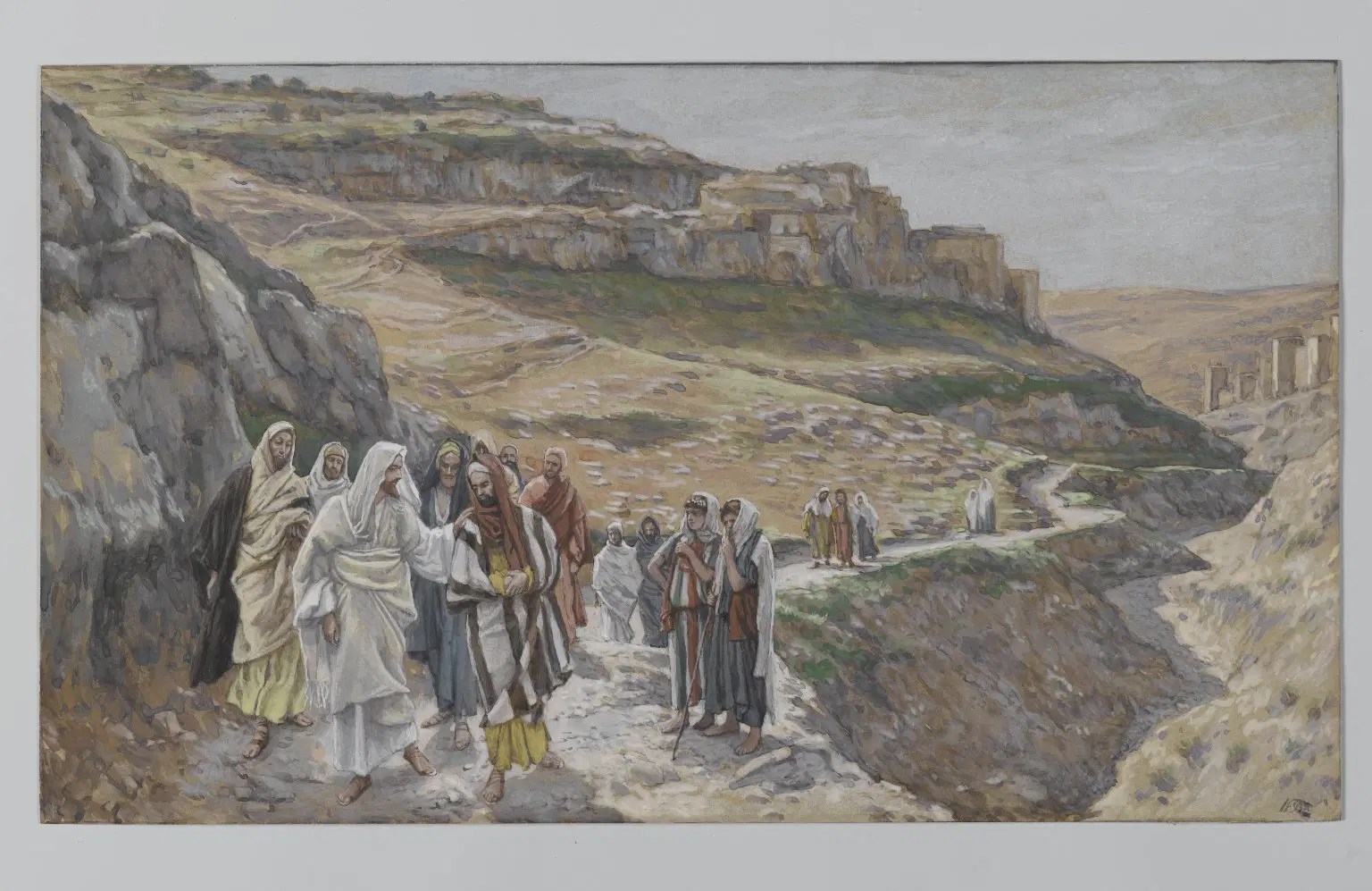
Jesus discourses with his disciples – James Tissot (Brooklyn Museum)

Christ the King 2024

LIVING on the edge of Western Europe it is not surprising that many British people have something of a fascination with the Roman Empire. In the first century AD, the Romans conquered Britain and ruled here for nearly four hundred years. They gave us many things: including straight roads, plumbing and under-floor heating, and founded towns many towns such as Carmarthen. Just off Priory Street in Carmarthen are the remains of a Roman amphitheatre which could hold about five thousand spectators. It isn’t quite the size of Colosseum in Rome — and it is highly unlikely that it was ever flooded to stage a mock sea-battle — but it is a reminder of how far Roman influence stretched. 

Rome was an empire, with an emperor at its head. The bad emperors are generally portrayed as cruel autocrats in films like Gladiator. However, these depictions tend to gloss over the fact that these emperors were worshipped as  being divine. One of their first acts on accession to the throne would be for the new Emperor to declare their predecessor, or father, a God. They would then be referred to as ‘DIVI FILIVS’, ‘Son of a god’, ‘Fab duw’. This feels alien to us, because we are Christians, and we are followers of Jesus, the Son of God the Father, the Creator and Sustainer of us all. 

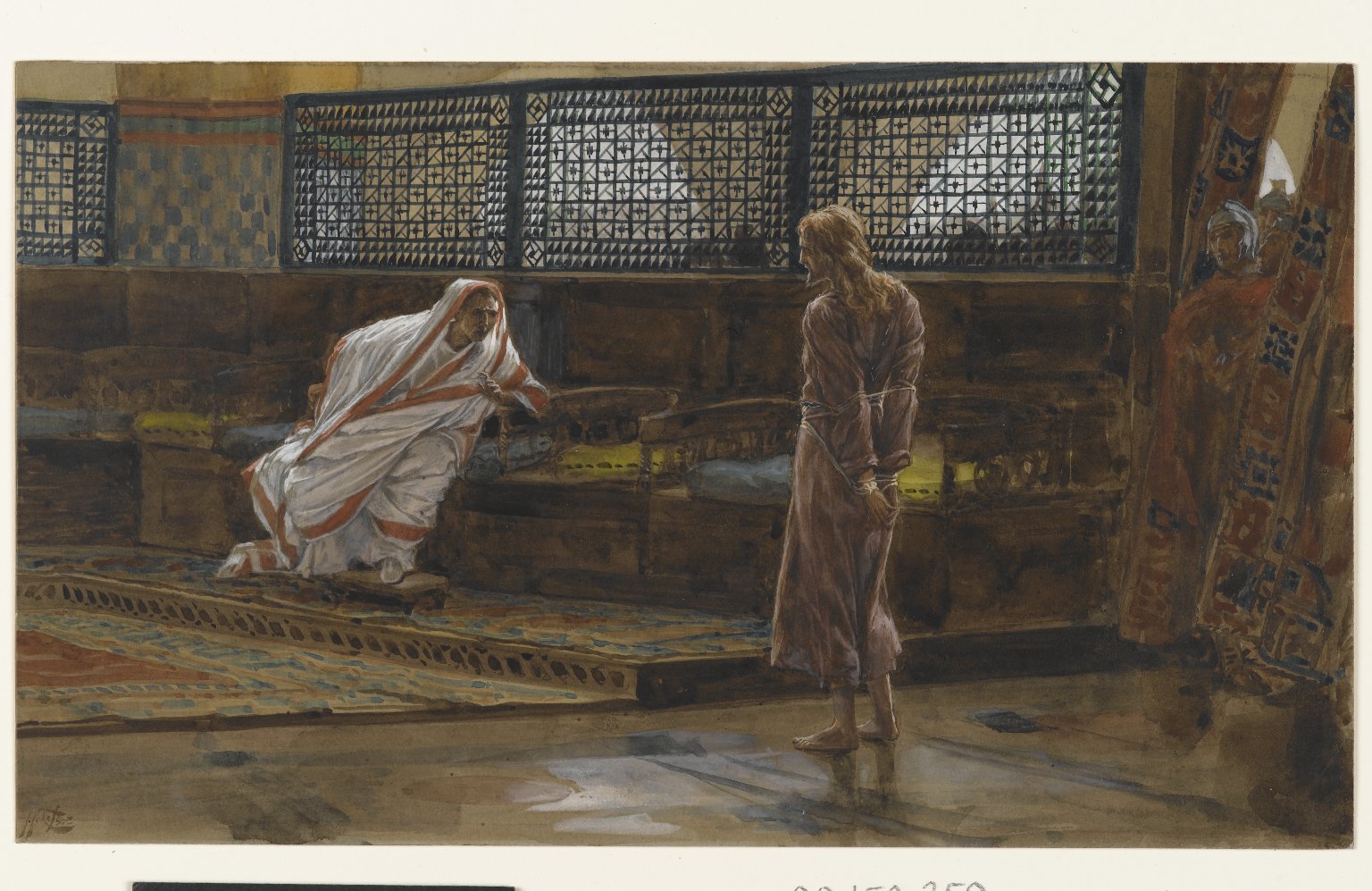
In this morning’s Gospel, Jesus is in Pilate’s headquarters, being questioned, before He is condemned to death on the Cross. Since Our Lord’s triumphal entry into Jerusalem a few days earlier, He has been hailed as the Davidic King, the Messiah. This is viewed as a clear challenge to Herod, and thus to the Roman occupation. Pilate is afraid of an insurrection leading to a rebellion and a change of government, all of which could mean his own death. So he asks Jesus:

“Ai ti yw Brenin yr Iddewon?”

“Are you the King of the Jews?” (Jn 18:33)

Our Lord does not answer, but instead asks Pilate a question:

“Ai ohonot dy hun yr wyt ti’n dweud hyn, ai ynteu eraill a ddywedodd hyn wrthyt amdanaf fi?”

“Do you say this of your own accord, or did others say it to you about me?” (Jn 18:34)

Pilate then replies:

“Dy genedl dy hun a’i phrif offeiriaid sydd wedi dy drosglwyddo di i mi. Beth wnaethost ti?”

“Your own nation and the chief priests have delivered you over to me. What have you done?” (Jn 18:35)

The back and forth is an attempt by the Roman Governor to see if there is substance to the charges, and to see whether Jesus will confess, or whether evidence can be gleaned, which would substantiate the accusation against Him. This leads Our Lord to make the following declaration:

“Nid yw fy nheyrnas i o’r byd hwn. Pe bai fy nheyrnas i o’r byd hwn, byddai fy ngwasanaethwyr i yn ymladd, rhag imi gael fy nhrosglwyddo i’r Iddewon. Ond y gwir yw, nid dyma darddle fy nheyrnas i.”

“My kingdom is not of this world. If my kingdom were of this world, my servants would have been fighting, that I might not be delivered over to the Jews. But my kingdom is not from the world.” (Jn 18:36)

Jesus Christ is not an earthly king, concerned with power, honour, wealth, and prestige, but rather a heavenly one, seeking to establish the Kingdom of God in the hearts and minds of men, women, and children. He seeks to build a kingdom of peace, love, and joy, and of healing and reconciliation. Pilate fails to grasp the nuance of Jesus’ proclamation, and instead focuses on what Jesus says, rather than what He means.

‘Yna meddai Pilat wrtho, “Yr wyt ti yn frenin, ynteu?”’

‘Then Pilate said to him, “So you are a king?”’ (Jn 18:37)

The Roman Governor is concerned with law, and not theology. He takes Our Lord’s words as a statement that Christ considers Himself a King, and that the charges against Him are true. So Jesus makes the following reply:

“Ti sy’n dweud fy mod yn frenin,” atebodd Iesu. “Er mwyn hyn yr wyf fi wedi cael fy ngeni, ac er mwyn hyn y deuthum i’r byd, i dystiolaethu i’r gwirionedd. Y mae pawb sy’n perthyn i’r gwirionedd yn gwrando ar fy llais i.”

“You say that I am a king. For this purpose I was born and for this purpose I have come into the world—to bear witness to the truth. Everyone who is of the truth listens to my voice.” (Jn 18:37)

Christ’s purpose is to bear witness to the truth, that He is God, and is calling people to repent and believe in Him. Pilate, however, is not listening to Jesus. The Governor focuses on the surface meaning, ignoring the truth beneath Christ’s words. And yet the truth will out in the end. A few hours later Our Lord will be crucified and the title fixed to the Cross will read: ‘Iesu o Nasareth, Brenin yr Iddewon’, ‘Jesus of Nazareth, King of the Jews’, in Hebrew, Latin, and Greek. In this way Pilate will proclaim Christ’s Kingship to the whole world. Because of this all people can see and know what a true King looks like; not robed in splendour in a palace, but nailed to a Cross, and dying the death ascribed to a criminal. In His Passion and Death, Christ bears witness to the truth, namely that:

‘Do, carodd Duw y byd gymaint nes iddo roi ei unig Fab, er mwyn i bob sy’n credu ynddo ef beidio â mynd i ddistryw ond cael bywyd tragwyddol. Oherwydd nid i gondemnio’r byd yr anfonodd Duw ei Fab i’r byd, ond er mwyn i’r byd gael ei achud trwyddo ef.’

‘God so loved the world that he gave his only Son, that whoever believes in him should not perish but have eternal life. For God sent the Son into the world, not to condemn the world, but that the world might be saved through him.’ (Jn 3:16-17) 

This is what real kingship looks like: selfless love and sacrifice. This is what Jesus offers the world in the Eucharist — His self-giving love with the power to transform the world. God gives Himself to us, so the world can share Eternal Life in Him. It is not about acquiring and displaying wealth, power, or privilege — things of this world. Instead, as Christians, we look to God and Heaven, as both the source of our being and as our eternal home.

To acknowledge Christ’s kingship is to do something truly radical. It is to say to those with worldly power, ‘We recognize something far greater and more powerful than you!’ This is a profound political act, which terrifies those who are insecure, just as it terrified Pilate and Herod. As followers of Jesus we have built the house of our faith on the rock which is Christ, and not the shifting sands of this world. 

So, my brothers and sisters, let us acknowledge Christ as our King. Let us serve Him, filled with His love for us, and for all people. Let this love form a Kingdom with God as its head. And as citizens of God’s Kingdom let us give praise and honour to God the Father, God the Son, and God the Holy Spirit. To whom be ascribed all glory, dominion and power, now and forever. Amen.

James Tissot: Jesus before Pilate (First interview) Brooklyn Museum