There are few things that can compare with a storm for making human beings feel small and helpless. When we are faced with strong winds, lashing rain and lightning, we can feel insignificant, powerless, and aware of our own mortality. I was caught in a storm, fairly recently, and it was absolutely terrifying. Such feelings are uncomfortable, and we would prefer not to experience them. They are, however, an important part of the human condition. Fear is one of the most powerful emotions we have, and it drives us to seek safety and security. Thankfully, as Christians, we know that we can find safety and security in God, our loving Creator and Sustainer.
This loving nature of God is highlighted in the passage from the Book of Job, which is the first reading this morning. God is truly powerful, but cares for humanity:
‘Who shut in the sea with doors when it burst out from the womb, … Thus far shall you come, and no farther, and here shall your proud waves be stayed’
‘Pan gaewyd ar y môr â dorau, pan lamai allan o’r groth…Hyd yma yr ei, a dim pellach, ac yma y gosodais derfyn i ymchwydd dy donnau’ (Job 38:8, 11)
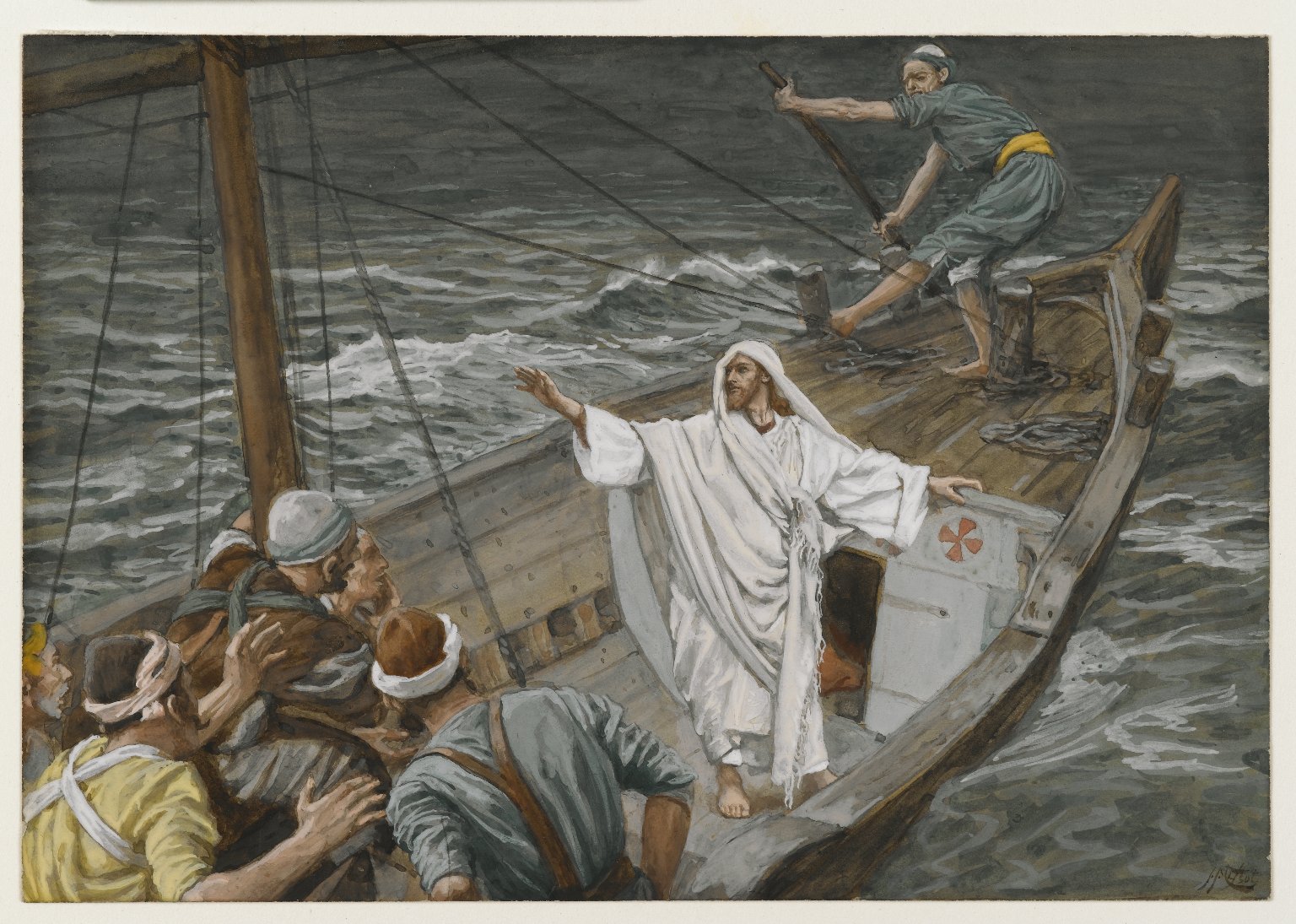
God’s power over nature is also central to this morning’s Gospel. Jesus and His disciples are crossing the Sea of Galilee when a violent storm blows up. The disciples are terrified. Despite many of them being fishermen, they are afraid that they are about to drown. This passage throws up a number of questions. Why are Jesus and His disciples crossing from the Jewish side of the Sea of Galilee to the non-Jewish side? Why are they sailing at night, rather than waiting until the next morning? We are not told the answers to these questions. However, this incident acts as a bridge between the section in Mark’s Gospel where Jesus has been teaching, to one where He will perform miracles, and put that teaching into practice.
As the boat begins to fill with water, the disciples are becoming desperate:
‘And they woke him and said to him, “Teacher, do you not care that we are perishing?” And he awoke and rebuked the wind and said to the sea, “Peace! Be still!” And the wind ceased, and there was a great calm.’
‘Deffroesant ef a dweud wrtho, “Athro, a wyt ti’n hidio dim ei bod ar ben arnom?” Ac fe ddeffrôdd a cheryddu’r gwynt a dweud wrth y môr, “Bydd ddistaw! Bydd dawel!” Gostegodd y gwynt, a bu tawelwch mawr.’ (Mk 4:38-39)
Jesus’ followers are afraid. There are thirteen of them packed into a boat twenty-six feet long, eight feet wide, and four feet deep.The boat is tossing, yet Jesus calmly sleeps. Once He is awoken He quickly takes control of the situation. Jesus can command the storm to cease because He is God. The ability to control the sea and its storms is a sign of divine power: God is the one who brings peace. Jesus has come to bring peace to troubled hearts. Having performed a miracle, He questions His disciples:
‘He said to them, “Why are you so afraid? Have you still no faith?” And they were filled with great fear and said to one another, “Who then is this, that even the wind and the sea obey him?”’
‘A dywedodd wrthynt, “Pam y mae arnoch ofn? Sut yr ydych heb ffydd o hyd?” Daeth ofn dirfawr arnynt, ac meddent wrth ei gilydd, “Pwy ynteu yw hwn? Y mae hyd yn oed y gwynt a’r môr yn ufuddhau iddo.”’ (Mk 4:39-41)
The answer to the disciples’ question is that Jesus is God. No-one else could do what He does. Jesus then questions why His followers feel fear and why they lack faith. To put it simply, the Disciples have not yet fully understood either who Jesus is, or what He is doing. Once they have experienced Christ’s Passion and Resurrection and seen His triumph over death, they will come to understand what is happening here.
Jesus calms storms both real and metaphorical: on the Sea of Galilee, and in our own lives. By dealing with sin once and for all on the Cross, He has brought us a peace which passes all understanding. In every Eucharist service there is a point after the prayers when we greet each other with ‘Peace’ ‘Tangnefedd’. Being at peace allows the Christian community to:
‘no longer live for themselves but for him who for their sake died and was raised.’
‘er mwyn i’r byw beidio â byw iddynt eu hunain mwyach, ond i’r un a fu farw drostynt, ac a gyfodwyd’ (2Cor 5:15)
Our life is not our own, because the love of Christ controls us, as St Paul writes in his Second Letter to the Corinthians (2Cor 5:14). Jesus’ Death and Resurrection provide an answer to the questions about suffering asked by Job, and by all humanity. By entering into the mystery of apparently meaningless pain and suffering, we can discover the source of all meaning, namely God.
To be in Christ is to be a new Creation. Through our Baptism we share in Our Lord’s Death and Resurrection. In the Eucharist we are given the pledge of Eternal Life: Christ’s Body and Blood, so that we might continue to be transformed more and more into His likeness. This is the journey of Faith — trusting God, so that He may make us into what He is. We put our trust in Him, safe in the knowledge that God alone can still the storms of our life, and that His perfect love can drive out our fear. We cling to the Cross as our source of Hope, knowing that whatever happens we are loved, and that this love has the power to save us. God’s love can free us from fear.
Released from anxiety, we, like the disciples, can be truly alive and share God’s love with others. We pray that all humanity may experience the peace of the Lord and give glory to God the Father, God the Son, and God the Holy Spirit. To whom be ascribed all glory, dominion, and power, now and forever. Amen.
 Novus Motus Oxoniensis