The Baptism of Christ 2026

‘This is my beloved Son, with whom I am well pleased.’

‘Hwn yw fy Mab, yr Anwylyd; ynddo ef yr wyf yn ymhyfrydu’ (Mt 3:17)

Our Baptism is one of the most important events in our lives. However, for the vast majority of Christians who were baptised as infants, it isn’t something we necessarily remember. We are too young to recall the experience. But whether we can remember it or not, we know that our baptism marked our entry into the Church. During the sacrament we were clothed with Christ and we were born again, by water and the Holy Spirit. Our Lord Jesus Christ was also baptised, but as a man, rather than a baby. This is what the Church celebrates today. 

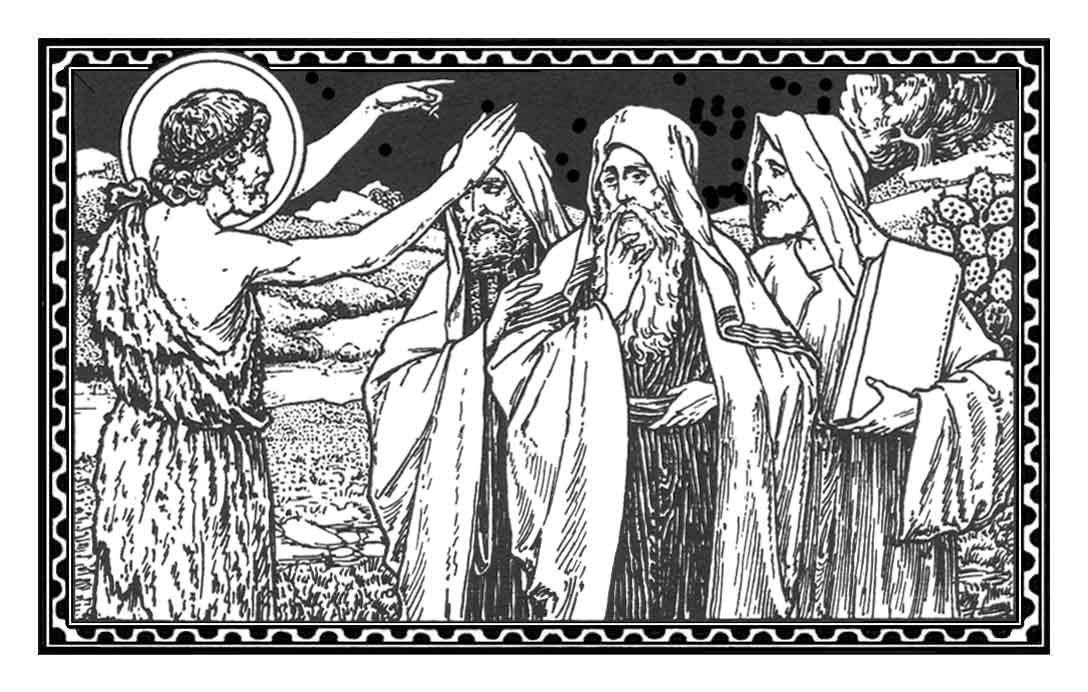
Baptism washes us from our sins, yet Jesus is not a sinner. So why does He need to get baptized? John the Baptist says to Christ, “I need to be baptized by you, and do you come to me?” (Mt 3:14). Our Lord replies by saying, “Let it be so now, for thus it is fitting for us to fulfil all righteousness.” (Mt 3:15). Jesus’ baptism is one of obedience to the will of God the Father. That is why our first reading is the first of the Servant Songs in the prophecy of Isaiah. The prophecy is fulfilled when the Father speaks the words from the first verse, at the moment of Jesus’ baptism. God gives His Son as a covenant to the nations. This covenant will be made on the Cross, to save humanity. Christ is a light for the nations, as Simeon states at the Presentation in the Temple. Jesus will open the eyes of the blind, and set prisoners free. This is the reality of the Kingdom of God, which we are members of, through our baptism.

Today, God does a new thing. This lies at the heart of the proclamation of the Good News of the Kingdom by St Peter in this morning’s second reading from the Acts of the Apostles. It is the same pronouncement that we find in Isaiah. There is a consistency in proclamation down through the centuries, a guarantee of its truth. God the Father expresses His love for His Son, whose obedience to His Father’s will shows humanity that by saying ‘Yes’ to God, the ‘No’ of Adam and Eve can be undone. Christ, the new Adam, fulfils all righteousness, and in so doing begins His public ministry which takes this ultimately to the Cross. This is where righteousness and obedience lead: to death and suffering, to the demonstration of God’s love and finally, to the restoration of humanity once and for all.

What is foolish in the eyes of the world, is in fact the greatest possible demonstration of love. We will see that love made visible here this morning, where Christ offers Himself for us, through His Body and Blood in the Eucharist. We feed on Him, so that He can transform us; so that we may come to share in the very life and nature of God. Through our Baptism, and through the Eucharist, God’s Kingdom becomes a living reality in us. We are transformed to live its life, and transform the world around us.

A few days ago we celebrated Epiphany, Our Lord’s manifestation to the Gentiles. Now this Sunday, at the start of Christ’s public ministry, He is again made manifest. God the Father acknowledges the Son in the flesh, and sends the Holy Spirit, the bond of their love. The fullness of the Divine Trinity is united and revealed on earth to proclaim that Christ is Lord. The Kingdom has become a reality. Christ does not need to be baptised, as we do. However, He does so in order to fulfil all righteousness and to sanctify the waters of baptism for those whom He would redeem, to show us the way to new life in Him. At the beginning of his public ministry, Jesus shows humanity the way to the Father, through himself. The world sees the generous love of God, which heals and restores us, from the darkness of the dungeon of sin and evil, to the light and life of the Kingdom of God. As our baptism is a sharing in the death and resurrection of Jesus, so His baptism points to the Cross, where streams of blood and water flow to cleanse and heal the world. We see the love of the Father, the power of the Spirit, and the obedience of Son, and all for us, who deeply need God’s love and healing, and forgiveness.

We long to experience this deep, divine love. The whole world needs it, but we are often too proud or too fearful to turn to the God of love. And yet it is exactly such people, the lost sheep, that Our Lord comes to seek. He desires to enfold them, and us, in His loving arms on the Cross. He washes us in the waters of baptism, so that we all may be a part of Him, regardless of whom we are, and what we have done. Salvation is the free gift of God and is open to all who turn to him.

Ours is a faith which can transform the world, so that all humanity can share in God’s life and love. Each and every one of us can become part of something radical and revolutionary, which can, and will, transform the world one soul at a time. Rather than human violence, cruelty, and mis-use of power, the only way to transform the world is through the love of God. This is what the Church is for. This is what Christianity is all about. This is why we are gathered here today, to be strengthened and nourished.

Through prayer, through the Word of God, and through the Sacraments of the Church, we are strengthened and nourished to live out our faith and transform the world. Nothing more, nothing less, just a revolution of love, of forgiveness, and of healing. This is what the world both wants and needs. So, let us draw on the strength of our baptism to live out our faith in order that the whole world may be transformed and believe. United with all our Christian brothers and sisters let us give glory to God the Father, God the Son, and God the Holy Spirit, Duw Dad, Duw Y Mab, a Duw yr Ysbryd Glân. To whom be ascribed all glory, dominion and power, now and forever. Amen.

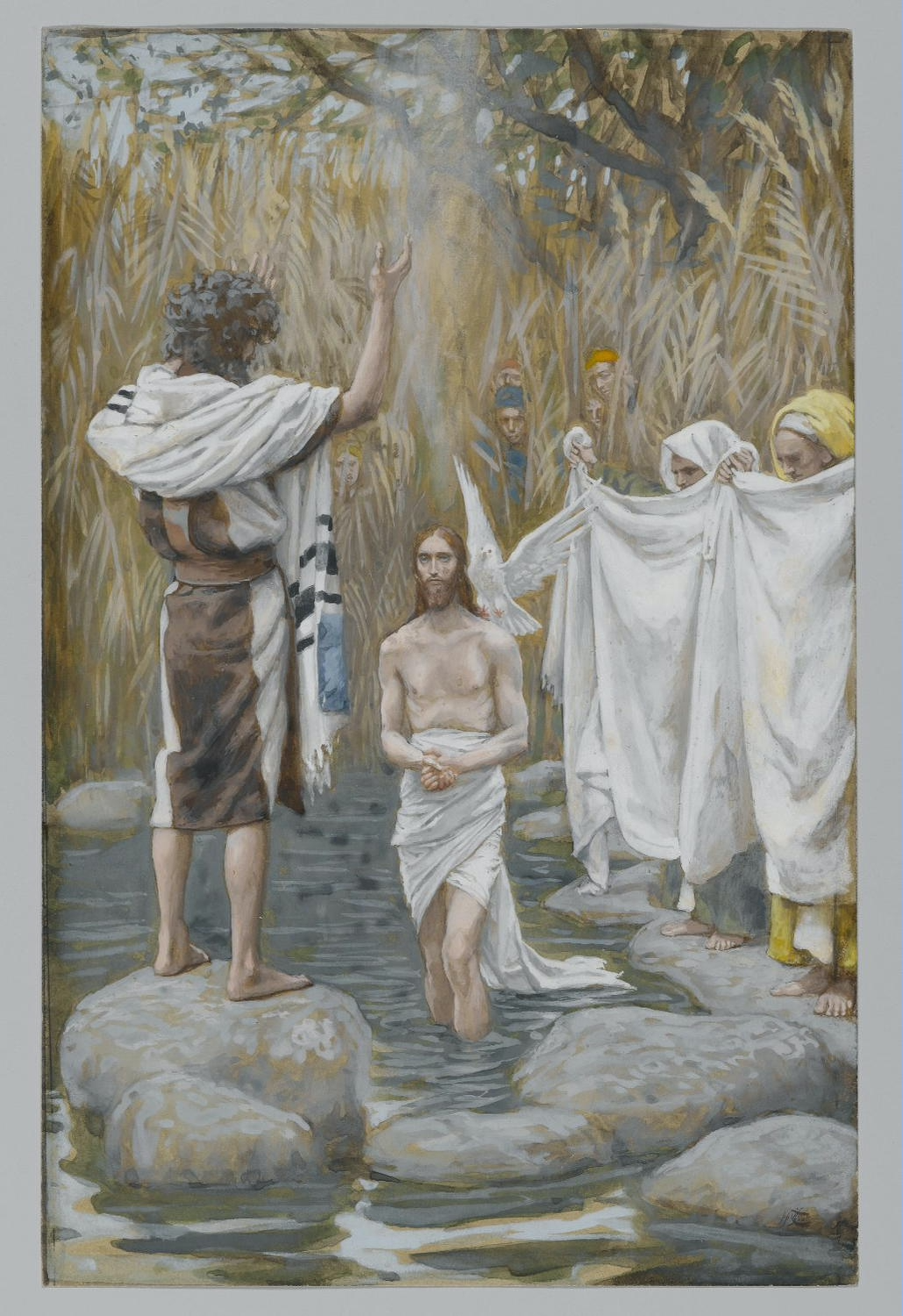
James Tissot: The Baptism of Christ (Brooklyn Museum)

Christmas 2025

‘all the ends of the earth shall see the salvation of our God.’

‘fe wêl holl gyrrau’r ddaear iachawduriaeth ein Duw ni’ (Isa 52:10)

Christmas is a time for many seasonal activities, including spending time with family and friends, eating special foods and enjoying Christmas Carols. Also, most of us will spend some time over the festive period watching films on the television, or in the cinema. Movies can, surprisingly, be particularly useful when we try to comprehend the wonderful events of Christmas. I would like to begin by focussing on a favourite film from my childhood — the 1981 adventure Raiders of the Lost Ark. In this film, the intrepid hat-wearing archaeologist, Indiana Jones, is competing with evil Nazi forces to discover the Ark of the Covenant, which, it is said, has the power to make an army invincible. At the climax of the film, the villains open the Ark on an island in the Aegean Sea. Immediately, spirits and bolts of lightning are released, which kill the Nazis and free Indiana and his companion Marion. Other than being the sort of film one might watch at Christmas, what is the relevance of the scene?

The film’s denouement relies upon the heroes averting their gaze, while the villains do not, and are therefore destroyed. The plot draws upon the biblical idea that the glory of God, which the Ark is said to contain, is not something which humanity should gaze upon. In the Book of Exodus, when Moses asks to see God, he is told that if he does so he will die. The glory of God is not something humans are able to behold. 

Yet, the first reading this morning reaches its climax with the statement that:

‘all the ends of the earth shall see the salvation of our God.’ (Isa 52:10)

There appears to be something strange going on here. Likewise, the one who begins His life wrapped in cloth and placed in a stone feeding trough, will end it by being taken down from a Cross, wrapped in cloth and placed in a stone tomb. ‘In my beginning is my end …. In my end is my beginning’ wrote T.S. Elliot in his poem ‘East Coker’, the second of his Four Quartets. And yet this end is but a prelude to Christ’s Resurrection, Ascension, and the Second Coming. 

In the great turnaround of salvation history, humanity goes from being unable to look upon the divine, to being able to behold Him in a manger, surrounded by farm animals. As the prophet Isaiah says:

‘The ox knows its owner, and the donkey its master’s crib,’ (Isa 1:3)

To put the mystery of our salvation into context, this morning’s Gospel goes back to the beginning, which is a very good place to start. Not to the Annunciation, where in the power of the Holy Spirit Christ takes flesh in the womb of His Mother, but to the beginning of time itself and the Creation of the Universe:

‘In the beginning was the Word, and the Word was with God, and the Word was God. He was in the beginning with God.’ (Jn 1:1)

The Word which spoke the Universe into being exists in eternity with God, and is God. This is whom we worship: the one who will save humanity, and who offers us eternal life with God. 

Today we celebrate Divine generosity and humility. God is among us. Mae Duw yn eich plith ni. Born as a weak and vulnerable baby, he is utterly dependent upon Mary and Joseph. In time, this divine generosity will be refused:

‘He came to his own, and his own people did not receive him.’ (Jn 1:11)

Ours is a God who does not force Himself upon us. Instead, He comes to us in love, that we might receive His divine love, and share it with others: 

‘And the Word became flesh and dwelt among us, and we have seen his glory, glory as of the only Son from the Father, full of grace and truth.’ (Jn 1:14)

God pitches His tent, and tabernacles among us. The invisible becomes visible. The God who is beyond human understanding becomes human, and shares our human life from its beginning to its end. This is no unapproachable divinity, remote and uncaring, but one who experiences our existence, who understands us from the inside out. Humanity beholds the glory of God, in a tiny baby who will grow into a man, who will die on a Cross to redeem us. 

Not only that, but Christ continues to give Himself to us, every time the Eucharist is celebrated. So that the Word can continue to become flesh. So that we can be transformed by Him, and share in God’s life. 

As we celebrate the birth of Our Saviour we should ask ourselves: have we made room for Jesus in our lives? Have we really? If we haven’t, we need to allow our hearts and our lives to become the stable in which the Christ-child can be born. We should see Him in the outcast, in the stranger, in all the people which the world shuns. As Christians, we are instructed to welcome such people, for in welcoming them we also welcome Our Lord and Saviour. This is how we live out His love in our lives.

This is the true meaning of Christmas — this is the love which can transform the world. It is radical and costly. This love terrified the might of the Roman Empire, by showing human power that it was as nothing compared to Divine Love. Soul by individual soul, for the past two thousand years, the world has been changed by ordinary people living out the love shown to the world by, and through, this little child.

So, today as we celebrate Jesus’ birth, let us raise our voices to join with the shepherds and angels and give praise and honour to God the Father, God the Son, and God the Holy Spirit, Duw Dad, Duw y Mab, a Duw yr Ysbryd Glân. To whom be ascribed all might, majesty, glory, dominion, and power, now and forever. Amen.

May I take this opportunity to wish you all a joyful, peaceful, and love-filled Christmas!

Gallaf gymryd y cyfle hwn i dymuno Nadolig llawen, heddychlon, ac llawn cariad i bawb!

Christmas Midnight Mass

‘He become human so that we might become divine.’

‘Fanodd ef ein natur ddynol ni, er mwyn i ni rannu ei natur ddwyfol ef’ (Athanasius de Inc. 54.3)

We have all come here tonight to celebrate something unique, something which defies both our understanding and our expectations. The fact that God, the Creator of all things, took flesh in the womb of the Virgin Mary and was born for us in Bethlehem is the Messiah, the Anointed of God, who would save us from our sins, should feel strange. In human terms this simply does not make sense, nor indeed should it.

And yet, here we are, some two thousand years later, celebrating the birth of this child who changed both human history and human nature. We do this because, as Christians, we do not judge things solely by human standards. We gather together in order to ponder the mystery of God’s love for us. Through love, God heals our wounds. Through love, God restores broken humanity. Through love, God offers us a fresh start. Our Heavenly Father can see beyond our failures and shortcomings, and He took on human form so that humanity might become divine; so that we may share in His life of love, both here on earth and in Heaven.

If that isn’t a cause for celebration, I honestly don’t know what is. However, we are so familiar with the story of Christmas that I wonder whether we, myself included, really take the time to ponder, and to marvel at the mystery which unfolded two thousand years ago in Bethlehem. Almighty God, who made all that is, comes to dwell among us. He took flesh in the womb of a teenage girl through the power of His Holy Spirit, so that in His Son we might see and experience God and His divine love for us. 

God comes among us not in power or splendour, but as a weak, vulnerable child, depending on others for love, food, and warmth. He is laid in an animal’s feeding trough, insulated from the cold hard stone by straw — beginning his days as he will end them placed in a stranger’s tomb. 

Throughout His life, all that Jesus says and does shows us how much God loves us. The Word becomes flesh, and enters the world. He dwells among us. This is a wondrous mystery which inspires us to worship. We stand and kneel with the shepherds and adore the God who comes among us. He shares our human life so that we might share His divine life. This is not because we have done something to deserve it: we haven’t worked for it, or earned it. Rather, it is the free gift of a loving and merciful God. This, then, is the glory of God — being born in simple poverty, surrounded by those on the margins of society. Our Heavenly Father calls humanity to a new way of being a community. The old order is cast aside, turning the world upside down and offering us the possibility of living in a radically different way. One founded on peace, love, and joy, rather than wealth and power. Heaven comes to earth, carried in the womb of a Virgin, so that we might behold the glory of God in a new-born child. So that we might experience the deep love and eternal truth of God.

The word is made flesh so that prophesy might be fulfilled. So that the hope of salvation might unfold. So that a people who have languished long in darkness might behold the glory of God in the place where Heaven and Earth meet: in a lowly stable in Bethlehem. Where men and angels may sing together: ‘Alleluia, Glory be to God on high, and on earth peace to people of goodwill’. The worship of Heaven is joined with Earth on this most holy night. In the quiet and stillness humans and animals join together to praise Almighty God, who stoops to save humanity in the birth of His Son. 

Despite the worrying state of the world around us, we can be filled with joy and hope: because Christ is born! No matter what difficulties we have to face, what fears and hardships may assail us and those we love, the birth of Our Saviour in Bethlehem is a cause for hope and joy, both in this world, and the next. God comes among us, as a baby, into a world of pain, fear, and misery; just as He did two thousand years ago. The God who made all that exists enters our world weak and helpless. Just as we were when we were born. He is totally dependent on others for food, warmth, shelter, and security. In doing so, God takes a huge risk to save humanity and to give us hope for the future.

Tonight we see God’s healing and reconciling love made manifest: to save us from ourselves, from sin, selfishness, and greed. At first this act of generosity and weakness does not appear to change things, and yet it does. God transforms our world; sometimes quickly, and sometimes slowly. Humanity is not always good at listening or waiting. It is easy to become so wrapped up in our own anxieties and yearnings that we close ourselves off from God’s transformative power. This Christmastime is an opportunity to open ourselves to God, to His transforming love.

There is also fear in the Christmas story. This is an understandable human reaction. When the shepherds saw the Heavenly Host, the angel said to them: ‘Paid ag ofni’ ‘Fear not, for behold I bring you good news of great joy that will be for all people’ (Lk 2:10). God comes among us to dispel our fears and to invite us to trust in Him. This Good News is as true today as it was two thousand years ago. The love and peace which Christ comes to bring can be made real and visible in our hearts and lives. It still has the power to change the world. God’s kingdom can be a reality, here and now. Jesus taught us to pray for God’s glorious kingdom to come on earth in the same way that it is in Heaven: ‘Thy Kingdom come, Thy will be done, on earth as it is in heaven’.  

The true gift of Christmas is the Good News that Christ is born; that God becomes one of us. Our humanity is reconciled to God in, and through, Jesus. God saves us, and sets us free to worship Him, to love Him, and to serve Him. In the fourth century, a bishop in Asia Minor, Theodotus of Ancyra, said in a Christmas homily: ‘He whose godhead made him rich became poor for our sake, so as to put salvation within the reach of everyone’ [Theodotus of Ancyra (Homily 1 on Christmas: PG 77: 1360-1361)]. Such is the wonder and mystery of God’s love for us. It is a love made perfect in weakness, yet with the strength to transform the lives of everyone including each and every one of us gathered here on this most holy night. 

God is with us. For two thousand years Christians have proclaimed this truth. Jesus is born for us, to set us free from sin. Jesus is born for us to give us eternal life. Jesus is born for us to pour out God’s love and reconciliation upon a world longing for healing and wholeness. Tonight, as the mystery of God’s love is made manifest, may we be filled with that love. May our voices echo the song of the angels to the shepherds in giving praise to God the Father, God the Son, and God the Holy Spirit, Duw Dad, Duw y Mab, a Duw yr Ysbryd Glân. To whom be ascribed all might, majesty, glory, dominion, and power, now and forever. Amen.

May I take this opportunity to wish you all a joyful, peaceful, and love-filled Christmas!

Gallaf gymryd y cyfle hwn i dymuno Nadolig llawen, heddychlon, ac llawn cariad i bawb!Incarnation

Advent IV: ‘He will save his people from their sins’

‘He will save his people from their sins.’

‘am mai ef a wareda ei bobl oddi wrth eu pechodau.’ (Mt 1:21)

Of all the figures in the story of Our Lord’s Nativity, the one most often overlooked is Joseph. It is fair to say that today’s Gospel finds Joseph in a particularly awkward situation. He is described in verse 19 as a ‘just man’. Just or righteous in this context means that he obeys Jewish Law. However, Deuteronomy 22:23-24 states that:

‘If there is a betrothed virgin, and a man meets her in the city and lies with her, then you shall bring them both out to the gate of that city, and you shall stone them to death with stones, the young woman because she did not cry for help though she was in the city, and the man because he violated his neighbour’s wife. So you shall purge the evil from your midst.’ (Deut 22:23-24)

Mary and Joseph are betrothed, and preparing to be married, but strictly speaking under Jewish Law because she is pregnant, Mary is guilty of a capital crime. It is perhaps for this reason that Luke’s account tells us that Mary spends time out in the country with her cousin Elizabeth, who is also pregnant. Joseph loves Mary, and rather than see her killed or publicly humiliated, he wants to put an end to the marriage quietly, without any fuss. It is at this moment that the Angel Gabriel appears to him in a dream saying:

“Joseph, son of David, do not fear to take Mary as your wife, for that which is conceived in her is from the Holy Spirit. She will bear a son, and you shall call his name Jesus, for he will save his people from their sins.” (Mt 1:20-21)

Joseph is a descendant of King David, a member of Israel’s Royal Family. This is an awkward fact when the current occupier of the throne is not part of that dynasty, but was put there by the Romans as a pliant puppet king. 

The angel says to Joseph: ‘Do not be afraid! Paid ag ofni!’ Again and again God speaks to His people to tell them not to fear and to be of good heart, to reassure and encourage them. God loves His people, there is nothing to be afraid about. The angel is clear: the child that will be born is of the Holy Spirit. He will be the Son of God, and His name will be Jesus, because He will save His people from their sins. ‘Yeshua’ means ‘God saves’ which is exactly what Jesus does. At a practical level the angel’s message to Joseph is designed to put him at ease, to stop him worrying. The message is Good News, through the angel the Gospel of Salvation is announced.

To reinforce this fact, St Matthew then quotes a prophecy of Isaiah, which is also found in the first reading today:

“Behold, the virgin shall conceive and bear a son, and they shall call his name Immanuel” (Mt 1:23)

The prophecy is being fulfilled; there will be a son born to the House of David, who will be God with us (Emmanuel), and He will save His people from their sins. This is why we celebrate Christmas, because it is the coming of our Saviour. What does is mean to say that God is with us? Is it an expression of solidarity? Or something more? In Jesus God is with us, and He shares our human life, from birth to death. Christ is not some remote divine figure, but one intimately acquainted with all of human existence. God is not distant, but instead is someone who understands us, and loves us. Christ’s entire existence is about communicating Divine Love and Reconciliation. The Church has also been proclaiming this same message of hope and salvation for the past two thousand years.

He will save his people from their sins’: the angel’s words to Joseph could not be clearer. Jesus is God’s rescue mission, sent to save humanity from their sins. This vocation ultimately leads to Calvary. Therefore, as we prepare to celebrate Christ’s Birth, we know that His life will end here, on the Cross. As we prepare for the most joyous of feasts, we are mindful of the cost and depth of God’s love.

It is important to notice what Joseph does when the dream is over:

‘When Joseph woke from sleep, he did as the angel of the Lord commanded him: he took his wife, but knew her not until she had given birth to a son. And he called his name Jesus.’ (Mt 1:24-25)

Joseph did what the angel commanded him to do. He was obedient. He listened and obeyed. Joseph is complete opposite of Ahaz, in today’s first reading, who neither listens to God nor obeys Him. Joseph is obedient in naming his son as he was instructed: ‘And he called his name Jesus’ (Mt 1:25). Jesus too will be obedient. His is an obedience to the Father’s will borne out through suffering, death and resurrection which characterises the mission of the Son. This is what brings about our salvation. We then, in obedience, look for His second coming as our Saviour and our Judge. As Christians, we are called to take time to ponder these mysteries — to stop for a while amid the business of our modern existence and reflect upon the wondrous nature of God’s love for us, and for all humanity. We need to take the opportunity to stop, and to ponder this wondrous fact; to reflect upon what ‘God-with-us’ means for each one of us, and for our lives.

As the people of God, members of the Christian Church, which we enter through our baptism, we have all been commissioned to proclaim the Good News of Jesus Christ, and to live out this example in our lives. Christians urge the world to pause and to consider exactly what is being celebrating at Christmas: the free gift, of hope and salvation for all people, through a baby, born in a stable, among the poor and the marginalised.

The act of Divine love, which we experience in Our Lord’s Nativity, should draw us, in turn, to love God and to love our neighbour; to live out the love which becomes flesh in the womb of the Virgin Mary. This same love will become the flesh and blood that we touch and taste, here, this morning, through the bread and wine. Feeding us, so that we might share His divine life. So, my brothers and sisters in Christ, let us be filled with, and transformed by, the divine gift of love. Let us, like Mary and Joseph, wait on the Lord and be reshaped by Him. Let us live out our faith in our lives so that others might believe and sing the praise of God the Father, God the Son, and God the Holy Spirit, Duw Dad, Duw y Mab, a Duw yr Ysbryd Glân. To whom be ascribed all might, majesty, glory, dominion, and power, now and forever. Amen.

James Tissot The Vision of St Joseph: Brooklyn Museum

Advent III – He who is to come

‘the ransomed of the Lord … shall obtain gladness and joy and sorrow and sighing shall flee away.’ (Isaiah 35:10)

‘a gwaredigion yr Arglwydd fydd yn dychwelyd … hebryngir hwy gan lawenydd a gorfoledd a bydd gofid a griddfan yn ffoi ymaith’

This year our first readings during Advent come from the book of Isaiah. This Old Testament prophet stresses the belief that the Messiah will come to deliver Israel. As Christians, we use the period of Advent to reflect upon the fact that Christ is coming. He is coming as a baby born in Bethlehem. He is coming to us here today in the Eucharist. And He is coming to judge the world. Should we be afraid? On the contrary, as the prophet says:

‘Strengthen the weak hands, and make firm the feeble knees. Say to those who have an anxious heart,“Be strong; fear not! Behold, your God will come with vengeance, with the recompense of God. He will come and save you’ (Isa 35:3-4). 

God is coming to save us, His people. The salvation we long for will be ours. The prophet Isaiah has a vision where the desert, a dry wilderness, is carpeted with flowers. This is a sign of new life.This is an image of hope. This is the flourishing which the Messiah will bring: ‘the glory of the Lord, the majesty of our God’ (Isa 35:2). As Christ Himself says, ‘I came that they may have life and have it abundantly’ (Jn 10:10). This is good news. It is a reason to rejoice and be glad. In order to mark this, the Church wears rose today, instead of penitential purple. In order to celebrate the joyful character of this day, and to remind us that Christ is coming. As Isaiah says:

‘the ransomed of the Lord shall return and come to Zion with singing; everlasting joy shall be upon their heads; they shall obtain gladness and joy, and sorrow and sighing shall flee away’ (Isa 35:10).

The time is both now and, at the same time, it is not yet. As St James writes, ‘You also, be patient. Establish your hearts, for the coming of the Lord is at hand’ (James 5:8). Patience is a hard thing to master. Human beings are naturally impatient. We do not want to wait, but we have to. The question is how we wait. We are told that this should be in joyful expectation, preparing ourselves for what is to come. 

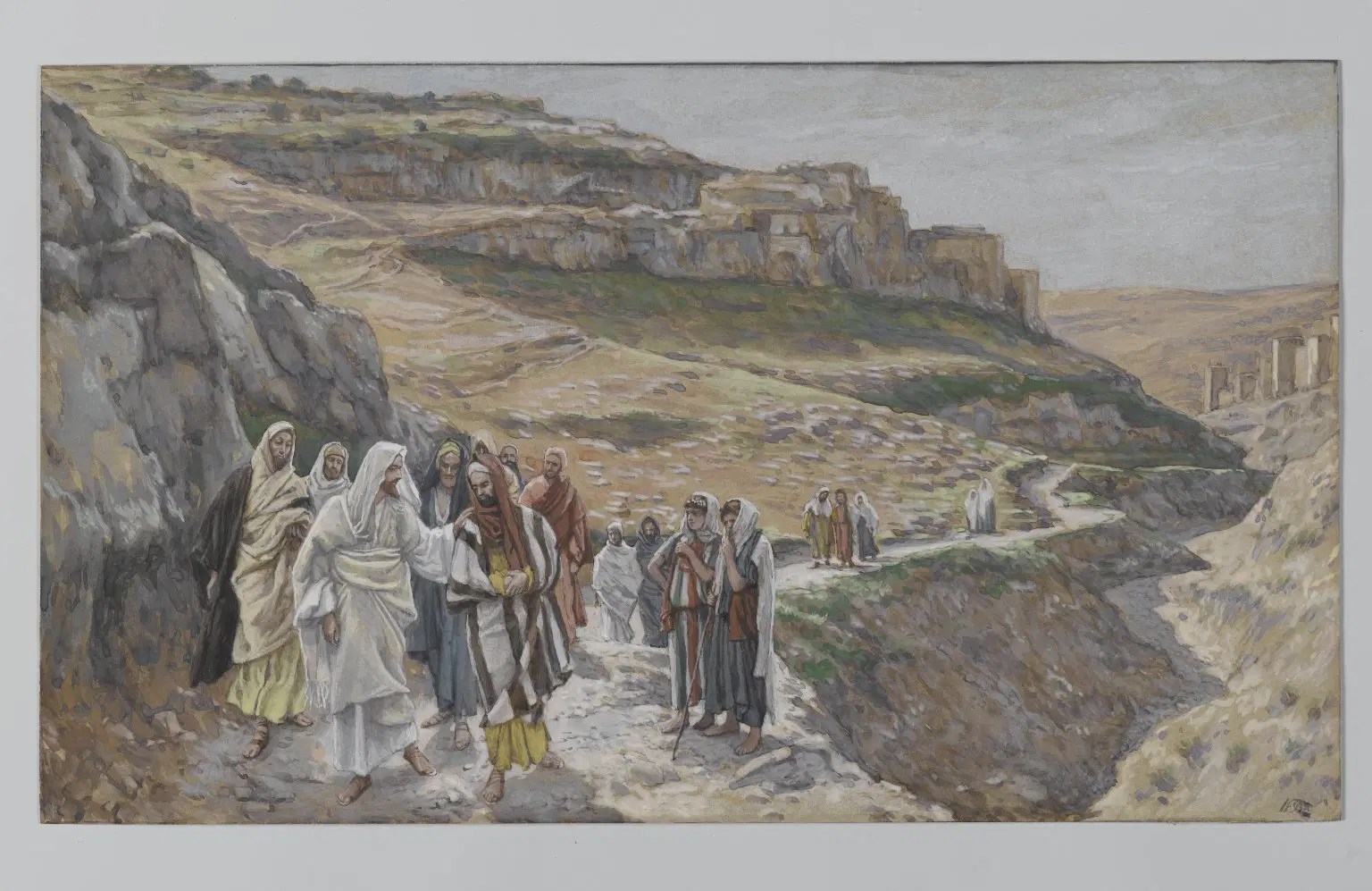
John the Baptist has been waiting for the Messiah. However, despite leaping in his mother’s womb at the Visitation to announce Christ’s coming, in this morning’s Gospel he appears to be having doubts. John is expecting a Messiah of judgement, and he is isn’t entirely sure what is going on. The Baptist has been imprisoned for criticising Herod Antipas’ marriage to his brother’s wife. John is therefore hoping for a messiah who will sweep away an unjust and corrupt regime. This is why he has doubts about Jesus, who does not seem to be a political messiah. Jesus tells John’s disciples:

‘Go and tell John what you hear and see: the blind receive their sight and the lame walk, lepers are cleansed and the deaf hear, and the dead are raised up, and the poor have good news preached to them’ (Mt 11:4-5). 

The vision of a messianic future envisaged by Isaiah in this morning’s first reading has become a reality: prophecy has been fulfilled, God keeps his promises. The Kingdom of God is a place of healing, and Christ is the great physician, who has come to heal our souls. Jesus is the one who is to come, who has come, and who will come again. The establishment of God’s kingdom can appear strange in human terms. Focussing on those on the margins, the sick, the poor, the oppressed, and the marginalised, is not a grand gesture. That is the point! The greatest gesture Jesus will make will be in handing Himself over to be crucified and to die the death of a common criminal. This is how the messiah will reign as the true King of Israel, on the Cross at Calvary. 

God’s salvation defies human expectations. This is the point: God’s ways are not our ways, nor are His thoughts our thoughts. That is the core message of this morning’s Gospel. If we expect God’s rule to look like human kingship, then we will be disappointed. Our Heavenly Father has something else in store, something far more wonderful than we could ever imagine, and at its heart is the transformation of humanity through love. God heals His people, because He is a God of love. Our Creator does not love us because we are loveable. We are sinners, who do not deserve to be loved, and cannot earn His divine love. But, rather than WHAT we are, God loves us for WHO we are: His sons and daughters, created in His image and likeness. God is someone whom we can trust, who keeps His promises. Our Heavenly Father offers the world the greatest present it could ever hope for: true love and eternal life.

Today, the peace which the Messiah came to bring seems as elusive as ever. The human capacity to create misery in the most dreadful ways continues relentlessly. We know that humanity still has some considerable distance to travel towards the establishment of a just and peaceful world. An answer is to embrace the need for repentance: to change our hearts and minds and to follow Jesus. We also prepare to meet Our Lord as He will come again, as our Saviour and our Judge. It is a daunting prospect, yet we know and trust that Christ saves us. By His Wounds on the Cross we are healed, and our sins are forgiven.

This is God’s grace: loving sinful humanity in order that we may be transformed by His Divine love. This is why the focus is on healing — something which only God can do — to redeem our souls with His love. This is the cause of our gladness and joy. What the prophet Isaiah hoped for has been fulfilled, and continues to be fulfilled. The Church is called to carry on God’s healing in the world, and restore each person with divine love. This is what we are about to celebrate in the Eucharist, where we both thank Our Heavenly Father for loving us, and we also prepare to experience that healing love, so that it may transform us, now, here, today. We do so with reverence, because we are not simply consuming human food and drink, but the very Body and Blood of Christ, given for us, to heal us. It is the greatest medicine our souls could ever wish for. Soon we ‘shall see the glory of the Lord, the majesty of our God’ (Isa 35:2). God’s glory and majesty is to give His Body for us on a Cross, and also to feed us with Himself.

Let us, then, come to the banquet with glad hearts, and experience the life-changing love of God. Let us allow it to heal and transform us, so that we can join our voices with all creation to joyfully sing the praises of God the Father, God the Son, and God the Holy Spirit, Duw Dad, Duw y Mad, a Duw yr Ysbryd Glân, to whom be ascribed all might, majesty, glory, dominion, and power, now and forever. Amen.

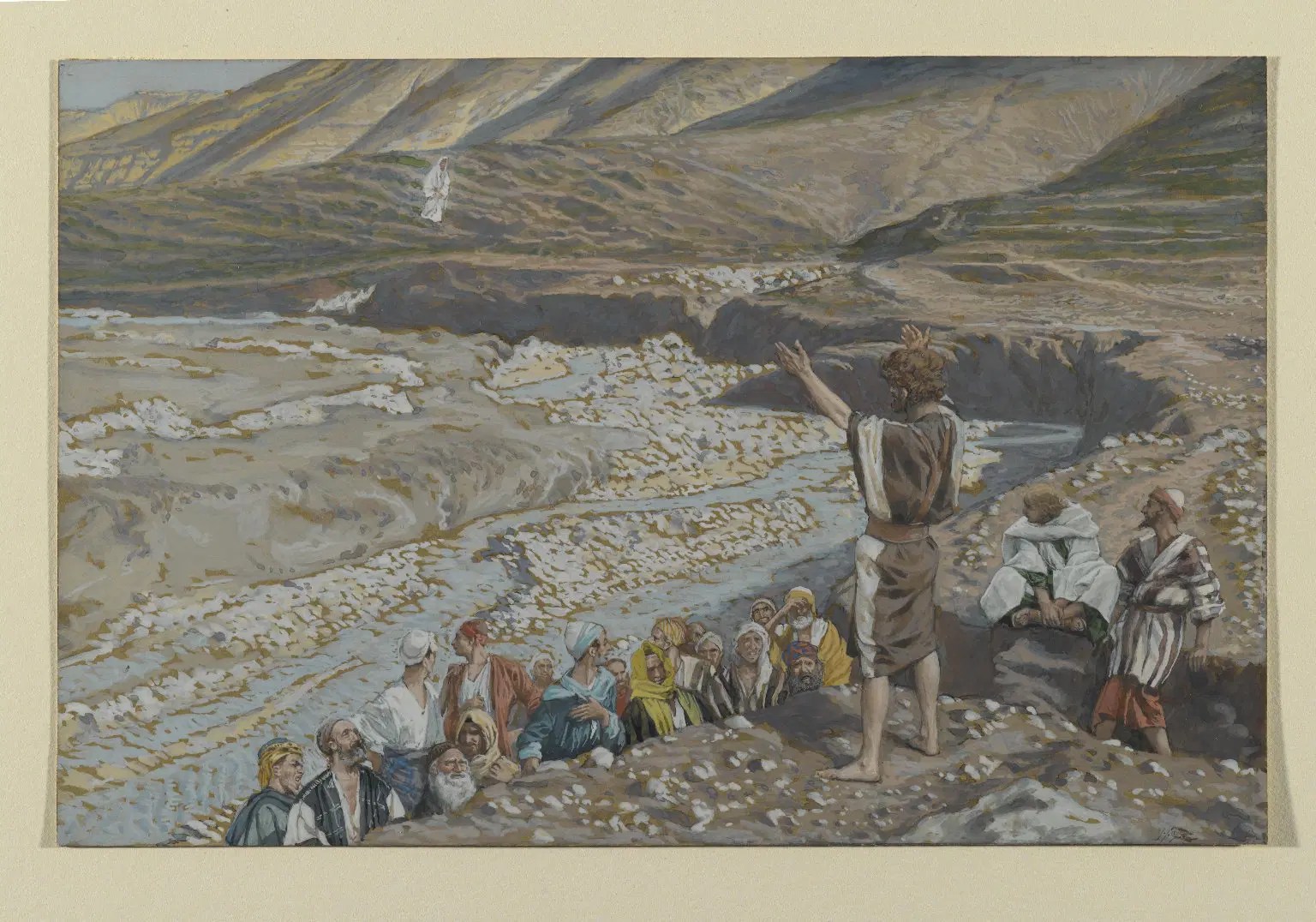
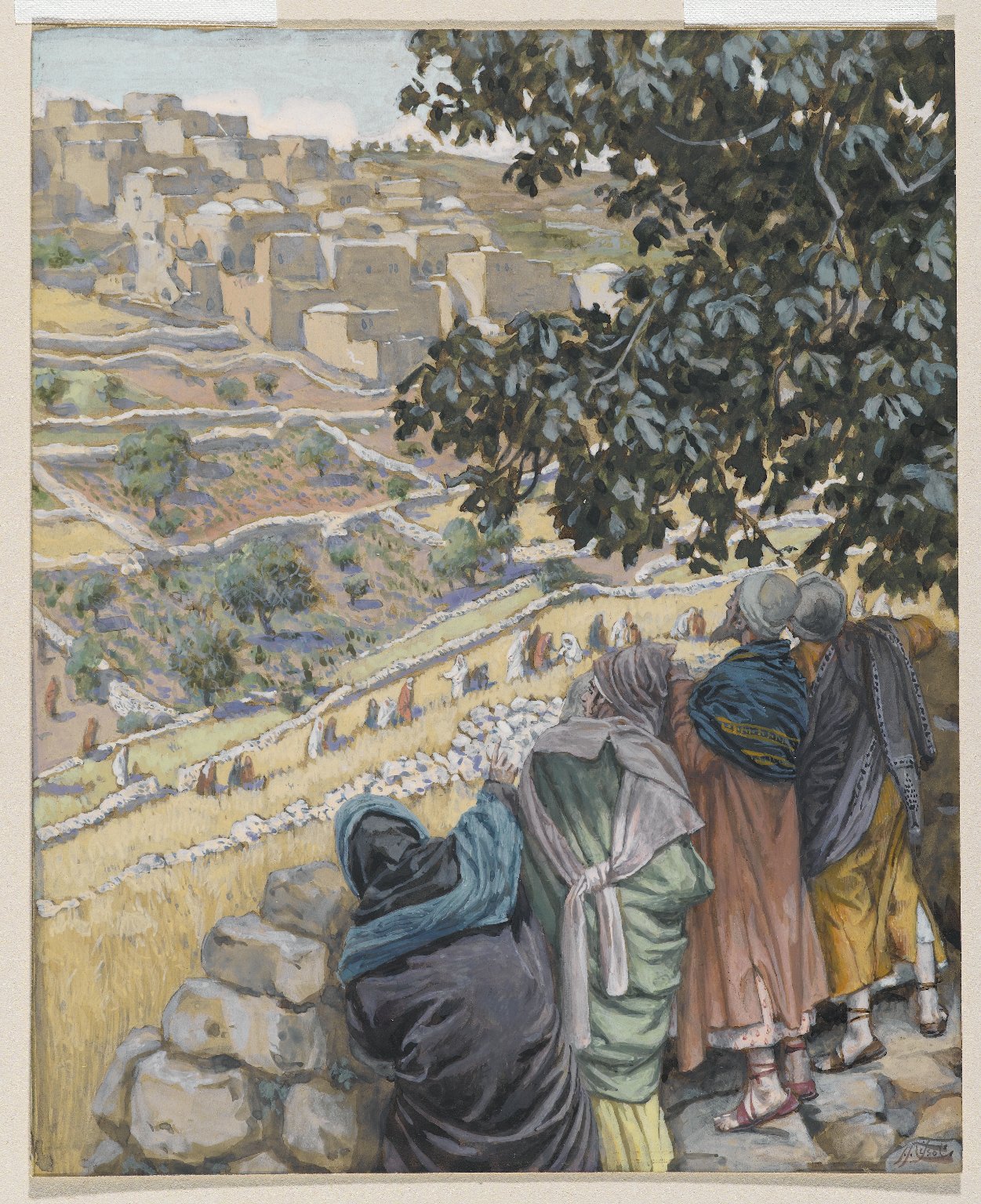
Jean Tissot: St John the Baptist sees Jesus from afar (Brooklyn Museum)

The Second Sunday of Advent

‘May the God of hope fill you with all joy and peace in believing’ (Rom 15:13)

A bydded i Dduw, ffynhonnell gobaith, eich llenwi â phob llawenydd a thangnefedd wrth ichwi arfer eich ffydd

The book of the prophet Isaiah has sometimes been called the ‘Fifth Gospel’. This is because so many of Isaiah’s prophecies look forward to the Messiah, and find their fulfilment in Jesus. We, too, are currently in a time of anticipation. Advent is when we prepare for Christ to come, both as a baby in Bethlehem, and as our Saviour and our Judge. As the son of Jesse, and the son of David, Jesus is Israel’s true king, who rules over all:

‘There shall come forth a shoot from the stump of Jesse, and a branch from his roots shall bear fruit. And the Spirit of the Lord shall rest upon him, the Spirit of wisdom and understanding, the Spirit of counsel and might, the Spirit of knowledge and the fear of the Lord. And his delight shall be in the fear of the Lord.’ (Isa 11:1-3)

Isaiah has hope in the peace the Messiah will bring. Injustice and affliction, the fruit of sin, is dealt with on the Cross, where Jesus ‘shall stand as a signal for the peoples’ (Isa 11:10). This is the great demonstration of God’s love to the world. A love which heals and reconciles humanity. 

To prepare the way for the Messiah, Israel needed prophets like Isaiah and John the Baptist both to announce His coming and to prepare people for His arrival. A prophet’s role is a difficult one because they are often required to tell people home truths. Those chosen by God to act as prophets point out the sorts of things which, if left to our own devices, we would rather ignore. John’s message is simple, plain, and direct:

‘Repent, for the kingdom of heaven is at hand’ (Mt 3:2)

To repent is to express sincere regret about one’s wrongdoing. The Greek word used —metanoia— literally means to ‘change your mind’. It is a proclamation, rather like a road sign which reads: ‘You are going the wrong way!’ Repentance is recognising this and turning around. 

For two thousand years the Church has worked to continue John’s proclamation, and to say to the world: turn around, and follow Jesus! The season of Advent is penitential because it highlights this call to conversion and says to everyone, both inside and outside the Church, that our lives are supposed to be a perpetual turning back to Our Lord. We all need to be reminded of our shortcomings, and to be encouraged to let God be at work in and through us.

John the Baptist’s blunt message struck a chord and sparked something of a revival in Israel. People took him seriously:

‘Then Jerusalem and all Judea and all the region about the Jordan were going out to him, and they were baptized by him in the River Jordan, confessing their sins.’ (Mt 3:5-6)

It is not surprising that in those times people travelled out into the desert to hear John. He was charismatic, and his message was a refreshing antidote to the Religious Establishment of his day. People came, confessed their sins, and were baptised. They were washed clean, to love and serve God. The crowds also came because, in John, the people of Israel saw prophecy fulfilled, and a new Elijah in their midst. One who points to the Messiah, and has done so ever since he leapt in his mother Elizabeth’s womb at the Visitation. Before John was even born he proclaimed that Jesus was the Christ, the Messiah, the One who would save us from our sins.

We see this Messianic kingdom, hoped for in the vision of Isaiah, in this morning’s first reading. The branch which comes forth from the stem of Jesse is the Blessed Virgin Mary. Filled with God’s Holy Spirit, she conceived and bore Our Saviour; the true King of all that is, or has been, or will be. Christ is on the side of the poor and the meek, people who are left behind, and ignored because they are not rich or powerful. This is a radical concept, one which still has some way to go before it is fully put into practice in the world around us. Isaiah’s vision of Messianic peace may appear impossible, but it signifies a world-changing harmony, which alters how things are, and how people behave. For, with and through God, another way is possible. This path is not simple, nor is it easy, but it is possible if we rely upon God to help us. As St Paul says to the Christians in Rome:

‘May the God of endurance and encouragement grant you to live in such harmony with one another, in accord with Christ Jesus, that together you may with one voice glorify the God and Father of our Lord Jesus Christ. Therefore welcome one another as Christ has welcomed you, for the glory of God.’ (Romans 15:5-7),

and a little later in the same passage:

‘May the God of hope fill you with all joy and peace in believing, so that by the power of the Holy Spirit you may abound in hope’ (Romans 15:13).

Hope can feel in pretty short supply when we look at the world around us, and if we just look to humanity then we will be disappointed. Our hope comes from God. Our hope is God. God is with us. It is His Birth that we are preparing to celebrate at Christmas. In Advent we prepare for Christ to come as our Saviour and our Judge: 

‘His winnowing fork is in his hand, and he will clear his threshing floor and gather his wheat into the barn, but the chaff he will burn with unquenchable fire.’ (Mt 3:12) 

Judgement is real, and it should make us stop and think for a moment. Are we living the way God wants us to? If we are not then we need to repent, we need to say sorry, and we need to live the way that God wants us to live. This is how we flourish as Christians. John the Baptist calls us to make a spiritual u-turn, to turn our life around, and to turn away from our sins, which separate us from God. John calls us to the waters of baptism, so that we can be healed and restored by God, filled with his grace, and prepared to receive the Holy Spirit:

“I baptize you with water for repentance, but he who is coming after me is mightier than I, whose sandals I am not worthy to carry. He will baptize you with the Holy Spirit and fire” (Mt 3:11).

The problem with the Pharisees and Sadducees who come to John is that they do not show any repentance. They haven’t made the necessary u-turn, and they do not have the humility to recognise their own sinfulness, and their need to be washed in the waters of baptism. They, therefore, do not possess the right attitude to allow God to be at work in their lives.

As well as recognising Jesus as our Saviour, John the Baptist sees Him as Our Judge. John points to the second coming of the Lord when, as St John of the Cross puts it, ‘we will be judged by love alone’. It is love that matters. In Christ we see what love means. True, deep, love is costly, self-giving and profound. As we are filled with God’s Spirit, nourished by Word and Sacrament, we need to live out this love in our lives. This is how we prepare to meet Jesus as we prepare to celebrate His Birth and look forward to His Second Coming.

So, my brothers and sisters in Christ, let us re-commit ourselves to live out God’s love in our lives. Let us turn away from everything which separates us from God, and from each other. Let us live out deep, costly, and self-giving love in our lives. This is both what Christ and John the Baptist call us to do. By acting in this way we demonstrate to the world around us what our faith means in practice. How our beliefs affect our lives, and why others should follow Jesus, and sing the praises of God the Father, God the Son, and God the Holy Spirit, Duw Dad, Duw y Mab, a Duw yr Ysbryd Glân. To whom be ascribed all might, majesty, glory, dominion, and power, now and forever. Amen.

Trinity I

Children love to ask questions: who? what? where? when? and, especially, why? The Questions we ask and the Answers we give can say an awful lot about who we are. One of the most fundamental question is one concerning identity: ‘Pwy wyt ti?’ ‘Who are you?’ My response would be: ‘I am Adrian, and I am a priest’. The name I was given in baptism, and the fact that God has called me to share in the priesthood of His Son Jesus Christ, define who I am, and what I do. They are why I am standing here, saying this to you, today.

From the time of their exile in Babylon, and before, the people of Israel had looked for a Messiah, a leader of the House of David. They sought someone who would bring them the peace and security that they longed for. The first reading this morning comes from the prophecy of Zechariah, and was written perhaps as late as two hundred years before the birth of Jesus Christ. At this time the Jewish people were struggling under Greek rulers who tried to abolish their identity, and all that they held sacred. The prophet Zechariah looks forward to a messianic future, when the people of the House of David :

‘edrychant ar yr un a drywanwyd ganddynt, a galaru amdano fel am uniganedig, ac wylo amdano fel am gyntafanedig.’

‘They will look on the one whom they have pierced; they will mourn for him as for an only son, and weep for him as people weep for a first-born child’ (Zech 12:10)

The mention of looking upon one whom they have pierced anticipates Christ and His Crucifixion, as noted by John’s Gospel: ‘They will look on him whom they have pierced’ (19:37). Zechariah also writes of the outpouring of a ‘spirit of kindness and prayer’, just as we have seen at Pentecost. Here Jesus’ Death, Resurrection and gift of the Holy Spirit are clearly prefigured: God’s saving plan is announced in the words of the prophet. A few verses later, Zechariah prophesies:

‘Yn y dydd hwnnw bydd ffynnon wedi ei hagor i linach Dafydd ac i drigolion Jerwsalem, ar gyfer pechod ac aflendid.’

‘On that day there shall be a fountain opened for the house of David and the inhabitants of Jerusalem to cleanse themselves from sin and uncleanness.’ (Zech 13:1)

This is what the Cross achieves for those who are washed in the Blood of Lamb, as we are at our Baptism. Christ’s death takes away our sins. Through Baptism and the Eucharist we share in Jesus’ Death and are raised to new life with Him. When St Paul writes to the Galatian Church, he stresses their common baptism:

‘Oblegid yr ydych bawb, trwy ffydd, yn blant Duw yng Nghrist Iesu. Oherwydd y mae pob un ohonoch sydd wedi ei fedyddio i Grist wedi gwisgo Crist amdano. Nid oes rhagor rhwng Iddewon a Groegiaid, rhwng caeth a rhydd, rhwng gwryw a benyw, oherwydd un person ydych chwi oll yng Nghrist Iesu.’

‘You are, all of you, sons of God through faith in Christ Jesus. All baptised in Christ, you have all clothed yourselves in Christ, and there are no more distinctions between Jew and Greek, slave and free, male and female, but all of you are one in Christ Jesus.’ (Gal 3:26-28)

St Paul is preaching a profound message. He explains that none of the distinctions which the world makes matter in God’s eyes. There is no difference. All people are one in Christ. There is a radical equality in the Church: all are welcome to come and experience God’s saving love. When Paul preached, nearly two thousand years ago, this was a revolutionary idea, and it still is today. We are all one in Christ: young and old, rich and poor. It doesn’t matter who we are, where we are from, or anything else. All that matters is that we find our true identity in Christ. This makes us heirs of God’s promise: that we would enjoy eternity in Heaven with our Creator and Sustainer.

In today’s Gospel Jesus begins by asking His disciples this question:

“Pwy y mae’r tyrfaoedd yn dweud ydwyf fi?”

“Who do the crowds say that I am?” (Lk 9:18)

His followers reply that the people think a variety of things: John the Baptist, Elijah, or another of the prophets. They recognise Jesus’ proclamation of the Good News of the Kingdom and understand Him in terms that are familiar to them. Christ, however, presses the issue by asking His disciples another question:

“pwy meddwch chwi ydwyf fi?”

“But who you say that I am?” (Lk 9:20)

Peter answers, ‘Meseia Duw, the Christ of God’ (Lk 9:20). By this answer Peter confesses that Jesus is the Messiah, God’s Anointed, the fulfilment of Zechariah’s prophecy. The disciple’s confession of belief is also our confession of belief as Christians: Jesus is the Christ, the Saviour, the Son of God. As we will soon declare in the words of the Nicene Creed.

Jesus instructs the disciples that they should not communicate this knowledge to anyone, at this time. He then explains what is about to happen:

“”Y mae’n rhaid i Fab y Dyn,” meddai, “ddioddef llawer a chael ei wrthod gan yr henuriaid a’r prif offeiriaid a’r ysgrifenyddion, a’i ladd, a’r trydydd dydd ei gyfodi.”

“The Son of Man is destined to suffer grievously, to be rejected by the elders and chief priests and scribes and to be put to death, and to be raised up on the third day” (Lk 9:22)

Jesus tells the disciples about His Passion, Death and Resurrection, because it is His mission. He has come to reconcile God and humanity, and to restore and heal our broken relationship. Christ then invites His followers to follow His example:

“Os myn neb ddod ar fy ôl i, rhaid iddo ymwadu ag ef ei hun a chodi ei groes bob dydd a’m canlyn i. Oherwydd pwy bynnag a fyn gadw ei fywyd, fe’i cyll, ond pwy bynnag a gyll ei fywyd er fy mwyn i, fe’i ceidw. Pa elw a gaiff rhywun o ennill yr holl fyd a’i ddifetha neu ei fforffedu ei hun?

‘If anyone wants to be a follower of mine, let him renounce himself and take up his cross every day and follow me. For anyone who wants to save his life will lose it; but anyone who loses his life for my sake, that man will save it.’ (Lk 9:23-24)

At the beginning of His public ministry, Jesus invites people to repent and believe. Now He calls us to self-denial, and to embrace the Cross. Christ asks us to accept the most shameful way to die, a form of torture, used by the Romans to execute slaves. As those saved and made free by the Cross of Christ, we take up our own cross and follow Jesus. We imitate Him, in selfless love and devotion, and we bear the weight of the cross in life’s difficulties and disappointments. Following Christ is hard. It is a struggle, and we cannot just rely solely upon our own willpower to succeed. Instead, the Christian life needs to be a corporate effort, something we do together, trusting in God’s Grace to be at work in us, both individually and as a community.

Christ wants us to lose our lives for His sake, and find freedom in His service. There is something paradoxical in Jesus’ teaching. We are to find perfect freedom in obedience, in service of God and each other. Each of us needs to be humble enough to accept what God offers us, and be prepared to try to live it out together. It isn’t about us, but rather letting God be at work in us. When we co-operate with God, and live in love, and joy, and peace, we flourish as human beings. This is liberating, and it is what Our Heavenly Father wants for us. This is what true freedom looks like, and we are called to live it together, today and every day.

So, as we celebrate the joy of our Salvation, let us pray that we may be changed by God’s love, and share this love with others. Let us give thanks for the mystery and wonder that is God, Duw Dad, Duw y Mab, a Duw yr Ysbryd Glân. God the Father, God the Son, and God the Holy Spirit. I’r hwn y priodoler pob gogoniant, arglwyddiaeth, a gallu, yn awr, ac yn oes oesoedd. To whom be ascribed all glory, dominion and power, now and forever. Amen.

Jesus discourses with his disciples – James Tissot (Brooklyn Museum)

Christmas 2024

Christmas is a time for many seasonal activities, including spending time with family and friends, eating special foods and enjoying Christmas Carols. Also, most of us will spend some time over the festive period watching films on the television, or in the cinema. Movies can, surprisingly, be particularly useful when we try and get our heads around the wonderful events of Christmas. I would like to begin by focussing on a film from my childhood — the 1981 adventure Raiders of the Lost Ark. In this film, the intrepid archaeologist Indiana Jones is competing with Nazi forces to discover the Ark of the Covenant, which, it is believed, has the power to make an army invincible. At the climax of the film, the villains open the Ark on an island in the Aegean Sea. Immediately, spirits and bolts of lightning are released, which kill the Nazis and free Indiana and his companion Marion. Other than being the sort of film one might watch at Christmas, what is the relevance of the scene?

The film’s denouement relies upon the heroes averting their gaze, while the villains do not, and are therefore destroyed. The plot draws upon the biblical idea that the glory of God, which the Ark is said to contain, is not something which humanity should gaze upon. In the Book of Exodus, when Moses asks to see God, he is told that if he does so he will die. The glory of God is not something humans are able to behold. 

Yet, the first reading this morning reaches its climax with the statement that:

‘fe wêl holl gyrrau’r ddaear iachawduriaeth ein Duw ni’

‘all the ends of the earth shall see the salvation of our God.’ (Isa 52:10)

There appears to be something strange going on here. Likewise, the one who begins His life wrapped in cloth and placed in a stone feeding trough, will end it taken down from a Cross, wrapped in cloth and placed in a stone tomb. ‘In my beginning is my end …. In my end is my beginning’ wrote T.S. Elliot in his poem ‘East Coker’, the second of his Four Quartets. And yet this end is but a prelude to Christ’s Resurrection, Ascension, and the Second Coming. 

In the great turnaround of salvation history, humanity goes from being unable to look upon the divine, to being able to behold Him in a manger, surrounded by farm animals. To put the mystery of our salvation into context, this morning’s Gospel goes back to the beginning, which is a very good place to start. Not to the Annunciation, where in the power of the Holy Spirit Christ takes flesh in the womb of His Mother, but to the beginning of time and the Creation of the Universe:

‘Yn y dechreuad yr oedd y Gair, a’r Gair oedd gyda Duw, a Duw oedd y Gair. Hwn oedd yn y dechreuad gyda Duw.’

‘In the beginning was the Word, and the Word was with God, and the Word was God. He was in the beginning with God.’ (Jn 1:1)

The Word which spoke the Universe into being exists in eternity with God, and is God. This is whom we worship: the one who will save humanity, and who offers us eternal life with God. 

Today we celebrate Divine generosity and humility. God is among us. Mae Duw yn eich plith ni. Born as a weak and vulnerable baby, he is utterly dependent upon Mary and Joseph. In time this divine generosity will be refused:

‘At ei eiddo ei hun y daeth, a’r eiddo ei hun nis derbyniasant ef.’

‘He came to his own, and his own people did not receive him.’ (Jn 1:11)

Ours is a God who does not force Himself upon us. Instead, He comes to us in love, to draw us out in love, that we might share in that love, and share it with others: 

‘A’r Gair a wnaethpwyd yn gnawd, ac a drigodd yn ein plith ni, (ac ni a welsom ei ogoniant ef, gogoniant megis yr Unig‐anedig oddi wrth y Tad,) yn llawn gras a gwirionedd.’

‘And the Word became flesh and dwelt among us, and we have seen his glory, glory as of the only Son from the Father, full of grace and truth.’ (Jn 1:14)

God pitches His tent, and tabernacles among us. The invisible becomes visible. The God who is beyond human understanding becomes human, and shares our human life from its beginning to its end. This is no unapproachable divinity, remote and uncaring, but one who experiences our existence, who understands us from the inside out. Humanity beholds the glory of God, in a baby who will die on a Cross to redeem us. 

Not only that, but Christ continues to give Himself to us, every time the Eucharist is celebrated, so that the Word can continue to become flesh, so that we can be transformed by Him, and share in God’s life. 

As we celebrate the birth of Our Saviour we need to ask ourselves: have we made room for Jesus in our lives? Have we really? If we haven’t, we need to let our hearts and our lives become the stable in which the Christ-child can be born. We need to see Him in the outcast, in the stranger, in the people which the world shuns. As Christians, we have to welcome such people, for in welcoming them we welcome Our Lord and Saviour. This is how we live out His love in our lives.

This is the true meaning of Christmas — this is the love which can transform the world. It is radical and costly. This love terrified the might of the Roman Empire, and showed human power that it was as nothing compared to Divine Love. Soul by individual soul, for the past two thousand years, the world has been changed by ordinary people living out the love shown to the world by, and through, this little vulnerable child.

So, today as we celebrate Jesus’ birth, let us raise our voices to join with the angels and give praise and honour to God the Father, God the Son, and God the Holy Spirit. To whom be ascribed all glory, dominion and power, now and forever. Amen.

Merry Christmas to you all!

Nadolig Llawen i chi gyd! 

Advent IV: The Visitation

OVER the Christmas and New Year period many of us will be travelling to visit friends and relatives, or will have visitors to stay. Our normal routines may have to be changed, but any disruption is outweighed by the joy that company brings. This Sunday is all about journeys to visit family. It takes the best part of a week to walk the ninety miles from Nazareth to Bethlehem. This is a difficult journey, which is uphill all the way. The Gospel this morning tells the story of the Visitation, when Mary went to visit her cousin Elizabeth, to help her during her pregnancy. Two expectant mothers together and two journeys to be with family. These journeys form an important part of the Christmas story, and change the world.

What was about to happen in Bethlehem had been announced. The prophet Micah contains one of the great Messianic prophecies:

‘ohonot ti y daw allan i mi un i fod yn llywodraethwr yn Israel, a’i darddiad yn y gorffennol, mewn dyddiau gynt.’

‘from you shall come forth for me one who is to be ruler in Israel, whose coming forth is from of old, from ancient days.’ (Micah 5:2)

Christ’s coming is ordained: He will be Israel’s true king. God’s plan of salvation has always been that Jesus should be born, and all of human history from the Creation onwards has been leading up to this point. Jesus will:

‘Fe arwain y praidd yn nerth yr Arglwydd, ac ym mawredd enw’r Arglwydd ei Dduw. A byddant yn ddiogel, oherwydd bydd ef yn fawr hyd derfynau’r ddaear; ac yna bydd heddwch.’

‘shepherd his flock in the strength of the Lord, in the majesty of the name of the Lord his God. And they shall dwell secure, for now he shall be great to the ends of the earth. And he shall be their peace.’ (Micah 5:4-5a)

Our Lord is the Good Shepherd who cares for His flock and lays down His life for us. We can dwell secure because Christ is our peace, and in Him we have the hope of Heaven and the promise of eternal life. These are huge claims to make, and yet Jesus will fulfil them. 

This is why the author of the Letter to the Hebrews can be confident that:

‘â’r ewyllys honno yr ydym wedi ein sancteiddio, trwy gorff Iesu Grist sydd wedi ei offrymu un waith am byth.’

‘by that will we have been sanctified through the offering of the body of Jesus Christ once for all’ (Hebrews 10:10)

The eternal offering of a sinless victim, both frees humanity of its sins, and also restores our relationship with God and with one another. It is an act of perfect obedience: prepared by God for Christ to do His will and sanctify humanity, to heal us and restore us. The Incarnation IS God’s plan for the salvation of humanity, it is not Plan B!

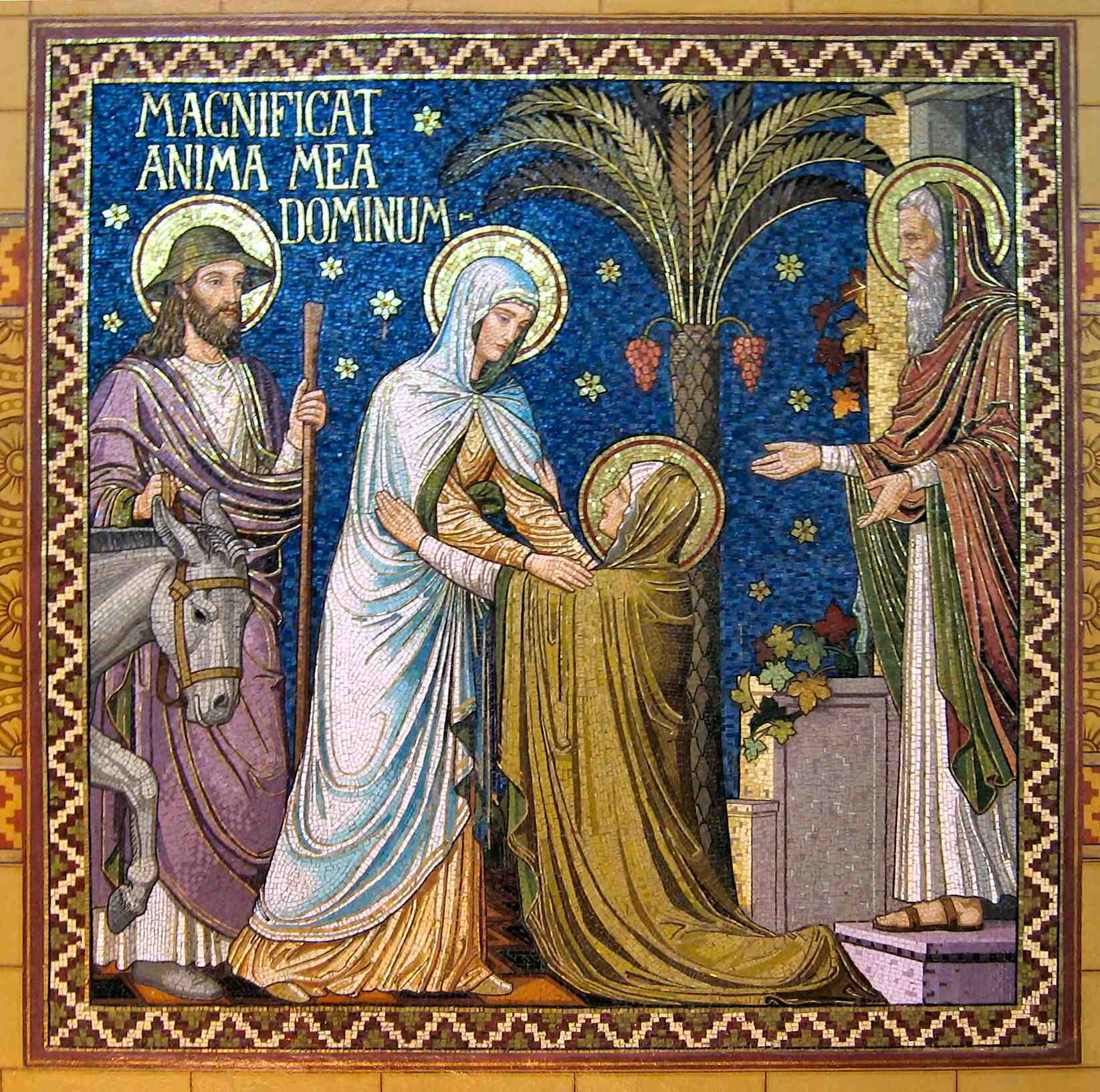
So while Mary, Joseph, and the donkey are making their way to Bethlehem, we turn our eyes elsewhere. The Gospel this morning is St Luke’s account of the Visitation, when Mary goes to see her older cousin Elizabeth, who is pregnant with her son, John the Baptist.

Pan glywodd hi gyfarchiad Mair, llamodd y plentyn yn ei chroth

And when Elizabeth heard the greeting of Mary, the baby leaped in her womb.’ (Lk 1:41)

Even before he was born, John recognises Jesus, and leaps for joy, announcing Christ’s presence and preparing His way. This leads Elizabeth to say to Mary:

‘Bendigedig wyt ti ymhlith gwragedd, a bendigedig yw ffrwyth dy groth.’

Blessed are you among women, and blessed is the fruit of your womb!’ (Lk 1:42)

Mary is blessed, because she says, ‘Yes’ to God, and she will soon give birth to a baby boy. This is no ordinary child, but God with us, Emmanuel. Elizabeth recognises that Mary’s obedience and humility undoes the sinfulness of Eve. That she who knew no sin might give birth to Him who would save us and all humanity from our sin. It is through the love and obedience of Mary that God’s love and obedience in Christ can be shown to the world. This is demonstrated in absolute perfection when, for love of us, Jesus opens His arms to embrace the world with the healing love of God on the Cross. Mary’s child will grow to be the good Shepherd, laying down his life for His flock, so that we may have life in all its fullness. As Christians, we prepare to celebrate Christmas because it points us to the Cross and beyond, and shows us once and for all, God’s great love for us.

We celebrate Mary because in all things she points to her Son. It is not about her, it is all about Jesus. We honour the Mother of God; and we worship the Son of God. We worship Him who died for love of us and all humankind. Jesus, who gave himself, to die so that we might live. The process of salvation starts with a young woman being greeted by an angel, and saying, ‘Yes’ to God.

Our salvation is very close indeed. We can feel it. We know that God keeps His promises. We can prepare to celebrate this Christmas festival with joy, because we know what is about to happen: a baby will be born who will save humanity from their sins. He is the one whom John the Baptist recognises as the Lamb of God, the one who takes away the sins of the world. This is the Good news we share with the world around us: that God loves us, was born for us, and dies and rises again, for us. Everything: all that Jesus is and says and does — from His taking flesh in the womb of His mother, His Birth, His Life, Death and Resurrection — proclaim God’s love to us. This is what we are preparing to celebrate: God’s love of humanity. Our Heavenly Father has always loved us, and always will. God is love. 

Let us therefore prepare to celebrate that love, so that it can fill our hearts and minds, making us into living proclamations of God’s love. God loves us so that we might become lovely, and gave His life for us, so that we may come to share  in His life. This is the hope proclaimed by the prophets. This is the hope of Advent. This is our hope! And, as we await Christ’s Coming, let us give praise and honour to God the Father, God the Son, and God the Holy Spirit. To whom be ascribed all glory, dominion and power, now and forever. Amen.

Trinity XV: Ephphatha – Be Opened!

I can still remember vividly the experience of my first Sunday off after being ordained. I had everything planned out. A friend of mine from theological college was a curate about 45 minutes away, so I could both see a friend and enjoy some quiet anonymous worship at the back of the pews. I dressed casually, but within seconds of entering the church I was handed books with a cheerful ‘Good Morning Father!’. I was rumbled! I suspect that without thinking about it I had performed several ritual gestures on entering, which rather gave the game away. Our actions are louder than our words, louder than the clothes we wear. Christianity is a faith which we live, which affects who we are, and what we do. 

The reading from the Letter of James makes this very point: God doesn’t treat people differently, so neither should we in the church. If anything the church should go out of its way to look after the poor, because in their poverty they know their need for God. 

‘Listen, my beloved brothers, has not God chosen those who are poor in the world to be rich in faith and heirs of the kingdom, which he has promised to those who love him?

‘Clywch, fy mrodyr annwyl. Oni ddewisodd Duw y rhai sy’n dlawd yng ngolwg y byd i fod yn gyfoethog mewn ffydd ac yn etifeddion y deyrnas a addawodd ef i’r rhai sydd yn ei garu?’ (James 2:5)

In this morning’s Gospel Jesus has been in Gentile territory to the north of Galilee. He has healed the Syro-Phonecian woman’s daughter, and is now heading back towards the Sea of Galilee. Having heard of His reputation for performing miraculous healings people bring a man to Our Lord who cannot hear or speak clearly, in the hope that he can be healed:

‘and they begged him to lay his hand on him.’

‘a cheisio ganddo roi ei law arno.’ (Mk 7:32)

The people are desperate: there is nothing they can do. This charismatic healer and teacher is their only hope. So Our Lord takes the man to one side, away from the crowd, and performs the healing. 

‘he put his fingers into his ears, and after spitting touched his tongue. And looking up to heaven, he sighed and said to him, “Ephphatha”, that is, “Be opened.”’

‘rhoes ei fysedd yn ei glustiau, poerodd, a chyffyrddodd â’i dafod; a chan edrych i fyny i’r nef ochneidiodd a dweud wrtho, “Ephphatha”, hynny yw, “Agorer di”.’ (Mk 7:33-4)

The scene may seem a little strange to us nowadays, but it has a refreshing physicality to it. Jesus isn’t simply preoccupied with spiritual matters. The healing is physical: involving touch and saliva. Our Lord does raise His eyes to Heaven and pray, but He also says, ‘Ephphatha — Be opened’ and the man is healed. Jesus is both conforming to people’s expectations, what they would like to be done, and also bringing about a miraculous healing by the power of God. 

‘And his ears were opened, his tongue was released, and he spoke plainly.’

‘Agorwyd ei glustiau ar unwaith, a datodwyd rhwym ei dafod a dechreuodd lefaru’n eglur.’ (Mk 7:35)

This is marvellous on several levels. It is the fulfilment of Isaiah’s prophecy which is the first reading today:

‘Then the eyes of the blind shall be opened, and the ears of the deaf unstopped; then shall the lame man leap like a deer, and the tongue of the mute sing for joy.’

‘Yna fe agorir llygaid y deillion a chlustiau’r byddariaidd; fe lama’r cloff fel hydd, fe gân tafod y mudan;’ (Isa 35:5-6)

Isaiah is looking forward to the coming of the Messiah, so Our Lord is fulfilling the prophecy and demonstrating his Messianic credentials — announcing to the world both who and what He is. The Kingdom of God is a place of healing and wholeness. It is also no longer to be understood in an exclusive sense. In Chapter 7 of Mark’s Gospel Jesus is outside Israel and now extends His healing to people who are not Jews. This is an important step which will have a profound effect upon the Church and its spreading across the world.

Our Lord tells the people who have witnessed the miracle not to tell anyone about it. However, his words have the opposite effect:

‘But the more he charged them, the more zealously they proclaimed it. And they were astonished beyond measure, saying, “He has done all things well. He even makes the deaf hear and the mute speak.”’

‘ond po fwyaf yr oedd ef yn gorchymyn iddynt, mwyaf yn y byd yr oeddent hwy’n cyhoeddi’r peth. Yr oeddent yn synnu’n fawr dros ben, gan ddweud, “Da y gwnaeth ef bob peth; y mae’n gwneud hyd yn oed i fyddariaid glywed ac i fudion lefaru.”’ (Mk 7:36-37)

They are amazed that prophecy is being fulfilled. But more than that, we see Gentiles sharing the Good News of the Kingdom of God. This is how the Church grows, and we see its beginnings here. The people of the Decapolis, the ten towns, are proclaiming the truth of the Gospel. They point forward to the spread of the Church.aWe are here in Church today because people have told others about it. The people’s profound experience of God’s healing love compels them to share it with others. Just as the deaf mute has been opened by the prayer of Jesus, so have the people around him. Their ears are opened and their tongues are loosed to proclaim the might works of God. 

The Kingdom of God is a place of healing and restoration for all, a fact which the Church continues to proclaim. Rather than being an exclusive event for the Chosen People, healing and salvation are for all who turn to God. All are invited, all are welcome. We are here today because people have shared the Good News with us. All of us come in need of God’s grace, His unmerited kindness. Not only this, but God gives us His very self, to heal us, and transform us.

My brothers and sisters in Christ, may we come to the Lord, so that we may be healed and restored. May we proclaim the Good News of the Kingdom of God, so that others may come to know and love God the Father, God the Son, and God the Holy Spirit. To whom be ascribed all glory, dominion and power, now and forever. Amen.

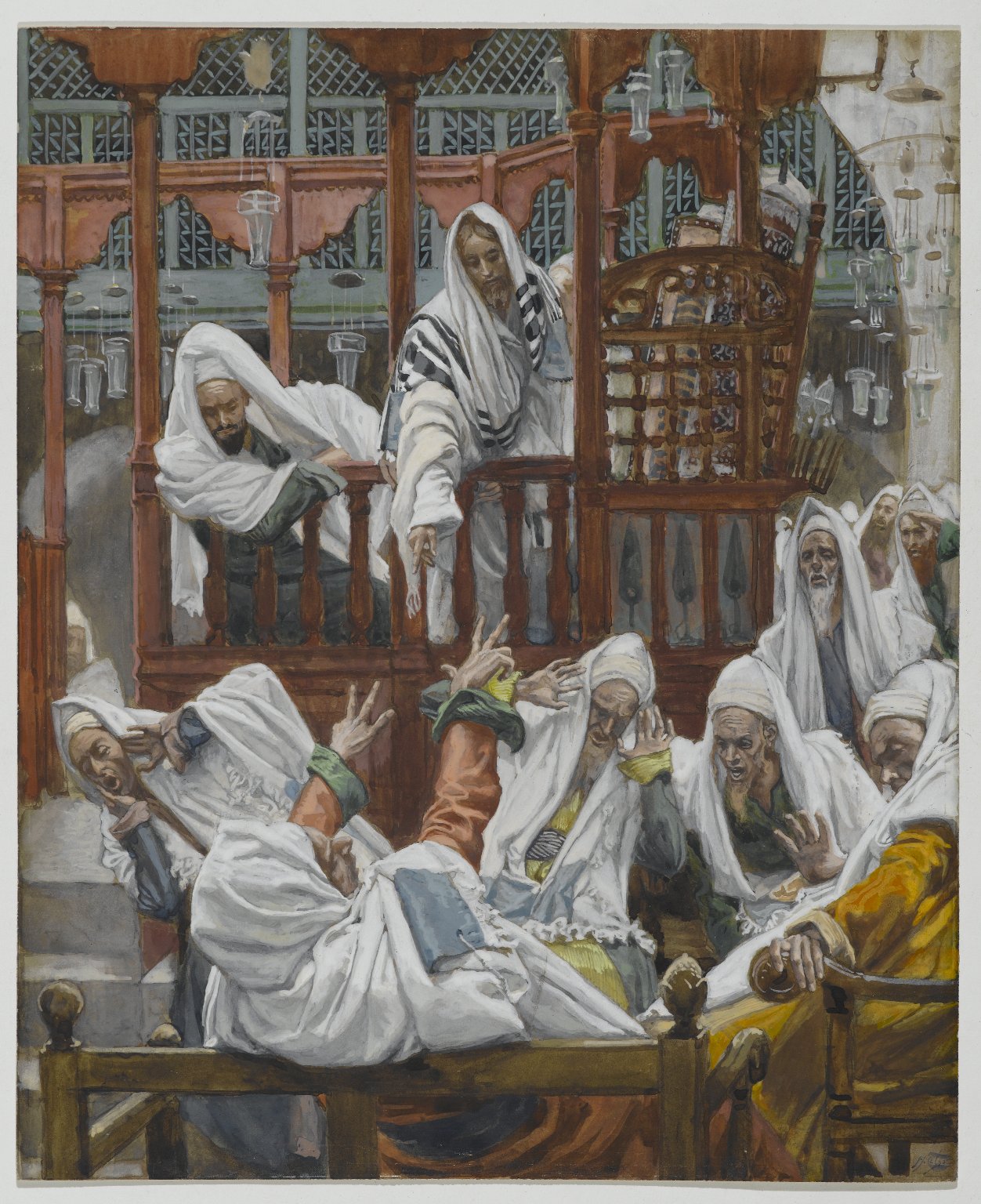
James Tissot: Jesus Heals a Mute Possessed Man (Brooklyn Museum)

Trinity I

THE novel by Robert Llewellyn —‘How green was my valley’ — reached millions through its 1941 film adaptation by John Ford. Telling the story of a family in a South Wales mining community, it criticises the unjust labour practises of the early twentieth century. Earlier in 1887 the historian Lord Acton wrote to the Professor of Ecclesiastical History at the University of Cambridge, saying that, ‘Power tends to corrupt, and absolute power corrupts absolutely.’ While this maxim now tends to be applied generally, it was originally a comment on religious institutions in general, and the medieval Papacy in particular. The truth of this statement is a reflection on our fallen human nature.

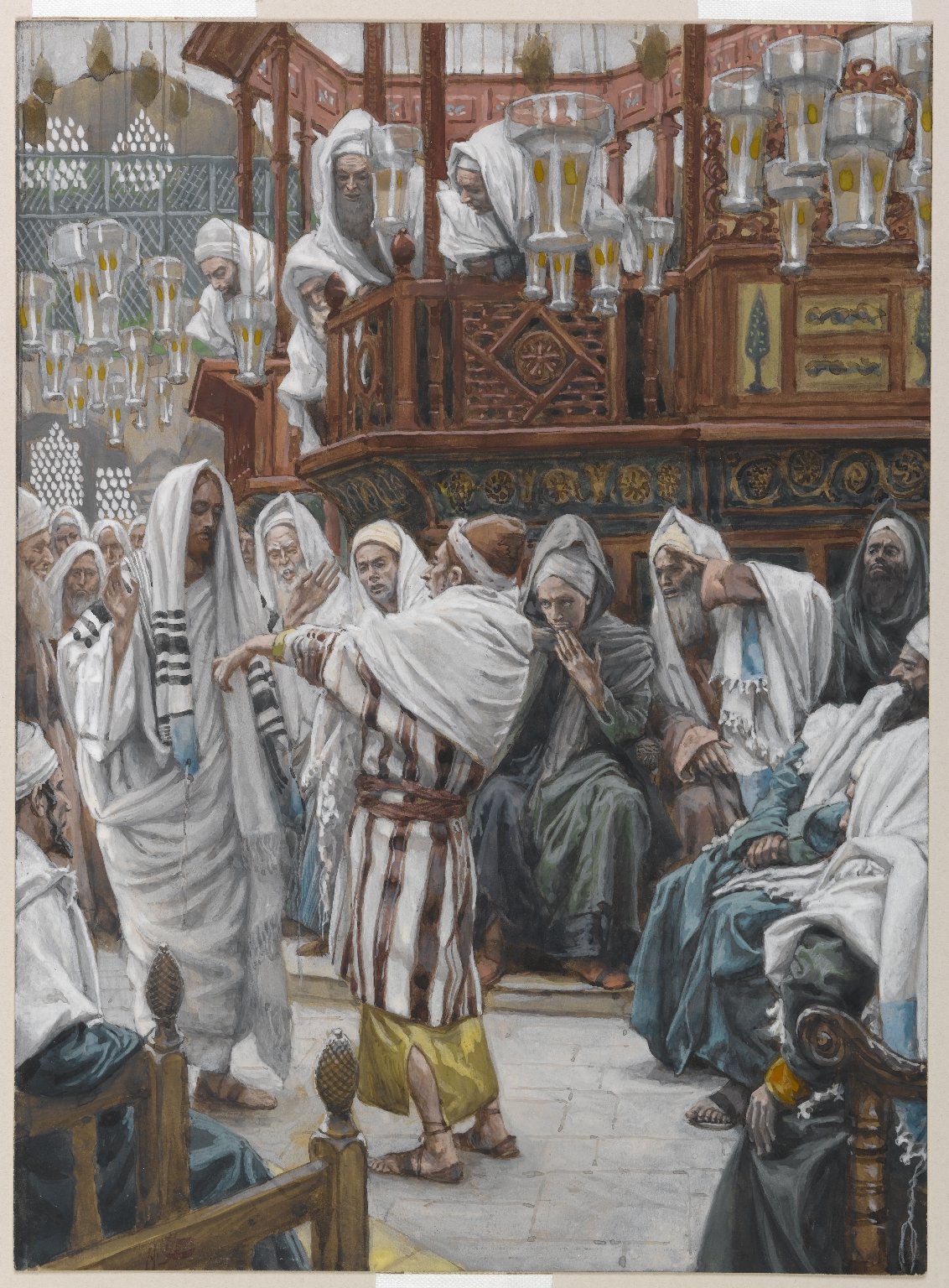
In the Gospels we often see Our Lord come into conflict with the Scribes, Priests, and Pharisees. These religious leaders are depicted as being more concerned with power and prestige than with the worship of Almighty God. If Religion is important then there will be a status attached to its ministers. They, therefore, have a responsibility to use this status for good, and to bring people closer to God.

In today’s Gospel it is the Sabbath, a day of rest. Jesus and His disciples are travelling, and the Pharisees notice that some of them have plucked ears of corn to eat. The Pharisees ask Our Lord:

‘Look, why are they doing what is not lawful on the Sabbath?’

‘Edrych, pam y maent yn gwneud peth sy’n groes i’r Gyfraith ar y Saboth?’  (Mk 2:24)

Jews are forbidden from doing any work on Sabbath, and the harvesting of grain, no matter how little, counts as work. This appears to be a clear-cut case, but Jesus replies as follows:

‘Have you never read what David did, when he was in need and was hungry, he and those who were with him: how he entered the house of God, in the time of Abiathar the high priest, and ate the bread of the Presence, which it is not lawful for any but the priests to eat, and also gave it to those who were with him?’

‘Onid ydych chwi erioed wedi darllen beth a wnaeth Dafydd, pan oedd mewn angen, ac eisiau bwyd arno ef a’r rhai oedd gydag ef? Sut yr aeth i mewn i dŷ Dduw, yn amser Abiathar yr archoffeiriad, a bwyta’r torthau cysegredig nad yw’n gyfreithlon i neb eu bwyta ond yr offeiriaid; ac fe’u rhoddodd hefyd i’r rhai oedd gydag ef?’ (Mk 2:25-26)

This story is recounted in 1Samuel 21:1-7. By referring to it Our Lord is making the point that if David’s actions were acceptable, then why is such a fuss being made about the disciples plucking a few ears of corn. Jesus underlines this by pointing out that:

‘The Sabbath was made for man, not man for the Sabbath’

‘Y Saboth a wnaethpwyd er mwyn dyn, ac nid dyn er mwyn y Saboth’ (Mk 2:27)

The legalism of the Pharisees has led them to forget what the Sabbath is really about: rest. The point of having a Sabbath is to ensure that people have a day of rest. Instead this day has become bound up with rules and observances which neither honour God, nor encourage humanity to rest. 

Jesus and His disciples arrive at a synagogue where there is a man with a withered hand. Clearly this is another opportunity for the legalism of the Pharisees to come to the fore.

‘And they watched Jesus, to see whether he would heal him on the Sabbath, so that they might accuse him.’

‘Ac yr oeddent â’u llygaid arno i weld a fyddai’n iacháu’r dyn ar y Saboth, er mwyn cael cyhuddiad i’w ddwyn yn ei erbyn.’ (Mk 3:2)

Rather than rejoicing that God has performed a miracle, and that a man with a disability has been healed, all the Pharisees can see is an opportunity to complain about rule-breaking, and to bring an accusation against Jesus. Our Lord calls the man to Him, and says to the Pharisees:

‘Is it lawful on the Sabbath to do good or to do harm, to save life or to kill?’

‘A yw’n gyfreithlon gwneud da ar y Saboth, ynteu gwneud drwg, achub bywyd, ynteu lladd?’ (Mk3:4)

They give no reply because they know that in order to save a life one may break every rule regarding the observance of the Sabbath. Jesus’ knowledge and interpretation of Jewish Scripture and Law is superior to theirs. Our Lord then asks the man to stretch out his hand, and he is miraculously healed. No law has been broken. Instead someone who was suffering, and who was probably shunned and made an outcast in society, has been cured and brought back into the fold of the community. God’s power to heal and restore humanity has been displayed. The Kingdom of God has been announced in deed.  

The response of the religious authorities is telling. Do they rejoice at this miracle? The answer is definitely no.

‘The Pharisees went out and immediately held counsel with the Herodians against him, how to destroy him.’

‘Ac fe aeth y Phariseaid allan ar eu hunion a chynllwyn â’r Herodianiaid yn ei erbyn, sut i’w ladd.’ (Mk 3:6)

The Pharisees have formed an alliance with a priestly party, keen on political independence. Both sides share a common aim — to get rid of Jesus. This is because He represents a threat to their power. Our Lord’s words and actions are understood by the Pharisees as an assault on their privileged position, with their innate goodness being ignored. From the start of His public ministry, Christ faces opposition from people who want Him dead. They think that they can destroy Jesus, and that will be the end of the matter, whereas it will only be the beginning. Our Lord will die on a Cross, but will be raised to new life at Easter. Calvary and the Empty Tomb are the salvation of humanity, part of God’s plan.

As Christians we gather on the Lord’s Day, the first day of the week, to celebrate Christ’s Death and Resurrection. By means of the Eucharist, we do that which Jesus commanded us to do until He comes again. For one hundred thousand successive Sundays the faithful have gathered to share in Holy Communion, because it matters, it is important. We are fed with the Bread of Angels, with the Body and Blood of Christ, so that we may be healed and given a foretaste of Heaven.

So, my brothers and sisters, let us rejoice in the healing salvation of Christ. Let us proclaim the Good News, so that all people may come to know, and love, God the Father, God the Son, and God the Holy Spirit. To whom be ascribed all glory, dominion, and power, now and forever. Amen.

James Tissot – The Man with a withered hand (Brooklyn Museum)
Tissot: The Disciples Eat Wheat on the Sabbath (Brooklyn Museum)

Good Friday 2024

The Practice of Crucifixion as a punishment was designed to be both as painful and as shameful as possible. Public torture was dressed up as execution, with the condemned having to struggle for each breath, before finally succumbing to asphyxiation. People could potentially hang there for days until exhaustion took its toll. It is possibly the most horrific and gruesome means to end a human life devised by humanity. A public crucifixion is also one of the central moments of the Christian Faith. This is how much God loves us. Jesus willingly undergoes a shameful death, and acts of brutal torture, for our sake. 

There are two Old Testament texts which are key to understanding this Good Friday Service. The first is Psalm 22, whose opening words are spoken by Jesus before He dies: ‘Fy Nuw, fy Nuw pam yr wyt wedi fy ngadael’ ‘My God, My God, why hast thou forsaken me’ (in Hebrew Eli, Eli, lama sabachthani). The second is the passage from Isaiah Chapters 52 and 53 which was today’s first reading. In Isaiah we see all of Christ’s suffering and death both foretold, and interpreted:

‘he bore the sin of many’ ‘with his stripes we are healed’ ‘He was oppressed, and he was afflicted, yet he opened not his mouth; like a lamb that is lead to the slaughter, and like a sheep that before its shearers is dumb, so he opened not his mouth.’ ‘he makes himself an offering for sin’. (Isa 53:12, 5, 7, 10)

The meaning is clear. The wounds of human sin, which cry out for healing, are healed in Christ. Such is God’s love for us. What disobedience has destroyed, love restores. Here we see the glory of God. In willingly accepting His death on the Cross, Our Lord fulfils Isaiah’s prophecy — the suffering servant is the Messiah, the Christ, God’s anointed. At the time when the Passover lambs are slaughtered in the Temple, Christ, as both priest and victim, offers himself upon the Altar of the Cross as the true lamb to take away the sins of the whole world. When Jesus dies the veil of the Temple is torn in two — the barrier between heaven and earth is taken away, and God is reconciled to humanity. This sacred drama takes place on a hill outside Jerusalem, close to where Abraham attempted to sacrifice Isaac.  Then a ram was sacrificed in the boy’s place, but now God sends His Son to die for us.

Two people are present at Calvary as witnesses. These are Mary, Jesus’ Mother, and John, the Beloved disciple. Thirty-three years before this day, the Archangel Gabriel announced to Mary that she would bear the Son of God. Now she stands at the foot of the Cross to see her beloved Son suffer and die. Simeon had once told her that a sword would pierce her soul, and now that prophecy comes true. But before He dies, Jesus does something wonderful:

‘When Jesus saw his mother and the disciple whom he loved standing nearby, he said to his mother, “Woman, behold, your son!” Then he said to the disciple, “Behold, your mother!” And from that hour the disciple took her to his own home.’ 

‘Pan welodd Iesu ei fam, felly, a’r disgybl yr oedd yn ei garu yn sefyll yn ei hymyl, meddai wrth ei fam, “Wraig, dyma dy fab di.” Yna dywedodd wrth y disgybl, “Dyma dy fam di.” Ac o’r awr honno, cymerodd y disgybl hi i mewn i’w gartref.’ (Jn 19:26-27)

Here we see a new family being formed. One not based on ties of blood, but of love. This is what the Church is, a family of love, and it starts here, at the foot of the Cross, where Christ, our great High Priest, offers Himself as both priest and victim. The Christian Church begins with three people on a hill outside Jerusalem. One of these three is about to die, condemned as a blasphemer and trouble-maker. Despite this less-than auspicious beginning we are gathered here today, nearly twenty centuries later. Christ’s Church starts as a failure in worldly terms. However it is a divine institution: it isn’t supposed to make sense in human terms. The Church’s mission is to draw us into the mystery of God’s love. Today we see that love made real in Jesus. This is love we can touch and taste, on the Cross, and in the Sacrament of the Altar. 

Let every one of us, today and every day, cling to the Cross, and find there all the grace we need. Let us rejoice that we have been redeemed at so great a cost. Let us glory in the Cross of our Lord Jesus Christ. He is our salvation, our life, and our resurrection, through whom each and every one of us is saved and set free. Amen

Diego Velazquez – Christ Crucified (Museo del Prado, Madrid)

Maundy Thursday 2024

To those of us living in cold northern climes, the idea of foot-washing is strange. However, if we lived in the Middle East it would not be. In hot and dusty parts of the world, if you wear sandals, your feet will get hot, tired, and dirty. In the time of Jesus, to wash a visitor’s feet was a sign of hospitality, and was usually something done by a servant. For a host or householder to do the foot-washing themselves was a sign both of humility and the importance of those being welcomed. Tonight Christ washes our feet. We are all guests at the Lord’s Supper, where Jesus institutes the Eucharist on the night before He suffers and dies.

St Paul’s First Letter to the Corinthians (our Second Reading tonight) was written about twenty years after Christ’s Death and Resurrection. This is the earliest account we possess of what happened on this night. Paul describes how Our Lord blesses bread and wine and feeds his followers. Jesus also explains what He is doing, saying, ‘This is my Body … This is my Blood’ ‘hwn yw fy nghorff … hwn yw fy ngwaed’. These words are repeated whenever the Eucharist is celebrated because Our Lord told us to ‘Do this’ ‘gwnewch hyn’, and so we do. We are fed by Christ, fed with Christ, both to proclaim His Death, but also to share His New Life. This is no ordinary meal, but rather a proclamation of God’s saving work.

At the Last Supper Jesus takes on the role of a servant, the Teacher washes His disciples’ feet, and feeds them with Himself. These acts of humility and generosity, help to bring the Christian Church into being. It starts here, tonight. This is why the Church commemorates it every year, both to remind us where we have come from, and where we are going. This is the Wedding Banquet of the Lamb, the Heavenly Feast of the Kingdom to which all people are invited. 

God (through me) washes our feet, kneeling on the floor, and wipes them with a towel. This is something that is both humble and utterly wonderful. Jesus gives us an example of loving service: this is what the Church is supposed to be. Those in positions of Christian leadership are called to be shepherds in the service of God’s people. Likewise, as Christ’s followers, we are all called to serve each other. As Jesus said:

‘If I then, your Lord and Teacher, have washed your feet, you also ought to wash one another’s feet. For I have given you an example, that you also should do just as I have done to you.’

‘Os wyf fi, felly, a minnau’n Arglwydd ac yn Athro, wedi golchi eich traed chwi, fe ddylech chwithau hefyd olchi traed eich gilydd. Yr wyf wedi rhoi esiampl i chwi; yr ydych chwithau i wneud fel yr wyf fi wedi ei wneud i chwi. ’ (Jn 13:14-15)

We follow Christ’s example. In the same way we celebrate the Eucharist because Christ told us to ‘do this’ ‘gwnewch hyn’ and so Christians have for nearly two thousand years, and we will continue to do so until Our Lord comes again. This is more than sacred drama. We are not simply spectators watching a reenactment, we are active participants in the mysteries themselves! The Eucharist, which Jesus instituted this evening, means a number of things. Firstly, the Eucharist is our thanksgiving to God for who Christ is, and what He does. Secondly, the Eucharist is an act of obedience: Our Lord told His disciples to ‘do this’, and so, for two thousand years the Church has obeyed His command. Thirdly, the Eucharist is a mystery that makes present the Body and Blood of Christ, which suffered and died for us on Calvary. As Christ fed His disciples, so He feeds us too. Tonight’s Eucharist is just as real as the first one, in the Upper Room, and each and every one ever since. That is why Christians celebrate this evening. On the night before He suffered and died for us, Jesus took bread and wine, gave thanks to God, and gave them to His disciples, telling them to do this in remembrance of Him.

God gives Himself to us as nourishment. God gives Himself to us, so that we might have life in Him. The role of the Church is to carry on the offering of the Son to the Father, to make it present across space and time. That is why we are here, tonight, gathered as disciples of Our Lord and Saviour Jesus Christ. As Christians we are to be people of love. It is love that makes us Christians. God’s love for us: a love which sees Our Lord offer Himself, to take away our sins, to heal our wounds, and restore us to God’s loving embrace. 

So my brothers and sisters in Christ, let us come to the Lord, and be washed. Let us feed on the heavenly banquet, which strengthens us. And let us to sing the praises of God the Father, God the Son, and God the Holy Spirit. To whom be ascribed, all majesty, glory, dominion, and power, now and forever. Amen.

Palm Sunday 2024

IN THIS COUNTRY when we want to celebrate something there is often some kind of procession. Sports teams who win trophies go on an open-topped bus. After King Charles’ Coronation, there was a great procession from Westminster Abbey back to Buckingham Palace. Today, we see the entry of the Messiah into Jerusalem. The Davidic King has made His triumphal entry, something which we have reenacted ourselves this morning, waving palms and singing, ‘Hosanna to the Son of David!’. The prophet Zechariah, writing 500 years before Jesus, looks forward to a messianic future:

Rejoice greatly, O daughter of Zion! Shout aloud, O daughter of Jerusalem! Behold, your king is coming to you; righteous and having salvation is he, humble and mounted on a donkey, on a colt, the foal of a donkey.

‘Bydd lawen iawn, ti ferch Seion; a chrechwena, ha ferch Jerwsalem: wele dy frenin yn dyfod atat: cyfiawn ac achubydd yw efe; y mae efe yn llariaidd, ac yn marchogaeth ar asyn, ac ar ebol llwdn asen.’ (Zech 9:9)

The donkey ridden by Jesus reminds us of the humble beast of burden, which carried his Mother to Bethlehem for His birth, and then carried the Holy Family into exile in Egypt. This is an act of humble leadership which realizes what the prophets foresaw. It shows us that Jesus Christ is truly the one who fulfils the hopes of Israel. The Hebrew Scriptures look forward to the deliverance of Israel. This deliverance is enacted in front of the eyes of those watching the Carpenter’s son enter the Holy City.

Scripture is fulfilled and there is a burst of popular enthusiasm, people wave palm branches and cry out. However, having someone claim to be a relative of King David is a direct challenge to Herod, the puppet ruler installed to comply with the Romans. The events we heard described, before our procession this morning, look something like a political coup — a bid to replace a leader lacking legitimacy. Such an attempt is bound to have political repercussions. It represents a direct challenge to the ruling house and to Rome, and therefore it has to be countered. The masses in Jerusalem are expecting a king of the Davidic line. One who would be seen as a challenge to the ruling élite, the status quo. But in Christ, God gives Israel something else. Yes, he is a King of the line of David. But Jesus is one who rules with love, and who has no desire for power, or honour. Naturally, the leaders and those in authority are threatened by Him: Jesus turns their world on its head. He is an awkward inconvenience. Jesus, however, does not want their power. He has come to be and accomplish something completely different. What is seen as a potential political coup is in fact a renewal of religion, the fulfilment of prophecy, and a new hope for Israel. Political and religious leaders can only see the threat, rather than the opportunity which Christ offers.

At its heart Christianity is an offer of new life in Jesus Christ. This starts with repentance, and acceptance of our need for God. As we grow in faith, we come to believe and trust in a God who loves us, and gives Himself for us. Then we can experience healing, wholeness, and fullness of life in and through Him. Such gifts come at a cost, which the week ahead will make clear to us in the most stark and direct way. 

Over the next few days we will see the joy and celebration of today turned into anger and resentment. Crowds which cried ‘Hosanna’ will soon shout ‘Crucify him!’. This should come as no surprise to us. We know how people can be fickle and manipulated. And yet, on the same night He will be betrayed, Jesus takes bread and wine, blesses them and says, ‘This is my Body … This is my Blood’. ‘hwn yw fy nghorff … hwn yw fy ngwaed’ These words are repeated when the Eucharist is celebrated because Our Lord told us to ‘Do this’ ‘gwnewch hyn’ and so we do. We come together so that God can feed us with His very self, so that we can have life in Him. This is not an optional extra, it is fundamental to who and what we are as Christians. In the Eucharist we experience God’s love, His body broken for us, His blood poured out, to heal us. This is the banquet of the Kingdom, the Wedding Feast of the Lamb, and we are all invited!

Today, and in the coming week, we see what God’s Love and God’s Glory are really like. They are not what people expect. God’s power is shown in humility, strength in weakness. As we continue our Lenten journey in the triumph of this day, we look towards the Holy and Life-giving Cross and beyond to the new life of Easter. Let us trust in the Lord, and go with Him to Calvary, and beyond. Let us raise our palms and sing the praises of God the Father, God the Son, and God the Holy Spirit. To whom be ascribed all glory, dominion, and power, now and forever. Amen.

Septuagesima (Year B)

The narration of stories is a skilled activity, whether they are told orally, or in writing. Setting the scene and introducing the characters are an important part of the process. Sometimes people begin with a long introduction, whereas others take you straight to the action. Mark’s Gospel definitely takes the latter approach. He does not set the scene by giving details of Jesus’ birth or childhood. Instead, he plunges straight into chronicling Our Lord’s public ministry in Galilee.

Mark’s Gospel begins with a description of Jesus’ ministry that proceeds at a frenetic pace. Jesus is baptised by John, goes into the desert for forty days, and calls two sets of brothers to follow Him: Simon and Andrew, James and John. In today’s passage Jesus teaches in a synagogue and heals a man possessed by an unclean spirit. Everything happens in quick succession, there is no time to waste. Part of this is a desire on the Gospel writer’s part to embody the vibrancy of Jesus’ proclamation of the Kingdom:

“The time is fulfilled, and the kingdom of God is at hand; repent and believe in the gospel.”

‘Yr amser a gyflawnwyd, a theyrnas Dduw a nesaodd: edifarhewch, a chredwch yr efengyl.’ (Mk 1:15)

Jesus is a man on a mission. He calls people to turn away from their sins, and to believe in the Good News: to love God and also to love your neighbour. As it is the Sabbath, people gather in the local synagogue. Worship in a synagogue involved singing Psalms, reading from Scripture, and teaching, rather like a sermon. This is familiar to us, as our Morning and Evening Prayer proceeds along similar lines. In this instance, instead of a Scribe or Teacher of Law explaining the biblical reading, Jesus Himself is teaching the people.

‘And they were astonished at his teaching, for he taught them as one who had authority not as the scribes’

‘A synasant wrth ei athrawiaeth ef: canys yr oedd efe yn eu dysgu hwy megis un ag awdurdod ganddo, ac nid fel yr ysgrifenyddion.’ (Mk 1:22)

Scribes relied on the authority of Moses, and would refer to other passages in the first five books of the Old Testament, and to previous interpretations, to make their point. Jesus does something different, and while Mark doesn’t tell us exactly what He said, it is clear that Our Lord’s interpretation of the Scriptures was both refreshing and authoritative. Jesus teaches like someone with authority. He isn’t a scribe or a Pharisee, He hasn’t spent years in theological training. Jesus stands outside traditional religious power structures. Our Lord’s teaching has authority not just because it is spoken with conviction, but because it is real and embodied in Him. Christ’s words are lived out in His life, because he is God: the Son of God, beloved of the Father (cf. Mk 1:11). He is filled with the Holy Spirit, and proclaims the Good News of the Kingdom. 

After Jesus has unpacked the Scriptures, He is addressed by a man who is clearly unwell:

“And immediately there was in their synagogue a man with an unclean spirit. And he cried out, ‘What have you to do with us, Jesus of Nazareth? Have you come to destroy us? I know who you are—the Holy One of God.’” 

‘Ac yr oedd yn eu synagog hwy ddyn ag ynddo ysbryd aflan: ac efe a lefodd, Gan ddywedyd, Och, beth sydd i ni a wnelom â thi, Iesu o Nasareth? a ddaethost ti i’n difetha ni? mi a’th adwaen pwy ydwyt, Sanct Duw.’ (Mk 1:23-24)

This is a man in need of healing, who is described as being possessed by an evil spirit, though nowadays we would probably prefer to describe him as suffering from mental illness. He is suffering, and longs to be healed. This weak, broken man recognises who and what Jesus is: He is the Holy One of God, the Messiah, Y Meseia. Our Lord speaks with authority telling the evil spirit to be silent and come out of the man. He can do this because He is God.

The Kingdom which Jesus proclaims in His teaching is a place of healing. Ours is a God who can heal our wounds, who can take broken humanity and restore it in love. This is why Christ’s teaching and the healing have to go together; they are both part of a larger whole, the coming Kingdom of God. Jesus proclaims our need to love God and each other, and puts this into practice, making the healing power of God’s love a reality in the world. Therefore, at the beginning of Jesus’ public ministry in Mark’s Gospel we see the proclamation of the Good News, and its application in a healing miracle. Jesus is the fulfilment of Moses’ prophecy, in today’s first reading, where he says:

“The Lord your God will raise up for you a prophet like me from among you, from your brothers—it is to him you shall listen” 

‘Yr Arglwydd dy Dduw a gyfyd i ti, o’th blith dy hun, o’th frodyr dy hun, Broffwyd megis finnau; arno ef y gwrandewch’ (Deut 18:15)

“And I will put my words in his mouth, and he shall speak to them all that I command him.”

‘a rhoddaf fy ngeiriau yn ei enau ef; ac efe a lefara wrthynt yr hyn oll a orchmynnwyf iddo.’ (Deut 18:18)

These verses are quoted, by both St Peter in Acts 3:22 and St Stephen in Acts 7:37, to refer to Jesus. For nearly two thousand years the Church has had a consistent interpretation of this passage as pointing to, and finding its fulfilment in, Jesus Christ. We can listen to Him with confidence because Jesus is God. He has authority, and He longs to heal us.

The message that Our Lord proclaims in His teaching is reinforced by His actions. Jesus shows that the Kingdom of God is a place where humanity can be healed and freed from sin. Christ demonstrates this most fully when He suffers and dies for us on the Cross. From the very beginning, Jesus looks to the Cross —not as a place of torture, humiliation, or defeat — but as the place of victory and healing. The Crucifixion is the supreme demonstration of God’s love for humanity. Through the Cross we learn how much God loves us. This is why God sends His Son to heal our wounds, to restore us, and to give us the hope of Heaven. Confident in His promises we can turn to God and pray for the healing that we all so desperately long for, and which the world needs. We can pray that His Divine nature might transform our human nature, and give us a foretaste of Heaven. We pray that our own wounds: physical and mental, will be healed, so that we might have life in Him, in this world and the next.

The possessed man asks Jesus, ‘Have you come to destroy us?’ ‘a ddaethost ti i’n difetha ni?’ The only thing that Christ has come to eradicate is the power of evil which separates man from God. We know that the Son of God has come not to destroy but to restore humanity, so that we may have life and have it to the full. This is the Good News of the Kingdom, which is still a reality here and now. We, in our brokenness, can approach the source of all healing, the God who loves us and gives himself for us, so that we can be restored by Him. God can take our lives and heal us in His love. Let us then come to Him, so that our lives may also be transformed. Let us proclaim to a world, which longs for healing and wholeness, the love of God the Father, God the Son, and God the Holy Spirit. To whom be ascribed all glory, dominion, and power, now and forever. Amen.

James Tissot The Possessed Man in the Synagogue (Brooklyn Museum)

The Twenty-second Sunday of Year A

The vocation to be a prophet is not an easy one. Prophets are tasked with telling people the plain, unvarnished truth about God. Their words can be quite unpalatable. Most, if not all, of us would much rather not hear hard truths. Therefore it comes as no surprise that in our first reading this morning, the prophet Jeremiah is feeling rejected and miserable. He has been prophesying the destruction of Jerusalem by the Babylonians, but, because this has not yet happened, he is seen as a fraud. Jeremiah starts to doubt God, and yet there is a burning fire within himself to call God’s people to repentance. However, when he announces this he is mocked. Jeremiah feels let down. 

Last week we read Peter’s declaration that Jesus is the Messiah, the Son of God. Following on from this, Jesus tells His disciples what must happen to Him:

He must go to Jerusalem and suffer many things from the elders and chief priests and scribes, and be killed, and on the third day be raised. (Mt 16:21)

Jesus’ words must have come as something of a shock to the disciples. This isn’t what is supposed to happen to the Messiah, so Peter takes Jesus to one side and tells Him off! Peter cannot understand what needs to happen. He has forgotten prophecies like Isaiah 53 which tell of the Suffering Servant. Peter cannot take it in — he does not want Jesus’ prophetic words to take place. This is a very human response. We also don’t want such appalling things to happen. Then it is Peter’s turn to be told off. Jesus says to him:

“Get behind me, Satan! You are a hindrance to me. For you are not setting your mind on the things of God, but on the things of man.” (Mt 16:23)

In just a couple of verses Peter has gone from being the rock upon which the church will be built, to being Satan, the deceiver, the devil, and a stumbling block. Peter has run the whole length of the spectrum, from getting things right to getting them totally wrong. There are no half-measures with Simon Peter. He jumps in with both feet. He may be right or wrong, but he is certainly committed, and through this commitment Jesus sees Peter as a leader. But the disciples’ inability to understand what Jesus is saying has led him to try and oppose the will of God. Peter, the Rock, has become a stumbling-block, an obstacle, something to trip over. Peter can only see things in human terms, but God has something else in store. The Cross is inevitable for the simple reason that God loves us that much. However, the Cross is not just for Christ. It is for each and every one of as Christians: we are called to bear it ourselves.

As believers, we are to take up our Cross and follow Jesus. We should be under no illusion; it isn’t easy to take up the Cross. We cannot do it on our own, we have to do it together, as a community, relying upon God, and loving and forgiving each other. All the power, all the wealth in the world, is worth nothing compared to finding true life in Christ. Worldly things cannot save us, they cannot give us eternal life, they cannot wipe clean our sins. Only Jesus can do this, on the Cross. Only in Christ can we have life — life in its fullness. Only if we lose our old life by following Him, can we find what our human life can truly be.

Thus the Church, in following Jesus, offers a radical alternative to the ways of selfishness and sin, an alternative which has the power to change the world through being conformed to Christ. We can do this together, by living out our faith and encouraging others to do so; by living lives of profound love, something that is difficult, and costly, and wonderful. 

Today, through prayer, through our conversation with God, throughlistening to God, we are nourished by the Word of God, the Bible, to know that God loves us, and will help us to live out that love and forgiveness in our lives. We are also nourished by the sacraments of the Church, by Holy Communion, so that the love which God shows to the world on the Cross continues to be poured out upon us, so that we can be strengthened to live out the life of faith. It is food for our souls, so that we may be built up in love. Let us turn to the Living God, to be fed by Him, fed with Him, to have new life in Him, so that He can continue to transform our human nature and follow His example. Let us take up our Cross, as people ransomed, healed, restored and forgiven by the love of God on the Cross.

In the Letter to the Romans, St Paul describes what love in action looks like. We are guided as to how to put our faith, into practice in our lives: by living out the love and forgiveness which we have received, turning from the ways of the world and following the way of God. The Christian life is sacrificial in that it involves personal sacrifice, and also by uniting ourselves to the sacrifice of Christ. This world cannot save us, only Christ can do that. The ways of the world cannot give us true happiness, or eternal life. Their promises are false. Only Christ, who is the Way, the Truth, and the Life (Jn 14:6) can save us. Only Christ can transform us, and this transformation lies at the heart of the proclamation of the Kingdom. Only by losing our life can we find it.

As Christians we embrace paradox, because God loves us enough to be born as one of us, to proclaim and live out the truth, healing and reconciliation, which He longs to lavish upon us. In Christ, God dies so that we might live. Words cannot express just how earth-shattering and transformative Divine Love is. It is a mystery, in the fullest sense of the word. God’s love and mercy are greater than anything we can know or imagine. We keep making mistakes, but God’s love is unconditional, we cannot earn it, it is freely offered to transform us. Thus, our faith is the work of a lifetime. Day by day God’s grace can perfect our nature, if we are humble enough to let God be at work in us. We pray that God’s grace may transform us so that, in this life and the next, we and all creation may give glory to God the Father, God the Son, and God the Holy Spirit, to who whom be ascribed as is most right and just, all might, majesty, glory, dominion and power, now and forever. Amen.

A 4158