Trinity IV – The Good Samaritan

This year I have re-kindled my love of reading fiction. I have been introduced to some new authors by books lent to me by friends and neighbours or recommended by my wife. Taking time to lose yourself in a good book is one of life’s greatest (and cheapest) pleasures. Everybody loves a good yarn. Stories are also a useful way to make a point and to convey a deeper truth about human nature. They help us to understand who we are and how we should live. As Jesus travels from Galilee to Jerusalem He teaches, using parables, vivid stories we know and love. As I said, everyone likes to hear a good yarn, but the parables are much more than that. Jesus uses parables to explain the Kingdom and His Mission — who He is, and what He is doing — so that His followers can understand and share that knowledge with others.

In today’s Gospel, Our Lord encounters a legal expert. This lawyer wants to put Jesus to the test, to check whether what He says is acceptable under Jewish religious law. This man of the law asks Him: 

“Athro, beth a wnaf i etifeddu bywyd tragwyddol?”

“Teacher, what shall I do to inherit eternal life?” (Lk 10:26)

Jesus replies by asking the lawyer to tell Him what is written in the Law, and questions how, as a legal expert, he interprets it. The man replies, by reciting scripture:

‘Câr yr Arglwydd dy Dduw â’th holl galon ac â’th holl enaid ac â’th holl nerth ac â’th holl feddwl, a châr dy gymydog fel ti dy hun.’

“You shall love the Lord your God with all your heart and with all your soul and with all your strength and with all your mind, and your neighbour as yourself.” (Lk 10:27)

The first part of the lawyer’s answer is a quotation from the book of Deuteronomy (6:5), part of the Shema, a Jewish declaration of faith in God, which begins ‘Hear, O Israel: the Lord our God is one’. The second part is a quotation from Leviticus (19:18). This summary of the Law outlines humanity’s duty both towards God and also towards our neighbours. This legal expert understands how he should behave, and how he should live his life. He has basically repeated Jesus’ teaching word-for-word. So far, so good. The lawyer then asks Our Lord another question:

‘Ond yr oedd ef am ei gyfiawnhau ei hun, ac meddai wrth Iesu, “A phwy yw fy nghymydog?”’

‘But he, desiring to justify himself, said to Jesus, “And who is my neighbour?”’ (Lk 10:29)

The lawyer wants to legitimise himself, and so he asks Jesus to define his terms. In a legal argument, this is a typical response. However, the lawyer’s motives are questionable. He is interested in self-justification, in making himself look good. Our Lord is happy to answer, and does so with a parable: The Parable of the Good Samaritan. This well-known story is set on road from Jerusalem to Jericho. Despite being a major route, it is steep and windy (a bit like some of the roads around here!), dropping over three thousand feet in seventeen miles. The road takes a traveller through lots of empty desert land, where bandits made a living robbing travellers. The sight of someone who has been attacked and robbed was probably not an unusual one along this route. 

In the parable, a priest and a Levite pass by one such victim, crossing to the other side as they do not wish to become ritually impure. Under Jewish law, if they touched a dead body, they would become unclean, and unable to offer sacrifice and worship in the Temple until they had been ritually cleansed. Rather than risk this, these Temple officials assume that the man is dead and simply pass on by. Soon afterwards another traveller sees the man who has been attacked:

‘Ond daeth teithiwr o Samariad ato; pan welodd hwn ef, tosturiodd wrtho. Aeth ato a rhwymo ei glwyfau, gan arllwys olew a gwin arnynt; gosododd ef ar ei anifail ei hun, a’i arwain i lety, a gofalu amdano.’

‘But a Samaritan traveller who came upon him was moved with compassion when he saw him. He went up and bandaged his wounds, pouring oil and wine on them. He then lifted him on to his own mount, carried him to the inn and looked after him.’ (Lk 10:33-34)

Samaritans and Jews generally kept separate from each other. They had profound theological differences, and the Jews worshipped on Mt Zion, while the Samaritans worshipped on Mt Gerizim. When the Jews went into exile in Babylon, the Samaritans remained behind. Despite the fact that they all worshipped the same God, they were completely estranged from each other. However, the Samaritan has compassion. He is deeply moved to help someone in need, and so he crosses the cultural boundaries and takes care of the man. We are told that he pours oil and wine on the injured man. This was current medical practice. It was also what one would do at a sacrifice at the Temple. Therefore, it is possible that Jesus’ image relates to some words of the prophet Hosea:

‘Oherwydd ffyddlondeb a geisiaf, ac nid aberth, gwybodaeth o Dduw yn hytrach na phoethoffrymau.’

‘For I desire mercy and not sacrifice, the knowledge of God rather than burnt offerings.’ (Hosea 6:6)

The priest and the Levite are concerned with sacrifice and purity, but the Samaritan shows the mercy that God desires. He binds up the injured man’s wounds, treats them, brings him to an inn, and takes care of his needs. The parable shows true love and mercy in action.

Traditionally the Church has also seen deeper meanings at work in this story. It has understood the Parable of the Good Samaritan in a symbolic way, which explains both the human condition, and Christ’s saving work. In one reading, the traveller represents Adam, and stands for all humanity. His wounds are those of sin and disobedience. The Samaritan is Jesus, the one who has compassion on us. The inn stands for the Church, the place where sinners are healed, and the oil and wine are the sacraments of the Church, which heal us. However, Christ is also the man wounded for our transgressions, who suffers for humanity, to heal our wounds.

Such an interpretation shows us how rich this parable is. Jesus tells it to His followersas He is travelling up to Jerusalem — the place where He will suffer and die. Our Lord is teaching His disciples what they need to understand in order to put mercy and love into action. Love and mercy are signs of the Kingdom of God. God’s Kingdom is where Jesus reigns from the Cross. It is where Christ overcomes sin and Death, to offer eternal life to all humanity. This is why St Paul can write:

‘Oherwydd gwelodd Duw yn dda i’w holl gyflawnder breswylio ynddo ef, a thrwyddo ef, ar ôl gwneud heddwch trwy ei waed ar y groes, i gymodi pob peth ag ef ei hun, y pethau sydd ar y ddaear a’r pethau sydd yn y nefoedd.’

‘Because God wanted all perfection to be found in him and all things to be reconciled through him and for him, everything in heaven and everything on earth, when he made peace by his death on the cross.’ (Col 1:19-20)

Our Lord’s Passion is a work of reconciliation. It is the job of every Christian to carry on that work. The Parable of the Good Samaritan is also about the reconciliation of people from different cultures — through Christ. Today Christians from so many different backgrounds gather together to read and study scripture. To pray together. To be healed and nourished by God, through the Sacraments. Both Baptism and the Eucharist are outward signs of spiritual grace, the power of God to heal, reconcile, and transform us all. We are gathered today in the ‘inn’ of the Church, so that God can heal us, and strengthen us to go out and share God’s saving love with others.

Following the example of the Good Samaritan, may we also be agents of God’s love and grace in the world. May we transform our homes, our communities, and the whole world. Filled with God’s love, compassion, and healing, let us give glory to God, Duw Dad, Duw y Mab, a Duw yr Ysbryd Glân. God the Father, God the Son, and God the Holy Spirit. I’r hwn y priodoler pob gogoniant, arglwyddiaeth, a gallu, yn awr, ac yn oes oesoedd. To whom be ascribed all glory, dominion and power, now and forever. Amen.

James Tissot – The Good Samaritan (Brooklyn Museum)

Pentecost 2025

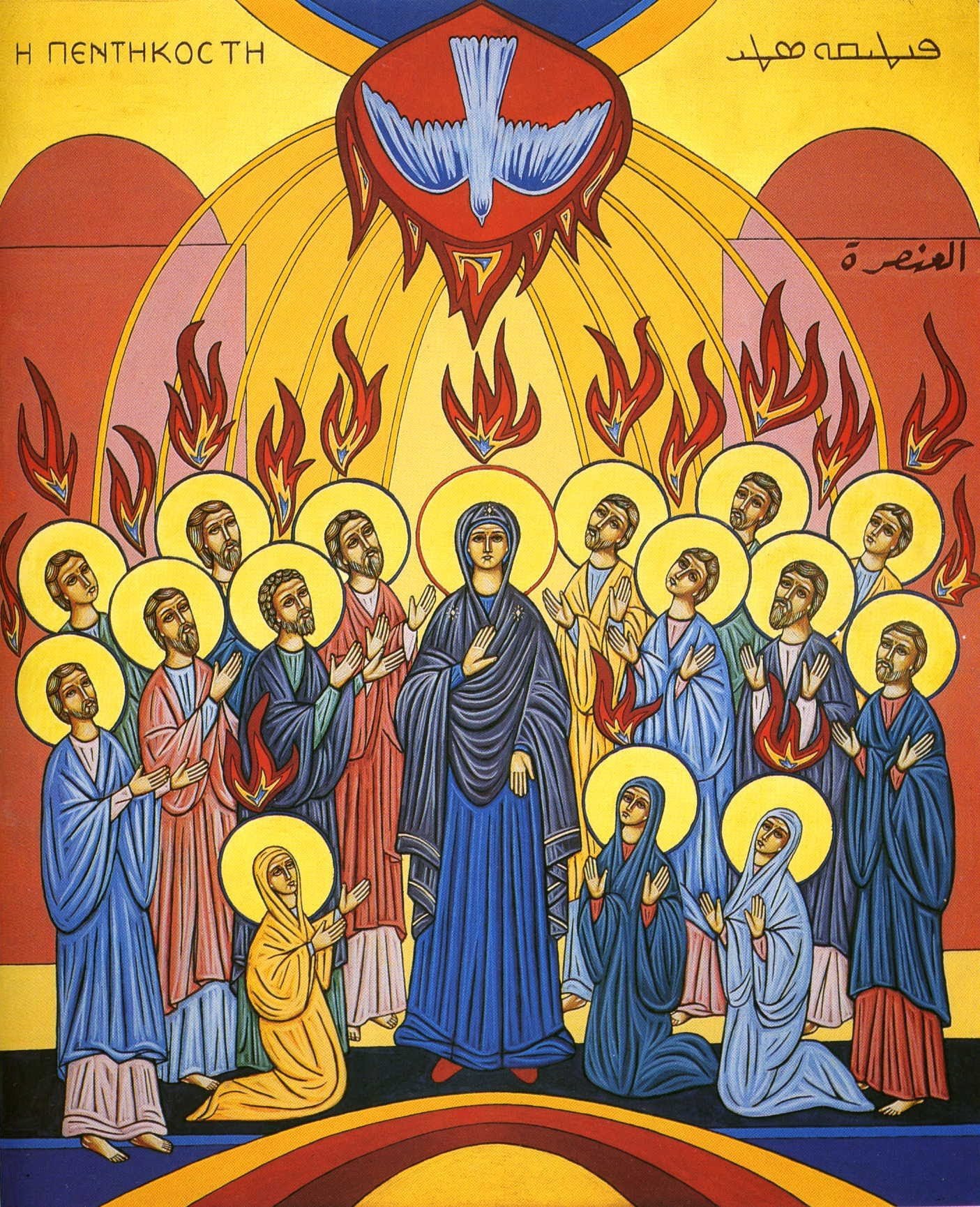
Every Sunday, and also on solemn Feast days, Christians make a public declaration of their faith in God, Father, Son, and Holy Spirit, using the words of the Nicene Creed — which we will all say together in a few minutes time. This statement of belief was drawn up seventeen hundred years ago at the First Ecumenical Council, which was called by the Roman Emperor Constantine to sort out divisions within the Church concerning the Divinity of Jesus Christ. The council met at Nicaea in Asia Minor (modern day Turkey) and comprised of three hundred and eighteen bishops of the Church. One of these was Nicholas of Myra, St Nicholas, the patron saint of this church. 

Questions about belief matter. They have the potential to divide the Church. Taking it away from its core purpose of being united in a common faith, and making a consistent proclamation of that faith. This is the situation in today’s reading from the Acts of the Apostles. Having been promised the Holy Spirit by Our Lord at His Ascension, the disciples wait and pray. At Pentecost they are filled with the Spirit. Emboldened, they are able to tell Jews from all over the Mediterranean world, who have gathered in Jerusalem, who Jesus is, and what He has done. From this moment on the disciples are known as Apostles from the Greek ἀπόστολος (meaning one who is sent, a messenger). The message they deliver is that all people should repent and believe the Good News of Jesus Christ. 

The outpouring of the Holy Spirit is not a one-off event, but rather a permanent state of affairs. This is how God continues to be active in the world: inspiring and strengthening Christ’s followers in living and proclaiming their faith. In John’s Gospel, Jesus promises His disciples:

‘Os ydych yn fy ngharu i, fe gadwch fy ngorchmynion i. Ac fe ofynnaf finnau i’m Tad, ac fe rydd ef i chwi Eiriolwr arall i fod gyda chwi am byth,’

‘If you love me, you will keep my commandments. And I will ask the Father, and he will give you another Helper, to be with you for ever.’ (Jn 14:15-16)

The promise is that God’s Spirit will be present in perpetuity. God will continue to pour out His Spirit to strengthen the Church. This is what we are celebrating today at Pentecost. Indeed, during the Eucharistic Prayer I, as your priest,  will pray that God continues to do this and ‘trwy nerth dy Ysbryd, i’r rhoddion hyn o fara a gwin fod i ni ei gorff a’i waed ef’ ‘that, by the power of your [God’s] Spirit, these gifts of bread and wine may be for us his body and blood’. Our heavenly Father makes wonderful things happen. Disciples who have been scared and have been in hiding are transformed into fearless evangelists, going out to preach Christ’s message of love and forgiveness. They become enthusiastic fellow-workers in the vineyard. God is able to completely change people and situations, because His love for us knows no bounds.  

The 318 bishops, who met at Nicaea, in 325AD, were able to put into words what Christians believe because they began their deliberations by praying for the gift of the Holy Spirit to guide and direct their thoughts and actions. This is entirely in line with Our Lord’s teaching in the Gospel: 

‘Ond bydd yr Eiriolwr, yr Ysbryd Glân, a anfona’r Tad yn fy enw i, yn dysgu popeth ichwi, ac yn dwyn ar gof ichwi y cwbl a ddywedais i wrthych.’

‘But the Helper, the Holy Spirit, whom the Father will send in my name, he will teach you all things and bring to your remembrance all that I have said to you.’ (Jn 14:26)

The Bishops, including St Nicholas, were strengthened by God to proclaim the truth, and to bear witness to it, in the face of those who would deny it. They bore witness to the truth of Jesus Christ: true God and true man, who promised the gift of the Holy Spirit. God’s Spirit gives Christians strength and brings us together as brothers and sisters in a new family, which we call the Church. 

It is thanks to the preaching of the Gospel begun by the Apostles at Pentecost, and continued by their successors at Nicaea, that we are here today. It is how billions of people have come to know, love, and serve Our Lord Jesus Christ. As people who are in Christ, who have entered the Church through our Baptism, we are given a very important job to do. We need to tell people about Jesus!

The world-wide Christian Church is wonderful in its diversity. We are all different, we do not speak the same language, or have the same culture. However, we are all equally empowered through having received the Holy Spirit at our Baptism, in our Confirmation, and through all the sacramental actions of the church, which are the outward and visible signs of the inward and spiritual grace of God. This is how the Holy Spirit works. This is how God builds us up together in love. Through the Eucharist, through prayer and through Scripture, we are nourished spiritually to keep doing all that God desires of us.

So, my brothers and sisters in Christ, let us pray earnestly for the gift of the Spirit. Just as St Nicholas was inspired by the Spirit, may God also fill us with His love and equip us to proclaim the Good News of the Kingdom. May the fire of the Holy Spirit embolden us to encourage others to come to know, and love Duw Dad, Duw y Mab, a Duw yr Ysbryd Glân. God the Father, God the Son, and God the Holy Spirit. I’r hwn y priodoler pob gogoniant, arglwyddiaeth, a gallu, yn awr, ac yn oes oesoedd. To whom be ascribed all glory, dominion and power, now and forever. Amen.

Trinity XIII: Lord, to whom shall we go? You have the words of eternal life!

LIFE in the twenty-first century seems to involve an ever-increasing amount of decisions. If we want to buy a cup of coffee we have to make many quick decisions about size, strength, type of coffee, milk, sugar, etc. It can be quite exhausting. Our readings this week focus on the choices and decisions people make. To follow the Christian faith is something we choose to do. We choose to trust God, we are not forced to. The decision to follow Christ is the most important choice we ever make. It affects both our life on earth and in the hereafter.

This morning’s first reading is an account of the renewal of the covenant between God and Israel brought about by Joshua at Shechem. The people of Israel are asked if they want to worship God and follow his laws. Joshua makes his position clear:

“But as for me and my house, we will serve the Lord.”

“Ond byddaf fi a’m teulu yn gwasanaethu’r Arglwydd.” (Josh 24:15)

The people of Israel follow his example and renew their covenant with God:

“Therefore we also will serve the Lord, for he is our God.”

“Yr ydym ninnau hefyd am wasanaethu’r Arglwydd, oherwydd ef yw ein Duw.” (Josh 24:18)

Their religious faith is a conscious act of the will. They choose to serve the God who has saved them. God has shown that He is their God.

In a similar way, the events of Chapter 6 of St John’s Gospel happen around the time of Passover, the festival which marks Israel’s deliverance from slavery in Egypt and the start of their journey to the Promised Land. This is a key moment in Salvation history. Our Lord has been teaching about the Bread of Life, and stressing the importance of eating His flesh and drinking His blood. Such teaching was difficult for a Jewish audience to hear, as it violated fundamental principles of their dietary laws. 

When many of his disciples heard it, they said, “This is a hard saying; who can listen to it?”

Wedi iddynt ei glywed, meddai llawer o’i ddisgyblion, “Geiriau caled yw’r rhain. Pwy all wrando arnynt?” (Jn 6:60)

Jesus is teaching in a synagogue in Capernaum, and those present are not used to this kind of instruction. It turns everything they know on its head. In Hebrew the word for flesh (baśar) and the word for good news, glad tidings, or the Gospel(besorah), sound similar. Such word-play is intentional, and may be linked to the Hebrew Wisdom tradition, such as we heard last week in the Book of Proverbs. Our Lord does not, however, back down, or change His teaching, but instead develops it further:

“Do you take offence at this? Then what if you were to see the Son of Man ascending to where he was before? It is the Spirit who gives life; the flesh is no help at all. The words that I have spoken to you are spirit and life. But there are some of you who do not believe.”

“A yw hyn yn peri tramgwydd i chwi? Beth ynteu os gwelwch Fab y Dyn yn esgyn i’r lle’r oedd o’r blaen? Yr Ysbryd sy’n rhoi bywyd; nid yw’r cnawd yn tycio dim. Y mae’r geiriau yr wyf fi wedi eu llefaru wrthych yn ysbryd ac yn fywyd. Ac eto y mae rhai ohonoch sydd heb gredu.” (Jn 6:61-64)

Having described the Institution of the Eucharist as a way of understanding His Passion and Death, Jesus goes on to talk about events after His Resurrection, namely His Ascension, and the Sending of the Holy Spirit at Pentecost. These are all linked, because they form the culmination of Salvation History. This is the Good News of Jesus Christ. This is God saving His people, the outworking of the covenant at Shechem into the New Covenant of Our Lord and Saviour. However its proclamation does not draw people to Jesus, instead it has the opposite effect:

After this many of his disciples turned back and no longer walked with him. So Jesus said to the Twelve, “Do you want to go away as well?”

O’r amser hwn trodd llawer o’i ddisgyblion yn eu holau a pheidio mwyach â mynd o gwmpas gydag ef. Yna gofynnodd Iesu i’r Deuddeg, “A ydych chwithau hefyd, efallai, am fy ngadael?” (Jn 6:66-67)

Jesus does not force people to follow Him. Then, as now, the choice to follow (or not follow) Christ is a personal decision made freely by each individual. Our Lord asks the Twelve if they want to leave as well, which leads to the following declaration of faith by St Peter:

Simon Peter answered him, “Lord, to whom shall we go? You have the words of eternal life, and we have believed, and have come to know, that you are the Holy One of God.”

Atebodd Simon Pedr ef, “Arglwydd, at bwy yr awn ni? Y mae geiriau bywyd tragwyddol gennyt ti, ac yr ydym ni wedi dod i gredu a gwybod mai ti yw Sanct Duw.” (Jn 6:68-69)

Simon Peter trusts Our Lord. He expresses that faith and trust. No-one else can offer what Jesus does, because He is God. Only God can make such incredible claims. To be a Christian is to make the same confession as Peter, and to have the same hope of eternal life in and through Jesus Christ. 

Jesus’ teaching is hard to accept, and difficult to understand, but we can experience it, when we receive Holy Communion. For Peter, and for us, belief precedes knowledge. We believe and then we come to understand.

Faith revolves around the question of commitment. It involves love and sacrifice — the two go hand in hand. This is what marriage is all about, and commitment also describes God’s relationship with us, and ours with God. It will see Jesus die on the Cross for us, to show us just how much God loves us, and wants to restore our relationship with Him, and with each other. To be close to God is wonderful, but it isn’t something God forces us into: we may choose to accept God’s love, or to refuse it. This love is freely given.

St Paul’s advice to the Christians in Ephesus is another difficult text, which revolves around making a choice. For St Paul, Christian marriage is all about loving service of one another, as demonstrated by Christ. Jesus lays down His life for us, so we should do the same for each other. Thus, in marriage in particular, and in society in general, loving service and self-sacrifice are the ways by which we should live. It is a generous form of life, because its model is Jesus, the most unselfish person ever, who created all that there is, and who redeemed it by offering His life as a ransom for many. We see this on the Cross and we commemorate it in the Eucharist, where Christ continues to feed us —His people— with Himself, so that we might have life in Him.

So, my brothers and sister in Christ, let us follow the example of St Peter and St Paul in trusting Jesus and being fed with Him, to prepare us for Heaven. Let us demonstrate our commitment by singing the praises of God the Father, God the Son, and God the Holy Spirit. To whom be ascribed all glory, dominion and power, now and forever. Amen.

Jesus Teaches in the Synagogues – James Tissot (Brooklyn Museum)