The Second Sunday of Advent

‘May the God of hope fill you with all joy and peace in believing’ (Rom 15:13)

A bydded i Dduw, ffynhonnell gobaith, eich llenwi â phob llawenydd a thangnefedd wrth ichwi arfer eich ffydd

The book of the prophet Isaiah has sometimes been called the ‘Fifth Gospel’. This is because so many of Isaiah’s prophecies look forward to the Messiah, and find their fulfilment in Jesus. We, too, are currently in a time of anticipation. Advent is when we prepare for Christ to come, both as a baby in Bethlehem, and as our Saviour and our Judge. As the son of Jesse, and the son of David, Jesus is Israel’s true king, who rules over all:

‘There shall come forth a shoot from the stump of Jesse, and a branch from his roots shall bear fruit. And the Spirit of the Lord shall rest upon him, the Spirit of wisdom and understanding, the Spirit of counsel and might, the Spirit of knowledge and the fear of the Lord. And his delight shall be in the fear of the Lord.’ (Isa 11:1-3)

Isaiah has hope in the peace the Messiah will bring. Injustice and affliction, the fruit of sin, is dealt with on the Cross, where Jesus ‘shall stand as a signal for the peoples’ (Isa 11:10). This is the great demonstration of God’s love to the world. A love which heals and reconciles humanity. 

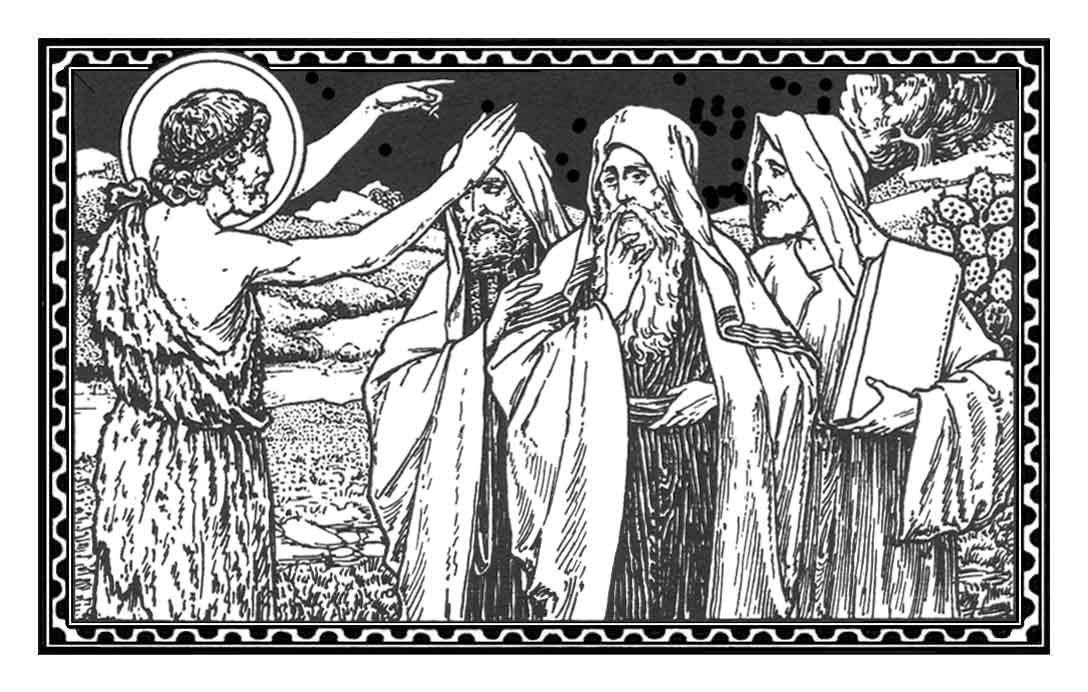
To prepare the way for the Messiah, Israel needed prophets like Isaiah and John the Baptist both to announce His coming and to prepare people for His arrival. A prophet’s role is a difficult one because they are often required to tell people home truths. Those chosen by God to act as prophets point out the sorts of things which, if left to our own devices, we would rather ignore. John’s message is simple, plain, and direct:

‘Repent, for the kingdom of heaven is at hand’ (Mt 3:2)

To repent is to express sincere regret about one’s wrongdoing. The Greek word used —metanoia— literally means to ‘change your mind’. It is a proclamation, rather like a road sign which reads: ‘You are going the wrong way!’ Repentance is recognising this and turning around. 

For two thousand years the Church has worked to continue John’s proclamation, and to say to the world: turn around, and follow Jesus! The season of Advent is penitential because it highlights this call to conversion and says to everyone, both inside and outside the Church, that our lives are supposed to be a perpetual turning back to Our Lord. We all need to be reminded of our shortcomings, and to be encouraged to let God be at work in and through us.

John the Baptist’s blunt message struck a chord and sparked something of a revival in Israel. People took him seriously:

‘Then Jerusalem and all Judea and all the region about the Jordan were going out to him, and they were baptized by him in the River Jordan, confessing their sins.’ (Mt 3:5-6)

It is not surprising that in those times people travelled out into the desert to hear John. He was charismatic, and his message was a refreshing antidote to the Religious Establishment of his day. People came, confessed their sins, and were baptised. They were washed clean, to love and serve God. The crowds also came because, in John, the people of Israel saw prophecy fulfilled, and a new Elijah in their midst. One who points to the Messiah, and has done so ever since he leapt in his mother Elizabeth’s womb at the Visitation. Before John was even born he proclaimed that Jesus was the Christ, the Messiah, the One who would save us from our sins.

We see this Messianic kingdom, hoped for in the vision of Isaiah, in this morning’s first reading. The branch which comes forth from the stem of Jesse is the Blessed Virgin Mary. Filled with God’s Holy Spirit, she conceived and bore Our Saviour; the true King of all that is, or has been, or will be. Christ is on the side of the poor and the meek, people who are left behind, and ignored because they are not rich or powerful. This is a radical concept, one which still has some way to go before it is fully put into practice in the world around us. Isaiah’s vision of Messianic peace may appear impossible, but it signifies a world-changing harmony, which alters how things are, and how people behave. For, with and through God, another way is possible. This path is not simple, nor is it easy, but it is possible if we rely upon God to help us. As St Paul says to the Christians in Rome:

‘May the God of endurance and encouragement grant you to live in such harmony with one another, in accord with Christ Jesus, that together you may with one voice glorify the God and Father of our Lord Jesus Christ. Therefore welcome one another as Christ has welcomed you, for the glory of God.’ (Romans 15:5-7),

and a little later in the same passage:

‘May the God of hope fill you with all joy and peace in believing, so that by the power of the Holy Spirit you may abound in hope’ (Romans 15:13).

Hope can feel in pretty short supply when we look at the world around us, and if we just look to humanity then we will be disappointed. Our hope comes from God. Our hope is God. God is with us. It is His Birth that we are preparing to celebrate at Christmas. In Advent we prepare for Christ to come as our Saviour and our Judge: 

‘His winnowing fork is in his hand, and he will clear his threshing floor and gather his wheat into the barn, but the chaff he will burn with unquenchable fire.’ (Mt 3:12) 

Judgement is real, and it should make us stop and think for a moment. Are we living the way God wants us to? If we are not then we need to repent, we need to say sorry, and we need to live the way that God wants us to live. This is how we flourish as Christians. John the Baptist calls us to make a spiritual u-turn, to turn our life around, and to turn away from our sins, which separate us from God. John calls us to the waters of baptism, so that we can be healed and restored by God, filled with his grace, and prepared to receive the Holy Spirit:

“I baptize you with water for repentance, but he who is coming after me is mightier than I, whose sandals I am not worthy to carry. He will baptize you with the Holy Spirit and fire” (Mt 3:11).

The problem with the Pharisees and Sadducees who come to John is that they do not show any repentance. They haven’t made the necessary u-turn, and they do not have the humility to recognise their own sinfulness, and their need to be washed in the waters of baptism. They, therefore, do not possess the right attitude to allow God to be at work in their lives.

As well as recognising Jesus as our Saviour, John the Baptist sees Him as Our Judge. John points to the second coming of the Lord when, as St John of the Cross puts it, ‘we will be judged by love alone’. It is love that matters. In Christ we see what love means. True, deep, love is costly, self-giving and profound. As we are filled with God’s Spirit, nourished by Word and Sacrament, we need to live out this love in our lives. This is how we prepare to meet Jesus as we prepare to celebrate His Birth and look forward to His Second Coming.

So, my brothers and sisters in Christ, let us re-commit ourselves to live out God’s love in our lives. Let us turn away from everything which separates us from God, and from each other. Let us live out deep, costly, and self-giving love in our lives. This is both what Christ and John the Baptist call us to do. By acting in this way we demonstrate to the world around us what our faith means in practice. How our beliefs affect our lives, and why others should follow Jesus, and sing the praises of God the Father, God the Son, and God the Holy Spirit, Duw Dad, Duw y Mab, a Duw yr Ysbryd Glân. To whom be ascribed all might, majesty, glory, dominion, and power, now and forever. Amen.
Palm Sunday Evensong

THIS evening I would like to talk about the Apostle John. The name ‘John’ means ‘The Lord has worked grace’. John the Apostle is the son of Zebedee and Salome (the sister of the Blessed Virgin Mary). He is also the brother of James, and the cousin of Jesus. In the Bible, John is called ‘the beloved disciple’, the disciple whom Jesus loved. He is also believed to be the author of the Gospel which now bears his name, as well as three canonical letters and the Book of Revelation. While scholars tend to ascribe some or all of these works to others, I do not wish to. Time tonight does not allow me to examine all of John’s writings in detail, so I must be selective. However, I strongly urge you to read John’s works and immerse yourself in the richness of his vision.

In the Synoptic Gospels (Matthew, Mark, & Luke) we first meet our soon-to-be disciple by the shore of the Sea of Galilee with his father, Zebedee and his brother, James. In John’s Gospel, however, there is no mention of him until the Last Supper. The apostle is then also present at the Crucifixion, standing at the foot of the Cross with Mary, the mother of Jesus. Along with Simon Peter, he is the first witness of the Resurrection. John is also one of the seven disciples who have breakfast with the Risen Christ by the Sea of Galilee, when Jesus asks Simon Peter three times if he loves him. At the end of his Gospel John writes the following authorial comment:

This is the disciple who is bearing witness about these things, and who has written these things, and we know that his testimony is true. Now there are also many other things that Jesus did. Were every one of them to be written, I suppose that the world itself could not contain the books that would be written. (Jn 21:24-25)

John is someone we can trust, whose writings help us to ponder the mysteries of God’s love. Elsewhere, in the Synoptic Gospels, John appears as part of an inner circle of disciples. He is with Peter and James at the Transfiguration, and at several miracles where not all the Twelve are present. What then are we to make of this apostle? The various mentions of him in Scripture show that he is a beloved disciple, one loved by God, who loves God deeply. Love is something of a defining characteristic in John’s writing, especially in his Gospel and Letters. But even love must be set in a wider context, namely God.

John’s Gospel begins at the beginning, a very good place to start.‘In the beginning was the Word, and the Word was with God, and the Word was God.’ (Jn 1:1) God is trinitarian: Father, Son, and Holy Spirit (Duw Dad, Mab ac Ysbryd Glân). He always has been, and always will be. ‘The Word became flesh and dwelt among us’ (Jn 1:14). The word translated as ‘dwelt’ actually means ‘pitched his tent’, tabernacled among us, like a nomad, or a shepherd, or an exile wandering like Israel after the Exodus from Egypt.

John then introduces his namesake, the Baptist, who on seeing his cousin Jesus, exclaims ‘Behold, the Lamb of God, who takes away the sin of the world!’ (Jn 1:29). Jesus calls disciples, and suddenly they are at a wedding in Cana, where the wine runs out. To prevent shame and ‘social death’ for the hosts, Our Lord turns a large amount of water into wine. God is generous, and the messianic banquet is a reality! There are other signs of Jesus’ divinity and God’s love for humanity. In John’s Gospel, Our Lord is keen to say, ‘I am’: ‘I am the Good Shepherd’ ‘I am the Bread of Life’ ‘I am the Way, the Truth, and the Life’. Just as God reveals himself to Moses at the Burning Bush, saying: ‘I am who I am’. This is the same God who took flesh in the womb of the Virgin Mary.

It is when John is with Mary at the foot of the Cross that the Beloved Disciple is singled out for the second time. Just before Christ dies He looks down, and says:

‘Woman behold your Son.’ Then he said to the disciple, ‘Behold your mother!’ And from that hour the disciple took her to his own home (Jn 19:26-27)

Something wonderful is happening here. On the hill of Calvary, on Good Friday, Jesus is starting the Church, with His Mother (the laity), John the Beloved Disciple (the Clergy), and Himself (Our Great High Priest). Jesus offers himself as both priest and sacrifice upon the altar of the Cross to take away our sins, and to restore our relationship with God and with each other. John and Mary become a new family, not because of ties of blood and kinship (though they are related), but through Jesus. Likewise, every Christian is a brother or sister in Christ. We are all children of God.

From this verse the tradition arises that Mary and John lived together in Ephesus, south of Smyrna, (modern İzmir). This tradition maintains that the Apostle was exiled to the island of Patmos for his preaching of the Good News. There John lived in a cave where he had the visions which have come down to us as the Apocalypse, the Revelation of St John the Divine. Before his exile, during the reign of the emperor Domitian, it is recorded that John survived being immersed in a vat of boiling oil near the Porta Latina, the Latin Gate on the south of the Aurelian Wall of the City of Rome. This miraculous event was remembered in a feast celebrated (until 1960) on 6th May, and is found in the Calendar of the 1662 Book of Common Prayer. John’s main feast day, however, is the 27th December. Significantly, he is the only apostle not to have suffered a martyr’s death, and so the liturgical colour of his feast days is white and not red — the usual colour for a martyr. 

In 2007, Pope Benedict XVI wrote that the example of St John teaches us that:

‘The Lord wishes to make each of us a disciple who lives in personal friendship with him. To achieve this, it is not enough to follow him and listen to him outwardly: it is also necessary to live with him and like him. This is only possible in the context of a relationship of deep familiarity, imbued with the warmth of total trust. This is what happens between friends: for this reason Jesus said one day: “Greater love has no man than this, that a man lay down his life for his friends … No longer do I call you servants, for the servant does not know what his master is doing; but I have called you friends, for all that I have heard from my Father I have made known to you” (Jn 15:13, 15)’  [ Pope Benedict XVI, Christ and his Church: Seeing the face of Jesus in the Church of the Apostles, CTS 2007: 72-73.]

The way to understand John and his theology is through the prism of love. As the apostle writes:

“For God so loved the world, that he gave his only Son, that whoever believes in him should not perish but have eternal life. For God did not send his Son into the world to condemn the world, but in order that the world might be saved through him.” (Jn 3:16-17)

These words are echoed in John’s First Letter:

‘By this we know love, that he laid down his life for us, and we ought to lay down our lives for the brothers.’ (1Jn 3:16)

God loves us, and becomes one of us, so that we may have life in all its fulness. Love means willing the good of another. God’s love for us shows that our flourishing is His will. This is the reason for the Incarnation, our Salvation, and Redemption. Love is also the source for both the words of teaching and the signs which pervade John’s Gospel. This is Good News, given to us by the Church — a community of love, which feeds us with Christ’s teaching and the bread of life — so that we can grow more and more into the likeness of the one who loves us: Jesus Christ, who is Our Lord and God.

John is the disciple who has a vision of Heaven, of heavenly liturgy which looks Eucharistic. As one of the first disciples to experience the reality of the Resurrection, and as one who sees and believes, John understands that Eternal Life Heaven is our objective. He says:

‘I write these things to you who believe in the name of the Son of God that you may know that you have eternal life.’ (1Jn 5:13)

As Christians, we need to follow the example set by the Beloved Disciple. We need to love Our Lord and Saviour above all else. Like John, we need to see and to believe, and to let God work in our lives. We are called to let God act in us, and through us, to bring His message of love and forgiveness to our needy world.

The depth of John’s relationship with Jesus illustrates how such a theology might come about. John’s life and teachings should continue to inspire us as Christians today. Reminding us to love, to believe, and to persevere in faith, even in the face of hardship. May all of us gathered here today be strengthened by the example of John, to grow closer to God and to give glory i Duw Dad, Duw y Mab, a Duw yr Ysbryd Glân. To God the Father, God the Son, and God the Holy Spirit. I’r hwn y priodoler pob gogoniant, arglwyddiaeth, a gallu, yn awr, ac yn oes oesoedd. To whom be ascribed all glory, dominion and power, now and forever. Amen.

Correggio: St John,San Giovanni Evangelista, Parma

Easter IV – The Good Shepherd

Living in Pembrokeshire, many of us know people who keep sheep. We are also aware of how difficult it has been for them, and all farmers, in the recent months with fields waterlogged due to unprecedented levels of rainfall. Sheep farming is a vital part of our rural life and so the image of Jesus as the Good Shepherd is something we find easy to identify with, unlike those who live in large cities.

Shepherds played an important part in Jesus’ life. Angels told them about the birth and they came down from the hills to worship Him in  the stable in Bethlehem. Not wishing to leave their animals behind, Nativity scenes depict the shepherds bringing sheep to the manger. This may be why Our Lord has an affinity with those who look after sheep and care for them. Jesus describes himself as the Good Shepherd, the one who lays down His life for His sheep. Christ dies so that we may have eternal life in Him. This model of self-sacrificial love lies at the heart of the Christian faith, and because of it, we are able to live the new life of Easter.

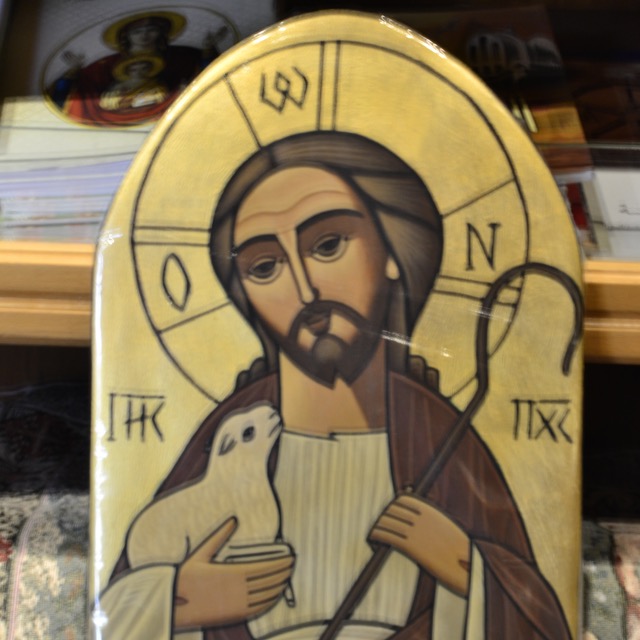
Jesus says, ‘I am the Good Shepherd’ ‘Myfi yw’r bugail da’ (Jn 10:11). This is straightforward: He cares for His flock. But then He says, ‘The good shepherd lays down his life for the sheep.’ ‘Y mae’r bugail da yn rhoi ei einioes dros y defaid’ (Jn 10:11). This goes above and beyond what we would expect of a shepherd, even a very good one! Jesus is using the image of the Good Shepherd to explain what will happen on Good Friday. He will suffer and die to protect us, His flock. 

Protect us from what? From Sin and Death. By dying for us, and rising from the dead, Jesus offers humanity freedom in Him. The Christian faith offers salvation, through faith. As St Peter puts it in this morning’s reading from the Acts of the Apostles: 

‘And there is salvation in no one else, for there is no other name under heaven given among men by which we must be saved.’

‘Ac nid oes iachawdwriaeth yn neb arall, oblegid nid oes enw arall dan y nef, wedi ei roi i’r ddynolryw, y mae’n rhaid i ni gael ein hachub drwyddo.’ (Acts 4:12)

Jesus offers what no-one else can: salvation and eternal life to those who believe in Him, and follow Him. Eccentric American millionaires employ bizarre methods in an attempt to defy the ageing process, but they are still going to die. Each and every human being is. That is the fate of all living things. But, because of who Christ is — namely true God and true man — and what He has done on the Cross and at the empty tomb, death is no longer something to be feared. Instead, it can be embraced, as the entry to eternal life, with God, forever. 

This way of looking at life and death is profoundly different from the world around us, because Christians are not bound by the primal human fear that our life is finite. Our Lord has opened to us the gates of Heaven, and shown us once and for all that God loves us.

At the heart of our faith as Christians is the profound conviction that we are people who are loved by God. As Archbishop Michael Ramsay said, ‘God is Christlike, and in him is no un-Christlikeness at all’ [God, Christ & the World: A Study in Contemporary Theology, London 1969, p.98]. When we see Jesus, we see God; when we hear Him speak, we hear the voice of God. We can know who God is, the Creator and Redeemer of the universe, through His Son, Jesus Christ. God is not a distant bearded man on a cloud. He is a loving Father, as illustrated in the Parable of the Prodigal Son. He loves us so much that He suffers and dies for us, to give us life in Him. This is the God who searches for lost sheep; who longs to love, restore, and reconcile; who can heal our wounds if we let Him. This is abundant life, offered to us by Our Lord, the Good Shepherd.

This life, this love is offered to us in the Eucharist, where we can touch and taste God’s profound love for us. In the bread and the wine we are given a foretaste of the heavenly banquet and a pledge of eternal life in Christ. Here today, as on a hundred thousand successive Sundays, we meet to be fed by Christ, and fed with Christ. To be healed, and to know His love. We are the sheep cared for by the Good Shepherd, who provides for all our needs. Who gives Himself so that we might have life.

So my brothers and sisters in Christ, as we continue to rejoice In Our Lord’s triumph over death, may we emulate His example and live the new life of Easter. Following Our Good Shepherd, who longs for us to be safe with Him forever in Heaven, let us share the Good News of His Kingdom with others. Let us pray that that all may come to know and love God the Father, God the Son, and God the Holy Spirit. To whom be ascribed all, glory, dominion, and power, now and forever. Amen.
Palm Sunday 2024

IN THIS COUNTRY when we want to celebrate something there is often some kind of procession. Sports teams who win trophies go on an open-topped bus. After King Charles’ Coronation, there was a great procession from Westminster Abbey back to Buckingham Palace. Today, we see the entry of the Messiah into Jerusalem. The Davidic King has made His triumphal entry, something which we have reenacted ourselves this morning, waving palms and singing, ‘Hosanna to the Son of David!’. The prophet Zechariah, writing 500 years before Jesus, looks forward to a messianic future:

Rejoice greatly, O daughter of Zion! Shout aloud, O daughter of Jerusalem! Behold, your king is coming to you; righteous and having salvation is he, humble and mounted on a donkey, on a colt, the foal of a donkey.

‘Bydd lawen iawn, ti ferch Seion; a chrechwena, ha ferch Jerwsalem: wele dy frenin yn dyfod atat: cyfiawn ac achubydd yw efe; y mae efe yn llariaidd, ac yn marchogaeth ar asyn, ac ar ebol llwdn asen.’ (Zech 9:9)

The donkey ridden by Jesus reminds us of the humble beast of burden, which carried his Mother to Bethlehem for His birth, and then carried the Holy Family into exile in Egypt. This is an act of humble leadership which realizes what the prophets foresaw. It shows us that Jesus Christ is truly the one who fulfils the hopes of Israel. The Hebrew Scriptures look forward to the deliverance of Israel. This deliverance is enacted in front of the eyes of those watching the Carpenter’s son enter the Holy City.

Scripture is fulfilled and there is a burst of popular enthusiasm, people wave palm branches and cry out. However, having someone claim to be a relative of King David is a direct challenge to Herod, the puppet ruler installed to comply with the Romans. The events we heard described, before our procession this morning, look something like a political coup — a bid to replace a leader lacking legitimacy. Such an attempt is bound to have political repercussions. It represents a direct challenge to the ruling house and to Rome, and therefore it has to be countered. The masses in Jerusalem are expecting a king of the Davidic line. One who would be seen as a challenge to the ruling élite, the status quo. But in Christ, God gives Israel something else. Yes, he is a King of the line of David. But Jesus is one who rules with love, and who has no desire for power, or honour. Naturally, the leaders and those in authority are threatened by Him: Jesus turns their world on its head. He is an awkward inconvenience. Jesus, however, does not want their power. He has come to be and accomplish something completely different. What is seen as a potential political coup is in fact a renewal of religion, the fulfilment of prophecy, and a new hope for Israel. Political and religious leaders can only see the threat, rather than the opportunity which Christ offers.

At its heart Christianity is an offer of new life in Jesus Christ. This starts with repentance, and acceptance of our need for God. As we grow in faith, we come to believe and trust in a God who loves us, and gives Himself for us. Then we can experience healing, wholeness, and fullness of life in and through Him. Such gifts come at a cost, which the week ahead will make clear to us in the most stark and direct way. 

Over the next few days we will see the joy and celebration of today turned into anger and resentment. Crowds which cried ‘Hosanna’ will soon shout ‘Crucify him!’. This should come as no surprise to us. We know how people can be fickle and manipulated. And yet, on the same night He will be betrayed, Jesus takes bread and wine, blesses them and says, ‘This is my Body … This is my Blood’. ‘hwn yw fy nghorff … hwn yw fy ngwaed’ These words are repeated when the Eucharist is celebrated because Our Lord told us to ‘Do this’ ‘gwnewch hyn’ and so we do. We come together so that God can feed us with His very self, so that we can have life in Him. This is not an optional extra, it is fundamental to who and what we are as Christians. In the Eucharist we experience God’s love, His body broken for us, His blood poured out, to heal us. This is the banquet of the Kingdom, the Wedding Feast of the Lamb, and we are all invited!

Today, and in the coming week, we see what God’s Love and God’s Glory are really like. They are not what people expect. God’s power is shown in humility, strength in weakness. As we continue our Lenten journey in the triumph of this day, we look towards the Holy and Life-giving Cross and beyond to the new life of Easter. Let us trust in the Lord, and go with Him to Calvary, and beyond. Let us raise our palms and sing the praises of God the Father, God the Son, and God the Holy Spirit. To whom be ascribed all glory, dominion, and power, now and forever. Amen.