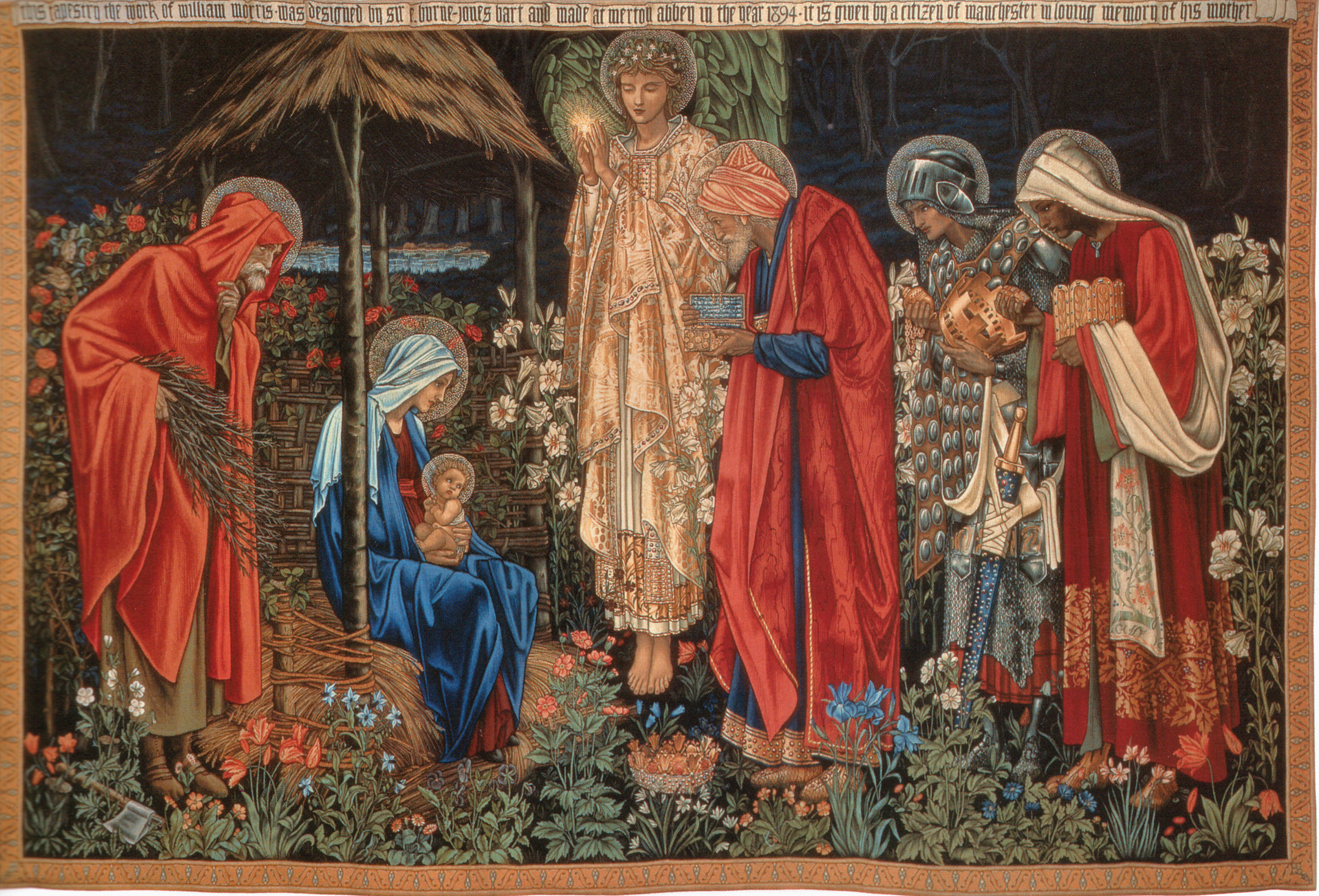
Epiphany 2026

‘Where is he who has been born king of the Jews? For we saw his star when it rose and have come to worship him.’

‘Ble mae’r hwn a anwyd yn frenin yr Iddewon? Oherwydd gwelsom ei seren ef ar ei chyfodiad, a daethom i’w addoli.’ (Mt 2:2)

IN Britain there is a tradition that royal births are announced by a notice placed on an easel outside Buckingham Palace. When the present King was born in 1948 the notice read as follows: ‘Buckingham Palace November 14th, The Princess Elizabeth, Duchess of Edinburgh was safely delivered of a prince at nine fourteen pm today. Her Royal Highness and her son are both doing well.’ Historically, royal births were witnessed by important people. They were public occasions rather than private ones. When a prince or princess is born, everyone wants to know what is happening. 

Two thousand years ago, out in the East, in what is now modern day Iraq and Iran, astrologers noticed something in the sky. This phenomenon possibly involved Jupiter and either Saturn, or the star Regulus in the constellation Leo. It was a significant astronomical event, which was understood to signify a royal birth. These Magi travelled to Judaea, as that was the direction that the celestial sign pointed them towards. As they were looking for a royal baby, their first stop was, naturally, the palace. When they arrived at Herod’s palace they asked:

‘Where is he who has been born king of the Jews? For we saw his star when it rose and have come to worship him.’ (Mt 2:2)

The travellers make a reasonable statement, but their words have an unexpected effect:

‘When Herod the king heard this, he was troubled, and all Jerusalem with him; and assembling all the chief priests and scribes of the people, he enquired of them where the Christ was to be born’ (Mt 2:3-4)

News of the birth of a royal child is troubling to Herod. He was an Aramean who had bought the right to be king by paying the Romans. Therefore, he was very concerned by questions of legitimacy because his own claim was based on shaky ground. Herod’s religious experts then explain where the child will be born, quoting a prophecy of Micah, which we heard on the Fourth Sunday of Advent:

‘In Bethlehem of Judea, for so it is written by the prophet: “And you, O Bethlehem, in the land of Judah, are by no means least among the rulers of Judah; for from you shall come a ruler who will shepherd my people Israel.”’ (Mt 2:5-6)

Bethlehem, the city of David, is where a King of the lineage of David will be born. A Davidic King poses a huge threat to Herod. There could be an uprising, leading to regime change. Herod needs to know what is going on. Since knowledge is power, he sends the Magi off to find the child and to report back to him.

What looks like a simple and straightforward enquiry is actually the first part of a plan to eliminate this potential threat to Herod’s rule. This will later be carried out in the Massacre of the Innocents — the wholesale slaughter of young male children in Bethlehem. Herod certainly has no intention of relinquishing his power. His behaviour is a sham. The Wise Men then leave the royal palace and head for the town of Bethlehem:

‘And behold, the star that they had seen when it rose went before them until it came to rest over the place where the child was. When they saw the star, they rejoiced exceedingly with great joy.’ (Mt 2:9-10)

The Magi have journeyed hundreds of miles because they saw a celestial event. Now this heavenly light is above Bethlehem, and the travellers have reached the new-born King. 

‘And going into the house they saw the child with Mary his mother, and they fell down and worshipped him. Then, opening their treasures, they offered him gifts, gold and frankincense and myrrh.’ (Mt 2:11) 

Gold, frankincense, and myrrh seem to us unusual presents for a baby. They are, however, all expensive, costly, and precious things, and therefore suitable as royal gifts. These offerings were prophesied by Isaiah: 

‘They shall bring gold and frankincense, and shall bring good news, the praises of the Lord.’ (Isa 60:6)

Gold, is a precious metal, which is pure and does not tarnish. It is a gift fit for a king. Gold’s purity points to a life of perfect obedience, the pattern of how life should be lived. Incense, from Arabia, was offered to God in the Temple in Jerusalem. As the sweet-smelling smoke rose, it looked like prayers rising to God. Frankincense is a sign of worship, and honour, representing how humanity should respond to God. We use it today in our worship to glorify God Myrrh was often a component of the ointment used for embalming bodies. This links to the anointing of Jesus’ body after His Death, and before His Resurrection from the dead. These three gifts given at Jesus’ birth point to Christ’s kingly power, and His role in worship as our great High Priest, which leads to His to Death and Burial.

The Wise Men are warned by a dream not to go back to Herod, and not to tell him who Jesus is. This is because the Judean king does not want to worship Jesus. Herod wants to kill Him, in order to safeguard his own position. And so the unexpected visitors leave as mysteriously as they arrived. These pilgrims from afar gave Our Lord gifts which celebrate His Humanity and Divinity, and which point forward to His Death and Resurrection. The beginning of Jesus’ earthly life looks to its end, because it is all part of the outworking of salvation history.

The events that we are celebrating today were prophesied by Isaiah in the first reading this morning:

‘Arise, shine, for your light has come, and the glory of the Lord has risen upon you.’ (Isa 60:1)

The birth of the Messiah is a sign of God’s glory, and the salvation He will bring for all people: 

‘And nations shall come to your light, and kings to the brightness of your rising.’ (Isa 60:3)

These pilgrims are the Magi, the Wise Men, the Kings who represent the entire Gentile (non-Jewish) World. They have come to worship God born among us. The travellers recognise who it is they have come to see, and their gifts fulfil Isaiah’s prophecy. Their gifts, which might appear strange at first sight, are, in fact, both apt and right: to worship God and honour a King, and to recognise the Saviour in their midst. Today, the World recognises the Birth of Jesus Christ, and the mystery of salvation is proclaimed to all.

As we celebrate the Feast of the Epiphany today, we also look forward. Both to Our Lord’s Baptism in the River Jordan and to His first miracle at the Wedding in Cana. Christ, He who is without sin shows humanity how to be free from their sins and to have new life in Him.

Therefore, my brothers and sisters, as we continue to celebrate Jesus’ birth, let us raise our voices to join with the wise men in giving praise and honour to God the Father, God the Son, and God the Holy Spirit, Duw Dad, Duw y Mab, a Duw yr Ysbryd Glân. To whom be ascribed all glory, dominion and power, now and forever. Amen.

Lent V

THE past sixty years in Britain and the West have seen societal change on a scale arguably never witnessed before in the history of humanity. The world in which we live has changed, and people have become used to the changes. On the whole, despite becoming more permissive, society is still judgemental. We put people on pedestals, and then we are surprised when they fall off. More than that, the media constantly encourages us to be critical of others. This is deeply corrosive, because it sets us up to think that we are somehow better than others. However, we too make mistakes. We all, each and every one of us, myself included, say and do things which we should not, which hurt others, and for which we need forgiveness.

Thankfully, we can ask God and each other for this forgiveness. Because of what Christ did for us, taking our sins upon himself, on the Cross, we are forgiven. God loves us. In turning to God for forgiveness, we are turning away from sin and trying to live our lives in a new way. The Christian life is, like the season of Lent, a constant repetition of this process: failing and trying again, and keeping going. So that bit by bit, gradually, we let God be at work in us, to transform us. This helps us to be less judgemental, more loving, and more forgiving. Drawing on God’s love, we can build up a community that is filled with this radical transforming love. We can become a force for good, a beacon of hope, sharing Christian love with the world around us.

Today’s Gospel finds Jesus is in the Temple in Jerusalem for the Feast of Tabernacles. According to the law of Moses the woman caught in adultery should be punished by being stoned to death. However, the Roman occupiers had taken from the Jews the power to put anyone to death. Jesus’ response shows the world that there is another way: a way of love and not of judgement. Interestingly, this passage is the only time when the Gospel writers record Jesus writing. After the Scribes and Pharisees have brought the unnamed woman to Him:

‘Plygodd Iesu i lawr ac ysgrifennu ar y llawr â’i fys.’

‘Jesus bent down and wrote with his finger on the ground.’ (Jn 8:6) 

This verse has puzzled people for centuries. What exactly did Jesus write? We cannot know for certain. An answer to this intriguing question may come from Scripture. A few verses earlier in John’s Gospel, Jesus talks of rivers of living water. In the prophet Jeremiah we find the following words:

‘O Arglwydd, gobaith Israel, gwaradwyddir pawb a’th adawa; torrir ymaith oddi ar y ddaear y rhai sy’n troi oddi wrthyt, am iddynt adael yr Arglwydd, ffynnon y dyfroedd byw.’

‘O Lord, the hope of Israel, all who forsake you shall be put to shame; those who turn away from you shall be written in the earth, for they have forsaken the Lord, the fountain of living water.’ (Jer 17:13)

We can speculate that at least part of this verse from Jeremiah is what Jesus wrote in the earth. Writing these words would both fulfil the prophecy of Jeremiah, and shame the woman’s accusers. Jesus is showing that the Scribes and Pharisees have turned away from God, towards legalism and judgmental behaviour. Those gathered would know the prophecy of Jeremiah, and also that Jesus has recently mentioned streams of living water. This verse is the key to understanding what is going on. Jesus is fulfilling Scripture, and demonstrating that God should be characterised by love, mercy, and forgiveness. 

The Religious Authorities have not quite understood the situation. They continue to press Jesus for an answer, which He does not give. Instead Jesus challenges them:

‘ymsythodd ac meddai wrthynt, “Pwy bynnag ohonoch sy’n ddibechod, gadewch i hwnnw fod yn gyntaf i daflu carreg ati.”’

‘he stood up and said to them, “Let him who is without sin among you be the first to throw a stone at her.”’ (Jn 8:7)

Jesus’ position is non-judgemental, and highlights the hypocrisy of the accusers. Christ then returns to His writing:

‘Yna plygodd eto ac ysgrifennu ar y llawr.’

‘And once more he bent down and wrote on the ground.’ (Jn 8:8)

It is possible that Jesus was finishing the verse from Jeremiah. We cannot be sure, but what we do know is that the combination of His words, both written and spoken have a profound effect:

‘A dechreuodd y rhai oedd wedi clywed fynd allan, un ar ôl y llall, y rhai hynaf yn gyntaf, nes i Iesu gael ei adael ar ei ben ei hun, a’r wraig yno yn y canol. Ymsythodd Iesu a gofyn iddi, “Wraig, ble maent? Onid oes neb wedi dy gondemnio?” Meddai hithau, “Neb, syr.” Ac meddai Iesu, “Nid wyf finnau’n dy gondemnio chwaith. Dos, ac o hyn allan paid â phechu mwyach.”’

‘But when they heard it, they went away one by one, beginning with the older ones, and Jesus was left alone with the woman standing before him. Jesus stood up and said to her, “Woman, where are they? Has no one condemned you?” She said, “No one, Lord.” And Jesus said, “Neither do I condemn you; go, and from now on sin no more.”’ (Jn 8:9-11)

It is interesting that the older (and wiser) ones are the first to grasp the full implications of what Jesus is saying. Christ does not condemn the woman: God is a God of mercy. However, Our Lord does say, ‘Dos, ac o hyn allan paid â phechu mwyach’ ‘go, and from now on sin no more’ (Jn 8:11). Forgiveness goes hand-in-hand with contrition and repentance. We are loved, healed and restored by God, but with forgiveness comes a challenge. As Christians we are to turn away from wrongdoing, from the ways of the world, and instead find life in Christ.

Lent gives us the opportunity to take a long, hard look at ourselves and at our lives. It is a time to recognise that we need to become more like Jesus — to live, and think, and speak like Him. We need to be nourished, healed and restored by Christ, so that we can live lives which proclaim His love and His truth to the world. Lent is also a time for us to realise that we are loved by God, and that God is merciful, forgives our sins, and longs for us to experience life in all its fulness.

It is interesting that today is Passion Sunday when we begin in earnest our commemoration of Jesus’ death and Resurrection. This morning’s Gospel speaks of a different type of passion (sexual desire) which when uncontrolled could lead to death — either of a person condemned for committing adultery or a relationship between a husband and wife.

As we pray today for couples preparing for marriage we also pray for those whose relationships are under strain and for all who have experienced marital breakdown. Let us be slow to judge, and quick to show compassion and mercy to those whose lives are not perfect.

Let us, as followers of Jesus, rejoice in the generous love of God and prepare ourselves to celebrate Christ’s Passion. Let us give thanks for our families and relationships and give glory i Duw Dad, Duw y Mab, a Duw yr Ysbryd Glân. I’r hwn y priodoler pob gogoniant, arglwyddiaeth, a gallu, yn awr, ac yn oes oesoedd. Amen.

Christ and the sinner, A Mironov 2011

Trinity VI – The Importance of Prophetic Truth in Changing Times

One of the trickiest things to do is to tell someone something they don’t want to hear. Some things can be difficult to hear, and difficult to say. Honesty and truth are essential if we want to change and grow. In Ancient Israel, prophets were sent by God to speak the truth: to call people back and to tell them where they were going wrong. When the people of Israel rebelled against God, which is the definition of sin, prophets called God’s people to repentance. They urged them to turn back to the God who loves them, and longs for them to flourish. Sadly, such messages were not always heeded:

‘The descendants also are impudent and stubborn: I send you to them, and you shall say to them, ‘Thus says the Lord God.’ And whether they hear or refuse to hear (for they are a rebellious house) they will know that a prophet has been among them.’

‘At blant wynebgaled ac ystyfnig yr wyf yn dy anfon, ac fe ddywedi wrthynt, ‘Fel hyn y dywed yr Arglwydd DDUW.’ Prun bynnag a wrandawant ai peidio — oherwydd tylwyth gwrthryfelgar ydynt — fe fyddant yn gwybod fod proffwyd yn eu mysg.’ (Ezek 2:4-5)

This is the situation which we encounter in today’s Gospel. As part of His Galilean ministry Our Lord goes to Nazareth, and teaches in the synagogue. In Luke’s account we hear Jesus reading from Isaiah:

“The Spirit of the Lord is upon me, because he has anointed me to proclaim good news to the poor. He has sent me to proclaim liberty to the captives and recovering of sight to the blind, to set at liberty those who are oppressed, to proclaim the year of the Lord’s favour.”

“Y mae Ysbryd yr Arglwydd arnaf, oherwydd iddo f’eneinio i bregethu’r newydd da i dlodion. Y mae wedi f’anfon i gyhoeddi rhyddhad i garcharorion, ac adferiad golwg i ddeillion, i beri i’r gorthrymedig gerdded yn rhydd, i gyhoeddi blwyddyn ffafr yr Arglwydd.” (Lk 4:18-19)

Clearly hearing such a prophecy and then being told that it was being fulfilled among them would be quite shocking. The people had spent five hundred years waiting for a Messiah, and now, suddenly, here he was. The worshippers in the synagogue are unwilling, or unable, to understand what is going on, so they say:

“Where did this man get these things? What is the wisdom given to him? How are such mighty works done by his hands? Is not this the carpenter, the son of Mary and brother of James and Joses and Judas and Simon? And are not his sisters here with us?” And they took offence at him.

“O ble y cafodd hwn y pethau hyn? A beth yw’r ddoethineb a roed i hwn, a’r fath weithredoedd nerthol sy’n cael eu gwneud trwyddo ef? Onid hwn yw’r saer, mab Mair a brawd Iago a Joses a Jwdas a Simon? Ac onid yw ei chwiorydd yma gyda ni?” Yr oedd ef yn peri tramgwydd iddynt. (Mk 6:2-3)

The inhabitants of Nazareth cannot reconcile the healer and teacher with the person they have seen growing up among them. Hence they stress Our Lord’s trade and family relationships. They cannot recognise the Messiah in their midst. The Nazarenes understand Christ’s human nature, but cannot see that He is divine. 

Jesus understands that a prophet is without honour among his own people. Those who think they know Him well, fail to discern what God is doing through Him. They may reject Christ, but He does not reject them. 

‘And he could do no mighty work there, except that he laid his hands on a few sick people and healed them.’

‘Ac ni allai wneud unrhyw wyrth yno, ond rhoi ei ddwylo ar ychydig gleifion a’u hiacháu.’ (Mk 6:5)

The Good News of the Kingdom is proclaimed, and healings take place. God’s love is poured out even where He is not welcomed, because God loves us, and has come to heal our wounds. Even when we turn our back on Him, Our Heavenly Father does not spurn us. The work of the Kingdom must continue:

‘And he marvelled because of their unbelief. And he went about among the villages teaching.’

‘Rhyfeddodd at eu hanghrediniaeth. Yr oedd yn mynd o amgylch y pentrefi dan ddysgu.’ (Mk 6:6)

Those who in theory should know Him best, who have known Jesus all His life, are the ones who turn their back on Him. Our Lord is amazed at their hardness of heart. He faces exactly what Ezekiel faced before Him. So Jesus continues to heal and teach, even though some do not hear, and do not believe. To those who do, Christ offers love, healing and New Life. He offers Himself in the Eucharist, so that we may have life in all its fulness.

We know who and what Jesus is. Many in the world around us reject Christ, rather like the people of Nazareth, or fail to accept Him as true God and true man. They doubt who He was, what He did, and what He said. Our duty, as Christians, is to tell people about Jesus, praying that they will want to believe. We need to model the Christian life, remembering that all things are possible — God can will do amazing things, especially when we cooperate with Him. 

Our country is currently experiencing a new start, a re-boot after the election. We pray for those who have been elected to office that they will govern with wisdom and compassion. May we too take this opportunity to re-boot and re-energise our life of faith, and shine as beacons of hope in our community and world. May we join with all creation and give glory to God the Father, God the Son, and God the Holy Spirit. To whom be ascribed all glory, dominion, and power, now and forever. Amen.

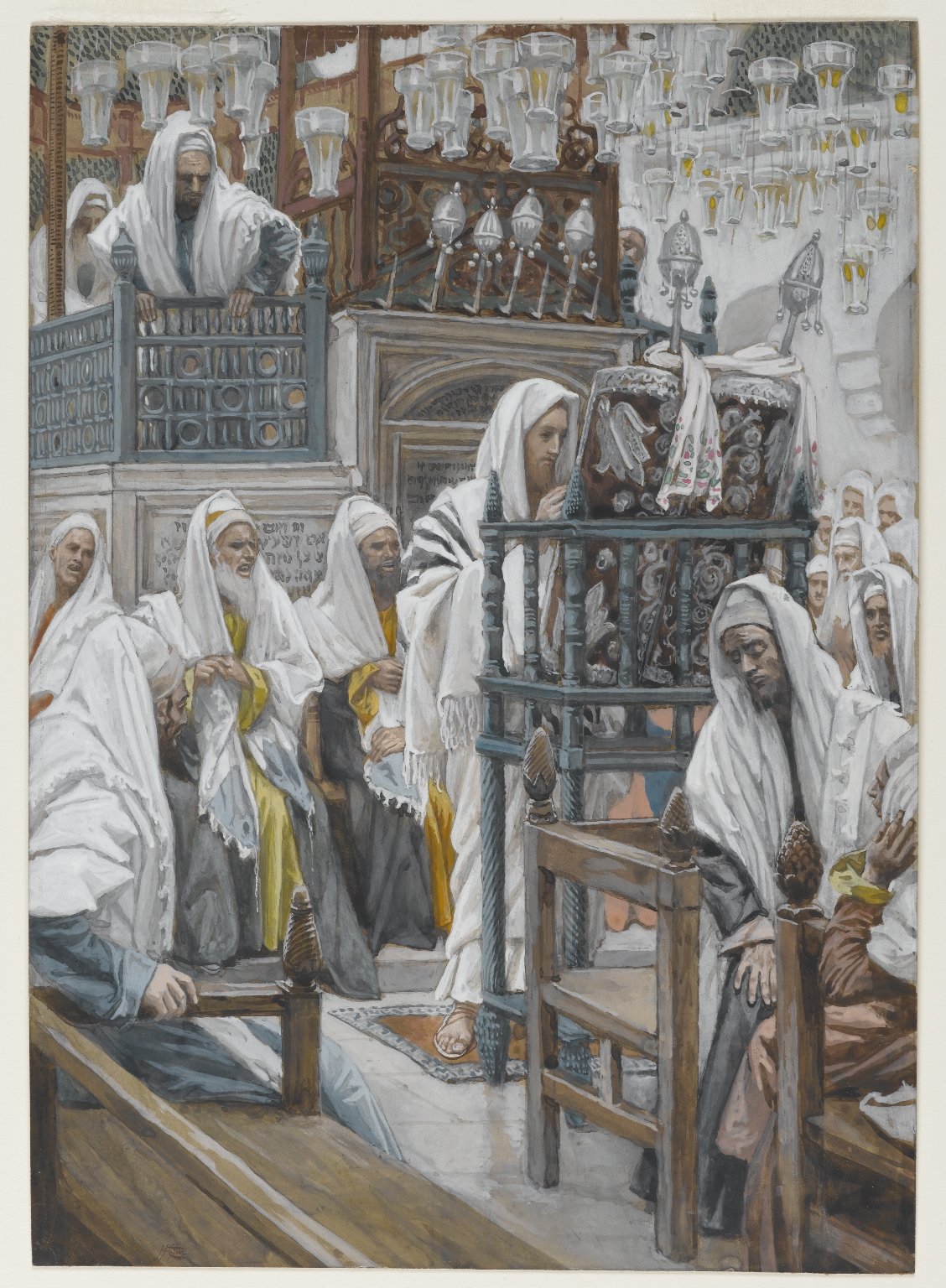
James Tissot: Jésus dans la synagogue déroule le livre [Brooklyn Museum]

Trinity Sunday 2024: Transformed by God’s Love: Exploring the Trinitarian Faith and Sacramental Life

WE are all extremely fortunate to live in North Pembrokeshire for many reasons, and especially because we are close to so many hills. Mountains and hills take a lot of effort to climb, but once you have ascended, you can see for miles around. Hilltops are special places, and today’s Gospel takes place on one. Also, many other important and significant moments in Matthew’s Gospel take place on mountains including the Temptation, the Sermon on the Mount, the Transfiguration, and the Crucifixion. Our Lord also speaks His final words before his Ascension on a hilltop. 

Last Sunday we celebrated Pentecost, the outpouring of the Holy Spirit upon the Church: a revelation of who God is, and how much God loves us, His people. This week we continue to meditate upon God’s love. This love forms a relationship so intimate that God is closer to us than we are to ourselves — that is something quite hard to get our heads around! Above all, God’s love is something to be experienced, rather than understood. Through this experience God transforms us, so that we can experience that love more fully, and finally enjoy it for eternity, in Heaven.

In today’s Gospel Jesus’ disciples have been told to go to Galilee, to a particular mountain, to meet the Risen Lord. They are obedient, and head north from Jerusalem. When the disciples arrive at the mountain, they see Our Lord and bow down and worship Him — just like the Wise Men did at His birth. Some of the apostles, however, doubt. They have not yet fully grasped the reality of the situation: the fact that Jesus has risen from the dead, is preparing to ascend to His Father, and send the Holy Spirit. Before His Ascension, Jesus comes to them, and speaks to them saying:

‘All authority in heaven and on earth has been given to me.’

‘Rhoddwyd i mi, bob awdurdod yn y nef ac ar y ddaear’ (Mt 28:18)

This, at one level, is a grand claim to make. But, it is the fulfilment of a prophecy about the Son of Man made by the prophet Daniel:

‘And to him was given dominion and glory and a kingdom, that all peoples, nations, and languages should serve him; his dominion is an everlasting dominion, which shall not pass away, and his kingdom one that shall not be destroyed.’

‘Rhoddwyd iddo arglwyddiaeth a gogoniant a brenhiniaeth, i’r holl bobloedd o bob cenedl ac iaith ei wasanaethu. Yr oedd ei arglwyddiaeth yn dragwyddol a digyfnewid, ac ni ddinistrir ei frenhiniaeth.’ (Dan 7:14)

Jesus is true God and true man. He fulfils the prophecies of scripture. He also has authority, which He shares with His Church, empowering it to act in His name.

Our Risen Lord tells the disciples to ‘Go therefore’ ‘Ewch, gan hynny’ (Mt 28:19). They are not to stay put, but are called to be active in the world. The Church is given a mission to: ‘make disciples of all nations’ ‘gwnewch ddisgyblion o’r holl genhedloedd’ (Mt 28:19). The disciples, having been taught by Jesus, are empowered to teach the faith to others. The Church has a universal mission. No-one is to be excluded or left out. As well as being proclaimers of the faith, the apostles are also instructed to baptize new converts:

‘baptizing them in the name of the Father and of the Son and of the Holy Spirit’

‘gan eu bedyddio hwy yn enw’r Tad a’r Mab a’r Ysbryd Glân’ (Mt 28:19)

This small detail is important. It matters. From the very beginning, the Christian Faith is a Trinitarian Faith. We believe in One God, who is Father, Son, and Holy Spirit. Three persons, bound together in love, who invite the world to be in a relationship with Them.

Our Eucharist this morning began, ‘Yn enw’r Tad, a’r Mab, a’r Ysbryd Glân, In the name of the Father, and of the Son, and of the Holy Spirit’, because this is the God whom we worship. We express our belief in the words that we use, and also in our actions. Our deeds show in a physical way what we believe. As Christians, we are called to live out the faith of our baptism in our lives. God, who is love, has shown that love to the world through His Son, Jesus Christ, and in the sending of the Holy Spirit. To be a Christian is to have encountered that love, and been changed by it. We are changed in our baptism, when we are born again to new life in Christ. Also, we are changed each and every time we receive Holy Communion. By God’s grace, Communion, whether physical or spiritual, transforms us. Through this Sacrament we are united with Christ, so that we may become what He is, and share in the love which is the life of God.

Before Our Lord leaves His disciples He makes them a promise:

‘And behold, I am with you always, to the end of the age.’

‘Ac yn awr, yr wyf fi gyda chwi bob amser hyd ddiwedd amser.’ (Mt 28:20)

We are not alone. Christ is with us. He hears our prayers, and speaks to us in Scripture. This is very comforting to know. Jesus is with us in three ways. Firstly, through the sending of the Holy Spirit. Secondly, by being in the Church, which is His Body, and of which He is the Head. And thirdly, in the Sacraments which are outward signs of inward spiritual Grace. All these things are freely given to transform us into children of God. These blessings allow us, and all Christians, to share in the very life of God the Father, God the Son, and God the Holy Spirit. To whom be ascribed all, glory, dominion, and power, now and forever. Amen.