When we think back over our lives some of the people we remember the most vividly are our teachers. Teachers are important. They form us, they instruct us, they inspire us, and they shape our lives in countless ways. We would not be the people we are without their hard work and inspiration.
At one level Jesus, Christ is the greatest teacher humanity has ever had. This is because His mission was to proclaim the Kingdom of God and to educate humanity about it, so that we might flourish. Christ’s mission is rooted in the simple fact that God loves us. We may make plenty of mistakes, but nonetheless God comes to us, lives as one of us, and shows us how to live life in all its fulness.
The readings this morning outline two possibilities: living in accordance with God’s will, or living by our own desires. It is clear which is preferable, and which way leads to human flourishing. So we have the challenge set before us to live as children of God. It is not necessarily an easy path, and it may involve hardship and suffering. However, nothing worth achieving comes without effort, struggle, and even suffering.
The prophet Jeremiah offers us a vision of what happens when we put our trust in God:
‘Bendigedig yw’r gŵr sy’n hyderu yn yr Arglwydd, a’r Arglwydd yn hyder iddo. Y mae fel pren a blannwyd ar lan dyfroedd, yn gwthio’i wreiddiau i’r afon, heb ofni gwres pan ddaw, a’i ddail yn ir; ar dymor sych ni prydera, ac ni phaid â ffrwytho’’
“Blessed is the man who trusts in the Lord, whose trust is the Lord. He is like a tree planted by water, that sends out its roots by the stream, and does not fear when heat comes, for its leaves remain green, and is not anxious in the year of drought, for it does not cease to bear fruit.” (Jer 17:7-8)
Here we see an image of human flourishing. This is how things should be. Also, references to trees in the Bible tend to look backwards to the Garden of Eden, and forwards to the tree of Calvary. Salvation history starts with humanity taking the wrong path after an interaction with a tree, and reaches a climax with God using a tree to make things right again. When my best friend got someone he’d worked with in Syria over here, he took them out into the British countryside, and they wept, because they had never seen so much green: grass and trees, and water. Coming from the Middle East, they were used to dryness and desert. The prophet Jeremiah is showing how good things can be, and paving the way for the proclamation which lies at the heart of today’s readings.
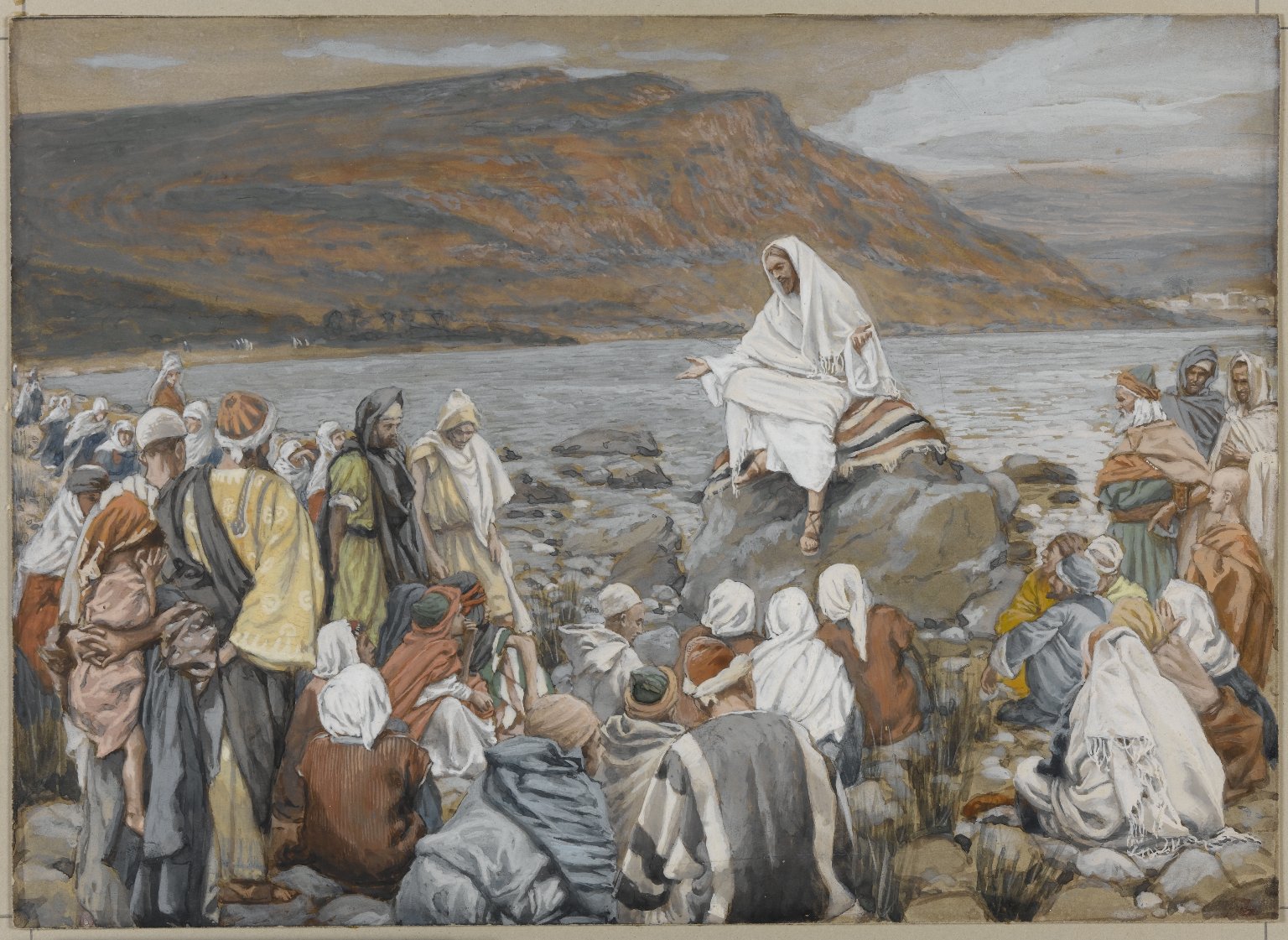
In Luke’s Gospel we see the continuation of Christ’s ministry of teaching and healing. People come to Jesus because they want to know God. They have travelled from a wide area, and are a diverse group of people, all united by a common desire: to be closer to God. Unlike in Matthew’s account, here Jesus does not go up a mountain to teach, but comes down to where people are. There He proclaims the values of the Kingdom:
‘Gwyn eich byd chwi’r tlodion, oherwydd eiddoch chwi yw teyrnas Dduw’
“Blessed are you who are poor, for yours is the kingdom of God.” (Lk 6:20)
To be poor in the world’s eyes is to lack money, possessions, power, and influence. All these worldly things do not matter in the Kingdom of God. There those who are poor, those who recognise their complete dependance upon God, are truly rich. This is because they have the humility to let God be at work in them, and they rely upon God, rather than their own strength, which enables them to be transformed. Two thousand years ago the poor were looked down upon, and their poverty was blamed on sin or fecklessness. They were at the bottom of the pile. To say that the Kingdom of God belongs to such people is to make a truly radical statement, turning societal norms and expectations on their head. What Our Lord is proposing is literally world-changing. This is the Good News of Jesus Christ.
However, Our Lord recognises that His radical vision will meet with opposition:
‘Gwyn eich byd pan fydd dynion yn eich casáu a’ch ysgymuno a’ch gwaradwyddo, a dirmygi eich enw fel peth drwg, o achos Mab y Dyn. Byddwch lawen y dydd hwnnw a llamwch o orfoledd, oherwydd, ystyriwch, y mae eich gwobr yn fawr yn y nef.’
“Blessed are you when people hate you and when they exclude you and revile you and spurn your name as evil, on account of the Son of Man! Rejoice in that day, and leap for joy, for behold, your reward is great in heaven.” (Lk 6:22-23)
To live the Christian life is to be different, to offer the world something new, something challenging, and something disturbing. It will be resisted, and it will lead to difficult times. Our reaction towards any persecution, however, is to be joy. At first sight this seems a little strange and it is definitely a challenge
Jesus then makes a series of four statements beginning with ‘Gwai chwi …Woe to you’. These parallel the earlier positive statements about the Kingdom and turn human values upside down. These speak to those people who trust in themselves, their riches and abilities, saying that all will not go well for them in the future. Those who will not listen to Jesus’ words, because they think they do not need to, will find out that they are wrong.
In some important ways, Christianity looks dangerous and suspect to the world around us, and so it should. As Christians, we are not conformed to the ways of the world, but rather to the will of God. We do not simply go along with things, because that is what everyone does. Instead, we follow a higher authority. We cannot be bought off with baubles and trinkets, with wealth or power — the things of this world. This is because we acknowledge someone greater, namely God. We try to live as God wants us to live, acknowledging Him before all things. As Christians, there should be something different about us, something that others can see, something that reflects Christ.
Jesus died to reconcile us to God and each other, and He was raised from the dead to give humanity hope in the God who loves us. This hope inspired St Paul to preach the Good News, and it should inspire us as well. We are called to live out our faith in our lives. Our beliefs need to make a difference to who and what we are, so that others might see the truth of the Gospel. What we do here, today, in church helps us to follow in Jesus’ footsteps. We hear God’s word, and we are nourished by it. We pray together for the Church and the World, and those in need. In the Eucharist, Christ fill us with His grace to strengthen and transform us, and then sends us out into the world to love our neighbour.
May we, today and every day, live out and proclaim the coming of God’s Kingdom, so that the world may believe and give glory i Duw Dad, Duw y Mab, a Duw yr Ysbryd Glân. I’r hwn y priodoler pob gogoniant, arglwyddiaeth, a gallu, yn awr, ac yn oes oesoedd. Amen.
 Novus Motus Oxoniensis