Trinity IV: Transformed by Faith -Embracing God’s Love in the Midst of Life’s Storms

There are few things that can compare with a storm for making human beings feel small and helpless. When we are faced with strong winds, lashing rain and lightning, we can feel insignificant, powerless, and aware of our own mortality. I was caught in a storm, fairly recently, and it was absolutely terrifying. Such feelings are uncomfortable, and we would prefer not to experience them. They are, however, an important part of the human condition. Fear is one of the most powerful emotions we have, and it drives us to seek safety and security. Thankfully, as Christians, we know that we can find safety and security in God, our loving Creator and Sustainer. 

This loving nature of God is highlighted in the passage from the Book of Job, which is the first reading this morning. God is truly powerful, but cares for humanity:

Who shut in the sea with doors when it burst out from the womb,Thus far shall you come, and no farther, and here shall your proud waves be stayed’ 

‘Pan gaewyd ar y môr â dorau, pan lamai allan o’r groth…Hyd yma yr ei, a dim pellach, ac yma y gosodais derfyn i ymchwydd dy donnau’ (Job 38:8, 11)

God’s power over nature is also central to this morning’s Gospel. Jesus and His disciples are crossing the Sea of Galilee when a violent storm blows up. The disciples are terrified. Despite many of them being fishermen, they are afraid that they are about to drown. This passage throws up a number of questions. Why are Jesus and His disciples crossing from the Jewish side of the Sea of Galilee to the non-Jewish side? Why are they sailing at night, rather than waiting until the next morning? We are not told the answers to these questions. However, this incident acts as a bridge between the section in Mark’s Gospel where Jesus has been teaching, to one where He will perform miracles, and put that teaching into practice. 

As the boat begins to fill with water, the disciples are becoming desperate:

And they woke him and said to him, “Teacher, do you not care that we are perishing?” And he awoke and rebuked the wind and said to the sea, “Peace! Be still!” And the wind ceased, and there was a great calm.

‘Deffroesant ef a dweud wrtho, “Athro, a wyt ti’n hidio dim ei bod ar ben arnom?” Ac fe ddeffrôdd a cheryddu’r gwynt a dweud wrth y môr, “Bydd ddistaw! Bydd dawel!” Gostegodd y gwynt, a bu tawelwch mawr.’ (Mk 4:38-39)

Jesus’ followers are afraid. There are thirteen of them packed into a boat twenty-six feet long, eight feet wide, and four feet deep.The boat is tossing, yet Jesus calmly sleeps. Once He is awoken He quickly takes control of the situation. Jesus can command the storm to cease because He is God. The ability to control the sea and its storms is a sign of divine power: God is the one who brings peace. Jesus has come to bring peace to troubled hearts. Having performed a miracle, He questions His disciples:

He said to them, “Why are you so afraid? Have you still no faith?” And they were filled with great fear and said to one another, “Who then is this, that even the wind and the sea obey him?”’ 

‘A dywedodd wrthynt, “Pam y mae arnoch ofn? Sut yr ydych heb ffydd o hyd?” Daeth ofn dirfawr arnynt, ac meddent wrth ei gilydd, “Pwy ynteu yw hwn? Y mae hyd yn oed y gwynt a’r môr yn ufuddhau iddo.”’ (Mk 4:39-41)

The answer to the disciples’ question is that Jesus is God. No-one else could do what He does. Jesus then questions why His followers feel fear and why they lack faith. To put it simply, the Disciples have not yet fully understood either who Jesus is, or what He is doing. Once they have experienced Christ’s Passion and Resurrection and seen His triumph over death, they will come to understand what is happening here. 

Jesus calms storms both real and metaphorical: on the Sea of Galilee, and in our own lives. By dealing with sin once and for all on the Cross, He has brought us a peace which passes all understanding. In every Eucharist service there is a point after the prayers when we greet each other with ‘Peace’ ‘Tangnefedd’. Being at peace allows the Christian community to:

no longer live for themselves but for him who for their sake died and was raised.

‘er mwyn i’r byw beidio â byw iddynt eu hunain mwyach, ond i’r un a fu farw drostynt, ac a gyfodwyd’ (2Cor 5:15)

Our life is not our own, because the love of Christ controls us, as St Paul writes in his Second Letter to the Corinthians (2Cor 5:14). Jesus’ Death and Resurrection provide an answer to the questions about suffering asked by Job, and by all humanity. By entering into the mystery of apparently meaningless pain and suffering, we can discover the source of all meaning, namely God. 

To be in Christ is to be a new Creation. Through our Baptism we share in Our Lord’s Death and Resurrection. In the Eucharist we are given the pledge of Eternal Life: Christ’s Body and Blood, so that we might continue to be transformed more and more into His likeness. This is the journey of Faith — trusting God, so that He may make us into what He is. We put our trust in Him, safe in the knowledge that God alone can still the storms of our life, and that His perfect love can drive out our fear. We cling to the Cross as our source of Hope, knowing that whatever happens we are loved, and that this love has the power to save us. God’s love can free us from fear.

Released from anxiety, we, like the disciples, can be truly alive and share God’s love with others. We pray that all humanity may experience the peace of the Lord and give glory to God the Father, God the Son, and God the Holy Spirit. To whom be ascribed all glory, dominion, and power, now and forever. Amen.
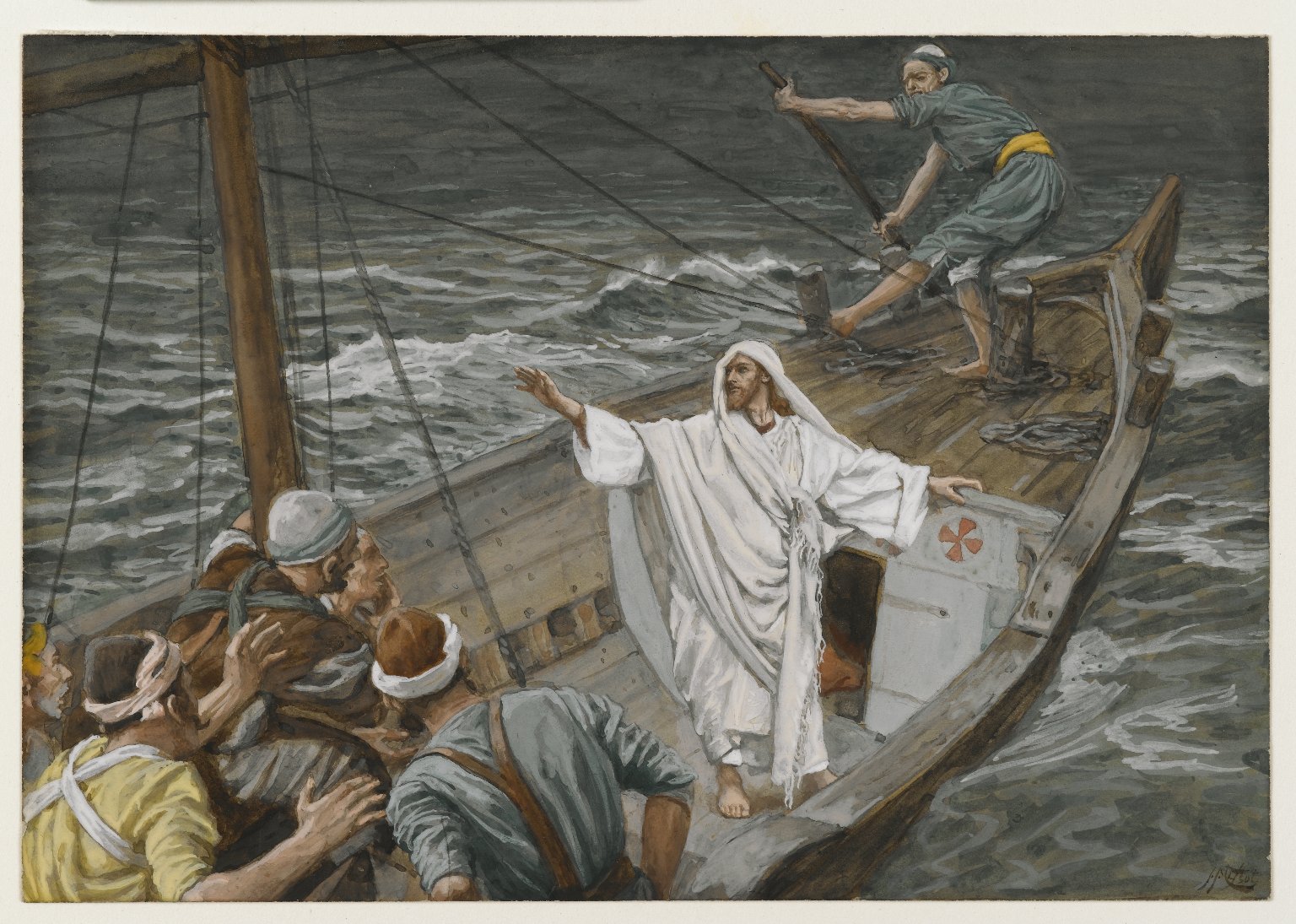
James Tissot – Jesus stilling the storm (Brooklyn Museum)

The Second Sunday of Easter

This morning we welcome baby Alice into the Christian community. This is an important day for her, as well as her family, and for all of us present here today.

At the beginning of His ministry, Jesus was baptised by John in the River Jordan. Today I will use the blessed water in the font and holy oil. The font is placed near the door of the church because baptism is the way that we enter the Church and become a member of the Christian community.

Today’s reading from the First Letter of John speaks of loving the children of God (plant Duw) and of keeping God’s commandments. M____ and C_____ are following God’s commandments by bringing their daughter Alice to be baptised, and we are all here to support them in their actions.

The Gospel for today records the risen Jesus appearing to the disciples. Peter and John have already witnessed the empty tomb, Mary Magdalen has even talked with the Risen Christ. However, the disciples are afraid. Their Teacher has gone from being hailed as the Messiah and King, to being crucified. Christ’s followers are all scared for their lives, lest a mob come and attack them. Some of their number are saying that the tomb is empty, and that Jesus has risen. Then, suddenly, the risen Lord is there among them saying: 

“Peace be with you!” 

‘Tangnefedd i chwi!’ (John 20: 19)

In a situation of heightened emotion, Our Lord’s gift is peace. God’s peace is not just the absence of noise or violence (heddwch) but something richer and deeper. This is the ‘Peace which passeth all understanding’ ‘Tangnefedd sydd uchlaw pob deall’, something given to us by God to transform our lives. Next, Jesus breathes on His disciples giving them the Holy Spirit and the power to forgive sins. Christ’s followers are equipped for the work of proclamation and reconciliation. This is what Jesus came to do, and He commits the Church to continue His mission and His saving work. To help His followers, Christ gives them (and us) the Holy Spirit, God’s free gift to His people, a sign of His generous love.

When Jesus appears to the disciples, one of them is absent. Thomas is not there — maybe he has been to get them all some food. When Thomas returns and hears what has happened, he feels somewhat left out. He is unsure and wants to have physical proof of Jesus’ Resurrection before he is able to fully believe:

“Unless I see in his hands the mark of the nails, and place my finger into the mark of the nails, and place my hand into his side, I will never believe.”

“Os na welaf ôl yr hoelion yn ei ddwylo, a rhoi fy mys yn ôl yr hoelion, a’m llaw yn ei ystlys, ni chredaf fi byth.” (John 20: 6-7)

These are the words of someone who longs to experience the reality of the Resurrection. Like the other disciples, Thomas has been on something of an emotional rollercoaster. It is understandable that he wants to be certain, to experience with his own eyes and hands that Jesus is alive.

A week later, Jesus comes to the disciples again, and says to them: 

“Peace be with you.” Then he said to Thomas, “Put your finger here, and see my hands; and put out your hand, and place it in my side. Do not disbelieve, but believe.”

“Tangnefedd i chwi!” Yna meddai wrth Thomas, “Estyn dy fys yma. Edrych ar fy nwylo. Estyn dy law a’i rhoi yn fy ystlys. A phaid â bod yn anghredadun, bydd yn gredadun.” (Jn 20:26-27)

Jesus gives Thomas what he wants: the opportunity to experience the reality of the Resurrection and to touch the wounds of love and mercy. This leads Thomas to reply to Jesus:

“My Lord and my God!”

“Fy Arglwydd a’m Duw!” (Jn 20:28)

Thomas no longer doubts. Instead he confesses that Jesus is God, and the Lord of his life. This is a profound and concise statement of faith, declaring both who Jesus is, and what He has done. Thomas has journeyed from doubt and despair to true faith. Doubt is the starting point, but it is not the end of the journey. St Thomas should not be known as ‘Doubting Thomas’, but rather as ‘Believing Thomas’, as this is what he becomes. Thomas’ belief changes his life, and leads him to take the Gospel to be proclaimed far and wide. He travels as far as India, founding Christian communities which have endured for two thousand years. Such faith is our inheritance, and in it we are blessed, as those who have not seen, but yet believe. We too are called to be like Thomas, and to share the Good News of Christ’s Resurrection with the world. 

At its heart today’s Gospel should be understood as something to encourage us in our life of faith:

‘but these [things] are written so that you may believe that Jesus is the Christ, the Son of God, and that by believing you may have life in his name.’

‘Ond y mae’r rhain wedi eu cofnodi er mwyn i chwi gredu mai Iesu yw’r Meseia, Mab Duw, ac er mwyn i chwi trwy gredu gael bywyd yn ei enw ef.’ (Jn 20:31)

Belief in Jesus leads to New Life. This underlines the Christian understanding of baptism. Through baptism we share in Jesus’ Death and Resurrection, and are given new life. This new life is eternal life with Christ, and in Christ.

At the Easter Vigil, last week, we renewed our baptismal promises to remind ourselves of what Our Lord has done for us. What Jesus has done for you, and for me, and for every Christian over the past two thousand years. In our Baptism we are united with Christ and made brothers and sisters. We become part of a new family which we call the Church. This new family is called to live in a new way. This is made clear in the first reading from the Acts of the Apostles. Here we see people of faith being loving and generous, caring for each other. We pray that we may be inspired by their example, and live out the faith of our baptism throughout our lives. 

Next to the font is our wonderful Easter Garden, which includes the Empty Tomb, the site of Jesus Resurrection.It is important to take our time over our celebration of Easter. We need time to allow the reality of what we commemorate to sink in. Something this wonderful, this world-changing, needs to be pondered, and shared. We gather today to do what the disciples did, and are filled with joy at Our Lord’s Resurrection from the dead. Through Christ’s Resurrection we are changed, transformed, and filled with God’s love. In the same way Alice will shortly be changed, transformed and filled with God’s love. Easter is a traditional time for baptism, and as a Christian community we welcome Alice and pray for her, and for her family. Today, and every day, we give thanks and praise to God the Father, God the Son, and God the Holy Spirit. To whom be ascribed all, glory, dominion, and power, now and forever. Amen.

Tissot: L’Incredulité de Saint Thomas, (Brooklyn Museum)