The Baptism of Christ 2026

‘This is my beloved Son, with whom I am well pleased.’

‘Hwn yw fy Mab, yr Anwylyd; ynddo ef yr wyf yn ymhyfrydu’ (Mt 3:17)

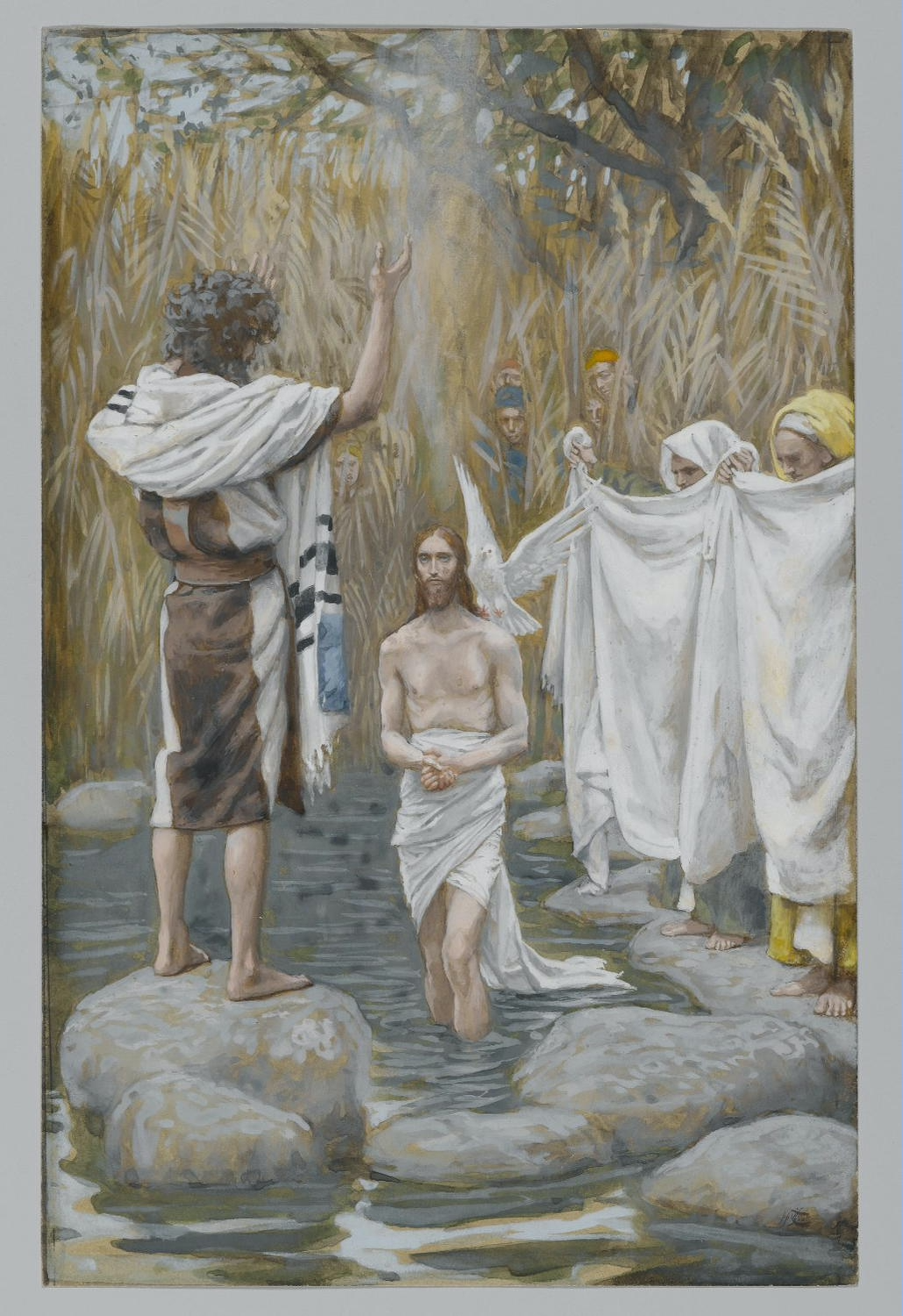
Our Baptism is one of the most important events in our lives. However, for the vast majority of Christians who were baptised as infants, it isn’t something we necessarily remember. We are too young to recall the experience. But whether we can remember it or not, we know that our baptism marked our entry into the Church. During the sacrament we were clothed with Christ and we were born again, by water and the Holy Spirit. Our Lord Jesus Christ was also baptised, but as a man, rather than a baby. This is what the Church celebrates today. 

Baptism washes us from our sins, yet Jesus is not a sinner. So why does He need to get baptized? John the Baptist says to Christ, “I need to be baptized by you, and do you come to me?” (Mt 3:14). Our Lord replies by saying, “Let it be so now, for thus it is fitting for us to fulfil all righteousness.” (Mt 3:15). Jesus’ baptism is one of obedience to the will of God the Father. That is why our first reading is the first of the Servant Songs in the prophecy of Isaiah. The prophecy is fulfilled when the Father speaks the words from the first verse, at the moment of Jesus’ baptism. God gives His Son as a covenant to the nations. This covenant will be made on the Cross, to save humanity. Christ is a light for the nations, as Simeon states at the Presentation in the Temple. Jesus will open the eyes of the blind, and set prisoners free. This is the reality of the Kingdom of God, which we are members of, through our baptism.

Today, God does a new thing. This lies at the heart of the proclamation of the Good News of the Kingdom by St Peter in this morning’s second reading from the Acts of the Apostles. It is the same pronouncement that we find in Isaiah. There is a consistency in proclamation down through the centuries, a guarantee of its truth. God the Father expresses His love for His Son, whose obedience to His Father’s will shows humanity that by saying ‘Yes’ to God, the ‘No’ of Adam and Eve can be undone. Christ, the new Adam, fulfils all righteousness, and in so doing begins His public ministry which takes this ultimately to the Cross. This is where righteousness and obedience lead: to death and suffering, to the demonstration of God’s love and finally, to the restoration of humanity once and for all.

What is foolish in the eyes of the world, is in fact the greatest possible demonstration of love. We will see that love made visible here this morning, where Christ offers Himself for us, through His Body and Blood in the Eucharist. We feed on Him, so that He can transform us; so that we may come to share in the very life and nature of God. Through our Baptism, and through the Eucharist, God’s Kingdom becomes a living reality in us. We are transformed to live its life, and transform the world around us.

A few days ago we celebrated Epiphany, Our Lord’s manifestation to the Gentiles. Now this Sunday, at the start of Christ’s public ministry, He is again made manifest. God the Father acknowledges the Son in the flesh, and sends the Holy Spirit, the bond of their love. The fullness of the Divine Trinity is united and revealed on earth to proclaim that Christ is Lord. The Kingdom has become a reality. Christ does not need to be baptised, as we do. However, He does so in order to fulfil all righteousness and to sanctify the waters of baptism for those whom He would redeem, to show us the way to new life in Him. At the beginning of his public ministry, Jesus shows humanity the way to the Father, through himself. The world sees the generous love of God, which heals and restores us, from the darkness of the dungeon of sin and evil, to the light and life of the Kingdom of God. As our baptism is a sharing in the death and resurrection of Jesus, so His baptism points to the Cross, where streams of blood and water flow to cleanse and heal the world. We see the love of the Father, the power of the Spirit, and the obedience of Son, and all for us, who deeply need God’s love and healing, and forgiveness.

We long to experience this deep, divine love. The whole world needs it, but we are often too proud or too fearful to turn to the God of love. And yet it is exactly such people, the lost sheep, that Our Lord comes to seek. He desires to enfold them, and us, in His loving arms on the Cross. He washes us in the waters of baptism, so that we all may be a part of Him, regardless of whom we are, and what we have done. Salvation is the free gift of God and is open to all who turn to him.

Ours is a faith which can transform the world, so that all humanity can share in God’s life and love. Each and every one of us can become part of something radical and revolutionary, which can, and will, transform the world one soul at a time. Rather than human violence, cruelty, and mis-use of power, the only way to transform the world is through the love of God. This is what the Church is for. This is what Christianity is all about. This is why we are gathered here today, to be strengthened and nourished.

Through prayer, through the Word of God, and through the Sacraments of the Church, we are strengthened and nourished to live out our faith and transform the world. Nothing more, nothing less, just a revolution of love, of forgiveness, and of healing. This is what the world both wants and needs. So, let us draw on the strength of our baptism to live out our faith in order that the whole world may be transformed and believe. United with all our Christian brothers and sisters let us give glory to God the Father, God the Son, and God the Holy Spirit, Duw Dad, Duw Y Mab, a Duw yr Ysbryd Glân. To whom be ascribed all glory, dominion and power, now and forever. Amen.

James Tissot: The Baptism of Christ (Brooklyn Museum)

Palm Sunday 2025

J.R.R. Tolkien’s famous novel, The Lord of the Rings is a long and complicated book. The main story is the journey of an unlikely group of heroes across Middle Earth to destroy a powerful Ring at Mount Doom, where it was forged. But it is also the tale of how Aragorn becomes the King of Middle Earth. He does this by reuniting the lands of Arnor and Gondor, and defeating the evil Sauron with a coalition of men, elves, dwarves, and hobbits. In constructing his narrative Tolkien drew on his encyclopaedic knowledge of medieval European literature and his deep Christian faith. The desire to see a monarchy re-established lies at the Jewish and Christian faiths. Jews await the coming of the Messiah, the anointed Davidic King, which Christians believe is Jesus. We believe that the Messiah has already come, to set His people free, and to inaugurate a kingdom of love, forgiveness, and reconciliation. 

The service this morning begins with Luke’s account of the first Palm Sunday, when Jesus enters Jerusalem on a donkey, an animal of peace and not war. The prophet Zechariah, writing 500 years before Jesus, looks forward to a messianic future:

‘Bydd lawen iawn, ti ferch Seion; a chrechwena, ha ferch Jerwsalem: wele dy frenin yn dyfod atat: cyfiawn ac achubydd yw efe; y mae efe yn llariaidd, ac yn marchogaeth ar asyn, ac ar ebol llwdn asen.’

Rejoice greatly, O daughter of Zion! Shout aloud, O daughter of Jerusalem! Behold, your king is coming to you; righteous and having salvation is he, humble and mounted on a donkey, on a colt, the foal of a donkey.’ (Zech 9:9)

The donkey ridden by Jesus reminds us of the humble beast of burden, which carried his Mother to Bethlehem for His birth, and then carried the Holy Family into exile in Egypt. This is an act of humble leadership which realizes what the prophets foresaw. It shows us that Jesus Christ is truly the one who fulfils the hopes of the people of Israel. The Hebrew Scriptures look forward to His deliverance of Israel. This is what is made real in front of the eyes of those watching the Carpenter’s son enter the Holy City of Jerusalem.

Scripture is fulfilled and there is a burst of popular enthusiasm — people wave palm branches and cry out. However, having someone claim to be a relative of King David is a direct challenge to Herod, the puppet ruler installed to comply with the Romans. The events we heard described, before our procession this morning, sound something like a political coup — a bid to replace a leader lacking legitimacy. Such an attempt is bound to have wide repercussions. It represents a direct challenge to the ruling house and to Rome, and therefore it has to be countered. The masses in Jerusalem are expecting a king of the Davidic line. One who would be seen as a threat to the ruling élite, a challenge to the status quo. But in Christ, God gives Israel something else. Yes, he is a King of the line of David, but Jesus is the one who rules with love. He has no desire for power, or honour. Naturally, the leaders and those in authority are threatened by Him: Christ turns their world on its head. He is an awkward inconvenience. Jesus, however, does not want their power. He has come to accomplish something completely different. What is seen as a potential political coup is in fact a renewal of religion, the fulfilment of prophecy, and a new hope for Israel. Political and religious leaders can only see the threat to their hold on power, rather than the opportunity which Christ offers.

At its heart Christianity is the offer of new life in Jesus Christ. This starts with repentance, and acceptance of our need for God. As we grow in faith, we come to believe and trust in a God who loves us, and gives Himself for us. Then we can experience healing, wholeness, and fullness of life in and through Him. Such gifts come at great cost to the giver, which the week ahead will make clear to us in the most stark and direct way. 

One way of reading St Luke’s account of Christ’s Passion and Death is through the lens of conversion and reconciliation. After Jesus celebrates the Eucharist a dispute arises amongst His disciples as to which of them is the greatest. There is something of a contrast here between the institution of the most solemn and sacred act of Christian worship, and the actions of the disciples who seem to be arguing like children in a playground: ‘I’m greater than you!’ ‘No, I’m greater than you!’. This is not how they should behave, so Our Lord explains:

‘Y mae brenhinoedd y Cenhedloedd yn arglwyddiaethu arnynt, a’r rhai sydd ag awdurdod drostynt yn cael eu galw yn gymwynaswyr. Ond peidiwch chwi â gwneud felly. Yn hytrach, bydded y mwyaf yn eich plith fel yr ieuengaf, a’r arweinydd fel un sy’n gweini.’

‘The kings of the Gentiles exercise lordship over them, and those in authority over them are called benefactors. But not so with you. Rather, let the greatest among you become as the youngest, and the leader as one who serves.’ (Lk 22:25-26)

Service of others lies at the heart of Christianity, not exercising power or influence. Christ is offering the world a new way to be, and the church needs to take this seriously, and follow His teachings.

As Jesus goes to Calvary, He tells the women of Jerusalem not to mourn for Him, but instead to mourn for themselves and their children. He says this because He understands that in a few years time the Romans will sack Jerusalem, and the people will be scattered in exile. Christ is more concerned with the needs of others than Himself, and as He goes to His execution, Our Lord is still a servant, caring for others.

As the Roman soldiers crucify Jesus He says:

“O Dad, maddau iddynt, oherwydd ni wyddant beth y maent yn ei wneud.”

‘Father, forgive them, for they know not what they do.’ (Lk 23:34)

Christ’s concern is for forgiveness and reconciliation — just as it has been throughout His earthly ministry. His life’s work is to restore each and every one of us to God and to pour out the Creator’s love on us. This is also evident from Jesus interaction with the penitent thief a few verses later:

Yna dywedodd, “Iesu, cofia fi pan ddoi i’th deyrnas.” Atebodd yntau, “Yn wir, rwy’n dweud wrthyt, heddiw byddi gyda mi ym Mharadwys.”

“And he said, ‘Jesus, remember me when you come into your kingdom.’ And Jesus said to him, ‘Truly, I say to you, today you will be with me in paradise.’” (Lk 23:42-43)

The criminal being executed for seditious acts against Rome expresses faith in Christ, and is rewarded with the grace earned for humanity on the Cross. Our Lord’s dying words are taken from Psalm 31:6, a confident prayer:

“O Dad, i’th ddwylo di yr wyf yn cyflwyno fy ysbryd.”

‘Father, into your hands I commit my spirit!’ (Lk 23:46)

Immediately afterwards the centurion in charge of the Crucifixion acts in a surprising manner, praising God and declaring Jesus to be innocent:

‘Pan welodd y canwriad yr hyn oedd wedi digwydd, dechreuodd ogoneddu Duw gan ddweud, “Yn wir, dyn cyfiawn oedd hwn.”’

‘Now when the centurion saw what had taken place, he praised God, saying, “Certainly this man was innocent!”’ (Lk 23:47)

The gathered crowds also do something unusual:

‘Ac wedi gweld yr hyn a ddigwyddodd, troes yr holl dyrfaoedd, a oedd wedi ymgynnull i wylio’r olygfa, tuag adref gan guro eu bronnau.’

‘And all the crowds that had assembled for this spectacle, when they saw what had taken place, returned home beating their breasts.’ (Lk 23:48)

In acting in this way they are expressing contrition and repentance, the necessary prerequisite to the acceptance of God’s grace. Salvation has become a reality and it is changing people’s lives. Just as it did two thousand years ago, it is still doing so today, and will continue to do so until the end of time itself.

Let us then, as followers of Jesus, hold up our palms as we rejoice in the generous love of God and prepare ourselves to celebrate Christ’s Passion. Let us give thanks for the fact that we are loved by God. And let us give glory i Duw Dad, Duw y Mab, a Duw yr Ysbryd Glân. To God the Father, God the Son, and God the Holy Spirit. I’r hwn y priodoler pob gogoniant, arglwyddiaeth, a gallu, yn awr, ac yn oes oesoedd. Amen. To whom be ascribed all glory, dominion and power, now and forever. Amen.

Epiphany 2025

IN Britain there is a tradition that royal births are announced by a notice placed on an easel outside Buckingham Palace. When the present King was born in 1948 the notice read: ‘Buckingham Palace November 14th, The Princess Elizabeth, Duchess of Edinburgh was safely delivered of a prince at nine fourteen pm today. Her Royal Highness and her son are both doing well.’ Historically, royal births were witnessed by important people. They were public occasions rather than private ones. Everyone wants to know what is happening. 

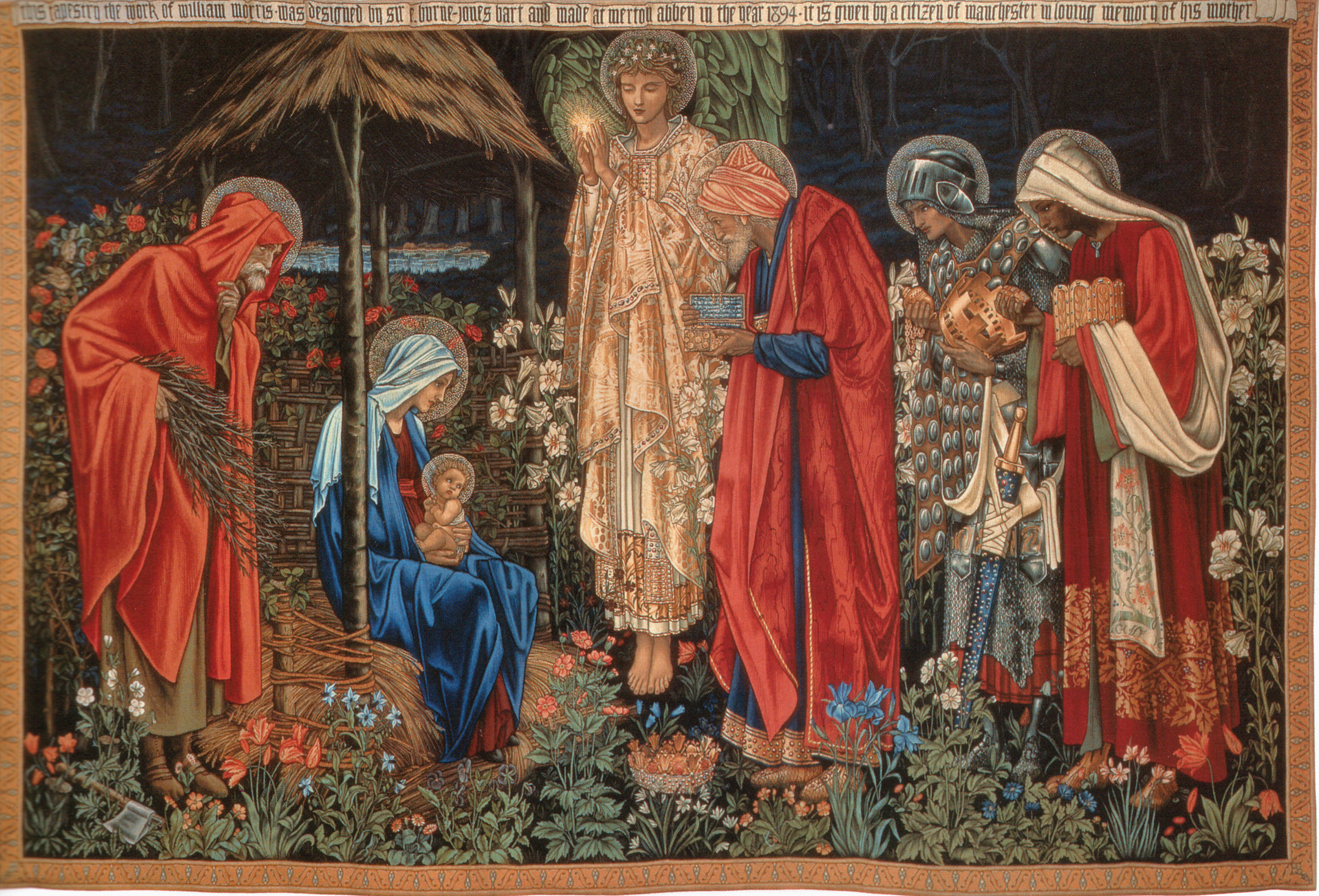
Meanwhile, out in the East, in what is now modern day Iraq and Iran, astrologers noticed something in the sky. This phenomenon possibly involved Jupiter and either Saturn, or the star Regulus in the constellation Leo. It was a significant astronomical event, which signified a royal birth. These Magi travelled to Judaea, as that was the direction that the celestial sign was pointing them towards. As they were looking for a royal birth, their first stop was, naturally, the palace. When they arrived at Herod’s palace they asked:

‘Ble mae’r hwn a anwyd yn frenin yr Iddewon? Oherwydd gwelsom ei seren ef ar ei chyfodiad, a daethom i’w addoli.’

‘Where is he who has been born king of the Jews? For we saw his star when it rose and have come to worship him.’ (Mt 2:2)

They make a reasonable statement, but their words have a strange effect:

‘A phan glywodd y Brenin Herod hyn, cythruddwyd ef, a Jerwsalem i gyd gydag ef. Galwodd ynghyd yr holl brif offeiriaid ac ysgrifenyddion y bobl, a holi ganddynt ble yr oedd y Meseia i gael ei eni’

‘When Herod the king heard this, he was troubled, and all Jerusalem with him; and assembling all the chief priests and scribes of the people, he enquired of them where the Christ was to be born’ (Mt 2:3-4)

News of a royal birth is troubling to Herod, an Aramean who bought the right to be king by paying the Romans. He was very concerned by questions of legitimacy because his own claim was based on shaky ground. Herod’s religious experts then explain where the child will be born, quoting a prophecy of Micah, which we heard on the Fourth Sunday of Advent:

“Ym Methlehem Jwdea, oherwydd felly yr ysgrifennwyd gan y proffwyd: ‘A thithau Bethlehem yng ngwlad Jwda, nid y lleiaf wyt ti o lawer ymysg tywysogion Jwda, canys ohonot ti y daw allan arweinydd a fydd yn fugail ar fy mhobl Israel.'”

‘In Bethlehem of Judea, for so it is written by the prophet: “And you, O Bethlehem, in the land of Judah, are by no means least among the rulers of Judah; for from you shall come a ruler who will shepherd my people Israel.”’ (Mt 2:5-6)

Bethlehem, the city of David, is where a King of the lineage of David will be born. A Davidic King poses a huge threat to Herod. There could be an uprising, and regime change. Herod needs to know what is going on. Since knowledge is power, he sends the Magi off to find the child and to report back.

What looks like a simple and straightforward enquiry is actually the first part of a plan to eliminate this potential threat to Herod’s rule. This will later be carried out in the Massacre of the Innocents — the wholesale slaughter of young male children in Bethlehem. Herod certainly has no intention of relinquishing his power, his behaviour is a sham. The Wise Men then leave the royal palace and head for Bethlehem.

‘a dyma’r seren a welsent ar ei chyfodiad yn mynd o’u blaen hyd nes iddi ddod ac aros uwchlaw’r man lle’r oedd y plentyn. A phan welsant y seren, yr oeddent yn llawen dros ben.’

‘And behold, the star that they had seen when it rose went before them until it came to rest over the place where the child was. When they saw the star, they rejoiced exceedingly with great joy.’ (Mt 2:9-10)

The Magi have journeyed hundreds of miles because they saw a celestial event. Now this heavenly light is above Bethlehem, and the travellers have reached the new-born King. 

‘Daethant i’r tŷ a gweld y plentyn gyda Mair ei fam; syrthiasant i lawr a’i addoli, ac wedi agor eu trysorau offrymasant iddo anrhegion, aur a thus a myrr.’

‘And going into the house they saw the child with Mary his mother, and they fell down and worshipped him. Then, opening their treasures, they offered him gifts, gold and frankincense and myrrh.’ (Mt 2:11) 

Gold, frankincense, and myrrh seem to us unusual presents. They are, however, all expensive, costly, and precious things, and therefore suitable royal gifts. These offerings were prophesied by Isaiah: 

‘byddant i gyd yn cludo aur a thus, ac yn mynegi moliant yr Arglwydd.’

‘They shall bring gold and frankincense, and shall bring good news, the praises of the Lord’ (Isa 60:6)

Gold, is a precious metal, which is pure and does not tarnish. It is a gift fit for a king. Gold’s purity points to a life of perfect obedience, the pattern of how life should be lived. Incense, from Arabia, was offered to God in the Temple in Jerusalem. As the sweet-smelling smoke rose, it looked like prayers rising to God. Frankincense is a sign of worship, and honour, representing how humanity should respond to God. Myrrh was often a component of the ointment used for embalming bodies. These three gifts given at Jesus’ birth point to Christ’s kingly power, and His role in worship as our great High Priest, which leads to His to Death and Burial.

The Wise Men are warned by a dream not to go back to Herod, and not to tell him who Jesus is. This is because the Judean king does not want to worship Jesus, he wants to kill Him, and safeguard his own position. And so the unexpected visitors leave as mysteriously as they arrived. These pilgrims from afar gave Our Lord gifts which celebrate His Humanity and Divinity, and which look forward to His Death and Resurrection. The beginning of Jesus’ earthly life looks to its end, because it is all part of the outworking of salvation history.

The events that we are celebrating today were prophesied by Isaiah in the first reading this morning:

‘Cod, llewyrcha, oherwydd daeth dy oleuni; llewyrchodd gogoniant yr Arglwydd arnat.’

‘Arise, shine, for your light has come, and the glory of the Lord has risen upon you’ (Isa 60:1)

The birth of the Messiah is a sign of God’s glory, and the salvation He will bring for all people: 

‘Fe ddaw’r cenhedloedd at dy oleuni, a brenhinoedd at ddisgleirdeb dy wawr.’

‘And nations shall come to your light, and kings to the brightness of your rising’ (Isa 60:3)

These pilgrims are the Magi, the Wise Men, the Kings who represent the entire Gentile (non-Jewish) World. They have come to worship God born among us. The travellers recognise who it is they have come to see, and their gifts fulfil Isaiah’s prophecy. What might appear strange at first sight is, in fact, both apt and right: to worship God and honour a King, and to recognise the Saviour in their midst. Today, the World recognises the Birth of Jesus Christ, and the mystery of salvation is proclaimed to all.

Likewise, as we celebrate the Feast of the Epiphany, we also look forward.Both to Our Lord’s Baptism in the River Jordan and to His first miracle at the Wedding at Cana. Christ, He who is without sin shows humanity how to be freed from sin and to have new life in Him.

So, today, as we continue to celebrate Jesus’ birth, let us raise our voices to join with the wise men in giving praise and honour to God the Father, God the Son, and God the Holy Spirit. To whom be ascribed all glory, dominion and power, now and forever. Amen.

Christmas 2024

Christmas is a time for many seasonal activities, including spending time with family and friends, eating special foods and enjoying Christmas Carols. Also, most of us will spend some time over the festive period watching films on the television, or in the cinema. Movies can, surprisingly, be particularly useful when we try and get our heads around the wonderful events of Christmas. I would like to begin by focussing on a film from my childhood — the 1981 adventure Raiders of the Lost Ark. In this film, the intrepid archaeologist Indiana Jones is competing with Nazi forces to discover the Ark of the Covenant, which, it is believed, has the power to make an army invincible. At the climax of the film, the villains open the Ark on an island in the Aegean Sea. Immediately, spirits and bolts of lightning are released, which kill the Nazis and free Indiana and his companion Marion. Other than being the sort of film one might watch at Christmas, what is the relevance of the scene?

The film’s denouement relies upon the heroes averting their gaze, while the villains do not, and are therefore destroyed. The plot draws upon the biblical idea that the glory of God, which the Ark is said to contain, is not something which humanity should gaze upon. In the Book of Exodus, when Moses asks to see God, he is told that if he does so he will die. The glory of God is not something humans are able to behold. 

Yet, the first reading this morning reaches its climax with the statement that:

‘fe wêl holl gyrrau’r ddaear iachawduriaeth ein Duw ni’

‘all the ends of the earth shall see the salvation of our God.’ (Isa 52:10)

There appears to be something strange going on here. Likewise, the one who begins His life wrapped in cloth and placed in a stone feeding trough, will end it taken down from a Cross, wrapped in cloth and placed in a stone tomb. ‘In my beginning is my end …. In my end is my beginning’ wrote T.S. Elliot in his poem ‘East Coker’, the second of his Four Quartets. And yet this end is but a prelude to Christ’s Resurrection, Ascension, and the Second Coming. 

In the great turnaround of salvation history, humanity goes from being unable to look upon the divine, to being able to behold Him in a manger, surrounded by farm animals. To put the mystery of our salvation into context, this morning’s Gospel goes back to the beginning, which is a very good place to start. Not to the Annunciation, where in the power of the Holy Spirit Christ takes flesh in the womb of His Mother, but to the beginning of time and the Creation of the Universe:

‘Yn y dechreuad yr oedd y Gair, a’r Gair oedd gyda Duw, a Duw oedd y Gair. Hwn oedd yn y dechreuad gyda Duw.’

‘In the beginning was the Word, and the Word was with God, and the Word was God. He was in the beginning with God.’ (Jn 1:1)

The Word which spoke the Universe into being exists in eternity with God, and is God. This is whom we worship: the one who will save humanity, and who offers us eternal life with God. 

Today we celebrate Divine generosity and humility. God is among us. Mae Duw yn eich plith ni. Born as a weak and vulnerable baby, he is utterly dependent upon Mary and Joseph. In time this divine generosity will be refused:

‘At ei eiddo ei hun y daeth, a’r eiddo ei hun nis derbyniasant ef.’

‘He came to his own, and his own people did not receive him.’ (Jn 1:11)

Ours is a God who does not force Himself upon us. Instead, He comes to us in love, to draw us out in love, that we might share in that love, and share it with others: 

‘A’r Gair a wnaethpwyd yn gnawd, ac a drigodd yn ein plith ni, (ac ni a welsom ei ogoniant ef, gogoniant megis yr Unig‐anedig oddi wrth y Tad,) yn llawn gras a gwirionedd.’

‘And the Word became flesh and dwelt among us, and we have seen his glory, glory as of the only Son from the Father, full of grace and truth.’ (Jn 1:14)

God pitches His tent, and tabernacles among us. The invisible becomes visible. The God who is beyond human understanding becomes human, and shares our human life from its beginning to its end. This is no unapproachable divinity, remote and uncaring, but one who experiences our existence, who understands us from the inside out. Humanity beholds the glory of God, in a baby who will die on a Cross to redeem us. 

Not only that, but Christ continues to give Himself to us, every time the Eucharist is celebrated, so that the Word can continue to become flesh, so that we can be transformed by Him, and share in God’s life. 

As we celebrate the birth of Our Saviour we need to ask ourselves: have we made room for Jesus in our lives? Have we really? If we haven’t, we need to let our hearts and our lives become the stable in which the Christ-child can be born. We need to see Him in the outcast, in the stranger, in the people which the world shuns. As Christians, we have to welcome such people, for in welcoming them we welcome Our Lord and Saviour. This is how we live out His love in our lives.

This is the true meaning of Christmas — this is the love which can transform the world. It is radical and costly. This love terrified the might of the Roman Empire, and showed human power that it was as nothing compared to Divine Love. Soul by individual soul, for the past two thousand years, the world has been changed by ordinary people living out the love shown to the world by, and through, this little vulnerable child.

So, today as we celebrate Jesus’ birth, let us raise our voices to join with the angels and give praise and honour to God the Father, God the Son, and God the Holy Spirit. To whom be ascribed all glory, dominion and power, now and forever. Amen.

Merry Christmas to you all!

Nadolig Llawen i chi gyd! 

Christ the King 2024

LIVING on the edge of Western Europe it is not surprising that many British people have something of a fascination with the Roman Empire. In the first century AD, the Romans conquered Britain and ruled here for nearly four hundred years. They gave us many things: including straight roads, plumbing and under-floor heating, and founded towns many towns such as Carmarthen. Just off Priory Street in Carmarthen are the remains of a Roman amphitheatre which could hold about five thousand spectators. It isn’t quite the size of Colosseum in Rome — and it is highly unlikely that it was ever flooded to stage a mock sea-battle — but it is a reminder of how far Roman influence stretched. 

Rome was an empire, with an emperor at its head. The bad emperors are generally portrayed as cruel autocrats in films like Gladiator. However, these depictions tend to gloss over the fact that these emperors were worshipped as  being divine. One of their first acts on accession to the throne would be for the new Emperor to declare their predecessor, or father, a God. They would then be referred to as ‘DIVI FILIVS’, ‘Son of a god’, ‘Fab duw’. This feels alien to us, because we are Christians, and we are followers of Jesus, the Son of God the Father, the Creator and Sustainer of us all. 

In this morning’s Gospel, Jesus is in Pilate’s headquarters, being questioned, before He is condemned to death on the Cross. Since Our Lord’s triumphal entry into Jerusalem a few days earlier, He has been hailed as the Davidic King, the Messiah. This is viewed as a clear challenge to Herod, and thus to the Roman occupation. Pilate is afraid of an insurrection leading to a rebellion and a change of government, all of which could mean his own death. So he asks Jesus:

“Ai ti yw Brenin yr Iddewon?”

“Are you the King of the Jews?” (Jn 18:33)

Our Lord does not answer, but instead asks Pilate a question:

“Ai ohonot dy hun yr wyt ti’n dweud hyn, ai ynteu eraill a ddywedodd hyn wrthyt amdanaf fi?”

“Do you say this of your own accord, or did others say it to you about me?” (Jn 18:34)

Pilate then replies:

“Dy genedl dy hun a’i phrif offeiriaid sydd wedi dy drosglwyddo di i mi. Beth wnaethost ti?”

“Your own nation and the chief priests have delivered you over to me. What have you done?” (Jn 18:35)

The back and forth is an attempt by the Roman Governor to see if there is substance to the charges, and to see whether Jesus will confess, or whether evidence can be gleaned, which would substantiate the accusation against Him. This leads Our Lord to make the following declaration:

“Nid yw fy nheyrnas i o’r byd hwn. Pe bai fy nheyrnas i o’r byd hwn, byddai fy ngwasanaethwyr i yn ymladd, rhag imi gael fy nhrosglwyddo i’r Iddewon. Ond y gwir yw, nid dyma darddle fy nheyrnas i.”

“My kingdom is not of this world. If my kingdom were of this world, my servants would have been fighting, that I might not be delivered over to the Jews. But my kingdom is not from the world.” (Jn 18:36)

Jesus Christ is not an earthly king, concerned with power, honour, wealth, and prestige, but rather a heavenly one, seeking to establish the Kingdom of God in the hearts and minds of men, women, and children. He seeks to build a kingdom of peace, love, and joy, and of healing and reconciliation. Pilate fails to grasp the nuance of Jesus’ proclamation, and instead focuses on what Jesus says, rather than what He means.

‘Yna meddai Pilat wrtho, “Yr wyt ti yn frenin, ynteu?”’

‘Then Pilate said to him, “So you are a king?”’ (Jn 18:37)

The Roman Governor is concerned with law, and not theology. He takes Our Lord’s words as a statement that Christ considers Himself a King, and that the charges against Him are true. So Jesus makes the following reply:

“Ti sy’n dweud fy mod yn frenin,” atebodd Iesu. “Er mwyn hyn yr wyf fi wedi cael fy ngeni, ac er mwyn hyn y deuthum i’r byd, i dystiolaethu i’r gwirionedd. Y mae pawb sy’n perthyn i’r gwirionedd yn gwrando ar fy llais i.”

“You say that I am a king. For this purpose I was born and for this purpose I have come into the world—to bear witness to the truth. Everyone who is of the truth listens to my voice.” (Jn 18:37)

Christ’s purpose is to bear witness to the truth, that He is God, and is calling people to repent and believe in Him. Pilate, however, is not listening to Jesus. The Governor focuses on the surface meaning, ignoring the truth beneath Christ’s words. And yet the truth will out in the end. A few hours later Our Lord will be crucified and the title fixed to the Cross will read: ‘Iesu o Nasareth, Brenin yr Iddewon’, ‘Jesus of Nazareth, King of the Jews’, in Hebrew, Latin, and Greek. In this way Pilate will proclaim Christ’s Kingship to the whole world. Because of this all people can see and know what a true King looks like; not robed in splendour in a palace, but nailed to a Cross, and dying the death ascribed to a criminal. In His Passion and Death, Christ bears witness to the truth, namely that:

‘Do, carodd Duw y byd gymaint nes iddo roi ei unig Fab, er mwyn i bob sy’n credu ynddo ef beidio â mynd i ddistryw ond cael bywyd tragwyddol. Oherwydd nid i gondemnio’r byd yr anfonodd Duw ei Fab i’r byd, ond er mwyn i’r byd gael ei achud trwyddo ef.’

‘God so loved the world that he gave his only Son, that whoever believes in him should not perish but have eternal life. For God sent the Son into the world, not to condemn the world, but that the world might be saved through him.’ (Jn 3:16-17) 

This is what real kingship looks like: selfless love and sacrifice. This is what Jesus offers the world in the Eucharist — His self-giving love with the power to transform the world. God gives Himself to us, so the world can share Eternal Life in Him. It is not about acquiring and displaying wealth, power, or privilege — things of this world. Instead, as Christians, we look to God and Heaven, as both the source of our being and as our eternal home.

To acknowledge Christ’s kingship is to do something truly radical. It is to say to those with worldly power, ‘We recognize something far greater and more powerful than you!’ This is a profound political act, which terrifies those who are insecure, just as it terrified Pilate and Herod. As followers of Jesus we have built the house of our faith on the rock which is Christ, and not the shifting sands of this world. 

So, my brothers and sisters, let us acknowledge Christ as our King. Let us serve Him, filled with His love for us, and for all people. Let this love form a Kingdom with God as its head. And as citizens of God’s Kingdom let us give praise and honour to God the Father, God the Son, and God the Holy Spirit. To whom be ascribed all glory, dominion and power, now and forever. Amen.

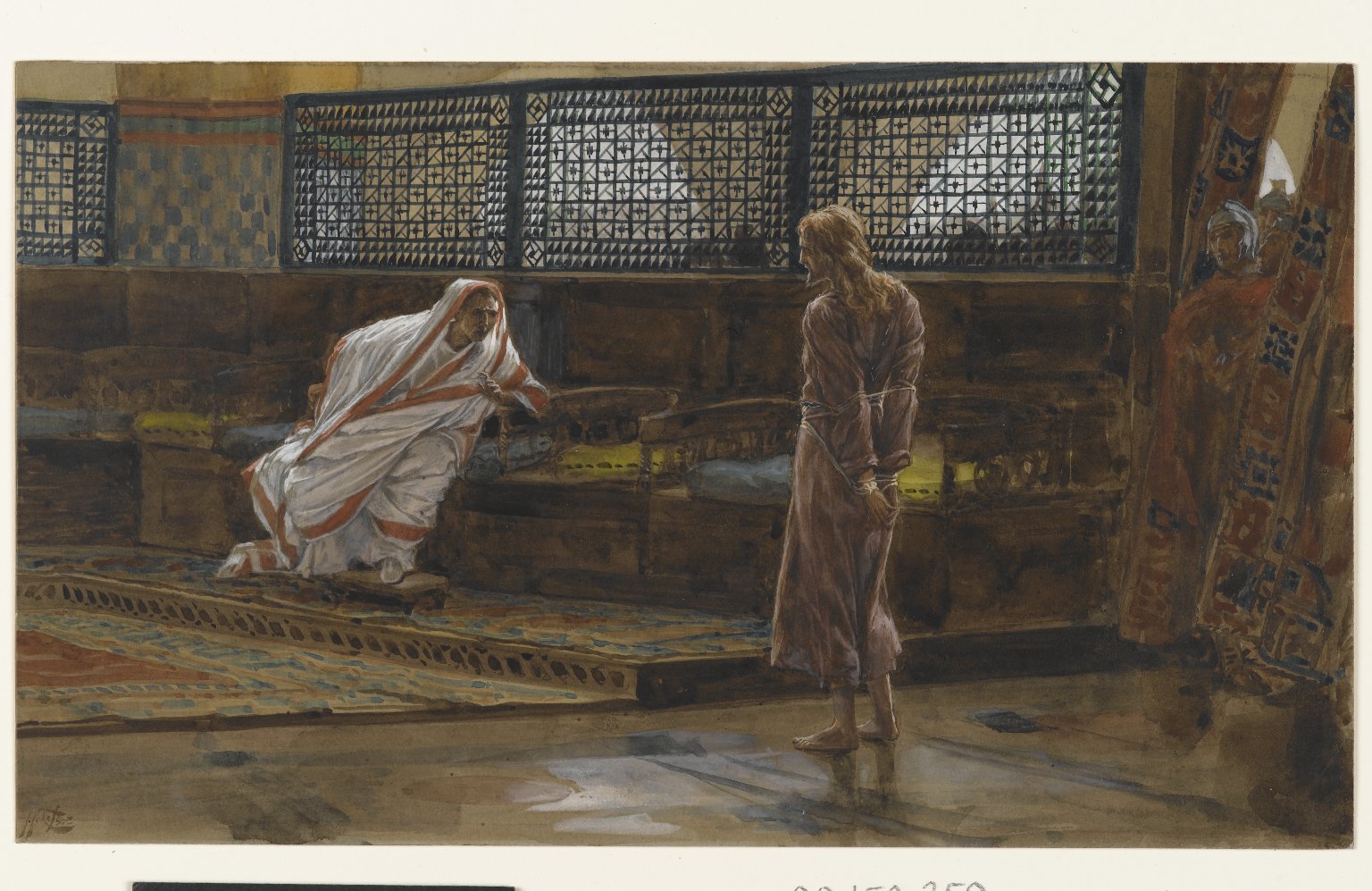
James Tissot: Jesus before Pilate (First interview) Brooklyn Museum

Trinity XXII – Living the life of Faith

To the sighted, the experience of being blind is difficult to imagine. We hear that the other senses are often stronger in those with minimal or no sight. The former Home Secretary, David Blunkett, blind from birth, was once heard to comment on the quality of a pass made during a football game. When he was asked how he knew, he replied that the sound of the kick and the reaction of the crowd meant that it must have been a good ball from a player to a teammate.

In this morning’s Gospel, Jesus and His disciples arrive at Jericho. They have walked about seventy miles from the Sea of Galilee, presumably down the Jordan River Valley, and are fast approaching Jerusalem. As the group leaves the town of Jericho they meet some beggars by the roadside. One of them is a blind man named Bartimaeus. On learning that Jesus is passing by, he cries out:

“Iesu, Fab Dafydd, trugarha wyrthyf.”

“Jesus, Son of David, have mercy on me!” (Mk 10:47)

Bartimaeus somehow recognises Jesus as the Messiah and asks Him for mercy. We do the same at the beginning of every Eucharist when we say, ‘Christe eleison, Crist trugarha, Christ have mercy’. The cries of Bartimaeus annoy the people around him, who tell him to be quiet and to stop causing a commotion. However, Bartimaeus does not listen to them. Instead he cries out all the more:

“Fab Dafydd, trugarha wrthyf.”

“Son of David, have mercy on me!” (Mk 10:48)

Bartimaeus is desperate. He longs for God’s mercy, and he longs for healing. Though he may be blind, Bartimaeus can see what many others cannot: that Jesus is the Messiah, the one who will heal and restore Israel. His faith in Jesus and his insistence pay off, as Jesus stops and asks to see him. 

Taflodd yntau ei fantell oddi arno, llamu ar ei draed a dod at Iesu. Cyfarchodd Iesu ef a dweud, “Beth yr wyt ti am i mi ei wneud iti?” Ac meddai’r dyn dall wrtho, “Rabbwni, y mae arnaf eisiau cael fy ngolwg yn ôl.”

And throwing off his cloak, he sprang up and came to Jesus. And Jesus said to him, “What do you want me to do for you?” And the blind man said to him, “Rabbi, let me recover my sight.” (Mk 10:50-51)

Bartimaeus does not want to beg for alms, he wants to see again, and he trusts Jesus to be able to help him. As he moves towards the Messiah, the blind man drops his cloak. This is his most valuable possession: the one thing that kept him warm and dry. He gives up everything for Jesus.

Dywedodd Iesu wrtho, “Dos, y mae dy ffydd wedi dy iacháu di.” A chafodd ei olwg yn ôl yn y fan, a dechreuodd ei ganlyn ef ar hyd y ffordd.

And Jesus said to him, “Go your way; your faith has made you well.” And immediately he recovered his sight and followed him on the way. (Mk 10:52)

Without even touching Bartimaeus, Jesus heals him. It is because of his trust and faith in Christ, that Bartimaeus is healed. Note that instead of rushing off, Bartimaeus follows the Saviour, and starts living the life of faith there and then. He is healed and immediately becomes a follower of Jesus. When he was blind Bartimaeus longed for the light and now he follows Jesus, the Light of the world. This healing miracle becomes a story of faith, and in that faith we too can follow Bartimaeus’ example.

The first believers in Jesus were known as followers of The Way, (Acts 9:2) and this is what Bartimaeus becomes. He follows Jesus on the way, both literally and metaphorically. He trusts Jesus, he has faith in Him, and he follows Him. In Mark’s Gospel the story of Bartimaeus acts as a bridge between the teaching and miracles of Jesus’ ministry in Galilee and His time in Jerusalem leading up to His death. Christ will enter Jerusalem on a donkey, as the Messiah, and will teach the people of Jerusalem how to follow God, fulfilling the hope and expectation of the prophets. Bartimaeus’ faith allows him to recognize the Messiah. The people of Jerusalem, on the other hand, cannot see that Jesus is the Christ, the Anointed One. They are blind to the Truth.

We too are ‘on The Way’, followers of Jesus who long for the same healing and restoration that takes Bartimaeus from being a beggar to becoming a disciple. We are called to be like Bartimaeus and to trust in Christ to be at work in our lives: transforming us, helping us to see the true way, and helping us to follow Him. Jesus, whose name means ‘God saves’ ‘Yeshua’, is in Jericho. In the Old Testament Joshua conquers Jericho. While in the New Testament, Jesus brings healing to this city. Through His Son, God is saving His people, who respond like Bartimaeus by following Him.

Today, in Mark’s Gospel, we see prophecy fulfilled. The Messiah has come to restore the faithful and to bring the healing for which each individual deeply longs. Christ offers the world healing and restoration. All we have to do is to accept His offer and follow Him, casting off the things that hold us back. We are called to follow both the lead and the example of Jesus as we make our journey through life.

So my brothers and sisters in Christ, let us follow Jesus on The Way, and live out God’s love, and mercy in our own lives. As we do so, let us give praise and honour to God the Father, God the Son, and God the Holy Spirit. To whom be ascribed all glory, dominion and power, now and forever. Amen.

Trinity I

THE novel by Robert Llewellyn —‘How green was my valley’ — reached millions through its 1941 film adaptation by John Ford. Telling the story of a family in a South Wales mining community, it criticises the unjust labour practises of the early twentieth century. Earlier in 1887 the historian Lord Acton wrote to the Professor of Ecclesiastical History at the University of Cambridge, saying that, ‘Power tends to corrupt, and absolute power corrupts absolutely.’ While this maxim now tends to be applied generally, it was originally a comment on religious institutions in general, and the medieval Papacy in particular. The truth of this statement is a reflection on our fallen human nature.

In the Gospels we often see Our Lord come into conflict with the Scribes, Priests, and Pharisees. These religious leaders are depicted as being more concerned with power and prestige than with the worship of Almighty God. If Religion is important then there will be a status attached to its ministers. They, therefore, have a responsibility to use this status for good, and to bring people closer to God.

In today’s Gospel it is the Sabbath, a day of rest. Jesus and His disciples are travelling, and the Pharisees notice that some of them have plucked ears of corn to eat. The Pharisees ask Our Lord:

‘Look, why are they doing what is not lawful on the Sabbath?’

‘Edrych, pam y maent yn gwneud peth sy’n groes i’r Gyfraith ar y Saboth?’  (Mk 2:24)

Jews are forbidden from doing any work on Sabbath, and the harvesting of grain, no matter how little, counts as work. This appears to be a clear-cut case, but Jesus replies as follows:

‘Have you never read what David did, when he was in need and was hungry, he and those who were with him: how he entered the house of God, in the time of Abiathar the high priest, and ate the bread of the Presence, which it is not lawful for any but the priests to eat, and also gave it to those who were with him?’

‘Onid ydych chwi erioed wedi darllen beth a wnaeth Dafydd, pan oedd mewn angen, ac eisiau bwyd arno ef a’r rhai oedd gydag ef? Sut yr aeth i mewn i dŷ Dduw, yn amser Abiathar yr archoffeiriad, a bwyta’r torthau cysegredig nad yw’n gyfreithlon i neb eu bwyta ond yr offeiriaid; ac fe’u rhoddodd hefyd i’r rhai oedd gydag ef?’ (Mk 2:25-26)

This story is recounted in 1Samuel 21:1-7. By referring to it Our Lord is making the point that if David’s actions were acceptable, then why is such a fuss being made about the disciples plucking a few ears of corn. Jesus underlines this by pointing out that:

‘The Sabbath was made for man, not man for the Sabbath’

‘Y Saboth a wnaethpwyd er mwyn dyn, ac nid dyn er mwyn y Saboth’ (Mk 2:27)

The legalism of the Pharisees has led them to forget what the Sabbath is really about: rest. The point of having a Sabbath is to ensure that people have a day of rest. Instead this day has become bound up with rules and observances which neither honour God, nor encourage humanity to rest. 

Jesus and His disciples arrive at a synagogue where there is a man with a withered hand. Clearly this is another opportunity for the legalism of the Pharisees to come to the fore.

‘And they watched Jesus, to see whether he would heal him on the Sabbath, so that they might accuse him.’

‘Ac yr oeddent â’u llygaid arno i weld a fyddai’n iacháu’r dyn ar y Saboth, er mwyn cael cyhuddiad i’w ddwyn yn ei erbyn.’ (Mk 3:2)

Rather than rejoicing that God has performed a miracle, and that a man with a disability has been healed, all the Pharisees can see is an opportunity to complain about rule-breaking, and to bring an accusation against Jesus. Our Lord calls the man to Him, and says to the Pharisees:

‘Is it lawful on the Sabbath to do good or to do harm, to save life or to kill?’

‘A yw’n gyfreithlon gwneud da ar y Saboth, ynteu gwneud drwg, achub bywyd, ynteu lladd?’ (Mk3:4)

They give no reply because they know that in order to save a life one may break every rule regarding the observance of the Sabbath. Jesus’ knowledge and interpretation of Jewish Scripture and Law is superior to theirs. Our Lord then asks the man to stretch out his hand, and he is miraculously healed. No law has been broken. Instead someone who was suffering, and who was probably shunned and made an outcast in society, has been cured and brought back into the fold of the community. God’s power to heal and restore humanity has been displayed. The Kingdom of God has been announced in deed.  

The response of the religious authorities is telling. Do they rejoice at this miracle? The answer is definitely no.

‘The Pharisees went out and immediately held counsel with the Herodians against him, how to destroy him.’

‘Ac fe aeth y Phariseaid allan ar eu hunion a chynllwyn â’r Herodianiaid yn ei erbyn, sut i’w ladd.’ (Mk 3:6)

The Pharisees have formed an alliance with a priestly party, keen on political independence. Both sides share a common aim — to get rid of Jesus. This is because He represents a threat to their power. Our Lord’s words and actions are understood by the Pharisees as an assault on their privileged position, with their innate goodness being ignored. From the start of His public ministry, Christ faces opposition from people who want Him dead. They think that they can destroy Jesus, and that will be the end of the matter, whereas it will only be the beginning. Our Lord will die on a Cross, but will be raised to new life at Easter. Calvary and the Empty Tomb are the salvation of humanity, part of God’s plan.

As Christians we gather on the Lord’s Day, the first day of the week, to celebrate Christ’s Death and Resurrection. By means of the Eucharist, we do that which Jesus commanded us to do until He comes again. For one hundred thousand successive Sundays the faithful have gathered to share in Holy Communion, because it matters, it is important. We are fed with the Bread of Angels, with the Body and Blood of Christ, so that we may be healed and given a foretaste of Heaven.

So, my brothers and sisters, let us rejoice in the healing salvation of Christ. Let us proclaim the Good News, so that all people may come to know, and love, God the Father, God the Son, and God the Holy Spirit. To whom be ascribed all glory, dominion, and power, now and forever. Amen.

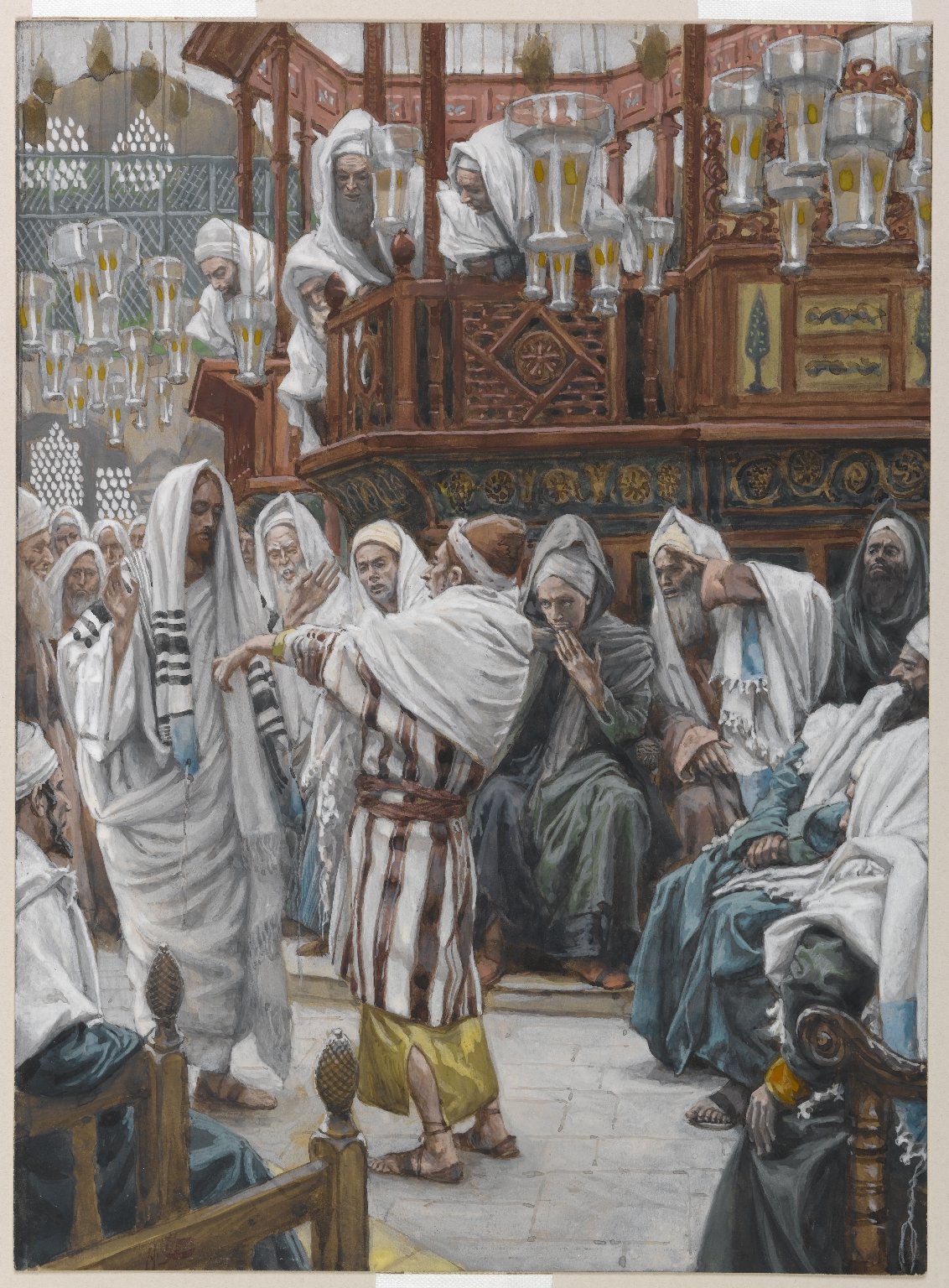
James Tissot – The Man with a withered hand (Brooklyn Museum)
Tissot: The Disciples Eat Wheat on the Sabbath (Brooklyn Museum)

The Second Sunday of Easter

This morning we welcome baby Alice into the Christian community. This is an important day for her, as well as her family, and for all of us present here today.

At the beginning of His ministry, Jesus was baptised by John in the River Jordan. Today I will use the blessed water in the font and holy oil. The font is placed near the door of the church because baptism is the way that we enter the Church and become a member of the Christian community.

Today’s reading from the First Letter of John speaks of loving the children of God (plant Duw) and of keeping God’s commandments. M____ and C_____ are following God’s commandments by bringing their daughter Alice to be baptised, and we are all here to support them in their actions.

The Gospel for today records the risen Jesus appearing to the disciples. Peter and John have already witnessed the empty tomb, Mary Magdalen has even talked with the Risen Christ. However, the disciples are afraid. Their Teacher has gone from being hailed as the Messiah and King, to being crucified. Christ’s followers are all scared for their lives, lest a mob come and attack them. Some of their number are saying that the tomb is empty, and that Jesus has risen. Then, suddenly, the risen Lord is there among them saying: 

“Peace be with you!” 

‘Tangnefedd i chwi!’ (John 20: 19)

In a situation of heightened emotion, Our Lord’s gift is peace. God’s peace is not just the absence of noise or violence (heddwch) but something richer and deeper. This is the ‘Peace which passeth all understanding’ ‘Tangnefedd sydd uchlaw pob deall’, something given to us by God to transform our lives. Next, Jesus breathes on His disciples giving them the Holy Spirit and the power to forgive sins. Christ’s followers are equipped for the work of proclamation and reconciliation. This is what Jesus came to do, and He commits the Church to continue His mission and His saving work. To help His followers, Christ gives them (and us) the Holy Spirit, God’s free gift to His people, a sign of His generous love.

When Jesus appears to the disciples, one of them is absent. Thomas is not there — maybe he has been to get them all some food. When Thomas returns and hears what has happened, he feels somewhat left out. He is unsure and wants to have physical proof of Jesus’ Resurrection before he is able to fully believe:

“Unless I see in his hands the mark of the nails, and place my finger into the mark of the nails, and place my hand into his side, I will never believe.”

“Os na welaf ôl yr hoelion yn ei ddwylo, a rhoi fy mys yn ôl yr hoelion, a’m llaw yn ei ystlys, ni chredaf fi byth.” (John 20: 6-7)

These are the words of someone who longs to experience the reality of the Resurrection. Like the other disciples, Thomas has been on something of an emotional rollercoaster. It is understandable that he wants to be certain, to experience with his own eyes and hands that Jesus is alive.

A week later, Jesus comes to the disciples again, and says to them: 

“Peace be with you.” Then he said to Thomas, “Put your finger here, and see my hands; and put out your hand, and place it in my side. Do not disbelieve, but believe.”

“Tangnefedd i chwi!” Yna meddai wrth Thomas, “Estyn dy fys yma. Edrych ar fy nwylo. Estyn dy law a’i rhoi yn fy ystlys. A phaid â bod yn anghredadun, bydd yn gredadun.” (Jn 20:26-27)

Jesus gives Thomas what he wants: the opportunity to experience the reality of the Resurrection and to touch the wounds of love and mercy. This leads Thomas to reply to Jesus:

“My Lord and my God!”

“Fy Arglwydd a’m Duw!” (Jn 20:28)

Thomas no longer doubts. Instead he confesses that Jesus is God, and the Lord of his life. This is a profound and concise statement of faith, declaring both who Jesus is, and what He has done. Thomas has journeyed from doubt and despair to true faith. Doubt is the starting point, but it is not the end of the journey. St Thomas should not be known as ‘Doubting Thomas’, but rather as ‘Believing Thomas’, as this is what he becomes. Thomas’ belief changes his life, and leads him to take the Gospel to be proclaimed far and wide. He travels as far as India, founding Christian communities which have endured for two thousand years. Such faith is our inheritance, and in it we are blessed, as those who have not seen, but yet believe. We too are called to be like Thomas, and to share the Good News of Christ’s Resurrection with the world. 

At its heart today’s Gospel should be understood as something to encourage us in our life of faith:

‘but these [things] are written so that you may believe that Jesus is the Christ, the Son of God, and that by believing you may have life in his name.’

‘Ond y mae’r rhain wedi eu cofnodi er mwyn i chwi gredu mai Iesu yw’r Meseia, Mab Duw, ac er mwyn i chwi trwy gredu gael bywyd yn ei enw ef.’ (Jn 20:31)

Belief in Jesus leads to New Life. This underlines the Christian understanding of baptism. Through baptism we share in Jesus’ Death and Resurrection, and are given new life. This new life is eternal life with Christ, and in Christ.

At the Easter Vigil, last week, we renewed our baptismal promises to remind ourselves of what Our Lord has done for us. What Jesus has done for you, and for me, and for every Christian over the past two thousand years. In our Baptism we are united with Christ and made brothers and sisters. We become part of a new family which we call the Church. This new family is called to live in a new way. This is made clear in the first reading from the Acts of the Apostles. Here we see people of faith being loving and generous, caring for each other. We pray that we may be inspired by their example, and live out the faith of our baptism throughout our lives. 

Next to the font is our wonderful Easter Garden, which includes the Empty Tomb, the site of Jesus Resurrection.It is important to take our time over our celebration of Easter. We need time to allow the reality of what we commemorate to sink in. Something this wonderful, this world-changing, needs to be pondered, and shared. We gather today to do what the disciples did, and are filled with joy at Our Lord’s Resurrection from the dead. Through Christ’s Resurrection we are changed, transformed, and filled with God’s love. In the same way Alice will shortly be changed, transformed and filled with God’s love. Easter is a traditional time for baptism, and as a Christian community we welcome Alice and pray for her, and for her family. Today, and every day, we give thanks and praise to God the Father, God the Son, and God the Holy Spirit. To whom be ascribed all, glory, dominion, and power, now and forever. Amen.
Tissot: L’Incredulité de Saint Thomas, (Brooklyn Museum)

Good Friday 2024

The Practice of Crucifixion as a punishment was designed to be both as painful and as shameful as possible. Public torture was dressed up as execution, with the condemned having to struggle for each breath, before finally succumbing to asphyxiation. People could potentially hang there for days until exhaustion took its toll. It is possibly the most horrific and gruesome means to end a human life devised by humanity. A public crucifixion is also one of the central moments of the Christian Faith. This is how much God loves us. Jesus willingly undergoes a shameful death, and acts of brutal torture, for our sake. 

There are two Old Testament texts which are key to understanding this Good Friday Service. The first is Psalm 22, whose opening words are spoken by Jesus before He dies: ‘Fy Nuw, fy Nuw pam yr wyt wedi fy ngadael’ ‘My God, My God, why hast thou forsaken me’ (in Hebrew Eli, Eli, lama sabachthani). The second is the passage from Isaiah Chapters 52 and 53 which was today’s first reading. In Isaiah we see all of Christ’s suffering and death both foretold, and interpreted:

‘he bore the sin of many’ ‘with his stripes we are healed’ ‘He was oppressed, and he was afflicted, yet he opened not his mouth; like a lamb that is lead to the slaughter, and like a sheep that before its shearers is dumb, so he opened not his mouth.’ ‘he makes himself an offering for sin’. (Isa 53:12, 5, 7, 10)

The meaning is clear. The wounds of human sin, which cry out for healing, are healed in Christ. Such is God’s love for us. What disobedience has destroyed, love restores. Here we see the glory of God. In willingly accepting His death on the Cross, Our Lord fulfils Isaiah’s prophecy — the suffering servant is the Messiah, the Christ, God’s anointed. At the time when the Passover lambs are slaughtered in the Temple, Christ, as both priest and victim, offers himself upon the Altar of the Cross as the true lamb to take away the sins of the whole world. When Jesus dies the veil of the Temple is torn in two — the barrier between heaven and earth is taken away, and God is reconciled to humanity. This sacred drama takes place on a hill outside Jerusalem, close to where Abraham attempted to sacrifice Isaac.  Then a ram was sacrificed in the boy’s place, but now God sends His Son to die for us.

Two people are present at Calvary as witnesses. These are Mary, Jesus’ Mother, and John, the Beloved disciple. Thirty-three years before this day, the Archangel Gabriel announced to Mary that she would bear the Son of God. Now she stands at the foot of the Cross to see her beloved Son suffer and die. Simeon had once told her that a sword would pierce her soul, and now that prophecy comes true. But before He dies, Jesus does something wonderful:

‘When Jesus saw his mother and the disciple whom he loved standing nearby, he said to his mother, “Woman, behold, your son!” Then he said to the disciple, “Behold, your mother!” And from that hour the disciple took her to his own home.’ 

‘Pan welodd Iesu ei fam, felly, a’r disgybl yr oedd yn ei garu yn sefyll yn ei hymyl, meddai wrth ei fam, “Wraig, dyma dy fab di.” Yna dywedodd wrth y disgybl, “Dyma dy fam di.” Ac o’r awr honno, cymerodd y disgybl hi i mewn i’w gartref.’ (Jn 19:26-27)

Here we see a new family being formed. One not based on ties of blood, but of love. This is what the Church is, a family of love, and it starts here, at the foot of the Cross, where Christ, our great High Priest, offers Himself as both priest and victim. The Christian Church begins with three people on a hill outside Jerusalem. One of these three is about to die, condemned as a blasphemer and trouble-maker. Despite this less-than auspicious beginning we are gathered here today, nearly twenty centuries later. Christ’s Church starts as a failure in worldly terms. However it is a divine institution: it isn’t supposed to make sense in human terms. The Church’s mission is to draw us into the mystery of God’s love. Today we see that love made real in Jesus. This is love we can touch and taste, on the Cross, and in the Sacrament of the Altar. 

Let every one of us, today and every day, cling to the Cross, and find there all the grace we need. Let us rejoice that we have been redeemed at so great a cost. Let us glory in the Cross of our Lord Jesus Christ. He is our salvation, our life, and our resurrection, through whom each and every one of us is saved and set free. Amen

Diego Velazquez – Christ Crucified (Museo del Prado, Madrid)

Palm Sunday 2024

IN THIS COUNTRY when we want to celebrate something there is often some kind of procession. Sports teams who win trophies go on an open-topped bus. After King Charles’ Coronation, there was a great procession from Westminster Abbey back to Buckingham Palace. Today, we see the entry of the Messiah into Jerusalem. The Davidic King has made His triumphal entry, something which we have reenacted ourselves this morning, waving palms and singing, ‘Hosanna to the Son of David!’. The prophet Zechariah, writing 500 years before Jesus, looks forward to a messianic future:

Rejoice greatly, O daughter of Zion! Shout aloud, O daughter of Jerusalem! Behold, your king is coming to you; righteous and having salvation is he, humble and mounted on a donkey, on a colt, the foal of a donkey.

‘Bydd lawen iawn, ti ferch Seion; a chrechwena, ha ferch Jerwsalem: wele dy frenin yn dyfod atat: cyfiawn ac achubydd yw efe; y mae efe yn llariaidd, ac yn marchogaeth ar asyn, ac ar ebol llwdn asen.’ (Zech 9:9)

The donkey ridden by Jesus reminds us of the humble beast of burden, which carried his Mother to Bethlehem for His birth, and then carried the Holy Family into exile in Egypt. This is an act of humble leadership which realizes what the prophets foresaw. It shows us that Jesus Christ is truly the one who fulfils the hopes of Israel. The Hebrew Scriptures look forward to the deliverance of Israel. This deliverance is enacted in front of the eyes of those watching the Carpenter’s son enter the Holy City.

Scripture is fulfilled and there is a burst of popular enthusiasm, people wave palm branches and cry out. However, having someone claim to be a relative of King David is a direct challenge to Herod, the puppet ruler installed to comply with the Romans. The events we heard described, before our procession this morning, look something like a political coup — a bid to replace a leader lacking legitimacy. Such an attempt is bound to have political repercussions. It represents a direct challenge to the ruling house and to Rome, and therefore it has to be countered. The masses in Jerusalem are expecting a king of the Davidic line. One who would be seen as a challenge to the ruling élite, the status quo. But in Christ, God gives Israel something else. Yes, he is a King of the line of David. But Jesus is one who rules with love, and who has no desire for power, or honour. Naturally, the leaders and those in authority are threatened by Him: Jesus turns their world on its head. He is an awkward inconvenience. Jesus, however, does not want their power. He has come to be and accomplish something completely different. What is seen as a potential political coup is in fact a renewal of religion, the fulfilment of prophecy, and a new hope for Israel. Political and religious leaders can only see the threat, rather than the opportunity which Christ offers.

At its heart Christianity is an offer of new life in Jesus Christ. This starts with repentance, and acceptance of our need for God. As we grow in faith, we come to believe and trust in a God who loves us, and gives Himself for us. Then we can experience healing, wholeness, and fullness of life in and through Him. Such gifts come at a cost, which the week ahead will make clear to us in the most stark and direct way. 

Over the next few days we will see the joy and celebration of today turned into anger and resentment. Crowds which cried ‘Hosanna’ will soon shout ‘Crucify him!’. This should come as no surprise to us. We know how people can be fickle and manipulated. And yet, on the same night He will be betrayed, Jesus takes bread and wine, blesses them and says, ‘This is my Body … This is my Blood’. ‘hwn yw fy nghorff … hwn yw fy ngwaed’ These words are repeated when the Eucharist is celebrated because Our Lord told us to ‘Do this’ ‘gwnewch hyn’ and so we do. We come together so that God can feed us with His very self, so that we can have life in Him. This is not an optional extra, it is fundamental to who and what we are as Christians. In the Eucharist we experience God’s love, His body broken for us, His blood poured out, to heal us. This is the banquet of the Kingdom, the Wedding Feast of the Lamb, and we are all invited!

Today, and in the coming week, we see what God’s Love and God’s Glory are really like. They are not what people expect. God’s power is shown in humility, strength in weakness. As we continue our Lenten journey in the triumph of this day, we look towards the Holy and Life-giving Cross and beyond to the new life of Easter. Let us trust in the Lord, and go with Him to Calvary, and beyond. Let us raise our palms and sing the praises of God the Father, God the Son, and God the Holy Spirit. To whom be ascribed all glory, dominion, and power, now and forever. Amen.
Lent V: Sir, we want to see Jesus!

THERE are some texts in the Bible which just stick in your head. The Gospel today contains one of them: ‘Sir, we wish to see Jesus’ ‘Syr, fe hoffem weld Iesu’ (Jn 12:21). It is a text often placed on pulpits to remind preachers of their primary task. This sounds simple enough, but, at one level, when I hear these words they remind me of my own shortcomings. Have other people seen Jesus in what I say and do? We are our own harshest critics in this regard — it is far easier to see our own faults and failings, than what God might be doing through us. 

In today’s Gospel we are in Jerusalem. It is just before the Passover, the most important religious festival, commemorating the journey from slavery in Egypt to the Promised Land. There are some Greeks, who may or may not be Jewish converts, that approach Philip, who has a Greek name. He, along with Simon Peter and Andrew, was first a disciple of John the Baptist, before following Jesus. These Greeks ask Philip a simple question:

Sir, we wish to see Jesus.”

Syr, fe hoffem weld Iesu’ (Jn 12:21)

These Greeks are well-disposed and interested, and they desire an encounter with Our Lord. At a fundamental level human beings long for communion with the Divine. It is what we are made for. So the disciples tell Jesus, who makes the following reply:

The hour has come for the Son of Man to be glorified. Truly, truly, I say to you, unless a grain of wheat falls into the earth and dies, it remains alone; but if it dies, it bears much fruit. Whoever loves his life loses it, and whoever hates his life in this world will keep it for eternal life. If anyone serves me, he must follow me; and where I am, there will my servant be also. If anyone serves me, the Father will honour him.

‘Daeth yr awr y gogonedder Mab y dyn. Yn wir, yn wir, meddaf i chwi, Oni syrth y gronyn gwenith i’r ddaear, a marw, hwnnw a erys yn unig: eithr os bydd efe marw, efe a ddwg ffrwyth lawer. Yr hwn sydd yn caru ei einioes, a’i cyll hi; a’r hwn sydd yn casáu ei einioes yn y byd hwn, a’i ceidw hi i fywyd tragwyddol. Os gwasanaetha neb fi, dilyned fi: a lle yr wyf fi, yno y bydd fy ngweinidog hefyd: ac os gwasanaetha neb fi, y Tad a’i hanrhydedda ef’ (Jn 12:23-26)

This is a strange response: Our Lord doesn’t say, ‘Of course, bring them here’, or ‘I’d be delighted to meet them’. Instead He starts talking about His forthcoming Death. Jesus does so by using an image from the Parable of the Sower to make the point that life comes through death, freedom through service. These are paradoxes, the exact opposite of what one might expect Him to say, and yet they are true. Christ then experiences something of a moment of doubt, at which point God the Fathers speaks of future glory, and then Our Lord goes back to talking about His death:

“Now is the judgement of this world; now will the ruler of this world be cast out. And I, when I am lifted up from the earth, will draw all people to myself.”

‘Yn awr y mae barn y byd hwn: yn awr y bwrir allan dywysog y byd hwn. A minnau, os dyrchefir fi oddi ar y ddaear, a dynnaf bawb ataf fy hun.’ (Jn 12:31-32)

Because of Jesus’ Death and Resurrection, the Church, Christ’s Body exists to save people and to offer eternal life through Him. God shows the world the fullness of glory, the most profound expression of self-giving love in the events of His Passion. This is why we celebrate it: week by week and year by year. We prepare ourselves during Lent to walk with Christ to Calvary and beyond. We see how much God loves us, how much God gives himself for us. This message of salvation comes to us from the prophets. God makes His intentions clear:

“Behold, the days are coming, declares the Lord, when I will make a new covenant with the house of Israel and the house of Judah,”

‘Wele y dyddiau yn dyfod, medd yr Arglwydd, y gwnaf gyfamod newydd â thŷ Israel, ac â thŷ Jwda’ (Jer 31:31)

God renews the covenant with humanity, writing it on our hearts, forgiving us our iniquities. The Law of Love, which God makes real in Jesus Christ has genuine transformative power, because it is rooted in forgiveness and healing, something which only God can provide. Our loving Father does this on the Cross, where He gives His Son to die for us, to heal our wounds, and to offer eternal salvation to all who believe in Him. This is God’s glory, the glorification of His Son, dying the death of a slave, to save humanity and free us. If we want to share in Christ’s glory, then we need to follow the same path of suffering love which takes Him to His Cross, and will take us to ours.

To follow Christ means embracing the Cross as the mystery of God’s love. If we let God’s love transform us, then wonderful things can happen. There will be pain and suffering along the way, but this is far outweighed by the promise of future glory. So then, as we continue our journey through Lent our journey to the Cross and beyond to the empty tomb of Easter, let us lose our lives in love and service of him who died for us, who bore our sins, who shows us how to live most fully, to be close to God, and filled with his love. Let us encourage one another, strengthen one another, and help each other to live lives which proclaim the truth of God’s saving love. To offer the world the hope of Heaven, where we may sing the praises of God the Father, God the Son, and God the Holy Spirit. To whom be ascribed all glory, dominion, and power, now and forever. Amen.
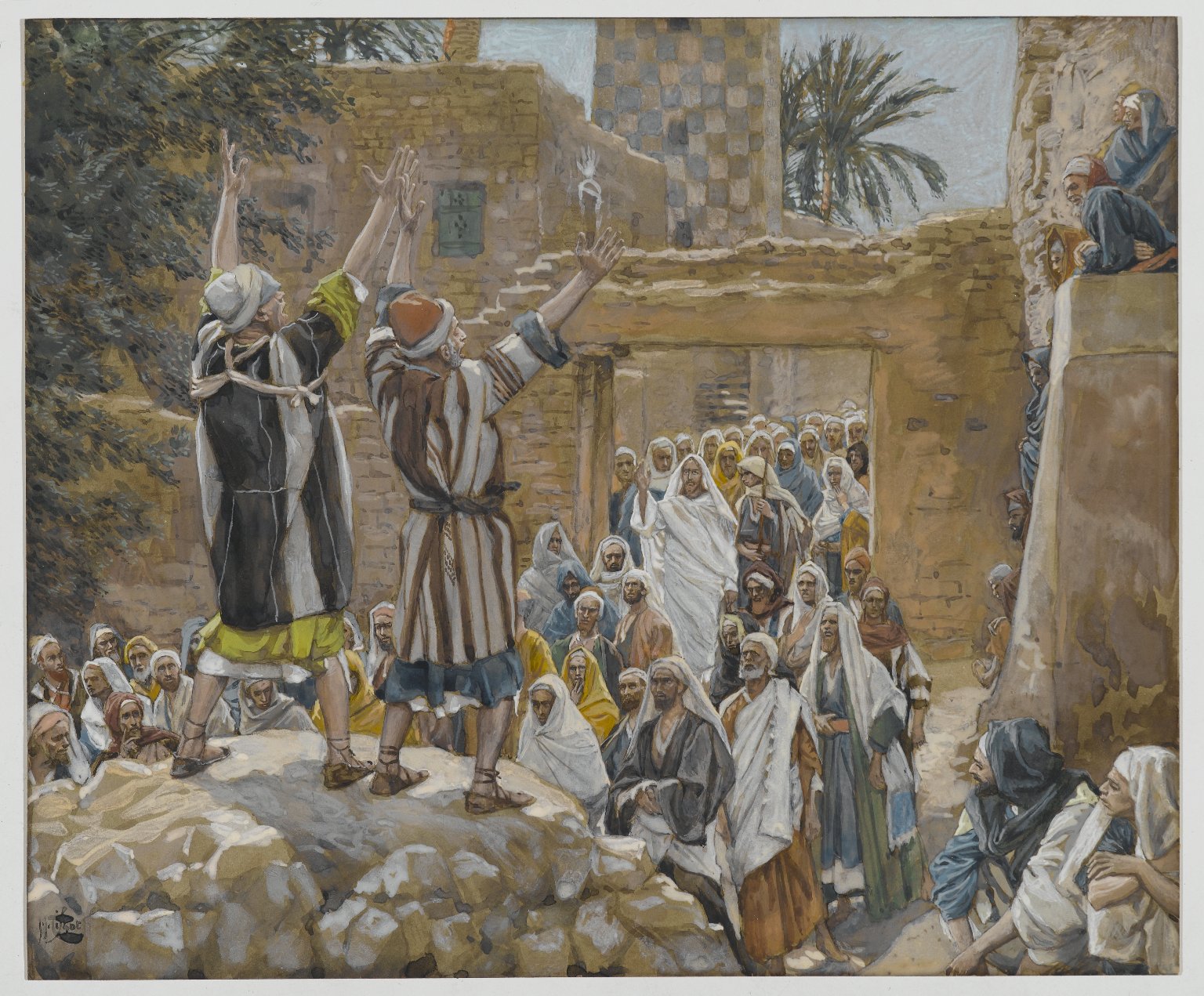
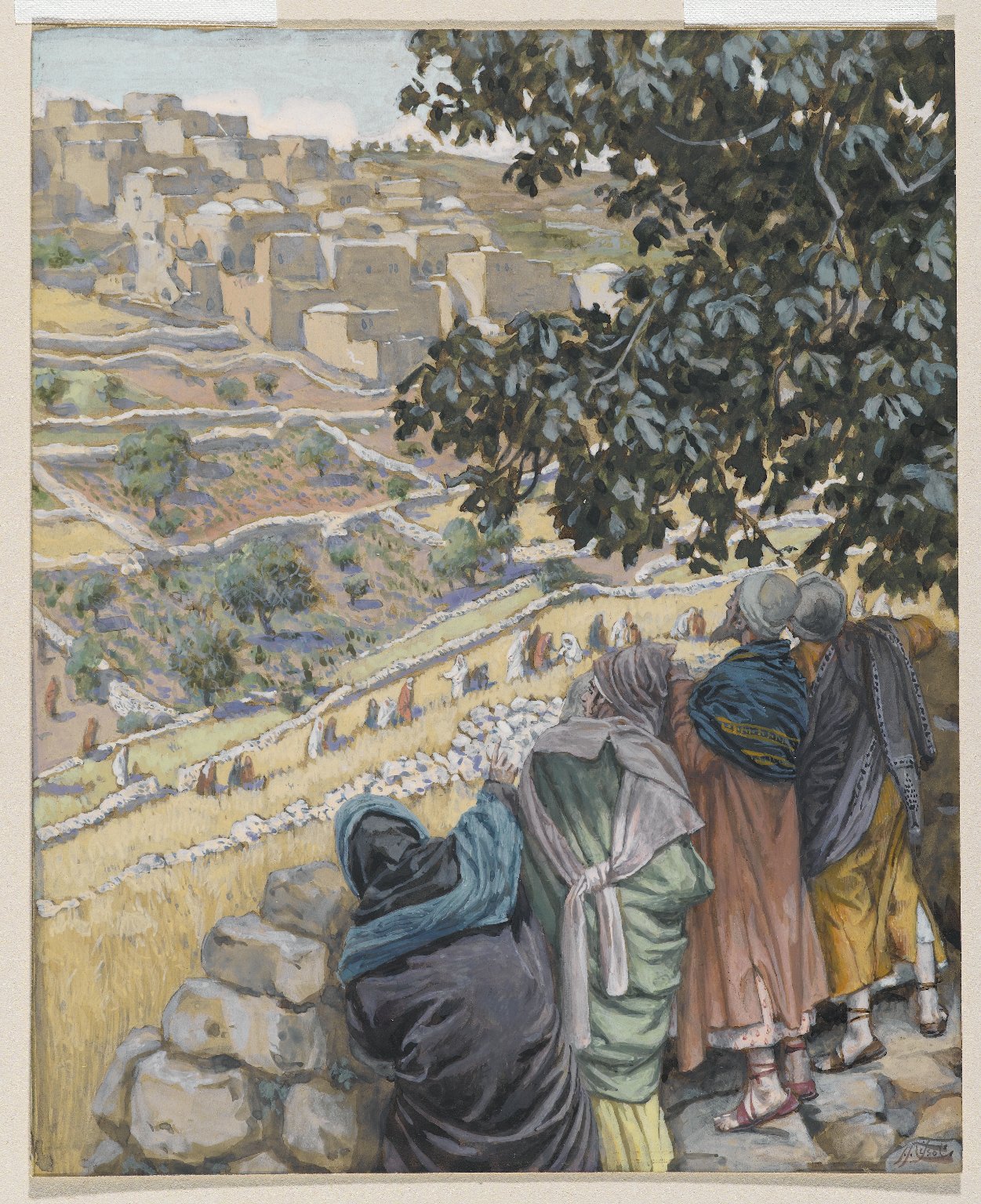
James Tissot : The Gentiles Ask to See Jesus  (Brooklyn Museum)