Homily for Trinity XXIII: Be Ready!

Watch therefore, for you know neither the day nor the hour

Byddwch wyliadrus gan hynny, oherwydd ni wyddoch na’r dydd na’r awr. (Mt 25:13)

I would like us this morning to consider two questions: What is Wisdom? What does it mean to be wise? There is a tradition of writing about Wisdom which can be found in the Bible, and across the Ancient Near East. Wisdom Literature seeks to explore the perennial questions of who God is and how humanity should live. The term ‘wisdom’ means much more than knowledge. It refers to how knowledge is used with judgement, something which comes with maturity and experience, and leads to our flourishing. In our first reading this morning we see Wisdom personified as a beautiful woman. If we love Wisdom, then we will recognise her easily. It stands to reason that Wisdom is an attractive quality.

To fix one’s thought on her is perfect understanding, and one who is vigilant on her account will soon be free from care, because she goes about seeking those worthy of her, and she graciously appears to them in their paths, and meets them in every thought. (Wisdom 6:15-16)

To be wise is to be freed from care or anxiety. Nothing in life or death can trouble the wise because they have fixed their thoughts on Wisdom. Such wisdom comes from God; it is divine, and not human. In fixing our minds on Wisdom, we fix them upon God, the source of all wisdom, or as a prayer in the Prayerbook puts it:

Almighty God, the fountain of all wisdom, which knowest our necessities before we ask, and our ignorance in asking: We beseech thee to have compassion on our infirmities; and those things which for our unworthiness we dare not, and for our blindness we cannot ask, vouchsafe to give us for the worthiness of thy Son Jesus Christ our Lord. Amen

Today’s second reading, from Paul’s First Letter to the Thessalonians, deals directly with questions of death and resurrection. Clearly some people have died, and there are members of the church community who are worried by this, so Paul is trying to allay their fears. He encourages them:

‘that you may not grieve as others do who have no hope. For since we believe that Jesus died and rose again, even so, through Jesus, God will bring with him those who have fallen asleep’. (1Thess 4:13-14)

This is our hope as Christians. Because Jesus died and rose again, and we share in His Resurrection, we know that our earthly life is not all that there is. We know that something greater awaits us. We can have hope, because that is what God gives each and every one of us. Our ultimate aim is to be with God forever. Through what Christ has done we have this hope. Today, on this Remembrance Sunday , we remember and give thanks for those who have gone before us and we encourage each other as a community.

In this morning’s Gospel Jesus continues His teaching about the Kingdom. Normally He says that, ‘The Kingdom of Heaven IS like…’ however, in this passage He says, ‘the Kingdom of Heaven will be like…’ Jesus is teaching about the future, a future reality which will come to be, rather than something which is already the case. This future reality is His return. Christians believe that Jesus will come again to judge the world.

The parable pictures this as the return of the bridegroom. The problem is that half of the young women were not prepared and did not have spare oil to keep their lamps lit. The bridegroom has been delayed and the virgins have become drowsy, and have fallen asleep. When the bridegroom eventually arrives half of them are not ready, and have to go to buy lamp oil. They therefore miss meeting the Bridegroom and so are shut out of the marriage feast. This may sound harsh, but Jesus tells the parable to warn us to be prepared, to be vigilant.

The point of the Parable of the Wise and Foolish Virgins, is that we will not know when Jesus will return, so we need to be ready to greet Him when He comes. This is not just to be ready in practical terms, but also in spiritual ones. How are we ready to meet Jesus? Are we living out our faith in our lives? Have we got things ‘in order’? Just as wisdom comes with age, so we can use our lives to prepare. Such preparations are wise, and a joint effort: we can prepare together. That is what the Church exists for: to help us to get ready to meet Jesus.

There are two inescapable facts in our readings this morning. The first is that our earthly lives are finite, they will come to an end. The second is that Jesus has promised that He will return. Death and Judgement may not be something that we like to think about, but they will happen, and we cannot simply live our lives as though neither will take place. Many in the world around us live this way. Is that wise? Not at all, it is the opposite of wisdom. At this time of Remembrance we, therefore, also reflect on our own mortality and the way in which we are living our lives and what we are doing for those in need.

To be prepared means to know what we are facing and to be ready for it. It is a mark of spiritual maturity that we can contemplate such things without fear. If we are prepared then we have lived out our faith, and we know that the God who will judge us is a God of love and mercy. Christ died for love of us, and to give us the hope of eternal life with Him. This is the Heavenly Marriage Feast which we look forward to as Christians.

If our lives are characterised by Faith, Hope, and Love, there is no need for fear. The world around us is scared of Death and Judgement, because it has no hope of forgiveness and eternal life. The promises of the world are empty, whereas what Jesus promises us is real, and is for everyone who turns to Him. This is Good News. In fact it is the best news possible! Our life on earth is meant to be a prelude to an eternity with God. This is what we believe and hope for as followers of Christ.

If what we believe in our hearts and how we live our lives are synchronised with each other, then we need have no fear, as the promise of sharing in Christ’s Resurrection is there for us. We do not need to be anxious, and we can get on with the business of living our lives secure in our faith. This is what it means to be a wise virgin with a lit lamp and a flask of oil, ready to meet our Lord . This is the purpose of the parable: to warn us in advance so that we can be prepared and not be surprised, so that we can be wise. We can therefore be lamps of faith in a dark world, ready to shine love, and hope on those around us.

My brothers and sisters in Christ, may our lamps of faith be filled with oil so that they may burn brightly to the honour of God the Father, God the Son, and God the Holy Spirit, Duw Dad, Duw y Mab, a Duw yr Ysbryd Glân. To whom be ascribed all glory, dominion and power, now and forever. Amen

The Second Sunday of Advent

‘May the God of hope fill you with all joy and peace in believing’ (Rom 15:13)

‘A bydded i Dduw, ffynhonnell gobaith, eich llenwi â phob llawenydd a thangnefedd wrth ichwi arfer eich ffydd’

The book of the prophet Isaiah has sometimes been called the ‘Fifth Gospel’. This is because so many of Isaiah’s prophecies look forward to the Messiah, and find their fulfilment in Jesus. We, too, are currently in a time of anticipation. Advent is when we prepare for Christ to come, both as a baby in Bethlehem, and as our Saviour and our Judge. As the son of Jesse, and the son of David, Jesus is Israel’s true king, who rules over all:

‘There shall come forth a shoot from the stump of Jesse, and a branch from his roots shall bear fruit. And the Spirit of the Lord shall rest upon him, the Spirit of wisdom and understanding, the Spirit of counsel and might, the Spirit of knowledge and the fear of the Lord. And his delight shall be in the fear of the Lord.’ (Isa 11:1-3)

Isaiah has hope in the peace the Messiah will bring. Injustice and affliction, the fruit of sin, is dealt with on the Cross, where Jesus ‘shall stand as a signal for the peoples’ (Isa 11:10). This is the great demonstration of God’s love to the world. A love which heals and reconciles humanity. 

To prepare the way for the Messiah, Israel needed prophets like Isaiah and John the Baptist both to announce His coming and to prepare people for His arrival. A prophet’s role is a difficult one because they are often required to tell people home truths. Those chosen by God to act as prophets point out the sorts of things which, if left to our own devices, we would rather ignore. John’s message is simple, plain, and direct:

‘Repent, for the kingdom of heaven is at hand’ (Mt 3:2)

To repent is to express sincere regret about one’s wrongdoing. The Greek word used —metanoia— literally means to ‘change your mind’. It is a proclamation, rather like a road sign which reads: ‘You are going the wrong way!’ Repentance is recognising this and turning around. 

For two thousand years the Church has worked to continue John’s proclamation, and to say to the world: turn around, and follow Jesus! The season of Advent is penitential because it highlights this call to conversion and says to everyone, both inside and outside the Church, that our lives are supposed to be a perpetual turning back to Our Lord. We all need to be reminded of our shortcomings, and to be encouraged to let God be at work in and through us.

John the Baptist’s blunt message struck a chord and sparked something of a revival in Israel. People took him seriously:

‘Then Jerusalem and all Judea and all the region about the Jordan were going out to him, and they were baptized by him in the River Jordan, confessing their sins.’ (Mt 3:5-6)

It is not surprising that in those times people travelled out into the desert to hear John. He was charismatic, and his message was a refreshing antidote to the Religious Establishment of his day. People came, confessed their sins, and were baptised. They were washed clean, to love and serve God. The crowds also came because, in John, the people of Israel saw prophecy fulfilled, and a new Elijah in their midst. One who points to the Messiah, and has done so ever since he leapt in his mother Elizabeth’s womb at the Visitation. Before John was even born he proclaimed that Jesus was the Christ, the Messiah, the One who would save us from our sins.

We see this Messianic kingdom, hoped for in the vision of Isaiah, in this morning’s first reading. The branch which comes forth from the stem of Jesse is the Blessed Virgin Mary. Filled with God’s Holy Spirit, she conceived and bore Our Saviour; the true King of all that is, or has been, or will be. Christ is on the side of the poor and the meek, people who are left behind, and ignored because they are not rich or powerful. This is a radical concept, one which still has some way to go before it is fully put into practice in the world around us. Isaiah’s vision of Messianic peace may appear impossible, but it signifies a world-changing harmony, which alters how things are, and how people behave. For, with and through God, another way is possible. This path is not simple, nor is it easy, but it is possible if we rely upon God to help us. As St Paul says to the Christians in Rome:

‘May the God of endurance and encouragement grant you to live in such harmony with one another, in accord with Christ Jesus, that together you may with one voice glorify the God and Father of our Lord Jesus Christ. Therefore welcome one another as Christ has welcomed you, for the glory of God.’ (Romans 15:5-7),

and a little later in the same passage:

‘May the God of hope fill you with all joy and peace in believing, so that by the power of the Holy Spirit you may abound in hope’ (Romans 15:13).

Hope can feel in pretty short supply when we look at the world around us, and if we just look to humanity then we will be disappointed. Our hope comes from God. Our hope is God. God is with us. It is His Birth that we are preparing to celebrate at Christmas. In Advent we prepare for Christ to come as our Saviour and our Judge: 

‘His winnowing fork is in his hand, and he will clear his threshing floor and gather his wheat into the barn, but the chaff he will burn with unquenchable fire.’ (Mt 3:12) 

Judgement is real, and it should make us stop and think for a moment. Are we living the way God wants us to? If we are not then we need to repent, we need to say sorry, and we need to live the way that God wants us to live. This is how we flourish as Christians. John the Baptist calls us to make a spiritual u-turn, to turn our life around, and to turn away from our sins, which separate us from God. John calls us to the waters of baptism, so that we can be healed and restored by God, filled with his grace, and prepared to receive the Holy Spirit:

“I baptize you with water for repentance, but he who is coming after me is mightier than I, whose sandals I am not worthy to carry. He will baptize you with the Holy Spirit and fire” (Mt 3:11).

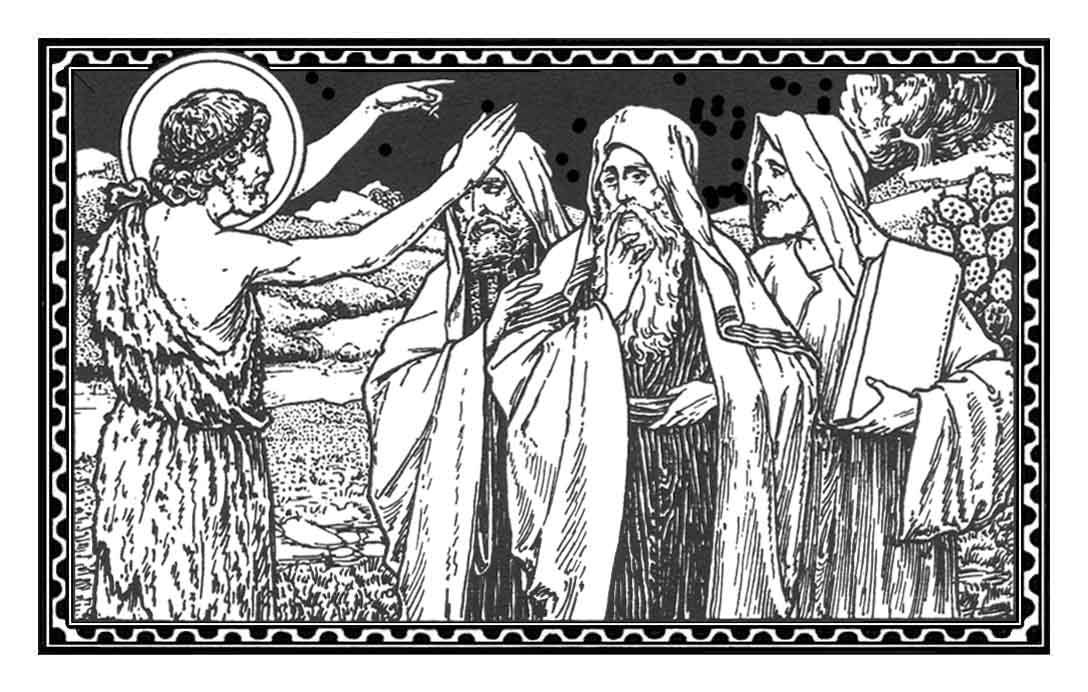
The problem with the Pharisees and Sadducees who come to John is that they do not show any repentance. They haven’t made the necessary u-turn, and they do not have the humility to recognise their own sinfulness, and their need to be washed in the waters of baptism. They, therefore, do not possess the right attitude to allow God to be at work in their lives.

As well as recognising Jesus as our Saviour, John the Baptist sees Him as Our Judge. John points to the second coming of the Lord when, as St John of the Cross puts it, ‘we will be judged by love alone’. It is love that matters. In Christ we see what love means. True, deep, love is costly, self-giving and profound. As we are filled with God’s Spirit, nourished by Word and Sacrament, we need to live out this love in our lives. This is how we prepare to meet Jesus as we prepare to celebrate His Birth and look forward to His Second Coming.

So, my brothers and sisters in Christ, let us re-commit ourselves to live out God’s love in our lives. Let us turn away from everything which separates us from God, and from each other. Let us live out deep, costly, and self-giving love in our lives. This is both what Christ and John the Baptist call us to do. By acting in this way we demonstrate to the world around us what our faith means in practice. How our beliefs affect our lives, and why others should follow Jesus, and sing the praises of God the Father, God the Son, and God the Holy Spirit, Duw Dad, Duw y Mab, a Duw yr Ysbryd Glân. To whom be ascribed all might, majesty, glory, dominion, and power, now and forever. Amen.