In the Science fiction film, ‘The Matrix’ and its sequels there is a character called ‘Trinity’, played by Carrie-Anne Moss. The name comes from her handle as a computer hacker. She, apparently, chose this moniker to give the impression that she is as mysterious and enigmatic as the concept of a Three-in-one being (God the Holy Trinity: Father, Son, and Holy Spirit). So what do Christians believe about the Trinity?
In today’s Gospel Jesus promises His disciples that,
“Ond pan ddaw ef, Ysbryd y Gwirionedd, fe’ch arwain chwi yn yr holl wirionedd. Oherwydd nid ohono’i hun y bydd yn llefaru; ond yr hyn a glyw y bydd yn ei lefaru, a’r hyn sy’n dod y bydd yn ei fynegi i chwi.”
“When the Spirit of truth comes, he will guide you into all the truth, for he will not speak on his own authority, but whatever he hears he will speak, and he will declare to you the things that are to come.” (Jn 16:13)
God gives us the Holy Spirit to guide us and lead us in our lives. We are invited into a relationship and journey of faith, which enables us to grow and develop. As Christians, we worship One God, Father, Son, and Holy Spirit. They are not three Gods, but one God. That the three persons of the Trinity are one God is itself a mystery. It is the enigma of God’s very self: a Trinity of Persons, consubstantial, co-equal, and co-eternal. ‘Consubstantial’ means ‘of one being’, i.e. they are One. ‘Co-equal’ means that the persons of the Trinity are equal to one another, none is greater or lesser than another. ‘Co-eternal’ means that they all have no beginning in time all three are eternal. We know God most fully in the person of Jesus Christ, the Incarnate Word of God, who was born of the Virgin Mary, died upon the Cross for our sins, was raised to New Life at Easter, and sent the Holy Spirit at Pentecost. In Christ, God discloses who and what He is. We know Him through His outpouring of love into our lives.
All Christians are baptised in the name of the Trinity. Our worship is Trinitarian. The service this morning began with the words ‘Yn enw’r Tad, a’r Mab, a’r Ysbryd Glân, In the name of the Father, and of the Son, and of the Holy Spirit, Amen.’ Eucharistic Services have begun by invoking the name of the Trinity, and making the sign of the Cross, for as long as we have descriptions of them, going back almost 1900 years. And 1700 years ago just before the Council of Nicaea, this morning’s first reading was one of the most controversial passages in Scripture:
“Lluniodd yr Arglwydd fi ar ddechrau ei waith, yn gyntaf o’i weithredoedd gynt.”
“The Lord possessed me at the beginning of his work, the first of his acts of old.” (Proverbs 8:22)
In the Greek text of Proverbs, used widely around the Mediterranean at that time, the verb translated as ‘possessed’ was one that meant ‘created’. This lead some people — the followers of Arius — to argue that this passage means that Jesus Christ was created and not begotten. This would therefore mean that Jesus had a beginning in time, and was not eternal. He was therefore somewhat lesser than God the Father. To discuss this theological issue Church Councils were called at Nicaea in ad325, and Constantinople in ad381. These meetings of bishops rejected the Arian ideas and gave us the doctrinal statement known as the Nicene Creed, which we will say together in a few minutes time. Our faith, as Christians, is rooted in our belief in God: Father, Son, and Holy Spirit, consubstantial, co-equal, and co-eternal. This is why the Creed is made up of three sections. It begins by stating what we believe about God the Father. The text then moves on to what we believe about Jesus the Son. The statement of faith then finishes with the Christian beliefs concerning the Holy Spirit. What we believe and how we worship God matters.
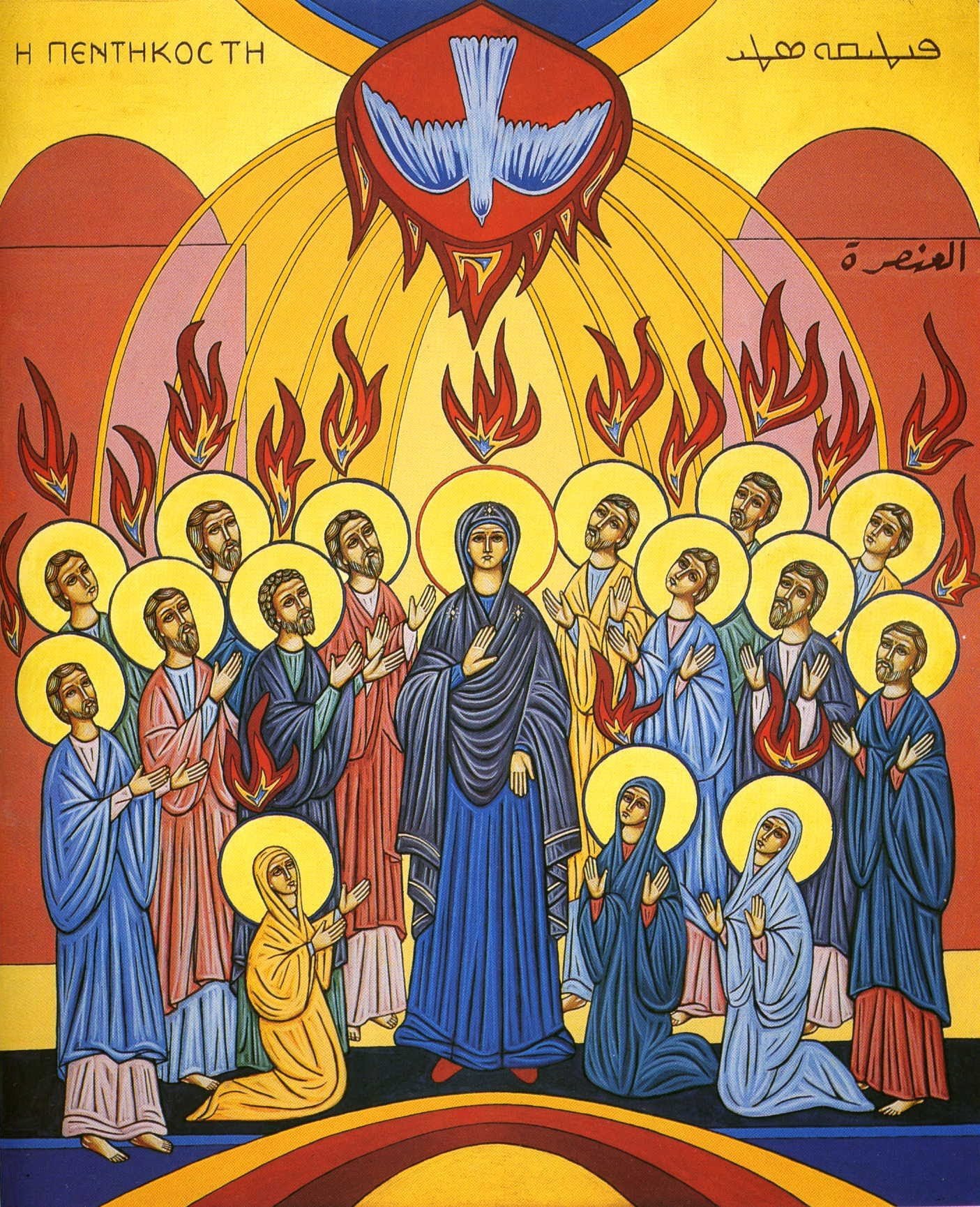
Last Sunday we celebrated Whitsun, Y Sulgwyn, the Feast of Pentecost: the Descent of the Holy Spirit upon the disciples in the Upper Room, fifty days after Easter, and ten days after Jesus’ Ascension into Heaven. With the coming of the Holy Spirit, we see the fullness of who God is. As St Paul puts it in his Letter to the Romans:
“oherwydd y mae cariad Duw wedi ei dywallt yn ein calonnau trwy’r Ysbryd Glân y mae ef wedi ei roi i ni.”
“God’s love has been poured into our hearts through the Holy Spirit who has been given to us.” (Romans 5:5)
As Christians, we are given the gift of the Holy Spirit — a spirit of love and joy. This allows us to experience God as He is: the Father who created all that exists; the Son who redeemed humanity; and the Spirit who sanctifies and encourages God’s people. God calls us into a relationship and we respond with worship which honours our Creator and Sustainer. We do this not because God requires our worship, but because of our own need to acknowledge our dependance upon Him. God loves us, and because we know that we are loved, we respond with love and praise.
The wonderful thing about the outpouring of the Holy Spirit at Pentecost is that it enables us to encounter and experience God in a deeper way. We can know Jesus Christ, the Word made flesh. He speaks to us in Scripture, and He comes to us in the Eucharist, so that we may be nourished by God. In our prayer and worship, we are filled with the Holy Spirit, who transforms us. The Trinity is not an abstract philosophical concept, but rather the manifestation of a generous and loving God. The Christian understanding of God is not of a remote being. God makes His home with us. He gives us His life, and He transforms and heals us in love. This is all possible through the relationship God has with us, through His Son and His Spirit, which is personal to each and every one of us. That is why we celebrate the Trinity today.
In Christ God becomes human, allowing Him to understand us from the inside, so to speak. This is not a distant, impersonal divinity, but one who lives a human life. One who understands our frailty, and who loves us. God sends His Spirit so that we may be encouraged and live out our true potential. We will face difficulties and hardships. Christ promises us no less, as does St Paul in our second reading. But the point is that these experiences, while difficult to endure, can also be positive: we grow and develop through them. It is often through the experience of suffering that we become more loving and forgiving.
God makes us new by his redeeming love and transforms us into what He wants us to be. God — Father, Son, and Holy Spirit — offers us all the opportunity to be something different, something more than we are. If we let Him change us. If we co-operate with His grace. When we are filled with the Holy Spirit, and nourished by Word and Sacrament, God is at work in us, transforming us into His likeness.
So, as we celebrate the mystery of the Holy and Life-giving Trinity, let us pray that we may be changed by God’s love, and share this love with others. Let us give thanks for the mystery and wonder that is God, Duw Dad, Duw y Mab, a Duw yr Ysbryd Glân. God the Father, God the Son, and God the Holy Spirit. I’r hwn y priodoler pob gogoniant, arglwyddiaeth, a gallu, yn awr, ac yn oes oesoedd. To whom be ascribed all glory, dominion and power, now and forever. Amen.


 Novus Motus Oxoniensis