Quinquagesima 2025

LIVING in the Welsh countryside we are surrounded by trees (coed). At this time of year we notice changes in them as catkins and buds appear. Spring is arriving, a new season, and the trees prepare for the transformations they will undergo during the months ahead. Likewise, we too need to prepare to enter a new season: Lent. The time of preparation for the transformation of Easter, when death turns to life through the Resurrection of Our Lord Jesus Christ.

In our first reading this morning we are given a criterion for judgement:

‘Fel y mae ffrwyth pren yn dangos y driniaeth a gafodd, felly y mae mynegiant rhywun o’i feddyliau yn dangos ei ddiwylliant’

‘The fruit discloses the cultivation of a tree; so the expression of a thought discloses the cultivation of a person’s mind.’ (Eccles. 27:6)

However, mention of trees and fruit makes us look both backwards and forwards. Back to Genesis, where humanity falls through eating forbidden fruit, and forward to Calvary, where the Cross becomes the tree of salvation. Christ is the fruit that hangs upon this tree, who heals our wounds, and who offers us eternal life.

In today’s Gospel, Jesus begins by telling a parable which seeks to criticise the Pharisees, and Religious Authorities of His day. 

“Adroddodd Iesu ddameg wrth ei ddisgyblion: “A fedr y dall arwain y dall? Onid syrthio i bydew a wna’r ddau? Nid yw disgybl yn well na’i athro; ond wedi ei lwyr gymhwyso bydd pob un fel ei athro.”

“Jesus told his disciples a parable: ‘Can a blind man lead a blind man? Will they not both fall into a pit? A disciple is not above his teacher, but everyone when he is fully trained will be like his teacher. ”(Lk 6:39-40)

The Pharisees are described as the blind leading the blind; teachers leading people the wrong way, oblivious to their own faults and shortcomings, yet judging others. They appear as hypocrites, as the teaching goes on to explain:

“Pam yr wyt yn edrych ar y brycheuyn sydd yn llygad dy gyfaill, a thithau heb sylwi ar y trawst sydd yn dy lygad dy hun? Sut y gelli ddweud wrth dy gyfaill, ‘Gyfaill, gad imi dynnu allan y brycheuyn sydd yn dy lygad di’, a thi dy hun heb weld y trawst sydd yn dy lygad di? Ragrithiwr, yn gyntaf tyn y trawst allan o’th lygad dy hun, ac yna fe weli yn ddigon eglur i dynnu’r brycheuyn sydd yn llygad dy gyfaill.”

“Why do you see the speck that is in your brother’s eye, but do not notice the log that is in your own eye? How can you say to your brother, ‘Brother, let me take out the speck that is in your eye’, when you yourself do not see the log that is in your own eye? You hypocrite, first take the log out of your own eye, and then you will see clearly to take out the speck that is in your brother’s eye.” (Lk 6:41-42)

To recognise that you have ‘a log in your own eye’ requires both self-examination and the humility to recognise your own failures and shortcomings before making any criticism of others. Here Jesus is clearly telling His followers not to be judgemental. Logs and splinters are made of wood, which comes from trees. With a beam in our own eyes we cannot see anything, let alone assist someone with a splinter in their eye. Making the world a better place starts with each of us as individuals, and not with someone else.

Our Lord then goes on to point out the need to bear good fruit, using an analogy from the natural world:

“Oherwydd nid yw coeden dda yn dwyn ffrwyth gwael, ac nid yw coeden wael chwaith yn dwyn ffrwyth da. Wrth ei ffrwyth ei hun y mae pob coeden yn cael ei hadnabod; nid oddi ar ddrain y mae casglu ffigys, ac nid oddi ar lwyni mieri y mae tynnu grawnwin.”

“For no good tree bears bad fruit, nor again does a bad tree bear good fruit, for each tree is known by its own fruit. For figs are not gathered from thorn bushes, nor are grapes picked from a bramble bush.” (Lk 6:43-44)

This vivid imagery is simple and straightforward. If we as Christians are to bear good fruit, then we need to live good lives. The Pharisees are trees bearing bad fruit, whereas Our Lord has come to offer humanity life in all its fulness. But for this, He will be rejected and hung on a tree. However, this fruit is the greatest that there is. God gives himself for us and to us, so that we may have life in Him. So that we may grow and flourish.

Our taking part in and receiving of the Eucharist is the way in which we are strengthened as Christians. It is the medicine for our souls. If we are nourished by Jesus then we can be built up in love and faith, and strengthened to bear witness to Christ. We need God’s grace to be at work in us, to fortify, and sustain us. 

At its heart Christianity is a religion of transformation. In the Incarnation Christ became what we are, so that we might share His Divine Life. God does not want us to stay as we are. When we encounter Him in prayer, in reading Holy Scripture, and in the Sacraments, we are changed by that experience. We become something which we were not before. Our faith is deepened, we grow in holiness, and we reflect more fully the light of Him in whose image we were created.

So, let us prepare to deepen our encounter with God as we approach the season of Lent. Let us use self-examination, and prayer, so that we may grow in holiness. Let us become firmly rooted in Christ, living out our faith to proclaim the Good News of the Kingdom, so that the world may believe and give glory i Duw Dad, Duw y Mab, a Duw yr Ysbryd Glân. I’r hwn y priodoler pob gogoniant, arglwyddiaeth, a gallu, yn awr, ac yn oes oesoedd. Amen.

Epiphany V 2025

THIS week’s readings focus on God’s call to humanity, so I would like to begin by sharing with you something of my own call. The first time I realised that I wanted to be a priest, I was about 10 years of age. It was in church at Margam, during a Sunday Morning Eucharist. The priest standing at the altar praying the Eucharistic Prayer, lived next door but one to us. He was a retired priest, called Fr Glyn — a great and holy man. I would go on to study at the same theological college as him (although this was something I only found out once I’d got there). As he stood at the altar and prayed the words that Jesus recited on the night before He died, I can remember a strong, overwhelming feeling: ‘I really want to do THAT!’ Even now, nearly forty years later, and after serving God as a priest for nearly fourteen years, that feeling still feels real. I still do not feel worthy of the call. But I’m not supposed to. That is the point: only God is worthy. However, God calls us not because we are worthy, but so that we might co-operate with Him in the outworking of His goodness, healing and love.

In our first reading this morning, the prophet Isaiah has a vision of heavenly glory. In his vision, Isaiah sees the throne room of the Heavenly Temple, with God surrounded by angels The prophet does not describe his emotional state, but he speaks of his human unworthiness in the divine presence. When Isaiah is confronted by the majesty of God, the singing of angels, the smoke of incense, all he can say is:

‘Gwae fi! Y mae wedi darfod amdanaf! Dyn a’i wefusau’n aflan ydwyf’

‘Woe is me. For I am lost; for I am a man of unclean lips’ (Isa 6:5)

Isaiah is aware of his human sinfulness and the gulf between himself and God. Yet his guilt is taken away, and his sin is atoned for. The prophet, who will foretell the coming of the Messiah who will save humanity, is prepared by God. He is set apart. When God asks, ‘Pwy a anfonaf? Pwy a â drosom ni?’’Whom shall I send, who will go for us?’ Isaiah can respond, ‘Dyma fi, anfon fi.‘Here I am! Send me’. This is quite a journey in a few verses, and that is the point. God doesn’t call those who are equipped. Rather, He equips those whom He calls.

In the Gospel, the teaching ministry of Jesus, which we saw begin in the synagogue in Nazareth, continues. His fame is spreading and the crowd that has come to listen to Our Lord’s teaching is so large that He uses a boat to address them, so that the hills behind the crowd will help make Him more easily heard, acting like a natural theatre 

After speaking to the crowd, Jesus continues to draw disciples to Himself. On the Sea of Galilee the best time to catch fish is at night, but unfortunately Simon, James, John, and others have been out all night and caught nothing. It is the morning, now, and they are exhausted. Worst of all their effort has brought no reward. They have no fish to sell. 

Jesus says to Simon, 

‘Dos allan i’r dŵr dwfn, a gollyngwch eich rwydau am ddalfa.’

‘Put out into the deep and let down your nets for a catch.’ (Lk 5:4)

These words seem to be crazy. The time to catch fish on the lake is at night not during the daytime. Simon knows this, but he agrees to let down his nets. Suddenly the fishing nets are full to breaking point, and Simon calls his colleagues to help him pull in the catch. Both boats are so full of fish that they can barely float. 

Simon’s response is telling, he falls down at Jesus’ knees and says:

‘Dos ymaith oddi wrthyf, oherwydd dyn pechadurus wyf fi, Arglwydd.’

‘Depart from me, for I am a sinful man, O Lord.’ (Lk 5:8)

Simon appreciates that what has happened is a miracle, something that God has done. His response to the presence of God is contrition — awareness of his own unworthiness. Simon knows that he doesn’t deserve this outpouring of grace. The unmerited kindness of God, is too much for him. This humble fisherman recognises his own unworthiness to be in the presence of the Divine. It is understandable, and human, and we would likely feel exactly the same way.

Then Our Lord addresses Simon:

‘Paid ag ofni; o hyn allan dal dynion y byddi di’

’Do not be afraid; from now on you will be catching men.’ (Lk 5:10)

Paid ag ofni’ ‘Do not be afraid’ God begins by addressing our fear, our reluctance to commit. The point is that we are not alone in this, but rather that God wants to work with us, and through us, to proclaim and extend His Kingdom. God welcomes humanity into His embrace, to know the love for which we long. True, unconditional love, offered to each and every one of us to transform us.

The final words of the passage are instructive: 

‘Yna daethant a1’r cychod yn ôl i’r lan, a gadael popeth, a’i ganlyn ef.’

‘And when they had brought their boats to land, they left everything and followed him.’ (Lk 5:11)

The fishermen are literally leaving everything. They have just landed the biggest catch of fish in their entire lives. They were about to be rich in worldly terms, and they have to leave it all behind. Their sacrifice is a real one. Following Jesus comes at a cost. However, it is not without its rewards. The first disciples turn their backs on worldly riches and possessions in order to be free to do God’s work.

The calling of the disciples is also the calling of the entire baptised people of God. This is a calling not to be afraid, but to respond to the God who loves us and saves us. This is a calling to live out in our lives, by word and deed, the saving truths of God. So God can use us for His glory and to spread His Kingdom. So that others may come to know God’s Love, Mercy, and Forgiveness. This is what we have signed up for: to be disciples of Jesus; to profess the faith of Christ Crucified; to share this faith with others.

This treasure has been entrusted to each and every one of us. We are all called to share our faith with others, so that the world may believe. Like the first disciples we acknowledge the glory o Duw Dad, Duw y Mab, a Duw yr Ysbryd Glân. I’r hwn y priodoler pob gogoniant, arglwyddiaeth, a gallu, yn awr, ac yn oes oesoedd. Amen.

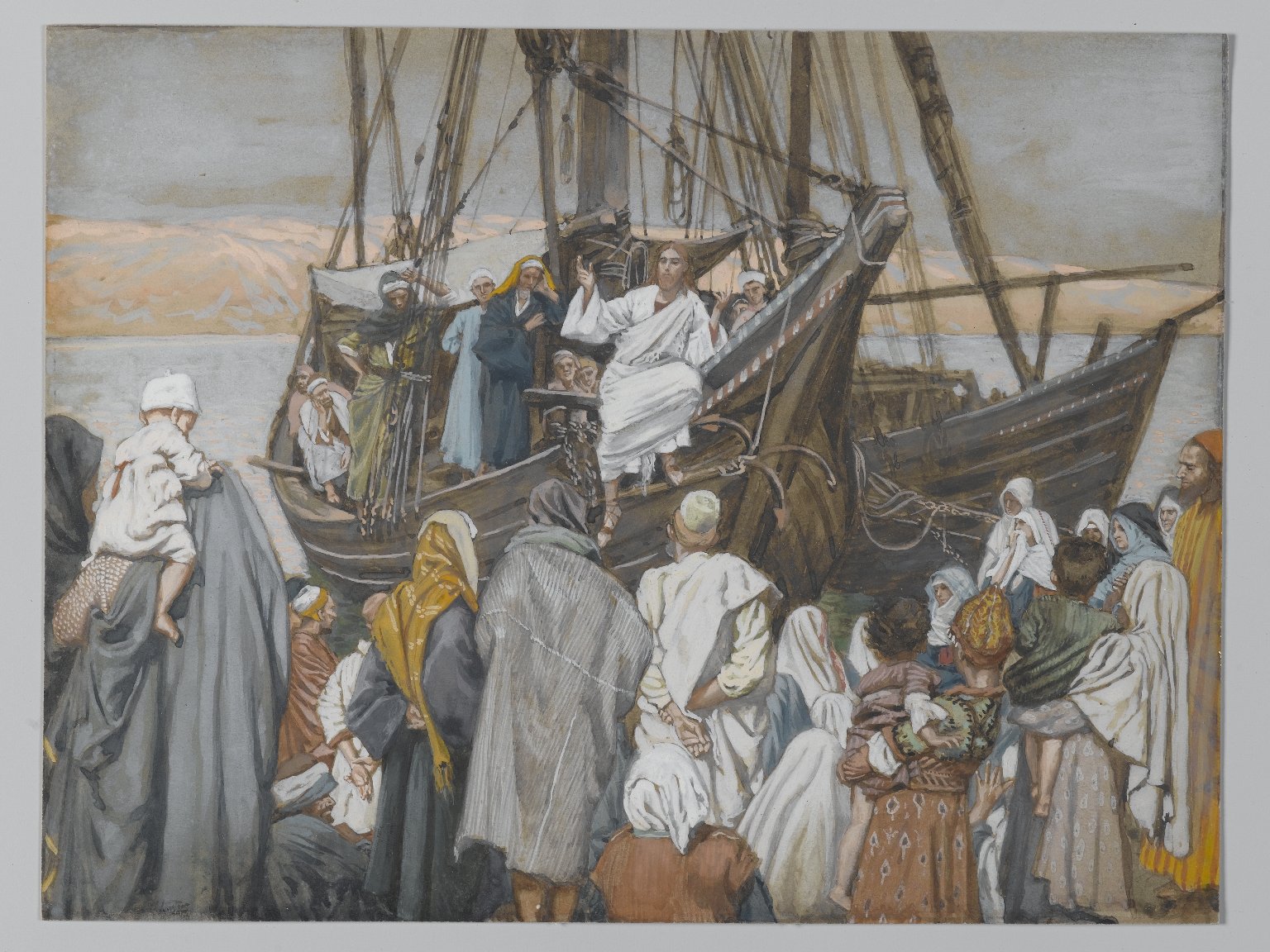
Jesus preaches from a boat – James Tissot (Brooklyn Museum)

The Baptism of the Lord 2025

TWO of the most important days of our lives are ones that many of us cannot remember. The first is the day of our birth, and the second is the day of our baptism. While people are often baptised when they are children or adults, many people in this country are baptised as infants. We may have photos of our baptism, and we may remember it or have been told about it by our families. People usually know where and when their baptism took place. Also, having been to other baptisms we know what will have happened on this significant day of our life, when we were welcomed as a member of the Christian community. Jesus’ baptism was in many ways similar to our own, and in some ways it was significantly different.

Early in Luke’s Gospel we hear about John the Baptist, a holy man who has been proclaiming a baptism of repentance for the forgiveness of sins (Lk 2:3). John has been calling people to turn away from their sins, and to turn back to God, and live holy lives. This has a significant effect on the people of Judea. There is an increase in religious observance; something like a religious revival. This, in turn, leads to speculation:

‘Gan fod y bobl yn disgwyl, a phawb yn ystyried yn ei galon tybed ai Ioan oedd y Meseia,’

‘As the people were filled with expectation, and all were questioning in their hearts concerning John, whether he might be the Christ,’ (Lk 3:15)

The people of Israel were longing for the Messiah, the Christ, the Anointed One. The prophesied Messiah is a charismatic King figure, anointed by God, and descended from David, who will make Israel flourish and re-establish the Kingdom of God. 

John the Baptist goes to great lengths to argue that he is not the Messiah. John is the messenger, preparing the way:

‘Yr wyf fi yn eich bedyddio â dŵr; ond y mae un cryfach na mi yn dod. Nid wyf fi’n deilwng i ddatod carrai ei sandalau ef. Bydd ef yn eich bedyddio â’r Ysbryd Glân ac â thân.’

‘I baptize you with water, but he who is mightier than I is coming, the strap of whose sandals I am not worthy to untie. He will baptize you with the Holy Spirit and with fire.’ (Lk 3:16)

The Baptist sees himself as not even worthy to untie the sandals of the Messiah, something a servant would do for their master. John demonstrates great humility, and his actions point forward to the baptism of the Church, instituted by Jesus in the River Jordan. Whereas John baptizes with water, Jesus will baptize with the Holy Spirit and fire. This looks forward to both Our Lord’s death on the Cross, and to Pentecost, when the Apostles are filled with the Holy Spirit.

‘Pan oedd yr holl bobl yn cael eu bedyddio, yr oedd Iesu, ar ôl ei fedydd ef, yn gweddïo. Agorwyd y nef, a disgynnodd yr Ysbryd Glân arno mewn ffurf gorfforol fel colomen; a daeth llais o’r nef: “Ti yw fy Mab, yr Anwylyd; ynot ti yr wyf yn ymhyfrydu.”’

‘Now when all the people were baptized, and when Jesus also had been baptized and was praying, the heavens were opened, and the Holy Spirit descended on him in bodily form, like a dove; and a voice came from heaven, “You are my beloved Son; with you I am well pleased.”’ (Lk 3:21-22)

We then have to ask ourselves why is Jesus being baptized? Jesus is not a sinner. He has no sins from which to repent, and yet He is in the River Jordan, being baptized by John. An explanation is that in His Baptism Jesus is in solidarity with sinful humanity: He does not wish us, His followers, to undergo anything that He would not undergo Himself. Christ is an example of how to come to God and have new life: He shows us the Way. As a sign of divine approval after the Baptism, as Jesus is praying, the heavens open, and the Holy Spirit descends upon Him in the form of a dove. God then says: ‘Ti yw fy Mab, yr Anwylyd; ynot ti yr wyf yn ymhyfrydu. You are my beloved Son; with you I am well pleased.’ (Lk 3:22)

At the beginning of his public ministry, Jesus shows humanity the way to the Father, through Himself. The world sees the generous love of God, which heals and restores us to the light and life of the Kingdom of God. As our baptism is a sharing in the death and resurrection of Jesus, so His Baptism points to the Cross, where streams of blood and water flow to cleanse and heal the world. We see the love of the Father, the power of the Spirit, and the obedience of Son, all for us — people who need God’s love, forgiveness, and healing.

At the moment of Jesus’ Baptism, the fullness of the Godhead is manifested in glory and the divine presence. In the account of Noah’s Ark God makes his love manifest in the form of a dove. At the end of the Flood a dove brings an olive branch back to the Ark, a sign of peace and new life. So now, the Holy Spirit appears in the form of a dove to show us the fullness of God, a relationship of love, which is opened up to us in our baptism. Through our baptism we are invited into the embrace of God’s eternal love. 

The Divine Trinity makes itself manifest in recognition of the Son’s obedience to the Father, and looks forward to the Cross, where God’s love is poured out upon the world, and through which we are saved. In our own baptism, we share in Christ’s Death and Resurrection. In His Baptism, as in His Death, Christ shows us the way to the Father in the power of the Holy Spirit. We are baptised in the name of the Holy and life-giving Trinity. Similarly, our worship this morning began by invoking the name of the Trinity: the Father, the Son, and the Holy Spirit (Yn enw’r Tad, a’r Mab, a’r Ysbryd Glân). And so all of our life as Christians is Trinitarian.

As we celebrate Our Lord’s Baptism in the River Jordan, and as we remember our own baptism, we also look forward to His first miracle at the Wedding at Cana. Christ, He who is without sin, shows humanity how to be freed from transgression and to have new life in Him.

So, today and every day, let us all draw strength from our Baptism and grow in faith, hope, and love, nourished by Christ, and with Christ. Let us share that love with others and give praise and honour i’r Duw Dad, Duw y Mab, a Duw yr Ysbryd Glân. I’r hwn y priodoler pob gogoniant, arglwyddiaeth a gallu, yn awr ac yn oes oesoedd. Amen.

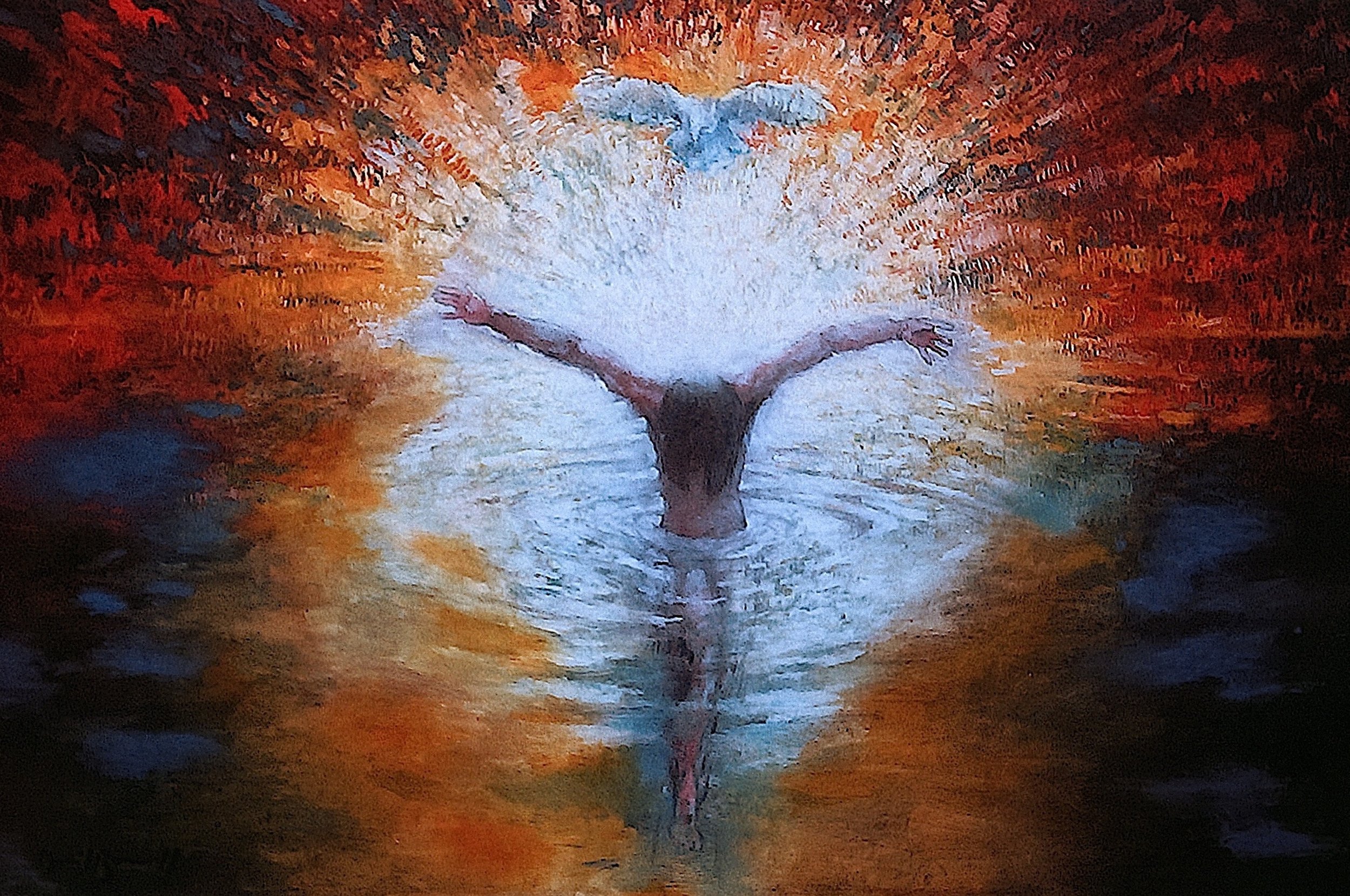
The Baptism of Christ – Daniel Bonnell

Trinity XV: Ephphatha – Be Opened!

I can still remember vividly the experience of my first Sunday off after being ordained. I had everything planned out. A friend of mine from theological college was a curate about 45 minutes away, so I could both see a friend and enjoy some quiet anonymous worship at the back of the pews. I dressed casually, but within seconds of entering the church I was handed books with a cheerful ‘Good Morning Father!’. I was rumbled! I suspect that without thinking about it I had performed several ritual gestures on entering, which rather gave the game away. Our actions are louder than our words, louder than the clothes we wear. Christianity is a faith which we live, which affects who we are, and what we do. 

The reading from the Letter of James makes this very point: God doesn’t treat people differently, so neither should we in the church. If anything the church should go out of its way to look after the poor, because in their poverty they know their need for God. 

‘Listen, my beloved brothers, has not God chosen those who are poor in the world to be rich in faith and heirs of the kingdom, which he has promised to those who love him?

‘Clywch, fy mrodyr annwyl. Oni ddewisodd Duw y rhai sy’n dlawd yng ngolwg y byd i fod yn gyfoethog mewn ffydd ac yn etifeddion y deyrnas a addawodd ef i’r rhai sydd yn ei garu?’ (James 2:5)

In this morning’s Gospel Jesus has been in Gentile territory to the north of Galilee. He has healed the Syro-Phonecian woman’s daughter, and is now heading back towards the Sea of Galilee. Having heard of His reputation for performing miraculous healings people bring a man to Our Lord who cannot hear or speak clearly, in the hope that he can be healed:

‘and they begged him to lay his hand on him.’

‘a cheisio ganddo roi ei law arno.’ (Mk 7:32)

The people are desperate: there is nothing they can do. This charismatic healer and teacher is their only hope. So Our Lord takes the man to one side, away from the crowd, and performs the healing. 

‘he put his fingers into his ears, and after spitting touched his tongue. And looking up to heaven, he sighed and said to him, “Ephphatha”, that is, “Be opened.”’

‘rhoes ei fysedd yn ei glustiau, poerodd, a chyffyrddodd â’i dafod; a chan edrych i fyny i’r nef ochneidiodd a dweud wrtho, “Ephphatha”, hynny yw, “Agorer di”.’ (Mk 7:33-4)

The scene may seem a little strange to us nowadays, but it has a refreshing physicality to it. Jesus isn’t simply preoccupied with spiritual matters. The healing is physical: involving touch and saliva. Our Lord does raise His eyes to Heaven and pray, but He also says, ‘Ephphatha — Be opened’ and the man is healed. Jesus is both conforming to people’s expectations, what they would like to be done, and also bringing about a miraculous healing by the power of God. 

‘And his ears were opened, his tongue was released, and he spoke plainly.’

‘Agorwyd ei glustiau ar unwaith, a datodwyd rhwym ei dafod a dechreuodd lefaru’n eglur.’ (Mk 7:35)

This is marvellous on several levels. It is the fulfilment of Isaiah’s prophecy which is the first reading today:

‘Then the eyes of the blind shall be opened, and the ears of the deaf unstopped; then shall the lame man leap like a deer, and the tongue of the mute sing for joy.’

‘Yna fe agorir llygaid y deillion a chlustiau’r byddariaidd; fe lama’r cloff fel hydd, fe gân tafod y mudan;’ (Isa 35:5-6)

Isaiah is looking forward to the coming of the Messiah, so Our Lord is fulfilling the prophecy and demonstrating his Messianic credentials — announcing to the world both who and what He is. The Kingdom of God is a place of healing and wholeness. It is also no longer to be understood in an exclusive sense. In Chapter 7 of Mark’s Gospel Jesus is outside Israel and now extends His healing to people who are not Jews. This is an important step which will have a profound effect upon the Church and its spreading across the world.

Our Lord tells the people who have witnessed the miracle not to tell anyone about it. However, his words have the opposite effect:

‘But the more he charged them, the more zealously they proclaimed it. And they were astonished beyond measure, saying, “He has done all things well. He even makes the deaf hear and the mute speak.”’

‘ond po fwyaf yr oedd ef yn gorchymyn iddynt, mwyaf yn y byd yr oeddent hwy’n cyhoeddi’r peth. Yr oeddent yn synnu’n fawr dros ben, gan ddweud, “Da y gwnaeth ef bob peth; y mae’n gwneud hyd yn oed i fyddariaid glywed ac i fudion lefaru.”’ (Mk 7:36-37)

They are amazed that prophecy is being fulfilled. But more than that, we see Gentiles sharing the Good News of the Kingdom of God. This is how the Church grows, and we see its beginnings here. The people of the Decapolis, the ten towns, are proclaiming the truth of the Gospel. They point forward to the spread of the Church.aWe are here in Church today because people have told others about it. The people’s profound experience of God’s healing love compels them to share it with others. Just as the deaf mute has been opened by the prayer of Jesus, so have the people around him. Their ears are opened and their tongues are loosed to proclaim the might works of God. 

The Kingdom of God is a place of healing and restoration for all, a fact which the Church continues to proclaim. Rather than being an exclusive event for the Chosen People, healing and salvation are for all who turn to God. All are invited, all are welcome. We are here today because people have shared the Good News with us. All of us come in need of God’s grace, His unmerited kindness. Not only this, but God gives us His very self, to heal us, and transform us.

My brothers and sisters in Christ, may we come to the Lord, so that we may be healed and restored. May we proclaim the Good News of the Kingdom of God, so that others may come to know and love God the Father, God the Son, and God the Holy Spirit. To whom be ascribed all glory, dominion and power, now and forever. Amen.

James Tissot: Jesus Heals a Mute Possessed Man (Brooklyn Museum)

The Second Sunday of Easter

This morning we welcome baby Alice into the Christian community. This is an important day for her, as well as her family, and for all of us present here today.

At the beginning of His ministry, Jesus was baptised by John in the River Jordan. Today I will use the blessed water in the font and holy oil. The font is placed near the door of the church because baptism is the way that we enter the Church and become a member of the Christian community.

Today’s reading from the First Letter of John speaks of loving the children of God (plant Duw) and of keeping God’s commandments. M____ and C_____ are following God’s commandments by bringing their daughter Alice to be baptised, and we are all here to support them in their actions.

The Gospel for today records the risen Jesus appearing to the disciples. Peter and John have already witnessed the empty tomb, Mary Magdalen has even talked with the Risen Christ. However, the disciples are afraid. Their Teacher has gone from being hailed as the Messiah and King, to being crucified. Christ’s followers are all scared for their lives, lest a mob come and attack them. Some of their number are saying that the tomb is empty, and that Jesus has risen. Then, suddenly, the risen Lord is there among them saying: 

“Peace be with you!” 

‘Tangnefedd i chwi!’ (John 20: 19)

In a situation of heightened emotion, Our Lord’s gift is peace. God’s peace is not just the absence of noise or violence (heddwch) but something richer and deeper. This is the ‘Peace which passeth all understanding’ ‘Tangnefedd sydd uchlaw pob deall’, something given to us by God to transform our lives. Next, Jesus breathes on His disciples giving them the Holy Spirit and the power to forgive sins. Christ’s followers are equipped for the work of proclamation and reconciliation. This is what Jesus came to do, and He commits the Church to continue His mission and His saving work. To help His followers, Christ gives them (and us) the Holy Spirit, God’s free gift to His people, a sign of His generous love.

When Jesus appears to the disciples, one of them is absent. Thomas is not there — maybe he has been to get them all some food. When Thomas returns and hears what has happened, he feels somewhat left out. He is unsure and wants to have physical proof of Jesus’ Resurrection before he is able to fully believe:

“Unless I see in his hands the mark of the nails, and place my finger into the mark of the nails, and place my hand into his side, I will never believe.”

“Os na welaf ôl yr hoelion yn ei ddwylo, a rhoi fy mys yn ôl yr hoelion, a’m llaw yn ei ystlys, ni chredaf fi byth.” (John 20: 6-7)

These are the words of someone who longs to experience the reality of the Resurrection. Like the other disciples, Thomas has been on something of an emotional rollercoaster. It is understandable that he wants to be certain, to experience with his own eyes and hands that Jesus is alive.

A week later, Jesus comes to the disciples again, and says to them: 

“Peace be with you.” Then he said to Thomas, “Put your finger here, and see my hands; and put out your hand, and place it in my side. Do not disbelieve, but believe.”

“Tangnefedd i chwi!” Yna meddai wrth Thomas, “Estyn dy fys yma. Edrych ar fy nwylo. Estyn dy law a’i rhoi yn fy ystlys. A phaid â bod yn anghredadun, bydd yn gredadun.” (Jn 20:26-27)

Jesus gives Thomas what he wants: the opportunity to experience the reality of the Resurrection and to touch the wounds of love and mercy. This leads Thomas to reply to Jesus:

“My Lord and my God!”

“Fy Arglwydd a’m Duw!” (Jn 20:28)

Thomas no longer doubts. Instead he confesses that Jesus is God, and the Lord of his life. This is a profound and concise statement of faith, declaring both who Jesus is, and what He has done. Thomas has journeyed from doubt and despair to true faith. Doubt is the starting point, but it is not the end of the journey. St Thomas should not be known as ‘Doubting Thomas’, but rather as ‘Believing Thomas’, as this is what he becomes. Thomas’ belief changes his life, and leads him to take the Gospel to be proclaimed far and wide. He travels as far as India, founding Christian communities which have endured for two thousand years. Such faith is our inheritance, and in it we are blessed, as those who have not seen, but yet believe. We too are called to be like Thomas, and to share the Good News of Christ’s Resurrection with the world. 

At its heart today’s Gospel should be understood as something to encourage us in our life of faith:

‘but these [things] are written so that you may believe that Jesus is the Christ, the Son of God, and that by believing you may have life in his name.’

‘Ond y mae’r rhain wedi eu cofnodi er mwyn i chwi gredu mai Iesu yw’r Meseia, Mab Duw, ac er mwyn i chwi trwy gredu gael bywyd yn ei enw ef.’ (Jn 20:31)

Belief in Jesus leads to New Life. This underlines the Christian understanding of baptism. Through baptism we share in Jesus’ Death and Resurrection, and are given new life. This new life is eternal life with Christ, and in Christ.

At the Easter Vigil, last week, we renewed our baptismal promises to remind ourselves of what Our Lord has done for us. What Jesus has done for you, and for me, and for every Christian over the past two thousand years. In our Baptism we are united with Christ and made brothers and sisters. We become part of a new family which we call the Church. This new family is called to live in a new way. This is made clear in the first reading from the Acts of the Apostles. Here we see people of faith being loving and generous, caring for each other. We pray that we may be inspired by their example, and live out the faith of our baptism throughout our lives. 

Next to the font is our wonderful Easter Garden, which includes the Empty Tomb, the site of Jesus Resurrection.It is important to take our time over our celebration of Easter. We need time to allow the reality of what we commemorate to sink in. Something this wonderful, this world-changing, needs to be pondered, and shared. We gather today to do what the disciples did, and are filled with joy at Our Lord’s Resurrection from the dead. Through Christ’s Resurrection we are changed, transformed, and filled with God’s love. In the same way Alice will shortly be changed, transformed and filled with God’s love. Easter is a traditional time for baptism, and as a Christian community we welcome Alice and pray for her, and for her family. Today, and every day, we give thanks and praise to God the Father, God the Son, and God the Holy Spirit. To whom be ascribed all, glory, dominion, and power, now and forever. Amen.

Tissot: L’Incredulité de Saint Thomas, (Brooklyn Museum)

Easter 2024

It is early in the morning and a woman sits in the darkness. Her beloved teacher, whom she has followed and supported for years was placed in a tomb a few days before, after having being executed for political and religious reasons. The sun has not yet risen, and as she sits, she cries. A week ago He was being hailed as the Messiah, God’s anointed, the Davidic king come to set His people free. Yet within a few days, the same people who cried ‘Hosanna’ were shouting ‘Crucify him!’ ‘Crucify him!’. So she goes, to be near her Lord, to be close to him. And as she goes, she notices something: the stone has been rolled away. It took several people to roll it there on Friday afternoon. What is going on? Mary Magdalen runs to tell Peter and John:

“They have taken the Lord out of the tomb, and we do not know where they have laid him.” 

‘Y maent wedi cymryd yr Arglwydd allan o’r bedd, ac ni wyddom lle y maent wedi ei roi i orwedd’ (John 20: 2)

Mary assumes, understandably, that grave-robbers have been at work. Or that the Jewish or Roman authorities, worried that this troublemaker might be a focus for dissent, have got rid of Him. To do so makes sense in political terms, but something greater has happened. Peter and John come running towards the tomb. John arrives first, peers inside the tomb, but stays outside. 

‘Then Simon Peter came, following him, and went into the tomb. He saw the linen cloths lying there, and the face cloth, which had been on Jesus’ head, not lying with the linen cloths but folded up in a place by itself.’

‘Yna daeth Simon Pedr ar ei ôl, a mynd i mewn i’r bedd. Gwelodd y llieiniau yn gorwedd yno, a hefyd y cadach oedd wedi bod am ei ben ef; nid oedd hwn yn gorwedd gyda’r llieiniau, ond ar wahân, wedi ei blygu ynghyd’ (John 20: 6-7)

What happens is a gradual process. Bit by bit, the followers of Jesus come to experience and understand this incredible and amazing event. 

Then the other disciple, who had reached the tomb first, also went in, and he saw and believed; for as yet they did not understand the Scripture, that he must rise from the dead. Then the disciples went back to their homes.’

‘Yna aeth y disgybl arall, y cyntaf i ddod at y bedd, yntau i mewn. Gwelodd ac fe gredodd. Oherwydd nid oeddent eto wedi deall yr hyn a ddwed yr Ysgrythur, fod yn rhaid iddo atgyfodi oddi wyth y meirw. Yna aeth y disgyblion adref yn eu holau.’ (John 20: 8-10)

A few days ago the disciples saw their Lord and Teacher killed and buried, but now the tomb is empty. The cloths that were wrapped around Jesus are there, but there is no body. John, the disciple Jesus loved, understands and believes. Peter does not yet understand or believe. Clearly it is all too much for Mary Magdalen who stays by the tomb, weeping. When the angels ask her why she is crying she replies:

“They have taken away my Lord, and I do not know where they have laid him.”

“Y maent wedi cymryd fy Arglwydd i ffwrdd, ac ni wn i lle y maent wedi ei roi i orwedd.” (John 20: 13)

Mary’s words are understandable, she is filled with grief and sadness. She is bereft and confused. At this point, Mary Magdalen encounters the Risen Christ:

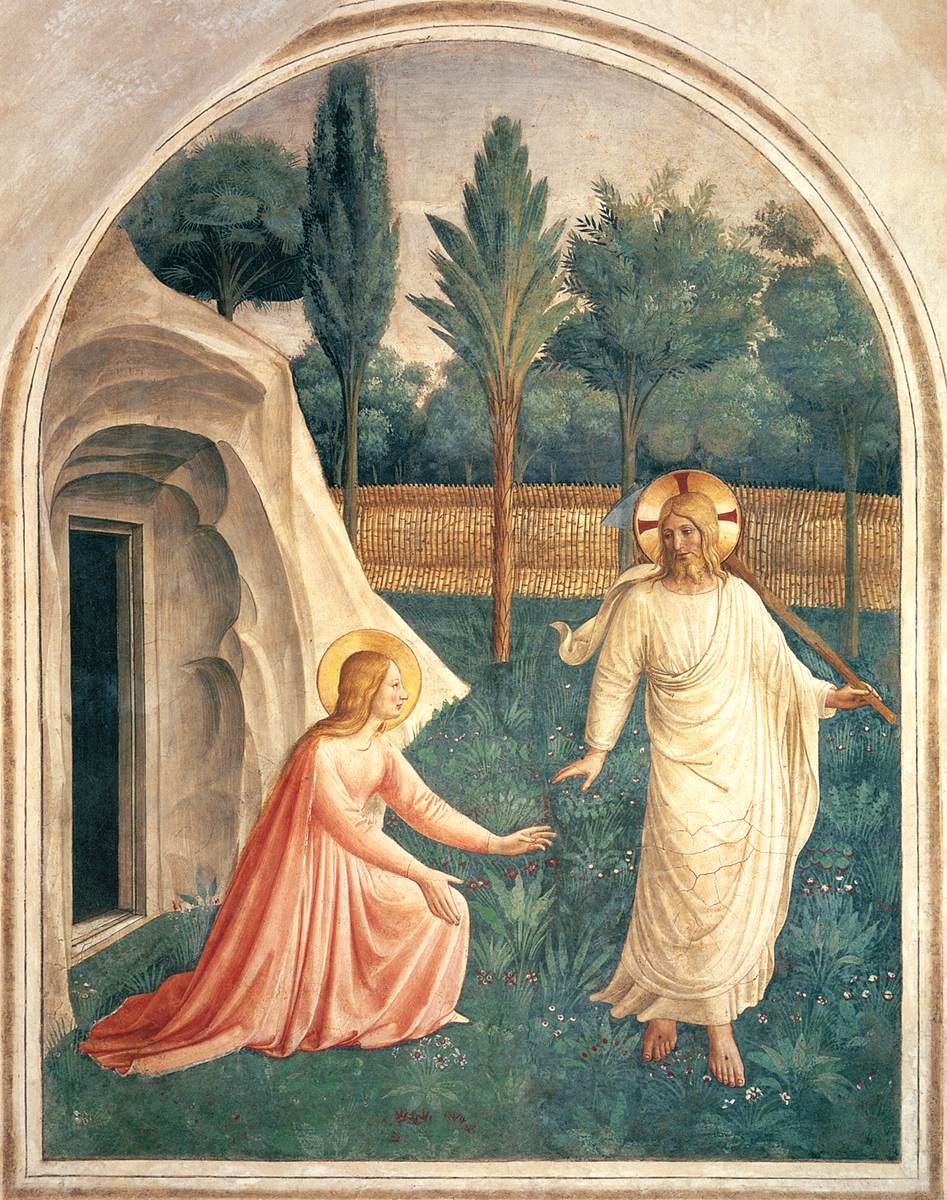
Jesus said to her, “Woman, why are you weeping? Whom are you seeking?” Supposing him to be the gardener, she said to him, “Sir, if you have carried him away, tell me where you have laid him, and I will take him away.”

‘“Wraig,” meddai Iesu wrhti, “pam yr wyt ti’n wylo? Pwy yr wyt yn ei geisio?” Gan feddwl mai’r garddwr ydoedd, dywedodd hithau wrtho, “Os mai ti, Syr, a’i cymerodd ef, dywed wrthyf lle y rhoddaist ef i orwedd, ac fe’i cymeraf fi ef i’m gofal.”’ (John 20: 15)

Mary supposes that Jesus is the gardener, the person employed to look after the cemetery. She does not yet understand who He is, or what is going on. However, the mention of the gardener is significant. In Genesis, humanity was created by God in a garden, Eden, and given the task of tending it (Gen 2:15). The Resurrection also takes place in a garden, showing us that Christ is the second Adam. Whilst the first Adam brought death to humanity by a tree, Jesus, the Second Adam, has brought life to the world by the tree of the Cross. Humanity falls because of a tree, and because of a tree we are offered eternal life in Christ. 

It was on the first day of the week, that Creation began, and now on the first day of the week we see a New Creation. Christ has risen from the dead, and conquered Death and Hell. Our Lord is a gardener, and the plants he tends are human beings. We believe in a God who loves us, who cares for us, and who longs to see us grow and flourish.

Jesus greets Mary Magdalen by name, and suddenly she recognises Him. She understands. She believes. Then Christ talks of His Ascension, as though forty days of Easter have condensed into a single moment. Mary now knows what she must do:

‘Mary Magdalene went and announced to the disciples, “I have seen the Lord”—and that he had said these things to her.’

‘Mair Magdalen i gyhoeddi’r newydd i’r disgyblion. “Yr wyf wedi gweld yr Arglwydd.” meddai, ac eglurodd ei fod wedi dweud y geiriau hyn wrthi’ (Jn 20:18)

Mary shares the Good News, just as Peter and Paul do in the first and second readings this morning. As Christians we are called to do likewise: to tell others that God loves us, all of us, that He died for us, and that He rose again to offer us eternal life with Him. This is the message of Easter. Good News! Christ has triumphed over Death and Hell, and humanity is healed and restored through Him.

So, my brothers and sisters in Christ, ‘Pasg hapus i chi gyd!’ ‘A Happy Easter to you all!’ May you, and those you love, be filled with Resurrection joy and strength, on this Easter Day and always. Amen.

Fra Angelico (Italian, ca. 1395–1455), “Noli me tangere,” 1440–42. Fresco from the convent of San Marco, Florence, Italy. http://www.wga.hu/frames-e.html?/html/a/angelico/index.html

The Second Sunday of Year B

There is a common misconception that when the Church talks about vocation, being called, it is referring to the call to ordained ministry, to be a deacon or a priest. Nothing could be further from the truth. While this call is an important one, there remains a fundamental call which comes to us all in our baptism: the call to follow Christ. Each and every one of us is called to be a disciple of Jesus, to listen to what He says, and to let this call affect our lives. It is both a daunting prospect, and the most normal and natural thing in the world. 

Our first reading this morning tells the story of the call of Samuel, a young boy serving at the sanctuary in Shiloh with the high priest Eli. After his mother, Hannah, had prayed to God for a child whom she would dedicate to God as a Nazirite, she became pregnant and Samuel was born. Nazirites were not allowed to cut their hair, drink wine, or touch a dead body. Eli’s predecessor, Samson, the last of the Judges in the Book of Judges, was also a  Nazirite. Samuel is called three times. Each time he goes to Eli, whom he assumes is calling him. Eventually Eli tells Samuel to reply, ‘Speak, Lord, for your servant hears.’ (1Sam 3:9). So Samuel responds to God’s invitation, and it totally changes his life. Are we willing to take that risk, and answer God’s call?

Ancient Corinth was something like a cross between London and Las Vegas. It was a rich trading centre with a reputation for sexual immorality. This morning’s second reading from St Paul’s First Letter to the Corinthians, is an attempt to argue that our embodied existence, that is how we live our lives , matters. Often, we become what we do. It is therefore important to do the right thing, and not the wrong. Paul’s argument leads to his conclusion:

You are not your own, for you were bought with a price. So glorify God in your body. (1Cor 6:19-20) 

We are not our own, we belong to God, who bought us with the price of His Son, Jesus Christ. The world likes to tell us that we are autonomous, that we can do whatever we want to, but at a fundamental level we are God’s people, and belong to the God who made us, and who redeemed us out of love for us. God sets us free to love Him and serve Him, so how we live our lives is our response to that love and an act of loving service. We can choose to glorify God, not that God needs our glory, but because it is how we should live our lives, in love and service. Our faith affects our lived existence.

In today’s Gospel we move beyond the Baptism of Christ to the events of the following day. John has testified that Jesus is the Lamb of God, who takes away the sins of the world, and that He is the Son of God. When John sees Jesus walking by he again exclaims ‘Behold the Lamb of God’ (Jn 1:36). The phrase looks back to the Suffering Servant in Isaiah 52-53 who is led like a lamb to the slaughter. The beginning of Jesus public ministry points to its end on the Cross. Jesus is the Messiah and He will die to take away our sins. Two of John’s disciples hear him saying these words and follow Jesus. When Jesus asks them what they are looking for, the disciples answer ‘Rabbi’. They acknowledge Jesus as a teacher, and ask Him where He is staying. Jesus replies, “Come and you will see.” (Jn 1:39). Jesus invites them to follow Him, to see where He is staying and to spend time with Him. These two disciples of John become followers of Jesus, literally and metaphorically. The Church continues to make the same invitation to the world, to come and see, to follow Jesus. These two disciples stay with Jesus, they listen to Him, they eat with Him, and begin to have a relationship with Him. We then discover that one of the men is Andrew, and that he has a brother, called Simon. Andrew is convinced that he has found the Messiah and brings his brother to Jesus. When Jesus meets Simon he says,

“So you are Simon the son of John? You shall be called Cephas” (which means Peter) (Jn 1:42)

Jesus gives Simon a new name. He calls him Cephas, which means ‘rock’ in Aramaic, Petros in Greek, from which our name Peter comes. Peter will be the rock upon which Christ will build His Church (Mt 16:18). The name Jesus gives points to Peter’s future role as the leader of the Apostles. Jesus takes the initiative and begins to sketch out a future for the disciples who are following Him. It is quick, and matter of fact, and yet momentous. Jesus is gathering people to help Him with this ministry.

The Church therefore begins with a few Galilean fishermen following a rabbi whom they recognise as the Messiah. Thanks to them, and their faith in Jesus, we are in the Church today. Faith, where we put our trust, is an important thing. It affects both who we are, and how we live our lives. Faith turned Peter from a fisherman into a leader of the early Christians, and it has continued to transform lives for the past two thousand years. 

In our baptism, God in Christ invites each and every one of us to follow Him, to ‘come and see’, as the first disciples did, and to invite others, as Andrew invited Simon Peter. To come and see who Jesus is, to get to know Him, and start a relationship with Him. This begins with our sharing in His Death and Resurrection, and ends in the glory of Heaven. Where we, and all the Church, give glory to God the Father, God the Son, and God the Holy Spirit, to whom be ascribed, as is most right and just, all might, majesty, glory, dominion, and power, now and forever. Amen. 

The Second Sunday before Advent: Mk 13:1-8

There was a time when you would see men walking around with sandwich boards, which declared, ‘The End is Nigh!’ It would be all too easy to mock them, or write them off as crackpots. They do, however, make a serious point. For all Christians, after Jesus’ Ascension, we are waiting for Jesus to come again, as our Saviour and our Judge. It might be today, or in a thousand years from now, but He is coming, and we need to be ready. We need to be prepared to meet Him. It is why, in the Season of Advent, which will soon be upon us, we consider the two comings of Jesus. The first is as a baby born in Bethlehem, the second will be as Our King, Our Saviour and Our Judge. The two comings are linked, and we need to be ready for both. 

People nowadays are worried by many things: Britain’s departure from the EU, the President of the United States of America, the threat of nuclear war, global climate change, the end of the world. The latter part of the twentieth century and the start of the twenty-first are full of dire warnings of impending doom. It’s scary stuff, it really is. But as Christians we know that whatever happens, we are loved by and saved by God, that we, and all things are in His hands. It can be hard to hold onto hope like this, but we can. 

The buildings of the Temple complex were soon to be destroyed by the Romans. The single most holy place in the world for Jews was about to be destroyed. It’s a frightening prospect, but it teaches an important lesson: not to be overly concerned with the stuff of this world, as it isn’t as important as we tend to make it. The disciples can’t quite understand that yet, but they will, in time.

What’s more important for Jesus is that the disciples aren’t led astray into strange beliefs, or following false Christs. The last two thousand years have seen some very strange versions, some might say perversions, of Christianity. What we believe matters, because it affects how we live our lives, it helps us give right praise to God, rather than something distorted, ugly and man-made. When Mark wrote his Gospel there were lots of strange ideas floating around about Jesus, and there still are today. It was a time of great uncertainty then, as now. There were wars and natural disasters which portend the end times. Christians were facing persecution then, and they are now too, all over the world. We are more likely to face indifference than persecution, but it knocks your confidence somewhat. You want hope and comfort, and the promise of something better. 

And we have that in Jesus Christ, who died for our sins, and who rose again to show us that we have the promise of eternal life with God, ‘For by a single offering he has perfected for all time those who are sanctified’ (Heb 10:14). This is truly good news to a troubled world. It is the heart of our faith, and the source of our joy. Peter and Andrew, James and John want to know when it will take place. Jesus doesn’t tell them, but he gives them signs to be alert for, so that they can be ready.

I wasn’t a boy scout, but their motto ‘Be Prepared’ is a good one, especially for Christians, because Jesus is coming, and we need to be ready to meet Him. It is good to think about this as we prepare to enter Advent, the penitential season which looks towards Christmas, and our yearly celebration of Jesus’ birth. It is truly amazing thing, that God should be born as one of us, to save us from our sins, to give us the hope of Heaven. We need to prepare for it, because it is important: not the turkey and tinsel and the rampant consumerism, but the Incarnation of the Word of God. It changes the world, and has been doing so for the last two thousand years. We also know that Jesus will come to judge the world. It’s tricky that one, knowing that we will be called to account for what we have been, said, thought, and done.None of us deserve to go to Heaven, but God is loving and merciful, and forgives our sins when we are penitent, He gives us another chance when we make a mess of it. We keep doing it, and God keeps forgiving us, so that we can try to do what God wants us to do. I find such generosity staggering. The world around us can be judgmental, it likes to write people off as no good, as failures. Thankfully God isn’t like that, and the church shouldn’t be either. We have to be a community of healing and reconciliation, so that we can offer the world an alternative. It is both liberating and exciting to that you and I are part of it, and hopefully we want others to be as well. 

This is the covenant that I will make with them after those days, says the Lord: I will put my laws on their hearts, and write them on their minds,’ (Heb 10:16). The author of the Letter to the Hebrews quotes Jeremiah (31:33) to show us how Scripture is fulfilled in the Person of Jesus, who makes a new covenant with His Precious Blood on Calvary. God makes it possible for us to live this new life, triumphing over sin and death. Christ does this for us, what can we do for Him?

We can be ready to meet Him, and we can live the life He wants us to live, not worry whether Christ will come tomorrow or in a thousand years.