Advent IV: ‘He will save his people from their sins’

‘He will save his people from their sins.’

‘am mai ef a wareda ei bobl oddi wrth eu pechodau.’ (Mt 1:21)

Of all the figures in the story of Our Lord’s Nativity, the one most often overlooked is Joseph. It is fair to say that today’s Gospel finds Joseph in a particularly awkward situation. He is described in verse 19 as a ‘just man’. Just or righteous in this context means that he obeys Jewish Law. However, Deuteronomy 22:23-24 states that:

‘If there is a betrothed virgin, and a man meets her in the city and lies with her, then you shall bring them both out to the gate of that city, and you shall stone them to death with stones, the young woman because she did not cry for help though she was in the city, and the man because he violated his neighbour’s wife. So you shall purge the evil from your midst.’ (Deut 22:23-24)

Mary and Joseph are betrothed, and preparing to be married, but strictly speaking under Jewish Law because she is pregnant, Mary is guilty of a capital crime. It is perhaps for this reason that Luke’s account tells us that Mary spends time out in the country with her cousin Elizabeth, who is also pregnant. Joseph loves Mary, and rather than see her killed or publicly humiliated, he wants to put an end to the marriage quietly, without any fuss. It is at this moment that the Angel Gabriel appears to him in a dream saying:

“Joseph, son of David, do not fear to take Mary as your wife, for that which is conceived in her is from the Holy Spirit. She will bear a son, and you shall call his name Jesus, for he will save his people from their sins.” (Mt 1:20-21)

Joseph is a descendant of King David, a member of Israel’s Royal Family. This is an awkward fact when the current occupier of the throne is not part of that dynasty, but was put there by the Romans as a pliant puppet king. 

The angel says to Joseph: ‘Do not be afraid! Paid ag ofni!’ Again and again God speaks to His people to tell them not to fear and to be of good heart, to reassure and encourage them. God loves His people, there is nothing to be afraid about. The angel is clear: the child that will be born is of the Holy Spirit. He will be the Son of God, and His name will be Jesus, because He will save His people from their sins. ‘Yeshua’ means ‘God saves’ which is exactly what Jesus does. At a practical level the angel’s message to Joseph is designed to put him at ease, to stop him worrying. The message is Good News, through the angel the Gospel of Salvation is announced.

To reinforce this fact, St Matthew then quotes a prophecy of Isaiah, which is also found in the first reading today:

“Behold, the virgin shall conceive and bear a son, and they shall call his name Immanuel” (Mt 1:23)

The prophecy is being fulfilled; there will be a son born to the House of David, who will be God with us (Emmanuel), and He will save His people from their sins. This is why we celebrate Christmas, because it is the coming of our Saviour. What does is mean to say that God is with us? Is it an expression of solidarity? Or something more? In Jesus God is with us, and He shares our human life, from birth to death. Christ is not some remote divine figure, but one intimately acquainted with all of human existence. God is not distant, but instead is someone who understands us, and loves us. Christ’s entire existence is about communicating Divine Love and Reconciliation. The Church has also been proclaiming this same message of hope and salvation for the past two thousand years.

He will save his people from their sins’: the angel’s words to Joseph could not be clearer. Jesus is God’s rescue mission, sent to save humanity from their sins. This vocation ultimately leads to Calvary. Therefore, as we prepare to celebrate Christ’s Birth, we know that His life will end here, on the Cross. As we prepare for the most joyous of feasts, we are mindful of the cost and depth of God’s love.

It is important to notice what Joseph does when the dream is over:

‘When Joseph woke from sleep, he did as the angel of the Lord commanded him: he took his wife, but knew her not until she had given birth to a son. And he called his name Jesus.’ (Mt 1:24-25)

Joseph did what the angel commanded him to do. He was obedient. He listened and obeyed. Joseph is complete opposite of Ahaz, in today’s first reading, who neither listens to God nor obeys Him. Joseph is obedient in naming his son as he was instructed: ‘And he called his name Jesus’ (Mt 1:25). Jesus too will be obedient. His is an obedience to the Father’s will borne out through suffering, death and resurrection which characterises the mission of the Son. This is what brings about our salvation. We then, in obedience, look for His second coming as our Saviour and our Judge. As Christians, we are called to take time to ponder these mysteries — to stop for a while amid the business of our modern existence and reflect upon the wondrous nature of God’s love for us, and for all humanity. We need to take the opportunity to stop, and to ponder this wondrous fact; to reflect upon what ‘God-with-us’ means for each one of us, and for our lives.

As the people of God, members of the Christian Church, which we enter through our baptism, we have all been commissioned to proclaim the Good News of Jesus Christ, and to live out this example in our lives. Christians urge the world to pause and to consider exactly what is being celebrating at Christmas: the free gift, of hope and salvation for all people, through a baby, born in a stable, among the poor and the marginalised.

The act of Divine love, which we experience in Our Lord’s Nativity, should draw us, in turn, to love God and to love our neighbour; to live out the love which becomes flesh in the womb of the Virgin Mary. This same love will become the flesh and blood that we touch and taste, here, this morning, through the bread and wine. Feeding us, so that we might share His divine life. So, my brothers and sisters in Christ, let us be filled with, and transformed by, the divine gift of love. Let us, like Mary and Joseph, wait on the Lord and be reshaped by Him. Let us live out our faith in our lives so that others might believe and sing the praise of God the Father, God the Son, and God the Holy Spirit, Duw Dad, Duw y Mab, a Duw yr Ysbryd Glân. To whom be ascribed all might, majesty, glory, dominion, and power, now and forever. Amen.

James Tissot The Vision of St Joseph: Brooklyn Museum

Advent III – He who is to come

‘the ransomed of the Lord … shall obtain gladness and joy and sorrow and sighing shall flee away.’ (Isaiah 35:10)

‘a gwaredigion yr Arglwydd fydd yn dychwelyd … hebryngir hwy gan lawenydd a gorfoledd a bydd gofid a griddfan yn ffoi ymaith’

This year our first readings during Advent come from the book of Isaiah. This Old Testament prophet stresses the belief that the Messiah will come to deliver Israel. As Christians, we use the period of Advent to reflect upon the fact that Christ is coming. He is coming as a baby born in Bethlehem. He is coming to us here today in the Eucharist. And He is coming to judge the world. Should we be afraid? On the contrary, as the prophet says:

‘Strengthen the weak hands, and make firm the feeble knees. Say to those who have an anxious heart,“Be strong; fear not! Behold, your God will come with vengeance, with the recompense of God. He will come and save you’ (Isa 35:3-4). 

God is coming to save us, His people. The salvation we long for will be ours. The prophet Isaiah has a vision where the desert, a dry wilderness, is carpeted with flowers. This is a sign of new life.This is an image of hope. This is the flourishing which the Messiah will bring: ‘the glory of the Lord, the majesty of our God’ (Isa 35:2). As Christ Himself says, ‘I came that they may have life and have it abundantly’ (Jn 10:10). This is good news. It is a reason to rejoice and be glad. In order to mark this, the Church wears rose today, instead of penitential purple. In order to celebrate the joyful character of this day, and to remind us that Christ is coming. As Isaiah says:

‘the ransomed of the Lord shall return and come to Zion with singing; everlasting joy shall be upon their heads; they shall obtain gladness and joy, and sorrow and sighing shall flee away’ (Isa 35:10).

The time is both now and, at the same time, it is not yet. As St James writes, ‘You also, be patient. Establish your hearts, for the coming of the Lord is at hand’ (James 5:8). Patience is a hard thing to master. Human beings are naturally impatient. We do not want to wait, but we have to. The question is how we wait. We are told that this should be in joyful expectation, preparing ourselves for what is to come. 

John the Baptist has been waiting for the Messiah. However, despite leaping in his mother’s womb at the Visitation to announce Christ’s coming, in this morning’s Gospel he appears to be having doubts. John is expecting a Messiah of judgement, and he is isn’t entirely sure what is going on. The Baptist has been imprisoned for criticising Herod Antipas’ marriage to his brother’s wife. John is therefore hoping for a messiah who will sweep away an unjust and corrupt regime. This is why he has doubts about Jesus, who does not seem to be a political messiah. Jesus tells John’s disciples:

‘Go and tell John what you hear and see: the blind receive their sight and the lame walk, lepers are cleansed and the deaf hear, and the dead are raised up, and the poor have good news preached to them’ (Mt 11:4-5). 

The vision of a messianic future envisaged by Isaiah in this morning’s first reading has become a reality: prophecy has been fulfilled, God keeps his promises. The Kingdom of God is a place of healing, and Christ is the great physician, who has come to heal our souls. Jesus is the one who is to come, who has come, and who will come again. The establishment of God’s kingdom can appear strange in human terms. Focussing on those on the margins, the sick, the poor, the oppressed, and the marginalised, is not a grand gesture. That is the point! The greatest gesture Jesus will make will be in handing Himself over to be crucified and to die the death of a common criminal. This is how the messiah will reign as the true King of Israel, on the Cross at Calvary. 

God’s salvation defies human expectations. This is the point: God’s ways are not our ways, nor are His thoughts our thoughts. That is the core message of this morning’s Gospel. If we expect God’s rule to look like human kingship, then we will be disappointed. Our Heavenly Father has something else in store, something far more wonderful than we could ever imagine, and at its heart is the transformation of humanity through love. God heals His people, because He is a God of love. Our Creator does not love us because we are loveable. We are sinners, who do not deserve to be loved, and cannot earn His divine love. But, rather than WHAT we are, God loves us for WHO we are: His sons and daughters, created in His image and likeness. God is someone whom we can trust, who keeps His promises. Our Heavenly Father offers the world the greatest present it could ever hope for: true love and eternal life.

Today, the peace which the Messiah came to bring seems as elusive as ever. The human capacity to create misery in the most dreadful ways continues relentlessly. We know that humanity still has some considerable distance to travel towards the establishment of a just and peaceful world. An answer is to embrace the need for repentance: to change our hearts and minds and to follow Jesus. We also prepare to meet Our Lord as He will come again, as our Saviour and our Judge. It is a daunting prospect, yet we know and trust that Christ saves us. By His Wounds on the Cross we are healed, and our sins are forgiven.

This is God’s grace: loving sinful humanity in order that we may be transformed by His Divine love. This is why the focus is on healing — something which only God can do — to redeem our souls with His love. This is the cause of our gladness and joy. What the prophet Isaiah hoped for has been fulfilled, and continues to be fulfilled. The Church is called to carry on God’s healing in the world, and restore each person with divine love. This is what we are about to celebrate in the Eucharist, where we both thank Our Heavenly Father for loving us, and we also prepare to experience that healing love, so that it may transform us, now, here, today. We do so with reverence, because we are not simply consuming human food and drink, but the very Body and Blood of Christ, given for us, to heal us. It is the greatest medicine our souls could ever wish for. Soon we ‘shall see the glory of the Lord, the majesty of our God’ (Isa 35:2). God’s glory and majesty is to give His Body for us on a Cross, and also to feed us with Himself.

Let us, then, come to the banquet with glad hearts, and experience the life-changing love of God. Let us allow it to heal and transform us, so that we can join our voices with all creation to joyfully sing the praises of God the Father, God the Son, and God the Holy Spirit, Duw Dad, Duw y Mad, a Duw yr Ysbryd Glân, to whom be ascribed all might, majesty, glory, dominion, and power, now and forever. Amen.
Jean Tissot: St John the Baptist sees Jesus from afar (Brooklyn Museum)

The Second Sunday of Advent

‘May the God of hope fill you with all joy and peace in believing’ (Rom 15:13)

A bydded i Dduw, ffynhonnell gobaith, eich llenwi â phob llawenydd a thangnefedd wrth ichwi arfer eich ffydd

The book of the prophet Isaiah has sometimes been called the ‘Fifth Gospel’. This is because so many of Isaiah’s prophecies look forward to the Messiah, and find their fulfilment in Jesus. We, too, are currently in a time of anticipation. Advent is when we prepare for Christ to come, both as a baby in Bethlehem, and as our Saviour and our Judge. As the son of Jesse, and the son of David, Jesus is Israel’s true king, who rules over all:

‘There shall come forth a shoot from the stump of Jesse, and a branch from his roots shall bear fruit. And the Spirit of the Lord shall rest upon him, the Spirit of wisdom and understanding, the Spirit of counsel and might, the Spirit of knowledge and the fear of the Lord. And his delight shall be in the fear of the Lord.’ (Isa 11:1-3)

Isaiah has hope in the peace the Messiah will bring. Injustice and affliction, the fruit of sin, is dealt with on the Cross, where Jesus ‘shall stand as a signal for the peoples’ (Isa 11:10). This is the great demonstration of God’s love to the world. A love which heals and reconciles humanity. 

To prepare the way for the Messiah, Israel needed prophets like Isaiah and John the Baptist both to announce His coming and to prepare people for His arrival. A prophet’s role is a difficult one because they are often required to tell people home truths. Those chosen by God to act as prophets point out the sorts of things which, if left to our own devices, we would rather ignore. John’s message is simple, plain, and direct:

‘Repent, for the kingdom of heaven is at hand’ (Mt 3:2)

To repent is to express sincere regret about one’s wrongdoing. The Greek word used —metanoia— literally means to ‘change your mind’. It is a proclamation, rather like a road sign which reads: ‘You are going the wrong way!’ Repentance is recognising this and turning around. 

For two thousand years the Church has worked to continue John’s proclamation, and to say to the world: turn around, and follow Jesus! The season of Advent is penitential because it highlights this call to conversion and says to everyone, both inside and outside the Church, that our lives are supposed to be a perpetual turning back to Our Lord. We all need to be reminded of our shortcomings, and to be encouraged to let God be at work in and through us.

John the Baptist’s blunt message struck a chord and sparked something of a revival in Israel. People took him seriously:

‘Then Jerusalem and all Judea and all the region about the Jordan were going out to him, and they were baptized by him in the River Jordan, confessing their sins.’ (Mt 3:5-6)

It is not surprising that in those times people travelled out into the desert to hear John. He was charismatic, and his message was a refreshing antidote to the Religious Establishment of his day. People came, confessed their sins, and were baptised. They were washed clean, to love and serve God. The crowds also came because, in John, the people of Israel saw prophecy fulfilled, and a new Elijah in their midst. One who points to the Messiah, and has done so ever since he leapt in his mother Elizabeth’s womb at the Visitation. Before John was even born he proclaimed that Jesus was the Christ, the Messiah, the One who would save us from our sins.

We see this Messianic kingdom, hoped for in the vision of Isaiah, in this morning’s first reading. The branch which comes forth from the stem of Jesse is the Blessed Virgin Mary. Filled with God’s Holy Spirit, she conceived and bore Our Saviour; the true King of all that is, or has been, or will be. Christ is on the side of the poor and the meek, people who are left behind, and ignored because they are not rich or powerful. This is a radical concept, one which still has some way to go before it is fully put into practice in the world around us. Isaiah’s vision of Messianic peace may appear impossible, but it signifies a world-changing harmony, which alters how things are, and how people behave. For, with and through God, another way is possible. This path is not simple, nor is it easy, but it is possible if we rely upon God to help us. As St Paul says to the Christians in Rome:

‘May the God of endurance and encouragement grant you to live in such harmony with one another, in accord with Christ Jesus, that together you may with one voice glorify the God and Father of our Lord Jesus Christ. Therefore welcome one another as Christ has welcomed you, for the glory of God.’ (Romans 15:5-7),

and a little later in the same passage:

‘May the God of hope fill you with all joy and peace in believing, so that by the power of the Holy Spirit you may abound in hope’ (Romans 15:13).

Hope can feel in pretty short supply when we look at the world around us, and if we just look to humanity then we will be disappointed. Our hope comes from God. Our hope is God. God is with us. It is His Birth that we are preparing to celebrate at Christmas. In Advent we prepare for Christ to come as our Saviour and our Judge: 

‘His winnowing fork is in his hand, and he will clear his threshing floor and gather his wheat into the barn, but the chaff he will burn with unquenchable fire.’ (Mt 3:12) 

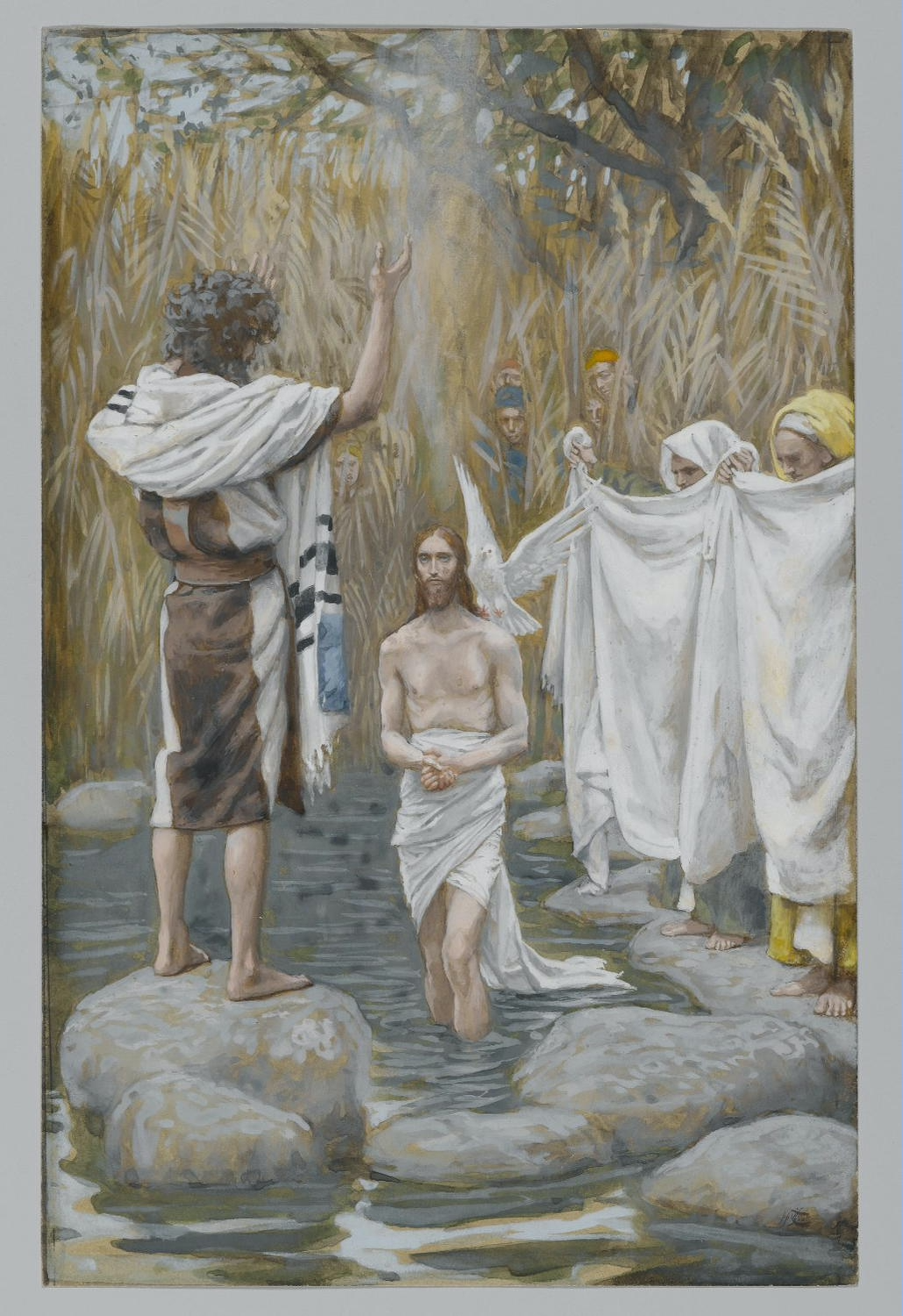
Judgement is real, and it should make us stop and think for a moment. Are we living the way God wants us to? If we are not then we need to repent, we need to say sorry, and we need to live the way that God wants us to live. This is how we flourish as Christians. John the Baptist calls us to make a spiritual u-turn, to turn our life around, and to turn away from our sins, which separate us from God. John calls us to the waters of baptism, so that we can be healed and restored by God, filled with his grace, and prepared to receive the Holy Spirit:

“I baptize you with water for repentance, but he who is coming after me is mightier than I, whose sandals I am not worthy to carry. He will baptize you with the Holy Spirit and fire” (Mt 3:11).

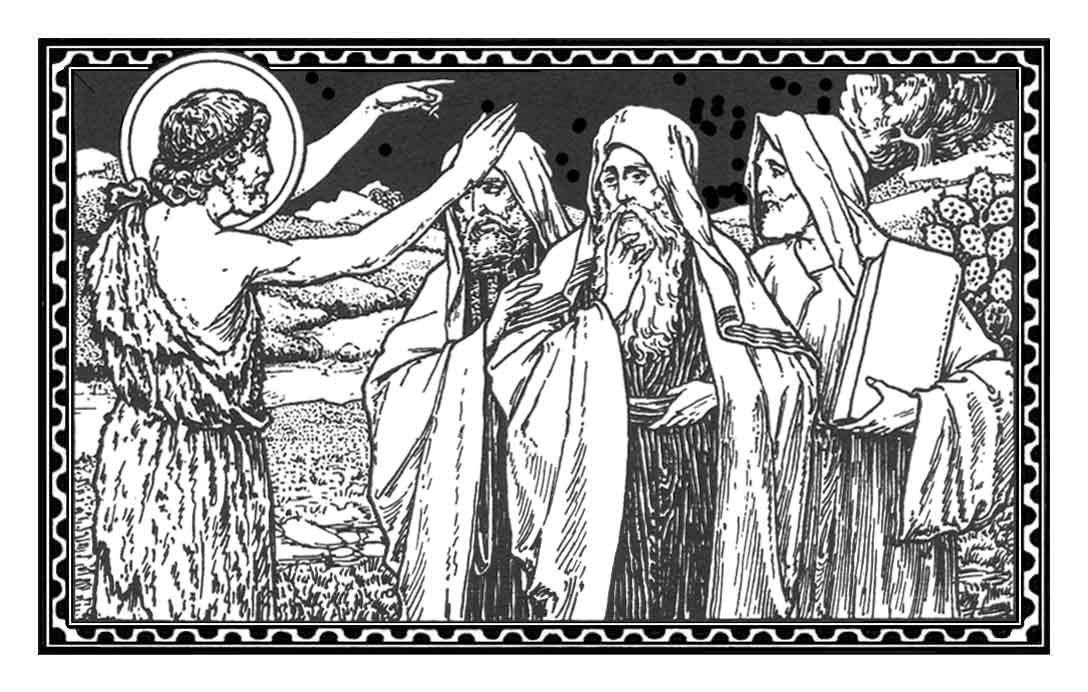
The problem with the Pharisees and Sadducees who come to John is that they do not show any repentance. They haven’t made the necessary u-turn, and they do not have the humility to recognise their own sinfulness, and their need to be washed in the waters of baptism. They, therefore, do not possess the right attitude to allow God to be at work in their lives.

As well as recognising Jesus as our Saviour, John the Baptist sees Him as Our Judge. John points to the second coming of the Lord when, as St John of the Cross puts it, ‘we will be judged by love alone’. It is love that matters. In Christ we see what love means. True, deep, love is costly, self-giving and profound. As we are filled with God’s Spirit, nourished by Word and Sacrament, we need to live out this love in our lives. This is how we prepare to meet Jesus as we prepare to celebrate His Birth and look forward to His Second Coming.

So, my brothers and sisters in Christ, let us re-commit ourselves to live out God’s love in our lives. Let us turn away from everything which separates us from God, and from each other. Let us live out deep, costly, and self-giving love in our lives. This is both what Christ and John the Baptist call us to do. By acting in this way we demonstrate to the world around us what our faith means in practice. How our beliefs affect our lives, and why others should follow Jesus, and sing the praises of God the Father, God the Son, and God the Holy Spirit, Duw Dad, Duw y Mab, a Duw yr Ysbryd Glân. To whom be ascribed all might, majesty, glory, dominion, and power, now and forever. Amen.

Advent Sunday

‘Gwisgwch yr Arglwydd Iesu Grist amdanoch’

‘But put on the Lord Jesus Christ.’ (Rom 13:14)

Today is Advent Sunday, the start of the season of Advent. The next four weeks are a time of waiting, of expectation: for the coming of Jesus Christ. Both as we prepare to celebrate His Birth at Christmas, and for the Second Coming of Christ as our Saviour and our Judge. The idea of Jesus’ return has not always been seen as something to look forward to. Judgement has been equated with condemnation, and fear of the coming judgement has been used to control people. Yet, as Christians, we look forward to Our Lord’s Second Coming, just as we look forward to our annual celebration of His First Coming, at Christmas.

In today’s Gospel Jesus is teaching His disciples about the end times. Our Lord draws a comparison between the Last Day and the Flood:

‘For as were the days of Noah, so will be the coming of the Son of Man. For as in those days before the flood they were eating and drinking, marrying and giving in marriage, until the day when Noah entered the ark, and they were unaware until the flood came and swept them all away, so will be the coming of the Son of Man.’ (Mt 24:37-39)

The point is that, just like the arrival of the Great Flood, no-one knows when the Last Day is going to happen. People are carrying on with their lives as normal. It is an unexpected event. One of the reasons Noah was saved was that he was prepared. He had built an ark. Our ark is the Church, which we enter through Baptism. For us the waters bring life not death. We are ready, and preparation is the key to Jesus’ message. Whenever the Lord comes, we need to be in a fit state to meet Him. 

How do we prepare? By following the advice in the first reading from the prophet Isaiah:

‘O house of Jacob, come, let us walk in the light of the Lord.’ (Isa 2:5)

If we walk in the light of the Lord, then we are not walking in darkness. We live out our faith in our lives, and our moral characters are formed by our behaviour. We become what we do often in our actions.

About sixteen hundred years ago, one of Christianity’s great figures, St Augustine, had been struggling towards the journey of faith. One day, as he sat under a fig tree, he kept hearing a child say, ‘Pick up and read’ (Aug. Conf. 8.29). And so he opened a Bible and read in the Letter to the Romans:

‘Not in revelling and drunkenness, not in debauchery and licentiousness, not in quarrelling and jealousy. But put on the Lord Jesus Christ, and make no provision for the flesh, to gratify its desires.’ (Rom 13:13-14)

Drunkenness, fornication, the sort of behaviour often associated with the Christmas Office Party in particular, and the modern society in general, can be dismissed as ‘just a bit of fun’ or of ‘no consequence in the great scheme of things’. However, what we do affects our lives: we become what we do often. The Christian Life is most definitely not a ‘fun-free zone’. Rather, it is a way of being which allows us to be fully alive; doing what we should be doing in the way we should be doing it. Today’s world is filled with examples of the behaviour which St Paul sees as problematic: people being quarrelsome and subject to baser appetites. One need only read a newspaper, look at the Internet, or turn on the television, to see a world which has got things wrong, in which we are not living decently. Our lives, our characters, are formed by what we think and do, by the decisions we make. This is a cumulative process, where we build on the choices we have made in the past. Therefore, we need to start down the right path as soon as possible, or turn back if we have gone astray.

The first reading, from the prophet Isaiah, looks forward to a Messianic Age of peace:

‘and they shall beat their swords into ploughshares, and their spears into pruning-hooks; nation shall not lift up sword against nation, neither shall they learn war any more.’ (Isa 2:4)

Swords and spears will be turned into agricultural tools for ploughing fields and cultivating vines.They will no longer be used for warfare, but instead for growing grain and grapes, to make bread and wine. These are the very foodstuffs Our Lord takes at the Last Supper, when He institutes the Eucharist. This feast of thanksgiving is the fulfilment of Isaiah’s prophecy, and represents the Messianic Kingdom where love will triumph over violence.

At this time of year, The Church prepares for three comings: the first is our annual commemoration of Jesus’ birth in Bethlehem, at Christmas, where the Word became flesh and dwelt among us. The second coming of Christ will be at the end of time, when He will be our Saviour and our Judge. The third coming we prepare for is even nearer. It happens day by day, and week by week, when Christ comes to us in the Eucharist, through His Body and Blood, under the outward forms of Bread and Wine. This is the Feast of the Kingdom, anticipated by the ploughshares and pruning hooks of Isaiah: tools used to help produce Bread and Wine. Isaiah’s prophecy looks forward to the peace of the Messiah and the banquet of Bread and Wine. These are the Foods of the Kingdom, which provide nourishment for our journey of faith, and give us strength and new life in Christ. Jesus comes to us in the Eucharist to fortify us, and to transform us into His likeness; to help us to live out our faith in the whole of our lives.

So, my brothers and sisters in Christ, let us prepare to meet Our Lord by living out our faith, in all aspects of our lives , nourished with Word and Sacrament. The time is short. The time is now. How we live really matters. We need to grow in the Lord, to learn His ways and walk in His paths. As Christians, we are called to live decently and vigilantly, preferring nothing to Christ, and inviting all the world to come to the fullness of life in Him. This is how we prepare for His coming at Christmas and as Our Saviour and Judge. By following Jesus, and being fed by Him, we are restored and healed by Him. And so, on this Advent Sunday, we sing the praise of God the Father, God the Son, and God the Holy Spirit, Duw Dad, Duw y Mab, a Duw yr Ysbryd Glân. To whom be ascribed all might, majesty, glory, dominion, and power, now and forever. Amen.
Fra Angelico The Conversion of St Augustine, [Musée Thomas-Henry, Cherbourg-en-Cotentin, France]

Saint Katharine, Virgin & Martyr

In the middle of the Sinai Peninsula in Egypt lies the famous monastery of St Katharine. It is the oldest monastery in continuous existence, and was founded by the emperor Justinian in the sixth century AD. It was built in the desert on the site of the Burning Bush, where God appeared to Moses. The monastery holds a collection of manuscripts in its library that is second only to the Vatican. And it is in this monastery that the bones of our patron, St Katharine of Alexandria, Virgin and Martyr, are enshrined.

Katharine is believed to have been the daughter of a fourth-century Roman Governor of Egypt, and became a Christian as a child. She was known for her intelligence and learning; she studied much and asked her tutors many questions. Around the year AD 305, when she was about 18 years old, she was arrested, and tortured, but her faith in God was strong and helped to convert people to Christianity. She engaged in dialogue and dispute with pagan intellectuals and refuted them, causing some of them to convert to Christianity. The Roman Emperor Maxentius offered her a proposal of marriage, which she refused, saying that she was a bride of Christ. The emperor, enraged, ordered her to be killed by being broken on a wheel. The wheel shattered when Katharine touched it, whereupon she was beheaded. Some scholars have disputed her existence. However, regardless of this question, (which cannot be proved), she has been an important focus for Christian devotion for nearly seventeen hundred years.

In the Roman Empire, until Constantine issued the Edict of Milan in AD 313, you could be condemned to death for simply being a Christian. It was expected that everyone would worship the Emperor as a living god, by offering prayer and worship, and burning incense before an image of him. Christians cannot do this, as we worship God alone. Faced with a choice, St Katharine was prepared to die, rather than worship a false god. Her fortitude inspires us to take our faith seriously and to prefer nothing to Christ.

It is common in Britain for public buildings to display a picture of the reigning monarch. For most of our lives this was the late Queen Elizabeth II, and now it is King Charles III. If, however, you were required by law under pain of death to worship the King as a god and burn a pinch of incense before his image, we would all, rightly, refuse. We are Christians and we worship God alone. Such was the reality in the world inhabited by Katharine, and countless other Christian martyrs. They were faced with a difficult choice: either to conform to the will of the state, or to die. They chose to bear witness to their faith. Followers of Christ would pray for the emperor, however, they could not pray to him. 

It is hardly surprising that the calm and dignified manner of many early Christians won admiration from the world around them. The Roman Empire valued philosophical detachment and public service, and Christians excelled at both of these things. However, it was the manner that Christians faced death, at the hands of the state, which inspired people.

In Medieval Europe, St Katharine was extremely popular, and devotion to her grew after the Crusades. She was made patron saint of students, teachers, librarians, and lawyers. St Katharine was one of the Fourteen Holy Helpers, along with St Agathius, St Barbara, St Blaise, St Christopher, St Cyriacus, St Denis, St Elmo, St Eustace, St George, St Giles, St Margaret of Antioch, St Pantaleon, and St Vitus. Some of these names are very familiar, and their popularity as Christian names, is testament to their continued importance as the basis of our culture. St Catharine bore witness to her faith in Jesus Christ. Her relationship with Him was the most important thing in her life. She is a model of faithful prayer and fortitude: trusting in God to bring good out of any situation.

The teaching of the Gospel passage set for today is clear. We are called to acknowledge Jesus Christ as Lord, regardless of the cost. Katharine could have saved her life by submitting and worshipping the Emperor, but she chose not to. Instead she proclaimed that Jesus is Lord, and not Caesar in Rome. And for this she paid with her life.

It is a fundamental truth of the Christian Religion that Love, Obedience, and Suffering go hand in hand — they are costly. Following Christ means embracing the suffering which comes from love and obedience, and bearing witness to the truth that God gave His life for us all, and may ask the same of us. The God whom we worship did not just die upon a Cross, but rather was raised to New Life. St Katharine knew Our Lord and trusted His promises. She now shares His Risen Life, and she calls us to follow Christ, to trust Him, and to love him. 

May we then, today and every day, be inspired by the example and witness of St Katharine, and may we follow her example and sing the praises of Our Divine Lord, God the Father, God the Son, and God the Holy Spirit, Duw Dad, Duw y Mab, a Duw yr Ysbryd Glân. To whom be ascribed all might, majesty, glory, dominion, and power, now and forever. Amen.
Raphael: St Catharine [The National Gallery, London]

All Saints: Living the Beatitudes

I have an important message for you all this morning: God has a plan for your life! Now, you may well have heard these words before, possibly from someone preaching a sermon, but they contain a profound truth. They are found in the Bible, in words that God speaks through the prophet Jeremiah:

For I know the plans I have for you, declares the Lord, plans for welfare and not for evil, to give you a future and a hope.

Oherwydd myfi sy’n gwybod fy mwriadau a drefnaf ar eich cyfer, medd yr Arglwydd, bwriadau o heddwch nid niwed, i roi ichwi ddyfodol gobeithiol. (Jer 29:11)

It can be hard to hold onto such a promise, especially when times are difficult and the outlook is bleak. We need to ask ourselves the question, ‘Do we trust God?’ If the answer is ‘Yes’ then, whatever difficulties or hardships may come our way, we know that our future is in safe hands.

Fundamentally, the point of being a Christian is to reside in Heaven. Such a destination is possible because of what Jesus Christ has done for us, out of love. This is the plan God has for our life, and this is why Jesus became man, lived, died, and rose from the dead. God shows us both how to live, and what He desires for us. We can have faith, and put our trust in the God who loves us, in the clear hope that, after our earthly life is over, we may enjoy eternity with God and the Saints in Heaven. Most of all, in this hope, we can live earthly lives of love, loving both God and each other, foreshadowing the eternal joys of Heaven. 

In our current culture we are not used to hearing such a message. There is a tendency to think that holiness is for other people, certainly not for us. But God wants each and every one of us to become a saint. He wants us to live in a world full of people trying to be saints. The Church is ‘a school for saints’ (which is peopled by sinners), in which Christians try to live out their faith, cooperating with the grace of God. We do this when we let Christ live in us, so that we can say with the Apostle Paul:

‘It is no longer I who live, but Christ who lives in me.’

‘a mwyach, nid myfi sy’n byw, ond Crist sy’n byw ynof fi.’ (Gal 2:20)

There is a paradox at work here. For when we truly let Christ live in us, we do not lose ourselves, but instead we discover who we really are. This enables us to become the people God wants us to be; the people we were created to be. As Jesus says in Matthew’s Gospel:

For whoever would save his life will lose it, but whoever loses his life for my sake will find it.

Oherwydd pwy bynnag a fyn gadw ei fywyd, fe’i cyll, ond pwy bynnag a gyll ei fywyd er fy mwyn i, fe’i caiff. (Mt 16:25)

Today the Church celebrates the Feast of All Saints. On this day, in the eighth century ad, Pope Gregory III dedicated a chapel to All Saints in St Peter’s Basilica in Rome, and now there are many Churches with this dedication. It is a good thing to celebrate the fact that Heaven is full of saints. They are the Church Triumphant, who spend eternity praising God and praying for us. Just as we pray for our friends here on earth, it stands to reason that our friends in Heaven pray for us as well. It is reassuring to understand that we are not alone in our quest to reach Heaven, and to know that those who are already there long for us to join them. 

If Heaven is our goal, how then should we live our lives on earth? Thankfully today’s Gospel gives us a template to follow, an example of what a Christian life looks like. 

We constantly hear how the world around us values success and confidence, and looks up to the rich, and the powerful. In contrast to this, Jesus says to the gathered crowd:

“Blessed are the poor in spirit, for theirs is the kingdom of heaven.”

“Gwyn eu byd y rhai sy’n dlodion yn yr ysbryd, oherwydd eiddynt hwy yw teyrnas nefoedd.” (Mt 5:3)

‘Poor in spirit’ is not a term we are used to using today, but it means the exact opposite of pride. Jesus places humility as key to living a Christian life: knowing who we are, and our need for God. Only if we rely upon God, and not ourselves, and ask Him to work through us, can we truly live out the Christian life. 

“Blessed are those who mourn, for they shall be comforted.”

“Gwyn eu byd y rhai sy’n galaru, oherwydd cânt hwy eu cysuro.” (Mt 5:4)

We mourn those we love, those whom we see no longer in this life. We do so because we love them, we miss them, we want to see them, and hold them, and talk to them. Our parting, while temporary, is still very painful. Thankfully the Kingdom of God, which Christ comes to bring, is a place of healing and comfort with the promise of eternal life. 

“Blessed are the meek, for they shall inherit the earth.”

“Gwyn eu byd y rhai addfwyn, oherwydd cânt hwy etifeddu’r ddaear.” (Mt 5:5)

Gentle people are not weak: they know how to use their strength, and how not to use it. As Jesus will later say in Matthew’s Gospel: ‘Take my yoke upon you, and learn from me, for I am gentle and lowly in heart, and you will find rest for your souls.’ ‘Cymerwch fy iau arnoch a dysgwch gennyf, oherwydd addfwyn ydwyf a gostyngedig o galon, ac fe gewch orffwystra i’ch eneidiau.’ (Mt 11:29). This is how God wants us to live as human beings. Christ is the example of gentleness we must follow. Once again, God’s vision of the future turns human expectations upside down. 

“Blessed are those who hunger and thirst for righteousness, for they shall be satisfied.”

“Gwyn eu byd y rhai sy’n newynu a sychedu am gyfiawnder, oherwydd cânt hwy eu digon.” (Mt 5:6)

Should we be devoted to God? Absolutely! Should we pray that His will is done on earth as it is in Heaven? Definitely! Jesus taught us to pray this way. Clearly God wants to see our world transformed and has invited us to help in the process; and doing so gives us fulfilment.

“Blessed are the merciful, for they shall receive mercy.”

“Gwyn eu byd y rhai trugarog, oherwydd cânt hwy dderbyn trugaredd.” (Mt 5:7)

We see what God’s mercy looks like in Christ’s death for us on the Cross. In following Christ’s example, we both ask for forgiveness for our own sins, and forgive those who sin against us. This forgiveness can transform us and the world around us, and it is how the healing and reconciliation of God’s Kingdom functions. 

“Blessed are the pure in heart, for they shall see God.”

“Gwyn eu byd y rhai pur eu calon, oherwydd cânt hwy weld Duw.” (Mt 5:8)

To be pure in heart is to want what God wants: to align our will with the will of God. It is to be saintly, and thus have the promise of Heaven, which is less of a place or a time, and much more a relationship. To see God is know Him, and to know His love for us. This is the very thing that Christ comes to restore to humanity, and it is our hope. 

“Blessed are the peacemakers, for they shall be called sons of God.” 

“Gwyn eu byd y tangnefeddwyr, oherwydd cânt hwy eu galw’n feibion i Dduw.”(Mt 5:9)

First and foremost, we know that Christ is the Son of God because He made ‘peace by the blood of his cross’ ‘ar ôl gwneud heddwch trwy ei waed ar y groes’ (Col 1:20). We too are called to follow Christ’s example to take up our Cross, and work for peace. We are called to strive for peace in our own hearts and lives, in our families and communities, and in our world.

“Blessed are those who are persecuted for righteousness’ sake, for theirs is the kingdom of heaven. Blessed are you when others revile you and persecute you and utter all kinds of evil against you falsely on my account.”

“Gwyn eu byd y rhai a erlidiwyd yn achos cyfiawnder, oherwydd eiddynt hwy yw teyrnas nefoedd. Gwyn eich byd pan fydd pobl yn eich gwaradwyddo a’ch erlid, ac yn dweud pob math o ddrygair celwyddog yn eich erbyn, o’m hachos i.” (Mt 5:10-11)

Following Jesus will not, by default, make us popular. Often people’s response is quite the opposite. If, however, we want to see God’s Kingdom as a reality in this life and the next, then we must be prepared to be shunned, or even ridiculed by others. To follow Christ is to take up the Cross, and to expect persecution. But we are not alone in this. Christ has gone before us, showing us that the story does not end with Death on a Cross, but with the glory of the Resurrection and Eternal life. 

If we want to become saints, then we have to be like Christ. We have to share in His suffering and death, and we have to be prepared to be rejected by the world. We may not face imprisonment, torture and death in this country, but many Christians around the world do. However, we may be scorned, ignored, or criticised. What do we do in such circumstances? We are called to be loving, generous, and forgiving, because that is what Jesus has shown us. We can be different to the world around us because we belong to a new community — the Kingdom — a community of faith, built on our relationship with Jesus Christ, who came to save humanity from itself. Our Lord came so that we might have life in all its fullness.This is what the Beatitudes mean. By living the life of God’s Kingdom in this place and at this time, we can live the life of Heaven (here and now) on earth. This is what God wants us to do. It is the way Jesus has showed us how to live. It is what the Saints have done before us.

So, on this feast of All Saints, let us be filled with faith and joy, and let us be ready to conform our lives to God’s will. May we live the life of the Kingdom together, and encourage others, so that all may join the choirs of Heaven to sing the praise of God the Father, God the Son, and God the Holy Spirit, Duw Dad, Duw y Mab, a Duw yr Ysbryd Glân. To whom be ascribed all glory, dominion and power, now and forever. Amen

James Tissot, The Sermon on the Mount, Brooklyn Museum

Epiphany 2025

IN Britain there is a tradition that royal births are announced by a notice placed on an easel outside Buckingham Palace. When the present King was born in 1948 the notice read: ‘Buckingham Palace November 14th, The Princess Elizabeth, Duchess of Edinburgh was safely delivered of a prince at nine fourteen pm today. Her Royal Highness and her son are both doing well.’ Historically, royal births were witnessed by important people. They were public occasions rather than private ones. Everyone wants to know what is happening. 

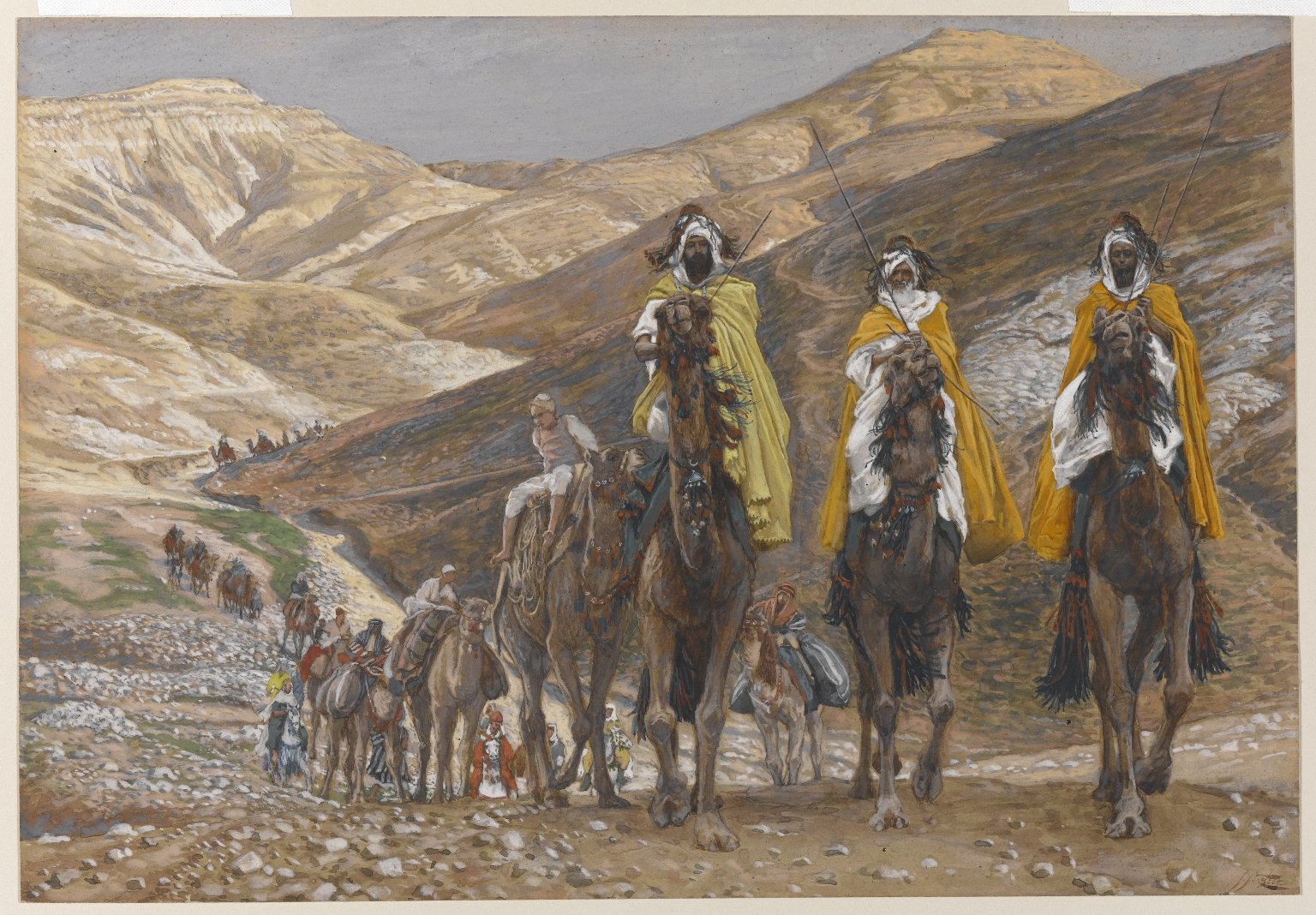
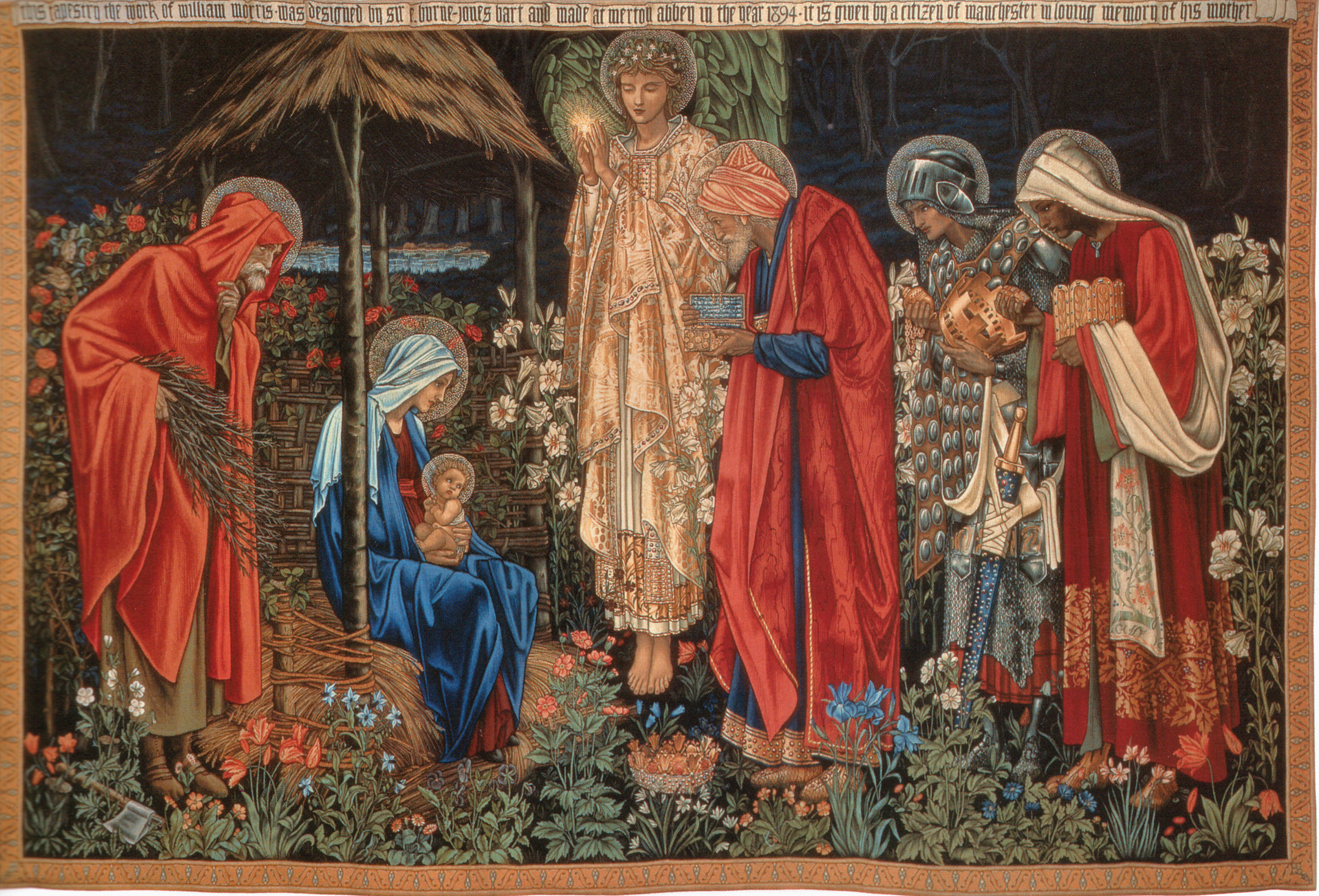
Meanwhile, out in the East, in what is now modern day Iraq and Iran, astrologers noticed something in the sky. This phenomenon possibly involved Jupiter and either Saturn, or the star Regulus in the constellation Leo. It was a significant astronomical event, which signified a royal birth. These Magi travelled to Judaea, as that was the direction that the celestial sign was pointing them towards. As they were looking for a royal birth, their first stop was, naturally, the palace. When they arrived at Herod’s palace they asked:

‘Ble mae’r hwn a anwyd yn frenin yr Iddewon? Oherwydd gwelsom ei seren ef ar ei chyfodiad, a daethom i’w addoli.’

‘Where is he who has been born king of the Jews? For we saw his star when it rose and have come to worship him.’ (Mt 2:2)

They make a reasonable statement, but their words have a strange effect:

‘A phan glywodd y Brenin Herod hyn, cythruddwyd ef, a Jerwsalem i gyd gydag ef. Galwodd ynghyd yr holl brif offeiriaid ac ysgrifenyddion y bobl, a holi ganddynt ble yr oedd y Meseia i gael ei eni’

‘When Herod the king heard this, he was troubled, and all Jerusalem with him; and assembling all the chief priests and scribes of the people, he enquired of them where the Christ was to be born’ (Mt 2:3-4)

News of a royal birth is troubling to Herod, an Aramean who bought the right to be king by paying the Romans. He was very concerned by questions of legitimacy because his own claim was based on shaky ground. Herod’s religious experts then explain where the child will be born, quoting a prophecy of Micah, which we heard on the Fourth Sunday of Advent:

“Ym Methlehem Jwdea, oherwydd felly yr ysgrifennwyd gan y proffwyd: ‘A thithau Bethlehem yng ngwlad Jwda, nid y lleiaf wyt ti o lawer ymysg tywysogion Jwda, canys ohonot ti y daw allan arweinydd a fydd yn fugail ar fy mhobl Israel.'”

‘In Bethlehem of Judea, for so it is written by the prophet: “And you, O Bethlehem, in the land of Judah, are by no means least among the rulers of Judah; for from you shall come a ruler who will shepherd my people Israel.”’ (Mt 2:5-6)

Bethlehem, the city of David, is where a King of the lineage of David will be born. A Davidic King poses a huge threat to Herod. There could be an uprising, and regime change. Herod needs to know what is going on. Since knowledge is power, he sends the Magi off to find the child and to report back.

What looks like a simple and straightforward enquiry is actually the first part of a plan to eliminate this potential threat to Herod’s rule. This will later be carried out in the Massacre of the Innocents — the wholesale slaughter of young male children in Bethlehem. Herod certainly has no intention of relinquishing his power, his behaviour is a sham. The Wise Men then leave the royal palace and head for Bethlehem.

‘a dyma’r seren a welsent ar ei chyfodiad yn mynd o’u blaen hyd nes iddi ddod ac aros uwchlaw’r man lle’r oedd y plentyn. A phan welsant y seren, yr oeddent yn llawen dros ben.’

‘And behold, the star that they had seen when it rose went before them until it came to rest over the place where the child was. When they saw the star, they rejoiced exceedingly with great joy.’ (Mt 2:9-10)

The Magi have journeyed hundreds of miles because they saw a celestial event. Now this heavenly light is above Bethlehem, and the travellers have reached the new-born King. 

‘Daethant i’r tŷ a gweld y plentyn gyda Mair ei fam; syrthiasant i lawr a’i addoli, ac wedi agor eu trysorau offrymasant iddo anrhegion, aur a thus a myrr.’

‘And going into the house they saw the child with Mary his mother, and they fell down and worshipped him. Then, opening their treasures, they offered him gifts, gold and frankincense and myrrh.’ (Mt 2:11) 

Gold, frankincense, and myrrh seem to us unusual presents. They are, however, all expensive, costly, and precious things, and therefore suitable royal gifts. These offerings were prophesied by Isaiah: 

‘byddant i gyd yn cludo aur a thus, ac yn mynegi moliant yr Arglwydd.’

‘They shall bring gold and frankincense, and shall bring good news, the praises of the Lord’ (Isa 60:6)

Gold, is a precious metal, which is pure and does not tarnish. It is a gift fit for a king. Gold’s purity points to a life of perfect obedience, the pattern of how life should be lived. Incense, from Arabia, was offered to God in the Temple in Jerusalem. As the sweet-smelling smoke rose, it looked like prayers rising to God. Frankincense is a sign of worship, and honour, representing how humanity should respond to God. Myrrh was often a component of the ointment used for embalming bodies. These three gifts given at Jesus’ birth point to Christ’s kingly power, and His role in worship as our great High Priest, which leads to His to Death and Burial.

The Wise Men are warned by a dream not to go back to Herod, and not to tell him who Jesus is. This is because the Judean king does not want to worship Jesus, he wants to kill Him, and safeguard his own position. And so the unexpected visitors leave as mysteriously as they arrived. These pilgrims from afar gave Our Lord gifts which celebrate His Humanity and Divinity, and which look forward to His Death and Resurrection. The beginning of Jesus’ earthly life looks to its end, because it is all part of the outworking of salvation history.

The events that we are celebrating today were prophesied by Isaiah in the first reading this morning:

‘Cod, llewyrcha, oherwydd daeth dy oleuni; llewyrchodd gogoniant yr Arglwydd arnat.’

‘Arise, shine, for your light has come, and the glory of the Lord has risen upon you’ (Isa 60:1)

The birth of the Messiah is a sign of God’s glory, and the salvation He will bring for all people: 

‘Fe ddaw’r cenhedloedd at dy oleuni, a brenhinoedd at ddisgleirdeb dy wawr.’

‘And nations shall come to your light, and kings to the brightness of your rising’ (Isa 60:3)

These pilgrims are the Magi, the Wise Men, the Kings who represent the entire Gentile (non-Jewish) World. They have come to worship God born among us. The travellers recognise who it is they have come to see, and their gifts fulfil Isaiah’s prophecy. What might appear strange at first sight is, in fact, both apt and right: to worship God and honour a King, and to recognise the Saviour in their midst. Today, the World recognises the Birth of Jesus Christ, and the mystery of salvation is proclaimed to all.

Likewise, as we celebrate the Feast of the Epiphany, we also look forward.Both to Our Lord’s Baptism in the River Jordan and to His first miracle at the Wedding at Cana. Christ, He who is without sin shows humanity how to be freed from sin and to have new life in Him.

So, today, as we continue to celebrate Jesus’ birth, let us raise our voices to join with the wise men in giving praise and honour to God the Father, God the Son, and God the Holy Spirit. To whom be ascribed all glory, dominion and power, now and forever. Amen.

Remembrance Sunday 2024

When I was at school we had an educational trip to Normandy and stayed at Arramanches. The hotel was near the beach which formed a section of ‘Gold Beach’, part of the Normandy Landings. One of the temporary Mulberry Harbours, built by the Allies could still be seen in the sea. A highlight of the trip was a visit to Bayeux, both to see the tapestry and also to visit the British Military Cemetery. Bayeux War Cemetery contains the graves of nearly five thousand British and Commonwealth soldiers who died on the beaches of Normandy, some eighty years ago. There is something deeply profound and moving about being confronted with the scale of death and sacrifice made during the Normandy Campaign and in other theatres of war. It makes us realise that the freedom, peace, and security we now enjoy comes at a huge cost.

Today we give our thanks to Almighty God for all who have served and died for our country, and also for the peace in which we currently live. We give thanks for those who continue to serve and protect us, putting their lives on the line to keep us safe. We also give thanks for the work of the Royal British Legion, who, for over a hundred years, have raised money to support veterans, and to keep alive the memory of those who died. We wish them continued success in their important work.

As we recall the sacrifice made by people from the villages in which we live, from this country, and from all over the world, our remembrance must be an active one which has an effect on our lives. We remember the generosity of those who gave their lives to ensure that we can live free from warfare and suffering. Such generosity must leave a mark on our lives, and help us to learn from the mistakes of the past, and do all that we can to prevent them from being repeated in the future.

The concept of peace is not simply the absence of war, but rather the right ordering of the world around us. It means living the way God wants us to live. That stands for living in harmony, and love, one with another, and forgiving each other. In this morning’s reading from Matthew’s Gospel, Our Lord says:

‘Gwyn eu byd y tangnefeddwyr: oherwydd cânt hwy eu galw’n feibion Duw’

‘Blessed are the peacemakers, for they will be called sons of God’ (Mt 5:9)

Peacemaking is costly and difficult. That is because it is rooted in sacrifice and forgiveness. However, there is no other way to bring about the peace for which we long. The greatest example we have of such forgiveness and sacrifice is the Cross. Here Jesus demonstrates to humanity how much we are loved by God, and the lengths to which the Son of God is prepared to go to show the world love, and to reconcile people both to God and to each other. 

The story does not end there. Jesus’ Death is followed by His Resurrection, on Easter Day, Sul y Pasg. Christ offers humanity the gift of eternal life, so that in Him our lives are changed and not ended. Christians believe that our earthly life is a prelude to our hope of eternity in Heaven, in the close presence of God.

This is how we should understand our life on earth: as a preparation for the life to come. When we listen to Christ’s teaching in the Sermon on the Mount, we find in Our Lord’s words a template for how we should live, as people of love and generosity. Such a lifestyle is consistent with the vision of the prophet Isaiah. He looks forward to a time when the wolf will lay with the lamb, and when swords will be beaten into ploughshares. God is ultimately responsible for such things, but we have our part to play as well — helping to make the Kingdom of God a reality. God’s Kingdom is a place of love, forgiveness, and reconciliation. A place where wounds are healed, and humanity is restored by Our Lord and Saviour Jesus Christ. Who offered Himself so that we might live, and enjoy life in all its fulness.

My brothers and sisters, we are all called to cooperate with God and with each other, so that our lives are characterised by the love and service we see in Christ. This same love and service is shown by those who gave their lives so that we might enjoy the peace and freedom for which they longed. We are grateful, and we gather to remember them, and the peace which they won at so great a cost. We take time to reflect upon their example and dedicate ourselves to continuing what they started — bringing comfort to those who mourn, and striving for a world characterised by justice and peace. We do so together, knowing that our efforts honour the injured and the fallen. 

Therefore, let all of us gathered here today follow Jesus to the Cross and beyond. Let us live out God’s love, mercy, and service in our own lives. Let us take care of each other, and honour the memory of those who have gone before us.

We will remember them.

Ni â’u cofiwn hwy. 

Trinity Sunday 2024: Transformed by God’s Love: Exploring the Trinitarian Faith and Sacramental Life

WE are all extremely fortunate to live in North Pembrokeshire for many reasons, and especially because we are close to so many hills. Mountains and hills take a lot of effort to climb, but once you have ascended, you can see for miles around. Hilltops are special places, and today’s Gospel takes place on one. Also, many other important and significant moments in Matthew’s Gospel take place on mountains including the Temptation, the Sermon on the Mount, the Transfiguration, and the Crucifixion. Our Lord also speaks His final words before his Ascension on a hilltop. 

Last Sunday we celebrated Pentecost, the outpouring of the Holy Spirit upon the Church: a revelation of who God is, and how much God loves us, His people. This week we continue to meditate upon God’s love. This love forms a relationship so intimate that God is closer to us than we are to ourselves — that is something quite hard to get our heads around! Above all, God’s love is something to be experienced, rather than understood. Through this experience God transforms us, so that we can experience that love more fully, and finally enjoy it for eternity, in Heaven.

In today’s Gospel Jesus’ disciples have been told to go to Galilee, to a particular mountain, to meet the Risen Lord. They are obedient, and head north from Jerusalem. When the disciples arrive at the mountain, they see Our Lord and bow down and worship Him — just like the Wise Men did at His birth. Some of the apostles, however, doubt. They have not yet fully grasped the reality of the situation: the fact that Jesus has risen from the dead, is preparing to ascend to His Father, and send the Holy Spirit. Before His Ascension, Jesus comes to them, and speaks to them saying:

‘All authority in heaven and on earth has been given to me.’

‘Rhoddwyd i mi, bob awdurdod yn y nef ac ar y ddaear’ (Mt 28:18)

This, at one level, is a grand claim to make. But, it is the fulfilment of a prophecy about the Son of Man made by the prophet Daniel:

‘And to him was given dominion and glory and a kingdom, that all peoples, nations, and languages should serve him; his dominion is an everlasting dominion, which shall not pass away, and his kingdom one that shall not be destroyed.’

‘Rhoddwyd iddo arglwyddiaeth a gogoniant a brenhiniaeth, i’r holl bobloedd o bob cenedl ac iaith ei wasanaethu. Yr oedd ei arglwyddiaeth yn dragwyddol a digyfnewid, ac ni ddinistrir ei frenhiniaeth.’ (Dan 7:14)

Jesus is true God and true man. He fulfils the prophecies of scripture. He also has authority, which He shares with His Church, empowering it to act in His name.

Our Risen Lord tells the disciples to ‘Go therefore’ ‘Ewch, gan hynny’ (Mt 28:19). They are not to stay put, but are called to be active in the world. The Church is given a mission to: ‘make disciples of all nations’ ‘gwnewch ddisgyblion o’r holl genhedloedd’ (Mt 28:19). The disciples, having been taught by Jesus, are empowered to teach the faith to others. The Church has a universal mission. No-one is to be excluded or left out. As well as being proclaimers of the faith, the apostles are also instructed to baptize new converts:

‘baptizing them in the name of the Father and of the Son and of the Holy Spirit’

‘gan eu bedyddio hwy yn enw’r Tad a’r Mab a’r Ysbryd Glân’ (Mt 28:19)

This small detail is important. It matters. From the very beginning, the Christian Faith is a Trinitarian Faith. We believe in One God, who is Father, Son, and Holy Spirit. Three persons, bound together in love, who invite the world to be in a relationship with Them.

Our Eucharist this morning began, ‘Yn enw’r Tad, a’r Mab, a’r Ysbryd Glân, In the name of the Father, and of the Son, and of the Holy Spirit’, because this is the God whom we worship. We express our belief in the words that we use, and also in our actions. Our deeds show in a physical way what we believe. As Christians, we are called to live out the faith of our baptism in our lives. God, who is love, has shown that love to the world through His Son, Jesus Christ, and in the sending of the Holy Spirit. To be a Christian is to have encountered that love, and been changed by it. We are changed in our baptism, when we are born again to new life in Christ. Also, we are changed each and every time we receive Holy Communion. By God’s grace, Communion, whether physical or spiritual, transforms us. Through this Sacrament we are united with Christ, so that we may become what He is, and share in the love which is the life of God.

Before Our Lord leaves His disciples He makes them a promise:

‘And behold, I am with you always, to the end of the age.’

‘Ac yn awr, yr wyf fi gyda chwi bob amser hyd ddiwedd amser.’ (Mt 28:20)

We are not alone. Christ is with us. He hears our prayers, and speaks to us in Scripture. This is very comforting to know. Jesus is with us in three ways. Firstly, through the sending of the Holy Spirit. Secondly, by being in the Church, which is His Body, and of which He is the Head. And thirdly, in the Sacraments which are outward signs of inward spiritual Grace. All these things are freely given to transform us into children of God. These blessings allow us, and all Christians, to share in the very life of God the Father, God the Son, and God the Holy Spirit. To whom be ascribed all, glory, dominion, and power, now and forever. Amen.

Epiphany 2023

Every year the Oxford English Dictionary creates a shortlist of eight words,  which are ‘chosen to reflect the mood, ethos, or preoccupations of the past year.’ The words are then put to a public vote. In 2023 the word selected to be the Oxford Word of the Year was ‘rizz’. This is a colloquial word meaning ‘style, charm, or attractiveness’, and is a shortened form of the word ‘charisma’. I would like to propose a word of the year for 2024: ‘hope’. Each one of us longs, from the very core of our being, to hear a message of hope. Hope for the future, something to inspire us. Today we continue to celebrate Christ’s birth at Christmas, as we mark the Solemn Feast of the Lord’s Epiphany: His coming into the world to bring hope. Wise men recognise who Jesus is and why He is important. As Christians, we continue to place our hope in the Word made flesh, Jesus Christ, born among us, and now made manifest to the world as its saviour. 

The Feast of Epiphany celebrates the coming of Wise Men from the East who followed a star, looking for a baby, who has been born king of the Jews. They go to Jerusalem, to see King Herod, as they assume that a king will be born to a royal family, in a palace. You cannot fault their reasoning. The Magi see a sign prefiguring a royal birth and go to the place where they think it will occur. Their arrival, however, does not quite have the effect they were expecting:

‘When Herod the king heard this, he was troubled, and all Jerusalem with him; and assembling all the chief priests and scribes of the people, he enquired of them where the Christ was to be born.’ 

‘Ond pan glybu Herod frenin, efe a gyffrowyd, a holl Jerwsalem gydag ef. A chwedi dwyn ynghyd yr holl archoffeiriaid ac ysgrifenyddion y bobl, efe a ymofynnodd â hwynt pa le y genid Crist.’ (Mt 2:3-4)

The wise men assume that the birth of a royal baby is a cause for celebration, but is certainly isn’t for Herod! His family bribed the Romans to gain the throne. They were not related to King David, and they were not even from Israel. So, on hearing the news from the wise men, Herod assembles all the religious and legal experts he can find. He is terrified that his position as king is under serious threat. The child could have a legitimate claim. There could be a revolution and regime change. Herod needs to know where this child will be born.

They told him, “In Bethlehem of Judea, for so it is written by the prophet: ‘And you, O Bethlehem, in the land of Judah, are by no means least among the rulers of Judah; for from you shall come a ruler who will shepherd my people Israel.’” 

‘A hwy a ddywedasant wrtho, Ym Methlehem Jwdea: canys felly yr ysgrifennwyd trwy’r proffwyd; A thithau, Bethlehem, tir Jwda, nid lleiaf wyt ymhlith tywysogion Jwda: canys ohonot ti y daw Tywysog, yr hwn a fugeilia fy mhobl Israel.’(Mt 2:5-6)

Once Herod knows where the child is expected to be born, the next thing is to find out when the birth will take place, and finally to establish who this royal baby is. Bethlehem is the birthplace of the Davidic monarchy: King David was born there, and so was Jesus. The Gospel quotes a prophecy of Micah ‘And you, O Bethlehem, in the land of Judah, are by no means least among the rulers of Judah; for from you shall come a ruler who will shepherd my people Israel.’ (Micah 5:2) to support the claim. 

‘Then Herod summoned the wise men secretly and ascertained from them what time the star had appeared. And he sent them to Bethlehem, saying, “Go and search diligently for the child, and when you have found him, bring me word, that I too may come and worship him.” After listening to the king, they went on their way.’ 

‘Yna Herod, wedi galw y doethion yn ddirgel, a’u holodd hwynt yn fanwl am yr amser yr ymddangosasai y seren. Ac wedi eu danfon hwy i Fethlehem, efe a ddywedodd, Ewch, ac ymofynnwch yn fanwl am y mab bychan; a phan gaffoch ef, mynegwch i mi, fel y gallwyf finnau ddyfod a’i addoli ef. Hwythau, wedi clywed y brenin, a aethant;’(Mt 2:7-9)

Herod claims that he wants to know when the baby was born, so that he may come and worship the infant king. However, he has no intention of relinquishing his power, his behaviour is a sham. The Wise Men leave the royal palace and head for Bethlehem.

‘And behold, the star that they had seen when it rose went before them until it came to rest over the place where the child was. When they saw the star, they rejoiced exceedingly with great joy.’ 

‘ac wele, y seren a welsent yn y dwyrain a aeth o’u blaen hwy, hyd oni ddaeth hi a sefyll goruwch y lle yr oedd y mab bychan. A phan welsant y seren, llawenychasant â llawenydd mawr dros ben’ (Mt 2:9-10)

The Magi have travelled hundreds of miles because they saw a star in the heavens. Now it is above Bethlehem, and they have reached the new-born King. 

‘And going into the house they saw the child with Mary his mother, and they fell down and worshipped him. Then, opening their treasures, they offered him gifts, gold and frankincense and myrrh.’ 

‘A phan ddaethant i’r tŷ, hwy a welsant y mab bychan gyda Mair ei fam; a hwy a syrthiasant i lawr, ac a’i haddolasant ef: ac wedi agoryd eu trysorau, a offrymasant iddo anrhegion; aur, a thus, a myrr.’ (Mt 2:11) 

Gold, frankincense, and myrrh are unusual gifts for a baby, even a royal one. They are, however, all precious and expensive. The first gift, gold, is a precious metal, which is pure and does not tarnish. It is a gift fit for a king. Gold’s purity points to a life of perfect obedience, the pattern of how life should be lived. The second gift is frankincense from Arabia, which was offered to God in the Temple in Jerusalem. As the sweet-smelling smoke rose, it looked like prayers rising to God. Frankincense is a sign of worship, and honour, representing how humanity should respond to God. The final gift, Myrrh, was an ointment, used for embalming. It speaks of death. Even in Jesus’ birth, we see Christ’s kingly power, and His obedience to the will of the Father. We see His role in worship as our great High Priest, which leads Him to Death and Burial.

‘And being warned in a dream not to return to Herod, they departed to their own country by another way.’ 

‘Ac wedi eu rhybuddio hwy gan Dduw trwy freuddwyd, na ddychwelent at Herod, hwy a aethant drachefn i’w gwlad ar hyd ffordd arall.’ (Mt 2:12)

The Wise Men are warned to neither go back to Herod, nor to tell him who Jesus is. This is because Herod does not want to worship Jesus, he wants to kill Him, in order to safeguard his own position on the throne. And so the unexpected visitors leave as mysteriously as they arrived. These pilgrims from afar gave Our Lord gifts which celebrate His Humanity and Divinity, and which point towards His Death and Burial. The beginning of Jesus’ earthly life looks to its end, because it is all part of the outworking of salvation history.

The Wise Men recognise the baby as the Messiah, the one who brings hope. They are gentiles from a distant land and show that the hope that Jesus brings is for all the peoples of the earth. The Magi recognise that the star points to a royal baby, of the House of David. Jesus is the true king, who will give hope and freedom to His people, and all the earth, through His life, death, and Resurrection. Here at the beginning of Christ’s earthly life we can see where it leads. Jesus gives us hope, hope in God who keeps His promises and offers salvation to His people.

So in 2024 let us be filled with the hope, joy and love. Let us give thanks for the Saviour made manifest, and may we proclaim the Good News of Our Salvation. In the name of the Father, the Son, and the Holy Spirit. Amen

James Tissot – The Magi journeying (Brooklyn Museum)