Trinity XIX

When I was studying for my PhD, I was expected to gain experience in giving papers at conferences. After you have given a conference talk, there is a time for the audience to ask questions. What you quickly learn is that some people take a particular delight in posing the most difficult questions. It is the same in all areas of life, and it isn’t much fun answering this line of enquiry. Jesus is constantly running up against people who ask difficult questions. The Pharisees, experts on Jewish religious law, seem to take a particular delight in asking awkward things. They try to catch Our Lord out, to undermine His teaching and credibility. However, they are unable to do so.

In the Gospel today, Jesus and His Disciples are stopped by legal experts, who ask Him a tricky question:

‘Is it lawful for a man to divorce his wife?’

‘oedd ym gyfreithlon i ddyn ysgaru ei wraig’ (Mk 10:2)

Our Lord answers their question with another:

‘What did Moses command you?’

‘Beth a orchmynnodd Moses i chwi?’ (Mk 10:3)

His strategy is a sensible one. They have asked if divorce is lawful, so Jesus refers them to Moses, the giver of the Jewish law. The Pharisees reply that Moses allowed divorce, whereupon Christ proceeds to explain the law to them. He contrasts the present situation with that established by God in the Creation. Marriage is a loving and faithful union which unites two people so they become one flesh. The concept of marriage is used throughout the Old Testament to describe the relationship between God and Israel. 

Later on Jesus’ disciples ask Him about divorce. In His reply Jesus calls marriage after divorce adultery. This represents a strengthening of the position, and has been understood as forbidding what had been previously allowed. What we are dealing with here is an ideal position, which humanity often fails to live up to. Sometimes Our Lord’s teachings are hard. The perfection that God expects of us can appear unattainable. However, this needs to be balanced by the fact that God is a God of love, mercy, and forgiveness. Christianity is a religion of love which recognises that people’s lives are often far from perfect.

Some time later people bring their children for Jesus to bless them. The disciples are unhappy about this and tell the people off. It has been a busy time and they are concerned that Our Lord is tired. Christ, however, rebukes them:

“Let the children come to me; do not hinder them, for to such belongs the kingdom of God. Truly, I say to you, whoever does not receive the kingdom of God like a child shall not enter it.”

“Gadewch i’r plant ddod ataf fi; peidiwch â’u rhwystro, oherwydd i rai fel hwy y mae ternas Dduw yn perthyn. Yn wir, ‘rwy’n dweud wrthych, pwy bynnag nad yw’n derbyn teyrnas Dduw yn null plentyn, nid â byth i mewn iddi” (Mk 10:14-15)

Jesus uses the children to make an important point. If we want to enter the Kingdom of God we have to be like children — simple, trusting, humble, unself-conscious, and dependant on others for our well-being. Our salvation, God’s grace, is a gift which we have to accept. We do not work for it, or earn it. By trying to stop the children coming for a blessing the disciples have overstepped the mark. So Jesus points out that we are all called to be joyful. Children play because it is fun and they love it. For youngsters, play is a serious business, done for its own sake, and no other. The same can be said about worship.

God does not need our praise. Worship is something that we need to do. Christians engage in prayer and worship not to change God, but to change ourselves: so that we might grow and develop, in the same way that children do. We come as children of God to be fed by God, so that we might grow into His likeness. This is the Kingdom, here and now, and we come in childish simplicity to be with God and each other, to learn, to pray, and to be nourished. This is what life is really about. This is what really matters.

That is why today we also hear the account of the Creation of humanity in the second chapter of Genesis. God knows that it is not good for people to be alone. Humanity is made for relationship: male and female, different and equal, made in the image and likeness of God, made for family. There is no greater kinship than the Church, where we are all brothers and sisters in Christ. This is a relationship which extends through space and time, and includes both the living and the dead. The Church family is united in faith, and hope, and love, fed with the bread of Heaven — God’s very self.

My Brothers and Sisters in Christ, we are loved by God, who longs for us to have life in all its fulness. Let us celebrate being members of the family that is the Kingdom, united with God and each other. Let us live lives of compassion and forgiveness, so that we attract others to know, and love, God the Father, God the Son, and God the Holy Spirit. To whom be ascribed all glory, dominion and power, now and forever. Amen.
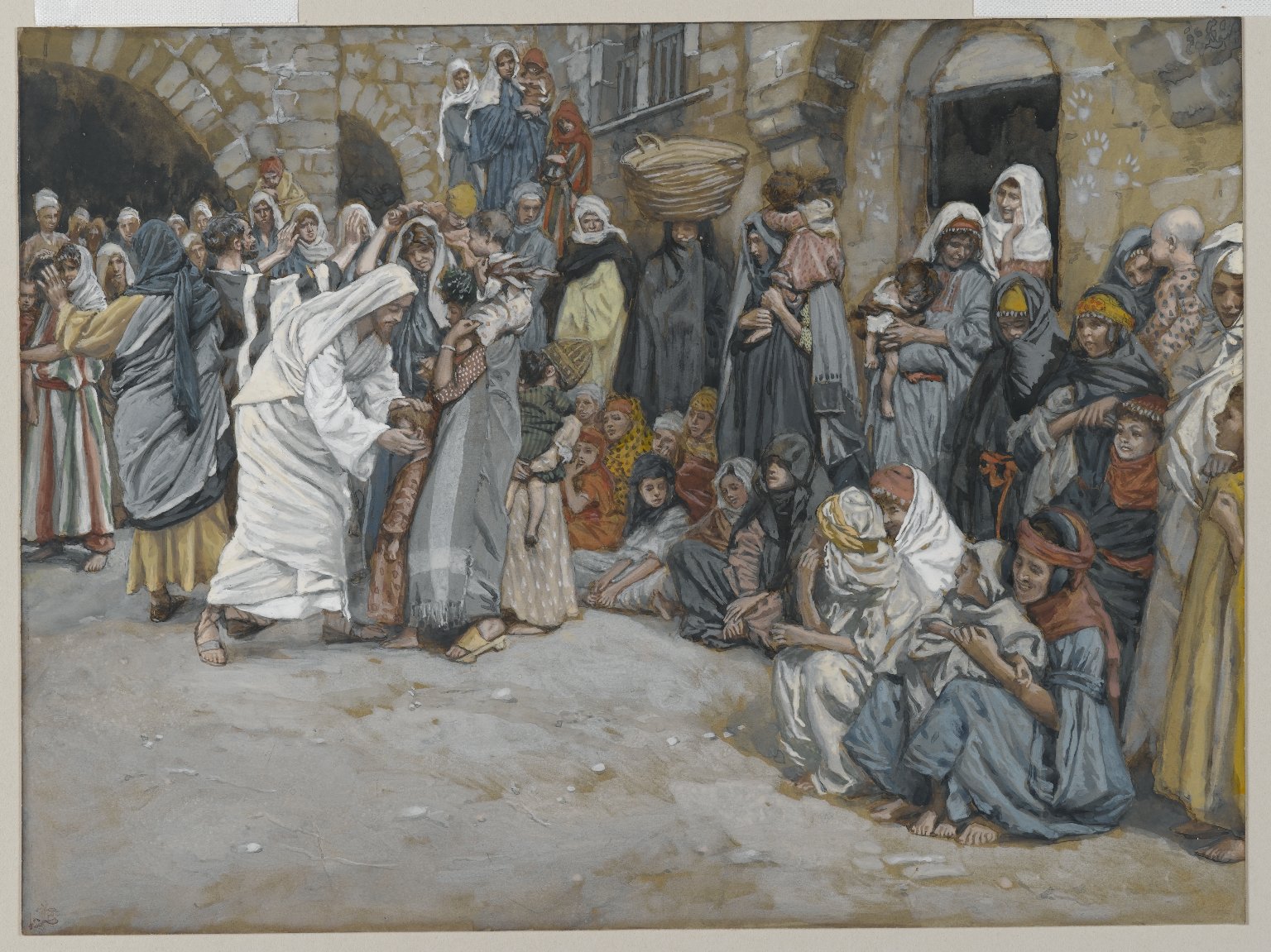
James Tissot: Suffer the little children to come unto me [Brooklyn Museum]

Trinity XIII: Lord, to whom shall we go? You have the words of eternal life!

LIFE in the twenty-first century seems to involve an ever-increasing amount of decisions. If we want to buy a cup of coffee we have to make many quick decisions about size, strength, type of coffee, milk, sugar, etc. It can be quite exhausting. Our readings this week focus on the choices and decisions people make. To follow the Christian faith is something we choose to do. We choose to trust God, we are not forced to. The decision to follow Christ is the most important choice we ever make. It affects both our life on earth and in the hereafter.

This morning’s first reading is an account of the renewal of the covenant between God and Israel brought about by Joshua at Shechem. The people of Israel are asked if they want to worship God and follow his laws. Joshua makes his position clear:

“But as for me and my house, we will serve the Lord.”

“Ond byddaf fi a’m teulu yn gwasanaethu’r Arglwydd.” (Josh 24:15)

The people of Israel follow his example and renew their covenant with God:

“Therefore we also will serve the Lord, for he is our God.”

“Yr ydym ninnau hefyd am wasanaethu’r Arglwydd, oherwydd ef yw ein Duw.” (Josh 24:18)

Their religious faith is a conscious act of the will. They choose to serve the God who has saved them. God has shown that He is their God.

In a similar way, the events of Chapter 6 of St John’s Gospel happen around the time of Passover, the festival which marks Israel’s deliverance from slavery in Egypt and the start of their journey to the Promised Land. This is a key moment in Salvation history. Our Lord has been teaching about the Bread of Life, and stressing the importance of eating His flesh and drinking His blood. Such teaching was difficult for a Jewish audience to hear, as it violated fundamental principles of their dietary laws. 

When many of his disciples heard it, they said, “This is a hard saying; who can listen to it?”

Wedi iddynt ei glywed, meddai llawer o’i ddisgyblion, “Geiriau caled yw’r rhain. Pwy all wrando arnynt?” (Jn 6:60)

Jesus is teaching in a synagogue in Capernaum, and those present are not used to this kind of instruction. It turns everything they know on its head. In Hebrew the word for flesh (baśar) and the word for good news, glad tidings, or the Gospel(besorah), sound similar. Such word-play is intentional, and may be linked to the Hebrew Wisdom tradition, such as we heard last week in the Book of Proverbs. Our Lord does not, however, back down, or change His teaching, but instead develops it further:

“Do you take offence at this? Then what if you were to see the Son of Man ascending to where he was before? It is the Spirit who gives life; the flesh is no help at all. The words that I have spoken to you are spirit and life. But there are some of you who do not believe.”

“A yw hyn yn peri tramgwydd i chwi? Beth ynteu os gwelwch Fab y Dyn yn esgyn i’r lle’r oedd o’r blaen? Yr Ysbryd sy’n rhoi bywyd; nid yw’r cnawd yn tycio dim. Y mae’r geiriau yr wyf fi wedi eu llefaru wrthych yn ysbryd ac yn fywyd. Ac eto y mae rhai ohonoch sydd heb gredu.” (Jn 6:61-64)

Having described the Institution of the Eucharist as a way of understanding His Passion and Death, Jesus goes on to talk about events after His Resurrection, namely His Ascension, and the Sending of the Holy Spirit at Pentecost. These are all linked, because they form the culmination of Salvation History. This is the Good News of Jesus Christ. This is God saving His people, the outworking of the covenant at Shechem into the New Covenant of Our Lord and Saviour. However its proclamation does not draw people to Jesus, instead it has the opposite effect:

After this many of his disciples turned back and no longer walked with him. So Jesus said to the Twelve, “Do you want to go away as well?”

O’r amser hwn trodd llawer o’i ddisgyblion yn eu holau a pheidio mwyach â mynd o gwmpas gydag ef. Yna gofynnodd Iesu i’r Deuddeg, “A ydych chwithau hefyd, efallai, am fy ngadael?” (Jn 6:66-67)

Jesus does not force people to follow Him. Then, as now, the choice to follow (or not follow) Christ is a personal decision made freely by each individual. Our Lord asks the Twelve if they want to leave as well, which leads to the following declaration of faith by St Peter:

Simon Peter answered him, “Lord, to whom shall we go? You have the words of eternal life, and we have believed, and have come to know, that you are the Holy One of God.”

Atebodd Simon Pedr ef, “Arglwydd, at bwy yr awn ni? Y mae geiriau bywyd tragwyddol gennyt ti, ac yr ydym ni wedi dod i gredu a gwybod mai ti yw Sanct Duw.” (Jn 6:68-69)

Simon Peter trusts Our Lord. He expresses that faith and trust. No-one else can offer what Jesus does, because He is God. Only God can make such incredible claims. To be a Christian is to make the same confession as Peter, and to have the same hope of eternal life in and through Jesus Christ. 

Jesus’ teaching is hard to accept, and difficult to understand, but we can experience it, when we receive Holy Communion. For Peter, and for us, belief precedes knowledge. We believe and then we come to understand.

Faith revolves around the question of commitment. It involves love and sacrifice — the two go hand in hand. This is what marriage is all about, and commitment also describes God’s relationship with us, and ours with God. It will see Jesus die on the Cross for us, to show us just how much God loves us, and wants to restore our relationship with Him, and with each other. To be close to God is wonderful, but it isn’t something God forces us into: we may choose to accept God’s love, or to refuse it. This love is freely given.

St Paul’s advice to the Christians in Ephesus is another difficult text, which revolves around making a choice. For St Paul, Christian marriage is all about loving service of one another, as demonstrated by Christ. Jesus lays down His life for us, so we should do the same for each other. Thus, in marriage in particular, and in society in general, loving service and self-sacrifice are the ways by which we should live. It is a generous form of life, because its model is Jesus, the most unselfish person ever, who created all that there is, and who redeemed it by offering His life as a ransom for many. We see this on the Cross and we commemorate it in the Eucharist, where Christ continues to feed us —His people— with Himself, so that we might have life in Him.

So, my brothers and sister in Christ, let us follow the example of St Peter and St Paul in trusting Jesus and being fed with Him, to prepare us for Heaven. Let us demonstrate our commitment by singing the praises of God the Father, God the Son, and God the Holy Spirit. To whom be ascribed all glory, dominion and power, now and forever. Amen.

Jesus Teaches in the Synagogues – James Tissot (Brooklyn Museum)