Lent V

THE past sixty years in Britain and the West have seen societal change on a scale arguably never witnessed before in the history of humanity. The world in which we live has changed, and people have become used to the changes. On the whole, despite becoming more permissive, society is still judgemental. We put people on pedestals, and then we are surprised when they fall off. More than that, the media constantly encourages us to be critical of others. This is deeply corrosive, because it sets us up to think that we are somehow better than others. However, we too make mistakes. We all, each and every one of us, myself included, say and do things which we should not, which hurt others, and for which we need forgiveness.

Thankfully, we can ask God and each other for this forgiveness. Because of what Christ did for us, taking our sins upon himself, on the Cross, we are forgiven. God loves us. In turning to God for forgiveness, we are turning away from sin and trying to live our lives in a new way. The Christian life is, like the season of Lent, a constant repetition of this process: failing and trying again, and keeping going. So that bit by bit, gradually, we let God be at work in us, to transform us. This helps us to be less judgemental, more loving, and more forgiving. Drawing on God’s love, we can build up a community that is filled with this radical transforming love. We can become a force for good, a beacon of hope, sharing Christian love with the world around us.

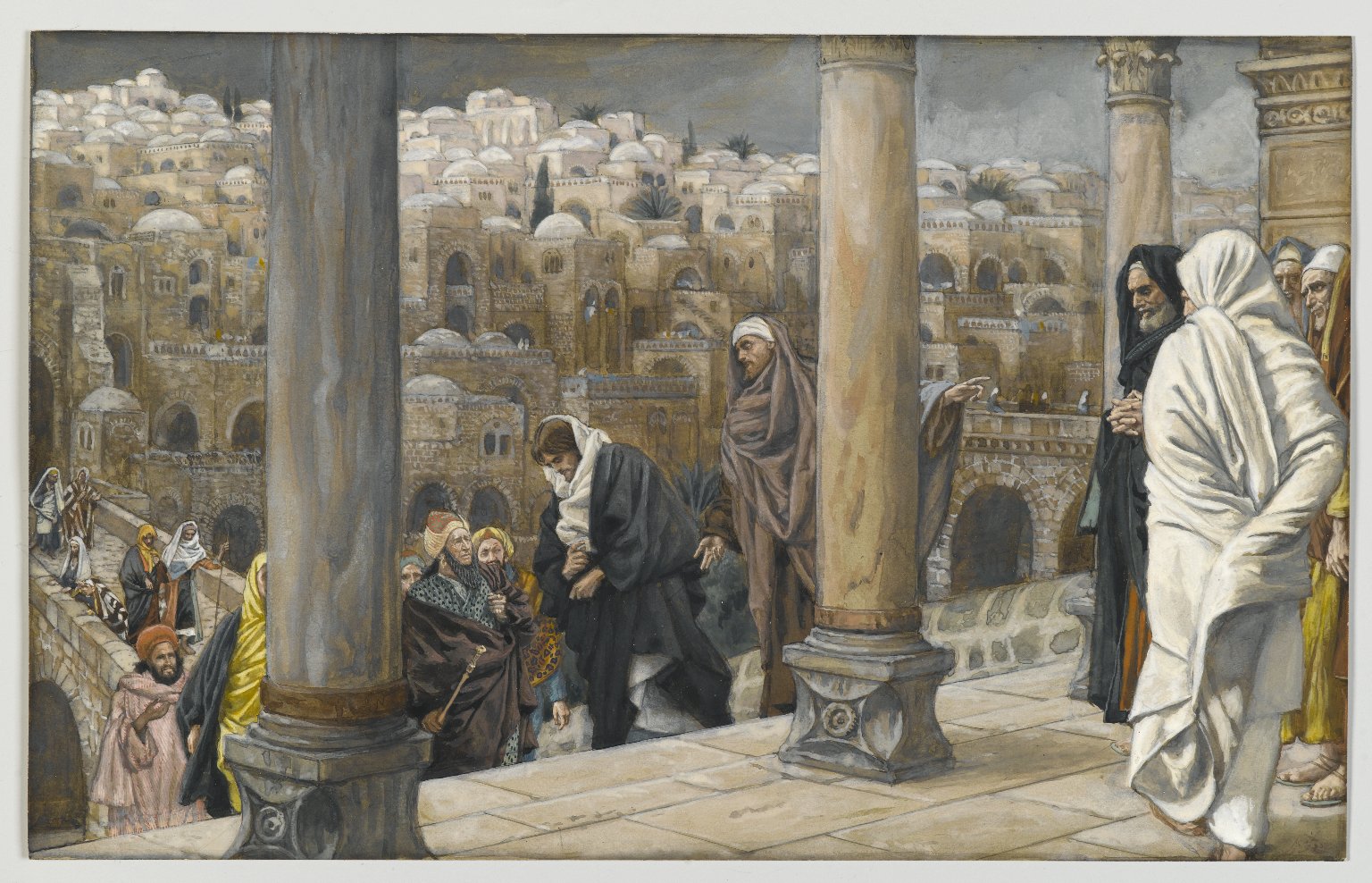
Today’s Gospel finds Jesus is in the Temple in Jerusalem for the Feast of Tabernacles. According to the law of Moses the woman caught in adultery should be punished by being stoned to death. However, the Roman occupiers had taken from the Jews the power to put anyone to death. Jesus’ response shows the world that there is another way: a way of love and not of judgement. Interestingly, this passage is the only time when the Gospel writers record Jesus writing. After the Scribes and Pharisees have brought the unnamed woman to Him:

‘Plygodd Iesu i lawr ac ysgrifennu ar y llawr â’i fys.’

‘Jesus bent down and wrote with his finger on the ground.’ (Jn 8:6) 

This verse has puzzled people for centuries. What exactly did Jesus write? We cannot know for certain. An answer to this intriguing question may come from Scripture. A few verses earlier in John’s Gospel, Jesus talks of rivers of living water. In the prophet Jeremiah we find the following words:

‘O Arglwydd, gobaith Israel, gwaradwyddir pawb a’th adawa; torrir ymaith oddi ar y ddaear y rhai sy’n troi oddi wrthyt, am iddynt adael yr Arglwydd, ffynnon y dyfroedd byw.’

‘O Lord, the hope of Israel, all who forsake you shall be put to shame; those who turn away from you shall be written in the earth, for they have forsaken the Lord, the fountain of living water.’ (Jer 17:13)

We can speculate that at least part of this verse from Jeremiah is what Jesus wrote in the earth. Writing these words would both fulfil the prophecy of Jeremiah, and shame the woman’s accusers. Jesus is showing that the Scribes and Pharisees have turned away from God, towards legalism and judgmental behaviour. Those gathered would know the prophecy of Jeremiah, and also that Jesus has recently mentioned streams of living water. This verse is the key to understanding what is going on. Jesus is fulfilling Scripture, and demonstrating that God should be characterised by love, mercy, and forgiveness. 

The Religious Authorities have not quite understood the situation. They continue to press Jesus for an answer, which He does not give. Instead Jesus challenges them:

‘ymsythodd ac meddai wrthynt, “Pwy bynnag ohonoch sy’n ddibechod, gadewch i hwnnw fod yn gyntaf i daflu carreg ati.”’

‘he stood up and said to them, “Let him who is without sin among you be the first to throw a stone at her.”’ (Jn 8:7)

Jesus’ position is non-judgemental, and highlights the hypocrisy of the accusers. Christ then returns to His writing:

‘Yna plygodd eto ac ysgrifennu ar y llawr.’

‘And once more he bent down and wrote on the ground.’ (Jn 8:8)

It is possible that Jesus was finishing the verse from Jeremiah. We cannot be sure, but what we do know is that the combination of His words, both written and spoken have a profound effect:

‘A dechreuodd y rhai oedd wedi clywed fynd allan, un ar ôl y llall, y rhai hynaf yn gyntaf, nes i Iesu gael ei adael ar ei ben ei hun, a’r wraig yno yn y canol. Ymsythodd Iesu a gofyn iddi, “Wraig, ble maent? Onid oes neb wedi dy gondemnio?” Meddai hithau, “Neb, syr.” Ac meddai Iesu, “Nid wyf finnau’n dy gondemnio chwaith. Dos, ac o hyn allan paid â phechu mwyach.”’

‘But when they heard it, they went away one by one, beginning with the older ones, and Jesus was left alone with the woman standing before him. Jesus stood up and said to her, “Woman, where are they? Has no one condemned you?” She said, “No one, Lord.” And Jesus said, “Neither do I condemn you; go, and from now on sin no more.”’ (Jn 8:9-11)

It is interesting that the older (and wiser) ones are the first to grasp the full implications of what Jesus is saying. Christ does not condemn the woman: God is a God of mercy. However, Our Lord does say, ‘Dos, ac o hyn allan paid â phechu mwyach’ ‘go, and from now on sin no more’ (Jn 8:11). Forgiveness goes hand-in-hand with contrition and repentance. We are loved, healed and restored by God, but with forgiveness comes a challenge. As Christians we are to turn away from wrongdoing, from the ways of the world, and instead find life in Christ.

Lent gives us the opportunity to take a long, hard look at ourselves and at our lives. It is a time to recognise that we need to become more like Jesus — to live, and think, and speak like Him. We need to be nourished, healed and restored by Christ, so that we can live lives which proclaim His love and His truth to the world. Lent is also a time for us to realise that we are loved by God, and that God is merciful, forgives our sins, and longs for us to experience life in all its fulness.

It is interesting that today is Passion Sunday when we begin in earnest our commemoration of Jesus’ death and Resurrection. This morning’s Gospel speaks of a different type of passion (sexual desire) which when uncontrolled could lead to death — either of a person condemned for committing adultery or a relationship between a husband and wife.

As we pray today for couples preparing for marriage we also pray for those whose relationships are under strain and for all who have experienced marital breakdown. Let us be slow to judge, and quick to show compassion and mercy to those whose lives are not perfect.

Let us, as followers of Jesus, rejoice in the generous love of God and prepare ourselves to celebrate Christ’s Passion. Let us give thanks for our families and relationships and give glory i Duw Dad, Duw y Mab, a Duw yr Ysbryd Glân. I’r hwn y priodoler pob gogoniant, arglwyddiaeth, a gallu, yn awr, ac yn oes oesoedd. Amen.

Christ and the sinner, A Mironov 2011

Lent I

The first reading this morning taken from the book of Deuteronomy, is part of the account of the Feast of First-fruits, called Shavuot. This feast celebrates the grain harvest in Israel, seven weeks after Passover. ‘What?’ you say, “Harvest Festivals?’ This seems a strange topic when we have just begun a six-week penitential season which is characterised by, amongst other things, fasting, abstaining from food. Yes, at first glance it does appear somewhat strange, but there is a reason. 

The reading from Deuteronomy is mostly an account of the words and actions made by the person offering the fruits of the earth to God. This includes a narration of preceding events: Israel’s journey from slavery in Egypt to Freedom in the Promised Land. It is a prayerful retelling of the Passover story, which gives thanks to God for His mighty acts. At the same time that the Jews re-live salvation history, we as Christians are preparing to do the same. Lent precedes Our Lord’s Passion, Death, and Resurrection (around the time of Passover), and also commemorates Jesus’ fasting in the desert at the beginning of His public ministry. 

The Christian journey through Lent is something of a trek through the desert. It is characterised by fasting, penitence and charity. These are the ways by which we prepare our souls and bodies to celebrate Our Lord’s Passion, Death, and Resurrection. We take time to solemnly ask forgiveness for all our wrongdoings, but we are also joyful knowing that Christ has overcome sin and death. There is a joy in what we do, and who we are, because of all that Christ has taught us and done for us. Lent is a hopeful and a healing time. And the world certainly needs hope and healing at the moment! These six weeks are both an opportunity to give ourselves a bit of encouragement in our spiritual lives, and they are also a time to prepare. As Christians, we travel with Christ from the wilderness of sin to the promised land of reunion with God the Father, and with each other.

The reading from Paul’s Letter to the Romans also begins by quoting from Deuteronomy (30:14), just before Moses offers Israel the choice between life and death, good and evil. But for Paul:

‘Os cyffesi Iesu yn Arglwydd â’th enau, a chredu yn dy galon fod Duw wedi ei gyfodi ef oddi wrth y meirw, cei dy achub.” Oherwydd credu â’r galon sy’n esgor ar gyfiawnder, a chyffesu â’r genau sy’n esgor ar iachawdwriaeth.’

‘if you confess with your mouth that Jesus is Lord and believe in your heart that God raised him from the dead, you will be saved. For with the heart one believes and is justified, and with the mouth one confesses and is saved.’ (Rom 10:9)

This is the heart of our faith as Christians: Jesus is Lord, not Caesar, nor any power of this world. Christ alone saves us, by His Death and Resurrection. We believe this and bear witness to our belief. 

Today’s Gospel takes us back to the time immediately after Jesus’ Baptism, when He begins His public ministry. Christ goes out into the desert to be alone, to be quiet, to fast and to pray, and to be close to God the Father. While He is in the desert, Jesus is tempted by the Devil. Satan uses three different approaches, beginning by saying: 

‘Os Mab Duw wyt ti, dywed wrth y garreg hon am droi’n fara.’

‘If you are the Son of God, command this stone to become bread.’ (Lk 4:3)

This is a temptation to be relevant, Jesus is hungry. The Devil is saying, ‘If you are the Son of God then do this’. This is the same thing that the crowd will say to Our Lord as He goes to be crucified. The Devil and the crowd both demand that God prove Himself, rather than accepting the presence of the Holy Spirit and the voice of God the Father at Christ’s Baptism: ‘Ti yw fy Mab, yr Anwylyd; ynot ti yr wyf yn ymhyfrydu.’ ‘You are my beloved Son; with you I am well pleased.’ (Lk 3:22) Jesus is pleasing to God because He is obedient, but Satan is all about disobedience; not listening to God, not obeying Him. Whereas Adam, the first man, causes sin to enter into the world by eating forbidden fruit. Christ, who is the second Adam, conquers by abstaining. The desert is the exact opposite of the garden of Eden. While Eden was full of plants, trees and animals, the desert is an empty, lifeless place.However, it becomes the setting for obedience, reconciliation and healing.

The second temptation put to Jesus is the allure of earthly power. The Devil says to Our Lord: 

‘I ti y rhof yr holl awdurdod ar y rhain a’u gogoniant hwy; oherwydd i mi y mae wedi ei draddodi, ac yr wyf yn ei roi i bwy bynnag a fynnaf. Felly, os addoli di fi, dy eiddo di fydd y cyfan.’

‘To you I will give all this authority and their glory, for it has been delivered to me, and I give it to whom I will. If you, then, will worship me, it will all be yours.’ (Lk 4:6-7)

Jesus chooses heavenly glory and the salvation of humanity rather than worldly power. The Devil can only offer a false god and fleeting influence, whereas Christ stands for what is true and eternal. The temptation to seek influence, and prestige, symbolised here by worshipping the Devil, leads to the misuse of power. It’s a very human failing. One that we see all too clearly in our world today.

The third temptation for Jesus, is to put God to the test. Here Christ is encouraged to be spectacular and self-seeking. Whenever we say, ‘look at me’ we are not saying, ‘look at God’. Jesus quotes Deuteronomy 6:16: ‘Peidiwch â gosod yr Arglwydd eich Duw ar ei brawf’ ‘You shall not put the Lord your God to the test’. God does not need to prove anything. He loves us, and sent His Son for us. If Jesus threw himself from the Temple it would be a great spectacle, but it wouldn’t achieve anything. The high place which Jesus will go up to is the Cross on the hill of Calvary. Here He will suffer and die to save humanity. This is where God shows His love for the world, through humiliation rather than by a glory-seeking stunt. 

Eventually the Devil gives up and departs. Christ’s faith and trust in God is stronger than temptation. We face the same temptations in our lives, but Jesus shows us that we can resist them. This isn’t easy — quite the opposite — but it is possible. This should encourage us as we try to follow Christ’s example, and grow in holiness this Lent. God does not ask the impossible of us, instead we try, and, when we fail, we ask for forgiveness. We grow in holiness in Lent through prayer, almsgiving, and fasting. Prayer offers us the opportunity to deepen our relationship with God. It is more about quality than quantity: expressing true repentance, for what we have done and failed to do, and resolving to do better in the future. Almsgiving helps us to be charitable and generous, to care for those in need, just as God is generous towards us.

Fasting is key, because it helps us to master our bodily cravings, to control what we eat and what we do, rather than being controlled by our appetites. This doesn’t mean that we should starve ourselves, but that we should be mindful of our actions and not give in to all our desires. Just as prayer is not about getting God’s attention or changing His mind, but rather changing who and what we are, making us more loving, humble and dependant on God. In the same way fasting stops us being slaves to our desires. It sets us free, and helps us to listen to God, and draw closer to Him. Through abstinence we enter into Christ’s suffering, so that we can follow the way of the Cross. We do this joyfully, because we are following Christ. We are learning to resist temptation, aided by prayer and a generous heart. Our aspiration is that this Lenten season will help us to grow in faith, hope, and love, and enable us to celebrate Our Lord’s Passion, Death and Resurrection with greater joy. 

So, my brothers and sisters, let us prepare ourselves to celebrate the Paschal mystery so that we, and all the world, may give glory i Duw Dad, Duw y Mab, a Duw yr Ysbryd Glân. I’r hwn y priodoler pob gogoniant, arglwyddiaeth, a gallu, yn awr, ac yn oes oesoedd. Amen.

Palm Sunday 2024

IN THIS COUNTRY when we want to celebrate something there is often some kind of procession. Sports teams who win trophies go on an open-topped bus. After King Charles’ Coronation, there was a great procession from Westminster Abbey back to Buckingham Palace. Today, we see the entry of the Messiah into Jerusalem. The Davidic King has made His triumphal entry, something which we have reenacted ourselves this morning, waving palms and singing, ‘Hosanna to the Son of David!’. The prophet Zechariah, writing 500 years before Jesus, looks forward to a messianic future:

Rejoice greatly, O daughter of Zion! Shout aloud, O daughter of Jerusalem! Behold, your king is coming to you; righteous and having salvation is he, humble and mounted on a donkey, on a colt, the foal of a donkey.

‘Bydd lawen iawn, ti ferch Seion; a chrechwena, ha ferch Jerwsalem: wele dy frenin yn dyfod atat: cyfiawn ac achubydd yw efe; y mae efe yn llariaidd, ac yn marchogaeth ar asyn, ac ar ebol llwdn asen.’ (Zech 9:9)

The donkey ridden by Jesus reminds us of the humble beast of burden, which carried his Mother to Bethlehem for His birth, and then carried the Holy Family into exile in Egypt. This is an act of humble leadership which realizes what the prophets foresaw. It shows us that Jesus Christ is truly the one who fulfils the hopes of Israel. The Hebrew Scriptures look forward to the deliverance of Israel. This deliverance is enacted in front of the eyes of those watching the Carpenter’s son enter the Holy City.

Scripture is fulfilled and there is a burst of popular enthusiasm, people wave palm branches and cry out. However, having someone claim to be a relative of King David is a direct challenge to Herod, the puppet ruler installed to comply with the Romans. The events we heard described, before our procession this morning, look something like a political coup — a bid to replace a leader lacking legitimacy. Such an attempt is bound to have political repercussions. It represents a direct challenge to the ruling house and to Rome, and therefore it has to be countered. The masses in Jerusalem are expecting a king of the Davidic line. One who would be seen as a challenge to the ruling élite, the status quo. But in Christ, God gives Israel something else. Yes, he is a King of the line of David. But Jesus is one who rules with love, and who has no desire for power, or honour. Naturally, the leaders and those in authority are threatened by Him: Jesus turns their world on its head. He is an awkward inconvenience. Jesus, however, does not want their power. He has come to be and accomplish something completely different. What is seen as a potential political coup is in fact a renewal of religion, the fulfilment of prophecy, and a new hope for Israel. Political and religious leaders can only see the threat, rather than the opportunity which Christ offers.

At its heart Christianity is an offer of new life in Jesus Christ. This starts with repentance, and acceptance of our need for God. As we grow in faith, we come to believe and trust in a God who loves us, and gives Himself for us. Then we can experience healing, wholeness, and fullness of life in and through Him. Such gifts come at a cost, which the week ahead will make clear to us in the most stark and direct way. 

Over the next few days we will see the joy and celebration of today turned into anger and resentment. Crowds which cried ‘Hosanna’ will soon shout ‘Crucify him!’. This should come as no surprise to us. We know how people can be fickle and manipulated. And yet, on the same night He will be betrayed, Jesus takes bread and wine, blesses them and says, ‘This is my Body … This is my Blood’. ‘hwn yw fy nghorff … hwn yw fy ngwaed’ These words are repeated when the Eucharist is celebrated because Our Lord told us to ‘Do this’ ‘gwnewch hyn’ and so we do. We come together so that God can feed us with His very self, so that we can have life in Him. This is not an optional extra, it is fundamental to who and what we are as Christians. In the Eucharist we experience God’s love, His body broken for us, His blood poured out, to heal us. This is the banquet of the Kingdom, the Wedding Feast of the Lamb, and we are all invited!

Today, and in the coming week, we see what God’s Love and God’s Glory are really like. They are not what people expect. God’s power is shown in humility, strength in weakness. As we continue our Lenten journey in the triumph of this day, we look towards the Holy and Life-giving Cross and beyond to the new life of Easter. Let us trust in the Lord, and go with Him to Calvary, and beyond. Let us raise our palms and sing the praises of God the Father, God the Son, and God the Holy Spirit. To whom be ascribed all glory, dominion, and power, now and forever. Amen.

Lent V: Sir, we want to see Jesus!

THERE are some texts in the Bible which just stick in your head. The Gospel today contains one of them: ‘Sir, we wish to see Jesus’ ‘Syr, fe hoffem weld Iesu’ (Jn 12:21). It is a text often placed on pulpits to remind preachers of their primary task. This sounds simple enough, but, at one level, when I hear these words they remind me of my own shortcomings. Have other people seen Jesus in what I say and do? We are our own harshest critics in this regard — it is far easier to see our own faults and failings, than what God might be doing through us. 

In today’s Gospel we are in Jerusalem. It is just before the Passover, the most important religious festival, commemorating the journey from slavery in Egypt to the Promised Land. There are some Greeks, who may or may not be Jewish converts, that approach Philip, who has a Greek name. He, along with Simon Peter and Andrew, was first a disciple of John the Baptist, before following Jesus. These Greeks ask Philip a simple question:

Sir, we wish to see Jesus.”

Syr, fe hoffem weld Iesu’ (Jn 12:21)

These Greeks are well-disposed and interested, and they desire an encounter with Our Lord. At a fundamental level human beings long for communion with the Divine. It is what we are made for. So the disciples tell Jesus, who makes the following reply:

The hour has come for the Son of Man to be glorified. Truly, truly, I say to you, unless a grain of wheat falls into the earth and dies, it remains alone; but if it dies, it bears much fruit. Whoever loves his life loses it, and whoever hates his life in this world will keep it for eternal life. If anyone serves me, he must follow me; and where I am, there will my servant be also. If anyone serves me, the Father will honour him.

‘Daeth yr awr y gogonedder Mab y dyn. Yn wir, yn wir, meddaf i chwi, Oni syrth y gronyn gwenith i’r ddaear, a marw, hwnnw a erys yn unig: eithr os bydd efe marw, efe a ddwg ffrwyth lawer. Yr hwn sydd yn caru ei einioes, a’i cyll hi; a’r hwn sydd yn casáu ei einioes yn y byd hwn, a’i ceidw hi i fywyd tragwyddol. Os gwasanaetha neb fi, dilyned fi: a lle yr wyf fi, yno y bydd fy ngweinidog hefyd: ac os gwasanaetha neb fi, y Tad a’i hanrhydedda ef’ (Jn 12:23-26)

This is a strange response: Our Lord doesn’t say, ‘Of course, bring them here’, or ‘I’d be delighted to meet them’. Instead He starts talking about His forthcoming Death. Jesus does so by using an image from the Parable of the Sower to make the point that life comes through death, freedom through service. These are paradoxes, the exact opposite of what one might expect Him to say, and yet they are true. Christ then experiences something of a moment of doubt, at which point God the Fathers speaks of future glory, and then Our Lord goes back to talking about His death:

“Now is the judgement of this world; now will the ruler of this world be cast out. And I, when I am lifted up from the earth, will draw all people to myself.”

‘Yn awr y mae barn y byd hwn: yn awr y bwrir allan dywysog y byd hwn. A minnau, os dyrchefir fi oddi ar y ddaear, a dynnaf bawb ataf fy hun.’ (Jn 12:31-32)

Because of Jesus’ Death and Resurrection, the Church, Christ’s Body exists to save people and to offer eternal life through Him. God shows the world the fullness of glory, the most profound expression of self-giving love in the events of His Passion. This is why we celebrate it: week by week and year by year. We prepare ourselves during Lent to walk with Christ to Calvary and beyond. We see how much God loves us, how much God gives himself for us. This message of salvation comes to us from the prophets. God makes His intentions clear:

“Behold, the days are coming, declares the Lord, when I will make a new covenant with the house of Israel and the house of Judah,”

‘Wele y dyddiau yn dyfod, medd yr Arglwydd, y gwnaf gyfamod newydd â thŷ Israel, ac â thŷ Jwda’ (Jer 31:31)

God renews the covenant with humanity, writing it on our hearts, forgiving us our iniquities. The Law of Love, which God makes real in Jesus Christ has genuine transformative power, because it is rooted in forgiveness and healing, something which only God can provide. Our loving Father does this on the Cross, where He gives His Son to die for us, to heal our wounds, and to offer eternal salvation to all who believe in Him. This is God’s glory, the glorification of His Son, dying the death of a slave, to save humanity and free us. If we want to share in Christ’s glory, then we need to follow the same path of suffering love which takes Him to His Cross, and will take us to ours.

To follow Christ means embracing the Cross as the mystery of God’s love. If we let God’s love transform us, then wonderful things can happen. There will be pain and suffering along the way, but this is far outweighed by the promise of future glory. So then, as we continue our journey through Lent our journey to the Cross and beyond to the empty tomb of Easter, let us lose our lives in love and service of him who died for us, who bore our sins, who shows us how to live most fully, to be close to God, and filled with his love. Let us encourage one another, strengthen one another, and help each other to live lives which proclaim the truth of God’s saving love. To offer the world the hope of Heaven, where we may sing the praises of God the Father, God the Son, and God the Holy Spirit. To whom be ascribed all glory, dominion, and power, now and forever. Amen.

James Tissot : The Gentiles Ask to See Jesus  (Brooklyn Museum)

Lent IV

IF you have ever been unwell while on holiday you probably sought out a Pharmacy. They are quite straightforward to locate as they tend to either have a cross on their sign, or a snake or two around a pole. This was the symbol of the Greek God of healing Aesculapius whose major shrine was at Epidaurus. Christians tend to associate the snake with the tempting of Adam and Eve in the Garden of Eden, but it is not this creature’s only occurrence in the Bible. 

This morning’s Gospel begins with Jesus explaining His forthcoming Crucifixion with a reference to Israel’s wanderings after the Exodus:

And the Lord said to Moses, “Make a fiery serpent and set it on a pole, and everyone who is bitten, when he sees it, shall live.” So Moses made a bronze serpent and set it on a pole. And if a serpent bit anyone, he would look at the bronze serpent and live.’ 

‘A dywedodd yr Arglwydd wrth Moses, Gwna i ti sarff danllyd, a gosod ar drostan: a phawb a frather, ac a edrycho ar honno, fydd byw. A gwnaeth Moses sarff bres, ac a’i gosododd ar drostan: yna os brathai sarff ŵr, ac edrych ohono ef ar y sarff bres, byw fyddai.’ (Numbers 21:8-9)

The people of Israel had been complaining about the journey, the lack of food and water, and that God has led them out into the desert to die, so God sent fiery serpents which killed them. The people then relented, and asked Moses to pray to God to take the serpents away. God listened to Moses, and provided a means for Israel to be saved. Jesus uses this example to explain why the Son of Man must be lifted up. Just as the bronze serpent saved people long ago, Jesus’ being lifted up on the Cross will save those who believe in Him. Our Lord’s death will occur at Passover, the festival which celebrates the people of Israel’s journey from slavery in Egypt, to the Promised Land. So Christ will deliver humanity from the slavery of sin and offer us eternal life in Him. He bears our burden, and reconciles us to the Father, and each other.

There then follows one of the most well-known verses in the Bible:

For God so loved the world, that he gave his only Son, that whoever believes in him should not perish but have eternal life. For God did not send his Son into the world to condemn the world, but in order that the world might be saved through him.

‘Canys felly y carodd Duw y byd fel y rhoddodd efe ei unig‐anedig Fab, fel na choller pwy bynnag a gredo ynddo ef, ond caffael ohono fywyd tragwyddol. Oblegid ni ddanfonodd Duw ei Fab i’r byd i ddamnio’r byd, ond fel yr achubid y byd trwyddo ef.’ (Jn 3:16-17) 

This is the heart of our faith as Christians. Christ was born for us, lived and died for us, and was raised to new life, so that we might have the promise of eternal life in Him. This is why we follow Christ into the desert of Lent for forty days, so that through prayer, fasting and charity we may be prepared in body and soul to celebrate the mystery of Christ’s Passion, Death, and Resurrection. Maundy Thursday, Good Friday and Easter are the ultimate embodiment of God’s generous Love towards humanity. God loves us, you and me, each one of us, so much that He gave His only Son to die for us, on the Cross.

God does not condemn humanity for falling short, instead He saves us. God is a God of love and generosity, who offers Himself to reconcile us to Him, and to each other. This generosity is at the heart of our faith as Christians. We worship a generous, loving God, and invite others to receive the free gift of God’s grace, and enter a relationship with the God who made us and who loves us. 

This relationship explains the joyful hope which St Paul has when he writes to the Church in Ephesus in our second reading this morning. Paul’s central message is that:

For by grace you have been saved through faith. And this is not your own doing; it is the gift of God,’ 

‘Canys trwy ras yr ydych yn gadwedig, trwy ffydd; a hynny nid ohonoch eich hunain: rhodd Duw ydyw’ (Eph 2:8)

Grace is unmerited kindness, something which we do not deserve, or earn. It is by the grace of God that we are saved, through faith, believing and trusting in Jesus Christ, who was born for us, died and rose again for us. We can put our trust in the God who loves us, and who shows us that love in His Son. It is not about what we can do, but about what God can do for us. Our relationship with God is the result of a gift, which we can accept and which can change our lives, if we only let go, and let God transform us, more and more into the likeness of His Son. 

Through prayer, the reading and study of scripture, living out our faith, and the sacraments of the Church, God brings about the work of transformation in us. As He gave Himself on the Cross for us, He gives us Himself in the Eucharist. During Communion we are fed with the Body and Blood of Christ, God’s very self, so that we can become what He is. Prepared by Lenten penitence we may look forward to sharing the new life of Easter, and singing the praises of God the Father, God the Son, and God the Holy Spirit. To whom be ascribed all glory, dominion, and power, now and forever. Amen.

Diego Velázquez – Christ Crucified (Museo del Prado, Madrid)

Lent II – The Transfiguration

One of the perils of driving in autumn or winter is the low Sun. Because of its angle and closeness to the Earth, we find ourselves dazzled by its brilliance. You have to avert your gaze or use a sun visor or sunglasses in order to drive. This can be inconvenient, but the brightness of our closet star is as nothing compared with the presence of God. Last week we heard the voice of God the Father at Jesus’ Baptism and we will hear Him again this week. 

Our first reading from Genesis, the story of Abraham and the Sacrifice of Isaac, is both well-known, and deeply shocking. The concept of human sacrifice was widespread in the Ancient World. It was not a common occurrence, but it did take place. It seems abhorrent to us, and so it should. In the passage God speaks to Abraham and says,

Take your son, your only son Isaac, whom you love, and go to the land of Moriah, and offer him there as a burnt offering on one of the mountains of which I shall tell you.”

‘Cymer yr awr hon dy fab, sef dy unig fab Isaac, yr hwn a hoffaist, a dos rhagot i dir Moreia, ac offryma ef yno yn boethoffrwm ar un o’r mynyddoedd yr hwn a ddywedwyf wrthyt.’ (Genesis 22:2)

Thankfully, just as Abraham is about to offer Isaac, God tells him to stop, as Abraham has demonstrated his complete devotion to God:

Do not lay your hand on the boy or do anything to him, for now I know that you fear God, seeing you have not withheld your son, your only son, from me.” 

‘Na ddod dy law ar y llanc, ac na wna ddim iddo: oherwydd gwn weithian i ti ofni Duw, gan nad ateliaist dy fab, dy unig fab, oddi wrthyf fi.’ (Genesis 22: 12)

Abraham sees a ram with its horns caught in a thicket, and offers it to God instead. The ram symbolises Christ. It looks forward to Jesus, recognised by John the Baptist as the Lamb of God, who takes away the sins of the world. The ram also points to the Passover Lamb in Exodus, which again prefigures Jesus, the fulfilment of the Paschal Sacrifice. Because Abraham has not withheld his son, he is blessed by God, and through his offspring, all people will be blessed. For Christians the Easter story is important because in it God, like Abraham, does not withhold His Only Son, but gives Him, to die for us. This narrative demands contemplation because it is the demonstration of the mystery of God’s love for humanity. The fact that God loves us that much is totally awesome, especially when we do not deserve it. The mystery of God’s love is that we are not loved because we are loveable. We are often quite the opposite! But God loves us anyway and His steadfast love transforms us. 

St Paul pondered such questions as he wrote to the Church in Rome:

‘He who did not spare his own Son but gave him up for us all’

‘Yr hwn nid arbedodd ei briod Fab, ond a’i traddododd ef trosom ni ol’ (Rom 8:32)

Christ’s death on the Cross is a demonstration of divine generosity, and the reason for our hope as Christians. God’s love for humanity is truly amazing. We should pause for a moment as we read or hear this. God loves me enough to die for me. If God can do this for us, what can we, in return, do for Him? During the Lenten Season we focus on the Cross and the Empty Tomb as the centre of our faith, three days which explain who we are, what we are, and why we are Christians. 

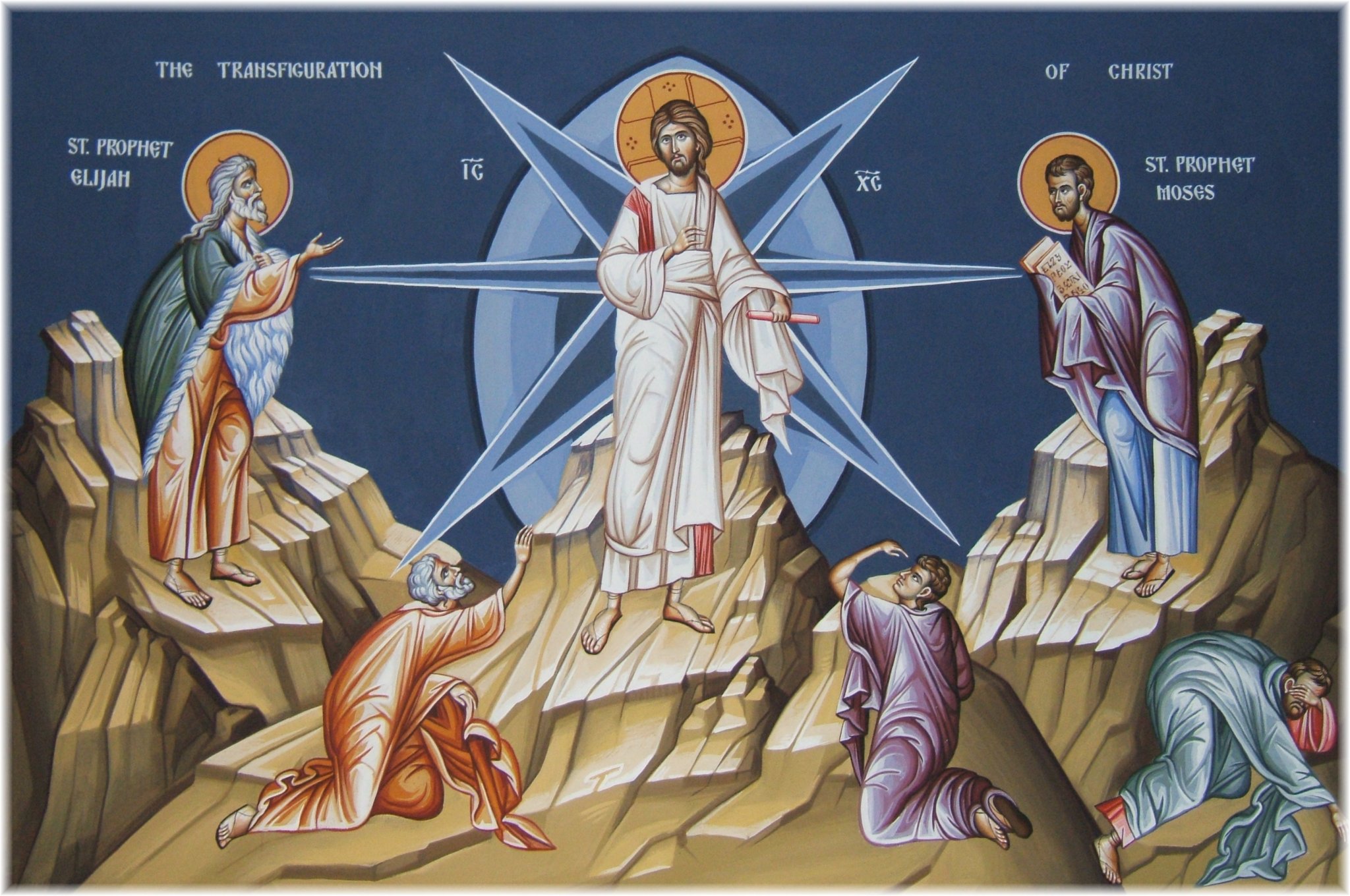
The Transfiguration, described in today’s Gospel, is strange because in it we see something of who Jesus really is: God. We have a brief glimpse of Divine glory as a prelude to Our Lord’s Passion and Death. The two are linked, as they both allow us to understand both who God is, and what He is doing. When God speaks from the cloud He tells us three things about Jesus. Firstly that Jesus is the Son of God, secondly that He is loved, and thirdly that we should listen to Him. What Jesus says and does should affect us and our lives. Like the disciples, we have to be open to the possibility of being radically changed by God. The opportunity of divine transformation is offered to us, so that we might come and share the Divine life of love.

Jesus tells the disciples not to tell anyone about their experience on the mountain until after He has risen from the dead. Jesus has another mountain He must climb: the hill of Calvary, where He will suffer and die upon the Cross. There He takes our sins upon Himself, restoring our relationship with God and each other. This then is real glory, not worldly glory, but the glory of God’s sacrificial love poured out on the world to heal and restore all humanity. The theologian Fulton Sheen spoke about the importance of mountains in Jesus’ life. He said:

Three important scenes of Our Lord’s life took place on mountains. On one, He preached the Beatitudes, the practice of which would bring a Cross from the world; on the second, He showed the glory that lay beyond the Cross; and on the third, He offered Himself in death as a prelude to His glory and that of all who would believe in His name

(Fulton Sheen, The Life of Christ, 1970 p.158)

The Transfiguration shows us the glory of heaven, the glory of the Resurrection at Easter, the glory that lies beyond the Cross. God’s love and God’s glory are intertwined, and cannot be separated because they given freely. God’s very nature is generous, beyond our understanding, and characterised by total self-gift. Our Heavenly Father does not hold anything back, and whereas Isaac is replaced at the last minute by a ram, there is no substitution for Jesus. God gives His Son, Jesus Christ, to die for us, and to rise again, so that we might enjoy eternity with Him in Heaven. The Transfiguration is a promise of our future heavenly glory. Through signs and glimpses, God shows us what future awaits us. He longs to heal and restore us, so that we might enjoy eternity with Him. 

The Transfiguration, therefore, looks to the Cross to help us to prepare ourselves to live the life of faith. It helps us to comprehend true majesty, true love and true glory. The wonderful glory that can change the world and which lasts forever, for eternity, unlike the fading glory of the world, which is here today but gone tomorrow.

So my brothers and sisters, as we celebrate God’s love and glory, let us prepare to  ascend the mountain ourselves and have an encounter with the living God in Holy Communion. Let us come to the source of healing and fount of love which is God’s very self. Let us touch and taste Our Lord and Saviour, given for us, so that we might live in Him. Let us be transformed by Him and enjoy the glories of Heaven singing the praises of God the Father, God the Son, and God the Holy Spirit. To whom be ascribed all glory, dominion, and power, now and forever. Amen.

Lent I

I don’t know about you, but for me years are definitely going by much more quickly these days. Not long ago it was Christmas and now we are already in Lent and preparing for Holy Week and Easter. Lent (Garawys) is a period of forty days, which prepares us to celebrate the Passion, Death and Resurrection of Jesus Christ. The symbolism of the number forty is rich in the Bible. It signifies a time of trial or testing, and recalls significant biblical events. Firstly, in the story of Noah’s Ark in Genesis 7:12, God floods the earth with water for forty days. Secondly, in the story of the Exodus, the people of Israel spend forty years in the desert before they reach the Promised Land. Thirdly, Moses remains with God on Mount Sinai for forty days before giving the people of Israel the Ten Commandments. And fourthly, in 1Kings 19:8, Elijah fasts for forty days on the way to Mount Horeb, before talking to God and finding Elisha. All of these examples point to Jesus Christ and foreshadow His saving work. 

Today’s first reading from Genesis takes us back to the aftermath of the flood, and the covenant which God establishes by setting His bow, a rainbow (enfys), in the clouds, so that all humanity can rest assured that they will not be destroyed by God. We can be confident that ultimately Our Creator is interested in reconciliation and healing: God is a God of love.

Our second reading from the First Letter of Peter, draws a link between Noah and the ark as a sign of salvation, and baptism, by which humanity is saved. It is a timely connection to make since Lent is traditionally a time for preparation for Baptism at Easter. The wider account of salvation history, and the life of Jesus in particular, become our life as Christians in our baptism: we share in them, they become part of us, and form both who and what we are. We enter into the drama of salvation as we die to sin, and are raised to new life in our baptism. Through our new life in Christ, we follow His example, and prepare for our annual celebration of Holy Week and Easter by going into the desert with Him for the forty days of Lent.

Keeping with the theme of Baptism, this morning’s Gospel begins with Our Lord’s Baptism in the River Jordan by His cousin, John. Jesus does not need to be baptised, He has not committed any sins for which He needs to repent. He does not require to be washed clean. We, on the other hand, do need to be cleansed of our sins. Christ shows humanity the way back to God, so that we might follow His example, and come to share in the same intimacy which characterises the life of God. During Jesus’ Baptism we hear the Father’s voice and see the Holy Spirit: three Persons, One God. It is a glimpse of Divine Glory, which awaits us in Heaven, the end and purpose of salvation history.

Then the Spirit drives Our Lord out into the desert: to be alone, to pray, to be with God. This is also a time of trial when Satan tempts Jesus. The devil attempts to deflect Christ from His mission to bring love and healing, and to proclaim the Kingdom of God. Unlike Matthew’s Gospel, which lists the temptations, Mark simply states that Jesus was tempted. Because He is without sin, Jesus is able to withstand temptation. Our Lord’s victory in the desert points to His great victory on the Cross. Christ then preaches to ‘the spirits in prison’ ‘ac a bregethodd i’r ysbrydion yng ngharchar’ (1Peter 3: 19). He does this to save humanity from sin and death, and restore the hope of Heaven. This is what we are preparing to celebrate at Easter. 

In the garden of Eden the animals were tame, but in the desert Jesus is with wild animals. Here the second Adam is beginning the work of the restoration of Creation. Mankind who fell because of a tree, will be restored by the tree of the Cross. While He is in the wilderness Our Lord is ministered to by angels. He is the Beloved Son, in whom the Father is well-pleased. After the trial of the temptations Christ is tired, and hungry. Experiencing temptation is a trying business, both physically and spiritually. This reminds us of the need for care, especially self-care, in our Lenten observances. Rest and nourishment are an important part of our spiritual and physical wellbeing, now more than ever.

After the forty days are over, Jesus returns to Galilee and starts to proclaim the Gospel, the Good News of the Kingdom of God:

“The time is fulfilled, and the kingdom of God is at hand; repent and believe in the gospel.” 

“Yr amser a gyflawnwyd, a theyrnas Dduw a nesaodd: edifarhewch, a chredwch yr efengyl.” (Mk 1:15)

This message is the same as the one announced by John the Baptist: Repent, turn away from your sins, turn back to God, and Believe the Gospel, proclaimed by Jesus Christ. As Christians, nearly two thousand years later, we believe and proclaim that same message. Jesus calls us to turn away from sin, to turn back to God, to trust Him, and to know that He longs for our healing and reconciliation. The Kingdom is a place where we are restored, and experience life in all its fulness.

During the weeks of Lent, we pray, fast, and are charitable in order to discipline our minds and bodies, so that we may grow in holiness and become more like Jesus. The Temptation of Jesus teaches us that we have to become weak, powerless and vulnerable, utterly reliant upon our Heavenly Father, so that God is able to be at work in us. Such weakness may be perceived as foolish in worldly terms, but that is the point. As Christians, we are not meant to be conformed to the world. In seeking to grow in faith, humility, and obedience, we allow God to transform us — taking us and shaping us into His likeness. Therefore, as we undertake to follow Christ in our Lenten pilgrimage, we do so in the knowledge of our weakness, and our total reliance upon God. If we turn away from what separates us from Our Heavenly Father, and believe in a God who loves us, then healing can take place. Following Jesus’ example we spend six weeks being close to Our Lord, so that He may renew and strengthen us.

So, my brothers and Sisters in Christ, let us use this time of Lent to draw close to God in prayer. Let us be nourished by the word of God in Holy Scripture, and by God’s very self, His Body and Blood in the Eucharist, so that He may transform us. By these means, may we share in the new life of the Kingdom and be prepared for the glory of Heaven where we, and all creation, may sing the praises of God the Father, God the Son, and God the Holy Spirit. To whom be ascribed all glory, dominion, and power, now and forever. Amen.
Lent III John 4: 5–42


God proves his love for us in that while we were still sinners Christ died for us

Hyperichius said, ‘The tree of life is high, and humility climbs it.’

He also said, ‘Imitate the tax-collector, to prevent yourself being condemned with the Pharisee. Follow the gentleness of Moses, and hollow out the rocky places of your heart, so that you turn them into springs of water.’


People can be strange, stubborn infuriating creatures, and the picture given to us of the Israelites in Exodus should strike something of a chord. We can recognise something of ourselves in it: stubborn, wilful, and sinful. But lest we get too disheartened it is important to recognise that Moses strikes the rock at Horeb, as the Lord commands him, and out flows water. This water, like the parted water of the Red Sea prefigures Christ, the living water, our baptism, through which we enter the Church. Through it we are regenerate, born again to eternal life in Christ Jesus, our Lord and Saviour, whose side was pierced on Calvary, and whence flowed blood and water. This water speaks to us of the grace of God poured out upon us, his people, to heal us and restore us, to help us live his risen life.

So as we continue our Lenten pilgrimage, we can do so joyfully because God’s love has been poured into our hearts – what matters is what has been done to us, by God, out of love, so that we can be like him. He is the reconciliation which achieves what we cannot: restoring our relationship with God and each other, healing our wounds, and giving us eternal life in Him.

Picture the scene – it’s the middle of the day, the sun is blazing overhead, he’s been walking for hours, days even. Jesus is tired – as a man, a human being, he is no different from you or me – he ate and drank,  he was thirsty, and he was knackered. Mid-day is certainly no time to be drawing water from a well – it’s something you do first thing in the morning, as the sun is rising. What sort of a woman is drawing water at mid-day? Hardly a respectable one, but rather someone shunned, someone beyond the pale, cast out of polite society as an adulteress who is living in sin. Jesus asks the woman for a drink – he’s defying a social convention – he’s breaking the rules. She’s really surprised – Jews are supposed to treat Samaritans as outcasts, they’re beyond the pale: they’re treated something like the Roma in Eastern Europe – outcasts, second class, scum, to be despised and looked down upon. And yet Jesus asks her for water, he initiates the conversation and the encounter, with an outsider, to bring her in.

Jesus offers her living water, so that she may never be thirsty again. The woman desires it, so that she will never be thirsty again, or have to come to the well to draw water, she’s fed up of the work, and fed up of being an outcast, and having to do it at antisocial hours when the community can see who and what she is. Jesus knows who and what she is – he recognises her irregular lifestyle. He also sees her need of God – her need for the water of grace to restore her soul, and inspire her to tell people the Good News. Her testimony is powerful because she has experienced God’s love as a living reality and she simply has to tell people about it. She brings them to Christ so that they can be nourished, so that they too can experience the grace of God.

People are interested in who and what Jesus is, what he’s got to say, and they believe and trust in Him as the Messiah the Anointed of God, as the Saviour of the World, a title recently taken up by the Roman Emperor, big claims to make, and dangerous ones, which along with His healings will soon lead to His condemnation and death. In plenty of parts of the world the proclamation of the Good News still leads to imprisonment, torture and death, even today. And yet as Christians we are called to bear witness regardless of the personal cost, so that the world may believe. Here in the West we have as a church become comfortable, we forget about persecution, or view it at a safe distance. We’re not involved, it doesn’t matter that much to us. Are we far from the grace of our baptism, have we not encountered Jesus in Word and Sacrament? Are we too afraid of the World? The world which Christ overcomes on the Cross.

To live is to change and to be perfect is to have changed often. If we are changing into Jesus Christ, then we’re on the right track. If we listen to his word; if we talk to him in prayer and let him talk to us; if we’re fed by Him in the Eucharist, by Christ both priest and victim, to become what He is – God; if we’re forgiven by Him, through making confession of our sins, not only do we come to understand Jesus, we become like him, we come to share in his divine nature, you, me, all of humanity ideally. We, the People of God, the new humanity, enter into the divine fullness of life, we have a foretaste of the heavenly banquet.

Lent should be something of a spiritual spring clean, asking God to drive out all that should not be there, preparing for the joy of Easter, to live the Risen Life, filled with God’s grace. In our baptism we died with Christ and were raised to new life in the Spirit. Let us prepare to live that life, holding fast to Our Lord and Saviour, clinging to the teachings of his body, the Church. Let us turn away from the folly of this world, the hot air, and focus on the true and everlasting joy of heaven, which awaits us, who are bought by his blood, washed in it, fed with it. So that we too may praise the Father, the Son and the Holy Spirit, to whom be ascribed as is most right and just, all might, majesty, glory, dominion, and power, now and forever…

23
Guercino Jesus and the Samaritan Woman, Museo Thyssen-Bornemisza, Madrid, 1640-1