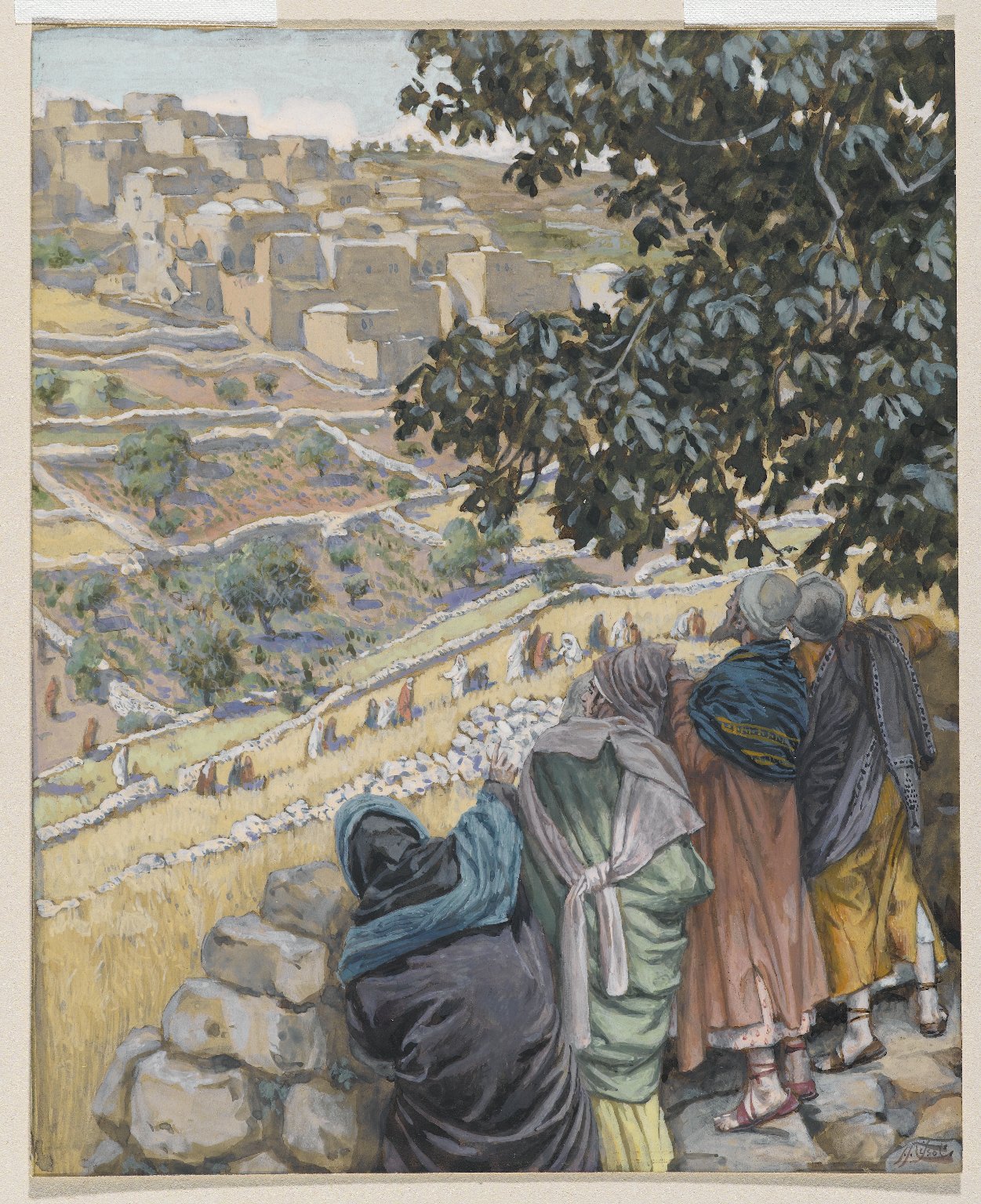
Trinity IV – The Good Samaritan

This year I have re-kindled my love of reading fiction. I have been introduced to some new authors by books lent to me by friends and neighbours or recommended by my wife. Taking time to lose yourself in a good book is one of life’s greatest (and cheapest) pleasures. Everybody loves a good yarn. Stories are also a useful way to make a point and to convey a deeper truth about human nature. They help us to understand who we are and how we should live. As Jesus travels from Galilee to Jerusalem He teaches, using parables, vivid stories we know and love. As I said, everyone likes to hear a good yarn, but the parables are much more than that. Jesus uses parables to explain the Kingdom and His Mission — who He is, and what He is doing — so that His followers can understand and share that knowledge with others.

In today’s Gospel, Our Lord encounters a legal expert. This lawyer wants to put Jesus to the test, to check whether what He says is acceptable under Jewish religious law. This man of the law asks Him: 

“Athro, beth a wnaf i etifeddu bywyd tragwyddol?”

“Teacher, what shall I do to inherit eternal life?” (Lk 10:26)

Jesus replies by asking the lawyer to tell Him what is written in the Law, and questions how, as a legal expert, he interprets it. The man replies, by reciting scripture:

‘Câr yr Arglwydd dy Dduw â’th holl galon ac â’th holl enaid ac â’th holl nerth ac â’th holl feddwl, a châr dy gymydog fel ti dy hun.’

“You shall love the Lord your God with all your heart and with all your soul and with all your strength and with all your mind, and your neighbour as yourself.” (Lk 10:27)

The first part of the lawyer’s answer is a quotation from the book of Deuteronomy (6:5), part of the Shema, a Jewish declaration of faith in God, which begins ‘Hear, O Israel: the Lord our God is one’. The second part is a quotation from Leviticus (19:18). This summary of the Law outlines humanity’s duty both towards God and also towards our neighbours. This legal expert understands how he should behave, and how he should live his life. He has basically repeated Jesus’ teaching word-for-word. So far, so good. The lawyer then asks Our Lord another question:

‘Ond yr oedd ef am ei gyfiawnhau ei hun, ac meddai wrth Iesu, “A phwy yw fy nghymydog?”’

‘But he, desiring to justify himself, said to Jesus, “And who is my neighbour?”’ (Lk 10:29)

The lawyer wants to legitimise himself, and so he asks Jesus to define his terms. In a legal argument, this is a typical response. However, the lawyer’s motives are questionable. He is interested in self-justification, in making himself look good. Our Lord is happy to answer, and does so with a parable: The Parable of the Good Samaritan. This well-known story is set on road from Jerusalem to Jericho. Despite being a major route, it is steep and windy (a bit like some of the roads around here!), dropping over three thousand feet in seventeen miles. The road takes a traveller through lots of empty desert land, where bandits made a living robbing travellers. The sight of someone who has been attacked and robbed was probably not an unusual one along this route. 

In the parable, a priest and a Levite pass by one such victim, crossing to the other side as they do not wish to become ritually impure. Under Jewish law, if they touched a dead body, they would become unclean, and unable to offer sacrifice and worship in the Temple until they had been ritually cleansed. Rather than risk this, these Temple officials assume that the man is dead and simply pass on by. Soon afterwards another traveller sees the man who has been attacked:

‘Ond daeth teithiwr o Samariad ato; pan welodd hwn ef, tosturiodd wrtho. Aeth ato a rhwymo ei glwyfau, gan arllwys olew a gwin arnynt; gosododd ef ar ei anifail ei hun, a’i arwain i lety, a gofalu amdano.’

‘But a Samaritan traveller who came upon him was moved with compassion when he saw him. He went up and bandaged his wounds, pouring oil and wine on them. He then lifted him on to his own mount, carried him to the inn and looked after him.’ (Lk 10:33-34)

Samaritans and Jews generally kept separate from each other. They had profound theological differences, and the Jews worshipped on Mt Zion, while the Samaritans worshipped on Mt Gerizim. When the Jews went into exile in Babylon, the Samaritans remained behind. Despite the fact that they all worshipped the same God, they were completely estranged from each other. However, the Samaritan has compassion. He is deeply moved to help someone in need, and so he crosses the cultural boundaries and takes care of the man. We are told that he pours oil and wine on the injured man. This was current medical practice. It was also what one would do at a sacrifice at the Temple. Therefore, it is possible that Jesus’ image relates to some words of the prophet Hosea:

‘Oherwydd ffyddlondeb a geisiaf, ac nid aberth, gwybodaeth o Dduw yn hytrach na phoethoffrymau.’

‘For I desire mercy and not sacrifice, the knowledge of God rather than burnt offerings.’ (Hosea 6:6)

The priest and the Levite are concerned with sacrifice and purity, but the Samaritan shows the mercy that God desires. He binds up the injured man’s wounds, treats them, brings him to an inn, and takes care of his needs. The parable shows true love and mercy in action.

Traditionally the Church has also seen deeper meanings at work in this story. It has understood the Parable of the Good Samaritan in a symbolic way, which explains both the human condition, and Christ’s saving work. In one reading, the traveller represents Adam, and stands for all humanity. His wounds are those of sin and disobedience. The Samaritan is Jesus, the one who has compassion on us. The inn stands for the Church, the place where sinners are healed, and the oil and wine are the sacraments of the Church, which heal us. However, Christ is also the man wounded for our transgressions, who suffers for humanity, to heal our wounds.

Such an interpretation shows us how rich this parable is. Jesus tells it to His followersas He is travelling up to Jerusalem — the place where He will suffer and die. Our Lord is teaching His disciples what they need to understand in order to put mercy and love into action. Love and mercy are signs of the Kingdom of God. God’s Kingdom is where Jesus reigns from the Cross. It is where Christ overcomes sin and Death, to offer eternal life to all humanity. This is why St Paul can write:

‘Oherwydd gwelodd Duw yn dda i’w holl gyflawnder breswylio ynddo ef, a thrwyddo ef, ar ôl gwneud heddwch trwy ei waed ar y groes, i gymodi pob peth ag ef ei hun, y pethau sydd ar y ddaear a’r pethau sydd yn y nefoedd.’

‘Because God wanted all perfection to be found in him and all things to be reconciled through him and for him, everything in heaven and everything on earth, when he made peace by his death on the cross.’ (Col 1:19-20)

Our Lord’s Passion is a work of reconciliation. It is the job of every Christian to carry on that work. The Parable of the Good Samaritan is also about the reconciliation of people from different cultures — through Christ. Today Christians from so many different backgrounds gather together to read and study scripture. To pray together. To be healed and nourished by God, through the Sacraments. Both Baptism and the Eucharist are outward signs of spiritual grace, the power of God to heal, reconcile, and transform us all. We are gathered today in the ‘inn’ of the Church, so that God can heal us, and strengthen us to go out and share God’s saving love with others.

Following the example of the Good Samaritan, may we also be agents of God’s love and grace in the world. May we transform our homes, our communities, and the whole world. Filled with God’s love, compassion, and healing, let us give glory to God, Duw Dad, Duw y Mab, a Duw yr Ysbryd Glân. God the Father, God the Son, and God the Holy Spirit. I’r hwn y priodoler pob gogoniant, arglwyddiaeth, a gallu, yn awr, ac yn oes oesoedd. To whom be ascribed all glory, dominion and power, now and forever. Amen.

James Tissot – The Good Samaritan (Brooklyn Museum)

Trinity xxiii – Love Actually

IN the 2003 film Bruce Almighty, Jim Carey’s character, Bruce, feels like his life is falling apart. As he drives in the dark, he begs God to tell him what to do, to give him a sign, or a signal. Immediately, a truck appears in front of him loaded with road signs saying, ‘Wrong way’, ‘Do not enter’, and ‘Stop!’. Bruce ignores the signs, overtakes the truck and then crashes his car into a lamppost. He is not hurt, but he is angry with God for not listening to his peas for guidance. This comedic scene brings home the message that sometimes we ask for God’s help in our lives and then fail to listen to what God is telling us to do.

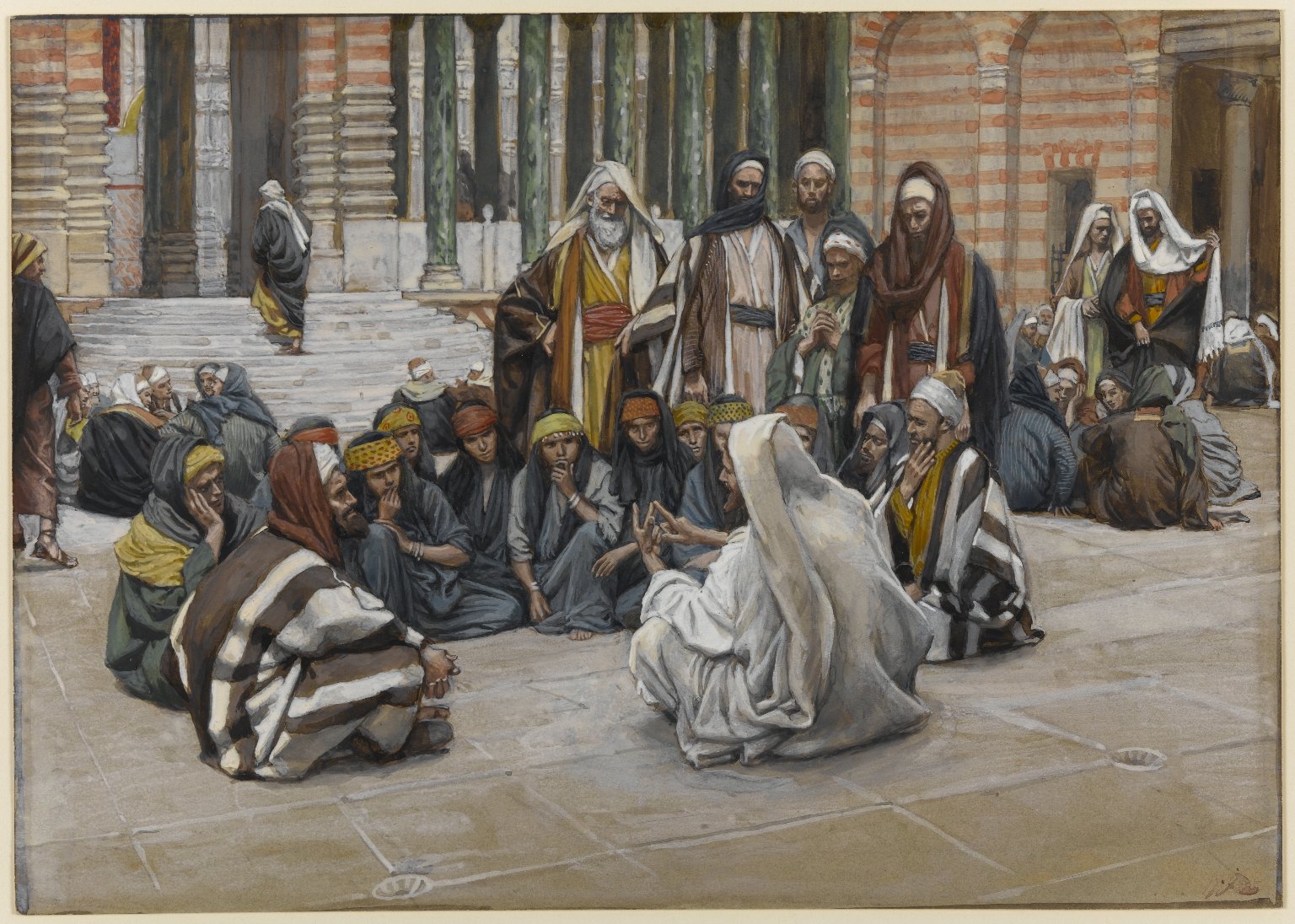
In this morning’s Gospel, Jesus is in Jerusalem, engaging in some theological discussions in the Temple. He has just been talking to a group of Sadducees about the Resurrection. Their conversation gains to the attention of a Scribe, a legal expert, who asks Our Lord:

“Prun yw’r gorchymyn cyntaf o’r cwbl?”

“Which commandment is the most important of all?” (Mk 12:28)

Jesus answers, as we would expect, with words which also form part of this morning’s first reading from Deuteronomy:

“Y cyntaf yw, ‘Gwrando, O Israel, yr Arglwydd ein Duw yw’r unig Arglwydd, a châr yr Arglwydd dy Dduw â’th holl galon ac â’th holl enaid ac â’th holl feddwl ac â’th holl nerth.’” 

“The most important is, ‘Hear, O Israel: The Lord our God, the Lord is one. And you shall love the Lord your God with all your heart and with all your soul and with all your mind and with all your strength.’” (Mk 12:29-30)

These words form the Shema, are a prayer recited three times a day by Jews. They are a declaration of faith in God, and represent how each person is called to love God with all of our being. To this Our Lord adds: 

“Yr ail yw hwn, ‘Câr dy gymydog fel ti dy hun.’ Nid oes gorchymyn arall mwy na’r rhain.”

“The second is this: ‘You shall love your neighbour as yourself.’ There is no other commandment greater than these.” (Mk 12:31)

Christ quotes from Leviticus (19:18) to show our duty towards our neighbour. Christians are commanded both to love, and to will the good of others, as St Thomas Aquinas said in the Summa Theologiae:Love is to will the good of another, Mae cariad ewyllysio y Dda o’r eraill’. To love, then, is not simply an act of passion or emotion — something which we feel — but it is also something which we choose to do. As followers of Christ, we desire to see others flourish, and we work towards that end. Love takes effort. To choose someone else’s good reminds us that we do not exist for our own sake, and that our lives are lived in community and relationship with others. We are called to be loving and generous, just as God has been loving and generous towards us in Christ. We seek to cooperate with God in promoting human flourishing. 

Our Lord’s teaching meets with the Scribe’s approval

“Da y dywedaist, Athro; gwir mai un ydyw ac nad oes Duw arall ond ef. Ac y mae ei garu ef â’r holl galon ac â’r holl ddeall ac â’r holl nerth, a charu dy gymydog fel ti dy hun, yn rhagorach na’r holl boethoffrymau a’r aberthau.”

“You are right, Teacher. You have truly said that he is one, and there is no other besides him. And to love him with all the heart and with all the understanding and with all the strength, and to love one’s neighbour as oneself, is much more than all whole burnt offerings and sacrifices.” (Mk 12:32-33)

Our duty towards God and our neighbour — namely to love them — is foundational to how we practise our religion and how we live our lives. This responsibility informs all that we are, and all that we do, and also promotes human flourishing. The scribe recognises this, and rather than tying to catch Jesus out, he is genuinely interested in seeing the world become a better place.

Such a positive response elicits a similar one from Jesus:

A phan welodd Iesu ei fod wedi ateb yn feddylgar, dywedodd wrtho, “Nid wyt ymhell oddi wrth deyrnas Dduw.”

And when Jesus saw that he answered wisely, he said to him, “You are not far from the kingdom of God.” (Mk 12: 34)

The scribe is not far from following the signs and becoming a follower of ‘The Way’. However, while he agrees with Jesus’ teaching, the scribe still does not recognise Jesus as the Messiah, which Bartimaeus, in last Sunday’s Gospel, was able to do despite being blind.

As Christians we believe that Jesus is our great high priest, who gives Himself, on our behalf, as an offering to God the Father, out of love. This is what takes place on the Cross at Calvary. God, in Christ, gives everything. The life of the Son of God is offered freely, to reconcile what sin has thrust apart. Jesus is the greatest example of generosity that exists. This is the heart of the Christian Faith: Christ dies for us and rises again to heal the wounds of sin and division and to open up the way to Heaven for those who believe in Him. At its heart the message of the Gospel is love: love of God and neighbour. This is what Our Lord demonstrates on the Cross. The greatest expression of God’s love for humanity, which is made present in the Eucharist. Each and every time the Eucharist is celebrated, we, the people of God, are fed with Christ’s Body and Blood, to be built up in love. The love of God becomes something which we can touch and taste. Jesus gives Himself to us, so that we can grow in the love of God and of each other.

So my brothers and sisters in Christ, let us be nourished by Him in Word and Sacrament. Let us be filled with the love of God and love of our neighbours, so that this love forms who we are and what we do. Let us also give praise and honour to God the Father, God the Son, and God the Holy Spirit. To whom be ascribed all glory, dominion and power, now and forever. Amen.
Trinity XIX

When I was studying for my PhD, I was expected to gain experience in giving papers at conferences. After you have given a conference talk, there is a time for the audience to ask questions. What you quickly learn is that some people take a particular delight in posing the most difficult questions. It is the same in all areas of life, and it isn’t much fun answering this line of enquiry. Jesus is constantly running up against people who ask difficult questions. The Pharisees, experts on Jewish religious law, seem to take a particular delight in asking awkward things. They try to catch Our Lord out, to undermine His teaching and credibility. However, they are unable to do so.

In the Gospel today, Jesus and His Disciples are stopped by legal experts, who ask Him a tricky question:

‘Is it lawful for a man to divorce his wife?’

‘oedd ym gyfreithlon i ddyn ysgaru ei wraig’ (Mk 10:2)

Our Lord answers their question with another:

‘What did Moses command you?’

‘Beth a orchmynnodd Moses i chwi?’ (Mk 10:3)

His strategy is a sensible one. They have asked if divorce is lawful, so Jesus refers them to Moses, the giver of the Jewish law. The Pharisees reply that Moses allowed divorce, whereupon Christ proceeds to explain the law to them. He contrasts the present situation with that established by God in the Creation. Marriage is a loving and faithful union which unites two people so they become one flesh. The concept of marriage is used throughout the Old Testament to describe the relationship between God and Israel. 

Later on Jesus’ disciples ask Him about divorce. In His reply Jesus calls marriage after divorce adultery. This represents a strengthening of the position, and has been understood as forbidding what had been previously allowed. What we are dealing with here is an ideal position, which humanity often fails to live up to. Sometimes Our Lord’s teachings are hard. The perfection that God expects of us can appear unattainable. However, this needs to be balanced by the fact that God is a God of love, mercy, and forgiveness. Christianity is a religion of love which recognises that people’s lives are often far from perfect.

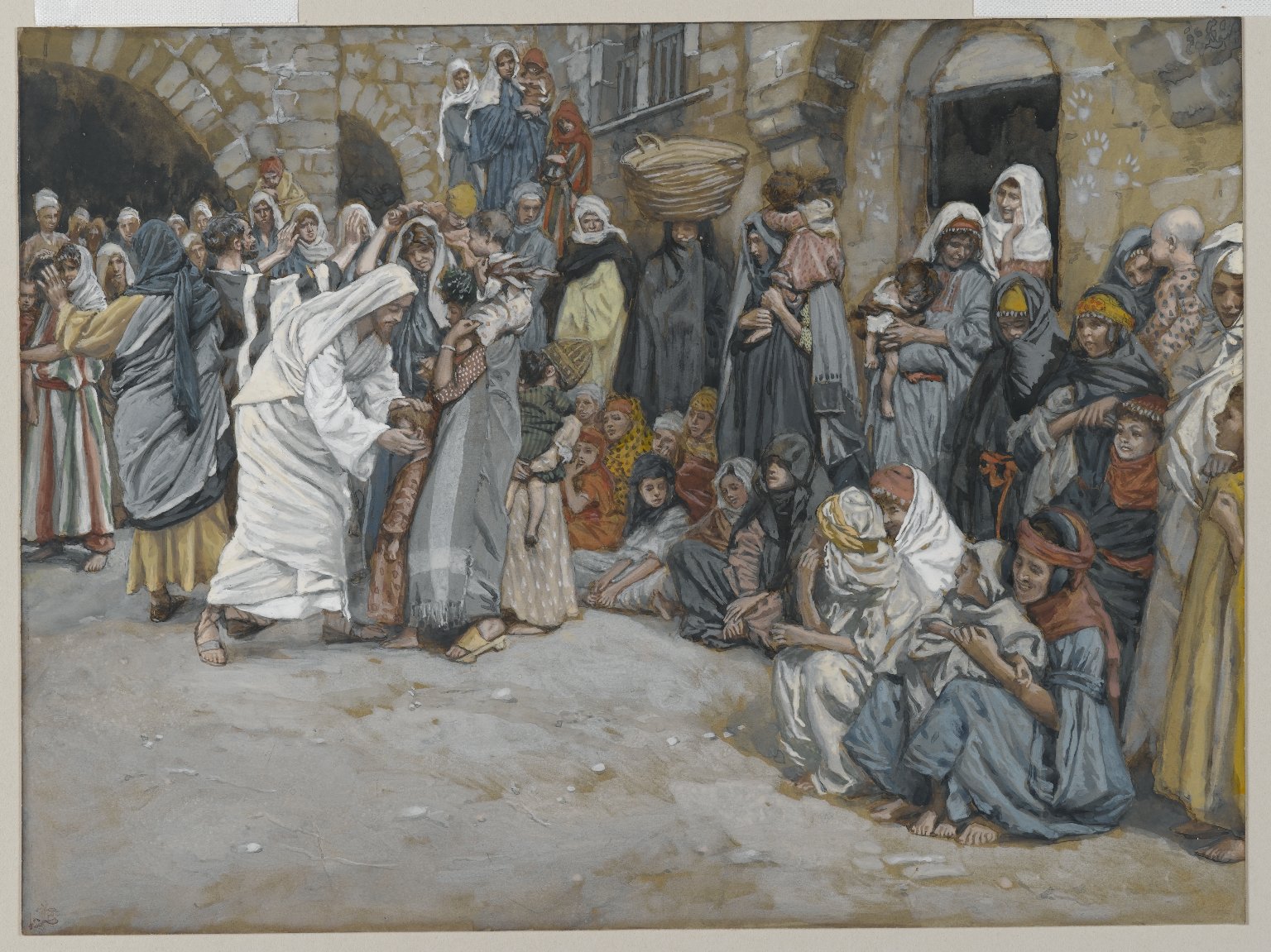
Some time later people bring their children for Jesus to bless them. The disciples are unhappy about this and tell the people off. It has been a busy time and they are concerned that Our Lord is tired. Christ, however, rebukes them:

“Let the children come to me; do not hinder them, for to such belongs the kingdom of God. Truly, I say to you, whoever does not receive the kingdom of God like a child shall not enter it.”

“Gadewch i’r plant ddod ataf fi; peidiwch â’u rhwystro, oherwydd i rai fel hwy y mae ternas Dduw yn perthyn. Yn wir, ‘rwy’n dweud wrthych, pwy bynnag nad yw’n derbyn teyrnas Dduw yn null plentyn, nid â byth i mewn iddi” (Mk 10:14-15)

Jesus uses the children to make an important point. If we want to enter the Kingdom of God we have to be like children — simple, trusting, humble, unself-conscious, and dependant on others for our well-being. Our salvation, God’s grace, is a gift which we have to accept. We do not work for it, or earn it. By trying to stop the children coming for a blessing the disciples have overstepped the mark. So Jesus points out that we are all called to be joyful. Children play because it is fun and they love it. For youngsters, play is a serious business, done for its own sake, and no other. The same can be said about worship.

God does not need our praise. Worship is something that we need to do. Christians engage in prayer and worship not to change God, but to change ourselves: so that we might grow and develop, in the same way that children do. We come as children of God to be fed by God, so that we might grow into His likeness. This is the Kingdom, here and now, and we come in childish simplicity to be with God and each other, to learn, to pray, and to be nourished. This is what life is really about. This is what really matters.

That is why today we also hear the account of the Creation of humanity in the second chapter of Genesis. God knows that it is not good for people to be alone. Humanity is made for relationship: male and female, different and equal, made in the image and likeness of God, made for family. There is no greater kinship than the Church, where we are all brothers and sisters in Christ. This is a relationship which extends through space and time, and includes both the living and the dead. The Church family is united in faith, and hope, and love, fed with the bread of Heaven — God’s very self.

My Brothers and Sisters in Christ, we are loved by God, who longs for us to have life in all its fulness. Let us celebrate being members of the family that is the Kingdom, united with God and each other. Let us live lives of compassion and forgiveness, so that we attract others to know, and love, God the Father, God the Son, and God the Holy Spirit. To whom be ascribed all glory, dominion and power, now and forever. Amen.
James Tissot: Suffer the little children to come unto me [Brooklyn Museum]

Trinity I

THE novel by Robert Llewellyn —‘How green was my valley’ — reached millions through its 1941 film adaptation by John Ford. Telling the story of a family in a South Wales mining community, it criticises the unjust labour practises of the early twentieth century. Earlier in 1887 the historian Lord Acton wrote to the Professor of Ecclesiastical History at the University of Cambridge, saying that, ‘Power tends to corrupt, and absolute power corrupts absolutely.’ While this maxim now tends to be applied generally, it was originally a comment on religious institutions in general, and the medieval Papacy in particular. The truth of this statement is a reflection on our fallen human nature.

In the Gospels we often see Our Lord come into conflict with the Scribes, Priests, and Pharisees. These religious leaders are depicted as being more concerned with power and prestige than with the worship of Almighty God. If Religion is important then there will be a status attached to its ministers. They, therefore, have a responsibility to use this status for good, and to bring people closer to God.

In today’s Gospel it is the Sabbath, a day of rest. Jesus and His disciples are travelling, and the Pharisees notice that some of them have plucked ears of corn to eat. The Pharisees ask Our Lord:

‘Look, why are they doing what is not lawful on the Sabbath?’

‘Edrych, pam y maent yn gwneud peth sy’n groes i’r Gyfraith ar y Saboth?’  (Mk 2:24)

Jews are forbidden from doing any work on Sabbath, and the harvesting of grain, no matter how little, counts as work. This appears to be a clear-cut case, but Jesus replies as follows:

‘Have you never read what David did, when he was in need and was hungry, he and those who were with him: how he entered the house of God, in the time of Abiathar the high priest, and ate the bread of the Presence, which it is not lawful for any but the priests to eat, and also gave it to those who were with him?’

‘Onid ydych chwi erioed wedi darllen beth a wnaeth Dafydd, pan oedd mewn angen, ac eisiau bwyd arno ef a’r rhai oedd gydag ef? Sut yr aeth i mewn i dŷ Dduw, yn amser Abiathar yr archoffeiriad, a bwyta’r torthau cysegredig nad yw’n gyfreithlon i neb eu bwyta ond yr offeiriaid; ac fe’u rhoddodd hefyd i’r rhai oedd gydag ef?’ (Mk 2:25-26)

This story is recounted in 1Samuel 21:1-7. By referring to it Our Lord is making the point that if David’s actions were acceptable, then why is such a fuss being made about the disciples plucking a few ears of corn. Jesus underlines this by pointing out that:

‘The Sabbath was made for man, not man for the Sabbath’

‘Y Saboth a wnaethpwyd er mwyn dyn, ac nid dyn er mwyn y Saboth’ (Mk 2:27)

The legalism of the Pharisees has led them to forget what the Sabbath is really about: rest. The point of having a Sabbath is to ensure that people have a day of rest. Instead this day has become bound up with rules and observances which neither honour God, nor encourage humanity to rest. 

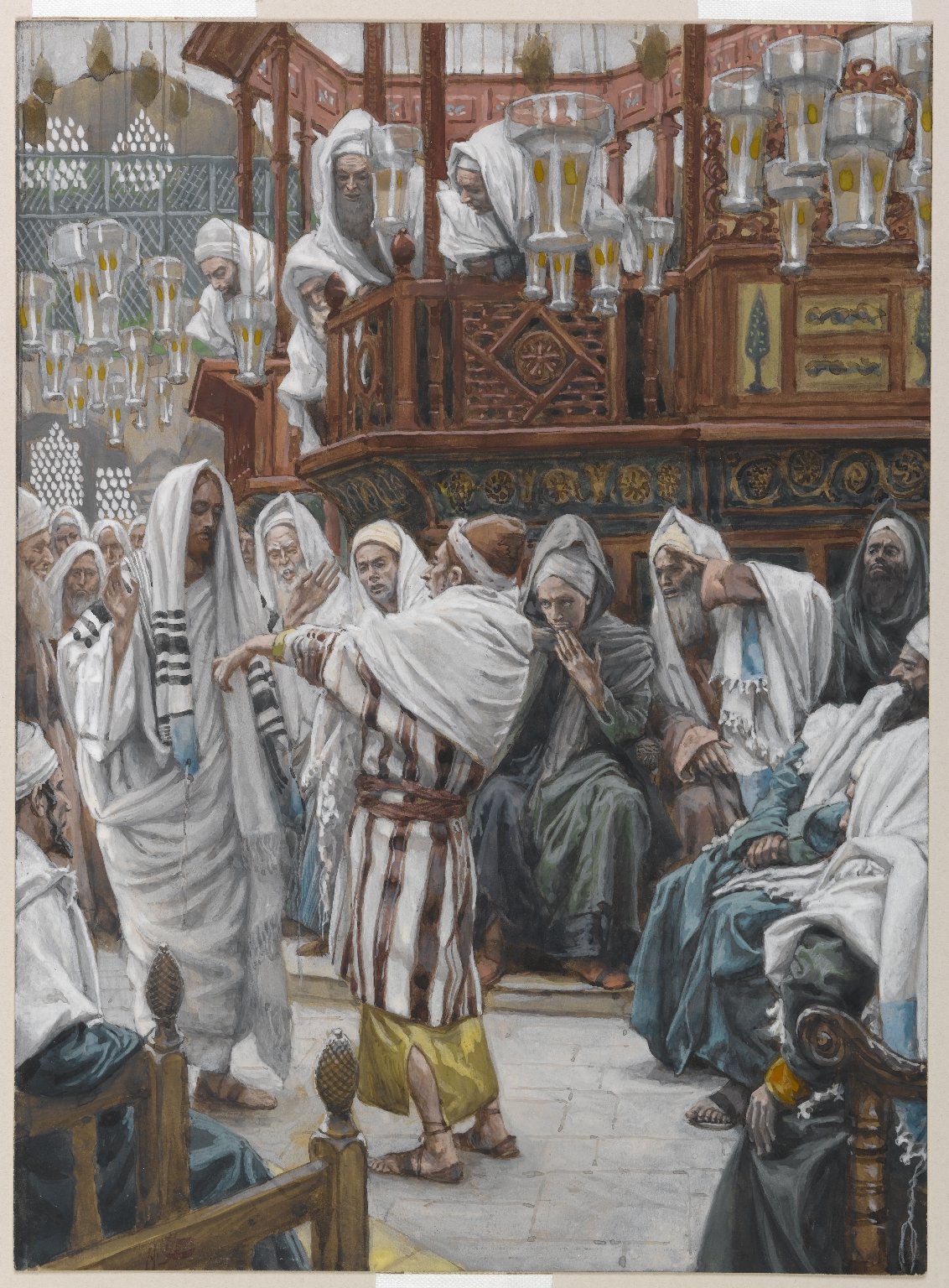
Jesus and His disciples arrive at a synagogue where there is a man with a withered hand. Clearly this is another opportunity for the legalism of the Pharisees to come to the fore.

‘And they watched Jesus, to see whether he would heal him on the Sabbath, so that they might accuse him.’

‘Ac yr oeddent â’u llygaid arno i weld a fyddai’n iacháu’r dyn ar y Saboth, er mwyn cael cyhuddiad i’w ddwyn yn ei erbyn.’ (Mk 3:2)

Rather than rejoicing that God has performed a miracle, and that a man with a disability has been healed, all the Pharisees can see is an opportunity to complain about rule-breaking, and to bring an accusation against Jesus. Our Lord calls the man to Him, and says to the Pharisees:

‘Is it lawful on the Sabbath to do good or to do harm, to save life or to kill?’

‘A yw’n gyfreithlon gwneud da ar y Saboth, ynteu gwneud drwg, achub bywyd, ynteu lladd?’ (Mk3:4)

They give no reply because they know that in order to save a life one may break every rule regarding the observance of the Sabbath. Jesus’ knowledge and interpretation of Jewish Scripture and Law is superior to theirs. Our Lord then asks the man to stretch out his hand, and he is miraculously healed. No law has been broken. Instead someone who was suffering, and who was probably shunned and made an outcast in society, has been cured and brought back into the fold of the community. God’s power to heal and restore humanity has been displayed. The Kingdom of God has been announced in deed.  

The response of the religious authorities is telling. Do they rejoice at this miracle? The answer is definitely no.

‘The Pharisees went out and immediately held counsel with the Herodians against him, how to destroy him.’

‘Ac fe aeth y Phariseaid allan ar eu hunion a chynllwyn â’r Herodianiaid yn ei erbyn, sut i’w ladd.’ (Mk 3:6)

The Pharisees have formed an alliance with a priestly party, keen on political independence. Both sides share a common aim — to get rid of Jesus. This is because He represents a threat to their power. Our Lord’s words and actions are understood by the Pharisees as an assault on their privileged position, with their innate goodness being ignored. From the start of His public ministry, Christ faces opposition from people who want Him dead. They think that they can destroy Jesus, and that will be the end of the matter, whereas it will only be the beginning. Our Lord will die on a Cross, but will be raised to new life at Easter. Calvary and the Empty Tomb are the salvation of humanity, part of God’s plan.

As Christians we gather on the Lord’s Day, the first day of the week, to celebrate Christ’s Death and Resurrection. By means of the Eucharist, we do that which Jesus commanded us to do until He comes again. For one hundred thousand successive Sundays the faithful have gathered to share in Holy Communion, because it matters, it is important. We are fed with the Bread of Angels, with the Body and Blood of Christ, so that we may be healed and given a foretaste of Heaven.

So, my brothers and sisters, let us rejoice in the healing salvation of Christ. Let us proclaim the Good News, so that all people may come to know, and love, God the Father, God the Son, and God the Holy Spirit. To whom be ascribed all glory, dominion, and power, now and forever. Amen.

James Tissot – The Man with a withered hand (Brooklyn Museum)
Tissot: The Disciples Eat Wheat on the Sabbath (Brooklyn Museum)