Advent III – He who is to come

‘the ransomed of the Lord … shall obtain gladness and joy and sorrow and sighing shall flee away.’ (Isaiah 35:10)

‘a gwaredigion yr Arglwydd fydd yn dychwelyd … hebryngir hwy gan lawenydd a gorfoledd a bydd gofid a griddfan yn ffoi ymaith’

This year our first readings during Advent come from the book of Isaiah. This Old Testament prophet stresses the belief that the Messiah will come to deliver Israel. As Christians, we use the period of Advent to reflect upon the fact that Christ is coming. He is coming as a baby born in Bethlehem. He is coming to us here today in the Eucharist. And He is coming to judge the world. Should we be afraid? On the contrary, as the prophet says:

‘Strengthen the weak hands, and make firm the feeble knees. Say to those who have an anxious heart,“Be strong; fear not! Behold, your God will come with vengeance, with the recompense of God. He will come and save you’ (Isa 35:3-4). 

God is coming to save us, His people. The salvation we long for will be ours. The prophet Isaiah has a vision where the desert, a dry wilderness, is carpeted with flowers. This is a sign of new life.This is an image of hope. This is the flourishing which the Messiah will bring: ‘the glory of the Lord, the majesty of our God’ (Isa 35:2). As Christ Himself says, ‘I came that they may have life and have it abundantly’ (Jn 10:10). This is good news. It is a reason to rejoice and be glad. In order to mark this, the Church wears rose today, instead of penitential purple. In order to celebrate the joyful character of this day, and to remind us that Christ is coming. As Isaiah says:

‘the ransomed of the Lord shall return and come to Zion with singing; everlasting joy shall be upon their heads; they shall obtain gladness and joy, and sorrow and sighing shall flee away’ (Isa 35:10).

The time is both now and, at the same time, it is not yet. As St James writes, ‘You also, be patient. Establish your hearts, for the coming of the Lord is at hand’ (James 5:8). Patience is a hard thing to master. Human beings are naturally impatient. We do not want to wait, but we have to. The question is how we wait. We are told that this should be in joyful expectation, preparing ourselves for what is to come. 

John the Baptist has been waiting for the Messiah. However, despite leaping in his mother’s womb at the Visitation to announce Christ’s coming, in this morning’s Gospel he appears to be having doubts. John is expecting a Messiah of judgement, and he is isn’t entirely sure what is going on. The Baptist has been imprisoned for criticising Herod Antipas’ marriage to his brother’s wife. John is therefore hoping for a messiah who will sweep away an unjust and corrupt regime. This is why he has doubts about Jesus, who does not seem to be a political messiah. Jesus tells John’s disciples:

‘Go and tell John what you hear and see: the blind receive their sight and the lame walk, lepers are cleansed and the deaf hear, and the dead are raised up, and the poor have good news preached to them’ (Mt 11:4-5). 

The vision of a messianic future envisaged by Isaiah in this morning’s first reading has become a reality: prophecy has been fulfilled, God keeps his promises. The Kingdom of God is a place of healing, and Christ is the great physician, who has come to heal our souls. Jesus is the one who is to come, who has come, and who will come again. The establishment of God’s kingdom can appear strange in human terms. Focussing on those on the margins, the sick, the poor, the oppressed, and the marginalised, is not a grand gesture. That is the point! The greatest gesture Jesus will make will be in handing Himself over to be crucified and to die the death of a common criminal. This is how the messiah will reign as the true King of Israel, on the Cross at Calvary. 

God’s salvation defies human expectations. This is the point: God’s ways are not our ways, nor are His thoughts our thoughts. That is the core message of this morning’s Gospel. If we expect God’s rule to look like human kingship, then we will be disappointed. Our Heavenly Father has something else in store, something far more wonderful than we could ever imagine, and at its heart is the transformation of humanity through love. God heals His people, because He is a God of love. Our Creator does not love us because we are loveable. We are sinners, who do not deserve to be loved, and cannot earn His divine love. But, rather than WHAT we are, God loves us for WHO we are: His sons and daughters, created in His image and likeness. God is someone whom we can trust, who keeps His promises. Our Heavenly Father offers the world the greatest present it could ever hope for: true love and eternal life.

Today, the peace which the Messiah came to bring seems as elusive as ever. The human capacity to create misery in the most dreadful ways continues relentlessly. We know that humanity still has some considerable distance to travel towards the establishment of a just and peaceful world. An answer is to embrace the need for repentance: to change our hearts and minds and to follow Jesus. We also prepare to meet Our Lord as He will come again, as our Saviour and our Judge. It is a daunting prospect, yet we know and trust that Christ saves us. By His Wounds on the Cross we are healed, and our sins are forgiven.

This is God’s grace: loving sinful humanity in order that we may be transformed by His Divine love. This is why the focus is on healing — something which only God can do — to redeem our souls with His love. This is the cause of our gladness and joy. What the prophet Isaiah hoped for has been fulfilled, and continues to be fulfilled. The Church is called to carry on God’s healing in the world, and restore each person with divine love. This is what we are about to celebrate in the Eucharist, where we both thank Our Heavenly Father for loving us, and we also prepare to experience that healing love, so that it may transform us, now, here, today. We do so with reverence, because we are not simply consuming human food and drink, but the very Body and Blood of Christ, given for us, to heal us. It is the greatest medicine our souls could ever wish for. Soon we ‘shall see the glory of the Lord, the majesty of our God’ (Isa 35:2). God’s glory and majesty is to give His Body for us on a Cross, and also to feed us with Himself.

Let us, then, come to the banquet with glad hearts, and experience the life-changing love of God. Let us allow it to heal and transform us, so that we can join our voices with all creation to joyfully sing the praises of God the Father, God the Son, and God the Holy Spirit, Duw Dad, Duw y Mad, a Duw yr Ysbryd Glân, to whom be ascribed all might, majesty, glory, dominion, and power, now and forever. Amen.

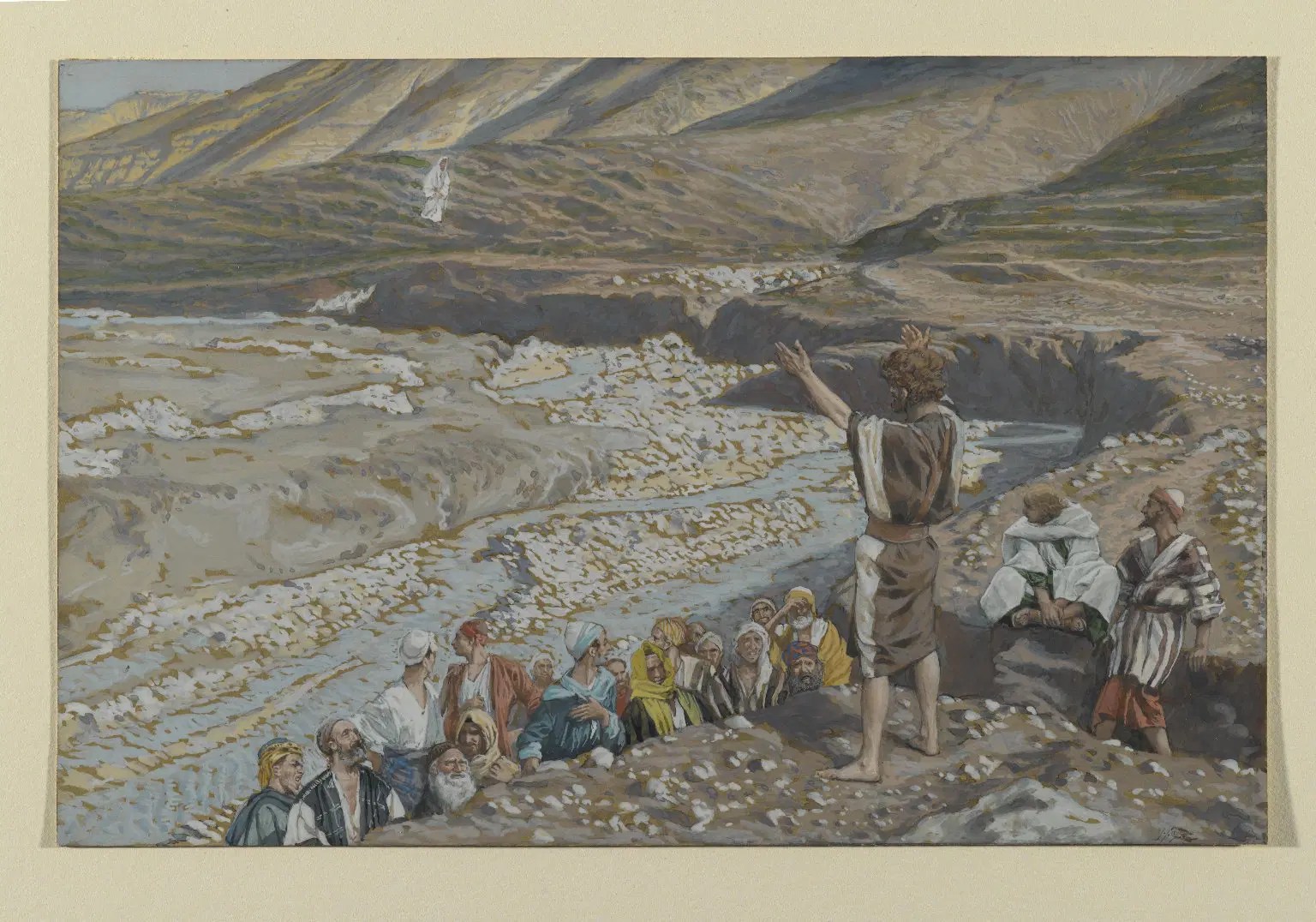
Jean Tissot: St John the Baptist sees Jesus from afar (Brooklyn Museum)

The Baptism of the Lord 2025

TWO of the most important days of our lives are ones that many of us cannot remember. The first is the day of our birth, and the second is the day of our baptism. While people are often baptised when they are children or adults, many people in this country are baptised as infants. We may have photos of our baptism, and we may remember it or have been told about it by our families. People usually know where and when their baptism took place. Also, having been to other baptisms we know what will have happened on this significant day of our life, when we were welcomed as a member of the Christian community. Jesus’ baptism was in many ways similar to our own, and in some ways it was significantly different.

Early in Luke’s Gospel we hear about John the Baptist, a holy man who has been proclaiming a baptism of repentance for the forgiveness of sins (Lk 2:3). John has been calling people to turn away from their sins, and to turn back to God, and live holy lives. This has a significant effect on the people of Judea. There is an increase in religious observance; something like a religious revival. This, in turn, leads to speculation:

‘Gan fod y bobl yn disgwyl, a phawb yn ystyried yn ei galon tybed ai Ioan oedd y Meseia,’

‘As the people were filled with expectation, and all were questioning in their hearts concerning John, whether he might be the Christ,’ (Lk 3:15)

The people of Israel were longing for the Messiah, the Christ, the Anointed One. The prophesied Messiah is a charismatic King figure, anointed by God, and descended from David, who will make Israel flourish and re-establish the Kingdom of God. 

John the Baptist goes to great lengths to argue that he is not the Messiah. John is the messenger, preparing the way:

‘Yr wyf fi yn eich bedyddio â dŵr; ond y mae un cryfach na mi yn dod. Nid wyf fi’n deilwng i ddatod carrai ei sandalau ef. Bydd ef yn eich bedyddio â’r Ysbryd Glân ac â thân.’

‘I baptize you with water, but he who is mightier than I is coming, the strap of whose sandals I am not worthy to untie. He will baptize you with the Holy Spirit and with fire.’ (Lk 3:16)

The Baptist sees himself as not even worthy to untie the sandals of the Messiah, something a servant would do for their master. John demonstrates great humility, and his actions point forward to the baptism of the Church, instituted by Jesus in the River Jordan. Whereas John baptizes with water, Jesus will baptize with the Holy Spirit and fire. This looks forward to both Our Lord’s death on the Cross, and to Pentecost, when the Apostles are filled with the Holy Spirit.

‘Pan oedd yr holl bobl yn cael eu bedyddio, yr oedd Iesu, ar ôl ei fedydd ef, yn gweddïo. Agorwyd y nef, a disgynnodd yr Ysbryd Glân arno mewn ffurf gorfforol fel colomen; a daeth llais o’r nef: “Ti yw fy Mab, yr Anwylyd; ynot ti yr wyf yn ymhyfrydu.”’

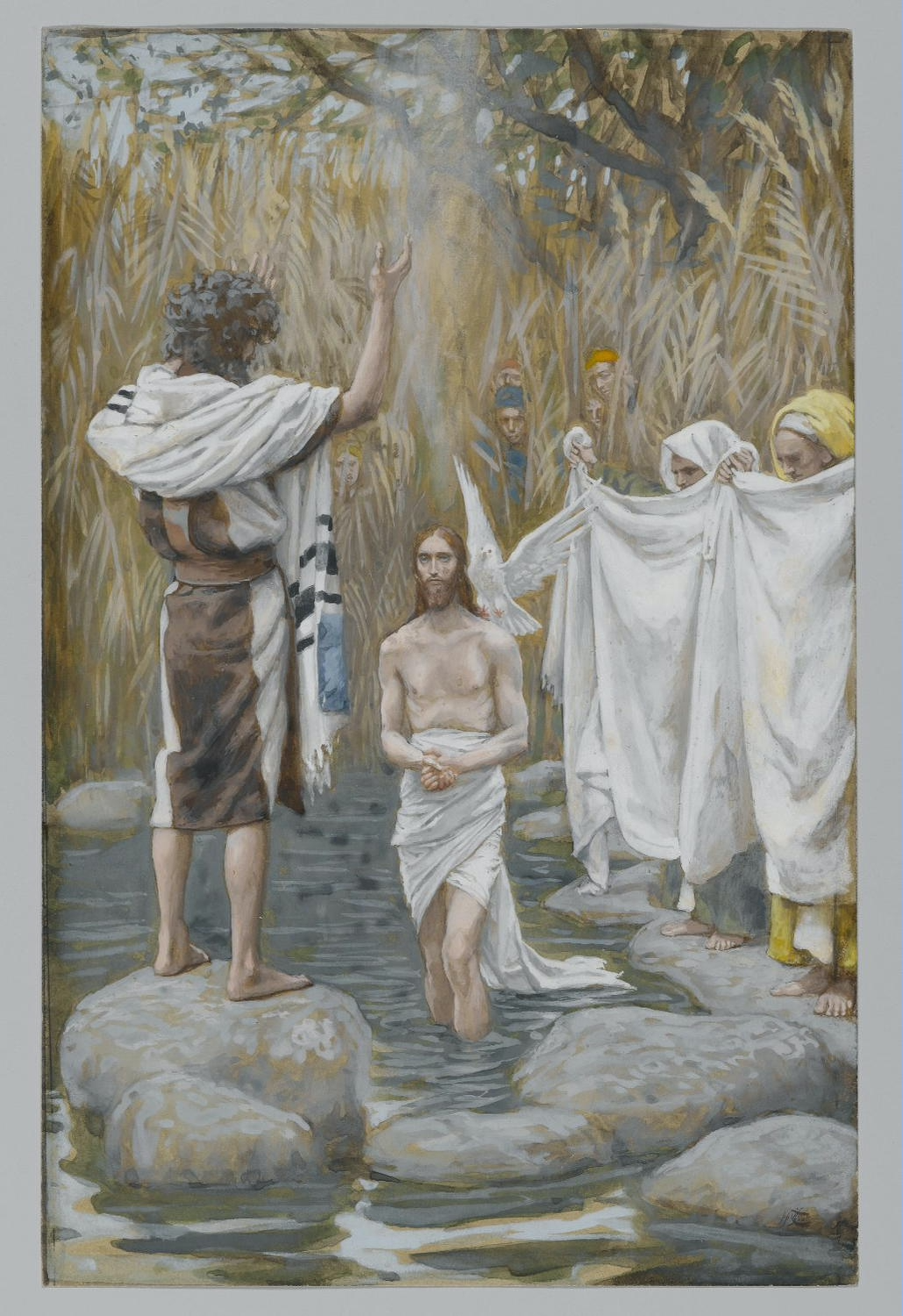
‘Now when all the people were baptized, and when Jesus also had been baptized and was praying, the heavens were opened, and the Holy Spirit descended on him in bodily form, like a dove; and a voice came from heaven, “You are my beloved Son; with you I am well pleased.”’ (Lk 3:21-22)

We then have to ask ourselves why is Jesus being baptized? Jesus is not a sinner. He has no sins from which to repent, and yet He is in the River Jordan, being baptized by John. An explanation is that in His Baptism Jesus is in solidarity with sinful humanity: He does not wish us, His followers, to undergo anything that He would not undergo Himself. Christ is an example of how to come to God and have new life: He shows us the Way. As a sign of divine approval after the Baptism, as Jesus is praying, the heavens open, and the Holy Spirit descends upon Him in the form of a dove. God then says: ‘Ti yw fy Mab, yr Anwylyd; ynot ti yr wyf yn ymhyfrydu. You are my beloved Son; with you I am well pleased.’ (Lk 3:22)

At the beginning of his public ministry, Jesus shows humanity the way to the Father, through Himself. The world sees the generous love of God, which heals and restores us to the light and life of the Kingdom of God. As our baptism is a sharing in the death and resurrection of Jesus, so His Baptism points to the Cross, where streams of blood and water flow to cleanse and heal the world. We see the love of the Father, the power of the Spirit, and the obedience of Son, all for us — people who need God’s love, forgiveness, and healing.

At the moment of Jesus’ Baptism, the fullness of the Godhead is manifested in glory and the divine presence. In the account of Noah’s Ark God makes his love manifest in the form of a dove. At the end of the Flood a dove brings an olive branch back to the Ark, a sign of peace and new life. So now, the Holy Spirit appears in the form of a dove to show us the fullness of God, a relationship of love, which is opened up to us in our baptism. Through our baptism we are invited into the embrace of God’s eternal love. 

The Divine Trinity makes itself manifest in recognition of the Son’s obedience to the Father, and looks forward to the Cross, where God’s love is poured out upon the world, and through which we are saved. In our own baptism, we share in Christ’s Death and Resurrection. In His Baptism, as in His Death, Christ shows us the way to the Father in the power of the Holy Spirit. We are baptised in the name of the Holy and life-giving Trinity. Similarly, our worship this morning began by invoking the name of the Trinity: the Father, the Son, and the Holy Spirit (Yn enw’r Tad, a’r Mab, a’r Ysbryd Glân). And so all of our life as Christians is Trinitarian.

As we celebrate Our Lord’s Baptism in the River Jordan, and as we remember our own baptism, we also look forward to His first miracle at the Wedding at Cana. Christ, He who is without sin, shows humanity how to be freed from transgression and to have new life in Him.

So, today and every day, let us all draw strength from our Baptism and grow in faith, hope, and love, nourished by Christ, and with Christ. Let us share that love with others and give praise and honour i’r Duw Dad, Duw y Mab, a Duw yr Ysbryd Glân. I’r hwn y priodoler pob gogoniant, arglwyddiaeth a gallu, yn awr ac yn oes oesoedd. Amen.

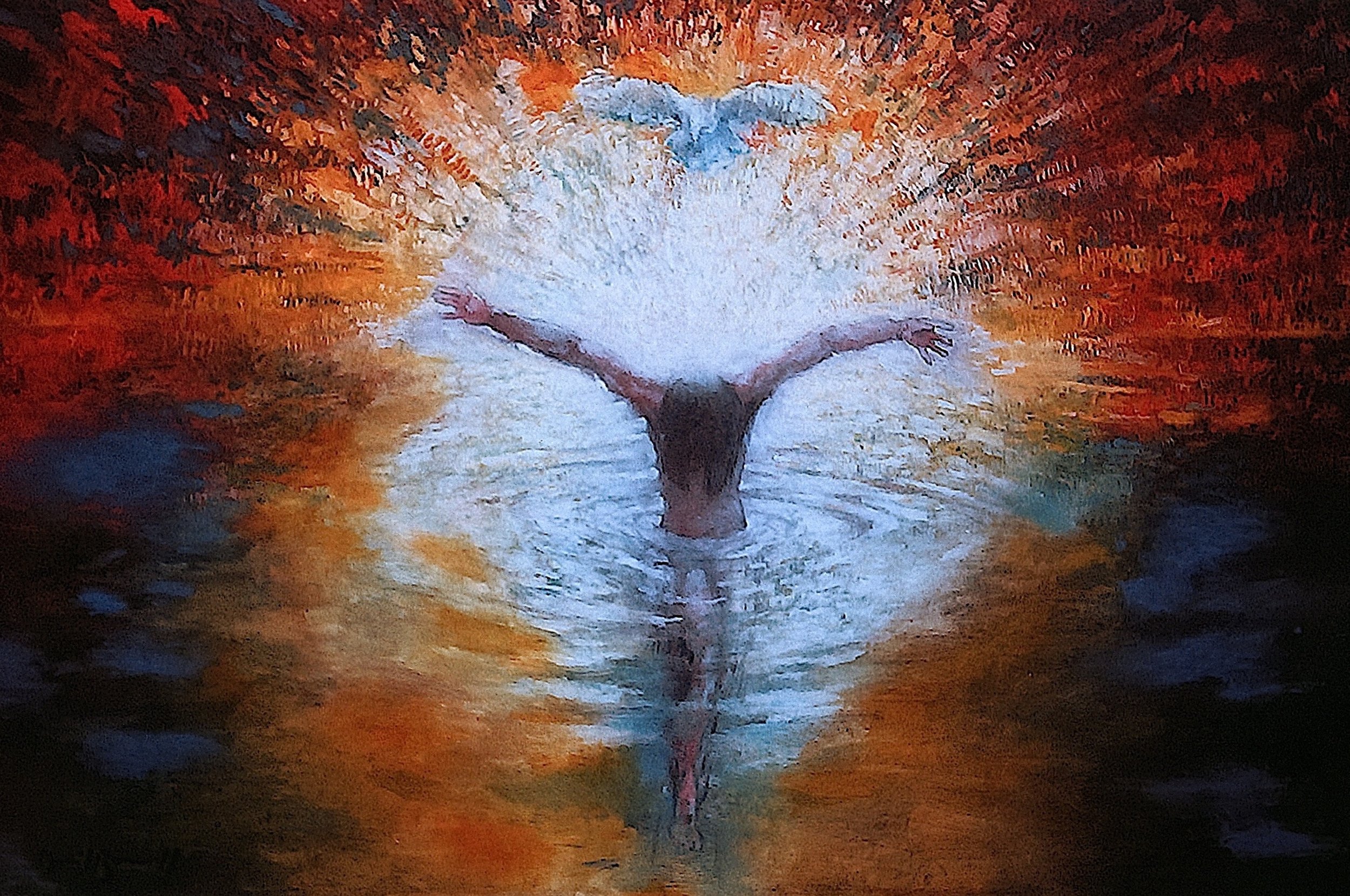
The Baptism of Christ – Daniel Bonnell

Advent IV: The Visitation

OVER the Christmas and New Year period many of us will be travelling to visit friends and relatives, or will have visitors to stay. Our normal routines may have to be changed, but any disruption is outweighed by the joy that company brings. This Sunday is all about journeys to visit family. It takes the best part of a week to walk the ninety miles from Nazareth to Bethlehem. This is a difficult journey, which is uphill all the way. The Gospel this morning tells the story of the Visitation, when Mary went to visit her cousin Elizabeth, to help her during her pregnancy. Two expectant mothers together and two journeys to be with family. These journeys form an important part of the Christmas story, and change the world.

What was about to happen in Bethlehem had been announced. The prophet Micah contains one of the great Messianic prophecies:

‘ohonot ti y daw allan i mi un i fod yn llywodraethwr yn Israel, a’i darddiad yn y gorffennol, mewn dyddiau gynt.’

‘from you shall come forth for me one who is to be ruler in Israel, whose coming forth is from of old, from ancient days.’ (Micah 5:2)

Christ’s coming is ordained: He will be Israel’s true king. God’s plan of salvation has always been that Jesus should be born, and all of human history from the Creation onwards has been leading up to this point. Jesus will:

‘Fe arwain y praidd yn nerth yr Arglwydd, ac ym mawredd enw’r Arglwydd ei Dduw. A byddant yn ddiogel, oherwydd bydd ef yn fawr hyd derfynau’r ddaear; ac yna bydd heddwch.’

‘shepherd his flock in the strength of the Lord, in the majesty of the name of the Lord his God. And they shall dwell secure, for now he shall be great to the ends of the earth. And he shall be their peace.’ (Micah 5:4-5a)

Our Lord is the Good Shepherd who cares for His flock and lays down His life for us. We can dwell secure because Christ is our peace, and in Him we have the hope of Heaven and the promise of eternal life. These are huge claims to make, and yet Jesus will fulfil them. 

This is why the author of the Letter to the Hebrews can be confident that:

‘â’r ewyllys honno yr ydym wedi ein sancteiddio, trwy gorff Iesu Grist sydd wedi ei offrymu un waith am byth.’

‘by that will we have been sanctified through the offering of the body of Jesus Christ once for all’ (Hebrews 10:10)

The eternal offering of a sinless victim, both frees humanity of its sins, and also restores our relationship with God and with one another. It is an act of perfect obedience: prepared by God for Christ to do His will and sanctify humanity, to heal us and restore us. The Incarnation IS God’s plan for the salvation of humanity, it is not Plan B!

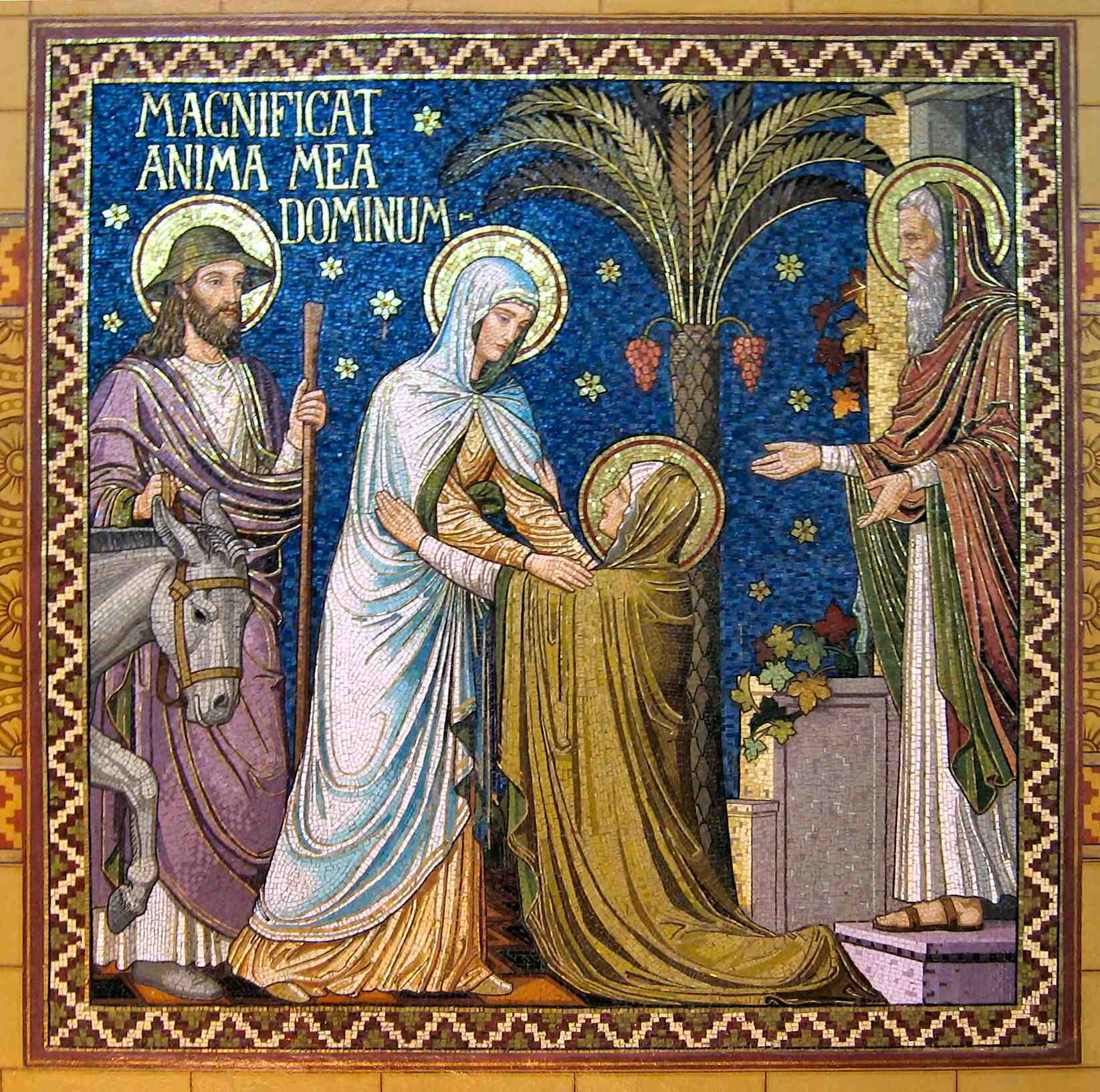
So while Mary, Joseph, and the donkey are making their way to Bethlehem, we turn our eyes elsewhere. The Gospel this morning is St Luke’s account of the Visitation, when Mary goes to see her older cousin Elizabeth, who is pregnant with her son, John the Baptist.

Pan glywodd hi gyfarchiad Mair, llamodd y plentyn yn ei chroth

And when Elizabeth heard the greeting of Mary, the baby leaped in her womb.’ (Lk 1:41)

Even before he was born, John recognises Jesus, and leaps for joy, announcing Christ’s presence and preparing His way. This leads Elizabeth to say to Mary:

‘Bendigedig wyt ti ymhlith gwragedd, a bendigedig yw ffrwyth dy groth.’

Blessed are you among women, and blessed is the fruit of your womb!’ (Lk 1:42)

Mary is blessed, because she says, ‘Yes’ to God, and she will soon give birth to a baby boy. This is no ordinary child, but God with us, Emmanuel. Elizabeth recognises that Mary’s obedience and humility undoes the sinfulness of Eve. That she who knew no sin might give birth to Him who would save us and all humanity from our sin. It is through the love and obedience of Mary that God’s love and obedience in Christ can be shown to the world. This is demonstrated in absolute perfection when, for love of us, Jesus opens His arms to embrace the world with the healing love of God on the Cross. Mary’s child will grow to be the good Shepherd, laying down his life for His flock, so that we may have life in all its fullness. As Christians, we prepare to celebrate Christmas because it points us to the Cross and beyond, and shows us once and for all, God’s great love for us.

We celebrate Mary because in all things she points to her Son. It is not about her, it is all about Jesus. We honour the Mother of God; and we worship the Son of God. We worship Him who died for love of us and all humankind. Jesus, who gave himself, to die so that we might live. The process of salvation starts with a young woman being greeted by an angel, and saying, ‘Yes’ to God.

Our salvation is very close indeed. We can feel it. We know that God keeps His promises. We can prepare to celebrate this Christmas festival with joy, because we know what is about to happen: a baby will be born who will save humanity from their sins. He is the one whom John the Baptist recognises as the Lamb of God, the one who takes away the sins of the world. This is the Good news we share with the world around us: that God loves us, was born for us, and dies and rises again, for us. Everything: all that Jesus is and says and does — from His taking flesh in the womb of His mother, His Birth, His Life, Death and Resurrection — proclaim God’s love to us. This is what we are preparing to celebrate: God’s love of humanity. Our Heavenly Father has always loved us, and always will. God is love. 

Let us therefore prepare to celebrate that love, so that it can fill our hearts and minds, making us into living proclamations of God’s love. God loves us so that we might become lovely, and gave His life for us, so that we may come to share  in His life. This is the hope proclaimed by the prophets. This is the hope of Advent. This is our hope! And, as we await Christ’s Coming, let us give praise and honour to God the Father, God the Son, and God the Holy Spirit. To whom be ascribed all glory, dominion and power, now and forever. Amen.

Advent III – Rejoice!

THIS morning many of us will have opened door №17 on our Advent Calendars. The Countdown to Christmas is well underway and seems to be moving even more quickly this year when Advent is only 3 weeks and 1 day long. There is much to prepare for. Most importantly, as Christians, we joyfully prepare to meet Jesus, both as a baby born in Bethlehem, and as our Saviour and our Judge. During this season our readings focus on both the prophet Isaiah and John the Baptist. This is because they both look to Jesus, as the fulfilment of prophecy: the Messiah, God’s anointed, who will save God’s people from their sins. 

In the Gospels, the religious authorities, the Scribes, Pharisees, and priests, tend to receive a fairly negative portrayal. Much of this is for good reason, but, this morning, I have to admit that I find myself agreeing with their questioning. The Gospel passage set for today takes two passages from the first chapter of St John’s Gospel. The first is quite straightforward. The evangelist writes:

There was a man sent from God, whose name was John. He came as a witness, to bear witness about the light, that all might believe through him. He was not the light, but came to bear witness about the light. 

Yr ydoedd gŵr wedi ei anfon oddi wrth Dduw, a’i enw Ioan. Hwn a ddaeth yn dystiolaeth, fel y tystiolaethai am y Goleuni, fel y credai pawb trwyddo ef. Nid efe oedd y Goleuni, eithr efe a anfonasid fel y tystiolaethai am y Goleuni. (Jn 1:6-8)

John the Baptist is the forerunner, the one who comes to bear witness to Christ, the Light of the World. He proclaims the Good News of God’s Kingdom by calling people to repentance. John calls us all to turn away from our sins, and to turn back to the God who loves us, and will save us. Today’s Gospel then shifts to the interaction between John and representatives from the Temple in Jerusalem:

And this is the testimony of John, when the Jews sent priests and Levites from Jerusalem to ask him, “Who are you?” 

A hon yw tystiolaeth Ioan, pan anfonodd yr Iddewon o Jerwsalem offeiriaid a Lefiaid i ofyn iddo, Pwy wyt ti? (Jn 1:19)

At one level John’s response to this question could have been purely factual: ‘I am John, the son of Zechariah the priest’. John would have known Temple priests, being the son of one, and they in turn would have known him. The priests and Levites are interested both in John’s identity and in what he is doing. 

As we heard last week, John has been baptising people in the Jordan. He stationed himself near Bethany where the road from Jerusalem to Jericho meets the Jordan. It is somewhere where you can cross the river, the water is shallow, you and your animals can drink and rest. It is an ideal place to have a break — the first-century equivalent of a motorway service station. John has been preaching repentance, and he has washed people in flowing water, to signify forgiveness. The religious authorities are trying to understand what exactly is going on. The conversation continues:

He confessed, and did not deny, but confessed, “I am not the Christ.” And they asked him, “What then? Are you Elijah?” He said, “I am not.” “Are you the Prophet?” And he answered, “No.” 

Ac efe a gyffesodd, ac ni wadodd; a chyffesodd, Nid myfi yw’r Crist. A hwy a ofynasant iddo, Beth ynteu? Ai Eleias wyt ti? Yntau a ddywedodd, Nage. Ai’r Proffwyd wyt ti? Ac efe a atebodd, Nage. (Jn 1:20-21)

John’s answer is clear. He is neither the Messiah, nor is he Elijah — though he does look somewhat like him. Those questioning the Baptist ask him to explain himself, so that they can tell the religious authorities in Jerusalem who and what he is. In answer John quotes from the Fortieth Chapter of Isaiah, which we heard read last week. 

He said, “I am the voice of one crying out in the wilderness, ‘Make straight the way of the Lord’, as the prophet Isaiah said.” 

Eb efe, Myfi yw llef un yn gweiddi yn y diffeithwch, Unionwch ffordd yr Arglwydd, fel y dywedodd Eseias y proffwyd. (Jn 1:23)

While this might appear a slightly cryptic response, what John is saying is: ‘I am fulfilling Isaiah’s prophecy’, in other words: ‘the Messiah is coming!’ This is Good News. It is also the reason why today’s reading from the prophet Isaiah contains the very passage that Jesus reads out in the synagogue at Nazareth at the start of his public ministry (Lk 4:16-19). John the forerunner proclaims that the Messiah is coming, this is a reason to be joyful!

The priests and Levites cannot quite understand what is going on. If John the Baptist is not the Messiah, nor Elijah returned to earth, why then is he baptising people? 

John answered them, “I baptize with water, but among you stands one you do not know, even he who comes after me, the strap of whose sandal I am not worthy to untie.” 

Ioan a atebodd iddynt, gan ddywedyd, Myfi sydd yn bedyddio â dwfr; ond y mae un yn sefyll yn eich plith chwi yr hwn nid adwaenoch chwi: Efe yw’r hwn sydd yn dyfod ar fy ôl i, yr hwn a aeth o’m blaen i; yr hwn nid ydwyf fi deilwng i ddatod carrai ei esgid.(Jn 1:26-27)

John sees himself as not even worthy to untie his cousin Jesus’ sandals, something that a servant would do. He is a model of humility. The Baptist does not seek power or prestige, all he wants is to do is God’s will. Christ is unknown to the religious authorities, and to all who do not follow Him. But we know Him and love Him, as Our Lord and Saviour, and we wait for His coming filled with joy and expectation. 

Even in the depth of winter, we know that God is someone whom we can trust, who keeps His promises. Our Heavenly Father offers the world the greatest present we could ever hope for: true love and eternal life. Today, the peace which the Messiah came to bring seems as elusive as ever, with the human capacity to create misery in the most dreadful ways continuing relentlessly. We know that humanity still has some considerable distance to travel. One possible answer is to embrace the need for repentance: to change our hearts and minds and to follow Christ. We also prepare to meet Him as He will come again, as our Saviour and our Judge. It is a daunting prospect, yet we know and trust that Jesus saves us. By His Wounds on the Cross we are healed, our sins are forgiven. 

As Christ’s followers we rejoice in a God who loves us, who heals us, and who and restores us. In Him, and through Him, we are given real hope for the future. In the midst of human pain and sorrow we can place all our hope and trust in God, who both loves us, and saves us. We draw close to Jesus in His Word, and in the Sacrament of the Altar. Today we are fed with His Body and Blood, so that we can be sanctified by God, and share in his divine life and joy.

Like Jesus and John the Baptist, may we be filled with the Holy Spirit. Let us proclaim God’s Truth so that all the world may come to believe and trust in Him. May we, this Advent time and always, sing the praises of God the Father, God the Son, and God the Holy Spirit. To whom be ascribed all glory, dominion, and power, now and forever. Amen.

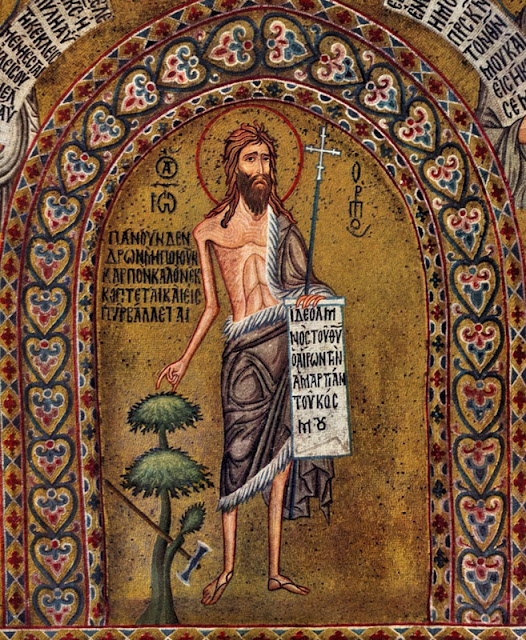
John the Baptist: 12th cent. Mosaic in Cappella Palatina di Palermo

Advent II – Repent!

ONE of the most important tasks for anyone bringing up children involves teaching them right from wrong, encouraging good conduct while avoiding bad behaviour. Children and adults alike learn by example, and we need people to teach us. The prophets of Ancient Israel take on this role, showing the people of God where they have gone wrong, and what they should do. John the Baptist is the last of the prophets, and points people towards the Messiah, Jesus. John is the last person to call Israel to repentance, and the first to proclaim the Kingdom of God, which finds its fulfilment in Christ. The Baptist looks back to the prophetic tradition of the Old Covenant, and forward to the New Covenant. Like the prophets of earlier generations, he educates God’s people and announces the reality of God’s saving love. Prophets can be divisive and unsettling figures because they speak with clarity and urgency. They tell it like it is, and are convinced of the importance of their message, because it comes from God.

Our first reading this morning from the prophet Isaiah is joyful and optimistic. Through the prophet, God speaks words of comfort to His people. Today we go back to the beginning of the Gospel of Mark. Here we find the words of Isaiah are quoted because they look forward to the coming of the Messiah:

A voice cries: “In the wilderness prepare the way of the Lord; make straight in the desert a highway for our God.” (Isaiah 40:3)

Jesus Christ is the fulfilment of biblical prophecy. In Him the glory of the Lord is revealed. Mark also quotes from the prophet Malachi:

“Behold, I send my messenger, and he will prepare the way before me. And the Lord whom you seek will suddenly come to his temple; and the messenger of the covenant in whom you delight, behold, he is coming, says the Lord of hosts.” (Malachi 3:1)

Mark includes both of these prophetic texts in his Gospel to show us that, from the beginning, prophecy is being fulfilled in Jesus. John the Baptist is the messenger, preparing the community for the coming of the Messiah: Jesus, who is God.

From his first appearance in the wilderness, John proclaims a baptism of repentance for the forgiveness of sins. Such a rite of initiation was usual for people converting to Judaism, but not for those who were already Jewish. It looks something like a revival: people are encouraged to take their faith more seriously, and to live it out in their lives. John then positions himself at a point where the busy road from Jerusalem crosses the River Jordan. There he challenges all those he meets to change their ways. The Baptist calls people to repentance, to turn away from sin and to turn back to God. It is good to be reminded that God’s love and mercy are available to all of us, even when we fall short of what Our Heavenly Father wants us to be. This is why the story of Jesus’ public ministry begins with His Baptism in the Jordan, and at the same time points to Golgotha. The place where Christ will die taking our sins, and those of all humanity upon Himself. Christ’s Death demonstrates God’s love for us and His mercy towards us. It is hard to comprehend how God could love us that much. And yet Christ gives us Himself in the Eucharist, so that His Body and Blood can transform us, so that we can share in His life on Earth and in Heaven.

John the Baptist is the last of the prophets and the voice crying in the wilderness of which the prophet Isaiah spoke. He has a challenging and uncompromising message: repent for the Kingdom of God is close at hand. This may not be what many people today want to hear, but it is, however, what people need to hear. Those who flock to him are aware of their sin, and aware of their need of God’s love, mercy, and forgiveness. The Baptist’s message may not be an easy one, but it is actually Good News. Our prayers are answered: that for which we hope, for which our soul deeply longs can be ours. Through our own baptism, we share in Christ’s Death and Resurrection, and we are washed from sin and given the gift of the Holy Spirit. It is difficult to make a proclamation similar to John’s in today’s society, where the Church is increasingly marginalised. Yet our message must still be ‘Repent!’. This is because the world needs to repent, to turn away from sin and selfishness, and back to a God of love, who longs for us to have life in all its fullness.

Repentance is both an event and a process. It is something that we need to do continuously, and do together. This is the life of faith which Christ calls us to live. Repentance is the work of a lifetime, we need to keep turning away from sin and turning back to God. The season of Advent is a good time for repentance. As we prepare to meet Jesus, we need to return to the God who loves us. As the prophet Isaiah wrote:

He will tend his flock like a shepherd; he will gather the lambs in his arms; he will carry them in his bosom, and gently lead those that are with young. (Isa 40:11)

We have been given clear instruction in how to live. The prophets tell us to return to the Lord. They too look forward to the coming of the Messiah. As we prepare to meet Him, let us prepare our hearts, our souls, and our lives. Let us, along with John the Baptist and all the saints, sing the praises of God the Father, God the Son, and God the Holy Spirit. To whom be ascribed all glory, dominion, and power, now and forever. Amen.

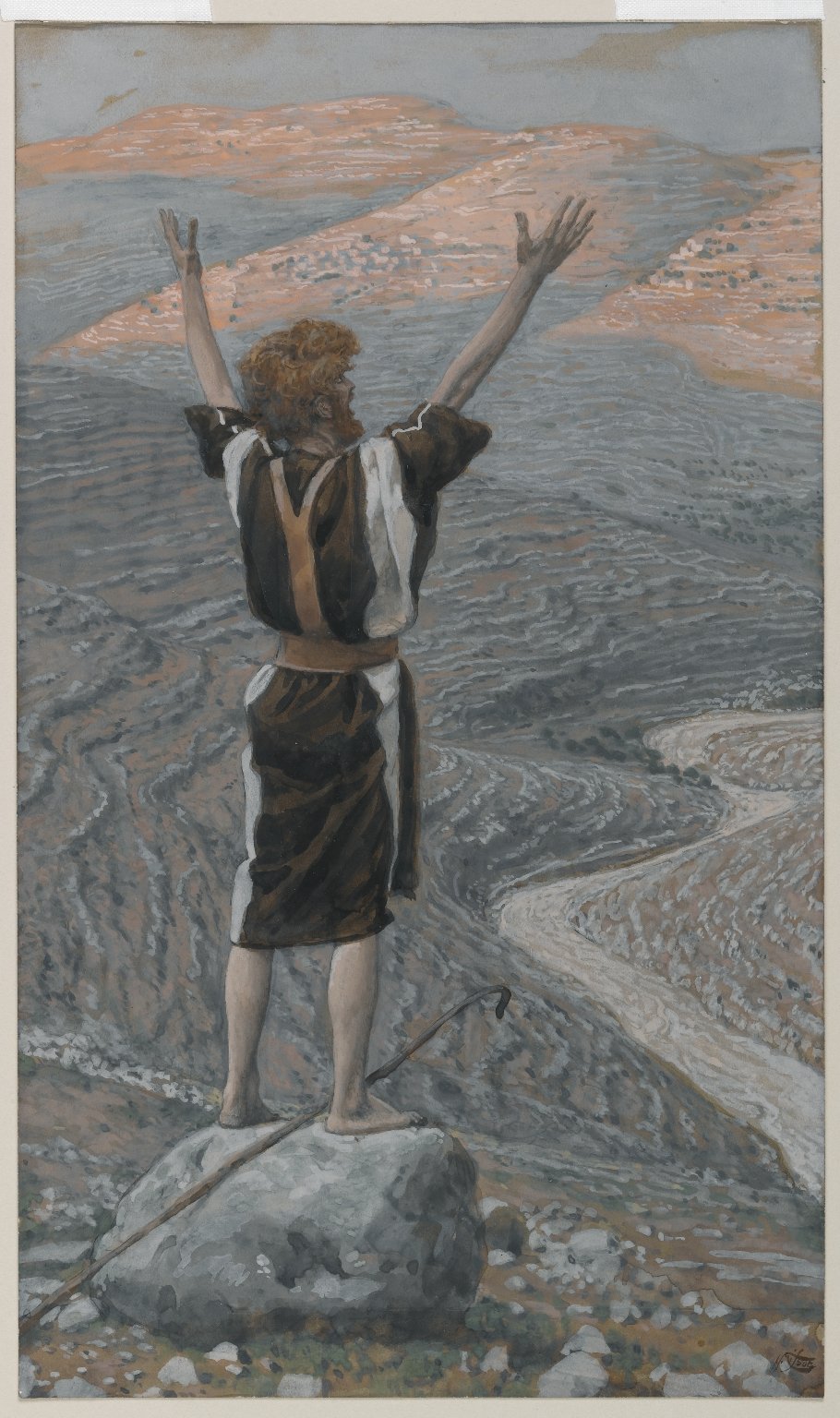
James Tissot – The voice in the desert (Brooklyn Museum)