Holy Cross Day

One of the important aspects of the liturgical life of the Church relates to the celebration of Saints’ Days in the Calendar. You might be aware that the 29th September is Michaelmas, but most people do not know why the feast is celebrated on that day. The date refers to the dedication of a church in Rome under St Michael’s patronage, which was dedicated on that day in the fifth century. Likewise, the Church of the Holy Sepulchre in Jerusalem, the site of Our Lord’s Crucifixion and Resurrection, was built under orders from the Roman Emperor Constantine and dedicated on the 13th September 335ad. On the following day, the 14th September, the True Cross, which his mother, St Helena, had discovered in 326AD, was brought out for the Christian faithful to venerate. The feast day also commemorates the exaltation of the Holy Cross in Constantinople in 629AD, when the True Cross was returned by the Persians, who had taken it during the sack of Jerusalem some fifteen years earlier. 

That is why we celebrate the Holy Cross today. But what are we celebrating? The Cross of Christ. The fact that God loves humanity enough to suffer and die for us, to take away our sins, and to offer us eternal life with God forever. This is the central truth of our faith, a life-changing reality which affects both this life and the next. The Holy Cross changes the world. We are freed and saved by the Cross.

In this morning’s Gospel, Our Lord is explaining His mission to Nicodemus:

“Ac fel y dyrchafodd Moses y sarff yn yr anialwch, felly y mae’n rhaid i Fab y Dyn gael ei ddyrchafu, er mwyn i bob un sy’n credu gael bywyd tragwyddol ynddo ef.”

‘And as Moses lifted up the serpent in the wilderness, so must the Son of Man be lifted up, that whoever believes in him may have eternal life.’ (Jn 3:14-15)

Jesus is drawing a parallel between His death and a significant event in the Exodus story, which is this morning’s Old Testament reading. Once again the people of Israel are complaining about the food and conditions on their journey: 

“Pam y daethoch â ni o’r Aifft i farw yn yr anialwch? Nid oes yma na bwyd na diod, ac y mae’n gas gennym y bwyd gwael hwn.”

‘Why have you brought us up out of Egypt to die in the wilderness? For there is no food and no water, and we loathe this worthless food.’ (Num 21:5)

The Israelites are rejecting the manna, bread given from Heaven, a gift from God. In response, God sends snakes which kill them. This causes the people to realise their sin, and repent. They ask Moses to intercede for them with the Almighty, and Moses is instructed to do the following:

“Gwna sarff a’i gosod ar bolyn, a bydd pawb a frathwyd, o edrych arni, yn cael byw.”

‘Make a fiery serpent and set it on a pole, and everyone who is bitten, when he sees it, shall live.’ (Num 21:8)

God does not take the serpents away, but He does give healing, and life. The Exodus story points to Christ, the Saviour and giver of life. In the Gospel, Jesus is explaining the Crucifixion to Nicodemus, to help him begin to understand how God is giving life to humanity. Our Lord points out what causes death, and what will now bring life. 

Just as the serpent in the desert brought healing to the people of Israel, so now the Cross is our only hope. The sacrifice of God for humanity is a free gift of infinite value. God gives salvation to us, and to all the world, for one simple reason: because He loves us, and desires that we might become more lovely, more like Him. God sends His Son into the world not to condemn it, but so that the world might be saved through Him. This is an unselfish act of generosity, of grace, by our Maker so that we might be saved from sin and death, from ourselves, and so that we can share new life in Him.

‘Do, carodd Duw y byd gymaint nes iddo roi ei unig Fab, er mwyn i bob un sy’n credu ynddo ef beidio â mynd i ddistryw ond cael bywyd tragwyddol. Oherwydd nid i gondemnio’r byd yr anfonodd Duw ei Fab i’r byd, ond er mwyn i’r byd gael ei achub trwyddo ef.’

‘For God so loved the world, that he gave his only Son, that whoever believes in him should not perish but have eternal life. For God did not send his Son into the world to condemn the world, but in order that the world might be saved through him.’ (Jn 3:16-17)

These few words spoken by Jesus to Nicodemus, recorded in John’s Gospel, encapsulate what we believe as Christians, and why we believe these things. Strengthened through prayer, our study of the Bible, nourished by Our Lord’s Body and Blood, may we live out our beliefs, forgiven and forgiving, preparing to be caught up forever in the love of God. Christ liberates us from sin and death. He saves us so that we may enjoy eternal life with God. Our response to such generosity should be thankfulness: that we are loved by God, and saved by Him.

Jesus’ sacrifice on the Cross is the same sacrifice which we see here this morning, which we can taste and touch. Bread and Wine, The Body and Blood of Our Lord which we can eat and drink, so that our lives and our souls can be transformed to live Christ’s risen life. We treat these elements with the uttermost reverence because they are God, given for us. They transform us to live as children of the Holy Spirit, freed from the shackles of this world. They strengthen us to live for God, to live as He wants us to, as His new creation. On a hundred thousand successive Sundays Christians have participated in this sacrifice, in memory of Him, to make the holy people of God. We likewise do this to make us holy: so that everything which we say, or think, or do, may be for God’s praise and glory.

Let us, therefore, give thanks for the fact that God loves us. Let us cling to the Cross, and let us sing the praises of God, Duw Dad, Duw y Mab, a Duw yr Ysbryd Glân. God the Father, God the Son, and God the Holy Spirit. I’r hwn y priodoler pob gogoniant, arglwyddiaeth, a gallu, yn awr, ac yn oes oesoedd. To whom be ascribed all glory, dominion and power, now and forever. Amen

Diego Velazquez Christ Crucified (Museo del Prado, Madrid)

Trinity Sunday 2025

In the Science fiction film, ‘The Matrix’ and its sequels there is a character called ‘Trinity’, played by Carrie-Anne Moss. The name comes from her handle as a computer hacker. She, apparently, chose this moniker to give the impression that she is as mysterious and enigmatic as the concept of a Three-in-one being (God the Holy Trinity: Father, Son, and Holy Spirit). So what do Christians believe about the Trinity?

In today’s Gospel Jesus promises His disciples that,

“Ond pan ddaw ef, Ysbryd y Gwirionedd, fe’ch arwain chwi yn yr holl wirionedd. Oherwydd nid ohono’i hun y bydd yn llefaru; ond yr hyn a glyw y bydd yn ei lefaru, a’r hyn sy’n dod y bydd yn ei fynegi i chwi.”

“When the Spirit of truth comes, he will guide you into all the truth, for he will not speak on his own authority, but whatever he hears he will speak, and he will declare to you the things that are to come.” (Jn 16:13)

God gives us the Holy Spirit to guide us and lead us in our lives. We are invited into a relationship and journey of faith, which enables us to grow and develop. As Christians, we worship One God, Father, Son, and Holy Spirit. They are not three Gods, but one God. That the three persons of the Trinity are one God is itself a mystery. It is the enigma of God’s very self: a Trinity of Persons, consubstantial, co-equal, and co-eternal. ‘Consubstantial’ means ‘of one being’, i.e. they are One. ‘Co-equal’ means that the persons of the Trinity are equal to one another, none is greater or lesser than another. ‘Co-eternal’ means that they all have no beginning in time all three are eternal. We know God most fully in the person of Jesus Christ, the Incarnate Word of God, who was born of the Virgin Mary, died upon the Cross for our sins, was raised to New Life at Easter, and sent the Holy Spirit at Pentecost. In Christ, God discloses who and what He is. We know Him through His outpouring of love into our lives.

All Christians are baptised in the name of the Trinity. Our worship is Trinitarian. The service this morning began with the words ‘Yn enw’r Tad, a’r Mab, a’r Ysbryd Glân, In the name of the Father, and of the Son, and of the Holy Spirit, Amen.’ Eucharistic Services have begun by invoking the name of the Trinity, and making the sign of the Cross, for as long as we have descriptions of them, going back almost 1900 years. And 1700 years ago just before the Council of Nicaea, this morning’s first reading was one of the most controversial passages in Scripture: 

“Lluniodd yr Arglwydd fi ar ddechrau ei waith, yn gyntaf o’i weithredoedd gynt.”

“The Lord possessed me at the beginning of his work, the first of his acts of old.” (Proverbs 8:22)

In the Greek text of Proverbs, used widely around the Mediterranean at that time, the verb translated as ‘possessed’ was one that meant ‘created’. This lead some people — the followers of Arius — to argue that this passage means that Jesus Christ was created and not begotten. This would therefore mean that Jesus had a beginning in time, and was not eternal. He was therefore somewhat lesser than God the Father. To discuss this theological issue Church Councils were called at Nicaea in ad325, and Constantinople in ad381. These meetings of bishops rejected the Arian ideas and gave us the doctrinal statement known as the Nicene Creed, which we will say together in a few minutes time. Our faith, as Christians, is rooted in our belief in God: Father, Son, and Holy Spirit, consubstantial, co-equal, and co-eternal. This is why the Creed is made up of three sections. It begins by stating what we believe about God the Father. The text then moves on to what we believe about Jesus the Son. The statement of faith then finishes with the Christian beliefs concerning the Holy Spirit. What we believe and how we worship God matters.

Last Sunday we celebrated Whitsun, Y Sulgwyn, the Feast of Pentecost: the Descent of the Holy Spirit upon the disciples in the Upper Room, fifty days after Easter, and ten days after Jesus’ Ascension into Heaven. With the coming of the Holy Spirit, we see the fullness of who God is. As St Paul puts it in his Letter to the Romans:

“oherwydd y mae cariad Duw wedi ei dywallt yn ein calonnau trwy’r Ysbryd Glân y mae ef wedi ei roi i ni.”

“God’s love has been poured into our hearts through the Holy Spirit who has been given to us.” (Romans 5:5)

As Christians, we are given the gift of the Holy Spirit — a spirit of love and joy. This allows us to experience God as He is: the Father who created all that exists; the Son who redeemed humanity; and the Spirit who sanctifies and encourages God’s people. God calls us into a relationship and we respond with worship which honours our Creator and Sustainer. We do this not because God requires our worship, but because of our own need to acknowledge our dependance upon Him. God loves us, and because we know that we are loved, we respond with love and praise. 

The wonderful thing about the outpouring of the Holy Spirit at Pentecost is that it enables us to encounter and experience God in a deeper way. We can know Jesus Christ, the Word made flesh. He speaks to us in Scripture, and He comes to us in the Eucharist, so that we may be nourished by God. In our prayer and worship, we are filled with the Holy Spirit, who transforms us. The Trinity is not an abstract philosophical concept, but rather the manifestation of a generous and loving God. The Christian understanding of God is not of a remote being. God makes His home with us. He gives us His life, and He transforms and heals us in love. This is all possible through the relationship God has with us, through His Son and His Spirit, which is personal to each and every one of us. That is why we celebrate the Trinity today.

In Christ God becomes human, allowing Him to understand us from the inside, so to speak. This is not a distant, impersonal divinity, but one who lives a human life. One who understands our frailty, and who loves us. God sends His Spirit so that we may be encouraged and live out our true potential. We will face difficulties and hardships. Christ promises us no less, as does St Paul in our second reading. But the point is that these experiences, while difficult to endure, can also be positive: we grow and develop through them. It is often through the experience of suffering that we become more loving and forgiving.

God makes us new by his redeeming love and transforms us into what He wants us to be. God — Father, Son, and Holy Spirit — offers us all the opportunity to be something different, something more than we are. If we let Him change us. If we co-operate with His grace. When we are filled with the Holy Spirit, and nourished by Word and Sacrament, God is at work in us, transforming us into His likeness.

So, as we celebrate the mystery of the Holy and Life-giving Trinity, let us pray that we may be changed by God’s love, and share this love with others. Let us give thanks for the mystery and wonder that is God, Duw Dad, Duw y Mab, a Duw yr Ysbryd Glân. God the Father, God the Son, and God the Holy Spirit. I’r hwn y priodoler pob gogoniant, arglwyddiaeth, a gallu, yn awr, ac yn oes oesoedd. To whom be ascribed all glory, dominion and power, now and forever. Amen.

The Trinity Lance McNeel 2009

Pentecost 2025

Every Sunday, and also on solemn Feast days, Christians make a public declaration of their faith in God, Father, Son, and Holy Spirit, using the words of the Nicene Creed — which we will all say together in a few minutes time. This statement of belief was drawn up seventeen hundred years ago at the First Ecumenical Council, which was called by the Roman Emperor Constantine to sort out divisions within the Church concerning the Divinity of Jesus Christ. The council met at Nicaea in Asia Minor (modern day Turkey) and comprised of three hundred and eighteen bishops of the Church. One of these was Nicholas of Myra, St Nicholas, the patron saint of this church. 

Questions about belief matter. They have the potential to divide the Church. Taking it away from its core purpose of being united in a common faith, and making a consistent proclamation of that faith. This is the situation in today’s reading from the Acts of the Apostles. Having been promised the Holy Spirit by Our Lord at His Ascension, the disciples wait and pray. At Pentecost they are filled with the Spirit. Emboldened, they are able to tell Jews from all over the Mediterranean world, who have gathered in Jerusalem, who Jesus is, and what He has done. From this moment on the disciples are known as Apostles from the Greek ἀπόστολος (meaning one who is sent, a messenger). The message they deliver is that all people should repent and believe the Good News of Jesus Christ. 

The outpouring of the Holy Spirit is not a one-off event, but rather a permanent state of affairs. This is how God continues to be active in the world: inspiring and strengthening Christ’s followers in living and proclaiming their faith. In John’s Gospel, Jesus promises His disciples:

‘Os ydych yn fy ngharu i, fe gadwch fy ngorchmynion i. Ac fe ofynnaf finnau i’m Tad, ac fe rydd ef i chwi Eiriolwr arall i fod gyda chwi am byth,’

‘If you love me, you will keep my commandments. And I will ask the Father, and he will give you another Helper, to be with you for ever.’ (Jn 14:15-16)

The promise is that God’s Spirit will be present in perpetuity. God will continue to pour out His Spirit to strengthen the Church. This is what we are celebrating today at Pentecost. Indeed, during the Eucharistic Prayer I, as your priest,  will pray that God continues to do this and ‘trwy nerth dy Ysbryd, i’r rhoddion hyn o fara a gwin fod i ni ei gorff a’i waed ef’ ‘that, by the power of your [God’s] Spirit, these gifts of bread and wine may be for us his body and blood’. Our heavenly Father makes wonderful things happen. Disciples who have been scared and have been in hiding are transformed into fearless evangelists, going out to preach Christ’s message of love and forgiveness. They become enthusiastic fellow-workers in the vineyard. God is able to completely change people and situations, because His love for us knows no bounds.  

The 318 bishops, who met at Nicaea, in 325AD, were able to put into words what Christians believe because they began their deliberations by praying for the gift of the Holy Spirit to guide and direct their thoughts and actions. This is entirely in line with Our Lord’s teaching in the Gospel: 

‘Ond bydd yr Eiriolwr, yr Ysbryd Glân, a anfona’r Tad yn fy enw i, yn dysgu popeth ichwi, ac yn dwyn ar gof ichwi y cwbl a ddywedais i wrthych.’

‘But the Helper, the Holy Spirit, whom the Father will send in my name, he will teach you all things and bring to your remembrance all that I have said to you.’ (Jn 14:26)

The Bishops, including St Nicholas, were strengthened by God to proclaim the truth, and to bear witness to it, in the face of those who would deny it. They bore witness to the truth of Jesus Christ: true God and true man, who promised the gift of the Holy Spirit. God’s Spirit gives Christians strength and brings us together as brothers and sisters in a new family, which we call the Church. 

It is thanks to the preaching of the Gospel begun by the Apostles at Pentecost, and continued by their successors at Nicaea, that we are here today. It is how billions of people have come to know, love, and serve Our Lord Jesus Christ. As people who are in Christ, who have entered the Church through our Baptism, we are given a very important job to do. We need to tell people about Jesus!

The world-wide Christian Church is wonderful in its diversity. We are all different, we do not speak the same language, or have the same culture. However, we are all equally empowered through having received the Holy Spirit at our Baptism, in our Confirmation, and through all the sacramental actions of the church, which are the outward and visible signs of the inward and spiritual grace of God. This is how the Holy Spirit works. This is how God builds us up together in love. Through the Eucharist, through prayer and through Scripture, we are nourished spiritually to keep doing all that God desires of us.

So, my brothers and sisters in Christ, let us pray earnestly for the gift of the Spirit. Just as St Nicholas was inspired by the Spirit, may God also fill us with His love and equip us to proclaim the Good News of the Kingdom. May the fire of the Holy Spirit embolden us to encourage others to come to know, and love Duw Dad, Duw y Mab, a Duw yr Ysbryd Glân. God the Father, God the Son, and God the Holy Spirit. I’r hwn y priodoler pob gogoniant, arglwyddiaeth, a gallu, yn awr, ac yn oes oesoedd. To whom be ascribed all glory, dominion and power, now and forever. Amen.

Palm Sunday Evensong

THIS evening I would like to talk about the Apostle John. The name ‘John’ means ‘The Lord has worked grace’. John the Apostle is the son of Zebedee and Salome (the sister of the Blessed Virgin Mary). He is also the brother of James, and the cousin of Jesus. In the Bible, John is called ‘the beloved disciple’, the disciple whom Jesus loved. He is also believed to be the author of the Gospel which now bears his name, as well as three canonical letters and the Book of Revelation. While scholars tend to ascribe some or all of these works to others, I do not wish to. Time tonight does not allow me to examine all of John’s writings in detail, so I must be selective. However, I strongly urge you to read John’s works and immerse yourself in the richness of his vision.

In the Synoptic Gospels (Matthew, Mark, & Luke) we first meet our soon-to-be disciple by the shore of the Sea of Galilee with his father, Zebedee and his brother, James. In John’s Gospel, however, there is no mention of him until the Last Supper. The apostle is then also present at the Crucifixion, standing at the foot of the Cross with Mary, the mother of Jesus. Along with Simon Peter, he is the first witness of the Resurrection. John is also one of the seven disciples who have breakfast with the Risen Christ by the Sea of Galilee, when Jesus asks Simon Peter three times if he loves him. At the end of his Gospel John writes the following authorial comment:

This is the disciple who is bearing witness about these things, and who has written these things, and we know that his testimony is true. Now there are also many other things that Jesus did. Were every one of them to be written, I suppose that the world itself could not contain the books that would be written. (Jn 21:24-25)

John is someone we can trust, whose writings help us to ponder the mysteries of God’s love. Elsewhere, in the Synoptic Gospels, John appears as part of an inner circle of disciples. He is with Peter and James at the Transfiguration, and at several miracles where not all the Twelve are present. What then are we to make of this apostle? The various mentions of him in Scripture show that he is a beloved disciple, one loved by God, who loves God deeply. Love is something of a defining characteristic in John’s writing, especially in his Gospel and Letters. But even love must be set in a wider context, namely God.

John’s Gospel begins at the beginning, a very good place to start.‘In the beginning was the Word, and the Word was with God, and the Word was God.’ (Jn 1:1) God is trinitarian: Father, Son, and Holy Spirit (Duw Dad, Mab ac Ysbryd Glân). He always has been, and always will be. ‘The Word became flesh and dwelt among us’ (Jn 1:14). The word translated as ‘dwelt’ actually means ‘pitched his tent’, tabernacled among us, like a nomad, or a shepherd, or an exile wandering like Israel after the Exodus from Egypt.

John then introduces his namesake, the Baptist, who on seeing his cousin Jesus, exclaims ‘Behold, the Lamb of God, who takes away the sin of the world!’ (Jn 1:29). Jesus calls disciples, and suddenly they are at a wedding in Cana, where the wine runs out. To prevent shame and ‘social death’ for the hosts, Our Lord turns a large amount of water into wine. God is generous, and the messianic banquet is a reality! There are other signs of Jesus’ divinity and God’s love for humanity. In John’s Gospel, Our Lord is keen to say, ‘I am’: ‘I am the Good Shepherd’ ‘I am the Bread of Life’ ‘I am the Way, the Truth, and the Life’. Just as God reveals himself to Moses at the Burning Bush, saying: ‘I am who I am’. This is the same God who took flesh in the womb of the Virgin Mary.

It is when John is with Mary at the foot of the Cross that the Beloved Disciple is singled out for the second time. Just before Christ dies He looks down, and says:

‘Woman behold your Son.’ Then he said to the disciple, ‘Behold your mother!’ And from that hour the disciple took her to his own home (Jn 19:26-27)

Something wonderful is happening here. On the hill of Calvary, on Good Friday, Jesus is starting the Church, with His Mother (the laity), John the Beloved Disciple (the Clergy), and Himself (Our Great High Priest). Jesus offers himself as both priest and sacrifice upon the altar of the Cross to take away our sins, and to restore our relationship with God and with each other. John and Mary become a new family, not because of ties of blood and kinship (though they are related), but through Jesus. Likewise, every Christian is a brother or sister in Christ. We are all children of God.

From this verse the tradition arises that Mary and John lived together in Ephesus, south of Smyrna, (modern İzmir). This tradition maintains that the Apostle was exiled to the island of Patmos for his preaching of the Good News. There John lived in a cave where he had the visions which have come down to us as the Apocalypse, the Revelation of St John the Divine. Before his exile, during the reign of the emperor Domitian, it is recorded that John survived being immersed in a vat of boiling oil near the Porta Latina, the Latin Gate on the south of the Aurelian Wall of the City of Rome. This miraculous event was remembered in a feast celebrated (until 1960) on 6th May, and is found in the Calendar of the 1662 Book of Common Prayer. John’s main feast day, however, is the 27th December. Significantly, he is the only apostle not to have suffered a martyr’s death, and so the liturgical colour of his feast days is white and not red — the usual colour for a martyr. 

In 2007, Pope Benedict XVI wrote that the example of St John teaches us that:

‘The Lord wishes to make each of us a disciple who lives in personal friendship with him. To achieve this, it is not enough to follow him and listen to him outwardly: it is also necessary to live with him and like him. This is only possible in the context of a relationship of deep familiarity, imbued with the warmth of total trust. This is what happens between friends: for this reason Jesus said one day: “Greater love has no man than this, that a man lay down his life for his friends … No longer do I call you servants, for the servant does not know what his master is doing; but I have called you friends, for all that I have heard from my Father I have made known to you” (Jn 15:13, 15)’  [ Pope Benedict XVI, Christ and his Church: Seeing the face of Jesus in the Church of the Apostles, CTS 2007: 72-73.]

The way to understand John and his theology is through the prism of love. As the apostle writes:

“For God so loved the world, that he gave his only Son, that whoever believes in him should not perish but have eternal life. For God did not send his Son into the world to condemn the world, but in order that the world might be saved through him.” (Jn 3:16-17)

These words are echoed in John’s First Letter:

‘By this we know love, that he laid down his life for us, and we ought to lay down our lives for the brothers.’ (1Jn 3:16)

God loves us, and becomes one of us, so that we may have life in all its fulness. Love means willing the good of another. God’s love for us shows that our flourishing is His will. This is the reason for the Incarnation, our Salvation, and Redemption. Love is also the source for both the words of teaching and the signs which pervade John’s Gospel. This is Good News, given to us by the Church — a community of love, which feeds us with Christ’s teaching and the bread of life — so that we can grow more and more into the likeness of the one who loves us: Jesus Christ, who is Our Lord and God.

John is the disciple who has a vision of Heaven, of heavenly liturgy which looks Eucharistic. As one of the first disciples to experience the reality of the Resurrection, and as one who sees and believes, John understands that Eternal Life Heaven is our objective. He says:

‘I write these things to you who believe in the name of the Son of God that you may know that you have eternal life.’ (1Jn 5:13)

As Christians, we need to follow the example set by the Beloved Disciple. We need to love Our Lord and Saviour above all else. Like John, we need to see and to believe, and to let God work in our lives. We are called to let God act in us, and through us, to bring His message of love and forgiveness to our needy world.

The depth of John’s relationship with Jesus illustrates how such a theology might come about. John’s life and teachings should continue to inspire us as Christians today. Reminding us to love, to believe, and to persevere in faith, even in the face of hardship. May all of us gathered here today be strengthened by the example of John, to grow closer to God and to give glory i Duw Dad, Duw y Mab, a Duw yr Ysbryd Glân. To God the Father, God the Son, and God the Holy Spirit. I’r hwn y priodoler pob gogoniant, arglwyddiaeth, a gallu, yn awr, ac yn oes oesoedd. To whom be ascribed all glory, dominion and power, now and forever. Amen.

Correggio: St John,San Giovanni Evangelista, Parma

Lent V

THE past sixty years in Britain and the West have seen societal change on a scale arguably never witnessed before in the history of humanity. The world in which we live has changed, and people have become used to the changes. On the whole, despite becoming more permissive, society is still judgemental. We put people on pedestals, and then we are surprised when they fall off. More than that, the media constantly encourages us to be critical of others. This is deeply corrosive, because it sets us up to think that we are somehow better than others. However, we too make mistakes. We all, each and every one of us, myself included, say and do things which we should not, which hurt others, and for which we need forgiveness.

Thankfully, we can ask God and each other for this forgiveness. Because of what Christ did for us, taking our sins upon himself, on the Cross, we are forgiven. God loves us. In turning to God for forgiveness, we are turning away from sin and trying to live our lives in a new way. The Christian life is, like the season of Lent, a constant repetition of this process: failing and trying again, and keeping going. So that bit by bit, gradually, we let God be at work in us, to transform us. This helps us to be less judgemental, more loving, and more forgiving. Drawing on God’s love, we can build up a community that is filled with this radical transforming love. We can become a force for good, a beacon of hope, sharing Christian love with the world around us.

Today’s Gospel finds Jesus is in the Temple in Jerusalem for the Feast of Tabernacles. According to the law of Moses the woman caught in adultery should be punished by being stoned to death. However, the Roman occupiers had taken from the Jews the power to put anyone to death. Jesus’ response shows the world that there is another way: a way of love and not of judgement. Interestingly, this passage is the only time when the Gospel writers record Jesus writing. After the Scribes and Pharisees have brought the unnamed woman to Him:

‘Plygodd Iesu i lawr ac ysgrifennu ar y llawr â’i fys.’

‘Jesus bent down and wrote with his finger on the ground.’ (Jn 8:6) 

This verse has puzzled people for centuries. What exactly did Jesus write? We cannot know for certain. An answer to this intriguing question may come from Scripture. A few verses earlier in John’s Gospel, Jesus talks of rivers of living water. In the prophet Jeremiah we find the following words:

‘O Arglwydd, gobaith Israel, gwaradwyddir pawb a’th adawa; torrir ymaith oddi ar y ddaear y rhai sy’n troi oddi wrthyt, am iddynt adael yr Arglwydd, ffynnon y dyfroedd byw.’

‘O Lord, the hope of Israel, all who forsake you shall be put to shame; those who turn away from you shall be written in the earth, for they have forsaken the Lord, the fountain of living water.’ (Jer 17:13)

We can speculate that at least part of this verse from Jeremiah is what Jesus wrote in the earth. Writing these words would both fulfil the prophecy of Jeremiah, and shame the woman’s accusers. Jesus is showing that the Scribes and Pharisees have turned away from God, towards legalism and judgmental behaviour. Those gathered would know the prophecy of Jeremiah, and also that Jesus has recently mentioned streams of living water. This verse is the key to understanding what is going on. Jesus is fulfilling Scripture, and demonstrating that God should be characterised by love, mercy, and forgiveness. 

The Religious Authorities have not quite understood the situation. They continue to press Jesus for an answer, which He does not give. Instead Jesus challenges them:

‘ymsythodd ac meddai wrthynt, “Pwy bynnag ohonoch sy’n ddibechod, gadewch i hwnnw fod yn gyntaf i daflu carreg ati.”’

‘he stood up and said to them, “Let him who is without sin among you be the first to throw a stone at her.”’ (Jn 8:7)

Jesus’ position is non-judgemental, and highlights the hypocrisy of the accusers. Christ then returns to His writing:

‘Yna plygodd eto ac ysgrifennu ar y llawr.’

‘And once more he bent down and wrote on the ground.’ (Jn 8:8)

It is possible that Jesus was finishing the verse from Jeremiah. We cannot be sure, but what we do know is that the combination of His words, both written and spoken have a profound effect:

‘A dechreuodd y rhai oedd wedi clywed fynd allan, un ar ôl y llall, y rhai hynaf yn gyntaf, nes i Iesu gael ei adael ar ei ben ei hun, a’r wraig yno yn y canol. Ymsythodd Iesu a gofyn iddi, “Wraig, ble maent? Onid oes neb wedi dy gondemnio?” Meddai hithau, “Neb, syr.” Ac meddai Iesu, “Nid wyf finnau’n dy gondemnio chwaith. Dos, ac o hyn allan paid â phechu mwyach.”’

‘But when they heard it, they went away one by one, beginning with the older ones, and Jesus was left alone with the woman standing before him. Jesus stood up and said to her, “Woman, where are they? Has no one condemned you?” She said, “No one, Lord.” And Jesus said, “Neither do I condemn you; go, and from now on sin no more.”’ (Jn 8:9-11)

It is interesting that the older (and wiser) ones are the first to grasp the full implications of what Jesus is saying. Christ does not condemn the woman: God is a God of mercy. However, Our Lord does say, ‘Dos, ac o hyn allan paid â phechu mwyach’ ‘go, and from now on sin no more’ (Jn 8:11). Forgiveness goes hand-in-hand with contrition and repentance. We are loved, healed and restored by God, but with forgiveness comes a challenge. As Christians we are to turn away from wrongdoing, from the ways of the world, and instead find life in Christ.

Lent gives us the opportunity to take a long, hard look at ourselves and at our lives. It is a time to recognise that we need to become more like Jesus — to live, and think, and speak like Him. We need to be nourished, healed and restored by Christ, so that we can live lives which proclaim His love and His truth to the world. Lent is also a time for us to realise that we are loved by God, and that God is merciful, forgives our sins, and longs for us to experience life in all its fulness.

It is interesting that today is Passion Sunday when we begin in earnest our commemoration of Jesus’ death and Resurrection. This morning’s Gospel speaks of a different type of passion (sexual desire) which when uncontrolled could lead to death — either of a person condemned for committing adultery or a relationship between a husband and wife.

As we pray today for couples preparing for marriage we also pray for those whose relationships are under strain and for all who have experienced marital breakdown. Let us be slow to judge, and quick to show compassion and mercy to those whose lives are not perfect.

Let us, as followers of Jesus, rejoice in the generous love of God and prepare ourselves to celebrate Christ’s Passion. Let us give thanks for our families and relationships and give glory i Duw Dad, Duw y Mab, a Duw yr Ysbryd Glân. I’r hwn y priodoler pob gogoniant, arglwyddiaeth, a gallu, yn awr, ac yn oes oesoedd. Amen.

Christ and the sinner, A Mironov 2011

Epiphany V 2025

THIS week’s readings focus on God’s call to humanity, so I would like to begin by sharing with you something of my own call. The first time I realised that I wanted to be a priest, I was about 10 years of age. It was in church at Margam, during a Sunday Morning Eucharist. The priest standing at the altar praying the Eucharistic Prayer, lived next door but one to us. He was a retired priest, called Fr Glyn — a great and holy man. I would go on to study at the same theological college as him (although this was something I only found out once I’d got there). As he stood at the altar and prayed the words that Jesus recited on the night before He died, I can remember a strong, overwhelming feeling: ‘I really want to do THAT!’ Even now, nearly forty years later, and after serving God as a priest for nearly fourteen years, that feeling still feels real. I still do not feel worthy of the call. But I’m not supposed to. That is the point: only God is worthy. However, God calls us not because we are worthy, but so that we might co-operate with Him in the outworking of His goodness, healing and love.

In our first reading this morning, the prophet Isaiah has a vision of heavenly glory. In his vision, Isaiah sees the throne room of the Heavenly Temple, with God surrounded by angels The prophet does not describe his emotional state, but he speaks of his human unworthiness in the divine presence. When Isaiah is confronted by the majesty of God, the singing of angels, the smoke of incense, all he can say is:

‘Gwae fi! Y mae wedi darfod amdanaf! Dyn a’i wefusau’n aflan ydwyf’

‘Woe is me. For I am lost; for I am a man of unclean lips’ (Isa 6:5)

Isaiah is aware of his human sinfulness and the gulf between himself and God. Yet his guilt is taken away, and his sin is atoned for. The prophet, who will foretell the coming of the Messiah who will save humanity, is prepared by God. He is set apart. When God asks, ‘Pwy a anfonaf? Pwy a â drosom ni?’’Whom shall I send, who will go for us?’ Isaiah can respond, ‘Dyma fi, anfon fi.‘Here I am! Send me’. This is quite a journey in a few verses, and that is the point. God doesn’t call those who are equipped. Rather, He equips those whom He calls.

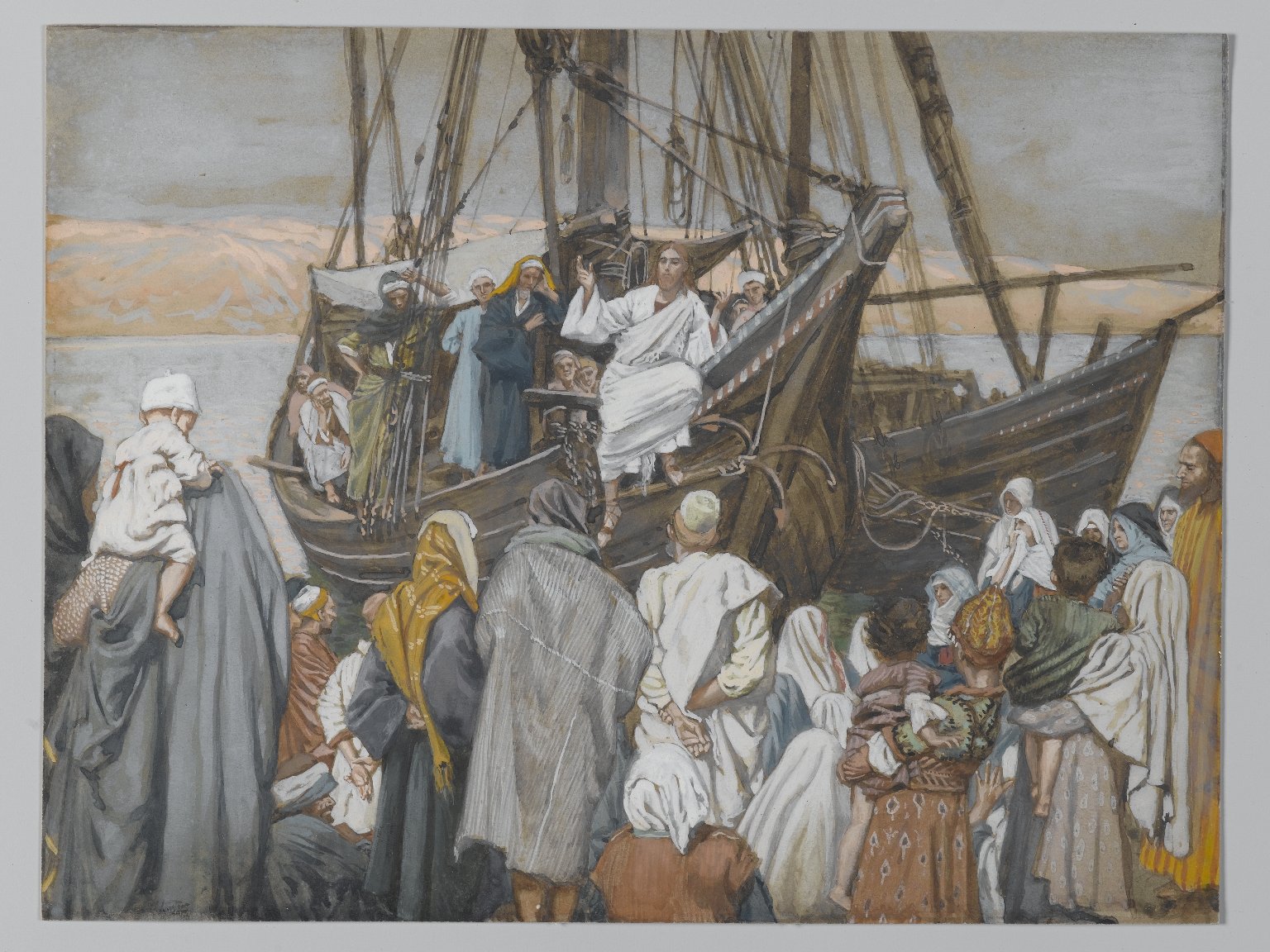
In the Gospel, the teaching ministry of Jesus, which we saw begin in the synagogue in Nazareth, continues. His fame is spreading and the crowd that has come to listen to Our Lord’s teaching is so large that He uses a boat to address them, so that the hills behind the crowd will help make Him more easily heard, acting like a natural theatre 

After speaking to the crowd, Jesus continues to draw disciples to Himself. On the Sea of Galilee the best time to catch fish is at night, but unfortunately Simon, James, John, and others have been out all night and caught nothing. It is the morning, now, and they are exhausted. Worst of all their effort has brought no reward. They have no fish to sell. 

Jesus says to Simon, 

‘Dos allan i’r dŵr dwfn, a gollyngwch eich rwydau am ddalfa.’

‘Put out into the deep and let down your nets for a catch.’ (Lk 5:4)

These words seem to be crazy. The time to catch fish on the lake is at night not during the daytime. Simon knows this, but he agrees to let down his nets. Suddenly the fishing nets are full to breaking point, and Simon calls his colleagues to help him pull in the catch. Both boats are so full of fish that they can barely float. 

Simon’s response is telling, he falls down at Jesus’ knees and says:

‘Dos ymaith oddi wrthyf, oherwydd dyn pechadurus wyf fi, Arglwydd.’

‘Depart from me, for I am a sinful man, O Lord.’ (Lk 5:8)

Simon appreciates that what has happened is a miracle, something that God has done. His response to the presence of God is contrition — awareness of his own unworthiness. Simon knows that he doesn’t deserve this outpouring of grace. The unmerited kindness of God, is too much for him. This humble fisherman recognises his own unworthiness to be in the presence of the Divine. It is understandable, and human, and we would likely feel exactly the same way.

Then Our Lord addresses Simon:

‘Paid ag ofni; o hyn allan dal dynion y byddi di’

’Do not be afraid; from now on you will be catching men.’ (Lk 5:10)

Paid ag ofni’ ‘Do not be afraid’ God begins by addressing our fear, our reluctance to commit. The point is that we are not alone in this, but rather that God wants to work with us, and through us, to proclaim and extend His Kingdom. God welcomes humanity into His embrace, to know the love for which we long. True, unconditional love, offered to each and every one of us to transform us.

The final words of the passage are instructive: 

‘Yna daethant a1’r cychod yn ôl i’r lan, a gadael popeth, a’i ganlyn ef.’

‘And when they had brought their boats to land, they left everything and followed him.’ (Lk 5:11)

The fishermen are literally leaving everything. They have just landed the biggest catch of fish in their entire lives. They were about to be rich in worldly terms, and they have to leave it all behind. Their sacrifice is a real one. Following Jesus comes at a cost. However, it is not without its rewards. The first disciples turn their backs on worldly riches and possessions in order to be free to do God’s work.

The calling of the disciples is also the calling of the entire baptised people of God. This is a calling not to be afraid, but to respond to the God who loves us and saves us. This is a calling to live out in our lives, by word and deed, the saving truths of God. So God can use us for His glory and to spread His Kingdom. So that others may come to know God’s Love, Mercy, and Forgiveness. This is what we have signed up for: to be disciples of Jesus; to profess the faith of Christ Crucified; to share this faith with others.

This treasure has been entrusted to each and every one of us. We are all called to share our faith with others, so that the world may believe. Like the first disciples we acknowledge the glory o Duw Dad, Duw y Mab, a Duw yr Ysbryd Glân. I’r hwn y priodoler pob gogoniant, arglwyddiaeth, a gallu, yn awr, ac yn oes oesoedd. Amen.

Jesus preaches from a boat – James Tissot (Brooklyn Museum)

Christmas 2024

Christmas is a time for many seasonal activities, including spending time with family and friends, eating special foods and enjoying Christmas Carols. Also, most of us will spend some time over the festive period watching films on the television, or in the cinema. Movies can, surprisingly, be particularly useful when we try and get our heads around the wonderful events of Christmas. I would like to begin by focussing on a film from my childhood — the 1981 adventure Raiders of the Lost Ark. In this film, the intrepid archaeologist Indiana Jones is competing with Nazi forces to discover the Ark of the Covenant, which, it is believed, has the power to make an army invincible. At the climax of the film, the villains open the Ark on an island in the Aegean Sea. Immediately, spirits and bolts of lightning are released, which kill the Nazis and free Indiana and his companion Marion. Other than being the sort of film one might watch at Christmas, what is the relevance of the scene?

The film’s denouement relies upon the heroes averting their gaze, while the villains do not, and are therefore destroyed. The plot draws upon the biblical idea that the glory of God, which the Ark is said to contain, is not something which humanity should gaze upon. In the Book of Exodus, when Moses asks to see God, he is told that if he does so he will die. The glory of God is not something humans are able to behold. 

Yet, the first reading this morning reaches its climax with the statement that:

‘fe wêl holl gyrrau’r ddaear iachawduriaeth ein Duw ni’

‘all the ends of the earth shall see the salvation of our God.’ (Isa 52:10)

There appears to be something strange going on here. Likewise, the one who begins His life wrapped in cloth and placed in a stone feeding trough, will end it taken down from a Cross, wrapped in cloth and placed in a stone tomb. ‘In my beginning is my end …. In my end is my beginning’ wrote T.S. Elliot in his poem ‘East Coker’, the second of his Four Quartets. And yet this end is but a prelude to Christ’s Resurrection, Ascension, and the Second Coming. 

In the great turnaround of salvation history, humanity goes from being unable to look upon the divine, to being able to behold Him in a manger, surrounded by farm animals. To put the mystery of our salvation into context, this morning’s Gospel goes back to the beginning, which is a very good place to start. Not to the Annunciation, where in the power of the Holy Spirit Christ takes flesh in the womb of His Mother, but to the beginning of time and the Creation of the Universe:

‘Yn y dechreuad yr oedd y Gair, a’r Gair oedd gyda Duw, a Duw oedd y Gair. Hwn oedd yn y dechreuad gyda Duw.’

‘In the beginning was the Word, and the Word was with God, and the Word was God. He was in the beginning with God.’ (Jn 1:1)

The Word which spoke the Universe into being exists in eternity with God, and is God. This is whom we worship: the one who will save humanity, and who offers us eternal life with God. 

Today we celebrate Divine generosity and humility. God is among us. Mae Duw yn eich plith ni. Born as a weak and vulnerable baby, he is utterly dependent upon Mary and Joseph. In time this divine generosity will be refused:

‘At ei eiddo ei hun y daeth, a’r eiddo ei hun nis derbyniasant ef.’

‘He came to his own, and his own people did not receive him.’ (Jn 1:11)

Ours is a God who does not force Himself upon us. Instead, He comes to us in love, to draw us out in love, that we might share in that love, and share it with others: 

‘A’r Gair a wnaethpwyd yn gnawd, ac a drigodd yn ein plith ni, (ac ni a welsom ei ogoniant ef, gogoniant megis yr Unig‐anedig oddi wrth y Tad,) yn llawn gras a gwirionedd.’

‘And the Word became flesh and dwelt among us, and we have seen his glory, glory as of the only Son from the Father, full of grace and truth.’ (Jn 1:14)

God pitches His tent, and tabernacles among us. The invisible becomes visible. The God who is beyond human understanding becomes human, and shares our human life from its beginning to its end. This is no unapproachable divinity, remote and uncaring, but one who experiences our existence, who understands us from the inside out. Humanity beholds the glory of God, in a baby who will die on a Cross to redeem us. 

Not only that, but Christ continues to give Himself to us, every time the Eucharist is celebrated, so that the Word can continue to become flesh, so that we can be transformed by Him, and share in God’s life. 

As we celebrate the birth of Our Saviour we need to ask ourselves: have we made room for Jesus in our lives? Have we really? If we haven’t, we need to let our hearts and our lives become the stable in which the Christ-child can be born. We need to see Him in the outcast, in the stranger, in the people which the world shuns. As Christians, we have to welcome such people, for in welcoming them we welcome Our Lord and Saviour. This is how we live out His love in our lives.

This is the true meaning of Christmas — this is the love which can transform the world. It is radical and costly. This love terrified the might of the Roman Empire, and showed human power that it was as nothing compared to Divine Love. Soul by individual soul, for the past two thousand years, the world has been changed by ordinary people living out the love shown to the world by, and through, this little vulnerable child.

So, today as we celebrate Jesus’ birth, let us raise our voices to join with the angels and give praise and honour to God the Father, God the Son, and God the Holy Spirit. To whom be ascribed all glory, dominion and power, now and forever. Amen.

Merry Christmas to you all!

Nadolig Llawen i chi gyd! 

Christ the King 2024

LIVING on the edge of Western Europe it is not surprising that many British people have something of a fascination with the Roman Empire. In the first century AD, the Romans conquered Britain and ruled here for nearly four hundred years. They gave us many things: including straight roads, plumbing and under-floor heating, and founded towns many towns such as Carmarthen. Just off Priory Street in Carmarthen are the remains of a Roman amphitheatre which could hold about five thousand spectators. It isn’t quite the size of Colosseum in Rome — and it is highly unlikely that it was ever flooded to stage a mock sea-battle — but it is a reminder of how far Roman influence stretched. 

Rome was an empire, with an emperor at its head. The bad emperors are generally portrayed as cruel autocrats in films like Gladiator. However, these depictions tend to gloss over the fact that these emperors were worshipped as  being divine. One of their first acts on accession to the throne would be for the new Emperor to declare their predecessor, or father, a God. They would then be referred to as ‘DIVI FILIVS’, ‘Son of a god’, ‘Fab duw’. This feels alien to us, because we are Christians, and we are followers of Jesus, the Son of God the Father, the Creator and Sustainer of us all. 

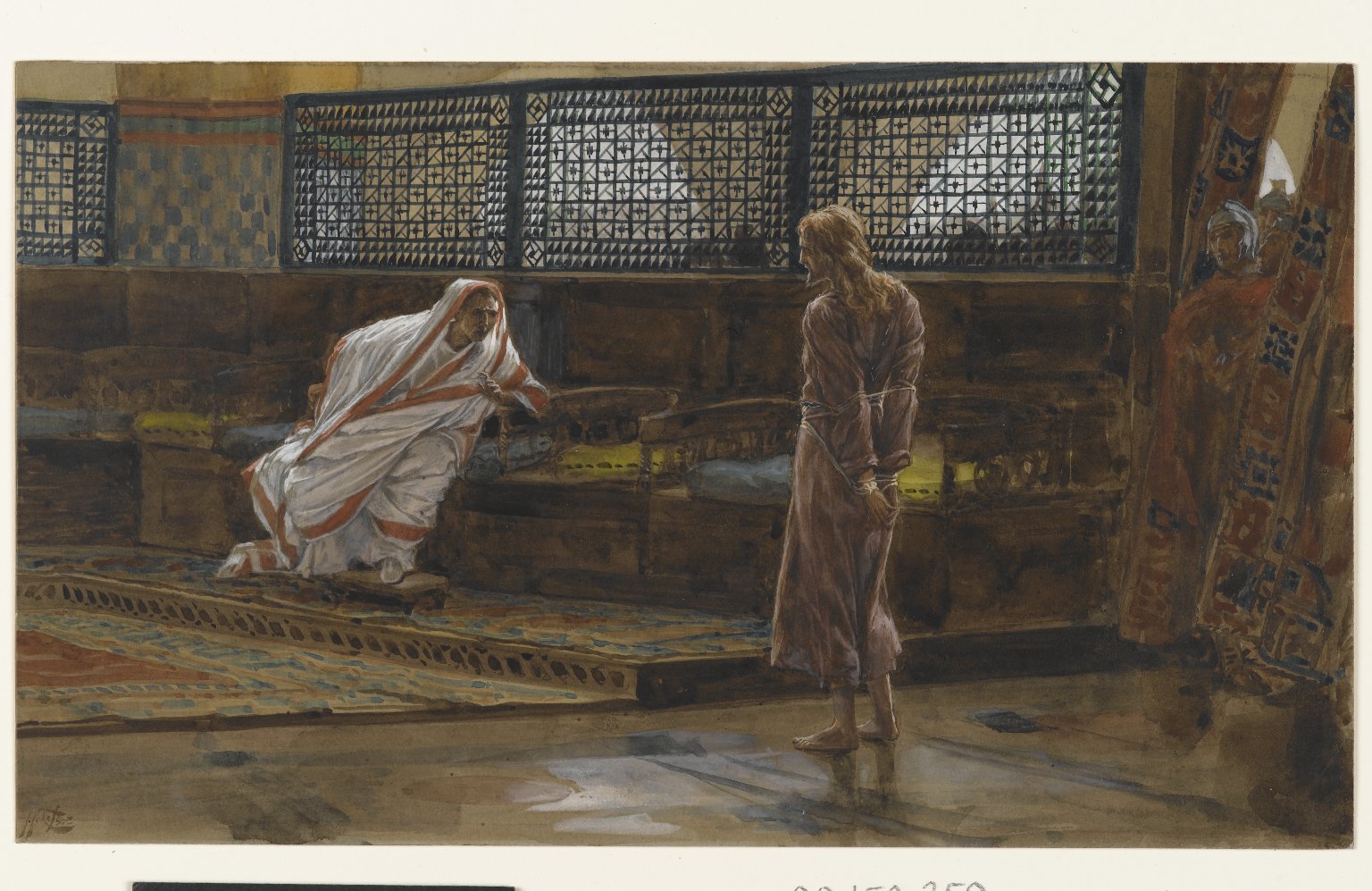
In this morning’s Gospel, Jesus is in Pilate’s headquarters, being questioned, before He is condemned to death on the Cross. Since Our Lord’s triumphal entry into Jerusalem a few days earlier, He has been hailed as the Davidic King, the Messiah. This is viewed as a clear challenge to Herod, and thus to the Roman occupation. Pilate is afraid of an insurrection leading to a rebellion and a change of government, all of which could mean his own death. So he asks Jesus:

“Ai ti yw Brenin yr Iddewon?”

“Are you the King of the Jews?” (Jn 18:33)

Our Lord does not answer, but instead asks Pilate a question:

“Ai ohonot dy hun yr wyt ti’n dweud hyn, ai ynteu eraill a ddywedodd hyn wrthyt amdanaf fi?”

“Do you say this of your own accord, or did others say it to you about me?” (Jn 18:34)

Pilate then replies:

“Dy genedl dy hun a’i phrif offeiriaid sydd wedi dy drosglwyddo di i mi. Beth wnaethost ti?”

“Your own nation and the chief priests have delivered you over to me. What have you done?” (Jn 18:35)

The back and forth is an attempt by the Roman Governor to see if there is substance to the charges, and to see whether Jesus will confess, or whether evidence can be gleaned, which would substantiate the accusation against Him. This leads Our Lord to make the following declaration:

“Nid yw fy nheyrnas i o’r byd hwn. Pe bai fy nheyrnas i o’r byd hwn, byddai fy ngwasanaethwyr i yn ymladd, rhag imi gael fy nhrosglwyddo i’r Iddewon. Ond y gwir yw, nid dyma darddle fy nheyrnas i.”

“My kingdom is not of this world. If my kingdom were of this world, my servants would have been fighting, that I might not be delivered over to the Jews. But my kingdom is not from the world.” (Jn 18:36)

Jesus Christ is not an earthly king, concerned with power, honour, wealth, and prestige, but rather a heavenly one, seeking to establish the Kingdom of God in the hearts and minds of men, women, and children. He seeks to build a kingdom of peace, love, and joy, and of healing and reconciliation. Pilate fails to grasp the nuance of Jesus’ proclamation, and instead focuses on what Jesus says, rather than what He means.

‘Yna meddai Pilat wrtho, “Yr wyt ti yn frenin, ynteu?”’

‘Then Pilate said to him, “So you are a king?”’ (Jn 18:37)

The Roman Governor is concerned with law, and not theology. He takes Our Lord’s words as a statement that Christ considers Himself a King, and that the charges against Him are true. So Jesus makes the following reply:

“Ti sy’n dweud fy mod yn frenin,” atebodd Iesu. “Er mwyn hyn yr wyf fi wedi cael fy ngeni, ac er mwyn hyn y deuthum i’r byd, i dystiolaethu i’r gwirionedd. Y mae pawb sy’n perthyn i’r gwirionedd yn gwrando ar fy llais i.”

“You say that I am a king. For this purpose I was born and for this purpose I have come into the world—to bear witness to the truth. Everyone who is of the truth listens to my voice.” (Jn 18:37)

Christ’s purpose is to bear witness to the truth, that He is God, and is calling people to repent and believe in Him. Pilate, however, is not listening to Jesus. The Governor focuses on the surface meaning, ignoring the truth beneath Christ’s words. And yet the truth will out in the end. A few hours later Our Lord will be crucified and the title fixed to the Cross will read: ‘Iesu o Nasareth, Brenin yr Iddewon’, ‘Jesus of Nazareth, King of the Jews’, in Hebrew, Latin, and Greek. In this way Pilate will proclaim Christ’s Kingship to the whole world. Because of this all people can see and know what a true King looks like; not robed in splendour in a palace, but nailed to a Cross, and dying the death ascribed to a criminal. In His Passion and Death, Christ bears witness to the truth, namely that:

‘Do, carodd Duw y byd gymaint nes iddo roi ei unig Fab, er mwyn i bob sy’n credu ynddo ef beidio â mynd i ddistryw ond cael bywyd tragwyddol. Oherwydd nid i gondemnio’r byd yr anfonodd Duw ei Fab i’r byd, ond er mwyn i’r byd gael ei achud trwyddo ef.’

‘God so loved the world that he gave his only Son, that whoever believes in him should not perish but have eternal life. For God sent the Son into the world, not to condemn the world, but that the world might be saved through him.’ (Jn 3:16-17) 

This is what real kingship looks like: selfless love and sacrifice. This is what Jesus offers the world in the Eucharist — His self-giving love with the power to transform the world. God gives Himself to us, so the world can share Eternal Life in Him. It is not about acquiring and displaying wealth, power, or privilege — things of this world. Instead, as Christians, we look to God and Heaven, as both the source of our being and as our eternal home.

To acknowledge Christ’s kingship is to do something truly radical. It is to say to those with worldly power, ‘We recognize something far greater and more powerful than you!’ This is a profound political act, which terrifies those who are insecure, just as it terrified Pilate and Herod. As followers of Jesus we have built the house of our faith on the rock which is Christ, and not the shifting sands of this world. 

So, my brothers and sisters, let us acknowledge Christ as our King. Let us serve Him, filled with His love for us, and for all people. Let this love form a Kingdom with God as its head. And as citizens of God’s Kingdom let us give praise and honour to God the Father, God the Son, and God the Holy Spirit. To whom be ascribed all glory, dominion and power, now and forever. Amen.

James Tissot: Jesus before Pilate (First interview) Brooklyn Museum

Homily for Trinity XXI: True Leadership

When I was still quite a young child, I developed a love of poetry. This has grown and deepened throughout my adult life. One of my favourite poets is Roger McGough, a Liverpudlian whose verses are comic, pithy, and profound. One of his poems is called ‘The Leader’. It goes:

‘I wanna be the leader
I wanna be the leader
Can I be the leader?
Can I? I can?
Promise? Promise?
Yippee I’m the leader
I’m the leader

OK what shall we do? ’ 

This poem captures perfectly the human desire for power and control, and ends with a question. Once you become a leader you have to lead. So what do you do? In the poem the speaker does at least ask the question, ‘What shall we do?’, which begins a conversation about what the future will hold. Sadly, too often those in power do not consult in this way, and end up imposing their will on others. The temptation to acquire power and misuse it is part of our fallen human nature. History is littered with examples of people who are both attracted to and corrupted by power. The Church is no exception, because , like all organisations it is made up of human beings who are vulnerable to the seductiveness of power and its trappings.

In this morning’s Gospel, Our Lord is approached by James and John, the sons of Zebedee, who ask Him:

“Teacher, we want you to do for us whatever we ask of you.” 

“Athro, yr ydym am iti wneud i ni y peth a ofynnwn gennyt.” (Mk 10 35)

That is a very bold request to make of anyone, let alone Jesus. They are basically asking Jesus to grant them whatever they ask for. But Our Lord does not seem shocked, surprised, or upset. Instead, He replies quite calmly: 

“What do you want me to do for you?” And they said to him, “Grant us to sit, one at your right hand and one at your left, in your glory.” 

“Beth yr ydych am imi ei wneud i chwi?” A dywedasant wrtho, “Dyro i ni gael eistedd, un ar dy law dde ac un ar dy law chwith yn dy ogoniant.” (Mk 10:36-37)

This is no small thing to ask for. It comes across as shocking and presumptuous. James and John are asking for special treatment, and for the ultimate place of honour – sitting either side of Christ in Heaven. The surprising thing is that Jesus does not tell them off, or question their motives. Instead He continues to have a reasoned conversation with them. 

And Jesus said to them, “The cup that I drink you will drink, and with the baptism with which I am baptized, you will be baptized, but to sit at my right hand or at my left is not mine to grant, but it is for those for whom it has been prepared.” 

Ac meddai Iesu wrthynt, “Cewch yfed y cwpan yr wyf fi yn ei yfed, a bedyddir chwi â’r bedydd y bedyddir fi ag ef, ond eistedd ar fy llaw dde neu ar fy llaw chwith, nid gennyf fi y mae’r hawl i’w roi; y mae’n perthyn i’r rhai y mae wedi ei ddarparu ar eu cyfer.” (Mk 10:39-40)

In the verses which come before today’s reading, Jesus has been teaching the Twelve disciples for the third time that He must go to Jerusalem and suffer and die. At this point in the Gospel narrative, Christ is making His final journey from Galilee up to Jerusalem, prior to His Passion and Death. So Our Lord is telling James and John that they will have to suffer and die like Him. Suffering lies at the heart of who Jesus is. Hence our first reading from the prophet Isaiah, which stresses the importance of suffering for God’s servant — something that Jesus will shortly experience. 

This whole discussion has upset the other disciples, who are angry that the sons of Zebedee have tried to gain power and prestige. James and John are thinking and acting in worldly ways. They have not yet fully understand and begun to live out the ways of the Kingdom of God. Power is not something to be sought, because it can be seductive and corrupting and can turn us away from how God wants us to live. Instead Our Lord offers His disciples a different way to live:

“But it shall not be so among you. But whoever would be great among you must be your servant, and whoever would be first among you must be slave of all. For even the Son of Man came not to be served but to serve, and to give his life as a ransom for many.”

“Ond nid felly y mae yn eich plith chwi; yn hytrach, pwy bynnag sydd am fod yn fawr yn eich plith, rhaid iddo fod yn was i chwi, a phwy bynnag sydd am fod yn flaenaf yn eich plith, rhaid iddo fod yn gaethwas i bawb. Oherwydd Mab y Dyn, yntau, ni ddaeth i gael ei wasanaethu ond i wasanaethu, ac i roi ei einioes yn bridwerth dros lawer.” (Mk 10:43-45)

Jesus calls His followers to operate according to a different paradigm, one based on service of God and each other rather than the exercise of power. The life of Jesus Christ, who gives his life ‘as a ransom for many’ (Mk 10:45) is our example. Christ willingly lays down His life to liberate people for God, to free them from death and sin, and to offer them, and us, eternal life in Heaven with God. This is why we celebrate Jesus’ Passion, Death, and Resurrection. The Cross and the Empty Tomb are the heart of our faith because they demonstrate God’s love for us. God loves each of us enough to die for us. Christ rises on the third day to show us that our eternal destiny is to enjoy God’s love forever in Heaven. The Christian Church proclaims this Gospel truth, and encourages all people to share in the gift God offers to us.

The gentle and kind way that Jesus treats His disciples shows us that we are dealing with a God of mercy, whose primary motivations are compassion and love. Service and Sacrifice lie at the heart of our faith, and not power or privilege.

So my brothers and sisters and Christ, may we follow Jesus to the Cross and beyond, and live out God’s love, mercy, and service in our own lives. Instead of seeking prestige and power for ourselves, let us take care of each other and the world around us, and give praise and honour to God the Father, God the Son, and God the Holy Spirit. To whom be ascribed all glory, dominion and power, now and forever. Amen.

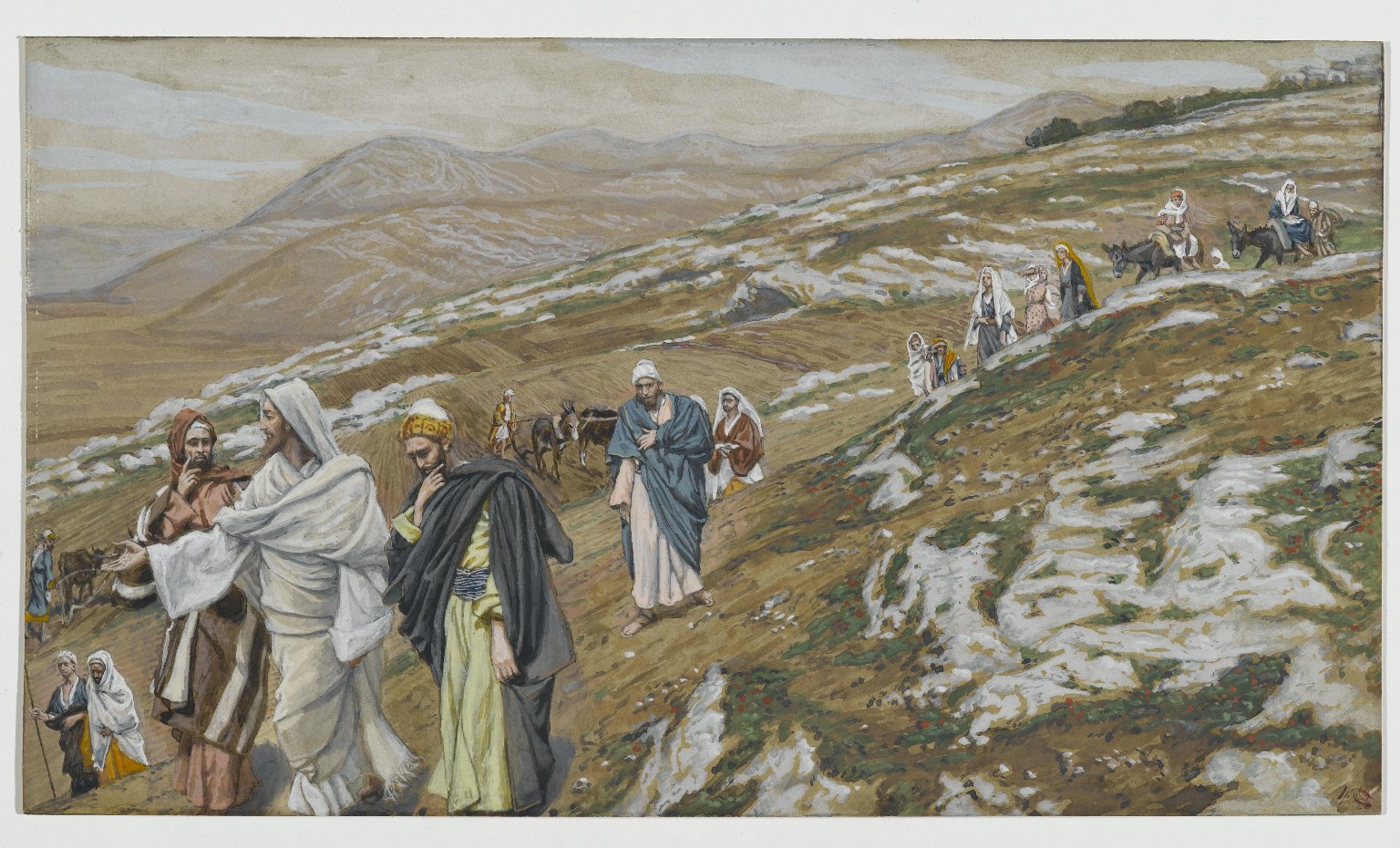
James Tissot: Jesus Travelling [Brooklyn Museum]

Trinity XIII: Lord, to whom shall we go? You have the words of eternal life!

LIFE in the twenty-first century seems to involve an ever-increasing amount of decisions. If we want to buy a cup of coffee we have to make many quick decisions about size, strength, type of coffee, milk, sugar, etc. It can be quite exhausting. Our readings this week focus on the choices and decisions people make. To follow the Christian faith is something we choose to do. We choose to trust God, we are not forced to. The decision to follow Christ is the most important choice we ever make. It affects both our life on earth and in the hereafter.

This morning’s first reading is an account of the renewal of the covenant between God and Israel brought about by Joshua at Shechem. The people of Israel are asked if they want to worship God and follow his laws. Joshua makes his position clear:

“But as for me and my house, we will serve the Lord.”

“Ond byddaf fi a’m teulu yn gwasanaethu’r Arglwydd.” (Josh 24:15)

The people of Israel follow his example and renew their covenant with God:

“Therefore we also will serve the Lord, for he is our God.”

“Yr ydym ninnau hefyd am wasanaethu’r Arglwydd, oherwydd ef yw ein Duw.” (Josh 24:18)

Their religious faith is a conscious act of the will. They choose to serve the God who has saved them. God has shown that He is their God.

In a similar way, the events of Chapter 6 of St John’s Gospel happen around the time of Passover, the festival which marks Israel’s deliverance from slavery in Egypt and the start of their journey to the Promised Land. This is a key moment in Salvation history. Our Lord has been teaching about the Bread of Life, and stressing the importance of eating His flesh and drinking His blood. Such teaching was difficult for a Jewish audience to hear, as it violated fundamental principles of their dietary laws. 

When many of his disciples heard it, they said, “This is a hard saying; who can listen to it?”

Wedi iddynt ei glywed, meddai llawer o’i ddisgyblion, “Geiriau caled yw’r rhain. Pwy all wrando arnynt?” (Jn 6:60)

Jesus is teaching in a synagogue in Capernaum, and those present are not used to this kind of instruction. It turns everything they know on its head. In Hebrew the word for flesh (baśar) and the word for good news, glad tidings, or the Gospel(besorah), sound similar. Such word-play is intentional, and may be linked to the Hebrew Wisdom tradition, such as we heard last week in the Book of Proverbs. Our Lord does not, however, back down, or change His teaching, but instead develops it further:

“Do you take offence at this? Then what if you were to see the Son of Man ascending to where he was before? It is the Spirit who gives life; the flesh is no help at all. The words that I have spoken to you are spirit and life. But there are some of you who do not believe.”

“A yw hyn yn peri tramgwydd i chwi? Beth ynteu os gwelwch Fab y Dyn yn esgyn i’r lle’r oedd o’r blaen? Yr Ysbryd sy’n rhoi bywyd; nid yw’r cnawd yn tycio dim. Y mae’r geiriau yr wyf fi wedi eu llefaru wrthych yn ysbryd ac yn fywyd. Ac eto y mae rhai ohonoch sydd heb gredu.” (Jn 6:61-64)

Having described the Institution of the Eucharist as a way of understanding His Passion and Death, Jesus goes on to talk about events after His Resurrection, namely His Ascension, and the Sending of the Holy Spirit at Pentecost. These are all linked, because they form the culmination of Salvation History. This is the Good News of Jesus Christ. This is God saving His people, the outworking of the covenant at Shechem into the New Covenant of Our Lord and Saviour. However its proclamation does not draw people to Jesus, instead it has the opposite effect:

After this many of his disciples turned back and no longer walked with him. So Jesus said to the Twelve, “Do you want to go away as well?”

O’r amser hwn trodd llawer o’i ddisgyblion yn eu holau a pheidio mwyach â mynd o gwmpas gydag ef. Yna gofynnodd Iesu i’r Deuddeg, “A ydych chwithau hefyd, efallai, am fy ngadael?” (Jn 6:66-67)

Jesus does not force people to follow Him. Then, as now, the choice to follow (or not follow) Christ is a personal decision made freely by each individual. Our Lord asks the Twelve if they want to leave as well, which leads to the following declaration of faith by St Peter:

Simon Peter answered him, “Lord, to whom shall we go? You have the words of eternal life, and we have believed, and have come to know, that you are the Holy One of God.”

Atebodd Simon Pedr ef, “Arglwydd, at bwy yr awn ni? Y mae geiriau bywyd tragwyddol gennyt ti, ac yr ydym ni wedi dod i gredu a gwybod mai ti yw Sanct Duw.” (Jn 6:68-69)

Simon Peter trusts Our Lord. He expresses that faith and trust. No-one else can offer what Jesus does, because He is God. Only God can make such incredible claims. To be a Christian is to make the same confession as Peter, and to have the same hope of eternal life in and through Jesus Christ. 

Jesus’ teaching is hard to accept, and difficult to understand, but we can experience it, when we receive Holy Communion. For Peter, and for us, belief precedes knowledge. We believe and then we come to understand.

Faith revolves around the question of commitment. It involves love and sacrifice — the two go hand in hand. This is what marriage is all about, and commitment also describes God’s relationship with us, and ours with God. It will see Jesus die on the Cross for us, to show us just how much God loves us, and wants to restore our relationship with Him, and with each other. To be close to God is wonderful, but it isn’t something God forces us into: we may choose to accept God’s love, or to refuse it. This love is freely given.

St Paul’s advice to the Christians in Ephesus is another difficult text, which revolves around making a choice. For St Paul, Christian marriage is all about loving service of one another, as demonstrated by Christ. Jesus lays down His life for us, so we should do the same for each other. Thus, in marriage in particular, and in society in general, loving service and self-sacrifice are the ways by which we should live. It is a generous form of life, because its model is Jesus, the most unselfish person ever, who created all that there is, and who redeemed it by offering His life as a ransom for many. We see this on the Cross and we commemorate it in the Eucharist, where Christ continues to feed us —His people— with Himself, so that we might have life in Him.

So, my brothers and sister in Christ, let us follow the example of St Peter and St Paul in trusting Jesus and being fed with Him, to prepare us for Heaven. Let us demonstrate our commitment by singing the praises of God the Father, God the Son, and God the Holy Spirit. To whom be ascribed all glory, dominion and power, now and forever. Amen.

Jesus Teaches in the Synagogues – James Tissot (Brooklyn Museum)

Trinity XII: The Bread of Life

THE poet Robert Browning once wrote: ‘If thou tastest a crust of bread, thou tastest all the stars and all the heavens’. This connection between bread and Heaven is the subject of today’s Gospel.

Our Lord has been teaching His followers about the Bread of Life. This is a topic which He returns to at the Last Supper. Seated with His disciples, Jesus says, ‘This is My Body’ ‘hwn yw nghorff’ and ‘This is My Blood’ ‘hwn yw fy ngwaed i’. He means what He says. For a hundred thousand successive Sundays the Church has followed Christ’s instruction to ‘do this in memory of me’. Not simply as a memorial, but to feed God’s people with God Himself: Body, Blood, Soul, and Divinity. To transform us, and prepare us for Heaven.

During the Roman Empire, when the Church was persecuted, followers of Jesus were accused of three false things. Firstly, atheism, because of their refusal to believe in, or worship pagan gods. Secondly, incest, because Christians called each other brother and sister, and loved each other. Thirdly, cannibalism — Christians were accused of eating human flesh. These last two charges are rooted in a misunderstanding of Christian worship. They are also evidence that, from the beginning, Christians were gathering for worship and consuming the Body and Blood of Christ.

Christ is being controversial when He teaches the people,

“I am the living bread that came down from heaven. If anyone eats of this bread, he will live for ever. And the bread that I will give for the life of the world is my flesh.”

“Myfi yw’r bara bywiol hwn a ddisgynnodd o’r nef. Caiff pwy bynnag sy’n bwyta o’r bara hwn fyw am byth. A’r bara sydd gennyf fi i’w roi yw fy nghnawd; a’i roi a wnaf dros fywyd y byd.” (Jn 6:51)

Our Lord is greater than the manna which God sent down to the Israelites during their wanderings in the desert. He is living bread. He is the bread which gives eternal life. God shares Himself with us, so that we might live in Him. But Christ’s teaching is deeply problematic for His audience. Jewish law prohibited the consumption of blood and human flesh. So what Jesus is proposing is impossible for His followers to accept. It is something that they cannot do, and yet they are told that they must. 

Jesus then repeats His teaching. He explains that anyone who wants to have life, needs to eat His Flesh and drink His Blood. Christ invites believers to the Eucharist and, in doing so, pledges to them that they will share in His Resurrection:

‘Whoever feeds on my flesh and drinks my blood has eternal life, and I will raise him up on the last day.’

‘Y mae gan y sawl sy’n bwyta fy nghnawd i ac yn yfed fy ngwaed i fywyd tragwyddol, a byddaf fi’n ei atgyfodi yn y dydd olaf.’ (Jn 6:54)

The purpose of the Eucharist is to transform us, to give us Eternal Life in Christ, so that we are part of Him. United with God and incorporated with Him forever.  As the bread is broken, and the wine is poured, so Jesus suffers and dies on the Cross. Our Lord’s Passion, Death and Resurrection are the core of our faith as Christians. In them we see how much God loves us. God’s love is freely given. We do not earn it, we do not deserve it; yet it is given to us. It is through Divine love that we may grow into something better, something greater, something more Christ-like. Such is the power of God’s sacrificial love at work in our lives. This is the treasure which we have come here to receive today. If it were ordinary food then we would eat it, and remain unchanged. But, instead, we who eat the Bread of Heaven are united with Christ. This is strong food! 

The Book of Proverbs speaks of Wisdom, which in the Christian tradition is identified with Christ, the Word made Flesh. Wisdom issues an invitation. She has constructed a house — the Church — and she has built seven pillars — the sacraments of the Church — the means of God’s grace to be active in our lives. The people of God are called to eat and drink, to live, and to walk in the way of wisdom, by following Jesus Christ. The message of New Testament is prefigured in the Hebrew Scriptures, which point to — and find their fulfilment in — Jesus Christ. He is the Wisdom of God, and the Word made Flesh. Christ’s invitation is an echo of the words of the Book of Proverbs:

“Come, eat of my bread and drink of the wine I have mixed. Leave your simple ways, and live, and walk in the way of insight.”

“Dewch, bwytewch gyda mi, ac yfwch y gwin a gymysgais. Gadewch eich gwiriondeb, ichwi gael byw; rhodiwch yn ffordd deall.” (Prov 9:5-6)

Throughout the Scriptures God issues an invitation to His people to be nourished, and walk in the way of truth. So my brothers and sisters in Christ, let us come to the banquet of the Lord, the feast of the Kingdom. May God’s grace transform us more and more into His likeness, and give us eternal life in Him. In the name of God the Father, God the Son, and God the Holy Spirit. Amen.

Trinity X: Sir, give us this bread always

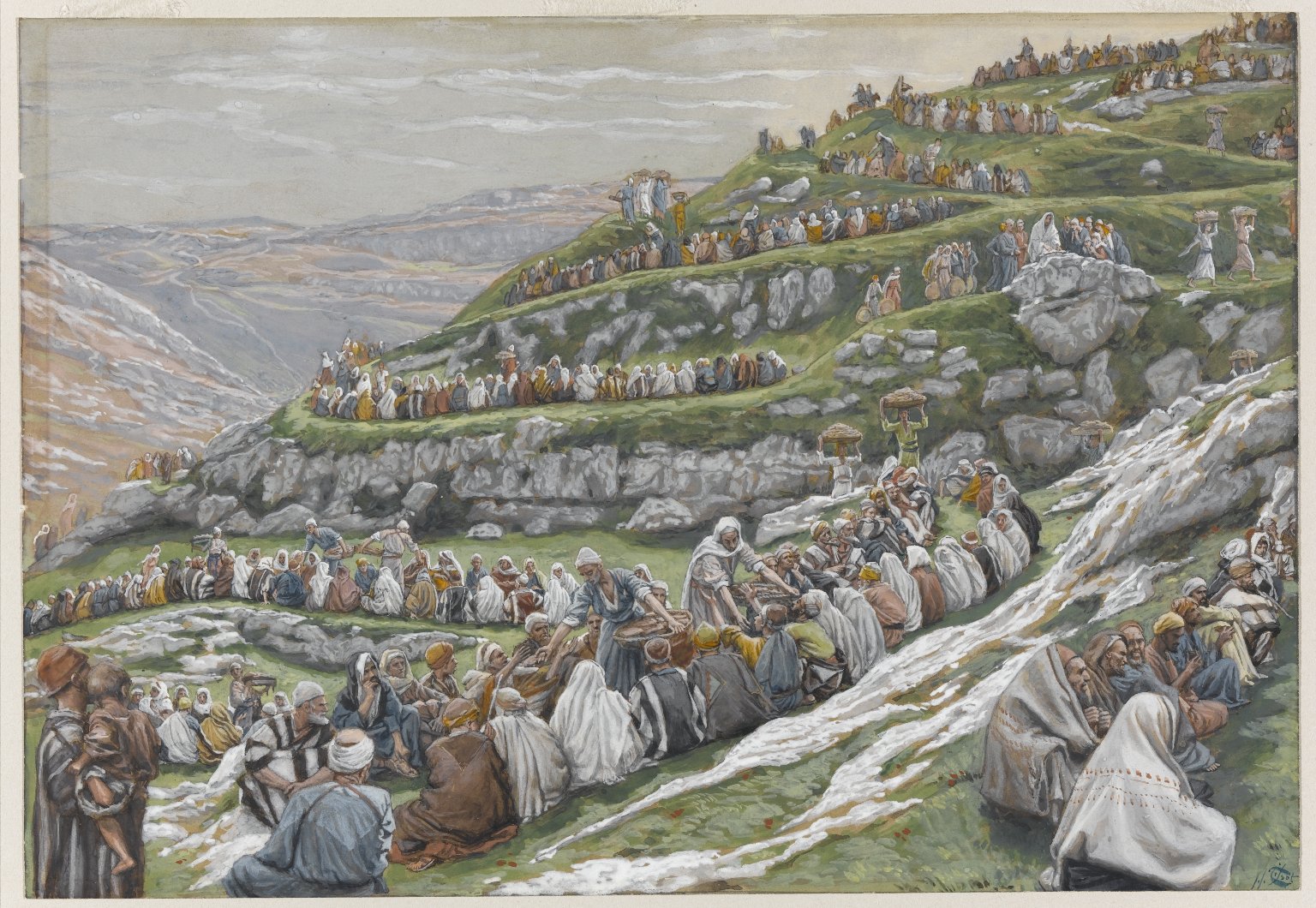
Food plays a huge part in the formation of human memory. Our memories of childhood are filled with the cooking of significant people or significant occasions. Our sense of taste can evoke these memories, allowing us to relive moments from the past. As the people of Israel are journeying through the wilderness towards the Promised Land, they are not happy. They would prefer to have died in Egypt with plenty to eat, rather than the hunger they are experiencing in the wilderness. So God promises to feed His people with quail and bread. Israel is fed by a miracle. God feeds us, as was shown by last week’s Multiplication of the Loaves and Fishes. Our Heavenly Father hears our prayers, and answers them. He takes care of His people.

In the Gospel, the miraculous feeding by the Sea of Galilee has caused something of a commotion. The people have continued to follow Jesus, who had gone off to pray and be alone. When they catch up with Him, He replies:

“Truly, truly, I say to you, you are seeking me, not because you saw signs, but because you ate your fill of the loaves. Do not labour for the food that perishes, but for the food that endures to eternal life, which the Son of Man will give to you.”

“Yn wir, yn wir, rwy’n dweud wrthych, yr ydych yn fy ngheisio i, nid am ichwi weld arwyddion, ond am ichwi fwyta’r bara a chael digon. Gweithiwch, nid am y bwyd sy’n darfod, ond am y bwyd sy’n para i fywyd tragwyddol. Mab y Dyn a rydd hwn ichwi,” (Jn 6:26-27)

The people can understand what is going on at a superficial level, but have failed to understand that Israel’s Messiah is leading them to a new Exodus, feeding them with new manna, to lead them to Heaven. He doesn’t want to be an earthly ruler, His Kingdom is not of this world. Instead, Our Lord wants to transform their souls, and their lives, by His gift of Himself: ‘food that endures to eternal life’, ‘y bwyd sy’n para i fywyd tragwyddol’. Jesus gives Himself to us, so that we might have eternal life in Him.

The Eucharist is not simply a memorial of Our Lord’s death, but a real sharing in His Body and Blood. God loves us, you and me — all of us — so much, that He longs to feed us with Himself. He loves us so much that He gives Himself to be tortured and to die on the Cross for us. This is the central message of Christianity: God loves us, and wants us to share Eternal Life with Him.

Those following Our Lord still do not seem to have grasped what is going on, so the people interrogate Jesus further:

Then what sign do you do, that we may see and believe you? What work do you perform? Our fathers ate the manna in the wilderness; as it is written, ‘He gave them bread from heaven to eat.’”

“Os felly,” meddent wrtho, “pa arwydd a wnei di, i ni gael gweld a chredu ynot? Beth fedri di ei wneud? Cafodd ein hynafiaid fanna i’w fwyta yn yr anialwch, fel y mae’n ysgrifenedig, ‘Rhoddodd iddynt fara o’r nef i’w fwyta.’” (Jn 6:30-31)

The people want to see more signs. The Feeding of the Five Thousand was not enough for them. Jesus asks them to believe in Him, and to put their trust in God. He then explains what is happening in the Exodus story:

Jesus then said to them, “Truly, truly, I say to you, it was not Moses who gave you the bread from heaven, but my Father gives you the true bread from heaven. For the bread of God is he who comes down from heaven and gives life to the world.” They said to him, “Sir, give us this bread always.”

Yna dywedodd Iesu wrthynt, “Yn wir, yn wir, rwy’n dweud wrthych, nid Moses sydd wedi rhoi’r bara o’r nef ichwi, ond fy Nhad sydd yn rhoi ichwi y gwir fara o’r nef. Oherwydd bara Duw yw’r hwn sy’n disgyn o’r nef ac yn rhoi bywyd i’r byd.” (Jn 6:32-4)

The people’s request is to continue to be fed: they are still hungry, hungry for the teaching which Jesus is providing. Christ is the one who can satisfy the deepest longing of the human heart, for intimacy with God. This is what Our Heavenly Father longs to provide for us.

Finally, Jesus says to them:

“I am the bread of life; whoever comes to me shall not hunger, and whoever believes in me shall never thirst.”

“Myfi yw bara’r bywyd. Ni bydd eisiau bwyd byth ar y sawl sy’n dod ataf fi, ac ni bydd syched byth ar y sawl sy’n credu ynof fi.” (Jn 6:35)

These are words we can trust: Christ yw bara bywyd, Christ is the Bread of Life. This is the first of seven sayings in John’s Gospel where Jesus describes who He is, and what He does by saying ‘I am …’ This is a direct echo of when God speaks to Moses at the Burning Bush in Exodus 3:14 and says:

I am who I am

So here Jesus is telling us who He is, who God is, so that we can believe in Him, and be nourished by Him. Our Lord is teaching us about the Eucharist. In it we truly receive the Body and Blood of Christ. Not as ordinary food, but as spiritual nourishment so that we may become what He is. So that God’s love may transform us, making us more Christlike.

Our response should be, in the words of the Gospel:

“Sir, give us this bread always.”

“Syr, rho’r bara hwn inni bob amser.” (Jn 6:34)

This sentiment is echoed in the words of the Lord’s Prayer: ‘Dyro i ni heddiw ein bara beunyddiol, Give us this day our daily bread’. This prayer is fulfilled in the Eucharist. Here Jesus gives us the Bread of Heaven, so that we might be fed by Him, and with His Body and Blood, so that we might have a foretaste of Heaven and a pledge of Eternal Life in Christ.

A miraculous feeding will happen here today, when we, the people of God, united in love and faith, offer ourselves and the bread that we have, so that it may be taken, blessed, broken, and shared. It is given so that we may be partakers in the mystical supper of the Kingdom of God, and a sign of the Heavenly Banquet. Where we hope to sing the praises of God the Father, God the Son, and God the Holy Spirit. To whom be ascribed all glory, dominion, and power, now and forever. Amen.

Leonardo da Vinci, The Last Supper, Santa Maria delle Grazie, Milan

Trinity IX – The God of Surprises

A surprise present or a visit from a loved one often brings great joy. One of the loveliest and yet most challenging aspects of Christianity is the fact that we worship a surprising God. Our Heavenly Father uses all sorts of people, and situations, in ways which we do not expect. The Christian journey is not always straightforward. The key is faith: trusting God to be at work, and knowing that everything will be good in the end.

In the Gospel, the people of Israel are like sheep without a shepherd. They feel let down and abandoned by their political and religious leaders. Such sentiments are widespread and understandable. However, there has been something of a religious revival in Galilee, and Our Lord has attracted quite a considerable following, numbering over five thousand people. After the proclamation of the Kingdom of God, the call to repentance and baptism, and some inspiring healing and teaching, people are excited. Prophecies are being fulfilled. The question on everyone’s lips is: Could this man really be the Messiah? 

Once again Jesus has taken His disciples across the See of Galilee for some rest and recuperation. However, the people’s need is great. They understand Christ’s healing miracles as a sign of the Kingdom, and they are keen to learn, and to be fed and nourished, both physically, and spiritually. Our Lord goes up onto higher ground and sits down. This makes perfect sense, especially as He is about to address the large number of people following Him. We should note the context. It is almost the Feast of Passover, the holiest day of the Jewish year, which marked their journey from slavery in Egypt to freedom in the Promised Land. The Passover was the time when people expected the Messiah to return, to lead the people to freedom. 

Then Jesus asks the disciple named Philip a question:

“Where are we to buy bread, so that these people may eat?”

“Ble y gallwn brynu bara i’r rhain gael bwyta?” (Jn 6:5)

Our Lord already knows the answer, but He wants to see what Philip thinks. The disciple replies:

“Two hundred denarii would not buy enough bread for each of them to get a little.”

“Ni byddai bara gwerth dau gant o ddarnau arian yn ddigon i roi tamaid bach i bob un ohonynt.” (Jn 6:7)

Two hundred denarii was over six months wages for a labourer. It is a large sum of money, which would buy a lot of food. Also feeding such a large crowd would be a logistical nightmare. Apart from the cost, there is the question of how you would get the food in the first place. Then Peter’s brother Andrew makes an intervention:

“There is a boy here who has five barley loaves and two fish, but what are they for so many?”

“Y mae bachgen yma a phum torth haidd a dau bysgodyn ganddo, ond beth yw hynny rhwng cynifer?” (Jn 6:9)

Andrew has a point: if £10,000 worth of food would only give people a mouthful, then a small bag full of food is a drop in an ocean of need. The situation appears to be an impossible one. Then Jesus acts.

Our Lord asks the people to sit down. There are five thousand men, and possibly another fifteen thousand women and children. Jesus takes the loaves and fishes, and blesses them. After thanking God for the food, He gives it to be distributed among the people. Not only does everyone eat as much as they want, but at the end there are twelve baskets of leftovers. It is through prayer and blessing that bread can be broken, distributed, and provide sustenance on a scale, and in a way, that defies human expectation and understanding. Not only are a huge number of people fed, but, as a sign of the super-abundance of God’s love and mercy, there is more left over at the end than there was to begin with! In the same way, the kingdom of God, of which the bread is a sign, grows when God’s love is shared. This love satisfies people’s deepest needs. The more we share it, the more there is. The Kingdom of God is a place of generosity and love, a place where our needs are answered and we are transformed.

John’s Gospel describes how Jesus takes, blesses, breaks and distributes bread, demonstrating how the Kingdom of God works. This looks forward to the Institution of the Eucharist by Jesus at the Last Supper.

The same miraculous feeding that took place by the shore of the Sea of Galilee will also happen here today. We gather as the people of God, united in love and faith, and offer ourselves. Like the small boy, we give the bread that we have, so that it may be taken, blessed, broken and given out. In this way we become partakers in the mystical supper of the Kingdom of God. We eat the Body of Christ not as ordinary food, but as bread for the journey of faith. The Eucharist is the sign and token of God’s love. This is the means by which we enjoy the close presence of God.

The crowd recognises the miraculous feeding as a sign, signifying God’s love, and the presence of the Messiah in their midst. In response they want to enact a political coup, and make Jesus a king. This is not what Our Lord wants, so He withdraws, to be alone, to be with God. The multiplication of the loaves and fishes shows us that God is active in the world, pouring out His generous love, meeting our needs, and healing our wounds. This is not the start of a political campaign. Christ does not want earthly power. Instead, He wants to reign in our hearts, and in our lives.

God uses barley bread — the bread of the poor — to feed His people. This points to the Eucharist and to the Cross as the place where humanity is nourished and healed. We follow Christ’s example week by week, because without Him, our hunger remains unsatisfied. 

Today and every day we give thanks that God loves us. He reveals His love in ways which often surprise us, and which defy our expectations. When we trust in Christ we are transformed in this life, and the next. We become prepared for Heaven, where we, and all the faithful, will sing the praises of God the Father, God the Son, and God the Holy Spirit. To whom be ascribed all glory, dominion, and power, now and forever. Amen.

James Tissot – The Multiplication of the Loaves and Fishes (Brooklyn Museum)

Pentecost 2024

FIRE is an amazing entity. It is something that can be both a benefit, but also a danger. The heat produced by an open fire, or a log-burning stove, provides warmth and comfort. The candles in church give light and form a focus for our prayers. However, we must always take care with fire, as it is a powerful force. The disciples are described as receiving the power of the Holy Spirit through what looked like ‘divided tongues of fire’ ‘tafodau fel o dân’ (Acts 2:3).

Before his Ascension, Christ tells His disciples to wait in Jerusalem so that they may be baptized in the Holy Spirit. The twelve have again gathered in the Upper Room, along with the Blessed Virgin Mary. This is the same place where Christ instituted the Eucharist, and washed His disciples’ feet. They have gathered here because Jesus told them to be together, and to pray, saying:

 ‘you shall receive power when the Holy Spirit has come upon you; and you shall be my witnesses … to the end of the earth’ 

‘Ond fe dderbyniwch nerth wedi’r Ysbryd Glân ddod arnoch, a byddwch yn dystion i mi … a hyd eithaf y ddaear’ (Acts 1:8)

Our Lord promises to pour out the Holy Spirit to strengthen and inspire the Church. God is generous, and wants to see humanity flourish. An amazing event then takes place. Everyone present is filled with the Holy Spirit. Tongues of fire rest upon them, and they speak in a variety of languages. Strengthened by God’s Spirit the disciples go out to preach. In Jerusalem there are people from all over the Mediterranean World, gathered for the Jewish festival of Shavuot, the celebration of the wheat harvest. These people are amazed to hear the mighty works of God spoken in their own languages. Not only that, those speaking are not the educated elite but a rag-tag assortment of Galilean fishermen and other ordinary men. They hear and understand the proclamation of who Jesus is, and what He has done. 

Through the power of God, the Good News is pronounced. Men who were afraid, hiding behind locked doors, have become confident, and will go out to share the Gospel around the world. Their miraculous transformation has, in turn, transformed the world, resulting in billions of Christians. We are here in church today because of the power of the Holy Spirit.

This is why St Paul can write to the Church in Galatia as a community that has experienced the indwelling of the Holy Spirit. The apostle describes what it means to be filled with the Holy Spirit:

But the fruit of the Spirit is love, joy, peace, patience, kindness, goodness, faithfulness, gentleness, self-control’ 

Ond ffrwyth yr Ysbryd yw cariad, llawenydd, tangnefedd, goddefgarwch, caredigrwydd, daioni, ffyddlondeb, addfwynder, hunanddisgyblaeth.’ (Gal 5:22-23)

Paul is describing how we are all supposed to be as Christians. Living by the Spirit is an ideal, which we often fail to live up to, but, nonetheless, it shows us how God wants us to live. Here is a glimpse of life in all its fulness: life in union with God, and with each other. This is perfect communion, something to strive for, even if we may struggle to attain it. This is how we can live when we allow God to be in control, and when our human will is perfectly aligned with the Father’s will for us. Living by the Spirit is what human flourishing looks like in practice.

At a number of points in John’s Gospel, Jesus speaks about the Holy Spirit to His disciples. Our Lord tells His followers that the Spirit will bear witness, confirming the truth of their faith, and will strengthen them for service: living and sharing the Good News. Jesus promises: 

When the Spirit of truth comes, he will give you into all truth

Ond pan ddaw ef, Ysbryd y Gwirionedd, fe’ch arwain chwi yn yr holl wirionedd’ (Jn 16:13)

We have come together today to celebrate God’s love and generosity in continuing to send His Holy Spirit. 

God is glorified in worship, which is why we sing His praises. Worship does not change God, it changes us: making us more loving, uniting us with our creator who sustains us with His love. Christians all around the world are united with the worship of Heaven, where the saints and angels sing the praises of God, Father, Son, and Holy Spirit. Through the power of the Holy Spirit, and nourished by Word and Sacrament, we are given a foretaste of the joy which awaits us.

So, my brothers and sisters in Christ, let us pray earnestly for the gift of the Spirit. May God fill us with His love and equip us to proclaim the Good News of the Kingdom. May the fire of the Holy Spirit embolden us to encourage others to come to know, and love, God the Father, God the Son, and God the Holy Spirit. To whom be ascribed all, glory, dominion, and power, now and forever. Amen.

Maronite Icon of Pentecost

Easter VII

In 1959 the first photograph of the Earth was taken from space by an unmanned satellite called Explorer 6. The image was blurry and very basic by today’s standards. Almost a decade later, the crew of Apollo 8 took a famous picture of our planet rising over the lunar landscape. It was named Earthrise. This iconic photograph helped people to understand the world better and take greater interest in environmental issues. As Christians we are called to care for our planet and all the people, plants, and creatures that dwell on it. At the same time, as Christians we are called to be in the world, but not of the world. This world is simply somewhere we will reside for a short while. Our citizenship is in Heaven, our true home, where we long to spend eternity with God. One of the ways in which the Church lives out this other-worldliness is shown in today’s reading from the Acts of the Apostles.

After Jesus’ Ascension, the disciples spend time together in prayer and fellowship. One of their first actions is to appoint a replacement for Judas Iscariot, so that the Eleven Apostles may become Twelve again. For Jews the number twelve is very significant. It stands for wholeness and the completion of God’s purpose. There are twelve months in a year, and twelve tribes of Israel. It was therefore important to the Apostles that they were restored to their proper number of twelve. So, out of all the current followers of Jesus, Peter states that they need someone who has been with them from the beginning, to act as a witness to Jesus’ resurrection. Two candidates are put forward: Justus and Matthias. Peter then prays for guidance:

You, Lord, who know the hearts of all, show which one of these two you have chosen to take the place in this ministry and apostleship from which Judas turned aside to go to his own place.” 

“Adwaenost ti, Arglwydd, galonnau pawb. Amlyga prun o’r ddau hyn a ddewisaist i gymryd ei le yn y weinidogaeth a’r apostolaeth hon, y cefnodd Jwdas arni i fynd i’w le ei hun.” (Acts 1: 24-25)

The disciples do not decide for themselves, they leave the choice up to God. Through the random process of casting lots, God can show them whom He wants to be an apostle. This feels strange to us nowadays. We want to be in control. We want to choose. Perhaps we would be better served by putting God back in control. 

The Gospel reading continues the exploration of the Farewell Discourses between the Last Supper and Jesus’ Arrest. Today we have arrived at Chapter 17, known as Jesus’ High Priestly Prayer. This is a truly solemn moment of intimate conversation between the Father and the Son. Before His Passion and Death, Christ is entrusting His Church to the Father, that it may be kept safe, and that it may be filled with the glory of God, and also strengthened to proclaim the Good News of the Kingdom. This is a moment of profound emotion and intimacy, a window into a conversation between two Persons of the Holy Trinity. 

Jesus is committing us, His Church to God, for God to care for us. His prayer sees His followers as being in opposition to a world which rebels against God; a world of sin and corruption; a world of power and politics. Christ prays that His people may be set apart, to be holy, devoted to God, and filled with love. To love is to will the good of the other. God loves us, and it is God’s will that we flourish and enjoy life in all its fulness, united to Him. This is why Jesus taught us to pray,

Thy kingdom come, thy will be done, on earth as it is in heaven.

“deled dy deyrnas, gwneler dy ewyllys; megis yn y nef, felly ar y ddaear hefyd.”(Mt 6:10)

Christ is praying that we, His Church, stay close to God. That we be united with God’s will, and filled with God’s love. This is why we look forward to next Sunday, when we celebrate Pentecost, the outpouring of the Holy Spirit. This is a sign of God’s love for us, the love which unites Father, Son and Holy Spirit. God invites us to be united with the life of the Trinity, and wants us to offer that invitation to others. If we place ourselves in God’s hands He will take the initiative, just as He did in choosing Matthias to replace Judas.

Th name Matthias means ‘gift of God’. The disciples receive this gift after praying together and asking for God’s guidance. As Christians we too need to spend time together, to pray for our needs and those of the world. In prayer we are united with each other and with God. Together we are nourished by sharing the Eucharist and hearing the Word of God. These things are crucial to who and what we are. United together we experience the love of God and the joy of community. The world may be indifferent to what we do, or it may mock us when we fail to live up to the example of Jesus. But, as Christians, we strive to live in the love of God, and forgive each other our trespasses. We aim to live out that same radical love and forgiveness which sees Jesus die upon the Cross and be raised to New Life for love of us, and for all the world.

This message of profound love and forgiveness is one that much of the world cannot or does not want to understand. We may not understand the depths of God’s love, but we know that it can be experienced, through personal encounter with Jesus in prayer, Word, and Sacrament. We are living testimony to love’s power to change lives. It sets us free to live for God and to proclaim his saving truth in our words and actions.

As I mentioned earlier in this sermon, Matthias’ name means ‘gift of God’, and his appointment comes just before God’s wonderful gift of the Holy Spirit. So as we wait with the Apostles for this gift, let us pray that God may be at work in us, building us up, and giving us strength to live the Christian life. Let us then share these gifts with others, so that they may also come to believe and give glory to God the Father, God the Son, and God the Holy Spirit. To whom be ascribed all glory, dominion, and power, now and forever. Amen.

Peter Paul Rubens Matthias (Museo del Prado, Madrid)

Easter VI

CHRISTIANITY is a religion which has at its heart a number of paradoxes. The Good News of the Kingdom of God is both simple and straightforward. But it is also difficult and complex. The basic theory is simple: ‘Love God, and love your neighbour’ ‘Câr Duw a Châr dy gymydog’. However, when we try to do this, we find that the practice is a little more complicated than the theory.

The Gospel passage for today is all about love. According to St Thomas Aquinas, ‘Love is… willing the good of the other.’ ‘Mae cariad ewyllysio y Dda o’r eraill’ [(STh I-II, q.26 a.4, CCC 1766) Respondeo dicendum quod, sicut Philosophus dicit in II Rhetoric, amare est velle alicui bonum]. To love, then, is not simply an act of passion or emotion — something which we feel — but it is also something which we choose to do. As Christians, we want to see others flourish, and we work towards that end. Love takes effort.

Jesus’ teaching is clear:

“This is my commandment, that you love one another as I have loved you. Greater love has no one than this, that someone lay down his life for his friends.”

“Dyma fy ngorchymyn i: carwch eich gilydd fel y cerais i chwi. Nid oes gan neb gariad mwy na hyn, sef bod rhywun yn rhoi ei einioes dros ei gyfeillion.” (Jn 15:12-13)

Christians are called to love one another as Christ loves us. In other words we are to love, even to the point of laying down our lives for each other. This is pertinent  as we remember those who gave their lives during the Second World War, eighty years ago. At the heart of our faith is the Cross. This is the ultimate demonstration of God’s love for us: God loves us so much that He dies for us, so that we might live in Him. The Cross is not the end, it leads to the Empty Tomb, and to the Triumph of Easter. Jesus dies to break the power of death, and to offer humanity eternal life with Him in Heaven. This is why we spend time in our celebration of Easter pondering the mystery of our redemption, entering ever deeper into the experience of God’s love for us.

When Our Lord speaks to His disciples, He speaks to us as well. He does not call us servants (weision), but friends (gyfeillion). To be a Christian is to be a friend of God and to enter into an intimate and loving relationship with the Creator and Redeemer of the Universe. God wants to be our friend. He wants to be united with us in a relationship characterised by love and generosity. 

We experience God’s love most fully in the Eucharist, where Christ continues to give Himself to, and for, us. Out of love, He continues to heal our wounds, to restore our relationship with God and each other, and gives us a foretaste of Heaven in the here and now. There is no other thing on earth as precious as this love. Nothing is more wondrous than this sign and token of God’s love for us. To dwell in Christ’s love is to be united with Him in physical and spiritual communion, so that God’s grace can transform us more and more into His likeness.

At this point in John’s Gospel Our Lord is in the Upper Room with His disciples. He has washed their feet and celebrated the Eucharist. Jesus has also talked about His Passion and Death in order to explain to His followers, including us, what He is about to do and why it matters. Christ is putting everything in place for there to be a Church to continue His work on Earth. This is why he addresses His disciples as follows:

“You did not choose me, but I chose you and appointed you that you should go and bear fruit and that your fruit should abide, so that whatever you ask the Father in my name, he may give it to you.”

“Nid chwi a’m dewisodd i, ond myfi a’ch dewisodd chwi, a’ch penodi i fynd allan a dwyn ffrwyth, ffrwyth sy’n aros. Ac yna, fe rydd y Tad i chwi beth bynnag a ofynnwch ganddo yn fy enw i.” (Jn 15:16)

We did not choose Jesus. He chose us. The Church is a vine which bears fruit. This is how it has continued for two thousand years. The Good News of the Kingdom has been proclaimed, and, throughout the world, people have grown and been nurtured in their faith. We have had a relationship with Jesus, which unites us with all Christians through both space and time, making us brothers and sisters in Christ, part of a family. Because of this relationship, with our Creator and each other, we are able to ask things of God in prayer. God listens to our prayer, and is generous in granting our requests. He gives his only Son to die for us and to rise again so that we might be certain of eternal life in Him. 

Finally, Jesus reminds His disciples of the need to love one another:

“These things I command you, so that you will love one another.”

“Dyma’r gorchymyn yr wyf yn ei roi i chwi: carwch eich gilydd.” (Jn 15:17)

Our Lord tells us what to do, so that we may bring about the will of God: that we love each other and flourish. God loves us, and wishes us to remain in a relationship with Him, and each other, that is characterised by generosity, and which takes as its model the Son of God, Our Risen Saviour. This conviction inspires the argument of the First Letter of John:

“In this is love, not that we have loved God but that he loved us and sent his Son to be the propitiation for our sins.”

“Yn hyn y mae cariad: nid ein bod ni’n caru Duw, ond ei fod ef wedi ein caru ni, ac wedi anfon ei Fab i fod yn aberth cymod dros ein pechodau.” (1Jn 4:10)

Jesus, through His self-sacrifice, makes up for all that we have done wrong. He offers Himself — the Righteous for the unrighteous — to restore our relationship with God and with each other. Jesus reconciles God and humanity, bringing back together what sin has thrust apart. This is the heart of the Good News. As well as dying for us, Christ also rose again. Our Lord reunites God and humanity, by laying down His life for His friends, and also gives us the hope of Heaven. We cannot earn our way there, but the generous love of our Creator offers us the opportunity to be united with Him forever.

My brothers and sisters in Christ, as we continue to celebrate Our Lord’s resurrection, may we rejoice in the abundance of divine generosity. May God’s grace transform us more and more into His likeness. Let us join with all our Christian brethren in rejoicing and singing the praises of God the Father, God the Son, and God the Holy Spirit. To whom be ascribed all glory, dominion, and power, now and forever. Amen.

James Tissot: The Last Sermon of Our Lord  (Brooklyn Museum)

Easter V – The True Vine

I know that many of you gathered here this morning are keen gardeners. One of the main gardening tasks in winter is to prune those plants which need to be pruned. At one level it is easy to think that having planted and watered a plant, it can be left to do its own thing, However, in order to both maximise the number and quality of blooms of, for example your roses, as well as encouraging strong healthy growth, then pruning is a must. Cutting off part of a living plant sounds brutal, but in fact it helps that plant to grow and produce fruit and flowers. I shall return to the theme of pruning in a short while.

In today’s first reading from the Acts of the Apostles we begin with a very human picture. The disciples of Jesus are afraid. They have good reason to be so. Saul was a sworn enemy of the Church, and he played a part in the martyrdom of the deacon Stephen. Could it be that Saul’s new-formed desire to join the disciples was just a trap? Then we see something wonderful: the power of a personal relationship. Barnabas vouches for Saul. The disciple explains both the former persecutor’s conversion on the road to Damascus, and his powerful preaching about how the risen Jesus had turned his life around. Later, when Saul tries to share his faith with fellow Jews they threaten to kill him. The disciples protect him and get him to the coast on a on a ship bound for his home town of Tarsus.  Having been afraid, the apostles have come to trust Saul as a fellow Christian. Their former enemy has become someone they now love, trust, accept, and care for. The situation can be summed up in the following verse:

‘So the church throughout all Judea and Galilee and Samaria had peace and was being built up. And walking in the fear of the Lord and in the comfort of the Holy Spirit, it multiplied.’

‘Yr oedd yr eglwys yn awr, drwy holl Jwdea a Galilea a Samaria, yn cael heddwch. Yr oedd yn cryfhau, a thrwy rodio yn ofn yr Arglwydd ac yn niddanwch yr Ysbryd Glân yn mynd ar gynnydd.’ (Acts 9:31)

Barnabas’ name means ‘Son of Consolation’, someone who acts like the Holy Spirit. Living up to his name, this disciple comforts the other disciples, strengthening their belief, and helping the Church to grow.

Barnabas puts his faith into action, and this is the advice given in our second reading from the First Letter of John:

‘let us not love in word or talk but in deed and in truth.’

‘gadewch inni garu, nid ar air nac ar dafod ond mewn gweithred a gwirionedd’ (1Jn 3:18)

The Christian Faith is not something we just talk about, it is something which affects our lives and our actions. We are called to live out our beliefs, and thus become an example that people want to emulate. Our deeds as Christians are arguably the most effective witness we have.

In the Gospel, Jesus once again illustrates his teaching by using an image which would have been very familiar to His audience. Vines were common throughout the entire Mediterranean World, producing grapes which could be eaten or made into wine. Jesus uses the concept of Himself as the Vine, with the disciples as the branches. It is a powerful vision of what the Church is: people who are grafted onto and into Christ, connected to Him, and in a relationship with Him. We entered into that relationship in our baptism, and it is a relationship which will continue throughout, and after, our life on earth. 

When we were baptised, we were grafted onto the vine, which is Christ. It is His will that we, as Christians, bear much fruit. This means that we must live out our faith in our lives, so that it affects who and what we are, and all that we say and do. We do this because it is what God expects of us, as we read in the First Letter of John: 

The love of God was made manifest among us, that God sent his only Son into the world, so that we might live through him’ (1Jn 4:9).

Because we are grafted into Christ we are in communion with Him. Jesus gives Himself to us in the Eucharist, His Body and Blood, so that we can have life in Him. He gives Himself to us out of love, so that we might have life in Him, and have it forever. The Eucharist is a pledge of eternal life with Christ, united in this world and the next. It is given to strengthen us on the journey of faith. Partaking in the Eucharist, physically or spiritually, helps us to live out our faith in our lives. Fed by and with Christ, we live in Him and for Him. 

Our Lord says:

‘Whoever abides in me and I in him, he it is that bears much fruit, for apart from me you can do nothing.’

‘Y mae’r sawl sydd yn aros ynof fi, a minnau ynddo yntau, yn dwyn llawer o ffrwyth, oherwydd ar wahân i mi ni allwch wneud dim.’ (Jn 15:5)

Apart from Jesus we can do nothing. When we rely solely on our own strength, our own talents, we inevitably fail. We must not forget that everything is God-given in the first place. To thrive we need to abide in Him. Without this connection to Our Heavenly Father we wither and die, cut off from the source of life and hope. 

So, my brothers and sisters in Christ, as we continue to rejoice in Our Lord’s Resurrection, may we take to heart the words of Our Lord:

‘By this my Father is glorified, that you bear much fruit and so prove to be my disciples.’

‘Dyma sut y gogoneddir fy Nhad: trwy i chwi ddwyn llawer o ffrwyth a bod yn ddisgyblion i mi.’ (Jn 15:8)

May we bear fruit in our lives, and, like Barnabas and Paul, become worthy witnesses to God the Father, God the Son, and God the Holy Spirit. To whom be ascribed all, glory, dominion, and power, now and forever. Amen.

Easter IV – The Good Shepherd

Living in Pembrokeshire, many of us know people who keep sheep. We are also aware of how difficult it has been for them, and all farmers, in the recent months with fields waterlogged due to unprecedented levels of rainfall. Sheep farming is a vital part of our rural life and so the image of Jesus as the Good Shepherd is something we find easy to identify with, unlike those who live in large cities.

Shepherds played an important part in Jesus’ life. Angels told them about the birth and they came down from the hills to worship Him in  the stable in Bethlehem. Not wishing to leave their animals behind, Nativity scenes depict the shepherds bringing sheep to the manger. This may be why Our Lord has an affinity with those who look after sheep and care for them. Jesus describes himself as the Good Shepherd, the one who lays down His life for His sheep. Christ dies so that we may have eternal life in Him. This model of self-sacrificial love lies at the heart of the Christian faith, and because of it, we are able to live the new life of Easter.

Jesus says, ‘I am the Good Shepherd’ ‘Myfi yw’r bugail da’ (Jn 10:11). This is straightforward: He cares for His flock. But then He says, ‘The good shepherd lays down his life for the sheep.’ ‘Y mae’r bugail da yn rhoi ei einioes dros y defaid’ (Jn 10:11). This goes above and beyond what we would expect of a shepherd, even a very good one! Jesus is using the image of the Good Shepherd to explain what will happen on Good Friday. He will suffer and die to protect us, His flock. 

Protect us from what? From Sin and Death. By dying for us, and rising from the dead, Jesus offers humanity freedom in Him. The Christian faith offers salvation, through faith. As St Peter puts it in this morning’s reading from the Acts of the Apostles: 

‘And there is salvation in no one else, for there is no other name under heaven given among men by which we must be saved.’

‘Ac nid oes iachawdwriaeth yn neb arall, oblegid nid oes enw arall dan y nef, wedi ei roi i’r ddynolryw, y mae’n rhaid i ni gael ein hachub drwyddo.’ (Acts 4:12)

Jesus offers what no-one else can: salvation and eternal life to those who believe in Him, and follow Him. Eccentric American millionaires employ bizarre methods in an attempt to defy the ageing process, but they are still going to die. Each and every human being is. That is the fate of all living things. But, because of who Christ is — namely true God and true man — and what He has done on the Cross and at the empty tomb, death is no longer something to be feared. Instead, it can be embraced, as the entry to eternal life, with God, forever. 

This way of looking at life and death is profoundly different from the world around us, because Christians are not bound by the primal human fear that our life is finite. Our Lord has opened to us the gates of Heaven, and shown us once and for all that God loves us.

At the heart of our faith as Christians is the profound conviction that we are people who are loved by God. As Archbishop Michael Ramsay said, ‘God is Christlike, and in him is no un-Christlikeness at all’ [God, Christ & the World: A Study in Contemporary Theology, London 1969, p.98]. When we see Jesus, we see God; when we hear Him speak, we hear the voice of God. We can know who God is, the Creator and Redeemer of the universe, through His Son, Jesus Christ. God is not a distant bearded man on a cloud. He is a loving Father, as illustrated in the Parable of the Prodigal Son. He loves us so much that He suffers and dies for us, to give us life in Him. This is the God who searches for lost sheep; who longs to love, restore, and reconcile; who can heal our wounds if we let Him. This is abundant life, offered to us by Our Lord, the Good Shepherd.

This life, this love is offered to us in the Eucharist, where we can touch and taste God’s profound love for us. In the bread and the wine we are given a foretaste of the heavenly banquet and a pledge of eternal life in Christ. Here today, as on a hundred thousand successive Sundays, we meet to be fed by Christ, and fed with Christ. To be healed, and to know His love. We are the sheep cared for by the Good Shepherd, who provides for all our needs. Who gives Himself so that we might have life.

So my brothers and sisters in Christ, as we continue to rejoice In Our Lord’s triumph over death, may we emulate His example and live the new life of Easter. Following Our Good Shepherd, who longs for us to be safe with Him forever in Heaven, let us share the Good News of His Kingdom with others. Let us pray that that all may come to know and love God the Father, God the Son, and God the Holy Spirit. To whom be ascribed all, glory, dominion, and power, now and forever. Amen.

The Third Sunday after Epiphany (Year B)

Organising a wedding is not an easy task. They can be complex and expensive undertakings, even when they are relatively modest affairs, with only family and a few friends. In some cultures, however, weddings can be more like celebrations for an entire community. Indeed, even today in the Middle East and Asia when a couple marry the celebrations can involve large numbers of guests, and last for several days. Clearly, the logistics of such festivities are complicated, and the financial outlay considerable. It is good to take a moment to consider how much the events in Cana, described in today’s Gospel reading, differ from most of the weddings that we have attended.

That Our Lord, His Mother, and His disciples are invited to the wedding should not be a surprise. This is a community celebration, with everyone present. The idea of running out of wine is not simply a failure of logistics and hospitality, but could represent a situation that would bring shame and disgrace on the hosts. It is a crisis which could stigmatise the family for years to come, with the couple thinking that their union had been cursed with bad luck. Suffice it to say, it would be a complete disaster for all concerned. Mary, wanting to prevent this, lets Jesus know that there is a serious problem. The situation is critical, and something needs to be done quickly. Our Lord, however, seems a little dismissive:

“Woman, what does this have to do with me? My hour has not yet come.”

‘Beth sydd i mi a wnelwyf â thi, wraig? ni ddaeth fy awr i eto.’ (Jn 2:4)

Jesus is looking ahead to when His hour will come, anticipating His Passion and Death on the Cross. That is also the next time that Mary will feature in John’s Gospel, when she stands with John at the foot of the Cross. The Wedding at Cana and the Crucifixion are two events that are clearly linked, both by what Our Lord says, and by who is present. What is about to happen at a Galilean wedding is a significant moment, which is underlined by Mary’s instruction to the servants:

‘His mother said to the servants, “Do whatever he tells you.”’

‘Ei fam ef a ddywedodd wrth y gwasanaethwyr, Beth bynnag a ddywedo efe wrthych, gwnewch’ (Jn 2:5)

Once again Mary demonstrates perfect obedience, and she encourages the servants to do the same. When we listen to what Jesus says and act on it we are following their example. Living the Christian life is essentially trying to do this. We listen to Jesus and do as He tells us. 

At the feast are six stone jars each holding thirty gallons which adds up to over eight hundred litres of water. This is a huge quantity of liquid, even for a large wedding. The servants fill the jars to the brim, making them fuller than they would usually be. This speaks of the abundance and generosity of God’s love. It defies our expectations, just as water being turned into wine defies expectation. The extravagant Wedding party points to something greater than itself. It is a foreshadowing of the joy of the Kingdom. The celebration at Cana is a taste of the lavish excess that our God wishes to bestow on us. His generosity, which is beyond our understanding, is a sign of His deep love for us.

The master of the feast does not seem to be bothered by the quantity of wine, but rather its quality. Moments ago the refreshments were running out, now they are plentiful. He addresses the bridegroom saying:

“Everyone serves the good wine first, and when people have drunk freely, then the poor wine. But you have kept the good wine until now.”

‘Pob dyn a esyd y gwin da yn gyntaf; ac wedi iddynt yfed yn dda, yna un a fo gwaeth: tithau a gedwaist y gwin da hyd yr awr hon.’ (Jn 2:10)

The steward has a point. It makes sense to serve the best wine first, and then serve inferior wine when people’s palettes are dulled. But this wedding feast represents a dramatic reversal of usual practice. It illustrates how God’s generosity stretches far beyond what we can expect or understand as humans. The Kingdom of God turns our values on their head, and its joyous new wine is finer than any earthly fruit of the vine. This is lavished upon humanity, so that it might transform us, so that we might come to share in the glory of God, and in His very nature. Our Lord therefore becomes the true master of the feast, just as He will feed humanity from the abundance of the Heavenly Banquet. The Wedding at Cana points to both Heaven, and to the Eucharist, where Christ nourishes us with the new wine of the Kingdom: His Blood, poured out to save and restore us. God loves us this much. How should we respond?

As Christians we are constantly called to live lives of joy and love in Christ. Through Him, rejoicing in our new life in baptism, and filled with the sober intoxication of the Spirit, we are nourished by Word and Sacrament. In this way we are restored to communion with God, and with each other, to live the life of the Kingdom, here and now. At the Wedding in Cana Jesus gives the world a sign, which shows both who and what He is, and which also points to heavenly and eternal realities. God manifests His glory, showing us who He really is: the personification of love and generosity.

This passage ends by explaining that, in response to this sign, Christs’s disciples  totally believe in Him. They put their trust in Him, as the one who fulfils prophecy, the Messiah, the Saviour of the world. Let us also put our trust in the God who loves us, and who feeds us with Himself, so that we might have life in and through Him. Let us share His joy both here on earth and in Heaven. And let us give praise to God the Father, God the Son, and God the Holy Spirit. To whom be ascribed all glory, dominion, and power, now and forever. Amen.

The Marriage at Cana (A. Mironov)

Second Sunday of Yr B

Not so many years ago a person’s profession was often inherited from their parents, or decided for them by others. Certainly, until quite recently, many people could expect to hold the same profession for all their working life. The situation has now changed. Those in employment today can expect to have between three and seven different careers in their working life. The younger a person is, the higher that number is likely to be. Generally speaking great change is easier to handle when we are young, before we get too set in our ways. Such an upheaval faces a number of young men in this morning’s Gospel reading. 

Jesus and John the Baptist know each other. They are related, being cousins and part of the same extended family. In the Gospel, John has just baptised Jesus and seen the Holy Spirit descend upon Him in the form of a dove. John declares that Jesus is the Son of God. The next day he sees Our Lord again and exclaims:

“Behold the Lamb of God!”

‘Wele Oen Duw’ (Jn 1:36)

The phrase is very familiar and used in the invitation to Communion. John the Baptist used the same phrase a few verses earlier, when he exclaimed:

“Behold, the Lamb of God, who takes away the sin of the world!”

‘Wele Oen Duw, yr hwn sydd yn tynnu ymaith bechodau’r byd’ (Jn 1:29)

Again, these words form part of our Eucharistic liturgy, the Agnus Dei. A Lamb who takes away sin means a sacrifice. So from the beginning, Jesus’ public ministry is understood to be sacrificial in character, laying down His life to  take away sin, and restore humanity and God. This is why on the night before He died Jesus took bread and wine, blessed them, and gave them to the disciples, saying ,’This is my Body, this is my Blood’, and told them to ‘do this’, which is why we are gathered here today.

Once John’s disciples hear what the Baptist about Jesus, they follow Him. Jesus asks them what they are seeking, and they reply:

“Rabbi” (which means Teacher), “where are you staying?”

‘Rabbi, (yr hyn o’i gyfieithu yw, Athro,) pa le yr wyt ti yn trigo?’ (Jn 1:38)

The disciples recognise Jesus as a teacher, and want to learn from Him. But rather than simply answering their question, Our Lord issues them an invitation:

“Come and you will see.”

‘Deuwch, a gwelwch’ (Jn 1:39)

Jesus invites them to follow Him, to see where He is staying and to spend time with Him. These two disciples of John become followers of Jesus, literally and metaphorically. The Church continues to make the same invitation to the world, to come, see, and follow Jesus. These two disciples begin by spending a day with Jesus. They listen to Him, they eat with Him, and begin to have a relationship with Him. We then discover that one of the men is Andrew, and that he has a brother, called Simon. Andrew is convinced that he has found the Messiah and so he brings his brother to Jesus. When Jesus meets Simon he says,

“So you are Simon the son of John? You shall be called Cephas” (which means Peter) 

‘Ti yw Simon mab Jona: ti a elwir Ceffas, yr hwn a gyfieithir, Carreg.’ (Jn 1:42)

Jesus gives Simon a new name. He calls him Cephas, which means ‘rock’ in Aramaic. In Greek this is ‘Petros’, which is how we get the name Peter. Peter will be the rock upon which Christ will build His Church (Mt 16:18). The name given by Jesus points to Peter’s future role as the leader of the Apostles. Jesus takes the initiative and begins to sketch out a future for the disciples who are following Him. It is quick, and matter of fact, and yet momentous. Jesus is gathering people to help Him with this ministry.

The Church therefore begins with a few Galilean fishermen following a rabbi whom they recognise as the Messiah. Thanks to them, and their faith in Jesus, we are here in the Church today. Faith, where we put our trust, is an important thing, affecting both who we are, and how we live our lives. Faith in Jesus turned Peter from a fisherman into a leader of the early Christians. The same faith has transformed lives over the past two thousand years, and continues to do so today. 

In our baptism, God in Christ invites each and every one of us to follow Him, to ‘come and see’, as the first disciples did, and to invite others, as Andrew invited Simon Peter. To come and see who Jesus is, to get to know Him, and start a relationship with Him. This begins with our sharing in His Death and Resurrection, and ends in the glory of Heaven. What starts as an encounter deepens into a life-long relationship. People’s lives, our lives are changed when we encounter Jesus, and this is as true for us today as it was two thousand years ago. Our lives are changed when we encounter Jesus in prayer, in scripture, and in His Body and Blood at the Eucharist. Each and every one of us is called to be a disciple of Jesus, to listen to what He says, and to let this call make an impact upon our lives. Jesus longs to transform humanity, to fill us with God’s love. He also wants us to share the invitation with others.

At the Epiphany the Wise Men recognised who and what Jesus was. Now fishermen recognise Him as the Messiah. They understood that He is the Anointed One, the Christ, the One to save Israel, and all the world from their sins. Ours is a faith which can transform the world, so that all humanity can share in God’s life and love. Each and every one of us can become part of something radical and revolutionary, which can and will transform the world one soul at a time. The only way to change the world is through the love of God. This is the mission of the church, and why we continue to offer the same invitation, ‘Come and see!’ ‘Deuwch, a gwelwch’’. The journey of faith begins with Our Lord’s invitation. This may lead to our lives being radically changed, just as the fishermen became leaders in Christ’s Church. Let us then, like these first disciples, commit our lives to following Jesus and encouraging others to do the same. May we have the strength to trust and follow Christ and put our talents into His service, wherever that may lead us. Amen.

James Tissot: Saint John the Baptist Sees Jesus from Afar (Brooklyn Museum)

Advent III – Rejoice!

THIS morning many of us will have opened door №17 on our Advent Calendars. The Countdown to Christmas is well underway and seems to be moving even more quickly this year when Advent is only 3 weeks and 1 day long. There is much to prepare for. Most importantly, as Christians, we joyfully prepare to meet Jesus, both as a baby born in Bethlehem, and as our Saviour and our Judge. During this season our readings focus on both the prophet Isaiah and John the Baptist. This is because they both look to Jesus, as the fulfilment of prophecy: the Messiah, God’s anointed, who will save God’s people from their sins. 

In the Gospels, the religious authorities, the Scribes, Pharisees, and priests, tend to receive a fairly negative portrayal. Much of this is for good reason, but, this morning, I have to admit that I find myself agreeing with their questioning. The Gospel passage set for today takes two passages from the first chapter of St John’s Gospel. The first is quite straightforward. The evangelist writes:

There was a man sent from God, whose name was John. He came as a witness, to bear witness about the light, that all might believe through him. He was not the light, but came to bear witness about the light. 

Yr ydoedd gŵr wedi ei anfon oddi wrth Dduw, a’i enw Ioan. Hwn a ddaeth yn dystiolaeth, fel y tystiolaethai am y Goleuni, fel y credai pawb trwyddo ef. Nid efe oedd y Goleuni, eithr efe a anfonasid fel y tystiolaethai am y Goleuni. (Jn 1:6-8)

John the Baptist is the forerunner, the one who comes to bear witness to Christ, the Light of the World. He proclaims the Good News of God’s Kingdom by calling people to repentance. John calls us all to turn away from our sins, and to turn back to the God who loves us, and will save us. Today’s Gospel then shifts to the interaction between John and representatives from the Temple in Jerusalem:

And this is the testimony of John, when the Jews sent priests and Levites from Jerusalem to ask him, “Who are you?” 

A hon yw tystiolaeth Ioan, pan anfonodd yr Iddewon o Jerwsalem offeiriaid a Lefiaid i ofyn iddo, Pwy wyt ti? (Jn 1:19)

At one level John’s response to this question could have been purely factual: ‘I am John, the son of Zechariah the priest’. John would have known Temple priests, being the son of one, and they in turn would have known him. The priests and Levites are interested both in John’s identity and in what he is doing. 

As we heard last week, John has been baptising people in the Jordan. He stationed himself near Bethany where the road from Jerusalem to Jericho meets the Jordan. It is somewhere where you can cross the river, the water is shallow, you and your animals can drink and rest. It is an ideal place to have a break — the first-century equivalent of a motorway service station. John has been preaching repentance, and he has washed people in flowing water, to signify forgiveness. The religious authorities are trying to understand what exactly is going on. The conversation continues:

He confessed, and did not deny, but confessed, “I am not the Christ.” And they asked him, “What then? Are you Elijah?” He said, “I am not.” “Are you the Prophet?” And he answered, “No.” 

Ac efe a gyffesodd, ac ni wadodd; a chyffesodd, Nid myfi yw’r Crist. A hwy a ofynasant iddo, Beth ynteu? Ai Eleias wyt ti? Yntau a ddywedodd, Nage. Ai’r Proffwyd wyt ti? Ac efe a atebodd, Nage. (Jn 1:20-21)

John’s answer is clear. He is neither the Messiah, nor is he Elijah — though he does look somewhat like him. Those questioning the Baptist ask him to explain himself, so that they can tell the religious authorities in Jerusalem who and what he is. In answer John quotes from the Fortieth Chapter of Isaiah, which we heard read last week. 

He said, “I am the voice of one crying out in the wilderness, ‘Make straight the way of the Lord’, as the prophet Isaiah said.” 

Eb efe, Myfi yw llef un yn gweiddi yn y diffeithwch, Unionwch ffordd yr Arglwydd, fel y dywedodd Eseias y proffwyd. (Jn 1:23)

While this might appear a slightly cryptic response, what John is saying is: ‘I am fulfilling Isaiah’s prophecy’, in other words: ‘the Messiah is coming!’ This is Good News. It is also the reason why today’s reading from the prophet Isaiah contains the very passage that Jesus reads out in the synagogue at Nazareth at the start of his public ministry (Lk 4:16-19). John the forerunner proclaims that the Messiah is coming, this is a reason to be joyful!

The priests and Levites cannot quite understand what is going on. If John the Baptist is not the Messiah, nor Elijah returned to earth, why then is he baptising people? 

John answered them, “I baptize with water, but among you stands one you do not know, even he who comes after me, the strap of whose sandal I am not worthy to untie.” 

Ioan a atebodd iddynt, gan ddywedyd, Myfi sydd yn bedyddio â dwfr; ond y mae un yn sefyll yn eich plith chwi yr hwn nid adwaenoch chwi: Efe yw’r hwn sydd yn dyfod ar fy ôl i, yr hwn a aeth o’m blaen i; yr hwn nid ydwyf fi deilwng i ddatod carrai ei esgid.(Jn 1:26-27)

John sees himself as not even worthy to untie his cousin Jesus’ sandals, something that a servant would do. He is a model of humility. The Baptist does not seek power or prestige, all he wants is to do is God’s will. Christ is unknown to the religious authorities, and to all who do not follow Him. But we know Him and love Him, as Our Lord and Saviour, and we wait for His coming filled with joy and expectation. 

Even in the depth of winter, we know that God is someone whom we can trust, who keeps His promises. Our Heavenly Father offers the world the greatest present we could ever hope for: true love and eternal life. Today, the peace which the Messiah came to bring seems as elusive as ever, with the human capacity to create misery in the most dreadful ways continuing relentlessly. We know that humanity still has some considerable distance to travel. One possible answer is to embrace the need for repentance: to change our hearts and minds and to follow Christ. We also prepare to meet Him as He will come again, as our Saviour and our Judge. It is a daunting prospect, yet we know and trust that Jesus saves us. By His Wounds on the Cross we are healed, our sins are forgiven. 

As Christ’s followers we rejoice in a God who loves us, who heals us, and who and restores us. In Him, and through Him, we are given real hope for the future. In the midst of human pain and sorrow we can place all our hope and trust in God, who both loves us, and saves us. We draw close to Jesus in His Word, and in the Sacrament of the Altar. Today we are fed with His Body and Blood, so that we can be sanctified by God, and share in his divine life and joy.

Like Jesus and John the Baptist, may we be filled with the Holy Spirit. Let us proclaim God’s Truth so that all the world may come to believe and trust in Him. May we, this Advent time and always, sing the praises of God the Father, God the Son, and God the Holy Spirit. To whom be ascribed all glory, dominion, and power, now and forever. Amen.

John the Baptist: 12th cent. Mosaic in Cappella Palatina di Palermo