Epiphany V 2025

THIS week’s readings focus on God’s call to humanity, so I would like to begin by sharing with you something of my own call. The first time I realised that I wanted to be a priest, I was about 10 years of age. It was in church at Margam, during a Sunday Morning Eucharist. The priest standing at the altar praying the Eucharistic Prayer, lived next door but one to us. He was a retired priest, called Fr Glyn — a great and holy man. I would go on to study at the same theological college as him (although this was something I only found out once I’d got there). As he stood at the altar and prayed the words that Jesus recited on the night before He died, I can remember a strong, overwhelming feeling: ‘I really want to do THAT!’ Even now, nearly forty years later, and after serving God as a priest for nearly fourteen years, that feeling still feels real. I still do not feel worthy of the call. But I’m not supposed to. That is the point: only God is worthy. However, God calls us not because we are worthy, but so that we might co-operate with Him in the outworking of His goodness, healing and love.

In our first reading this morning, the prophet Isaiah has a vision of heavenly glory. In his vision, Isaiah sees the throne room of the Heavenly Temple, with God surrounded by angels The prophet does not describe his emotional state, but he speaks of his human unworthiness in the divine presence. When Isaiah is confronted by the majesty of God, the singing of angels, the smoke of incense, all he can say is:

‘Gwae fi! Y mae wedi darfod amdanaf! Dyn a’i wefusau’n aflan ydwyf’

‘Woe is me. For I am lost; for I am a man of unclean lips’ (Isa 6:5)

Isaiah is aware of his human sinfulness and the gulf between himself and God. Yet his guilt is taken away, and his sin is atoned for. The prophet, who will foretell the coming of the Messiah who will save humanity, is prepared by God. He is set apart. When God asks, ‘Pwy a anfonaf? Pwy a â drosom ni?’’Whom shall I send, who will go for us?’ Isaiah can respond, ‘Dyma fi, anfon fi.‘Here I am! Send me’. This is quite a journey in a few verses, and that is the point. God doesn’t call those who are equipped. Rather, He equips those whom He calls.

In the Gospel, the teaching ministry of Jesus, which we saw begin in the synagogue in Nazareth, continues. His fame is spreading and the crowd that has come to listen to Our Lord’s teaching is so large that He uses a boat to address them, so that the hills behind the crowd will help make Him more easily heard, acting like a natural theatre 

After speaking to the crowd, Jesus continues to draw disciples to Himself. On the Sea of Galilee the best time to catch fish is at night, but unfortunately Simon, James, John, and others have been out all night and caught nothing. It is the morning, now, and they are exhausted. Worst of all their effort has brought no reward. They have no fish to sell. 

Jesus says to Simon, 

‘Dos allan i’r dŵr dwfn, a gollyngwch eich rwydau am ddalfa.’

‘Put out into the deep and let down your nets for a catch.’ (Lk 5:4)

These words seem to be crazy. The time to catch fish on the lake is at night not during the daytime. Simon knows this, but he agrees to let down his nets. Suddenly the fishing nets are full to breaking point, and Simon calls his colleagues to help him pull in the catch. Both boats are so full of fish that they can barely float. 

Simon’s response is telling, he falls down at Jesus’ knees and says:

‘Dos ymaith oddi wrthyf, oherwydd dyn pechadurus wyf fi, Arglwydd.’

‘Depart from me, for I am a sinful man, O Lord.’ (Lk 5:8)

Simon appreciates that what has happened is a miracle, something that God has done. His response to the presence of God is contrition — awareness of his own unworthiness. Simon knows that he doesn’t deserve this outpouring of grace. The unmerited kindness of God, is too much for him. This humble fisherman recognises his own unworthiness to be in the presence of the Divine. It is understandable, and human, and we would likely feel exactly the same way.

Then Our Lord addresses Simon:

‘Paid ag ofni; o hyn allan dal dynion y byddi di’

’Do not be afraid; from now on you will be catching men.’ (Lk 5:10)

Paid ag ofni’ ‘Do not be afraid’ God begins by addressing our fear, our reluctance to commit. The point is that we are not alone in this, but rather that God wants to work with us, and through us, to proclaim and extend His Kingdom. God welcomes humanity into His embrace, to know the love for which we long. True, unconditional love, offered to each and every one of us to transform us.

The final words of the passage are instructive: 

‘Yna daethant a1’r cychod yn ôl i’r lan, a gadael popeth, a’i ganlyn ef.’

‘And when they had brought their boats to land, they left everything and followed him.’ (Lk 5:11)

The fishermen are literally leaving everything. They have just landed the biggest catch of fish in their entire lives. They were about to be rich in worldly terms, and they have to leave it all behind. Their sacrifice is a real one. Following Jesus comes at a cost. However, it is not without its rewards. The first disciples turn their backs on worldly riches and possessions in order to be free to do God’s work.

The calling of the disciples is also the calling of the entire baptised people of God. This is a calling not to be afraid, but to respond to the God who loves us and saves us. This is a calling to live out in our lives, by word and deed, the saving truths of God. So God can use us for His glory and to spread His Kingdom. So that others may come to know God’s Love, Mercy, and Forgiveness. This is what we have signed up for: to be disciples of Jesus; to profess the faith of Christ Crucified; to share this faith with others.

This treasure has been entrusted to each and every one of us. We are all called to share our faith with others, so that the world may believe. Like the first disciples we acknowledge the glory o Duw Dad, Duw y Mab, a Duw yr Ysbryd Glân. I’r hwn y priodoler pob gogoniant, arglwyddiaeth, a gallu, yn awr, ac yn oes oesoedd. Amen.
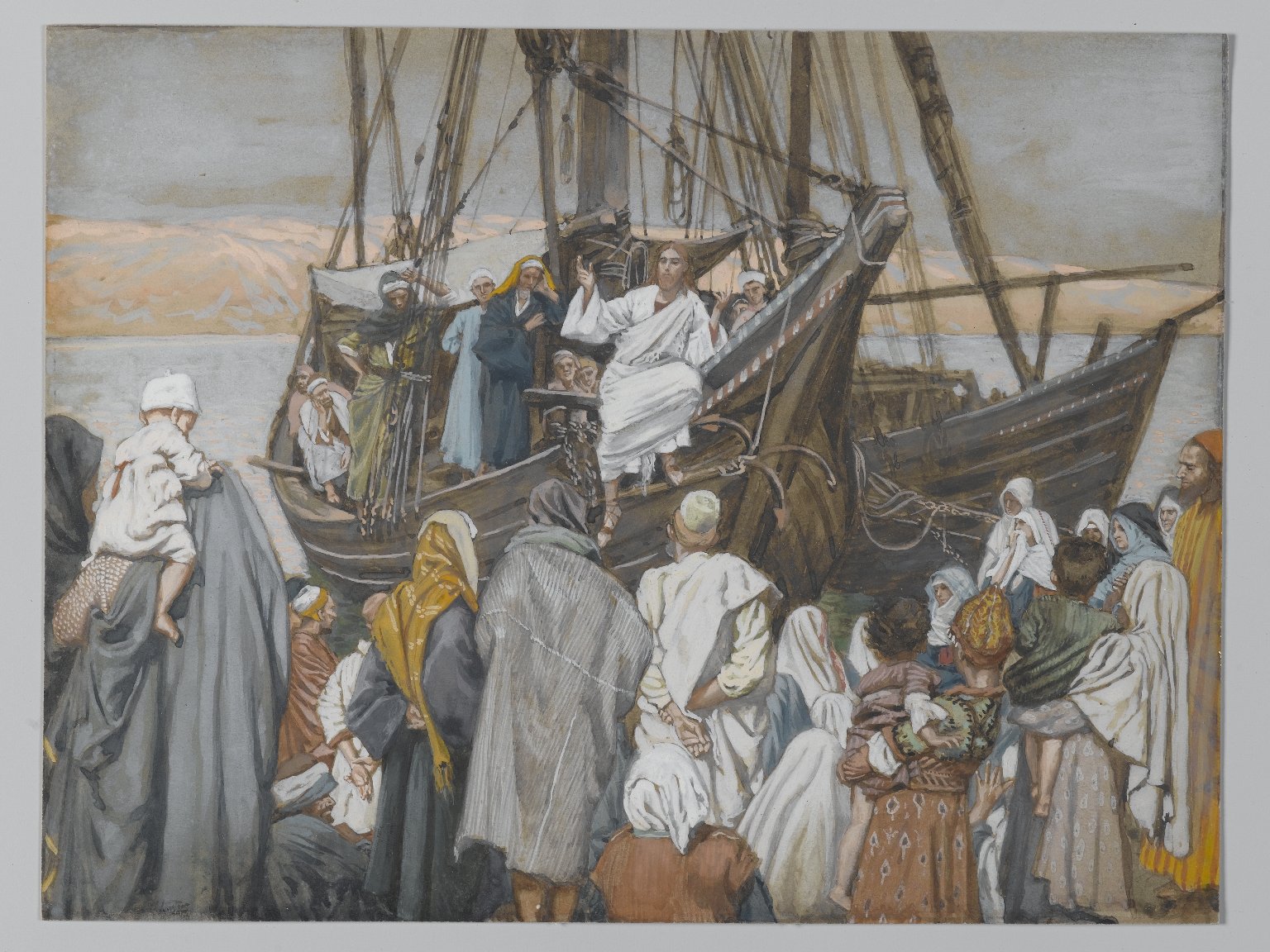
Jesus preaches from a boat – James Tissot (Brooklyn Museum)

Homily for Trinity XXI: True Leadership

When I was still quite a young child, I developed a love of poetry. This has grown and deepened throughout my adult life. One of my favourite poets is Roger McGough, a Liverpudlian whose verses are comic, pithy, and profound. One of his poems is called ‘The Leader’. It goes:

‘I wanna be the leader
I wanna be the leader
Can I be the leader?
Can I? I can?
Promise? Promise?
Yippee I’m the leader
I’m the leader

OK what shall we do? ’ 

This poem captures perfectly the human desire for power and control, and ends with a question. Once you become a leader you have to lead. So what do you do? In the poem the speaker does at least ask the question, ‘What shall we do?’, which begins a conversation about what the future will hold. Sadly, too often those in power do not consult in this way, and end up imposing their will on others. The temptation to acquire power and misuse it is part of our fallen human nature. History is littered with examples of people who are both attracted to and corrupted by power. The Church is no exception, because , like all organisations it is made up of human beings who are vulnerable to the seductiveness of power and its trappings.

In this morning’s Gospel, Our Lord is approached by James and John, the sons of Zebedee, who ask Him:

“Teacher, we want you to do for us whatever we ask of you.” 

“Athro, yr ydym am iti wneud i ni y peth a ofynnwn gennyt.” (Mk 10 35)

That is a very bold request to make of anyone, let alone Jesus. They are basically asking Jesus to grant them whatever they ask for. But Our Lord does not seem shocked, surprised, or upset. Instead, He replies quite calmly: 

“What do you want me to do for you?” And they said to him, “Grant us to sit, one at your right hand and one at your left, in your glory.” 

“Beth yr ydych am imi ei wneud i chwi?” A dywedasant wrtho, “Dyro i ni gael eistedd, un ar dy law dde ac un ar dy law chwith yn dy ogoniant.” (Mk 10:36-37)

This is no small thing to ask for. It comes across as shocking and presumptuous. James and John are asking for special treatment, and for the ultimate place of honour – sitting either side of Christ in Heaven. The surprising thing is that Jesus does not tell them off, or question their motives. Instead He continues to have a reasoned conversation with them. 

And Jesus said to them, “The cup that I drink you will drink, and with the baptism with which I am baptized, you will be baptized, but to sit at my right hand or at my left is not mine to grant, but it is for those for whom it has been prepared.” 

Ac meddai Iesu wrthynt, “Cewch yfed y cwpan yr wyf fi yn ei yfed, a bedyddir chwi â’r bedydd y bedyddir fi ag ef, ond eistedd ar fy llaw dde neu ar fy llaw chwith, nid gennyf fi y mae’r hawl i’w roi; y mae’n perthyn i’r rhai y mae wedi ei ddarparu ar eu cyfer.” (Mk 10:39-40)

In the verses which come before today’s reading, Jesus has been teaching the Twelve disciples for the third time that He must go to Jerusalem and suffer and die. At this point in the Gospel narrative, Christ is making His final journey from Galilee up to Jerusalem, prior to His Passion and Death. So Our Lord is telling James and John that they will have to suffer and die like Him. Suffering lies at the heart of who Jesus is. Hence our first reading from the prophet Isaiah, which stresses the importance of suffering for God’s servant — something that Jesus will shortly experience. 

This whole discussion has upset the other disciples, who are angry that the sons of Zebedee have tried to gain power and prestige. James and John are thinking and acting in worldly ways. They have not yet fully understand and begun to live out the ways of the Kingdom of God. Power is not something to be sought, because it can be seductive and corrupting and can turn us away from how God wants us to live. Instead Our Lord offers His disciples a different way to live:

“But it shall not be so among you. But whoever would be great among you must be your servant, and whoever would be first among you must be slave of all. For even the Son of Man came not to be served but to serve, and to give his life as a ransom for many.”

“Ond nid felly y mae yn eich plith chwi; yn hytrach, pwy bynnag sydd am fod yn fawr yn eich plith, rhaid iddo fod yn was i chwi, a phwy bynnag sydd am fod yn flaenaf yn eich plith, rhaid iddo fod yn gaethwas i bawb. Oherwydd Mab y Dyn, yntau, ni ddaeth i gael ei wasanaethu ond i wasanaethu, ac i roi ei einioes yn bridwerth dros lawer.” (Mk 10:43-45)

Jesus calls His followers to operate according to a different paradigm, one based on service of God and each other rather than the exercise of power. The life of Jesus Christ, who gives his life ‘as a ransom for many’ (Mk 10:45) is our example. Christ willingly lays down His life to liberate people for God, to free them from death and sin, and to offer them, and us, eternal life in Heaven with God. This is why we celebrate Jesus’ Passion, Death, and Resurrection. The Cross and the Empty Tomb are the heart of our faith because they demonstrate God’s love for us. God loves each of us enough to die for us. Christ rises on the third day to show us that our eternal destiny is to enjoy God’s love forever in Heaven. The Christian Church proclaims this Gospel truth, and encourages all people to share in the gift God offers to us.

The gentle and kind way that Jesus treats His disciples shows us that we are dealing with a God of mercy, whose primary motivations are compassion and love. Service and Sacrifice lie at the heart of our faith, and not power or privilege.

So my brothers and sisters and Christ, may we follow Jesus to the Cross and beyond, and live out God’s love, mercy, and service in our own lives. Instead of seeking prestige and power for ourselves, let us take care of each other and the world around us, and give praise and honour to God the Father, God the Son, and God the Holy Spirit. To whom be ascribed all glory, dominion and power, now and forever. Amen.

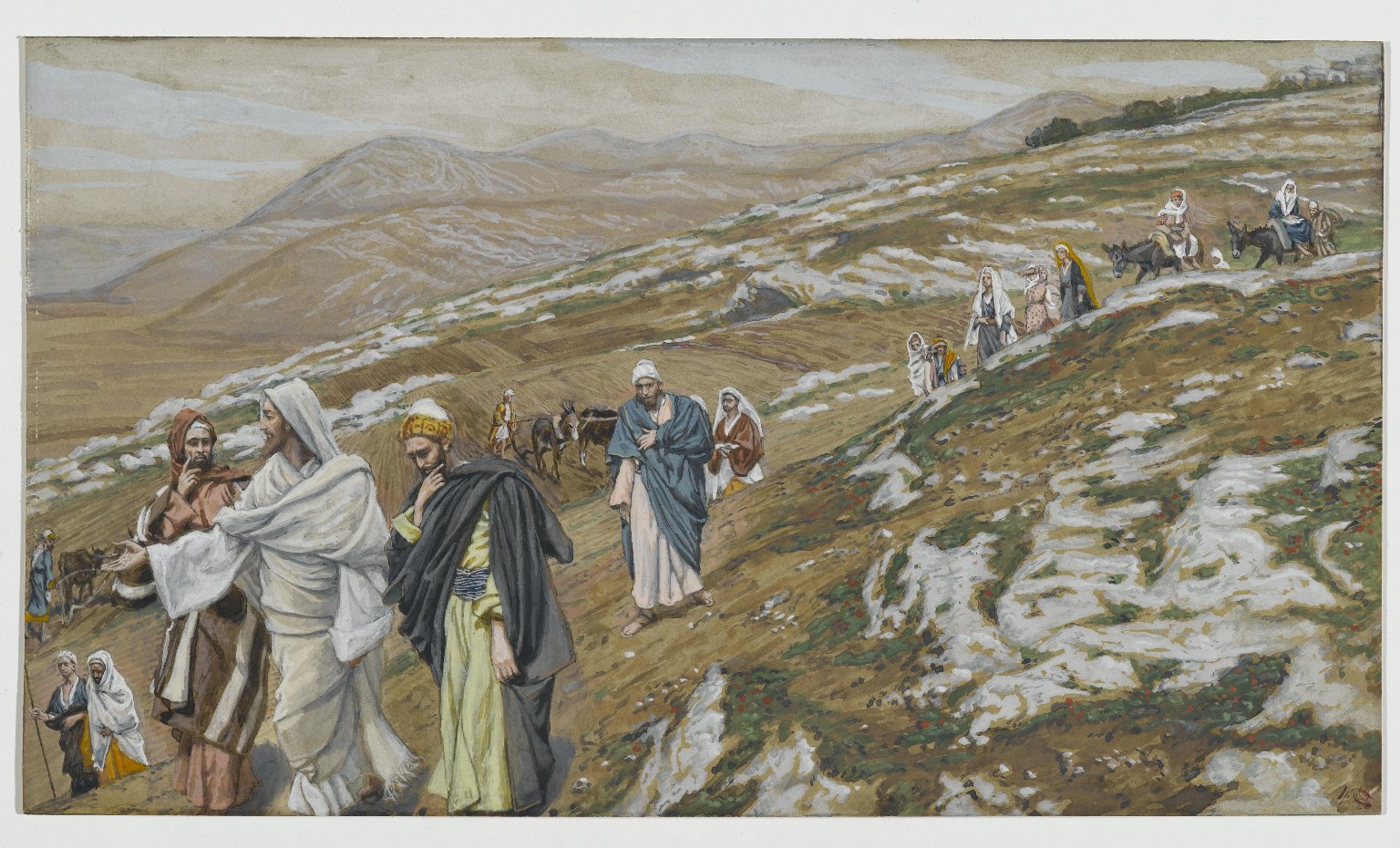
James Tissot: Jesus Travelling [Brooklyn Museum]