Advent III – He who is to come

‘the ransomed of the Lord … shall obtain gladness and joy and sorrow and sighing shall flee away.’ (Isaiah 35:10)

‘a gwaredigion yr Arglwydd fydd yn dychwelyd … hebryngir hwy gan lawenydd a gorfoledd a bydd gofid a griddfan yn ffoi ymaith’

This year our first readings during Advent come from the book of Isaiah. This Old Testament prophet stresses the belief that the Messiah will come to deliver Israel. As Christians, we use the period of Advent to reflect upon the fact that Christ is coming. He is coming as a baby born in Bethlehem. He is coming to us here today in the Eucharist. And He is coming to judge the world. Should we be afraid? On the contrary, as the prophet says:

‘Strengthen the weak hands, and make firm the feeble knees. Say to those who have an anxious heart,“Be strong; fear not! Behold, your God will come with vengeance, with the recompense of God. He will come and save you’ (Isa 35:3-4). 

God is coming to save us, His people. The salvation we long for will be ours. The prophet Isaiah has a vision where the desert, a dry wilderness, is carpeted with flowers. This is a sign of new life.This is an image of hope. This is the flourishing which the Messiah will bring: ‘the glory of the Lord, the majesty of our God’ (Isa 35:2). As Christ Himself says, ‘I came that they may have life and have it abundantly’ (Jn 10:10). This is good news. It is a reason to rejoice and be glad. In order to mark this, the Church wears rose today, instead of penitential purple. In order to celebrate the joyful character of this day, and to remind us that Christ is coming. As Isaiah says:

‘the ransomed of the Lord shall return and come to Zion with singing; everlasting joy shall be upon their heads; they shall obtain gladness and joy, and sorrow and sighing shall flee away’ (Isa 35:10).

The time is both now and, at the same time, it is not yet. As St James writes, ‘You also, be patient. Establish your hearts, for the coming of the Lord is at hand’ (James 5:8). Patience is a hard thing to master. Human beings are naturally impatient. We do not want to wait, but we have to. The question is how we wait. We are told that this should be in joyful expectation, preparing ourselves for what is to come. 

John the Baptist has been waiting for the Messiah. However, despite leaping in his mother’s womb at the Visitation to announce Christ’s coming, in this morning’s Gospel he appears to be having doubts. John is expecting a Messiah of judgement, and he is isn’t entirely sure what is going on. The Baptist has been imprisoned for criticising Herod Antipas’ marriage to his brother’s wife. John is therefore hoping for a messiah who will sweep away an unjust and corrupt regime. This is why he has doubts about Jesus, who does not seem to be a political messiah. Jesus tells John’s disciples:

‘Go and tell John what you hear and see: the blind receive their sight and the lame walk, lepers are cleansed and the deaf hear, and the dead are raised up, and the poor have good news preached to them’ (Mt 11:4-5). 

The vision of a messianic future envisaged by Isaiah in this morning’s first reading has become a reality: prophecy has been fulfilled, God keeps his promises. The Kingdom of God is a place of healing, and Christ is the great physician, who has come to heal our souls. Jesus is the one who is to come, who has come, and who will come again. The establishment of God’s kingdom can appear strange in human terms. Focussing on those on the margins, the sick, the poor, the oppressed, and the marginalised, is not a grand gesture. That is the point! The greatest gesture Jesus will make will be in handing Himself over to be crucified and to die the death of a common criminal. This is how the messiah will reign as the true King of Israel, on the Cross at Calvary. 

God’s salvation defies human expectations. This is the point: God’s ways are not our ways, nor are His thoughts our thoughts. That is the core message of this morning’s Gospel. If we expect God’s rule to look like human kingship, then we will be disappointed. Our Heavenly Father has something else in store, something far more wonderful than we could ever imagine, and at its heart is the transformation of humanity through love. God heals His people, because He is a God of love. Our Creator does not love us because we are loveable. We are sinners, who do not deserve to be loved, and cannot earn His divine love. But, rather than WHAT we are, God loves us for WHO we are: His sons and daughters, created in His image and likeness. God is someone whom we can trust, who keeps His promises. Our Heavenly Father offers the world the greatest present it could ever hope for: true love and eternal life.

Today, the peace which the Messiah came to bring seems as elusive as ever. The human capacity to create misery in the most dreadful ways continues relentlessly. We know that humanity still has some considerable distance to travel towards the establishment of a just and peaceful world. An answer is to embrace the need for repentance: to change our hearts and minds and to follow Jesus. We also prepare to meet Our Lord as He will come again, as our Saviour and our Judge. It is a daunting prospect, yet we know and trust that Christ saves us. By His Wounds on the Cross we are healed, and our sins are forgiven.

This is God’s grace: loving sinful humanity in order that we may be transformed by His Divine love. This is why the focus is on healing — something which only God can do — to redeem our souls with His love. This is the cause of our gladness and joy. What the prophet Isaiah hoped for has been fulfilled, and continues to be fulfilled. The Church is called to carry on God’s healing in the world, and restore each person with divine love. This is what we are about to celebrate in the Eucharist, where we both thank Our Heavenly Father for loving us, and we also prepare to experience that healing love, so that it may transform us, now, here, today. We do so with reverence, because we are not simply consuming human food and drink, but the very Body and Blood of Christ, given for us, to heal us. It is the greatest medicine our souls could ever wish for. Soon we ‘shall see the glory of the Lord, the majesty of our God’ (Isa 35:2). God’s glory and majesty is to give His Body for us on a Cross, and also to feed us with Himself.

Let us, then, come to the banquet with glad hearts, and experience the life-changing love of God. Let us allow it to heal and transform us, so that we can join our voices with all creation to joyfully sing the praises of God the Father, God the Son, and God the Holy Spirit, Duw Dad, Duw y Mad, a Duw yr Ysbryd Glân, to whom be ascribed all might, majesty, glory, dominion, and power, now and forever. Amen.

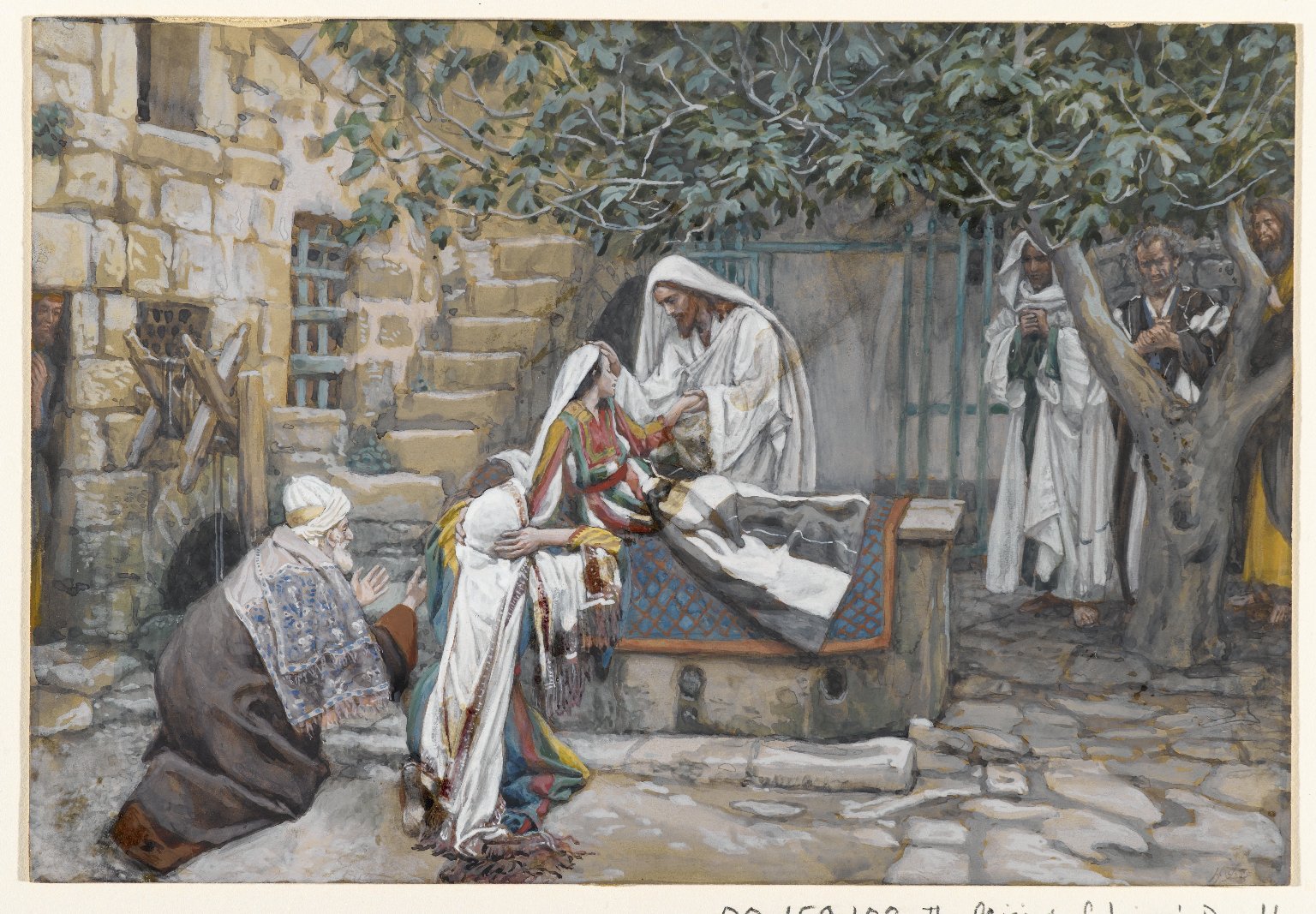
Jean Tissot: St John the Baptist sees Jesus from afar (Brooklyn Museum)

Trinity V: Jesus our healer

There are, as we all know, few things in life worse than when someone we love is seriously ill. We do everything we possibly can to help, but often there is not much that we can do. However, when we feel powerless and desperate, and need help, we can turn to God in prayer. The Kingdom of God, proclaimed and inaugurated by Jesus Christ is a place of true healing, and through our relationship with Jesus we can seek wholeness for ourselves and for those close to us. This is why the Gospels contain healing miracles. These miraculous accounts are signs of God’s restoration of creation through His Son, something which will culminate with Christ’s Passion, Death, and Resurrection, and through which our human nature is healed.

In today’s Gospel Jesus and the disciples have sailed back across the Sea of Galilee to the Jewish side. On their arrival they are greeted by the leader of a local synagogue whose daughter is close to death. Jairus longs for his child to be healed, and asked Jesus to place His hands on her, so that she might be saved and live.

While Jesus is walking to Jairus’ house to heal his daughter, another miracle takes place. Lots of people are following, which is understandable since Jesus is a charismatic preacher and teacher, who heals people. In the crowd is a woman with a serious gynaecological complaint. Two people need healing, and while Our Lord is on His way to heal one female in need, another seizes the opportunity to be cured.

This woman is desperate, because she has suffered bleeding for twelve years. In Jewish ritual terms she would be classed as unclean. She would have been unable to join in worship, and would be seen as someone to avoid. Also, she would not have been able to bear children. Despite all her efforts and attempts to find a cure she had only got worse, even though she had spent all the money she possessed. The presence of this miraculous healer was the answer to her prayers. She had heard about the Saviour, and said to herself:

“If I touch even his garments, I will be made well.”

“Os cyffyrddaf hyd yn oed â’i ddillad ef, fe gaf fy iacháu.” (Mk 5:28)

This woman has faith. She believes that Jesus can heal her, and she puts her trust in Him to do what the physicians could not achieve. Our Lord notices that someone has touched His garments. He realizes that this was not simply someone brushing past, but something important. His disciples, not aware of what has happened, try to put this down to the press of the crowd. Then the woman, who has been healed, comes forward:

‘But the woman, knowing what had happened to her, came in fear and trembling and fell down before him and told him the whole truth. And he said to her, “Daughter, your faith has made you well; go in peace, and be healed of your disease.”’ 

‘Daeth y wraig, dan grynu yn ei braw, yn gwybod beth oedd wedi digwydd iddi, a syrthiodd o’i flaen ef a dweud wrtho’r holl wir. Dywedodd yntau wrthi hi, “Ferch, y mae dy ffydd wedi dy iacháu di. Dos mewn tangnefedd, a bydd iach o’th glwyf.”’ (Mk 5:33-34)

The woman comes ‘in fear and trembling’ not because she is afraid of Jesus, but because it is the proper way for humans to act in the presence of God. She is filled with awe at her experience of divine healing. Jesus’ reply is astounding for several reasons. The fact that He responds at all is noteworthy. Talking to a woman who was not a member of your family was frowned upon, let alone a woman who is viewed as being ritually unclean and an outcast. Jesus is breaking a social taboo. He also addresses her as ‘daughter’, a reminder that Jesus’ family are not just those related to Him in earthly terms, but all those who do God’s will. This unnamed woman is a daughter of God and her faith has healed her. She trusted God to do what the physicians could not. Faith is the route to salvation and healing, by trusting God to be at work. Now the woman can go in peace, because she has been restored to health. Peace is God’s gift to us, that we may experience wholeness. Jesus underlines that what has happened is not a temporary healing, but a permanent state of affairs.

While Jesus is still speaking to the woman, messengers come to give Jairus some bad news:

“Your daughter is dead. Why trouble the Teacher any further?”

“Y mae dy ferch wedi marw; pam yr wyt yn poeni’r Athro bellach?” (Mk 5:35)

The situation is hopeless, and in their eyes there is nothing that Jesus can do. Thankfully, Our Lord has other ideas:

‘But overhearing what they said, Jesus said to the ruler of the synagogue, “Do not fear, only believe.”’

‘Ond anwybyddodd Iesu y neges, a dywedodd wrth arweinydd y synagog, “Paid ag ofni, dim ond credu.”’ (Mk 5:36)

Instead of being afraid Jairus needs to believe that God will save his daughter. The synagogue leader has already demonstrated his faith by prostrating himself before Jesus and asking for healing. Now, in the face of his daughter’s apparent demise, Jairus must trust God to be at work. When Jesus arrives at the house a second miracle takes place: 

‘Taking her by the hand he said to her, “Talitha cumi”, which means, “Little girl, I say to you, arise.”’

‘Ac wedi gafael yn llaw’r plentyn dyma fe’n dweud wrthi, “Talitha cŵm,” sy’n golygu, “Fy ngeneth, rwy’n dweud wrthyt, cod.”’ (Mk 5:41)

Note the fact that Jesus takes the girl by the hand. AT the time of Jesus, touching a dead body would make a person ritually impure. This is why the priest and Levite in the Parable of the good Samaritan pass by on the other side, for fear of being made unclean by being in contact with a dead person. Jesus disregards the taboo of uncleanness, and speaks to the girl. He addresses her in Aramaic, her mother tongue, and says “Talitha cumi” literally: ‘little lamb, get up’ ‘oen bach codwch’. This is a term of endearment which also reminds us that Christ is the Good Shepherd who cares for His lambs, keeping them safe, and saving them from death. 

The people who are present — Jairus and his wife, Peter, James and John — are all amazed. They are filled with awe, with holy fear at witnessing the mighty works of God. Finally, Jesus tells her parents to give the girl something to eat, which shows us the reality of her resuscitation. This also points towards the feast of the Kingdom, which we hope to enjoy in Heaven, and which is prefigured in the Eucharist. In physical and spiritual communion, Christ gives Himself to feed us. Through His Body and Blood He heals our bodies and our souls, and assures us of eternal life.

As we care for and pray for those close to us who are ill we give thanks that God loves us, and heals us. Through faith, wonderful things can, and do, happen. May our worship today be a foretaste of Heaven, where all are healed. Let us join with Saints and Angels to sing the praises of God the Father, God the Son, and God the Holy Spirit. To whom be ascribed all glory, dominion, and power, now and forever. Amen.
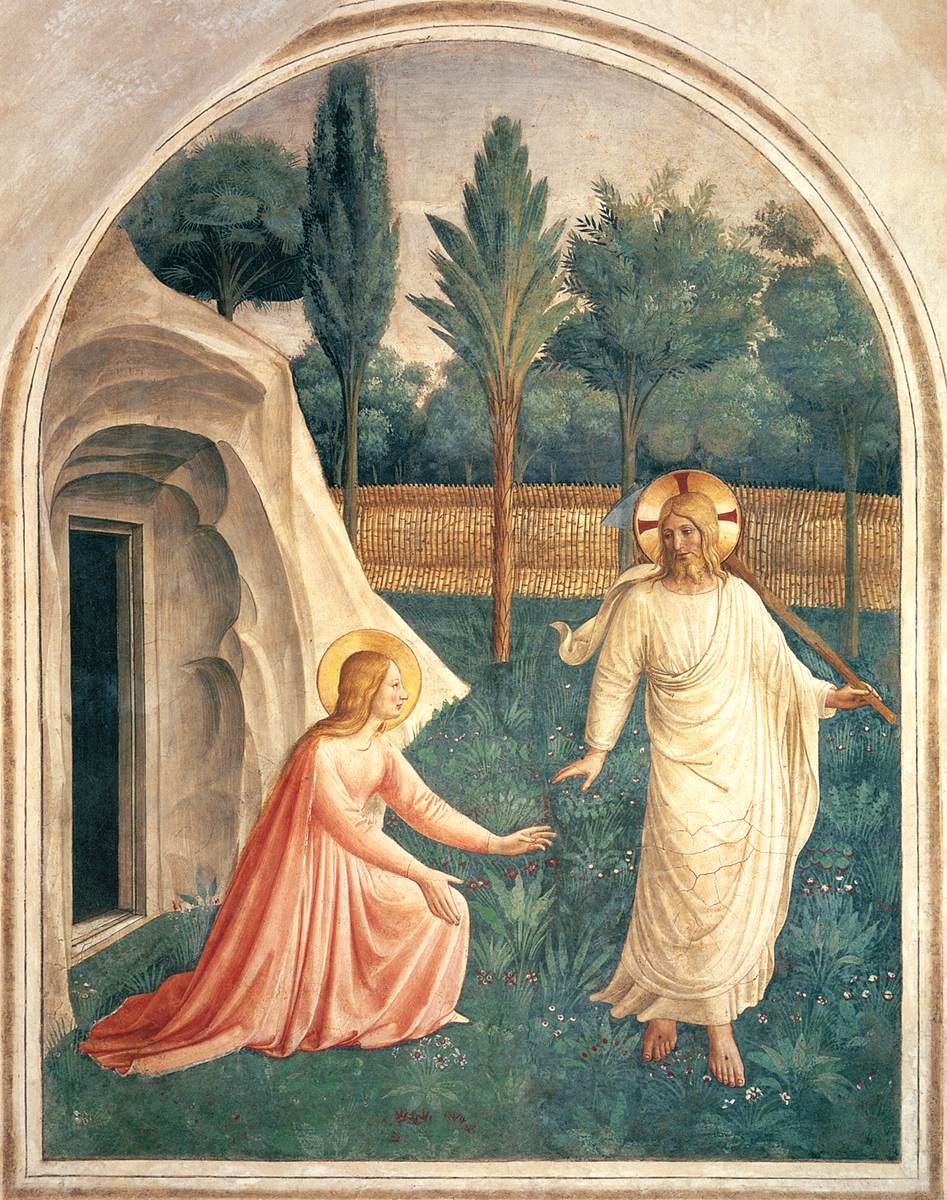
James Tissot Jairus’ Daughter (Brooklyn Museum)

Easter 2024

It is early in the morning and a woman sits in the darkness. Her beloved teacher, whom she has followed and supported for years was placed in a tomb a few days before, after having being executed for political and religious reasons. The sun has not yet risen, and as she sits, she cries. A week ago He was being hailed as the Messiah, God’s anointed, the Davidic king come to set His people free. Yet within a few days, the same people who cried ‘Hosanna’ were shouting ‘Crucify him!’ ‘Crucify him!’. So she goes, to be near her Lord, to be close to him. And as she goes, she notices something: the stone has been rolled away. It took several people to roll it there on Friday afternoon. What is going on? Mary Magdalen runs to tell Peter and John:

“They have taken the Lord out of the tomb, and we do not know where they have laid him.” 

‘Y maent wedi cymryd yr Arglwydd allan o’r bedd, ac ni wyddom lle y maent wedi ei roi i orwedd’ (John 20: 2)

Mary assumes, understandably, that grave-robbers have been at work. Or that the Jewish or Roman authorities, worried that this troublemaker might be a focus for dissent, have got rid of Him. To do so makes sense in political terms, but something greater has happened. Peter and John come running towards the tomb. John arrives first, peers inside the tomb, but stays outside. 

‘Then Simon Peter came, following him, and went into the tomb. He saw the linen cloths lying there, and the face cloth, which had been on Jesus’ head, not lying with the linen cloths but folded up in a place by itself.’

‘Yna daeth Simon Pedr ar ei ôl, a mynd i mewn i’r bedd. Gwelodd y llieiniau yn gorwedd yno, a hefyd y cadach oedd wedi bod am ei ben ef; nid oedd hwn yn gorwedd gyda’r llieiniau, ond ar wahân, wedi ei blygu ynghyd’ (John 20: 6-7)

What happens is a gradual process. Bit by bit, the followers of Jesus come to experience and understand this incredible and amazing event. 

Then the other disciple, who had reached the tomb first, also went in, and he saw and believed; for as yet they did not understand the Scripture, that he must rise from the dead. Then the disciples went back to their homes.’

‘Yna aeth y disgybl arall, y cyntaf i ddod at y bedd, yntau i mewn. Gwelodd ac fe gredodd. Oherwydd nid oeddent eto wedi deall yr hyn a ddwed yr Ysgrythur, fod yn rhaid iddo atgyfodi oddi wyth y meirw. Yna aeth y disgyblion adref yn eu holau.’ (John 20: 8-10)

A few days ago the disciples saw their Lord and Teacher killed and buried, but now the tomb is empty. The cloths that were wrapped around Jesus are there, but there is no body. John, the disciple Jesus loved, understands and believes. Peter does not yet understand or believe. Clearly it is all too much for Mary Magdalen who stays by the tomb, weeping. When the angels ask her why she is crying she replies:

“They have taken away my Lord, and I do not know where they have laid him.”

“Y maent wedi cymryd fy Arglwydd i ffwrdd, ac ni wn i lle y maent wedi ei roi i orwedd.” (John 20: 13)

Mary’s words are understandable, she is filled with grief and sadness. She is bereft and confused. At this point, Mary Magdalen encounters the Risen Christ:

Jesus said to her, “Woman, why are you weeping? Whom are you seeking?” Supposing him to be the gardener, she said to him, “Sir, if you have carried him away, tell me where you have laid him, and I will take him away.”

‘“Wraig,” meddai Iesu wrhti, “pam yr wyt ti’n wylo? Pwy yr wyt yn ei geisio?” Gan feddwl mai’r garddwr ydoedd, dywedodd hithau wrtho, “Os mai ti, Syr, a’i cymerodd ef, dywed wrthyf lle y rhoddaist ef i orwedd, ac fe’i cymeraf fi ef i’m gofal.”’ (John 20: 15)

Mary supposes that Jesus is the gardener, the person employed to look after the cemetery. She does not yet understand who He is, or what is going on. However, the mention of the gardener is significant. In Genesis, humanity was created by God in a garden, Eden, and given the task of tending it (Gen 2:15). The Resurrection also takes place in a garden, showing us that Christ is the second Adam. Whilst the first Adam brought death to humanity by a tree, Jesus, the Second Adam, has brought life to the world by the tree of the Cross. Humanity falls because of a tree, and because of a tree we are offered eternal life in Christ. 

It was on the first day of the week, that Creation began, and now on the first day of the week we see a New Creation. Christ has risen from the dead, and conquered Death and Hell. Our Lord is a gardener, and the plants he tends are human beings. We believe in a God who loves us, who cares for us, and who longs to see us grow and flourish.

Jesus greets Mary Magdalen by name, and suddenly she recognises Him. She understands. She believes. Then Christ talks of His Ascension, as though forty days of Easter have condensed into a single moment. Mary now knows what she must do:

‘Mary Magdalene went and announced to the disciples, “I have seen the Lord”—and that he had said these things to her.’

‘Mair Magdalen i gyhoeddi’r newydd i’r disgyblion. “Yr wyf wedi gweld yr Arglwydd.” meddai, ac eglurodd ei fod wedi dweud y geiriau hyn wrthi’ (Jn 20:18)

Mary shares the Good News, just as Peter and Paul do in the first and second readings this morning. As Christians we are called to do likewise: to tell others that God loves us, all of us, that He died for us, and that He rose again to offer us eternal life with Him. This is the message of Easter. Good News! Christ has triumphed over Death and Hell, and humanity is healed and restored through Him.

So, my brothers and sisters in Christ, ‘Pasg hapus i chi gyd!’ ‘A Happy Easter to you all!’ May you, and those you love, be filled with Resurrection joy and strength, on this Easter Day and always. Amen.

Fra Angelico (Italian, ca. 1395–1455), “Noli me tangere,” 1440–42. Fresco from the convent of San Marco, Florence, Italy. http://www.wga.hu/frames-e.html?/html/a/angelico/index.html

The 33rd Sunday of Year A (Prov 31:10-13, 19-20, 30-31, 1 Thess 5:1-11, Mt 25:14-30)

In the ancient world, as in today’s world, the domestic life of women was difficult. Without modern labour-saving devices, household chores were even more laborious and time-consuming. A wife would be expected to run a household, and it was hard and difficult work. Such a demanding role means that paragons in the domestic sphere were to be praised and prized. And, in the Book of Proverbs, we see such an example of industry, of hard work. Throughout Ancient Wisdom Literature, wisdom and industry go hand in hand, they are beautiful and good, as they come from the source of all beauty and goodness, namely God. An excellent wife is more valuable than jewels, because while precious stones possess beauty and value, they are not capable of doing good. 

The heart of her husband trusts in her, and he will have no lack of gain. (Proverbs 31:11)

As a result of the relationship between a loving husband and wife, their mutual prosperity is assured. This then leads to generosity:

She opens her hand to the poor and reaches out her hands to the needy. (Proverbs 31:20)

The point of wealth is not for it to be acquired for its own sake, but so that it may be a blessing to others. God wants humanity to flourish by being loving and generous. This theme runs through all our readings this morning.

St Paul’s First Letter to the Thessalonians is written to a community that is afraid of two things: death and the return of Jesus in Judgement. These are understandable emotions. However, while death and judgement are inescapable, they do not need to be feared. They are compared with the labour pains of a pregnant woman, which are often sudden and sharp. But if we live lives characterised by love, and we have faith in Jesus Christ who died and rose again for us, we have the hope of salvation. This is good news, and leads St Paul to write:

For God has not destined us for wrath, but to obtain salvation through our Lord Jesus Christ (1Thess 5:9)

Paul’s letter is written to encourage his fellow Christians, to allay their fears and to build up their faith, hope, and love, as a community:

Therefore encourage one another and build one another up, just as you are doing (1Thess 5:11)

We all of us need encouragement, especially when times are difficult, and when we are as afraid or unsure, as we are at the moment. It is good to be reminded that, in trying to lift each others spirits, we are behaving as a Christian community should.

In today’s Gospel, Jesus continues to talk about the future using parables. Just as with the Parable of the Wise and Foolish Virgins, Jesus begins by showing that he is talking about a future reality: how things WILL BE, not how they are now. This future reality is Christ’s return. Christians believe that Jesus will come again to judge the world. The theme of today’s parable, the Parable of the Talents is judgement. These days, we are not comfortable with ideas of judgement. Many of us remember preachers using ideas of hell-fire and damnation to fill people with fear. But the heart of the Gospel is love not fear, and perfect love casts out fear. 

In the parable the master goes on a journey and entrusts his property to his servants. He puts his possessions into their care because he trusts them to look after it. The servants who are assigned five and two talents are both praised for being ‘good and faithful’. They have acted morally and demonstrated their faith, and they will be rewarded. The problem is with the servant who was given just one talent and hid it in the ground. He explains his actions, saying:

‘Master, I knew you to be a hard man, reaping where you did not sow, and gathering where you scattered no seed, so I was afraid, and I went and hid your talent in the ground. Here you have what is yours.’ (Mt 25:24-25)

This servant does not love his master, he fears him. He does not take care of what has been entrusted to him, because he simply sees it as a possession, a thing. The servant loves neither his master nor what was entrusted to him. By hiding the talent in the ground, he squanders the opportunity his master has given him, because he is jealous and resentful. As all gardeners know, seeds produce different results, just as in the Parable of the Sower, but they all need to be sown in the first place. What we learn here is that bitterness and resentment have no place in the Kingdom, they are not compatible with a Gospel of Love. The tragedy is that the fearful servant condemns himself to being outside the Kingdom, by failing to recognise both generosity, and the value of a relationship. 

The Parable of the Talents, just like the Parable of the Wise and Foolish Virgins, is a commentary on the life of the Kingdom. These are stories of servants who are prepared and continue to work, until their master returns. They are parables which teach us how to be a Church of loving generous service, not one of fear.

It may sound pedestrian, or even humdrum, but living the Christian life, living the life of the Kingdom, is, at a day to day level, boring, difficult and repetitive. It is about ‘keeping on keeping on’ — loving, forgiving, praying –- nourished by the Body and Blood of Christ, fed by Him, and with Him, freed from the fear which is the antithesis of the Kingdom, rejoicing in the gifts which God gives us, being thankful for them, and using them for God’s glory. None of us fully deserve the gift of God’s love and forgiveness in Jesus Christ: we have not earned it. It is not a reward, but rather the gift of a loving God. It is a gift which we are called to receive, and it transforms our lives. The God who will come to judge us, and all humanity, is a God of love and mercy, whose hands bear the mark of nails, wounded for love of us. Judgement and mercy go hand in hand, and if we love God and love our neighbour, we are living the life of the Kingdom, here and now, free from fear. 

So let us live out that life together, encouraging one another, so that we may all be built up in faith, hope, and love, and together share in the joy of the Kingdom, so that all may know and love God the Father, God the Son, and God the Holy Spirit, to whom be ascribed, as is most right and just, all might, majesty, glory, dominion, and power, now and forever. Amen. 
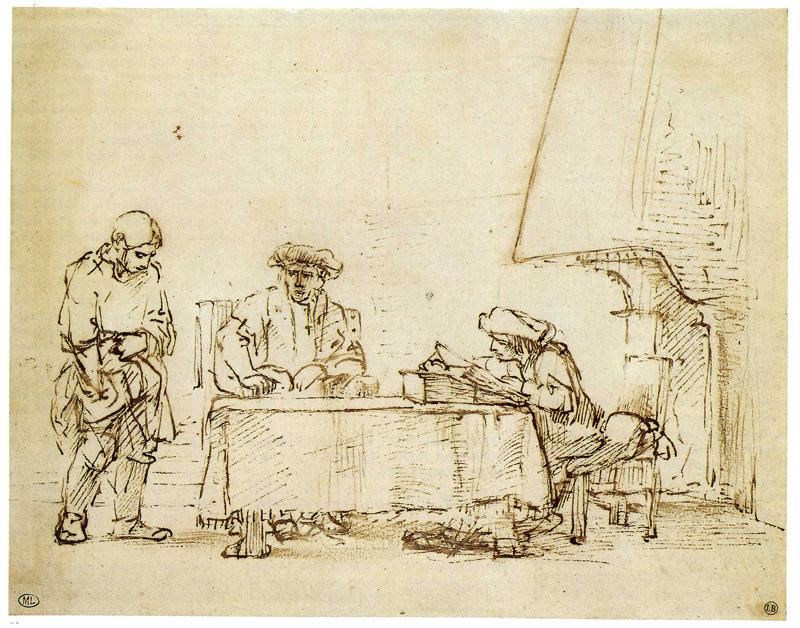
Rembrandt The Parable of the Talents

The Feast of All Saints (Mt 5:1-12)

“God has a plan for your life!” You may well have heard these words before, possibly from someone preaching a sermon, but they contain a truth, and are found in the Bible, in words that God speaks through the prophet Jeremiah:

For I know the plans I have for you, declares the Lord, plans for welfare and not for evil, to give you a future and a hope. (Jer 29:11)

It can be hard to hold onto promises such as these, especially when times are difficult and the outlook is bleak. We need to ask ourselves the question, ‘Can we trust God?’ If the answer is ‘Yes’ then, whatever difficulties or hardships may come our way, we know that our future is in safe hands.

Our Christian life begins with Baptism, where we are washed with water in the Name of the Father, the Son, and the Holy Spirit. Through Baptism we share in Christ’s Death and Resurrection, and are raised to new life in Him. We receive the Holy Spirit, Faith, Hope, and Love, and we are marked with the sign of the Cross to show that we belong to Christ. These are all manifestations of God’s Grace, unmerited kindness and generosity, but they are given for a reason. They are given to us so that we may love God and serve Him in this life, and be with Him in the next. Fundamentally, the point of being a Christian is to reside in Heaven. This is possible because of what Jesus Christ has done for us, out of love. This is the plan God has for our life, and this is why Jesus became man, lived, and died, and rose from the dead. God shows us both how to live, and what He has in store for us. We can have faith, and put our trust in a God who loves us. In the clear hope that, after our earthly life is over, we may enjoy eternity with God in Heaven. Most of all, in this hope, we can live lives of love, love of God and of each other, foreshadowing eternal heavenly joys. 

In our current culture we are not used to hearing this message. It sounds strange. We tend to think that holiness is for other people, certainly not us. But God wants each and every one of us to become a saint. He wants us to live in a world full of people trying to be saints. The Church is ‘a school for saints’, in which Christians try to live out their faith, cooperating with the grace of God. We do this when we let Christ live in us, so that we can say with the Apostle Paul:

‘It is no longer I who live, but Christ who lives in me.’ (Gal 2:20)

There is a paradox at work here, for when we truly let Christ live in us, we do not lose ourselves, but instead we find who we really are. We can then be the people God wants us to be, the people we were created to be. As Jesus says in Matthew’s Gospel:

For whoever would save his life will lose it, but whoever loses his life for my sake will find it. (Mt 16:25)

Today the Church celebrates the Feast of All Saints. On this day, in the eighth century AD, Pope Gregory III dedicated a chapel to All Saints in St Peter’s Basilica in Rome. It is a good thing to celebrate the fact that Heaven is full of saints, the Church Triumphant, who spend eternity praising God and praying for us. Just as we pray for our friends here on earth, it stands to reason that our friends in Heaven pray for us as well. It is reassuring to know that we are not alone in our quest to reach Heaven, and to know that those who are already there long for us to join them. 

If Heaven is our goal, how thenshould we live our lives on earth? Thankfully today’s Gospel gives us a template to follow, an example of what a Christian life looks like. 

The Sermon on the Mount (The Beatitudes) begins with the words which we have just read. It is important to notice that Jesus goes up a mountain to teach people. This brings to mind Moses ascending Mt Sinai and receiving the Ten Commandments of the Law. At one level what we have here is a New Law, a new way to understand how we should relate to God and to each other. It is a radical vision, which turns human expectations on their head. 

We constantly hear how the world around us values success and confidence, and looks up to the rich, and the powerful. In contrast to this, Jesus says to the gathered crowd:

“Blessed are the poor in spirit, for theirs is the kingdom of heaven.” (Mt 5:3)

‘Poor in spirit’ is not a term we are used to using, but it means the exact opposite of pride. It places humility as key to living a Christian life: knowing who we are, and our need for God. Only if we rely upon God, and not ourselves, and ask Him to work through us can we truly live out the Christian life. 

“Blessed are those who mourn, for they shall be comforted.” (Mt 5:4)

We mourn those we love, those whom we see no longer in this life, because we love them, we miss them, we want to see them, and hold them, and talk to them. Our parting, while temporary, is still very painful. Thankfully the Kingdom of God, which Christ comes to bring, is a place of healing and comfort with the promise of eternal life. 

“Blessed are the meek, for they shall inherit the earth.” (Mt 5:5)

Gentle people are not weak: they know how to use their strength, and how not to use it. As Jesus will later say in Matthew’s Gospel: ‘Take my yoke upon you, and learn from me, for I am gentle and lowly in heart, and you will find rest for your souls.’ (Mt 11:29). This is how God wants us to live as human beings. Christ is the example of gentleness we must follow. Once again, God’s vision of the future turns human expectations upside down. 

“Blessed are those who hunger and thirst for righteousness, for they shall be satisfied.” (Mt 5:6)

Should we be devoted to God? Absolutely! Should we pray that His will is done on earth as it is in Heaven? Of course! Jesus taught us to pray this way. Our faith should influence how we live our lives, so that we work for the coming of God’s Kingdom here on earth. Clearly God wants to see our world transformed and has invited us to help in the process; and doing so gives us fulfilment.

“Blessed are the merciful, for they shall receive mercy.” (Mt 5:7)

We see what God’s mercy looks like in Christ’s death for us on the Cross. In following Christ’s example, we ask for forgiveness for our own sins, and forgive those who sin against us. This forgiveness can transform us and the world around us, and it is how the healing and reconciliation of God’s Kingdom functions. 

“Blessed are the pure in heart, for they shall see God.” (Mt 5:8)

To be pure in heart is to want what God wants: to align our will with the will of God. It is to be saintly, and thus have the promise of Heaven, which is less of a place or a time, and much more a relationship. To see God is know Him, and to know His love for us. This is what Christ comes to restore to humanity, and it is our hope. 

“Blessed are the peacemakers, for they shall be called sons of God.” (Mt 5:9)

First and foremost, we know that Christ is the Son of God because He made ‘peace by the blood of his cross’ (Colossians 1:20). We too are called to follow Christ’s example and take up our Cross, and work for peace. Peace in our own hearts and lives, in our families and communities and in our world.

“Blessed are those who are persecuted for righteousness’ sake, for theirs is the kingdom of heaven. Blessed are you when others revile you and persecute you and utter all kinds of evil against you falsely on my account.” (Mt 5:10-11)

Following Jesus will not make us popular, often quite the opposite. If, however, we want to see God’s Kingdom as a reality in this life and the next, then we must be prepared to be shunned, or even ridiculed by others. To follow Christ is to take up the Cross, and to expect persecution, and false accusation. But we are not alone in this, Christ has gone before us, showing us that the story does not end with death on a Cross, but the glory of the Resurrection and Eternal life. 

If we want to become saints, then we have to be like Christ, share in His suffering and death, be prepared to be rejected by the world, and dismissed as irrelevant. We may not face imprisonment, torture and death in this country, but many Christians around the world do. However, we may be scorned and ignored, or patronised. What do we do in such circumstances? We are called to be loving, generous, and forgiving, because that is what Jesus has shown us. We can be different to the world around us because we belong to a new community, the community of faith, built on our relationship with Jesus Christ, who came to save humanity from itself. He came that we might have life and have it to the full, and that is what the Beatitudes mean. By living the life of God’s Kingdom here and now, we can live the life of Heaven here on earth. It may sound foolish, but it is what God wants us to do, what Jesus showed us to do. We are called to be fools for God.

So let us, on this feast of All Saints, be filled with courage, and be ready to conform our lives to God’s will and live out our baptism and our faith in the world. May we  live the life of the Kingdom together, and encourage others in order that all may join the choirs of Heaven to sing the praise of God the Father, God the Son, and God the Holy Spirit, to whom be ascribed, as is most right and just, all might, majesty, glory, dominion, and power, now and forever. Amen.