Trinity Sunday 2025

In the Science fiction film, ‘The Matrix’ and its sequels there is a character called ‘Trinity’, played by Carrie-Anne Moss. The name comes from her handle as a computer hacker. She, apparently, chose this moniker to give the impression that she is as mysterious and enigmatic as the concept of a Three-in-one being (God the Holy Trinity: Father, Son, and Holy Spirit). So what do Christians believe about the Trinity?

In today’s Gospel Jesus promises His disciples that,

“Ond pan ddaw ef, Ysbryd y Gwirionedd, fe’ch arwain chwi yn yr holl wirionedd. Oherwydd nid ohono’i hun y bydd yn llefaru; ond yr hyn a glyw y bydd yn ei lefaru, a’r hyn sy’n dod y bydd yn ei fynegi i chwi.”

“When the Spirit of truth comes, he will guide you into all the truth, for he will not speak on his own authority, but whatever he hears he will speak, and he will declare to you the things that are to come.” (Jn 16:13)

God gives us the Holy Spirit to guide us and lead us in our lives. We are invited into a relationship and journey of faith, which enables us to grow and develop. As Christians, we worship One God, Father, Son, and Holy Spirit. They are not three Gods, but one God. That the three persons of the Trinity are one God is itself a mystery. It is the enigma of God’s very self: a Trinity of Persons, consubstantial, co-equal, and co-eternal. ‘Consubstantial’ means ‘of one being’, i.e. they are One. ‘Co-equal’ means that the persons of the Trinity are equal to one another, none is greater or lesser than another. ‘Co-eternal’ means that they all have no beginning in time all three are eternal. We know God most fully in the person of Jesus Christ, the Incarnate Word of God, who was born of the Virgin Mary, died upon the Cross for our sins, was raised to New Life at Easter, and sent the Holy Spirit at Pentecost. In Christ, God discloses who and what He is. We know Him through His outpouring of love into our lives.

All Christians are baptised in the name of the Trinity. Our worship is Trinitarian. The service this morning began with the words ‘Yn enw’r Tad, a’r Mab, a’r Ysbryd Glân, In the name of the Father, and of the Son, and of the Holy Spirit, Amen.’ Eucharistic Services have begun by invoking the name of the Trinity, and making the sign of the Cross, for as long as we have descriptions of them, going back almost 1900 years. And 1700 years ago just before the Council of Nicaea, this morning’s first reading was one of the most controversial passages in Scripture: 

“Lluniodd yr Arglwydd fi ar ddechrau ei waith, yn gyntaf o’i weithredoedd gynt.”

“The Lord possessed me at the beginning of his work, the first of his acts of old.” (Proverbs 8:22)

In the Greek text of Proverbs, used widely around the Mediterranean at that time, the verb translated as ‘possessed’ was one that meant ‘created’. This lead some people — the followers of Arius — to argue that this passage means that Jesus Christ was created and not begotten. This would therefore mean that Jesus had a beginning in time, and was not eternal. He was therefore somewhat lesser than God the Father. To discuss this theological issue Church Councils were called at Nicaea in ad325, and Constantinople in ad381. These meetings of bishops rejected the Arian ideas and gave us the doctrinal statement known as the Nicene Creed, which we will say together in a few minutes time. Our faith, as Christians, is rooted in our belief in God: Father, Son, and Holy Spirit, consubstantial, co-equal, and co-eternal. This is why the Creed is made up of three sections. It begins by stating what we believe about God the Father. The text then moves on to what we believe about Jesus the Son. The statement of faith then finishes with the Christian beliefs concerning the Holy Spirit. What we believe and how we worship God matters.

Last Sunday we celebrated Whitsun, Y Sulgwyn, the Feast of Pentecost: the Descent of the Holy Spirit upon the disciples in the Upper Room, fifty days after Easter, and ten days after Jesus’ Ascension into Heaven. With the coming of the Holy Spirit, we see the fullness of who God is. As St Paul puts it in his Letter to the Romans:

“oherwydd y mae cariad Duw wedi ei dywallt yn ein calonnau trwy’r Ysbryd Glân y mae ef wedi ei roi i ni.”

“God’s love has been poured into our hearts through the Holy Spirit who has been given to us.” (Romans 5:5)

As Christians, we are given the gift of the Holy Spirit — a spirit of love and joy. This allows us to experience God as He is: the Father who created all that exists; the Son who redeemed humanity; and the Spirit who sanctifies and encourages God’s people. God calls us into a relationship and we respond with worship which honours our Creator and Sustainer. We do this not because God requires our worship, but because of our own need to acknowledge our dependance upon Him. God loves us, and because we know that we are loved, we respond with love and praise. 

The wonderful thing about the outpouring of the Holy Spirit at Pentecost is that it enables us to encounter and experience God in a deeper way. We can know Jesus Christ, the Word made flesh. He speaks to us in Scripture, and He comes to us in the Eucharist, so that we may be nourished by God. In our prayer and worship, we are filled with the Holy Spirit, who transforms us. The Trinity is not an abstract philosophical concept, but rather the manifestation of a generous and loving God. The Christian understanding of God is not of a remote being. God makes His home with us. He gives us His life, and He transforms and heals us in love. This is all possible through the relationship God has with us, through His Son and His Spirit, which is personal to each and every one of us. That is why we celebrate the Trinity today.

In Christ God becomes human, allowing Him to understand us from the inside, so to speak. This is not a distant, impersonal divinity, but one who lives a human life. One who understands our frailty, and who loves us. God sends His Spirit so that we may be encouraged and live out our true potential. We will face difficulties and hardships. Christ promises us no less, as does St Paul in our second reading. But the point is that these experiences, while difficult to endure, can also be positive: we grow and develop through them. It is often through the experience of suffering that we become more loving and forgiving.

God makes us new by his redeeming love and transforms us into what He wants us to be. God — Father, Son, and Holy Spirit — offers us all the opportunity to be something different, something more than we are. If we let Him change us. If we co-operate with His grace. When we are filled with the Holy Spirit, and nourished by Word and Sacrament, God is at work in us, transforming us into His likeness.

So, as we celebrate the mystery of the Holy and Life-giving Trinity, let us pray that we may be changed by God’s love, and share this love with others. Let us give thanks for the mystery and wonder that is God, Duw Dad, Duw y Mab, a Duw yr Ysbryd Glân. God the Father, God the Son, and God the Holy Spirit. I’r hwn y priodoler pob gogoniant, arglwyddiaeth, a gallu, yn awr, ac yn oes oesoedd. To whom be ascribed all glory, dominion and power, now and forever. Amen.

The Trinity Lance McNeel 2009

Pentecost 2025

Every Sunday, and also on solemn Feast days, Christians make a public declaration of their faith in God, Father, Son, and Holy Spirit, using the words of the Nicene Creed — which we will all say together in a few minutes time. This statement of belief was drawn up seventeen hundred years ago at the First Ecumenical Council, which was called by the Roman Emperor Constantine to sort out divisions within the Church concerning the Divinity of Jesus Christ. The council met at Nicaea in Asia Minor (modern day Turkey) and comprised of three hundred and eighteen bishops of the Church. One of these was Nicholas of Myra, St Nicholas, the patron saint of this church. 

Questions about belief matter. They have the potential to divide the Church. Taking it away from its core purpose of being united in a common faith, and making a consistent proclamation of that faith. This is the situation in today’s reading from the Acts of the Apostles. Having been promised the Holy Spirit by Our Lord at His Ascension, the disciples wait and pray. At Pentecost they are filled with the Spirit. Emboldened, they are able to tell Jews from all over the Mediterranean world, who have gathered in Jerusalem, who Jesus is, and what He has done. From this moment on the disciples are known as Apostles from the Greek ἀπόστολος (meaning one who is sent, a messenger). The message they deliver is that all people should repent and believe the Good News of Jesus Christ. 

The outpouring of the Holy Spirit is not a one-off event, but rather a permanent state of affairs. This is how God continues to be active in the world: inspiring and strengthening Christ’s followers in living and proclaiming their faith. In John’s Gospel, Jesus promises His disciples:

‘Os ydych yn fy ngharu i, fe gadwch fy ngorchmynion i. Ac fe ofynnaf finnau i’m Tad, ac fe rydd ef i chwi Eiriolwr arall i fod gyda chwi am byth,’

‘If you love me, you will keep my commandments. And I will ask the Father, and he will give you another Helper, to be with you for ever.’ (Jn 14:15-16)

The promise is that God’s Spirit will be present in perpetuity. God will continue to pour out His Spirit to strengthen the Church. This is what we are celebrating today at Pentecost. Indeed, during the Eucharistic Prayer I, as your priest,  will pray that God continues to do this and ‘trwy nerth dy Ysbryd, i’r rhoddion hyn o fara a gwin fod i ni ei gorff a’i waed ef’ ‘that, by the power of your [God’s] Spirit, these gifts of bread and wine may be for us his body and blood’. Our heavenly Father makes wonderful things happen. Disciples who have been scared and have been in hiding are transformed into fearless evangelists, going out to preach Christ’s message of love and forgiveness. They become enthusiastic fellow-workers in the vineyard. God is able to completely change people and situations, because His love for us knows no bounds.  

The 318 bishops, who met at Nicaea, in 325AD, were able to put into words what Christians believe because they began their deliberations by praying for the gift of the Holy Spirit to guide and direct their thoughts and actions. This is entirely in line with Our Lord’s teaching in the Gospel: 

‘Ond bydd yr Eiriolwr, yr Ysbryd Glân, a anfona’r Tad yn fy enw i, yn dysgu popeth ichwi, ac yn dwyn ar gof ichwi y cwbl a ddywedais i wrthych.’

‘But the Helper, the Holy Spirit, whom the Father will send in my name, he will teach you all things and bring to your remembrance all that I have said to you.’ (Jn 14:26)

The Bishops, including St Nicholas, were strengthened by God to proclaim the truth, and to bear witness to it, in the face of those who would deny it. They bore witness to the truth of Jesus Christ: true God and true man, who promised the gift of the Holy Spirit. God’s Spirit gives Christians strength and brings us together as brothers and sisters in a new family, which we call the Church. 

It is thanks to the preaching of the Gospel begun by the Apostles at Pentecost, and continued by their successors at Nicaea, that we are here today. It is how billions of people have come to know, love, and serve Our Lord Jesus Christ. As people who are in Christ, who have entered the Church through our Baptism, we are given a very important job to do. We need to tell people about Jesus!

The world-wide Christian Church is wonderful in its diversity. We are all different, we do not speak the same language, or have the same culture. However, we are all equally empowered through having received the Holy Spirit at our Baptism, in our Confirmation, and through all the sacramental actions of the church, which are the outward and visible signs of the inward and spiritual grace of God. This is how the Holy Spirit works. This is how God builds us up together in love. Through the Eucharist, through prayer and through Scripture, we are nourished spiritually to keep doing all that God desires of us.

So, my brothers and sisters in Christ, let us pray earnestly for the gift of the Spirit. Just as St Nicholas was inspired by the Spirit, may God also fill us with His love and equip us to proclaim the Good News of the Kingdom. May the fire of the Holy Spirit embolden us to encourage others to come to know, and love Duw Dad, Duw y Mab, a Duw yr Ysbryd Glân. God the Father, God the Son, and God the Holy Spirit. I’r hwn y priodoler pob gogoniant, arglwyddiaeth, a gallu, yn awr, ac yn oes oesoedd. To whom be ascribed all glory, dominion and power, now and forever. Amen.

Trinity Sunday 2024: Transformed by God’s Love: Exploring the Trinitarian Faith and Sacramental Life

WE are all extremely fortunate to live in North Pembrokeshire for many reasons, and especially because we are close to so many hills. Mountains and hills take a lot of effort to climb, but once you have ascended, you can see for miles around. Hilltops are special places, and today’s Gospel takes place on one. Also, many other important and significant moments in Matthew’s Gospel take place on mountains including the Temptation, the Sermon on the Mount, the Transfiguration, and the Crucifixion. Our Lord also speaks His final words before his Ascension on a hilltop. 

Last Sunday we celebrated Pentecost, the outpouring of the Holy Spirit upon the Church: a revelation of who God is, and how much God loves us, His people. This week we continue to meditate upon God’s love. This love forms a relationship so intimate that God is closer to us than we are to ourselves — that is something quite hard to get our heads around! Above all, God’s love is something to be experienced, rather than understood. Through this experience God transforms us, so that we can experience that love more fully, and finally enjoy it for eternity, in Heaven.

In today’s Gospel Jesus’ disciples have been told to go to Galilee, to a particular mountain, to meet the Risen Lord. They are obedient, and head north from Jerusalem. When the disciples arrive at the mountain, they see Our Lord and bow down and worship Him — just like the Wise Men did at His birth. Some of the apostles, however, doubt. They have not yet fully grasped the reality of the situation: the fact that Jesus has risen from the dead, is preparing to ascend to His Father, and send the Holy Spirit. Before His Ascension, Jesus comes to them, and speaks to them saying:

‘All authority in heaven and on earth has been given to me.’

‘Rhoddwyd i mi, bob awdurdod yn y nef ac ar y ddaear’ (Mt 28:18)

This, at one level, is a grand claim to make. But, it is the fulfilment of a prophecy about the Son of Man made by the prophet Daniel:

‘And to him was given dominion and glory and a kingdom, that all peoples, nations, and languages should serve him; his dominion is an everlasting dominion, which shall not pass away, and his kingdom one that shall not be destroyed.’

‘Rhoddwyd iddo arglwyddiaeth a gogoniant a brenhiniaeth, i’r holl bobloedd o bob cenedl ac iaith ei wasanaethu. Yr oedd ei arglwyddiaeth yn dragwyddol a digyfnewid, ac ni ddinistrir ei frenhiniaeth.’ (Dan 7:14)

Jesus is true God and true man. He fulfils the prophecies of scripture. He also has authority, which He shares with His Church, empowering it to act in His name.

Our Risen Lord tells the disciples to ‘Go therefore’ ‘Ewch, gan hynny’ (Mt 28:19). They are not to stay put, but are called to be active in the world. The Church is given a mission to: ‘make disciples of all nations’ ‘gwnewch ddisgyblion o’r holl genhedloedd’ (Mt 28:19). The disciples, having been taught by Jesus, are empowered to teach the faith to others. The Church has a universal mission. No-one is to be excluded or left out. As well as being proclaimers of the faith, the apostles are also instructed to baptize new converts:

‘baptizing them in the name of the Father and of the Son and of the Holy Spirit’

‘gan eu bedyddio hwy yn enw’r Tad a’r Mab a’r Ysbryd Glân’ (Mt 28:19)

This small detail is important. It matters. From the very beginning, the Christian Faith is a Trinitarian Faith. We believe in One God, who is Father, Son, and Holy Spirit. Three persons, bound together in love, who invite the world to be in a relationship with Them.

Our Eucharist this morning began, ‘Yn enw’r Tad, a’r Mab, a’r Ysbryd Glân, In the name of the Father, and of the Son, and of the Holy Spirit’, because this is the God whom we worship. We express our belief in the words that we use, and also in our actions. Our deeds show in a physical way what we believe. As Christians, we are called to live out the faith of our baptism in our lives. God, who is love, has shown that love to the world through His Son, Jesus Christ, and in the sending of the Holy Spirit. To be a Christian is to have encountered that love, and been changed by it. We are changed in our baptism, when we are born again to new life in Christ. Also, we are changed each and every time we receive Holy Communion. By God’s grace, Communion, whether physical or spiritual, transforms us. Through this Sacrament we are united with Christ, so that we may become what He is, and share in the love which is the life of God.

Before Our Lord leaves His disciples He makes them a promise:

‘And behold, I am with you always, to the end of the age.’

‘Ac yn awr, yr wyf fi gyda chwi bob amser hyd ddiwedd amser.’ (Mt 28:20)

We are not alone. Christ is with us. He hears our prayers, and speaks to us in Scripture. This is very comforting to know. Jesus is with us in three ways. Firstly, through the sending of the Holy Spirit. Secondly, by being in the Church, which is His Body, and of which He is the Head. And thirdly, in the Sacraments which are outward signs of inward spiritual Grace. All these things are freely given to transform us into children of God. These blessings allow us, and all Christians, to share in the very life of God the Father, God the Son, and God the Holy Spirit. To whom be ascribed all, glory, dominion, and power, now and forever. Amen.

Pentecost 2024

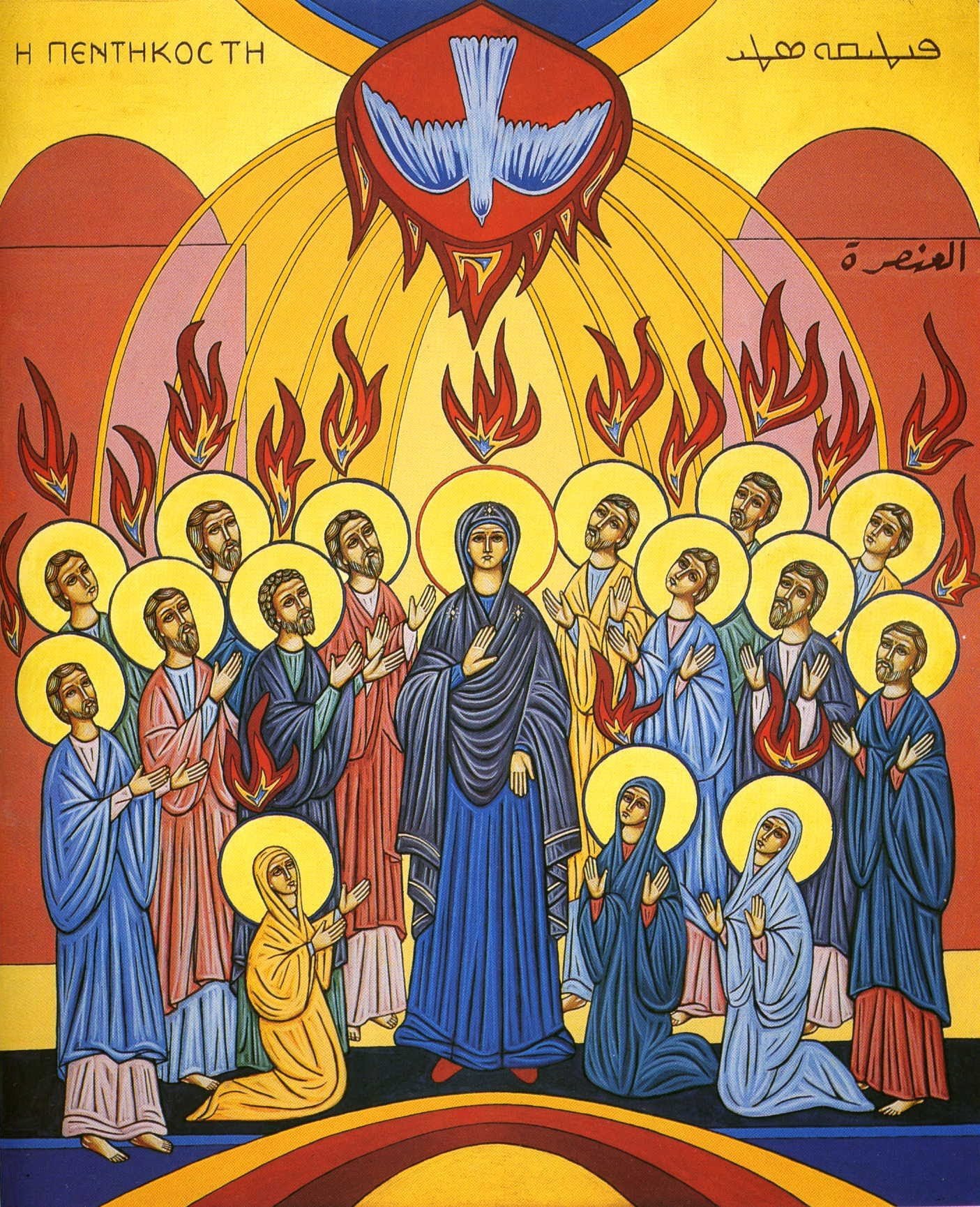
FIRE is an amazing entity. It is something that can be both a benefit, but also a danger. The heat produced by an open fire, or a log-burning stove, provides warmth and comfort. The candles in church give light and form a focus for our prayers. However, we must always take care with fire, as it is a powerful force. The disciples are described as receiving the power of the Holy Spirit through what looked like ‘divided tongues of fire’ ‘tafodau fel o dân’ (Acts 2:3).

Before his Ascension, Christ tells His disciples to wait in Jerusalem so that they may be baptized in the Holy Spirit. The twelve have again gathered in the Upper Room, along with the Blessed Virgin Mary. This is the same place where Christ instituted the Eucharist, and washed His disciples’ feet. They have gathered here because Jesus told them to be together, and to pray, saying:

 ‘you shall receive power when the Holy Spirit has come upon you; and you shall be my witnesses … to the end of the earth’ 

‘Ond fe dderbyniwch nerth wedi’r Ysbryd Glân ddod arnoch, a byddwch yn dystion i mi … a hyd eithaf y ddaear’ (Acts 1:8)

Our Lord promises to pour out the Holy Spirit to strengthen and inspire the Church. God is generous, and wants to see humanity flourish. An amazing event then takes place. Everyone present is filled with the Holy Spirit. Tongues of fire rest upon them, and they speak in a variety of languages. Strengthened by God’s Spirit the disciples go out to preach. In Jerusalem there are people from all over the Mediterranean World, gathered for the Jewish festival of Shavuot, the celebration of the wheat harvest. These people are amazed to hear the mighty works of God spoken in their own languages. Not only that, those speaking are not the educated elite but a rag-tag assortment of Galilean fishermen and other ordinary men. They hear and understand the proclamation of who Jesus is, and what He has done. 

Through the power of God, the Good News is pronounced. Men who were afraid, hiding behind locked doors, have become confident, and will go out to share the Gospel around the world. Their miraculous transformation has, in turn, transformed the world, resulting in billions of Christians. We are here in church today because of the power of the Holy Spirit.

This is why St Paul can write to the Church in Galatia as a community that has experienced the indwelling of the Holy Spirit. The apostle describes what it means to be filled with the Holy Spirit:

But the fruit of the Spirit is love, joy, peace, patience, kindness, goodness, faithfulness, gentleness, self-control’ 

Ond ffrwyth yr Ysbryd yw cariad, llawenydd, tangnefedd, goddefgarwch, caredigrwydd, daioni, ffyddlondeb, addfwynder, hunanddisgyblaeth.’ (Gal 5:22-23)

Paul is describing how we are all supposed to be as Christians. Living by the Spirit is an ideal, which we often fail to live up to, but, nonetheless, it shows us how God wants us to live. Here is a glimpse of life in all its fulness: life in union with God, and with each other. This is perfect communion, something to strive for, even if we may struggle to attain it. This is how we can live when we allow God to be in control, and when our human will is perfectly aligned with the Father’s will for us. Living by the Spirit is what human flourishing looks like in practice.

At a number of points in John’s Gospel, Jesus speaks about the Holy Spirit to His disciples. Our Lord tells His followers that the Spirit will bear witness, confirming the truth of their faith, and will strengthen them for service: living and sharing the Good News. Jesus promises: 

When the Spirit of truth comes, he will give you into all truth

Ond pan ddaw ef, Ysbryd y Gwirionedd, fe’ch arwain chwi yn yr holl wirionedd’ (Jn 16:13)

We have come together today to celebrate God’s love and generosity in continuing to send His Holy Spirit. 

God is glorified in worship, which is why we sing His praises. Worship does not change God, it changes us: making us more loving, uniting us with our creator who sustains us with His love. Christians all around the world are united with the worship of Heaven, where the saints and angels sing the praises of God, Father, Son, and Holy Spirit. Through the power of the Holy Spirit, and nourished by Word and Sacrament, we are given a foretaste of the joy which awaits us.

So, my brothers and sisters in Christ, let us pray earnestly for the gift of the Spirit. May God fill us with His love and equip us to proclaim the Good News of the Kingdom. May the fire of the Holy Spirit embolden us to encourage others to come to know, and love, God the Father, God the Son, and God the Holy Spirit. To whom be ascribed all, glory, dominion, and power, now and forever. Amen.

Maronite Icon of Pentecost

Easter VII

In 1959 the first photograph of the Earth was taken from space by an unmanned satellite called Explorer 6. The image was blurry and very basic by today’s standards. Almost a decade later, the crew of Apollo 8 took a famous picture of our planet rising over the lunar landscape. It was named Earthrise. This iconic photograph helped people to understand the world better and take greater interest in environmental issues. As Christians we are called to care for our planet and all the people, plants, and creatures that dwell on it. At the same time, as Christians we are called to be in the world, but not of the world. This world is simply somewhere we will reside for a short while. Our citizenship is in Heaven, our true home, where we long to spend eternity with God. One of the ways in which the Church lives out this other-worldliness is shown in today’s reading from the Acts of the Apostles.

After Jesus’ Ascension, the disciples spend time together in prayer and fellowship. One of their first actions is to appoint a replacement for Judas Iscariot, so that the Eleven Apostles may become Twelve again. For Jews the number twelve is very significant. It stands for wholeness and the completion of God’s purpose. There are twelve months in a year, and twelve tribes of Israel. It was therefore important to the Apostles that they were restored to their proper number of twelve. So, out of all the current followers of Jesus, Peter states that they need someone who has been with them from the beginning, to act as a witness to Jesus’ resurrection. Two candidates are put forward: Justus and Matthias. Peter then prays for guidance:

You, Lord, who know the hearts of all, show which one of these two you have chosen to take the place in this ministry and apostleship from which Judas turned aside to go to his own place.” 

“Adwaenost ti, Arglwydd, galonnau pawb. Amlyga prun o’r ddau hyn a ddewisaist i gymryd ei le yn y weinidogaeth a’r apostolaeth hon, y cefnodd Jwdas arni i fynd i’w le ei hun.” (Acts 1: 24-25)

The disciples do not decide for themselves, they leave the choice up to God. Through the random process of casting lots, God can show them whom He wants to be an apostle. This feels strange to us nowadays. We want to be in control. We want to choose. Perhaps we would be better served by putting God back in control. 

The Gospel reading continues the exploration of the Farewell Discourses between the Last Supper and Jesus’ Arrest. Today we have arrived at Chapter 17, known as Jesus’ High Priestly Prayer. This is a truly solemn moment of intimate conversation between the Father and the Son. Before His Passion and Death, Christ is entrusting His Church to the Father, that it may be kept safe, and that it may be filled with the glory of God, and also strengthened to proclaim the Good News of the Kingdom. This is a moment of profound emotion and intimacy, a window into a conversation between two Persons of the Holy Trinity. 

Jesus is committing us, His Church to God, for God to care for us. His prayer sees His followers as being in opposition to a world which rebels against God; a world of sin and corruption; a world of power and politics. Christ prays that His people may be set apart, to be holy, devoted to God, and filled with love. To love is to will the good of the other. God loves us, and it is God’s will that we flourish and enjoy life in all its fulness, united to Him. This is why Jesus taught us to pray,

Thy kingdom come, thy will be done, on earth as it is in heaven.

“deled dy deyrnas, gwneler dy ewyllys; megis yn y nef, felly ar y ddaear hefyd.”(Mt 6:10)

Christ is praying that we, His Church, stay close to God. That we be united with God’s will, and filled with God’s love. This is why we look forward to next Sunday, when we celebrate Pentecost, the outpouring of the Holy Spirit. This is a sign of God’s love for us, the love which unites Father, Son and Holy Spirit. God invites us to be united with the life of the Trinity, and wants us to offer that invitation to others. If we place ourselves in God’s hands He will take the initiative, just as He did in choosing Matthias to replace Judas.

Th name Matthias means ‘gift of God’. The disciples receive this gift after praying together and asking for God’s guidance. As Christians we too need to spend time together, to pray for our needs and those of the world. In prayer we are united with each other and with God. Together we are nourished by sharing the Eucharist and hearing the Word of God. These things are crucial to who and what we are. United together we experience the love of God and the joy of community. The world may be indifferent to what we do, or it may mock us when we fail to live up to the example of Jesus. But, as Christians, we strive to live in the love of God, and forgive each other our trespasses. We aim to live out that same radical love and forgiveness which sees Jesus die upon the Cross and be raised to New Life for love of us, and for all the world.

This message of profound love and forgiveness is one that much of the world cannot or does not want to understand. We may not understand the depths of God’s love, but we know that it can be experienced, through personal encounter with Jesus in prayer, Word, and Sacrament. We are living testimony to love’s power to change lives. It sets us free to live for God and to proclaim his saving truth in our words and actions.

As I mentioned earlier in this sermon, Matthias’ name means ‘gift of God’, and his appointment comes just before God’s wonderful gift of the Holy Spirit. So as we wait with the Apostles for this gift, let us pray that God may be at work in us, building us up, and giving us strength to live the Christian life. Let us then share these gifts with others, so that they may also come to believe and give glory to God the Father, God the Son, and God the Holy Spirit. To whom be ascribed all glory, dominion, and power, now and forever. Amen.

Peter Paul Rubens Matthias (Museo del Prado, Madrid)