Palm Sunday Evensong

THIS evening I would like to talk about the Apostle John. The name ‘John’ means ‘The Lord has worked grace’. John the Apostle is the son of Zebedee and Salome (the sister of the Blessed Virgin Mary). He is also the brother of James, and the cousin of Jesus. In the Bible, John is called ‘the beloved disciple’, the disciple whom Jesus loved. He is also believed to be the author of the Gospel which now bears his name, as well as three canonical letters and the Book of Revelation. While scholars tend to ascribe some or all of these works to others, I do not wish to. Time tonight does not allow me to examine all of John’s writings in detail, so I must be selective. However, I strongly urge you to read John’s works and immerse yourself in the richness of his vision.

In the Synoptic Gospels (Matthew, Mark, & Luke) we first meet our soon-to-be disciple by the shore of the Sea of Galilee with his father, Zebedee and his brother, James. In John’s Gospel, however, there is no mention of him until the Last Supper. The apostle is then also present at the Crucifixion, standing at the foot of the Cross with Mary, the mother of Jesus. Along with Simon Peter, he is the first witness of the Resurrection. John is also one of the seven disciples who have breakfast with the Risen Christ by the Sea of Galilee, when Jesus asks Simon Peter three times if he loves him. At the end of his Gospel John writes the following authorial comment:

This is the disciple who is bearing witness about these things, and who has written these things, and we know that his testimony is true. Now there are also many other things that Jesus did. Were every one of them to be written, I suppose that the world itself could not contain the books that would be written. (Jn 21:24-25)

John is someone we can trust, whose writings help us to ponder the mysteries of God’s love. Elsewhere, in the Synoptic Gospels, John appears as part of an inner circle of disciples. He is with Peter and James at the Transfiguration, and at several miracles where not all the Twelve are present. What then are we to make of this apostle? The various mentions of him in Scripture show that he is a beloved disciple, one loved by God, who loves God deeply. Love is something of a defining characteristic in John’s writing, especially in his Gospel and Letters. But even love must be set in a wider context, namely God.

John’s Gospel begins at the beginning, a very good place to start.‘In the beginning was the Word, and the Word was with God, and the Word was God.’ (Jn 1:1) God is trinitarian: Father, Son, and Holy Spirit (Duw Dad, Mab ac Ysbryd Glân). He always has been, and always will be. ‘The Word became flesh and dwelt among us’ (Jn 1:14). The word translated as ‘dwelt’ actually means ‘pitched his tent’, tabernacled among us, like a nomad, or a shepherd, or an exile wandering like Israel after the Exodus from Egypt.

John then introduces his namesake, the Baptist, who on seeing his cousin Jesus, exclaims ‘Behold, the Lamb of God, who takes away the sin of the world!’ (Jn 1:29). Jesus calls disciples, and suddenly they are at a wedding in Cana, where the wine runs out. To prevent shame and ‘social death’ for the hosts, Our Lord turns a large amount of water into wine. God is generous, and the messianic banquet is a reality! There are other signs of Jesus’ divinity and God’s love for humanity. In John’s Gospel, Our Lord is keen to say, ‘I am’: ‘I am the Good Shepherd’ ‘I am the Bread of Life’ ‘I am the Way, the Truth, and the Life’. Just as God reveals himself to Moses at the Burning Bush, saying: ‘I am who I am’. This is the same God who took flesh in the womb of the Virgin Mary.

It is when John is with Mary at the foot of the Cross that the Beloved Disciple is singled out for the second time. Just before Christ dies He looks down, and says:

‘Woman behold your Son.’ Then he said to the disciple, ‘Behold your mother!’ And from that hour the disciple took her to his own home (Jn 19:26-27)

Something wonderful is happening here. On the hill of Calvary, on Good Friday, Jesus is starting the Church, with His Mother (the laity), John the Beloved Disciple (the Clergy), and Himself (Our Great High Priest). Jesus offers himself as both priest and sacrifice upon the altar of the Cross to take away our sins, and to restore our relationship with God and with each other. John and Mary become a new family, not because of ties of blood and kinship (though they are related), but through Jesus. Likewise, every Christian is a brother or sister in Christ. We are all children of God.

From this verse the tradition arises that Mary and John lived together in Ephesus, south of Smyrna, (modern İzmir). This tradition maintains that the Apostle was exiled to the island of Patmos for his preaching of the Good News. There John lived in a cave where he had the visions which have come down to us as the Apocalypse, the Revelation of St John the Divine. Before his exile, during the reign of the emperor Domitian, it is recorded that John survived being immersed in a vat of boiling oil near the Porta Latina, the Latin Gate on the south of the Aurelian Wall of the City of Rome. This miraculous event was remembered in a feast celebrated (until 1960) on 6th May, and is found in the Calendar of the 1662 Book of Common Prayer. John’s main feast day, however, is the 27th December. Significantly, he is the only apostle not to have suffered a martyr’s death, and so the liturgical colour of his feast days is white and not red — the usual colour for a martyr. 

In 2007, Pope Benedict XVI wrote that the example of St John teaches us that:

‘The Lord wishes to make each of us a disciple who lives in personal friendship with him. To achieve this, it is not enough to follow him and listen to him outwardly: it is also necessary to live with him and like him. This is only possible in the context of a relationship of deep familiarity, imbued with the warmth of total trust. This is what happens between friends: for this reason Jesus said one day: “Greater love has no man than this, that a man lay down his life for his friends … No longer do I call you servants, for the servant does not know what his master is doing; but I have called you friends, for all that I have heard from my Father I have made known to you” (Jn 15:13, 15)’  [ Pope Benedict XVI, Christ and his Church: Seeing the face of Jesus in the Church of the Apostles, CTS 2007: 72-73.]

The way to understand John and his theology is through the prism of love. As the apostle writes:

“For God so loved the world, that he gave his only Son, that whoever believes in him should not perish but have eternal life. For God did not send his Son into the world to condemn the world, but in order that the world might be saved through him.” (Jn 3:16-17)

These words are echoed in John’s First Letter:

‘By this we know love, that he laid down his life for us, and we ought to lay down our lives for the brothers.’ (1Jn 3:16)

God loves us, and becomes one of us, so that we may have life in all its fulness. Love means willing the good of another. God’s love for us shows that our flourishing is His will. This is the reason for the Incarnation, our Salvation, and Redemption. Love is also the source for both the words of teaching and the signs which pervade John’s Gospel. This is Good News, given to us by the Church — a community of love, which feeds us with Christ’s teaching and the bread of life — so that we can grow more and more into the likeness of the one who loves us: Jesus Christ, who is Our Lord and God.

John is the disciple who has a vision of Heaven, of heavenly liturgy which looks Eucharistic. As one of the first disciples to experience the reality of the Resurrection, and as one who sees and believes, John understands that Eternal Life Heaven is our objective. He says:

‘I write these things to you who believe in the name of the Son of God that you may know that you have eternal life.’ (1Jn 5:13)

As Christians, we need to follow the example set by the Beloved Disciple. We need to love Our Lord and Saviour above all else. Like John, we need to see and to believe, and to let God work in our lives. We are called to let God act in us, and through us, to bring His message of love and forgiveness to our needy world.

The depth of John’s relationship with Jesus illustrates how such a theology might come about. John’s life and teachings should continue to inspire us as Christians today. Reminding us to love, to believe, and to persevere in faith, even in the face of hardship. May all of us gathered here today be strengthened by the example of John, to grow closer to God and to give glory i Duw Dad, Duw y Mab, a Duw yr Ysbryd Glân. To God the Father, God the Son, and God the Holy Spirit. I’r hwn y priodoler pob gogoniant, arglwyddiaeth, a gallu, yn awr, ac yn oes oesoedd. To whom be ascribed all glory, dominion and power, now and forever. Amen.

Correggio: St John,San Giovanni Evangelista, Parma

Epiphany V 2025

THIS week’s readings focus on God’s call to humanity, so I would like to begin by sharing with you something of my own call. The first time I realised that I wanted to be a priest, I was about 10 years of age. It was in church at Margam, during a Sunday Morning Eucharist. The priest standing at the altar praying the Eucharistic Prayer, lived next door but one to us. He was a retired priest, called Fr Glyn — a great and holy man. I would go on to study at the same theological college as him (although this was something I only found out once I’d got there). As he stood at the altar and prayed the words that Jesus recited on the night before He died, I can remember a strong, overwhelming feeling: ‘I really want to do THAT!’ Even now, nearly forty years later, and after serving God as a priest for nearly fourteen years, that feeling still feels real. I still do not feel worthy of the call. But I’m not supposed to. That is the point: only God is worthy. However, God calls us not because we are worthy, but so that we might co-operate with Him in the outworking of His goodness, healing and love.

In our first reading this morning, the prophet Isaiah has a vision of heavenly glory. In his vision, Isaiah sees the throne room of the Heavenly Temple, with God surrounded by angels The prophet does not describe his emotional state, but he speaks of his human unworthiness in the divine presence. When Isaiah is confronted by the majesty of God, the singing of angels, the smoke of incense, all he can say is:

‘Gwae fi! Y mae wedi darfod amdanaf! Dyn a’i wefusau’n aflan ydwyf’

‘Woe is me. For I am lost; for I am a man of unclean lips’ (Isa 6:5)

Isaiah is aware of his human sinfulness and the gulf between himself and God. Yet his guilt is taken away, and his sin is atoned for. The prophet, who will foretell the coming of the Messiah who will save humanity, is prepared by God. He is set apart. When God asks, ‘Pwy a anfonaf? Pwy a â drosom ni?’’Whom shall I send, who will go for us?’ Isaiah can respond, ‘Dyma fi, anfon fi.‘Here I am! Send me’. This is quite a journey in a few verses, and that is the point. God doesn’t call those who are equipped. Rather, He equips those whom He calls.

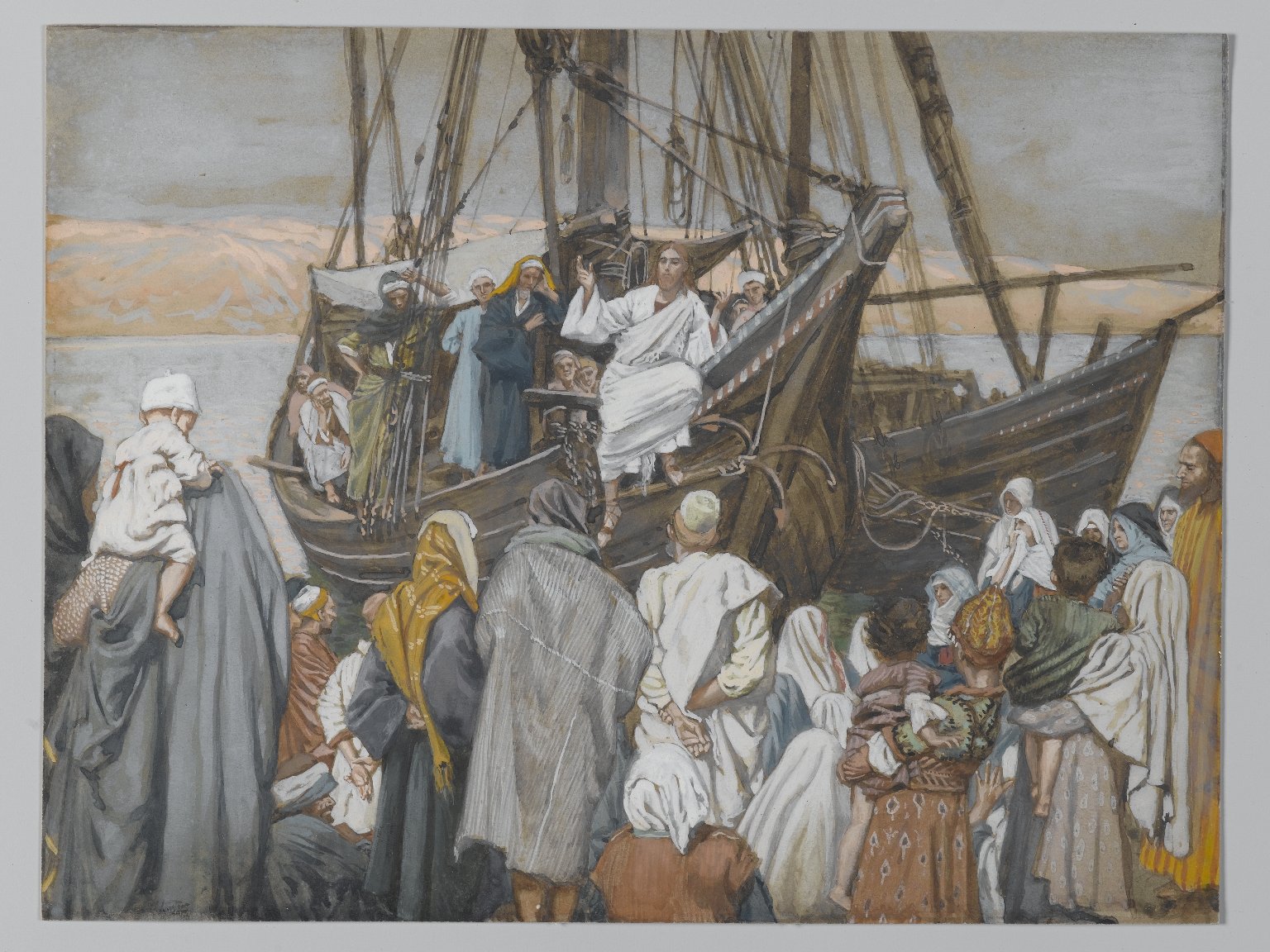
In the Gospel, the teaching ministry of Jesus, which we saw begin in the synagogue in Nazareth, continues. His fame is spreading and the crowd that has come to listen to Our Lord’s teaching is so large that He uses a boat to address them, so that the hills behind the crowd will help make Him more easily heard, acting like a natural theatre 

After speaking to the crowd, Jesus continues to draw disciples to Himself. On the Sea of Galilee the best time to catch fish is at night, but unfortunately Simon, James, John, and others have been out all night and caught nothing. It is the morning, now, and they are exhausted. Worst of all their effort has brought no reward. They have no fish to sell. 

Jesus says to Simon, 

‘Dos allan i’r dŵr dwfn, a gollyngwch eich rwydau am ddalfa.’

‘Put out into the deep and let down your nets for a catch.’ (Lk 5:4)

These words seem to be crazy. The time to catch fish on the lake is at night not during the daytime. Simon knows this, but he agrees to let down his nets. Suddenly the fishing nets are full to breaking point, and Simon calls his colleagues to help him pull in the catch. Both boats are so full of fish that they can barely float. 

Simon’s response is telling, he falls down at Jesus’ knees and says:

‘Dos ymaith oddi wrthyf, oherwydd dyn pechadurus wyf fi, Arglwydd.’

‘Depart from me, for I am a sinful man, O Lord.’ (Lk 5:8)

Simon appreciates that what has happened is a miracle, something that God has done. His response to the presence of God is contrition — awareness of his own unworthiness. Simon knows that he doesn’t deserve this outpouring of grace. The unmerited kindness of God, is too much for him. This humble fisherman recognises his own unworthiness to be in the presence of the Divine. It is understandable, and human, and we would likely feel exactly the same way.

Then Our Lord addresses Simon:

‘Paid ag ofni; o hyn allan dal dynion y byddi di’

’Do not be afraid; from now on you will be catching men.’ (Lk 5:10)

Paid ag ofni’ ‘Do not be afraid’ God begins by addressing our fear, our reluctance to commit. The point is that we are not alone in this, but rather that God wants to work with us, and through us, to proclaim and extend His Kingdom. God welcomes humanity into His embrace, to know the love for which we long. True, unconditional love, offered to each and every one of us to transform us.

The final words of the passage are instructive: 

‘Yna daethant a1’r cychod yn ôl i’r lan, a gadael popeth, a’i ganlyn ef.’

‘And when they had brought their boats to land, they left everything and followed him.’ (Lk 5:11)

The fishermen are literally leaving everything. They have just landed the biggest catch of fish in their entire lives. They were about to be rich in worldly terms, and they have to leave it all behind. Their sacrifice is a real one. Following Jesus comes at a cost. However, it is not without its rewards. The first disciples turn their backs on worldly riches and possessions in order to be free to do God’s work.

The calling of the disciples is also the calling of the entire baptised people of God. This is a calling not to be afraid, but to respond to the God who loves us and saves us. This is a calling to live out in our lives, by word and deed, the saving truths of God. So God can use us for His glory and to spread His Kingdom. So that others may come to know God’s Love, Mercy, and Forgiveness. This is what we have signed up for: to be disciples of Jesus; to profess the faith of Christ Crucified; to share this faith with others.

This treasure has been entrusted to each and every one of us. We are all called to share our faith with others, so that the world may believe. Like the first disciples we acknowledge the glory o Duw Dad, Duw y Mab, a Duw yr Ysbryd Glân. I’r hwn y priodoler pob gogoniant, arglwyddiaeth, a gallu, yn awr, ac yn oes oesoedd. Amen.

Jesus preaches from a boat – James Tissot (Brooklyn Museum)

Advent Sunday 2024: Be Alert: Preparing for Christ’s Return

WHEN I was a young boy I was given a bookmark, on which was printed, ‘BE ALERT: The world needs all the lerts it can get!’ This pun amused me greatly, and it still does. However, it contains a serious message. As Christians we are called to be watchful and aware: both of the world around us, and of the signs of God’s Kingdom. We must also be watchful for Our Lord’s Return. There are two things of which we can be sure. Firstly, that our earthly lives are finite, and secondly, that Christ will come to judge the World. People often find both of these concepts somewhat off-putting, which is understandable. However, they are a reality which we need to face, and understand. Christians believe in God. We trust that we are loved by Our Heavenly Father, who is a God of love and mercy. He sent His Son, Jesus Christ, to reconcile us to Himself and with each other. This is why we can have hope, and prepare to meet Christ with joyful hearts.

The prophet Jeremiah, in our first reading this morning, speaks of prophecy being fulfilled:

‘“Y mae’r dyddiau’n dod,” medd yr Arglwydd, “y cyflawnaf y gair daionus a addewais i dŷ Israel ac i dŷ Jwda.”’

‘Behold, the days are coming, declares the Lord, when I will fulfil the promise I made to the house of Israel and the house of Judah.’ (Jer 33:14)

God promises to fulfil prophecy and to send His people a Saviour. This promise, made to the House of David, is fulfilled both by Jesus’ birth and His return in judgement. God promises to save His people and to rule in a way that is far beyond any human idea of justice. Earthly rulers and politicians will, and do, disappoint us: they always fall short of our expectations. They are human beings, and are therefore fallible. Instead, we call upon God to intervene, and make things right. Only our Heavenly Father can save us, we cannot save ourselves.

However, waiting for Jesus’ Return is not without its problems. St Paul writes to Christians in northern Greece who are expecting Christ’s Second Coming to be imminent. Their expectations need to be managed, and they need help to live out their faith, so that they grow in love together. Our time on earth is limited, so we need to take every opportunity to live in a way that is pleasing to God.

Jesus’ description of the end times is in agreement with the apocalyptic passages found in the prophets. In other words, when that day comes it will be clear. If we are alert, then we will know what is going on. We should look forward to this day, and not be afraid: 

“A’r pryd hwnnw gwelant Fab y Dyn yn dyfod mewn cwmwl gyda nerth a gogoniant mawr. Pan ddechreua’r pethau hyn ddigwydd, ymunionwch a chodwch eich pennau, oherwydd y mae eich rhyddhad yn agosáu.”

‘And then they will see the Son of Man coming in a cloud with power and great glory. Now when these things begin to take place, straighten up and raise your heads, because your redemption is drawing near.’ (Lk 21:27-28)

Christ’s return is a sign of the Kingdom of God. He will welcome us to our eternal Heavenly home. Mindful of our destiny, we should use this season of Advent as a time for preparation. We should make these four weeks leading to Christmas a time when we turn away from everything which separates us from God and each other. As Our Lord says in the Gospel:

“Cymerwch ofal, rhag i’ch meddyliau gael eu pylu gan ddiota a meddwi a gofalon bydol, ac i’r dydd hwnnw ddod arnoch yn ddisymwth fel magl; oherwydd fe ddaw ar bawb sy’n trigo ar wyneb y ddaear gyfan.”

‘But watch yourselves lest your hearts be weighed down with dissipation and drunkenness and cares of this life, and that day come upon you suddenly like a trap. For it will come upon all who dwell on the face of the whole earth’ (Lk 21:34-35)

These words are as relevant today as they were two thousand years ago. Human nature has not changed, nor has our propensity for doing the wrong things — squandering our time, energy, and resources. Instead, we should listen to Jesus and obey His commands:

“Byddwch effro bob amser, gan ddeisyf am nerth i ddianc rhag yr holl bethau hyn sydd ar ddigwydd, ac i sefyll yng ngŵydd Mab y Dyn.”

‘But stay awake at all times, praying that you may have strength to escape all these things that are going to take place, and to stand before the Son of Man.’ (Lk 21:36)

Vigilance, prayer, and complete reliance upon God are the weapons of our spiritual armoury with which to combat the darkness of this world. 

So, my brothers and sisters in Christ, let us be alert and watchful. Let us serve Christ our King who will return, filled with His love for us, and for all people. Let this love form a Kingdom with God as its head. And as we await the Christ’s Second Coming, let us give praise and honour to God the Father, God the Son, and God the Holy Spirit. To whom be ascribed all glory, dominion and power, now and forever. Amen.

Christos Pantokrator, St Catherine’s Monastery, Sinai

Trinity XII: The Bread of Life

THE poet Robert Browning once wrote: ‘If thou tastest a crust of bread, thou tastest all the stars and all the heavens’. This connection between bread and Heaven is the subject of today’s Gospel.

Our Lord has been teaching His followers about the Bread of Life. This is a topic which He returns to at the Last Supper. Seated with His disciples, Jesus says, ‘This is My Body’ ‘hwn yw nghorff’ and ‘This is My Blood’ ‘hwn yw fy ngwaed i’. He means what He says. For a hundred thousand successive Sundays the Church has followed Christ’s instruction to ‘do this in memory of me’. Not simply as a memorial, but to feed God’s people with God Himself: Body, Blood, Soul, and Divinity. To transform us, and prepare us for Heaven.

During the Roman Empire, when the Church was persecuted, followers of Jesus were accused of three false things. Firstly, atheism, because of their refusal to believe in, or worship pagan gods. Secondly, incest, because Christians called each other brother and sister, and loved each other. Thirdly, cannibalism — Christians were accused of eating human flesh. These last two charges are rooted in a misunderstanding of Christian worship. They are also evidence that, from the beginning, Christians were gathering for worship and consuming the Body and Blood of Christ.

Christ is being controversial when He teaches the people,

“I am the living bread that came down from heaven. If anyone eats of this bread, he will live for ever. And the bread that I will give for the life of the world is my flesh.”

“Myfi yw’r bara bywiol hwn a ddisgynnodd o’r nef. Caiff pwy bynnag sy’n bwyta o’r bara hwn fyw am byth. A’r bara sydd gennyf fi i’w roi yw fy nghnawd; a’i roi a wnaf dros fywyd y byd.” (Jn 6:51)

Our Lord is greater than the manna which God sent down to the Israelites during their wanderings in the desert. He is living bread. He is the bread which gives eternal life. God shares Himself with us, so that we might live in Him. But Christ’s teaching is deeply problematic for His audience. Jewish law prohibited the consumption of blood and human flesh. So what Jesus is proposing is impossible for His followers to accept. It is something that they cannot do, and yet they are told that they must. 

Jesus then repeats His teaching. He explains that anyone who wants to have life, needs to eat His Flesh and drink His Blood. Christ invites believers to the Eucharist and, in doing so, pledges to them that they will share in His Resurrection:

‘Whoever feeds on my flesh and drinks my blood has eternal life, and I will raise him up on the last day.’

‘Y mae gan y sawl sy’n bwyta fy nghnawd i ac yn yfed fy ngwaed i fywyd tragwyddol, a byddaf fi’n ei atgyfodi yn y dydd olaf.’ (Jn 6:54)

The purpose of the Eucharist is to transform us, to give us Eternal Life in Christ, so that we are part of Him. United with God and incorporated with Him forever.  As the bread is broken, and the wine is poured, so Jesus suffers and dies on the Cross. Our Lord’s Passion, Death and Resurrection are the core of our faith as Christians. In them we see how much God loves us. God’s love is freely given. We do not earn it, we do not deserve it; yet it is given to us. It is through Divine love that we may grow into something better, something greater, something more Christ-like. Such is the power of God’s sacrificial love at work in our lives. This is the treasure which we have come here to receive today. If it were ordinary food then we would eat it, and remain unchanged. But, instead, we who eat the Bread of Heaven are united with Christ. This is strong food! 

The Book of Proverbs speaks of Wisdom, which in the Christian tradition is identified with Christ, the Word made Flesh. Wisdom issues an invitation. She has constructed a house — the Church — and she has built seven pillars — the sacraments of the Church — the means of God’s grace to be active in our lives. The people of God are called to eat and drink, to live, and to walk in the way of wisdom, by following Jesus Christ. The message of New Testament is prefigured in the Hebrew Scriptures, which point to — and find their fulfilment in — Jesus Christ. He is the Wisdom of God, and the Word made Flesh. Christ’s invitation is an echo of the words of the Book of Proverbs:

“Come, eat of my bread and drink of the wine I have mixed. Leave your simple ways, and live, and walk in the way of insight.”

“Dewch, bwytewch gyda mi, ac yfwch y gwin a gymysgais. Gadewch eich gwiriondeb, ichwi gael byw; rhodiwch yn ffordd deall.” (Prov 9:5-6)

Throughout the Scriptures God issues an invitation to His people to be nourished, and walk in the way of truth. So my brothers and sisters in Christ, let us come to the banquet of the Lord, the feast of the Kingdom. May God’s grace transform us more and more into His likeness, and give us eternal life in Him. In the name of God the Father, God the Son, and God the Holy Spirit. Amen.

Trinity IV: Transformed by Faith -Embracing God’s Love in the Midst of Life’s Storms

There are few things that can compare with a storm for making human beings feel small and helpless. When we are faced with strong winds, lashing rain and lightning, we can feel insignificant, powerless, and aware of our own mortality. I was caught in a storm, fairly recently, and it was absolutely terrifying. Such feelings are uncomfortable, and we would prefer not to experience them. They are, however, an important part of the human condition. Fear is one of the most powerful emotions we have, and it drives us to seek safety and security. Thankfully, as Christians, we know that we can find safety and security in God, our loving Creator and Sustainer. 

This loving nature of God is highlighted in the passage from the Book of Job, which is the first reading this morning. God is truly powerful, but cares for humanity:

Who shut in the sea with doors when it burst out from the womb,Thus far shall you come, and no farther, and here shall your proud waves be stayed’ 

‘Pan gaewyd ar y môr â dorau, pan lamai allan o’r groth…Hyd yma yr ei, a dim pellach, ac yma y gosodais derfyn i ymchwydd dy donnau’ (Job 38:8, 11)

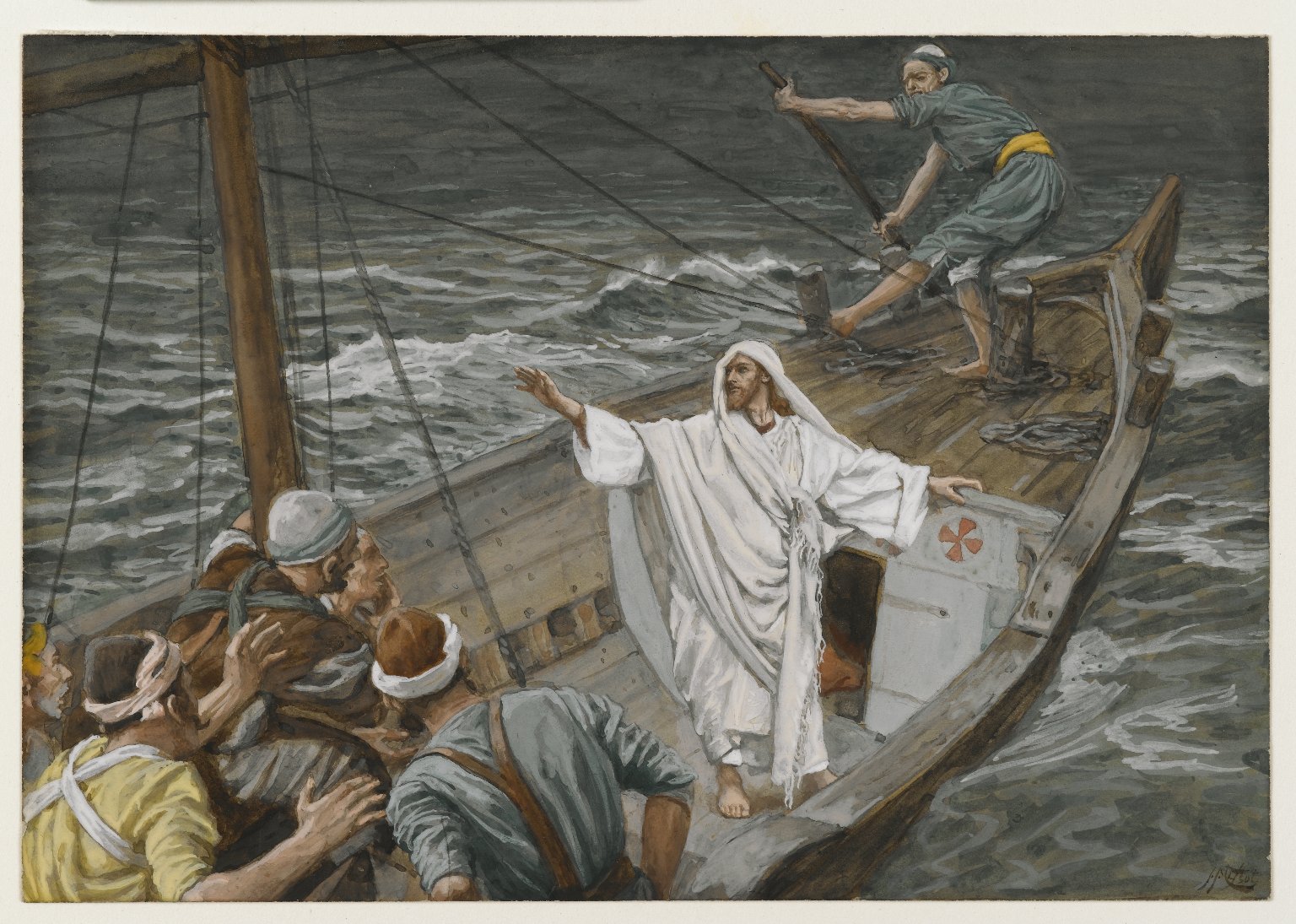
God’s power over nature is also central to this morning’s Gospel. Jesus and His disciples are crossing the Sea of Galilee when a violent storm blows up. The disciples are terrified. Despite many of them being fishermen, they are afraid that they are about to drown. This passage throws up a number of questions. Why are Jesus and His disciples crossing from the Jewish side of the Sea of Galilee to the non-Jewish side? Why are they sailing at night, rather than waiting until the next morning? We are not told the answers to these questions. However, this incident acts as a bridge between the section in Mark’s Gospel where Jesus has been teaching, to one where He will perform miracles, and put that teaching into practice. 

As the boat begins to fill with water, the disciples are becoming desperate:

And they woke him and said to him, “Teacher, do you not care that we are perishing?” And he awoke and rebuked the wind and said to the sea, “Peace! Be still!” And the wind ceased, and there was a great calm.

‘Deffroesant ef a dweud wrtho, “Athro, a wyt ti’n hidio dim ei bod ar ben arnom?” Ac fe ddeffrôdd a cheryddu’r gwynt a dweud wrth y môr, “Bydd ddistaw! Bydd dawel!” Gostegodd y gwynt, a bu tawelwch mawr.’ (Mk 4:38-39)

Jesus’ followers are afraid. There are thirteen of them packed into a boat twenty-six feet long, eight feet wide, and four feet deep.The boat is tossing, yet Jesus calmly sleeps. Once He is awoken He quickly takes control of the situation. Jesus can command the storm to cease because He is God. The ability to control the sea and its storms is a sign of divine power: God is the one who brings peace. Jesus has come to bring peace to troubled hearts. Having performed a miracle, He questions His disciples:

He said to them, “Why are you so afraid? Have you still no faith?” And they were filled with great fear and said to one another, “Who then is this, that even the wind and the sea obey him?”’ 

‘A dywedodd wrthynt, “Pam y mae arnoch ofn? Sut yr ydych heb ffydd o hyd?” Daeth ofn dirfawr arnynt, ac meddent wrth ei gilydd, “Pwy ynteu yw hwn? Y mae hyd yn oed y gwynt a’r môr yn ufuddhau iddo.”’ (Mk 4:39-41)

The answer to the disciples’ question is that Jesus is God. No-one else could do what He does. Jesus then questions why His followers feel fear and why they lack faith. To put it simply, the Disciples have not yet fully understood either who Jesus is, or what He is doing. Once they have experienced Christ’s Passion and Resurrection and seen His triumph over death, they will come to understand what is happening here. 

Jesus calms storms both real and metaphorical: on the Sea of Galilee, and in our own lives. By dealing with sin once and for all on the Cross, He has brought us a peace which passes all understanding. In every Eucharist service there is a point after the prayers when we greet each other with ‘Peace’ ‘Tangnefedd’. Being at peace allows the Christian community to:

no longer live for themselves but for him who for their sake died and was raised.

‘er mwyn i’r byw beidio â byw iddynt eu hunain mwyach, ond i’r un a fu farw drostynt, ac a gyfodwyd’ (2Cor 5:15)

Our life is not our own, because the love of Christ controls us, as St Paul writes in his Second Letter to the Corinthians (2Cor 5:14). Jesus’ Death and Resurrection provide an answer to the questions about suffering asked by Job, and by all humanity. By entering into the mystery of apparently meaningless pain and suffering, we can discover the source of all meaning, namely God. 

To be in Christ is to be a new Creation. Through our Baptism we share in Our Lord’s Death and Resurrection. In the Eucharist we are given the pledge of Eternal Life: Christ’s Body and Blood, so that we might continue to be transformed more and more into His likeness. This is the journey of Faith — trusting God, so that He may make us into what He is. We put our trust in Him, safe in the knowledge that God alone can still the storms of our life, and that His perfect love can drive out our fear. We cling to the Cross as our source of Hope, knowing that whatever happens we are loved, and that this love has the power to save us. God’s love can free us from fear.

Released from anxiety, we, like the disciples, can be truly alive and share God’s love with others. We pray that all humanity may experience the peace of the Lord and give glory to God the Father, God the Son, and God the Holy Spirit. To whom be ascribed all glory, dominion, and power, now and forever. Amen.

James Tissot – Jesus stilling the storm (Brooklyn Museum)