‘Whoever feeds on this bread will live for ever.’
‘Caiff y sawl sy’n bwyta’r bara hwn fyw am byth.’ (Io 6:58)
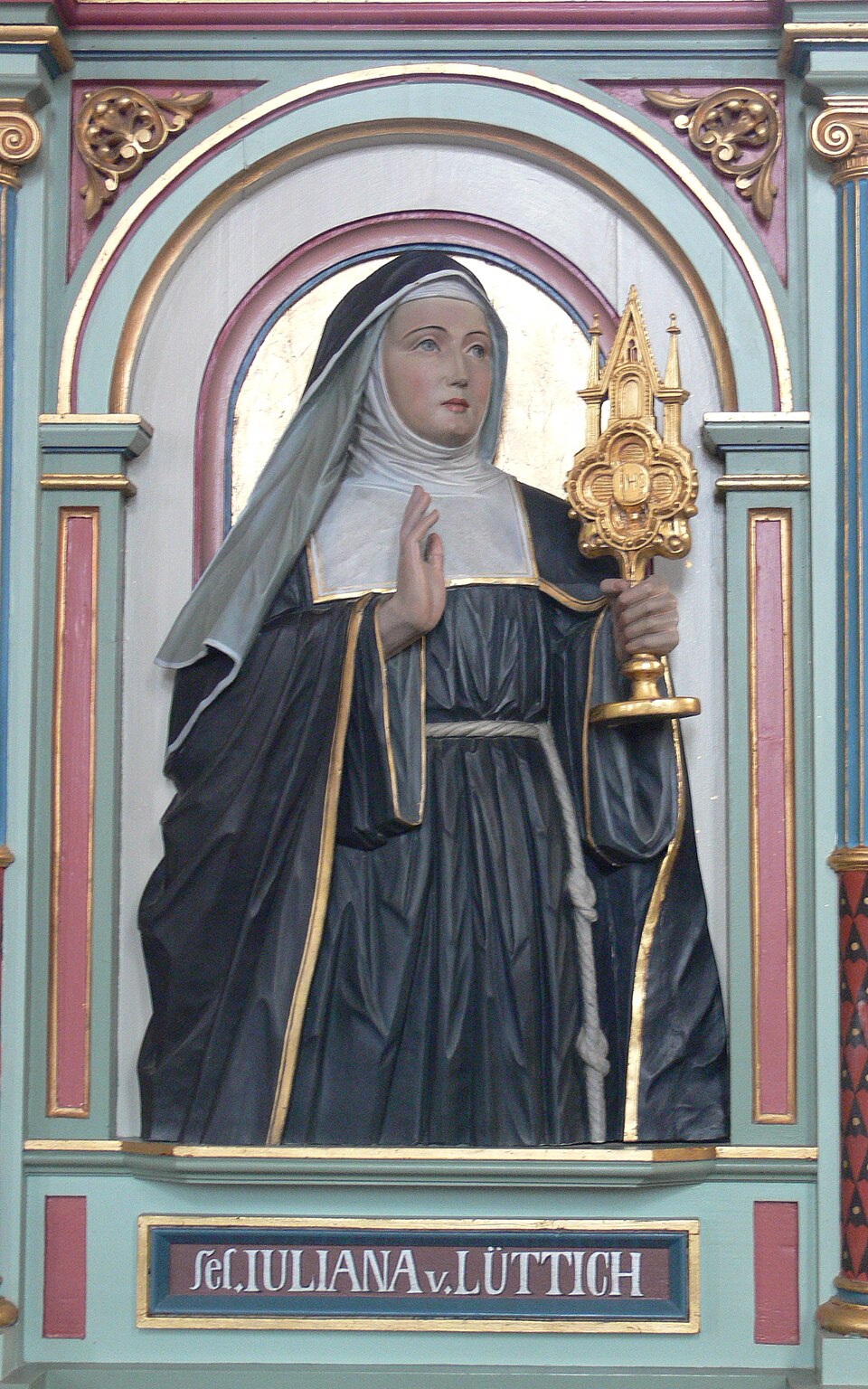
I would like to begin this evening by telling you a story. It is about a girl who was born in Liège in Belgium around 1192 AD. Her name was Juliana. At the age of five Juliana was orphaned and placed in a hospice at Mount Cornillion just outside Liège, along with her sister Agnes. At the age of 13 they both joined the Norbertine Community of Canons and Canonesses. These religious wear a white habit, and are particularly devoted to the Blessed Virgin Mary and the Eucharist. Juliana had a particular devotion to the Eucharist, and she longed with all her heart that it would have its own special feast day. She had visions which were interpreted as pointing out the lack of a Eucharistic festival. In time, Juliana was elected as the prioress of her community. Under her leadership, the canonesses’ devotional fervour grew and the community was reported to Jacques Pantaleon, the Archdeacon of Liège. However, as such devotion was firmly within the bounds of orthodox belief and practice, it was seen to be perfectly acceptable. Jacques went to become the Bishop of Verdun, then the Latin Patriarch of Jerusalem, and finally, in 1261, he became Pope Urban IV. In 1264 Pope Urban declared that the Thursday after Trinity Sunday was to be kept as a Solemn Feast of the Most Holy Eucharist, the Body of Christ, Corpus Christi. Pope Urban asked his theologian, Thomas Aquinas, to compose liturgical texts, which are still used to this day.
Pope Urban was clearly moved by Juliana’s piety and devotion to the Eucharist, and instituted the Feast on the first free Thursday in the liturgical calendar. Our Lord Himself instituted the Eucharist on a Thursday, Maundy Thursday, in the Upper Room with His disciples. After Maundy Thursday we have had seven weeks of Eastertide, and the Octave of Pentecost, so this is the first day on which we have been able to look back and focus on what Our Lord did on Maundy Thursday when He was gathered with the Apostles in the Upper Room on the night before he died. So Today’s the day!
Eucharistic devotion is not a new thing. For as long as we have accounts of the Eucharist being celebrated, going back to St Paul’s First Letter to the Corinthians, it is clear that what is going on is something special, and out of the ordinary. Jesus said: ‘This is my Body … This is my Blood … Do this!’ And so the Church does. Christ’s words are clear. What we receive in the Eucharist under the outward forms of Bread is truly the Body and Blood, Soul and Divinity, of the Word made Flesh: the Second Person of the Trinity. The Eucharist is a memorial of Christ’s Passion and Death, where His offering of Himself to the Father, in love and obedience to His Will, is re-presented for all time. When we partake in the Eucharist we are as close to Jesus at the Last Supper and on Calvary as we can be.
The Eucharist is the most precious gift we can be given. It is God’s gift of His very self, given to us, so that we might become what He is. This Sacrament is given to transform us and to prepare us for Eternal Life with God in Heaven. God prepares for the promise with the meeting of Abram and Melchizedek in Genesis. The King of Salem brings out bread and wine. He is a priest of God Most High, who feeds Abram our father in faith.
When Paul writes to the Church in Corinth, he is ensuring tradition. What has been handed on to him, he then hands on to his fellow Christians. As the Twentieth Century Anglican scholar and monk, Dom Gregory Dix put it:
At the heart of it all is the eucharistic action, a thing of absolute simplicity — the taking, blessing, breaking and giving of bread, and the taking, blessing, and giving of a cup of wine and water, as these were first done with their new meaning by a young Jew before and after supper with His friends on the night before he died….
For century after century, spreading slowly to every continent and country and among every race on earth, this action has been done, in every conceivable human circumstance, for every conceivable human need …. week by week and month by month, on a hundred thousand successive Sundays, faithfully, unfailingly, across all the parishes of Christendom, the pastors have done this just to make the plebs sancta Dei—the holy common people of God.
Dom Gregory Dix, The Shape of the Liturgy, London, 1945, p. 743-4
The Eucharist makes the Church, and the Church makes the Eucharist. It is a question of both/and, rather than either/or. Our Lord’s teaching in the Gospel is clear:
‘The one who eats this bread will live forever’ (Jn 6:58)
God gives Himself to us, so that we might live forever in Him. If that isn’t a reason to celebrate, then I don’t know what is! Generosity, sacrifice, and transformation, these three things lie at the heart of our faith as Christians. All three are encapsulated in a ritual action, which is the source and summit of our life of faith.
Back in the year 304 AD a group of 49 Christians were discovered worshipping in Abitene, near Carthage in modern Tunisia. There had been an edict from the Roman Emperor Diocletian, which had prohibited such gatherings. But when the Abitene Christians were asked why they had broken the emperor’s law, one of them replied:
sine Dominico non possumus. Without the Lord we cannot live
This reply along with their actions make clear the importance of gathering on the Lord’s Day for worship; the central importance of the Eucharist in the life of faith, and the fact that Jesus is Lord. These Christians bore witness to their faith even at the cost of their lives. They could not live without the Eucharist, and communion with each other, and with God. May we follow their example, and remain close to the Lord who feeds us with Himself.
So, as we celebrate the mystery of the Eucharist, let us pray that we may be changed by God’s love, manifest in His Body and Blood. Let us share this love with others, and let us give thanks for the mystery and wonder that is God, Duw Dad, Duw y Mab, a Duw yr Ysbryd Glân. God the Father, God the Son, and God the Holy Spirit. To whom be ascribed all glory, dominion and power, now and forever. Amen.