Trinity VI – Lord teach us how to pray

If I were to ask you if you could recite a text off by heart you might regale me with a poem, a passage from a book, or a speech from Shakespeare learned at school. If I then asked whether you knew any prayers off by heart you would probably say ‘The Lord’s Prayer’, ‘Y Gweddi’r Arglwydd’. Even if they do not know all the words, most people have heard the Lord’s Prayer. It is an important part of our Christian heritage.

Our readings this week focus on prayer. Christians know that God answers prayer. However, God may say, ‘Yes’ or ‘No’ or even ‘Not yet’. We may not like the answer, but one will be forthcoming. Prayer is both simple and mysterious. Simple, insofar as it is our conversation with the divine. Mysterious, in the fact that prayer changes us, and not the Almighty. So prayer is something of a paradox, being at the same time quite straightforward and also an enigma. We pray to God, but prayer doesn’t change God, it changes us. Pagans in Greece and Rome would bargain with their gods: if you do this for me, I will give you that. Jews and Christians, however, are profoundly different. We do not bargain with God, and we do not need to, because we are in a covenant relationship with our Heavenly Father who loves us.

It would be all too easy to see this morning’s first reading, where Abraham tries to save Sodom and Gomorrah, as being concerned with bargaining with God. However, prayer does not work in that way. What the reading from Genesis shows us is that we are in a covenant, a relationship with God, and that God is generous and loving. He wants the best for us.

The American Bishop Fulton J. Sheen summed it up as follows:

‘Prayer is helplessness casting itself on Power, infirmity leaning on Strength, misery reaching to Mercy, and a prisoner clamouring for Relief.’ Life Is Worth Living, Second Series (New York, 1954), p. 213.

In today’s Gospel the disciples ask Jesus:

“Arglwydd, dysg i ni weddïo, fel y dysgodd Ioan yntau i’w ddisgyblion ef.”

‘Lord teach us to pray, just as John taught his disciples’ (Lk 11:1).

Jesus and John the Baptist were cousins. They both preached about the need for both repentance and belief in the Good News. Also, they both taught their disciples how to pray. Virtually all Christian prayer can be described by one or more of four phrases: ‘please’, ‘thank you’, ‘I’m sorry’, and ‘I love you’. God does not need our prayers, we do. This is because praying allows us to open our hearts and lives to God, allowing Him to change us. Jesus answers His disciple’s request to teach them how to pray as follows:

Ac meddai wrthynt, “Pan weddïwch, dywedwch: ‘Dad, sancteiddier dy enw; deled dy deyrnas; dyro inni o ddydd i ddydd ein bara beunyddiol; a maddau inni ein pechodau, oherwydd yr ydym ninnau yn maddau i bob un sy’n troseddu yn ein herbyn; a phaid â’n dwyn i brawf.’” 

He said to them, ‘Say this when you pray: ‘“Father, may your name be held holy, your kingdom come; give us each day our daily bread, and forgive us our sins, for we ourselves forgive each one who is in debt to us. And do not put us to the test.”’  (Lk 11:2-4)

The version of Jesus’ words we are most familiar with is that found in Matthew’s Gospel, which is slightly longer than Luke’s prayer. But both contain the same elements. The prayer begins by calling God, ‘Abba’ ‘Father’ ‘Tâd’. Such a term expresses our close relationship with our Creator. The idea that God’s name should be kept holy goes hand in hand with the desire that God’s Kingdom may come. Christianity is all about the establishment of the Kingdom of God: that God may rule over our hearts and our lives.

Next, we ask God to feed us, to forgive us our sins, as we forgive those who sin against us, and to free us from temptation. It is important to note that every celebration of the Eucharist begins with us all acknowledging our own shortcomings and asking God’s forgiveness. Saying sorry to God is important, because it keeps us humble, and helps to maintain our relationship with God, and with each other. We all make mistakes, you do, I certainly do. Recognizing this is the start of a process which allows us to grow in virtue and holiness, through God’s love. The high point of the Eucharist is when God feeds us with His Body and Blood, providing us with spiritual food to nourish our souls. All our food is a gift from God, and being thankful for it, just like being humble, helps to keep us close to God. If you don’t already do so, try to get into the habit of saying a few words of thanks to God before you eat a meal.

There are good reasons why Christians regularly pray this prayer, which we call The Lord’s Prayer, Y Gweddi’r Arglwydd. Jesus has told us how to pray and gave us these words. Similarly, we celebrate the Eucharist because Jesus told us to ‘do this in memory of Him’ and so we do. We use the Lord’s Prayer when we pray, because it honours God, and it forms us as Christians. We will soon pray it together before Communion, asking that God will continue the process of transforming us day by day into His image and likeness. 

In the Gospel reading Jesus continues to teach His disciples using parables. In this narrative, there is a late-night hospitality emergency. A friend is on a journey (just like Jesus and His disciples), and arrives at your home (just like Jesus visited Mary and Martha last week). Naturally you want to be hospitable as a sign of your friendship. So, you pop round to a next door and ask to borrow some food. However, the initial response you receive from your neighbour is not very positive:

‘Paid â’m blino; y mae’r drws erbyn hyn wedi ei folltio, a’m plant gyda mi yn y gwely; ni allaf godi i roi dim iti’, rwy’n dweud wrthych, hyd yn oed os gwrthyd ef godi a rhoi rhywbeth iddo o achos eu cyfeillgarwch, eto oherwydd ei daerni digywilydd fe fydd yn codi ac yn rhoi iddo gymaint ag sydd arno ei eisiau.’

“Do not bother me. The door is bolted now, and my children and I are in bed; I cannot get up to give it you.” I tell you, if the man does not get up and give it him for friendship’s sake, persistence will be enough to make him get up and give his friend all he wants. (Lk 11:7-8)

Jesus shows that, despite the neighbour not wanting to get up and be bothered with the request for food, because the person is persistent and stays there, disregarding the initial reluctance, his request is granted. Perseverance is rewarded. The point Our Lord is making is that God hears our prayers and answers our requests. We might need to ask more than once, and commit time to prayer, but we will not be ignored.

‘Ac yr wyf fi’n dweud wrthych: gofynnwch, ac fe roddir i chwi; ceisiwch, ac fe gewch; curwch, ac fe agorir i chwi. Oherwydd y mae pawb sy’n gofyn yn derbyn, a’r sawl sy’n ceisio yn cael, ac i’r un sy’n curo agorir y drws.’

‘So I say to you: Ask, and it will be given to you; search, and you will find; knock, and the door will be opened to you. For the one who asks always receives; the one who searches always finds; the one who knocks will always have the door opened to him.’ (Lk 11:9-10)

The phrase ‘knock, and the door will be opened to you’ ‘curwch, ac fe agorir i chwi’ reinforces the teaching in the parable. The neighbour opens the door and gives the requested provisions. Jesus then develops His teaching, by drawing a comparison between the lesser and the greater. This is a common rabbinic practice:

‘Os bydd mab un ohonoch yn gofyn i’w dad am bysgodyn, a rydd ef iddo sarff yn lle pysgodyn? Neu os bydd yn gofyn am wy, a rydd ef iddo ysgorpion? Am hynny, os ydych chwi, sy’n ddrwg, yn medru rhoi rhoddion da i’ch plant, gymaint mwy y rhydd y Tad nefol yr Ysbryd Glân i’r rhai sy’n gofyn ganddo.’

‘What father among you would hand his son a stone when he asked for bread? Or hand him a snake instead of a fish? Or hand him a scorpion if he asked for an egg? If you then, who are evil, know how to give your children what is good, how much more will the heavenly Father give the Holy Spirit to those who ask him!’ (Lk 11:11-13)

The Good News of the Kingdom is that God answers prayer. Not only that, but He gives us more than we ask Him for. God also grants us the Holy Spirit. This is an important concept in the wider narrative of Luke’s Gospel and the Acts of the Apostles, where the Church is filled with God’s Spirit. God answers prayer because He is our Creator, and we are in a special relationship with Him. In today’s Old Testament reading God listens to Abraham’s pleas for mercy and then grants them. 

Turning to St Paul’s Letter to the Colossians, the apostle can proclaim baptism as the way to salvation, because this enables us to share in Christ’s Death and Resurrection, and the forgiveness of our sins:

‘Y mae wedi ei bwrw hi o’r neilltu; fe’i hoeliodd ar y groes.’ 

‘he has done away with it by nailing it to the cross’ (Col 2:14)

God cancels our debt by paying it Himself, overcoming evil and sin through an outpouring of healing love. This is the demonstration that God loves us and hears our prayers, and so we continue to remember the Passion through our celebration of the Eucharist. God forgives our sins, and gave His life for us, nailing our sins to the Cross. He suffered in His flesh so that we who have died with Christ in our baptism may also share His risen life. That is why Jesus can assure us that God listens to our prayers and answers them, giving us the good things we need.

My brothers and sisters in Christ, through practising both prayer and action, may we be agents of God’s love and grace in the world. May we transform our homes, our communities, and the whole world. Filled with God’s generous love, compassion and forgiveness, let us give glory to God, Duw Dad, Duw y Mab, a Duw yr Ysbryd Glân. God the Father, God the Son, and God the Holy Spirit. I’r hwn y priodoler pob gogoniant, arglwyddiaeth, a gallu, yn awr, ac yn oes oesoedd. To whom be ascribed all glory, dominion and power, now and forever. Amen.
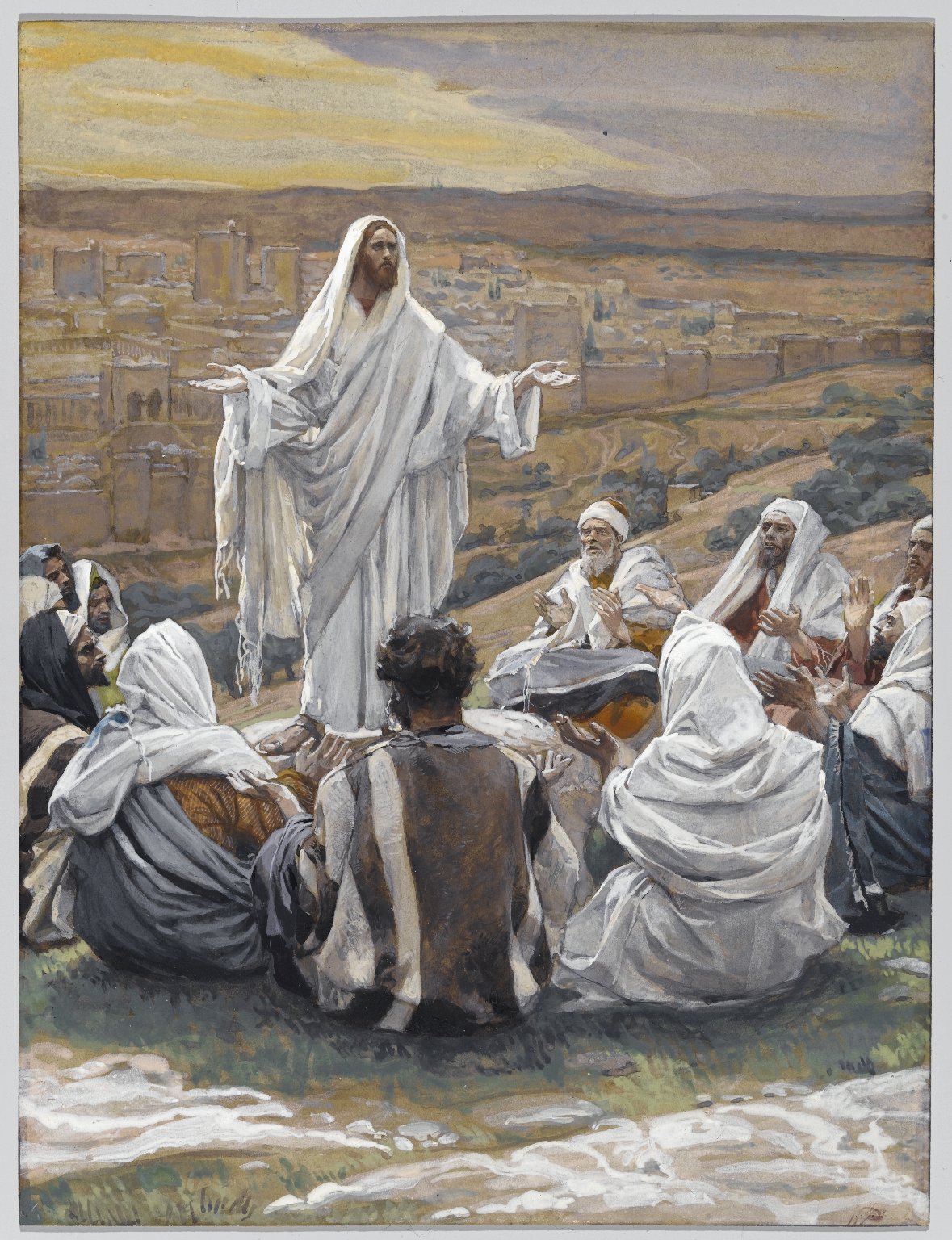
James Tissot – The Lord’s Prayer [Brooklyn Museum]

Quinquagesima 2025

LIVING in the Welsh countryside we are surrounded by trees (coed). At this time of year we notice changes in them as catkins and buds appear. Spring is arriving, a new season, and the trees prepare for the transformations they will undergo during the months ahead. Likewise, we too need to prepare to enter a new season: Lent. The time of preparation for the transformation of Easter, when death turns to life through the Resurrection of Our Lord Jesus Christ.

In our first reading this morning we are given a criterion for judgement:

‘Fel y mae ffrwyth pren yn dangos y driniaeth a gafodd, felly y mae mynegiant rhywun o’i feddyliau yn dangos ei ddiwylliant’

‘The fruit discloses the cultivation of a tree; so the expression of a thought discloses the cultivation of a person’s mind.’ (Eccles. 27:6)

However, mention of trees and fruit makes us look both backwards and forwards. Back to Genesis, where humanity falls through eating forbidden fruit, and forward to Calvary, where the Cross becomes the tree of salvation. Christ is the fruit that hangs upon this tree, who heals our wounds, and who offers us eternal life.

In today’s Gospel, Jesus begins by telling a parable which seeks to criticise the Pharisees, and Religious Authorities of His day. 

“Adroddodd Iesu ddameg wrth ei ddisgyblion: “A fedr y dall arwain y dall? Onid syrthio i bydew a wna’r ddau? Nid yw disgybl yn well na’i athro; ond wedi ei lwyr gymhwyso bydd pob un fel ei athro.”

“Jesus told his disciples a parable: ‘Can a blind man lead a blind man? Will they not both fall into a pit? A disciple is not above his teacher, but everyone when he is fully trained will be like his teacher. ”(Lk 6:39-40)

The Pharisees are described as the blind leading the blind; teachers leading people the wrong way, oblivious to their own faults and shortcomings, yet judging others. They appear as hypocrites, as the teaching goes on to explain:

“Pam yr wyt yn edrych ar y brycheuyn sydd yn llygad dy gyfaill, a thithau heb sylwi ar y trawst sydd yn dy lygad dy hun? Sut y gelli ddweud wrth dy gyfaill, ‘Gyfaill, gad imi dynnu allan y brycheuyn sydd yn dy lygad di’, a thi dy hun heb weld y trawst sydd yn dy lygad di? Ragrithiwr, yn gyntaf tyn y trawst allan o’th lygad dy hun, ac yna fe weli yn ddigon eglur i dynnu’r brycheuyn sydd yn llygad dy gyfaill.”

“Why do you see the speck that is in your brother’s eye, but do not notice the log that is in your own eye? How can you say to your brother, ‘Brother, let me take out the speck that is in your eye’, when you yourself do not see the log that is in your own eye? You hypocrite, first take the log out of your own eye, and then you will see clearly to take out the speck that is in your brother’s eye.” (Lk 6:41-42)

To recognise that you have ‘a log in your own eye’ requires both self-examination and the humility to recognise your own failures and shortcomings before making any criticism of others. Here Jesus is clearly telling His followers not to be judgemental. Logs and splinters are made of wood, which comes from trees. With a beam in our own eyes we cannot see anything, let alone assist someone with a splinter in their eye. Making the world a better place starts with each of us as individuals, and not with someone else.

Our Lord then goes on to point out the need to bear good fruit, using an analogy from the natural world:

“Oherwydd nid yw coeden dda yn dwyn ffrwyth gwael, ac nid yw coeden wael chwaith yn dwyn ffrwyth da. Wrth ei ffrwyth ei hun y mae pob coeden yn cael ei hadnabod; nid oddi ar ddrain y mae casglu ffigys, ac nid oddi ar lwyni mieri y mae tynnu grawnwin.”

“For no good tree bears bad fruit, nor again does a bad tree bear good fruit, for each tree is known by its own fruit. For figs are not gathered from thorn bushes, nor are grapes picked from a bramble bush.” (Lk 6:43-44)

This vivid imagery is simple and straightforward. If we as Christians are to bear good fruit, then we need to live good lives. The Pharisees are trees bearing bad fruit, whereas Our Lord has come to offer humanity life in all its fulness. But for this, He will be rejected and hung on a tree. However, this fruit is the greatest that there is. God gives himself for us and to us, so that we may have life in Him. So that we may grow and flourish.

Our taking part in and receiving of the Eucharist is the way in which we are strengthened as Christians. It is the medicine for our souls. If we are nourished by Jesus then we can be built up in love and faith, and strengthened to bear witness to Christ. We need God’s grace to be at work in us, to fortify, and sustain us. 

At its heart Christianity is a religion of transformation. In the Incarnation Christ became what we are, so that we might share His Divine Life. God does not want us to stay as we are. When we encounter Him in prayer, in reading Holy Scripture, and in the Sacraments, we are changed by that experience. We become something which we were not before. Our faith is deepened, we grow in holiness, and we reflect more fully the light of Him in whose image we were created.

So, let us prepare to deepen our encounter with God as we approach the season of Lent. Let us use self-examination, and prayer, so that we may grow in holiness. Let us become firmly rooted in Christ, living out our faith to proclaim the Good News of the Kingdom, so that the world may believe and give glory i Duw Dad, Duw y Mab, a Duw yr Ysbryd Glân. I’r hwn y priodoler pob gogoniant, arglwyddiaeth, a gallu, yn awr, ac yn oes oesoedd. Amen.

Trinity XIX

When I was studying for my PhD, I was expected to gain experience in giving papers at conferences. After you have given a conference talk, there is a time for the audience to ask questions. What you quickly learn is that some people take a particular delight in posing the most difficult questions. It is the same in all areas of life, and it isn’t much fun answering this line of enquiry. Jesus is constantly running up against people who ask difficult questions. The Pharisees, experts on Jewish religious law, seem to take a particular delight in asking awkward things. They try to catch Our Lord out, to undermine His teaching and credibility. However, they are unable to do so.

In the Gospel today, Jesus and His Disciples are stopped by legal experts, who ask Him a tricky question:

‘Is it lawful for a man to divorce his wife?’

‘oedd ym gyfreithlon i ddyn ysgaru ei wraig’ (Mk 10:2)

Our Lord answers their question with another:

‘What did Moses command you?’

‘Beth a orchmynnodd Moses i chwi?’ (Mk 10:3)

His strategy is a sensible one. They have asked if divorce is lawful, so Jesus refers them to Moses, the giver of the Jewish law. The Pharisees reply that Moses allowed divorce, whereupon Christ proceeds to explain the law to them. He contrasts the present situation with that established by God in the Creation. Marriage is a loving and faithful union which unites two people so they become one flesh. The concept of marriage is used throughout the Old Testament to describe the relationship between God and Israel. 

Later on Jesus’ disciples ask Him about divorce. In His reply Jesus calls marriage after divorce adultery. This represents a strengthening of the position, and has been understood as forbidding what had been previously allowed. What we are dealing with here is an ideal position, which humanity often fails to live up to. Sometimes Our Lord’s teachings are hard. The perfection that God expects of us can appear unattainable. However, this needs to be balanced by the fact that God is a God of love, mercy, and forgiveness. Christianity is a religion of love which recognises that people’s lives are often far from perfect.

Some time later people bring their children for Jesus to bless them. The disciples are unhappy about this and tell the people off. It has been a busy time and they are concerned that Our Lord is tired. Christ, however, rebukes them:

“Let the children come to me; do not hinder them, for to such belongs the kingdom of God. Truly, I say to you, whoever does not receive the kingdom of God like a child shall not enter it.”

“Gadewch i’r plant ddod ataf fi; peidiwch â’u rhwystro, oherwydd i rai fel hwy y mae ternas Dduw yn perthyn. Yn wir, ‘rwy’n dweud wrthych, pwy bynnag nad yw’n derbyn teyrnas Dduw yn null plentyn, nid â byth i mewn iddi” (Mk 10:14-15)

Jesus uses the children to make an important point. If we want to enter the Kingdom of God we have to be like children — simple, trusting, humble, unself-conscious, and dependant on others for our well-being. Our salvation, God’s grace, is a gift which we have to accept. We do not work for it, or earn it. By trying to stop the children coming for a blessing the disciples have overstepped the mark. So Jesus points out that we are all called to be joyful. Children play because it is fun and they love it. For youngsters, play is a serious business, done for its own sake, and no other. The same can be said about worship.

God does not need our praise. Worship is something that we need to do. Christians engage in prayer and worship not to change God, but to change ourselves: so that we might grow and develop, in the same way that children do. We come as children of God to be fed by God, so that we might grow into His likeness. This is the Kingdom, here and now, and we come in childish simplicity to be with God and each other, to learn, to pray, and to be nourished. This is what life is really about. This is what really matters.

That is why today we also hear the account of the Creation of humanity in the second chapter of Genesis. God knows that it is not good for people to be alone. Humanity is made for relationship: male and female, different and equal, made in the image and likeness of God, made for family. There is no greater kinship than the Church, where we are all brothers and sisters in Christ. This is a relationship which extends through space and time, and includes both the living and the dead. The Church family is united in faith, and hope, and love, fed with the bread of Heaven — God’s very self.

My Brothers and Sisters in Christ, we are loved by God, who longs for us to have life in all its fulness. Let us celebrate being members of the family that is the Kingdom, united with God and each other. Let us live lives of compassion and forgiveness, so that we attract others to know, and love, God the Father, God the Son, and God the Holy Spirit. To whom be ascribed all glory, dominion and power, now and forever. Amen.
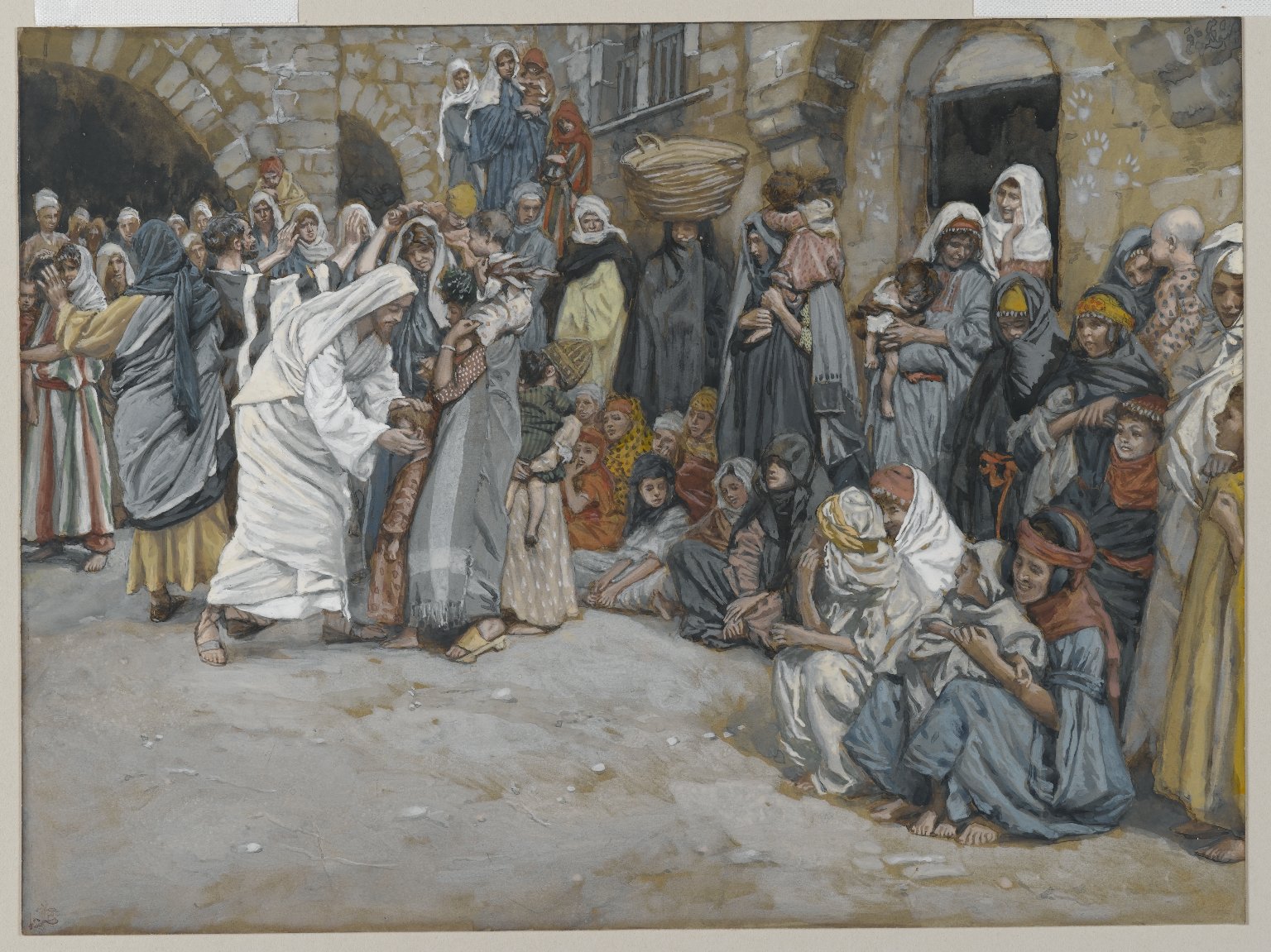
James Tissot: Suffer the little children to come unto me [Brooklyn Museum]