“But even now I know that whatever you ask from God, God will give you.”
“A hyd yn oed yn awr, mi wn y rhydd Duw i ti beth bynnag a ofynni ganddo.” ” (Jn 11:22)
One thing is absolutely certain from the moment we are born, and that is that our earthly life will end at some point. This is something most people don’t like to spend much time thinking about, and yet it remains an inescapable truth. The Sadducees in Ancient Israel did not believe in life after death, and there are probably plenty of people nowadays who think the same as them. However, the Christian Faith is a celebration of the Life, Death, and Resurrection of Jesus Christ. We are an Easter people. Resurrection is the heart of our faith. As our celebration of Lent continues, we look to the Cross and beyond to the glory of Easter, placing our hope in Him who died and rose again.
The possibility of bringing life out of death is central to the first reading from the prophet Ezekiel. Writing during the exile in Babylon, the prophet has a vision of a valley of dry bones. Even in this image of lifelessness, Ezekiel is able to see God’s ability to bring good out of every situation. Ezekiel’s vision of the day of resurrection also looks forward to Jesus, who is the fulfilment of all prophecy.
Today’s Gospel takes place in Bethany, a village about two miles east of Jerusalem. Bethany is best known for being the home of Lazarus, Mary, and Martha, who were followers and friends of Jesus. Their house still exists, and now forms part of a church. The Raising of Lazarus from the dead is the last of Jesus’ signs and miracles before His Passion. It was the final straw that pushed the Religious Authorities in Jerusalem into having Our Lord arrested and killed. From the start, today’s Gospel passage looks forward to the events around Jesus’ Passion. The reading begins by pointing out that:
It was Mary who anointed the Lord with ointment and wiped his feet with her hair, whose brother Lazarus was ill. (Jn 11:2)
St Matthew’s account of the Passion begins with this anointing in Bethany. The two sisters send a message to tell Jesus that their brother, ‘he whom you love is ill’ (Jn 11:3). However Our Lord’s response to this news is surprising:
“This illness does not lead to death. It is for the glory of God, so that the Son of God may be glorified through it.” (Jn 11:4)
Jesus then remains two more days where He is, and after this time tells His disciples, “Let us go to Judea again.” (Jn 11:7)
At a human level this seems strange. We would expect Jesus to go straight away to see His friend who is ill, in order to heal him. But this is not what happens. What is even more unexpected is that a few verses later Our Lord makes known that He is aware that Lazarus has died:
Then Jesus told them plainly, “Lazarus has died, and for your sake I am glad that I was not there, so that you may believe. But let us go to him.” (Jn 11:14-15)
The key point is that the disciples may believe. Lazarus’ death is how they will come to belief, as it prefigures Our Lord’s Resurrection. The raising of Lazarus is a sign which points towards Easter.
Jesus and His disciples travel back to Bethany, and as they approach the village they are met by Martha, Lazarus’ sister, who greets Our Lord and says:
“Lord, if you had been here, my brother would not have died. But even now I know that whatever you ask from God, God will give you.” (Jn 11:21-22)
Martha is grieving her brother’s death, but in the midst of her grief she can recognise Jesus’ ability to heal, through the help of God. Martha has a deep faith, which is demonstrated in the following memorable exchange:
Jesus said to her, “Your brother will rise again.” Martha said to him, “I know that he will rise again in the resurrection on the last day.” Jesus said to her, “I am the resurrection and the life. Whoever believes in me, though he die, yet shall he live, and everyone who lives and believes in me shall never die. Do you believe this?” She said to him, “Yes, Lord; I believe that you are the Christ, the Son of God, who is coming into the world.” (Jn 11:23-27)
Martha understands Jesus’ words to be about the resurrection of the dead before the final judgement. Jesus explains that, through her faith in Him, she can have true hope. Through our faith in Christ we can also have eternal life in Him. We too need to believe and trust in Him. Our Lord raises Lazarus to point to His own Resurrection, to explain what will happen. He does this to give people hope, to strengthen their faith, and to help them to live out His love in their lives.
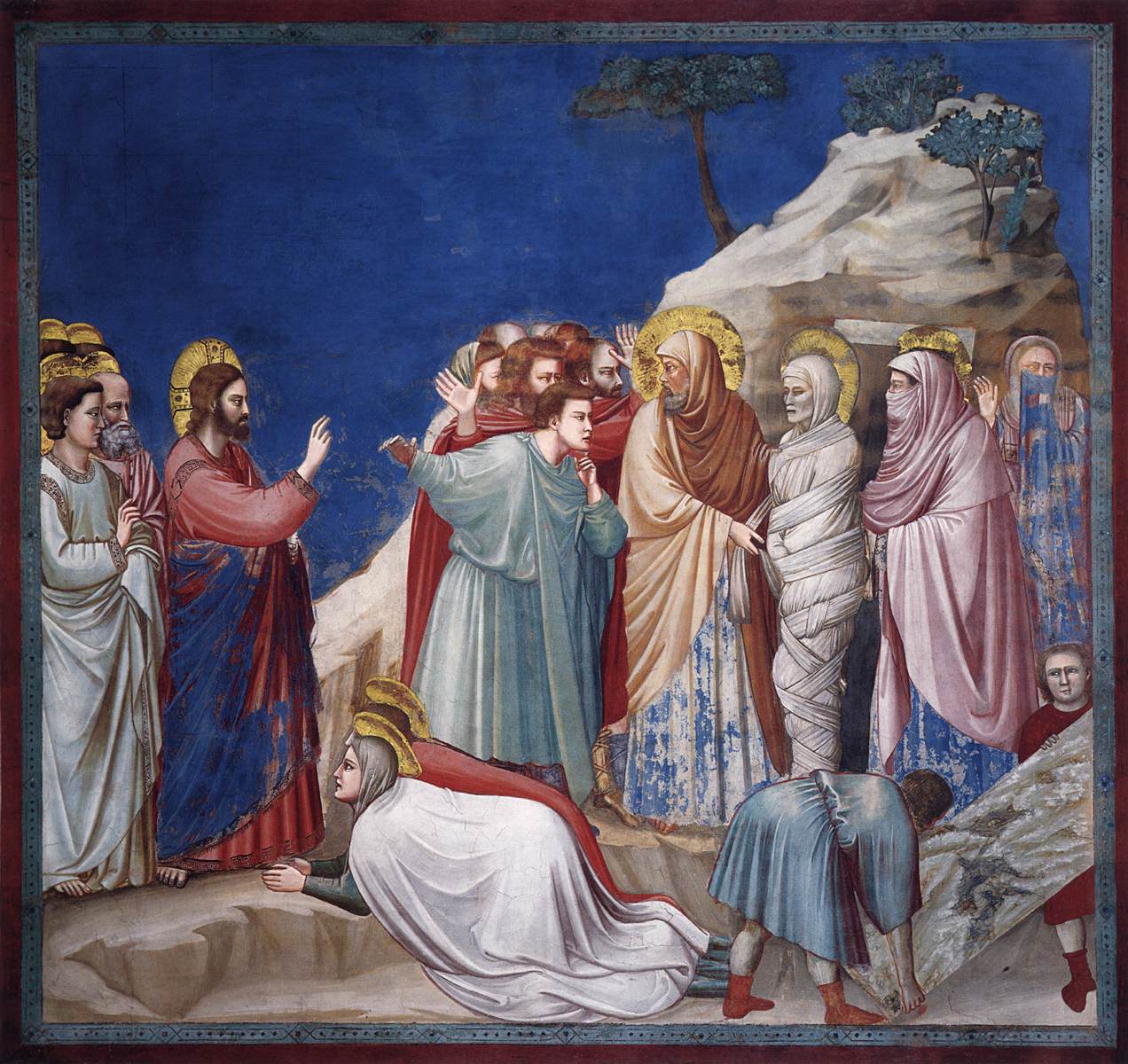
Mary of Bethany’s initial response is the same as that of her sister, Martha. She wishes that Jesus had been there to heal Lazarus, and she falls at His feet, weeping. Mary’s grief moves Our Lord, who asks where her brother is buried.
They said to him, “Lord, come and see.” Jesus wept. (Jn 11:34-35)
There is an immense power in these last two words: ‘Jesus wept’. God, who created the Universe weeps at the grave of His friend. Jesus is the man of sorrows, acquainted with grief. He will soon undergo His Passion and Death for us. We have a God who understands humanity, who shares our pain, and who will submit Himself to torture and death on our behalf.
Jesus tells the people assembled at the tomb to remove the stone. Martha, ever the practical disciple, points out that there will be an odour as Lazarus has been dead for four days.
Jesus said to her, “Did I not tell you that if you believed you would see the glory of God?” So they took away the stone. And Jesus lifted up his eyes and said, “Father, I thank you that you have heard me. I knew that you always hear me, but I said this on account of the people standing around, that they may believe that you sent me.” When he had said these things, he cried out with a loud voice, “Lazarus, come out.” (Jn 11:40-43)
The key here is faith and prayer. In this respect the raising of Lazarus is no different, and no less miraculous, than our own daily lives, which are supported by our faith in God, and prayer. Martha has faith, and sees the glory of God in the raising of her brother who was dead and is now alive. The raising of Lazarus is a miracle, and a demonstration of God’s love, which also points forward to all that Jesus will accomplish in His Passion, Death and Resurrection.
In our baptism we share in Christ’s saving Death and Resurrection. In the signs of John’s Gospel, from the changing of water into wine at the Marriage Feast at Cana, to the raising of Lazarus, we see demonstrations of God’s love, and the power of prayer and faith. Jesus demonstrates that we are loved by a generous God, who is willing to die for us, and rise again, to offer us new life in Him, through faith.
Therefore, my brothers and sisters in Christ, let us embrace the faith of Mary and Martha, and trust in Our Lord to heal our wounds and raise us to eternal life. Let us give thanks and sing the praises of God the Father, God the Son, and God the Holy Spirit, Duw Dad, Duw Y Mab, a Duw yr Ysbryd Glân. To whom be ascribed all, glory, dominion, and power, now and forever. Amen.


 Novus Motus Oxoniensis