When I was studying for my PhD, I was expected to gain experience in giving papers at conferences. After you have given a conference talk, there is a time for the audience to ask questions. What you quickly learn is that some people take a particular delight in posing the most difficult questions. It is the same in all areas of life, and it isn’t much fun answering this line of enquiry. Jesus is constantly running up against people who ask difficult questions. The Pharisees, experts on Jewish religious law, seem to take a particular delight in asking awkward things. They try to catch Our Lord out, to undermine His teaching and credibility. However, they are unable to do so.
In the Gospel today, Jesus and His Disciples are stopped by legal experts, who ask Him a tricky question:
‘Is it lawful for a man to divorce his wife?’
‘oedd ym gyfreithlon i ddyn ysgaru ei wraig’ (Mk 10:2)
Our Lord answers their question with another:
‘What did Moses command you?’
‘Beth a orchmynnodd Moses i chwi?’ (Mk 10:3)
His strategy is a sensible one. They have asked if divorce is lawful, so Jesus refers them to Moses, the giver of the Jewish law. The Pharisees reply that Moses allowed divorce, whereupon Christ proceeds to explain the law to them. He contrasts the present situation with that established by God in the Creation. Marriage is a loving and faithful union which unites two people so they become one flesh. The concept of marriage is used throughout the Old Testament to describe the relationship between God and Israel.
Later on Jesus’ disciples ask Him about divorce. In His reply Jesus calls marriage after divorce adultery. This represents a strengthening of the position, and has been understood as forbidding what had been previously allowed. What we are dealing with here is an ideal position, which humanity often fails to live up to. Sometimes Our Lord’s teachings are hard. The perfection that God expects of us can appear unattainable. However, this needs to be balanced by the fact that God is a God of love, mercy, and forgiveness. Christianity is a religion of love which recognises that people’s lives are often far from perfect.
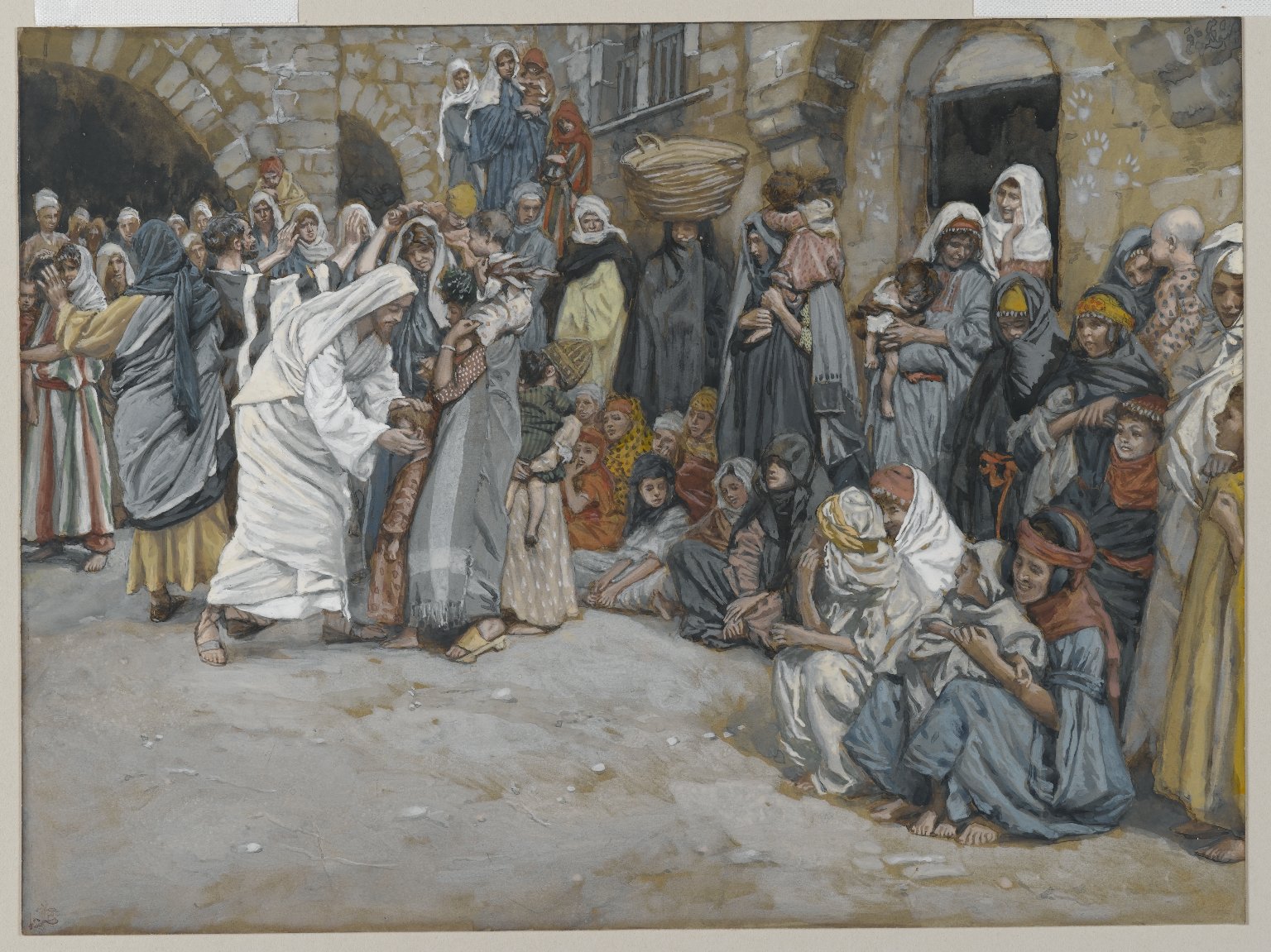
Some time later people bring their children for Jesus to bless them. The disciples are unhappy about this and tell the people off. It has been a busy time and they are concerned that Our Lord is tired. Christ, however, rebukes them:
“Let the children come to me; do not hinder them, for to such belongs the kingdom of God. Truly, I say to you, whoever does not receive the kingdom of God like a child shall not enter it.”
“Gadewch i’r plant ddod ataf fi; peidiwch â’u rhwystro, oherwydd i rai fel hwy y mae ternas Dduw yn perthyn. Yn wir, ‘rwy’n dweud wrthych, pwy bynnag nad yw’n derbyn teyrnas Dduw yn null plentyn, nid â byth i mewn iddi” (Mk 10:14-15)
Jesus uses the children to make an important point. If we want to enter the Kingdom of God we have to be like children — simple, trusting, humble, unself-conscious, and dependant on others for our well-being. Our salvation, God’s grace, is a gift which we have to accept. We do not work for it, or earn it. By trying to stop the children coming for a blessing the disciples have overstepped the mark. So Jesus points out that we are all called to be joyful. Children play because it is fun and they love it. For youngsters, play is a serious business, done for its own sake, and no other. The same can be said about worship.
God does not need our praise. Worship is something that we need to do. Christians engage in prayer and worship not to change God, but to change ourselves: so that we might grow and develop, in the same way that children do. We come as children of God to be fed by God, so that we might grow into His likeness. This is the Kingdom, here and now, and we come in childish simplicity to be with God and each other, to learn, to pray, and to be nourished. This is what life is really about. This is what really matters.
That is why today we also hear the account of the Creation of humanity in the second chapter of Genesis. God knows that it is not good for people to be alone. Humanity is made for relationship: male and female, different and equal, made in the image and likeness of God, made for family. There is no greater kinship than the Church, where we are all brothers and sisters in Christ. This is a relationship which extends through space and time, and includes both the living and the dead. The Church family is united in faith, and hope, and love, fed with the bread of Heaven — God’s very self.
My Brothers and Sisters in Christ, we are loved by God, who longs for us to have life in all its fulness. Let us celebrate being members of the family that is the Kingdom, united with God and each other. Let us live lives of compassion and forgiveness, so that we attract others to know, and love, God the Father, God the Son, and God the Holy Spirit. To whom be ascribed all glory, dominion and power, now and forever. Amen.
 Novus Motus Oxoniensis