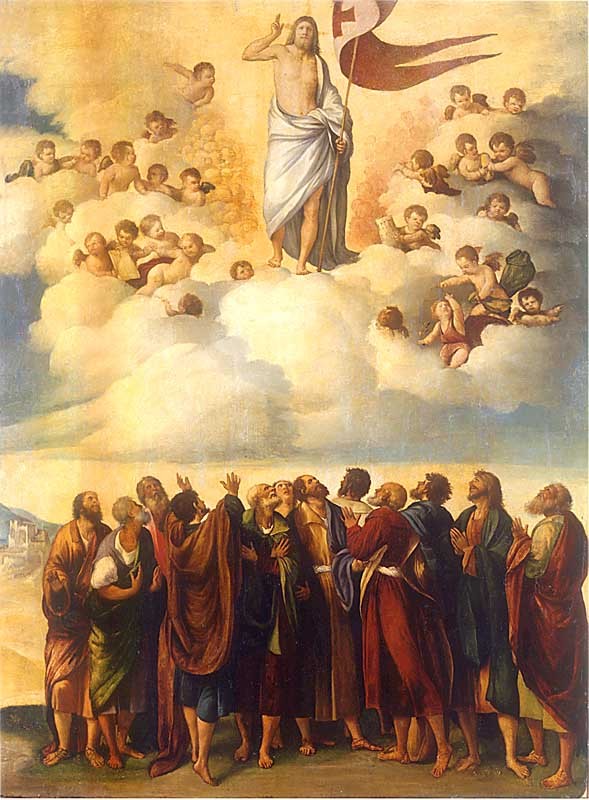
Ascension Day is a time for celebration. However, we are not commemorating Jesus’ departure from the earth, but instead His return to God the Father. We celebrate Christ’s abiding presence with us, and also those things that He asks of us, and promises to us. It is a day of festivity and expectation, looking forward to the future in love and hope.
Before Jesus returns to the Father, He makes the apostles a three-part promise: Firstly that they will be baptized with the Holy Spirit (Acts 1:4), secondly that they will receive power, and thirdly they will be Christ’s witnesses to the ends of the earth (Acts 1:8). Through this promise Christ is looking forward to Pentecost, and to the church’s future. To the time in which we live now.
One of the most important questions in the entire Bible is found in today’s Gospel: who do you say that Jesus is? How we answer this question can tell us a lot about our own faith. Who we say Jesus is matters. In fact it is central to who and what we are as Christians.
In the Gospel, Jesus and his disciples had ventured into the District of Caesarea Philippi, an area about 25 miles northeast of the Sea of Galilee. This region had tremendous religious implications. The place was littered with the temples of Syrian gods. Caesarea Philippi was where Herod the Great, father of the then-ruling Herod Antipas, had erected an elaborate marble temple. Here you could even worship the Roman Emperor as a God himself. You might say that the religions of the known world were on display in this town. It was with this multi-religious background that Jesus chose to ask the most crucial question of his ministry.
Jesus asks his disciples, ‘But who do YOU say that I am?’ ‘A chwithau pwy meddwch chwi ydwyf fi?’ (Mt 16:15) Peter answers: ‘You are the Messiah, the Son of the Living God’ ‘Ti yw’r Meseia, Mab y Duw byw’ (Mt 16:16). This is a big claim to make. Saying that Jesus is divine was problematic, as these words undermined both what Jews thought about religion, and also the claims made by Romans about the Emperor. To say that Jesus is the Anointed One, the Hope of Israel, who fulfils the promises in the Prophets is a very radical statement indeed.
Peter’s answer demonstrates his faith. He believes in Jesus, and trusts Him. Because of this, Our Lord makes him the principal disciple and gives him a primary role in leading and building the Church. Christ is looking towards the future where the disciples will carry on what He has started. They are charged with sharing the Good News, and offering forgiveness in Jesus’ name.
Our Lord ascends to Heaven forty days after the Resurrection, but Christ does not leave us. Instead He takes our humanity to be with God. This process began with the breaking open of the gates of Hell at Easter. Having conquered death itself, Jesus returns to the Father, taking us with Him. This is also a prelude to the outpouring of the Holy Spirit at Pentecost. God is generous. He saves humanity. He opens Heaven to us. He promises us the Holy Spirit, to strengthen us as we live our lives of faith.
If we truly believe that Jesus Christ is the Son of the Living God, the Messiah — the anointed one who delivers us from our sins, who died, rose again, and who sends us His Holy Spirit — then this faith should have a profound effect on who we are and how we live our lives. This is why we have gathered here this evening to be nourished by Word and Sacrament. We have come together to pray for the world and for each other, and to be built up in love, as we await Our Lord’s Second Coming as Judge and Ruler of all.
Jesus makes promises which are true. We can trust Him, and like the apostles we can prepare for the Coming of the Holy Spirit at Pentecost in prayer, and joyful expectation. We know that we will never be abandoned, because we are always united with, and loved by the Triune God. United with our Christian brothers and sisters around the world we give praise to God the Father, God the Son, and God the Holy Spirit, to whom be ascribed all glory, dominion, and power, now and forever.
 Novus Motus Oxoniensis