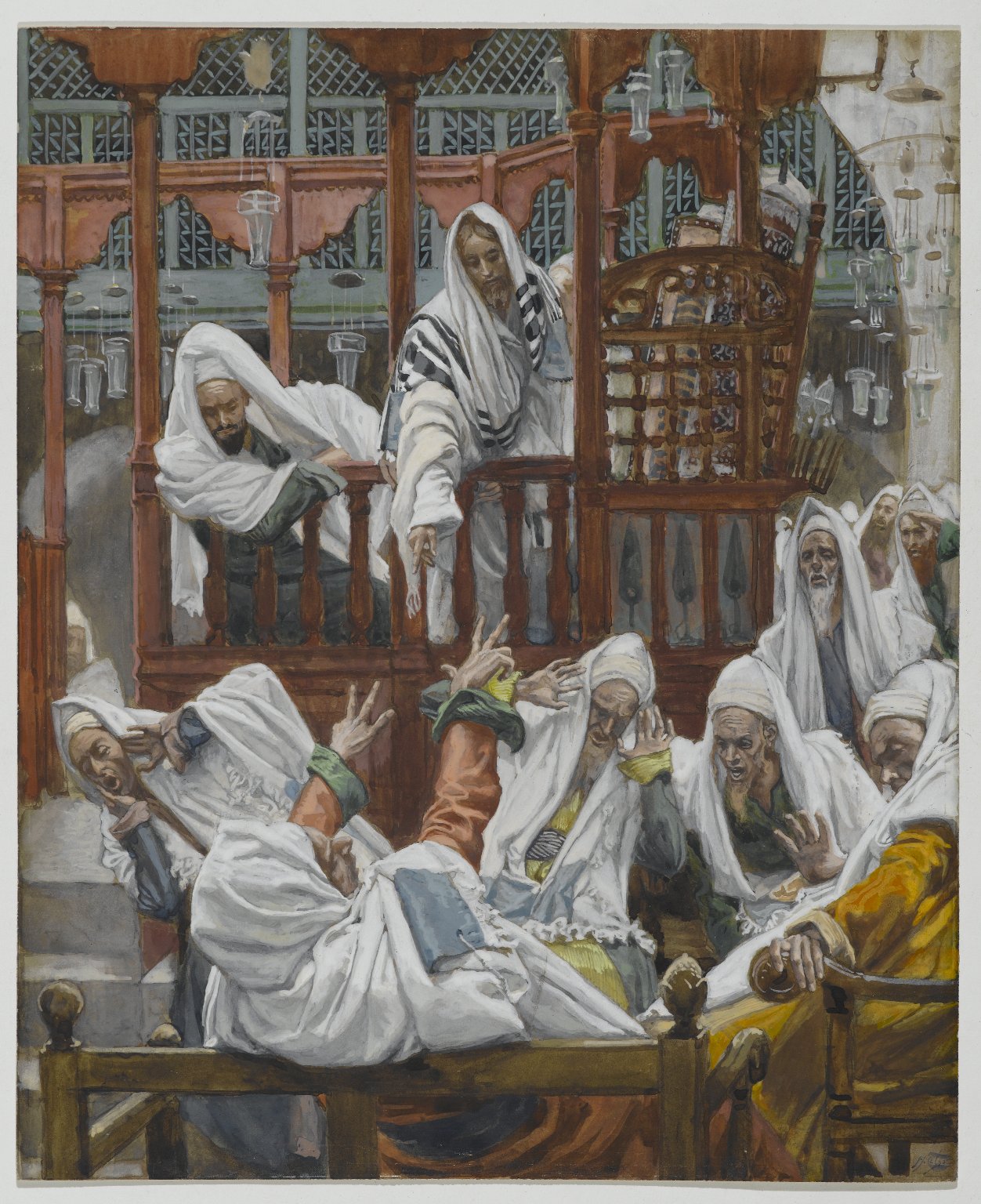
Trinity XV: Ephphatha – Be Opened!

I can still remember vividly the experience of my first Sunday off after being ordained. I had everything planned out. A friend of mine from theological college was a curate about 45 minutes away, so I could both see a friend and enjoy some quiet anonymous worship at the back of the pews. I dressed casually, but within seconds of entering the church I was handed books with a cheerful ‘Good Morning Father!’. I was rumbled! I suspect that without thinking about it I had performed several ritual gestures on entering, which rather gave the game away. Our actions are louder than our words, louder than the clothes we wear. Christianity is a faith which we live, which affects who we are, and what we do. 

The reading from the Letter of James makes this very point: God doesn’t treat people differently, so neither should we in the church. If anything the church should go out of its way to look after the poor, because in their poverty they know their need for God. 

‘Listen, my beloved brothers, has not God chosen those who are poor in the world to be rich in faith and heirs of the kingdom, which he has promised to those who love him?

‘Clywch, fy mrodyr annwyl. Oni ddewisodd Duw y rhai sy’n dlawd yng ngolwg y byd i fod yn gyfoethog mewn ffydd ac yn etifeddion y deyrnas a addawodd ef i’r rhai sydd yn ei garu?’ (James 2:5)

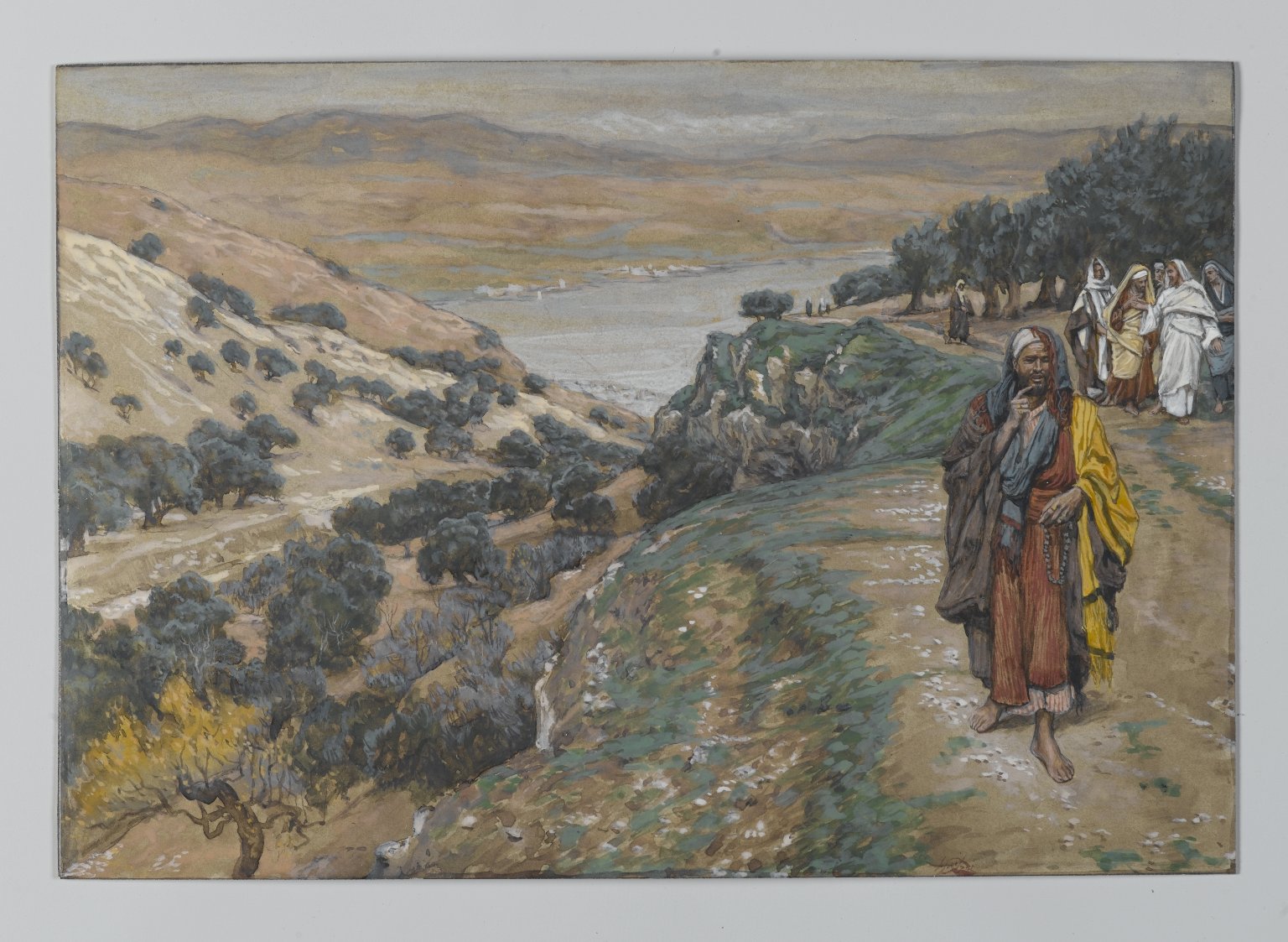
In this morning’s Gospel Jesus has been in Gentile territory to the north of Galilee. He has healed the Syro-Phonecian woman’s daughter, and is now heading back towards the Sea of Galilee. Having heard of His reputation for performing miraculous healings people bring a man to Our Lord who cannot hear or speak clearly, in the hope that he can be healed:

‘and they begged him to lay his hand on him.’

‘a cheisio ganddo roi ei law arno.’ (Mk 7:32)

The people are desperate: there is nothing they can do. This charismatic healer and teacher is their only hope. So Our Lord takes the man to one side, away from the crowd, and performs the healing. 

‘he put his fingers into his ears, and after spitting touched his tongue. And looking up to heaven, he sighed and said to him, “Ephphatha”, that is, “Be opened.”’

‘rhoes ei fysedd yn ei glustiau, poerodd, a chyffyrddodd â’i dafod; a chan edrych i fyny i’r nef ochneidiodd a dweud wrtho, “Ephphatha”, hynny yw, “Agorer di”.’ (Mk 7:33-4)

The scene may seem a little strange to us nowadays, but it has a refreshing physicality to it. Jesus isn’t simply preoccupied with spiritual matters. The healing is physical: involving touch and saliva. Our Lord does raise His eyes to Heaven and pray, but He also says, ‘Ephphatha — Be opened’ and the man is healed. Jesus is both conforming to people’s expectations, what they would like to be done, and also bringing about a miraculous healing by the power of God. 

‘And his ears were opened, his tongue was released, and he spoke plainly.’

‘Agorwyd ei glustiau ar unwaith, a datodwyd rhwym ei dafod a dechreuodd lefaru’n eglur.’ (Mk 7:35)

This is marvellous on several levels. It is the fulfilment of Isaiah’s prophecy which is the first reading today:

‘Then the eyes of the blind shall be opened, and the ears of the deaf unstopped; then shall the lame man leap like a deer, and the tongue of the mute sing for joy.’

‘Yna fe agorir llygaid y deillion a chlustiau’r byddariaidd; fe lama’r cloff fel hydd, fe gân tafod y mudan;’ (Isa 35:5-6)

Isaiah is looking forward to the coming of the Messiah, so Our Lord is fulfilling the prophecy and demonstrating his Messianic credentials — announcing to the world both who and what He is. The Kingdom of God is a place of healing and wholeness. It is also no longer to be understood in an exclusive sense. In Chapter 7 of Mark’s Gospel Jesus is outside Israel and now extends His healing to people who are not Jews. This is an important step which will have a profound effect upon the Church and its spreading across the world.

Our Lord tells the people who have witnessed the miracle not to tell anyone about it. However, his words have the opposite effect:

‘But the more he charged them, the more zealously they proclaimed it. And they were astonished beyond measure, saying, “He has done all things well. He even makes the deaf hear and the mute speak.”’

‘ond po fwyaf yr oedd ef yn gorchymyn iddynt, mwyaf yn y byd yr oeddent hwy’n cyhoeddi’r peth. Yr oeddent yn synnu’n fawr dros ben, gan ddweud, “Da y gwnaeth ef bob peth; y mae’n gwneud hyd yn oed i fyddariaid glywed ac i fudion lefaru.”’ (Mk 7:36-37)

They are amazed that prophecy is being fulfilled. But more than that, we see Gentiles sharing the Good News of the Kingdom of God. This is how the Church grows, and we see its beginnings here. The people of the Decapolis, the ten towns, are proclaiming the truth of the Gospel. They point forward to the spread of the Church.aWe are here in Church today because people have told others about it. The people’s profound experience of God’s healing love compels them to share it with others. Just as the deaf mute has been opened by the prayer of Jesus, so have the people around him. Their ears are opened and their tongues are loosed to proclaim the might works of God. 

The Kingdom of God is a place of healing and restoration for all, a fact which the Church continues to proclaim. Rather than being an exclusive event for the Chosen People, healing and salvation are for all who turn to God. All are invited, all are welcome. We are here today because people have shared the Good News with us. All of us come in need of God’s grace, His unmerited kindness. Not only this, but God gives us His very self, to heal us, and transform us.

My brothers and sisters in Christ, may we come to the Lord, so that we may be healed and restored. May we proclaim the Good News of the Kingdom of God, so that others may come to know and love God the Father, God the Son, and God the Holy Spirit. To whom be ascribed all glory, dominion and power, now and forever. Amen.
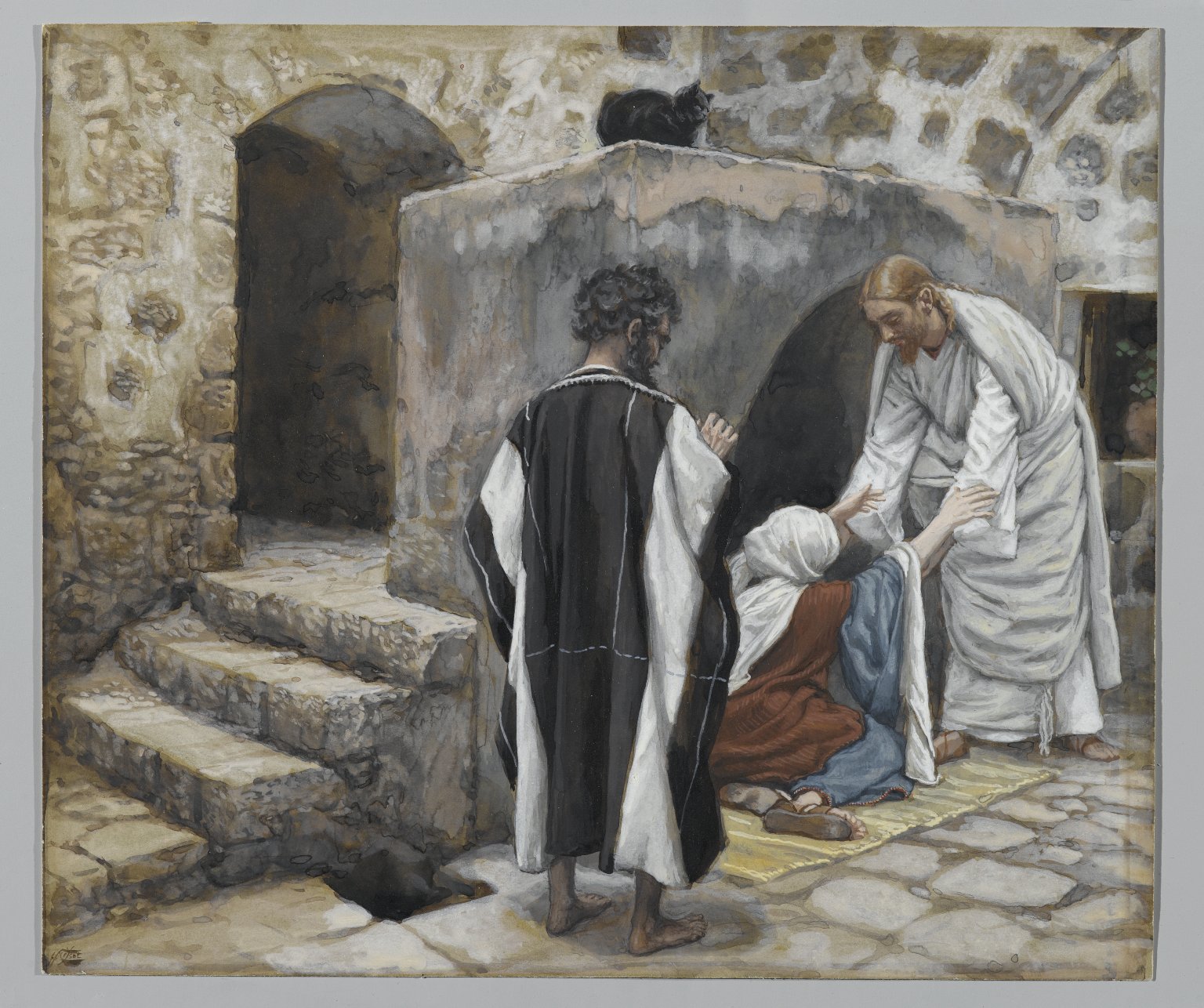
James Tissot: Jesus Heals a Mute Possessed Man (Brooklyn Museum)

Trinity XIV: Authentic Faith

‘For the Lord sees not as man sees: man looks on the outward appearance, but the Lord looks on the heart.’

oblegid nid yr hyn a wêl meidrolyn y mae Duw’n ei weld. Yr hyn sydd yn y golwg a wêl meidrolyn, ond y mae’r Arglwydd yn gweld beth sydd yn y galon.’ (1Sam 16:7)

People in general want to be taken seriously, and to be trusted. For a society to function and flourish, people need to be able to trust each other. One of the main ways in which we earn people’s trust is by honesty and authenticity. When our words and actions align, we are people of integrity. If what we do and what we say do not match up, we leave ourselves open to an accusation of hypocrisy: of playing a role rather than being genuine.

This morning’s Gospel begins with a striking scene. Jesus’ disciples are observed by the Scribes and Pharisees to be eating food without having washed their hands beforehand. The Pharisees are unhappy that the disciples are failing to comply with the outward practice of their religion. What the Religious Authorities are advocating is not just good hygiene but ritual cleanliness. After washing one’s hands, and before drying them, the tradition was to recite the following prayer:

Blessed are You, Lord our God, King of the universe, who has sanctified us with Your commandments, and commanded us concerning the washing of the hands.

The Gospel writer, Mark has to explain the practice to his non-Jewish audience, who are not necessarily familiar with such things. He shows how concerned the religious leaders are with what is going on, reporting their question to Jesus:

“Why do your disciples not walk according to the tradition of the elders, but eat with defiled hands?”

“Pam nad yw dy ddisgyblion di’n dilyn traddodiad yr hynafiaid, ond yn bwyta’u bwyd â dwylo halogedig?” (Mk 7:5)

This leads Our Lord to reply:

“Well did Isaiah prophesy of you hypocrites, as it is written, “‘This people honours me with their lips, but their heart is far from me; in vain do they worship me, teaching as doctrines the commandments of men.’ You leave the commandment of God and hold to the tradition of men.”

“Da y proffwydodd Eseia amdanoch chwi ragrithwyr, fel y mae’n ysgrifenedig: ‘Y mae’r bobl hyn yn fy anrhydeddu â’u gwefusau, ond y mae eu calon ymhell oddi wrthyf; yn ofer y maent yn fy addoli, gan ddysgu gorchmynion dynol fel athrawiaethau.’ Yr ydych yn anwybyddu gorchymyn Duw ac yn glynu wrth draddodiad dynol.” (Mk 7:6-8)

Jesus is questioning why the religious authorities are making up rules and stressing the importance of outward compliance with God’s commandments. He quotes from the prophet Isaiah to show that while the Scribes and Pharisees pay lip-service to God, they are not close to Him in their hearts. The Commandments are not an end in themselves, but a means to an end: namely, closeness with God. The Pharisees’ desire for outward conformity and rule-following has led them to drive people away from God, rather than bringing them closer.

The point Jesus is making is also made clear in this morning’s reading from the book of Deuteronomy, where Moses says to the people of Israel:

‘You shall not add to the word that I command you, nor take from it, that you may keep the commandments of the Lord your God that I command you.’

‘Peidiwch ag ychwanegu dim at yr hyn yr wyf yn ei orchymyn ichwi, nac ychwaith dynnu oddi wrtho, ond cadw at orchmynion yr Arglwydd eich Duw yr wyf fi yn eu gorchymyn ichwi.’ (Deut 4:2)

God has made His commands clear. The people should neither add to them, nor ignore them. However, in their desire to be seen to be keeping God’s commands the religious leaders are making up their own laws, and forcing them upon God’s people. They are reducing religion into something done for show, for outward appearance, rather than to help people to grow in holiness.

Christ then develops His teaching, stating:

“There is nothing outside a person that by going into him can defile him, but the things that come out of a person are what defile him.”

“Nid oes dim sy’n mynd i mewn i rywun o’r tu allan iddo yn gallu ei halogi; ond y pethau sy’n dod allan o rywun, dyna sy’n ei halogi.” (Mk 7:15)

Food does not defile us. Defilement is something that we do to ourselves. What we think and feel affects our relationship with God much more than our outward conformity with a religious ritual. This is made clear in God’s words to Samuel before anointing David King of Israel:

‘For the Lord sees not as man sees: man looks on the outward appearance, but the Lord looks on the heart.’

‘oblegid nid yr hyn a wêl meidrolyn y mae Duw’n ei weld. Yr hyn sydd yn y golwg a wêl meidrolyn, ond y mae’r Arglwydd yn gweld beth sydd yn y galon.’ (1Sam 16:7)

Jesus then proceeds to give examples of the human sins which come ‘out of the heart of man’ ‘o galon dynion’ and cause defilement. These include what became known as the seven deadly sins: pride, greed, wrath, envy, lust, gluttony and sloth. 

Christ is uncompromising in diagnosing the problem — these are all things which separate God and humanity. Our Lord is concerned with the cleanliness of people’s souls. It is from within, from the human heart, that sinfulness springs. Jesus’ point is a simple one: we become what we do. Thus, the formation of a moral character is important, and can only be brought about by doing the right things for the right reasons.

However, despite our best efforts, we will never fully succeed. Sin is a problem which only God can sort out. This is why Christ died for us: taking the burden of our wrongdoings upon Himself. He defeats Sin and Death, to reconcile us, and heal us. The Cross is the most important demonstration of Divine Love and Forgiveness. The right action can help form our moral character, but it is God’s Grace which brings about the reconciliation which our efforts cannot.

My brothers and sisters in Christ, let us live out our faith in our lives. Let us proclaim the kingdom in an authentic way, so that others will be drawn to the words and example of Jesus. Clothed in the humility of our need of God, His love and mercy, let us come to Him. To be fed by Him, to be fed with Him, to be healed and restored by Him. With pure hearts, let us give praise to God the Father, God the Son, and God the Holy Spirit. To whom be ascribed all glory, dominion and power, now and forever. Amen.
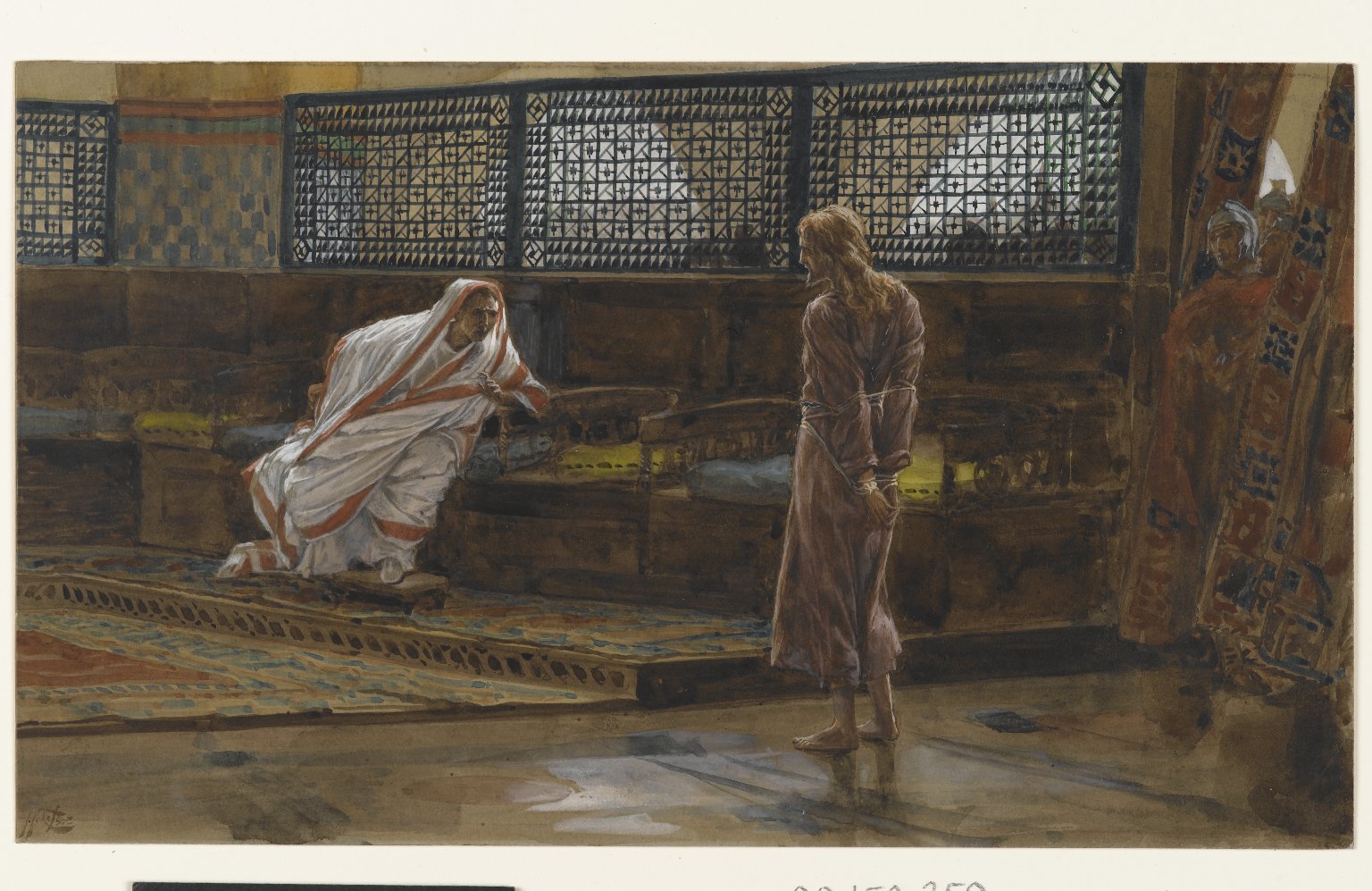
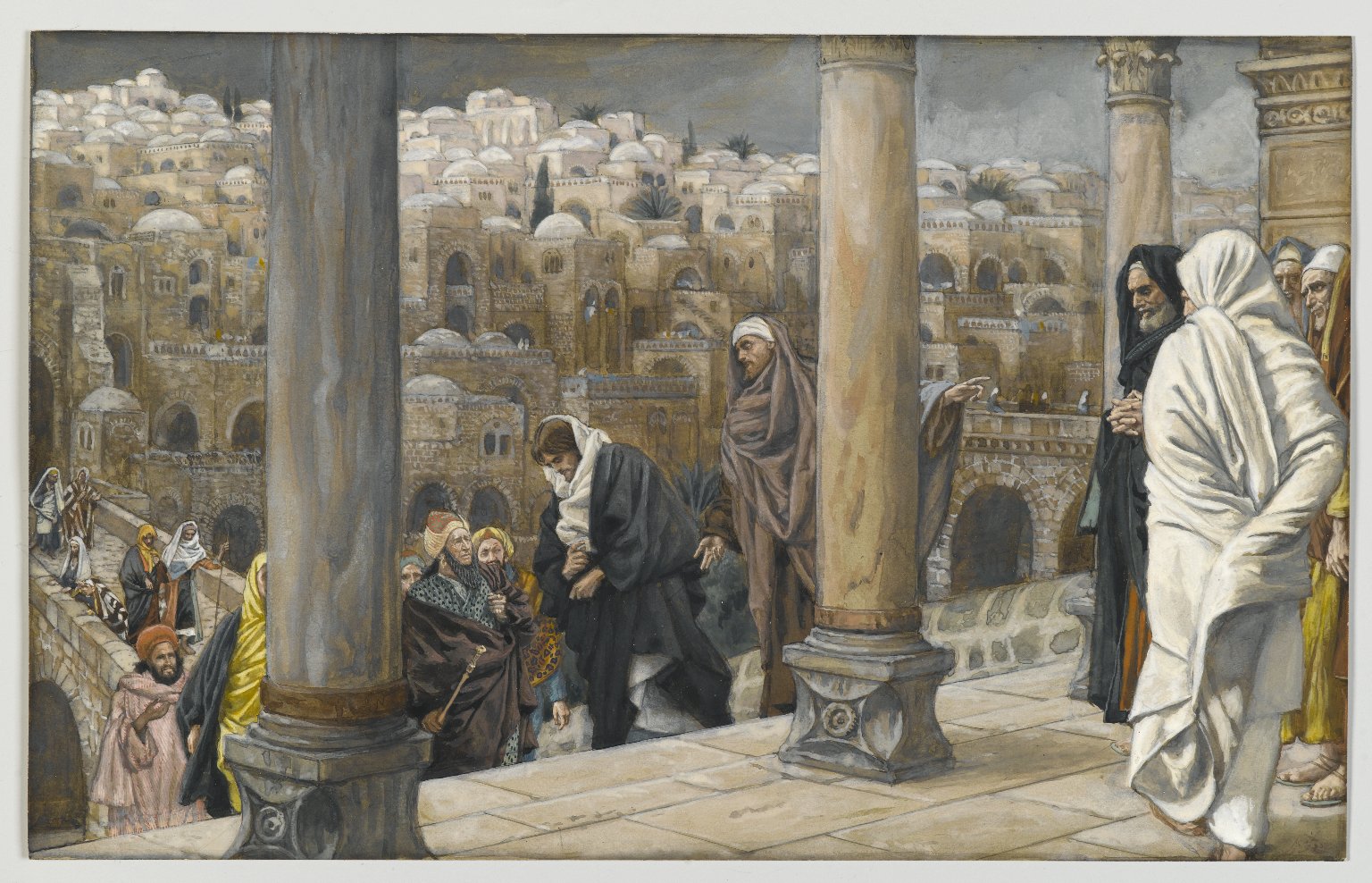
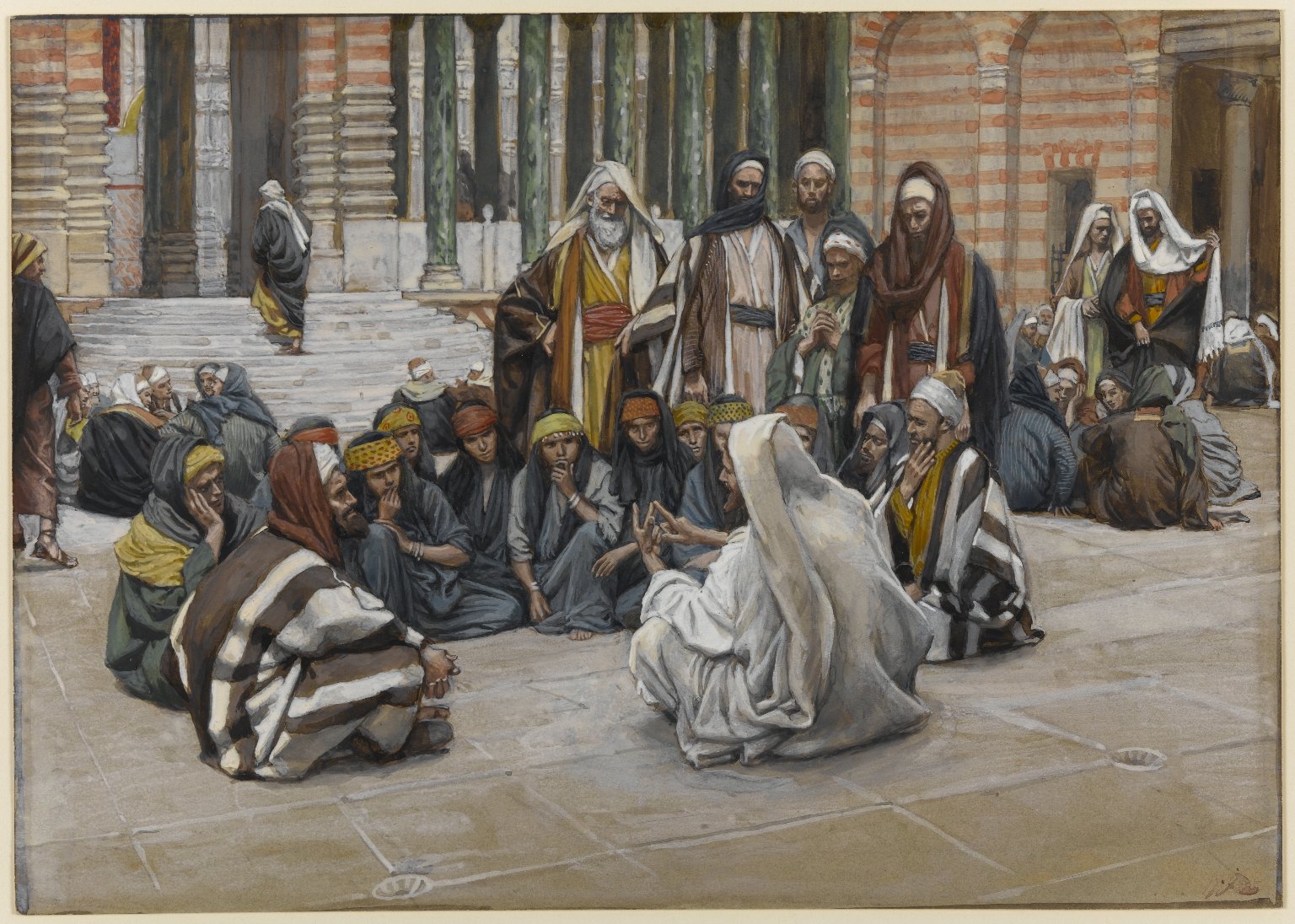
James Tissot – The Pharisees question Jesus (Brooklyn Museum)

Trinity XIII: Lord, to whom shall we go? You have the words of eternal life!

LIFE in the twenty-first century seems to involve an ever-increasing amount of decisions. If we want to buy a cup of coffee we have to make many quick decisions about size, strength, type of coffee, milk, sugar, etc. It can be quite exhausting. Our readings this week focus on the choices and decisions people make. To follow the Christian faith is something we choose to do. We choose to trust God, we are not forced to. The decision to follow Christ is the most important choice we ever make. It affects both our life on earth and in the hereafter.

This morning’s first reading is an account of the renewal of the covenant between God and Israel brought about by Joshua at Shechem. The people of Israel are asked if they want to worship God and follow his laws. Joshua makes his position clear:

“But as for me and my house, we will serve the Lord.”

“Ond byddaf fi a’m teulu yn gwasanaethu’r Arglwydd.” (Josh 24:15)

The people of Israel follow his example and renew their covenant with God:

“Therefore we also will serve the Lord, for he is our God.”

“Yr ydym ninnau hefyd am wasanaethu’r Arglwydd, oherwydd ef yw ein Duw.” (Josh 24:18)

Their religious faith is a conscious act of the will. They choose to serve the God who has saved them. God has shown that He is their God.

In a similar way, the events of Chapter 6 of St John’s Gospel happen around the time of Passover, the festival which marks Israel’s deliverance from slavery in Egypt and the start of their journey to the Promised Land. This is a key moment in Salvation history. Our Lord has been teaching about the Bread of Life, and stressing the importance of eating His flesh and drinking His blood. Such teaching was difficult for a Jewish audience to hear, as it violated fundamental principles of their dietary laws. 

When many of his disciples heard it, they said, “This is a hard saying; who can listen to it?”

Wedi iddynt ei glywed, meddai llawer o’i ddisgyblion, “Geiriau caled yw’r rhain. Pwy all wrando arnynt?” (Jn 6:60)

Jesus is teaching in a synagogue in Capernaum, and those present are not used to this kind of instruction. It turns everything they know on its head. In Hebrew the word for flesh (baśar) and the word for good news, glad tidings, or the Gospel(besorah), sound similar. Such word-play is intentional, and may be linked to the Hebrew Wisdom tradition, such as we heard last week in the Book of Proverbs. Our Lord does not, however, back down, or change His teaching, but instead develops it further:

“Do you take offence at this? Then what if you were to see the Son of Man ascending to where he was before? It is the Spirit who gives life; the flesh is no help at all. The words that I have spoken to you are spirit and life. But there are some of you who do not believe.”

“A yw hyn yn peri tramgwydd i chwi? Beth ynteu os gwelwch Fab y Dyn yn esgyn i’r lle’r oedd o’r blaen? Yr Ysbryd sy’n rhoi bywyd; nid yw’r cnawd yn tycio dim. Y mae’r geiriau yr wyf fi wedi eu llefaru wrthych yn ysbryd ac yn fywyd. Ac eto y mae rhai ohonoch sydd heb gredu.” (Jn 6:61-64)

Having described the Institution of the Eucharist as a way of understanding His Passion and Death, Jesus goes on to talk about events after His Resurrection, namely His Ascension, and the Sending of the Holy Spirit at Pentecost. These are all linked, because they form the culmination of Salvation History. This is the Good News of Jesus Christ. This is God saving His people, the outworking of the covenant at Shechem into the New Covenant of Our Lord and Saviour. However its proclamation does not draw people to Jesus, instead it has the opposite effect:

After this many of his disciples turned back and no longer walked with him. So Jesus said to the Twelve, “Do you want to go away as well?”

O’r amser hwn trodd llawer o’i ddisgyblion yn eu holau a pheidio mwyach â mynd o gwmpas gydag ef. Yna gofynnodd Iesu i’r Deuddeg, “A ydych chwithau hefyd, efallai, am fy ngadael?” (Jn 6:66-67)

Jesus does not force people to follow Him. Then, as now, the choice to follow (or not follow) Christ is a personal decision made freely by each individual. Our Lord asks the Twelve if they want to leave as well, which leads to the following declaration of faith by St Peter:

Simon Peter answered him, “Lord, to whom shall we go? You have the words of eternal life, and we have believed, and have come to know, that you are the Holy One of God.”

Atebodd Simon Pedr ef, “Arglwydd, at bwy yr awn ni? Y mae geiriau bywyd tragwyddol gennyt ti, ac yr ydym ni wedi dod i gredu a gwybod mai ti yw Sanct Duw.” (Jn 6:68-69)

Simon Peter trusts Our Lord. He expresses that faith and trust. No-one else can offer what Jesus does, because He is God. Only God can make such incredible claims. To be a Christian is to make the same confession as Peter, and to have the same hope of eternal life in and through Jesus Christ. 

Jesus’ teaching is hard to accept, and difficult to understand, but we can experience it, when we receive Holy Communion. For Peter, and for us, belief precedes knowledge. We believe and then we come to understand.

Faith revolves around the question of commitment. It involves love and sacrifice — the two go hand in hand. This is what marriage is all about, and commitment also describes God’s relationship with us, and ours with God. It will see Jesus die on the Cross for us, to show us just how much God loves us, and wants to restore our relationship with Him, and with each other. To be close to God is wonderful, but it isn’t something God forces us into: we may choose to accept God’s love, or to refuse it. This love is freely given.

St Paul’s advice to the Christians in Ephesus is another difficult text, which revolves around making a choice. For St Paul, Christian marriage is all about loving service of one another, as demonstrated by Christ. Jesus lays down His life for us, so we should do the same for each other. Thus, in marriage in particular, and in society in general, loving service and self-sacrifice are the ways by which we should live. It is a generous form of life, because its model is Jesus, the most unselfish person ever, who created all that there is, and who redeemed it by offering His life as a ransom for many. We see this on the Cross and we commemorate it in the Eucharist, where Christ continues to feed us —His people— with Himself, so that we might have life in Him.

So, my brothers and sister in Christ, let us follow the example of St Peter and St Paul in trusting Jesus and being fed with Him, to prepare us for Heaven. Let us demonstrate our commitment by singing the praises of God the Father, God the Son, and God the Holy Spirit. To whom be ascribed all glory, dominion and power, now and forever. Amen.

Jesus Teaches in the Synagogues – James Tissot (Brooklyn Museum)

Trinity XII: The Bread of Life

THE poet Robert Browning once wrote: ‘If thou tastest a crust of bread, thou tastest all the stars and all the heavens’. This connection between bread and Heaven is the subject of today’s Gospel.

Our Lord has been teaching His followers about the Bread of Life. This is a topic which He returns to at the Last Supper. Seated with His disciples, Jesus says, ‘This is My Body’ ‘hwn yw nghorff’ and ‘This is My Blood’ ‘hwn yw fy ngwaed i’. He means what He says. For a hundred thousand successive Sundays the Church has followed Christ’s instruction to ‘do this in memory of me’. Not simply as a memorial, but to feed God’s people with God Himself: Body, Blood, Soul, and Divinity. To transform us, and prepare us for Heaven.

During the Roman Empire, when the Church was persecuted, followers of Jesus were accused of three false things. Firstly, atheism, because of their refusal to believe in, or worship pagan gods. Secondly, incest, because Christians called each other brother and sister, and loved each other. Thirdly, cannibalism — Christians were accused of eating human flesh. These last two charges are rooted in a misunderstanding of Christian worship. They are also evidence that, from the beginning, Christians were gathering for worship and consuming the Body and Blood of Christ.

Christ is being controversial when He teaches the people,

“I am the living bread that came down from heaven. If anyone eats of this bread, he will live for ever. And the bread that I will give for the life of the world is my flesh.”

“Myfi yw’r bara bywiol hwn a ddisgynnodd o’r nef. Caiff pwy bynnag sy’n bwyta o’r bara hwn fyw am byth. A’r bara sydd gennyf fi i’w roi yw fy nghnawd; a’i roi a wnaf dros fywyd y byd.” (Jn 6:51)

Our Lord is greater than the manna which God sent down to the Israelites during their wanderings in the desert. He is living bread. He is the bread which gives eternal life. God shares Himself with us, so that we might live in Him. But Christ’s teaching is deeply problematic for His audience. Jewish law prohibited the consumption of blood and human flesh. So what Jesus is proposing is impossible for His followers to accept. It is something that they cannot do, and yet they are told that they must. 

Jesus then repeats His teaching. He explains that anyone who wants to have life, needs to eat His Flesh and drink His Blood. Christ invites believers to the Eucharist and, in doing so, pledges to them that they will share in His Resurrection:

‘Whoever feeds on my flesh and drinks my blood has eternal life, and I will raise him up on the last day.’

‘Y mae gan y sawl sy’n bwyta fy nghnawd i ac yn yfed fy ngwaed i fywyd tragwyddol, a byddaf fi’n ei atgyfodi yn y dydd olaf.’ (Jn 6:54)

The purpose of the Eucharist is to transform us, to give us Eternal Life in Christ, so that we are part of Him. United with God and incorporated with Him forever.  As the bread is broken, and the wine is poured, so Jesus suffers and dies on the Cross. Our Lord’s Passion, Death and Resurrection are the core of our faith as Christians. In them we see how much God loves us. God’s love is freely given. We do not earn it, we do not deserve it; yet it is given to us. It is through Divine love that we may grow into something better, something greater, something more Christ-like. Such is the power of God’s sacrificial love at work in our lives. This is the treasure which we have come here to receive today. If it were ordinary food then we would eat it, and remain unchanged. But, instead, we who eat the Bread of Heaven are united with Christ. This is strong food! 

The Book of Proverbs speaks of Wisdom, which in the Christian tradition is identified with Christ, the Word made Flesh. Wisdom issues an invitation. She has constructed a house — the Church — and she has built seven pillars — the sacraments of the Church — the means of God’s grace to be active in our lives. The people of God are called to eat and drink, to live, and to walk in the way of wisdom, by following Jesus Christ. The message of New Testament is prefigured in the Hebrew Scriptures, which point to — and find their fulfilment in — Jesus Christ. He is the Wisdom of God, and the Word made Flesh. Christ’s invitation is an echo of the words of the Book of Proverbs:

“Come, eat of my bread and drink of the wine I have mixed. Leave your simple ways, and live, and walk in the way of insight.”

“Dewch, bwytewch gyda mi, ac yfwch y gwin a gymysgais. Gadewch eich gwiriondeb, ichwi gael byw; rhodiwch yn ffordd deall.” (Prov 9:5-6)

Throughout the Scriptures God issues an invitation to His people to be nourished, and walk in the way of truth. So my brothers and sisters in Christ, let us come to the banquet of the Lord, the feast of the Kingdom. May God’s grace transform us more and more into His likeness, and give us eternal life in Him. In the name of God the Father, God the Son, and God the Holy Spirit. Amen.

Trinity X: Sir, give us this bread always

Food plays a huge part in the formation of human memory. Our memories of childhood are filled with the cooking of significant people or significant occasions. Our sense of taste can evoke these memories, allowing us to relive moments from the past. As the people of Israel are journeying through the wilderness towards the Promised Land, they are not happy. They would prefer to have died in Egypt with plenty to eat, rather than the hunger they are experiencing in the wilderness. So God promises to feed His people with quail and bread. Israel is fed by a miracle. God feeds us, as was shown by last week’s Multiplication of the Loaves and Fishes. Our Heavenly Father hears our prayers, and answers them. He takes care of His people.

In the Gospel, the miraculous feeding by the Sea of Galilee has caused something of a commotion. The people have continued to follow Jesus, who had gone off to pray and be alone. When they catch up with Him, He replies:

“Truly, truly, I say to you, you are seeking me, not because you saw signs, but because you ate your fill of the loaves. Do not labour for the food that perishes, but for the food that endures to eternal life, which the Son of Man will give to you.”

“Yn wir, yn wir, rwy’n dweud wrthych, yr ydych yn fy ngheisio i, nid am ichwi weld arwyddion, ond am ichwi fwyta’r bara a chael digon. Gweithiwch, nid am y bwyd sy’n darfod, ond am y bwyd sy’n para i fywyd tragwyddol. Mab y Dyn a rydd hwn ichwi,” (Jn 6:26-27)

The people can understand what is going on at a superficial level, but have failed to understand that Israel’s Messiah is leading them to a new Exodus, feeding them with new manna, to lead them to Heaven. He doesn’t want to be an earthly ruler, His Kingdom is not of this world. Instead, Our Lord wants to transform their souls, and their lives, by His gift of Himself: ‘food that endures to eternal life’, ‘y bwyd sy’n para i fywyd tragwyddol’. Jesus gives Himself to us, so that we might have eternal life in Him.

The Eucharist is not simply a memorial of Our Lord’s death, but a real sharing in His Body and Blood. God loves us, you and me — all of us — so much, that He longs to feed us with Himself. He loves us so much that He gives Himself to be tortured and to die on the Cross for us. This is the central message of Christianity: God loves us, and wants us to share Eternal Life with Him.

Those following Our Lord still do not seem to have grasped what is going on, so the people interrogate Jesus further:

Then what sign do you do, that we may see and believe you? What work do you perform? Our fathers ate the manna in the wilderness; as it is written, ‘He gave them bread from heaven to eat.’”

“Os felly,” meddent wrtho, “pa arwydd a wnei di, i ni gael gweld a chredu ynot? Beth fedri di ei wneud? Cafodd ein hynafiaid fanna i’w fwyta yn yr anialwch, fel y mae’n ysgrifenedig, ‘Rhoddodd iddynt fara o’r nef i’w fwyta.’” (Jn 6:30-31)

The people want to see more signs. The Feeding of the Five Thousand was not enough for them. Jesus asks them to believe in Him, and to put their trust in God. He then explains what is happening in the Exodus story:

Jesus then said to them, “Truly, truly, I say to you, it was not Moses who gave you the bread from heaven, but my Father gives you the true bread from heaven. For the bread of God is he who comes down from heaven and gives life to the world.” They said to him, “Sir, give us this bread always.”

Yna dywedodd Iesu wrthynt, “Yn wir, yn wir, rwy’n dweud wrthych, nid Moses sydd wedi rhoi’r bara o’r nef ichwi, ond fy Nhad sydd yn rhoi ichwi y gwir fara o’r nef. Oherwydd bara Duw yw’r hwn sy’n disgyn o’r nef ac yn rhoi bywyd i’r byd.” (Jn 6:32-4)

The people’s request is to continue to be fed: they are still hungry, hungry for the teaching which Jesus is providing. Christ is the one who can satisfy the deepest longing of the human heart, for intimacy with God. This is what Our Heavenly Father longs to provide for us.

Finally, Jesus says to them:

“I am the bread of life; whoever comes to me shall not hunger, and whoever believes in me shall never thirst.”

“Myfi yw bara’r bywyd. Ni bydd eisiau bwyd byth ar y sawl sy’n dod ataf fi, ac ni bydd syched byth ar y sawl sy’n credu ynof fi.” (Jn 6:35)

These are words we can trust: Christ yw bara bywyd, Christ is the Bread of Life. This is the first of seven sayings in John’s Gospel where Jesus describes who He is, and what He does by saying ‘I am …’ This is a direct echo of when God speaks to Moses at the Burning Bush in Exodus 3:14 and says:

I am who I am

So here Jesus is telling us who He is, who God is, so that we can believe in Him, and be nourished by Him. Our Lord is teaching us about the Eucharist. In it we truly receive the Body and Blood of Christ. Not as ordinary food, but as spiritual nourishment so that we may become what He is. So that God’s love may transform us, making us more Christlike.

Our response should be, in the words of the Gospel:

“Sir, give us this bread always.”

“Syr, rho’r bara hwn inni bob amser.” (Jn 6:34)

This sentiment is echoed in the words of the Lord’s Prayer: ‘Dyro i ni heddiw ein bara beunyddiol, Give us this day our daily bread’. This prayer is fulfilled in the Eucharist. Here Jesus gives us the Bread of Heaven, so that we might be fed by Him, and with His Body and Blood, so that we might have a foretaste of Heaven and a pledge of Eternal Life in Christ.

A miraculous feeding will happen here today, when we, the people of God, united in love and faith, offer ourselves and the bread that we have, so that it may be taken, blessed, broken, and shared. It is given so that we may be partakers in the mystical supper of the Kingdom of God, and a sign of the Heavenly Banquet. Where we hope to sing the praises of God the Father, God the Son, and God the Holy Spirit. To whom be ascribed all glory, dominion, and power, now and forever. Amen.
Leonardo da Vinci, The Last Supper, Santa Maria delle Grazie, Milan

Trinity IX – The God of Surprises

A surprise present or a visit from a loved one often brings great joy. One of the loveliest and yet most challenging aspects of Christianity is the fact that we worship a surprising God. Our Heavenly Father uses all sorts of people, and situations, in ways which we do not expect. The Christian journey is not always straightforward. The key is faith: trusting God to be at work, and knowing that everything will be good in the end.

In the Gospel, the people of Israel are like sheep without a shepherd. They feel let down and abandoned by their political and religious leaders. Such sentiments are widespread and understandable. However, there has been something of a religious revival in Galilee, and Our Lord has attracted quite a considerable following, numbering over five thousand people. After the proclamation of the Kingdom of God, the call to repentance and baptism, and some inspiring healing and teaching, people are excited. Prophecies are being fulfilled. The question on everyone’s lips is: Could this man really be the Messiah? 

Once again Jesus has taken His disciples across the See of Galilee for some rest and recuperation. However, the people’s need is great. They understand Christ’s healing miracles as a sign of the Kingdom, and they are keen to learn, and to be fed and nourished, both physically, and spiritually. Our Lord goes up onto higher ground and sits down. This makes perfect sense, especially as He is about to address the large number of people following Him. We should note the context. It is almost the Feast of Passover, the holiest day of the Jewish year, which marked their journey from slavery in Egypt to freedom in the Promised Land. The Passover was the time when people expected the Messiah to return, to lead the people to freedom. 

Then Jesus asks the disciple named Philip a question:

“Where are we to buy bread, so that these people may eat?”

“Ble y gallwn brynu bara i’r rhain gael bwyta?” (Jn 6:5)

Our Lord already knows the answer, but He wants to see what Philip thinks. The disciple replies:

“Two hundred denarii would not buy enough bread for each of them to get a little.”

“Ni byddai bara gwerth dau gant o ddarnau arian yn ddigon i roi tamaid bach i bob un ohonynt.” (Jn 6:7)

Two hundred denarii was over six months wages for a labourer. It is a large sum of money, which would buy a lot of food. Also feeding such a large crowd would be a logistical nightmare. Apart from the cost, there is the question of how you would get the food in the first place. Then Peter’s brother Andrew makes an intervention:

“There is a boy here who has five barley loaves and two fish, but what are they for so many?”

“Y mae bachgen yma a phum torth haidd a dau bysgodyn ganddo, ond beth yw hynny rhwng cynifer?” (Jn 6:9)

Andrew has a point: if £10,000 worth of food would only give people a mouthful, then a small bag full of food is a drop in an ocean of need. The situation appears to be an impossible one. Then Jesus acts.

Our Lord asks the people to sit down. There are five thousand men, and possibly another fifteen thousand women and children. Jesus takes the loaves and fishes, and blesses them. After thanking God for the food, He gives it to be distributed among the people. Not only does everyone eat as much as they want, but at the end there are twelve baskets of leftovers. It is through prayer and blessing that bread can be broken, distributed, and provide sustenance on a scale, and in a way, that defies human expectation and understanding. Not only are a huge number of people fed, but, as a sign of the super-abundance of God’s love and mercy, there is more left over at the end than there was to begin with! In the same way, the kingdom of God, of which the bread is a sign, grows when God’s love is shared. This love satisfies people’s deepest needs. The more we share it, the more there is. The Kingdom of God is a place of generosity and love, a place where our needs are answered and we are transformed.

John’s Gospel describes how Jesus takes, blesses, breaks and distributes bread, demonstrating how the Kingdom of God works. This looks forward to the Institution of the Eucharist by Jesus at the Last Supper.

The same miraculous feeding that took place by the shore of the Sea of Galilee will also happen here today. We gather as the people of God, united in love and faith, and offer ourselves. Like the small boy, we give the bread that we have, so that it may be taken, blessed, broken and given out. In this way we become partakers in the mystical supper of the Kingdom of God. We eat the Body of Christ not as ordinary food, but as bread for the journey of faith. The Eucharist is the sign and token of God’s love. This is the means by which we enjoy the close presence of God.

The crowd recognises the miraculous feeding as a sign, signifying God’s love, and the presence of the Messiah in their midst. In response they want to enact a political coup, and make Jesus a king. This is not what Our Lord wants, so He withdraws, to be alone, to be with God. The multiplication of the loaves and fishes shows us that God is active in the world, pouring out His generous love, meeting our needs, and healing our wounds. This is not the start of a political campaign. Christ does not want earthly power. Instead, He wants to reign in our hearts, and in our lives.

God uses barley bread — the bread of the poor — to feed His people. This points to the Eucharist and to the Cross as the place where humanity is nourished and healed. We follow Christ’s example week by week, because without Him, our hunger remains unsatisfied. 

Today and every day we give thanks that God loves us. He reveals His love in ways which often surprise us, and which defy our expectations. When we trust in Christ we are transformed in this life, and the next. We become prepared for Heaven, where we, and all the faithful, will sing the praises of God the Father, God the Son, and God the Holy Spirit. To whom be ascribed all glory, dominion, and power, now and forever. Amen.

James Tissot – The Multiplication of the Loaves and Fishes (Brooklyn Museum)

Trinity VIII – ‘Like Sheep without a Shepherd’

Most of us who drive around these parts are used to slowing down or swerving to avoid a sheep on the road. Whether it is the warm tarmac, or a tasty morsel nearby, sheep are happy to lie down or move without any thought of the cars around them. These animals are often characterised as being foolish, stubborn, and easily led. Sheep need shepherds, to keep them safe and healthy, to watch over them, and to protect them from danger. Sheep, therefore, may not, at first glance, be the most flattering metaphor to use for God’s people (both as the people of Israel and the Church) but they represent an ancient image, with deep resonance in Scripture. David, Israel’s second king, was taken from the sheep-folds, and God is described as a shepherd in Psalm 23: ‘The Lord is my shepherd’. This image speaks of a relationship of love and care, and of someone who protects us from harm, and who is willing to defend us at all costs. This points to Jesus: the Good Shepherd, who lays down his life for us on Calvary.

The first reading this morning is taken from the prophet Jeremiah, who is castigating the leaders of Israel. According to the prophet, they have failed to look after God’s people: 

“Woe to the shepherds who destroy and scatter the sheep of my pasture!” declares the Lord. 

“Gwae chwi fugeiliaid, sydd yn gwasgaru defaid fy mhorfa ac yn eu harwain ar grwydr,” medd yr Arglwydd (Jer 23:1)

The Kings and Priests of Israel are supposed to act as shepherds, and protect and care for their flock. But they are not true shepherds because they exercise power selfishly, driving away and destroying the sheep. Such leaders seek power for its own sake, to make themselves feel grand and important. They become cruel and selfish. These types of rulers do not care for the well-being of their people. Jeremiah then contrasts the leaders who fail to look after the people, with God who loves and cares for them.

“Then I will gather the remnant of my flock out of all the countries where I have driven them, and I will bring them back to their fold, and they shall be fruitful and multiply. I will set shepherds over them who will care for them, and they shall fear no more, nor be dismayed, neither shall any be missing,” declares the Lord.

“Yr wyf fi am gasglu ynghyd weddill fy mhraidd o’r holl wledydd lle y gyrrais hwy, a’u dwyn drachefn i’w corlan; ac fe amlhânt yn ffrwythlon. Gosodaf arnynt fugeiliaid a’u bugeilia, ac nid ofnant mwyach, na chael braw; ac ni chosbir hwy,” medd yr Arglwydd. (Jer 23:3-4)

The prophet then speaks of a future when God will ‘raise up for David a righteous branch’ ‘y cyfodaf i Ddafydd Flaguryn cyfiawn’ (Jer 23:5). This is understood as pointing to Jesus, the righteous King, sent by God to care for His people.

Meanwhile, in this morning’s Gospel, the disciples return to Jesus, after having been sent out  in pairs to preach, teach, and heal. Once they have told the Lord what they have done, He replies:

“Come away by yourselves to a desolate place and rest a while.”

“Dewch chwi eich hunain o’r neilltu i le unig a gorffwyswch am dipyn.” (Mk 6:31)

Jesus understands that for ministry to be effective there needs to be a balance between action, rest, and reflection. Otherwise, the disciples will end up exhausted, as their pastoral ministry is demanding:

‘For many were coming and going, and they had no leisure even to eat.’

‘Oherwydd yr oedd llawer yn mynd a dod, ac nid oedd cyfle iddynt hyd yn oed i fwyta.’ (Mk 6:32)

Clearly the apostles need time to rest and to have some food. They also need time to learn from Jesus, and to take care of the people. Our Lord takes them by boat to a secluded spot, but they are recognised, and crowds run to greet them. It looks like the situation is about to be repeated, when Jesus intervenes:

‘When he went ashore he saw a great crowd, and he had compassion on them, because they were like sheep without a shepherd. And he began to teach them many things.’

‘Pan laniodd Iesu gwelodd dyrfa fawr, a thosturiodd wrthynt am eu bod fel defaid heb fugail; a dechreuodd ddysgu llawer iddynt.’ (Mk 6:34)

Like sheep without a shepherd’ ‘fel defaid heb fugail’ these are people in great need. They have heard the proclamation of the Kingdom of God, and they come to learn more, to be healed, and to be fed and nourished. Christ recognizes their longings and ministers to them, giving His disciples an opportunity to eat and rest. Jeremiah’s prophecy is fulfilled by Our Lord, and the people of Israel are cared for. They are loved, and they are nourished. When their needs were not met by their political and religious leaders, they turn to Christ, the Good Shepherd, who looks after God’s people. 

On the Cross, the Good Shepherd lays down His life for His sheep. This sacrifice lies at the heart of St Paul’s message to the Ephesians in this morning’s second reading. Jesus gives humanity life through His suffering and death. On the night before He died He told us, His flock, what to do, so that God’s people might continue to be fed and nourished by Him, and with Him. Our Lord continues to care for us, because He loves us. God gives Himself to us, so that we might share in His life, and be transformed by His Grace, more and more into His likeness. 

So, my brothers and sisters in Christ, let us rejoice that we are nourished and cared for by the true Shepherd of our souls. Let us prepare for the banquet of the Kingdom, by allowing God’s grace to transform us. And let us sing the praises of God the Father, God the Son, and God the Holy Spirit. To whom be ascribed all glory, dominion, and power, now and forever. Amen.
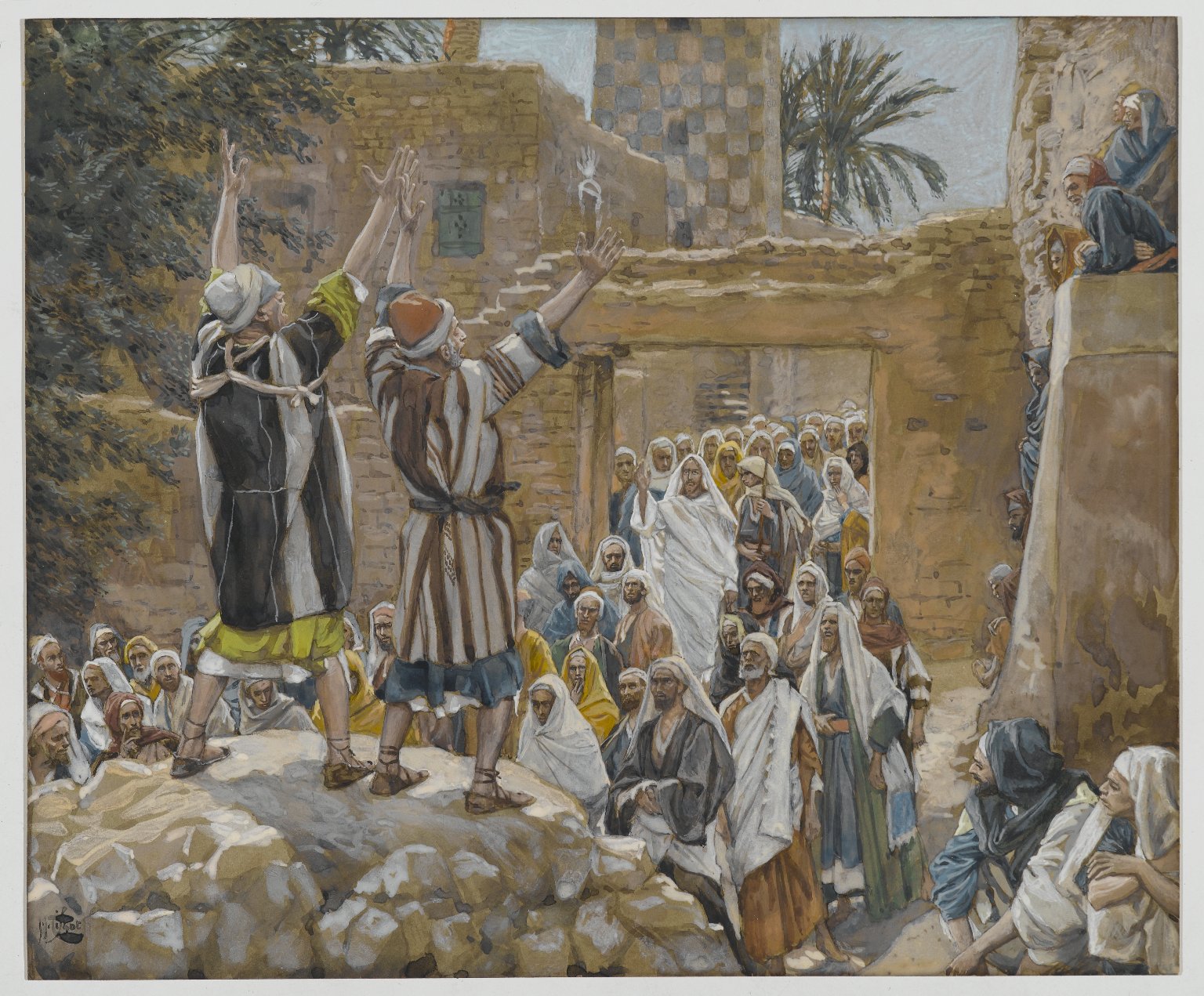
James Tissot – He sent them out two by two (Brooklyn Museum)

Trinity VI – The Importance of Prophetic Truth in Changing Times

One of the trickiest things to do is to tell someone something they don’t want to hear. Some things can be difficult to hear, and difficult to say. Honesty and truth are essential if we want to change and grow. In Ancient Israel, prophets were sent by God to speak the truth: to call people back and to tell them where they were going wrong. When the people of Israel rebelled against God, which is the definition of sin, prophets called God’s people to repentance. They urged them to turn back to the God who loves them, and longs for them to flourish. Sadly, such messages were not always heeded:

‘The descendants also are impudent and stubborn: I send you to them, and you shall say to them, ‘Thus says the Lord God.’ And whether they hear or refuse to hear (for they are a rebellious house) they will know that a prophet has been among them.’

‘At blant wynebgaled ac ystyfnig yr wyf yn dy anfon, ac fe ddywedi wrthynt, ‘Fel hyn y dywed yr Arglwydd DDUW.’ Prun bynnag a wrandawant ai peidio — oherwydd tylwyth gwrthryfelgar ydynt — fe fyddant yn gwybod fod proffwyd yn eu mysg.’ (Ezek 2:4-5)

This is the situation which we encounter in today’s Gospel. As part of His Galilean ministry Our Lord goes to Nazareth, and teaches in the synagogue. In Luke’s account we hear Jesus reading from Isaiah:

“The Spirit of the Lord is upon me, because he has anointed me to proclaim good news to the poor. He has sent me to proclaim liberty to the captives and recovering of sight to the blind, to set at liberty those who are oppressed, to proclaim the year of the Lord’s favour.”

“Y mae Ysbryd yr Arglwydd arnaf, oherwydd iddo f’eneinio i bregethu’r newydd da i dlodion. Y mae wedi f’anfon i gyhoeddi rhyddhad i garcharorion, ac adferiad golwg i ddeillion, i beri i’r gorthrymedig gerdded yn rhydd, i gyhoeddi blwyddyn ffafr yr Arglwydd.” (Lk 4:18-19)

Clearly hearing such a prophecy and then being told that it was being fulfilled among them would be quite shocking. The people had spent five hundred years waiting for a Messiah, and now, suddenly, here he was. The worshippers in the synagogue are unwilling, or unable, to understand what is going on, so they say:

“Where did this man get these things? What is the wisdom given to him? How are such mighty works done by his hands? Is not this the carpenter, the son of Mary and brother of James and Joses and Judas and Simon? And are not his sisters here with us?” And they took offence at him.

“O ble y cafodd hwn y pethau hyn? A beth yw’r ddoethineb a roed i hwn, a’r fath weithredoedd nerthol sy’n cael eu gwneud trwyddo ef? Onid hwn yw’r saer, mab Mair a brawd Iago a Joses a Jwdas a Simon? Ac onid yw ei chwiorydd yma gyda ni?” Yr oedd ef yn peri tramgwydd iddynt. (Mk 6:2-3)

The inhabitants of Nazareth cannot reconcile the healer and teacher with the person they have seen growing up among them. Hence they stress Our Lord’s trade and family relationships. They cannot recognise the Messiah in their midst. The Nazarenes understand Christ’s human nature, but cannot see that He is divine. 

Jesus understands that a prophet is without honour among his own people. Those who think they know Him well, fail to discern what God is doing through Him. They may reject Christ, but He does not reject them. 

‘And he could do no mighty work there, except that he laid his hands on a few sick people and healed them.’

‘Ac ni allai wneud unrhyw wyrth yno, ond rhoi ei ddwylo ar ychydig gleifion a’u hiacháu.’ (Mk 6:5)

The Good News of the Kingdom is proclaimed, and healings take place. God’s love is poured out even where He is not welcomed, because God loves us, and has come to heal our wounds. Even when we turn our back on Him, Our Heavenly Father does not spurn us. The work of the Kingdom must continue:

‘And he marvelled because of their unbelief. And he went about among the villages teaching.’

‘Rhyfeddodd at eu hanghrediniaeth. Yr oedd yn mynd o amgylch y pentrefi dan ddysgu.’ (Mk 6:6)

Those who in theory should know Him best, who have known Jesus all His life, are the ones who turn their back on Him. Our Lord is amazed at their hardness of heart. He faces exactly what Ezekiel faced before Him. So Jesus continues to heal and teach, even though some do not hear, and do not believe. To those who do, Christ offers love, healing and New Life. He offers Himself in the Eucharist, so that we may have life in all its fulness.

We know who and what Jesus is. Many in the world around us reject Christ, rather like the people of Nazareth, or fail to accept Him as true God and true man. They doubt who He was, what He did, and what He said. Our duty, as Christians, is to tell people about Jesus, praying that they will want to believe. We need to model the Christian life, remembering that all things are possible — God can will do amazing things, especially when we cooperate with Him. 

Our country is currently experiencing a new start, a re-boot after the election. We pray for those who have been elected to office that they will govern with wisdom and compassion. May we too take this opportunity to re-boot and re-energise our life of faith, and shine as beacons of hope in our community and world. May we join with all creation and give glory to God the Father, God the Son, and God the Holy Spirit. To whom be ascribed all glory, dominion, and power, now and forever. Amen.
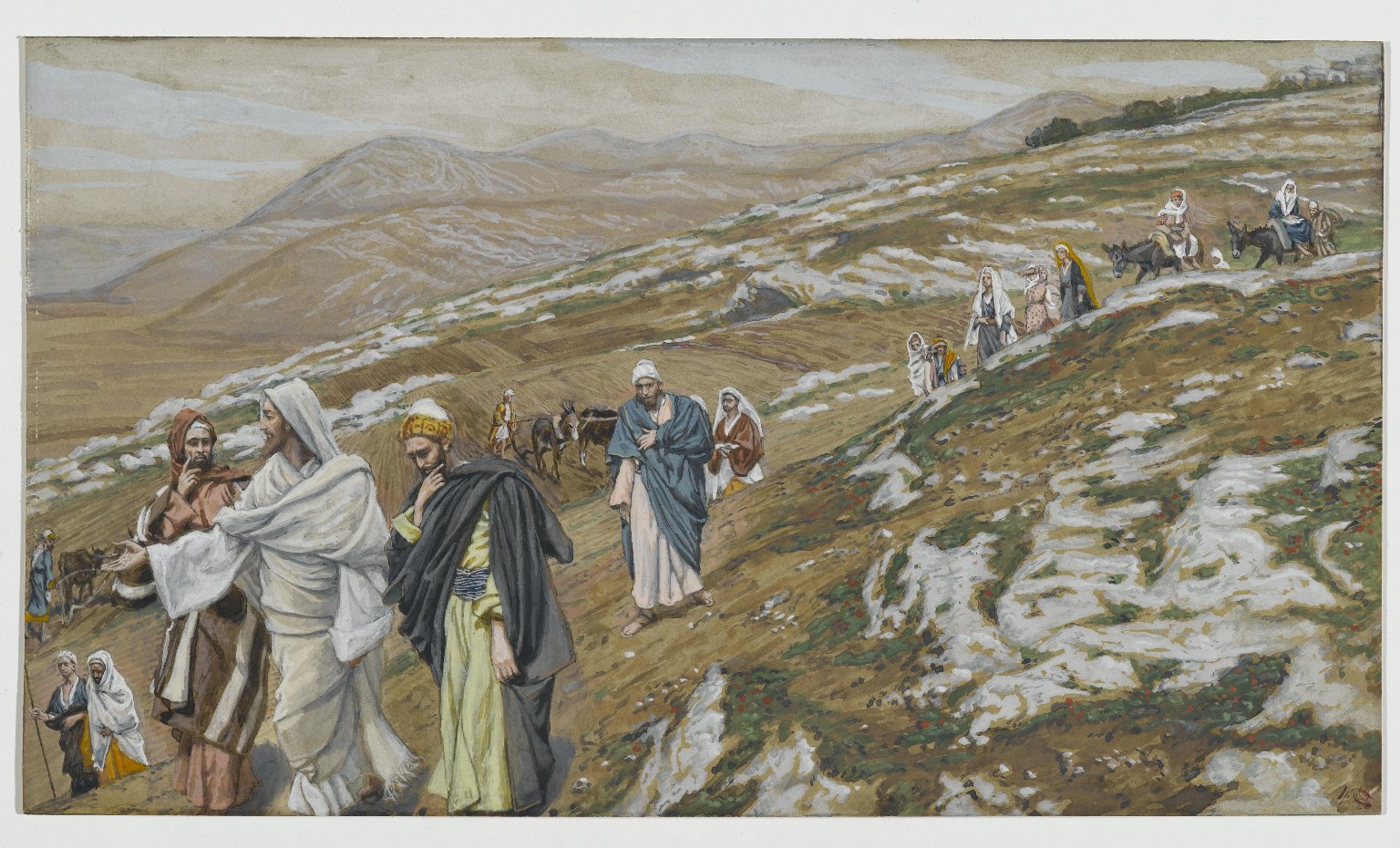
James Tissot: Jésus dans la synagogue déroule le livre [Brooklyn Museum]

Trinity V: Jesus our healer

There are, as we all know, few things in life worse than when someone we love is seriously ill. We do everything we possibly can to help, but often there is not much that we can do. However, when we feel powerless and desperate, and need help, we can turn to God in prayer. The Kingdom of God, proclaimed and inaugurated by Jesus Christ is a place of true healing, and through our relationship with Jesus we can seek wholeness for ourselves and for those close to us. This is why the Gospels contain healing miracles. These miraculous accounts are signs of God’s restoration of creation through His Son, something which will culminate with Christ’s Passion, Death, and Resurrection, and through which our human nature is healed.

In today’s Gospel Jesus and the disciples have sailed back across the Sea of Galilee to the Jewish side. On their arrival they are greeted by the leader of a local synagogue whose daughter is close to death. Jairus longs for his child to be healed, and asked Jesus to place His hands on her, so that she might be saved and live.

While Jesus is walking to Jairus’ house to heal his daughter, another miracle takes place. Lots of people are following, which is understandable since Jesus is a charismatic preacher and teacher, who heals people. In the crowd is a woman with a serious gynaecological complaint. Two people need healing, and while Our Lord is on His way to heal one female in need, another seizes the opportunity to be cured.

This woman is desperate, because she has suffered bleeding for twelve years. In Jewish ritual terms she would be classed as unclean. She would have been unable to join in worship, and would be seen as someone to avoid. Also, she would not have been able to bear children. Despite all her efforts and attempts to find a cure she had only got worse, even though she had spent all the money she possessed. The presence of this miraculous healer was the answer to her prayers. She had heard about the Saviour, and said to herself:

“If I touch even his garments, I will be made well.”

“Os cyffyrddaf hyd yn oed â’i ddillad ef, fe gaf fy iacháu.” (Mk 5:28)

This woman has faith. She believes that Jesus can heal her, and she puts her trust in Him to do what the physicians could not achieve. Our Lord notices that someone has touched His garments. He realizes that this was not simply someone brushing past, but something important. His disciples, not aware of what has happened, try to put this down to the press of the crowd. Then the woman, who has been healed, comes forward:

‘But the woman, knowing what had happened to her, came in fear and trembling and fell down before him and told him the whole truth. And he said to her, “Daughter, your faith has made you well; go in peace, and be healed of your disease.”’ 

‘Daeth y wraig, dan grynu yn ei braw, yn gwybod beth oedd wedi digwydd iddi, a syrthiodd o’i flaen ef a dweud wrtho’r holl wir. Dywedodd yntau wrthi hi, “Ferch, y mae dy ffydd wedi dy iacháu di. Dos mewn tangnefedd, a bydd iach o’th glwyf.”’ (Mk 5:33-34)

The woman comes ‘in fear and trembling’ not because she is afraid of Jesus, but because it is the proper way for humans to act in the presence of God. She is filled with awe at her experience of divine healing. Jesus’ reply is astounding for several reasons. The fact that He responds at all is noteworthy. Talking to a woman who was not a member of your family was frowned upon, let alone a woman who is viewed as being ritually unclean and an outcast. Jesus is breaking a social taboo. He also addresses her as ‘daughter’, a reminder that Jesus’ family are not just those related to Him in earthly terms, but all those who do God’s will. This unnamed woman is a daughter of God and her faith has healed her. She trusted God to do what the physicians could not. Faith is the route to salvation and healing, by trusting God to be at work. Now the woman can go in peace, because she has been restored to health. Peace is God’s gift to us, that we may experience wholeness. Jesus underlines that what has happened is not a temporary healing, but a permanent state of affairs.

While Jesus is still speaking to the woman, messengers come to give Jairus some bad news:

“Your daughter is dead. Why trouble the Teacher any further?”

“Y mae dy ferch wedi marw; pam yr wyt yn poeni’r Athro bellach?” (Mk 5:35)

The situation is hopeless, and in their eyes there is nothing that Jesus can do. Thankfully, Our Lord has other ideas:

‘But overhearing what they said, Jesus said to the ruler of the synagogue, “Do not fear, only believe.”’

‘Ond anwybyddodd Iesu y neges, a dywedodd wrth arweinydd y synagog, “Paid ag ofni, dim ond credu.”’ (Mk 5:36)

Instead of being afraid Jairus needs to believe that God will save his daughter. The synagogue leader has already demonstrated his faith by prostrating himself before Jesus and asking for healing. Now, in the face of his daughter’s apparent demise, Jairus must trust God to be at work. When Jesus arrives at the house a second miracle takes place: 

‘Taking her by the hand he said to her, “Talitha cumi”, which means, “Little girl, I say to you, arise.”’

‘Ac wedi gafael yn llaw’r plentyn dyma fe’n dweud wrthi, “Talitha cŵm,” sy’n golygu, “Fy ngeneth, rwy’n dweud wrthyt, cod.”’ (Mk 5:41)

Note the fact that Jesus takes the girl by the hand. AT the time of Jesus, touching a dead body would make a person ritually impure. This is why the priest and Levite in the Parable of the good Samaritan pass by on the other side, for fear of being made unclean by being in contact with a dead person. Jesus disregards the taboo of uncleanness, and speaks to the girl. He addresses her in Aramaic, her mother tongue, and says “Talitha cumi” literally: ‘little lamb, get up’ ‘oen bach codwch’. This is a term of endearment which also reminds us that Christ is the Good Shepherd who cares for His lambs, keeping them safe, and saving them from death. 

The people who are present — Jairus and his wife, Peter, James and John — are all amazed. They are filled with awe, with holy fear at witnessing the mighty works of God. Finally, Jesus tells her parents to give the girl something to eat, which shows us the reality of her resuscitation. This also points towards the feast of the Kingdom, which we hope to enjoy in Heaven, and which is prefigured in the Eucharist. In physical and spiritual communion, Christ gives Himself to feed us. Through His Body and Blood He heals our bodies and our souls, and assures us of eternal life.

As we care for and pray for those close to us who are ill we give thanks that God loves us, and heals us. Through faith, wonderful things can, and do, happen. May our worship today be a foretaste of Heaven, where all are healed. Let us join with Saints and Angels to sing the praises of God the Father, God the Son, and God the Holy Spirit. To whom be ascribed all glory, dominion, and power, now and forever. Amen.
James Tissot Jairus’ Daughter (Brooklyn Museum)

Trinity IV: Transformed by Faith -Embracing God’s Love in the Midst of Life’s Storms

There are few things that can compare with a storm for making human beings feel small and helpless. When we are faced with strong winds, lashing rain and lightning, we can feel insignificant, powerless, and aware of our own mortality. I was caught in a storm, fairly recently, and it was absolutely terrifying. Such feelings are uncomfortable, and we would prefer not to experience them. They are, however, an important part of the human condition. Fear is one of the most powerful emotions we have, and it drives us to seek safety and security. Thankfully, as Christians, we know that we can find safety and security in God, our loving Creator and Sustainer. 

This loving nature of God is highlighted in the passage from the Book of Job, which is the first reading this morning. God is truly powerful, but cares for humanity:

Who shut in the sea with doors when it burst out from the womb,Thus far shall you come, and no farther, and here shall your proud waves be stayed’ 

‘Pan gaewyd ar y môr â dorau, pan lamai allan o’r groth…Hyd yma yr ei, a dim pellach, ac yma y gosodais derfyn i ymchwydd dy donnau’ (Job 38:8, 11)

God’s power over nature is also central to this morning’s Gospel. Jesus and His disciples are crossing the Sea of Galilee when a violent storm blows up. The disciples are terrified. Despite many of them being fishermen, they are afraid that they are about to drown. This passage throws up a number of questions. Why are Jesus and His disciples crossing from the Jewish side of the Sea of Galilee to the non-Jewish side? Why are they sailing at night, rather than waiting until the next morning? We are not told the answers to these questions. However, this incident acts as a bridge between the section in Mark’s Gospel where Jesus has been teaching, to one where He will perform miracles, and put that teaching into practice. 

As the boat begins to fill with water, the disciples are becoming desperate:

And they woke him and said to him, “Teacher, do you not care that we are perishing?” And he awoke and rebuked the wind and said to the sea, “Peace! Be still!” And the wind ceased, and there was a great calm.

‘Deffroesant ef a dweud wrtho, “Athro, a wyt ti’n hidio dim ei bod ar ben arnom?” Ac fe ddeffrôdd a cheryddu’r gwynt a dweud wrth y môr, “Bydd ddistaw! Bydd dawel!” Gostegodd y gwynt, a bu tawelwch mawr.’ (Mk 4:38-39)

Jesus’ followers are afraid. There are thirteen of them packed into a boat twenty-six feet long, eight feet wide, and four feet deep.The boat is tossing, yet Jesus calmly sleeps. Once He is awoken He quickly takes control of the situation. Jesus can command the storm to cease because He is God. The ability to control the sea and its storms is a sign of divine power: God is the one who brings peace. Jesus has come to bring peace to troubled hearts. Having performed a miracle, He questions His disciples:

He said to them, “Why are you so afraid? Have you still no faith?” And they were filled with great fear and said to one another, “Who then is this, that even the wind and the sea obey him?”’ 

‘A dywedodd wrthynt, “Pam y mae arnoch ofn? Sut yr ydych heb ffydd o hyd?” Daeth ofn dirfawr arnynt, ac meddent wrth ei gilydd, “Pwy ynteu yw hwn? Y mae hyd yn oed y gwynt a’r môr yn ufuddhau iddo.”’ (Mk 4:39-41)

The answer to the disciples’ question is that Jesus is God. No-one else could do what He does. Jesus then questions why His followers feel fear and why they lack faith. To put it simply, the Disciples have not yet fully understood either who Jesus is, or what He is doing. Once they have experienced Christ’s Passion and Resurrection and seen His triumph over death, they will come to understand what is happening here. 

Jesus calms storms both real and metaphorical: on the Sea of Galilee, and in our own lives. By dealing with sin once and for all on the Cross, He has brought us a peace which passes all understanding. In every Eucharist service there is a point after the prayers when we greet each other with ‘Peace’ ‘Tangnefedd’. Being at peace allows the Christian community to:

no longer live for themselves but for him who for their sake died and was raised.

‘er mwyn i’r byw beidio â byw iddynt eu hunain mwyach, ond i’r un a fu farw drostynt, ac a gyfodwyd’ (2Cor 5:15)

Our life is not our own, because the love of Christ controls us, as St Paul writes in his Second Letter to the Corinthians (2Cor 5:14). Jesus’ Death and Resurrection provide an answer to the questions about suffering asked by Job, and by all humanity. By entering into the mystery of apparently meaningless pain and suffering, we can discover the source of all meaning, namely God. 

To be in Christ is to be a new Creation. Through our Baptism we share in Our Lord’s Death and Resurrection. In the Eucharist we are given the pledge of Eternal Life: Christ’s Body and Blood, so that we might continue to be transformed more and more into His likeness. This is the journey of Faith — trusting God, so that He may make us into what He is. We put our trust in Him, safe in the knowledge that God alone can still the storms of our life, and that His perfect love can drive out our fear. We cling to the Cross as our source of Hope, knowing that whatever happens we are loved, and that this love has the power to save us. God’s love can free us from fear.

Released from anxiety, we, like the disciples, can be truly alive and share God’s love with others. We pray that all humanity may experience the peace of the Lord and give glory to God the Father, God the Son, and God the Holy Spirit. To whom be ascribed all glory, dominion, and power, now and forever. Amen.
James Tissot – Jesus stilling the storm (Brooklyn Museum)

Trinity III

There is one thing that all people in Britain like to discuss: the weather. Once we have greeted someone and asked how they are, the next thing we often say concerns the weather. This is understandable. The weather has a big impact on how we feel, what we wear, and what we do. It is particularly important, especially in the countryside. Rural life is dependant on the sun and the rain, so it is natural that they are the subject of our conversations.

Jesus taught using parables. He told stories which used people’s lives to explain about who God is, and what a relationship with Him looks and feels like. In today’s Gospel Our Lord uses two images to explain the growth of the Kingdom of God. The first is agricultural. Jesus has just described people’s journey of faith in the Parable of the Sower. Now He again uses the image of crop-growing. After the farmer scatters the seed something amazing happens:

‘He sleeps and rises night and day, and the seed sprouts and grows; he knows not how.’

‘ac yna’n cysgu’r nos a chodi’r dydd, a’r had yn egino ac yn tyfu mewn modd nas gŵyr ef.’ (Mk 4:27)

The growth of seeds is a miracle of nature. I still remember as a child sprinkling cress seeds on damp paper. After a few weeks, something grew which was good to eat. As a parable for the Kingdom, and therefore the growth of the Church, the Parable of the Seed reminds us that while we are called to action, there are other forces at work. God has a key part to play in the growth of His kingdom. Even though we may not necessarily understand what is happening, the point is that God takes what we do, and uses it to make His Kingdom grow. Our efforts are not all that matters. Christ then develops His teaching:

‘The earth produces by itself, first the blade, then the ear, then the full grain in the ear. But when the grain is ripe, at once he puts in the sickle, because the harvest has come.’

‘Ohoni ei hun y mae’r ddaear yn dwyn ffrwyth, eginyn yn gyntaf, yna tywysen, yna ŷd llawn yn y dywysen. A phan fydd y cnwd wedi aeddfedu, y mae’n bwrw iddi ar unwaith â’r cryman, gan fod y cynhaeaf wedi dod.’ (Mk 4:28-29)

These two sentences cover the entirety of human history from Jesus to the end of time. The harvest coincides with God’s judgement at the Second Coming of Our Lord. This is also the subject of the second reading this morning. St Paul writes:

‘For we must all appear before the judgement seat of Christ, so that each one may receive what is due for what he has done in the body, whether good or evil.’

‘Oherwydd rhaid i bawb ohonom ymddangos gerbron brawdle Crist, er mwyn i bob un dderbyn ei dâl yn ôl ei weithredoedd yn y corff, ai da ai drwg.’ (2Cor 5:10)

How we live our lives matters. What we say and do not only forms our own character but it also affects the world around us. Christians are called to be people of love, and to share that love with others so that the Kingdom of God continues to grow.

Jesus then explains what the Kingdom is like, using the image of the mustard seed:

‘which, when sown on the ground, is the smallest of all the seeds on earth, yet when it is sown it grows up and becomes larger than all the garden plants and puts out large branches, so that the birds of the air can make nests in its shade.’

‘pan heuir ef ar y ddaear, hwn yw’r lleiaf o’r holl hadau sydd ar y ddaear, ond wedi ei hau, y mae’n tyfu ac yn mynd yn fwy na’r holl lysiau, ac yn dwyn canghennau mor fawr nes bod adar yr awyr yn gallu nythu dan ei gysgod.’ (Mk 4:31-32)

The Kingdom of God starts small with a few disciples, but grows into something that encompasses the whole world. It is like a mustard seed which starts off being only a couple of millimetres wide, but then increases in size reaching up to twelve feet in height. This plant may have a small beginning, but it contains within itself the possibility of remarkable growth. The image of birds nesting in its shade signals divine blessings, as today’s passage from Ezekiel makes clear:

‘And under it will dwell every kind of bird; in the shade of its branches birds of every sort will nest.’

‘Bydd adar o bob math yn nythu ynddo, ac yn clwydo yng nghysgod ei gangau.’ (Ezek 17:23)

Jesus takes the imagery of Ezekiel’s prophecy and shows how it will be brought to fulfilment in and through the Church. Such is the generous nature of God, that He gives us a place where we can be safe, and where we can grow in faith. By hearing God’s word, and by praying together, and by sharing in the Eucharist, we are nourished and strengthened to live as a Christian community. 

So, my brothers and sisters in Christ, let us rejoice that God has made His Kingdom a reality. Let us work together with each other and with Our Heavenly Father to make His Kingdom come. Let us join with our Christian brothers and sisters and the heavenly host in singing the praises of God the Father, God the Son, and God the Holy Spirit. To whom be ascribed all glory, dominion, and power, now and forever. Amen.

James Tissot The Sower (Brooklyn Museum)

Trinity II: ‘Who are my mother and my brothers?’

I grew up listening to the music of the 1960s and 1970s. The large size of an LP record sleeve is a great vehicle for artwork, and photography in particular. The shots are often in soft focus, giving the subjects a gentle dreamlike quality. It can be easy to think that the whole of Our Lord’s ministry was gentle and easy, especially because of how it is shown in Victorian religious art. However, today’s Gospel shows us that this was not always the case. As the passage begins there are so many people gathered around Jesus that He and His disciples are not even able to eat. People are desperate to hear what He has to say, they are desperate for healing. While their need is great, without rest and refreshment, there is no way that Christ can minister to them effectively in the long term without taking care of himself. 

We can have a lot of sympathy for Our Lord’s family, who are genuinely concerned for His wellbeing and that of His friends. They want to take care of His physical needs, as Jesus seems to be prioritising God’s people over Himself.

The religious authorities, however, have a completely different understanding of what is going on:

‘And the scribes who came down from Jerusalem were saying, “He is possessed by Beelzebul,” and “by the prince of demons he casts out the demons.”’

‘A’r ysgrifenyddion hefyd, a oedd wedi dod i lawr o Jerwsalem, yr oeddent hwythau’n dweud, “Y mae Beelsebwl ynddo”, a, “Trwy bennaeth y cythreuliaid y mae’n bwrw allan gythreuliaid.”’ (Mk 3:22)

The scribes understand the actions of this charismatic healer and teacher from Galilee as being the result of demonic possession. This is another way of saying, ‘Jesus is a fraud’ and ‘This isn’t the work of God’. Their attempt to write Christ off not only flies in the face of the evidence, but also does not follow through logically. Jesus challenges them saying: 

“How can Satan cast out Satan? If a kingdom is divided against itself, that kingdom cannot stand. And if a house is divided against itself, that house will not be able to stand. And if Satan has risen up against himself and is divided, he cannot stand, but is coming to an end.” 

“Pa fodd y gall Satan fwrw allan Satan? Os bydd teyrnas yn ymrannu yn ei herbyn ei hun, ni all y deyrnas honno sefyll. Ac os bydd tŷ yn ymrannu yn ei erbyn ei hun, ni all y tŷ hwnnw sefyll. Ac os yw Satan wedi codi yn ei erbyn ei hun ac ymrannu, ni all yntau sefyll; y mae ar ben arno.”(Mk 3:23-26)

If Jesus is possessed by the Devil, how can He cast the Devil out? His accusers have failed to see the spirit of God, the Holy Spirit, at work in Christ. The scribes refusal to see God at work is a sign of their pride and hardness of heart. They cannot discern the works of God, and write off as evil a wondrous demonstration of God’s love for humanity. The religious authorities have failed to discern what is actually going on, and have taken the easy step of finding someone to blame, someone to write off. God’s healing love is being dismissed as the work of the Devil. This is a serious matter, as Jesus explains:

“Truly, I say to you, all sins will be forgiven the children of man, and whatever blasphemies they utter, but whoever blasphemes against the Holy Spirit never has forgiveness, but is guilty of an eternal sin”— for they were saying, “He has an unclean spirit.”

“Yn wir, rwy’n dweud wrthych, maddeuir popeth i blant y ddaear, eu pechodau a’u cableddau, beth bynnag fyddant; ond pwy bynnag a gabla yn erbyn yr Ysbryd Glân, ni chaiff faddeuant byth; y mae’n euog o bechod tragwyddol.” Dywedodd hyn oherwydd iddynt ddweud, “Y mae ysbryd aflan ynddo.” (Mk 3:28-30)

The scribes have condemned themselves. Whereas they have accused Jesus of blasphemy, they are in fact the blasphemers. Jesus does not condemn them, but rather offers humanity the forgiveness of sins. This is another demonstration of God’s love being poured out on the world. The Kingdom of God is a place of healing and restoration.

Our Lord then has a confrontation with His relatives, which leads to a profound moment of teaching. When the crowd tell him that His family are outside, He answers, “Who are my mother and my brothers?””Pwy yw fy mam i a’m brodyr?” (Mk 3:33). Then, looking round, He says: ‘Here are my mother and my brothers!’ ‘Dyma fy mam a’m brodyr i’ (Mk 3:34). 

Family was, and continues to be, important, for Jews juke like it is for people in general. The family unit is the basic building block of society. But Our Lord points out that ties of kinship are less important than humanity’s relationship with God. In our baptism, we all became brothers and sisters in Christ. The Church is our family, which calls us to live in a new way with each other, a way defined by love, and not the exercise of power or control. God offers us healing and wholeness, the forgiveness of our sins, so that we can be in a new relationship both with God and with each other.

The Church comes together as a family to experience forgiveness and to be nourished by Word and Sacrament in the Eucharist. This is the most profound and meaningful thing we, as human beings, can do together. It gives us a foretaste of the joy of Heaven. In it we are fed by God, and with God. God gives himself for us, so that we might have life in Him. 

Let us therefore come and be nourished. Let us invite others to become part of God’s family. Joining with Christians throughout the world, may we sing the praises of God the Father, God the Son, and God the Holy Spirit. To whom be ascribed all glory, dominion, and power, now and forever. Amen.
James Tissot Jesus Commands the Apostles to Rest (Brooklyn Museum)

Trinity I

THE novel by Robert Llewellyn —‘How green was my valley’ — reached millions through its 1941 film adaptation by John Ford. Telling the story of a family in a South Wales mining community, it criticises the unjust labour practises of the early twentieth century. Earlier in 1887 the historian Lord Acton wrote to the Professor of Ecclesiastical History at the University of Cambridge, saying that, ‘Power tends to corrupt, and absolute power corrupts absolutely.’ While this maxim now tends to be applied generally, it was originally a comment on religious institutions in general, and the medieval Papacy in particular. The truth of this statement is a reflection on our fallen human nature.

In the Gospels we often see Our Lord come into conflict with the Scribes, Priests, and Pharisees. These religious leaders are depicted as being more concerned with power and prestige than with the worship of Almighty God. If Religion is important then there will be a status attached to its ministers. They, therefore, have a responsibility to use this status for good, and to bring people closer to God.

In today’s Gospel it is the Sabbath, a day of rest. Jesus and His disciples are travelling, and the Pharisees notice that some of them have plucked ears of corn to eat. The Pharisees ask Our Lord:

‘Look, why are they doing what is not lawful on the Sabbath?’

‘Edrych, pam y maent yn gwneud peth sy’n groes i’r Gyfraith ar y Saboth?’  (Mk 2:24)

Jews are forbidden from doing any work on Sabbath, and the harvesting of grain, no matter how little, counts as work. This appears to be a clear-cut case, but Jesus replies as follows:

‘Have you never read what David did, when he was in need and was hungry, he and those who were with him: how he entered the house of God, in the time of Abiathar the high priest, and ate the bread of the Presence, which it is not lawful for any but the priests to eat, and also gave it to those who were with him?’

‘Onid ydych chwi erioed wedi darllen beth a wnaeth Dafydd, pan oedd mewn angen, ac eisiau bwyd arno ef a’r rhai oedd gydag ef? Sut yr aeth i mewn i dŷ Dduw, yn amser Abiathar yr archoffeiriad, a bwyta’r torthau cysegredig nad yw’n gyfreithlon i neb eu bwyta ond yr offeiriaid; ac fe’u rhoddodd hefyd i’r rhai oedd gydag ef?’ (Mk 2:25-26)

This story is recounted in 1Samuel 21:1-7. By referring to it Our Lord is making the point that if David’s actions were acceptable, then why is such a fuss being made about the disciples plucking a few ears of corn. Jesus underlines this by pointing out that:

‘The Sabbath was made for man, not man for the Sabbath’

‘Y Saboth a wnaethpwyd er mwyn dyn, ac nid dyn er mwyn y Saboth’ (Mk 2:27)

The legalism of the Pharisees has led them to forget what the Sabbath is really about: rest. The point of having a Sabbath is to ensure that people have a day of rest. Instead this day has become bound up with rules and observances which neither honour God, nor encourage humanity to rest. 

Jesus and His disciples arrive at a synagogue where there is a man with a withered hand. Clearly this is another opportunity for the legalism of the Pharisees to come to the fore.

‘And they watched Jesus, to see whether he would heal him on the Sabbath, so that they might accuse him.’

‘Ac yr oeddent â’u llygaid arno i weld a fyddai’n iacháu’r dyn ar y Saboth, er mwyn cael cyhuddiad i’w ddwyn yn ei erbyn.’ (Mk 3:2)

Rather than rejoicing that God has performed a miracle, and that a man with a disability has been healed, all the Pharisees can see is an opportunity to complain about rule-breaking, and to bring an accusation against Jesus. Our Lord calls the man to Him, and says to the Pharisees:

‘Is it lawful on the Sabbath to do good or to do harm, to save life or to kill?’

‘A yw’n gyfreithlon gwneud da ar y Saboth, ynteu gwneud drwg, achub bywyd, ynteu lladd?’ (Mk3:4)

They give no reply because they know that in order to save a life one may break every rule regarding the observance of the Sabbath. Jesus’ knowledge and interpretation of Jewish Scripture and Law is superior to theirs. Our Lord then asks the man to stretch out his hand, and he is miraculously healed. No law has been broken. Instead someone who was suffering, and who was probably shunned and made an outcast in society, has been cured and brought back into the fold of the community. God’s power to heal and restore humanity has been displayed. The Kingdom of God has been announced in deed.  

The response of the religious authorities is telling. Do they rejoice at this miracle? The answer is definitely no.

‘The Pharisees went out and immediately held counsel with the Herodians against him, how to destroy him.’

‘Ac fe aeth y Phariseaid allan ar eu hunion a chynllwyn â’r Herodianiaid yn ei erbyn, sut i’w ladd.’ (Mk 3:6)

The Pharisees have formed an alliance with a priestly party, keen on political independence. Both sides share a common aim — to get rid of Jesus. This is because He represents a threat to their power. Our Lord’s words and actions are understood by the Pharisees as an assault on their privileged position, with their innate goodness being ignored. From the start of His public ministry, Christ faces opposition from people who want Him dead. They think that they can destroy Jesus, and that will be the end of the matter, whereas it will only be the beginning. Our Lord will die on a Cross, but will be raised to new life at Easter. Calvary and the Empty Tomb are the salvation of humanity, part of God’s plan.

As Christians we gather on the Lord’s Day, the first day of the week, to celebrate Christ’s Death and Resurrection. By means of the Eucharist, we do that which Jesus commanded us to do until He comes again. For one hundred thousand successive Sundays the faithful have gathered to share in Holy Communion, because it matters, it is important. We are fed with the Bread of Angels, with the Body and Blood of Christ, so that we may be healed and given a foretaste of Heaven.

So, my brothers and sisters, let us rejoice in the healing salvation of Christ. Let us proclaim the Good News, so that all people may come to know, and love, God the Father, God the Son, and God the Holy Spirit. To whom be ascribed all glory, dominion, and power, now and forever. Amen.

James Tissot – The Man with a withered hand (Brooklyn Museum)
Tissot: The Disciples Eat Wheat on the Sabbath (Brooklyn Museum)

Trinity Sunday 2024: Transformed by God’s Love: Exploring the Trinitarian Faith and Sacramental Life

WE are all extremely fortunate to live in North Pembrokeshire for many reasons, and especially because we are close to so many hills. Mountains and hills take a lot of effort to climb, but once you have ascended, you can see for miles around. Hilltops are special places, and today’s Gospel takes place on one. Also, many other important and significant moments in Matthew’s Gospel take place on mountains including the Temptation, the Sermon on the Mount, the Transfiguration, and the Crucifixion. Our Lord also speaks His final words before his Ascension on a hilltop. 

Last Sunday we celebrated Pentecost, the outpouring of the Holy Spirit upon the Church: a revelation of who God is, and how much God loves us, His people. This week we continue to meditate upon God’s love. This love forms a relationship so intimate that God is closer to us than we are to ourselves — that is something quite hard to get our heads around! Above all, God’s love is something to be experienced, rather than understood. Through this experience God transforms us, so that we can experience that love more fully, and finally enjoy it for eternity, in Heaven.

In today’s Gospel Jesus’ disciples have been told to go to Galilee, to a particular mountain, to meet the Risen Lord. They are obedient, and head north from Jerusalem. When the disciples arrive at the mountain, they see Our Lord and bow down and worship Him — just like the Wise Men did at His birth. Some of the apostles, however, doubt. They have not yet fully grasped the reality of the situation: the fact that Jesus has risen from the dead, is preparing to ascend to His Father, and send the Holy Spirit. Before His Ascension, Jesus comes to them, and speaks to them saying:

‘All authority in heaven and on earth has been given to me.’

‘Rhoddwyd i mi, bob awdurdod yn y nef ac ar y ddaear’ (Mt 28:18)

This, at one level, is a grand claim to make. But, it is the fulfilment of a prophecy about the Son of Man made by the prophet Daniel:

‘And to him was given dominion and glory and a kingdom, that all peoples, nations, and languages should serve him; his dominion is an everlasting dominion, which shall not pass away, and his kingdom one that shall not be destroyed.’

‘Rhoddwyd iddo arglwyddiaeth a gogoniant a brenhiniaeth, i’r holl bobloedd o bob cenedl ac iaith ei wasanaethu. Yr oedd ei arglwyddiaeth yn dragwyddol a digyfnewid, ac ni ddinistrir ei frenhiniaeth.’ (Dan 7:14)

Jesus is true God and true man. He fulfils the prophecies of scripture. He also has authority, which He shares with His Church, empowering it to act in His name.

Our Risen Lord tells the disciples to ‘Go therefore’ ‘Ewch, gan hynny’ (Mt 28:19). They are not to stay put, but are called to be active in the world. The Church is given a mission to: ‘make disciples of all nations’ ‘gwnewch ddisgyblion o’r holl genhedloedd’ (Mt 28:19). The disciples, having been taught by Jesus, are empowered to teach the faith to others. The Church has a universal mission. No-one is to be excluded or left out. As well as being proclaimers of the faith, the apostles are also instructed to baptize new converts:

‘baptizing them in the name of the Father and of the Son and of the Holy Spirit’

‘gan eu bedyddio hwy yn enw’r Tad a’r Mab a’r Ysbryd Glân’ (Mt 28:19)

This small detail is important. It matters. From the very beginning, the Christian Faith is a Trinitarian Faith. We believe in One God, who is Father, Son, and Holy Spirit. Three persons, bound together in love, who invite the world to be in a relationship with Them.

Our Eucharist this morning began, ‘Yn enw’r Tad, a’r Mab, a’r Ysbryd Glân, In the name of the Father, and of the Son, and of the Holy Spirit’, because this is the God whom we worship. We express our belief in the words that we use, and also in our actions. Our deeds show in a physical way what we believe. As Christians, we are called to live out the faith of our baptism in our lives. God, who is love, has shown that love to the world through His Son, Jesus Christ, and in the sending of the Holy Spirit. To be a Christian is to have encountered that love, and been changed by it. We are changed in our baptism, when we are born again to new life in Christ. Also, we are changed each and every time we receive Holy Communion. By God’s grace, Communion, whether physical or spiritual, transforms us. Through this Sacrament we are united with Christ, so that we may become what He is, and share in the love which is the life of God.

Before Our Lord leaves His disciples He makes them a promise:

‘And behold, I am with you always, to the end of the age.’

‘Ac yn awr, yr wyf fi gyda chwi bob amser hyd ddiwedd amser.’ (Mt 28:20)

We are not alone. Christ is with us. He hears our prayers, and speaks to us in Scripture. This is very comforting to know. Jesus is with us in three ways. Firstly, through the sending of the Holy Spirit. Secondly, by being in the Church, which is His Body, and of which He is the Head. And thirdly, in the Sacraments which are outward signs of inward spiritual Grace. All these things are freely given to transform us into children of God. These blessings allow us, and all Christians, to share in the very life of God the Father, God the Son, and God the Holy Spirit. To whom be ascribed all, glory, dominion, and power, now and forever. Amen.
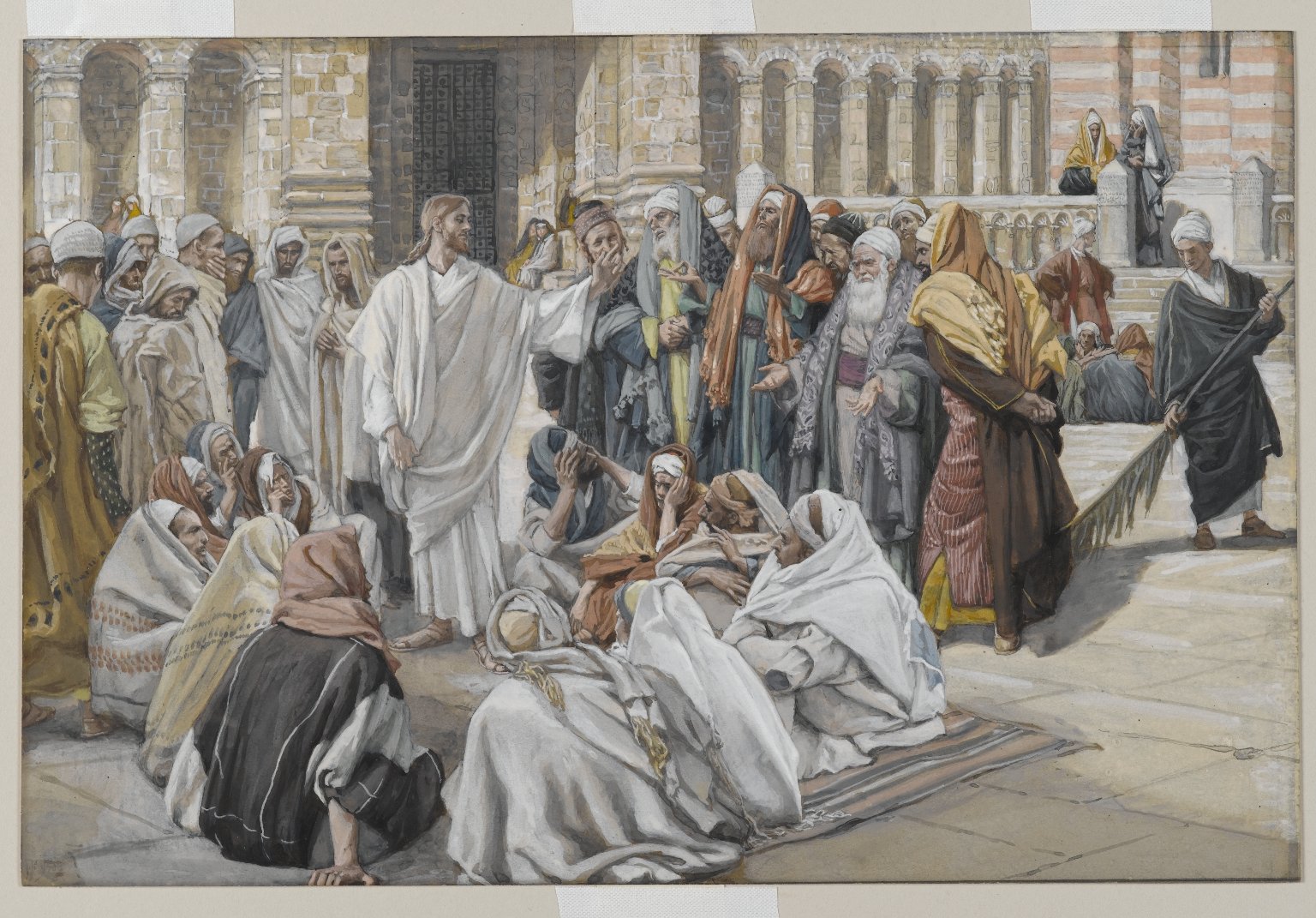
Pentecost 2024

FIRE is an amazing entity. It is something that can be both a benefit, but also a danger. The heat produced by an open fire, or a log-burning stove, provides warmth and comfort. The candles in church give light and form a focus for our prayers. However, we must always take care with fire, as it is a powerful force. The disciples are described as receiving the power of the Holy Spirit through what looked like ‘divided tongues of fire’ ‘tafodau fel o dân’ (Acts 2:3).

Before his Ascension, Christ tells His disciples to wait in Jerusalem so that they may be baptized in the Holy Spirit. The twelve have again gathered in the Upper Room, along with the Blessed Virgin Mary. This is the same place where Christ instituted the Eucharist, and washed His disciples’ feet. They have gathered here because Jesus told them to be together, and to pray, saying:

 ‘you shall receive power when the Holy Spirit has come upon you; and you shall be my witnesses … to the end of the earth’ 

‘Ond fe dderbyniwch nerth wedi’r Ysbryd Glân ddod arnoch, a byddwch yn dystion i mi … a hyd eithaf y ddaear’ (Acts 1:8)

Our Lord promises to pour out the Holy Spirit to strengthen and inspire the Church. God is generous, and wants to see humanity flourish. An amazing event then takes place. Everyone present is filled with the Holy Spirit. Tongues of fire rest upon them, and they speak in a variety of languages. Strengthened by God’s Spirit the disciples go out to preach. In Jerusalem there are people from all over the Mediterranean World, gathered for the Jewish festival of Shavuot, the celebration of the wheat harvest. These people are amazed to hear the mighty works of God spoken in their own languages. Not only that, those speaking are not the educated elite but a rag-tag assortment of Galilean fishermen and other ordinary men. They hear and understand the proclamation of who Jesus is, and what He has done. 

Through the power of God, the Good News is pronounced. Men who were afraid, hiding behind locked doors, have become confident, and will go out to share the Gospel around the world. Their miraculous transformation has, in turn, transformed the world, resulting in billions of Christians. We are here in church today because of the power of the Holy Spirit.

This is why St Paul can write to the Church in Galatia as a community that has experienced the indwelling of the Holy Spirit. The apostle describes what it means to be filled with the Holy Spirit:

But the fruit of the Spirit is love, joy, peace, patience, kindness, goodness, faithfulness, gentleness, self-control’ 

Ond ffrwyth yr Ysbryd yw cariad, llawenydd, tangnefedd, goddefgarwch, caredigrwydd, daioni, ffyddlondeb, addfwynder, hunanddisgyblaeth.’ (Gal 5:22-23)

Paul is describing how we are all supposed to be as Christians. Living by the Spirit is an ideal, which we often fail to live up to, but, nonetheless, it shows us how God wants us to live. Here is a glimpse of life in all its fulness: life in union with God, and with each other. This is perfect communion, something to strive for, even if we may struggle to attain it. This is how we can live when we allow God to be in control, and when our human will is perfectly aligned with the Father’s will for us. Living by the Spirit is what human flourishing looks like in practice.

At a number of points in John’s Gospel, Jesus speaks about the Holy Spirit to His disciples. Our Lord tells His followers that the Spirit will bear witness, confirming the truth of their faith, and will strengthen them for service: living and sharing the Good News. Jesus promises: 

When the Spirit of truth comes, he will give you into all truth

Ond pan ddaw ef, Ysbryd y Gwirionedd, fe’ch arwain chwi yn yr holl wirionedd’ (Jn 16:13)

We have come together today to celebrate God’s love and generosity in continuing to send His Holy Spirit. 

God is glorified in worship, which is why we sing His praises. Worship does not change God, it changes us: making us more loving, uniting us with our creator who sustains us with His love. Christians all around the world are united with the worship of Heaven, where the saints and angels sing the praises of God, Father, Son, and Holy Spirit. Through the power of the Holy Spirit, and nourished by Word and Sacrament, we are given a foretaste of the joy which awaits us.

So, my brothers and sisters in Christ, let us pray earnestly for the gift of the Spirit. May God fill us with His love and equip us to proclaim the Good News of the Kingdom. May the fire of the Holy Spirit embolden us to encourage others to come to know, and love, God the Father, God the Son, and God the Holy Spirit. To whom be ascribed all, glory, dominion, and power, now and forever. Amen.

Maronite Icon of Pentecost

Easter VII

In 1959 the first photograph of the Earth was taken from space by an unmanned satellite called Explorer 6. The image was blurry and very basic by today’s standards. Almost a decade later, the crew of Apollo 8 took a famous picture of our planet rising over the lunar landscape. It was named Earthrise. This iconic photograph helped people to understand the world better and take greater interest in environmental issues. As Christians we are called to care for our planet and all the people, plants, and creatures that dwell on it. At the same time, as Christians we are called to be in the world, but not of the world. This world is simply somewhere we will reside for a short while. Our citizenship is in Heaven, our true home, where we long to spend eternity with God. One of the ways in which the Church lives out this other-worldliness is shown in today’s reading from the Acts of the Apostles.

After Jesus’ Ascension, the disciples spend time together in prayer and fellowship. One of their first actions is to appoint a replacement for Judas Iscariot, so that the Eleven Apostles may become Twelve again. For Jews the number twelve is very significant. It stands for wholeness and the completion of God’s purpose. There are twelve months in a year, and twelve tribes of Israel. It was therefore important to the Apostles that they were restored to their proper number of twelve. So, out of all the current followers of Jesus, Peter states that they need someone who has been with them from the beginning, to act as a witness to Jesus’ resurrection. Two candidates are put forward: Justus and Matthias. Peter then prays for guidance:

You, Lord, who know the hearts of all, show which one of these two you have chosen to take the place in this ministry and apostleship from which Judas turned aside to go to his own place.” 

“Adwaenost ti, Arglwydd, galonnau pawb. Amlyga prun o’r ddau hyn a ddewisaist i gymryd ei le yn y weinidogaeth a’r apostolaeth hon, y cefnodd Jwdas arni i fynd i’w le ei hun.” (Acts 1: 24-25)

The disciples do not decide for themselves, they leave the choice up to God. Through the random process of casting lots, God can show them whom He wants to be an apostle. This feels strange to us nowadays. We want to be in control. We want to choose. Perhaps we would be better served by putting God back in control. 

The Gospel reading continues the exploration of the Farewell Discourses between the Last Supper and Jesus’ Arrest. Today we have arrived at Chapter 17, known as Jesus’ High Priestly Prayer. This is a truly solemn moment of intimate conversation between the Father and the Son. Before His Passion and Death, Christ is entrusting His Church to the Father, that it may be kept safe, and that it may be filled with the glory of God, and also strengthened to proclaim the Good News of the Kingdom. This is a moment of profound emotion and intimacy, a window into a conversation between two Persons of the Holy Trinity. 

Jesus is committing us, His Church to God, for God to care for us. His prayer sees His followers as being in opposition to a world which rebels against God; a world of sin and corruption; a world of power and politics. Christ prays that His people may be set apart, to be holy, devoted to God, and filled with love. To love is to will the good of the other. God loves us, and it is God’s will that we flourish and enjoy life in all its fulness, united to Him. This is why Jesus taught us to pray,

Thy kingdom come, thy will be done, on earth as it is in heaven.

“deled dy deyrnas, gwneler dy ewyllys; megis yn y nef, felly ar y ddaear hefyd.”(Mt 6:10)

Christ is praying that we, His Church, stay close to God. That we be united with God’s will, and filled with God’s love. This is why we look forward to next Sunday, when we celebrate Pentecost, the outpouring of the Holy Spirit. This is a sign of God’s love for us, the love which unites Father, Son and Holy Spirit. God invites us to be united with the life of the Trinity, and wants us to offer that invitation to others. If we place ourselves in God’s hands He will take the initiative, just as He did in choosing Matthias to replace Judas.

Th name Matthias means ‘gift of God’. The disciples receive this gift after praying together and asking for God’s guidance. As Christians we too need to spend time together, to pray for our needs and those of the world. In prayer we are united with each other and with God. Together we are nourished by sharing the Eucharist and hearing the Word of God. These things are crucial to who and what we are. United together we experience the love of God and the joy of community. The world may be indifferent to what we do, or it may mock us when we fail to live up to the example of Jesus. But, as Christians, we strive to live in the love of God, and forgive each other our trespasses. We aim to live out that same radical love and forgiveness which sees Jesus die upon the Cross and be raised to New Life for love of us, and for all the world.

This message of profound love and forgiveness is one that much of the world cannot or does not want to understand. We may not understand the depths of God’s love, but we know that it can be experienced, through personal encounter with Jesus in prayer, Word, and Sacrament. We are living testimony to love’s power to change lives. It sets us free to live for God and to proclaim his saving truth in our words and actions.

As I mentioned earlier in this sermon, Matthias’ name means ‘gift of God’, and his appointment comes just before God’s wonderful gift of the Holy Spirit. So as we wait with the Apostles for this gift, let us pray that God may be at work in us, building us up, and giving us strength to live the Christian life. Let us then share these gifts with others, so that they may also come to believe and give glory to God the Father, God the Son, and God the Holy Spirit. To whom be ascribed all glory, dominion, and power, now and forever. Amen.

Peter Paul Rubens Matthias (Museo del Prado, Madrid)

Ascension 2024

Ascension Day is a time for celebration. However, we are not commemorating Jesus’ departure from the earth, but instead His return to God the Father. We celebrate Christ’s abiding presence with us, and also those things that He asks of us, and promises to us. It is a day of festivity and expectation, looking forward to the future in love and hope. 

Before Jesus returns to the Father, He makes the apostles a three-part promise: Firstly that they will be baptized with the Holy Spirit (Acts 1:4), secondly that they will receive power, and thirdly they will be Christ’s witnesses to the ends of the earth (Acts 1:8). Through this promise Christ is looking forward to Pentecost, and to the church’s future. To the time in which we live now.

One of the most important questions in the entire Bible is found in today’s Gospel: who do you say that Jesus is? How we answer this question can tell us a lot about our own faith. Who we say Jesus is matters. In fact it is central to who and what we are as Christians.

In the Gospel, Jesus and his disciples had ventured into the District of Caesarea Philippi, an area about 25 miles northeast of the Sea of Galilee. This region had tremendous religious implications. The place was littered with the temples of Syrian gods. Caesarea Philippi was where Herod the Great, father of the then-ruling Herod Antipas, had erected an elaborate marble temple. Here you could even worship the Roman Emperor as a God himself. You might say that the religions of the known world were on display in this town. It was with this multi-religious background that Jesus chose to ask the most crucial question of his ministry.

Jesus asks his disciples, ‘But who do YOU say that I am?‘A chwithau pwy meddwch chwi ydwyf fi?’ (Mt 16:15) Peter answers: ‘You are the Messiah, the Son of the Living God‘Ti yw’r Meseia, Mab y Duw byw’ (Mt 16:16). This is a big claim to make. Saying that Jesus is divine was problematic, as these words undermined both what Jews thought about religion, and also the claims made by Romans about the Emperor. To say that Jesus is the Anointed One, the Hope of Israel, who fulfils the promises in the Prophets is a very radical statement indeed.

Peter’s answer demonstrates his faith. He believes in Jesus, and trusts Him. Because of this, Our Lord makes him the principal disciple and gives him a primary role in leading and building the Church. Christ is looking towards the future where the disciples will carry on what He has started. They are charged with sharing the Good News, and offering forgiveness in Jesus’ name.

Our Lord ascends to Heaven forty days after the Resurrection, but Christ does not leave us. Instead He takes our humanity to be with God. This process began with the breaking open of the gates of Hell at Easter. Having conquered death itself, Jesus returns to the Father, taking us with Him. This is also a prelude to the outpouring of the Holy Spirit at Pentecost. God is generous. He saves humanity. He opens Heaven to us. He promises us the Holy Spirit, to strengthen us as we live our lives of faith. 

If we truly believe that Jesus Christ is the Son of the Living God, the Messiah — the anointed one who delivers us from our sins, who died, rose again, and who sends us His Holy Spirit — then this faith should have a profound effect on who we are and how we live our lives. This is why we have gathered here this evening to be nourished by Word and Sacrament. We have come together to pray for the world and for each other, and to be built up in love, as we await Our Lord’s Second Coming as Judge and Ruler of all.

Jesus makes promises which are true. We can trust Him, and like the apostles we can prepare for the Coming of the Holy Spirit at Pentecost in prayer, and joyful expectation. We know that we will never be abandoned, because we are always united with, and loved by the Triune God. United with our Christian brothers and sisters around the world we give praise to God the Father, God the Son, and God the Holy Spirit, to whom be ascribed all glory, dominion, and power, now and forever.

Dosso Dossi – The Ascension (Private Collection)

Easter VI

CHRISTIANITY is a religion which has at its heart a number of paradoxes. The Good News of the Kingdom of God is both simple and straightforward. But it is also difficult and complex. The basic theory is simple: ‘Love God, and love your neighbour’ ‘Câr Duw a Châr dy gymydog’. However, when we try to do this, we find that the practice is a little more complicated than the theory.

The Gospel passage for today is all about love. According to St Thomas Aquinas, ‘Love is… willing the good of the other.’ ‘Mae cariad ewyllysio y Dda o’r eraill’ [(STh I-II, q.26 a.4, CCC 1766) Respondeo dicendum quod, sicut Philosophus dicit in II Rhetoric, amare est velle alicui bonum]. To love, then, is not simply an act of passion or emotion — something which we feel — but it is also something which we choose to do. As Christians, we want to see others flourish, and we work towards that end. Love takes effort.

Jesus’ teaching is clear:

“This is my commandment, that you love one another as I have loved you. Greater love has no one than this, that someone lay down his life for his friends.”

“Dyma fy ngorchymyn i: carwch eich gilydd fel y cerais i chwi. Nid oes gan neb gariad mwy na hyn, sef bod rhywun yn rhoi ei einioes dros ei gyfeillion.” (Jn 15:12-13)

Christians are called to love one another as Christ loves us. In other words we are to love, even to the point of laying down our lives for each other. This is pertinent  as we remember those who gave their lives during the Second World War, eighty years ago. At the heart of our faith is the Cross. This is the ultimate demonstration of God’s love for us: God loves us so much that He dies for us, so that we might live in Him. The Cross is not the end, it leads to the Empty Tomb, and to the Triumph of Easter. Jesus dies to break the power of death, and to offer humanity eternal life with Him in Heaven. This is why we spend time in our celebration of Easter pondering the mystery of our redemption, entering ever deeper into the experience of God’s love for us.

When Our Lord speaks to His disciples, He speaks to us as well. He does not call us servants (weision), but friends (gyfeillion). To be a Christian is to be a friend of God and to enter into an intimate and loving relationship with the Creator and Redeemer of the Universe. God wants to be our friend. He wants to be united with us in a relationship characterised by love and generosity. 

We experience God’s love most fully in the Eucharist, where Christ continues to give Himself to, and for, us. Out of love, He continues to heal our wounds, to restore our relationship with God and each other, and gives us a foretaste of Heaven in the here and now. There is no other thing on earth as precious as this love. Nothing is more wondrous than this sign and token of God’s love for us. To dwell in Christ’s love is to be united with Him in physical and spiritual communion, so that God’s grace can transform us more and more into His likeness.

At this point in John’s Gospel Our Lord is in the Upper Room with His disciples. He has washed their feet and celebrated the Eucharist. Jesus has also talked about His Passion and Death in order to explain to His followers, including us, what He is about to do and why it matters. Christ is putting everything in place for there to be a Church to continue His work on Earth. This is why he addresses His disciples as follows:

“You did not choose me, but I chose you and appointed you that you should go and bear fruit and that your fruit should abide, so that whatever you ask the Father in my name, he may give it to you.”

“Nid chwi a’m dewisodd i, ond myfi a’ch dewisodd chwi, a’ch penodi i fynd allan a dwyn ffrwyth, ffrwyth sy’n aros. Ac yna, fe rydd y Tad i chwi beth bynnag a ofynnwch ganddo yn fy enw i.” (Jn 15:16)

We did not choose Jesus. He chose us. The Church is a vine which bears fruit. This is how it has continued for two thousand years. The Good News of the Kingdom has been proclaimed, and, throughout the world, people have grown and been nurtured in their faith. We have had a relationship with Jesus, which unites us with all Christians through both space and time, making us brothers and sisters in Christ, part of a family. Because of this relationship, with our Creator and each other, we are able to ask things of God in prayer. God listens to our prayer, and is generous in granting our requests. He gives his only Son to die for us and to rise again so that we might be certain of eternal life in Him. 

Finally, Jesus reminds His disciples of the need to love one another:

“These things I command you, so that you will love one another.”

“Dyma’r gorchymyn yr wyf yn ei roi i chwi: carwch eich gilydd.” (Jn 15:17)

Our Lord tells us what to do, so that we may bring about the will of God: that we love each other and flourish. God loves us, and wishes us to remain in a relationship with Him, and each other, that is characterised by generosity, and which takes as its model the Son of God, Our Risen Saviour. This conviction inspires the argument of the First Letter of John:

“In this is love, not that we have loved God but that he loved us and sent his Son to be the propitiation for our sins.”

“Yn hyn y mae cariad: nid ein bod ni’n caru Duw, ond ei fod ef wedi ein caru ni, ac wedi anfon ei Fab i fod yn aberth cymod dros ein pechodau.” (1Jn 4:10)

Jesus, through His self-sacrifice, makes up for all that we have done wrong. He offers Himself — the Righteous for the unrighteous — to restore our relationship with God and with each other. Jesus reconciles God and humanity, bringing back together what sin has thrust apart. This is the heart of the Good News. As well as dying for us, Christ also rose again. Our Lord reunites God and humanity, by laying down His life for His friends, and also gives us the hope of Heaven. We cannot earn our way there, but the generous love of our Creator offers us the opportunity to be united with Him forever.

My brothers and sisters in Christ, as we continue to celebrate Our Lord’s resurrection, may we rejoice in the abundance of divine generosity. May God’s grace transform us more and more into His likeness. Let us join with all our Christian brethren in rejoicing and singing the praises of God the Father, God the Son, and God the Holy Spirit. To whom be ascribed all glory, dominion, and power, now and forever. Amen.

James Tissot: The Last Sermon of Our Lord  (Brooklyn Museum)

Easter V – The True Vine

I know that many of you gathered here this morning are keen gardeners. One of the main gardening tasks in winter is to prune those plants which need to be pruned. At one level it is easy to think that having planted and watered a plant, it can be left to do its own thing, However, in order to both maximise the number and quality of blooms of, for example your roses, as well as encouraging strong healthy growth, then pruning is a must. Cutting off part of a living plant sounds brutal, but in fact it helps that plant to grow and produce fruit and flowers. I shall return to the theme of pruning in a short while.

In today’s first reading from the Acts of the Apostles we begin with a very human picture. The disciples of Jesus are afraid. They have good reason to be so. Saul was a sworn enemy of the Church, and he played a part in the martyrdom of the deacon Stephen. Could it be that Saul’s new-formed desire to join the disciples was just a trap? Then we see something wonderful: the power of a personal relationship. Barnabas vouches for Saul. The disciple explains both the former persecutor’s conversion on the road to Damascus, and his powerful preaching about how the risen Jesus had turned his life around. Later, when Saul tries to share his faith with fellow Jews they threaten to kill him. The disciples protect him and get him to the coast on a on a ship bound for his home town of Tarsus.  Having been afraid, the apostles have come to trust Saul as a fellow Christian. Their former enemy has become someone they now love, trust, accept, and care for. The situation can be summed up in the following verse:

‘So the church throughout all Judea and Galilee and Samaria had peace and was being built up. And walking in the fear of the Lord and in the comfort of the Holy Spirit, it multiplied.’

‘Yr oedd yr eglwys yn awr, drwy holl Jwdea a Galilea a Samaria, yn cael heddwch. Yr oedd yn cryfhau, a thrwy rodio yn ofn yr Arglwydd ac yn niddanwch yr Ysbryd Glân yn mynd ar gynnydd.’ (Acts 9:31)

Barnabas’ name means ‘Son of Consolation’, someone who acts like the Holy Spirit. Living up to his name, this disciple comforts the other disciples, strengthening their belief, and helping the Church to grow.

Barnabas puts his faith into action, and this is the advice given in our second reading from the First Letter of John:

‘let us not love in word or talk but in deed and in truth.’

‘gadewch inni garu, nid ar air nac ar dafod ond mewn gweithred a gwirionedd’ (1Jn 3:18)

The Christian Faith is not something we just talk about, it is something which affects our lives and our actions. We are called to live out our beliefs, and thus become an example that people want to emulate. Our deeds as Christians are arguably the most effective witness we have.

In the Gospel, Jesus once again illustrates his teaching by using an image which would have been very familiar to His audience. Vines were common throughout the entire Mediterranean World, producing grapes which could be eaten or made into wine. Jesus uses the concept of Himself as the Vine, with the disciples as the branches. It is a powerful vision of what the Church is: people who are grafted onto and into Christ, connected to Him, and in a relationship with Him. We entered into that relationship in our baptism, and it is a relationship which will continue throughout, and after, our life on earth. 

When we were baptised, we were grafted onto the vine, which is Christ. It is His will that we, as Christians, bear much fruit. This means that we must live out our faith in our lives, so that it affects who and what we are, and all that we say and do. We do this because it is what God expects of us, as we read in the First Letter of John: 

The love of God was made manifest among us, that God sent his only Son into the world, so that we might live through him’ (1Jn 4:9).

Because we are grafted into Christ we are in communion with Him. Jesus gives Himself to us in the Eucharist, His Body and Blood, so that we can have life in Him. He gives Himself to us out of love, so that we might have life in Him, and have it forever. The Eucharist is a pledge of eternal life with Christ, united in this world and the next. It is given to strengthen us on the journey of faith. Partaking in the Eucharist, physically or spiritually, helps us to live out our faith in our lives. Fed by and with Christ, we live in Him and for Him. 

Our Lord says:

‘Whoever abides in me and I in him, he it is that bears much fruit, for apart from me you can do nothing.’

‘Y mae’r sawl sydd yn aros ynof fi, a minnau ynddo yntau, yn dwyn llawer o ffrwyth, oherwydd ar wahân i mi ni allwch wneud dim.’ (Jn 15:5)

Apart from Jesus we can do nothing. When we rely solely on our own strength, our own talents, we inevitably fail. We must not forget that everything is God-given in the first place. To thrive we need to abide in Him. Without this connection to Our Heavenly Father we wither and die, cut off from the source of life and hope. 

So, my brothers and sisters in Christ, as we continue to rejoice in Our Lord’s Resurrection, may we take to heart the words of Our Lord:

‘By this my Father is glorified, that you bear much fruit and so prove to be my disciples.’

‘Dyma sut y gogoneddir fy Nhad: trwy i chwi ddwyn llawer o ffrwyth a bod yn ddisgyblion i mi.’ (Jn 15:8)

May we bear fruit in our lives, and, like Barnabas and Paul, become worthy witnesses to God the Father, God the Son, and God the Holy Spirit. To whom be ascribed all, glory, dominion, and power, now and forever. Amen.
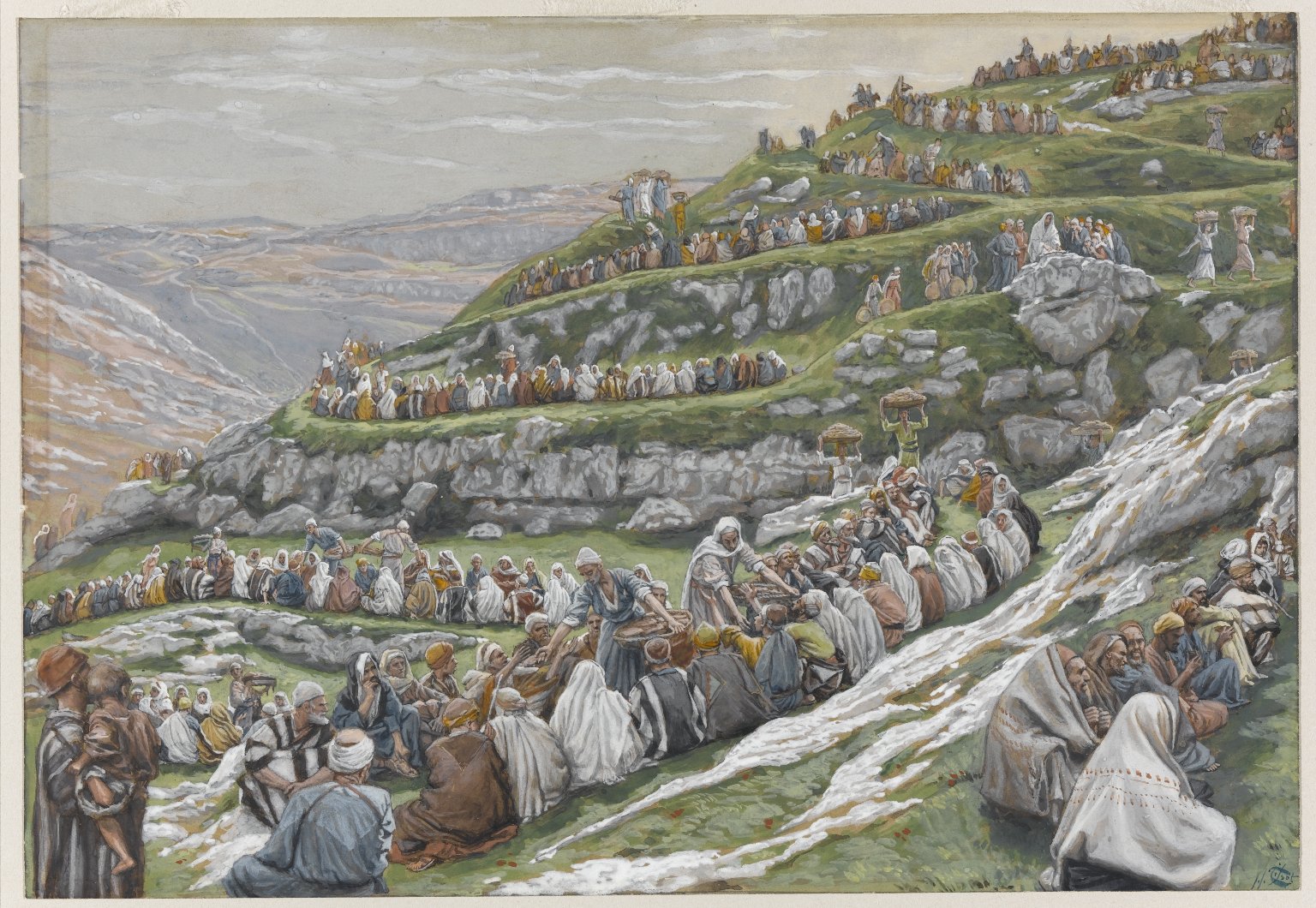
Easter IV – The Good Shepherd

Living in Pembrokeshire, many of us know people who keep sheep. We are also aware of how difficult it has been for them, and all farmers, in the recent months with fields waterlogged due to unprecedented levels of rainfall. Sheep farming is a vital part of our rural life and so the image of Jesus as the Good Shepherd is something we find easy to identify with, unlike those who live in large cities.

Shepherds played an important part in Jesus’ life. Angels told them about the birth and they came down from the hills to worship Him in  the stable in Bethlehem. Not wishing to leave their animals behind, Nativity scenes depict the shepherds bringing sheep to the manger. This may be why Our Lord has an affinity with those who look after sheep and care for them. Jesus describes himself as the Good Shepherd, the one who lays down His life for His sheep. Christ dies so that we may have eternal life in Him. This model of self-sacrificial love lies at the heart of the Christian faith, and because of it, we are able to live the new life of Easter.

Jesus says, ‘I am the Good Shepherd’ ‘Myfi yw’r bugail da’ (Jn 10:11). This is straightforward: He cares for His flock. But then He says, ‘The good shepherd lays down his life for the sheep.’ ‘Y mae’r bugail da yn rhoi ei einioes dros y defaid’ (Jn 10:11). This goes above and beyond what we would expect of a shepherd, even a very good one! Jesus is using the image of the Good Shepherd to explain what will happen on Good Friday. He will suffer and die to protect us, His flock. 

Protect us from what? From Sin and Death. By dying for us, and rising from the dead, Jesus offers humanity freedom in Him. The Christian faith offers salvation, through faith. As St Peter puts it in this morning’s reading from the Acts of the Apostles: 

‘And there is salvation in no one else, for there is no other name under heaven given among men by which we must be saved.’

‘Ac nid oes iachawdwriaeth yn neb arall, oblegid nid oes enw arall dan y nef, wedi ei roi i’r ddynolryw, y mae’n rhaid i ni gael ein hachub drwyddo.’ (Acts 4:12)

Jesus offers what no-one else can: salvation and eternal life to those who believe in Him, and follow Him. Eccentric American millionaires employ bizarre methods in an attempt to defy the ageing process, but they are still going to die. Each and every human being is. That is the fate of all living things. But, because of who Christ is — namely true God and true man — and what He has done on the Cross and at the empty tomb, death is no longer something to be feared. Instead, it can be embraced, as the entry to eternal life, with God, forever. 

This way of looking at life and death is profoundly different from the world around us, because Christians are not bound by the primal human fear that our life is finite. Our Lord has opened to us the gates of Heaven, and shown us once and for all that God loves us.

At the heart of our faith as Christians is the profound conviction that we are people who are loved by God. As Archbishop Michael Ramsay said, ‘God is Christlike, and in him is no un-Christlikeness at all’ [God, Christ & the World: A Study in Contemporary Theology, London 1969, p.98]. When we see Jesus, we see God; when we hear Him speak, we hear the voice of God. We can know who God is, the Creator and Redeemer of the universe, through His Son, Jesus Christ. God is not a distant bearded man on a cloud. He is a loving Father, as illustrated in the Parable of the Prodigal Son. He loves us so much that He suffers and dies for us, to give us life in Him. This is the God who searches for lost sheep; who longs to love, restore, and reconcile; who can heal our wounds if we let Him. This is abundant life, offered to us by Our Lord, the Good Shepherd.

This life, this love is offered to us in the Eucharist, where we can touch and taste God’s profound love for us. In the bread and the wine we are given a foretaste of the heavenly banquet and a pledge of eternal life in Christ. Here today, as on a hundred thousand successive Sundays, we meet to be fed by Christ, and fed with Christ. To be healed, and to know His love. We are the sheep cared for by the Good Shepherd, who provides for all our needs. Who gives Himself so that we might have life.

So my brothers and sisters in Christ, as we continue to rejoice In Our Lord’s triumph over death, may we emulate His example and live the new life of Easter. Following Our Good Shepherd, who longs for us to be safe with Him forever in Heaven, let us share the Good News of His Kingdom with others. Let us pray that that all may come to know and love God the Father, God the Son, and God the Holy Spirit. To whom be ascribed all, glory, dominion, and power, now and forever. Amen.
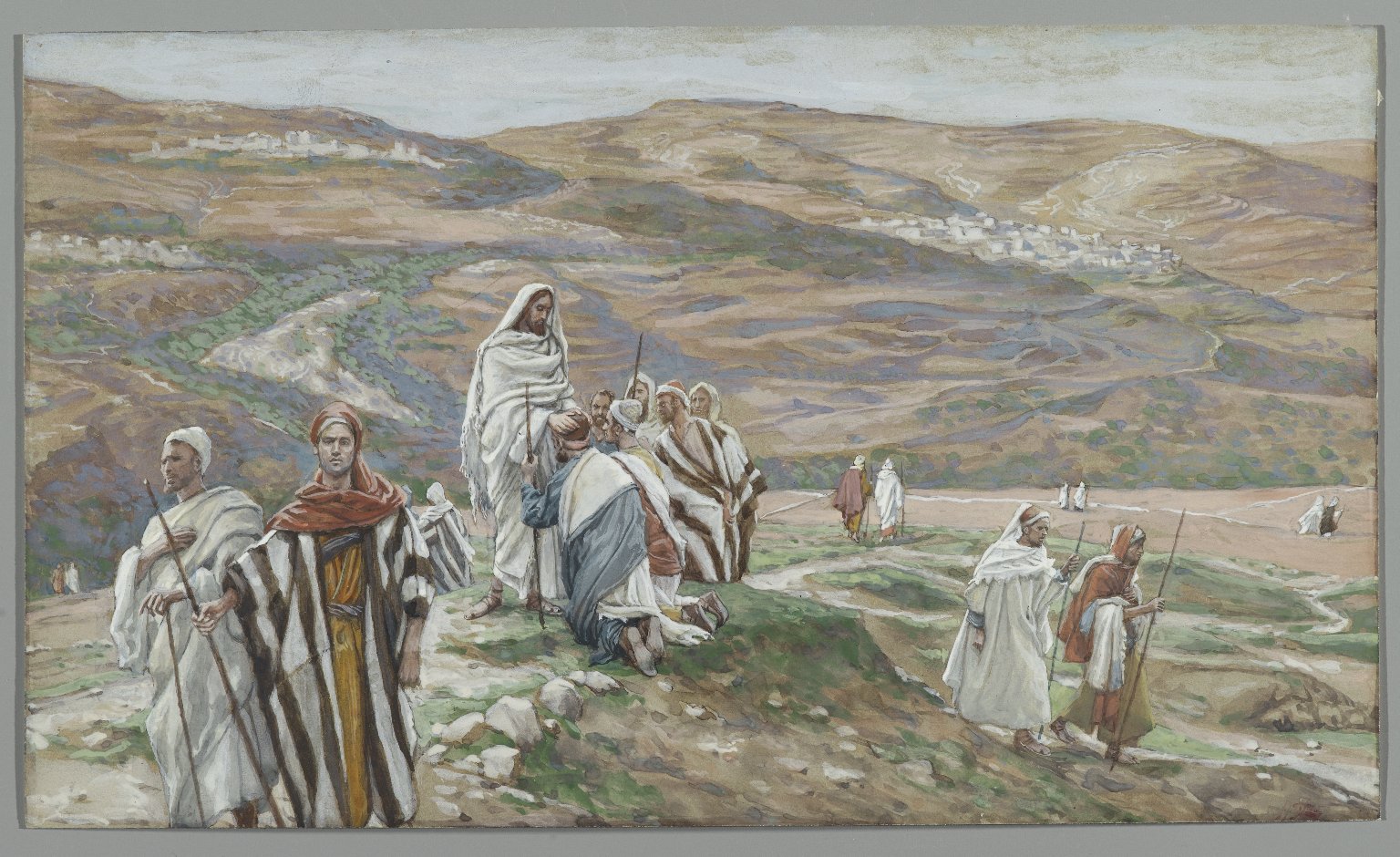
The Second Sunday of Easter

This morning we welcome baby Alice into the Christian community. This is an important day for her, as well as her family, and for all of us present here today.

At the beginning of His ministry, Jesus was baptised by John in the River Jordan. Today I will use the blessed water in the font and holy oil. The font is placed near the door of the church because baptism is the way that we enter the Church and become a member of the Christian community.

Today’s reading from the First Letter of John speaks of loving the children of God (plant Duw) and of keeping God’s commandments. M____ and C_____ are following God’s commandments by bringing their daughter Alice to be baptised, and we are all here to support them in their actions.

The Gospel for today records the risen Jesus appearing to the disciples. Peter and John have already witnessed the empty tomb, Mary Magdalen has even talked with the Risen Christ. However, the disciples are afraid. Their Teacher has gone from being hailed as the Messiah and King, to being crucified. Christ’s followers are all scared for their lives, lest a mob come and attack them. Some of their number are saying that the tomb is empty, and that Jesus has risen. Then, suddenly, the risen Lord is there among them saying: 

“Peace be with you!” 

‘Tangnefedd i chwi!’ (John 20: 19)

In a situation of heightened emotion, Our Lord’s gift is peace. God’s peace is not just the absence of noise or violence (heddwch) but something richer and deeper. This is the ‘Peace which passeth all understanding’ ‘Tangnefedd sydd uchlaw pob deall’, something given to us by God to transform our lives. Next, Jesus breathes on His disciples giving them the Holy Spirit and the power to forgive sins. Christ’s followers are equipped for the work of proclamation and reconciliation. This is what Jesus came to do, and He commits the Church to continue His mission and His saving work. To help His followers, Christ gives them (and us) the Holy Spirit, God’s free gift to His people, a sign of His generous love.

When Jesus appears to the disciples, one of them is absent. Thomas is not there — maybe he has been to get them all some food. When Thomas returns and hears what has happened, he feels somewhat left out. He is unsure and wants to have physical proof of Jesus’ Resurrection before he is able to fully believe:

“Unless I see in his hands the mark of the nails, and place my finger into the mark of the nails, and place my hand into his side, I will never believe.”

“Os na welaf ôl yr hoelion yn ei ddwylo, a rhoi fy mys yn ôl yr hoelion, a’m llaw yn ei ystlys, ni chredaf fi byth.” (John 20: 6-7)

These are the words of someone who longs to experience the reality of the Resurrection. Like the other disciples, Thomas has been on something of an emotional rollercoaster. It is understandable that he wants to be certain, to experience with his own eyes and hands that Jesus is alive.

A week later, Jesus comes to the disciples again, and says to them: 

“Peace be with you.” Then he said to Thomas, “Put your finger here, and see my hands; and put out your hand, and place it in my side. Do not disbelieve, but believe.”

“Tangnefedd i chwi!” Yna meddai wrth Thomas, “Estyn dy fys yma. Edrych ar fy nwylo. Estyn dy law a’i rhoi yn fy ystlys. A phaid â bod yn anghredadun, bydd yn gredadun.” (Jn 20:26-27)

Jesus gives Thomas what he wants: the opportunity to experience the reality of the Resurrection and to touch the wounds of love and mercy. This leads Thomas to reply to Jesus:

“My Lord and my God!”

“Fy Arglwydd a’m Duw!” (Jn 20:28)

Thomas no longer doubts. Instead he confesses that Jesus is God, and the Lord of his life. This is a profound and concise statement of faith, declaring both who Jesus is, and what He has done. Thomas has journeyed from doubt and despair to true faith. Doubt is the starting point, but it is not the end of the journey. St Thomas should not be known as ‘Doubting Thomas’, but rather as ‘Believing Thomas’, as this is what he becomes. Thomas’ belief changes his life, and leads him to take the Gospel to be proclaimed far and wide. He travels as far as India, founding Christian communities which have endured for two thousand years. Such faith is our inheritance, and in it we are blessed, as those who have not seen, but yet believe. We too are called to be like Thomas, and to share the Good News of Christ’s Resurrection with the world. 

At its heart today’s Gospel should be understood as something to encourage us in our life of faith:

‘but these [things] are written so that you may believe that Jesus is the Christ, the Son of God, and that by believing you may have life in his name.’

‘Ond y mae’r rhain wedi eu cofnodi er mwyn i chwi gredu mai Iesu yw’r Meseia, Mab Duw, ac er mwyn i chwi trwy gredu gael bywyd yn ei enw ef.’ (Jn 20:31)

Belief in Jesus leads to New Life. This underlines the Christian understanding of baptism. Through baptism we share in Jesus’ Death and Resurrection, and are given new life. This new life is eternal life with Christ, and in Christ.

At the Easter Vigil, last week, we renewed our baptismal promises to remind ourselves of what Our Lord has done for us. What Jesus has done for you, and for me, and for every Christian over the past two thousand years. In our Baptism we are united with Christ and made brothers and sisters. We become part of a new family which we call the Church. This new family is called to live in a new way. This is made clear in the first reading from the Acts of the Apostles. Here we see people of faith being loving and generous, caring for each other. We pray that we may be inspired by their example, and live out the faith of our baptism throughout our lives. 

Next to the font is our wonderful Easter Garden, which includes the Empty Tomb, the site of Jesus Resurrection.It is important to take our time over our celebration of Easter. We need time to allow the reality of what we commemorate to sink in. Something this wonderful, this world-changing, needs to be pondered, and shared. We gather today to do what the disciples did, and are filled with joy at Our Lord’s Resurrection from the dead. Through Christ’s Resurrection we are changed, transformed, and filled with God’s love. In the same way Alice will shortly be changed, transformed and filled with God’s love. Easter is a traditional time for baptism, and as a Christian community we welcome Alice and pray for her, and for her family. Today, and every day, we give thanks and praise to God the Father, God the Son, and God the Holy Spirit. To whom be ascribed all, glory, dominion, and power, now and forever. Amen.
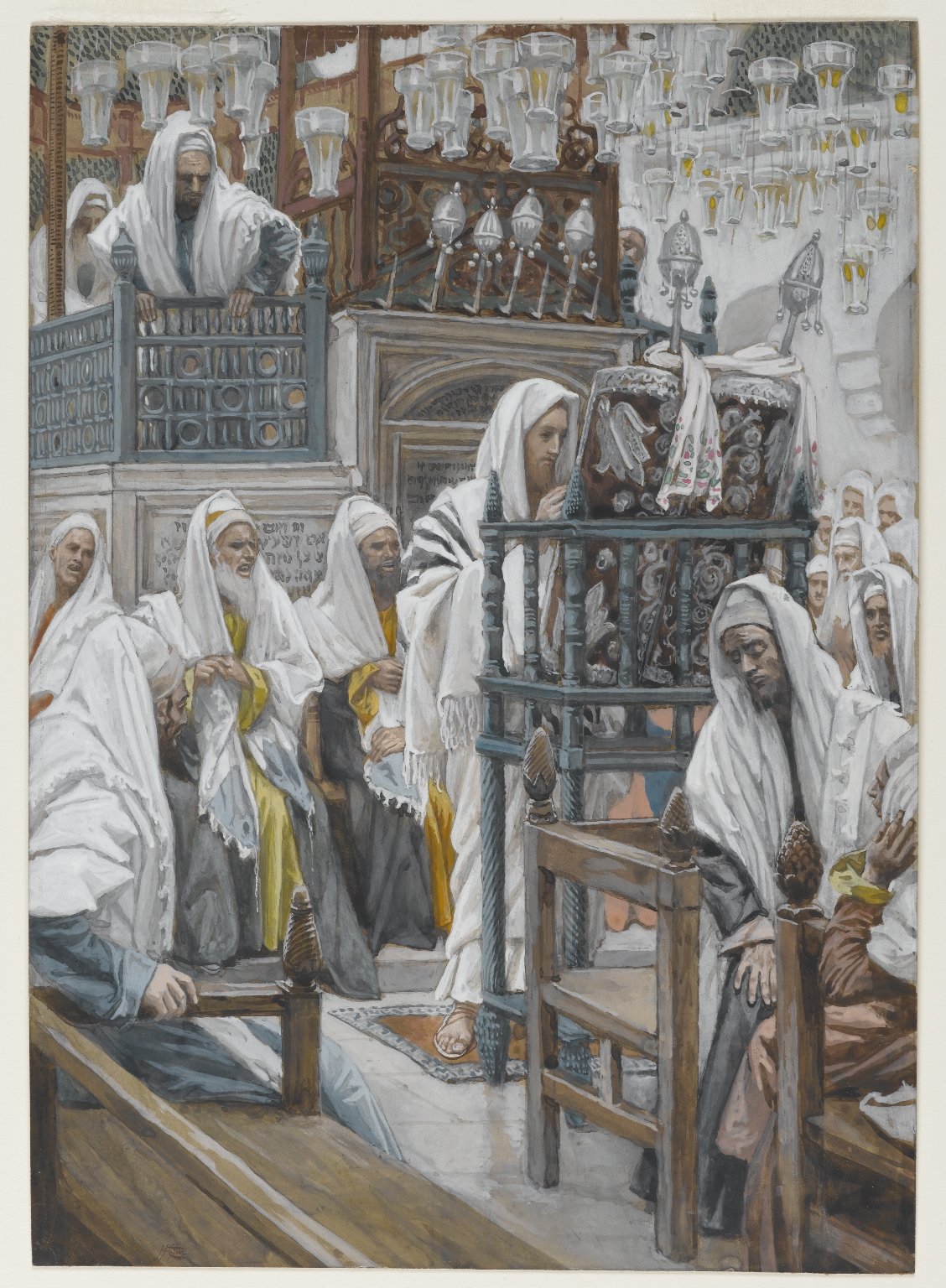
Tissot: L’Incredulité de Saint Thomas, (Brooklyn Museum)

Easter 2024

It is early in the morning and a woman sits in the darkness. Her beloved teacher, whom she has followed and supported for years was placed in a tomb a few days before, after having being executed for political and religious reasons. The sun has not yet risen, and as she sits, she cries. A week ago He was being hailed as the Messiah, God’s anointed, the Davidic king come to set His people free. Yet within a few days, the same people who cried ‘Hosanna’ were shouting ‘Crucify him!’ ‘Crucify him!’. So she goes, to be near her Lord, to be close to him. And as she goes, she notices something: the stone has been rolled away. It took several people to roll it there on Friday afternoon. What is going on? Mary Magdalen runs to tell Peter and John:

“They have taken the Lord out of the tomb, and we do not know where they have laid him.” 

‘Y maent wedi cymryd yr Arglwydd allan o’r bedd, ac ni wyddom lle y maent wedi ei roi i orwedd’ (John 20: 2)

Mary assumes, understandably, that grave-robbers have been at work. Or that the Jewish or Roman authorities, worried that this troublemaker might be a focus for dissent, have got rid of Him. To do so makes sense in political terms, but something greater has happened. Peter and John come running towards the tomb. John arrives first, peers inside the tomb, but stays outside. 

‘Then Simon Peter came, following him, and went into the tomb. He saw the linen cloths lying there, and the face cloth, which had been on Jesus’ head, not lying with the linen cloths but folded up in a place by itself.’

‘Yna daeth Simon Pedr ar ei ôl, a mynd i mewn i’r bedd. Gwelodd y llieiniau yn gorwedd yno, a hefyd y cadach oedd wedi bod am ei ben ef; nid oedd hwn yn gorwedd gyda’r llieiniau, ond ar wahân, wedi ei blygu ynghyd’ (John 20: 6-7)

What happens is a gradual process. Bit by bit, the followers of Jesus come to experience and understand this incredible and amazing event. 

Then the other disciple, who had reached the tomb first, also went in, and he saw and believed; for as yet they did not understand the Scripture, that he must rise from the dead. Then the disciples went back to their homes.’

‘Yna aeth y disgybl arall, y cyntaf i ddod at y bedd, yntau i mewn. Gwelodd ac fe gredodd. Oherwydd nid oeddent eto wedi deall yr hyn a ddwed yr Ysgrythur, fod yn rhaid iddo atgyfodi oddi wyth y meirw. Yna aeth y disgyblion adref yn eu holau.’ (John 20: 8-10)

A few days ago the disciples saw their Lord and Teacher killed and buried, but now the tomb is empty. The cloths that were wrapped around Jesus are there, but there is no body. John, the disciple Jesus loved, understands and believes. Peter does not yet understand or believe. Clearly it is all too much for Mary Magdalen who stays by the tomb, weeping. When the angels ask her why she is crying she replies:

“They have taken away my Lord, and I do not know where they have laid him.”

“Y maent wedi cymryd fy Arglwydd i ffwrdd, ac ni wn i lle y maent wedi ei roi i orwedd.” (John 20: 13)

Mary’s words are understandable, she is filled with grief and sadness. She is bereft and confused. At this point, Mary Magdalen encounters the Risen Christ:

Jesus said to her, “Woman, why are you weeping? Whom are you seeking?” Supposing him to be the gardener, she said to him, “Sir, if you have carried him away, tell me where you have laid him, and I will take him away.”

‘“Wraig,” meddai Iesu wrhti, “pam yr wyt ti’n wylo? Pwy yr wyt yn ei geisio?” Gan feddwl mai’r garddwr ydoedd, dywedodd hithau wrtho, “Os mai ti, Syr, a’i cymerodd ef, dywed wrthyf lle y rhoddaist ef i orwedd, ac fe’i cymeraf fi ef i’m gofal.”’ (John 20: 15)

Mary supposes that Jesus is the gardener, the person employed to look after the cemetery. She does not yet understand who He is, or what is going on. However, the mention of the gardener is significant. In Genesis, humanity was created by God in a garden, Eden, and given the task of tending it (Gen 2:15). The Resurrection also takes place in a garden, showing us that Christ is the second Adam. Whilst the first Adam brought death to humanity by a tree, Jesus, the Second Adam, has brought life to the world by the tree of the Cross. Humanity falls because of a tree, and because of a tree we are offered eternal life in Christ. 

It was on the first day of the week, that Creation began, and now on the first day of the week we see a New Creation. Christ has risen from the dead, and conquered Death and Hell. Our Lord is a gardener, and the plants he tends are human beings. We believe in a God who loves us, who cares for us, and who longs to see us grow and flourish.

Jesus greets Mary Magdalen by name, and suddenly she recognises Him. She understands. She believes. Then Christ talks of His Ascension, as though forty days of Easter have condensed into a single moment. Mary now knows what she must do:

‘Mary Magdalene went and announced to the disciples, “I have seen the Lord”—and that he had said these things to her.’

‘Mair Magdalen i gyhoeddi’r newydd i’r disgyblion. “Yr wyf wedi gweld yr Arglwydd.” meddai, ac eglurodd ei fod wedi dweud y geiriau hyn wrthi’ (Jn 20:18)

Mary shares the Good News, just as Peter and Paul do in the first and second readings this morning. As Christians we are called to do likewise: to tell others that God loves us, all of us, that He died for us, and that He rose again to offer us eternal life with Him. This is the message of Easter. Good News! Christ has triumphed over Death and Hell, and humanity is healed and restored through Him.

So, my brothers and sisters in Christ, ‘Pasg hapus i chi gyd!’ ‘A Happy Easter to you all!’ May you, and those you love, be filled with Resurrection joy and strength, on this Easter Day and always. Amen.

Fra Angelico (Italian, ca. 1395–1455), “Noli me tangere,” 1440–42. Fresco from the convent of San Marco, Florence, Italy. http://www.wga.hu/frames-e.html?/html/a/angelico/index.html

An Easter Homily ascribed to St John Chrysostom [PG 59: 721-4]

Εἴ τις εὐσεβὴς καὶ φιλόθεος, ἀπολαυέτω τῆς καλῆς ταύτης πανηγύρεως· εἴ τις δοῦλος εὐγνώμων, εἰσελθέτω χαίρων εἰς τὴν χαρὰν τοῦ Κυρίου αὐτοῦ· εἴ τις ἔκαμενηστεύων, ἀπολαβέτω νῦν τὸ δηνάριον· εἴ τις ἀπὸ πρώτης ὥρας εἰργάσατο, δεχέσθω σήμερον τὸ δίκαιον ὄφλημα· εἴ τις μετὰ τὴν τρίτην ἦλθεν, εὐχαριστῶν ἑορτάσῃ· εἴ τις μετὰ τὴν ἕκτην ἔφθασε, μηδὲν ἀμφιβαλλέτω· καὶ γὰρ οὐδὲν ζημιοῦται· εἴ τις ὑστέρησεν εἰς τὴν ἐννάτην, προσελθέτω μηδὲν ἐνδοιάζων· εἴ τις εἰς μόνην ἔφθασε τὴν ἑνδεκάτην, μὴ φοβηθῇ τὴν βραδυτῆτα. Φιλότιμος γὰρ ὢν ὁ Δεσπότης δέχεται τὸν ἔσχατον, καθάπερ καὶ τὸν πρῶτον· ἀναπαύει τὸν τῆς ἑνδεκάτης,ὡς τὸν ἐργασάμενον ἀπὸ τῆς πρώτης· καὶ τὸν ὕστερον ἐλεεῖ, καὶ τὸν πρῶτον θεραπεύει· κἀκείνῳ δίδωσι, καὶ τούτῳ χαρίζεται. Καὶ τὴν πρᾶξιν τιμᾷ, καὶ τὴν πρόθεσιν ἐπαινεῖ. Οὐκοῦν εἰσέλθητε πάντες εἰς τὴν χαρὰν τοῦ Κυρίου ἡμῶν, καὶ πρῶτοι καὶ δεύτεροι τὸν μισθὸν ἀπολάβετε, πλούσιοι καὶ πένητες μετὰ ἀλλήλων χορεύσατε, ἐγκρατεῖς καὶ ῥᾴθυμοι τὴν ἡμέραν τιμήσατε, νηστεύσαντες καὶ μὴ νηστεύσαντες εὐφράνθητε σήμερον. Ἡ τράπεζα γέμει, τρυφήσατε πάντες· ὁ μόσχος πολὺς, μηδεὶς ἐξέλθοι πεινῶν. Πάντες ἀπολαύσατε τοῦ πλούτου τῆς χρηστότητος. Μηδεὶς θρηνείτω πενίαν· ἐφάνη γὰρ ἡ κοινὴ βασιλεία· μηδεὶς ὀδυρέσθω τὰ πταίσματα· συγγνώμη γὰρ ἐκ τοῦ τάφου ἀνέτειλε· μηδεὶς φοβείσθω τὸν θάνατον· ἠλευθέρωσε γὰρ ἡμᾶς ὁ τοῦ Σωτῆρος θάνατος· ἔσβεσεν αὐτὸν ὑπ’ αὐτοῦ κατεχόμενος· ἐκόλασε τὸν ᾅδην κατελθὼν εἰς τὸν ᾅδην· ἐπίκρανεν αὐτὸν γευσάμενον τῆς σαρκὸς αὐτοῦ. Καὶ τοῦτο προλαβὼν Ἡσαΐας ἐβόησεν· Ὁ ᾅδης, φησὶν, ἐπικράνθη. Συναντήσας σοι κάτω ἐπικράνθη· καὶ γὰρ καθῃρέθη· ἐπικράνθη· καὶ γὰρ ἐνεπαίχθη. Ἔλαβε σῶμα, καὶ Θεῷ περιέτυχεν· ἔλαβε γῆν, καὶ συνήντησεν οὐρανῷ· ἔλαβεν ὅπερ ἔβλεπε, καὶ πέπτωκεν ὅθεν οὐκ ἔβλεπε. Ποῦ σου, θάνατε, τὸ κέντρον; ποῦ σου, ᾅδη, τὸ νῖκος; Ἀνέστη Χριστὸς, καὶ σὺ καταβέβλησαι· ἀνέστη Χριστὸς, καὶ πεπτώκασι δαίμονες· ἀνέστη Χριστὸς, καὶ χαίρουσιν ἄγγελοι· ἀνέστη Χριστὸς, καὶ νεκρὸς οὐδεὶς ἐπὶ μνήματος. Χριστὸς γὰρ ἐγερθεὶς ἐκ νεκρῶν, ἀπαρχὴ τῶν κεκοιμημένων ἐγένετο· αὐτῷ ἡ δόξα καὶ τὸ κράτος εἰς τοὺς αἰῶνας τῶν αἰώνων. Ἀμήν.

If anyone is a devout lover of God, let them rejoice in this beautiful radiant feast. If anyone is a faithful servant, let them gladly enter into the joy of their Lord. If any are wearied with fasting, let them now reap their reward. If any have laboured since the first hour, let them receive today their just reward. If any have come after the third hour, let them celebrate the feast with thankfulness. If any have arrived after the sixth hour, let them not doubt, for they will sustain no loss. If any have delayed until the ninth hour, let them not hesitate but draw near. If any have arrived at the eleventh hour, let them not fear their lateness. For the Master is gracious and welcomes the last no less than the first. He gives rest to those who come at the eleventh hour just as kindly as those who have laboured since the first hour. The first he fills to overflowing: on the last he has compassion. To the one he grants his favour, to the other pardon. He does not look only at the work: he looks into the intention of the heart. Enter then, all of you, into the joy of your Master. First and Last, receive alike your reward. Rich and poor dance together. You who have fasted and you who have not, rejoice today. The table is fully laden: let all enjoy it. The fatted calf is served: let no-one go away hungry. Come all of you, share in the banquet of faith: draw on the wealth of his mercy. Let no-one lament their poverty; for the universal kingdom has been revealed. Let no-one weep for their sins; for the light of the forgiveness has risen from the grave. Let no-one fear death; for the death of the Saviour has set us free. He has destroyed death by undergoing hell. He has despoiled hell by descending into hell. Hell was filled with bitterness when it tasted his flesh, as Isaiah foretold: ‘Hell was filled with bitterness when it met you face-to-face below’ – filled with bitterness, for it was brought to nothing; filled with bitterness, for it was mocked; filled with bitterness, for it was overthrown; filled with bitterness, for it was destroyed; filled with bitterness, for it was put in chains. It received a body, and encountered God. It received earth, and confronted heaven. It received what it saw, and was overpowered by what it did not see. O death, where is your sting? O hell, where is your victory? Christ is risen, and the demons are fallen. Christ is risen, and the angels rejoice. Christ is risen, and life reigns in freedom. Christ is risen, and the grave is emptied of the dead. For Christ being raised from the dead has become the first-fruits of those who sleep. To him be glory and dominion to the ages of ages. Amen.

Good Friday 2024

The Practice of Crucifixion as a punishment was designed to be both as painful and as shameful as possible. Public torture was dressed up as execution, with the condemned having to struggle for each breath, before finally succumbing to asphyxiation. People could potentially hang there for days until exhaustion took its toll. It is possibly the most horrific and gruesome means to end a human life devised by humanity. A public crucifixion is also one of the central moments of the Christian Faith. This is how much God loves us. Jesus willingly undergoes a shameful death, and acts of brutal torture, for our sake. 

There are two Old Testament texts which are key to understanding this Good Friday Service. The first is Psalm 22, whose opening words are spoken by Jesus before He dies: ‘Fy Nuw, fy Nuw pam yr wyt wedi fy ngadael’ ‘My God, My God, why hast thou forsaken me’ (in Hebrew Eli, Eli, lama sabachthani). The second is the passage from Isaiah Chapters 52 and 53 which was today’s first reading. In Isaiah we see all of Christ’s suffering and death both foretold, and interpreted:

‘he bore the sin of many’ ‘with his stripes we are healed’ ‘He was oppressed, and he was afflicted, yet he opened not his mouth; like a lamb that is lead to the slaughter, and like a sheep that before its shearers is dumb, so he opened not his mouth.’ ‘he makes himself an offering for sin’. (Isa 53:12, 5, 7, 10)

The meaning is clear. The wounds of human sin, which cry out for healing, are healed in Christ. Such is God’s love for us. What disobedience has destroyed, love restores. Here we see the glory of God. In willingly accepting His death on the Cross, Our Lord fulfils Isaiah’s prophecy — the suffering servant is the Messiah, the Christ, God’s anointed. At the time when the Passover lambs are slaughtered in the Temple, Christ, as both priest and victim, offers himself upon the Altar of the Cross as the true lamb to take away the sins of the whole world. When Jesus dies the veil of the Temple is torn in two — the barrier between heaven and earth is taken away, and God is reconciled to humanity. This sacred drama takes place on a hill outside Jerusalem, close to where Abraham attempted to sacrifice Isaac.  Then a ram was sacrificed in the boy’s place, but now God sends His Son to die for us.

Two people are present at Calvary as witnesses. These are Mary, Jesus’ Mother, and John, the Beloved disciple. Thirty-three years before this day, the Archangel Gabriel announced to Mary that she would bear the Son of God. Now she stands at the foot of the Cross to see her beloved Son suffer and die. Simeon had once told her that a sword would pierce her soul, and now that prophecy comes true. But before He dies, Jesus does something wonderful:

‘When Jesus saw his mother and the disciple whom he loved standing nearby, he said to his mother, “Woman, behold, your son!” Then he said to the disciple, “Behold, your mother!” And from that hour the disciple took her to his own home.’ 

‘Pan welodd Iesu ei fam, felly, a’r disgybl yr oedd yn ei garu yn sefyll yn ei hymyl, meddai wrth ei fam, “Wraig, dyma dy fab di.” Yna dywedodd wrth y disgybl, “Dyma dy fam di.” Ac o’r awr honno, cymerodd y disgybl hi i mewn i’w gartref.’ (Jn 19:26-27)

Here we see a new family being formed. One not based on ties of blood, but of love. This is what the Church is, a family of love, and it starts here, at the foot of the Cross, where Christ, our great High Priest, offers Himself as both priest and victim. The Christian Church begins with three people on a hill outside Jerusalem. One of these three is about to die, condemned as a blasphemer and trouble-maker. Despite this less-than auspicious beginning we are gathered here today, nearly twenty centuries later. Christ’s Church starts as a failure in worldly terms. However it is a divine institution: it isn’t supposed to make sense in human terms. The Church’s mission is to draw us into the mystery of God’s love. Today we see that love made real in Jesus. This is love we can touch and taste, on the Cross, and in the Sacrament of the Altar. 

Let every one of us, today and every day, cling to the Cross, and find there all the grace we need. Let us rejoice that we have been redeemed at so great a cost. Let us glory in the Cross of our Lord Jesus Christ. He is our salvation, our life, and our resurrection, through whom each and every one of us is saved and set free. Amen

Diego Velazquez – Christ Crucified (Museo del Prado, Madrid)

Maundy Thursday 2024

To those of us living in cold northern climes, the idea of foot-washing is strange. However, if we lived in the Middle East it would not be. In hot and dusty parts of the world, if you wear sandals, your feet will get hot, tired, and dirty. In the time of Jesus, to wash a visitor’s feet was a sign of hospitality, and was usually something done by a servant. For a host or householder to do the foot-washing themselves was a sign both of humility and the importance of those being welcomed. Tonight Christ washes our feet. We are all guests at the Lord’s Supper, where Jesus institutes the Eucharist on the night before He suffers and dies.

St Paul’s First Letter to the Corinthians (our Second Reading tonight) was written about twenty years after Christ’s Death and Resurrection. This is the earliest account we possess of what happened on this night. Paul describes how Our Lord blesses bread and wine and feeds his followers. Jesus also explains what He is doing, saying, ‘This is my Body … This is my Blood’ ‘hwn yw fy nghorff … hwn yw fy ngwaed’. These words are repeated whenever the Eucharist is celebrated because Our Lord told us to ‘Do this’ ‘gwnewch hyn’, and so we do. We are fed by Christ, fed with Christ, both to proclaim His Death, but also to share His New Life. This is no ordinary meal, but rather a proclamation of God’s saving work.

At the Last Supper Jesus takes on the role of a servant, the Teacher washes His disciples’ feet, and feeds them with Himself. These acts of humility and generosity, help to bring the Christian Church into being. It starts here, tonight. This is why the Church commemorates it every year, both to remind us where we have come from, and where we are going. This is the Wedding Banquet of the Lamb, the Heavenly Feast of the Kingdom to which all people are invited. 

God (through me) washes our feet, kneeling on the floor, and wipes them with a towel. This is something that is both humble and utterly wonderful. Jesus gives us an example of loving service: this is what the Church is supposed to be. Those in positions of Christian leadership are called to be shepherds in the service of God’s people. Likewise, as Christ’s followers, we are all called to serve each other. As Jesus said:

‘If I then, your Lord and Teacher, have washed your feet, you also ought to wash one another’s feet. For I have given you an example, that you also should do just as I have done to you.’

‘Os wyf fi, felly, a minnau’n Arglwydd ac yn Athro, wedi golchi eich traed chwi, fe ddylech chwithau hefyd olchi traed eich gilydd. Yr wyf wedi rhoi esiampl i chwi; yr ydych chwithau i wneud fel yr wyf fi wedi ei wneud i chwi. ’ (Jn 13:14-15)

We follow Christ’s example. In the same way we celebrate the Eucharist because Christ told us to ‘do this’ ‘gwnewch hyn’ and so Christians have for nearly two thousand years, and we will continue to do so until Our Lord comes again. This is more than sacred drama. We are not simply spectators watching a reenactment, we are active participants in the mysteries themselves! The Eucharist, which Jesus instituted this evening, means a number of things. Firstly, the Eucharist is our thanksgiving to God for who Christ is, and what He does. Secondly, the Eucharist is an act of obedience: Our Lord told His disciples to ‘do this’, and so, for two thousand years the Church has obeyed His command. Thirdly, the Eucharist is a mystery that makes present the Body and Blood of Christ, which suffered and died for us on Calvary. As Christ fed His disciples, so He feeds us too. Tonight’s Eucharist is just as real as the first one, in the Upper Room, and each and every one ever since. That is why Christians celebrate this evening. On the night before He suffered and died for us, Jesus took bread and wine, gave thanks to God, and gave them to His disciples, telling them to do this in remembrance of Him.

God gives Himself to us as nourishment. God gives Himself to us, so that we might have life in Him. The role of the Church is to carry on the offering of the Son to the Father, to make it present across space and time. That is why we are here, tonight, gathered as disciples of Our Lord and Saviour Jesus Christ. As Christians we are to be people of love. It is love that makes us Christians. God’s love for us: a love which sees Our Lord offer Himself, to take away our sins, to heal our wounds, and restore us to God’s loving embrace. 

So my brothers and sisters in Christ, let us come to the Lord, and be washed. Let us feed on the heavenly banquet, which strengthens us. And let us to sing the praises of God the Father, God the Son, and God the Holy Spirit. To whom be ascribed, all majesty, glory, dominion, and power, now and forever. Amen.
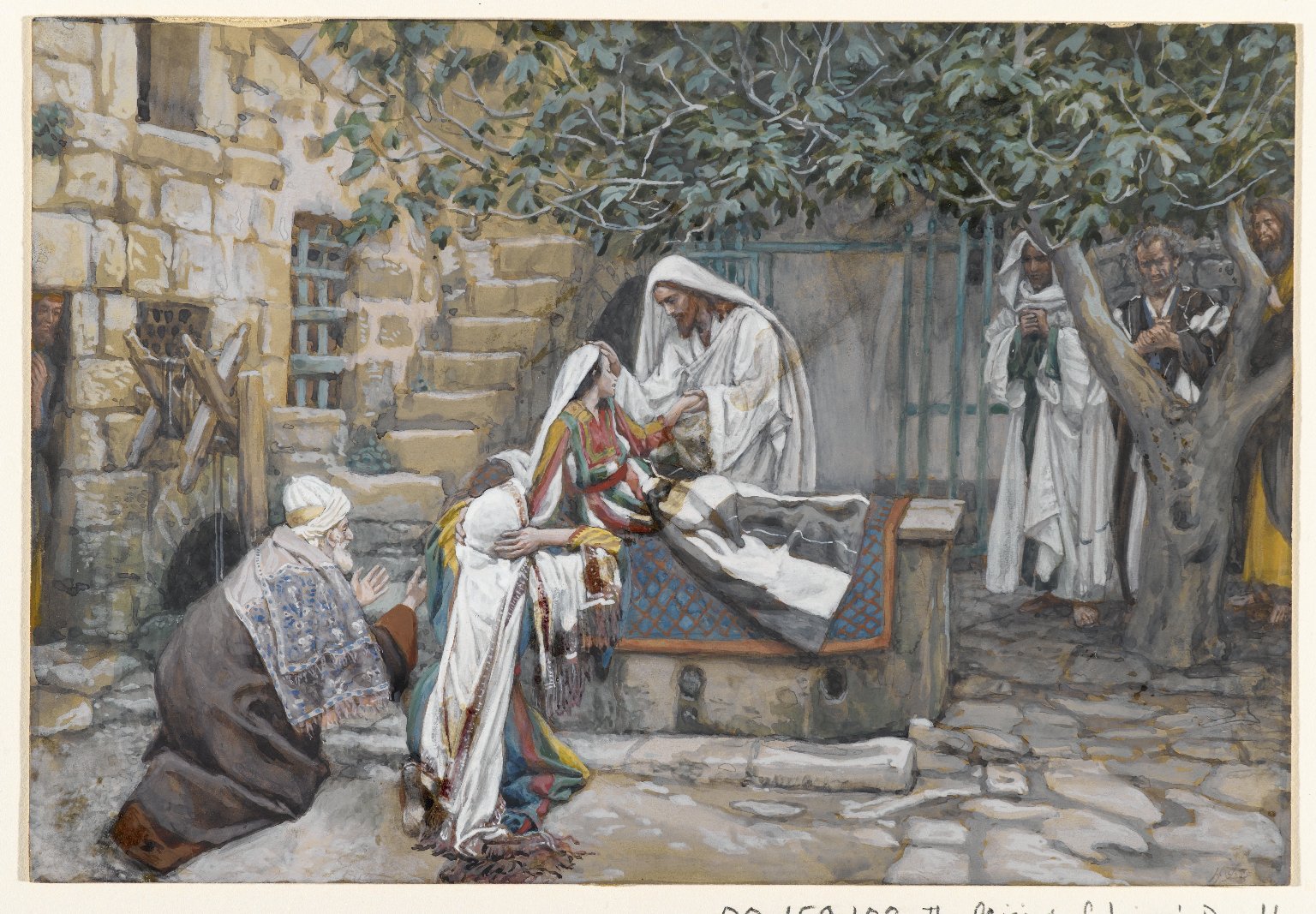
Palm Sunday 2024

IN THIS COUNTRY when we want to celebrate something there is often some kind of procession. Sports teams who win trophies go on an open-topped bus. After King Charles’ Coronation, there was a great procession from Westminster Abbey back to Buckingham Palace. Today, we see the entry of the Messiah into Jerusalem. The Davidic King has made His triumphal entry, something which we have reenacted ourselves this morning, waving palms and singing, ‘Hosanna to the Son of David!’. The prophet Zechariah, writing 500 years before Jesus, looks forward to a messianic future:

Rejoice greatly, O daughter of Zion! Shout aloud, O daughter of Jerusalem! Behold, your king is coming to you; righteous and having salvation is he, humble and mounted on a donkey, on a colt, the foal of a donkey.

‘Bydd lawen iawn, ti ferch Seion; a chrechwena, ha ferch Jerwsalem: wele dy frenin yn dyfod atat: cyfiawn ac achubydd yw efe; y mae efe yn llariaidd, ac yn marchogaeth ar asyn, ac ar ebol llwdn asen.’ (Zech 9:9)

The donkey ridden by Jesus reminds us of the humble beast of burden, which carried his Mother to Bethlehem for His birth, and then carried the Holy Family into exile in Egypt. This is an act of humble leadership which realizes what the prophets foresaw. It shows us that Jesus Christ is truly the one who fulfils the hopes of Israel. The Hebrew Scriptures look forward to the deliverance of Israel. This deliverance is enacted in front of the eyes of those watching the Carpenter’s son enter the Holy City.

Scripture is fulfilled and there is a burst of popular enthusiasm, people wave palm branches and cry out. However, having someone claim to be a relative of King David is a direct challenge to Herod, the puppet ruler installed to comply with the Romans. The events we heard described, before our procession this morning, look something like a political coup — a bid to replace a leader lacking legitimacy. Such an attempt is bound to have political repercussions. It represents a direct challenge to the ruling house and to Rome, and therefore it has to be countered. The masses in Jerusalem are expecting a king of the Davidic line. One who would be seen as a challenge to the ruling élite, the status quo. But in Christ, God gives Israel something else. Yes, he is a King of the line of David. But Jesus is one who rules with love, and who has no desire for power, or honour. Naturally, the leaders and those in authority are threatened by Him: Jesus turns their world on its head. He is an awkward inconvenience. Jesus, however, does not want their power. He has come to be and accomplish something completely different. What is seen as a potential political coup is in fact a renewal of religion, the fulfilment of prophecy, and a new hope for Israel. Political and religious leaders can only see the threat, rather than the opportunity which Christ offers.

At its heart Christianity is an offer of new life in Jesus Christ. This starts with repentance, and acceptance of our need for God. As we grow in faith, we come to believe and trust in a God who loves us, and gives Himself for us. Then we can experience healing, wholeness, and fullness of life in and through Him. Such gifts come at a cost, which the week ahead will make clear to us in the most stark and direct way. 

Over the next few days we will see the joy and celebration of today turned into anger and resentment. Crowds which cried ‘Hosanna’ will soon shout ‘Crucify him!’. This should come as no surprise to us. We know how people can be fickle and manipulated. And yet, on the same night He will be betrayed, Jesus takes bread and wine, blesses them and says, ‘This is my Body … This is my Blood’. ‘hwn yw fy nghorff … hwn yw fy ngwaed’ These words are repeated when the Eucharist is celebrated because Our Lord told us to ‘Do this’ ‘gwnewch hyn’ and so we do. We come together so that God can feed us with His very self, so that we can have life in Him. This is not an optional extra, it is fundamental to who and what we are as Christians. In the Eucharist we experience God’s love, His body broken for us, His blood poured out, to heal us. This is the banquet of the Kingdom, the Wedding Feast of the Lamb, and we are all invited!

Today, and in the coming week, we see what God’s Love and God’s Glory are really like. They are not what people expect. God’s power is shown in humility, strength in weakness. As we continue our Lenten journey in the triumph of this day, we look towards the Holy and Life-giving Cross and beyond to the new life of Easter. Let us trust in the Lord, and go with Him to Calvary, and beyond. Let us raise our palms and sing the praises of God the Father, God the Son, and God the Holy Spirit. To whom be ascribed all glory, dominion, and power, now and forever. Amen.
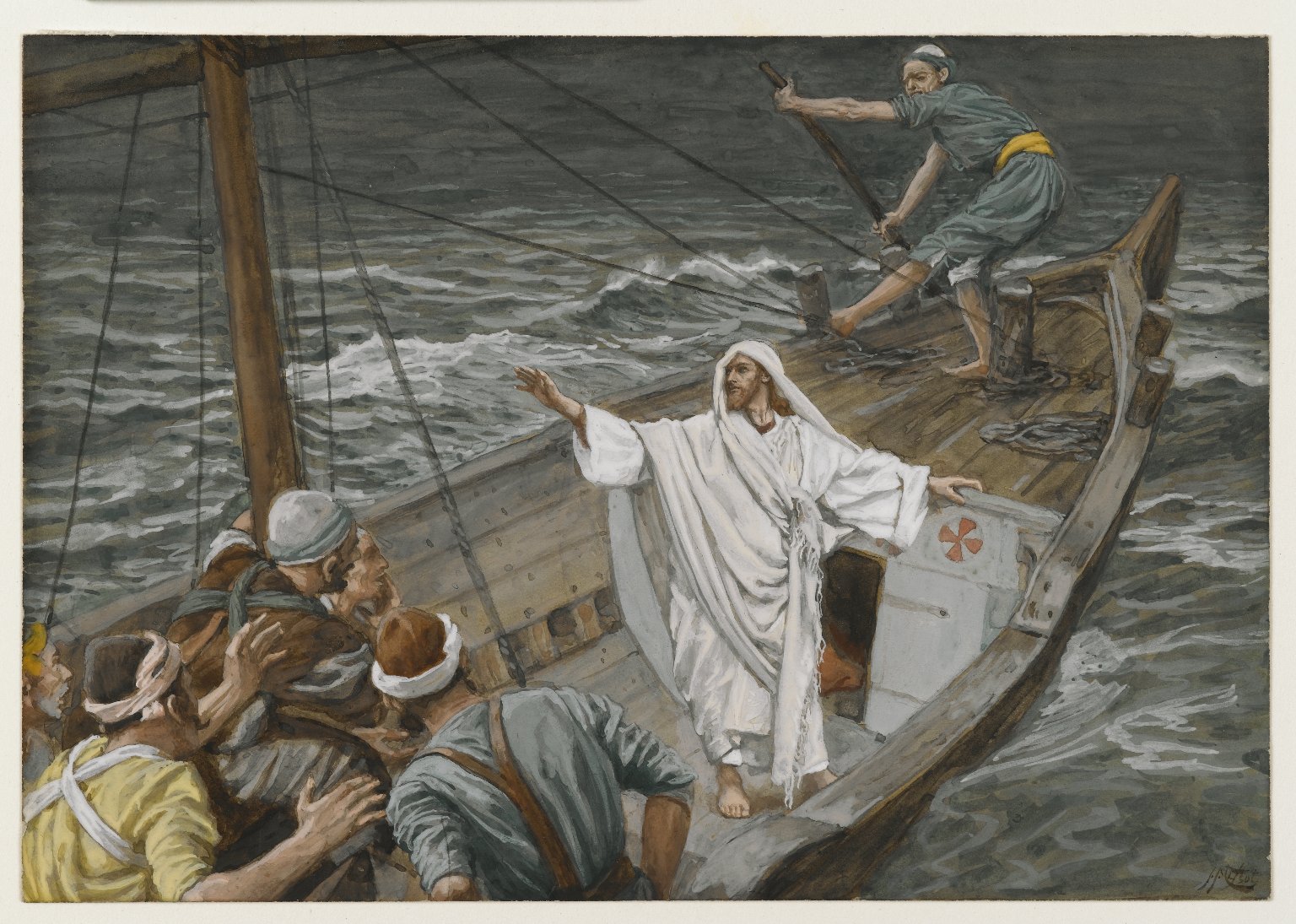
Lent V: Sir, we want to see Jesus!

THERE are some texts in the Bible which just stick in your head. The Gospel today contains one of them: ‘Sir, we wish to see Jesus’ ‘Syr, fe hoffem weld Iesu’ (Jn 12:21). It is a text often placed on pulpits to remind preachers of their primary task. This sounds simple enough, but, at one level, when I hear these words they remind me of my own shortcomings. Have other people seen Jesus in what I say and do? We are our own harshest critics in this regard — it is far easier to see our own faults and failings, than what God might be doing through us. 

In today’s Gospel we are in Jerusalem. It is just before the Passover, the most important religious festival, commemorating the journey from slavery in Egypt to the Promised Land. There are some Greeks, who may or may not be Jewish converts, that approach Philip, who has a Greek name. He, along with Simon Peter and Andrew, was first a disciple of John the Baptist, before following Jesus. These Greeks ask Philip a simple question:

Sir, we wish to see Jesus.”

Syr, fe hoffem weld Iesu’ (Jn 12:21)

These Greeks are well-disposed and interested, and they desire an encounter with Our Lord. At a fundamental level human beings long for communion with the Divine. It is what we are made for. So the disciples tell Jesus, who makes the following reply:

The hour has come for the Son of Man to be glorified. Truly, truly, I say to you, unless a grain of wheat falls into the earth and dies, it remains alone; but if it dies, it bears much fruit. Whoever loves his life loses it, and whoever hates his life in this world will keep it for eternal life. If anyone serves me, he must follow me; and where I am, there will my servant be also. If anyone serves me, the Father will honour him.

‘Daeth yr awr y gogonedder Mab y dyn. Yn wir, yn wir, meddaf i chwi, Oni syrth y gronyn gwenith i’r ddaear, a marw, hwnnw a erys yn unig: eithr os bydd efe marw, efe a ddwg ffrwyth lawer. Yr hwn sydd yn caru ei einioes, a’i cyll hi; a’r hwn sydd yn casáu ei einioes yn y byd hwn, a’i ceidw hi i fywyd tragwyddol. Os gwasanaetha neb fi, dilyned fi: a lle yr wyf fi, yno y bydd fy ngweinidog hefyd: ac os gwasanaetha neb fi, y Tad a’i hanrhydedda ef’ (Jn 12:23-26)

This is a strange response: Our Lord doesn’t say, ‘Of course, bring them here’, or ‘I’d be delighted to meet them’. Instead He starts talking about His forthcoming Death. Jesus does so by using an image from the Parable of the Sower to make the point that life comes through death, freedom through service. These are paradoxes, the exact opposite of what one might expect Him to say, and yet they are true. Christ then experiences something of a moment of doubt, at which point God the Fathers speaks of future glory, and then Our Lord goes back to talking about His death:

“Now is the judgement of this world; now will the ruler of this world be cast out. And I, when I am lifted up from the earth, will draw all people to myself.”

‘Yn awr y mae barn y byd hwn: yn awr y bwrir allan dywysog y byd hwn. A minnau, os dyrchefir fi oddi ar y ddaear, a dynnaf bawb ataf fy hun.’ (Jn 12:31-32)

Because of Jesus’ Death and Resurrection, the Church, Christ’s Body exists to save people and to offer eternal life through Him. God shows the world the fullness of glory, the most profound expression of self-giving love in the events of His Passion. This is why we celebrate it: week by week and year by year. We prepare ourselves during Lent to walk with Christ to Calvary and beyond. We see how much God loves us, how much God gives himself for us. This message of salvation comes to us from the prophets. God makes His intentions clear:

“Behold, the days are coming, declares the Lord, when I will make a new covenant with the house of Israel and the house of Judah,”

‘Wele y dyddiau yn dyfod, medd yr Arglwydd, y gwnaf gyfamod newydd â thŷ Israel, ac â thŷ Jwda’ (Jer 31:31)

God renews the covenant with humanity, writing it on our hearts, forgiving us our iniquities. The Law of Love, which God makes real in Jesus Christ has genuine transformative power, because it is rooted in forgiveness and healing, something which only God can provide. Our loving Father does this on the Cross, where He gives His Son to die for us, to heal our wounds, and to offer eternal salvation to all who believe in Him. This is God’s glory, the glorification of His Son, dying the death of a slave, to save humanity and free us. If we want to share in Christ’s glory, then we need to follow the same path of suffering love which takes Him to His Cross, and will take us to ours.

To follow Christ means embracing the Cross as the mystery of God’s love. If we let God’s love transform us, then wonderful things can happen. There will be pain and suffering along the way, but this is far outweighed by the promise of future glory. So then, as we continue our journey through Lent our journey to the Cross and beyond to the empty tomb of Easter, let us lose our lives in love and service of him who died for us, who bore our sins, who shows us how to live most fully, to be close to God, and filled with his love. Let us encourage one another, strengthen one another, and help each other to live lives which proclaim the truth of God’s saving love. To offer the world the hope of Heaven, where we may sing the praises of God the Father, God the Son, and God the Holy Spirit. To whom be ascribed all glory, dominion, and power, now and forever. Amen.
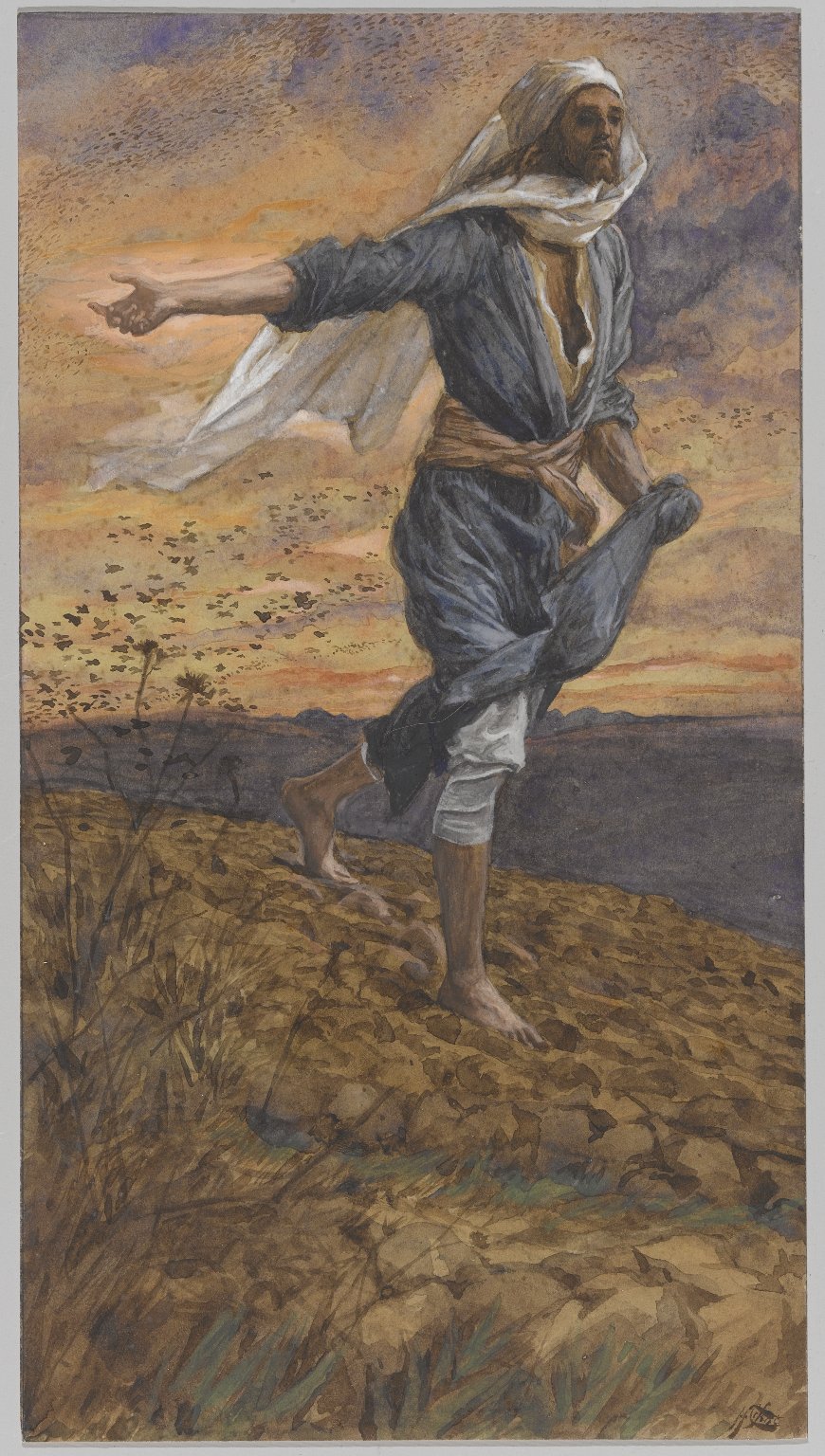
James Tissot : The Gentiles Ask to See Jesus  (Brooklyn Museum)

Lent IV

IF you have ever been unwell while on holiday you probably sought out a Pharmacy. They are quite straightforward to locate as they tend to either have a cross on their sign, or a snake or two around a pole. This was the symbol of the Greek God of healing Aesculapius whose major shrine was at Epidaurus. Christians tend to associate the snake with the tempting of Adam and Eve in the Garden of Eden, but it is not this creature’s only occurrence in the Bible. 

This morning’s Gospel begins with Jesus explaining His forthcoming Crucifixion with a reference to Israel’s wanderings after the Exodus:

And the Lord said to Moses, “Make a fiery serpent and set it on a pole, and everyone who is bitten, when he sees it, shall live.” So Moses made a bronze serpent and set it on a pole. And if a serpent bit anyone, he would look at the bronze serpent and live.’ 

‘A dywedodd yr Arglwydd wrth Moses, Gwna i ti sarff danllyd, a gosod ar drostan: a phawb a frather, ac a edrycho ar honno, fydd byw. A gwnaeth Moses sarff bres, ac a’i gosododd ar drostan: yna os brathai sarff ŵr, ac edrych ohono ef ar y sarff bres, byw fyddai.’ (Numbers 21:8-9)

The people of Israel had been complaining about the journey, the lack of food and water, and that God has led them out into the desert to die, so God sent fiery serpents which killed them. The people then relented, and asked Moses to pray to God to take the serpents away. God listened to Moses, and provided a means for Israel to be saved. Jesus uses this example to explain why the Son of Man must be lifted up. Just as the bronze serpent saved people long ago, Jesus’ being lifted up on the Cross will save those who believe in Him. Our Lord’s death will occur at Passover, the festival which celebrates the people of Israel’s journey from slavery in Egypt, to the Promised Land. So Christ will deliver humanity from the slavery of sin and offer us eternal life in Him. He bears our burden, and reconciles us to the Father, and each other.

There then follows one of the most well-known verses in the Bible:

For God so loved the world, that he gave his only Son, that whoever believes in him should not perish but have eternal life. For God did not send his Son into the world to condemn the world, but in order that the world might be saved through him.

‘Canys felly y carodd Duw y byd fel y rhoddodd efe ei unig‐anedig Fab, fel na choller pwy bynnag a gredo ynddo ef, ond caffael ohono fywyd tragwyddol. Oblegid ni ddanfonodd Duw ei Fab i’r byd i ddamnio’r byd, ond fel yr achubid y byd trwyddo ef.’ (Jn 3:16-17) 

This is the heart of our faith as Christians. Christ was born for us, lived and died for us, and was raised to new life, so that we might have the promise of eternal life in Him. This is why we follow Christ into the desert of Lent for forty days, so that through prayer, fasting and charity we may be prepared in body and soul to celebrate the mystery of Christ’s Passion, Death, and Resurrection. Maundy Thursday, Good Friday and Easter are the ultimate embodiment of God’s generous Love towards humanity. God loves us, you and me, each one of us, so much that He gave His only Son to die for us, on the Cross.

God does not condemn humanity for falling short, instead He saves us. God is a God of love and generosity, who offers Himself to reconcile us to Him, and to each other. This generosity is at the heart of our faith as Christians. We worship a generous, loving God, and invite others to receive the free gift of God’s grace, and enter a relationship with the God who made us and who loves us. 

This relationship explains the joyful hope which St Paul has when he writes to the Church in Ephesus in our second reading this morning. Paul’s central message is that:

For by grace you have been saved through faith. And this is not your own doing; it is the gift of God,’ 

‘Canys trwy ras yr ydych yn gadwedig, trwy ffydd; a hynny nid ohonoch eich hunain: rhodd Duw ydyw’ (Eph 2:8)

Grace is unmerited kindness, something which we do not deserve, or earn. It is by the grace of God that we are saved, through faith, believing and trusting in Jesus Christ, who was born for us, died and rose again for us. We can put our trust in the God who loves us, and who shows us that love in His Son. It is not about what we can do, but about what God can do for us. Our relationship with God is the result of a gift, which we can accept and which can change our lives, if we only let go, and let God transform us, more and more into the likeness of His Son. 

Through prayer, the reading and study of scripture, living out our faith, and the sacraments of the Church, God brings about the work of transformation in us. As He gave Himself on the Cross for us, He gives us Himself in the Eucharist. During Communion we are fed with the Body and Blood of Christ, God’s very self, so that we can become what He is. Prepared by Lenten penitence we may look forward to sharing the new life of Easter, and singing the praises of God the Father, God the Son, and God the Holy Spirit. To whom be ascribed all glory, dominion, and power, now and forever. Amen.
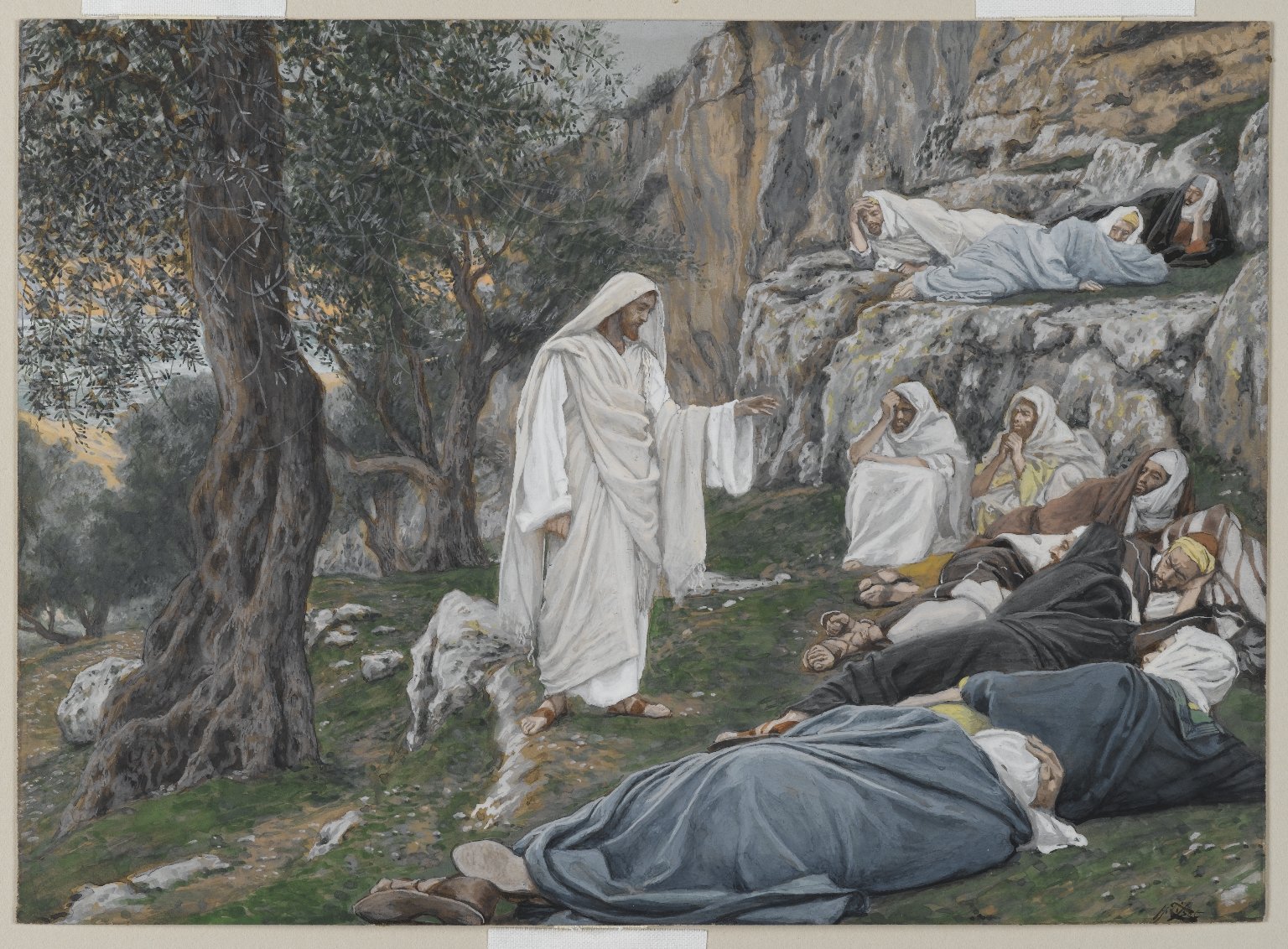
Diego Velázquez – Christ Crucified (Museo del Prado, Madrid)

Lent III – Cleansing the Temple

One of the truths about humanity is that we are amazingly good at doing the wrong thing. Corruption and greed beset us, and religious organisations are no exception. We need to be vigilant, constantly on our guard, lest we fall into the scandalous behaviour typified by the traders and money-changers in this morning’s Gospel. 

The Temple in Jerusalem remains to this day the most important place in the world for Jews. At its centre was the Holy of Holies which contained the Ark of the Covenant. Inside the Ark were the two tablets containing the Ten Commandments, some of the manna from the desert, and Aaron’s staff. That is why, to this day, Jews continue to pray at the Western Wall in Jerusalem. This is all that remains of the Temple after its destruction by the Romans in ad 70. At the time of Jesus, Passover was the busiest time of year in Jerusalem. As the central festival of Judaism, Passover marks the journey from slavery in Egypt to the freedom of the Promised Land, Israel. 

In our first reading this morning from the Book of Exodus, God gives the law to Moses on Mount Sinai in the desert. It describes both how to honour God, and how humanity should live. Our duty towards God and our neighbour is clearly shown. When Moses receives the Ten Commandments from God, the first is:

I am the Lord your God, who brought you out of the land of Egypt, out of the house of slavery; you shall have no other gods before me.

‘Myfi yw yr Arglwydd dy Dduw, yr hwn a’th ddug di allan o wlad yr Aifft, o dŷ y caethiwed. Na fydded i ti dduwiau eraill ger fy mron i’ (Exod 20:2-3)

The temple traders, in their desire to profit from people’s religious observance, have broken this first and most important commandment. Their desire for making money and profit has got in the way of what the Temple is supposed to be about: namely, worshipping God. It has become a racket, a money-making scheme to fleece pilgrims who have come from far away and who do not have the right money or the correct sacrificial animals with them. This is no way to worship God, a God who loves us, and who showed that love by delivering Israel from slavery in Egypt, and who will deliver humanity by His Son.

Our Lord is doing the right thing, cleansing the Temple from those who use religion as an opportunity to grow rich through the piety of others. What started as something good has become corrupt, and needs to be reformed. God is not honoured when He is used as an opportunity for people to get rich. The Temple is supposed to be a house of prayer for all the nations (Isaiah 56:7 & Mark 11:7), but the Court of the Gentiles has been filled with stalls for money-changers and animal-sellers. By clearing them out Jesus has made room for the pilgrims, and upset the religious establishment, something which will eventually lead to His Death, at Passover, which we celebrate on Good Friday. He will be crucified and die at the time when the Passover lambs are being slaughtered in the Temple. This is a sacrifice which will not need to be repeated, as Jesus will die once, for the sins of the whole world.

The Jews ask Jesus, 

What sign do you show us for doing these things?

‘Pa arwydd yr wyt ti yn ei ddangos i ni, gan dy fod yn gwneuthur y pethau hyn?’ (Jn 2:18)

Our Lord makes a cryptic reply:

Destroy this temple, and in three days I will raise it up.” 

‘Dinistriwch y deml hon, ac mewn tridiau y cyfodaf hi.’ (Jn 2:19)

His audience cannot understand what Jesus means. It took almost fifty years to build the Temple after the return from Babylon. The idea of destroying it and rebuilding it in three days is crazy. However, Christ is talking about His own Death and Resurrection. Once this has happened, the disciples can understand what Our Lord meant, but currently they do not. They are confused by this inspiring, miracle-working rabbi, who keeps talking about His own Death and Resurrection. 

For those of us who have the benefit of two thousand years of tradition behind us, Jesus makes perfect sense. Christ mentions His Death and Resurrection so often because it is the most important moment in human history. Nothing else really matters compared to these few days around Passover. They are the core of our faith, the reason for our hope, and the greatest demonstration of love the world has ever seen.

Our Lord is the True Temple, the place where God dwells, His presence among the people of Israel. He is the Lamb of God, who takes away the sins of the world (Jn 1:28). As both Priest and Victim He will offer the sacrifice which restores humanity’s relationship with God and each other. The Jews demand a sign, and Christ prophesies that if they destroy this temple then he will raise it up in three days. He looks to His death and resurrection to show them where true worship lies — in the person of Jesus Christ. Jesus said, ‘I have come not to abolish the law and the prophets but to fulfil them’ ‘Peidiwch â thybio i mi ddod i ddileu’r Gyfraith na’r proffwydi; ni ddeuthum i ddileu ond i gyflawni’ (Matthew 5:17). The Ten Commandments are not abolished by Christ, or set aside, but rather His proclamation of the Kingdom and Repentance show us that we still need to live the Law of Moses out in our lives: to show that we honour God and live our lives accordingly. In His cleansing of the Temple, Christ looks to the Cross and to the Resurrection, as the way that God will restore our relationship with Him. The Cross is a stumbling-block to Jews, who are obsessed with the worship of the Temple, and it is foolishness to Gentiles who cannot believe that God could display such weakness, such powerlessness. Instead the Cross, the supreme demonstration of God’s love for us, shocking and scandalous though it is, is a demonstration of the utter, complete, self-giving love of God. Here, love and mercy are offered to heal each and every one of us. Here we are restored. 

It is a shock to learn that God loves us enough to do this, to suffer dreadfully and die for us, to save us from our sins. We do not deserve this generosity, and that is the point. Through Christ we are offered the opportunity to become something other and greater than we are. By putting away the ways of the world, of power and money, selfishness and sin, we can have new life in and through Him.

As we continue our Lenten pilgrimage, may we cleanse the temples of our hearts, and ask God for forgiveness. Let us prepare to celebrate with joy the Paschal feast, freed from sin. Let us rejoice in Our Lord’s victory on the Cross and in His Resurrection, which has opened to us the gates of everlasting life. Where we hope to sing the praises of God the Father, God the Son, and God the Holy Spirit. To whom be ascribed all glory, dominion, and power, now and forever. Amen.
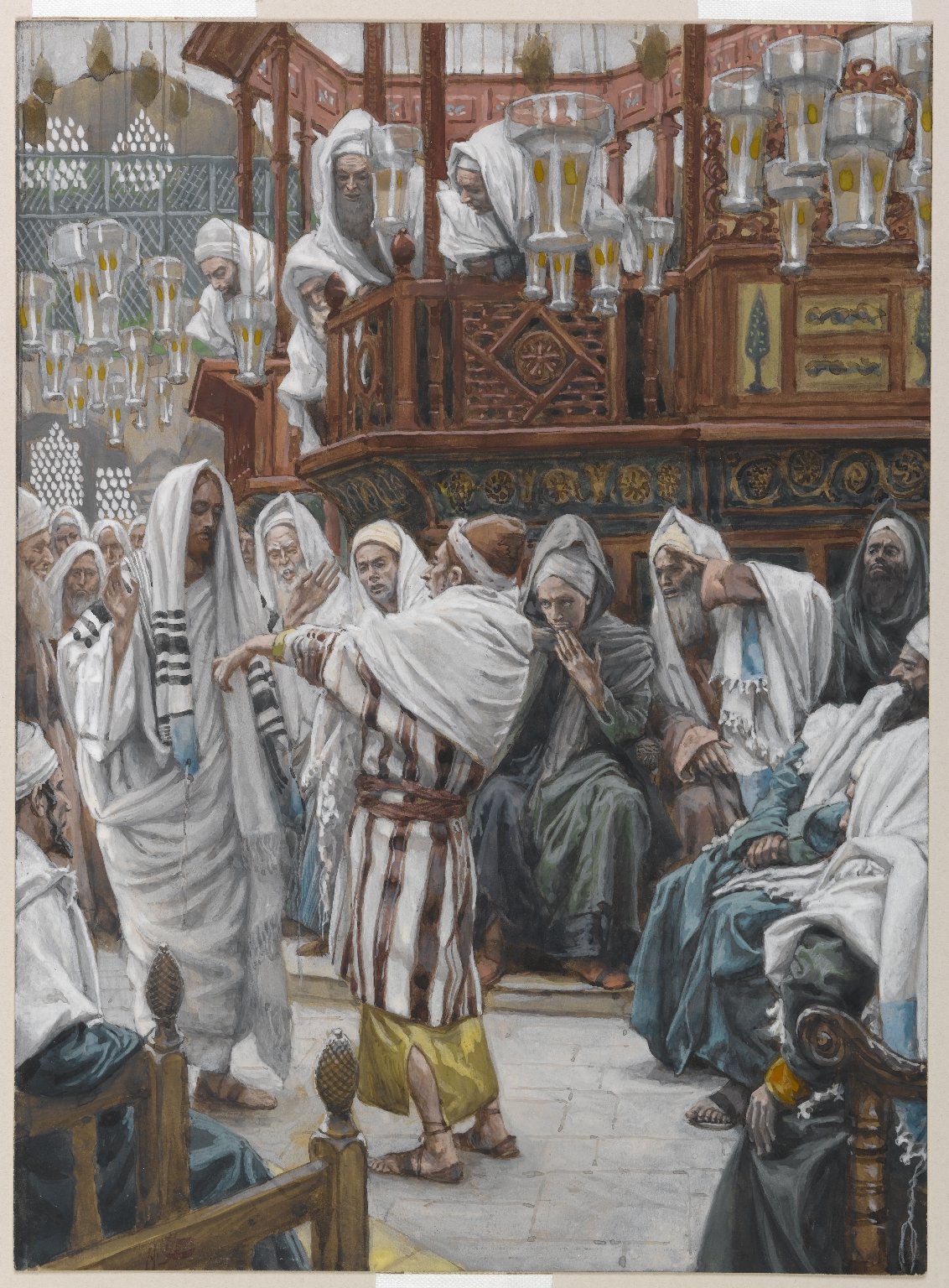
El Greco – Christ driving the traders from the Temple [National Gallery, London]

Lent II – The Transfiguration

One of the perils of driving in autumn or winter is the low Sun. Because of its angle and closeness to the Earth, we find ourselves dazzled by its brilliance. You have to avert your gaze or use a sun visor or sunglasses in order to drive. This can be inconvenient, but the brightness of our closet star is as nothing compared with the presence of God. Last week we heard the voice of God the Father at Jesus’ Baptism and we will hear Him again this week. 

Our first reading from Genesis, the story of Abraham and the Sacrifice of Isaac, is both well-known, and deeply shocking. The concept of human sacrifice was widespread in the Ancient World. It was not a common occurrence, but it did take place. It seems abhorrent to us, and so it should. In the passage God speaks to Abraham and says,

Take your son, your only son Isaac, whom you love, and go to the land of Moriah, and offer him there as a burnt offering on one of the mountains of which I shall tell you.”

‘Cymer yr awr hon dy fab, sef dy unig fab Isaac, yr hwn a hoffaist, a dos rhagot i dir Moreia, ac offryma ef yno yn boethoffrwm ar un o’r mynyddoedd yr hwn a ddywedwyf wrthyt.’ (Genesis 22:2)

Thankfully, just as Abraham is about to offer Isaac, God tells him to stop, as Abraham has demonstrated his complete devotion to God:

Do not lay your hand on the boy or do anything to him, for now I know that you fear God, seeing you have not withheld your son, your only son, from me.” 

‘Na ddod dy law ar y llanc, ac na wna ddim iddo: oherwydd gwn weithian i ti ofni Duw, gan nad ateliaist dy fab, dy unig fab, oddi wrthyf fi.’ (Genesis 22: 12)

Abraham sees a ram with its horns caught in a thicket, and offers it to God instead. The ram symbolises Christ. It looks forward to Jesus, recognised by John the Baptist as the Lamb of God, who takes away the sins of the world. The ram also points to the Passover Lamb in Exodus, which again prefigures Jesus, the fulfilment of the Paschal Sacrifice. Because Abraham has not withheld his son, he is blessed by God, and through his offspring, all people will be blessed. For Christians the Easter story is important because in it God, like Abraham, does not withhold His Only Son, but gives Him, to die for us. This narrative demands contemplation because it is the demonstration of the mystery of God’s love for humanity. The fact that God loves us that much is totally awesome, especially when we do not deserve it. The mystery of God’s love is that we are not loved because we are loveable. We are often quite the opposite! But God loves us anyway and His steadfast love transforms us. 

St Paul pondered such questions as he wrote to the Church in Rome:

‘He who did not spare his own Son but gave him up for us all’

‘Yr hwn nid arbedodd ei briod Fab, ond a’i traddododd ef trosom ni ol’ (Rom 8:32)

Christ’s death on the Cross is a demonstration of divine generosity, and the reason for our hope as Christians. God’s love for humanity is truly amazing. We should pause for a moment as we read or hear this. God loves me enough to die for me. If God can do this for us, what can we, in return, do for Him? During the Lenten Season we focus on the Cross and the Empty Tomb as the centre of our faith, three days which explain who we are, what we are, and why we are Christians. 

The Transfiguration, described in today’s Gospel, is strange because in it we see something of who Jesus really is: God. We have a brief glimpse of Divine glory as a prelude to Our Lord’s Passion and Death. The two are linked, as they both allow us to understand both who God is, and what He is doing. When God speaks from the cloud He tells us three things about Jesus. Firstly that Jesus is the Son of God, secondly that He is loved, and thirdly that we should listen to Him. What Jesus says and does should affect us and our lives. Like the disciples, we have to be open to the possibility of being radically changed by God. The opportunity of divine transformation is offered to us, so that we might come and share the Divine life of love.

Jesus tells the disciples not to tell anyone about their experience on the mountain until after He has risen from the dead. Jesus has another mountain He must climb: the hill of Calvary, where He will suffer and die upon the Cross. There He takes our sins upon Himself, restoring our relationship with God and each other. This then is real glory, not worldly glory, but the glory of God’s sacrificial love poured out on the world to heal and restore all humanity. The theologian Fulton Sheen spoke about the importance of mountains in Jesus’ life. He said:

Three important scenes of Our Lord’s life took place on mountains. On one, He preached the Beatitudes, the practice of which would bring a Cross from the world; on the second, He showed the glory that lay beyond the Cross; and on the third, He offered Himself in death as a prelude to His glory and that of all who would believe in His name

(Fulton Sheen, The Life of Christ, 1970 p.158)

The Transfiguration shows us the glory of heaven, the glory of the Resurrection at Easter, the glory that lies beyond the Cross. God’s love and God’s glory are intertwined, and cannot be separated because they given freely. God’s very nature is generous, beyond our understanding, and characterised by total self-gift. Our Heavenly Father does not hold anything back, and whereas Isaac is replaced at the last minute by a ram, there is no substitution for Jesus. God gives His Son, Jesus Christ, to die for us, and to rise again, so that we might enjoy eternity with Him in Heaven. The Transfiguration is a promise of our future heavenly glory. Through signs and glimpses, God shows us what future awaits us. He longs to heal and restore us, so that we might enjoy eternity with Him. 

The Transfiguration, therefore, looks to the Cross to help us to prepare ourselves to live the life of faith. It helps us to comprehend true majesty, true love and true glory. The wonderful glory that can change the world and which lasts forever, for eternity, unlike the fading glory of the world, which is here today but gone tomorrow.

So my brothers and sisters, as we celebrate God’s love and glory, let us prepare to  ascend the mountain ourselves and have an encounter with the living God in Holy Communion. Let us come to the source of healing and fount of love which is God’s very self. Let us touch and taste Our Lord and Saviour, given for us, so that we might live in Him. Let us be transformed by Him and enjoy the glories of Heaven singing the praises of God the Father, God the Son, and God the Holy Spirit. To whom be ascribed all glory, dominion, and power, now and forever. Amen.
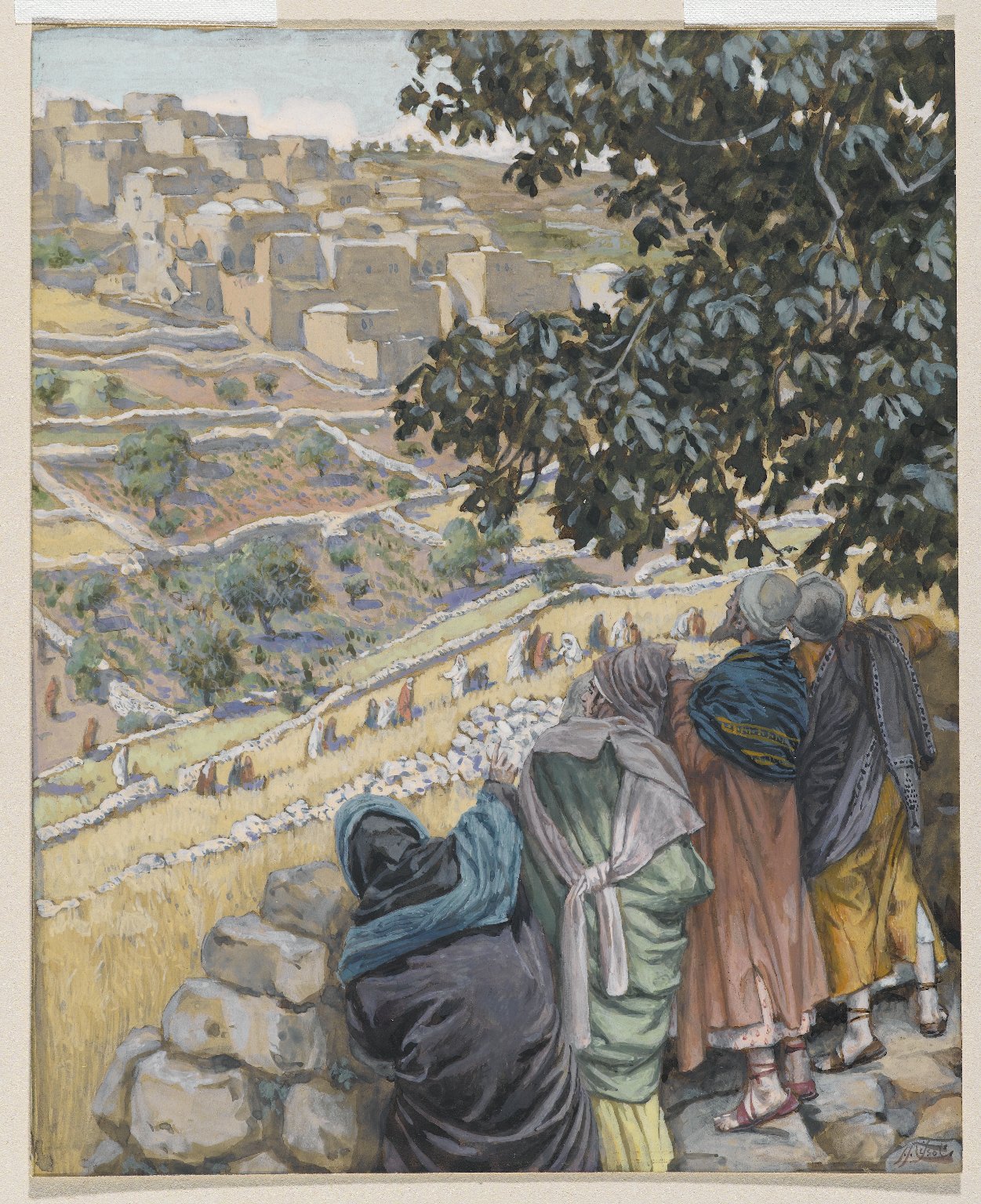
Lent I

I don’t know about you, but for me years are definitely going by much more quickly these days. Not long ago it was Christmas and now we are already in Lent and preparing for Holy Week and Easter. Lent (Garawys) is a period of forty days, which prepares us to celebrate the Passion, Death and Resurrection of Jesus Christ. The symbolism of the number forty is rich in the Bible. It signifies a time of trial or testing, and recalls significant biblical events. Firstly, in the story of Noah’s Ark in Genesis 7:12, God floods the earth with water for forty days. Secondly, in the story of the Exodus, the people of Israel spend forty years in the desert before they reach the Promised Land. Thirdly, Moses remains with God on Mount Sinai for forty days before giving the people of Israel the Ten Commandments. And fourthly, in 1Kings 19:8, Elijah fasts for forty days on the way to Mount Horeb, before talking to God and finding Elisha. All of these examples point to Jesus Christ and foreshadow His saving work. 

Today’s first reading from Genesis takes us back to the aftermath of the flood, and the covenant which God establishes by setting His bow, a rainbow (enfys), in the clouds, so that all humanity can rest assured that they will not be destroyed by God. We can be confident that ultimately Our Creator is interested in reconciliation and healing: God is a God of love.

Our second reading from the First Letter of Peter, draws a link between Noah and the ark as a sign of salvation, and baptism, by which humanity is saved. It is a timely connection to make since Lent is traditionally a time for preparation for Baptism at Easter. The wider account of salvation history, and the life of Jesus in particular, become our life as Christians in our baptism: we share in them, they become part of us, and form both who and what we are. We enter into the drama of salvation as we die to sin, and are raised to new life in our baptism. Through our new life in Christ, we follow His example, and prepare for our annual celebration of Holy Week and Easter by going into the desert with Him for the forty days of Lent.

Keeping with the theme of Baptism, this morning’s Gospel begins with Our Lord’s Baptism in the River Jordan by His cousin, John. Jesus does not need to be baptised, He has not committed any sins for which He needs to repent. He does not require to be washed clean. We, on the other hand, do need to be cleansed of our sins. Christ shows humanity the way back to God, so that we might follow His example, and come to share in the same intimacy which characterises the life of God. During Jesus’ Baptism we hear the Father’s voice and see the Holy Spirit: three Persons, One God. It is a glimpse of Divine Glory, which awaits us in Heaven, the end and purpose of salvation history.

Then the Spirit drives Our Lord out into the desert: to be alone, to pray, to be with God. This is also a time of trial when Satan tempts Jesus. The devil attempts to deflect Christ from His mission to bring love and healing, and to proclaim the Kingdom of God. Unlike Matthew’s Gospel, which lists the temptations, Mark simply states that Jesus was tempted. Because He is without sin, Jesus is able to withstand temptation. Our Lord’s victory in the desert points to His great victory on the Cross. Christ then preaches to ‘the spirits in prison’ ‘ac a bregethodd i’r ysbrydion yng ngharchar’ (1Peter 3: 19). He does this to save humanity from sin and death, and restore the hope of Heaven. This is what we are preparing to celebrate at Easter. 

In the garden of Eden the animals were tame, but in the desert Jesus is with wild animals. Here the second Adam is beginning the work of the restoration of Creation. Mankind who fell because of a tree, will be restored by the tree of the Cross. While He is in the wilderness Our Lord is ministered to by angels. He is the Beloved Son, in whom the Father is well-pleased. After the trial of the temptations Christ is tired, and hungry. Experiencing temptation is a trying business, both physically and spiritually. This reminds us of the need for care, especially self-care, in our Lenten observances. Rest and nourishment are an important part of our spiritual and physical wellbeing, now more than ever.

After the forty days are over, Jesus returns to Galilee and starts to proclaim the Gospel, the Good News of the Kingdom of God:

“The time is fulfilled, and the kingdom of God is at hand; repent and believe in the gospel.” 

“Yr amser a gyflawnwyd, a theyrnas Dduw a nesaodd: edifarhewch, a chredwch yr efengyl.” (Mk 1:15)

This message is the same as the one announced by John the Baptist: Repent, turn away from your sins, turn back to God, and Believe the Gospel, proclaimed by Jesus Christ. As Christians, nearly two thousand years later, we believe and proclaim that same message. Jesus calls us to turn away from sin, to turn back to God, to trust Him, and to know that He longs for our healing and reconciliation. The Kingdom is a place where we are restored, and experience life in all its fulness.

During the weeks of Lent, we pray, fast, and are charitable in order to discipline our minds and bodies, so that we may grow in holiness and become more like Jesus. The Temptation of Jesus teaches us that we have to become weak, powerless and vulnerable, utterly reliant upon our Heavenly Father, so that God is able to be at work in us. Such weakness may be perceived as foolish in worldly terms, but that is the point. As Christians, we are not meant to be conformed to the world. In seeking to grow in faith, humility, and obedience, we allow God to transform us — taking us and shaping us into His likeness. Therefore, as we undertake to follow Christ in our Lenten pilgrimage, we do so in the knowledge of our weakness, and our total reliance upon God. If we turn away from what separates us from Our Heavenly Father, and believe in a God who loves us, then healing can take place. Following Jesus’ example we spend six weeks being close to Our Lord, so that He may renew and strengthen us.

So, my brothers and Sisters in Christ, let us use this time of Lent to draw close to God in prayer. Let us be nourished by the word of God in Holy Scripture, and by God’s very self, His Body and Blood in the Eucharist, so that He may transform us. By these means, may we share in the new life of the Kingdom and be prepared for the glory of Heaven where we, and all creation, may sing the praises of God the Father, God the Son, and God the Holy Spirit. To whom be ascribed all glory, dominion, and power, now and forever. Amen.

Quinquagesima – Imitate Jesus!

When we all were children, we learned through imitation, through copying others. Human beings learn to speak, and walk, and everything else, by seeing and hearing others. To imitate the actions of others is an important mechanism for social learning — that is, for acquiring new knowledge. So St Paul writes at the end of this morning’s second reading:

Be imitators of me, as I am of Christ’ 

‘Byddwch ddilynwyr i mi, megis yr wyf finnau i Grist.’ (1Cor 11:1)

Paul encourages the Corinthian church to imitate him, as he imitates Christ. He wants them to do so in order that they all might live out the love of God in their lives, for the glory of God, and to proclaim the truth of the Gospel to the world. This too is our calling as Christians. We are charged to follow the same example , live out the same faith, and proclaim the same truth in our daily lives. 

Today’s readings focus on leprosy, an infection of the skin which usually placed the sufferer on the margins of society. The position adopted in Leviticus is clear:

‘He is unclean. He shall live alone. His dwelling shall be outside the camp.

‘aflan yw efe: triged ei hunan; bydded ei drigfa allan o’r gwersyll.’ (Lev 13:46)

This verse is used by the author of the Letter to the Hebrews to describe Christ’s Crucifixion and death:

‘So Jesus also suffered outside the gate in order to sanctify the people through his own blood. Therefore let us go to him outside the camp and bear the reproach he endured. For here we have no lasting city, but we seek the city that is to come.’

‘Oherwydd paham Iesu hefyd, fel y sancteiddiai’r bobl trwy ei waed ei hun, a ddioddefodd y tu allan i’r porth. Am hynny awn ato ef o’r tu allan i’r gwersyll, gan ddwyn ei waradwydd ef. Canys nid oes i ni yma ddinas barhaus, eithr un i ddyfod yr ŷm ni yn ei disgwyl.’ (Heb 13:12-14)

The writer of the Letter to the Hebrews encourages us to follow Christ’s example and to become outcasts — unclean in terms of Jewish ritual purity — to share in Christ’s suffering and to be united with Him. Something previously seen as being shameful has now become glorious. This is a demonstration of God’s love and healing, where once there was condemnation there is now reconciliation.

Our gospel reading this morning continues the accounts of miraculous healings by Jesus, which we have encountered over the past few weeks. This morning Our Lord is met by a man who is suffering from leprosy, and who begs to be healed. Given the purity code in Leviticus, we can understand why the leper longs to be healed, and restored to his place in the community. The man suffering with leprosy kneels before Jesus, performing an act of submission, putting himself entirely at Christ’s mercy, and says:

“If you will, you can make me clean.”

‘Os mynni, ti a elli fy nglanhau’ (Mk 1:40)

Jesus is filled with emotion and touches him. Rather than simply saying, ‘Be healed’, or ‘Be clean’, Our Lord stretches out His hand and touches the man with leprosy. In Jewish ritual terms, by doing this Christ makes Himself unclean. He breaks the rules. and does what no-one would do. Instead of casting the man out, or ignoring him, Jesus touches the man and heals him. Here we see God’s healing love in action. The proclamation of the Kingdom of God is the proclamation of love and healing, to restore humanity. Having broken the rules, Jesus says to the healed leper:

“See that you say nothing to anyone, but go, show yourself to the priest and offer for your cleansing what Moses commanded, for a proof to them.” 

‘Gwêl na ddywedych ddim wrth neb: eithr dos ymaith, dangos dy hun i’r offeiriad, ac offryma dros dy lanhad y pethau a orchmynnodd Moses, er tystiolaeth iddynt hwy.’ (Mk 1:44)

Jesus tells the man to comply with the Law, to show himself to a priest. This is so that the former leper can undergo a ritual bath, and be restored to his rightful place in society. This also acts as proof to the religious authorities that a miraculous healing has taken place. God is announcing His Kingdom and the fulfilment of messianic prophecy. God is healing His people. 

Jesus wants the man not only to be restored, but also to enjoy life in all its fullness. This is why the religious authorities need to be aware of the fact that a man who was deemed unclean can now be pronounced clean. However, the man does not listen, and instead proclaims his miraculous healing to all and sundry. His actions, while understandable, are problematic. The man does not listen to what Jesus says, he does not obey Our Lord’s instructions. Jesus is not simply a charismatic healer seeking to garner popular support through miracles. The miracles are a sign of the Kingdom of God becoming a reality. The man’s exuberance does, however, cause problems:

‘so that Jesus could no longer openly enter a town, but was out in desolate places, and people were coming to him from every quarter’

‘fel na allai’r Iesu fyned mwy yn amlwg i’r ddinas; eithr yr oedd efe allan mewn lleoedd anghyfannedd: ac o bob parth y daethant ato ef.’ (Mk 1:45)

Jesus has become a celebrity, and people longing for healing flock to Him. This speaks of the deep and widespread need for healing in Galilee. As it was there then, so it is here, now. We long for God to heal us, to take away our fears, and fill us with His love. At a practical level this is bound to be exhausting for Our Saviour, so He goes out to desolate deserted places, in other words, the desert. Jesus retreats to the wilderness to be alone with God, to rest and to pray. This reminds us that in the Church’s calendar we are about to enter the season of Lent. The season of prayer and penitence which leads to Our Lord’s Passion. By going to the Cross Jesus makes His dwelling ‘outside the camp’. He becomes unclean to make humanity clean through the shedding of His Blood. During Lent we imitate Christ’s example, and go with Him to the desert and the Cross.

Christians prepare for Easter by going out into the desert with Jesus to be close to God, through prayer, fasting, and deeds of charity. We follow Jesus’ example, we imitate Him, so that we may draw closer to Him and experience His healing love. By journeying with Christ, we prepare to enter into the mystery of His Passion, Death, and Resurrection, so that we may rise with Him to new life. Let us then imitate Our Lord, by proclaiming to a world, longing for healing and wholeness, the love of God the Father, God the Son, and God the Holy Spirit. To whom be ascribed all glory, dominion, and power, now and forever. Amen.
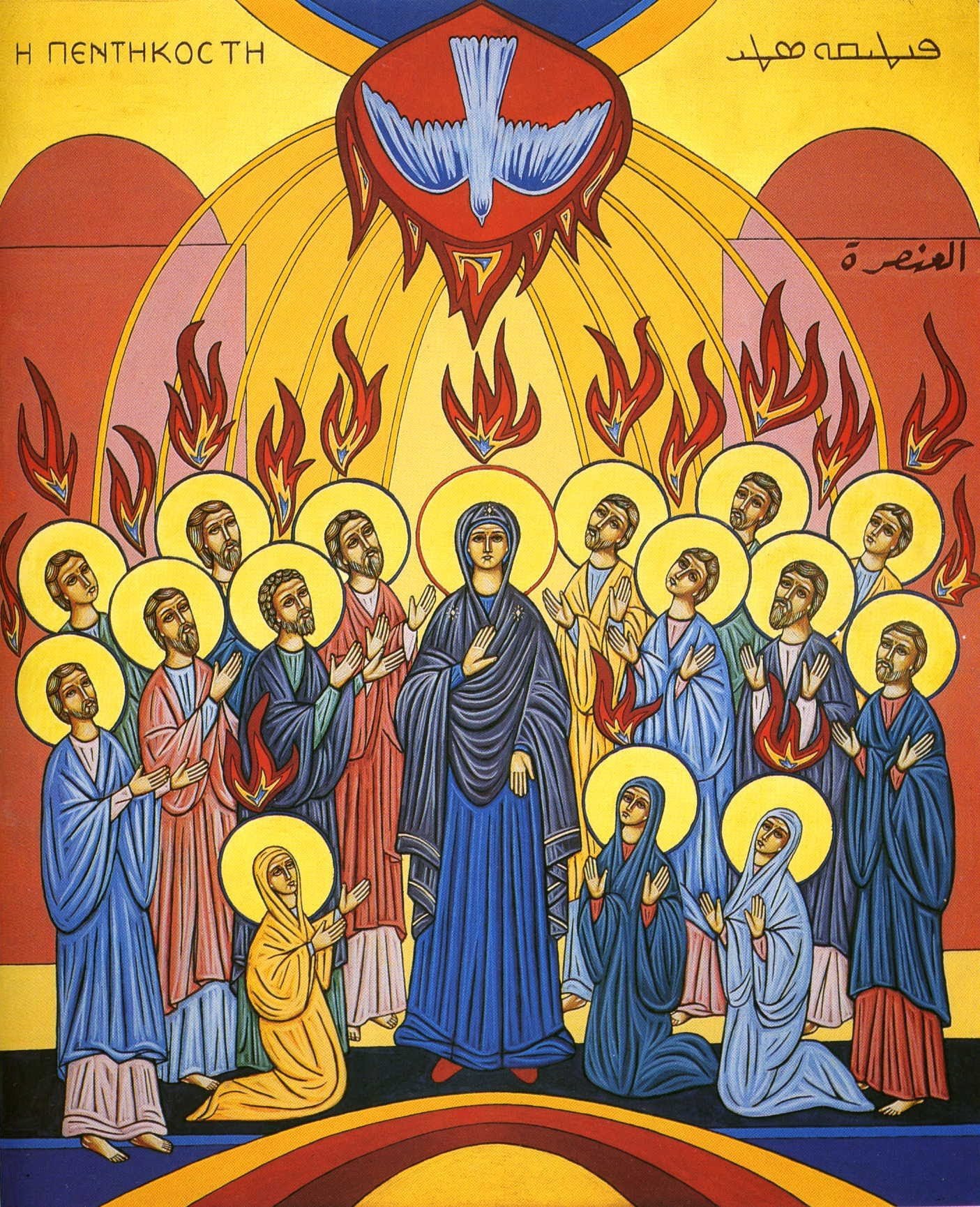
James Tissot – Healing of the lepers at Capernaum (Brooklyn Museum)

Sexagesima

Recently we have begun to talk about the idea of work-life balance, due to an awareness that people in the modern world are spending more time at work, and need to make sure that their patterns of life and work are healthy. Clearly spending too much time at work and not enough at rest will be detrimental to our physical, mental and spiritual health. 

Our Gospel this morning follows on directly from last week. After teaching in the synagogue in Capernaum and healing the possessed man, Jesus and His disciples go back to the family home of Simon and Andrew. After what had been a draining experience, they were no doubt in need of both rest and nourishment. But before this can happen, there is a situation which requires Our Lord’s immediate attention:

‘Now Simon’s mother-in-law lay ill with a fever, and immediately they told him about her. And he came and took her by the hand and lifted her up, and the fever left her, and she began to serve them.’ (Mk 1:30-31)

It’s serious, and it’s life-threatening. He takes her by the hand, lifts her up, and she is immediately restored to full health: she gets up and looks after them. Mark’s account is simple and straightforward, and goes along at a tremendous breathless pace. The healing is miraculous and instantaneous. It takes your breath away. It is a powerful demonstration of the reality of God’s love for us: if we let God be at work in our lives then wonderful things are possible, but we have to trust Him. I know that I really struggle with that, and I suspect that I’m not alone in feeling that way. 

Once the Sabbath was over at sundown, the people of Capernaum bring people to Him who are sick, and in need of healing, and he heals them. The Kingdom of God has become a reality in the person and actions of Jesus. And then early the next morning, before dawn Jesus goes away to pray. He finds a deserted place, a place where He can be alone with God to pray. It reminds us of the need for prayer and quiet in our own lives — we need time to be with God, to talk to Him, and to listen to what He has to say to us. We live in a world filled with noise and distraction, where social media and mobile phones vibrate and flash to get our attention to draw us in. Instead, if we want to be close to God and let His power be at work in us, we need to be silent and find a deserted place, if only for a few minutes, to let a healing encounter take place. God meets us when we are alone, when we are silent, when we are vulnerable, when we no longer rely on our own strength but hand ourselves over completely to Him. This is not an easy thing to do, but it is the only way for God to be at work in us: we need to make space for Him. 

And then it is over, Simon and the other disciples find Jesus and call Him back to the people who need Him. But rather than simply staying where He is, He moves them on to the next towns, so that He may preach there, for that is why He came out. As well as healing the sick Jesus has a message to proclaim: repent and believe the Good News (Mk 1:15). He calls people to turn away from sin, to turn back to God, and to know that the Kingdom is near. The disciples can only see people’s needs, they need to understand that there is a wider context too. So Jesus preaches, He explains the Scriptures so that people can understand that prophecies are being fulfilled in Him, and He casts out demons so that people can see the Healing which the kingdom promises is a reality there and then. 

Which of us can say that we don’t need Christ’s healing in our lives? I know that I do, the truth is that we all do. If we are close to Him in prayer, if we listen to Him, if we have the humility which says, ‘I need God’s help’ then we can be open to the transforming power of His Love. Here this morning, in the Eucharist, at the Altar, Christ will give Himself for us, His Body and His Blood, so that we can feed on Him, be fed by Him, and be fed with Him, so that our souls can be healed. What greater medicine could there be for us, than God’s very self? What gift more precious or more wonderful? Our soul’s true food. We eat Christ’s Body and drink His Blood so that we might share His Divine life, that we might be given a foretaste of Heaven here on earth. For two thousand years, on a hundred thousand successive Sundays, the Church has done THIS, to obey Christ’s command, and so that the healing work begun in Galilee might be continued here, now, among us. 

Let us listen to His words. Let us be close to Him in prayer. Let us come to Him, to the One who loves us, who heals us, who gives Himself upon the Cross to die for us. To the One who rises again to give us the promise of eternal life in Him. Let us come to be healed, to the table of the Lord to be fed with Him, so that He might heal us, and restore us, so that we might have life, and life to the full in and through Him.

Let us proclaim to a world, which longs for healing and wholeness, the love of God the Father, God the Son, and God the Holy Spirit. To whom be ascribed all glory, dominion, and power, now and forever. Amen.

James Tissot – The Healing of Peter’s Mother-in-law (Brooklyn Museum)

Septuagesima (Year B)

The narration of stories is a skilled activity, whether they are told orally, or in writing. Setting the scene and introducing the characters are an important part of the process. Sometimes people begin with a long introduction, whereas others take you straight to the action. Mark’s Gospel definitely takes the latter approach. He does not set the scene by giving details of Jesus’ birth or childhood. Instead, he plunges straight into chronicling Our Lord’s public ministry in Galilee.

Mark’s Gospel begins with a description of Jesus’ ministry that proceeds at a frenetic pace. Jesus is baptised by John, goes into the desert for forty days, and calls two sets of brothers to follow Him: Simon and Andrew, James and John. In today’s passage Jesus teaches in a synagogue and heals a man possessed by an unclean spirit. Everything happens in quick succession, there is no time to waste. Part of this is a desire on the Gospel writer’s part to embody the vibrancy of Jesus’ proclamation of the Kingdom:

“The time is fulfilled, and the kingdom of God is at hand; repent and believe in the gospel.”

‘Yr amser a gyflawnwyd, a theyrnas Dduw a nesaodd: edifarhewch, a chredwch yr efengyl.’ (Mk 1:15)

Jesus is a man on a mission. He calls people to turn away from their sins, and to believe in the Good News: to love God and also to love your neighbour. As it is the Sabbath, people gather in the local synagogue. Worship in a synagogue involved singing Psalms, reading from Scripture, and teaching, rather like a sermon. This is familiar to us, as our Morning and Evening Prayer proceeds along similar lines. In this instance, instead of a Scribe or Teacher of Law explaining the biblical reading, Jesus Himself is teaching the people.

‘And they were astonished at his teaching, for he taught them as one who had authority not as the scribes’

‘A synasant wrth ei athrawiaeth ef: canys yr oedd efe yn eu dysgu hwy megis un ag awdurdod ganddo, ac nid fel yr ysgrifenyddion.’ (Mk 1:22)

Scribes relied on the authority of Moses, and would refer to other passages in the first five books of the Old Testament, and to previous interpretations, to make their point. Jesus does something different, and while Mark doesn’t tell us exactly what He said, it is clear that Our Lord’s interpretation of the Scriptures was both refreshing and authoritative. Jesus teaches like someone with authority. He isn’t a scribe or a Pharisee, He hasn’t spent years in theological training. Jesus stands outside traditional religious power structures. Our Lord’s teaching has authority not just because it is spoken with conviction, but because it is real and embodied in Him. Christ’s words are lived out in His life, because he is God: the Son of God, beloved of the Father (cf. Mk 1:11). He is filled with the Holy Spirit, and proclaims the Good News of the Kingdom. 

After Jesus has unpacked the Scriptures, He is addressed by a man who is clearly unwell:

“And immediately there was in their synagogue a man with an unclean spirit. And he cried out, ‘What have you to do with us, Jesus of Nazareth? Have you come to destroy us? I know who you are—the Holy One of God.’” 

‘Ac yr oedd yn eu synagog hwy ddyn ag ynddo ysbryd aflan: ac efe a lefodd, Gan ddywedyd, Och, beth sydd i ni a wnelom â thi, Iesu o Nasareth? a ddaethost ti i’n difetha ni? mi a’th adwaen pwy ydwyt, Sanct Duw.’ (Mk 1:23-24)

This is a man in need of healing, who is described as being possessed by an evil spirit, though nowadays we would probably prefer to describe him as suffering from mental illness. He is suffering, and longs to be healed. This weak, broken man recognises who and what Jesus is: He is the Holy One of God, the Messiah, Y Meseia. Our Lord speaks with authority telling the evil spirit to be silent and come out of the man. He can do this because He is God.

The Kingdom which Jesus proclaims in His teaching is a place of healing. Ours is a God who can heal our wounds, who can take broken humanity and restore it in love. This is why Christ’s teaching and the healing have to go together; they are both part of a larger whole, the coming Kingdom of God. Jesus proclaims our need to love God and each other, and puts this into practice, making the healing power of God’s love a reality in the world. Therefore, at the beginning of Jesus’ public ministry in Mark’s Gospel we see the proclamation of the Good News, and its application in a healing miracle. Jesus is the fulfilment of Moses’ prophecy, in today’s first reading, where he says:

“The Lord your God will raise up for you a prophet like me from among you, from your brothers—it is to him you shall listen” 

‘Yr Arglwydd dy Dduw a gyfyd i ti, o’th blith dy hun, o’th frodyr dy hun, Broffwyd megis finnau; arno ef y gwrandewch’ (Deut 18:15)

“And I will put my words in his mouth, and he shall speak to them all that I command him.”

‘a rhoddaf fy ngeiriau yn ei enau ef; ac efe a lefara wrthynt yr hyn oll a orchmynnwyf iddo.’ (Deut 18:18)

These verses are quoted, by both St Peter in Acts 3:22 and St Stephen in Acts 7:37, to refer to Jesus. For nearly two thousand years the Church has had a consistent interpretation of this passage as pointing to, and finding its fulfilment in, Jesus Christ. We can listen to Him with confidence because Jesus is God. He has authority, and He longs to heal us.

The message that Our Lord proclaims in His teaching is reinforced by His actions. Jesus shows that the Kingdom of God is a place where humanity can be healed and freed from sin. Christ demonstrates this most fully when He suffers and dies for us on the Cross. From the very beginning, Jesus looks to the Cross —not as a place of torture, humiliation, or defeat — but as the place of victory and healing. The Crucifixion is the supreme demonstration of God’s love for humanity. Through the Cross we learn how much God loves us. This is why God sends His Son to heal our wounds, to restore us, and to give us the hope of Heaven. Confident in His promises we can turn to God and pray for the healing that we all so desperately long for, and which the world needs. We can pray that His Divine nature might transform our human nature, and give us a foretaste of Heaven. We pray that our own wounds: physical and mental, will be healed, so that we might have life in Him, in this world and the next.

The possessed man asks Jesus, ‘Have you come to destroy us?’ ‘a ddaethost ti i’n difetha ni?’ The only thing that Christ has come to eradicate is the power of evil which separates man from God. We know that the Son of God has come not to destroy but to restore humanity, so that we may have life and have it to the full. This is the Good News of the Kingdom, which is still a reality here and now. We, in our brokenness, can approach the source of all healing, the God who loves us and gives himself for us, so that we can be restored by Him. God can take our lives and heal us in His love. Let us then come to Him, so that our lives may also be transformed. Let us proclaim to a world, which longs for healing and wholeness, the love of God the Father, God the Son, and God the Holy Spirit. To whom be ascribed all glory, dominion, and power, now and forever. Amen.
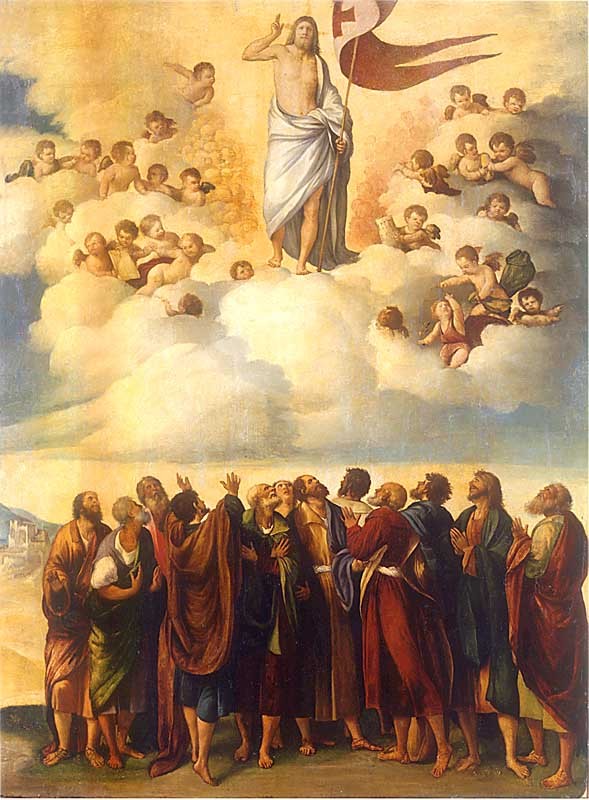
James Tissot The Possessed Man in the Synagogue (Brooklyn Museum)

The Third Sunday after Epiphany (Year B)

Organising a wedding is not an easy task. They can be complex and expensive undertakings, even when they are relatively modest affairs, with only family and a few friends. In some cultures, however, weddings can be more like celebrations for an entire community. Indeed, even today in the Middle East and Asia when a couple marry the celebrations can involve large numbers of guests, and last for several days. Clearly, the logistics of such festivities are complicated, and the financial outlay considerable. It is good to take a moment to consider how much the events in Cana, described in today’s Gospel reading, differ from most of the weddings that we have attended.

That Our Lord, His Mother, and His disciples are invited to the wedding should not be a surprise. This is a community celebration, with everyone present. The idea of running out of wine is not simply a failure of logistics and hospitality, but could represent a situation that would bring shame and disgrace on the hosts. It is a crisis which could stigmatise the family for years to come, with the couple thinking that their union had been cursed with bad luck. Suffice it to say, it would be a complete disaster for all concerned. Mary, wanting to prevent this, lets Jesus know that there is a serious problem. The situation is critical, and something needs to be done quickly. Our Lord, however, seems a little dismissive:

“Woman, what does this have to do with me? My hour has not yet come.”

‘Beth sydd i mi a wnelwyf â thi, wraig? ni ddaeth fy awr i eto.’ (Jn 2:4)

Jesus is looking ahead to when His hour will come, anticipating His Passion and Death on the Cross. That is also the next time that Mary will feature in John’s Gospel, when she stands with John at the foot of the Cross. The Wedding at Cana and the Crucifixion are two events that are clearly linked, both by what Our Lord says, and by who is present. What is about to happen at a Galilean wedding is a significant moment, which is underlined by Mary’s instruction to the servants:

‘His mother said to the servants, “Do whatever he tells you.”’

‘Ei fam ef a ddywedodd wrth y gwasanaethwyr, Beth bynnag a ddywedo efe wrthych, gwnewch’ (Jn 2:5)

Once again Mary demonstrates perfect obedience, and she encourages the servants to do the same. When we listen to what Jesus says and act on it we are following their example. Living the Christian life is essentially trying to do this. We listen to Jesus and do as He tells us. 

At the feast are six stone jars each holding thirty gallons which adds up to over eight hundred litres of water. This is a huge quantity of liquid, even for a large wedding. The servants fill the jars to the brim, making them fuller than they would usually be. This speaks of the abundance and generosity of God’s love. It defies our expectations, just as water being turned into wine defies expectation. The extravagant Wedding party points to something greater than itself. It is a foreshadowing of the joy of the Kingdom. The celebration at Cana is a taste of the lavish excess that our God wishes to bestow on us. His generosity, which is beyond our understanding, is a sign of His deep love for us.

The master of the feast does not seem to be bothered by the quantity of wine, but rather its quality. Moments ago the refreshments were running out, now they are plentiful. He addresses the bridegroom saying:

“Everyone serves the good wine first, and when people have drunk freely, then the poor wine. But you have kept the good wine until now.”

‘Pob dyn a esyd y gwin da yn gyntaf; ac wedi iddynt yfed yn dda, yna un a fo gwaeth: tithau a gedwaist y gwin da hyd yr awr hon.’ (Jn 2:10)

The steward has a point. It makes sense to serve the best wine first, and then serve inferior wine when people’s palettes are dulled. But this wedding feast represents a dramatic reversal of usual practice. It illustrates how God’s generosity stretches far beyond what we can expect or understand as humans. The Kingdom of God turns our values on their head, and its joyous new wine is finer than any earthly fruit of the vine. This is lavished upon humanity, so that it might transform us, so that we might come to share in the glory of God, and in His very nature. Our Lord therefore becomes the true master of the feast, just as He will feed humanity from the abundance of the Heavenly Banquet. The Wedding at Cana points to both Heaven, and to the Eucharist, where Christ nourishes us with the new wine of the Kingdom: His Blood, poured out to save and restore us. God loves us this much. How should we respond?

As Christians we are constantly called to live lives of joy and love in Christ. Through Him, rejoicing in our new life in baptism, and filled with the sober intoxication of the Spirit, we are nourished by Word and Sacrament. In this way we are restored to communion with God, and with each other, to live the life of the Kingdom, here and now. At the Wedding in Cana Jesus gives the world a sign, which shows both who and what He is, and which also points to heavenly and eternal realities. God manifests His glory, showing us who He really is: the personification of love and generosity.

This passage ends by explaining that, in response to this sign, Christs’s disciples  totally believe in Him. They put their trust in Him, as the one who fulfils prophecy, the Messiah, the Saviour of the world. Let us also put our trust in the God who loves us, and who feeds us with Himself, so that we might have life in and through Him. Let us share His joy both here on earth and in Heaven. And let us give praise to God the Father, God the Son, and God the Holy Spirit. To whom be ascribed all glory, dominion, and power, now and forever. Amen.
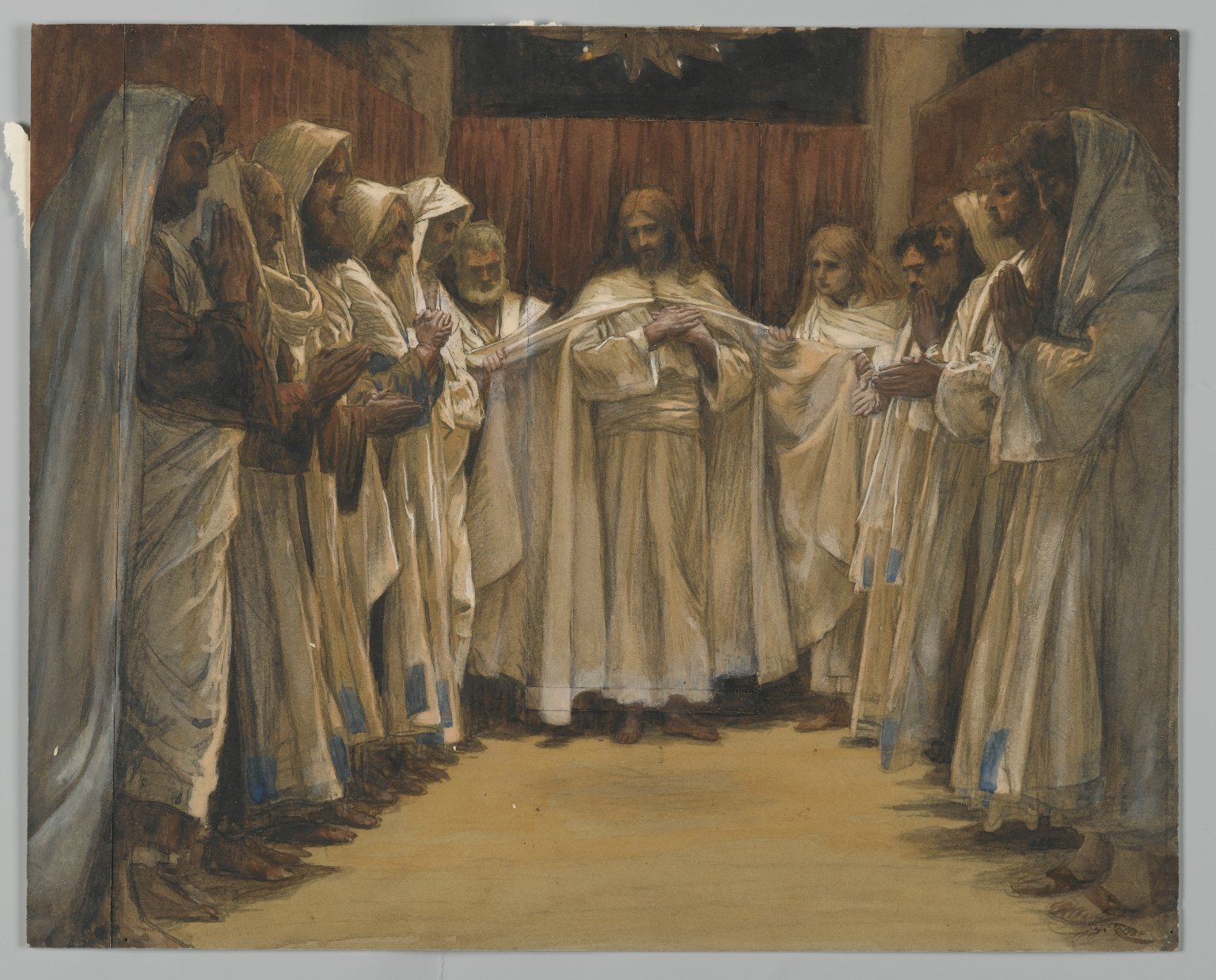
The Marriage at Cana (A. Mironov)

Second Sunday of Yr B

Not so many years ago a person’s profession was often inherited from their parents, or decided for them by others. Certainly, until quite recently, many people could expect to hold the same profession for all their working life. The situation has now changed. Those in employment today can expect to have between three and seven different careers in their working life. The younger a person is, the higher that number is likely to be. Generally speaking great change is easier to handle when we are young, before we get too set in our ways. Such an upheaval faces a number of young men in this morning’s Gospel reading. 

Jesus and John the Baptist know each other. They are related, being cousins and part of the same extended family. In the Gospel, John has just baptised Jesus and seen the Holy Spirit descend upon Him in the form of a dove. John declares that Jesus is the Son of God. The next day he sees Our Lord again and exclaims:

“Behold the Lamb of God!”

‘Wele Oen Duw’ (Jn 1:36)

The phrase is very familiar and used in the invitation to Communion. John the Baptist used the same phrase a few verses earlier, when he exclaimed:

“Behold, the Lamb of God, who takes away the sin of the world!”

‘Wele Oen Duw, yr hwn sydd yn tynnu ymaith bechodau’r byd’ (Jn 1:29)

Again, these words form part of our Eucharistic liturgy, the Agnus Dei. A Lamb who takes away sin means a sacrifice. So from the beginning, Jesus’ public ministry is understood to be sacrificial in character, laying down His life to  take away sin, and restore humanity and God. This is why on the night before He died Jesus took bread and wine, blessed them, and gave them to the disciples, saying ,’This is my Body, this is my Blood’, and told them to ‘do this’, which is why we are gathered here today.

Once John’s disciples hear what the Baptist about Jesus, they follow Him. Jesus asks them what they are seeking, and they reply:

“Rabbi” (which means Teacher), “where are you staying?”

‘Rabbi, (yr hyn o’i gyfieithu yw, Athro,) pa le yr wyt ti yn trigo?’ (Jn 1:38)

The disciples recognise Jesus as a teacher, and want to learn from Him. But rather than simply answering their question, Our Lord issues them an invitation:

“Come and you will see.”

‘Deuwch, a gwelwch’ (Jn 1:39)

Jesus invites them to follow Him, to see where He is staying and to spend time with Him. These two disciples of John become followers of Jesus, literally and metaphorically. The Church continues to make the same invitation to the world, to come, see, and follow Jesus. These two disciples begin by spending a day with Jesus. They listen to Him, they eat with Him, and begin to have a relationship with Him. We then discover that one of the men is Andrew, and that he has a brother, called Simon. Andrew is convinced that he has found the Messiah and so he brings his brother to Jesus. When Jesus meets Simon he says,

“So you are Simon the son of John? You shall be called Cephas” (which means Peter) 

‘Ti yw Simon mab Jona: ti a elwir Ceffas, yr hwn a gyfieithir, Carreg.’ (Jn 1:42)

Jesus gives Simon a new name. He calls him Cephas, which means ‘rock’ in Aramaic. In Greek this is ‘Petros’, which is how we get the name Peter. Peter will be the rock upon which Christ will build His Church (Mt 16:18). The name given by Jesus points to Peter’s future role as the leader of the Apostles. Jesus takes the initiative and begins to sketch out a future for the disciples who are following Him. It is quick, and matter of fact, and yet momentous. Jesus is gathering people to help Him with this ministry.

The Church therefore begins with a few Galilean fishermen following a rabbi whom they recognise as the Messiah. Thanks to them, and their faith in Jesus, we are here in the Church today. Faith, where we put our trust, is an important thing, affecting both who we are, and how we live our lives. Faith in Jesus turned Peter from a fisherman into a leader of the early Christians. The same faith has transformed lives over the past two thousand years, and continues to do so today. 

In our baptism, God in Christ invites each and every one of us to follow Him, to ‘come and see’, as the first disciples did, and to invite others, as Andrew invited Simon Peter. To come and see who Jesus is, to get to know Him, and start a relationship with Him. This begins with our sharing in His Death and Resurrection, and ends in the glory of Heaven. What starts as an encounter deepens into a life-long relationship. People’s lives, our lives are changed when we encounter Jesus, and this is as true for us today as it was two thousand years ago. Our lives are changed when we encounter Jesus in prayer, in scripture, and in His Body and Blood at the Eucharist. Each and every one of us is called to be a disciple of Jesus, to listen to what He says, and to let this call make an impact upon our lives. Jesus longs to transform humanity, to fill us with God’s love. He also wants us to share the invitation with others.

At the Epiphany the Wise Men recognised who and what Jesus was. Now fishermen recognise Him as the Messiah. They understood that He is the Anointed One, the Christ, the One to save Israel, and all the world from their sins. Ours is a faith which can transform the world, so that all humanity can share in God’s life and love. Each and every one of us can become part of something radical and revolutionary, which can and will transform the world one soul at a time. The only way to change the world is through the love of God. This is the mission of the church, and why we continue to offer the same invitation, ‘Come and see!’ ‘Deuwch, a gwelwch’’. The journey of faith begins with Our Lord’s invitation. This may lead to our lives being radically changed, just as the fishermen became leaders in Christ’s Church. Let us then, like these first disciples, commit our lives to following Jesus and encouraging others to do the same. May we have the strength to trust and follow Christ and put our talents into His service, wherever that may lead us. Amen.

James Tissot: Saint John the Baptist Sees Jesus from Afar (Brooklyn Museum)

Epiphany 2023

Every year the Oxford English Dictionary creates a shortlist of eight words,  which are ‘chosen to reflect the mood, ethos, or preoccupations of the past year.’ The words are then put to a public vote. In 2023 the word selected to be the Oxford Word of the Year was ‘rizz’. This is a colloquial word meaning ‘style, charm, or attractiveness’, and is a shortened form of the word ‘charisma’. I would like to propose a word of the year for 2024: ‘hope’. Each one of us longs, from the very core of our being, to hear a message of hope. Hope for the future, something to inspire us. Today we continue to celebrate Christ’s birth at Christmas, as we mark the Solemn Feast of the Lord’s Epiphany: His coming into the world to bring hope. Wise men recognise who Jesus is and why He is important. As Christians, we continue to place our hope in the Word made flesh, Jesus Christ, born among us, and now made manifest to the world as its saviour. 

The Feast of Epiphany celebrates the coming of Wise Men from the East who followed a star, looking for a baby, who has been born king of the Jews. They go to Jerusalem, to see King Herod, as they assume that a king will be born to a royal family, in a palace. You cannot fault their reasoning. The Magi see a sign prefiguring a royal birth and go to the place where they think it will occur. Their arrival, however, does not quite have the effect they were expecting:

‘When Herod the king heard this, he was troubled, and all Jerusalem with him; and assembling all the chief priests and scribes of the people, he enquired of them where the Christ was to be born.’ 

‘Ond pan glybu Herod frenin, efe a gyffrowyd, a holl Jerwsalem gydag ef. A chwedi dwyn ynghyd yr holl archoffeiriaid ac ysgrifenyddion y bobl, efe a ymofynnodd â hwynt pa le y genid Crist.’ (Mt 2:3-4)

The wise men assume that the birth of a royal baby is a cause for celebration, but is certainly isn’t for Herod! His family bribed the Romans to gain the throne. They were not related to King David, and they were not even from Israel. So, on hearing the news from the wise men, Herod assembles all the religious and legal experts he can find. He is terrified that his position as king is under serious threat. The child could have a legitimate claim. There could be a revolution and regime change. Herod needs to know where this child will be born.

They told him, “In Bethlehem of Judea, for so it is written by the prophet: ‘And you, O Bethlehem, in the land of Judah, are by no means least among the rulers of Judah; for from you shall come a ruler who will shepherd my people Israel.’” 

‘A hwy a ddywedasant wrtho, Ym Methlehem Jwdea: canys felly yr ysgrifennwyd trwy’r proffwyd; A thithau, Bethlehem, tir Jwda, nid lleiaf wyt ymhlith tywysogion Jwda: canys ohonot ti y daw Tywysog, yr hwn a fugeilia fy mhobl Israel.’(Mt 2:5-6)

Once Herod knows where the child is expected to be born, the next thing is to find out when the birth will take place, and finally to establish who this royal baby is. Bethlehem is the birthplace of the Davidic monarchy: King David was born there, and so was Jesus. The Gospel quotes a prophecy of Micah ‘And you, O Bethlehem, in the land of Judah, are by no means least among the rulers of Judah; for from you shall come a ruler who will shepherd my people Israel.’ (Micah 5:2) to support the claim. 

‘Then Herod summoned the wise men secretly and ascertained from them what time the star had appeared. And he sent them to Bethlehem, saying, “Go and search diligently for the child, and when you have found him, bring me word, that I too may come and worship him.” After listening to the king, they went on their way.’ 

‘Yna Herod, wedi galw y doethion yn ddirgel, a’u holodd hwynt yn fanwl am yr amser yr ymddangosasai y seren. Ac wedi eu danfon hwy i Fethlehem, efe a ddywedodd, Ewch, ac ymofynnwch yn fanwl am y mab bychan; a phan gaffoch ef, mynegwch i mi, fel y gallwyf finnau ddyfod a’i addoli ef. Hwythau, wedi clywed y brenin, a aethant;’(Mt 2:7-9)

Herod claims that he wants to know when the baby was born, so that he may come and worship the infant king. However, he has no intention of relinquishing his power, his behaviour is a sham. The Wise Men leave the royal palace and head for Bethlehem.

‘And behold, the star that they had seen when it rose went before them until it came to rest over the place where the child was. When they saw the star, they rejoiced exceedingly with great joy.’ 

‘ac wele, y seren a welsent yn y dwyrain a aeth o’u blaen hwy, hyd oni ddaeth hi a sefyll goruwch y lle yr oedd y mab bychan. A phan welsant y seren, llawenychasant â llawenydd mawr dros ben’ (Mt 2:9-10)

The Magi have travelled hundreds of miles because they saw a star in the heavens. Now it is above Bethlehem, and they have reached the new-born King. 

‘And going into the house they saw the child with Mary his mother, and they fell down and worshipped him. Then, opening their treasures, they offered him gifts, gold and frankincense and myrrh.’ 

‘A phan ddaethant i’r tŷ, hwy a welsant y mab bychan gyda Mair ei fam; a hwy a syrthiasant i lawr, ac a’i haddolasant ef: ac wedi agoryd eu trysorau, a offrymasant iddo anrhegion; aur, a thus, a myrr.’ (Mt 2:11) 

Gold, frankincense, and myrrh are unusual gifts for a baby, even a royal one. They are, however, all precious and expensive. The first gift, gold, is a precious metal, which is pure and does not tarnish. It is a gift fit for a king. Gold’s purity points to a life of perfect obedience, the pattern of how life should be lived. The second gift is frankincense from Arabia, which was offered to God in the Temple in Jerusalem. As the sweet-smelling smoke rose, it looked like prayers rising to God. Frankincense is a sign of worship, and honour, representing how humanity should respond to God. The final gift, Myrrh, was an ointment, used for embalming. It speaks of death. Even in Jesus’ birth, we see Christ’s kingly power, and His obedience to the will of the Father. We see His role in worship as our great High Priest, which leads Him to Death and Burial.

‘And being warned in a dream not to return to Herod, they departed to their own country by another way.’ 

‘Ac wedi eu rhybuddio hwy gan Dduw trwy freuddwyd, na ddychwelent at Herod, hwy a aethant drachefn i’w gwlad ar hyd ffordd arall.’ (Mt 2:12)

The Wise Men are warned to neither go back to Herod, nor to tell him who Jesus is. This is because Herod does not want to worship Jesus, he wants to kill Him, in order to safeguard his own position on the throne. And so the unexpected visitors leave as mysteriously as they arrived. These pilgrims from afar gave Our Lord gifts which celebrate His Humanity and Divinity, and which point towards His Death and Burial. The beginning of Jesus’ earthly life looks to its end, because it is all part of the outworking of salvation history.

The Wise Men recognise the baby as the Messiah, the one who brings hope. They are gentiles from a distant land and show that the hope that Jesus brings is for all the peoples of the earth. The Magi recognise that the star points to a royal baby, of the House of David. Jesus is the true king, who will give hope and freedom to His people, and all the earth, through His life, death, and Resurrection. Here at the beginning of Christ’s earthly life we can see where it leads. Jesus gives us hope, hope in God who keeps His promises and offers salvation to His people.

So in 2024 let us be filled with the hope, joy and love. Let us give thanks for the Saviour made manifest, and may we proclaim the Good News of Our Salvation. In the name of the Father, the Son, and the Holy Spirit. Amen

James Tissot – The Magi journeying (Brooklyn Museum)

Christmas 2023

How do you remember the significant people and events in your lives? Since the nineteenth century, with the invention of photography, we have tended to use photographs, and stored the pictures in albums. Nowadays, however they are more likely to be online or on a mobile phone or tablet. From the first ultrasound scans of a baby in the womb, and throughout life, we have visual reminders. But photography has only been widespread for about 150 years. Before then only the rich could afford to have pictures painted to record something for posterity. If we wished to recreate an event from the past, then a dramatic retelling was the only option available. This is exactly what St Francis of Assisi did to remember the events and people of the first nativity and to inspire the devotion of all those who saw it. 

The first nativity took place exactly 800 years ago this month. The year was 1223, and the location was a cave at Greccio in Italy, around 100km north of Rome. St Francis of Assisi was inspired to recreate the first nativity in Bethlehem in an Italian village with real animals and humans playing various parts — exactly like we did in Maenclochog last night. There are good reasons why such recreations are appealing. They remind us of the reality of the Incarnation, that God took flesh in the womb of the Virgin Mary and was born in Bethlehem. The new-born baby Jesus was surrounded by an ox and an ass, and sheep, and was laid in an animals’ feeding trough. As the prophet Isaiah says:

‘The ox knows its owner, and the donkey its master’s crib’ 

‘Yr ych a edwyn ei feddiannydd, a’r asyn breseb ei berchennog’(Isa 1:3)

By this humble beginning God embarked on the journey of sharing our life, so that we might come to share His. Christ begins His life being laid on stone feeding trough. He will end it, taken down from the Cross and laid in a stone tomb. Such parallels are not mere coincidence. Instead, they point us towards a God who has made himself manifest, discoverable through signs, fulfilling prophecies, and declaring love for humanity. 

Jesus is the Prince of Peace, and the embodiment of the Gospel of Salvation. He comes to bring comfort and redemption to the whole world.

‘for the Lord has comforted his people; he has redeemed Jerusalem.’

‘canys yr Arglwydd a gysurodd ei bobl, efe a waredodd Jerwsalem.’ (Isa 52:9)

Today our salvation has dawned, prophecy is fulfilled, and the Saviour of the world is born. The message of Isaiah is one of joy. The birth of the Messiah, Jesus Christ, is Good News. This is because He comes to bring true peace to humanity. That such peace currently eludes our world, is exactly why He came: to heal our wounds and to show us a new way to live. Throughout His life, all that Christ says and does shows us how much God loves us. The Word becomes flesh, ‘A’r Gair a wnaethpwyd yn gnawd’ and enters the world. He dwells among us ‘ac a drigodd yn ein plith ni’: a wondrous mystery which provokes us to worship, to kneel with the shepherds and to adore the God who comes among us. Jesus shares our human life so that we might share His divine life, not because we asked, and not because we are deserving, it is not something we have earned. Rather, it is the free gift of a loving and merciful God. This then is the glory of God — being born in simple poverty. Jesus, the Son of God comes to call humanity to a new way of being together, where the old order is cast aside, turning the world upside down .He offers us the possibility of living in a radically different way. Instead of war, misery and hatred, He shows us the way of peace, joy, and love.

Such is the reality St Francis sought to inspire in the hearts and lives of people eight hundred years ago. It is a message which can still inspire us, a mystery which can still transform us. So that through the grace of God we can come to share in the Divine life, born among us, in a stable not a palace. God surprises us with generosity which we cannot fathom. God subverts human expectations. Christ’s first breaths are taken surrounded by animals and shepherds. Not what one would expect of a royal birth! 

God is a God of mystery and paradox. We know that we can never fully understand Him, but we can experience His love. To quote from Sir John Betjeman’s poem ‘Christmas’:

No love that in a family dwells,

No carolling in frosty air,

Nor all the steeple-shaking bells

Can with this single Truth compare —

That God was man in Palestine

And lives today in Bread and Wine.

May we greet Our Lord, born among us, and may we feed on His Body and Blood at the Altar. Given to transform us, so that we may join with the choir of angels in singing the praises of God the Father, God the Son, and God the Holy Spirit. To whom be ascribed all glory, dominion, and power, now and forever. Amen.
Merry Christmas to you all!

Nadolig Llawen i chi gyd!

Advent IV – Trust!

Those of you who are fans of The Sound of Music will know that to begin at the beginning is a very good place to start. This morning’s Gospel does exactly that, by going back to the Annunciation of the Angel Gabriel to the Blessed Virgin Mary, the beginning of the story of Christmas. As we prepare to celebrate Christ’s birth this evening and tomorrow, it is only natural to return to the point of Our Lord’s Conception to help us to ponder the wonderful mystery which God accomplishes for our sake. 

At its heart, Christianity is a religion which declares that God becomes a human being, so that humanity can share in the life of God. This is what we believe as Christians, and why we proclaim this truth to the world. The greatest news in human history is a teenage pregnancy — something that is shocking and scandalous, is how God saves us. This is why St Paul can write to the Romans:

the revelation of the mystery that was kept secret for long ages but has now been disclosed and through the prophetic writings has been made known to all nations (Rom 16:25-26)

This is the proclamation of the Good News of Jesus Christ. It starts with an encounter in Nazareth. A young woman is engaged to be married and receives a visitor, who says:

“Greetings, O favoured one, the Lord is with you!” (Lk 1:28)

Mary is confused, she cannot understand what is going on. Biblical accounts of the interaction between God and humanity show us that ours is a God who takes risks. Mary could refuse, she could say no, and human history would be profoundly different. So the angel Gabriel says, ‘Paid ag ofni, Do not be afraid’. Mary does not need to be afraid because God is doing something wonderful. She will bear a son and call him Jesus, which means ‘God saves’. Jesus the Son of God will save God’s people from their sins, and will fulfil the promise made to David, which we heard in our first reading. 

Mary cannot understand how this will happen. The Holy Spirit, God active in the world, and the bond of love between God the Father and God the Son, will overshadow her. God will take flesh in her womb and be born as one of us. So Mary replies:

“Behold, I am the servant of the Lord; let it be to me according to your word.” (Lk 1:38)

Mary says ‘Yes’ to God. This is a ‘Yes’ which undoes the ‘No’ of Eve. It brings about the salvation of humanity, through the Life, Death, and Resurrection of her Son. Mary’s obedience to the will of God, ‘the obedience of faith’ (Rom 16:26), both trusts God to be at work, and makes it possible. We can be joyful because of Mary’s ‘yes’ to God. In her we have a pattern of obedience to the will of God which all Christians are to follow.

In the first reading this morning King David is worried. He says to Nathan the prophet:

“See now, I dwell in a house of cedar, but the ark of God dwells in a tent.” (2 Samuel 7:2)

Since the Exodus from Egypt, the Ark of the Covenant has resided in a  tabernacle, a tent, a temporary dwelling. This worries David, but God is not concerned whether he lives in a tent or a temple. It does not matter. God’s response is not to accept David’s offer, but instead to make David an amazing counter-offer:

Moreover, the Lord declares to you that the Lord will make you a house. When your days are fulfilled and you lie down with your fathers, I will raise up your offspring after you, who shall come from your body, and I will establish his kingdom…  I will be to him a father, and he shall be to me a son… And your house and your kingdom shall be made sure for ever before me. Your throne shall be established for ever.’” (2 Samuel 7:11-12, 14, 16)

God offers David a family, a Royal House. This is a promise which bears fruit with the coming of Jesus, born of the House of David, and the Son of God. Jesus’ mother Mary will be the living Ark of the New Covenant. This will be a covenant that is not made in stone, but rather in flesh; the flesh of the Son of God, who is born for us, and who dies for us. Mary’s womb will be the place where the Son of God will begin to dwell with us:

Therefore the Lord himself will give you a sign. Behold, the virgin shall conceive and bear a son, and shall call his name Immanuel. (Isa 7:14)

Immanuel in Hebrew means ‘God (is) with us’ and this is what we are preparing to celebrate at Christmas: God being among us. Let us then follow Mary’s example of obedience, listen to God, and trust Him to be at work in us. Let us welcome Jesus both in Bethlehem and here upon the altar, where God, who became flesh and blood in the womb of Mary, offers us His Body and Blood in the Eucharist, so that we might share His Life. Let us, like Mary, say, ‘Yes’ to God, welcome him into our hearts. Let us be beacons in the world, shining with God’s love. May all this Christmas come to believe and trust in God the Father, God the Son, and God the Holy Spirit. To whom be ascribed all glory, dominion, and power, now and forever. Amen.

Sr. Grace Remington OCSO, Mary and Eve, crayon and pencil, 2005

Advent III – Rejoice!

THIS morning many of us will have opened door №17 on our Advent Calendars. The Countdown to Christmas is well underway and seems to be moving even more quickly this year when Advent is only 3 weeks and 1 day long. There is much to prepare for. Most importantly, as Christians, we joyfully prepare to meet Jesus, both as a baby born in Bethlehem, and as our Saviour and our Judge. During this season our readings focus on both the prophet Isaiah and John the Baptist. This is because they both look to Jesus, as the fulfilment of prophecy: the Messiah, God’s anointed, who will save God’s people from their sins. 

In the Gospels, the religious authorities, the Scribes, Pharisees, and priests, tend to receive a fairly negative portrayal. Much of this is for good reason, but, this morning, I have to admit that I find myself agreeing with their questioning. The Gospel passage set for today takes two passages from the first chapter of St John’s Gospel. The first is quite straightforward. The evangelist writes:

There was a man sent from God, whose name was John. He came as a witness, to bear witness about the light, that all might believe through him. He was not the light, but came to bear witness about the light. 

Yr ydoedd gŵr wedi ei anfon oddi wrth Dduw, a’i enw Ioan. Hwn a ddaeth yn dystiolaeth, fel y tystiolaethai am y Goleuni, fel y credai pawb trwyddo ef. Nid efe oedd y Goleuni, eithr efe a anfonasid fel y tystiolaethai am y Goleuni. (Jn 1:6-8)

John the Baptist is the forerunner, the one who comes to bear witness to Christ, the Light of the World. He proclaims the Good News of God’s Kingdom by calling people to repentance. John calls us all to turn away from our sins, and to turn back to the God who loves us, and will save us. Today’s Gospel then shifts to the interaction between John and representatives from the Temple in Jerusalem:

And this is the testimony of John, when the Jews sent priests and Levites from Jerusalem to ask him, “Who are you?” 

A hon yw tystiolaeth Ioan, pan anfonodd yr Iddewon o Jerwsalem offeiriaid a Lefiaid i ofyn iddo, Pwy wyt ti? (Jn 1:19)

At one level John’s response to this question could have been purely factual: ‘I am John, the son of Zechariah the priest’. John would have known Temple priests, being the son of one, and they in turn would have known him. The priests and Levites are interested both in John’s identity and in what he is doing. 

As we heard last week, John has been baptising people in the Jordan. He stationed himself near Bethany where the road from Jerusalem to Jericho meets the Jordan. It is somewhere where you can cross the river, the water is shallow, you and your animals can drink and rest. It is an ideal place to have a break — the first-century equivalent of a motorway service station. John has been preaching repentance, and he has washed people in flowing water, to signify forgiveness. The religious authorities are trying to understand what exactly is going on. The conversation continues:

He confessed, and did not deny, but confessed, “I am not the Christ.” And they asked him, “What then? Are you Elijah?” He said, “I am not.” “Are you the Prophet?” And he answered, “No.” 

Ac efe a gyffesodd, ac ni wadodd; a chyffesodd, Nid myfi yw’r Crist. A hwy a ofynasant iddo, Beth ynteu? Ai Eleias wyt ti? Yntau a ddywedodd, Nage. Ai’r Proffwyd wyt ti? Ac efe a atebodd, Nage. (Jn 1:20-21)

John’s answer is clear. He is neither the Messiah, nor is he Elijah — though he does look somewhat like him. Those questioning the Baptist ask him to explain himself, so that they can tell the religious authorities in Jerusalem who and what he is. In answer John quotes from the Fortieth Chapter of Isaiah, which we heard read last week. 

He said, “I am the voice of one crying out in the wilderness, ‘Make straight the way of the Lord’, as the prophet Isaiah said.” 

Eb efe, Myfi yw llef un yn gweiddi yn y diffeithwch, Unionwch ffordd yr Arglwydd, fel y dywedodd Eseias y proffwyd. (Jn 1:23)

While this might appear a slightly cryptic response, what John is saying is: ‘I am fulfilling Isaiah’s prophecy’, in other words: ‘the Messiah is coming!’ This is Good News. It is also the reason why today’s reading from the prophet Isaiah contains the very passage that Jesus reads out in the synagogue at Nazareth at the start of his public ministry (Lk 4:16-19). John the forerunner proclaims that the Messiah is coming, this is a reason to be joyful!

The priests and Levites cannot quite understand what is going on. If John the Baptist is not the Messiah, nor Elijah returned to earth, why then is he baptising people? 

John answered them, “I baptize with water, but among you stands one you do not know, even he who comes after me, the strap of whose sandal I am not worthy to untie.” 

Ioan a atebodd iddynt, gan ddywedyd, Myfi sydd yn bedyddio â dwfr; ond y mae un yn sefyll yn eich plith chwi yr hwn nid adwaenoch chwi: Efe yw’r hwn sydd yn dyfod ar fy ôl i, yr hwn a aeth o’m blaen i; yr hwn nid ydwyf fi deilwng i ddatod carrai ei esgid.(Jn 1:26-27)

John sees himself as not even worthy to untie his cousin Jesus’ sandals, something that a servant would do. He is a model of humility. The Baptist does not seek power or prestige, all he wants is to do is God’s will. Christ is unknown to the religious authorities, and to all who do not follow Him. But we know Him and love Him, as Our Lord and Saviour, and we wait for His coming filled with joy and expectation. 

Even in the depth of winter, we know that God is someone whom we can trust, who keeps His promises. Our Heavenly Father offers the world the greatest present we could ever hope for: true love and eternal life. Today, the peace which the Messiah came to bring seems as elusive as ever, with the human capacity to create misery in the most dreadful ways continuing relentlessly. We know that humanity still has some considerable distance to travel. One possible answer is to embrace the need for repentance: to change our hearts and minds and to follow Christ. We also prepare to meet Him as He will come again, as our Saviour and our Judge. It is a daunting prospect, yet we know and trust that Jesus saves us. By His Wounds on the Cross we are healed, our sins are forgiven. 

As Christ’s followers we rejoice in a God who loves us, who heals us, and who and restores us. In Him, and through Him, we are given real hope for the future. In the midst of human pain and sorrow we can place all our hope and trust in God, who both loves us, and saves us. We draw close to Jesus in His Word, and in the Sacrament of the Altar. Today we are fed with His Body and Blood, so that we can be sanctified by God, and share in his divine life and joy.

Like Jesus and John the Baptist, may we be filled with the Holy Spirit. Let us proclaim God’s Truth so that all the world may come to believe and trust in Him. May we, this Advent time and always, sing the praises of God the Father, God the Son, and God the Holy Spirit. To whom be ascribed all glory, dominion, and power, now and forever. Amen.
John the Baptist: 12th cent. Mosaic in Cappella Palatina di Palermo

Advent II – Repent!

ONE of the most important tasks for anyone bringing up children involves teaching them right from wrong, encouraging good conduct while avoiding bad behaviour. Children and adults alike learn by example, and we need people to teach us. The prophets of Ancient Israel take on this role, showing the people of God where they have gone wrong, and what they should do. John the Baptist is the last of the prophets, and points people towards the Messiah, Jesus. John is the last person to call Israel to repentance, and the first to proclaim the Kingdom of God, which finds its fulfilment in Christ. The Baptist looks back to the prophetic tradition of the Old Covenant, and forward to the New Covenant. Like the prophets of earlier generations, he educates God’s people and announces the reality of God’s saving love. Prophets can be divisive and unsettling figures because they speak with clarity and urgency. They tell it like it is, and are convinced of the importance of their message, because it comes from God.

Our first reading this morning from the prophet Isaiah is joyful and optimistic. Through the prophet, God speaks words of comfort to His people. Today we go back to the beginning of the Gospel of Mark. Here we find the words of Isaiah are quoted because they look forward to the coming of the Messiah:

A voice cries: “In the wilderness prepare the way of the Lord; make straight in the desert a highway for our God.” (Isaiah 40:3)

Jesus Christ is the fulfilment of biblical prophecy. In Him the glory of the Lord is revealed. Mark also quotes from the prophet Malachi:

“Behold, I send my messenger, and he will prepare the way before me. And the Lord whom you seek will suddenly come to his temple; and the messenger of the covenant in whom you delight, behold, he is coming, says the Lord of hosts.” (Malachi 3:1)

Mark includes both of these prophetic texts in his Gospel to show us that, from the beginning, prophecy is being fulfilled in Jesus. John the Baptist is the messenger, preparing the community for the coming of the Messiah: Jesus, who is God.

From his first appearance in the wilderness, John proclaims a baptism of repentance for the forgiveness of sins. Such a rite of initiation was usual for people converting to Judaism, but not for those who were already Jewish. It looks something like a revival: people are encouraged to take their faith more seriously, and to live it out in their lives. John then positions himself at a point where the busy road from Jerusalem crosses the River Jordan. There he challenges all those he meets to change their ways. The Baptist calls people to repentance, to turn away from sin and to turn back to God. It is good to be reminded that God’s love and mercy are available to all of us, even when we fall short of what Our Heavenly Father wants us to be. This is why the story of Jesus’ public ministry begins with His Baptism in the Jordan, and at the same time points to Golgotha. The place where Christ will die taking our sins, and those of all humanity upon Himself. Christ’s Death demonstrates God’s love for us and His mercy towards us. It is hard to comprehend how God could love us that much. And yet Christ gives us Himself in the Eucharist, so that His Body and Blood can transform us, so that we can share in His life on Earth and in Heaven.

John the Baptist is the last of the prophets and the voice crying in the wilderness of which the prophet Isaiah spoke. He has a challenging and uncompromising message: repent for the Kingdom of God is close at hand. This may not be what many people today want to hear, but it is, however, what people need to hear. Those who flock to him are aware of their sin, and aware of their need of God’s love, mercy, and forgiveness. The Baptist’s message may not be an easy one, but it is actually Good News. Our prayers are answered: that for which we hope, for which our soul deeply longs can be ours. Through our own baptism, we share in Christ’s Death and Resurrection, and we are washed from sin and given the gift of the Holy Spirit. It is difficult to make a proclamation similar to John’s in today’s society, where the Church is increasingly marginalised. Yet our message must still be ‘Repent!’. This is because the world needs to repent, to turn away from sin and selfishness, and back to a God of love, who longs for us to have life in all its fullness.

Repentance is both an event and a process. It is something that we need to do continuously, and do together. This is the life of faith which Christ calls us to live. Repentance is the work of a lifetime, we need to keep turning away from sin and turning back to God. The season of Advent is a good time for repentance. As we prepare to meet Jesus, we need to return to the God who loves us. As the prophet Isaiah wrote:

He will tend his flock like a shepherd; he will gather the lambs in his arms; he will carry them in his bosom, and gently lead those that are with young. (Isa 40:11)

We have been given clear instruction in how to live. The prophets tell us to return to the Lord. They too look forward to the coming of the Messiah. As we prepare to meet Him, let us prepare our hearts, our souls, and our lives. Let us, along with John the Baptist and all the saints, sing the praises of God the Father, God the Son, and God the Holy Spirit. To whom be ascribed all glory, dominion, and power, now and forever. Amen.

James Tissot – The voice in the desert (Brooklyn Museum)

The First Sunday of Advent

THE recent changes to speed limits on the roads in Wales have made everyone who drives much more interested in reading road signs. Gone are the old certainties, and instead we are left unsure. Not long ago things used to be relatively simple, now they have become far more complex. At times, it can be hard to know exactly what speed we are supposed to be doing, and we can end up concentrating more on the signs than on the road ahead. This situation is far from ideal, but in some ways it mirrors the confusion and lack of certainty that many Christians feel regarding the second coming of Our Lord and Saviour Jesus Christ. But we are given signs to follow.

The season of Advent begins today. Four weeks of preparation, of getting ready. At this time of year the Church prepares to meet Christ in two ways. Firstly, in the annual celebration of His Birth at Christmas, and also by preparing for His Second Coming as our Saviour and our Judge. During the four weeks of Advent the Liturgy encourages us to ponder the Four Last Things: Death, Judgement, Heaven, and Hell. It is important to think about such things. Our earthly lives are finite, but afterwards we have an eternal destiny. Christians believe that Jesus was born, lived, died, and rose again to give us the hope of eternal life in Him. In the grand scheme of things, what really matters are our lives and our souls: who we are, what we are, what we do, and where our motivations come from.

Our readings over the last few weeks have been preparing us for the change of season with their focus on judgement and Our Lord’s Return. They highlight a paradox. We do not know when Christ will return, but we are told that the signs will be clear. 

Jesus says:

“But concerning that day or that hour, no one knows, not even the angels in heaven, nor the Son, but only the Father. Be on guard, keep awake. For you do not know when the time will come.” (Mk 13:32-33)

There is no way that we can know exactly when Jesus will return, so all we can do is be vigilant and be alert. We can live lives that demonstrate our readiness by living out our faith, here and now, every single day. We have only one life to live here on Earth, and we must try, with God’s grace, to do the best we can. In today’s world, the idea of living for today is frequently seen as more important than caring about what will happen to us when we die. However, as Christians, we know that how we live our lives matters not just for today, but for eternity. Jesus calls all people to repentance — to turn around and change the whole of their lives and follow Him in their thoughts, their words, and their deeds. We need to follow Jesus’ teachings for the Kingdom of God is close at hand.

What matters is not when Our Lord returns, but whether we are ready to meet him, when that day comes. The words of Isaiah from this morning’s first reading can help us. The prophet is looking forward to the redemption of Israel, the coming of the Messiah, and a new future after exile. Against a picture of human sin, and rebellion against God, there is the implicit possibility of something better. God has plan, a plan for good things, and this plan is for our well-being, brought about through Jesus. Isaiah is convinced of both the power and the love of God, to remake us, and restore us, to enrich us with His grace.

We are not left alone in all this. God both tells us the nature and source of the problem, and provides us with a solution. He helps us along our way: strengthening and encouraging us to turn our lives around, and follow Him. Jesus instructs us to be vigilant, to keep awake, and be ready to greet Him, when He comes.

Our Lord will return, and we look forward to this as each year we celebrate His first coming as a baby in Bethlehem. The prophet Isaiah eagerly anticipates the Incarnation, when he asks God:

‘Oh that you would rend the heavens and come down,’ (Isa 64:1)

This is exactly what God does at the Annunciation, when Mary conceives through the power of the Holy Spirit, so that He can be born in Bethlehem. Christ comes among us, as a weak and vulnerable child, to show all humanity that we are loved and valued. His birth demonstrates that healing and reconciliation are possible. Scripture is fulfilled, and we can have hope for the future. Christmas, Christ’s birth, should fill us with joy, and wonder. What greater present could we offer to the Infant Jesus than hearts filled with love and lives lived in the true freedom proclaimed by the Gospel. At one level, it doesn’t matter when the Second Coming is. What matters is living lives infused with the values of the Kingdom of God, here and now.

Christ’s first coming in Bethlehem was proclaimed through signs, in the prophecy of Isaiah and others. The star proclaimed the Messiah’s birth, guiding wise men from the East. In a similar way, Our Lord’s Second Coming will be announced in the celestial realms:

“But in those days, after that tribulation, the sun will be darkened, and the moon will not give its light, and the stars will be falling from heaven, and the powers in the heavens will be shaken. And then they will see the Son of Man coming in clouds with great power and glory. And then he will send out the angels and gather his elect from the four winds, from the ends of the earth to the ends of heaven.” (Mk 13:24-26)

When Jesus comes the signs will be clear, just as the fig tree heralds the start of summer. God gives us signs so that we can be sure and ready to meet Him when He comes.

This Advent, God asks us, to turn our lives around, and prepare ourselves to meet our Lord, just as He meets us today. We encounter Him at the altar in His body and blood, in His words proclaimed in Scripture, in the yearly remembrance of His Nativity, and in His coming in glory as our Saviour and our Judge. God was prepared to go to any length to meet us, to be with us, and to heal us. In turn we need to prepare ourselves, our souls and our lives to meet Him. We do this so that we may be united with Him forever. In anticipation of this day we sing the praises of God the Father, God the Son, and God the Holy Spirit. To whom be ascribed all glory, dominion, and power, now and forever. Amen.

Michelangelo The Last Judgement, Sistine Chapel

Christ the King

THIS year saw an event take place in London that has not happened in Britain for seventy years — The Coronation of a Monarch. Many of us watched the live television coverage of King Charles and Queen Camilla’s coronation, and were struck by the number of prayers said throughout the ceremony asking for God’s blessing upon the new King. Another large part of the service in Westminster Abbey involved the presentation of various symbols of Kingship, and in particular a crown, an orb, and a sceptre. Before the King was crowned, he was given an orb, representing his powers and responsibilities, and also a sceptre, which signifies good governance. Like the Crown, the Orb and the Sceptre have a Cross on the top of them. The reason that these three objects are surmounted by a cross is to signify that all power comes ultimately from God, who reigns over all. This symbolism is important. When we acknowledge Christ as King we are saying that He is above all human power and authority, and we affirm that God is supreme. We, as Christians, declare that our primary allegiance is to God alone, and not to the things of this world. 

In our first reading this morning, from the prophet Ezekiel, we see God speaking as a shepherd caring for His flock. This image lies behind Jesus’ description of Himself as the Good Shepherd in John’s Gospel (Jn 10:11-18). Jesus uses imagery from the Hebrew Scriptures to show that they are fulfilled in Him; that God’s promises are coming true. Jesus the Good Shepherd is a hopeful and encouraging image, one which we need today as much as ever. God is not absent or disinterested in us or how we live our lives, quite the opposite, as these words from the prophecy of Ezekiel show:

I myself will be the shepherd of my sheep, and I myself will make them lie down, declares the Lord God. I will seek the lost, and I will bring back the strayed, and I will bind up the injured, and I will strengthen the weak (Ezekiel 34:15-16)

This vision of care, healing, and reconciliation, is exactly what Jesus promises and demonstrates in the Gospels. This should not surprise us, as there is a continuity between the Old and New Testaments. What is promised in the Old is fulfilled in the New. The Word of God finds its fullest expression in the Word made Flesh, Jesus Christ. Our Lord takes the image for His teaching from the words of Ezekiel’s Prophecy:

“As for you, my flock, thus says the Lord God: Behold, I judge between sheep and sheep, between rams and male goats.” (Ezekiel 34:15-16)

So this morning we come to the last of Jesus’ teaching concerning the end times: the Sheep and the Goats. It is not a parable, Our Lord does not say, ‘The Kingdom of Heaven is like…’ Instead, in the last section of teaching in Matthew’s Gospel, Jesus is looking towards the future, and to the end times. We have had teaching on the wise and foolish virgins, and the talents, to encourage people both to be ready, and to prepare for Christ’s Second Coming as Lord and Judge of all. This is what is envisaged by the beginning of His teaching:

“When the Son of Man comes in his glory, and all the angels with him, then he will sit on his glorious throne. Before him will be gathered all the nations, and he will separate people one from another as a shepherd separates the sheep from the goats.” (Mt 25:31-32)

Christ comes in His glory first when He is crucified. This is the glory of God. Our Lord reigns from the tree, and our crucified Saviour will return as the judge of all. As those involved in keeping animals will know, sheep and goats need to be separated. Sheep are hardier than goats, so they can sleep outside, whereas goats need shelter at night. Normally it is easy to distinguish the two animals from each other since sheep’s tails point down, and goats’ tails point up. The sheep and the goats are two of the three groups mentioned in the text, but there is also a third group which it is easy to overlook: that is those who are in need, the least of Christ’s brethren.

When Jesus describes his criteria for judgement he says:

“‘Come, you who are blessed by my Father, inherit the kingdom prepared for you from the foundation of the world. For I was hungry and you gave me food, I was thirsty and you gave me drink, I was a stranger and you welcomed me, I was naked and you clothed me, I was sick and you visited me, I was in prison and you came to me.’” (Mt 25:34-36)

Here we see faith lived out, and put into action. Jesus is telling us how Christians should live in the world, making their love visible and demonstrating it in acts of service. Those who are placed on Our Lord’s right are genuinely surprised to be there. At which point Christ answers:

‘Truly, I say to you, as you did it to one of the least of these my brothers, you did it to me.’ (Mt 25:40)

Our Lord’s brethren are those disciples who listen to His’ words, who believe in Him, and who do His will. In other words: you and me. We are to be Christ’s ambassadors, sharing the Good News of the Kingdom, and bringing His healing and reconciliation to the world. Jesus’ teaching tells us that we are called to be like Him, to carry our own cross daily, as He is about to do. This is why Our Lord institutes the Eucharist on the night before He dies, so that we may be strengthened to carry on the proclamation of His Kingdom, and His saving Death and Resurrection.

We celebrate Christ as King because He reigns from the Cross, reconciling God and humanity by His death. The throne of God is in fact the Cross. This is where Christ is raised up and reigns in glory, the glory of self-giving generous love. Christ bears forever the marks of the nails and the spear because they are the marks of love. This is the glory of the Kingdom, and we are called to share and participate in it, to make it a reality here and now.

We ourselves are not called to judge. That is God’s job. Our Heavenly Father will judge with love and mercy. Instead, we are called to love God and neighbour, to follow Him, and to proclaim the Good News of His Kingdom, today and every day. So that all creation may bow before Him and worship God the Father, God the Son, and God the Holy Spirit. To whom be ascribed all glory, dominion, and power, now and forever. Amen.

Trinity XXIV – The Parable of the Talents

TODAY, in 2023, when we hear the word ‘talent’ we understand it to mean someone’s particular skills and abilities. We all have different talents which compliment each other. Some folk have musical abilities, others are good with numbers, or have a talent for baking or flower-arranging. We all have our individual God-given talents. However, in the Roman Empire, when Jesus told the parable in today’s Gospel, a ‘talent’ was a unit of measurement. A single talent weighed approximately 30kg. This means that in today’s money a talent of gold would be worth approximately £1.5 million. That’s a lot of money! Much more than Jesus’ listeners would ever earn. By using such large sums of money in His parable, Jesus is being deliberately shocking in order to give His words a stronger impact 

The Parable of the Talents isn’t actually about money. It appears to be so, on the surface, but instead it draws together strands from Jesus’ teaching throughout the Gospel to make some important points.

“The kingdom of Heaven is like a man going on a journey, who called his servants and entrusted to them his property.” (Mt 25:14)

This is a parable about the Kingdom, about how to live a Christian life here and now. It is also about what will happen at the end of time, when Christ will return, and there will be the Last Judgement. This is why today’s readings include a passage from Paul’s First Letter to the Thessalonians which states:

“For you yourselves are fully aware that the day of the Lord will come like a thief in the night” (1Thess 5:2)

To paraphrase Monty Python’s Flying Circus’ well-known phrase: ‘No-one expects the Spanish Inquisition!’, ‘No-one expects the Second Coming!’ Except of course we do, because Jesus has told us all about it, and has warned us to be ready, like the Virgins with spare oil for their lamps in another of Jesus’ parables. 

In today’s parable, before the master goes away, he divides up his property between his servants:

“To one he gave five talents, to another two, to another one, to each according to his ability” (Mt 25:15)

The division of resources is not equal, but rather each is given an amount appropriate to his own abilities. The servants who have been given five and two talents each double their money. However, the person who was given one talent (still a huge amount of money), simply buries it in the ground. In the parable the servants have not earned the money they are given, but they have been given it. In the parable of the Sower, Jesus indicated that those called to the kingdom would produce different yields. These variances in our own talents should not be the basis for envy and jealousy, because our differences are gifts given in service to one another — so are the talents given to the servants of a man going on a journey. It is not unfair that they were given different amounts. Rather what is crucial is how they regarded what they had been given, and how they used their talents. 

It is clear that the servant who received one talent feared the giver. This was because he assumed that gifts could only be lost or used up. In other words, the servant with one talent assumed that they were part of a zero-sum game, meaning that  if someone wins, someone else must lose. The servant who feared losing what he had, turned his gift into a possession — it was a thing, and it was his thing. But by contrast, the first two servants recognised that trying to secure the gifts that they had been given means that they would be lost — so they put the gifts to use for the glory of God. In the same way we are all called to use our talents to glorify God, not simply for our own gain.

The servants who receive either five or two talents are both thankful and generous, but the servant who received one is only interested in power and control. At one level this servant stands for the Scribes and Pharisees whom Jesus has been criticising and castigating for their negative approach to God, using religion to control others, rather than building a society based on love and generosity. 

The parable represents God’s desire for a society in which humanity can flourish, freed from fear and greed, filled with joy and sharing the Good News. The point of wealth is not for it to be acquired for its own sake, but so that it may be a blessing to others. God wants humanity to thrive by being loving and generous to each other. This theme runs through all our readings this morning.

The servants who are assigned five and two talents are both praised for being ‘good and faithful’. They have acted morally and have demonstrated their faith. In return, they will be rewarded. The problem is with the servant who was given just one talent and hid it in the ground. He explains his actions, saying:

‘Master, I knew you to be a hard man, reaping where you did not sow, and gathering where you scattered no seed, so I was afraid, and I went and hid your talent in the ground. Here you have what is yours.’ (Mt 25:24-25)

This servant does not love his master, he fears him. He does not take care of what has been entrusted to him, because he simply sees it as a possession, a thing. This person neither loves his master nor cares for what was entrusted to him. By hiding the wealth in the ground, he squanders the opportunity his master has given him. The servant is is jealous and resentful, he controls the situation and is unable and unwilling to respond with generosity.

In contrast to this, God generously gives His own Son to die and rise again for us. He does this out of love. None of us fully deserve the gift of God’s love and forgiveness in Jesus Christ. It is not something that we have earned. It is not a reward. Rather it is a transformative gift from a loving God, which we are called to receive. The God who will come to judge us, and all humanity at the Second Coming, is a God of love and mercy, whose hands bear the mark of nails, wounded for love of us. Judgement and mercy go hand in hand. If we love God, and if we love our neighbour, then we are living the life of the Kingdom, here and now, free from fear.

So let us flourish in our life together, encouraging one another, so that we may all be built up in faith, hope, and love. Together let us share in the joy of the Kingdom by living generously. Acknowledging our individual talents let us sing the praises of God the Father, God the Son, and God the Holy Spirit. To whom be ascribed all glory, dominion, and power, now and forever. Amen.

Remembrance 2023

‘Gwyn eu byd y tangnefeddwyr: oherwydd cânt hwy eu galw’n feibion Duw’

Blessed are the peacemakers, for they will be called sons of God’ (Mt 5:9)

For over one hundred years people in this country have gathered on the Sunday closest to Armistice Day to give thanks to Almighty God for all who have served and died, and also for the peace in which we currently live. We give thanks for those who continue to serve and protect us, and we give thanks for the work of the Royal British Legion, who have raised money to support service personnel for over one hundred years. We wish them continued success in their important work.

As we recall the sacrifice made by people from the villages in which we live, from this country, and from all over the world, our remembrance must be an active one which has an effect on our lives. We remember the generosity of those who gave their lives to ensure that we can live free from warfare and suffering. Such generosity must leave a mark on our lives, and help us to learn from the mistakes of the past, and endeavour not to repeat them in the future.

The concept of peace is not simply the absence of war, but the right ordering of the world around us. It means living the way God wants us to live. That means living in harmony, and love, one with another. That is why Jesus, in the Sermon on the Mount, calls peacemakers are children of God. To live in peace is the will of God. Our Creator wants humanity to flourish.

Human nature leads people to long for wealth and power, and some are willing to stop at nothing to acquire these things. Christ, however, shows us another way — the way of love and gentleness, which longs to heal and reconcile. This is what Christ proclaimed on earth, and continues to do — Jesus’ loving example allows us to experience the peace of the Kingdom of God, where wounds are healed and divisions reconciled. Humanity, it seems, while desiring peace, constantly finds itself drawn into warfare of one sort or another. Usually wars are fought for political ends, with the cost being borne by ordinary men, women and children. 

Both in Ukraine and the Middle East we see the misery and cost of conflict. We continue to pray for the people of Israel and Gaza and Ukraine. We pray for all victims of warfare: the dead, the injured, and refugees, and we pray for peace and justice to reign throughout the world. 

So is there a way out of this endless cycle? In short, Yes. The alternative is in the sacrifice of Jesus Christ upon the Cross, who gave Himself and suffered for our sins and the sins of all humanity: past, present and future. The slaughter of millions of people which characterised the wars of the last century is an act of brutality which nails Jesus to the cross. And yet He goes to His death gladly, for love of us. It is this act of total self-giving which shows us what true love is, and how we too need to fashion our lives after this pattern of love.

Our reflections on war and peace take place within the context of a Eucharist. On the night before He died, Our Lord and Saviour commanded His disciples to do this in memory of Him, and we have done so on a hundred thousand successive Sundays. To remember His Death and Resurrection, and to be fed with His Body and Blood, so that we might be transformed into His likeness, transformed by that act of self-giving love. 

We must always remember that Jesus’ loving self-giving is done to reconcile humanity with God. While we are conscious of our failings and shortcomings and our need for God, we must always remember that we are a people who are forgiven, who are loved by God in a way which has the power to transform our lives. Our lives can be transformed when, and if, we learn to love not only our friends and family, but also our enemies. Only then can swords be beaten into ploughshares and spears into pruning-hooks. Only then can the peace for which people fought, struggled and died become a reality in our world.

As individuals, as a community, and as a nation, we are thankful for those who sacrificed themselves for us, and we honour their memory by treasuring the peace won at so great a cost. Christians are serious about peace, because it is the will of God, and the means of human flourishing. Each of us are thankful that we are alive today and able to give thanks for those who gave their lives for us. As part of our thankful response we are called to commit ourselves to being peacemakers in our own lives, in our community, and in our world. What greater tribute could there be to the fallen than for us to work for a world where all may live in peace and security. By doing this we honour their memory and share the treasure they have given us through their selflessness. We should be selfless and generous, following their example and the example of the Generous God, who loved us so much that He gave His Son to die for us.

In this time of serious wars and conflicts around our planet we pray for all those caught up in events beyond their control. In our Church and chapel communities we pray for peace and for the love of God to fill the world, making God’s love a reality here and now. In doing so, we give sincere thanks the sacrifice of our forebears. 

We will remember them.

Trinity XXII – Don’t be a hypocrite!

IN 1936 RMS Queen Mary was launched and was at that time the largest ship to cross the oceans. Through four decades and a World War she served until she was retired as a floating hotel and museum in Long Beach, California. During the conversion into a hotel her three massive funnels were taken off to be scraped down and repainted. But, on the dock they crumbled. Nothing was left of the ¾inch steel plate from which they had been formed. All that remained were more than thirty coats of paint that had been applied over the years. The steel had rusted away. While it looked fine from the outside, inside it was a different story. Appearing to be something you are not is the fundamental problem with hypocrisy.

In the Gospels the main targets for Jesus’ criticism are the contemporary Religious Authorities, and those who are hypocritical. This is because do not practise what they preach. They appear to be one thing when they are in fact something quite different.

The first reading this morning from the prophet Malachi condemns people who withhold animals from sacrifice to God and break their vows by offering something blemished. Malachi criticised the priests for not honouring God or teaching the truth. They have fallen short of what God requires of them and led His people astray, and their actions are not unlike the Pharisees in the Gospel.

Jesus comments that the Pharisees are good at telling other people what to do, but not at doing it themselves:

“The scribes and the Pharisees sit on Moses’ seat, so practise and observe whatever they tell you—but not what they do. For they preach, but do not practise. They tie up heavy burdens, hard to bear, and lay them on people’s shoulders, but they themselves are not willing to move them with their finger.” (Mt 23:1-4)

Here we see hypocrisy in action: do as I say, not as I do. It is an easy trap to fall into. Telling someone to do something is straightforward, but doing it yourself so that you can be an example is much harder, it takes considerably more effort. The Pharisees unwillingness to practise what they preach undermines their claim to religious authority. They profess to be experts, teaching the Law from the seat of Moses, but their religious observance is all for show.

“They do all their deeds to be seen by others. For they make their phylacteries broad and their fringes long, and they love the place of honour at feasts and the best seats in the synagogues and greetings in the market-places and being called rabbi by others.” (Mt 23:5-7)

For the Scribes and the Pharisees religion is all about show, a display of piety, and honour, power, and prestige in society. This allows them to become puffed-up with pride and self-importance. They think that they are better than others and more important. People show them genuine respect, but they have become arrogant and self-absorbed. They have fallen into the trap of thinking that they are better than they are and have forgotten the important fact that all that they have, all that they are, their talents and abilities are in fact gifts from the God they are called to serve.

“But you are not to be called rabbi, for you have one teacher, and you are all brothers. And call no man your father on earth, for you have one Father, who is in heaven. Neither be called instructors, for you have one instructor, the Christ.” (Mt 23:8-10)

Our Lord then begins to teach about humility, beginning with the titles people use. It isn’t that titles are bad in themselves, but rather the attitude which can go with them. Which encourages some to use titles to exert influence over others and misuse that power. Here we see where the Scribes and Pharisees have gone wrong, rather than using their position for good they have become selfish autocratic hypocrites, who fail to practise what they preach. They place intolerable burdens on others, while living a life of ease themselves. God the Father and Jesus Christ do not operate like this. God is loving, not a tyrant, and Jesus will soon demonstrate this love for all the world to see.

“Our blessed Lord began His public life on the Mount of the Beatitudes, by preaching, ‘Blessed are the meek: for they shall possess the earth.’ He finished His public life on the hill of Calvary by practising that meekness: ‘Father, forgive them for they know not what they do.’” [Fulton J. Sheen The Cross and the Beatitudes, 1937 p. 3]

Jesus teaching has been leading up to the key point that He is trying to make:

The greatest among you shall be your servant. Whoever exalts himself will be humbled, and whoever humbles himself will be exalted. (Mt 23:11-12)

What really matters is humility. It goes hand-in-hand with love of God and neighbour, and it characterises Our Lord’s Life, Death, and Resurrection. Jesus embodies love, humility and gentleness. He practises what He preaches, just as St Paul does in his dealings with the church in Thessaly. 

“For you remember, brothers, our labour and toil: we worked night and day, that we might not be a burden to any of you, while we proclaimed to you the gospel of God.” (1Thess 2:9)

In contrast to the corrupt Old Testament priests and the hypocritical Scribes and Pharisees, in Paul we have an example of kindness and true pastoral ministry, rooted in Jesus. For Our Lord, ministry is sacrificial and finds its fullest expression in the Cross. Each and every Sunday we gather to do what Jesus did on the night before He died, so that we, the people of God, might be nourished with Word and Sacrament. Jesus gives himself for us, so that we can be fed with Him and transformed by Him, who gave Himself to death, so that we might live. 

Christ’s life and death are the greatest demonstration of generosity, given for all people, for you and me, that we all may have life in Christ. In thanksgiving we join with all the saints to sing the praises of God the Father, God the Son, and God the Holy Spirit. To whom be ascribed all glory, dominion, and power, now and forever. Amen.

James Tissot – Woe unto You, Scribes and Pharisees (Brooklyn Museum)

Trinity XXI – Love…

In the first five books of the Bible there are 613 commandments. 248 of these are positive statements: ‘You shall…’, while 365 (one for each day of the year) are negative commandments: ‘You shall not…’. That’s a lot to remember! Someone once asked two famous rabbis, Shammai and Hillel for a summary of the Law which could be recited standing on one leg. Shammai refused to give an answer to what he considered to be a silly question. Hillel, on the other hand, replied: ‘What is harmful for you, do not do to your neighbour; that is the whole Torah, while the rest is commentary; go and learn it’. Rabbi Hillel was the grandfather of Gamaliel, who taught St Paul, and his teaching is close to that of Our Lord in today’s Gospel.

Jesus has just been debating with some Sadducees, the Jewish aristocratic priestly sect who denied the Resurrection. He has argued that understanding God as the God of Abraham, Isaac, and Jacob means that He is the God not of the dead, but  of the living. Therefore the Sadducees’ beliefs about the afterlife are wrong. These words no doubt cheered up the Pharisees (rivals of the Sadducees) immensely, so they decide to come along to see who this teacher is, and to ask Him some questions. 

‘And one of them, a lawyer, asked him a question to test him. “Teacher, which is the great commandment in the law?”’ (Mt 22:35-36)

This is a fair question, and Our Lord’s answer is not surprising:

‘And he said to him, “You shall love the Lord your God with all your heart and with all your soul and with all your mind. This is the great and first commandment.”’ (Mt 22:37-38)

In this answer Jesus quotes Deuteronomy 6:5, a piece of Scripture recited by Jews every single day. These are words affixed to Jewish doorposts, and begin ‘Hear, O Israel, the Lord our God is one…’ This central declaration of faith in God highlights the fact that first and foremost humans are called to love God. These words define who God is, and how we should relate to Him. We are to love God because God loves us and cares for us. God’s love makes demands of us, and requires all that we are, all that we think, and all that we do to be motivated by love of God. Jesus then adds a second commandment:

‘And the second is like it: You shall love your neighbour as yourself. On these two commandments depend all the Law and the Prophets”’ (Mt 22:39-40)

By adding these words, Jesus introduced a revolutionary idea — that the love of God and the love of neighbour are interconnected and inseparable. Our Lord invites us to recognize the image of God in every person we encounter, and to love them as we love ourselves.

Through these two commandments, Jesus provides us with the roadmap to a meaningful and Christ-centred life. To love God with all our hearts, souls, and minds is to cultivate an intimate relationship with the Divine. This is an invitation to pray, to seek God’s guidance in all things, and to surrender our will to His.

This means loving our neighbours and ourselves as God loves us, with the same costly and generous love that our Creator has for us. Jesus cuts right to the heart of the Old Covenant to show that what He is teaching is the fulfilment rather than the abolition of the Law and the Prophets. We know from elsewhere in the Gospels that when someone asks the follow-up question, ‘Who is my neighbour?’, Our Lord tells the parable of the Good Samaritan, illustrating what costly love in action looks like.

This may sound straightforward, in theory, but in practice it is less so. It takes a lifetime of practice, which is brought about through three things. Firstly, our living together as a Christian community. Secondly through being fed by word and sacrament, and thirdly by living lives which put God’s love into practice. We are to live by God’s standards and not those of the world. Christian love makes no sense unless it is rooted in the person, teaching, and example of Jesus Christ. In Him we have the example of perfect humanity to live up to. We will try, and at times fail in our endeavours, but the point is that we keep trying. To love our neighbours as ourselves is a call to compassion, empathy, and service.

As G.K.Chesterton wrote: ‘when the world goes wrong, it proves rather that the Church is right. The Church is justified, not because her children did not sin, but because they do’. The Church is to be a community of love and forgiveness. Despite this phrase having been uttered many times, I suspect that all of us fail to grasp quite how radical a departure it represents. We are to love and forgive those whom we would rather not. The Church is not just a body of people like us, whom we like, where it is always easy to get on with one another. We grow in love and forgiveness when we are among people whom we may not like, whom we would not choose to be associated with. Nonetheless, we are called to love them, to forgive them, and at the same time to be loved and forgiven by them. Since the body of Christ is made up of all baptised Christians, we are talking about a lot of different people.

All human beings are made in the image and likeness of God, and are thus imbued with a fundamental dignity, and with rights. This is the foundation of human society, and it is the will of God. As Christians we have a duty to help the weak, the vulnerable, the marginalised, and the poor. These words remain as true for us today as when they were spoken three thousand years ago. They should cause us to reflect on how the society in which we live functions. Are we loving and generous towards the weak and vulnerable? To love our neighbours as ourselves is a call to compassion, to empathy, and to service.

In a world that is plagued by self-interest and division, let us heed the words of Our Lord. Let us commit ourselves to loving God with all our hearts, with all our minds, and with all our souls, while also loving our neighbours as ourselves. In this simple yet profound message, we find the essence of our Christian calling, and the promise of a life filled with God’s grace and love.

May the love of God, made manifest through Christ, guide us through all our days, and may our love for one another shine as a beacon of light in a world that so desperately needs hope and unity. Amen

James Tissot: The Pharisees and the Sadducees Come to Tempt Jesus (Brooklyn Museum)

Trinity XX – Paying Taxes

SOMETIMES people ask loaded questions, in order to trap us into saying something unfortunate. If someone were to ask you, ‘Have you stopped cheating your taxes?’ answering either ‘Yes’ or ‘No’ would provide evidence that you had previously, or were continuing to defraud His Majesty’s Revenue. The way to reply is to say, ‘I have never cheated’. 

In today’s Gospel the Pharisees attempt to catch Jesus out in a similar way. They begin by seemingly flattering Our Lord:

“Teacher, we know that you are true and teach the way of God truthfully, and you do not care about anyone’s opinion, for you are not swayed by appearances.” (Mt 22: 16)

While their words appear to be complimenting Christ, they are simply trying to lull Him into a false sense of security. Next comes the important question:

“Tell us, then, what you think. Is it lawful to pay taxes to Caesar, or not?” (Mt 22: 17)

The Pharisees want to trap Jesus. If He says ‘Yes’ He appears to be supporting the Romans. This can then be used to cast doubt on His credibility, and write him off as a collaborator: He is not one of us, He is not a real prophet, a true son of Israel. If Jesus comes out against taxation they can brand Him a political troublemaker, a revolutionary, an enemy of the State. By saying ‘No’ Jesus would ally with zealots, religious extremists, and have made a provocative political statement for which He can be denounced. 

Thankfully, Our Lord is wise to their tricks:

‘But Jesus, aware of their malice, said, “Why put me to the test, you hypocrites? Show me the coin for the tax.” And they brought him a denarius.’ (Mt 22:18-19)

Jesus sidesteps the loaded question by asking to see the coin used to pay tax to the Romans. A denarius is a small silver coin, ¾ of an inch in diameter, about the size of a modern 5p. It represented a day’s wages for a labourer, and worth approximately £75 in today’s money.

‘And Jesus said to them, “Whose likeness and inscription is this?” They said, “Caesar’s.” Then he said to them, “Therefore render to Caesar the things that are Caesar’s, and to God the things that are God’s.” When they heard it, they marvelled. And they left him and went away.’ (Mt 22:19-22)

The Pharisees come filled with malice, with a desire to catch Him out, but Jesus uses this as an opportunity to show them the proper order of things. You should pay your taxes but at the same time give God what is owed to him. That is a heart filled with love, love of God and of each other, a life which proclaims this love in the service of others and through the worship of Almighty God. This is where real power lies. This is the truly subversive aspect of Jesus’ teaching. This is what He proclaims in the Temple, in the very heart of the religious establishment. Christ shows people how to live life to the full. 

Jesus does not allow Himself to be drawn into the argument about whether it is idolatrous to use Roman coins with pictures of pagan gods on them. Paying a Roman tax with a Roman coin is fine, but what matters more is rendering to God the things that are God’s. 

Jesus is asking us all a difficult question. What do you and I, all of us, render to God ‘talwch i Dduw’ in our personal lives? If we claim to be disciples, then what does that actually mean in the way we speak and act? The Pharisees walk away from Jesus in amazement, but we cannot do that. We have to follow a different set of rules, which give us lives of freedom. In the power of the Holy Spirit the Truth can be proclaimed, the truth which sets us free from the ways of the world, free to love and serve God. Jesus is opposed to either the collaboration of the Herodians or the rigourist harshness of the Pharisees, and instead proclaims the freedom and love of the Kingdom of God. Because of what God has done for us, we are able to render to God the things that are God’s ‘talwch bethau Duw i Dduw’: lives characterised by the love and generosity which are at the heart of the Gospel. This is what really matters: living the life of the Kingdom here and now.

Loving God and loving our neighbour mean living in a way which leads us to thrive both as individuals and as a group of people. It involves turning our backs on the selfishness which surrounds us, and building a genuine community, like that founded by St Paul in Thessalonica in northern Greece. Everything we are, everything we have comes from God, and our primary allegiance is to Him. Christ demonstrates this by going to the Cross for us and all humanity: to demonstrate once and for all how much God loves the world, and longs to heal our wounds and reconcile us to each other and to Him. As we are nourished today by Jesus in Word and Sacrament, may we be built up and strengthened to live out our faith and to proclaim the reality of the Kingdom of God. May we invite others, that all may come to share in the fellowship of the feast and sing the praises of God the Father, God the Son, and God the Holy Spirit. To whom be ascribed all glory, dominion, and power, now and forever. Amen.

James Tissot: The Tribute Money (Brooklyn Museum)

Trinity 19 – The Wedding Feast

Oswald Golter was a missionary in northern China during the 1940s. After ten years service he was returning home. His ship stopped in India, and while waiting for a boat home he found a group of refugees living in a warehouse on the pier. Unwanted by anyone else the refugees were stranded there. Golter went to visit them. As it was Christmas-time wished them a merry Christmas and asked them what they would like for Christmas.

“We’re not Christians,” they said. “We don’t believe in Christmas.”

“I know,” said the missionary, “but what do you want for Christmas?” They described some German pastries they were particularly fond of, and so Oswald Golter cashed in his ticket, used the money to buy baskets and baskets of the pastries, took them to the refugees, and wished them a merry Christmas.

When he later repeated the incident to a class, a student said, “But sir, why did you do that for them? They weren’t Christians. They don’t even believe in Jesus.”

“I know,” he replied, “but I do!”

Most people like being invited to attend a party, and would greet an invitation with joy: especially if it were a wedding. There will be lots to eat and drink, music, dancing, everything you could want at a celebration. In this morning’s Gospel reading this is the image Jesus uses to introduce his Parable of the Wedding Feast. We can all sympathise with the king in the parable. He has every right to be annoyed. He has invited people, provided them with clothing, and they are either too busy to bother to come or mistreat those whom he sends to invite them.

The Good News of the Christian Faith, which this parable embodies, is one of generous hospitality: God is generous towards us, and so we are expected to be generous to one another. In this morning’s gospel, Jesus has gone to Jerusalem. He has cleansed the Temple, he has healed the sick and the lame, and is preaching about the love of God. In his parable we see salvation history condensed into a paragraph. And we see how God sent the prophets to invite people to God’s feast. However, most of the people are too busy, too concerned with matters of this world, so they ignore the prophets. Some of the prophets are killed, the city, Jerusalem, is destroyed, and still folk do not come. So God’s invitation is widened: all are welcome. 

If we turn to our own day, the invitation is still made, but many people are unready or unwilling to come to God’s banquet. They are too busy, their lives are too full. Going to a Eucharist on a Sunday morning is seen as one choice among many, with most people preferring to read the paper, wash the car, or spend time with their nearest and dearest. Lest we think that we are somehow better for being here, we can ask ourselves how committed we are We could all of us, I suspect, do more for the sake of the gospel.

In the parable the king stands for God. His servants are the prophets who are ignored, and then abused and killed. Finally all are invited, so that the Wedding Feast for the King’s Son is full. Then something strange happens:

“But when the king came in to look at the guests, he saw there a man who had no wedding garment. And he said to him, ‘Friend, how did you get in here without a wedding garment?’ And he was speechless.” (Mt 22:11-12)

People going to a wedding would be provided with a wedding garment, they were generally made from linen. These served both to show the generosity of the host, and also to stress a radical equality among the wedding guests. It didn’t matter who you were, or how rich or poor, all were dressed in the same clothes. So what does the wedding garment mean? Honestly, we don’t know, but a best guess is either baptism, or love, gentleness, and generosity. The point is that without being clothed with love of God and neighbour, the guest cannot be there. God is generous, but God makes demands of us, and expects us to live out our faith for all to see.

In the first reading from the prophet Isaiah we have a vision of the Messianic banquet, to which all people are invited:

‘On this mountain the Lord of hosts will make for all peoples a feast of rich food, a feast of well-aged wine, of rich food full of marrow, of aged wine well refined,’ (Isa 25:6)

These words find their fulfilment in the Eucharist, which Christ instituted on the night before He died. We have come together today to do what Christ did, and this is the Wedding Feast of the Lamb. May we come to it dressed in the garment of love. Oswald Golter, the missionary on his way back home wanted to celebrate the Incarnation, the Birth of Jesus with other people. It didn’t matter that they were not believers! What was important was that what happened in Bethlehem: a demonstration of God’s love. So Oswald’s response was to be loving in return, to show refugees, on the very margins of society, that they were loved and valued too. Our faith leads us to love people, to will their good, to celebrate with them. When we live out our faith, and put it into action in our lives, theory becomes reality. 

God expects us to put our faith into action in order to demonstrate and proclaim the Kingdom of God. So let us come to the Lord clothed with love, filled with His Spirit, transformed by the Eucharist. Let us also invite others to join in the worship of God the Father, God the Son, and God the Holy Spirit. To whom be ascribed all glory, dominion, and power, now and forever. Amen.

The Wedding Feast – Pieter Brueghel the Younger

Trinity XVIII – Wicked husbandmen

OVER the last few weeks we have read or heard a lot of vineyards in our readings. Jesus has just told a parable about labourers in a vineyard, which we heard two weeks ago, and now, this morning, two of our readings are all about viticulture. Vines are important things: they grow grapes which make juice and wine, which people drink. But more than that, at a symbolic level, the vineyard stands for Israel, the land of God’s chosen people. The metaphor of the vineyard allows both Isaiah and Jesus to talk about Israel and their relationship with God. However, they do not have much to say that is good. Our readings are telling the truth about falling short of what God expects of us, His people, who have been made in His image and likeness. 

In our first reading today, the prophet Isaiah sings a love-song for his beloved, that is, God, who plants a vineyard on a hill, having prepared the soil and cleared away the stones. These actions are all signs of love and care. God defends the vineyard with a watchtower to give advanced notice of attack. There is also a vat for making wine out of the grapes. However, the grapes are wild. Wild grapes are weeds, which grow more vigorously, and their fruit is sour, not sweet. You cannot make good wine from sour grapes. This prophecy speaks of Israel being abandoned and destroyed. This is because God expects justice, but instead, is faced with bloodshed. God looks for righteousness, but instead, finds an outcry. The Hebrew for each pair of words is similar, so the prophet is using wordplay to make the point more strongly. Israel needs to repent, to turn back to God and follow His ways.

In this morning’s Gospel, Jesus continues to teach in the Temple, after His Triumphal entry on Palm Sunday. He has told the parable about labourers in a vineyard, and the parable of the two sons, and now He recites a parable about a vineyard and a son. Jesus sets the scene in a way which clearly refers to the prophecy of Isaiah which we have just heard. The chief priests and elders would have known the prophecy that Jesus was referring to. This parable has a number of servants being sent to collect the fruit:

And the tenants took his servants and beat one, killed another, and stoned another. Again he sent other servants, more than at first. And they did the same to them. (Mt 21:35-36)

This is a description of how Israel acts towards prophets, such as Isaiah. Despite telling the truth and telling the people God’s word, they are mistreated and killed. Again and again the prophets call God’s people to repentance, to turn back to the Lord, and again and again they are ignored and mistreated. As a result, God sends His Son. As the parable continues:

Finally he sent his son to them, saying, ‘They will respect my son.’ But when the tenants saw the son, they said to themselves, ‘This is the heir. Come, let us kill him and have his inheritance.’ And they took him and threw him out of the vineyard and killed him. (Mt 21: 37-39)

Here Jesus is prophesying His own death. Soon, despite having just been welcomed into Jerusalem as the Messiah, Jesus will see the crowds turn against Him. Encouraged by the chief priests and elders (who are listening to what is being said) the people will call for Jesus’ Death. 

At the conclusion of the parable, Jesus asks the religious authorities what God will do, and they answer Him:

When therefore the owner of the vineyard comes, what will he do to those tenants?” They said to him, “He will put those wretches to a miserable death and let out the vineyard to other tenants who will give him the fruits in their seasons.” (Mt 21:40-41)

Their answer is telling. The chief priests understand what will happen, and that their actions will have consequences. They will be punished for not doing what God wants. Finally Jesus quotes from the Psalms (Ps 118:22) to explain the situation:

Jesus said to them, “Have you never read in the Scriptures: “‘The stone that the builders rejected has become the cornerstone; this was the Lord’s doing, and it is marvellous in our eyes’? Therefore I tell you, the kingdom of God will be taken away from you and given to a people producing its fruits.” (Mt 21:42-3)

Just like the prophet Isaiah earlier, Jesus uses clever word-play to reinforce His theme. Isaiah makes the point that the words for justice and bloodshed, and righteousness and an outcry are similar. Likewise, the Hebrew words for stone (eben, as in Ebenezer) and son (ben, as in Benjamin) are very similar, there is only one letter difference. Thus, when He speaks about the stone, Jesus is referring to Himself, the Son of God.

Jesus uses the Psalms to reinforce His interpretation of Isaiah. He is letting His listeners know that He must be rejected, suffer, and die like the Suffering Servant in Isaiah Chapters 52-53. Jesus also makes clear that salvation is now not solely for Israel, but also for the Gentiles. In fact it is for anyone who produces the fruit that God desires them to produce. This is the Christian proclamation in a nutshell.

Despite Jesus’ rejection and death, it is God’s love and forgiveness that are being proclaimed to the world. The Kingdom of God is a place of reconciliation, where wounds are healed, and lives are restored. Love is the core of our faith: God’s love for us, and our love for each other and for God. This is how God transforms the world: through love. God so loved the world, a world which He created, and restored, and redeemed. We, here, are living proof of that love, and we are given the task of tending the Lord’s vineyard. How can we live out that same generous love in our own lives? We need to work together, nourished by Word and Sacrament, and live lives of love and forgiveness. We are all called to proclaim God’s love to the world, and to invite others to enter the joy of the Lord. We do this so that all may sing the praises of God the Father, God the Son, and God the Holy Spirit. To whom be ascribed all glory, dominion, and power, now and forever. Amen.

Vineyards with a View of Auvers – Vincent van Gogh (via Wikimedia)