Today we can easily become paralysed by a sense that there is nothing we can do in the face of so much suffering, such a lack of love and justice in man’s relationship with man, but the Cross of Christ stands at the heart of it all, and the prayer of Christ, now as always is the answer to man’s need.
Homily for Lent II (John 3:1-17)
The sight of a crucifix has a continuity with Golgotha; at times its vision is embarrassing. We can keep a statue of Buddha in a room, tickle his tummy for good luck, but it is never mortifying. The crucifix somehow or other makes us feel involved. It is much more than a picture of Marie Antoinette and the death-dealing guillotine. No matter how much we thrust it away, it makes its plaguing reappearance like an unpaid bill.
Fulton J. Sheen Those Mysterious Priests1974: 101—102
Baptism is a wonderful thing, and it is why each and every one of us is here today. It is how we enter the Church, how we become part of the body of Christ, sharing in His death, and His resurrection. It is something for which people have traditionally prepared during this season of Lent, for Baptism and Confirmation at Easter, so that they can die with Christ and be raised to new life with Him. We enter into the mystery of Christ’s saving work so that we may conformed to it and transformed by it, believing and trusting in him, publically declaring our faith in Him, and praying for His Holy Spirit, so that our lives may be transformed – living for Him, living in Him, and being transformed more and more into the likeness of Christ.
To be drawn into His likeness means coming closer to His Cross and Passion: just as Moses lifted up the serpent in the wilderness, so must the Son of Man be lifted up (Jn 3:14). Just as the serpent in the desert brought salvation to the people of Israel, so now the Cross is our only hope – the sacrifice of God for humanity, not something we can give God, but something he gives us – a free gift of infinite value. God gives it to us and to all the world for one simple reason – love, for love of us – weak, poor, sinful humanity, so that we might be more lovely, more like Him. God sends His Son into the world not to condemn it, but so that the world might be saved through Him – an unselfish act of generosity, of grace, so that we might be saved from sin and death, from ourselves, so that we can share new life in Him.
It is that same sacrifice which we see here, which we can taste and touch, which we can eat and drink, so that our lives and our souls can be transformed to live Christ’s risen life. It is something which we treat with the uttermost reverence because it is God, given for us, because it can transform us to live as children of the Holy Spirit, freed from the shackles of this world, free to live for Him, to live as He wants us to, His new creation, of water and the Spirit. This is what the Church has done on a hundred thousand successive Sundays, in memory of Him, to make the holy people of God. To make us holy: so that everything which we say, or think, or do, may be for His praise and glory, living out the faith which we believe in our hearts, as a sign to the world that the ways of selfishness and sin are as nothing compared with the generous love of God.
So great is this gift, that we prepare to celebrate it with this solemn season of prayer, and fasting, and abstinence, to focus our minds and our lives on the God who loves us and who saves us. We prepare our hearts and minds and lives to celebrate the mystery of our redemption, so that our lives may reflect His glory, so that we may live for Him, fed by Him, fed with Him, with our lives and souls transformed by Him. We are transformed so that we can transform the world so that it may live for Him, living life in all its fullness: living for others, living as God wants us to live. Living the selfless love which saves us and all the world, living out our faith, and encouraging others so to do, can and will conform us to Christ, so that we may be like Him, and become ever more like Him, prepared for eternal life with Him, so that we may sing the praises of God the Father, God the Son, and God the Holy Spirit, to whom be ascribed, as is most right and just, all might, majesty, glory, dominion, and power, now and forever.
A thought for the day from the desert
Hyperichius said, ‘The tree of life is high, and humility climbs it.’
He also said, ‘Imitate the tax-collector, to prevent yourself being condemned with the Pharisee. Follow the gentleness of Moses, and hollow out the rocky places of your heart, so that you turn them into springs of water.’
He also said, ‘Imitate the tax-collector, to prevent yourself being condemned with the Pharisee. Follow the gentleness of Moses, and hollow out the rocky places of your heart, so that you turn them into springs of water.’
Lent I Year A
This morning’s Epistle from St Paul’s Letter to the Romans really hits the nail on the head – humanity is sinful, it isn’t comfortable to be reminded of this, in fact the world around us would much rather forget this fact, but Lent is a time for facing home truths, for being confronted with the truth about the human condition – we’re not as good as we think we are. If this were the whole story then I suspect that we could and indeed should feel utterly miserable and wretched. Thankfully it isn’t – our vocation as Christians is to be joyful, even when we are penitent, for the simple reason that we can have hope in Christ, that in our baptism we share in His life, death and resurrection. Paul can rejoice in the ‘abundance of grace and the free gift of righteousness’ poured out by God in Christ, who on the Cross takes our sins upon Himself, who pays the debt which we cannot, who restores the relationship between us and God, and between ourselves. The Sacrifice of Calvary is re-presented here, today, so that we, the people of God can be fed by God, fed with God, healed and restored, and given a foretaste of heaven.
As we undertake the spiritual journey of Lent we spend forty days in prayer, in penitence, and fasting, so that we may celebrate with joy Our Lord and Saviour’s Passion, Death, and Resurrection. We enter the desert of repentance, turning away from sin, turning to God, to love Him, to trust Him, to ask Him to heal us and restore us. We do what we do because Christ has done it before. At the start of His public ministry, Jesus goes to pray and fast, and we follow His example. He was led by the Spirit, as God Incarnate He is God, and His life demonstrates the unity of the Trinity. He’s been fasting for forty days, he’s starving – he’s a human being, he isn’t some superhero who is immune to human feelings. He is tempted by the devil to turn the stones around Him into bread; it is the temptation to be relevant, a temptation into which our contemporary church seems all too willing to give. His reply to the devil, that man does not live by bread alone but by every word which proceeds from the mouth of God, reminds us that as Christians we are fed by Word and Sacrament, nourished by God so that we may grow in faith.
Christ is taken to the pinnacle of the Temple in Jerusalem and told to throw Himself down – it is the temptation to be spectacular, again something which the contemporary church seems rather keen on. But nothing should be done for show; we are to follow Christ simply and humbly, trusting in Him. The devil wants to put God to the test, it is an act of disobedience, contrary to the humble obedience which sees us live trusting in God, relying upon Him, formed by Him.
Christ is tempted to turn away from God the Father, to worship a false god. He is offered much in material terms – all the world and its splendour – wealth and power – a huge temptation for humanity, and one into which many people give. The Church too has given in, and continues so to do. We have to be weak, powerless and vulnerable, so that God can be at work in us, as we humbly worship and serve Him. It may look foolish in worldly terms, but that is the point – we’re not meant to be conformed to the world, but as we seek to grow in faith, in humility, and obedience, we allow God to be at work in us – taking us and refashioning us.
So as we undertake to follow Christ in our Lenten pilgrimage we do so in our weakness, so that we may rely upon God, and Him alone. We do so joyfully, knowing that Christ’s victory which we will celebrate at Easter is total and complete – it is justification and life for all.
Let us pray that we may receive grace to follow Christ so that we may prepare to celebrate His Death and Resurrection and sing the praise of God the Father, God the Son, and God the Holy Spirit, to whom be ascribed as is most right and just, all might, majesty, glory, dominion, and power, now and forever.
Homily for Quinquagesima
“Three important scenes of Our Lord’s life took place on mountains. On one, He preached the Beatitudes, the practice of which would bring a Cross from the world; on the second, He showed the glory that lay beyond the Cross; and on the third, He offered Himself in death as a prelude to His glory and that of all who would believe in His name”
Fulton Sheen The Life of Christ 1970: 158
The world around us has a good idea of what it thinks glory is: most of the time it looks like success and triumph, just think of people winning a gold medal at the Olympics, people waving flags – a bit like St Davids on St David’s Day but a lot more noisy.
Rather than concentrate on human ideas of glory, this morning’s readings give us a glimpse of God’s glory. In the Book of Exodus we see Moses going up Mount Sinai to receive the Law, the Ten Commandments – to show Israel what to believe and how to live. Moses spends time in the closer presence of God, so that when he comes back down the mountain he is shining.
Jesus takes his closest disciples with him to show them something of the glory of God, he appears with Moses and Elijah to show them and us that Jesus is the fulfilment of the Law and the Prophets; he is the Messiah, and the Son of God. Peter responds in a moment with a very human response, he knows that it is good to be here and it helps to change his life. When God speaks he tells us three things about Jesus: he is the Son of God, he is loved and we should listen to him – what he says and does should affect us and our lives – we have to be open to the possibility of being changed by God. Jesus tells the disciples not to tell anyone about this until after he has risen from the dead. The detail is important: Jesus will suffer and die upon the cross, taking our sins upon Himself, restoring our relationship with God and each other – this is real glory – not worldly glory but the glory of God’s saving love poured out on the world to heal it and restore it.
That is why we are here this morning – to see the self same sacrifice here with our own eyes, to touch and to taste what God’s love is really like – to go up the mountain and experience the glory of God, what God is really like, so that God’s love may transform us, given a foretaste of heaven, and prepared to be transformed by God. This is true glory – the glory of the Cross, the glory of suffering love lavished upon the world. The Transfiguration looks to the Cross to help us prepare for Lent, to begin a period of fasting and prayer, of spiritual spring cleaning, of getting back on track with God and each other, so that we may be prepared to celebrate Our Lord’s Passion, Death and Resurrection, to behold true majesty, true love and true glory – the kind that can change the world and last forever, for eternity, not the fading glory of the world, here today and gone tomorrow, but something everlasting, wonderful.
So let us behold God’s glory, here, this morning, let is touch and taste God’s glory, let us prepare to be transformed by his love, through the power of His Holy Spirit, built up as living stones, a temple to God’s glory, healed, and restored, reconciled, and given a foretaste of eternal life with him, so that God may take our lives and transform us, so that everything that we say, or think, or do, may proclaim him, let us tell the world about him, so that it too may believe and trust and have new life in God the Father, God the Son, and God the Holy Spirit, to whom be ascribed, as is most right and just, all might, majesty, glory, dominion, and power, now and forever.
A thought for the day from Mother Mary Clare
We must try to understand the meaning of the age in which we are called to bear witness. We must accept the fact that this is an age in which the cloth is being unwoven. It is therefore no good trying to patch. We must, rather, set up the loom on which the coming generations may weave new cloth according to the pattern God provides.
A thought for the day from Mother Mary Clare SLG
You are dedicated to love and reconciliation. Your life is directed to that end, and you must learn to stand at the Cross. It is a long learning, a long road, but a sure road if it is up the hill to Calvary.
It is a road on which you, by being stripped of all self, may mediate to the world the dawning knowledge of the glory that descends.
Sexagesima Evensong
Paul had to begin with the Cross and then retrace his steps backward to Calvary. To him and to his people, the prophetic connection between suffering and glory were repugnant. The Jew and the Greek both had a horror of death; to the Greek there was a physical aversion; to the Jew it was a moral shame. And yet the glorified Christ began Paul’s conversion with the Cross—at that very point where all national characteristics were assailed. He had to see Christ repersecuted, recrucified, renailed. And when he asked who it was who questioned, there flashed the vision, ‘I am Jesus, Whom you are persecuting’ (Acts 26:16)Fulton Sheen Those Mysterious Priests 1974: 10
There is something truly wonderful in the fact that one of the foremost persecutors of the Early Church, Saul of Tarsus, is converted and becomes the Apostle to the Gentiles. It reminds us of the fact that no-one is beyond God’s reach, that a second chance, a fresh start, and a new beginning is on offer for each and everyone who turns to Christ. The Gospel is truly Good News, and the saving work of God in Christ Jesus, Our Lord and Saviour, is something which we should both celebrate and share, with everyone whom we meet, at all times, and in all places.
As a result of his conversion experience upon the road to Damascus, the man who had clamoured for the stoning of Stephen now prizes Christ above all else. When he writes to the church in Colossae he begins by singing the praise of the God who loves him and who saves him.
Christ is the image of the invisible God, the God whom we cannot see, cannot know, and cannot understand becomes visible and vulnerable in the person of Christ Jesus – he is born as a baby in Bethlehem, he needs his parents love and care. He is tempted, but he resists in order to show us how to live our lives. He preaches the Good News of the Kingdom, calling humanity to repent for the Kingdom is close at hand, he heals the sick to show us what God’s love is like in action. But most of all, He suffers and dies for us – he pays the debt which we cannot. God is Christlike and in Him is no un-Christlikeness at all – Jesus shows us who and what God is. He is the invisible made visible, the incomprehensible made comprehensible, the remote made personal. He is the only-begotten Son of God, begotten not made, consubstantial, co-eternal, and co-equal divinity. As the Word of God He is the creative force through which the World was made, God spake and it was done, it is through the Word of God that all Creation springs into being. All that there is owes its very existence to God – the God who suffered and died for love of us.
As well as stressing the supreme majesty of Christ, Paul is at pains to stress how it is that in Christ all things hold together – this is the cohesive power of God: to unite, to hold together, to reconcile, to redeem, to love. Christ is the head of the body, the Church. We are all baptised into Him, into His Death and Resurrection, we are nourished by Him in Word and Sacrament, we are fed by Him, fed with Him, with His Body and Blood under the outward forms of Bread and Wine, to share His Divine life, and to be given a foretaste of Heaven, so that our lives and souls may be transformed by Him, so that we may grow together in Unity and Love, which is His Will. He is the beginning and the end of all things, the Alpha and the Omega, firstborn from the dead so that we might share His risen life. We honour Him, we honour God, in our praise and worship, and in our lives when we live out our faith, when we live as God wants us to, so that in all things God might be pre-eminent – so that God is the most important thing in our life.
For in him all the fullness of God was pleased to dwell – he is true God and true man: two natures, two wills, united without change, division, confusion, or separation. ‘Was pleased to dwell’ for such are the loving purposes of God – and the Word became flesh and dwelt among us, full of grace and truth. This is the heart of our faith, and the Good News of the Gospel, God became man for our sake. And if we want to know how much God loves us, we can see in Christ – God loves us this much (extends arms) the arms of God are flung wide upon the Cross to embrace the world with God’s love – this is what it takes to reconcile to himself all things on earth or in heaven. This is the price God pays for love of us – for you and me, each and every one of us, everyone who has ever lived, or who will ever live. In this God makes peace by the blood of His Cross, this is true glory, this is how God reigns in majesty, and shows that He is supreme, and over all things, through dying the death of a common criminal, through suffering for our sake, and so we can say with St Paul in his Letter to the Galatians “We should glory in the cross of our Lord Jesus Christ, for he is our salvation, our life and our resurrection; through him we are saved and made free.” (Galatians 6:14)  To him be all glory, now and forever,
To him be all glory, now and forever,Homily for Sexagesima
‘Set your heart on his kingdom first, and on his righteousness’
In the Gospels over the past few weeks Jesus has been telling us quite a lot about how we should live our lives. This concentration should alert us to two facts: it is important and it isn’t easy. How we live our lives matters, as it is how we put our faith into practice and also it forms our moral character: we become what we do. Living a Christian life isn’t a matter of giving our assent to principles, or signing on the dotted line, it’s about a relationship with God and each other, which we demonstrate not only by what we believe, but how our beliefs shape our actions.
The call to holiness of life is rooted in the goodness of the created order: God saw all that he had made and it was good. The path to human flourishing starts with the response of humanity to the goodness of God shown in the goodness of the world. It continues with the hope which we have in Christ that all things will be restored in Him, for in this hope we were saved.
Living out our faith in the world can be a tricky business: we cannot serve both God and money. A world which cares only for profit and greed, for the advancement of self, is surely a cruel uncaring world which is entirely opposed to the values of the Gospel. The Church has to speak out against poverty, injustice, and corruption, in order to call the world back to its senses, to say to it ‘Repent, for the Kingdom of God is close at hand’. The kingdom is the hope that we will live in a world where the hungry are fed, the naked clothed, and all humanity lives in the peace of God. Christianity is a radical faith which looks to nothing less than the complete transformation of the world – you may see us as idealistic, as dreamers not rooted in reality, but this Kingdom is a reality here and now, and it’s up to us to help advance it.
Such is the power of advertising that we are forever being bombarded with enticements to buy new clothes, to diet, to celebrate, to spend money so that it makes us happy, but also so that we feel guilty, we take out loans to finance our extravagance. Against this we need to hear the words of Jesus ‘Surely life means more than food, and the body more than clothing’. But, I hear you cry; you’re wearing fine clothes, and standing in a pulpit telling us about this. Indeed I am, but priests and deacons wear beautiful vestments not to point to themselves, not as a display, put to point us to God, the source of all beauty, to honour Him, in all that we do or say, to remind us why we are here today, to be fed by God, to be fed with God, in Word and Sacrament, so that we may be strengthened and transformed. A God who loves us so much that he died for us on the Cross, the same sacrifice present upon the altar here – given for us to touch and taste God’s love, this is the reality of God’s love in our lives.
So how do we respond to it? This is the kingdom of God, right here, right now, we’re living it, and we need to trust the God who loves us and saves us, and live out our faith in our lives, we need to embody the values of the Kingdom, and help others to live them so that we can carry on God’s work. Every day when we pray the Lord’s Prayer we say ‘Thy Kingdom come, Thy will be done on earth as it is in heaven’. As we look towards Lent let us all encourage each other to do God’s will in our lives so that we may hasten the coming of God’s Kingdom and do His will, living out our faith in our lives, helping each other to do this and inviting others in to share the peace and love and joy of the Kingdom, so that the world around us may believe and give glory to God the Father, God the Son, and God the Holy Spirit, to whom be ascribed, as is most right and just, all might, majesty, glory, dominion, and power, now and forever.
Homily for the Sixth Sunday of Year A (Septuagesima)
Septuagesima, roughly seventy days before Easter, or three weeks before the start of Lent, reminds us that in the Church names and time are important things: they are used to divide and to mark, to draw our attention to things. Historically, the countdown to Lent is a chance to change our focus, with Candlemas our celebration of Christmas drew to a close, and we began to look to the Cross, to Our Lord and Saviour’s Passion. So we begin the countdown to our Lenten observance of prayer and fasting, we begin to get ready to prepare for the most solemn part of the Christian Year: Holy Week and Easter. It’s the Church’s equivalent of an advanced warning – we need to be on the lookout, we need to be prepared, rather like dealing with the current spate of bad weather and power cuts.
What we do and how we do it are important things, and they matter – there are times when we make the sign of the Cross, when the names of the Trinity, the Father, The Son, and the Holy Spirit are mentioned, we bow our heads at the name of Jesus, and we bow or genuflect to altars and aumbries, from which we are fed with the Body and Blood of Christ to honour the God who loves us and who saves us. Many of us may have received flowers or other tokens of affection this week – they demonstrate in a physical way the feelings which we have inside. The church’s ritual is just like this – it enacts what it represents and allows us to make a physical demonstration of the faith which we have inside us. The gestures are not empty; rather they are full of meaning, and full of faith.
What we say, and what we do matter. For a start being a Christian isn’t something we just do for an hour on a Sunday morning, without any connection to the other 167 hours in a week. We enter the Church through baptism, and through prayer and the sacraments, being fed with the Word of God and His Body and Blood, we can be transformed to be like the one who saves us, and who loves us. It doesn’t cost us any money, it’s free, it’s all gift – the grace of God, poured out on us, on you and me, to heal us and to restore us. You’d be a fool to turn this down, wouldn’t you?
It is free, but with it there comes a commitment: a commitment to Christ and His Church, to living our lives in a way which is recognisably Christ-like. This morning’s Gospel tells us that we need to be careful – even the words which we use matter. To be a part of the Christian community has as its basis and starting point reconciliation: reconciliation to God and each other – we need to confess our sins, our faults, and our failings to God, and using the ministry of a priest. It isn’t something which we should leave to the secular courts, or the law of the land, because what is at stake is the state of our souls and our relationship with Christ and with His Body, the Church.
All of our life matters, even the smallest thing, even a glance. It matters because we are what we do, and what we do helps to form our moral character – we get used to it, it becomes normal and instinctive, it is how we put our faith into practice in our lives. It’s not easy, it’s difficult, and I’m not standing here as a moral super-hero telling people off, but rather as a sinner redeemed by God’s love and mercy, who knows that it’s something which we cannot do alone, we need God, and we need each other – it’s a community effort, and through God’s mercy, and our prayer and support we can be built as living stones as a temple to God’s glory. We can do it together, we are doing it, but we need to keep on trying, together – living simple, transparent lives, letting our ‘Yes’ be ‘Yes’ and our ‘No’ be ‘No’, so that the whole of our lives together proclaims the faith of our hearts, that we are set free to live the life of the Kingdom here and now, that we are prepared to keep renewing our commitment to God and each other, so that the world around us may believe and give glory to God the Father, God the Son, and God the Holy Spirit, to whom be ascribed, as is most right and just, all might, majesty, glory, dominion, and power, now and forever.
Homily for the Fifth Sunday of Year A
A friend of mine, who doesn’t go to church or call themselves a Christian once said to me ‘There’s something strange about Christians’ I agreed with them as they had, however unwittingly, stated a profound truth: we should be something other, there should be something strange, or unusual about us – to be a Christian is to be profoundly counter-cultural and to stand up for something profoundly different to the world around us.
What we believe as Christians and how we live our lives are intrinsically linked: our actions should be grounded in our beliefs, and they should be a demonstration of our faith in our lives. In this morning’s Gospel, Jesus says that we are the light of the world: we should not be hidden under a bushel, hiding away our faith as a matter of private devotion which does not affect our lives, so that it cannot be seen by others. By putting a light on a stand it can shed its light around and shine in the darkness. By living out our faith in our lives we let our light shine, so that others may both follow our example and give glory to God for the life of a faithful Christian.
In Matthew’s Gospel we have over the last few weeks been following the beginnings of Jesus’ public ministry, he has preached repentance, for the Kingdom of God is at hand, he has called disciples, he has healed the sick, and now in the Fifth Chapter he has shown the world how God wants us to live in the Beatitudes. We are to be poor in Spirit, to know our need of God, to rely up Him, rather than ourselves, we are to show mercy, to be pure in heart, peacemakers, and for all this we shall be persecuted. It was all going rather well up to that last point, but it is an uncomfortable truth that in living out the faith of the Gospel in our lives will cause us to face persecution and ridicule. We will be hailed as hypocrites whenever we fail, and fail we will – but surely a hypocrite is someone who fails but who denies it, who carries on as if nothing has happened, whereas Christians are open about it – we confess our sins, our failures, our shortcomings, we seek God’s mercy and rely upon Him, in His love and grace to heal and restore us, to help us onward in our journey of faith.
Jesus calls us to live the life of the Kingdom, here and now – it’s radical, it’s dangerous, and it has the power to completely change the world – the values of the Kingdom are radically counter-cultural in that we do live our lives by the values of the world, but rather those of the Kingdom of God: love, mercy, forgiveness, generosity, there is no place here for fear, greed, anger, or the like. We are called to live like Jesus, to live in Him, to enter into new life in Him, through Baptism, to be fed by Him in Word and Sacrament – to be fed with Him, with His Body and Blood, to that He shared our human nature might transform us, might give us a foretaste here on earth of Heaven, to prepare us for life with Him. That is why we, the people of God are here, today, to feed in this sacred banquet, our souls’ true food. From the start of Jesus’ public ministry He talks about persecution and rejection, even now He is looking to the Cross, to Calvary, where the relationship between the human and the divine is healed and restored. That sacrifice is present, here, today, under the outward forms of bread and wine, to heal us, to restore us, to strengthen us so that we can live out our faith in our lives.
Christ calls the disciples, he calls us to be salt, salt which enhances the flavour of food, which preserves it, and saves it from decay. We are called to show through the living out of our faith in our lives that to be in Christ is to have life in all its fullness, all its richness, in Christ who loves us and saves us we can be freed from sin, we can turn away from the moral decay of the world around us, to live the life of the Kingdom here and now, so that our faith and lives proclaim the truth of God’s saving work, in us, the holy people of God, ransomed, healed, restored forgiven, and fed with the bread of angels, to invite the world to share in the heavenly banquet and sing the praise of God the Father, God the Son, and God the Holy Spirit, to whom be ascribed as is most right and just, all might, majesty, glory, dominion, and power, now and forever.
A thought for the day
The test today is whether the Church will be identified with any culture. One thing is certain, if the Church marries the spirit of the age, she will be a widow in the next one. Those who are seeking to make the Church wholly an institution of ‘good works and social service’ need to recall that in the Letters to the Seven Churches in Revelation, Christ says: ‘I know your works.’ Works are important, but they cannot save souls, nor deliver us from the wrath of God.
Fulton Sheen Those Mysterious Priests, 1974: 139
A prayer for the Day
|
O
|
God, heavenly Father, who by thy Son Jesus Christ hast promised to them that seek first thy kingdom and thy righteousness, all things necessary to their bodily sustenance: Send us we beseech thee, such seasonable weather that we may receive the fruits of the earth to our comfort, and to thy honour; through Jesus Christ our Lord. Amen.
Homily for Candlemas
Today the Church celebrates the Presentation of Christ in the Temple, also known as the Purification of the Blessed Virgin Mary and commonly called Candlemas. We are not quite so used to ideas of ritual purity inherent in the Thanksgiving for a woman after Childbirth, which used to be described as the Churching of Women. The Holy Family go to the Temple to give thanks to God and to comply with the Law: they demonstrate obedience, they listen to what God says and do it – as such they are a model for all Christian families to follow.
When they go to the Temple the Holy Family encounter Simeon, a man of faith and holiness, devoted to God, and looking for the consolation of Israel, he knows that he will not die until he sees the Messiah, the Lord’s Anointed, and the Saviour of the World. As he takes the child Jesus in his arms he prays ‘Lord, now lettest thou thy servant depart in peace : according to thy word. For mine eyes have seen : thy salvation, Which thou hast prepared : before the face of all people; To be a light to lighten the Gentiles : and to be the glory of thy people Israel.’ The promise made to him by, revealed through His Holy Spirit has been fulfilled in the six-week-old infant in his arms. As Christ was made manifest to the Gentiles at Epiphany, so now His saving message is proclaimed, so that the world may know that its salvation has come in the person of Jesus Christ. Simeon speaks to Our Lord’s Mother of her Son’s future, and the pain she will endure. Before he dies Simeon is looking to the Cross, the means by which our salvation is wrought, the Cross at which Mary will stand to see humanity freed from its sin through the love and mercy of God, through grace, the free gift of God in Christ. So as Candlemas concludes our Celebration of Christmas, of the mystery of the Incarnation, so to it points to that which gives it its true meaning: the Death and Resurrection of Jesus Christ.
That is why we are here this morning, to be fed by Christ, to be fed with Christ, truly present in His Body and Blood, Soul and Divinity – God whom we can touch and taste. A God who shares His Divine Life with us, so that we can be transformed by Him, built up as living stones as a temple to His Glory, given a foretaste of Heaven here on Earth. This is our soul’s true food, the bread for the journey of faith, a re-presentation of the sacrifice which sets us free to live for Him, to live with Him, through Him and in Him.
The significance of what is happening is not just recognised by Simeon, but also by Anna, a holy woman, a woman of prayer, a woman who is close to God – she to recognises what God is doing in Christ, and she proclaims it, so that God’s redemption of His people may be known. Let us be like her, and let all of our lives, everything which we say, or think, or do, proclaim the saving truth of God’s love to the world. Let us burn, like the candles which God has blessed to give light and warmth to the world, so that it may believe and give glory to God the Father, God the Son, and God the Holy Spirit, to whom be ascribed as is most right and just all might, majesty, glory, dominion, and power, now and forever.
Homily for Epiphany III Matthew 4:12-23
Epiphany III Mt 4:12-23
If you go to S. Paul’s Cathedral in London or the Chapel of Keble College, Oxford, you can see one of the most popular and reproduced works of Religious Art: Holman Hunt’s painting, The Light of the World. It shows our Lord and Saviour Jesus Christ standing at a door with a lantern. The door has no handle; it needs to be opened from the inside: Jesus may be the Light of the World, but he does not force himself upon us, we have to welcome Him into our hearts and our lives. His coming into the world which we celebrate at Christmas, which was made manifest to the world at Epiphany, was not the entry of a tyrant, forcing himself upon the world, but as a vulnerable and loving baby, entirely dependent upon the love and care of others, God comes among us. His coming is foretold by the prophet Isaiah, He is the light of the nations, and a cause of great joy: to be a Christian, to follow Christ is not be filled with the joy and love which comes from God, we can be serious, but should never be miserable, our vocation is to live out our faith, in love, and hope, and joy.
There is nothing worse than to see strife and division amongst Christians, as S. Paul found in Corinth: it has no place in the church, it isn’t what God intended for us, it’s not how things should be; it has to be resisted, wounds have to be healed, transgressions forgiven. It’s part of how we live out our faith in our lives. If we turn to the words of this morning’s Gospel we see Jesus saying, “Repent, for the kingdom of heaven is at hand.” To repent is to turn away from what separates us from God and each other, it is to turn to God in Christ, to be close to Him in Word and Sacrament, to be fed by Him, to be fed with Him, with His Body and Blood, so that we might share His divine nature, so that we might be given a foretaste of heaven, so that we may be strengthened to live out our faith in our lives, so that the world may believe – the Kingdom is close at hand, and Christ calls us, the baptised people of God, to share in the work of His kingdom. He asks that we follow Him, that we go where He goes, that we do what He does – it sounds easy enough, but it’s not, it’s something which we need to do together, and while I can help you to do it, I cannot without your help, your prayers, your love, and your support. As Christians we are inter-dependent, we rely upon each other.
We need to be like those first disciples who heard what Jesus said, who listened, and did what He told them, who were close to Jesus, so that our faith is a reality in our lives, strengthened and fed by Him who is the greatest medicine for our souls, who comes to us here, this morning in His Body and Blood, to heal us, to restore us and strengthen us to follow him, so that the world may believe and and sing the praise of God the Father, God the Son, and God the Holy Spirit, to whom be ascribed as is most right and just all might, majesty, glory, dominion, and power, now and forever.
Homily for the Epiphany
What Christ did in his own human nature in Galilee, he is doing today … in every city and hamlet of the world where souls are vivified by his Spirit. He is still being born in other Bethlehems of the world, still coming into his own and his own receiving him not, still instructing the learned doctors of the law and answering their questions, still labouring at a carpenter’s bench, still ‘[going] about doing good’ (see Acts 10:34–43), still preaching, governing, sanctifying, climbing other Calvaries, and entering into the glory of his Father.
Fulton J. Sheen In the Fullness of Time
The Manifestation of Our Lord to the Gentiles, which the church celebrates today, is a deepening of the splendour of the Incarnation – the mystery is made manifest. With the arrival of the Wise Men from the East, the entire World is told that God is with us. Gentiles are made co-heirs, ‘members of the same body, and partakers of the promise in Christ Jesus through the gospel’. The Good news is for everybody.
The promise is made through the words of the prophet Isaiah in this morning’s first reading. The light which is shown by the star which the Wise Men follow is the Light of the World: the true light, which gives light to all. Kings and the nations come to its brightness, they come to worship God made man; they come to pay their homage to the Saviour born among them. They come with camels, bringing gold and frankincense to worship their king and their God. They come to a stable in Bethlehem, to kneel before a manger where animals feed, and not to a royal palace, not to a throne. This is what true kingship is, true love, true glory: that of God and not of humanity.
Herod is afraid, he fears for his own position; he worries about power, and commits infanticide to make sure of it. This very human response should stand as a warning to those who wish to follow the ways of the world. Herod clings to power; God becomes a vulnerable baby, totally dependent on others. Herod can only bring death; whereas Christ comes to bring life and life in all its fullness. Herod says he wants to worship, but it is the Wise Men who kneel before God incarnate and worship Him. They offer gold to honour a king, frankincense to worship God, and myrrh which speaks of His death. At the moment when Christ is made manifest to the world we are to look to the Cross, where the love of God will be shown must fully, and to the tomb in which his body will be laid, which will be empty.
Likewise as we celebrate the Epiphany we also look forward to Our Lord’s Baptism in the River Jordan and his first miracle at the Wedding at Cana. He who is without sin shows humanity how to be freed from sin and to have new life in Him. In turning water into wine we see that the kingdom of God is a place of generous love, a place of joy, and of life in all its fullness.
It is a sign of the banquet where Christ feeds the faithful with the Sacrament of His Body and Blood, where God, who came to share our human nature, gives himself to us so that we might share His Divine nature, a treasure far greater and more valuable than gold, or frankincense, or myrrh – a treasure which can transform our souls and our lives, which can transform the entire world.
So let us be filled with joy and love, may we live lives of joy, and love, and service of God and one another, which proclaim in word and deed the love of God to the world, that it may believe: so that all creation may resound with the praise of God the Father, God the Son, and God the Holy Spirit, to whom be ascribed as is most right and just, all might, majesty, glory, dominion, and power, now and forever.
The Holy Family
The Church celebrates the birth of Jesus Christ, the Son of God, not as an excuse for the saccharin-sweet pictures of babies and family much loved by advertising executives, and secular descriptions of Christmas and the family in general. We celebrate the Holy Family of Jesus, Mary and Joseph as the paradigm of human life and love. The union of husband, wife, and child is the basis of human life, human society, and the church. It brings both rights and responsibilities – it shows us how to live and how to flourish. It is rooted in love – it is costly, it requires sacrifice. As parents and children we know this all too well. The loving care and nurture we see embodied in the Holy Family reminds us of our duty to live out the same in our lives, so that we may truly flourish as human beings made in the image of God through walking in His ways.
This morning’s Old Testament Reading reminds us of the need to respect and care for our parents, to do for them what they did for us. Such gentleness and care is at the heart of our faith insofar as it allows us to live out in our lives something of the love and care shown to us by God in Christ, the love and care shown to Him by his own mother and father – the care for Him, His safety and well-being which define the relationship of love. As opposed to the fear of Herod who can only see the coming of the Christ-child as a threat to his own earthy power, in Joseph we see a father who is protective, who puts his family’s needs before his own. This generous self-giving love lies at the heart of our faith: it is shown in every part of Our Lord’s life: from the Annunciation, in his Birth, His life, His proclamation of the Good News of the Kingdom, in His healing of the sick, His forgiveness of sins, in His Passion, His Death and Resurrection. It is central to S. Paul’s understanding of how Christians should live together: in love – letting everything we say or think or do be rooted in that genuine, costly, self-giving love which comes from God.
This love lies at the heart of our faith, of our understanding of the human family, and how we seek to live out our faith in our lives, fashioning human society as one rooted in generous love. It makes us as the Church, a family, all equal, loved and redeemed by God, a family which we enter through our baptism, where we are clothed with Christ, where God enters a new covenant with humanity, a new covenant in the body and blood of His Son, which is given to us in Communion, so that we feast in the Banquet of the Kingdom, where humanity is given a foretaste of heaven, where we come to share in the divine life of love shown to the world in Christ Jesus Our Lord and Saviour. So let us live out this love in Our lives, may all that we think, or say, or do, proclaim the love shown to us in Christ and the Holy Family, for our good, and that of the world, that it may see and believe and sing the praise of God the Father, God the Son, and God the Holy Spirit, to whom be ascribed as is most right and just all might, majesty, glory, dominion, and power, now and forever.
Christmas Midnight Mass 2013
We consider Christmas as the encounter, the great encounter, the historical encounter, the decisive encounter, between God and mankind. He who has faith knows this truly; let him rejoice.
Pope Paul VI, speech, Dec. 23, 1965
The people of Israel longed for salvation: they hoped that God would deliver them as he had from Egypt and Babylon – he had done so in the past, he would do so in the future, but in a way which they could neither expect nor fully understand. The prophesy of Isaiah speaks of light shining in darkness – a time of hope, of new beginnings, of comfort amidst tribulation. It is a light which will shine with the coming of Jesus Christ, the Light of the World, a light which the darkness cannot overcome. His coming brings joy and peace, the promise is fulfilled. The promise is fulfilled and yet humanity clings to greed, and lust and selfishness.
The world can seem deaf to the message which was proclaimed over two thousand years ago – there was no room in the inn, no comfort or luxury; but in a stable, surrounded by animals, by shepherds, poor, hungry, shunned by ‘polite’ society, God comes to earth, he meets humanity not in a blaze of glory and triumph, but as a vulnerable baby, who needs a mother to feed him, who needs other to provide him with warmth and security. The Word of God, through which everything was created, lies silent and helpless. Here we see real love – open, vulnerable, all gift, holding back nothing, but risking all to come among us, to heal our wounds, to save us, to show us how to live.
All the tinsel, and excess, all the consumerism, and even the ignorance and unbelief of the modern world cannot cover up the sheer wonder of this night. ‘God does not give us explanations; we do not comprehend the world, and we are not going to. It is and it remains for us a confused mystery of bright and dark. God does not give us explanations; he gives up a Son. Such is the spirit of the angel’s message to the shepherds: “Peace upon earth, good will to men … and this shall be the sign unto you: ye shall find a babe wrapped in swaddling clothes, and lying in a manger.” A Son is better than an explanation. The explanation of our death leaves us no less dead than we were; but a Son gives us a life, in which to live.’ [Austin Farrer Said or Sung pp. 27, 28]
The Son gives us a life in which to live, and gives us himself to us in bread and wine so that we might share his divine life, so as the shepherds hurried to meet him, let us too long for that divine encounter, let us long to be fed by him, fed with him, so that we can share his life, life in all its fullness. It is not something for us in purely spiritual terms, but rather to form our lives: who we are and what we say and do.
When the Holy Family came to Bethlehem there was no room for them. As we celebrate the birth of Our Saviour we have to ask ourselves: Have we made room for Himin our lives? Have we really? If we haven’t, then no fine words can make up for it. We have to let our hearts and our lives be the stable in which the Christ child can be born. We have to see him in the outcast, in the stranger, in the people which the world shuns, and we have to welcome them, and in welcoming them to welcome Him. This is how we live out His love in our lives. This is the meaning of Christmas – this is the love which can transform the world, it is radical and costly. It terrified the might of the Roman Empire, and showed human power that it was as nothing compared to Divine Love. Soul by individual soul, for the past two thousand years, the world has been changed by living out the love shown to the world in this little vulnerable child. So let us receive the greatest gift which has ever been given and share it with others, living it out in our lives, regardless of the cost, so that the world may believe and sing the praise of God the Father, God the Son, and God the Holy Spirit, to whom be ascribed as is most right and just all might, majesty, glory, dominion, and power, now and forever.
Advent IV (Year A) Still Waiting
We always make the fatal mistake of thinking that it is what we do that matters, when really what matters is what we let God do to us. God sent the angel to Mary, not to ask her to do something, but to let something be done. Since God is a better artisan than you, the more you abandon yourself to him, the happier he can make you.
Fulton Sheen Seven Words of Jesus and Mary
The world around us can get things so wrong: with all the build-up around us we might easily think that it was already Christmas Day, that the true message of Christmas was one of conspicuous consumption, and spending money. Every year it seems that the decorations go up a bit earlier, and yet here we are in church, still waiting. I don’t know about you, but I for one am not overly keen on waiting, and yet it is what the church is called to be, to live out in the world. We are to be a people who watch and wait, in joyful hope and expectation – we are to be like Mary and Joseph – people who are waiting for God. In the prophesy of Isaiah we see the hope of salvation dawning in God-with-us, Emmanuel. God’s promise is fulfilled through the patience of Mary & Joseph, and their obedience to God’s will: ‘he did what the Angel of the Lord told him to do’. It is an obedience to the Father’s will borne out through suffering, death & resurrection which characterises the mission of the Son, this is what brings about our salvation. We in obedience look for his second coming as our Saviour and our Judge, and as the Church we have an opportunity to ponder these mysteries – to stop for a while amid the business of our modern existence and reflect upon the wondrous nature of God’s love for us and all humanity: we can stop for a moment and consider both what it means and how it affects our lives.
As the Church, the people of God, which we enter through our baptism, we are called to proclaim the Good News, to live out the story of Jesus in our lives, and we call the world to stop and to consider exactly what we are celebrating at Christmas: a free gift, of hope and salvation for all people, in a baby, born in a stable, among the poor and the marginalised.
The world around us is quick to judge, it wants to do the right thing – it is a bit like Joseph trying to save Mary the embarrassment and the shame. Thankfully God has other ideas, because he who will be born will save his people from their sins – what wonderful news this is. Those sins which separate us from each other and from God, this falling short of what we know we could or should be – this is what Jesus saves us from. We are to take this opportunity to stop and to ponder this wondrous fact, to reflect upon what ‘God-with-us’ means to us and our lives.
The act of love which we will experience in Our Lord’s Nativity should draw us to love God and our neighbour, to live out the love which becomes flesh in the womb of the Virgin Mary, which will become flesh and blood that we can touch and taste, here, this morning, to feed us, so that we might share His divine life. So let us imitate the mystery we celebrate, let us be filled with and transformed by the divine life of love, let us like Mary and Joseph wait on the Lord, and be transformed by him, to live out our faith in our lives so that the world might believe and sing the praise of God the Father, God the Son, and God the Holy Spirit, to whom be ascribed as is most right and just all might, majesty, glory, dominion, and power, now and forever.
On Reading Scripture – Some Thoughts
I would like to start by considering some words from Origen’s Peri Archôn, On First Principles:
1. All who believe and are assured that grace and truth were obtained through JesusChrist, and who know Christ to be the truth, agreeably to His own declaration, “I am the truth,” derive the knowledge which incites men to a good and happy life from no other source than from the very words and teaching of Christ. And by the words of Christ we do not mean those only which He spake when He became man and tabernacled in the flesh; for before that time, Christ, the Word of God, was in Moses and the prophets. For without the Word of God, how could they have been able to prophesy of Christ? And were it not our purpose to confine the present treatise within the limits of all attainable brevity, it would not be difficult to show, in proof of this statement, out of the Holy Scriptures, how Moses or the prophets both spake and performed all they did through being filled with the Spirit of Christ. And therefore I think it sufficient to quote this one testimony of Paul from the Epistle to the Hebrews, in which he says: “By faith Moses, when he was come to years, refused to be called the son of Pharaoh’s daughter; choosing rather to suffer affliction with the people of God, than to enjoy the pleasures of sin for a season; esteeming the reproach of Christ greater riches than the treasures of the Egyptians.” Moreover, that after His ascension into heaven He spake in His apostles, is shown by Paul in these words: “Or do you seek a proof of Christ who speaketh in me?”
If Jesus is the way, the truth and the life, and if Jesus is the word of God, then the word of God is truth. It must be the sole criterion for truth and wisdom. The Lord is our light and our salvation, his word is a lantern unto our feet and a light unto our path. To begin to understand the fathers on their own terms, we have to begin from this starting point and given that the Bible is our sole source of wisdom we are not trying to peer behind the text, but see how the whole of Scripture makes sense in and of itself, there is no such thing as contradiction only is a deeper and richer understanding.
Most modern biblical scholarship does not adopt this approach because in a post-enlightenment way it adopts a theory of referential meaning: the Bible is significant because it refers. The Bible has an x, subject matter, and good interpretation helps readers to shift attention from the signs or words to the x that is the real meaning of the signs and words. This is the reason for source criticism and the unpacking of the deep, layered texts. Theologians go wrong when they treated the Bible simply as a body of evidence for what happened, as a series of facts which refer to historical events somehow outside the text, or as evidence of theological propositions, separating Scripture and Christian doctrine in a way which would be unthinkable to the fathers of the church. This is why they can appear to modern readers to be disorganised ineffective or contradictory. Instead, we would do well to meditate upon the words of St Irenaeus (adv. Haer. 2.28.2) ‘the Scriptures are indeed perfect, since they were spoken by the Word of God and His Spirit’.
Advent II (Year A) Repent
It is easy to find truth; it is hard to face it, and harder still to follow it…. The only people who ever arrive at a knowledge of God are those who, when the door is opened, accept that truth and shoulder the responsibilities it brings. It requires more courage than brains to learn to know God: God is the most obvious fact of human experience, but accepting him is one of the most arduous.
Fulton Sheen Lift Up Your Heart
Why do we bother to read the Bible? It’s a serious question. It’s just a load of stories isn’t it? It’s all made up; we don’t have to believe all that stuff, do we? That’s what the world would have us believe. Jesus is something half-way between a hippie and a social worker, and so on and so forth. The Church gives us a very simple answer, it points to Christ, who is the author and fulfilment of scripture, this is why Scripture teaches us, and gives us hope. Unlike those people who keep saying that the Church doesn’t need to read the Old Testament, that the picture of God is all wrong, that it’s all about patriarchal oppression – men being nasty to women, we affirm the whole of Scripture and its truth and divine inspiration, because it points us to Jesus Christ, the Word made flesh, the Word of God, the beginning and the end of scripture, and its fulfilment, the Way, the Truth, and the Life. When the Church reads the Bible we see Christ foretold, perhaps nowhere more than in the prophesy of Isaiah, who points to Jesus’ life and death so completely that he is sometimes referred to as the Fifth Gospel. He points to Christ, so that we can live in the way God intends us to.
In this morning’s Gospel John the Baptist fulfils the message of the prophets, he has a message which is as true now, here, today, as it ever was ‘Repent, the Kingdom of God is at hand’ He calls us to make a spiritual u- turn, to turn our life around, to turn away from what separates us from God, our sins. He calls us to the waters of baptism, so that we can be healed and restored by God, filled with his grace, and prepared to receive the Holy Spirit: “I baptize you with water for repentance, but he who is coming after me is mightier than I, whose sandals I am not worthy to carry. He will baptize you with the Holy Spirit and fire” (Mt 3:11). The problem with the Pharisees and Sadducees who come to John is that they do not show the repentance necessary, they haven’t made the u-turn, they don’t have the humility to recognise there sinfulness, and the need to be washed in the waters of baptism. They are confident that they are children of Abraham; they don’t have the right attitude for God to be at work in their lives.
As well as seeing Jesus as our Saviour, John the Baptist sees Jesus as Our Judge, he points to the second coming of the Lord when, as St John of the Cross puts it, ‘we will be judged by love alone’. It is love that matters – in Christ we see what love means – costly, self-giving and profound. As we are filled with His Spirit, nourished by Word and Sacrament, we need to live out this love in our lives. This is how we prepare to meet him as we prepare to celebrate His Birth and look forward to his Second Coming. So let us be prepared, let us live out God’s love in our lives, let us turn away from everything which separates us from God and each other, let us live out that costly, self-giving love in our lives, as this is what God wants us to do. It is through doing this that the world around us can see what our faith means in practice, how it affects our lives, and why they could and should follow Him.
Advent I (Year A)
Let Christ Be Formed in YouAs God was physically formed in Mary, so he wills to be spiritually formed in you. If you knew he was seeing through your eyes, you would see in everyone a child of God. If you knew that he worked through your hands, they would bless all the day through.… If you knew that he wants to use your mind, your will, your fingers, and your heart, how different you would be. If half the world did this, there would be no war!Fulton Sheen How to find Christmas Peace
It is the easiest thing in the world to forget that Christianity is, at its very core, a radical and revolutionary faith. We are charged with nothing less than the complete transformation of the world: conforming the world to the will of God. We can, and indeed should, look around us and see that things are not utterly terrible; but equally we must be careful not to kid ourselves that everything is just fine. We have to start with the expectation that the world is called to know God and to serve him, that the world will come to the mountain of the Lord and his temple, so that he may teach us his ways, not ours, and so that we may walk in his paths, and not those of our own devising. We are called to the way of peace and love, real, genuine, costly love. The vision in Isaiah’s prophesy is of a future where humanity grows into a peace which comes from God, where instead of the ways of the world, humanity, obedient to his proclamation, grows up, and lives according to the divine vision of human flourishing.
It is a matter of urgency, something which should occupy the Church: we are called to be people of the light and not the darkness. We are not to live riotously, in drunkenness, in fornication and sexual immorality, but instead to have put on Christ – through baptism, through being close to him in word and sacrament, fed by him, nourished by him, strengthened by him, and formed into his likeness, prepared to be with him. This is truly radical in the eyes of the world, it represents a complete turning away from the ways of selfishness, sin and self-indulgence, which people are now told is all that matters.
That is why in this morning’s Gospel, Jesus starts with the story of Noah – as a warning to people that simply carrying on regardless, as if nothing is happening or going to happen simply will not do – this careless existence cannot lead to life, and life in all its fullness. It is an urgent matter, we need to be prepared. As a church we have a double preparation in Advent – to prepare for our yearly celebration of Our Lord’s Incarnation, and to prepare for his second coming, when as King of the Universe he will come as Our Saviour and Our Judge. We need to be prepared both physically and spiritually, we do need to look around us in order to try and work out when something is going to happen: what we need to do is to live so that we are prepared at any time. We need to prepare our hearts, our souls, our minds, all of our life, we need to live and act, to think and speak like the people of God, fully alive in him, having turned away from the ways of the world, to live fully in him, we are to live this way, and invite others so to do, so that the Kingdom of God’s peace and love may truly be found here in earth, where humanity is truly valued, where violence, death, murder, and immorality are no more. God wants us to live like this so that we can be truly alive in him, grown up, not childish slaves to sinful passions, but rather walking in the light of the Lord, clothed with Christ and ready to greet him when he comes again, so that he may find us and all the world both ready and doing his will. We know that he will come, we do not know when, but this cannot lead us to say, ‘Oh it doesn’t really matter, he’s not coming yet, we’re all ok’ or ‘I’m sure that God’s fine with …’ or ‘We don’t need to bother with that any more’. For these are all symptoms of an attitude which doesn’t take God at his word, which doesn’t take him seriously, which doesn’t truly value his word to us, and does not want humanity to be fully alive in him, which prefers darkness to light, which is not for God, but against him – turned in on itself, presenting itself as modern and forward-thinking, but instead it is a manifestation of the oldest trick in the book, one of turning away from God.
The time is short, the time is now, it really matters; we need to come to the Lord, learn his ways and walk in his paths, living decently, living vigilantly, preferring nothing to Christ, and inviting all the world to come to the fullness of life in him. This is how we celebrate his coming at Christmas and as Our Saviour and Judge, by following him, fed by him, restored and healed by him, and sharing his church’s message with all the world, so that it too may believe sing the praise of God the Father, God the Son, and God the Holy Spirit, to whom be ascribed as is most right and just all might, majesty, glory, dominion, and power, now and forever.
Something to ponder in Advent
“If you have never before prayed [with] Mary, do so now. Can you not see that if Christ himself willed to be physically formed in her for nine months and then spiritually formed by her for thirty years, it is to her that we must go to learn how to have Christ formed in us?”
Fulton Sheen, Seven Words of Jesus and Mary,Garden City NY 1953
Homily for the Solemnity of Our Lord Jesus Christ, Universal King (Yr C)

The death of Our Lord on the Cross reveals that we are meant to be perpetually dissatisfied here below. If earth were meant to be a Paradise, then He Who made it would never have taken leave of it on Good Friday. The commending of the Spirit to the Father was at the same time the refusal to commend it to earth. The completion or fulfilment of life is in heaven, not on earth.
Fulton Sheen, Victory over Vice,1939: 99
Today the Church celebrates the last Sunday before Advent as the Solemnity of Christ the King, before we start Advent, the season of preparation for our yearly remembrance of Our Lord’s birth in Bethlehem; we stop to ponder his majesty, his kingship, and what this means for us and for the world. As someone of the House of David, it is good to start by looking back. Just as the Lord said to David ‘You shall be shepherd of my people Israel’ (2Sam 5:2) this also looks forward to Christ the Good Shepherd, who lays down his life for his sheep. In him we see true kingship, and true sacrifice.
In this morning’s epistle, St Paul praises his Lord and Saviour as ‘He is the image of the invisible God, the firstborn of all creation. For by him all things were created, in heaven and on earth, visible and invisible, whether thrones or dominions or rulers or authorities—all things were created through him and for him. And he is before all things, and in him all things hold together. And he is the head of the body, the church. He is the beginning, the firstborn from the dead, that in everything he might be pre-eminent. For in him all the fullness of God was pleased to dwell,and through him to reconcile to himself all things, whether on earth or in heaven, making peace by the blood of his cross.’ (Col. 1: 15–20). It places Christ before and above everything, it sets the scene for our worship of him.
Jesus Christ shows the world his kingship when he reigns on the Cross. It bears the title ‘Jesus of Nazareth, King of the Jews’ but those who are standing by cannot understand – if he is the Messiah, who saved others, why isn’t he saving himself? His kingship is not marked by self-interest, he rules for the sake of others, or as St Paul puts it ‘making peace by the blood of his cross’. Thankfully in Luke’s Gospel the penitent thief can say to him ‘Jesus, remember me when you come into your kingdom’ (Lk 23:42). He recognises Jesus’ kingly power, he acknowledges it, and puts himself under it. We need to be like him. We need to acknowledge him as our Lord and King; we need to recognise who he is and what he does. We need to, the whole world needs to, acknowledge that Jesus Christ is Lord to the glory of the Father.
Jesus’ kingship is not the ruthless exercise of power by a dictator; it is rather shown by sacrificial self-giving love, to reconcile God to all things. It is costly, and his body still bears the wounds of love, transfigured, and glorious, so that we can have confidence in whom we worship. As he gives himself for us on the Cross, he gives himself to us under the forms of bread and wine; he feeds us with himself, so that our nature may transformed, and given a foretaste of heaven. So let us worship Him, let us adore him, let us acknowledge his universal kingship, the Lord and Redeemer of all. What looks like defeat is God’s triumph, it opens the gates of heaven, it inaugurates God’s kingdom of peace and love, into which all may enter. So let us enter, and encourage others to do so, enter into the joy of the Lord, that they may believe and to sing the praise of God the Father, God the Son, and God the Holy Spirit, to whom be ascribed as is most right and just all might, majesty, glory, dominion, and power, now and forever.
Something to ponder
All the good works in the world are not equal to the Holy Sacrifice of the Mass because they are the works of men; but the Mass is the work of God.
Martyrdom is nothing in comparison for it is but the Sacrifice of man to God; but the Mass is the Sacrifice of God for man.
Martyrdom is nothing in comparison for it is but the Sacrifice of man to God; but the Mass is the Sacrifice of God for man.
St John Vianney, Curé d’Ars


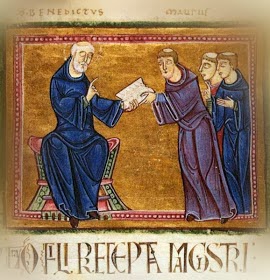
Homily for All Saints of the Order of St Benedict
There are two things that we need to know about all the Saints of the Order of St Benedict: that there are lots of them, and that they’re all on our side – they’re praying for us. When we consider the saints, especially in large numbers there can be something decidedly off-putting about it: we’re filled with a sense of our own inadequacy, that we’re not good enough, that we’re not up to the task – sainthood isn’t for us.

And so I would like to begin by spending a few moments considering the portion of the Rule which is appointed to be read today, from the second half of Chapter 35 – it concerns those appointed to serve at table for the week. It is quite mundane and practical: they are to eat early, before they serve the brethren so that they do not grumble and it isn’t too hard for them. Before they begin or finish their week of service they are to give thanks to God. It is this reliance upon God which undergirds all that they do from start to finish which provides us with an important spiritual lesson: in knowing upon whom we can rely we can be truly thankful, we can be built up in love, with generous, thankful hearts.
That is why in the Prologue to the Rule our Holy Father St Benedict expresses his aim as follows: Constituenda est ergo nobis Dominici schola servitii – we have, therefore to establish a school of the Lord’s service. It is a school: somewhere where things can be both taught and practised, it is a place to learn to serve God and others. To love and to serve God and our neighbour is we are all called to by virtue of our baptism; it is how we live out our faith in our lives. This then is the path to heaven, for saints are sinners who, through God’s love and grace, keep trying, who stay close to Him.
So, as we keep trying, we can do so in the knowledge that nothing can separate us from the love of God in Christ Jesus our Lord (Rom 8:39). That’s what the Incarnation, the Cross, and the Resurrection achieve: a relationship of such depth, such love, which has such power to heal and transform our human nature. For all things are possible with God (Mk 10:27) this is why the first word of the Prologue is Ausculta ‘Listen’ we listen so that we might learn; in listening we focus our attention on what really matters so that we can sit lightly to the things of this world, all the superficial stuff that the world tells us is important or valuable, so that we might discard it and concentrate on what really matters. Our listening informs what we are, what we do, and what we shall be.
So as we sing the praises of those who have followed in the footsteps of St Benedict, let us imitate them, in the Lord’s service, strengthened by Word and Sacrament – fed by God, fed with God, so that our nature may be transformed, so that through prayer and service we may honour the God who created us, who redeemed us, and who sustains us, so that we may live out our faith so that the world may believe and give glory to God the Father, God the Son, and God the Holy Spirit, to whom be ascribed as is most right and just, all might, majesty, glory, dominion, and power, now and forever.
Homily for the 32nd Sunday of Year C
God does not love us because we are lovely or loveable; His love exists not on account of our character, but on account of His. Our highest experience is responsive, not initiative. And it is only because we are loved by Him that we are loveable.
Fulton Sheen, Rejoice, 1984: 9
At this time of year our thoughts turn quite naturally to things eternal. We have prayed for the repose of the souls of the faithful departed, and remember those who gave their lives in the past century. As Christians we know that our earthly life is not all that there is. This morning’s first reading is, despite its rather gruesome subject matter, one which contains hope – the hope of eternal life, the promise of a loving God, in whose image we are made.
This hope is part of our faith, which is to be lived out in love: costly, and self-giving. This is our calling as Christians. This is what St Paul is encouraging the church in Northern Greece to live out. As a result of this we are called to prayer and the spread of the Gospel, that the message of God’s love and forgiveness, of healing and wholeness in the message and person of Jesus Christ. Through his giving of himself on the Cross we can have hope; hope that this world is not all that there is, that our destiny is something greater, something richer. The Sadducees can only ask a question to try and support their denial of life after death. Christ can only start from the reality of eternal life with God. It is acknowledged by Moses, it is the heritage of Israel, and thus for the Church as the new Israel.
This is why we as the Church pray for the living and the dead; it is why we are fed by Word and Sacrament – nourished by God and with God, given a foretaste of the heavenly banquet, to prepare us for an eternity with God. Such is the comfort which God gives us, such is the grace poured into our hearts. Such a great gift should provoke in us something of a response – a fashioning of our lives after the self-giving love which is the heart of the life and death and resurrection of Jesus Christ.
In this we can truly become what we were created for. We can realise that Love increases the more it is given, freely, not counting the cost, in the faith and hope that this life is not all that there is – that we are called to live out love in our lives. To live it out so that world may be filled with love, that it may believe, freed to sing the praise of God the Father, God the Son, and God the Holy Spirit, to whom be ascribed as is most right and just all might, majesty, glory, dominion, and power, now and forever.
Homily for the 31st Sunday of Year C
Humility is not self-contempt but the truth about ourselves coupled with a reverence for others; it is self-surrender to the highest goal.
Fulton Sheen Thoughts for Daily Living, 1955: 121
Last week the Gospel presented us with two people, a Pharisee and a tax-collector: one was a religious expert, a pillar of society, the other someone hated and despised. And yet, on the inside they were completely different – one was self-righteous, arrogant and full of himself, the other knew his need of God’s love and mercy. They show us what not to be and what we should be, and this week we see another one.
Zacchaeus is a chief tax collector; he is someone who was hated, who has got rich by over-charging people. He starts off just being curious – he wants to see what all the fuss is about, he wants to see Jesus. He can’t see over the crowds so he climbs up a sycamore tree. When Jesus sees him, he tells him to come down quickly as Our Lord has to stay at his house today. He hurries down and welcomes Jesus with joy, he’s glad to see Him, to welcome Jesus into his house.
The crowd are a bit miffed – they say, ‘Ooh … look at Him, what’s he going to that man’s house for?’ They just can’t see beyond outward appearances, they judge him – they just see a sinner, they don’t see someone who wants to see Jesus and love Him. The simple presence of Jesus has a transformative effect on Zacchaeus, he gives away half of his property to the poor and promises to repay those whom he has defrauded and to give them compensation. The Son of Man has come to seek out and save the lost – to show people that there is another way. This is the love of God in action – this is what happens on the Cross – God shows us the transforming power of His love, love shown to the un-loveable, so that they might become lovely.
It is an idea which can be found in scripture – this morning’s first reading shows us that God is loving and merciful, and that God’s love and mercy can have an effect on our lives, if we trust in Him, if we invite Him in, so that his transforming love can be at work in our lives, and ‘may make you worthy of his calling and may fulfil every resolve for good and every work of faith by his power, so that the name of our Lord Jesus may be glorified in you, and you in him, according to the grace of our God and the Lord Jesus Christ.’ (1Thess 1:11–12) It is through God’s grace, an undeserved gift, that people like Zacchaeus can be transformed, transformed by God and for God, and what was true for him is true for us, here, today.
That is why, as Christians, we pray, why we come to Mass each and every week to be fed by word and sacrament, so that God’s grace and transforming love may be at work in us, transforming our nature, making us more like Him. Everything that we say or think or do in our lives needs to be an outworking of our faith, so that our exterior life and our interior life are in harmony with each other – so that our lives, like St Paul’s, may proclaim the Gospel. This is what we are called to, and how we are to live. Unless we start from the point where we know our need of God and rely upon him, where we too make that space where God can be at work in us, in our souls and our lives, we are doomed.
Is this the kind of life we really want to lead? Is this really the path of human flourishing? Or are we called to something better, something greater, something more lovely? So let us put our trust in the God who loves us and who saves us, let us know our need of him and his transforming grace to fill our lives and transform all of his creation so that the world so that it may believe and be transformed to sing the praise of God the Father, God the Son, and God the Holy Spirit, to whom be ascribed as is most right and just all might, majesty, glory, dominion, and power, now and forever.
A thought for the day
A brother said to a hermit, ‘If I see a monk about whom I have heard that he is guilty of a sin, I cannot make myself invite him into my cell. But if I see a good monk, I bring him in gladly.’ The hermit said, ‘If you do good to a good brother it is nothing to him, but to the other give double charity, for he is sick.’
A thought for the day
Having withdrawn from the palace to the solitary life, abba Arsenius prayed and heard a voice saying to him, ‘Arsenius, flee, be silent, pray always, for these are the source of sinlessness.’
Abba Nilus said, ‘The arrows of the enemy cannot touch one who loves quietness; but he who moves about in a crowd will often be wounded.’
Theophilus of holy memory, bishop of Alexandra, journeyed to Scetis and the brethren coming together said to abba Pambo, ‘Say a word or two to the bishop, that his soul may be edified in this place.’ The old man replied, ‘If he is not edified by my silence, there is no hope that he will be edified by my words.’
A thought for the day
They asked Abba Makarios ‘How should we pray?’ And the old man replied, ‘There is no need to speak much in prayer; often stretch out your hands and say “Lord, as you will and as you know, have mercy on me.” But if there is war in your soul, add, “Help me!” and because he knows what we need, he shows mercy on us.’
Sermon for Evensong Trinity XXII
War may be either a crusade or a curse: either a token of man’s love of God, or the fruit of man’s godlessness; either a sign that men are with God, or a token that they are againsthim
Fulton Sheen Whence come Wars? 1940: 1–2
There is something about martial or manly language when used in Christian context which is apparently politically incorrect these days. We have hymn-books which no longer allow the faithful to sing ‘Onward Christian Soldiers’ instead we are supposed to sing ‘Onward Christian Pilgrims’ and other such trite nonsense because well-meaning so-called ‘liberals’ tell us that we should. Despite their best intentions the Christian life is one of constant warfare: spiritual warfare against the powers of this world, and the Prince of Lies, Satan, who though utterly defeated on the Cross still wages a campaign against the Body of Christ. Our vocation, then, is to fight, armed in the way described by St Paul in his letter to the Ephesians (Eph. 6:11–17).
In this evening’s second lesson we see St Paul giving advice to Timothy, the Bishop of Ephesus. He addresses him as ‘my child’ not only because he is younger but also because the Church is a family, which is one in Christ – we are a family which cuts across gender, race, class, and time. Timothy is strengthened ‘by the grace that is in Christ Jesus’ it is the only source of grace, and it alone can strengthen us, the Church, and her bishops. He is encouraged to pass on to others what he has heard from St Paul in the presence of many others – the teaching office of the Church is something public, to pass on the truth and to share it with others so that they too may pass it on. It is a serious task, one which is entrusted to me, and which I am to entrust to you. We are all part of the greater whole charged with the spreading of the Good News of Jesus Christ by thought and word and deed. It is a serious business, and not to be taken lightly. It is of the utmost importance, so that we all may stand strong in the faith, entrusted to the Church.
It is something which will lead us to share in suffering – our sharing the Good News will lead us to share the suffering of Christ, we are to be conformed to Him, sharing his pain, his trials, for His sake. The world is always ready to persecute the Church because the message of the Gospel seeks to transform it, to turn away from the ways of selfishness and greed and sin, to establish a kingdom of love. All around the world our brothers and sisters are persecuted for their faith, they have to practise it in secret; they risk imprisonment, torture, and death, all for their allegiance to Christ Jesus. As those who have been baptised, we are to share in Our Lord’s death and new life; we are to place our allegiance to Him before anything else. It is radical; it has the power to change the world. The world is rightly scared of the power of the Gospel – nothing, not even Satan himself, can stand against it.
We are to approach our faith with the training and resolve of a soldier – we are to be single-minded, and not led astray by worldly things, so that we can do the will of Him who loves us, and who died for us. We are to be like athletes, competing to win a prize, playing by the rules, living out the love which we have received. We are to toil like a farmer – it is hard, back-breaking even, but we will receive our reward. It is through doing this and through thought and prayer that we can come to understand what God has in store for us.
It is not an easy undertaking, it is not for the faint-hearted, and if we were to rely upon our own human strength then we would most surely fail – but if we rely upon the God who became human so that we might become divine, who understands our weakness, who proclaimed the Gospel of love, and healing, and forgiveness, then we can do marvellous things for the love of Him who loves us. It will be difficult; we will face opposition, from a world which would rather not be transformed into the image of God, but it is our calling. So let us stand firm, and fight the good fight, so that the world so that it may believe and be transformed to sing the praise of God the Father, God the Son, and God the Holy Ghost, to whom be ascribed as is most right and just all might, majesty, glory, dominion, and power, now and forever.
Homily for the Thirtieth Sunday of Year C
Humility is not self-contempt but the truth about ourselves coupled with a reverence for others; it is self-surrender to the highest goal.
Fulton Sheen Thoughts for Daily Living, 1955: 121
Most of us, I suspect, almost all of us don’t really like paying taxes; we know that we have to, but we’d rather not. There were taxes in Jesus’ day and tax collectors were privatised in the Roman Empire: they had to pay for the contract to collect the taxes, and recouped the cost of gaining the contract by over-charging people. They were not popular people, they were resented, they were hated, and with good reason.
We know that in this morning’s Gospel that he’s supposed to be the villain of the piece, the Pharisee, a religious authority, is supposed to be the person to whom we look up, the example one might expect to follow. The parable, then, turns our understanding of the world on its head. The key to understanding the parable lies in Luke’s opening comment regarding those: ‘who trusted in themselves that they were righteous, and treated others with contempt’ (Lk 18:9). There is a fundamental problem with the difference between how they think of themselves and others. The Pharisee isn’t praying, he isn’t talking to God, he’s praying to himself, justifying what he thinks of himself, saying to God, ‘Look at me, am I not good?’
But the tax collector, standing far off, would not even lift up his eyes to heaven, but beat his breast, saying, ‘God, be merciful to me, a sinner!’ (Lk 18:13). His prayer is that God will be merciful. He is so conscious of his own sin and need of God that he opens up a space in which God can be at work. It is in this space that we all need to be. We need to recognise that we need God to be at work in us, that we need to rely upon him to change us, to transform us – so that we can become the people that God wants us to be. All the prayer, all the rituals, all the externals of religion, are of no use unless they go hand in hand with an attitude which recognises that we need God, that we are sinful, and need his love and his mercy to transform us.
That is why, as Christians, we pray, why we come to Mass each and every week to be fed by word and sacrament, so that God’s grace and transforming love may be at work in us, transforming our nature, making us more like him. Everything that we say or think or do needs to be an outworking of our faith, so that our exterior life and our interior life are in harmony with each other – so that our lives, like St Paul’s, may proclaim the Gospel. This is what we are called to, and how we are to live. Unless we start from the point where we know our need of God and rely upon him, where we too make that space where God can be at work in us, in our souls and our lives, we are doomed to be like the self-righteous Pharisee, talking to ourselves, massaging our own egos, wallowing in selfishness and narcissism, proud and cruel.
Is this the kind of life we really want to lead? Is this really the path of human flourishing? Or are we called to something better, something greater, something more lovely? So let us put our trust in the God who loves us and who saves us, let us know our need of him and his transforming grace to fill our lives and transform all of his creation so that the world so that it may believe and be transformed to sing the praise of God the Father, God the Son, and God the Holy Spirit, to whom be ascribed as is most right and just all might, majesty, glory, dominion, and power, now and forever.
A Thought for the Day from the Desert
Abba Poemen said, ‘There is no greater love than a man lays his life for his neighbour. When you hear someone complaining and you struggle with yourself and do not answer him back with complaints; when you are hurt and bear it patiently, not looking for revenge; then you are laying down your life for your neighbour.’
Trinity XXI Evensong
For the joy of the Lord is your strength
Living as we do in difficult and uncertain times it is all too easy to become downcast, to let the cares of the world, our worries and our frailties get us down. It can be all too easy not understand quite what God may have in store for us. We can be like Mary and Martha perplexed at why Jesus does not come immediately, why he goes away, only to return once they fear all hope is lost.
In such moments which happen to us all from time to time, we can trust that our vocation as Christians is one of JOY, a joy which comes from the Lord. The following words of Fulton Sheen are helpful in reminding us of this:
Lightness of spirit is related to Redemption, for it lifts us out of precarious situations. As soon as a priest goes in for revolutionary tactics in politics he becomes boringly serious. This world is all there is, and therefore he takes political involvements without a grain of salt. One rarely sees a Commissar smile. Only those who are ‘in the world, not of it’ can take events seriously and lightly. Joy is born by straddling two worlds – one the world of politics, the other of grace.
Those Mysterious Priests 1974: 238
In this evening’s first lesson we see the people of Israel celebrating. They are told to ‘Eat the fat and drink sweet wine and send portions to anyone who has nothing ready, for this day is holy to our Lord’ (Neh. 8:10). There is something about feasting and rejoicing which is good for the soul, the Christian faith should never be dour or miserable, we proclaim Good News to all the world. There is also the instruction to give to those who have not. Our faith is something which needs to be put into action – it requires a generosity of spirit, of showing love and care to all those around us – to care for the spiritual and physical well-being of our fellow men and women. This generosity and care, like that of God for us, forms the church into a community of love, a place where people may have an encounter with the living God, and through His Holy Spirit receive joy and peace.
As Christians it is up to us to help make this a reality here and now. We live in the expectation of Our Lord’s Second coming, so surely we should be doing what he tells us, living out our faith in the world, so that it may believe. Our lives need to be attractive, and filled with joy, freed from the cares of this world, freed to sing God’s praise, freed to share his love with others.
As people rooted in the joy and generosity which characterise the love of God, shown to us in Christ Jesus Our Lord, we can all be truly joyful, knowing that the joy of the Lord is our strength. Our strength as the people of God comes from Him who saves us out of love, who commands us to feast (as well as fast) a feast we celebrate day by day and week by week when we feed on the Sacrament of Our Lord’s Body and Blood in Holy Communion, to be strengthened body and soul to love Him and serve Him, and to live out His joy in our lives. It really is the most wonderful thing, it should leave us with beaming smiles and joyous expectation to share the love and joy with others. So let is live out our vocation, to be joyous Christians, servants of a loving God, to the praise and honour of his name.
A thought for the day from S. Ignatius of Antioch
Constantly pray for others; for there is still hope that they may repent so as to attain God. And so, allow them to learn from you, at least by your deeds. In response to their anger show meekness; to their boasting, be humble; to their blasphemies, offer up prayers; to their wandering in error, be firmly rooted in faith; to their savage behaviour, act civilised. Do not be eager to imitate their example. Through gentleness we should be their brothers. And we should be seen to be eager to imitate the Lord. Who was mistreated more than he? Or defrauded? Or rejected? Do this so that no weed planted by the Devil may be found in you and you may abide in Jesus Christ both in the flesh and in the spirit, with all holiness and self-control.
To the Ephesians 10
More advice from S. Teresa of Avila
Beware of a certain kind of humility suggested by the devil which is accompanied by great anxiety about the gravity of our sins. He disturbs souls in many ways by this means, until at last he stops them from receiving Holy Communion and from private prayer by doubts as to whether they are in a fit state for it, and such thoughts as: ‘Am I worthy of it? Am I in a good disposition? I am unfit to live in a religious community.’
Thus Christians are hindered from prayer, and when they communicate, the time during which they ought to be obtaining graces is spent in wondering whether they are well prepared or no.
Everything such a person says seems to them on the verge of evil, and all their actions appear fruitless, however good they are in themselves. They become discouraged and unable to do any good, for what is right in others they fancy is wrong in themselves.
When you are in this state, turn your mind so far as you can from your misery and fix it on the mercy of God, His love for us, and all that He endured for our sake.
A thought for the day from S. Teresa of Avila
So far as you can without offending God, try to be genial and behave in such a way with those you have to deal with that they may take pleasure in your conversation and may imitate your life and manners, instead of being frightened and deterred from virtue.
The more holy someone is, the more cordial they should be with others.
Although you may be pained because their conversation is not what you would wish, never keep aloof if you want to help them and win their love.
Try to think rightly about God. He does not look at such trifling matters as you suppose; do not alarm your soul or lose courage for you might lose greatly. Keep a pure intention and a firm resolve not to offend God, as I said, but do not trammel your soul for instead of advancing in sanctity you would contract a number of imperfections and would not help others as you might have done.
St Isaac of Nineveh on the Mercy of God
As a handful of sand thrown into the ocean, so are the sins of all flesh as compared with the mind of God.
Just as a strongly-flowing fountain is not blocked by a handful of earth, so the compassion of the Creator is not overcome by the wickedness of his creatures.
Someone who bears a grudge while they pray is like a person who sows in the sea and expects to reap a harvest.
As a flame of fire cannot be prevented from ascending upwards, so the prayers of the compassionate cannot be held back from ascending into heaven.
Advice for Christian Living from S Francis de Sales
One form of gentleness we should practise is towards ourselves. We should never get irritable with ourselves because of our imperfections. It is reasonable to be displeased and sorry when we commit faults, but not fretful or spiteful to ourselves.
Some make the mistake of being angry because they have been angry, hurt because they have been hurt, vexed because they have been vexed. They think that they are getting rid of anger, that the second remedies the first; actually, they are preparing the way for fresh anger on the first occasion. Besides this, all irritation with ourselves tends to foster pride and springs from self-love, which is displeased at finding that we are not perfect.
We should regard our faults with calm, collected and firm displeasure. We correct ourselves better by a quiet persevering repentance than by an irritated, hasty and passionate one. When your heart has fallen raise it gently, humbling yourself before God, acknowledging your fault, but not surprised at your fall. Infirmity is infirm, weakness weak, and frailty frail.
(S Francis de Sales Introduction to the Devout Life III:9)
A thought for the day from S. Thérèse of Lisieux
‘Love is repaid by love alone’ (St John of the Cross)
I saw that love alone imparts life to all the members, so that should love ever fail, apostles would no longer preach the gospel and martyrs would refuse to shed their blood. Finally, I realised that love includes every vocation, that love is all things, that love is eternal, reaching down through the ages and stretching back to the utmost limits of the earth.
Beside myself with joy, I cried out, ‘Jesus, my love, my vocation is found at last – my vocation is love!’ I have found my place in the Church, and this place, Jesus, you have given me yourself; in the heart of the Church I will be love. In this way I will be all things and my wish will be fulfilled.
But why do you say ‘beside myself with joy’? It is, rather, peace which has claimed me, the calm, quiet peace of the sailor as he catches sight of the beacon which lights him to port. The beacon of love.
I am only a weak and helpless child, but my very weakness makes me dare to offer myself, Jesus, as a victim to your love. In the old days, only pure and spotless victims of holocaust would be accepted by God, and his justice was appeased only by the most perfect sacrifices. Now the law of fear has given way to the law of love, and I have been chosen, though weak and imperfect, as love’s victim.
A thought for the Day
It is one of the paradoxes of Christianity that the only things that are really our own when we die is what we give away in His name. What we leave in our wills is snatched from us by death; but what we give away is recorded by God to our eternal credit, for only our works follow us. It is not what is given that profits unto salvation; it is why it is given.
Fulton J Sheen The Seven Virtues 1953:72-73
A thought for the day
Be watchful of time and how you spend it. Nothing is more precious than time. In the twinkling of an eye heaven may be won or lost.
Time is made for man, not man for time.
I hear you say sadly, ‘How shall I fare? And if what you say is true, how shall I give account of each moment of time? – I, who am now twenty four, and until now have never paid heed to time … Help me now for the love of Jesus.’
That is indeed well said: ‘For the love of Jesus.’ For in the love of Jesus you shall find your help.
So then love Jesus, and all that he has is yours. Knit yourself to him by love and faith.
from The Cloud of Unknowing Chapter 4
A thought for the Day
It is easy to find Truth; it is harder to face it, and harder still to follow it.
Fulton Sheen Lift up your Heart, 1942:106
Homily for the 25th Sunday of Year C
True generosity never looks to reciprocity; it gives neither because it expects a gift in return, nor because there is a duty or an obligation to give. Charity lies beyond obligation; its essence is the ‘adorable extra.’ Its reward is in the joy of giving.
Fulton Sheen Way to Inner Peace, 1955: 108
‘What shall I do?’ (Lk 16:3) As Christians we are charged with nothing more than the transformation of the entire world and its conversion to Christ. In this we do the will of him ‘who desires all people to be saved and to come to the knowledge of the truth.’ (1Tim 2:4) It is something which is rooted in prayer, which should characterise our lives, which fills our hearts with love so that we may lift ‘holy hands without anger or quarrelling’ (1Tim 2:8). We live such lives so that our faith is lived out, and that it may be attractive, inviting and so that it may convert the world.
The world around us is cruel, selfish, and unfair. Profit is everything. The behaviour criticised by the prophet Amos is still widespread. It is something which we have to combat as we live out our faith. In Amos’ prophesy we hear ‘we will buy the helpless man for silver’ (Amos 8:6) and we know that he was bought for thirty pieces of silver. This was his price; he was bought and suffered for us, to take away our sins, to transform the world, giving Himself out of love so that humanity might share His Divinity.
Such is the generous love that redeems the world, giving ‘Himself as a ransom for all’ (1Tim 2:6). This too is the generosity which we see in this morning’s Gospel. It’s something of a shock to the system to see Our Lord condoning unjust or immoral behaviour. He has been charged with wasting his master’s possessions, so he goes to the people who are in debt to his master and writes the debts off. He shows a generosity and love which is reckless, which does not count the cost. At one level he does what he is accused of doing and is commended by his master. We’re expecting him to be condemned for acting like this, and yet he is praised. It reminds us that we are called to be generous, even to the point of being reckless, sitting lightly to the things of this world, and holding no store by wealth, or position, or influence, but instead giving it away, sharing it with others. If we cannot serve God and money, then as Christians we are to serve God. In this we can show that we are faithful in small things and hope to receive a place in the eternal dwellings.
This sort of behaviour looks completely mad in the eyes of the world, but we are not to conform ourselves to the ways of the world, but rather to those of the Kingdom of God. This is how we can transform the world around us, and conform it to God in Christ. It starts with our baptism; it continues with prayer, with reading Scripture and receiving Holy Communion, so that God’s grace may be poured out on us, to transform our human nature, so that His Kingdom may be a reality, so that the world may believe and be saved. So let us live out our faith, practising the same generosity which God poured out on us, shedding His Blood to take away our sins. Let us transform the world so that it may turn away from the ways of greed and selfishness and put its trust in the true riches of the Kingdom. If ‘no servant can serve two masters, for either he will hate the one and love the other, or he will be devoted to the one and despise the other. You cannot serve God and money’ (Lk 16:13) we have to choose between money and God. We cannot take it with us when we go, we cannot put pockets in our shrouds; money is no use once you’re dead, other than for buying you a fancier coffin or a grander funeral. Let us rather love God, and fashion our lives after the generosity which God shows to us, sparing not even His only Son, who died for our sake, so that we might live, and have eternal life in Him.
It is this generous God who comes to us today in Word and Sacrament, to heal us and restore us, to give us life in him. He entrusts to us the true riches of the Kingdom so that we may share them recklessly, generously with the world so that it may believe and give glory to God the Father, God the Son, and God the Holy Spirit, to whom be ascribed as is most right and just all might, majesty, glory, dominion, and power, now and forever.
The Nativity of the Blessed Virgin Mary
Let those who think that the Church pays too much attention to Mary give heed to the fact that Our Blessed Lord Himself gave ten times as much of His life to her as He gave to His Apostles.
Fulton J Sheen The World’s First Love 1956: 88
It is a fair thing to say, and I am certainly not embarrassed to admit the fact, and hopefully she is not too embarrassed to hear it, but I love my Mum! I am lucky to be the son of such a lovely lady, and in an ideal world, all of us would like to or are able to say a similar thing. It is a relationship of love, of nurture, and support, which gives rise to human flourishing; it is a building block of human society, it is something fundamental, which should be both valued and celebrated.
As great as human motherhood is, in the Church we celebrate something even greater: the fact that the Blessed Virgin Mary is the mother of Our Blessed Lord and Saviour, the world’s Redeemer, who entrusted her to the world, and the world to her care, as He hung on the Cross at Calvary. As such she is the mother of the Church, the Queen of Heaven and Earth and the Queen of Peace. Today the Church celebrates the birth of the one of the Saviour of the World was born. She is one special lady! We cannot praise or honour her enough for the simple reason that her saying Yes to God at the Annunciation undoes the No of Eve in the Garden of Eden. She is obedient, and likewise her husband, S. Joseph, when he hears the angel’s message, trusts and obeys. In them both we see true love and obedience, a model for humanity in how it relates to itself and to God.
Mary (and Joseph) listen and obey, which brings about the birth of Him who restores humanity’s relationship with God and ourselves, who gives us the hope of heaven, who gives Himself out of love, sharing our human nature so that we might share His divinity. That is why we have come here this morning, to he nourished by Him, and with Him, with His Word, with His Body and Blood, under the outward forms of bread and wine, so that through grace, the free gift of God, He might transform our nature so that we might share His nature.
It really is the most wonderful news – the good news of the Gospel, that God loves us, dies for us, and rises again, so that we and all who turn to Him can be saved, and have life in its fullness. It is not without its cost, as Our Lady found out, in the prophecy of Simeon a sword would pierce her own soul when she saw her Son dying on the Cross. Yet here too she is obedient, she has been told that he will save His people from their sins. Here too she trusts in God, and through her trust snd obedience we can enkoy the fruits of her Son’s saving work. This is something which we can and should celebrate: the fruits of her obedience and trust. It should encourage us to imitate her and be obedient to God, to trust Him, and fo what He tells us to do. She is the model Christian, living the model Christian life; she receives the reward promised by her Son in her Assumption, sharing His risen life and glory at His right hand in Heaven. She shows the world what it means to be obedient to God and to trust in Him, and what the rewards of God’s promises are.
It is not easy to be like her, to be obedient to the will of God: more often than not humans are more inclined to follow their own will, their own desires or pleasures, because they want to, and because such self-gratification is all that matters. In our modern capitalist consumer society we are taught want things and to get them, even if we have to borrow to get them. It is enticing, but where does all this self-gratification lead? Nowhere! Other than death and emptiness: you cannot simply buy your way into heaven. You can pay to have your body frozen, but it cannot save your soul: nothing we can say or think or do can. It’s that simple, and thanks to the obedience of the woman whose birth we celebrate today, we are given something which money cannot buy: the love of God poured into our hearts, restoring our lives and relationships, forgiving our sins, helping us to become the people God wants us to become, to prepare us to share the joy of paradise, in God’s presence for ever.
Such a wonderful free gift should have a serious effect upon our lives, who and what we are, and how we live our lives here and now. If we are willing to accept the free gift of God, we have to accept that it has consequences for who and what we are, and yet we know that the service of God is perfect freedom: we are not faced with tyranny or oppression but love and mercy. Do let us live, following the example of the Blessed Virgin Mary and aided by her prayers, so that we may transform our lives and the whole world, so that it too may believe and give glory to God the Father, God the Son, and God the Holy Spirit, to whom be ascribed as is most right and just, all might, majesty, glory, dominion, and power, now and forever.
Such a wonderful free gift should have a serious effect upon our lives, who and what we are, and how we live our lives here and now. If we are willing to accept the free gift of God, we have to accept that it has consequences for who and what we are, and yet we know that the service of God is perfect freedom: we are not faced with tyranny or oppression but love and mercy. Do let us live, following the example of the Blessed Virgin Mary and aided by her prayers, so that we may transform our lives and the whole world, so that it too may believe and give glory to God the Father, God the Son, and God the Holy Spirit, to whom be ascribed as is most right and just, all might, majesty, glory, dominion, and power, now and forever.
A thought for the day from St Augustine
quia fecisti nos ad te et inquietum est cor nostrum donec requiescat in te. (Conf. 1.1)
You have made us for Yourself, and our heart is restless, till it rests in You.
Homily for the 21st Sunday of Year C
To the bad conscience God appears always the God of wrath. The boy who broke the vase by throwing a ball at it says to his mother: ‘Now Mummy, don’t get mad.’ Anger is not in the mother; anger is in the boy’s projection to his mother of his own sense of justice. Anger is not in God; anger is in our disordered selves.
Fulton Sheen Preface to Religion, 1946: 50
The Cross of Calvary stands at the crossroads of three prosperous civilizations as eloquent testimony to the uncomfortable truth that the successful people, the social leaders, the people who are labelled niceare the ones most capable of crucifying the Divine Truth and the Eternal Love.
Fulton Sheen Peace of Soul, 1954: 69
Growing up is probably best described as not an easy or indeed a pleasant process. Learning right from wrong, what to do and how to do it, takes time and invariably involves mistakes. The problem comes not from making mistakes themselves but rather from not learning from them. Learning lessons requires humility – knowing that you do not know everything, that you have much to learn, that you are not the finished article but rather a work in progress. That through God’s grace working in you, you may become something greater, something better than you are.
This recognition of one’s limitations and failings opens up a space where God can be at work in our lives, transforming us to live the Divine life of Love. This is the narrow door of this morning’s gospel: narrow because if we have a sense of our own self-importance or our worth which is too big then we cannot enter – our sense of who and what we are gets in the way. It’s not enough to have eaten and drunk in God’s presence, to have been around when he taught in our streets – it’s a question of engagement – are you a bystander or have you been fed by God, with God, and through the grace of the sacrament lived out your faith in your life – living out the love of God in your life? Have you been around when the Gospel has been taught, or have you both listened to it and lived it out in your life?
It isn’t an easy thing to do – it is costly, difficult, and hard and it is something which we need to do together. That’s after all what the Church is for – it’s a collection of sinners trying to live in response to the love of God which has been poured out on us. It’s something which we have to do together – loving each other, loving our enemies, living out forgiveness as we have been forgiven and loved by God. It’s a radically different way of life to that which the world would encourage us to practice. It isn’t easy, it’s really difficult, and we willfail at it, but that’s the point! The point is not that we fail and that’s it, but that we keep trying, loving and forgiving, together, built up as the body of Christ, humble enough to let God be at work in us, transforming our nature by his Grace – making us the people of God, living out his love in the world.
We have come here this morning to be fed by Word and Sacrament, to be nourished by God, with God, to have false ideas of who and what we are stripped away, and recognising our dependence upon God and each other, to try and live out our faith – to grow in holiness together as the people of God, loved, healed, and restored by him – and through this to grow up into the full stature of Christ and to transform the world that it may reflect more fully the glory of God. The Gospel really is this radical, it’s not nice, or comfortable, it’s challenging and difficult, and utterly wonderful, releasing people from the slavery of this world and its false ideas to live in the freedom and love of God.
We have to look to Jesus and to His Cross to see God’s love for us. What is shameful in the eyes of the world, we can see as glorious – true love which gives regardless of the cost, which forgives sins, which heals and restores broken sinful humanity, which gives us the hope of heaven. This is grace the free gift of God, giving Himself who shared our humanity so that we might share His divinity, strengthened by Word and Sacrament to live out our faith.
The world cannot understand this, it doesn’t make sense, it isn’t logical, it shouldn’t happen. But it does, and it calls the world to something different, something radical and world-changing, which can re-form human society in the image of God and His Love. It will be hard: the world will laugh at us and our feeble attempts to follow God. Yet, we believe in a God who loves us, and who would never laugh at us, or belittle our feeble efforts to follow Him and conform ourselves to Him. So may the fire of God’s love be kindled in our hearts and lives, that we may be ablaze for Him, aflame with love for God and neighbour, love our enemies and our friends, and lets us change the world, not just this village, or this county, but all of God’s creation, all of humanity, that they may know God’s love and that it may rule in their hearts and lives.
God takes the initiative in Christ to help us to have life in its fullness – it’s not a life without rules, or discipline, it isn’t easy, it’s costly and difficult, but it is good and rewarding. It may not feel like that, we may struggle to experience its goodness or even its rewards in this life, but it prepares us for an eternity with God, in his closer presence. Humility is the key – in it we recognise our utter dependence upon God, our own sinfulness, our need to be loved and to share that love with others. God loves us not because we are loveable, but that through His love we might become lovely. So let us hasten to enter through the narrow gate, so that God may continue to transform our human nature, that his saving love and power may be at work in our hearts and our lives, so that we can transform ourselves and all the world so that it may believe and sing the praise of God the Father, God the Son, and God the Holy Spirit, to whom be ascribed as is most right and just all might, majesty, glory, dominion, and power, now and forever.
A thought for the day
O LORD, who hast taught us that all our doings without charity are nothing worth: Send thy Holy Ghost, and pour into our hearts that most excellent gift of charity, the very bond of peace and of all virtues, without which whosoever liveth is counted dead before thee: Grant this for thine only Son Jesus Christ’s sake. Amen
Admittedly it is the collect for Quinquagesima (The Sunday before Lent) but it’s something to live by all year round, if we’re honest!
Homily for the 20th Sunday of Year C
… it has been said that Christianity does not suit the modern man, therefore scrap Christianity. Now let us say, Christianity does not suit modern man, therefore let us scrap modern man
Fulton Sheen Philosophies at War, 1943: 98–99
We are more than used to seeing Christianity as a religion characterised by love: love of God and love of neighbour, which is quite right. It can be all too easy for this to be transformed into a religion of niceness, but at no point in the Sermon on the Mount does our Blessed Lord say ‘Blessed are the nice, for they will have a nice warm fuzzy feeling deep inside’. We are not called to like people but to love them. It is costly and difficult, and the religion of nice offers us syrupy sentiment in place of costly love. It plays down the cost and difficulty of living a Christian life, and offers us something superficial and worthless.
It is difficult when we read passages like this morning’s gospel. Our Lord comes not to give peace but division. Given the massive strides made in the last fifty years towards Christian unity and healing the wounds of our past and divisions, this can sound shocking or even wrong. And yet what Christ comes to bring will cause division because it forces people to make a choice – do we wish to follow the ways of the world or the Gospel? These two can never be reconciled – only in the City of God can we see the rule of love. Only by choosing Christ over the world can His love rule in our hearts and our lives. It is a difficult and a costly choice – we will face ridicule, we will be considered fools, who have chosen a hard and difficult path over the easy path of the ways of the world.
People have always rejected Christianity, ignored it, or treated it with contempt, because it is difficult and costly, it asks a lot of us, and what it offers can be easily mocked – when we proclaim it by our words and actions we have to expect to be treated like Jeremiah and thrown down a well, what we stand for is dangerous and awkward, a truth which the world does not wish to hear. It isn’t as though living the Christian life is easy – we will fail often, we will be like Jeremiah sinking in the mud – but the love and grace of God can lift us up, this can heal and restore us, and help us to continue our pilgrimage through this life and the next.
We are, as this morning’s epistle puts it, surrounded by ‘so great a cloud of witnesses’ martyrs, those who have borne witness to the faith, the saints whose life and prayers can strengthen and inspire us – they show us the path we should tread. We have to look to Jesus and to His Cross to see God’s love for us. What is shameful in the eyes of the world, we can see as glorious – true love which gives regardless of the cost, which forgives sins, which heals and restores broken sinful humanity, which gives us the hope of heaven. This is grace the free gift of God, giving Himself who shared our humanity so that we might share His divinity, strengthened by Word and Sacrament to live out our faith.
The world cannot understand this, it doesn’t make sense, it isn’t logical, it shouldn’t happen. But it does, and it calls the world to something different, something radical and world-changing, which can re-form human society in the image of God and His Love. It will be hard: the world will laugh at us and our feeble attempts to follow God. Yet, we believe in a God who loves us, and who would never laugh at us, or belittle our feeble efforts to follow Him and conform ourselves to Him. So may the fire of God’s love be kindled in our hearts and lives, that we may be ablaze for Him, aflame with love for God and neighbour, love our enemies and our friends, and lets us change the world, not just this village, or this county, but all of God’s creation, all of humanity, that they may know God’s love and that it may rule in their hearts and lives.
That is why we have come here, today, to be fed in word and sacrament, to be fed by God, to be fed with God, with His Body and Blood and His Word, so that it may nourish us and prepare us for heaven, so that it can transform our human nature and fill us with the Divine life of love and forgiveness, which we can start living out here and now and change all the world, so that it may believe and be transformed to sing the praise of God the Father, God the Son, and God the Holy Spirit, to whom be ascribed as is most right and just all might, majesty, glory, dominion, and power, now and forever.
 Novus Motus Oxoniensis