‘For I have given you an example, that you also should do just as I have done to you.’
‘Yr wyf wedi rhoi esiampl i chwi; yr ydych chwithau i wneud fel yr wyf fi wedi ei wneud i chwi.’ (Jn 13:15)
Celebrations of important events in our lives and our nation’s history usually involve both eating food and also telling a story. The Jewish celebration of Passover (Pesach) is no different. This feast’s food includes lamb and unleavened bread. The story (Hebrew Haggadah, literally ‘telling’) is the account, from the Book of Exodus, of Israel’s journey from slavery in Egypt — part of which was the first reading this evening. Over the next few days both Jews and Christians will tell stories and eat food in order to relive the events of the past. This is done in such a way as to make these events become present to us, here and now, so that we can enter into them, and re-live them.
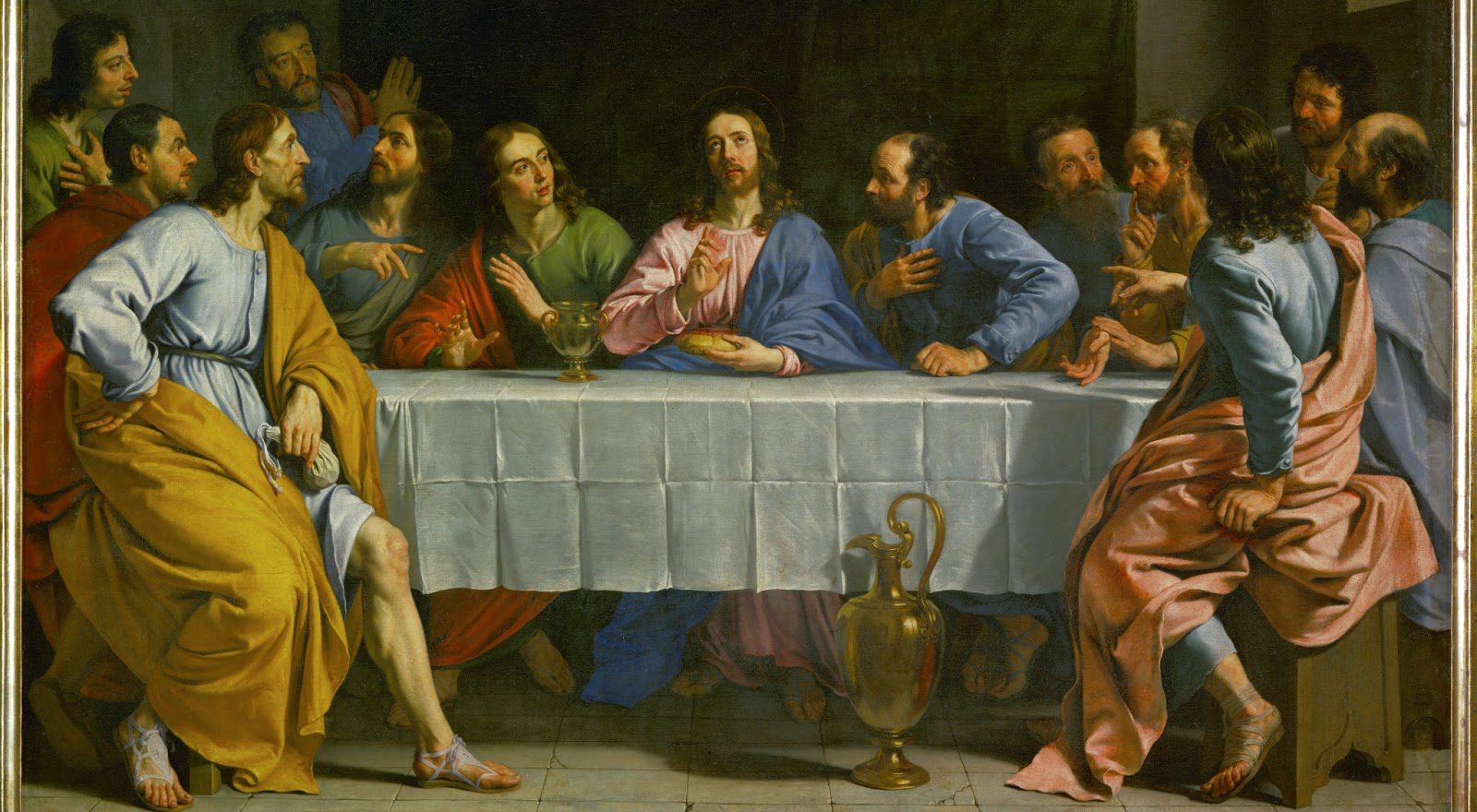
Tonight we are all guests at the Lord’s Supper. Tonight, before He suffers and dies, Jesus institutes the Eucharist. What Our Lord does on this evening, the Church has continued to observe for a hundred thousand successive Sundays, and will continue to do so until the end of time. Jesus told us to ‘do this’ ‘gwnewch hyn’ and so we do. This is more than sacred drama. We are not simply spectators watching a re-enactment, we are active participants in the mysteries themselves. Through participation in them we are transformed by them!
The Liturgy of the Eucharist, which Jesus instituted this evening, means a number of things. Firstly, the Eucharist is our thanksgiving to God for who Christ is, and what He does for us. Secondly, the Eucharist is an act of obedience. Our Lord told His disciples to ‘do this’, and so, for two thousand years, Christians have obeyed His command. Thirdly, the Eucharist is a mystery which makes present the Body and Blood of Christ, who suffered and died for us on Calvary. As Jesus fed His disciples, so He feeds us. Tonight’s Eucharist is just as real as the first one, in the Upper Room, and each and every one ever since. That is why Christ’s followers celebrate this evening. On the night before He suffered and died for us, Jesus took bread and wine, and gave thanks to God. He then gave them to His disciples, telling them to do this in remembrance of Him. In the celebration of the Mass we do not just remember Jesus, but by doing what He did, and saying what He said, He feeds us with Himself. Christ is the priest who gives Himself. But at the same time, He is the servant who washes our feet.
St Paul writes:
‘For I received from the Lord what I also delivered to you’ (1Cor 11:23)
The apostle hands on to the church in Corinth all that was given to him by our Lord. This is tradition in action: handing on those things you have been taught, or experienced, for the benefit of others. Paul’s letter contains the earliest known account of the Last Supper. Christ gives the Church priests, who share in His Priesthood to carry on His saving work in the world, to wash feet, to celebrate the Eucharist. I am honoured and humbled to minister to you as your priest, to wash your feet and to celebrate the Eucharist, especially on this holy night. However, this is a responsibility that I cannot fulfil solely by my own strength and abilities, but through the grace of God, and with your help and your prayers.
God does not expect us to understand the mystery of His saving love. Instead we are called to experience this love so that it might transform us. God gives Himself to us as nourishment. God gives Himself to us, so that we might have life in Him. The role of the Church is to carry on the offering of the Son to the Father, to make redemption present across space and time. That is why we are here, tonight, gathered as disciples of Our Lord and Saviour Jesus Christ. As followers of Christ we are called to be people of love. It is love that makes us Christians. God’s infinite love for us leads to Our Lord sacrificing Himself, to take away our sins, to heal our wounds, and restore us to God’s loving embrace.
Jesus takes ordinary food — water, bread, and wine — along with simple rituals and does something extraordinary. The God who spoke the universe into being kneels, takes off his outer clothing and washes the feet of humanity:
‘If I then, your Lord and Teacher, have washed your feet, you also ought to wash one another’s feet.’ (Jn 13:14)
Tonight Christ washes our feet. Kneeling on the floor, He pours water over our feet and wipes them with a towel. This is something that is both humble and utterly wonderful. Jesus gives us an example of loving service, which the Church is tasked with continuing. In a few moments time I will wash people’s feet. I have to tell you that this is one of the most moving things that I have ever done, and that I ever do. Because tonight the Upper Room is here in this church, and I, as your priest, will stand and kneel in the place of Christ. When I was made a priest, just before the laying on of hands, the Bishop who ordained me told me to ‘Imitate the mysteries you celebrate’. I try to follow these words to the best of my ability. Tonight Our Lord feels very close, as we make the events of two thousand years ago real in a particular way here this evening. We begin in the Upper Room with the washing of the Disciples’ feet and the Institution of the Eucharist, and we will end in the stillness and silence of Gethsemane, waiting with Our Lord, before His Arrest. Those in positions of Christian leadership are called to be shepherds in the service of God’s people. Here, tonight, we see love and service made real. They become something we can feel, touch, and taste. These things are given for us, so that we might be transformed, prepared for Heaven, to enjoy eternity with God.
Christ gives us an example to follow, a ceremony of service and nourishment, so that we can continue to re-live and experience God’s generous love. The hands which tonight wash feet and celebrate the Eucharist will tomorrow be nailed to the Cross. This is how much God loves us. This is how far God goes to reconcile each of us to Him, and to heal our wounds. Never was a lamb set upon the altar that could take away the sins of the world, until God Himself took on the nature of a servant. This way of living goes against everything people are told about putting themselves and their lives first and judging their importance and worth by what they own, rather than how they live their lives. And yet this world, in its selfish searching, truly wants and needs to be healed, and to be embraced by a loving God. That is why tomorrow, on the Cross, Our Lord’s Arms will be flung wide open to embrace all people with God’s divine love.
Let us then prepare ourselves for the journey ahead. Let us have our feet washed by Christ. Let us be fed by Him, and strengthened by Him. Let us fashion our lives after His example. Let us prepare to go to Calvary with Jesus, and lay down our lives in His service. Let us pick up our Cross and follow Him to death and beyond, to the New Life of Easter. Let us live His Risen Life, and share our joy with others. And let us give glory i Duw Dad, Duw y Mab, a Duw yr Ysbryd Glân. To God the Father, God the Son, and God the Holy Spirit. To whom be ascribed all glory, dominion and power, now and forever. Amen.
 Novus Motus Oxoniensis