‘Where is he who has been born king of the Jews? For we saw his star when it rose and have come to worship him.’
‘Ble mae’r hwn a anwyd yn frenin yr Iddewon? Oherwydd gwelsom ei seren ef ar ei chyfodiad, a daethom i’w addoli.’ (Mt 2:2)
IN Britain there is a tradition that royal births are announced by a notice placed on an easel outside Buckingham Palace. When the present King was born in 1948 the notice read as follows: ‘Buckingham Palace November 14th, The Princess Elizabeth, Duchess of Edinburgh was safely delivered of a prince at nine fourteen pm today. Her Royal Highness and her son are both doing well.’ Historically, royal births were witnessed by important people. They were public occasions rather than private ones. When a prince or princess is born, everyone wants to know what is happening.
Two thousand years ago, out in the East, in what is now modern day Iraq and Iran, astrologers noticed something in the sky. This phenomenon possibly involved Jupiter and either Saturn, or the star Regulus in the constellation Leo. It was a significant astronomical event, which was understood to signify a royal birth. These Magi travelled to Judaea, as that was the direction that the celestial sign pointed them towards. As they were looking for a royal baby, their first stop was, naturally, the palace. When they arrived at Herod’s palace they asked:
‘Where is he who has been born king of the Jews? For we saw his star when it rose and have come to worship him.’ (Mt 2:2)
The travellers make a reasonable statement, but their words have an unexpected effect:
‘When Herod the king heard this, he was troubled, and all Jerusalem with him; and assembling all the chief priests and scribes of the people, he enquired of them where the Christ was to be born’ (Mt 2:3-4)
News of the birth of a royal child is troubling to Herod. He was an Aramean who had bought the right to be king by paying the Romans. Therefore, he was very concerned by questions of legitimacy because his own claim was based on shaky ground. Herod’s religious experts then explain where the child will be born, quoting a prophecy of Micah, which we heard on the Fourth Sunday of Advent:
‘In Bethlehem of Judea, for so it is written by the prophet: “And you, O Bethlehem, in the land of Judah, are by no means least among the rulers of Judah; for from you shall come a ruler who will shepherd my people Israel.”’ (Mt 2:5-6)
Bethlehem, the city of David, is where a King of the lineage of David will be born. A Davidic King poses a huge threat to Herod. There could be an uprising, leading to regime change. Herod needs to know what is going on. Since knowledge is power, he sends the Magi off to find the child and to report back to him.
What looks like a simple and straightforward enquiry is actually the first part of a plan to eliminate this potential threat to Herod’s rule. This will later be carried out in the Massacre of the Innocents — the wholesale slaughter of young male children in Bethlehem. Herod certainly has no intention of relinquishing his power. His behaviour is a sham. The Wise Men then leave the royal palace and head for the town of Bethlehem:
‘And behold, the star that they had seen when it rose went before them until it came to rest over the place where the child was. When they saw the star, they rejoiced exceedingly with great joy.’ (Mt 2:9-10)
The Magi have journeyed hundreds of miles because they saw a celestial event. Now this heavenly light is above Bethlehem, and the travellers have reached the new-born King.
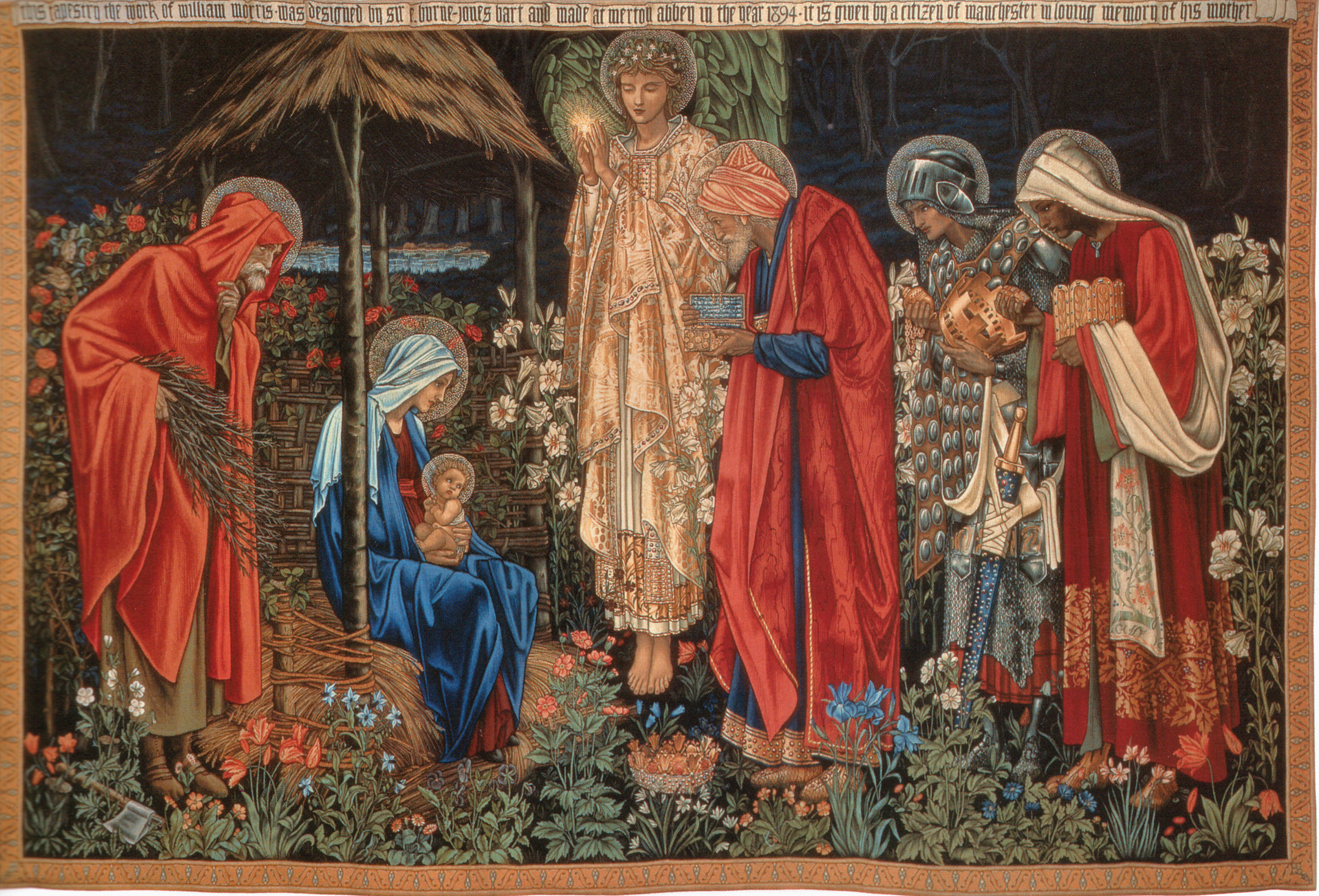
‘And going into the house they saw the child with Mary his mother, and they fell down and worshipped him. Then, opening their treasures, they offered him gifts, gold and frankincense and myrrh.’ (Mt 2:11)
Gold, frankincense, and myrrh seem to us unusual presents for a baby. They are, however, all expensive, costly, and precious things, and therefore suitable as royal gifts. These offerings were prophesied by Isaiah:
‘They shall bring gold and frankincense, and shall bring good news, the praises of the Lord.’ (Isa 60:6)
Gold, is a precious metal, which is pure and does not tarnish. It is a gift fit for a king. Gold’s purity points to a life of perfect obedience, the pattern of how life should be lived. Incense, from Arabia, was offered to God in the Temple in Jerusalem. As the sweet-smelling smoke rose, it looked like prayers rising to God. Frankincense is a sign of worship, and honour, representing how humanity should respond to God. We use it today in our worship to glorify God Myrrh was often a component of the ointment used for embalming bodies. This links to the anointing of Jesus’ body after His Death, and before His Resurrection from the dead. These three gifts given at Jesus’ birth point to Christ’s kingly power, and His role in worship as our great High Priest, which leads to His to Death and Burial.
The Wise Men are warned by a dream not to go back to Herod, and not to tell him who Jesus is. This is because the Judean king does not want to worship Jesus. Herod wants to kill Him, in order to safeguard his own position. And so the unexpected visitors leave as mysteriously as they arrived. These pilgrims from afar gave Our Lord gifts which celebrate His Humanity and Divinity, and which point forward to His Death and Resurrection. The beginning of Jesus’ earthly life looks to its end, because it is all part of the outworking of salvation history.
The events that we are celebrating today were prophesied by Isaiah in the first reading this morning:
‘Arise, shine, for your light has come, and the glory of the Lord has risen upon you.’ (Isa 60:1)
The birth of the Messiah is a sign of God’s glory, and the salvation He will bring for all people:
‘And nations shall come to your light, and kings to the brightness of your rising.’ (Isa 60:3)
These pilgrims are the Magi, the Wise Men, the Kings who represent the entire Gentile (non-Jewish) World. They have come to worship God born among us. The travellers recognise who it is they have come to see, and their gifts fulfil Isaiah’s prophecy. Their gifts, which might appear strange at first sight, are, in fact, both apt and right: to worship God and honour a King, and to recognise the Saviour in their midst. Today, the World recognises the Birth of Jesus Christ, and the mystery of salvation is proclaimed to all.
As we celebrate the Feast of the Epiphany today, we also look forward. Both to Our Lord’s Baptism in the River Jordan and to His first miracle at the Wedding in Cana. Christ, He who is without sin shows humanity how to be free from their sins and to have new life in Him.
Therefore, my brothers and sisters, as we continue to celebrate Jesus’ birth, let us raise our voices to join with the wise men in giving praise and honour to God the Father, God the Son, and God the Holy Spirit, Duw Dad, Duw y Mab, a Duw yr Ysbryd Glân. To whom be ascribed all glory, dominion and power, now and forever. Amen.
 Novus Motus Oxoniensis