One of the curious aspects of life as a clergyman is the number of times that people ask you to pray for specific weather: be it rain, or sunshine. The 1662 Book of Common Prayer actually contains prayers for rain and fair weather, just after the Litany, after Morning and Evening Prayer. Therefore, I can only assume that weather-related prayers have always been high on the list of people’s priorities. Generally speaking, however, my response has been to say, “Sorry I’m in Sales, not Management”. I have always been concerned that people seem to think that I am somehow able to influence the Almighty when it comes to matters meteorological. Fundamentally, prayer doesn’t change God, it changes us. Now, on reflection, I’m more inclined to listen to their prayer request and honour it, as I do every other.
All Christians are called to evangelise, to share the Good News of the Kingdom of God. However, doing so can feel a bit like being a salesperson. To some people you are just annoying. Most people show varying degrees of disinterest, but a few people are genuinely interested in what you have to say. However, if you were to use this morning’s Gospel as a sales-pitch, I doubt that you would meet with much success. Jesus’ stark presentation of the cost of discipleship is not necessarily an easy way to win people round.
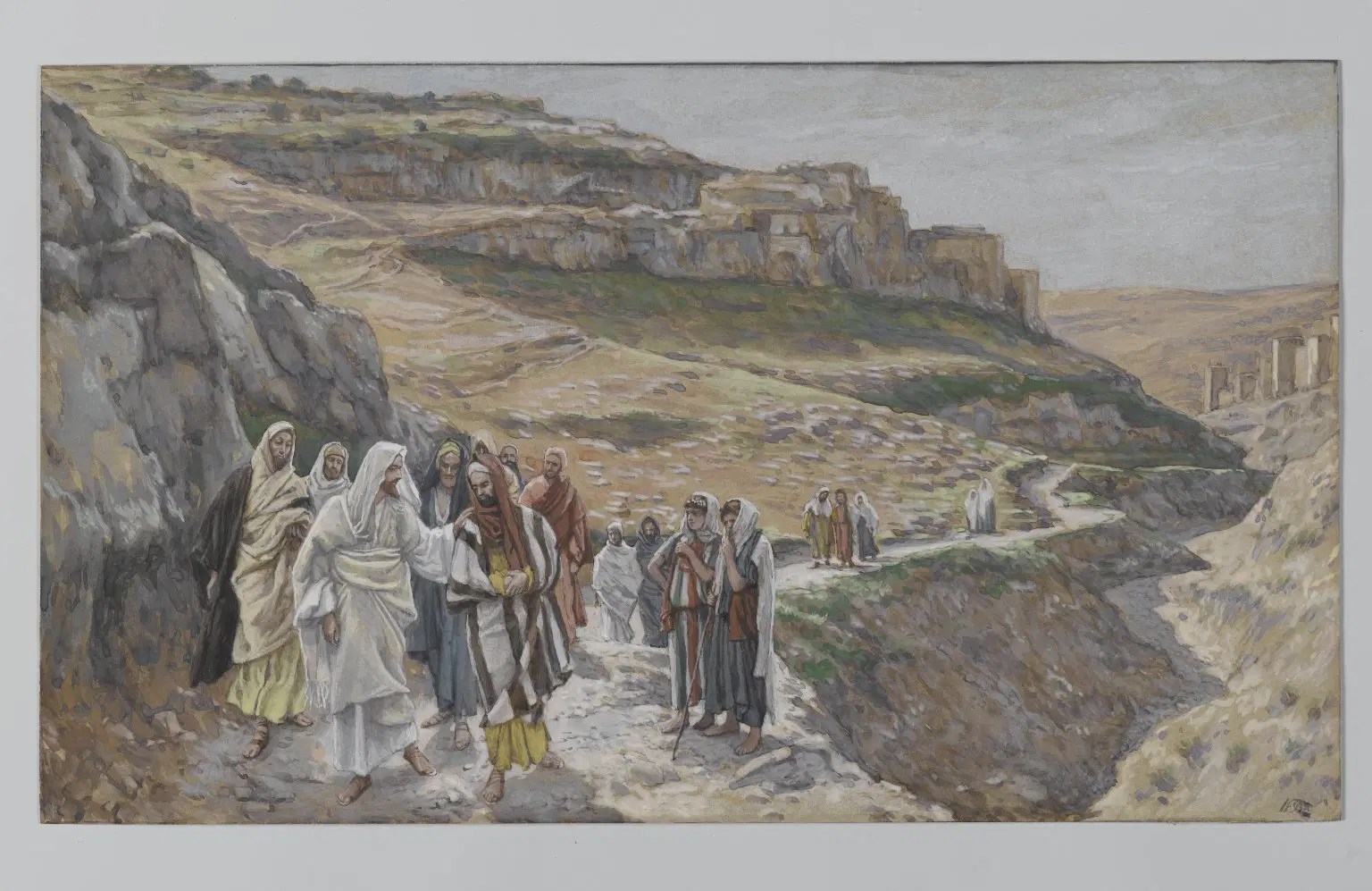
Christ has attracted a large group of people eager to hear what He has to say, so Our Lord explains what discipleship is all about:
“Os daw rhywun ataf fi heb gasáu ei dad ei hun, a’i fam a’i wraig a’i blant a’i frodyr a’i chwiorydd, a hyd yn oed ei fywyd ei hun, ni all fod yn ddisgybl imi.”
“If anyone comes to me and does not hate his own father and mother and wife and children and brothers and sisters, yes, and even his own life, he cannot be my disciple. Whoever does not bear his own cross and come after me cannot be my disciple.” (Lk 14:26-27)
Families do not always get on well, but Christians are called to ‘love their enemies’ (Lk 6:27) and to despise our own families, and even our own lives. This seems strange, and paradoxical. Aren’t Christians called to be people of love? Indeed we are, and the primary focus of our love as Christians should be God. Jesus is saying that God must be the most important thing in our life. Nothing should get in the way of the fact that our primary relationship is not with our parents, siblings, spouse, or offspring, but with the God in whose image we were created.
To make this a reality each and every one of us is called to bear a cross, to risk torture and death, and offer the whole of our lives to God. We are told we must follow Jesus, wherever that may lead. Our commitment has to be total, there is no room here for half-measures. Hence the stark imagery employed by Our Lord. Jesus uses strong and disturbing language to shock us. He reminds us that in Him we are called to a new relationship which takes us away from traditional social structures. That means that everyone in the Church becomes our brother and sister, and that our primary responsibility is to love Christ, and follow Him. To imitate Him, and take up our own Cross.
Our Lord then uses the images of a construction project and of warfare to reinforce the point that we need to see the matter through to its conclusion. Jerusalem was no stranger to either. King Herod’s rebuilding of the Temple took 46 years to complete, and war (or the threat of it) was a constant factor of everyday life. The point is being made that there is nothing worse than a half-finished building. It says, ‘The constructors didn’t plan properly, or get the finances in place first’. Likewise, in war you fight believing that you can win, otherwise you sue for peace. At this point, we remember and pray for our brothers and sisters in Ukraine and the Holy Land and throughout all the world where there is violence and war.
At the end of the Gospel passage Jesus reiterates His main point:
“Yr un modd, gan hynny, ni all neb ohonoch nad yw’n ymwrthod â’i holl feddiannau fod yn ddisgybl i mi.”
“So therefore, any one of you who does not renounce all that he has cannot be my disciple.” (Lk 14:33)
Over-attachment to material things is a problem: our stuff cannot save us, only God can. Are possessions useful or pleasant? Certainly. Can we enjoy them? Yes. But the problem occurs when their importance becomes misplaced. All that really matters is eternal life with God, sharing the Divine life of Love. Nothing we ‘have’ is really ours. We can enjoy material things and share them with others, but in a few years time our earthly life will have ended. There are no pockets in shrouds! As the old saying goes: ‘you can’t take it with you when you go’.
As Christians, we gather, to hear God’s word read and explained; to pray together; to be nourished together. We do these things so that we may grow together in love, and to embrace the Cross. Having died with Christ in our baptism, and being raised to new life with Him, we live out our faith in our lives. Our discipleship can be costly and difficult. It calls us to renounce the world and rely upon God, together, as a community of faith. To form a new community where old ties and distinctions are done away with, where we have a new identity, and where we are called to a higher purpose.
These are not easy things to achieve, and the Christian community has, for two thousand years, struggled to live up to these goals. But we put our trust in a God who forgives our sins and failings, who understands our humanity from the inside. We are not written off, or cast aside. We are not abandoned or discarded. This is because we are all made in God’s image, people of infinite intrinsic value. Christ died for us, to give us eternal life, to heal our wounds. He calls us to follow Him, so that we may find His freedom, and share in His triumph over death and sin.
As Christians, we are called to something great and wonderful: to stand, like Christ as a contradiction, offering the world a new way to live; a way of life not of death; a way of generosity rather than selfishness. We are called to renounce the world and instead to embrace the freedom, and joy, that is the life of the Kingdom of God.
It is truly liberating to look at the world as Jesus wants us to, knowing that all that really matters is loving God, and loving our neighbour. Doing this can be difficult, especially when times are uncertain as they are today, but we know that we can trust the God who loves us, who gives His life for us. The God who comes to us to feed us with Himself. So let us together follow him and invite others to do so. Let us give thanks for all our blessings and sing the praises of God, Duw Dad, Duw y Mab, a Duw yr Ysbryd Glân. God the Father, God the Son, and God the Holy Spirit. I’r hwn y priodoler pob gogoniant, arglwyddiaeth, a gallu, yn awr, ac yn oes oesoedd. To whom be ascribed all glory, dominion and power, now and forever. Amen
 Novus Motus Oxoniensis