TWO of the most important days of our lives are ones that many of us cannot remember. The first is the day of our birth, and the second is the day of our baptism. While people are often baptised when they are children or adults, many people in this country are baptised as infants. We may have photos of our baptism, and we may remember it or have been told about it by our families. People usually know where and when their baptism took place. Also, having been to other baptisms we know what will have happened on this significant day of our life, when we were welcomed as a member of the Christian community. Jesus’ baptism was in many ways similar to our own, and in some ways it was significantly different.
Early in Luke’s Gospel we hear about John the Baptist, a holy man who has been proclaiming a baptism of repentance for the forgiveness of sins (Lk 2:3). John has been calling people to turn away from their sins, and to turn back to God, and live holy lives. This has a significant effect on the people of Judea. There is an increase in religious observance; something like a religious revival. This, in turn, leads to speculation:
‘Gan fod y bobl yn disgwyl, a phawb yn ystyried yn ei galon tybed ai Ioan oedd y Meseia,’
‘As the people were filled with expectation, and all were questioning in their hearts concerning John, whether he might be the Christ,’ (Lk 3:15)
The people of Israel were longing for the Messiah, the Christ, the Anointed One. The prophesied Messiah is a charismatic King figure, anointed by God, and descended from David, who will make Israel flourish and re-establish the Kingdom of God.
John the Baptist goes to great lengths to argue that he is not the Messiah. John is the messenger, preparing the way:
‘Yr wyf fi yn eich bedyddio â dŵr; ond y mae un cryfach na mi yn dod. Nid wyf fi’n deilwng i ddatod carrai ei sandalau ef. Bydd ef yn eich bedyddio â’r Ysbryd Glân ac â thân.’
‘I baptize you with water, but he who is mightier than I is coming, the strap of whose sandals I am not worthy to untie. He will baptize you with the Holy Spirit and with fire.’ (Lk 3:16)
The Baptist sees himself as not even worthy to untie the sandals of the Messiah, something a servant would do for their master. John demonstrates great humility, and his actions point forward to the baptism of the Church, instituted by Jesus in the River Jordan. Whereas John baptizes with water, Jesus will baptize with the Holy Spirit and fire. This looks forward to both Our Lord’s death on the Cross, and to Pentecost, when the Apostles are filled with the Holy Spirit.
‘Pan oedd yr holl bobl yn cael eu bedyddio, yr oedd Iesu, ar ôl ei fedydd ef, yn gweddïo. Agorwyd y nef, a disgynnodd yr Ysbryd Glân arno mewn ffurf gorfforol fel colomen; a daeth llais o’r nef: “Ti yw fy Mab, yr Anwylyd; ynot ti yr wyf yn ymhyfrydu.”’
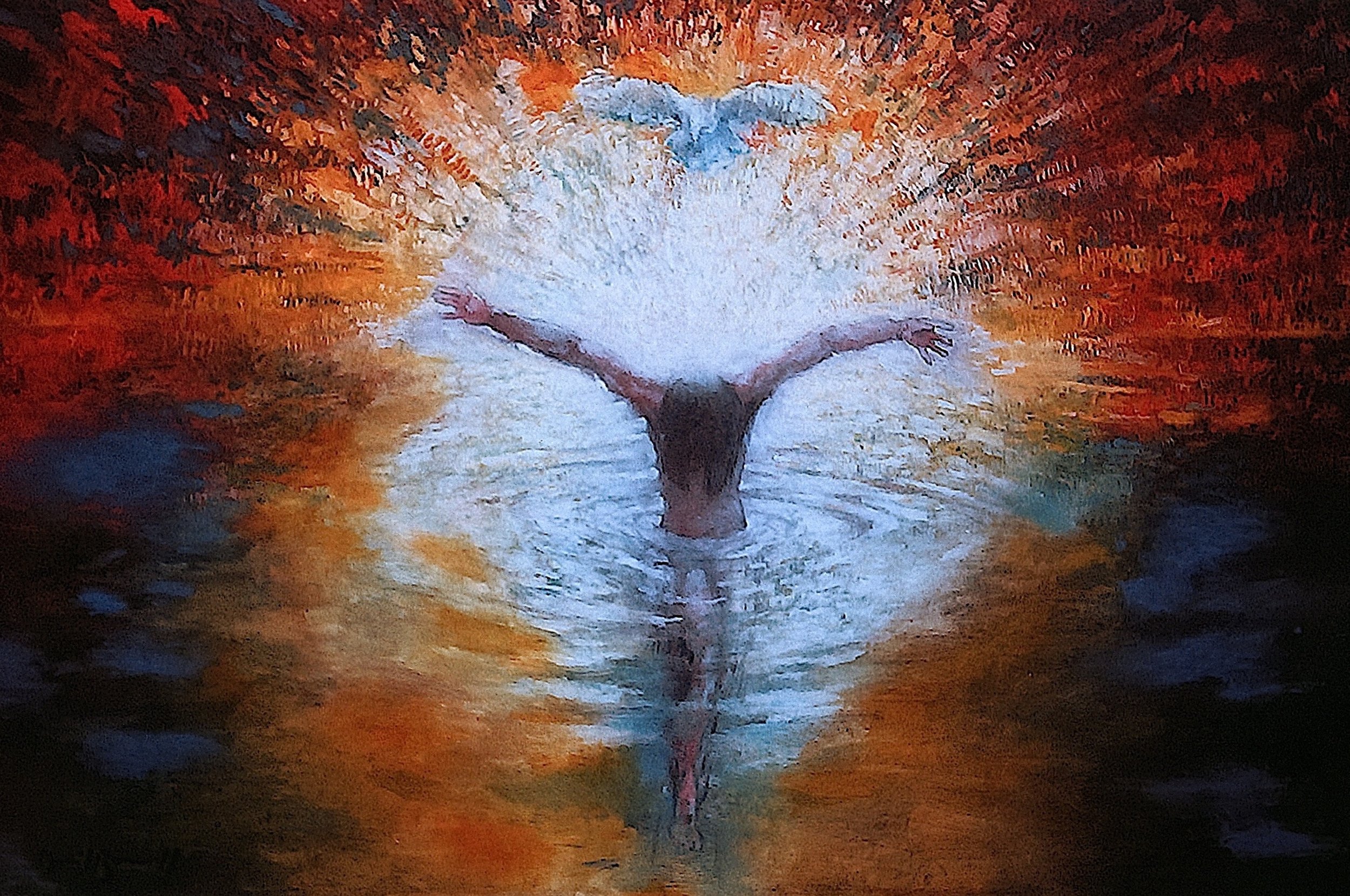
‘Now when all the people were baptized, and when Jesus also had been baptized and was praying, the heavens were opened, and the Holy Spirit descended on him in bodily form, like a dove; and a voice came from heaven, “You are my beloved Son; with you I am well pleased.”’ (Lk 3:21-22)
We then have to ask ourselves why is Jesus being baptized? Jesus is not a sinner. He has no sins from which to repent, and yet He is in the River Jordan, being baptized by John. An explanation is that in His Baptism Jesus is in solidarity with sinful humanity: He does not wish us, His followers, to undergo anything that He would not undergo Himself. Christ is an example of how to come to God and have new life: He shows us the Way. As a sign of divine approval after the Baptism, as Jesus is praying, the heavens open, and the Holy Spirit descends upon Him in the form of a dove. God then says: ‘Ti yw fy Mab, yr Anwylyd; ynot ti yr wyf yn ymhyfrydu. You are my beloved Son; with you I am well pleased.’ (Lk 3:22)
At the beginning of his public ministry, Jesus shows humanity the way to the Father, through Himself. The world sees the generous love of God, which heals and restores us to the light and life of the Kingdom of God. As our baptism is a sharing in the death and resurrection of Jesus, so His Baptism points to the Cross, where streams of blood and water flow to cleanse and heal the world. We see the love of the Father, the power of the Spirit, and the obedience of Son, all for us — people who need God’s love, forgiveness, and healing.
At the moment of Jesus’ Baptism, the fullness of the Godhead is manifested in glory and the divine presence. In the account of Noah’s Ark God makes his love manifest in the form of a dove. At the end of the Flood a dove brings an olive branch back to the Ark, a sign of peace and new life. So now, the Holy Spirit appears in the form of a dove to show us the fullness of God, a relationship of love, which is opened up to us in our baptism. Through our baptism we are invited into the embrace of God’s eternal love.
The Divine Trinity makes itself manifest in recognition of the Son’s obedience to the Father, and looks forward to the Cross, where God’s love is poured out upon the world, and through which we are saved. In our own baptism, we share in Christ’s Death and Resurrection. In His Baptism, as in His Death, Christ shows us the way to the Father in the power of the Holy Spirit. We are baptised in the name of the Holy and life-giving Trinity. Similarly, our worship this morning began by invoking the name of the Trinity: the Father, the Son, and the Holy Spirit (Yn enw’r Tad, a’r Mab, a’r Ysbryd Glân). And so all of our life as Christians is Trinitarian.
As we celebrate Our Lord’s Baptism in the River Jordan, and as we remember our own baptism, we also look forward to His first miracle at the Wedding at Cana. Christ, He who is without sin, shows humanity how to be freed from transgression and to have new life in Him.
So, today and every day, let us all draw strength from our Baptism and grow in faith, hope, and love, nourished by Christ, and with Christ. Let us share that love with others and give praise and honour i’r Duw Dad, Duw y Mab, a Duw yr Ysbryd Glân. I’r hwn y priodoler pob gogoniant, arglwyddiaeth a gallu, yn awr ac yn oes oesoedd. Amen.
 Novus Motus Oxoniensis