Christmas is a time for many seasonal activities, including spending time with family and friends, eating special foods and enjoying Christmas Carols. Also, most of us will spend some time over the festive period watching films on the television, or in the cinema. Movies can, surprisingly, be particularly useful when we try and get our heads around the wonderful events of Christmas. I would like to begin by focussing on a film from my childhood — the 1981 adventure Raiders of the Lost Ark. In this film, the intrepid archaeologist Indiana Jones is competing with Nazi forces to discover the Ark of the Covenant, which, it is believed, has the power to make an army invincible. At the climax of the film, the villains open the Ark on an island in the Aegean Sea. Immediately, spirits and bolts of lightning are released, which kill the Nazis and free Indiana and his companion Marion. Other than being the sort of film one might watch at Christmas, what is the relevance of the scene?
The film’s denouement relies upon the heroes averting their gaze, while the villains do not, and are therefore destroyed. The plot draws upon the biblical idea that the glory of God, which the Ark is said to contain, is not something which humanity should gaze upon. In the Book of Exodus, when Moses asks to see God, he is told that if he does so he will die. The glory of God is not something humans are able to behold.
Yet, the first reading this morning reaches its climax with the statement that:
‘fe wêl holl gyrrau’r ddaear iachawduriaeth ein Duw ni’
‘all the ends of the earth shall see the salvation of our God.’ (Isa 52:10)
There appears to be something strange going on here. Likewise, the one who begins His life wrapped in cloth and placed in a stone feeding trough, will end it taken down from a Cross, wrapped in cloth and placed in a stone tomb. ‘In my beginning is my end …. In my end is my beginning’ wrote T.S. Elliot in his poem ‘East Coker’, the second of his Four Quartets. And yet this end is but a prelude to Christ’s Resurrection, Ascension, and the Second Coming.
In the great turnaround of salvation history, humanity goes from being unable to look upon the divine, to being able to behold Him in a manger, surrounded by farm animals. To put the mystery of our salvation into context, this morning’s Gospel goes back to the beginning, which is a very good place to start. Not to the Annunciation, where in the power of the Holy Spirit Christ takes flesh in the womb of His Mother, but to the beginning of time and the Creation of the Universe:
‘Yn y dechreuad yr oedd y Gair, a’r Gair oedd gyda Duw, a Duw oedd y Gair. Hwn oedd yn y dechreuad gyda Duw.’
‘In the beginning was the Word, and the Word was with God, and the Word was God. He was in the beginning with God.’ (Jn 1:1)
The Word which spoke the Universe into being exists in eternity with God, and is God. This is whom we worship: the one who will save humanity, and who offers us eternal life with God.
Today we celebrate Divine generosity and humility. God is among us. Mae Duw yn eich plith ni. Born as a weak and vulnerable baby, he is utterly dependent upon Mary and Joseph. In time this divine generosity will be refused:
‘At ei eiddo ei hun y daeth, a’r eiddo ei hun nis derbyniasant ef.’
‘He came to his own, and his own people did not receive him.’ (Jn 1:11)
Ours is a God who does not force Himself upon us. Instead, He comes to us in love, to draw us out in love, that we might share in that love, and share it with others:
‘A’r Gair a wnaethpwyd yn gnawd, ac a drigodd yn ein plith ni, (ac ni a welsom ei ogoniant ef, gogoniant megis yr Unig‐anedig oddi wrth y Tad,) yn llawn gras a gwirionedd.’
‘And the Word became flesh and dwelt among us, and we have seen his glory, glory as of the only Son from the Father, full of grace and truth.’ (Jn 1:14)
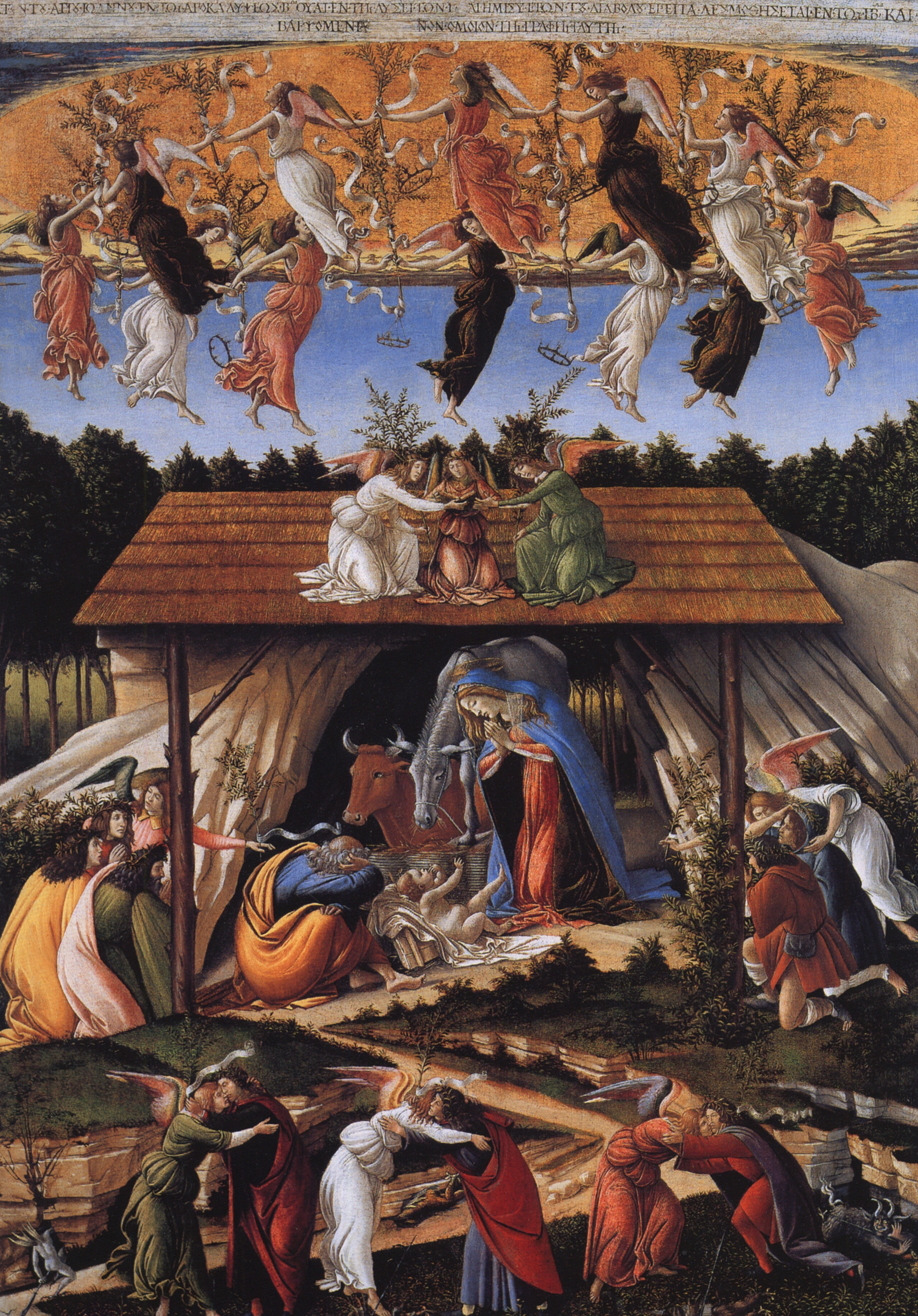
God pitches His tent, and tabernacles among us. The invisible becomes visible. The God who is beyond human understanding becomes human, and shares our human life from its beginning to its end. This is no unapproachable divinity, remote and uncaring, but one who experiences our existence, who understands us from the inside out. Humanity beholds the glory of God, in a baby who will die on a Cross to redeem us.
Not only that, but Christ continues to give Himself to us, every time the Eucharist is celebrated, so that the Word can continue to become flesh, so that we can be transformed by Him, and share in God’s life.
As we celebrate the birth of Our Saviour we need to ask ourselves: have we made room for Jesus in our lives? Have we really? If we haven’t, we need to let our hearts and our lives become the stable in which the Christ-child can be born. We need to see Him in the outcast, in the stranger, in the people which the world shuns. As Christians, we have to welcome such people, for in welcoming them we welcome Our Lord and Saviour. This is how we live out His love in our lives.
This is the true meaning of Christmas — this is the love which can transform the world. It is radical and costly. This love terrified the might of the Roman Empire, and showed human power that it was as nothing compared to Divine Love. Soul by individual soul, for the past two thousand years, the world has been changed by ordinary people living out the love shown to the world by, and through, this little vulnerable child.
So, today as we celebrate Jesus’ birth, let us raise our voices to join with the angels and give praise and honour to God the Father, God the Son, and God the Holy Spirit. To whom be ascribed all glory, dominion and power, now and forever. Amen.
Merry Christmas to you all!
Nadolig Llawen i chi gyd!
 Novus Motus Oxoniensis